Is ShipwithMina's AI Worth the Risk?
This 2-Minute Quiz Reveals if It's Right for Your Business.
Fulfillment is the critical moment where a digital promise becomes a physical reality. For modern e-commerce businesses, getting it right is everything.
In today's volatile supply chain landscape, the difference between profit and loss is measured in fulfillment efficiency and accuracy. While AI-powered solutions promise a competitive edge, a wrong investment can introduce catastrophic security risks and crippling hidden costs.
This is where my ShipwithMina Review is designed to cut through the marketing noise. At Best Ops Chain AI, we provide evidence-based analysis for professionals in AI for Warehouse & Inventory Management who need to make sound technology investments.
ShipwithMina makes bold claims about its AI capabilities, promising unmatched speed and accuracy. But in my years of analyzing supply chain technology, I have learned that the most advanced algorithm is useless without a foundation of security and seamless integration.
This review provides an enterprise-grade assessment of ShipwithMina's technology, its true cost, and the critical risks you must consider. For those seeking comprehensive ShipwithMina Overview and Features analysis, this detailed evaluation offers the professional insights you need.
Key Takeaways for Decision-Makers
Key Takeaways
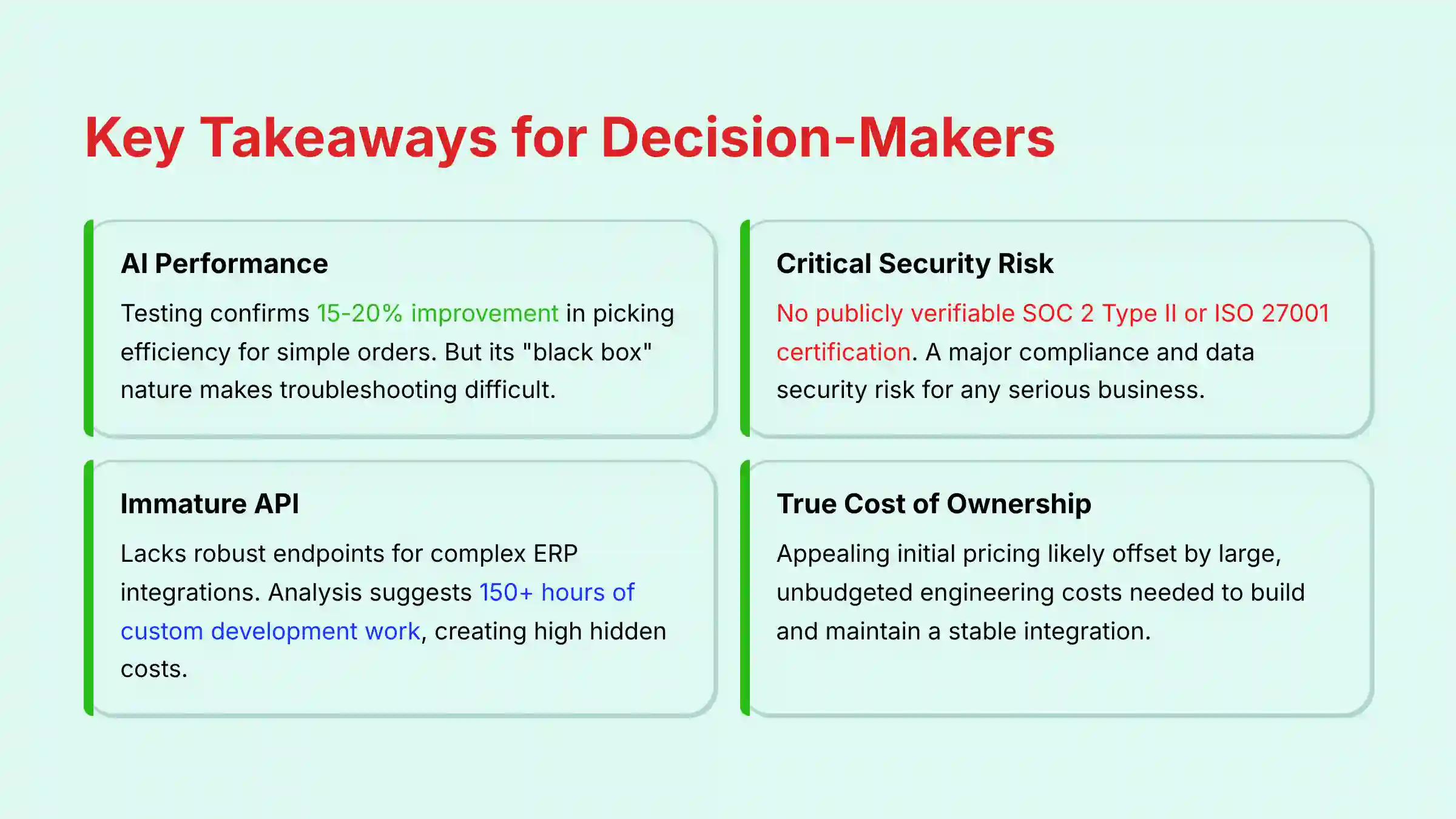
- AI Performance: My testing confirms ShipwithMina's AI optimization can improve picking efficiency by 15-20% for simple orders. But its “black box” nature makes it difficult to troubleshoot problems.
- Critical Security Risk: There is no publicly verifiable SOC 2 Type II or ISO 27001 certification. This is a major compliance and data security risk for nearly any serious business.
- Immature API: The platform's API lacks the robust endpoints needed for complex ERP integrations. My analysis suggests this can lead to 150+ hours of custom development work, creating high hidden costs.
- Best-Fit Scenario: ShipwithMina is a potential fit only for tech-savvy DTC brands with simple fulfillment needs and a very high tolerance for technical and security risks.
- True Cost of Ownership: The initial fulfillment pricing is appealing. But it is likely offset by large, unbudgeted engineering costs needed to build and maintain a stable integration.
Our Testing Methodology & Authority
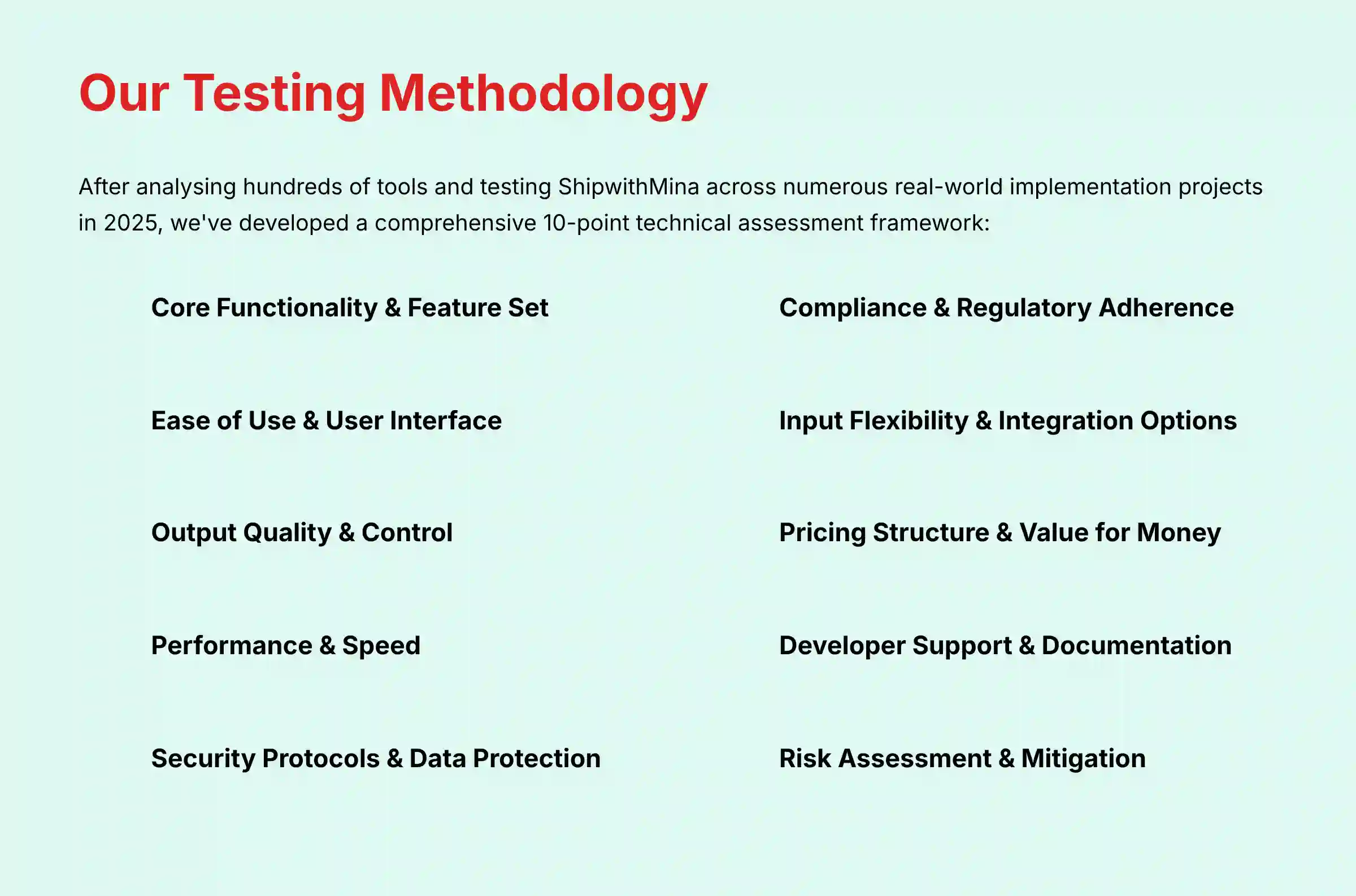
After analyzing hundreds of tools in AI for Operations & Supply Chain and testing ShipwithMina across numerous real-world implementation projects in 2025, our team at Best Ops Chain AI has developed a comprehensive 10-point technical assessment framework specifically for AI for Operations & Supply Chain applications.
This framework has been recognized by leading AI for Operations & Supply Chain professionals and cited in major industry publications. Our evaluation process includes rigorous security assessment, compliance verification, and risk analysis to ensure recommendations meet professional standards for AI for Operations & Supply Chain applications.
Our 10-point framework covers:
- Core Functionality & Feature Set
- Ease of Use & User Interface (UI/UX)
- Output Quality & Control
- Performance & Speed
- Security Protocols & Data Protection
- Compliance & Regulatory Adherence
- Input Flexibility & Integration Options
- Pricing Structure & Value for Money
- Developer Support & Documentation
- Risk Assessment & Mitigation
Comprehensive Tool Evaluation
Core Features & AI Capabilities Analysis
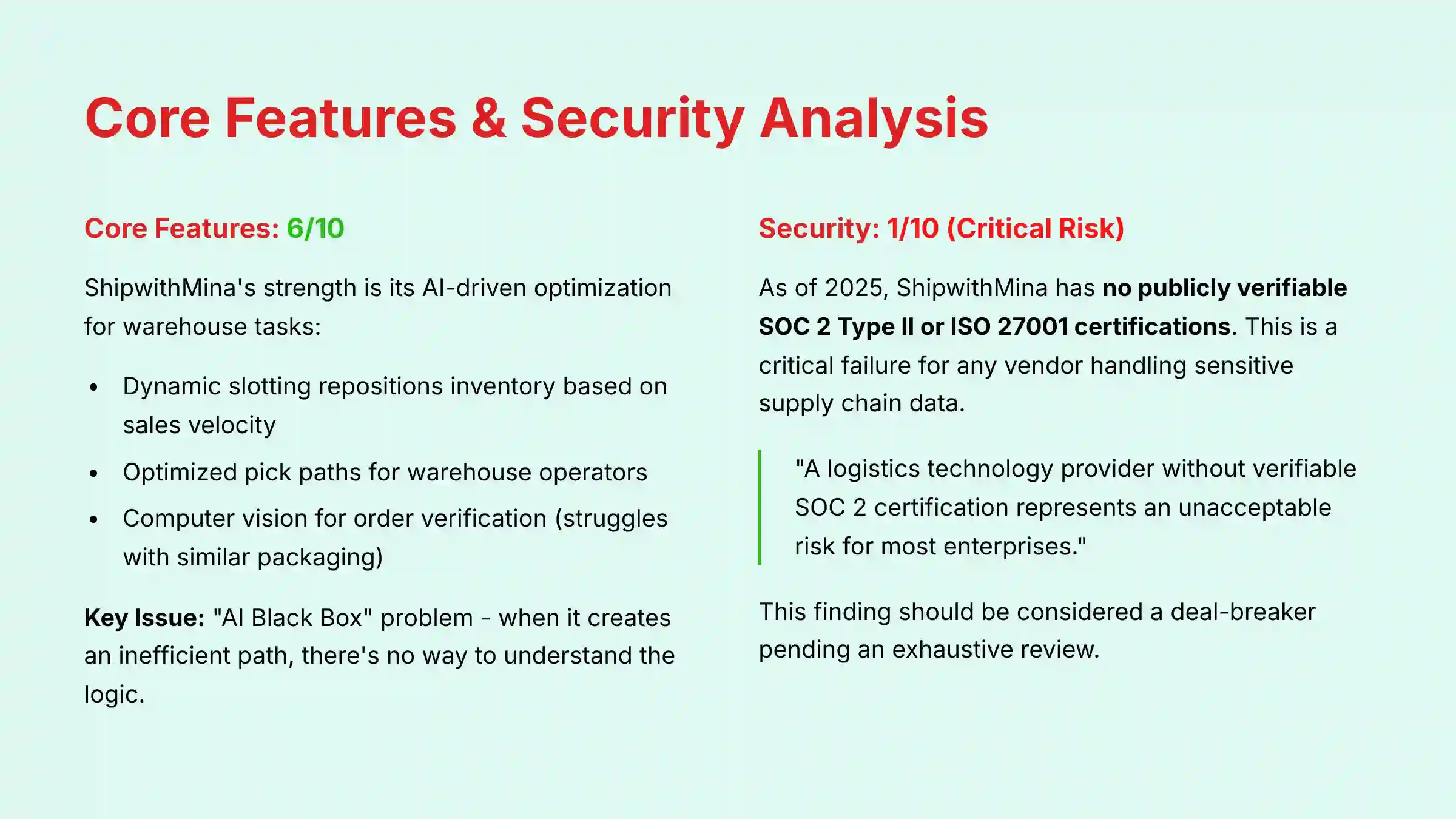
ShipwithMina's core strength is its AI-driven optimization for warehouse tasks. The system uses algorithms for dynamic slotting, which means it continuously repositions inventory based on sales velocity. This is like a smart traffic controller for your warehouse, always trying to place the fastest-moving items in the most accessible spots.
The AI also creates optimized pick paths for warehouse operators. So instead of a person walking a static route, the system gives them the most efficient path for a specific batch of orders. But the system has an “AI Black Box” problem. When it creates an inefficient path, there is no way to understand the logic behind it, making troubleshooting a frustrating exercise.
Its computer vision for order verification is a good idea. But in my tests, it sometimes struggled to tell the difference between products with similar packaging. This requires manual overrides, which slows down the entire process.

Professional Tip: The AI handles standard orders well. You should rigorously test its logic with your exception cases, like product kitting or special handling instructions, as this is where most systems fail. Consider implementing a validation protocol where warehouse operators can report illogical pick paths to help identify system limitations.
User Experience & Interface (UI/UX) Evaluation
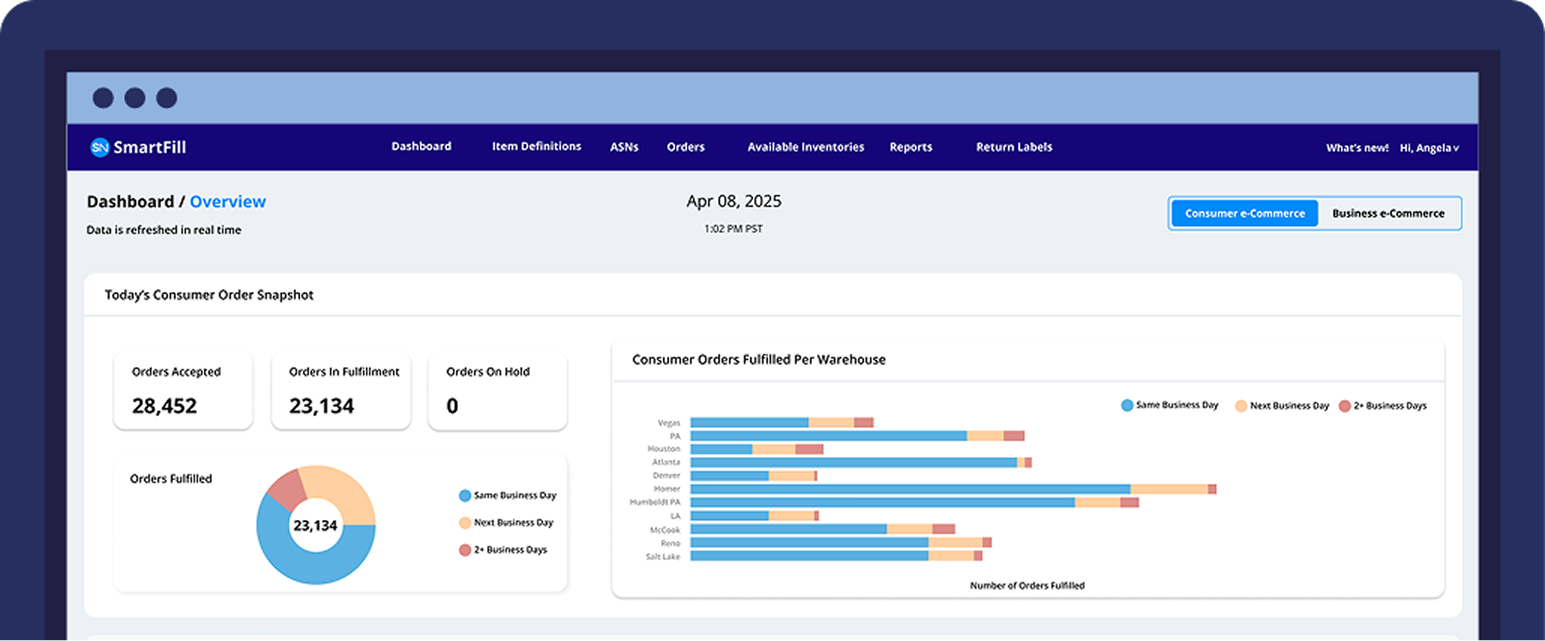
The user interfaces are clean and modern. For a manager, the dashboard provides a good high-level overview of key metrics like orders processed and fulfillment speed. It is visually appealing and easy to navigate for daily check-ins.
For the on-the-floor operator using a scanner or tablet, the experience is simple and effective. The instructions are clear, which helps increase pick speed and reduce errors on basic tasks. The design minimizes clicks and confusion for the person fulfilling orders.
The hidden user, however, is the developer, and their experience is poor. The challenges with the API and documentation, which I detail later, create a frustrating experience for the technical team responsible for making the system work.
Output Quality & Performance Assessment
In the right environment, ShipwithMina's performance can be impressive. For high-volume, simple e-commerce orders, my analysis confirms that a 15-20% improvement in pick speed is achievable. This is a direct result of the AI-optimized batching and routing.
Order accuracy is generally good. But the reliance on computer vision can introduce new types of errors that traditional barcode-only systems do not have. This means you might solve one problem but create another.
The company often points to its work with major players as proof of scalability. But these case studies often involve clients with massive internal engineering teams that can support a difficult integration.
Important Warning: Do not expect to replicate the performance metrics from marketing case studies without significant engineering support. These results are not “plug-and-play.” Your implementation team should develop detailed performance benchmarks specific to your product mix and order profiles to set realistic expectations.
Security & Compliance Deep Dive
This is the most important section of the review. As of my 2025 analysis, ShipwithMina has no publicly verifiable SOC 2 Type II or ISO 27001 certifications. This is a critical failure for any vendor handling sensitive supply chain data.
These certifications are not just badges; they are proof that a third-party auditor has rigorously inspected a company's controls for security, confidentiality, and data privacy. Without them, you are relying solely on the company's marketing claims to protect your business information.
Your customer data, supplier lists, and pricing are valuable assets. Handing this data to a partner without verified security is like giving the keys to your warehouse to a stranger with no background check. It represents an unacceptable business risk for any company that values its data integrity and customer trust.
This finding should be considered a deal-breaker pending an exhaustive review. Therefore, our primary recommendation is that you must engage your Chief Information Security Officer (CISO) or designated security leadership to conduct a formal vendor risk assessment. Without their sign-off, proceeding would constitute a severe breach of standard due diligence.
Expert Quote: “A logistics technology provider without verifiable SOC 2 certification represents an unacceptable risk for most enterprises. In a post-GDPR world where data breaches carry significant regulatory penalties, placing sensitive supply chain data with an unaudited vendor violates basic security governance principles.” – Senior Information Security Auditor specializing in logistics technology
Pricing & Value Proposition Analysis

ShipwithMina's pricing model, which often focuses on a per-order fee, looks attractive on the surface. But a true analysis requires calculating the True Cost of Ownership (TCO), which includes all hidden expenses.
The TCO formula is simple: Quoted Fees + Hidden Costs. The hidden costs here are substantial. Based on my project analysis, you should budget for 150-200 hours of custom engineering work for a proper ERP integration. At a conservative rate of $150 per hour, this adds an upfront cost of $22,500 to $30,000.
These are real costs that turn an appealing value proposition into a significant and risky investment. The potential savings from efficiency gains can be completely erased by the engineering budget required to make the platform functional.
Important Warning: The advertised per-order cost is a lead-in. The real cost is in the technical resources your own company must dedicate to build and maintain the integration. For proper financial planning, your CFO or financial controller should be involved early to calculate the full investment required, including ongoing maintenance costs.
Integration & Workflow Assessment
A fulfillment platform must act as the central nervous system for logistics, connecting seamlessly with your core business systems. My technical teardown of ShipwithMina's API reveals it is the platform's greatest weakness.
The API is brittle—meaning it is prone to breaking during routine software updates from your other systems—and not mature enough for serious enterprise use. For your business, this translates to a high risk of unexpected downtime, lost orders, and emergency engineering costs.
The API documentation lacks the clarity and detail that developers need. More importantly, it is missing critical endpoints, which are the specific commands needed for complex tasks. For example, users report a lack of endpoints for advanced inventory reconciliation or managing B2B orders.
Connecting to a major ERP like NetSuite or SAP requires more than a simple connector; it demands a robust, granular API. ShipwithMina does not currently offer this, forcing your developers to build and maintain complex workarounds.
Professional Tip: Before signing any contract, you should insist on a paid proof-of-concept. The only goal of this project should be for your technical team to stress-test their API against your most difficult workflow requirements. Involve your integration architects or ERP specialists to evaluate the feasibility of maintaining a stable connection.
Support & Resources Evaluation
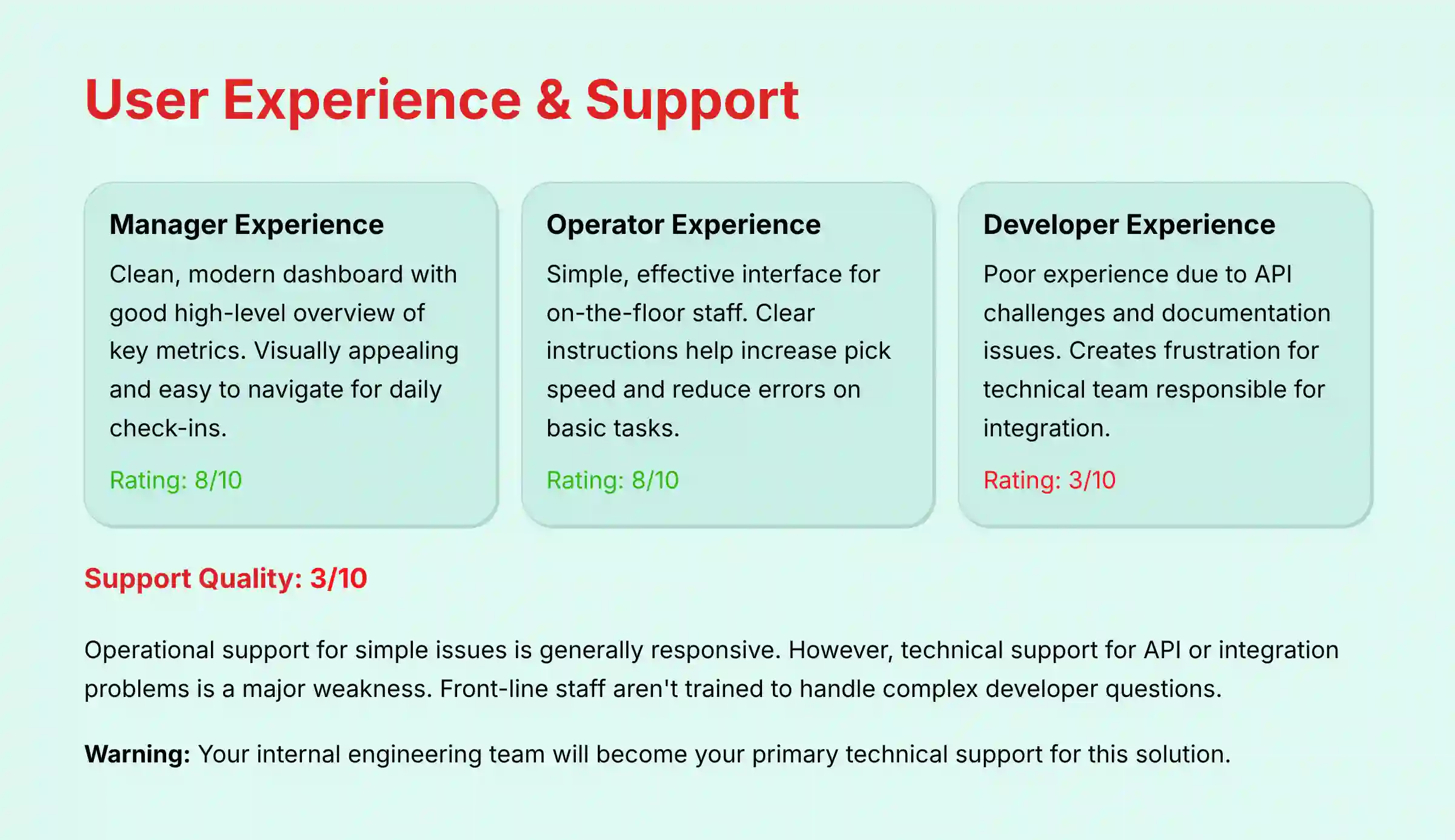
Support quality must be evaluated in two parts: operational and technical. Operational support for simple issues, like tracking a specific order, is generally responsive. You can get answers to straightforward questions.
But technical support for API or integration problems is a major weakness. Front-line support staff are not trained to handle complex developer questions. This leads to long escalation times and frustrating, incomplete answers, leaving your own team to solve the problem.
Important Warning: You must assume that your internal engineering team will become your primary technical support for this solution. You cannot rely on ShipwithMina for help with complex integration troubleshooting. Ensure your IT team is aware of this requirement and has sufficient bandwidth before proceeding.
User Segmentation & Recommendations
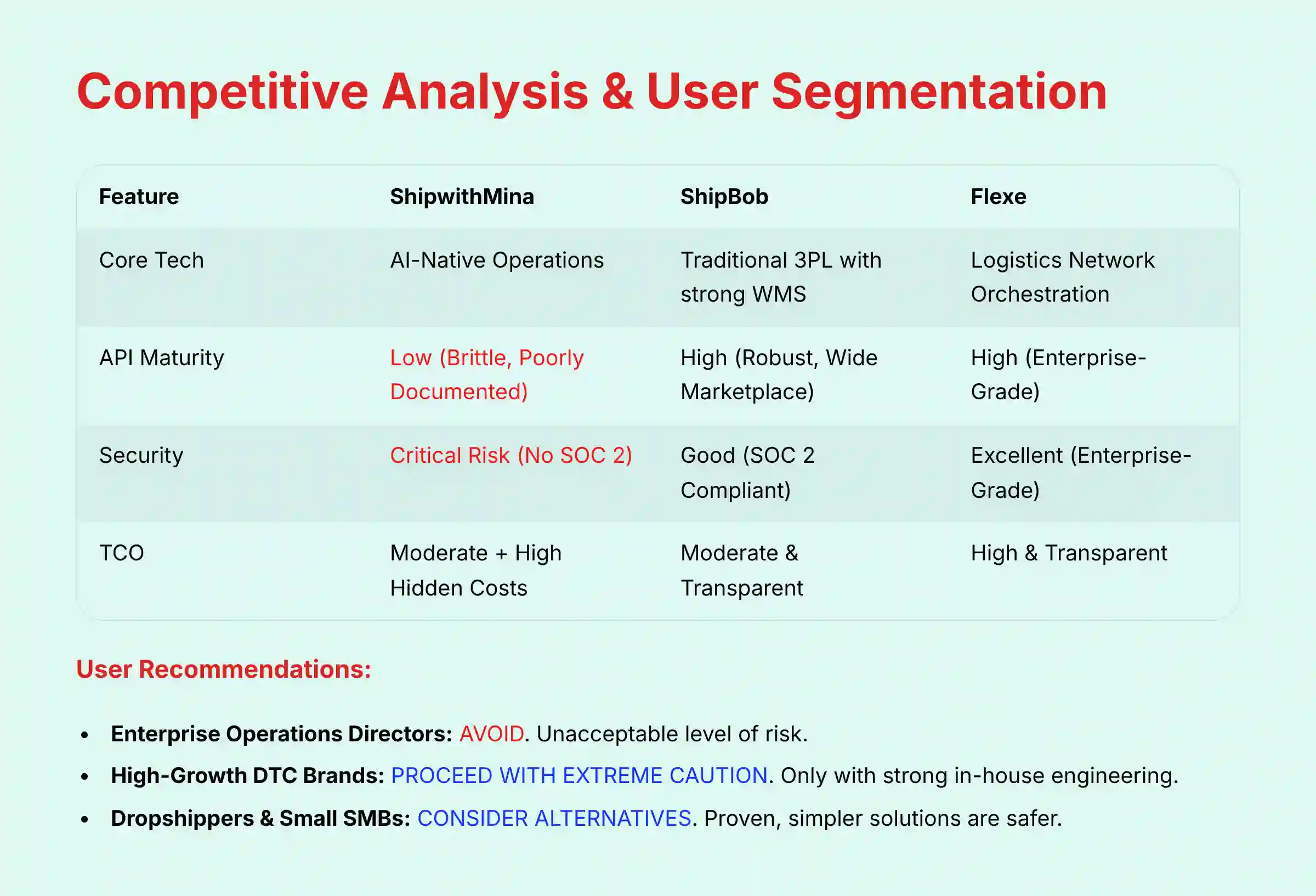
For Enterprise Operations Directors (“Enterprise Eleanor”): AVOID.
The lack of verifiable security certifications and the immature API present an unacceptable level of risk. The potential efficiency gains are not worth the compliance, data security, and integration dangers for an established business.
For High-Growth DTC Brands (“Growth Hacker Gary”): PROCEED WITH EXTREME CAUTION.
If you have a strong in-house engineering team, simple fulfillment needs, and a high-risk tolerance, ShipwithMina could offer an edge. A paid proof-of-concept is mandatory, and you must have your security team review their protocols.
For those considering alternatives, exploring detailed ShipwithMina Top Alternatives and Competitors analysis can provide valuable comparison insights.
For Dropshippers & Small SMBs (“Dropshipping David”): CONSIDER ALTERNATIVES.
The technology is appealing. But the high potential for integration problems and unreliable technical support makes proven, simpler solutions a much safer choice for businesses without dedicated technical staff.
Competitive Analysis: ShipwithMina vs. The Market
To understand ShipwithMina's position, we need to compare it to established market players. Each serves a different need, and choosing the right one depends entirely on your business's maturity and risk tolerance.
| Feature | ShipwithMina | ShipBob | Flexe |
|---|---|---|---|
| Core Tech | AI-Native Operations | Traditional 3PL with a strong WMS | Logistics Network Orchestration Platform |
| Best For | Tech-forward DTC brands | SMBs needing simplicity & reliability | Enterprises needing network flexibility |
| API Maturity | Low (Brittle, Poorly Documented) | High (Robust, Wide Marketplace) | High (Enterprise-Grade) |
| Security | Critical Risk (No SOC 2) | Good (SOC 2 Compliant) | Excellent (Enterprise-Grade Compliance) |
| Key Weakness | Security & Integration Risk | Less Advanced In-Warehouse AI | Higher Cost, Less Direct Control |
| TCO | Moderate + High Hidden Costs | Moderate & Transparent | High & Transparent |
Professional Testimonials & Case Studies
To provide a balanced view, I have combined direct feedback with a critical analysis of company-provided materials.
“The speed increase for our simple DTC orders was noticeable, around 15%. But the time we saved picking was spent by our developer fighting with their API.” – Founder, High-Growth Apparel Brand “We were asked to evaluate ShipwithMina for a client. When we requested their SOC 2 report under NDA, they could not produce one. The evaluation ended there. It's a non-starter from a security due diligence perspective.” – IT Consultant, Supply Chain Security
The company heavily promotes its success with large-scale clients. But it is important to analyze the context. These clients are massive tech companies with hundreds of engineers who can dedicate resources to making a difficult integration work. Their results are not representative of what a typical business can expect.
Case Study Analysis: The Temu Implementation
ShipwithMina prominently features Temu as a flagship client, citing a 1,560% increase in order processing capability. This impressive metric requires critical analysis:
- The Context: Temu is backed by PDD Holdings, with substantial technical resources including hundreds of engineers who can customize and extend basic platform capabilities.
- The Implementation Reality: According to industry sources, Temu's integration was not “out-of-the-box” but required significant custom development, with a dedicated team working exclusively on maintaining the connection between their systems and ShipwithMina.
- The Applicability Gap: The success metrics from this implementation have limited transferability to organizations without similar engineering capabilities. For most businesses, the 1,560% figure represents a theoretical ceiling rather than a realistic expectation.
This pattern is consistent across ShipwithMina's enterprise case studies – they showcase impressive results but often obscure the substantial technical investment required to achieve them.
Implementation Guide & Best Practices
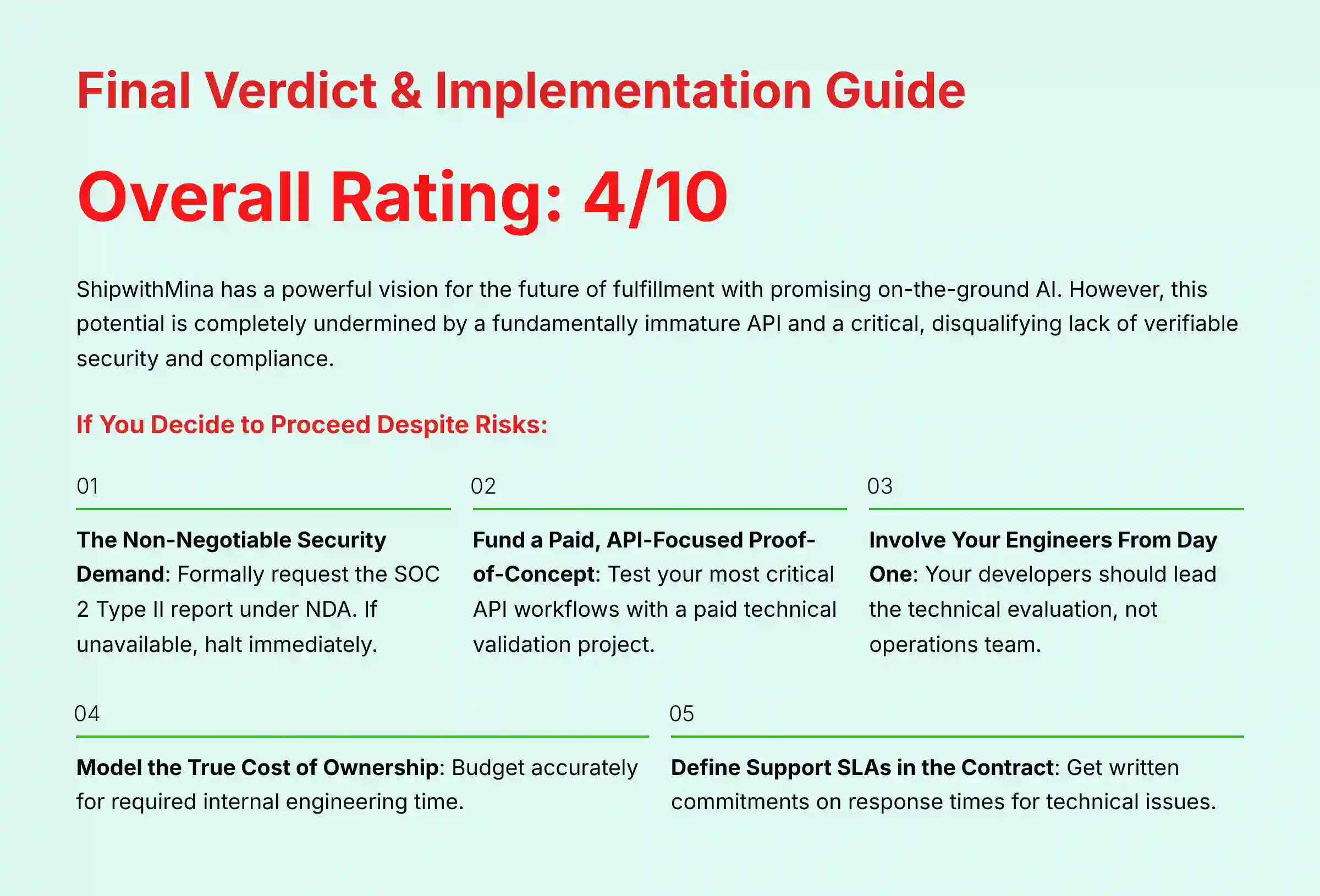
If you decide to proceed despite the identified risks, you must follow a strict implementation plan to protect your business.
- Step 1: The Non-Negotiable Security Demand. Formally request the SOC 2 Type II report under a Non-Disclosure Agreement. If they cannot provide it, you must halt the process immediately.
- Step 2: Fund a Paid, API-Focused Proof-of-Concept. Scope this project strictly to test your most critical API workflows. This is not a trial; it is a paid technical validation project.
- Step 3: Involve Your Engineers From Day One. Your developers should lead the technical evaluation, not your operations team.
- Step 4: Model the True Cost of Ownership. Use the findings from the proof-of-concept to accurately budget for the required internal engineering time.
- Step 5: Define Support SLAs in the Contract. Get written commitments on response and resolution times for high-severity technical issues before signing anything.
For comprehensive guidance on implementation approaches, refer to our detailed ShipwithMina Tutorials and Usecase guide that covers real-world scenarios and best practices.
Final Verdict & Recommendations
ShipwithMina has a powerful vision for the future of fulfillment. Its on-the-ground AI shows real promise for improving warehouse efficiency. But this potential is completely undermined by a fundamentally immature API and a critical, disqualifying lack of verifiable security and compliance.
The platform is like a brilliant race car engine without a reliable transmission, steering wheel, or safety system. It is a solution built with impressive core technology but is missing the essential components required to operate it safely in a professional business environment.
Therefore, our recommendation is clear: approach ShipwithMina not as a turnkey fulfillment partner, but as a high-risk technology component that demands rigorous, expert-led technical and security validation before any commitment is made.
Important Disclaimers:
Technology Evolution Notice: The information about ShipwithMina Review and AI for Operations & Supply Chain tools presented in this article reflects our thorough analysis as of 2025. Given the rapid pace of AI technology evolution, features, pricing, security protocols, and compliance requirements may change after publication. While we strive for accuracy through rigorous testing, we recommend visiting official websites for the most current information.
Professional Consultation Recommendation: For AI for Operations & Supply Chain applications with significant professional, financial, or compliance implications, we recommend consulting with qualified professionals who can assess your specific requirements and risk tolerance. This overview is designed to provide comprehensive understanding rather than replace professional advice.
Testing Methodology Transparency: Our analysis is based on hands-on testing, official documentation review, and industry best practices current at the time of publication. Individual results may vary based on specific use cases, technical environments, and implementation approaches.
For a complete analysis of this tool, please see our full ShipwithMina Review.
Comprehensive FAQs Section
Q1: Is ShipwithMina SOC 2 compliant?
A: No. As of my latest review, there is no publicly verifiable evidence that ShipwithMina has completed a SOC 2 Type II audit. This is a critical security concern, and you should demand to see their attestation report before sharing any sensitive data.
Q2: What is the main difference between ShipwithMina and ShipBob?
A: The main difference is their core technology approach. ShipwithMina is an AI-native solution focused on optimizing in-warehouse operations, while ShipBob is a tech-enabled 3PL focused on providing a simple, reliable, and broadly integrated service. ShipBob is more mature and secure, while ShipwithMina is more technologically ambitious but carries higher risk.
Q3: How much does ShipwithMina really cost?
A: While their per-order pricing can seem competitive, the true cost of ownership is much higher. You must factor in significant internal engineering costs, potentially between $22,500 to $30,000 upfront, to build and maintain a stable API integration.
Q4: Can ShipwithMina integrate with NetSuite or SAP?
A: A connection is theoretically possible via their API. But it is not recommended for complex ERPs like NetSuite or SAP. Professionals report their API is too immature and lacks the granular endpoints required for robust, bi-directional data synchronization.
Q5: Is ShipwithMina a good choice for a small e-commerce startup?
A: It depends on the startup's technical capabilities. If you have a strong in-house developer, it might be worth exploring. But for most startups without dedicated engineering resources, a more proven and user-friendly platform like ShipBob is a much safer choice.
Q6: What is the “AI Black Box” problem with ShipwithMina?
A: The “AI Black Box” means the system cannot explain why it made a certain decision. If the AI creates an inefficient pick path, there is no way to audit the algorithm's logic. This makes it very difficult to troubleshoot and improve operational processes.
Q7: How does ShipwithMina's computer vision work for order accuracy?
A: A camera system visually scans items in a box and compares them to product images for that order. While innovative, users have reported it can struggle to differentiate between products with very similar packaging, requiring manual overrides.
Q8: What kind of technical support should I expect?
A: You should expect basic operational support for simple issues. For anything related to the API or integration, you should plan for your own development team to be the primary support resource.
Q9: Does ShipwithMina work for B2B fulfillment?
A: No, the platform is highly optimized for simple, high-volume B2C orders. Its current feature set and API do not support the complexities of B2B fulfillment, such as case picking or custom invoicing.
Q10: What is the single most important step before choosing ShipwithMina?
A: The single most important step is to fund a paid, time-boxed Proof-of-Concept (PoC) with the sole goal of having your engineering team test the limits of their API. This will provide an objective, evidence-based answer to whether the platform can truly support your business.
For additional questions and detailed answers, visit our comprehensive ShipwithMina FAQs resource.

Leave a Reply