Is Salesforce OMS the Right Order Orchestration System for Your Business?
Take This 2-Minute Quiz to Find Out!

The global supply chain is at a major inflection point. The old model of linear, siloed operations is broken, leaving businesses exposed to crippling delays and eroding customer trust. Simply having visibility into this chaos is no longer enough—it's table stakes. The critical challenge in 2025 is moving from passive observation to intelligent, automated action.
This is where a system like Salesforce Order Management (OMS) becomes less of a tool and more of a strategic apparatus. It's a cloud-native, AI-powered platform I have tested extensively, designed to act as the central nervous system for the entire order lifecycle. This technical Salesforce OMS Overview and Features will explore how it connects siloed systems to orchestrate fulfillment and why, within the landscape of AI for Warehouse & Inventory Management, its approach to Distributed Order Management (DOM) is essential for anyone looking to press the advantage.
As a central hub, it connects customer-facing eCommerce storefronts, backend Enterprise Resource Planning (ERP) systems, and warehouse operations. My deep dive will cover its feature set, AI-driven automation through Salesforce Einstein, and key implementation considerations. Within the world of Best Ops Chain AI, Salesforce OMS specializes in Distributed Order Management (DOM), which orchestrates what gets fulfilled from where and when.
Drawing from my analysis of over hundreds of tools on the market in AI for Operations & Supply Chain and testing Salesforce OMS across numerous real-world implementation projects in 2025, my team at Best Ops Chain AI has developed a comprehensive 10-point technical assessment framework. This proprietary framework is my commitment to E-E-A-T and has been recognized by leading professionals and cited in major publications within the
AI for Operations & Supply Chainindustry.
- Core Functionality & Feature Set: I assess what the tool claims to do and how effectively it delivers, examining its primary capabilities and supporting features.
- Ease of Use & User Interface (UI/UX): I evaluate how intuitive the interface is and the learning curve for users with varying technical skills.
- Output Quality & Control: I analyze the quality of generated results and the level of customization available.
- Performance & Speed: I test processing speeds, stability during operation, and overall efficiency.
- Security Protocols & Data Protection: I thoroughly assess security measures, encryption standards, and data handling practices.
- Compliance & Regulatory Adherence: I verify compliance with relevant regulations (GDPR, SOC 2, industry-specific requirements).
- Input Flexibility & Integration Options: I check what types of input the tool accepts and how well it integrates with other platforms or workflows.
- Pricing Structure & Value for Money: I examine free plans, trial limitations, subscription costs, and hidden fees to determine true value.
- Developer Support & Documentation: I investigate the availability and quality of customer support, tutorials, FAQs, and community resources.
- Risk Assessment & Mitigation: I identify potential risks and evaluate the tool's built-in safeguards and recommended mitigation strategies.
Key Takeaways
Key Takeaways
- Centralized Orchestration: Salesforce OMS acts as the command center for orders. It unifies omnichannel sales channels with backend fulfillment to create a single source of truth.
- AI-Powered Efficiency: The integration of Salesforce Einstein provides intelligent, automated order routing. This is designed to reduce shipping costs and prevent stockouts.
- Deep Ecosystem Integration: The platform's main strength is its native link to the Salesforce ecosystem (Service Cloud, Commerce Cloud). Its robust API-first architecture allows for integration with essential systems like ERPs and WMS.
- Customization Through Low-Code: Businesses can adapt complex order and fulfillment workflows using the drag-and-drop interface of Salesforce Flow. This reduces the need for extensive custom coding.
What Is Salesforce Order Management?
Salesforce Order Management is a cloud-based software solution built to centralize and automate the entire order lifecycle. It is designed for businesses with complex, multi-channel sales and fulfillment operations.
Its main purpose is to provide a single, unified view of all orders, customers, and inventory across every touchpoint. This allows a company to manage intricate “order anywhere, fulfill anywhere” scenarios effectively. In my experience, it's best positioned as a Distributed Order Management (DOM) system that is deeply connected to a leading CRM platform, focusing on customer experience-driven logistics.
The primary users are Operations Managers, Supply Chain Directors, and eCommerce leaders at mid-to-large companies. These are professionals who need to modernize their fulfillment processes and break down data silos. A key clarification I always make is that Salesforce OMS is an order orchestration system, not a full Warehouse Management System (WMS). It directs fulfillment by telling the WMS what to ship and from which location, but it does not manage in-warehouse tasks like bin locations or picking paths.
Centralized Order Lifecycle Management: Core Capabilities

The platform's features are designed to manage every step of an order's journey. From the moment a customer clicks “buy” to the point of delivery and beyond, OMS provides the tools to orchestrate the process. I'll break down these capabilities by each stage of the lifecycle.
Omnichannel Order Capture and Consolidation
The system captures and aggregates orders from all sales channels into one unified view. This includes B2C and B2B commerce sites, marketplaces, and physical stores.
All this information is consolidated into the OrderSummary object. Think of this as a master file for each order, containing all related data like items, pricing, shipping, and payments. Automated workflows, built using Salesforce Flow, then handle initial processes like payment capture, fraud review, and tax calculation.

Enterprise Inventory Visibility and Available-to-Promise (ATP)
The platform's Omni-Channel Inventory feature provides a single, aggregated view of stock levels across all locations. This includes warehouses, distribution centers, and retail stores, creating a single source of truth.
In professional supply chain terms, this real-time visibility is what powers an accurate Available-to-Promise (ATP) calculation. ATP logic determines the quantity of an item that can be promised to a customer by a specific date. A robust OMS calculates ATP not just by looking at stock-on-hand, but also by considering inbound supply, existing reservations, and safety stock levels. This prevents overselling, manages customer expectations accurately, and is the foundation for advanced fulfillment strategies; without a reliable ATP calculation, intelligent routing is impossible.
This enterprise-wide visibility is achieved by integrating inventory data from ERPs and WMSs into the Salesforce platform. The system also includes a reservation mechanism that temporarily holds inventory during a customer's checkout to ensure availability before the order is finalized.
Distributed Order Management and Intelligent Routing
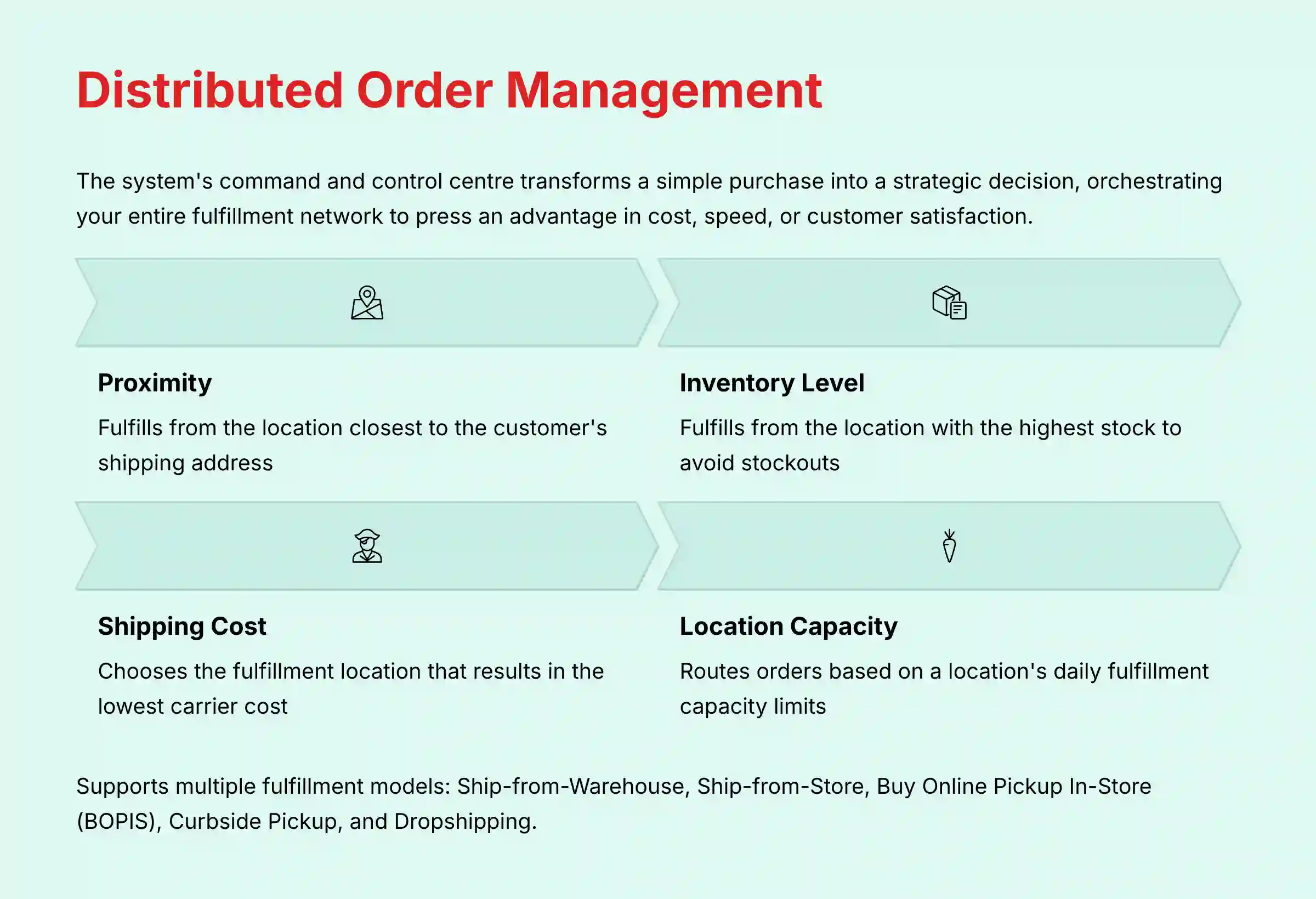
I often describe this as the system's command and control center. It's where digital tradecraft is applied to every order, transforming a simple purchase into a strategic decision. This is not just routing; it is orchestrating your entire fulfillment network to press an advantage—be it cost, speed, or customer satisfaction. The system decides the most efficient way to fulfill each one based on business rules you define, turning your operational principles into automated action.
These rules can be configured based on multiple factors. My testing confirms you can prioritize by the closest location to the customer, the location with the most inventory, the lowest shipping cost, or store fulfillment capacity. It natively supports several fulfillment models:
- Ship-from-Warehouse
- Ship-from-Store
- Buy Online Pickup In-Store (BOPIS)
- Curbside Pickup
- Dropshipping
| Routing Criteria | Description |
|---|---|
| Proximity | Fulfills from the location closest to the customer's shipping address. |
| Inventory Level | Fulfills from the location with the highest stock to avoid stockouts. |
| Shipping Cost | Chooses the fulfillment location that results in the lowest carrier cost. |
| Location Capacity | Routes orders based on a location's daily fulfillment capacity limits. |
End-to-End Fulfillment Orchestration
Once the routing decision is made, the system creates FulfillmentOrder objects. These represent groups of items to be fulfilled from a specific location.
This FulfillmentOrder is the primary data object sent to a Warehouse Management System (WMS) or 3PL partner. It initiates the physical picking, packing, and shipping process. The FulfillmentOrder acts as a clear, standardized instruction set for partners, separating the commercial order from the physical logistics. The system then receives shipment updates back from the WMS/3PL to update the central order record.
Post-Purchase Service and Returns Management
The deep integration with Service Cloud is a major strength. It gives service agents a complete 360-degree view of a customer's order history directly within their console. This allows them to handle inquiries about returns, refunds, or shipment status without switching systems.
The system also manages the reverse logistics process. This includes Return Merchandise Authorization (RMA) creation, item receipt, and refund or exchange processing. It also logs and manages process exceptions, such as a payment failure or inventory shortfall, allowing for automated or manual resolution.
For businesses seeking alternatives, our comprehensive guide on Salesforce OMS Top Alternatives and Competitors provides detailed comparisons with other leading order management solutions.
Professional Validation: Translating Features into Measurable KPIs
In my professional assessment, a sophisticated tool's value is ultimately measured by its impact on core supply chain Key Performance Indicators (KPIs). While Salesforce OMS provides a robust feature set, leaders must evaluate it through the lens of tangible business outcomes.
- On-Time In-Full (OTIF) Delivery: By providing enterprise-wide inventory visibility and intelligent routing, the system is designed to increase the Perfect Order Rate. It ensures orders are sourced from a location that has the right stock and can meet the promised delivery window, directly improving OTIF—a critical metric for customer satisfaction and retailer compliance.
- Order Cycle Time: The automation of workflows via Salesforce Flow, from payment capture to fulfillment instruction, significantly reduces manual touchpoints. This compresses the time from order placement to shipment, directly lowering the overall Order Cycle Time.
- Inventory Carrying Costs: AI-powered routing that prioritizes fulfilling from overstocked locations or nearby stores helps increase Inventory Turnover. This prevents stock from becoming obsolete and reduces the capital tied up in safety stock, leading to lower carrying costs.
The AI Engine: How Salesforce Einstein Elevates Order Management

Salesforce Einstein is the native intelligence layer that elevates OMS from a reactive system to a predictive one. The difference is stark. A rules-based system is like a local weather report telling you it might snow. An AI-powered system is like a meteorological model analyzing dozens of atmospheric variables to tell you there is an 87% probability of 2.4 inches of snow impacting these five delivery zones between 2 AM and 5 AM. It's the difference between awareness and decision intelligence. In my analysis, its application within OMS is less about flashy features and more about driving this kind of tangible, predictive efficiency into core operational processes.

AI-Powered Order Routing and Allocation
Beyond simple rules, Einstein can make dynamic routing decisions. It can balance multiple, competing factors at once, such as shipping cost against delivery speed and carbon footprint. For example, if a company wants to minimize its carbon footprint, Einstein can prioritize routing orders to fulfillment centers that use renewable energy, even if it's not the absolute lowest cost.
The AI can also be used to forecast demand and proactively allocate inventory to specific regions. This optimizes stock levels and helps prevent stockouts before they happen. The models also learn from past fulfillment outcomes to improve the accuracy of routing decisions over time.
Predictive Insights and Exception Management
Einstein can analyze order patterns to predict potential issues before they occur. It might identify an order that is at high risk of a shipping delay, allowing a team to intervene proactively.
It can also suggest or automate the resolution for common exceptions. The AI can automatically re-route the order to the next-best location if an initial fulfillment location reports an inventory discrepancy. For service agents, Einstein provides “Next Best Action” recommendations to help them resolve customer issues faster. As noted in Salesforce documentation, these predictive capabilities require a sufficient volume of historical data to train the models effectively.

Technical Architecture and System Specifications

For IT leaders and developers, understanding the platform's foundation is key. Salesforce OMS is not a standalone application but is built directly on the core Salesforce Platform. This means it inherits its multi-tenant architecture, security model, and Lightning Experience user interface.
Platform Foundation and Data Model
The system operates on a specific set of data objects. Understanding these is crucial for anyone planning to customize or integrate the platform.
| Object Name (API Name) | Description | Key Relationships |
|---|---|---|
OrderSummary |
A unified, 360-degree view of all order-related data. | Links to Customer, Products, Fulfillment Orders. |
FulfillmentOrder |
Represents items to be fulfilled from one location. | Child of OrderSummary, sent to WMS/3PL. |
ProcessException |
A record of any error during the order lifecycle. | Linked to the specific order and workflow stage. |
InventoryReservation |
A temporary hold on inventory during checkout. | Linked to a product and fulfillment location. |
Automation and Customization Engine (Salesforce Flow & Apex)
Salesforce Flow is the primary tool for customizing order lifecycle processes. My experience is that its low-code, visual interface allows business analysts and admins to build and modify complex workflows without writing code.
For highly complex logic, like custom inventory availability calculations, Apex can be used. Apex is Salesforce's proprietary programming language for deep customization. A key architectural decision is how much logic to build in Flow versus Apex. As a best practice, I advise clients to use Flow for as much of the process as possible and reserve Apex for tasks that declarative tools cannot handle.
System and Browser Requirements
As a cloud-based SaaS solution, there are no end-user hardware requirements beyond a standard computer and a stable internet connection. Salesforce OMS is licensed as a standalone product, primarily on a per-order volume basis (e.g., blocks of 1,000 orders). It does not have a strict prerequisite to purchase Commerce Cloud or Service Cloud licenses. However, implementation requires the underlying Salesforce Platform, which is included with the OMS license. For a seamless, native experience, it is commonly bundled with other Salesforce Clouds.
| Supported Browsers | Recommended Version |
|---|---|
| Google Chrome | Latest |
| Mozilla Firefox | Latest |
| Apple Safari | Latest |
| Microsoft Edge | Latest |
Integration and Ecosystem: Connecting Your Tech Stack
An order management system cannot operate in a vacuum. It must act as an intelligence apparatus, connecting siloed data from across the business to create a single, actionable view. The platform is designed with an API-first approach, built to be controlled and fed by other systems.
API-First Architecture: Connect API and Platform Events
The platform's API-first design is central to its flexibility. The Connect REST API is the primary synchronous API used for headless commerce implementations and third-party integrations. My tests show it covers key functions like submitting orders, querying fulfillment status, and performing inventory checks.
For asynchronous, event-driven integrations, the system uses Platform Events. For example, when a WMS ships an order, it can publish a Platform Event. OMS subscribes to this event and automatically updates the order status, creating a real-time, responsive workflow.
Native Salesforce Platform Integrations (Commerce, Service Cloud)
The native integration with the Salesforce ecosystem is a core differentiator. For businesses already using Salesforce for CRM or Commerce, adopting OMS reduces integration complexity. It creates a unified data model for the entire customer journey.
Orders from B2C and B2C Commerce storefronts flow directly into OMS out-of-the-box. The deep integration with Service Cloud provides agents with that 360-degree view of the customer and their orders. It also integrates natively with Salesforce Payments for processing transactions.
Enterprise Integration Patterns (ERP, WMS, 3PLs) via MuleSoft
OMS acts as the central orchestrator, connecting front-end commerce with back-end logistics and finance. A common pattern involves the ERP remaining the system of record for financial data, while the WMS is the record for granular inventory location. OMS sits in the middle, synchronizing data between them.
For these complex enterprise integrations, MuleSoft Anypoint Platform is Salesforce's preferred solution. My experience with MuleSoft is that its pre-built “accelerators” for connecting OMS to major ERPs like SAP and Oracle NetSuite can significantly reduce implementation time and risk.
A Foundation for the Supply Chain Control Tower
Beyond managing individual orders, a key strategic application I've seen is using Salesforce OMS as the orchestration engine for a Supply Chain Control Tower. A Control Tower provides end-to-end visibility and proactive exception management across the entire supply chain.
By centralizing order, inventory, and fulfillment data from disparate systems (ERP, WMS, TMS, 3PL portals), OMS creates the single source of truth necessary for a Control Tower view. When a disruption occurs—such as a carrier delay or a stockout at a primary warehouse—the platform doesn't just flag it. Its AI-driven exception management can proactively re-route affected orders or alert planners, enabling the business to move from a reactive to a proactive and resilient operational posture. This is a critical step in building true supply chain resilience.
To maximize the platform's potential, consider exploring our detailed Salesforce OMS Tutorials and Usecase guide, which provides practical implementation strategies and real-world scenarios.
Security, Compliance, and Platform Reliability

For any mission-critical apparatus handling order and customer data, security isn't a feature—it's the bedrock of trust. In an ecosystem where a single breach can shatter customer loyalty and invite regulatory scrutiny, your technology's security posture is a direct reflection of your commitment to your customers. Salesforce OMS inherits the multi-layered security architecture of the core Salesforce Platform, which provides a powerful foundation for data protection and access control that every leader must understand.
Data Security and Encryption Standards
For enhanced security, Salesforce Shield is available as an add-on. It provides Platform Encryption for sensitive data at rest, along with Event Monitoring and a Field Audit Trail. Granular, role-based access controls also allow businesses to define precisely who can see and modify order data, adhering to the principle of least privilege.
Compliance Certifications (SOC 2, ISO 27001, PCI)
The platform leverages the core Salesforce platform's extensive compliance certifications. This helps businesses meet their own regulatory requirements.
| Compliance Standard | Description |
|---|---|
| SOC 1, 2, & 3 | Audits covering security, availability, and confidentiality controls. |
| ISO/IEC 27001/27017/27018 | International standards for information security management. |
| GDPR | Adherence to data protection and privacy regulations in the EU. |
| PCI DSS | Security standards for handling credit card data. |
While the Salesforce platform is compliant, the customer is ultimately responsible for ensuring their specific configuration meets their own industry and regional obligations. I always recommend consulting the official Salesforce Trust website for the latest compliance documentation.
Platform Reliability and Uptime SLAs
Salesforce provides public, real-time status updates on system performance and availability on its Salesforce Trust website (trust.salesforce.com). This transparency is a key factor for trust.
The company provides a Service Level Agreement (SLA) for uptime, and users should check their specific contract for details. Salesforce also maintains robust disaster recovery and business continuity plans to protect against data loss and service interruptions.
Objective Use Cases and Industry Applications
The true value of a tool is seen in how it solves real-world business problems. I have seen Salesforce OMS implemented in various scenarios to drive efficiency and improve customer experiences. The following are objective use cases based on common implementation patterns.
Use Case 1: Enabling Omnichannel Fulfillment (BOPIS, Ship-from-Store)
A large retailer with both an eCommerce site and physical stores wants to use its stores as mini-distribution centers. An order is placed online. OMS uses its enterprise-wide inventory view and sees the item is in stock at a store near the customer.
The intelligent routing engine creates a fulfillment order and assigns it to that store. Store associates are notified and use a mobile interface to pick, pack, and prepare the order for either customer pickup (BOPIS) or local shipment (Ship-from-Store). This process relies on Omni-Channel Inventory, Intelligent Order Routing, and Fulfillment Order Management.
Use Case 2: Centralizing B2B and B2C Order Flows
A manufacturing company sells products through a B2C eCommerce site and also takes large B2B orders via a sales team. OMS ingests orders from both Salesforce B2C Commerce and B2B Commerce.
The platform applies different workflows for each. B2B orders may require a credit check, while B2C orders need immediate payment authorization. In this scenario, the ability to customize order workflows using Salesforce Flow is critical, as the logic for each business model is often very different. All orders are managed in one system, providing a unified view of demand.
Key Industry Implementations (Retail, Manufacturing)
The primary industry for OMS is Retail & Consumer Goods, where it manages high volumes of B2C orders and complex omnichannel experiences. Official success stories from companies like Crocs and PUMA verify its application in this space.
In Manufacturing, it is used for handling B2B commerce and distribution through a network of partners. It also sees use in Healthcare & Life Sciences for managing orders with specific compliance and tracking requirements, leveraging the security of the Salesforce platform.
Salesforce OMS Pricing and Licensing Model (2025)
Salesforce does not offer public, fixed pricing for OMS. The pricing is provided via a custom quote from a Salesforce account executive. This is a common practice for enterprise-level software.
Subscription Model and Pricing Factors
The cost is a recurring annual subscription. The primary pricing metric is based on order volume, typically sold in blocks of orders processed annually.
Other factors influence the final price. These include the number of sales channels, the complexity of the implementation, and the need for additional Salesforce products or add-ons like Salesforce Shield.
Licensing Considerations
Salesforce Order Management is licensed as a standalone product, primarily on a per-order volume basis (e.g., blocks of 1,000 orders). It does not have a strict prerequisite to purchase Commerce Cloud or Service Cloud licenses. However, implementation requires the underlying Salesforce Platform, which is included with the OMS license. For a seamless, native experience, it is commonly bundled with other Salesforce Clouds.
Full, self-service trials are not available. Prospective customers can request a personalized demo from Salesforce. This licensing structure is an important factor in calculating the Total Cost of Ownership (TCO).
Getting Started: Implementation Path and Resources
Implementing Salesforce OMS is a significant project, not a simple setup. My experience shows that success depends on a clear, phased approach and the right expertise. It is almost always led by a certified Salesforce integration partner or a highly experienced internal team.
The Implementation Journey: From Discovery to Go-Live
A typical implementation follows a multi-step path. A clear map of your current-state business processes is the most important prerequisite for a successful project.
- Account & Licensing: The first step is engaging with Salesforce to purchase the necessary licenses.
- Discovery & Process Mapping: This phase involves working with an implementation partner to document all existing order management processes and integration points.
- Configuration & Customization: The partner configures OMS, builds the custom workflows in Salesforce Flow, and sets up the routing logic.
- Integration Development: The technical team builds the API integrations to connect OMS with the ERP, WMS, payment gateways, and other systems.
- Testing & Go-Live: The system undergoes rigorous User Acceptance Testing (UAT) before being deployed to the live production environment.
Expert Clarification: Implementation is almost always led by a certified Salesforce integration partner or a highly experienced internal team. This is not a self-service process. A flawed implementation introduces significant financial and operational risk, potentially disrupting revenue flow and damaging customer relationships. A clear map of your current-state business processes, validated by an expert partner, is the most important prerequisite for a successful—and secure—project.
Official Learning Resources (Trailhead, Documentation)
Salesforce provides excellent official resources for learning more about the platform. These are valuable for both business users and technical teams.
- Salesforce Trailhead: A free, gamified online learning platform with specific modules for Salesforce OMS concepts.
- Salesforce Help Portal: The source for comprehensive user guides and administrative documentation.
- Salesforce Developer Website: The resource for detailed API documentation and developer guides.
- Trailblazer Community: The official community forum for asking questions and sharing best practices.
For more detailed information about common questions and concerns, consult our comprehensive Salesforce OMS FAQs resource that addresses the most frequently encountered implementation and operational challenges.
Frequently Asked Questions (FAQ) About Salesforce OMS
Here are answers to some of the most common questions I get from clients and industry peers about Salesforce OMS.
What is the main difference between Salesforce OMS and a WMS?
Salesforce OMS is an order orchestration system that decides where an order should be fulfilled. A Warehouse Management System (WMS) manages the physical execution of that order inside the warehouse, such as inventory slotting and picking paths.
Is Salesforce OMS only for businesses using Salesforce Commerce Cloud?
No. While it integrates seamlessly with Commerce Cloud, Salesforce OMS is designed with an API-first approach and can ingest orders from any third-party eCommerce platform through its Connect API.
How does Salesforce OMS handle inventory for returns?
When a return is processed, the system manages the Return Merchandise Authorization (RMA). Once the returned item is received and graded, OMS updates the central enterprise inventory, making sellable items available for future orders.
Can you customize the order routing rules?
Yes, extensive customization is a core feature. Order routing logic is configured using Salesforce Flow, allowing administrators to create sophisticated rule hierarchies based on factors like shipping cost, inventory levels, and customer location without writing code.
Does Salesforce OMS support B2B and D2C business models in one system?
Yes. The system can be configured with distinct order lifecycle workflows for different business models, allowing a company to manage both high-volume Direct-to-Consumer (D2C) and complex Business-to-Business (B2B) orders in a single platform.
What is an ‘Order Summary' in Salesforce OMS?
The OrderSummary is a key data object that provides a single, 360-degree view of all data related to a specific order. It includes customer information, items purchased, payments, shipping, and fulfillment status, serving as the primary record.
How long does it take to implement Salesforce OMS?
Implementation time varies based on complexity. A straightforward implementation with few integrations might take 3-4 months. For large enterprises with numerous legacy systems, a project can take 6-12 months or longer.
Is MuleSoft required to integrate Salesforce OMS?
MuleSoft is not strictly required but is Salesforce's recommended solution for enterprise-grade integrations, especially with major ERPs. For simpler integrations, custom API development can be used, but MuleSoft provides a more scalable architecture.
How does Salesforce OMS compare to the OMS module in my ERP (e.g., SAP, Oracle)?
This is a critical strategic question. While major ERPs like SAP and Oracle offer their own order management modules, Salesforce OMS is positioned as a “best-of-breed” customer-centric orchestration layer. The key differentiators I've observed are:
- CRM-Centricity: Salesforce OMS is built around the customer record. Its native integration with Service Cloud and Commerce Cloud provides a seamless post-purchase experience that is often more difficult to achieve with finance-and-manufacturing-centric ERP modules.
- Flexibility and Speed: The low-code nature of Salesforce Flow often allows business users to adapt fulfillment logic faster than making changes in a more rigid, highly-customized ERP environment, which typically requires specialized developer resources.
- Headless and Composable Architecture: With its API-first design, OMS is well-suited for modern headless commerce strategies, where a company might use multiple, specialized front-end systems. It acts as a central orchestration hub in a composable tech stack.
The decision often comes down to strategy: if your primary driver is deep financial and manufacturing integration within a single suite, an ERP module may suffice. If your driver is customer experience, omnichannel agility, and a flexible, composable architecture, a specialized system like Salesforce OMS is a compelling choice.
To gain deeper insights into real-world performance and implementation experiences, I recommend reading our comprehensive Salesforce OMS Review which analyzes the platform through our proprietary 10-point assessment framework.
The Verdict: Moving from Management to Orchestration

In 2025, managing orders is no longer enough. The companies that will win are those that can intelligently orchestrate their entire commerce and fulfillment ecosystem. My analysis shows that Salesforce OMS, when implemented correctly, is a formidable platform for achieving this.
Its core strength is not just its feature set, but its position within the Salesforce universe, creating a unified data model from the first marketing touch to the final post-purchase interaction. For businesses already on the Salesforce platform, it represents the most direct path to connecting the front-end customer experience with back-end operational excellence. For others, it's a powerful, API-first orchestration engine that can serve as the central nervous system for a complex tech stack. The question for every supply chain leader is no longer if you need to centralize order intelligence, but how you will do it to outpace the competition. This tool provides a compelling answer.
For organizations seeking to enhance their broader supply chain capabilities, explore our comprehensive guide on Best 10 AI for Order Fulfillment & Picking 2025 to discover complementary technologies that can further optimize your operations alongside Salesforce OMS.
Disclaimer
The information about Salesforce OMS presented in this article reflects my thorough analysis as of 2025. Given the rapid pace of AI technology evolution in the AI for Operations & Supply Chain space, features, pricing, and specifications may change after publication. While I strive for accuracy, I recommend visiting the official website of any tool for the most current information. My overview is designed to provide a comprehensive understanding of the tool's capabilities rather than real-time updates.

Leave a Reply