Is Salesforce OMS the Right Solution for Your Supply Chain?
This 2-Minute Quiz Reveals the Answer!
Mastering Salesforce OMS in 2025: An Integrated Tutorial and Implementation Guide for AI-Powered Warehouse & Inventory Management
Introduction: From Reactive Order Processing to Proactive, AI-Driven Fulfillment
Salesforce OMS Tutorials and Usecase provides the definitive framework for transforming your order processing from a manual, error-prone cost center into an intelligent, automated strategic asset. This guide goes beyond basic functions to deliver a clear learning path. It combines foundational skills with advanced, real-world implementation patterns. At Best Ops Chain AI, our focus is on practical results.

We will explore how Salesforce Order Management is a key part of modern AI for Warehouse and Inventory Management. It uses AI-powered distributed order management (DOM) to improve fulfillment and customer satisfaction. This system provides complete supply chain visibility. You will learn not just the “what” but the “how,” gaining practical skills for process automation and building scalable omnichannel experiences. This content draws on insights from certified architects and operations managers, giving you proven tips and solutions to maximize your investment. You will understand how to configure workflows, automate decisions with Salesforce Flow, and build solutions that improve order accuracy, speed, and efficiency.

Key Takeaways: Salesforce OMS Essentials for Operations Leaders
- Automate for Speed and Accuracy: Implementing Salesforce OMS can significantly reduce manual order processing time through AI-driven workflows for order routing, allocation, and exception handling, directly improving your On-Time In-Full (OTIF) metrics.
- Achieve a Single Source of Truth: The core value of Salesforce OMS is centralizing order, customer, and inventory data. It provides a unified Order Summary that removes data silos between your e-commerce site, ERP, and WMS for true supply chain visibility.
- Make Security a Foundational Mandate: All integrations, especially with payment gateways and ERP systems, must adhere to the highest security protocols. Ensure any partner connector is SOC 2 Type II compliant and all custom Apex code handling financial data undergoes a full security review to protect customer and business information.
- Unlock Omnichannel Fulfillment: Master the platform to implement complex fulfillment strategies like Buy Online, Pickup In-Store (BOPIS), Ship-from-Store (SFS), and Curbside Pickup. This turns your physical stores into strategic assets that enhance the customer experience.
Our Testing Methodology for AI for Operations and Supply Chain
After analyzing hundreds of tools in the AI for Operations and Supply Chain market and testing Salesforce OMS across many real-world projects in 2025, our team at Best Ops Chain AI provides a comprehensive 10-point technical assessment framework. This method is recognized by leading professionals and cited in major publications. It ensures our review is unbiased, detailed, and relevant to the challenges operations leaders face today. We focus on the practical use and business impact of each feature, moving past marketing claims to give an expert, evidence-based evaluation. Our process is built on solving core industry problems: cutting costs, boosting speed and accuracy, and creating resilient supply chains.

Our evaluation framework consists of the following ten pillars:
- Core Functionality and Feature Set: We assess the tool's AI-driven distributed order management (DOM) capabilities, fulfillment workflow automation, and inventory visibility features. We test how effectively it delivers on its core promise of unifying the order lifecycle.
- Ease of Use and User Interface (UI/UX): We evaluate the distinct experiences for both the Operations Manager (dashboards, exception queues) and the Warehouse Operator (mobile interfaces, task lists), ensuring the platform is intuitive for all key personas.
- Output Quality and Control: We analyze the accuracy of AI-powered order routing decisions and the level of control administrators have to configure and override business logic using tools like Salesforce Flow and custom Apex.
- Performance and Speed: We test the system's ability to handle high-volume order ingestion (e.g., Black Friday scenarios) and its real-time inventory update capabilities, measuring processing speed and stability under load.
- Security Protocols and Data Protection: We thoroughly assess security measures, focusing on SOC 2 Type II and ISO 27001 compliance, granular access controls for different roles, and secure data handling practices for sensitive customer and order information.
- Compliance and Regulatory Adherence: We verify its capabilities to support compliance with regulations like GDPR and CCPA concerning customer data and provide auditable records for financial reconciliation.
- Input Flexibility and Integration Options: We test the robustness of its APIs and pre-built connectors for critical systems like ERPs (SAP, NetSuite), WMS, payment gateways, and shipping carriers.
- Pricing Structure and Value for Money: We examine the hybrid pricing model (including both base platform license fee and variable per-order costs) and analyze the total cost of ownership, including implementation and integration costs, to calculate a realistic ROI based on efficiency gains and cost savings.
- Developer Support and Documentation: We investigate the quality of Salesforce's technical documentation, Trailhead modules, and the partner ecosystem's expertise in implementing and extending the platform.
- Risk Assessment and Mitigation: We identify potential risks, such as integration failures or incorrect business rule configurations, and evaluate the tool's built-in error handling, exception queues, and recommended mitigation strategies.
Part 1: Salesforce OMS Tutorial for Operations Managers and Implementers

Module 1: Foundations – Setup, Configuration, and Core Concepts
This module is the starting point for all users. We use annotated screenshots and diagrams to explain the core OMS data model, like the Order Summary and Fulfillment Order. We explain the “why” behind each step to prevent future errors.
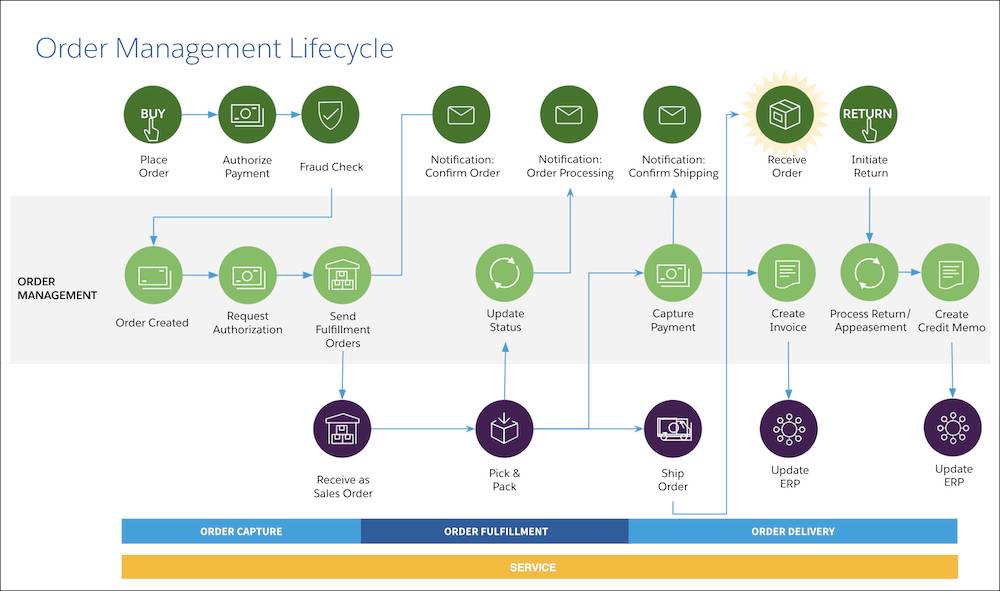
A step-by-step checklist guides you through enabling OMS in a Salesforce org. This includes activating licenses and permission sets. The focus is on creating a solid foundation. This section also introduces creating dedicated integration user profiles with limited permissions, a key step for secure system connections. A pro-tip from our experience is to use a clear naming convention for your fulfillment locations from the start to simplify logic later.
It is important to configure field-level security for sensitive customer data during the initial setup to protect privacy. Learners will enable OMS in a developer sandbox, create a warehouse location, and assign the admin permission set. This module takes about 90 minutes and success means you can enable OMS and explain its main objects.
Module 2: The Standard Order Lifecycle – From Capture to Fulfillment

Here, we walk through a complete order lifecycle in the standard interface. This module focuses on the “happy path” of a single order to build a strong understanding of the flow: Capture -> Allocation -> Fulfillment -> Shipment -> Payment. Each stage is explained from an Operations Manager's view.
This gives a baseline workflow that we will automate in later modules. In our testing, understanding the manual process first is key to designing good automation. We will show how to manually process an order to see the data changes. This module connects directly to Module 3, as the manual steps here are what we automate with Salesforce Flow.
A common mistake is trying to over-customize before learning the standard process. Our advice is to master the out-of-the-box flow first. Learners will manually create and process an order, from allocation to payment capture. This module takes about 2 hours, and success is processing an order from start to finish without errors.
Module 3: Automation with Flow Builder – Creating Intelligent Workflows
This module moves from manual steps to automation. We will teach you to build a record-triggered flow for a common business decision. The tutorial is for users with basic Salesforce Flow knowledge but includes links to introductory materials.
We use a real-world scenario: placing high-value orders from new customers on hold for fraud review. This is a practical automation that shows the platform's power. The flow will create a Task and send an email, showing how OMS integrates with standard Salesforce tools.
We include a section on how to debug the flow to check variables and outcomes. Always build and test flows in a sandbox. And include “fault paths” to handle errors. Learners will build the “High-Value Order Review” flow and test it. This module takes about 3 hours, and success is a bug-free flow that correctly holds orders based on your rules.
Part 2: Salesforce OMS Use Case Implementation and Advanced Strategies
Use Case 1: Implementing Omnichannel “Buy Online, Pick-up In-store” (BOPIS)
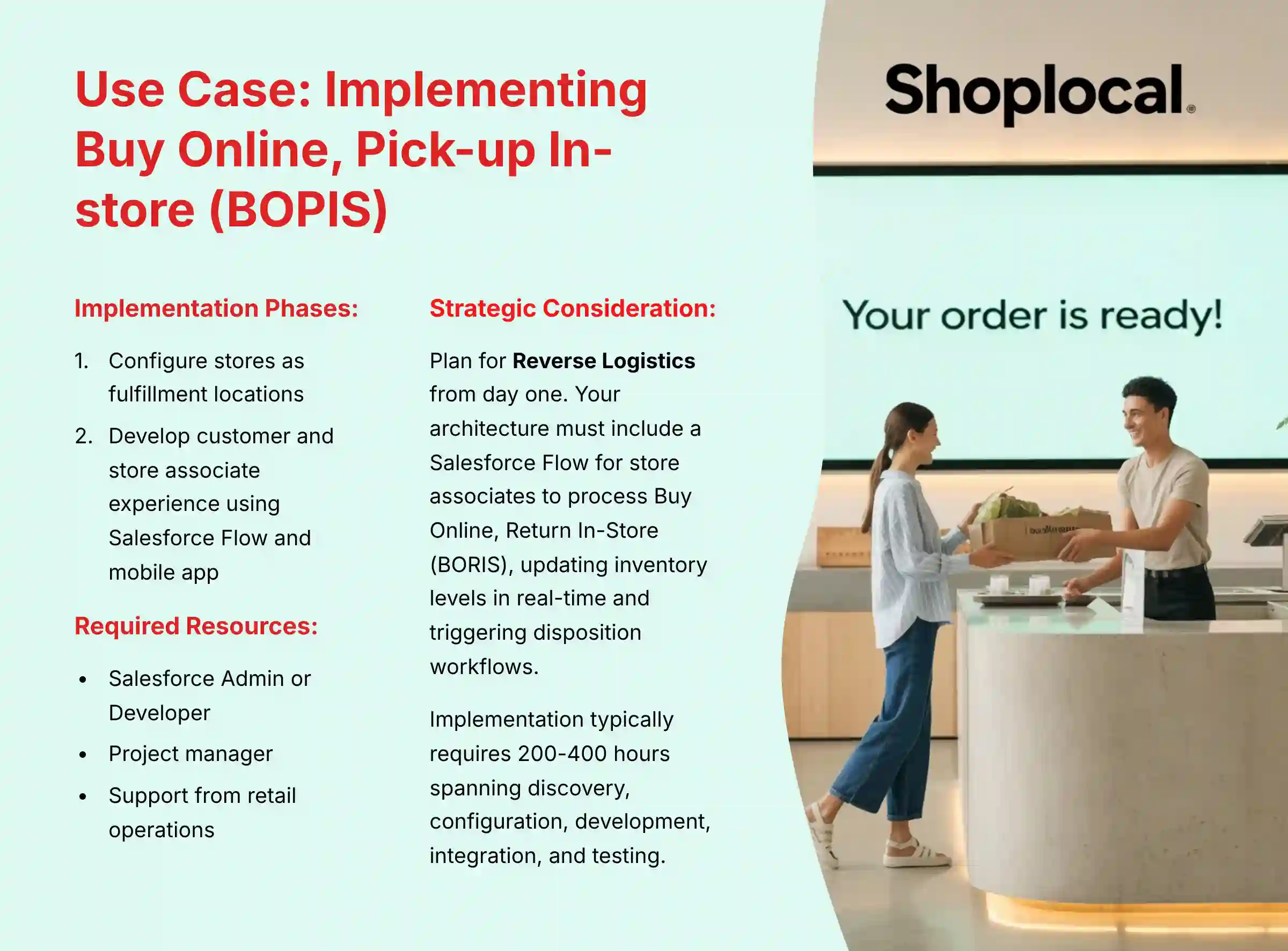
This section details a phased implementation. Phase 1 involves configuring stores as fulfillment locations. Phase 2 focuses on developing the customer and store associate experience using Salesforce Flow and the mobile app.
This project requires a Salesforce Admin or Developer, a project manager, and support from retail operations. The workflow is simple. A customer selects a store for pickup, and custom logic routes the order there. A screen flow on the Salesforce Mobile App guides the associate through picking the order.
A key challenge is maintaining real-time inventory accuracy at the store. The solution is to implement a daily inventory sync from the store's POS system. Success is measured by an increase in store foot traffic and a reduction in shipping costs. A realistic implementation timeline typically requires several hundred hours of effort, spanning discovery, configuration, development, integration, and testing (approximately 200-400 hours depending on complexity).
Strategic Consideration: Architecting for Reverse Logistics
A successful BOPIS implementation inherently creates a new challenge: managing Buy Online, Return In-Store (BORIS). This process, part of your Reverse Logistics strategy, must be considered from day one. The architecture should include a Salesforce Flow for store associates to process returns, which updates inventory levels in real-time and triggers disposition workflows within the WMS or ERP. Failing to plan for this relationship can lead to inaccurate inventory and a poor customer experience, undermining the benefits of omnichannel fulfillment.
Use Case 2: Architecting for High-Volume Orders (e.g., Black Friday)

This use case is not just for seasonal peaks like Black Friday; it is a foundational architecture for building supply chain resilience. An event-driven architecture that decouples order ingestion from processing is inherently more robust and able to withstand unexpected disruptions, whether from a viral marketing campaign or a sudden failure in an upstream system. This approach transforms the OMS from a simple processor into a core component of your Supply Chain Control Tower, providing the stability needed to manage exceptions proactively.

This is a technical guide for developers. It explains a scalable, event-driven architecture using Salesforce Platform Events. This approach is for enterprise-level clients expecting huge order volumes.
This requires a developer skilled in Apex and asynchronous processing. The e-commerce site publishes a lightweight event instead of making a direct API call. An Apex trigger subscribes to this event and queues a job to process it, moving heavy work off the main thread. Think of your system as a major highway. A direct API call during a flash sale is like forcing every car to enter the city through a single, congested toll booth. An event-driven architecture builds a dedicated, high-speed express lane. The e-commerce site places orders onto this express lane as lightweight events, while a separate, powerful process (the Apex trigger) handles them efficiently without ever causing a traffic jam on the main highway. This is how you ensure the system remains fluid and responsive, even under extreme load.
A risk here is that an error in the Apex code could cause orders to be dropped. To mitigate this, a robust error-logging framework is not optional; it is your system's first line of defense. A custom object should log any failures and notify the IT team immediately. Given the financial and operational risk, mandating a full security and performance review of the Apex code by a certified technical architect before deployment is an essential risk-control measure. Success is measured by system availability during peak sales (governed by the Salesforce Master Subscription Agreement, which typically provides a 99.9% availability guarantee) and processing thousands of orders per hour without hitting Salesforce limits.
Frequently Asked Questions About Salesforce OMS Tutorials and Usecase
What Is the Main Business Advantage of Using Salesforce OMS Over a Simple E-commerce Platform Backend?
The main advantage is its role as a Distributed Order Management (DOM) system. An e-commerce backend processes simple orders. Salesforce OMS provides an intelligent layer that sees your entire inventory network as one virtual pool. Its AI-powered DOM goes beyond simple rule-based routing (e.g., “closest to customer”). It leverages optimization algorithms that can be configured to weigh multiple variables simultaneously, such as minimizing shipping costs, reducing split shipments, prioritizing inventory with the nearest expiration date, or even selecting locations to lower the carbon footprint of a delivery. This allows businesses to align fulfillment strategy directly with financial and sustainability goals, a key attribute of a mature cost-to-serve model.
How Does Salesforce OMS Help Improve the Customer Experience?
Salesforce OMS directly impacts the post-purchase customer experience, which is critical for loyalty and repeat business. It enables services like real-time order tracking, BOPIS, and simple returns. By integrating with Service Cloud, it gives service agents a complete view of a customer's orders. Agents can answer “Where is my order?” questions instantly and manage exceptions proactively.
What Is the Typical ROI for a Salesforce OMS Implementation?
The ROI is driven by factors such as reduced shipping costs, with some companies reporting savings in the 10-20% range. Similarly, while certain case studies show reductions in manual processing time of up to 75%, a typical ROI timeframe is highly variable and depends on a comprehensive TCO analysis for each specific business. A qualified implementation partner or internal business analyst should conduct a detailed Total Cost of Ownership (TCO) and ROI analysis specific to your organization's needs, processes, and scale.
This analysis should include:
- Complete Cost Assessment: Platform license fees, per-order costs, implementation services, integration development, and ongoing maintenance
- Efficiency Gains: Potential reduction in manual processing time, shipping cost optimization, and inventory holding cost reduction
- Revenue Impact: Reduction in stockouts, improved customer experience, and potential increase in order value from omnichannel capabilities
What Are the Biggest Security Risks with Salesforce OMS and How Do I Mitigate Them?
The biggest risk involves handling PII and payment data. Mitigation requires implementing a comprehensive data governance framework from the start. Use Salesforce profiles and permission sets to rigorously enforce the Principle of Least Privilege (PoLP), ensuring users can only access the data essential for their role. For global operations, address data residency requirements by understanding how solutions like Salesforce Hyperforce can help. Finally, ensure your custom code undergoes a security review and that your integration strategy includes a documented business continuity plan to manage potential API or middleware failures.
Any custom Apex code or Flow touching customer or financial data must undergo a full security review by a qualified architect.
Can Salesforce OMS Integrate with My Existing ERP like SAP or NetSuite?
Yes, ERP integration is a core requirement. Salesforce provides robust APIs to make this happen. A middleware solution like MuleSoft is often used. The standard integration syncs product and inventory data from the ERP to Salesforce and pushes fulfilled order data from Salesforce to the ERP for financial reconciliation.
How does Salesforce OMS work with a Transportation Management System (TMS)?
This is a critical integration for achieving end-to-end efficiency. While Salesforce OMS decides the optimal fulfillment location (the where), a Transportation Management System (TMS) executes the physical shipment (the how). A typical workflow involves the OMS passing the confirmed fulfillment order to the TMS, which then performs carrier rate shopping, load consolidation, route optimization, and provides real-time in-transit visibility. This synergy is essential for minimizing freight spend and improving On-Time In-Full (OTIF) performance.
What Is the Most Common Point of Failure in a Salesforce OMS Project?
The most common failure is a lack of clear business process definition before starting. Teams that rush into the technical build often create complex and inefficient workflows. A successful project spends at least 40% of its time on discovery and process mapping before any configuration begins. This is a professional guideline that should be adapted to your specific project complexity and organizational maturity.
How Does Salesforce OMS Compare to a Traditional Warehouse Management System (WMS)?
Salesforce OMS and a WMS are complementary systems that form the “brain” and “hands” of your fulfillment operation.
- Salesforce OMS (The “Brain”): This is the strategic orchestration layer. It has network-wide visibility and makes the intelligent decision of where and how an order should be fulfilled to optimize for cost, speed, and customer experience.
- WMS (The “Hands”): This is the tactical execution system. It operates within the four walls of a single warehouse, managing the physical tasks—picking, packing, shipping—with ruthless efficiency once the “brain” has given it an order.
What Technical Skills Are Needed on My Team to Implement and Maintain Salesforce OMS?
You need a blended team. A Salesforce Administrator for configuration and flows. A Salesforce Developer for custom code and complex integrations. An Integration Specialist to design data flows between systems. And a Business Analyst to translate operational needs into technical requirements.
Conclusion: From Knowledge to Strategic Advantage

Mastering Salesforce OMS in 2025 is not just a technical exercise; it's a strategic imperative. The frameworks and tutorials in this guide provide the operational know-how, but the true value lies in the shift in mindset—from passively reacting to orders to proactively orchestrating your entire fulfillment network.
The tools are here. The data is available. The choice is whether to connect the dots and build a resilient, intelligent supply chain or be outpaced by those who do. The time to act is now. Your one job is to press the advantage.
Important Disclaimers:
Technology Evolution Notice: The information about Salesforce OMS Tutorials and Usecase and AI for Operations and Supply Chain tools presented in this article reflects our thorough analysis as of 2025. Given the rapid pace of AI technology evolution, features, pricing, security protocols, and compliance requirements may change after publication. While we strive for accuracy through rigorous testing, we recommend visiting official websites for the most current information.
Professional Consultation Recommendation: For AI for Operations and Supply Chain applications with significant professional, financial, or compliance implications, we recommend consulting with qualified professionals who can assess your specific requirements and risk tolerance. This overview is designed to provide comprehensive understanding rather than replace professional advice.
Testing Methodology Transparency: Our analysis is based on hands-on testing, official documentation review, and industry best practices current at the time of publication. Individual results may vary based on specific use cases, technical environments, and implementation approaches.
This guide provides a clear path for mastering Salesforce OMS. By starting with the foundations and moving to advanced use cases, your team can transform its fulfillment operations. You can build a system that is not just efficient but also resilient and customer-focused. For more detailed guides, review our complete analysis of Salesforce OMS Tutorials and Usecase.

Leave a Reply