Struggling with Omnichannel Fulfillment?
See if Salesforce OMS is the Right Fit!
Key Takeaways
- AI-Powered Intelligence: Salesforce OMS uses Einstein AI to automatically route orders to optimal fulfillment locations, reducing shipping costs and delivery times through intelligent decision-making.
- Unified Inventory Management: Creates a single source of truth by centralizing inventory data from all sales channels, warehouses, and retail locations in real-time.
- Omnichannel Excellence: Unlike traditional ERP systems, Salesforce OMS is natively designed for complex omnichannel environments with customer-centric focus rather than finance-centric operations.
- Implementation Timeline: Typical implementation ranges from 3-9 months depending on complexity, requiring dedicated cross-functional teams and certified Salesforce implementation partners.
- Volume-Based Pricing: Pricing is primarily based on annual order volume with tiered cost structures, requiring custom quotes from Salesforce sales teams rather than published pricing.
What is Salesforce Order Management (OMS) and how does it use AI for warehouse and inventory operations?
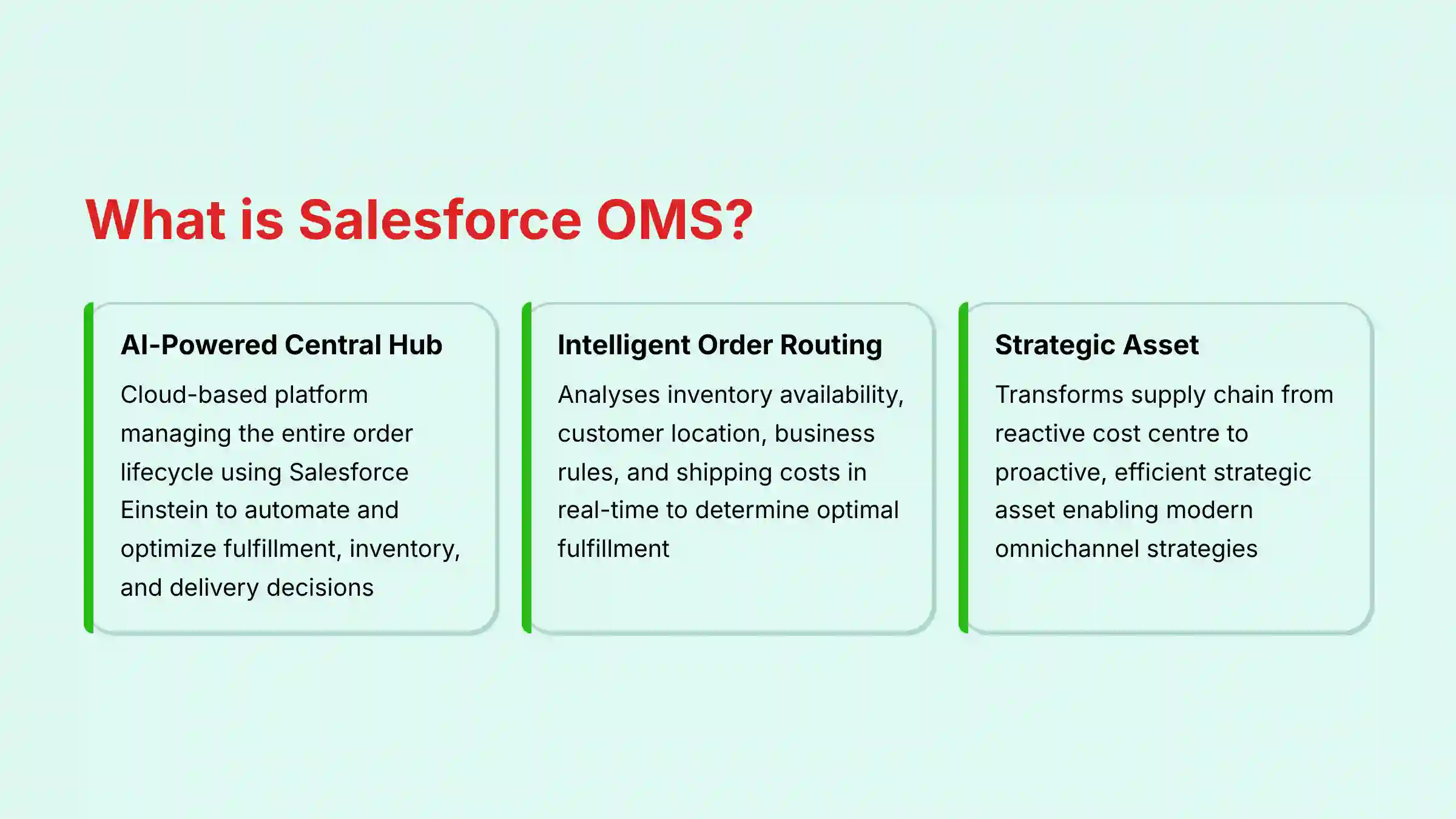
Salesforce Order Management (OMS) is a cloud-based platform designed to be a central hub for managing the entire lifecycle of an order. It uses AI, specifically Salesforce Einstein, to automate and optimize fulfillment, inventory, and delivery decisions, transforming the supply chain from a reactive cost center into a proactive, efficient strategic asset.
For warehouse and inventory operations, this means moving beyond simple order taking and manual decision-making. For businesses seeking comprehensive Salesforce OMS Overview and Features, the platform represents a fundamental shift in how orders are processed and fulfilled.
The AI's primary role is to enable “intelligent order routing.” When an order is received, Einstein analyzes multiple factors in real-time, such as:
- Inventory Availability: Checks stock levels across all locations, including warehouses, distribution centers, and even retail stores.
- Customer Location: Determines the closest fulfillment source to the end customer.
- Business Rules: Considers pre-set rules, such as “fulfill from warehouse before store” or “prioritize orders for VIP customers.”
- Shipping Costs & Speed: Calculates the most cost-effective and fastest fulfillment option to meet customer delivery expectations.
By automating this complex decision-making process, Salesforce OMS helps businesses reduce shipping costs, shorten delivery windows, prevent stockouts, and improve overall customer satisfaction without requiring manual intervention for every order.
It provides the foundation for modern omnichannel strategies like Buy Online, Pick Up In-Store (BOPIS) and Ship-from-Store. Organizations interested in evaluating the system can explore our detailed Salesforce OMS Review for comprehensive insights.
How does Salesforce OMS create a single source of truth for inventory across all sales channels?

Salesforce OMS creates a single source of truth by centralizing inventory data from all disparate systems into one unified platform. Traditionally, businesses struggle with “data silos” where their e-commerce site, physical stores, marketplaces (like Amazon), and ERP system all have separate, non-synchronized views of inventory.
This leads to costly problems like selling out-of-stock items (resulting in canceled orders) or failing to sell available inventory because a specific channel shows “out of stock.”
Salesforce OMS solves this by integrating with all points of commerce and inventory locations. It acts as a real-time ledger, continuously pulling data from and pushing updates to:
- Warehouses & Distribution Centers (via WMS/ERP integration)
- Physical Retail Stores (via POS systems)
- Third-Party Logistics Providers (3PLs)
- Suppliers and Drop-shippers
When an item is sold on your website, picked in a warehouse, or returned to a store, Salesforce OMS updates the “global available-to-promise” inventory count everywhere, instantly.
This ensures that every sales channel, customer service agent, and operations manager is looking at the exact same data. This end-to-end visibility is the cornerstone of an efficient omnichannel operation, allowing businesses to confidently sell every last unit of their stock, regardless of where it is physically located.
What are the key differences between Salesforce OMS and a traditional ERP's order management module?

The primary difference is that Salesforce OMS is a customer-centric, cloud-native platform designed for agility, while traditional ERP order management modules are typically finance-centric, on-premise systems designed for record-keeping.
While both can manage orders, their core philosophies and capabilities are vastly different. Companies considering alternatives should examine our analysis of Salesforce OMS Top Alternatives and Competitors to understand the competitive landscape.
Here are the key distinctions:
- Focus & Flexibility: Salesforce OMS is built around the customer experience, using AI to enable fast, flexible, and cost-effective fulfillment options. ERP modules are often rigid, focusing more on the financial transaction and accounting side of an order rather than the operational fulfillment journey.
- Omnichannel Native vs. Bolted-On: Salesforce OMS is inherently designed for complex omnichannel environments (e-commerce, stores, mobile, marketplaces). Traditional ERPs were built for a simpler era of bulk B2B shipments from a single warehouse and often struggle to manage real-time, multi-location inventory and fulfillment without extensive customization.
- Integration & Ecosystem: Salesforce OMS is part of a broad, interconnected ecosystem (including Commerce Cloud, Service Cloud, and Marketing Cloud), allowing for a seamless flow of data from marketing campaigns to post-sale service. ERP integrations are often more complex, costly, and less focused on the end-to-end customer journey.
- AI and Intelligence: Salesforce OMS has AI (Einstein) at its core for intelligent routing and exception prediction. This capability is rarely found in traditional ERP modules, which rely on static, rule-based logic that requires constant manual updates.
Essentially, an ERP's module answers “Did we book and bill this order correctly?” while Salesforce OMS answers “What is the smartest, fastest, and most profitable way to get this order to the customer?”
How does Salesforce OMS's “intelligent order routing” work to reduce shipping costs and delivery times?

Intelligent order routing in Salesforce OMS is an AI-driven process that automatically selects the optimal fulfillment location for every order based on a combination of cost, speed, and custom business rules.
This replaces manual decision-making or static “if-then” logic that can't adapt to real-time conditions. The process works in a sequence of automated steps:
- Order Ingestion: The order is captured from any sales channel (e.g., website, app, store).
- Inventory Check: The system instantly identifies all locations that have the ordered item(s) in stock (e.g., Warehouse A, Warehouse B, Store C, Store D).
- Constraint & Logic Application: The AI, Salesforce Einstein, then applies multiple layers of logic:
- Cost-Based Logic: It compares shipping rates from each potential location to the customer's address. For example, it will calculate that shipping from a New Jersey store to a New York customer is far cheaper than shipping the same item from a California warehouse.
- Proximity-Based Logic: It prioritizes the physically closest location to shorten delivery times and meet customer expectations for 2-day or next-day shipping.
- Capacity & Business Rules: It also considers location-specific rules, such as a retail store's daily limit for shipping out orders or a business rule to “always fulfill from a distribution center first.”
- Optimal Assignment: Based on the combined analysis, the OMS automatically assigns the order to the single best location—the one that meets the delivery promise at the lowest possible cost—and sends the fulfillment instructions to that location's system (WMS or POS).
This automated optimization, performed in seconds for every order, directly reduces operational expenses by minimizing high-zone shipping charges and boosts customer loyalty by enabling faster, more reliable deliveries.
For practical implementation guidance, organizations can reference comprehensive Salesforce OMS Tutorials and Usecase documentation.
Can Salesforce OMS use AI to predict and manage fulfillment exceptions, like potential shipping delays or stockouts?

Yes, Salesforce OMS uses AI capabilities to identify and manage at-risk orders, but with important limitations regarding external data. The system is designed to create exception workflows based on operational data within the Salesforce ecosystem.
The system manages exceptions in several ways:
- Exception Workflows and SLA Monitoring: Salesforce OMS can flag orders that have missed internal service-level agreements (SLAs), such as orders not fulfilled within 24 hours or shipments that have received stalled status updates from carriers. These exceptions can trigger automated workflows for customer service intervention.
- Inventory Buffers and Safety Stock: While OMS itself is not a demand forecasting tool, it provides the critical real-time inventory visibility needed for AI-powered planning tools to work effectively. By maintaining an accurate, global view of inventory, it allows forecasting systems to more accurately predict when and where safety stock is needed to prevent stockouts.
- Automated Exception Workflows: If an exception occurs (e.g., an item is found to be damaged in the warehouse during picking), the OMS can trigger an automated workflow. Instead of simply canceling the line item, it can instantly re-route that part of the order to the next-best fulfillment location that has the item in stock, saving the sale and preserving the customer experience with minimal manual intervention.
Important Note: For true predictive risk scoring based on external factors like weather events, carrier network delays, or port congestion, businesses will need to integrate Salesforce OMS with additional platforms.
This typically requires separately licensed products such as Salesforce Data Cloud to ingest external data sources, Tableau for advanced analytics, or specialized third-party supply chain visibility platforms. These enhanced capabilities are not included in the core OMS product license and represent additional investment in both software and implementation services.
The most effective approach is to use the OMS's AI predictions to drive human-in-the-loop workflows, where the system flags potential issues and creates cases in Salesforce Service Cloud for customer service agents to review and take appropriate action.
For more specific implementation questions and troubleshooting, businesses can consult the detailed Salesforce OMS FAQs resource.
How does Salesforce OMS integrate with external Warehouse Management Systems (WMS), 3PLs, and shipping carriers?

Salesforce OMS is designed as an integration-first platform, using a robust set of APIs (Application Programming Interfaces) to connect with the broader supply chain ecosystem, including WMS, 3PLs, and carriers.
It is not intended to replace these specialized systems but rather to orchestrate the flow of information between them. The integration strategy typically relies on pre-built connectors and a flexible API framework.

Here's how it generally works for each component:
- Warehouse Management Systems (WMS): Salesforce OMS integrates with the WMS to pass down fulfillment requests (i.e., “pick, pack, and ship this order”) and receive status updates back. When the OMS routes an order to a specific warehouse, it sends the order details via an API call. The WMS then manages the physical fulfillment process within the warehouse. Once the order is shipped, the WMS sends back a shipment confirmation, tracking number, and inventory deduction update to the OMS.
- Third-Party Logistics (3PLs): Integration with 3PLs functions similarly to a WMS integration. The OMS treats the 3PL's warehouse as another fulfillment node in the network. It sends fulfillment orders to the 3PL's system (often via EDI or API) and receives shipment confirmations and inventory updates in return. This allows businesses to leverage external fulfillment partners seamlessly within their routing logic.
- Shipping Carriers: Salesforce OMS can integrate directly with carriers (like FedEx, UPS, DHL) or through multi-carrier shipping software (like Shippo or EasyPost). This connection is used to generate shipping labels, retrieve tracking numbers, and provide customers with real-time visibility into their package's transit status directly within the order history page.
This API-driven approach ensures that the OMS can remain the central “brain” of the operation while leveraging the specialized capabilities of other best-of-breed systems across the supply chain.
The biggest implementation challenge is often data hygiene rather than technical connection. Before beginning integration work, companies should focus on cleaning up and standardizing product SKUs, location codes, and inventory counts across systems. Inconsistent data across your ERP, WMS, and e-commerce platform will cause integration failures regardless of how well the technical APIs are configured.
For businesses managing complex fulfillment networks, exploring Best 10 AI for Order Fulfillment & Picking 2025 can provide valuable insights into complementary AI solutions that work alongside Salesforce OMS.
What is the pricing model for Salesforce OMS? Is it based on order volume, features, or a flat license fee?

The pricing for Salesforce OMS is primarily based on order volume, specifically the number of orders processed by the system annually. This is a common software-as-a-service (SaaS) model in the order management space. It is not a flat license fee.
The cost is typically structured in tiers, where the “cost per order” decreases as the total annual order volume increases.
Several factors will influence the final price:
- Annual Order Volume: This is the main driver. A business processing 50,000 orders per year will be in a different pricing tier than a business processing 500,000 orders per year.
- Product Edition & Features: Salesforce often offers different editions of its products. More advanced editions that include enhanced AI capabilities, more sophisticated analytics, or a greater number of fulfillment locations may come at a higher price point.
- Add-ons and Ecosystem Products: The total cost of ownership will also include any other Salesforce products you bundle, such as Salesforce Commerce Cloud for e-commerce or Service Cloud for customer support. While often sold as a package, these are technically separate licenses.
Because pricing is highly dependent on a company's specific scale and needs, Salesforce does not publish a public price list. You must contact their sales team for a custom quote based on your projected order volume and required feature set.
When budgeting, it's also critical to factor in implementation costs, which are separate from the software license fees.
When evaluating pricing, be sure to clarify which AI capabilities are included in the base OMS license versus which require additional product licenses like Salesforce Data Cloud or Tableau. These distinctions can significantly impact your total investment and expected ROI.
What is a typical implementation timeline for Salesforce OMS, and what internal resources are required?
A typical implementation timeline for Salesforce OMS can range from three to nine months, depending on the complexity of the business. A straightforward implementation for a direct-to-consumer brand with one warehouse might be on the shorter end, while a complex, global, omnichannel enterprise with dozens of fulfillment nodes and legacy system integrations will be on the longer end.
The implementation project is usually broken down into key phases:
- Discovery & Scoping (1-2 months): This involves detailed workshops to map out all current order processes, define fulfillment logic, and design the future state. This is the most critical phase.
- Configuration & Integration (2-4 months): This is the core technical work of setting up the OMS, configuring the routing rules, and building the API connections to the ERP, WMS, and other systems.
- Testing (1-2 months): End-to-end user acceptance testing (UAT) is performed to ensure orders flow correctly from checkout to fulfillment and that all data is passed accurately between systems.
- Training & Go-Live (1 month): Training of internal teams (customer service, operations) and a phased rollout of the system.
In terms of internal resources, a successful implementation requires a dedicated cross-functional team, including:
- A Project Manager: To oversee the timeline, budget, and coordination.
- An Operations Lead: A subject matter expert who deeply understands the company's fulfillment and inventory processes.
- An IT/Technical Lead: To manage the data migration and technical integrations with other systems.
- A Customer Service Lead: To represent the needs of the post-purchase experience.
Most companies hire a certified Salesforce implementation partner to manage the technical configuration and provide strategic guidance throughout this process.
The most common point of failure in an OMS implementation has nothing to do with technology; it's about change management. The new system will fundamentally change how your operations and customer service teams work.
Don't wait until the “Training” phase to involve them. Embed key operational users in the project from day one. Have them participate in the Discovery and Testing phases. When users feel a sense of ownership over the new process, adoption rates skyrocket, and you'll uncover critical process details you would have otherwise missed.

Leave a Reply