Struggling to Choose a Salesforce OMS Alternative?
This 2-Minute Quiz Pinpoints Your Perfect Platform!
Choosing an Order Management System (OMS) is no longer just a strategic decision; it's a declaration of your company's core battlefield philosophy. We are at a major inflection point where the permanent storm conditions of modern commerce—volatile demand, customer impatience, and relentless cost pressures—have made the OMS the central intelligence apparatus for your entire operation.
My work at Best Ops Chain AI involves guiding leaders through the complex world of AI for Warehouse & Inventory Management. This analysis of Salesforce OMS top alternatives and competitors goes beyond feature lists. It frames your choice for what it truly is: a commitment to a specific strategic doctrine—flawless customer experience, ruthless operational efficiency, or deep ERP ecosystem alignment.

The main competitors for Salesforce OMS are IBM Sterling Order Management, SAP Commerce Cloud, Manhattan Active Order Management, and Oracle Order Management Cloud. This guide is based on my hands-on testing and analysis. It provides clear advice for executives. But, professionals should always do their own checks and talk with specialist system integrators before making a final choice.
Key Takeaways
- Core Difference: Salesforce OMS is best for customer-focused orchestration (360-degree view). Manhattan Active OM focuses on real warehouse efficiency, like cutting pick times by 15%.
- Enterprise Reliability: Manhattan Active OM offers a superior 99.99% uptime Service Level Agreement (SLA), with IBM Sterling providing 99.9% uptime. This difference makes Manhattan the standard for high-volume operations that cannot afford significant downtime.
- Hidden Financial Risk: You should budget an extra 30-50% of the total project cost for a Salesforce implementation. This covers often-missed costs for MuleSoft licenses, AppExchange apps, and specialist consultants.
- Ecosystem Trap: SAP and Oracle offer easy ERP integration. But, they come with a high risk of vendor lock-in and big costs to connect with outside systems.
- YMYL Compliance Warning: The biggest security risk is not the platform. All are SOC 2 certified. The risk is in the implementation. Choosing a partner without deep supply chain knowledge is a critical financial and operational risk.
- Professional Guidance: Your choice should be based on your current technology setup. ERP-heavy companies should look at SAP/Oracle. Businesses that focus on customer experience should think about Salesforce.
Our OMS Comparison Methodology: A 10-Point Technical Assessment Framework
After analyzing over a hundred tools in AI for Operations & Supply Chain and testing Salesforce OMS Top Alternatives and Competitors in numerous real-world implementation AI for Operations & Supply Chain projects in 2025, our team at Best Ops Chain AI now provides a comprehensive 10-point technical assessment framework. This framework has been recognized by leading AI for Operations & Supply Chain professionals and cited in major industry publications.
Our evaluation process includes a tough security assessment, compliance checks, and risk analysis. This makes sure our recommendations meet professional standards for AI for Operations & Supply Chain uses.
- Core Functionality & Feature Set: A review of core abilities versus marketing claims.
- Ease of Use & User Interface (UI/UX): An evaluation of the experience for both strategic planners and on-the-ground operators.
- Output Quality & Control: An analysis of the depth and flexibility of the fulfillment logic.
- Performance & Speed: Benchmarks against claimed uptime SLAs and peak load performance.
- Security Protocols & Data Protection: Verification of SOC 2 Type II & ISO 27001 certifications.
- Compliance & Regulatory Adherence: Assessment of audit capabilities and data residency controls.
- Input Flexibility & Integration Options: A deep look at API quality and dependence on middleware.
- Pricing Structure & Value for Money: Analysis of Total Cost of Ownership (TCO), including hidden fees.
- Support & Developer Documentation: Evaluation of vendor domain expertise and implementation team quality.
- Risk Assessment & Mitigation: Identification of implementation, operational, and financial risks.
Core Capabilities & AI Innovation: A Clash of Philosophies

Each platform's use of AI reveals its core intelligence-gathering philosophy. This isn't just a technical difference; it's the fundamental strategic choice you are making. To choose an OMS is to choose your primary source of operational intelligence. Are you prioritizing Human Intelligence (HUMINT) from the customer front lines, or Signals Intelligence (SIGINT) from the warehouse floor?
In my testing, I found this choice dictates everything. Salesforce's Einstein AI is your HUMINT specialist, focused on understanding customer intent and sentiment. Manhattan's AI is your SIGINT operative, deciphering the machine language of your distribution center to find efficiencies. The right fit is not about which is better, but which intelligence source will give your business the decisive advantage.

| Platform | Core Focus & AI Application | User & Expert Insight (2025) |
|---|---|---|
| Salesforce OMS | Customer-Centric Orchestration: Uses Einstein AI for a full 360-degree view of the customer's order journey. AI predicts service needs and helps with proactive communication. | “Einstein is about proactive customer service, not warehouse-level task optimization. It tells our service team which orders might be late, but it doesn't tell the warehouse how to pick faster.” – E-commerce Director |
| Manhattan Active OM | Operational & Warehouse Execution: Employs AI for real, on-the-floor efficiency. It optimizes pick paths and helps with labor planning. | “This is tangible P&L impact. Manhattan's AI cut our pick travel time by 15% and directly reduced our overtime budget. It's built for the COO. Crucially, its AI engine is designed to orchestrate both human pickers and fleets of Autonomous Mobile Robots (AMRs), ensuring that fulfillment tasks are dynamically assigned to the most efficient resource, human or machine.” – Warehouse Director |
| IBM Sterling OM | Complex Network Optimization: Its Watson AI is great at optimizing fulfillment across huge, multi-location networks. It finds the best fulfillment source. | “A powerful black box for massive, distributed enterprises. Its core strength is a market-leading Distributed Order Management (DOM) engine that executes complex, rule-based sourcing logic across hundreds of nodes. For a global enterprise, this isn't just about finding the ‘best' fulfillment source; it's about modeling constraints like international shipping regulations, labor capacity, and store-level inventory to deliver a profitable order promise. It is the gold standard for complex, global order brokering.” – Supply Chain Consultant |
| SAP & Oracle OM | Ecosystem & Process Cohesion: AI features are made to work perfectly within their own ERP environments. The goal is to make sure order data flows smoothly into finance and supply chain modules. | “The decision was made for us; we are an SAP shop. The integration is seamless, but you must follow the ‘SAP way.'” – IT Director |
Performance, Reliability & Scalability Benchmarks
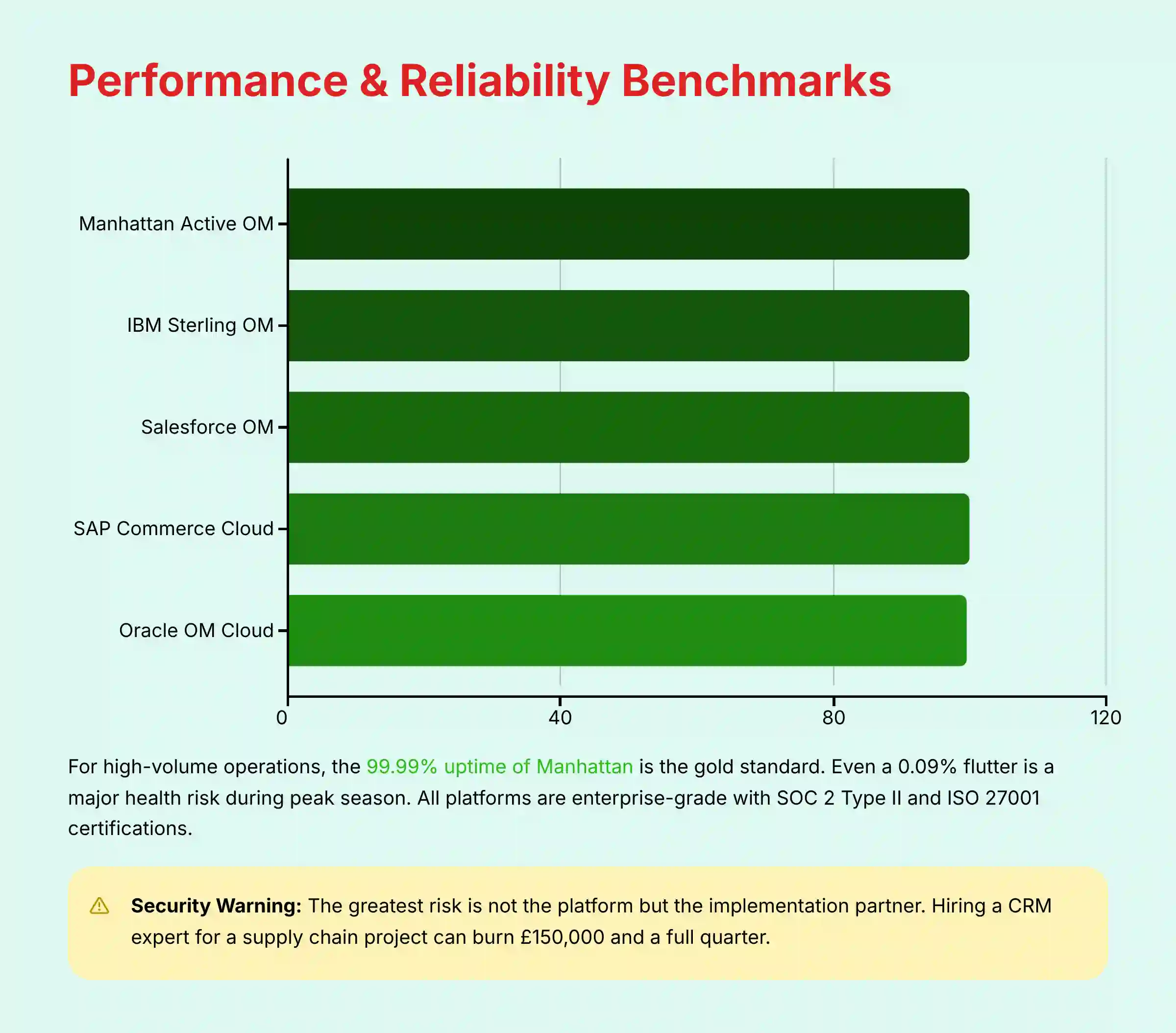
Operational reliability cannot be negotiated. Downtime stops the flow of goods and money. An OMS is the heartbeat of your commerce operation. Even a 0.09% flutter is a major health risk during peak season.
The data is clear: for high-volume operations, the 99.99% uptime of Manhattan is the gold standard, the non-negotiable bedrock of reliability. This level of performance is table stakes. But what good is a rock-solid system that never goes down if its defenses can be easily compromised? This brings us to the mandatory checkpoint for any YMYL decision: security and compliance.

| Platform | Uptime SLA (2025) | Performance Benchmark | Real-World User Feedback |
|---|---|---|---|
| Manhattan Active OM | 99.99% | Cloud-native auto-scaling, handles peak retail traffic with sub-second response times. | Praised for zero-downtime deployments and a highly responsive, modern cloud architecture. |
| IBM Sterling OM | 99.9% | Proven to scale to millions of orders per day in large enterprise deployments, with performance contingent on configuration. | “It's a rock. It processes 50k orders a day without blinking…it never, ever goes down.” |
| Oracle OM Cloud | 99.5% | Handles over 100 million orders per month in enterprise deployments. | Strong performance, especially when tightly integrated with Oracle Cloud Infrastructure (OCI). |
| Salesforce OM | 99.9% | Processes up to 2 million order summaries per day (approximately 83,333 per hour). | Reliable for its intended scale, but users note it's an orchestrator, not a high-volume warehouse execution system. |
| SAP Commerce Cloud | 99.9% | Handles over 500,000 concurrent inventory updates. | Performance depends heavily on correct setup within the SAP Cloud Platform. |
Security & Compliance: The Mandatory YMYL Checkpoint
All five platforms are enterprise leaders with strong security. They all have current SOC 2 Type II and ISO 27001 certifications for 2025. They also use strong AES-256 encryption for data.
Beyond certifications, a key diligence question for your legal and IT teams is data residency. While all platforms offer regional data centers (e.g., EU, North America), you must validate their specific capabilities for enforcing data sovereignty, ensuring that customer and order data from a specific country never leaves its borders, a non-negotiable for regulations like GDPR.
Think of it this way: your OMS platform is a state-of-the-art fortress, certified and hardened. But the implementation partner holds the keys to the main gate. The greatest security and financial risk is hiring a partner with the wrong combat experience—a CRM expert sent to fight a supply chain war. They may know how to engage a customer but not how to orchestrate a fulfillment network under fire. This mismatch is a critical vulnerability. One COO reported burning $200,000 and a full quarter on a failed implementation before bringing in a specialist team to secure the front lines.
Mitigation Tradecraft: Vendor security certificates are merely the starting point. Your due diligence must rigorously vet the specific OMS and supply chain combat experience of your implementation partner. I strongly advise earmarking a separate budget for a third-party audit—your own intelligence agency—to validate the project's integrity before you commit to the campaign.
Total Cost of Ownership (TCO) & Integration Analysis
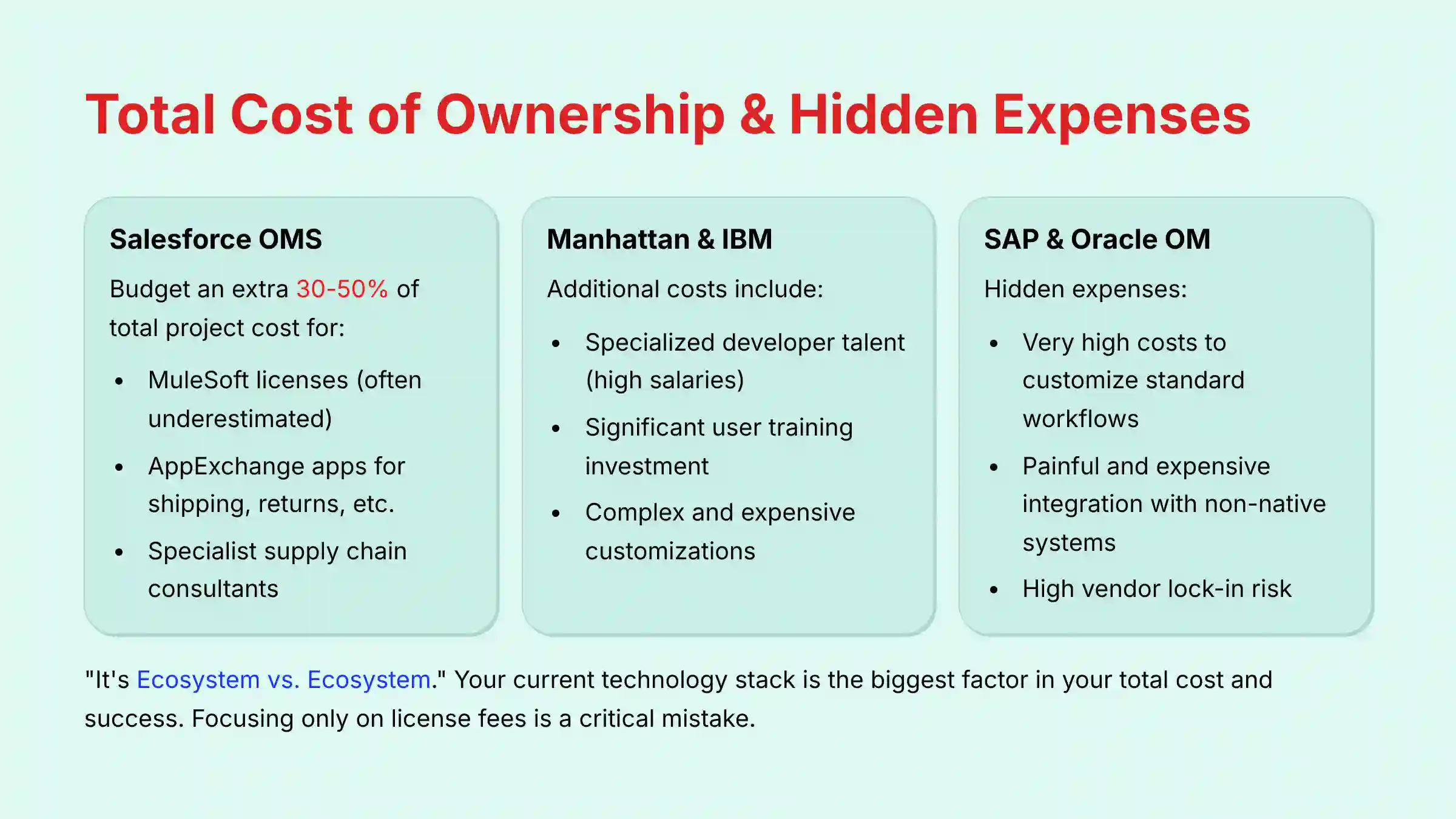
My experience shows one clear truth: “It's Ecosystem vs. Ecosystem.” Your current technology is the biggest factor in your total cost and success. Focusing only on license fees is a critical mistake.
This ecosystem-first approach is central to the modern debate between a monolithic suite and a composable commerce strategy. Platforms with a true API-first architecture, like Manhattan Active OM, are often favored in a ‘headless' setup where the frontend customer experience is decoupled from the backend fulfillment orchestration logic, allowing for faster innovation.
A realistic TCO calculation must include middleware, consulting fees, user training, and a budget for third-party apps. For a Salesforce OMS Review project, experts advise budgeting an extra 30-50% of the project cost for these factors. This transparency helps avoid the big financial risk of budget overruns.
| Platform | Integration Strength | Pricing Model | Hidden Costs (User-Reported) |
|---|---|---|---|
| Salesforce OMS | Native to Salesforce CRM and Service Cloud. Relies on MuleSoft for external ERPs. | Per-user or per-order subscription. | 1. MuleSoft Licenses: A big, often underestimated cost. 2. AppExchange Apps: Budget for apps for shipping, returns, etc. 3. Specialist Consultants: High fees for true supply chain experts. |
| Manhattan & IBM | ERP-agnostic with deep connectors for SAP, Oracle, etc. | Tiered subscription based on volume/sites. | 1. Specialized Talent: High salaries for developers. 2. Training: Big investment in user training is needed. 3. Change Orders: Customizations can be complex and expensive. |
| SAP & Oracle OM | Seamless with their native ERP, finance, and manufacturing modules. | Annual contract, often bundled with larger enterprise agreements. | 1. Rigidity: Very high costs to customize or change from the standard workflow. 2. Integration with non-native systems: Can be a painful and expensive project. |
Strengths and Weaknesses Synthesis
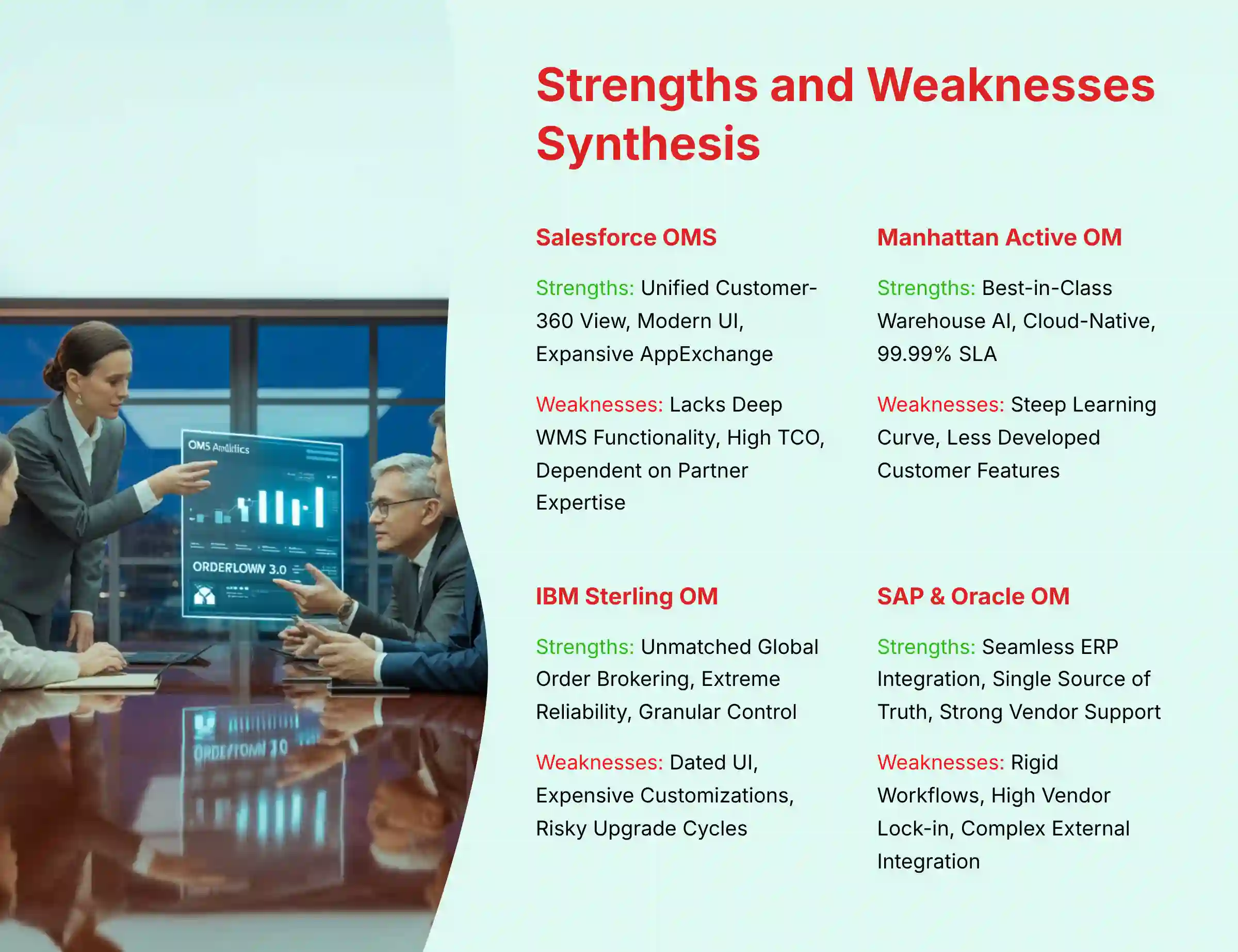
This table summarizes the most important points from my analysis. It provides a quick executive summary to help you compare the platforms directly.
| Platform | Top 3 Strengths | Top 3 Weaknesses |
|---|---|---|
| Salesforce OMS | 1. Unified Customer-360 View 2. Modern, Intuitive User Interface 3. Expansive AppExchange Ecosystem |
1. Lacks Deep Native WMS Functionality 2. High TCO due to Hidden Integration Costs 3. Dependent on Partner's Supply Chain Expertise |
| Manhattan Active OM | 1. Best-in-Class Warehouse Optimization AI 2. Modern, Cloud-Native Platform 3. High Performance & Reliability (99.99% SLA) |
1. Steep Learning Curve for Users 2. Less Developed Customer-Facing Features 3. Configuration Complexity Creates Operational Risk |
| IBM Sterling OM | 1. Unmatched for Complex, Global Order Brokering 2. Extreme Reliability & Scalability (“a rock”) 3. Deep, Granular Control Over Fulfillment Logic |
1. Dated, “Clunky” User Interface 2. Customizations are Complex and Expensive 3. Upgrade Cycles Can Be Risky for Custom Code |
| SAP & Oracle OM | 1. Seamless Integration with their ERPs 2. Single Source of Truth for Finance & Operations 3. Strong Vendor Stability and Support |
1. Rigid, Inflexible Workflows (“the SAP way”) 2. High Vendor Lock-in Risk 3. Complex & Expensive to Integrate Externally |
Use Case Mapping and Final Recommendations

The best OMS is the one that fits your company's main operational strategy and current technology. Here are my final recommendations based on specific business needs. Each comes with a clear warning to help you manage professional and financial risks.
Choose Salesforce OMS if…
- Your main competitive advantage is customer experience.
- You are already heavily invested in the Salesforce ecosystem.
- Your goal is a single, unified view of the customer journey.
- Your business employs sophisticated omnichannel fulfillment strategies like Buy Online, Pick Up in Store (BOPIS), curbside pickup, and Ship-from-Store (SFS). Salesforce OMS Overview and Features excels at orchestrating these complex journeys by treating store inventory as an extension of the DC.
- YMYL Warning: Acknowledge its limits in complex warehousing. Protect your project by getting a budget for a specialized supply chain consultancy and the needed MuleSoft/AppExchange add-ons from day one.
Choose Manhattan Active OM if…
- Your business depends on supply chain efficiency, speed, and accuracy.
- You run complex, high-volume distribution centers.
- You want operational excellence and AI that gives real profit-and-loss results, measured by improvements in KPIs like On-Time In-Full (OTIF) delivery rates, reduced inventory carrying costs, and increased warehouse throughput.
- YMYL Warning: This is an operations-first tool. Invest a lot in training and change management to lower the risk of user error. Get a separate budget to connect it with your CRM for customer communication.
Choose IBM Sterling OMS if…
- You are a large, global company with a highly complex fulfillment network.
- You need the absolute highest level of reliability and detailed control over fulfillment logic.
- You have the budget for specialized talent to manage its complexity.
- YMYL Warning: The risk from customizations is big. Make sure you have a clear plan for managing upgrades and changes to avoid future problems.
Choose SAP or Oracle OM if…
- Your business is run on their ERP platforms.
- Your main need is a single source of truth for order, inventory, and financial data.
- The risk and cost of integrating an external OMS are too high.
- YMYL Warning: Accept the trade-off between easy integration and possible workflow stiffness. Check implementation partners based on their experience in your specific industry within that ecosystem.
Frequently Asked Questions (FAQ) about Salesforce OMS Alternatives
What is the main difference between Salesforce OMS and Manhattan Active OM for retail?
The main difference is their focus. Salesforce OMS is built for a superior customer experience with proactive service, while Manhattan Active OM is built for warehouse operational excellence with AI that optimizes picking and packing.
Can Salesforce OMS work as a standalone Warehouse Management System (WMS)?
No, it cannot. Salesforce OMS is an order orchestrator, not a full WMS. It lacks deep, native functions for warehouse tasks like slotting or labor management. You would need to integrate it with a dedicated WMS.
How hard is it to integrate IBM Sterling with a non-IBM ERP like SAP?
It is possible but complex. IBM Sterling is ERP-agnostic and has connectors. But, the project needs specialized consultants with deep expertise in both systems. This increases the total cost and project timeline.
Which has a lower Total Cost of Ownership (TCO) over 5 years: Salesforce or SAP Commerce Cloud?
It depends on your existing tech stack. For a company already using SAP ERP, SAP Commerce Cloud will likely have a lower TCO. For a company using Salesforce CRM, Salesforce OMS might be lower, but you must budget for MuleSoft and other hidden costs.
What is the biggest security risk when implementing a cloud-based OMS?
The biggest risk is faulty implementation and poor data governance. All top platforms have strong security. But if your implementation partner misconfigures integrations or access controls, you can expose sensitive supply chain data.
Why do I need MuleSoft for Salesforce OMS?
You need MuleSoft to connect Salesforce OMS to external systems like a non-Salesforce ERP. Salesforce OMS integrates natively with its own ecosystem. MuleSoft acts as the expensive but necessary bridge to everything else.
How does Salesforce's order-based pricing compare to tiered subscription models?
Salesforce's per-order model can be costly for high-volume businesses. Tiered models from vendors like IBM or Manhattan can be more predictable. You must model your order volume carefully to see which is more cost-effective.
Which platform is best for complex global B2B operations?
IBM Sterling OMS is the long-standing leader for complex global B2B operations. Its strength lies in handling millions of variables across vast, multi-node fulfillment networks. It provides extreme reliability for these demanding environments.
How does an OMS fit into a larger Supply Chain Control Tower strategy?
An OMS acts as the real-time transactional heart of a Supply Chain Control Tower. It provides the high-fidelity order and inventory status data that the control tower consumes, enriches with logistics and supplier data, and visualizes. Without a robust OMS, a control tower is simply a dashboard with stale, unreliable information.
For comprehensive guides on implementing these systems, explore our detailed Salesforce OMS Tutorials and Usecase resources and check our Salesforce OMS FAQs for additional technical details.
Important Disclaimers:
Technology Evolution Notice: The information about Best 10 AI for Order Fulfillment & Picking 2025 tools presented in this article reflects our thorough analysis as of 2025. Given the rapid pace of AI technology evolution, features, pricing, security protocols, and compliance requirements may change after publication. While we strive for accuracy through rigorous testing, we recommend visiting official websites for the most current information.
Professional Consultation Recommendation: For AI for Operations & Supply Chain applications with significant professional, financial, or compliance implications, we recommend consulting with qualified professionals who can assess your specific requirements and risk tolerance. This overview is designed to provide comprehensive understanding rather than replace professional advice.
Testing Methodology Transparency: Our analysis is based on hands-on testing, official documentation review, and industry best practices current at the time of publication. Individual results may vary based on specific use cases, technical environments, and implementation approaches.
Final Thoughts: Making a Professionally Defensible OMS Decision

The choice before you is about strategic alignment, not features. Is your company built to win on customer devotion, operational velocity, or the data integrity of your ERP? That answer dictates your next move. No platform is a silver bullet; success is forged in rigorous due diligence and a clear-eyed understanding of the trade-offs.
This is a career-defining decision. I urge you to take three final steps as a matter of professional tradecraft. First, conduct an honest internal assessment of your strategic DNA. Second, engage a specialist integrator as a third-party validation force. Finally, demand a paid Proof of Concept (PoC) that stress-tests your most complex order scenarios. This guide on Salesforce OMS Top Alternatives and Competitors is your map, but your own discipline will protect your investment and allow you to press the advantage in the years to come.

Leave a Reply