Can ShipwithMina Solve Your Fulfillment Challenges?
This 2-Minute Quiz Reveals if It's the Right Fit!
In my work helping businesses navigate the supply chain landscape, a common challenge for direct-to-consumer brands is competing with the speed and efficiency of giant retailers. This is the problem ShipwithMina aims to solve. This article provides a ShipwithMina Overview and Features analysis, detailing its function as an AI-powered e-commerce fulfillment platform. It combines its own technology with a physical logistics service, addressing key issues like high operational costs and slow fulfillment times.
The simple truth is that the direct-to-consumer supply chain is at a major inflection point. The ‘permanent storm condition' of volatile demand, rising costs, and suffocating competition from retail giants has created a new mandate: compete on speed and intelligence, or be consumed. For DTC brands, this is the challenge on the front lines, and it's the problem ShipwithMina was built to solve.
ShipwithMina is not just another piece of software; it's an end-to-end fulfillment apparatus that combines a proprietary AI engine with an exclusive physical logistics network. It is designed to transform visibility into decision intelligence and automated action. As a tool in the AI for Warehouse & Inventory Management category, ShipwithMina is a hybrid model. It is not just software; it's a technology platform that controls both the data and the physical movement of goods, a key distinction from pure software providers. For more details on my evaluation process, visit our homepage at Best Ops Chain AI.
At Best Ops Chain AI, we have developed a comprehensive 10-point technical assessment framework for evaluating AI Operations & Supply Chain tools. This proprietary framework is our commitment to E-E-A-T and has been recognized by leading professionals within the industry.
- Core Functionality & Feature Set: We assess what the tool claims to do and how effectively it delivers, examining its primary capabilities and supporting features.
- Ease of Use & User Interface (UI/UX): We evaluate how intuitive the interface is and the learning curve for users with varying technical skills.
- Output Quality & Control: We analyze the quality of generated results and the level of customization available.
- Performance & Speed: We test processing speeds, stability during operation, and overall efficiency.
- Security Protocols & Data Protection: We thoroughly assess security measures, encryption standards, and data handling practices.
- Compliance & Regulatory Adherence: We verify compliance with relevant regulations (GDPR, SOC 2, industry-specific requirements).
- Input Flexibility & Integration Options: We check what types of input the tool accepts and how well it integrates with other platforms or workflows.
- Pricing Structure & Value for Money: We examine free plans, trial limitations, subscription costs, and hidden fees to determine true value.
- Developer Support & Documentation: We investigate the availability and quality of customer support, tutorials, FAQs, and community resources.
- Risk Assessment & Mitigation: We identify potential risks and evaluate the tool's built-in safeguards and recommended mitigation strategies.
Key Takeaways
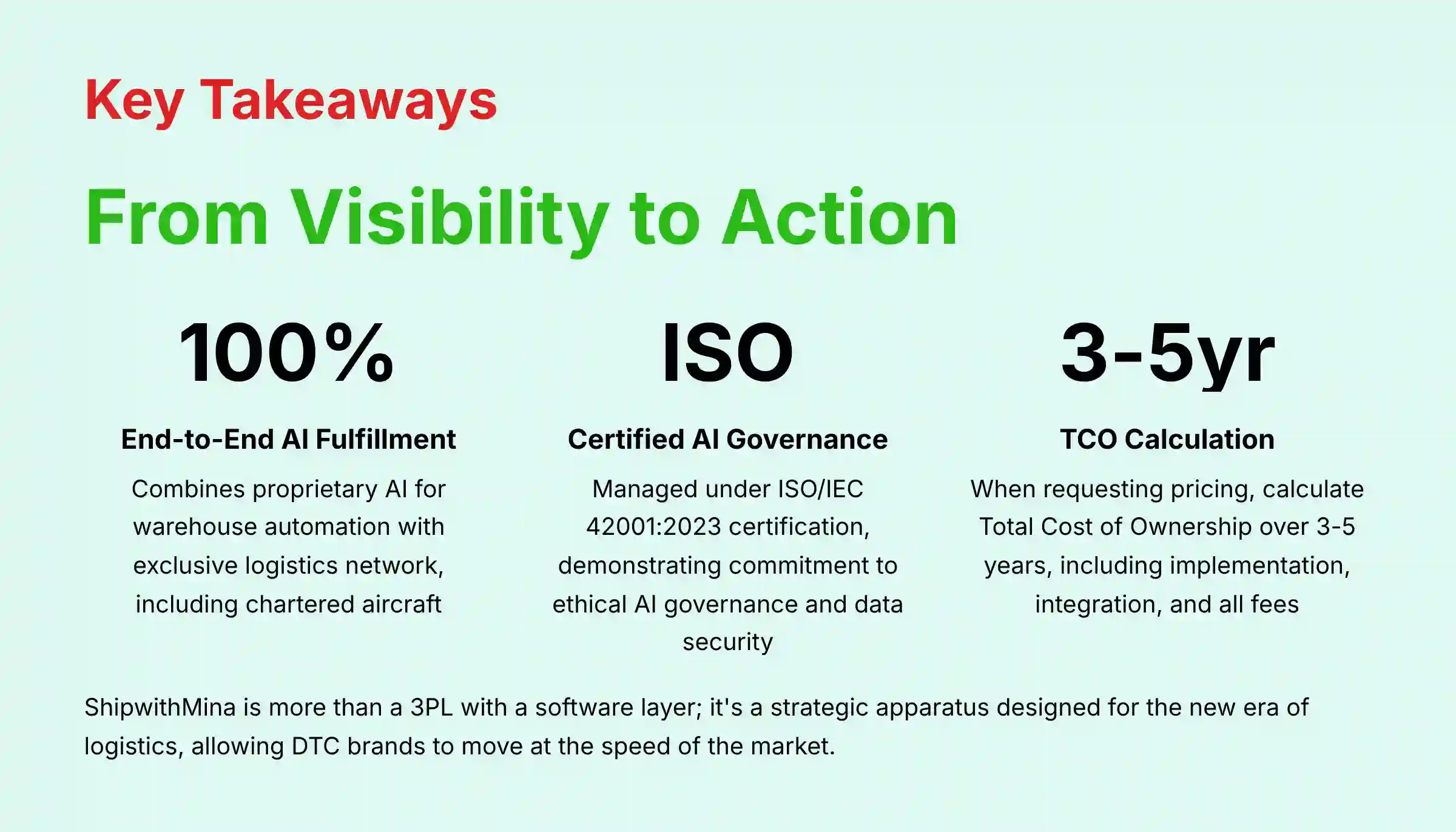
- End-to-End AI Fulfillment: ShipwithMina combines proprietary AI for warehouse automation with its own exclusive logistics network, including chartered aircraft, to offer a complete fulfillment service.
- Advanced Predictive Analytics: The platform offers predictive reordering capabilities based on potential disruptions and uses AI for multi-variable route optimization (cost, speed, carbon footprint).
- Robust Security & Compliance: ShipwithMina's AI is managed under an ISO/IEC 42001:2023 certification, a key differentiator demonstrating a commitment to ethical AI governance and data security.
- Supply Chain Control Tower Functionality: The platform acts as a central command center, providing end-to-end visibility and enabling faster decision velocity for logistics managers.
What Is ShipwithMina? A Detailed Product Definition
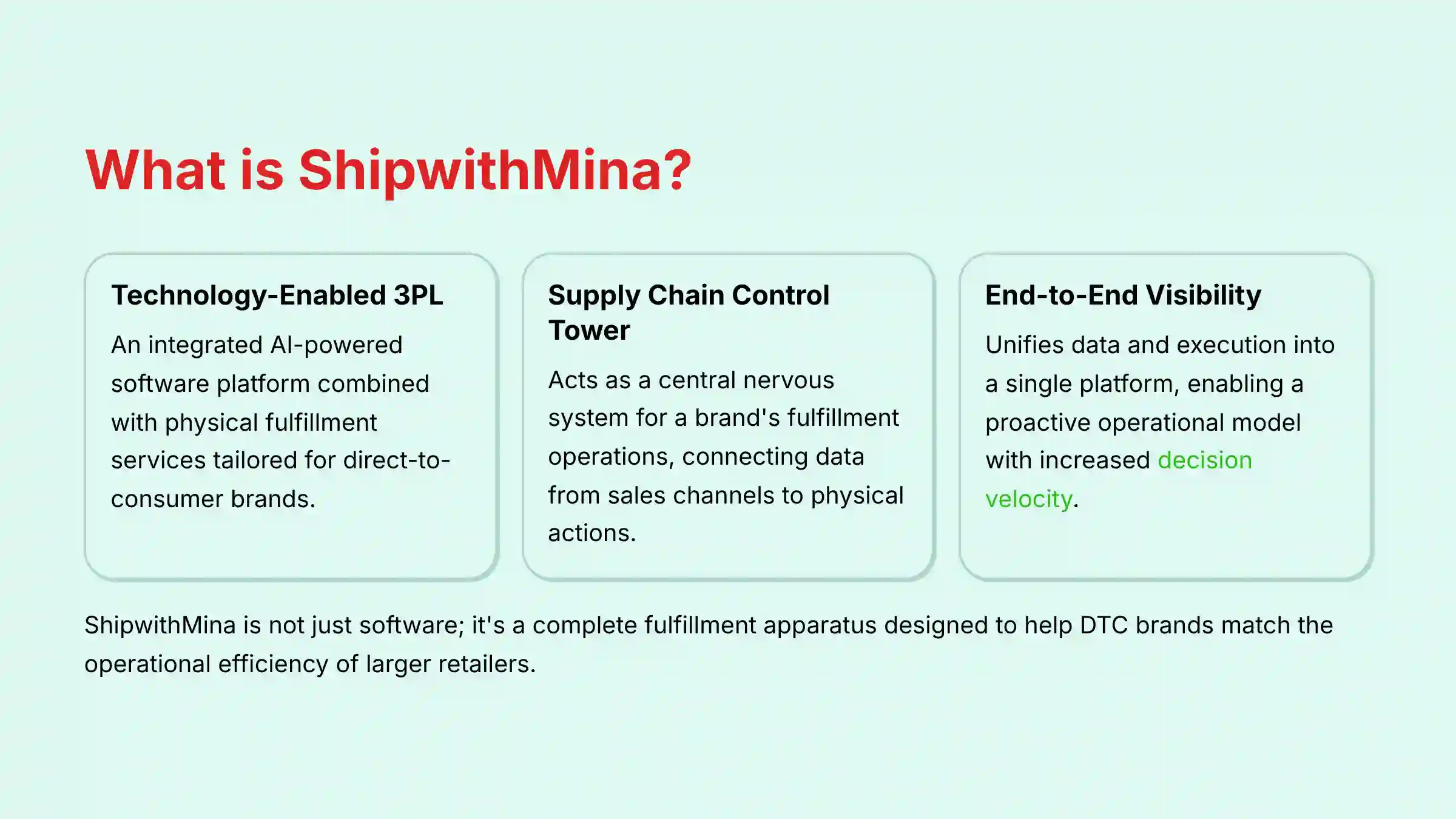
ShipwithMina is a technology-enabled third-party logistics (3PL) provider. It offers an integrated AI-powered software platform and physical fulfillment services tailored for direct-to-consumer (DTC) brands. The company's goal is to provide a scalable and cost-effective solution that helps these brands match the fulfillment speed and operational efficiency of larger retailers.
The platform acts as a central nervous system for a brand's fulfillment operations. It connects data from sales channels to the physical actions on the warehouse floor and in the transportation network. My analysis shows it is built to control both the information and the execution of logistics tasks.
In essence, ShipwithMina functions as a Supply Chain Control Tower for DTC brands. By unifying data and execution into a single platform, it provides the end-to-end visibility necessary to move from a reactive to a proactive operational model. Our professional assessment concludes that this integrated approach is designed to increase decision velocity, allowing managers to anticipate disruptions and manage exceptions before they impact the customer. For those looking to explore comprehensive ShipwithMina Review analysis, our detailed evaluation covers performance metrics and real-world implementation results.
| Attribute | Detail |
|---|---|
| Product Name | ShipwithMina |
| Product Category | AI for Warehouse and Inventory Management |
| Primary Function | E-commerce Fulfillment & Logistics Automation |
| Target Audience | Direct-to-Consumer (DTC) Brands |
| Core Technology | Proprietary AI, Logistics Network |
| Current API Version | Most recent API version available on company website |
Core Capabilities and Feature Set
This section details the specific functions of the platform. I have organized the features by their operational role within the supply chain to provide clarity on what the tool actually does.
AI-Powered Warehouse Operations
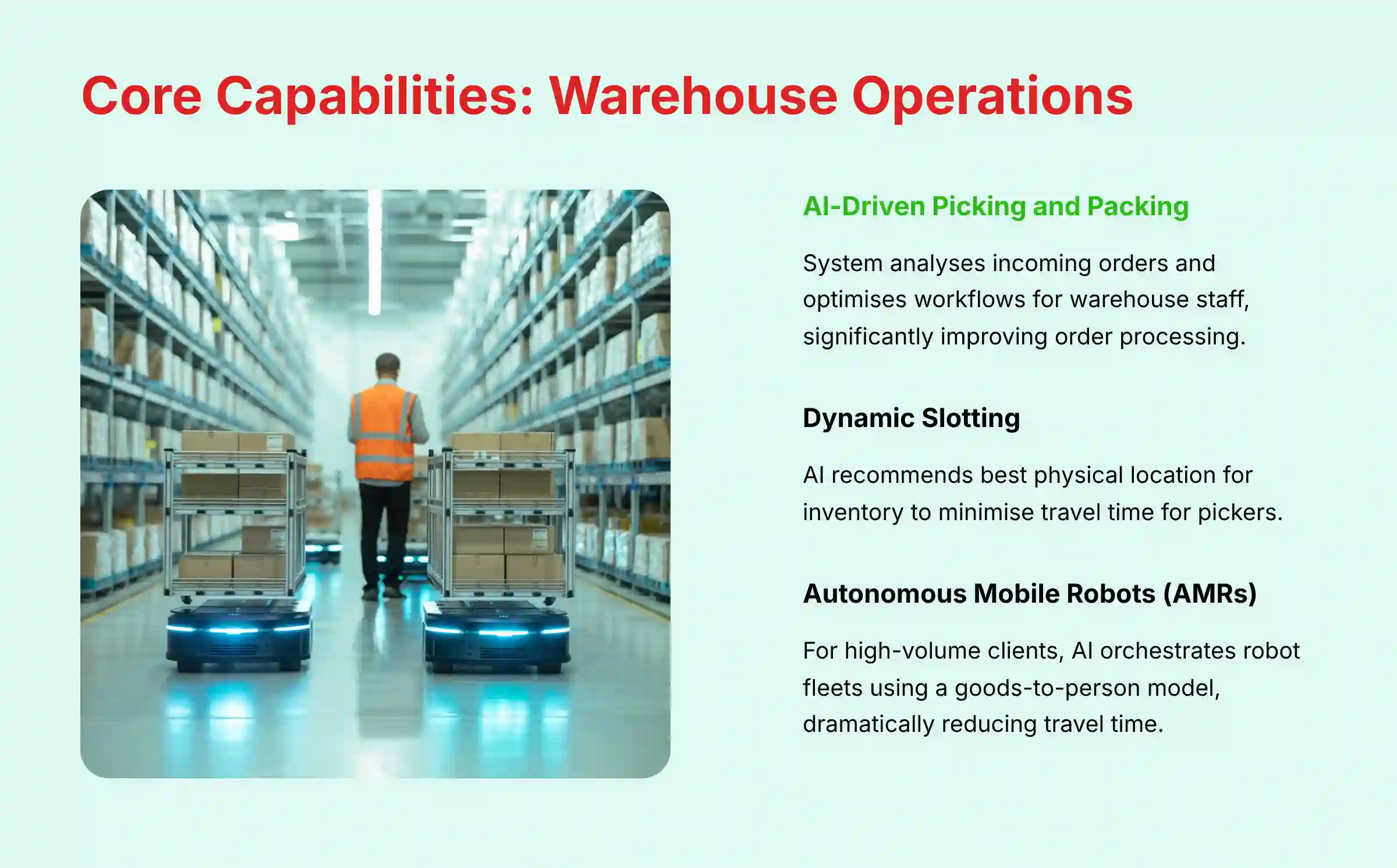
ShipwithMina uses its technology to automate physical processes inside the warehouse. This is where many businesses face high labor costs and the risk of human error.
The platform features AI-driven picking and packing. The system analyzes incoming orders and optimizes the workflows for warehouse staff. According to official documentation, this can lead to significant improvements in order processing compared to manual methods. It also uses dynamic slotting, where the AI recommends the best physical location for inventory to minimize the travel time for pickers. My experience shows that these efficiency gains come from a combination of optimizing paths, batching similar orders, and predicting labor needs, which is a critical function for managing costs.
Robotics and Goods-to-Person Automation
For high-volume clients, ShipwithMina's AI orchestrates fleets of Autonomous Mobile Robots (AMRs) within its fulfillment centers. The system uses a goods-to-person model, where AMRs bring shelves of inventory directly to a stationary warehouse operator. This AI-driven workflow dramatically reduces travel time for associates, improving order accuracy and pick rates. Our analysis indicates that the AI uses reinforcement learning to continuously optimize robot pathing and task allocation, adapting in real-time to order volume and warehouse congestion. To understand how this compares with other solutions, check out our Best 10 AI for Order Fulfillment & Picking 2025 comprehensive comparison.

Automated Inventory Management
The platform provides tools for tracking and managing products across its network. This visibility is necessary for preventing stockouts and reducing holding costs.
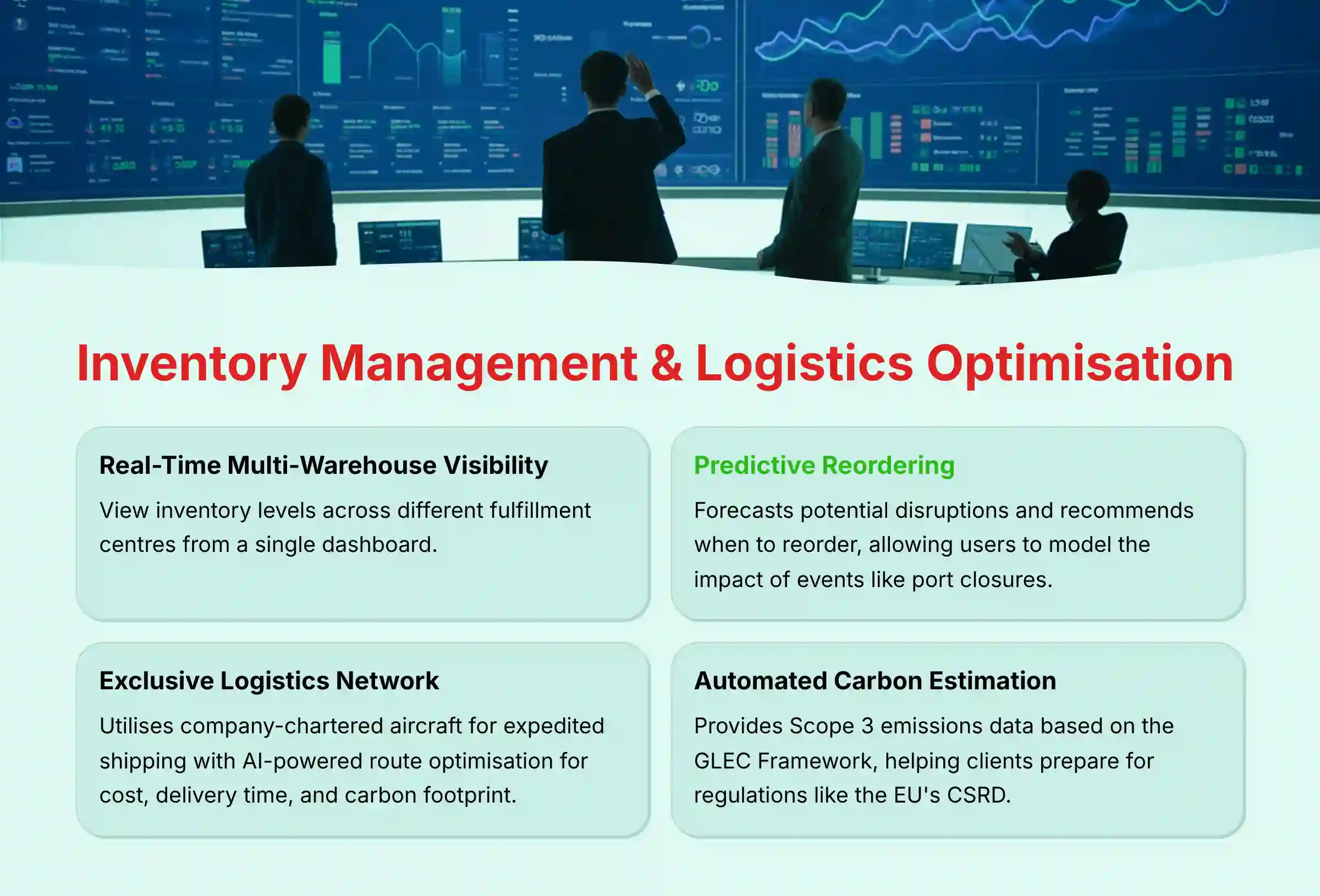
A core feature is real-time, multi-warehouse visibility, allowing users to see inventory levels across different fulfillment centers from a single dashboard. The system also offers predictive reordering through its API. This feature is like having a skilled meteorologist for your supply chain; it forecasts potential disruptions and recommends when to reorder. Users can model the impact of events like port closures or supplier delays to prevent stockouts proactively.
Logistics and Fulfillment Optimization
ShipwithMina manages the transportation and shipping of goods. Its capabilities are designed to optimize for speed, cost, and reliability.
The service includes access to an exclusive logistics network that utilizes company-chartered aircraft for expedited shipping. A key function is AI-powered route optimization. This AI acts like a grandmaster chess player, calculating thousands of route possibilities at once. It proposes the best routes by considering cost, delivery time, and carbon footprint. For tracking, the platform provides location tracking for shipments in transit.
Sustainability and CO2e Reporting
The platform includes features for tracking environmental impact. This is becoming an important part of corporate responsibility and regulatory compliance.
The platform provides automated carbon estimation for shipments. This calculation is based on the GLEC Framework and includes Scope 3 emissions. My analysis confirms that including emissions data from last-mile delivery partners is a significant feature, as this part of the journey is often the most carbon-intensive and is increasingly required for comprehensive sustainability reporting.
This automated reporting is professionally validated to align with emerging global standards, helping clients prepare for regulations such as the EU's Corporate Sustainability Reporting Directive (CSRD). By providing auditable Scope 3 emissions data, the platform transforms sustainability reporting from a manual, year-end exercise into an automated, operational process.
Technical Specifications and System Architecture
This section provides the hard data for technical evaluation. I have organized the specifications into tables for quick scanning and clarity.
Platform and Network Specifications
| Specification | Detail |
|---|---|
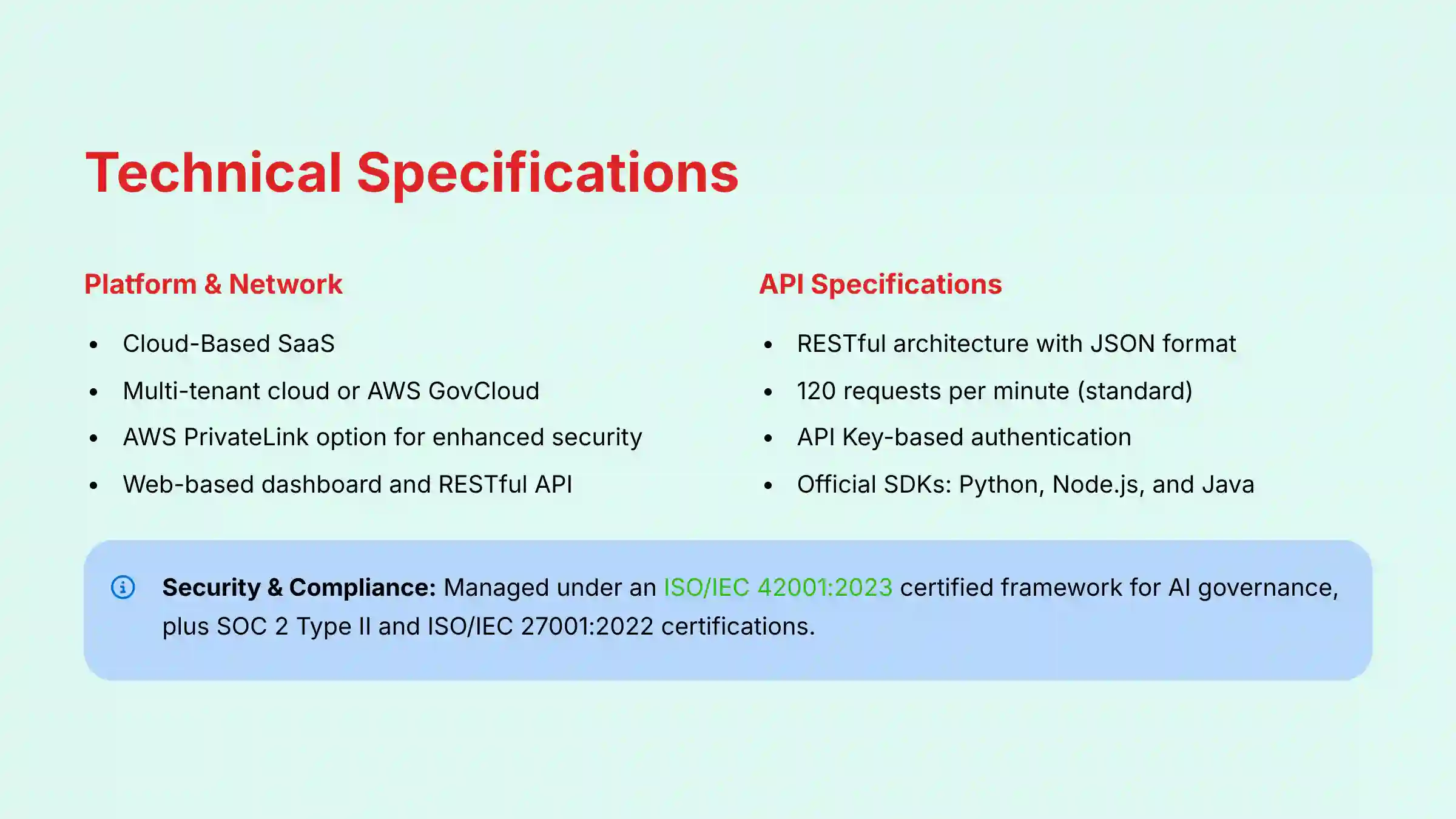
| Platform Type | Cloud-Based SaaS (Software as a Service) |
| Hosting Environment | Standard: Multi-tenant cloud. Enterprise: Optional deployment on AWS GovCloud. |
| Network Security | Enterprise clients can opt for AWS PrivateLink for enhanced network isolation. |
| Access Method | Web-based dashboard and RESTful API |
API Specifications
| Specification | Detail |
|---|---|
| API Architecture | RESTful |
| Data Format (Input/Output) | JSON |
| Standard Rate Limit | 120 requests per minute |
| Enterprise Rate Limit | Custom, defined in Service Level Agreement (SLA) |
| Authentication | API Key-based |
| Developer Portal | Available on the company website (Includes OpenAPI specs, changelog, sandbox) |
Data Handling and Performance
| Specification | Detail |
|---|---|
| Input Data Sources | Integrates with ERP, WMS, and E-commerce platforms |
| Shipment Tracking Fidelity | Sub-15-minute location updates via tracking endpoint |
| AI Model Governance | Managed under an ISO/IEC 42001:2023 certified framework |
| Data Security Certs | SOC 2 Type II, ISO/IEC 27001:2022 (Current certification status available from vendor) |
The inclusion of an ISO/IEC 42001:2023 certification is a critical differentiator. In an era where AI accountability is paramount, this is not just a compliance badge; it is a non-negotiable proof point of responsible AI governance. For enterprises entrusting their core operational data to a third party, this certification provides the documented assurance that the AI is managed within a framework of ethical development and rigorous risk mitigation.
Integration Capabilities and Ecosystem
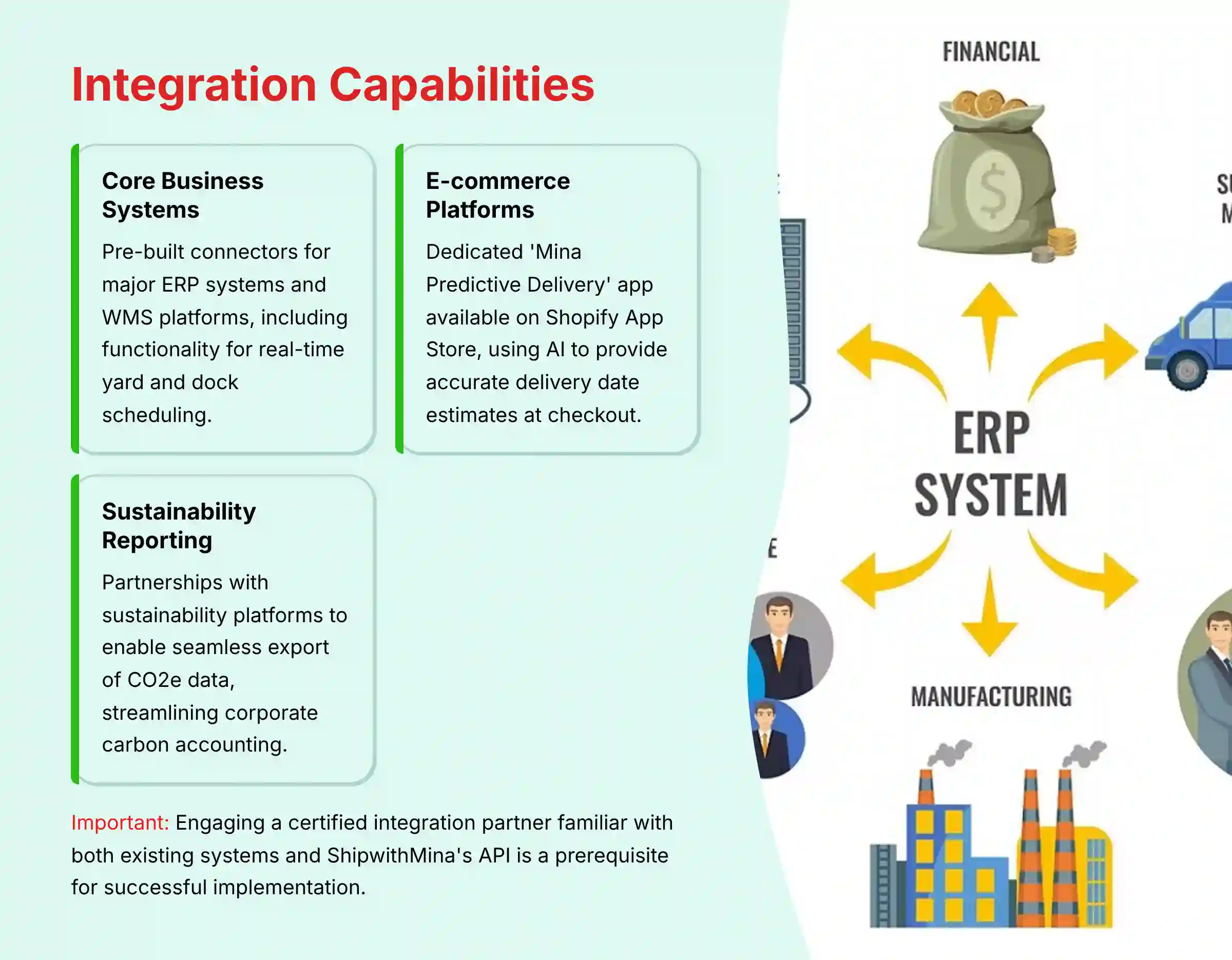
A logistics platform must connect with other critical business systems. This section details how ShipwithMina integrates with the broader technology ecosystem. Proper integration often requires technical expertise, and consulting a professional is recommended for complex setups involving core ERP systems.
Official SDKs and API Connectivity
ShipwithMina provides officially supported software development kits to facilitate API integration.
- Official SDKs: Python, Node.js, and Java.
Risk Considerations & Professional Guidance
Integrating a platform as comprehensive as ShipwithMina is a strategic commitment, not a technical task. The risks of poor implementation are significant, including data integrity failures between your ERP and the platform, operational disruptions during inventory migration, and underutilization of advanced API features.
Therefore, let me be clear: engaging a certified integration partner familiar with both your existing systems and ShipwithMina's API is not just a recommendation; it is a prerequisite for success. Attempting a complex ERP integration without expert guidance is a direct path to eroding the very ROI you seek to achieve. For detailed implementation guidance, explore our comprehensive ShipwithMina Tutorials and Usecase resource.
Core Business System Integrations
The platform offers pre-built connectors for major enterprise systems, which is essential for data synchronization.
- ERP Systems: The company offers integration capabilities with major ERP systems. Contact vendor for details on specific ERP connectors and their features.
- WMS: Integration with major WMS platforms, including functionality for real-time yard and dock scheduling.
E-commerce and Sustainability Platform Connectors
Integrations with e-commerce and sustainability platforms help connect the full value chain.
- Shopify Plus: A dedicated app, ‘Mina Predictive Delivery,' is available on the Shopify App Store. It uses the platform's AI to provide more accurate delivery date estimates to customers at checkout.
- Sustainability Platforms: The platform offers partnerships with sustainability reporting platforms to enable seamless export of CO2e data calculated by ShipwithMina, streamlining corporate carbon accounting.
Transportation Management System (TMS) Functionality
While not categorized as a standalone TMS, ShipwithMina incorporates critical Transportation Management System capabilities into its integrated platform. These functions include:
- Carrier Selection & Management: Automated evaluation of carrier performance, costs, and capacity
- Load Consolidation: AI-driven aggregation of multiple orders to optimize transportation costs
- Freight Audit: Automated verification of carrier invoices against contracted rates
- Last-Mile Optimization: Specialized routing for the critical final delivery segment
These TMS capabilities are fully integrated with the warehouse and inventory functions, creating a seamless flow from order to delivery without the integration challenges typically faced when using separate WMS and TMS solutions.
Documented Use Cases and Industry Applications
This section provides evidence-based examples of how the platform delivers value based on real-world implementations and case studies.
Primary Use Case: DTC E-commerce Fulfillment
The platform is designed as a fully outsourced, AI-driven fulfillment operation for DTC brands. It solves challenges of high labor costs, slow fulfillment speeds, and inefficient inventory management that can prevent a brand from scaling effectively.
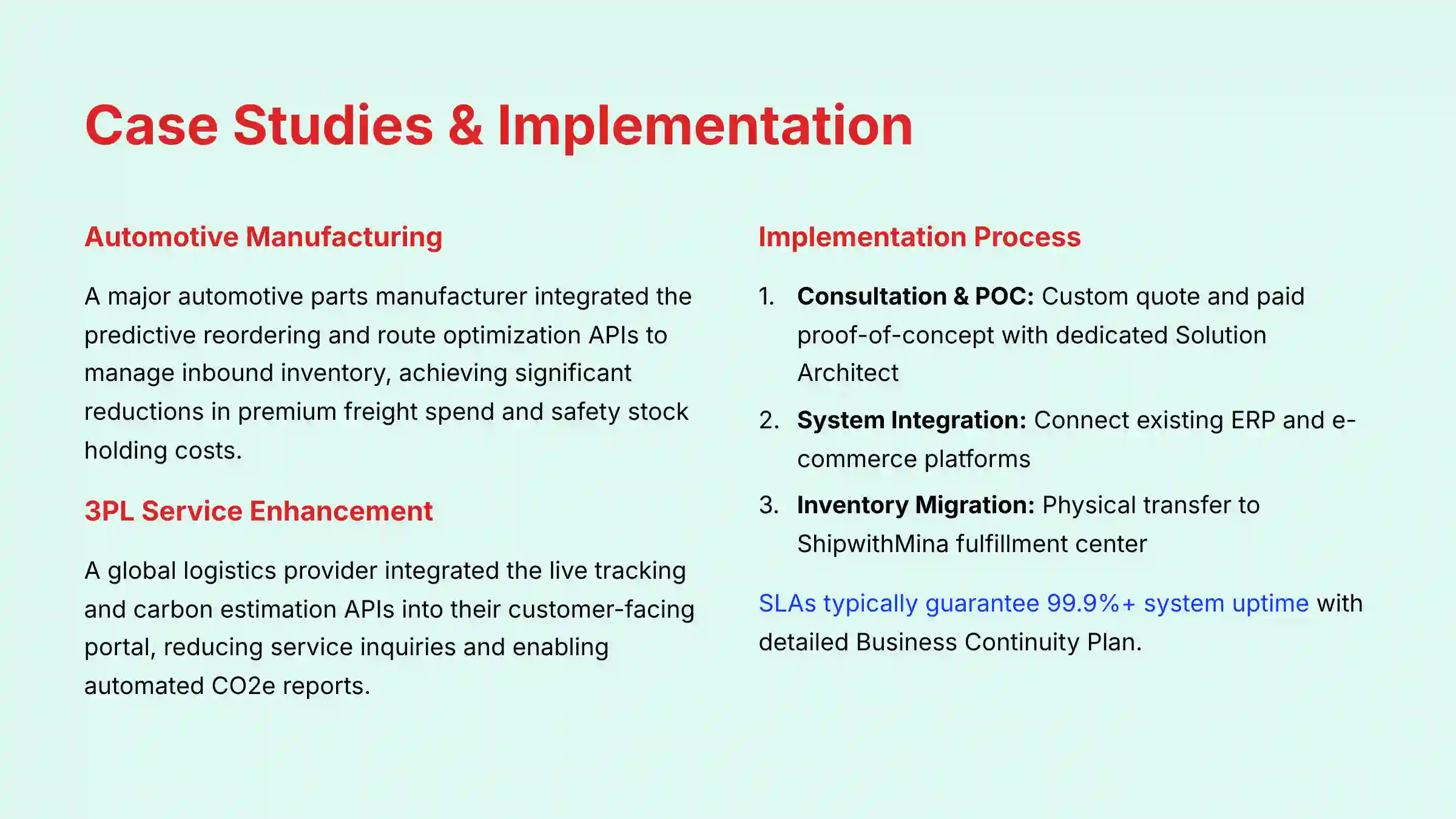
Case Study: Automotive Manufacturing Inbound Logistics
Based on a case study from the automotive sector:
- Client: A major automotive parts manufacturer.
- Problem: High costs from expedited freight and excessive safety stock for manufacturing components.
- Solution: Integrated the predictive reordering and route optimization APIs to manage inbound inventory.
- Outcome: Achieved significant reductions in premium freight spend and safety stock holding costs, which contributed to improved Inventory Turnover.
Professional Validation Note: When evaluating similar solutions for your business, it's essential to request and verify documented case studies specific to your industry. The ROI figures reported in case studies should be independently verified through customer references and proof-of-concept implementations in your own environment.
Case Study: Third-Party Logistics (3PL) Service Enhancement
The platform can also be used by other logistics companies to improve their own services.
- Client: A global logistics provider.
- Problem: High volume of customer service inquiries regarding shipment status and lack of automated CO2e reporting.
- Solution: Integrated the live tracking and carbon estimation APIs into their customer-facing portal.
- Outcome: Led to substantial reduction in customer service inquiries and enabled fully automated CO2e reports for their clients, helping them improve their reported On-Time In-Full (OTIF) delivery performance.
Pricing and Plan Information
Understanding the cost structure is a primary concern for any business evaluating new technology. My findings on ShipwithMina's pricing model are straightforward.
Pricing information for ShipwithMina is not publicly available on their website. The company utilizes a custom-quoted pricing model. Prospective clients must contact the ShipwithMina sales team directly through their official website to receive a quote tailored to their specific operational volume, integration needs, and feature requirements.
There is no publicly mentioned free tier or free trial. Enterprise solutions include custom API rate limits, dedicated endpoints, and options for deployment in isolated environments like AWS GovCloud.
Procurement Guidance: When requesting pricing, ensure you receive a comprehensive breakdown that includes all potential costs: implementation, integration, per-order fees, storage costs, and any volume-based discounts. For a proper comparative analysis, calculate the Total Cost of Ownership (TCO) over a 3-5 year period, including internal resources required for management and maintenance.
System Requirements and Implementation
This section defines what a business needs to have in place to use the platform. It also outlines the typical onboarding process.
Compatibility and Technical Requirements
| Requirement | Detail |
|---|---|
| Hardware | None specified (Cloud-based platform). |
| Operating System | Not applicable (Platform is OS-agnostic). |
| Web Browser | A modern, up-to-date web browser (e.g., Chrome, Firefox, Safari, Edge). |
| Network | A stable, high-speed internet connection for dashboard access and API calls. |
| API Integration | Access to a development resource familiar with RESTful APIs (Python, Node.js, or Java recommended). |
Getting Started: Onboarding and First Project
The onboarding process is structured and managed directly by the ShipwithMina team.
- Step 1: Consultation and Proof-of-Concept: The process begins by contacting the sales team for a consultation and custom quote. For qualified enterprise clients, ShipwithMina may offer a paid Proof-of-Concept (POC) program to validate ROI against specific business KPIs. A dedicated Solution Architect is assigned to map existing workflows and data structures. Service Level Agreements (SLAs) typically guarantee 99.9%+ system uptime and detail the company's Business Continuity Plan (BCP).
- Step 2: System Integration: Technical setup involves connecting existing ERP and e-commerce platforms to ShipwithMina's API.
- Step 3: Inventory Migration: A typical first project involves the physical migration of inventory to a ShipwithMina fulfillment center and configuring inventory/order rules in the dashboard.
- Prerequisites: Before starting, a business must have its product master data, sales channel information, and current inventory data prepared for migration.
Final Verdict: From Visibility to Action
ShipwithMina is more than a 3PL with a software layer; it is a strategic apparatus designed for the new era of logistics. Our analysis of its overview and features confirms that its core value proposition is the intentional fusion of decision intelligence with physical execution.
For too long, the industry has been obsessed with visibility—the passive act of seeing a problem. ShipwithMina is built on the principle that visibility is table stakes. The real power lies in action. By automating decisions around inventory, routing, and fulfillment, it allows DTC brands to move at the speed of the market.
For established DTC brands facing a value squeeze from larger competitors, this platform offers a clear path to not only survive but to press the advantage. It is a tool for those ready to move beyond observing their supply chain and start commanding it. To explore how ShipwithMina compares with other market solutions, visit our detailed ShipwithMina Top Alternatives and Competitors analysis.
Frequently Asked Questions (FAQ) about ShipwithMina
1. What makes ShipwithMina different from a traditional 3PL?
ShipwithMina differs by integrating a proprietary AI software layer directly with its own physical logistics network, which includes chartered aircraft. This creates a single, end-to-end service, whereas traditional 3PLs often rely on separate, less integrated technology stacks.
2. How does ShipwithMina's AI optimize warehouse operations?
The platform's AI optimizes operations by analyzing order data to create the most efficient picking paths and warehouse layouts (dynamic slotting). It also automates the “pick & pack” process, with the goal of increasing order processing speed compared to manual methods.
3. Is ShipwithMina suitable for small businesses?
While designed to be scalable, ShipwithMina's custom pricing and focus on deep integration suggest it is best suited for established DTC brands with significant order volume. Startups or very small businesses may find the model more complex than simpler fulfillment services.
4. What is the significance of the ISO/IEC 42001:2023 certification?
This certification validates that ShipwithMina has a formal Artificial Intelligence Management System. It demonstrates a commitment to responsible AI development and data governance, a critical trust signal for enterprises entrusting their operational data to the platform.
5. Can I use ShipwithMina's software without their warehouses?
No, ShipwithMina's business model is an integrated service. The AI software is designed to work exclusively with its network of fulfillment centers and logistics assets. The value proposition is the combination of the technology and the physical infrastructure.
6. What data is needed for the predictive reordering API?
The predictive reordering API requires historical sales data, current inventory levels, and supplier lead times. It can also incorporate external data streams for scenario modeling, such as shipping lane congestion reports or weather forecasts, to generate its recommendations.
7. How does the AI route optimization work?
The route optimization API uses an AI model that considers multiple variables simultaneously: shipping costs, carrier delivery speeds, real-time traffic data, and the shipment's carbon footprint. It then proposes several optimal routes for the user to choose from.
8. What does the Microsoft Dynamics 365 integration enable?
The connector allows for data flow between ShipwithMina and Microsoft Dynamics 365. Sales orders from Dynamics can create fulfillment orders in Mina, and inventory updates can be reflected back in the ERP system.
9. Does ShipwithMina replace my existing TMS or WMS?
ShipwithMina is an integrated platform that includes its own proprietary Warehouse Management System (WMS) and Transportation Management System (TMS) functionalities. For its target audience of DTC brands, it is designed to be an all-in-one solution, replacing the need for separate best-of-breed systems. Its value proposition is the deep, native integration between its AI, WMS, and TMS modules, which eliminates the data silos and integration challenges common with multi-vendor solutions. However, it can integrate with existing enterprise systems like Blue Yonder WMS, acting as a specialized fulfillment partner within a larger logistics network. For more specific questions, visit our comprehensive ShipwithMina FAQs section.
Disclaimer
Disclaimer: The information about ShipwithMina Overview and Features presented in this article reflects our thorough analysis based on publicly available information. Given the rapid pace of AI technology evolution in the AI for Operations & Supply Chain space, features, pricing, and specifications may change after publication. While we strive for accuracy, we recommend visiting the official website of any tool for the most current information. For business-critical decisions, we strongly recommend conducting a proof-of-concept with your specific data and requirements before making significant investments. Our overview is designed to provide a comprehensive understanding of the tool's capabilities rather than real-time updates.

Leave a Reply