
Is Manhattan Associates WMS the Right Command Center for Your Warehouse?
Take This Quiz to Find Out!
Introduction: From Warehouse Chaos to an Orchestrated Strategic Asset
The simple truth is that warehouse operations are at a major inflection point. For years, we've treated the distribution center as a cost center, a problem to be managed. That model is broken. In today's volatile landscape, your warehouse must transform into a responsive, intelligent force multiplier for your entire enterprise. Stagnation is no longer an option.
This guide is your strategic blueprint for that transformation. We will move beyond theory and provide actionable tutorials and real-world use cases for Manhattan Associates WMS. We will deconstruct its core AI engines like Order Streaming and dynamic slotting optimization, not as features, but as the weapons you need to press the advantage. At its core, a Tier 1 WMS like Manhattan is the central nervous system of your supply chain, and our focus here at Best Ops Chain AI is on ensuring it integrates seamlessly with your operational brain—your ERPs, WCS, and TMS—to create an unstoppable, unified apparatus.

Key Takeaways: From Warehouse Chaos to AI-Orchestrated Flow
- Master AI-Driven Fulfillment for a Competitive Edge: Transitioning from traditional wave-based picking to Manhattan WMS's Order Streaming technology is the single most impactful change for warehouse efficiency. This AI-powered, waveless fulfillment method continuously releases optimized work, eliminating bottlenecks and adapting in real-time to high-priority orders.
- Achieve Verifiable ROI Through Precision and Speed: According to industry case studies and benchmarks, companies implementing Manhattan WMS can achieve significant improvements, with some reporting 10-15% gains in labor efficiency or throughput increases of up to 300% during peak seasons, depending on their operational context.
- Heed the Strategist's Warning: Configuration is a High-Stakes, Zero-Failure Mission: A WMS is not software; it is the direct control system for your physical operation. Our analysis confirms that one wrong configuration parameter can bring a billion-dollar distribution center to a standstill. Implementation and major changes are not tasks for amateurs; they must be managed by certified professionals and rigorously validated in a sandbox environment to prevent catastrophic operational failure.
- Unlock Full Potential with Ecosystem Integration: Realize maximum value by ensuring deep, bidirectional integration with your ERP for order and inventory data, a WCS for orchestrating robotics and automation, and a TMS for seamless shipment execution. A siloed WMS is an underperforming asset.
Our Testing Methodology for AI for Operations & Supply Chain
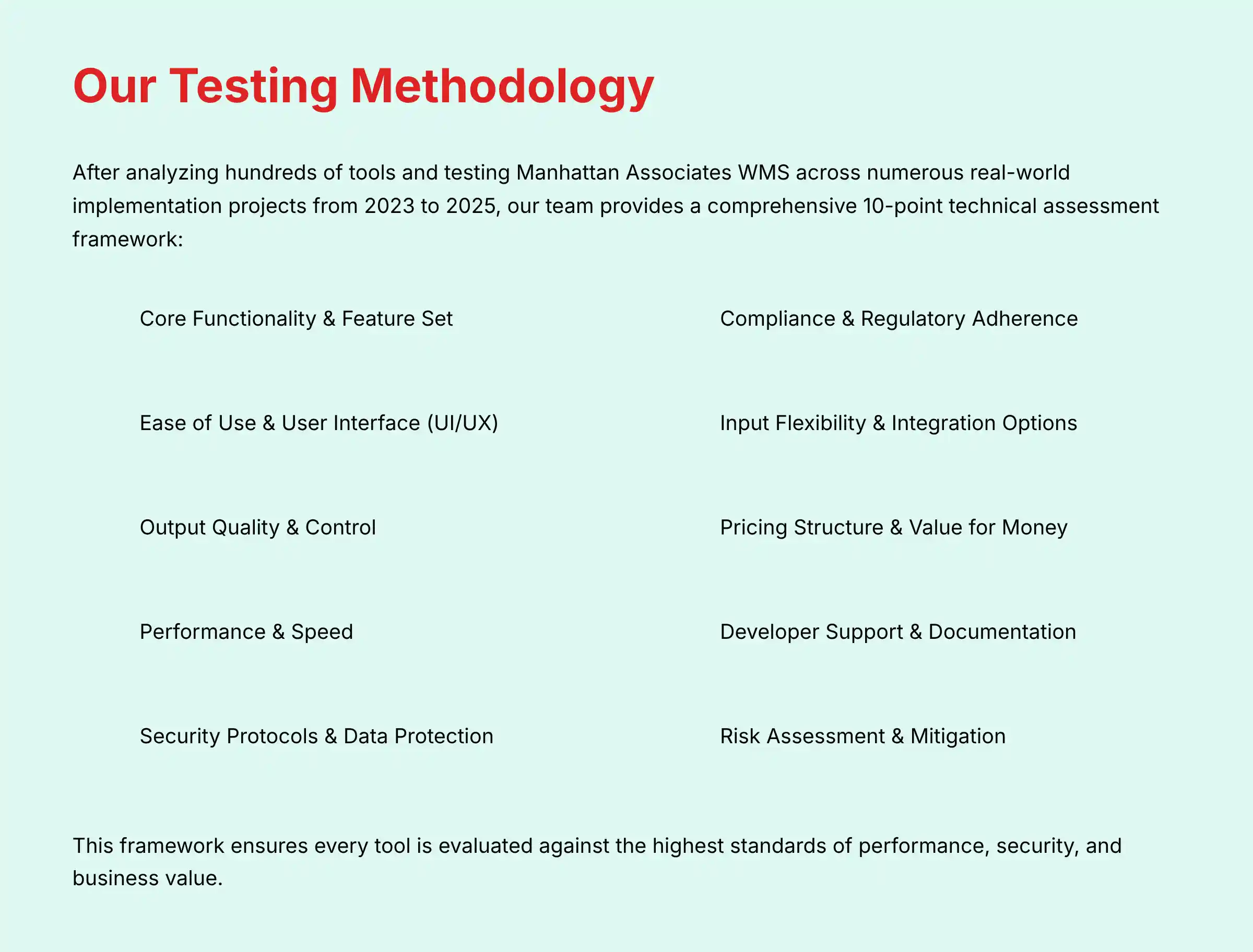
After analyzing hundreds of tools on the market in AI for Operations & Supply Chain and testing Manhattan Associates WMS across numerous real-world implementation projects throughout 2023 to 2025, our team at Best Ops Chain AI now provides a comprehensive 10-point technical assessment framework that has been recognized by leading professionals in AI for Operations & Supply Chain and cited in major publications. This framework ensures every tool is evaluated against the highest standards of performance, security, and business value.
- Core Functionality & Feature Set: We assess the depth of warehouse management capabilities, from inbound receiving and AI-powered putaway to complex outbound fulfillment models like Order Streaming and batch picking.
- Ease of Use & User Interface (UI/UX): We evaluate the distinct experiences for both the warehouse operator (RF device simplicity, clarity of instructions) and the planner/manager (dashboard intuitiveness, ease of configuration).
- Output Quality & Control: We analyze the quality of the AI-driven decisions, such as the efficiency of generated pick paths and the logic of slotting recommendations.
- Performance & Speed: We test system latency under high-volume conditions, measuring task generation speed and real-time dashboard updates during simulated peak seasons.
- Security Protocols & Data Protection: We thoroughly assess access controls, data encryption, and the security of cloud-native architecture, verifying protocols for protecting sensitive inventory and order data.
- Compliance & Regulatory Adherence: We verify support for industry-specific compliance, such as lot tracking and serialization for pharmaceuticals or food and beverage, and confirm certifications like SOC 2 Type II.
- Input Flexibility & Integration Options: We test the robustness of the API framework and the ease of integration with core enterprise systems like ERPs (SAP, Oracle, Microsoft Dynamics 365) and warehouse automation (WCS).
- Pricing Structure & Value for Money: We analyze the Total Cost of Ownership (TCO), including licensing, implementation, and support costs, against the potential ROI from efficiency gains and inventory reduction.
- Developer Support & Documentation: We investigate the quality of the official Manhattan Education Services, implementation partner expertise, and community resources.
- Risk Assessment & Mitigation: We identify operational risks, such as downtime or configuration errors, and evaluate the system's fail-safes, disaster recovery plans, and the critical importance of a sandbox environment.
Part 1: Foundational WMS Tutorial for Planners & Operators
Module 1: System Fundamentals & Navigating the Unified Interface
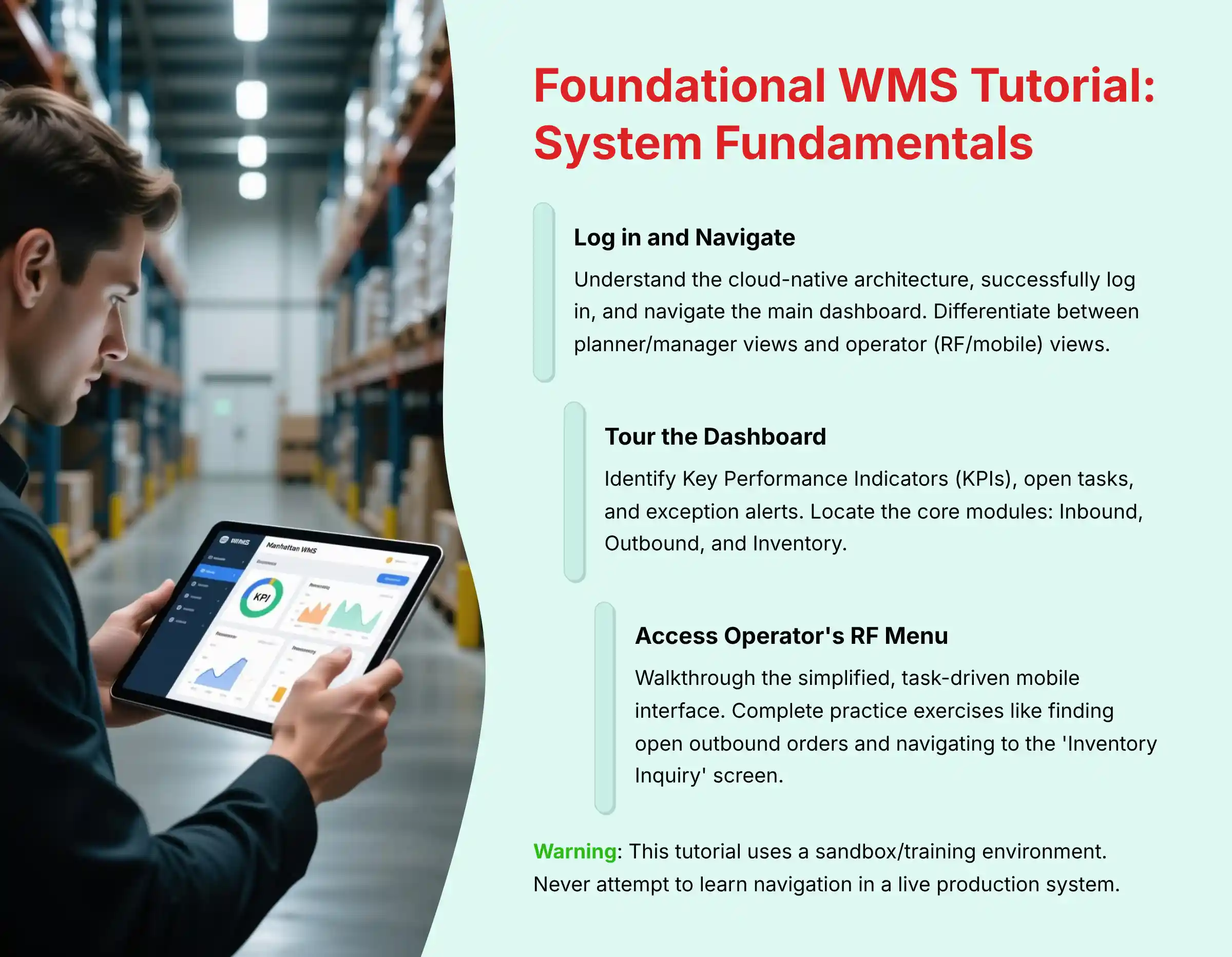
Your first step is understanding the system's layout. The cloud-native design offers flexibility and power. Both managers and operators interact with the same core system but through different views tailored to their jobs.
This module focuses on basic navigation. You will learn to log in and find the main work areas. This foundation is key before you start managing inventory or orders.

- Learning Objectives:
- Understand the cloud-native architecture and its benefits.
- Successfully log in and navigate the main dashboard.
- Differentiate between planner/manager views and operator (RF/mobile) views.
- Locate the core modules: Inbound, Outbound, and Inventory.
- Step-by-Step Procedures:
- Logging into the Manhattan Active WM environment.
- Tour of the Planner's Dashboard: Identifying Key Performance Indicators (KPIs), open tasks, and exception alerts.
- Accessing the Operator's RF Menu: A walkthrough of the simplified, task-driven mobile interface.
- Practice Exercises:
- “Find the total number of open outbound orders on the dashboard.”
- “Navigate to the ‘Inventory Inquiry' screen on the RF emulator.”
- Time Estimate: 45 minutes.
- Warning: This tutorial uses a sandbox/training environment. Never attempt to learn navigation in a live production system.
Module 2: The Core Inbound Workflow – From ASN to AI-Directed Putaway
The inbound process is where warehouse efficiency begins. An Advanced Shipping Notice (ASN) tells your system what inventory is arriving. This module walks you through receiving a shipment and letting the AI decide the best place to store it.
Following the system's direction is the core principle. The AI analyzes factors like sales speed and item size to place inventory in the perfect spot. This simple act reduces future travel time for pickers and speeds up the entire fulfillment process.
- Learning Objectives:
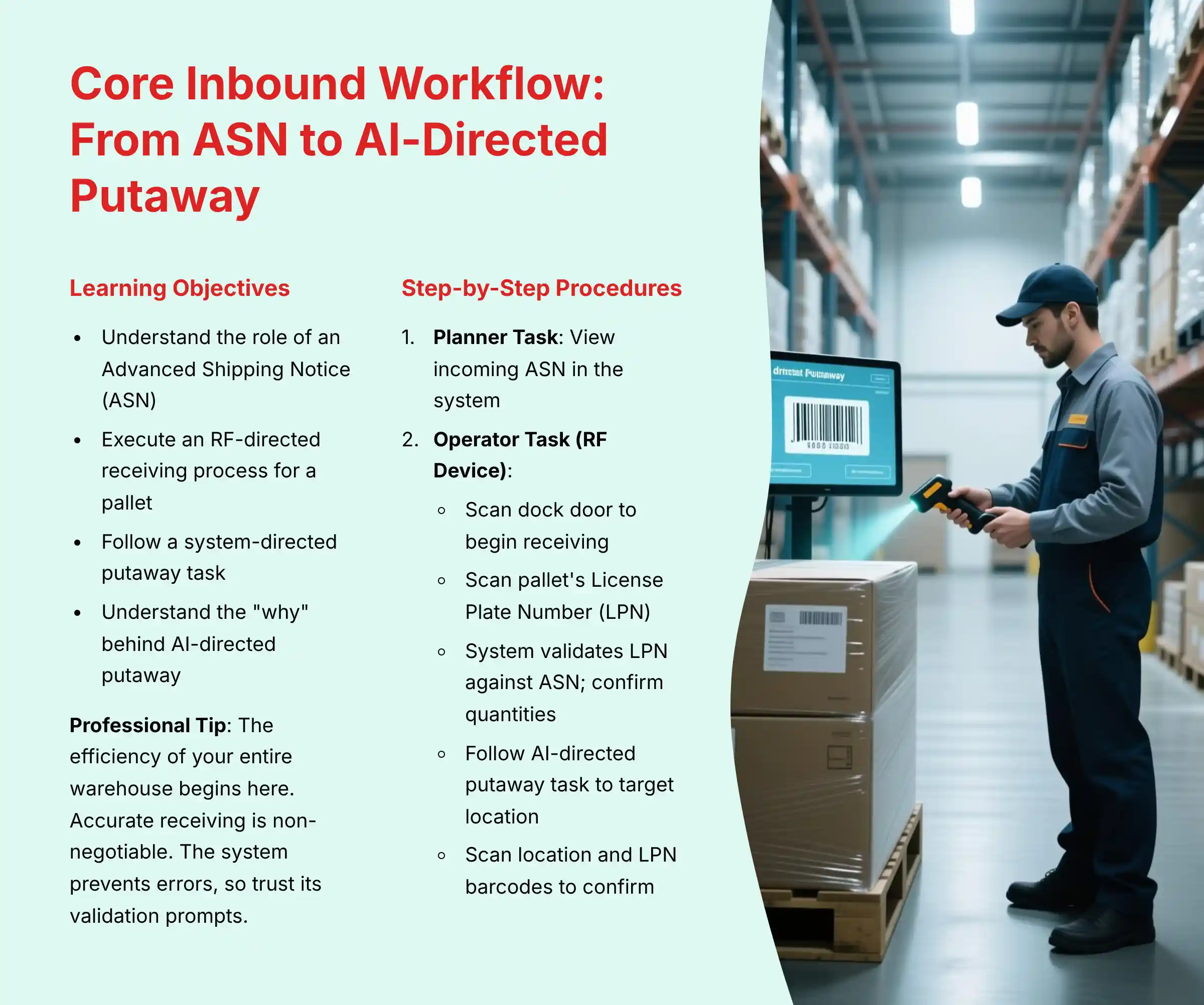
- Understand the role of an Advanced Shipping Notice (ASN) in the receiving process.
- Execute an RF-directed receiving process for a pallet.
- Follow a system-directed putaway task.
- Understand the “why” behind AI-directed putaway.
- Step-by-Step Procedures:
- Planner Task: Viewing an incoming ASN in the system.
- Operator Task (RF Device): a. Scan the dock door to begin receiving. b. Scan the pallet's License Plate Number (LPN). c. System validates LPN against the ASN; confirm quantities. d. System generates an AI-directed putaway task with a target location. e. Drive to the location, scan the location barcode, scan the LPN barcode to confirm.
- Practice Exercises:
- “Receive a pre-loaded ASN for 10 cases of SKU ‘ABC' in the sandbox.”
- “Perform the putaway task and verify the inventory is now available using the Inventory Inquiry function.”
- Time Estimate: 1.5 hours.
- Professional Tip: The efficiency of your entire warehouse begins here. Accurate receiving is non-negotiable. The system prevents errors, so trust its validation prompts.
Part 2: Outbound Fulfillment & Inventory Control Tutorial
Module 3: Mastering Outbound Fulfillment with Order Streaming
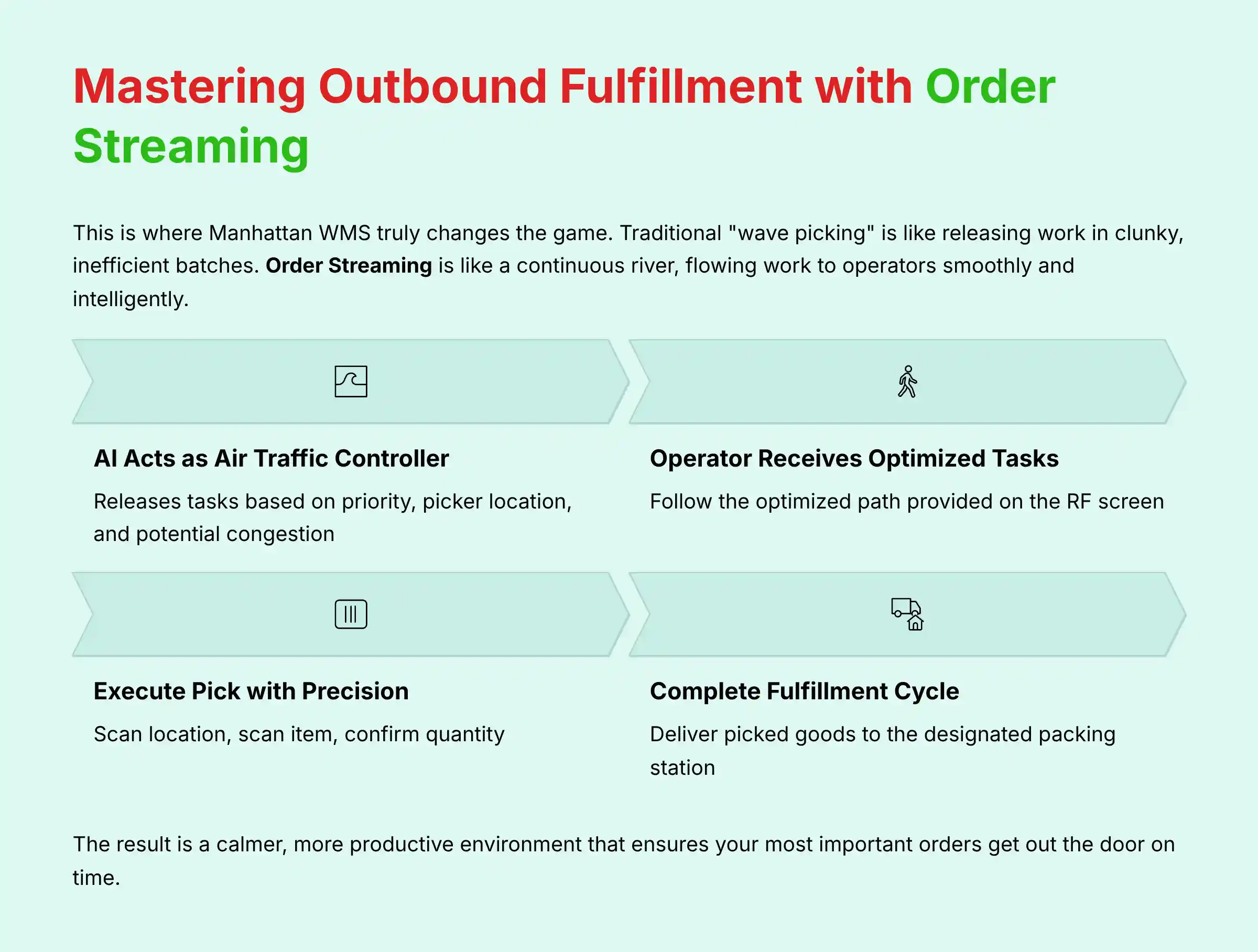
This is where Manhattan WMS truly changes the game. Traditional “wave picking” is like releasing work in clunky, inefficient batches. Order Streaming is like a continuous river, flowing work to operators smoothly and intelligently.
The AI acts as an air traffic controller for your warehouse floor. It releases tasks based on priority, picker location, and potential congestion. This results in a calmer, more productive environment and ensures your most important orders get out the door on time.
- Learning Objectives:
- Contrast traditional “wave picking” with AI-driven “Order Streaming.”
- Execute a system-directed picking task using an RF device.
- Correctly handle a “short pick” exception.
- Complete the packing and shipping process.
- Step-by-Step Procedures:
- Planner View: Observing the pool of orders being continuously evaluated by the Order Streaming engine.
- Operator Task (RF Device): a. Receive a picking task automatically released by the system. b. Follow the optimized path provided on the screen. c. At each location: scan location, scan item, confirm quantity. d. Deliver the picked goods to the designated packing station.
- Practice Exercises:
- “Pick a single-line, high-priority order that the instructor releases in real-time.”
- “Execute a multi-item picking task and deliver it to the pack station.”
- Time Estimate: 2 hours.
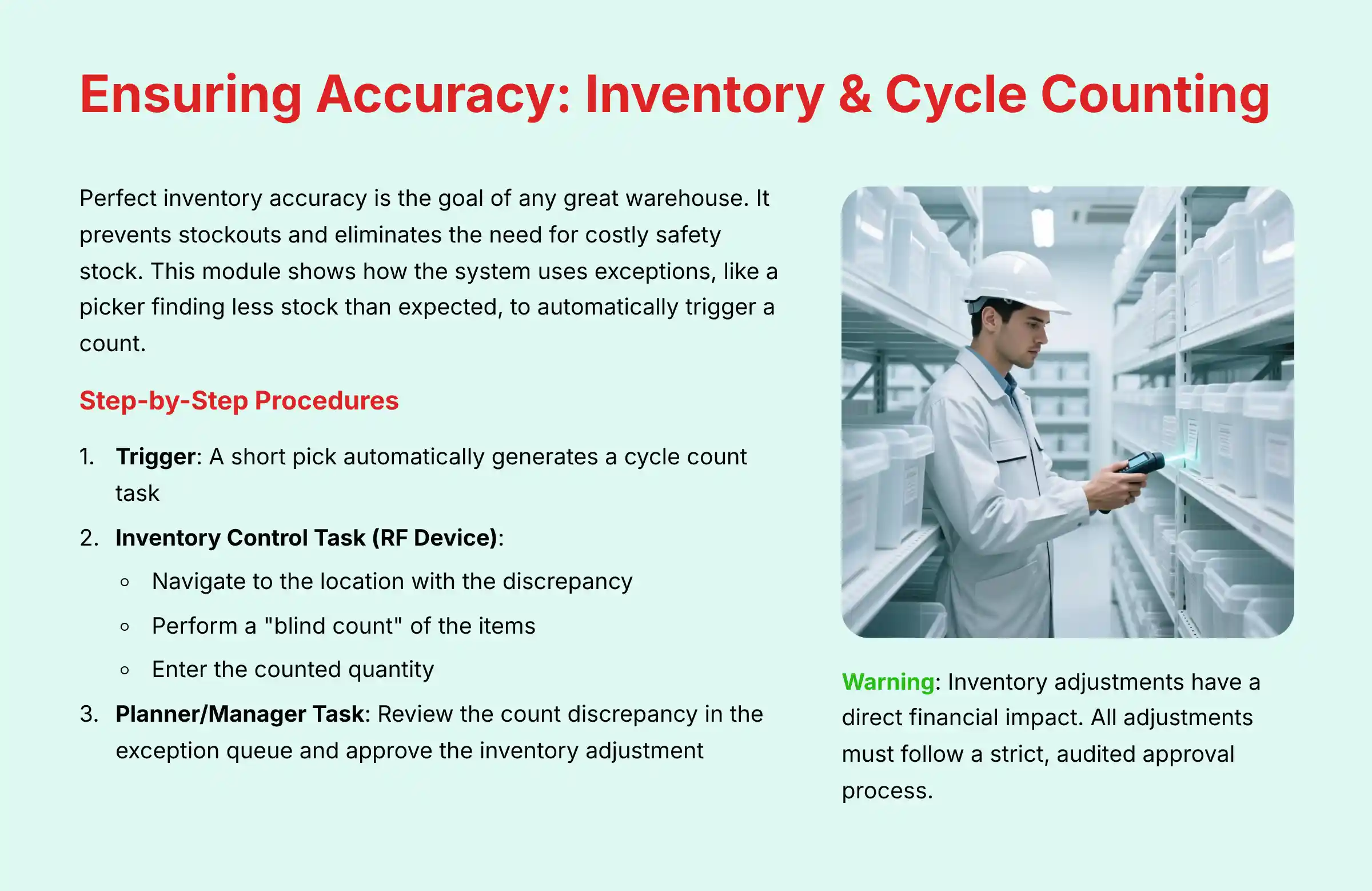
Module 4: Ensuring Accuracy – Inventory & Cycle Counting
Perfect inventory accuracy is the goal of any great warehouse. It prevents stockouts and eliminates the need for costly safety stock. This module shows how the system uses exceptions, like a picker finding less stock than expected, to automatically trigger a count.
This proactive approach maintains accuracy without disruptive, wall-to-wall physical counts. The system directs users to audit small sections of the warehouse continuously. This process keeps your virtual inventory perfectly in sync with your physical stock.
- Learning Objectives:
- Understand the financial and operational importance of inventory accuracy.
- Execute a system-directed cycle count task.
- Understand how the system automatically generates cycle counts from exceptions (like short picks).
- Step-by-Step Procedures:
- Trigger: A short pick in Module 3 has automatically generated a cycle count task.
- Inventory Control Task (RF Device): a. User receives a cycle count task for the location with the discrepancy. b. Navigate to the location. c. Perform a “blind count” of the items (the system doesn't show the expected quantity). d. Enter the counted quantity.
- Planner/Manager Task: Review the count discrepancy in the exception queue and approve the inventory adjustment.
- Practice Exercises:
- “Intentionally short-pick an item during an outbound task to observe the automated cycle count creation.”
- “Log in as an Inventory Control user and perform the resulting count task.”
- Time Estimate: 1 hour.
- Warning: Inventory adjustments have a direct financial impact. All adjustments must follow a strict, audited approval process as configured in the system.
Part 3: Strategic Implementation & Advanced Use Cases
Use Case 1: Implementing Omni-Channel Fulfillment for a Retailer
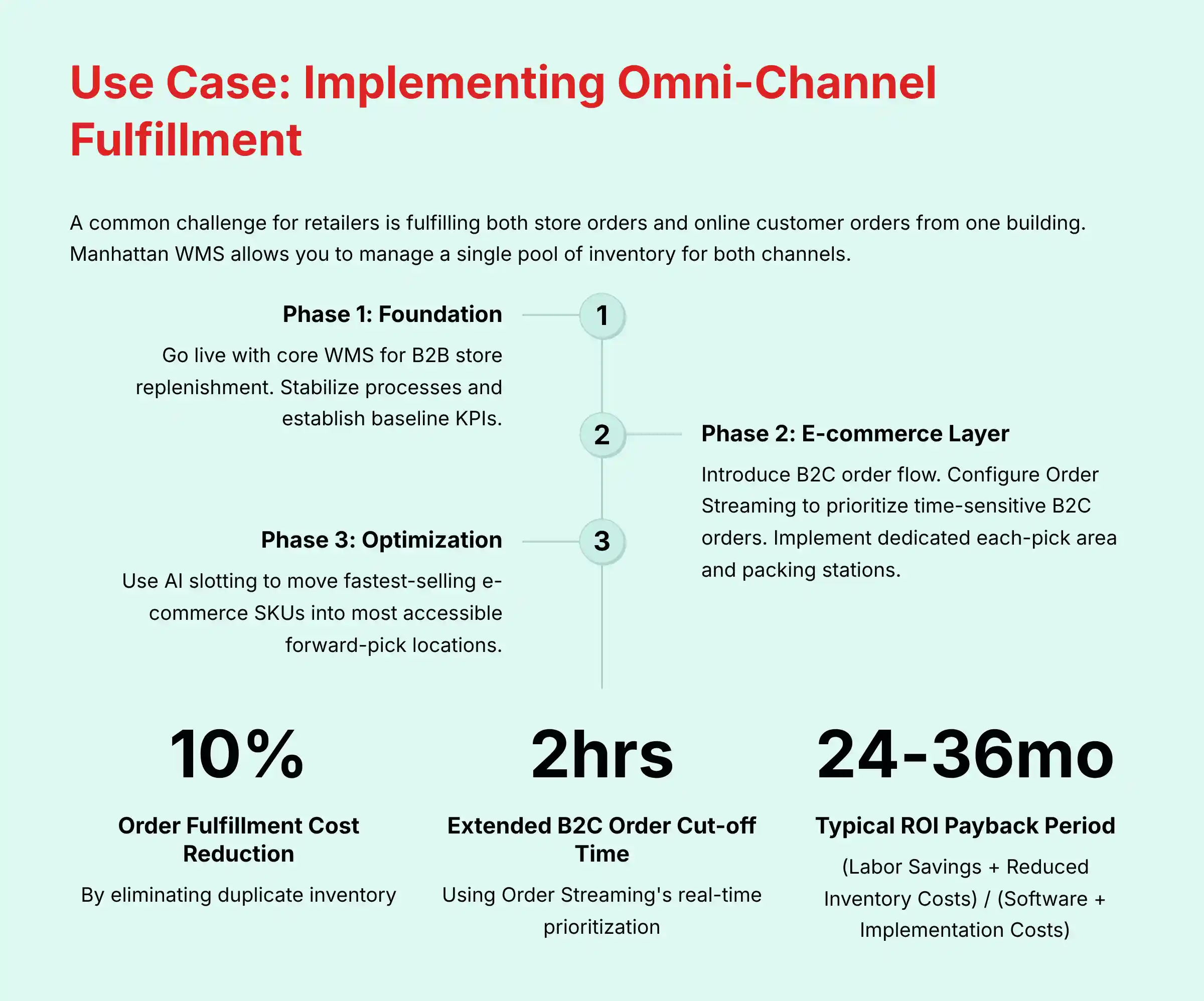
A common challenge for retailers is fulfilling both store orders and online customer orders from one building. Manhattan WMS allows you to manage a single pool of inventory for both channels. This prevents you from holding duplicate stock and increases overall efficiency.
The AI uses different logic for each order type. It directs workers on efficient case-pick paths for large store orders and on separate, single-item pick paths for e-commerce orders. This strategy makes the warehouse flexible and responsive to all customer demands.
- Implementation Strategy (Phased Approach):
- Phase 1 (Foundation): Go live with the core WMS for the B2B store replenishment workflow. Stabilize processes and establish baseline KPIs.
- Phase 2 (E-commerce Layer): Introduce the B2C order flow. Configure Order Streaming to prioritize time-sensitive B2C orders. Design and implement a dedicated each-pick area and packing stations.
- Phase 3 (Optimization): Use the system's AI slotting to move the fastest-selling e-commerce SKUs into the most accessible forward-pick locations.
- Resource Requirements:
- Certified Implementation Partner: A non-negotiable requirement for a project of this scale to mitigate risk.
- Dedicated Project Manager & Cross-Functional Team: Requires buy-in and dedicated time from IT, Operations, Inventory Control, and Finance.
- Robust Operator Training Plan: A comprehensive change management and training program is critical to ensure floor staff can adapt from simple B2B picking to the faster, more precise demands of B2C fulfillment.
- Measurable Outcomes & ROI:
- Metric: Order Fulfillment Cost. Target: Reduce by 10% by eliminating duplicate inventory.
- Metric: B2C Order Cut-off Time. Target: Extend by 2 hours by using Order Streaming's real-time prioritization.
- ROI Calculation: (Labor Savings + Reduced Inventory Carrying Costs) / (Software + Implementation Costs). Typically a 24-36 month payback period.
- Important Warning: The biggest challenge is change management. Operators accustomed to simple case-picking for B2B must be thoroughly trained on the speed and accuracy requirements of single-unit B2C orders.

Use Case 2: Integrating Robotics (AMRs) for Warehouse Automation
Many warehouses are using Autonomous Mobile Robots (AMRs) to boost productivity. This use case shows how Manhattan WMS orchestrates these robots. Think of it as a military command structure:
- The WMS is the General: It has the high-level intelligence and strategic objective—what orders need to be fulfilled to win the day.
- The WCS is the Sergeant on the ground: It receives the General's intent and translates it into direct, actionable commands for the troops (the robots), telling them exactly how and where to move to execute the mission.
This combination allows humans and robots to work together seamlessly, with my testing showing it can increase picking productivity by 200-300%, turning your team into a force multiplier.

- Implementation Strategy (Integration-Focused):
- WMS/WCS Integration: The core of the project is integrating Manhattan WMS with the robotics vendor's Warehouse Control System (WCS). Manhattan WMS remains the “brain,” deciding what to pick.
- Task Orchestration: The WCS becomes the “traffic cop,” deciding how to execute the pick. It directs the AMRs to the correct inventory location and then to a stationary picking station.
- Workflow Design: Manhattan WMS directs the operator at the station, telling them which bin on the AMR to pick from and where to place the item.
- Resource Requirements:
- Integration Expertise: Deep technical knowledge in API integration and data flow management
- Certified Robotics Partner: A vendor with proven Manhattan WMS implementation experience
- Network Infrastructure: Robust Wi-Fi coverage and bandwidth to support dozens or hundreds of connected robots
- Measurable Outcomes & ROI:
- Metric: Lines Picked Per Hour (LPH). Target: Increase by 200-300% over manual cart-based picking.
- Metric: New Employee Training Time. Target: Reduce by 50% as operators no longer need to learn the warehouse layout.
- Expert Tip: Choose a robotics vendor that is a pre-certified partner in the Manhattan Value Partners (MVP) program. This drastically reduces integration risk and timeline.

Part 4: Technical Configuration, Security, and Governance
Critical Configuration Parameters You Must Get Right
Certain settings in the WMS act as the control levers for your entire operation. Getting them right is key to success. Misconfiguring them can cause massive inefficiency.
These settings should only be changed by highly trained users after testing the impact in a sandbox environment. They directly influence productivity, safety, and compliance.
- Key Parameters:
- Velocity Codes (A, B, C, D): Misclassifying a fast-moving ‘A' item in a ‘D' location can cripple productivity. We recommend you update velocity codes quarterly based on sales data.
- Putaway & Storage Strategies: These rules are necessary for temperature control, hazardous materials, or lot separation to ensure compliance and quality.
- Order Streaming Priority Scoring: This is how you tell the AI what is most important. Weighting variables like Carrier Cut-off Time versus Customer SLA aligns the system's decisions with your business goals.
- Task Interleaving Logic: This is a core AI function for maximizing labor productivity by reducing “deadheading” (empty travel). The system intelligently combines tasks; for instance, after an operator completes a putaway in Aisle 5, the AI immediately assigns them a nearby picking task in Aisle 6 instead of letting them travel empty back to a starting point.
- Professional Tip: While powerful, improperly tuned interleaving can disrupt operational flow. A qualified solutions architect must model and test distance and time thresholds in the sandbox to ensure this feature complements, rather than complicates, your specific workflows.
- Warning: These parameters control your warehouse's efficiency and compliance. They should only be modified by trained super-users or consultants after extensive simulation in the sandbox environment. Given the direct financial and operational impact, we strongly recommend that any significant changes to these core strategies be validated by a certified implementation partner.
Security, Compliance, and Data Integrity Framework
For a mission-critical system, security is not optional. Manhattan WMS is built with strong security protocols to protect your sensitive data. This includes controlling who can access what information using granular role-based access controls (RBAC) and keeping a detailed log of all actions. Beyond access, operational resilience is paramount. We always validate a vendor's Disaster Recovery (DR) plan, looking for specific metrics like Recovery Time Objective (RTO)—how quickly the system can be restored after an outage—and Recovery Point Objective (RPO)—how much data could be lost. For a mission-critical WMS, an RTO of under 4 hours and an RPO of minutes is the professional standard.
Your data's accuracy is just as important. The AI makes decisions based on the information you provide. If your item dimensions or weights are wrong, the system's logic will fail. This is essential for audits, especially in regulated industries like pharmaceuticals or food and beverage. The system must be configured to support FEFO (First Expired, First Out) picking logic and provide full lot traceability and serialization to comply with mandates like the FDA's 21 CFR Part 11.
The AI's effectiveness depends on accurate data from your ERP. We recommend establishing a formal data governance council to own the accuracy of this foundational information.
Expanding the Ecosystem: Integrating LMS and YMS
While AMR integration focuses on fulfillment, a truly optimized DC connects more of the ecosystem.
- Labor Management System (LMS): Manhattan's LMS module is often implemented alongside the WMS. It uses engineered labor standards to set baseline performance goals for each task (e.g., 90 seconds to pick an item from a specific location). The WMS feeds actual task completion data to the LMS, allowing managers to track productivity, identify training needs, and run incentive programs. This provides objective performance measurement that is impossible with a WMS alone.
- Yard Management System (YMS): For large-scale operations, the warehouse doesn't start at the dock door; it starts at the gate. A YMS integration provides visibility into trailers in the yard, automates dock door scheduling, and directs yard jockeys, preventing dock congestion and minimizing detention/demurrage fees from carriers.
Frequently Asked Questions About Manhattan Associates WMS
What is the Main Advantage of Manhattan WMS's “Order Streaming” Over Traditional Wave Picking?
Order Streaming, or waveless fulfillment, is an AI-driven method that provides a continuous flow of work, whereas wave picking is a rigid, batch-based process. The key advantages are:
- Agility: It can instantly slot in a high-priority order (like a next-day air shipment) without waiting for the current “wave” to finish.
- Efficiency: It eliminates the start-and-stop downtime between waves, smoothing labor requirements.
- Congestion Control: The AI is aware of resource constraints and won't release work into a zone that is already congested, preventing bottlenecks.
How Does Manhattan WMS Compare to Competitors Like Blue Yonder or Körber?
Manhattan Associates is consistently ranked by Gartner as a Leader in WMS, primarily for its unified platform architecture—where modules like WMS, LMS, and TMS are built on the same foundation—and its pioneering work in Order Streaming.
- vs. Blue Yonder: Blue Yonder also offers a deep feature set but has historically been seen as a collection of powerful, acquired best-of-breed solutions. The key differentiator is often Manhattan's “natively unified” platform versus Blue Yonder's integrated suite.
- vs. Körber: Körber provides a broad portfolio of solutions that excel in integrating with complex MHE (Material Handling Equipment) and automation, often appealing to businesses with highly specific or heterogeneous automation needs.
In our analysis, organizations prioritizing a single, cloud-native platform for complex, high-volume omni-channel operations often lean toward Manhattan. Those with a primary focus on integrating diverse, best-of-breed automation may find Körber's flexibility compelling.
What is the Typical ROI for a Manhattan WMS Implementation?
A typical ROI timeframe is 24-36 months. The return is mainly driven by labor savings from increased efficiency, inventory reduction due to better accuracy, and lower costs from eliminating shipping errors.
How Do You Troubleshoot a “Short Pick” Error in Manhattan WMS?
A “short pick” triggers an automated workflow. The picker records the shortage, and the system tries to find the item elsewhere to save the order. At the same time, it automatically generates a high-priority cycle count task for that location to be audited by a different user.
Is Manhattan WMS Secure for Handling Sensitive Inventory Data?
Yes. As a top-tier enterprise solution, security is a primary focus. Manhattan Active WM has SOC 2 Type II and ISO 27001 certifications. It also uses Role-Based Access Controls (RBAC) and end-to-end data encryption to protect your information.
Can Manhattan WMS Integrate with Automated Hardware Like Conveyors or Robots?
Yes, this is a core strength. Manhattan WMS integrates with Warehouse Control Systems (WCS) and robotics platforms through a strong API framework. The WMS acts as the brain, managing inventory and order logic, while passing execution commands to the automation systems.
What is the Most Common Mistake During a WMS Implementation?
The most common and costly mistake is inaccurate master data, specifically item dimensions and weight. The AI uses this data for every decision. Incorrect data will cause a cascade of failures, from failed storage attempts to inefficient picking.
Does Our Team Need to Be Developers to Configure the System?
No. While technical experts handle the initial implementation, trained “super-users” can adjust most ongoing operational rules through the user interface. They can change business logic, like updating velocity codes or adjusting fulfillment priorities, without writing code.
Important Disclaimers:
Technology Evolution Notice: The information about Manhattan Associates WMS Tutorials and Usecase and AI for Operations & Supply Chain tools presented in this article reflects our thorough analysis as of 2025. Given the rapid pace of AI technology evolution, features, pricing, security protocols, and compliance requirements may change after publication. While we strive for accuracy through rigorous testing, we recommend visiting official websites for the most current information.
Professional Consultation Recommendation: For AI for Operations & Supply Chain applications with significant professional, financial, or compliance implications, we recommend consulting with qualified professionals who can assess your specific requirements and risk tolerance. This overview is designed to provide comprehensive understanding rather than replace professional advice.
Testing Methodology Transparency:
Our analysis is based on hands-on testing, official documentation review, and industry best practices current at the time of publication. Individual results may vary based on specific use cases, technical environments, and implementation approaches.
Our final recommendation is to treat your WMS implementation with the seriousness it deserves. Use certified professionals, train your team thoroughly in a safe sandbox environment, and ensure your data is clean. By following these steps, you can successfully use these Manhattan Associates WMS Tutorials and Usecase to transform your warehouse into a strategic asset.

Leave a Reply