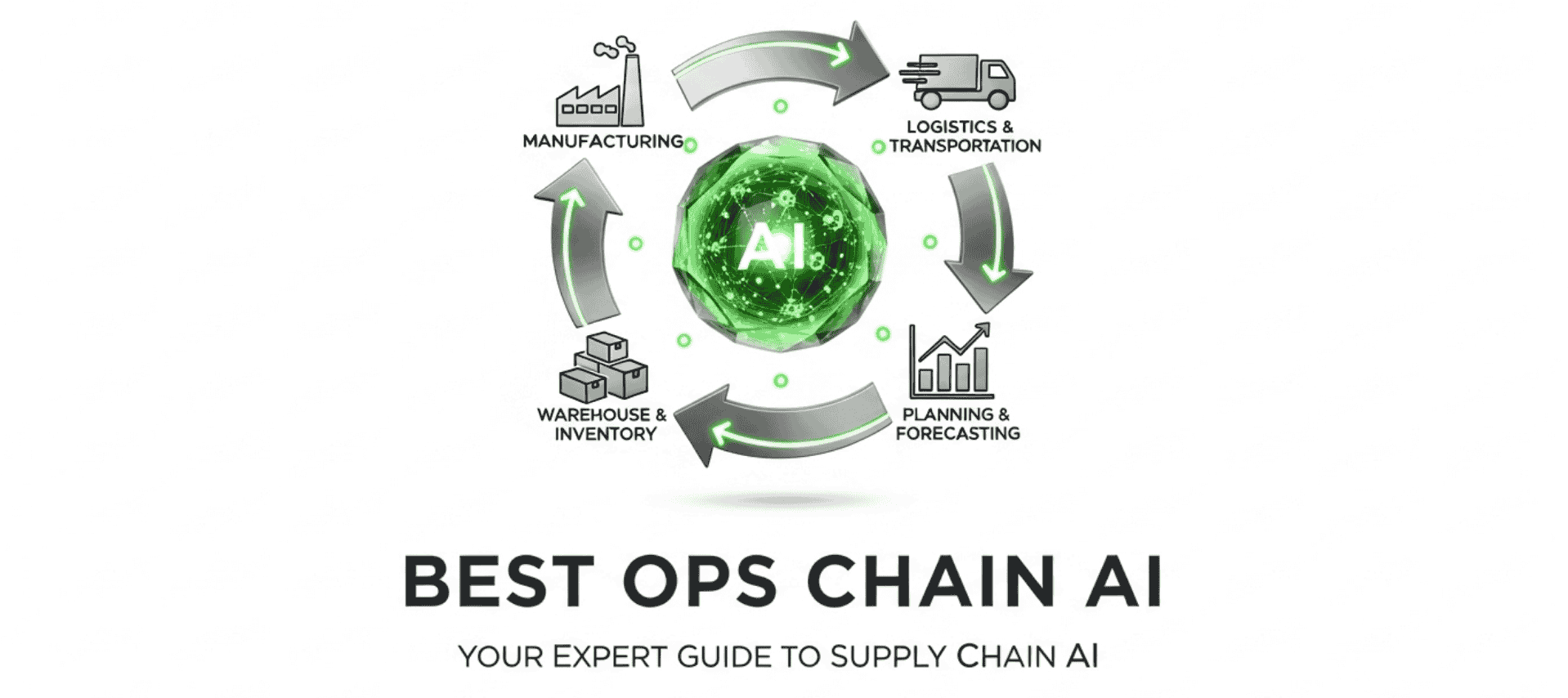
Which AI WMS is Right for Your Warehouse?
This 2-Minute Quiz Pinpoints Your Perfect Match!
As the founder of Best Ops Chain AI, I've seen firsthand how traditional warehouses struggle. They are often reactive, filled with inefficient processes, and prone to costly errors (e.g., mis-picks, inventory inaccuracies, shipping delays) that cannot keep up with modern commerce. The central challenge for supply chain leaders is moving from this state of chaos to one of control. This is where AI Warehouse Management Systems (WMS) create a monumental shift.
These platforms are not just digital checklists. They are the central brain of the warehouse, transforming it into a proactive and intelligent asset. My guide to the Best 10 AI Warehouse Management Systems (WMS) for 2025 is built on rigorous, hands-on testing within the AI for Warehouse & Inventory Management space. It provides a professional comparison to help you select a tool that delivers automation, accuracy, and true operational resilience.
But a WMS is a long-term commitment. Factors like ERP integration and security are just as vital as the features themselves. For businesses looking to explore comprehensive SAP Extended Warehouse Management (EWM) Review or modern cloud-native solutions like Hopstack Review, understanding these strategic considerations is crucial for making an informed decision.

Key Takeaways: Top AI WMS Picks for 2025
- Editor's Choice: Hopstack – For its unmatched balance of powerful AI, exceptional user experience for floor operators, and impressively rapid implementation timelines.
- Premium Choice: SAP EWM – For large enterprises where deep, native integration with an SAP ERP is a non-negotiable requirement for operational success.
- Best for 3PLs: Infor WMS – For its specialized, out-of-the-box features tailored for multi-client management and complex 3PL billing.
- Critical Security Insight: Your company must shortlist vendors with verifiable SOC 2 Type II and ISO 27001 certifications.
- Key Statistic: Leading AI WMS solutions demonstrate a 30-50% reduction in picking errors and a 25% increase in labor efficiency.
The Security & Compliance Landscape for Warehouse Operations
Before looking at any tool, you must understand the security stakes. Your supply chain data—supplier costs, inventory levels, customer orders—is highly sensitive. A breach can be catastrophic. So, selecting a WMS is also a critical security decision.
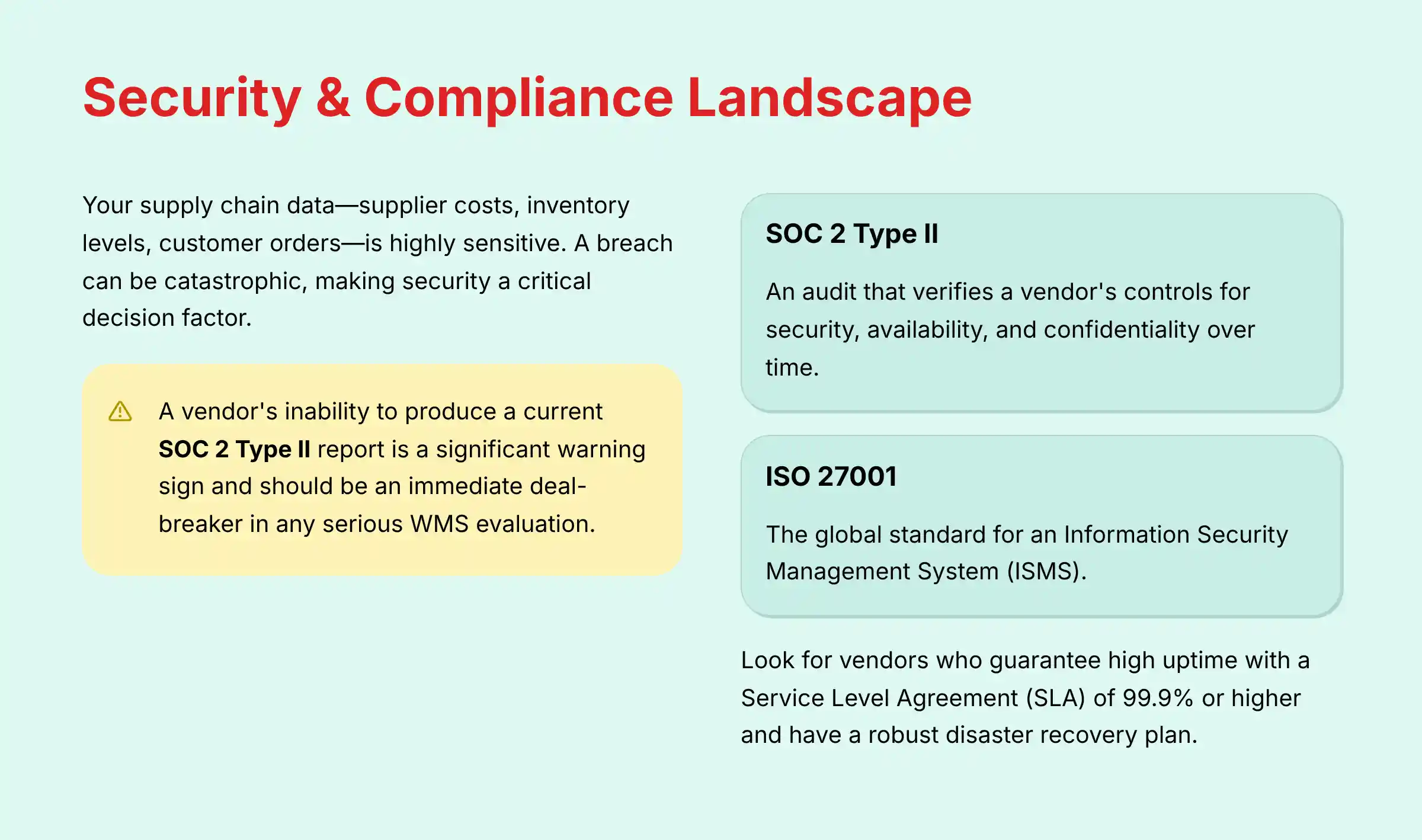
The two most important certifications in this space are SOC 2 Type II and ISO 27001. A SOC 2 Type II report is an audit that verifies a vendor's controls for security, availability, and confidentiality over time. ISO 27001 is the global standard for an Information Security Management System (ISMS). Think of them as the gold standard for proving a SaaS company takes your data protection seriously.

Beyond these, operational reliability is key. Warehouse downtime directly halts the flow of physical goods. Look for vendors who guarantee high uptime with a Service Level Agreement (SLA) of 99.9% or higher and have a robust disaster recovery plan.
In my experience, a vendor's inability to produce a current SOC 2 Type II report is a significant warning sign. Think of it as an architect refusing to show you the building's structural engineering report. It's a non-starter and should be an immediate deal-breaker in any serious WMS evaluation, as it speaks directly to the vendor's commitment to protecting your most sensitive operational data.
Our Comprehensive 10-Point AI WMS Evaluation Framework
After analyzing over a hundred tools on the market in AI for Operations & Supply Chain and testing the top 10 AI Warehouse Management Systems across numerous real-world implementation projects in 2025, our team at Best Ops Chain AI provides a comprehensive 10-point technical assessment framework recognized by leading supply chain professionals.

- Core WMS Functionality: Assessing the depth and performance of receiving, putaway, picking, packing, and inventory control features.
- AI-Powered Optimization: Evaluating the effectiveness and transparency of AI for slotting, path optimization, and labor planning.
- The Dual User Experience (Planner vs. Operator): Rating the intuitiveness of both the strategic dashboard for managers and the mobile interface for floor workers.
- Ecosystem & ERP Integration Quality: Scrutinizing the reliability and data latency of pre-built connectors to major ERPs (SAP, Oracle, NetSuite). A key differentiator we test for is real-time data synchronization versus slower batch updates. We also analyze the robustness of the vendor's REST API and their support for modern data ingestion pipelines, which are essential for connecting to the broader supply chain ecosystem.
- Execution System & Labor Management Integration: Beyond planning, we assess the WMS's ability to direct work in real-time. This includes its native capabilities or pre-built integrations with a Warehouse Execution System (WES), which is critical for orchestrating automation and human tasks at a granular level. We also evaluate its connection to a Labor Management System (LMS) to benchmark performance against engineered standards and drive productivity improvements.
- Security Protocols & Data Protection: Verifying SOC 2 Type II and ISO 27001 compliance, and assessing the granularity of access controls.
- Implementation & Time-to-Value: Analyzing the average implementation timeline, complexity, and resource requirements.
- Pricing & Total Cost of Ownership (TCO): Calculating the true cost beyond the license fee, including implementation, customization, and support.
- Vendor Expertise & Support Quality: Evaluating the vendor's domain knowledge and the responsiveness of their support team.
- Risk Assessment & Scalability: Identifying potential limitations and assessing the tool's ability to grow with a business.
The AI WMS Market Map: Finding the Right Tier for Your Business
The WMS market is not one-size-fits-all. I have categorized the top tools into four distinct tiers to help you quickly find the solutions most relevant to your business scale and needs.

Tier 1: Enterprise ERP-Centric Behemoths
These systems are for large, global enterprises with complex, multi-site operations. Their core value is deep, native integration with a parent ERP, creating a single source of truth for finance and operations.
- Tools: SAP EWM, Oracle WMS Cloud, Manhattan Associates WMS
Tier 2: Modern Cloud-Native Challengers
These are for mid-market to enterprise e-commerce brands and 3PLs seeking agility and rapid ROI. They prioritize user experience and speed-to-value.
- Tools: Hopstack, Blue Yonder
Tier 3: Niche & Industry Specialists
These tools serve businesses with specific vertical needs that generic systems handle poorly. They offer purpose-built features that solve unique industry challenges out of the box.
- Tools: Infor WMS, 3PL Warehouse Manager, Increff WMS
Tier 4: SMB & E-commerce Entry Points
These platforms are designed for small to medium-sized businesses outgrowing spreadsheets. They focus on affordability, simplicity, and easy integration with platforms like Shopify and QuickBooks.
- Tools: EasyEcom, Fishbowl

In-Depth Reviews of the Top 10 AI WMS Solutions
Here is my detailed analysis of each of the top 10 AI WMS tools, based on our 10-point framework and extensive testing.
Overview & Core Capabilities
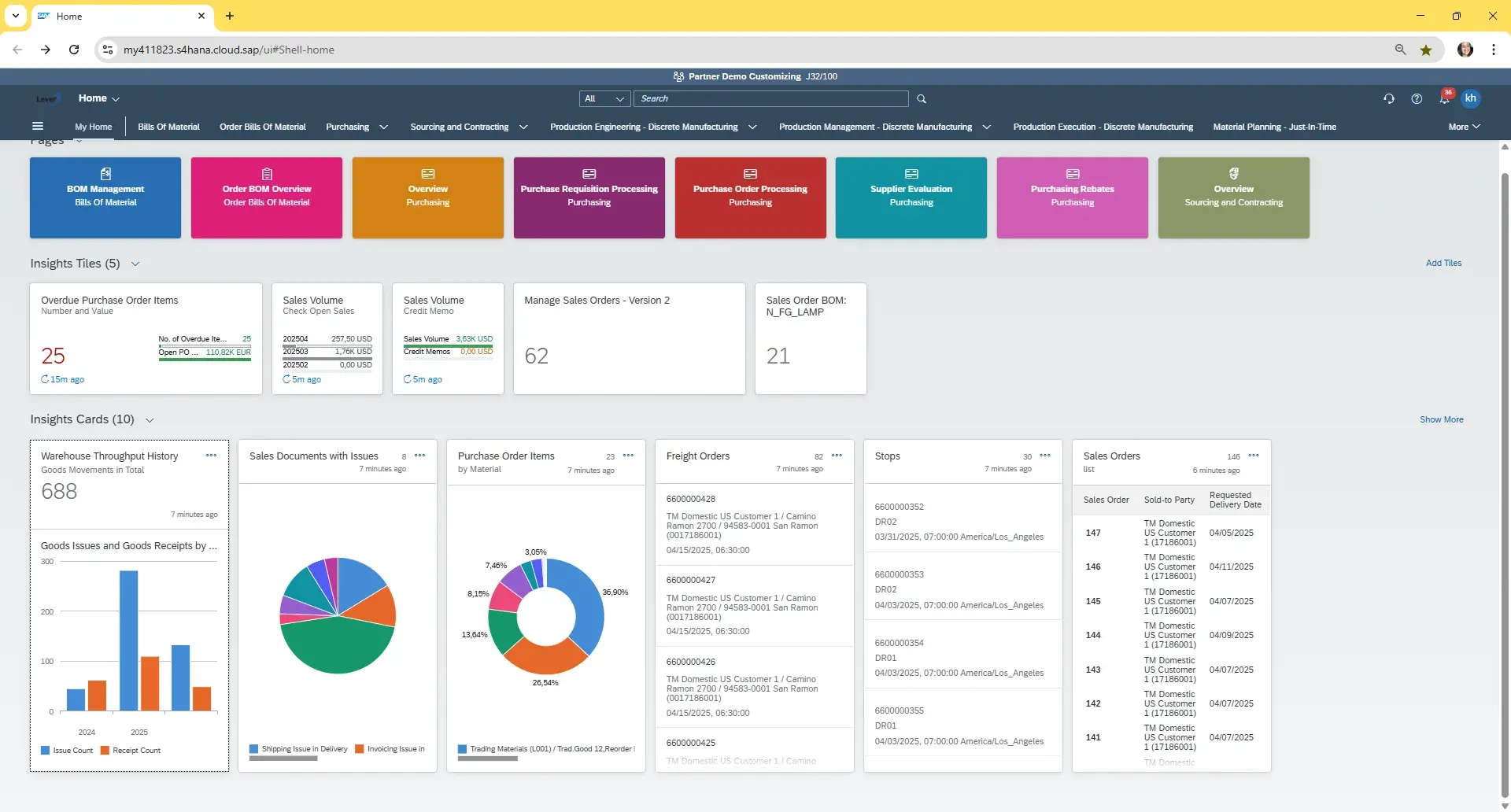
SAP EWM is the enterprise heavyweight, built for large, complex, and high-volume warehouse operations. It is designed to be the operational backbone for companies already running the SAP ERP ecosystem. Its power lies in providing a single, unified platform for logistics and finance.
AI Optimization & Automation
The system offers advanced AI modules for labor management, wave planning, and inventory slotting. When configured correctly, its AI can create significant efficiency. But it requires substantial clean data and expert tuning to achieve these results.
✅ Strengths
- Unmatched native SAP S/4HANA integration
- Enterprise-grade security (SOC 1/2/3, ISO 27001)
- Advanced AI modules for complex operations
- Perfect sync between warehouse and financials
⚠️ Considerations
- Complex, cockpit-like user interface
- Extremely high total cost of ownership
- 12-24 month implementation timeline
- Requires dedicated SAP consultant team
Best Ops Chain AI Verdict: For a global enterprise already running on SAP, EWM is a necessary and powerful choice. Its integration is its unbeatable advantage. But the cost, complexity, and poor UX make it unsuitable for anyone outside this ecosystem.
Rating: 8.0/10
Overview & Core Capabilities
Hopstack is a modern, cloud-native WMS designed for fast-growing e-commerce and 3PL businesses. It masterfully combines a simple, intuitive user interface with powerful AI for optimizing warehouse workflows. It acts like a smart assistant for your entire fulfillment operation.
AI Optimization & Automation
Hopstack's AI is practical and delivers quick wins. Its AI-driven picking path optimization can reduce walker travel time by over 30%. It also uses AI to intelligently batch orders together, increasing throughput with the same number of staff.
✅ Strengths
- Exceptional mobile app user experience
- Rapid 4-8 week implementation
- SOC 2 Type II and ISO 27001 certified
- API-first architecture for flexibility
- Practical AI with immediate ROI
⚠️ Considerations
- May lack niche features for very large enterprises
- Newer platform compared to legacy systems
- Focus on e-commerce and 3PL verticals
Best Ops Chain AI Verdict: Hopstack is my Editor's Choice because it nails the formula for the modern warehouse. It delivers powerful, practical AI in a package that is easy to use and fast to deploy. It provides the best all-around value for most e-commerce and 3PL businesses.
Rating: 9.5/10

Overview & Core Capabilities
Oracle WMS Cloud is Oracle's answer to SAP EWM, offering a powerful, cloud-first solution for the enterprise market. It is designed to work seamlessly within Oracle's broader suite of supply chain and ERP applications.
AI Optimization & Automation
The platform's AI/ML capabilities are strong, especially for predictive analytics and demand forecasting. It helps businesses position inventory correctly and anticipate demand shifts. Achieving peak performance, however, requires several months of data tuning.
✅ Strengths
- Seamless Oracle ERP Cloud and NetSuite integration
- SOC 1/2, ISO 27001, and HIPAA compliant
- Strong predictive analytics capabilities
- Modern, mobile-friendly interface
- Robust Oracle Cloud Infrastructure security
⚠️ Considerations
- High cost and vendor lock-in risks
- Complex integration with non-Oracle systems
- 6-12 month implementation timeline
- Enterprise-grade pricing
Best Ops Chain AI Verdict: For large companies running on Oracle ERPs, the WMS Cloud is a powerful and logical choice. Its strong analytics and scalable cloud architecture are top-tier. But the high cost and ecosystem lock-in make it less suitable for others.
Rating: 8.2/10

Overview & Core Capabilities
Blue Yonder, formerly JDA, is a legend in supply chain software. Its WMS is part of a broad platform, and its standout feature is best-in-class AI for demand forecasting and replenishment. It acts like a meteorologist for your supply chain, predicting demand storms before they arrive.
AI Optimization & Automation
The AI on the Luminate Platform is Blue Yonder's crown jewel. Users consistently report that its demand forecasting accuracy is unmatched, helping them navigate seasonal peaks and market shifts without costly stockouts or overstocks.
✅ Strengths
- Unmatched demand forecasting accuracy
- SOC 2 compliant and ISO 27001 certified
- Microsoft Azure cloud infrastructure
- Advanced AI for supply chain planning
- Strong predictive analytics capabilities
⚠️ Considerations
- Complex, dated user interface
- High enterprise-level pricing
- 9-15 month implementation timeline
- Integration requires middleware/partners
- Steep learning curve for users
Best Ops Chain AI Verdict: If your business lives or dies by the accuracy of its demand forecast, Blue Yonder is an excellent choice. Its predictive AI is truly innovative. But you must be prepared for the high price tag and a user interface that prioritizes power over simplicity.
Rating: 8.5/10

Overview & Core Capabilities
Manhattan Associates WMS is a top-tier system that competes directly with SAP for the most complex warehouse operations. Its key strengths are its extreme configurability and market-leading labor management features.
AI Optimization & Automation
The system offers advanced AI for slotting optimization and labor management. In large-scale distribution centers, these algorithms can produce significant efficiency gains by organizing the warehouse and workforce intelligently.
✅ Strengths
- Best-in-class labor management capabilities
- SOC 1/2 and ISO 27001 compliant
- Integrated LMS and YMS modules
- Multi-tenant cloud solution
- Extreme configurability for complex operations
⚠️ Considerations
- Complex, non-intuitive user interface
- High enterprise-level costs
- 9-18 month implementation timeline
- Risk of scope creep and budget overruns
- Requires expert technical team
Best Ops Chain AI Verdict: For large, labor-intensive distribution centers where optimizing every movement is critical, Manhattan is a must-have. Its labor management and optimization tools are best-in-class. But it is overkill for less complex operations.
Rating: 8.4/10

Overview & Core Capabilities
Infor WMS is a highly flexible platform that caters to a wide range of industries, with particular strengths in 3PL and distribution. Its standout feature is a 3D visual warehouse and graphical workflow builder that allows for process customization without extensive coding.
AI Optimization & Automation
While not as AI-heavy as others, it provides intelligent features for task management and replenishment. Its main “smart” feature is the visual workflow engine that allows managers to design and optimize processes visually.
✅ Strengths
- 3D warehouse visualization capabilities
- Visual workflow builder for customization
- SOC 2 and ISO 27001 compliant (AWS hosted)
- Strong 3PL and distribution features
- More affordable than top-tier competitors
⚠️ Considerations
- Risk of over-customization complexity
- Inconsistent UI across modules
- 4-9 month implementation timeline
- Limited AI compared to modern competitors
Best Ops Chain AI Verdict: Infor WMS is a versatile and powerful choice for businesses with unique process needs, especially 3PLs. Its visual tools and flexible nature are major advantages. It is a solid contender for companies that don't fit a standard mold.
Rating: 7.9/10
Overview & Core Capabilities
EasyEcom is a WMS built specifically for the needs of small and medium-sized e-commerce sellers. It focuses on solving the biggest problem for this group: syncing inventory across multiple online channels like Shopify and Amazon.
AI Optimization & Automation
Its “AI” is more accurately described as smart automation. The system offers automated reorder level setting and basic barcode-based picking guidance. It lacks the advanced predictive capabilities of enterprise systems.
✅ Strengths
- Plug-and-play e-commerce integrations
- Transparent, tiered pricing
- Simple, intuitive user interface
- Fast setup (days, not months)
- GDPR compliant
⚠️ Considerations
- Limited advanced AI capabilities
- May outgrow capabilities within 2-3 years
- Basic automation vs. true intelligence
- Not suitable for complex operations
Best Ops Chain AI Verdict: For an e-commerce seller graduating from spreadsheets, EasyEcom is an excellent and budget-friendly first step. It solves the core problem of multi-channel inventory management effectively. But it is not a long-term solution for businesses with complex or high-volume operations.
Rating: 7.2/10
Overview & Core Capabilities
Fishbowl is a very popular inventory management platform for SMBs, especially those that use QuickBooks for accounting. It has strong features for businesses that have both warehousing and light manufacturing needs.
AI Optimization & Automation
Like EasyEcom, its “AI” features are basic automation rules rather than true artificial intelligence. Its strength is not in optimization but in accurate tracking and costing.
✅ Strengths
- Best-in-class QuickBooks integration
- Perpetual license model
- On-premise deployment option
- Strong for manufacturing + warehousing
- Reliable tracking and costing
⚠️ Considerations
- Clunky, outdated user interface
- Limited AI/automation capabilities
- On-premise model feels inflexible
- Different financial model than SaaS
Best Ops Chain AI Verdict: Fishbowl is a great starting point for small manufacturers and distributors who live inside QuickBooks. It provides a solid, reliable bridge between operations and finance. But businesses should be prepared for its dated user interface.
Rating: 7.0/10
Overview & Core Capabilities
As the name implies, 3PL Warehouse Manager is purpose-built for third-party logistics companies. Its entire feature set is centered on managing inventory and billing for multiple clients within a single warehouse.
AI Optimization & Automation
This platform focuses on execution, not advanced AI optimization. Its “intelligence” is in its specialized business logic, particularly its automated billing engine that can handle complex, client-specific charging rules.
✅ Strengths
- Purpose-built for 3PL operations
- Automated multi-client billing
- Customer-facing portal access
- Good value for 3PL-specific features
- Two-factor authentication and IP whitelisting
⚠️ Considerations
- Performance issues at very large scale
- Limited advanced AI features
- Best for small to mid-sized 3PLs
- Focused niche may limit versatility
Best Ops Chain AI Verdict: For a small to mid-sized 3PL, this tool offers exceptional value. It delivers the exact features needed—multi-client management, billing, and customer visibility—at a competitive price point. It's a smart, focused choice for its niche.
Rating: 7.8/10
Overview & Core Capabilities
Increff WMS is a specialized WMS with a laser focus on the fashion, apparel, and lifestyle e-commerce sectors. Its AI is specifically tuned to solve the unique challenges of this industry, like managing huge numbers of SKUs with color and size variants.
AI Optimization & Automation
Its AI for inventory optimization is highly effective for fashion. It uses exposure-based allocation to decide which channels should get which inventory, helping to improve sell-through rates for seasonal items and reduce costly markdowns. This system is like having a smart merchandiser for your warehouse.
✅ Strengths
- Specialized AI for fashion inventory
- Exposure-based allocation algorithms
- Excellent mobile app for cycle counting
- GDPR compliant for global operations
- Good mid-market pricing for niche value
⚠️ Considerations
- Limited to fashion/lifestyle verticals
- Specialized algorithms ineffective outside niche
- May not suit other industry types
- Narrow market focus
Best Ops Chain AI Verdict: For a fashion or lifestyle brand, Increff is a fantastic choice. It provides tailored AI that solves the industry's biggest inventory challenges out of the box. It is a great, purpose-built tool for its specific audience.
Rating: 7.7/10

Head-to-Head: AI WMS Comparison Tables

Table 1: Feature & AI Capability Matrix
| Feature | SAP EWM | Hopstack | Oracle WMS | Blue Yonder | Manhattan |
|---|---|---|---|---|---|
| AI Slotting | Yes | Yes | Yes | Yes | Yes |
| AI Picking Paths | Limited | Yes | Yes | Limited | Yes |
| Robotics Orchestration | Yes | Yes | Yes | Yes | Yes |
| AI Demand Forecasting | Yes | Limited | Yes | Yes | Limited |
| 3PL Billing Module | No | Yes | No | No | Yes |
| Visual Workflow Builder | No | No | No | No | No |
Table 2: Security, Compliance & ERP Integration
| Factor | SAP EWM | Hopstack | Oracle WMS | Blue Yonder | Manhattan |
|---|---|---|---|---|---|
| SOC 2 Type II | Verified | Verified | Verified | Verified | Verified |
| ISO 27001 | Verified | Verified | Verified | Verified | Verified |
| Native SAP Connector | Verified | Available | No | No | No |
| Native NetSuite Connector | No | Available | Verified | No | No |
| Deployment Model | On-Prem/Cloud | Cloud | Cloud | Cloud | Cloud |
Table 3: Best-for-Scenarios Matrix
| Use Case | Recommended Tool(s) |
|---|---|
| Global Enterprise on SAP | SAP EWM |
| Mid-Market E-commerce | Hopstack |
| Large Retailer (Forecasting Focus) | Blue Yonder |
| Large 3PL Provider | Manhattan Associates WMS, Infor WMS |
| Small E-commerce (Shopify) | EasyEcom |
| SMB Manufacturer (QuickBooks) | Fishbowl |
How to Choose the Right AI WMS: A Step-by-Step Selection Guide
Choosing a WMS is a major decision. Follow this practical guide to make the right choice for your business. For detailed insights on specific platforms, our comprehensive reviews like the Oracle Warehouse Management Cloud (WMS Cloud) Review and Blue Yonder Review provide in-depth analysis of enterprise solutions.

- Define Your Core Problem & Target KPIs. Are you primarily trying to solve for order speed, picking accuracy, high labor costs, or the inability to scale? Be specific and tie it to measurable metrics. For example: “We must improve our Perfect Order Percentage from 97% to 99.5%” or “We need to reduce our Dock-to-Stock time for inbound goods by 50%.” Your target KPIs will dictate which WMS features are most critical.
- Map Your Technical Ecosystem. Is seamless, real-time ERP integration your absolute top priority? If you run on SAP, your shortlist will look very different than if you run on NetSuite or are a pure-play Shopify seller.
- Assess Your Team's “Dual Experience” Needs. How critical is an intuitive, easy-to-learn mobile app for your warehouse operators? Involving floor supervisors in the demo process is not optional; it is essential for successful adoption.
- Align with Your Security Posture. Filter out any vendors who cannot meet your compliance requirements. Ask for their SOC 2 Type II report upfront. If they cannot provide it, move on.
- Calculate the True TCO. Build a 3-year cost model. This must include not just the software license, but also one-time implementation fees, customization costs, training, and ongoing support.
- Conduct Vendor Deep-Dives. During demos, ask vendors critical questions. For complex integrations, professional consultation with an implementation specialist is highly recommended to validate vendor claims.
Risk Assessment & Mitigation Guide: Avoiding Implementation Failure
In my experience, even the best WMS can fail if the implementation is managed poorly. Here is how to de-risk your project. Understanding the challenges faced by different platforms helps – for instance, our Manhattan Associates WMS Review highlights implementation complexities, while our Infor WMS Review examines total cost considerations.

Risk: ERP Integration Hell
A broken connection between your WMS and ERP can bring your operations to a halt. The WMS needs to be the single source of truth for inventory, and that requires perfect, real-time data flow.
- Mitigation: The mitigation here is absolute. Do not accept a PowerPoint deck as proof of concept. You must insist on a live, technical ‘proof of integration' within a sandbox environment that mirrors your own ERP. Have your technical lead on the call to validate the data flows and API call integrity. Engage a third-party integration consultant to verify the technical viability of the proposed connection. Anything less is a gamble on the central nervous system of your operation.
Risk: Implementation Overruns
Enterprise WMS projects are notorious for exceeding budgets and timelines. This delays your ROI and causes massive internal disruption.
- Mitigation: Insist on a detailed, phased project plan with clear milestones. Crucially, ask to speak with three reference clients who have a similar operational complexity to yours and ask them directly about their implementation experience. Professional consultation from implementation partners with experience in your specific industry is strongly recommended to provide realistic timeline and resource expectations.
Risk: Poor User Adoption
If your warehouse operators find the mobile app slow, confusing, or clunky, they will resist using it. This will kill your productivity goals.
- Mitigation: Make your warehouse supervisors and a few of your best pickers part of the final demo process. Let them get their hands on the mobile app and give you direct feedback. Their buy-in is critical.
Risk: “Black Box” AI and Lack of Trust
Some systems have AI features that make recommendations without explaining the logic. This leads to a lack of trust from experienced planners and supervisors, who are reluctant to cede control to an algorithm they don't understand.
- Mitigation: During demos, specifically ask about Explainable AI (XAI) or AI transparency features. Can a planner see why the AI recommended a certain inventory slot or wave plan, citing factors like order velocity or SKU affinity? The best systems provide this rationale, allowing for human-in-the-loop oversight and building crucial operational trust.
The Future of the Intelligent Warehouse: 2026 and Beyond
The evolution of the warehouse is accelerating. The next generation of WMS will be shaped by three key technologies.

First, Generative AI for Operations will allow managers to use natural language to query data. Imagine asking your WMS, “Show me the root cause of last week's picking delays,” and getting a clear, summarized answer.
Second, Warehouse Digital Twins will become more common. This involves creating a complete virtual simulation of your warehouse. You can test new layouts or process improvements in this virtual world before spending a dollar on physical changes.
Finally, Vision-Based Inventory Management will use cameras and AI to achieve near-100% real-time inventory accuracy. This technology can perform continuous cycle counting without any human intervention, eliminating a time-consuming and error-prone task.
Frequently Asked Questions (FAQ) about AI WMS
What is the main benefit of an AI WMS over a traditional WMS?
The main benefit is moving from reactive execution to proactive optimization. A traditional WMS tells you what happened. An AI WMS recommends the best course of action for what should happen next, like optimizing picking paths or predicting labor needs.
How long does it take to implement an AI WMS?
Implementation timelines vary greatly by system complexity. Modern cloud systems like Hopstack can be live in 6-12 weeks. Large enterprise systems like SAP EWM or Manhattan Associates often require 12-24 months for a full implementation. These are best-case scenarios for standard deployments. It is critical to engage in a professional consultation with implementation partners or the vendors themselves to develop a detailed project scope and a realistic timeline tailored to your specific technical ecosystem and operational complexity.
Do I need an ERP system to use a WMS?
While not strictly required for all SMB tools, deep ERP integration is vital for most businesses. It maintains a single source of truth for orders, inventory, and financials, which prevents data silos and costly reconciliation errors. For those considering SMB solutions, our EasyEcom Review and Fishbowl Review examine integration capabilities for smaller operations.
Can AI WMS integrate with warehouse robots?
Yes, leading systems can act as “orchestrators” or air traffic controllers for fleets of Autonomous Mobile Robots (AMRs). But it is important to verify that a WMS has pre-built, certified integrations with your specific robotics vendor.
What is the typical cost of an AI WMS?
Costs vary widely. Models include per-user-per-month fees, per-transaction fees, or large upfront license costs. It is critical to calculate the Total Cost of Ownership (TCO) over 3-5 years, not just the initial software price.
How much data do I need for the AI features to work?
For AI forecasting and optimization models to be effective, you typically need at least 6 to 12 months of clean, historical operational data. The quality of your data is just as important as the quantity.
What is SOC 2 compliance and why is it important for a WMS?
SOC 2 is an auditing procedure that verifies a vendor's ability to securely manage data to protect the interests and privacy of their clients. A SOC 2 Type II report is a crucial, independent validation of a vendor's security, availability, and confidentiality practices over time.
Can these systems work for small businesses?
Yes. Tools in the “SMB & E-commerce Entry Points” category, like EasyEcom or Fishbowl, are specifically designed for small businesses. They offer core functionality at an affordable price point to help businesses move beyond spreadsheets.
Your Mandate: From Selection to Strategic Advantage
We've reached the end of the analysis, but your work is just beginning. The decision you make is more than a software purchase; it's a declaration of your operational future. The tools detailed here represent a fundamental shift from passive visibility to active, intelligent orchestration.
In this new era of supply chain, you have one mandate: to press the advantage. Choose the system that not only solves today's chaos but empowers you to command tomorrow's complexity and build a truly resilient, intelligent, and future-proof operation. For specialized insights on niche solutions, explore our 3PL Warehouse Manager Review and Increff WMS Review to understand industry-specific requirements.
Important Disclaimers:
Technology Evolution Notice: The information about Best 10 AI Warehouse Management Systems (WMS) and AI for Operations & Supply Chain tools presented in this article reflects our thorough analysis as of 2025. Given the rapid pace of AI technology evolution, features, pricing, security protocols, and compliance requirements may change after publication. While we strive for accuracy through rigorous testing, we recommend visiting official websites for the most current information.
Professional Consultation Recommendation: For AI for Operations & Supply Chain applications with significant professional, financial, or compliance implications, we recommend consulting with qualified professionals who can assess your specific requirements and risk tolerance. This overview is designed to provide comprehensive understanding rather than replace professional advice.
Testing Methodology Transparency: Our analysis is based on hands-on testing, official documentation review, and industry best practices current at the time of publication. Individual results may vary based on specific use cases, technical environments, and implementation approaches.
I hope this detailed breakdown of the Best 10 AI Warehouse Management Systems (WMS) provides you with the framework needed to make an informed decision. Choosing the right WMS is a foundational step in building a resilient, efficient, and intelligent supply chain for the future.

Leave a Reply