Is SAP EWM the Right Warehouse Solution for Your Business?
This 2-Minute Quiz Reveals Your Ideal Deployment Strategy!
Key Takeaways
- Advanced Architecture: SAP EWM provides the essential digital foundation for AI-enabled warehouse operations with sophisticated process orchestration capabilities
- Deployment Flexibility: Choose between embedded S/4HANA integration or decentralized deployment based on performance and operational requirements
- Automation Integration: Native integration with robotics and Material Flow Systems enables intelligent coordination between humans and machines
- AI-Ready Platform: EWM creates rich operational datasets that fuel machine learning for predictive slotting, labor forecasting, and process optimization
- Enterprise Integration: For SAP ERP users, EWM offers superior integration benefits compared to third-party solutions like Manhattan WMS
What is SAP Extended Warehouse Management (EWM) and how does it enable an intelligent warehouse?
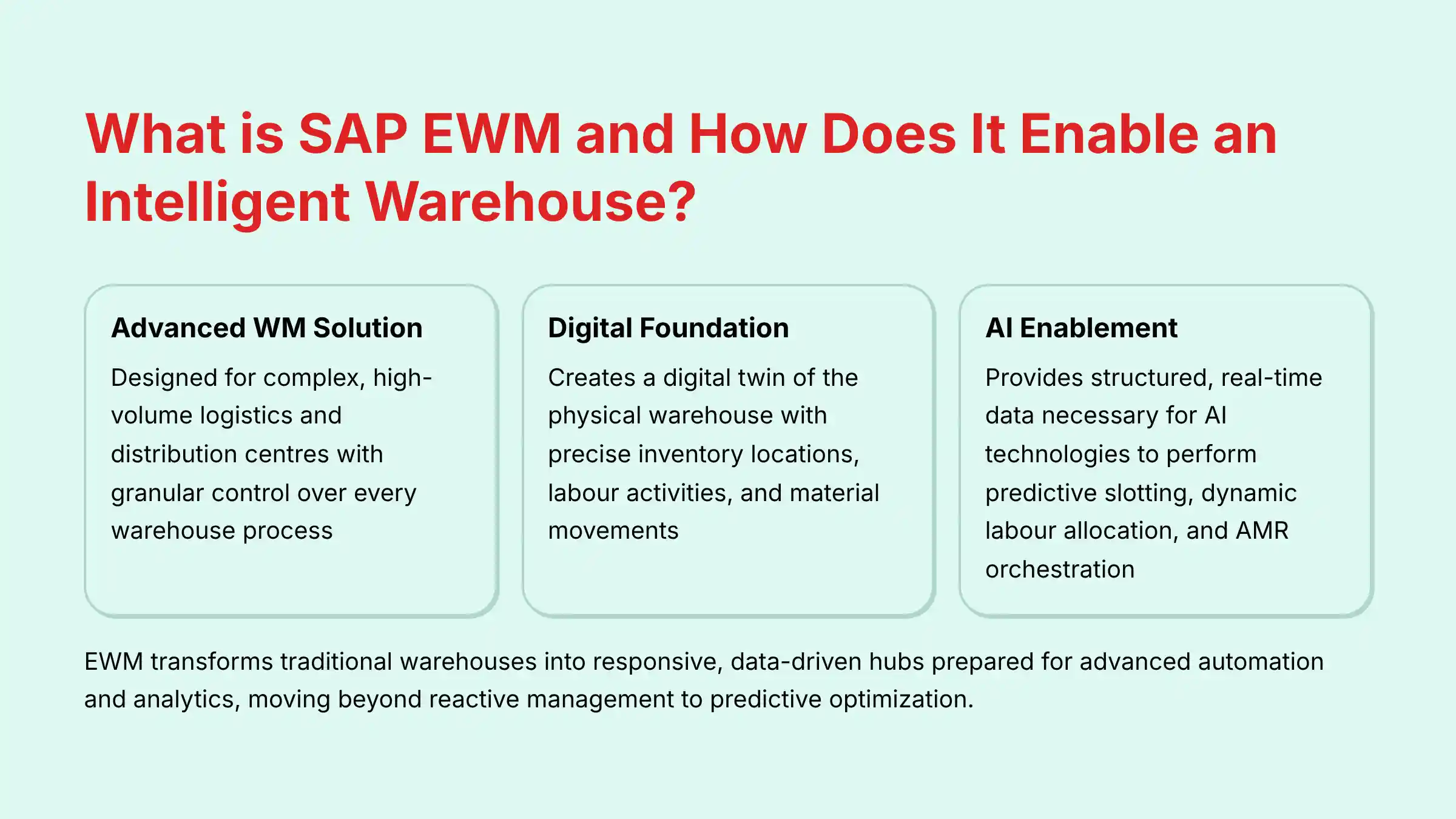
SAP Extended Warehouse Management (EWM) is SAP's advanced warehouse management solution designed for complex, high-volume logistics and distribution centers. Unlike its predecessor, SAP WM, EWM is a highly flexible platform that provides granular control over every warehouse process, from inbound receiving and quality inspection to complex outbound picking, packing, and shipping operations.
Within the context of an AI-driven supply chain, SAP EWM serves as the operational foundation or “brain” of the intelligent warehouse. It provides the structured, real-time data and process control necessary for AI technologies to function effectively. EWM manages precise inventory locations, labor activities, and material movements, creating a digital twin of the physical warehouse. This granular data becomes the fuel for AI and machine learning algorithms to perform advanced tasks such as:
- Predictive slotting that optimizes product placement based on forecasted demand patterns
- Dynamic labor allocation that adjusts resources based on workload predictions
- Orchestration of autonomous mobile robots (AMRs) for efficient material transport
- Real-time decision support for exception handling and bottleneck prevention
By providing this robust digital foundation, EWM transforms traditional warehouses into responsive, data-driven hubs prepared for advanced automation and analytics. The system's ability to capture detailed operational data creates the perfect environment for AI implementation, allowing organizations to move beyond reactive warehouse management to predictive and prescriptive optimization that reduces costs while improving throughput and accuracy.
For organizations seeking to implement intelligent warehouse solutions, exploring our comprehensive SAP Extended Warehouse Management (EWM) Overview and Features provides detailed insights into how these capabilities translate into real-world operational benefits.
What are the key differences between the legacy SAP WM and the modern SAP EWM?
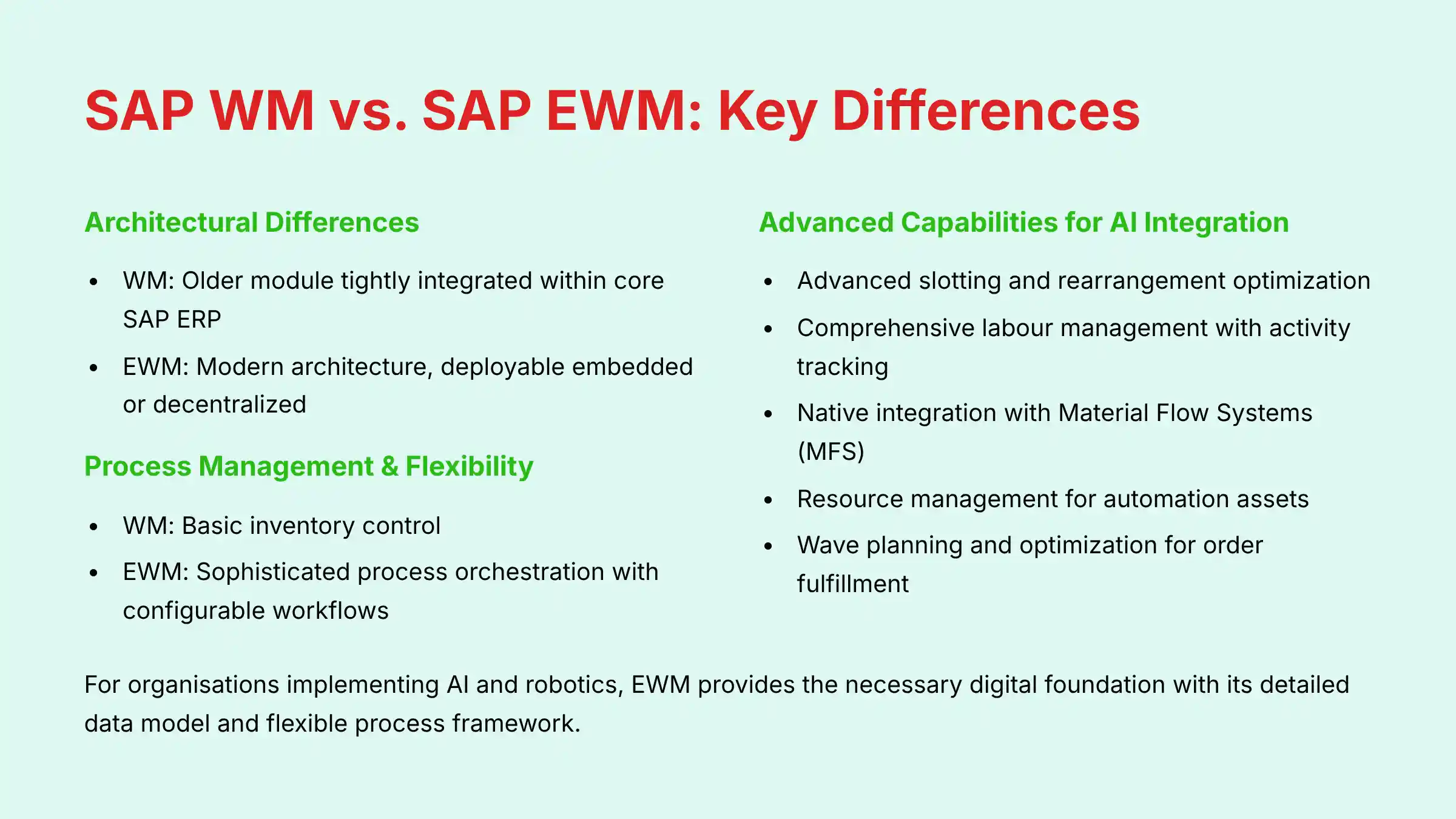
The transition from SAP Warehouse Management (WM) to Extended Warehouse Management (EWM) represents a fundamental shift in warehouse management capabilities and architecture that's critical for AI-enabled operations.
Architectural Differences:
SAP WM is an older module tightly integrated within the core SAP ERP system, offering basic functionalities suitable for simpler operations. Its capabilities are largely limited to inventory management within predefined storage bins. EWM, conversely, is built on a more modern architecture that can be deployed either embedded within S/4HANA or as a decentralized system for maximum performance and scalability.
Process Management & Flexibility:
While WM provides basic inventory control, EWM delivers sophisticated process orchestration with configurable workflows. EWM introduces the concept of “process-oriented warehouse management” where physical processes can be modeled with greater flexibility, allowing for customization without custom coding. This architectural advantage enables EWM to handle significantly greater complexity and transaction volumes – critical for high-throughput automated warehouses.
Advanced Capabilities for AI Integration:
EWM provides several key functional advantages essential for modern intelligent warehouses:
- Advanced slotting and rearrangement optimization algorithms
- Comprehensive labor management with detailed activity tracking
- Value-added services like kitting, labeling, and light assembly
- Native integration with Material Flow Systems (MFS) for automation control
- Resource management for equipment and automation assets
- Wave planning and optimization for order fulfillment
- Yard management capabilities for comprehensive site logistics
For organizations looking to implement AI and robotics in their warehouses, EWM provides the necessary digital foundation with its detailed data model and flexible process framework. While WM might suffice for simple operations, EWM is the strategic platform for any company aiming to build an intelligent, highly automated warehouse operation in the modern supply chain landscape.
To understand how these capabilities translate into practical applications, our detailed SAP Extended Warehouse Management (EWM) Review examines real-world implementation scenarios and performance outcomes across various industry sectors.
What are the deployment options for SAP EWM (Embedded vs. Decentralized) and which is best?
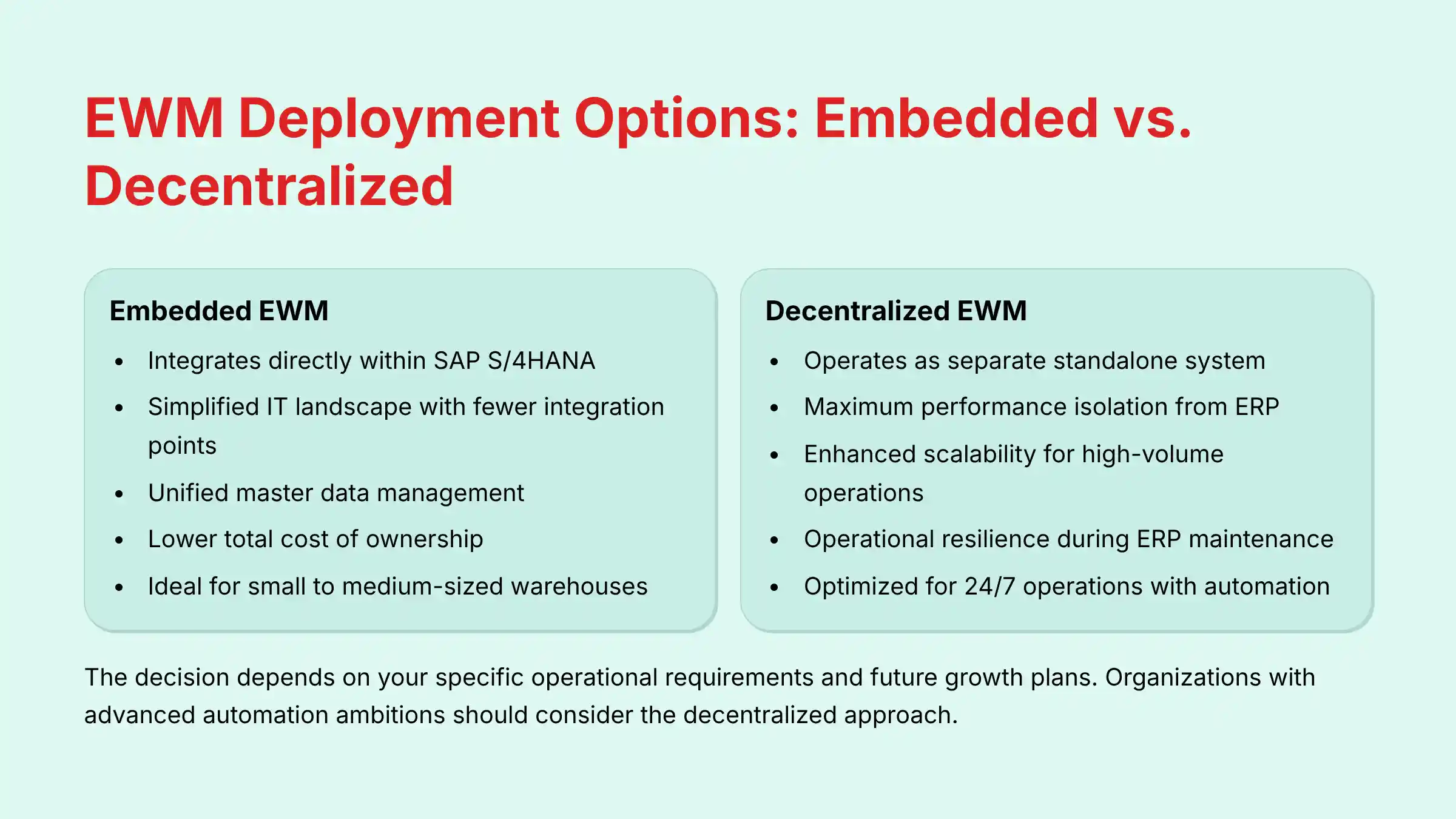
SAP EWM offers two primary deployment models, each with distinct characteristics that impact how effectively you can implement AI-driven warehouse operations:
Embedded EWM
Embedded EWM integrates directly within your SAP S/4HANA instance, creating a unified system where warehouse management functions as a seamless component of your core ERP. This model offers significant advantages:
- Simplified IT landscape with fewer integration points
- Unified master data management without synchronization complexity
- Lower total cost of ownership through shared infrastructure
- Streamlined end-to-end process execution
- Easier reporting and analytics across ERP and warehouse operations
This option is ideal for small to medium-sized warehouses handling moderate transaction volumes where operational continuity is manageable within standard ERP maintenance windows.
Decentralized EWM
Decentralized EWM operates as a separate standalone system instance, communicating with S/4HANA through defined interfaces. This architecture provides:
- Maximum performance isolation from ERP processes
- Enhanced scalability for high-volume operations
- Operational resilience (warehouse continues running during ERP maintenance)
- Flexibility to implement warehouse-specific patches and updates
- Optimized support for 24/7 operations with real-time automation
For large distribution centers leveraging complex automation, robotics, and AI-driven decision systems, the decentralized model typically delivers superior results. The performance isolation ensures that warehouse operations remain responsive even during peak processing periods, while the system independence allows for uninterrupted operations during ERP maintenance.
The decision ultimately depends on your specific operational requirements and future growth plans. Organizations with advanced automation ambitions, high transaction volumes, or critical 24/7 operations should strongly consider the decentralized approach, while those with simpler operations seeking integration efficiency may find the embedded option more suitable and cost-effective.
For organizations evaluating alternatives to SAP's offerings, our comprehensive guide to SAP Extended Warehouse Management (EWM) Top Alternatives and Competitors provides valuable comparative analysis of deployment flexibility across different WMS platforms.
How does SAP EWM integrate with warehouse automation like Autonomous Mobile Robots (AMRs) or AGVs?
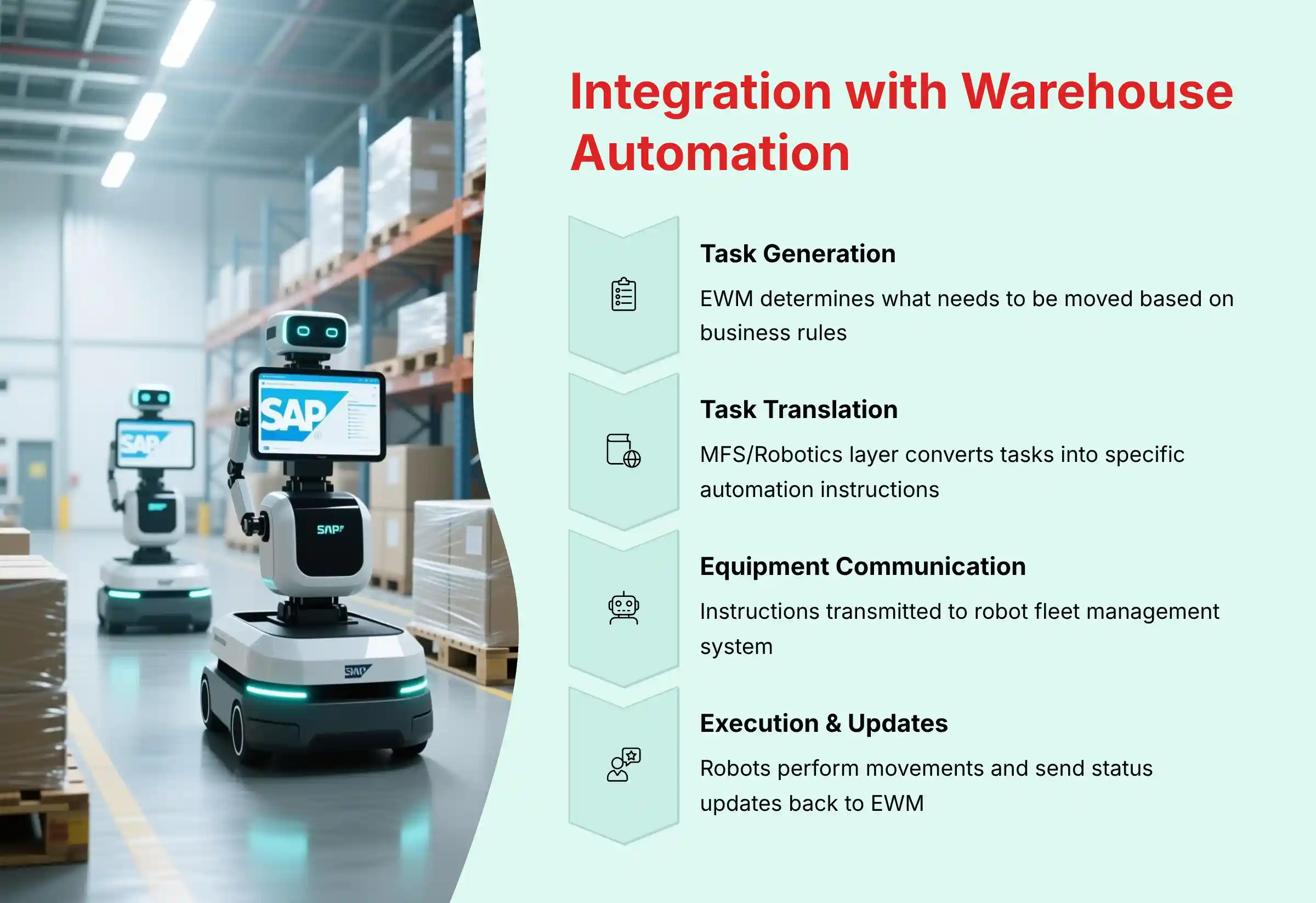
SAP EWM connects with modern warehouse automation systems through a sophisticated orchestration architecture that enables intelligent coordination between the warehouse management system and physical robotics. This integration primarily occurs through two key components: the Material Flow System (MFS) module or the newer SAP Warehouse Robotics layer, which serve as the crucial middleware between high-level business processes and physical automation.
The integration workflow follows a clear pattern:
- Task Generation: EWM determines what needs to be moved based on business rules and warehouse strategies (e.g., “transfer pallet X from receiving to storage location Y”)
- Task Translation: The MFS or Warehouse Robotics layer converts these logical tasks into specific automation instructions, applying additional optimization logic and routing information
- Equipment Communication: These instructions are transmitted to the vendor-specific robot fleet management system using standardized interfaces and protocols
- Execution & Feedback: The robots perform the physical movements while sending status updates back through the integration layer to EWM
- Inventory & Task Updates: EWM receives confirmation of completed movements, updating inventory positions and task status in real-time
This architecture provides several critical advantages for AI-enabled warehouse operations:
- Vendor Neutrality: The abstraction layer allows integration with multiple robotics vendors simultaneously, avoiding technology lock-in
- Orchestration Intelligence: The system can dynamically allocate tasks between human workers and various types of automation
- Real-Time Visibility: Operations managers maintain complete visibility of automation status and progress
- Exception Handling: When automation encounters problems, the system can intelligently reroute tasks to alternative resources
For successful implementation, it's essential to focus on properly configuring the MFS or Warehouse Robotics layer with well-defined communication telegrams (data packets) that effectively translate between EWM's business logic and the robotics systems' operational requirements. This integration layer is the foundation for creating a truly intelligent warehouse where humans and machines work together seamlessly under a unified management system.
Organizations seeking practical implementation guidance should explore our step-by-step SAP Extended Warehouse Management (EWM) Tutorials and Usecase which includes real-world automation integration scenarios and configuration best practices.
Can SAP EWM use AI for tasks like predictive slotting or labor forecasting?
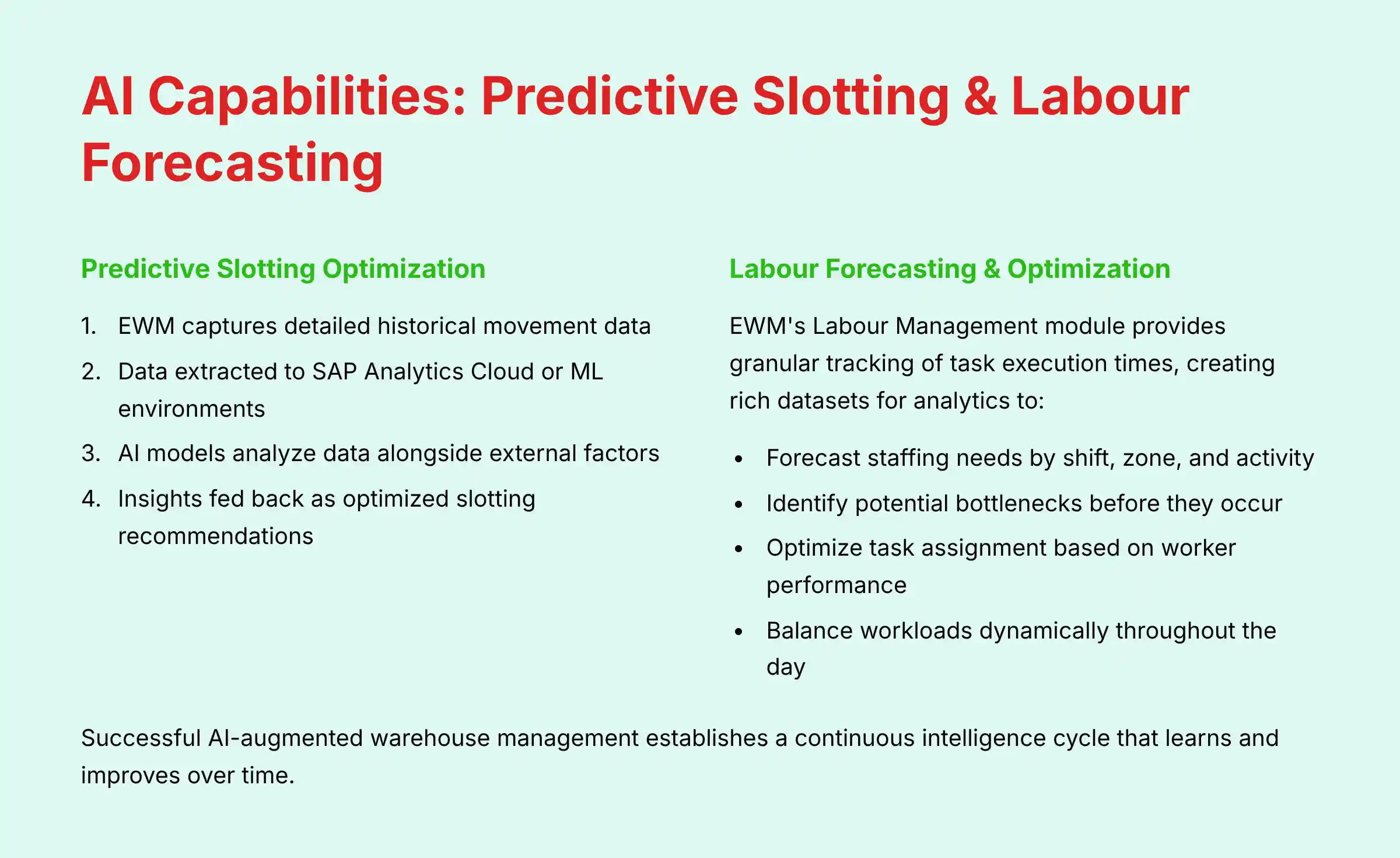
SAP EWM creates the essential foundation for AI-powered warehouse optimization, but leverages a broader ecosystem of technologies to deliver truly predictive capabilities. While EWM itself includes powerful rules-based optimization algorithms, the full potential of AI-driven warehouse management emerges when EWM is integrated with specialized analytics and machine learning platforms.
For predictive slotting optimization, EWM provides the critical baseline functionality through its built-in slotting engine that considers product attributes (dimensions, weight, handling requirements) and static velocity classifications. However, to achieve genuinely predictive slotting that anticipates demand fluctuations, organizations typically implement a multi-system approach:
- EWM captures and stores detailed historical movement data (picks, putaways, transfers)
- This data is extracted to SAP Analytics Cloud (SAC) or specialized machine learning environments
- AI models analyze this historical data alongside external factors (seasonality, promotions, market trends)
- The resulting predictive insights are fed back into EWM as optimized slotting recommendations
For labor forecasting and optimization, a similar pattern applies. EWM's Labor Management module provides granular tracking of task execution times and labor performance, creating a rich dataset of historical productivity metrics. When this operational data is processed through advanced analytics platforms, the system can predict future labor requirements with remarkable accuracy, enabling warehouse managers to:
- Forecast staffing needs by shift, zone, and activity type
- Identify potential bottlenecks before they occur
- Optimize task assignment based on individual worker performance profiles
- Balance workloads dynamically throughout the day
Organizations achieving the greatest success with AI-augmented warehouse management typically establish a continuous intelligence cycle: EWM generates rich operational data, external AI systems analyze this data to create predictive models, and these insights flow back to EWM to optimize future operations. This creates a warehouse operation that continuously learns and improves over time, reducing costs while enhancing throughput and accuracy.
For warehouse operators looking to implement AI capabilities beyond SAP's native offerings, our comprehensive analysis of Best 10 AI Warehouse Management Systems (WMS) provides valuable insights into specialized AI platforms that integrate effectively with EWM deployments.
SAP EWM vs. Manhattan WMS: Which is better for a company using SAP's ERP?
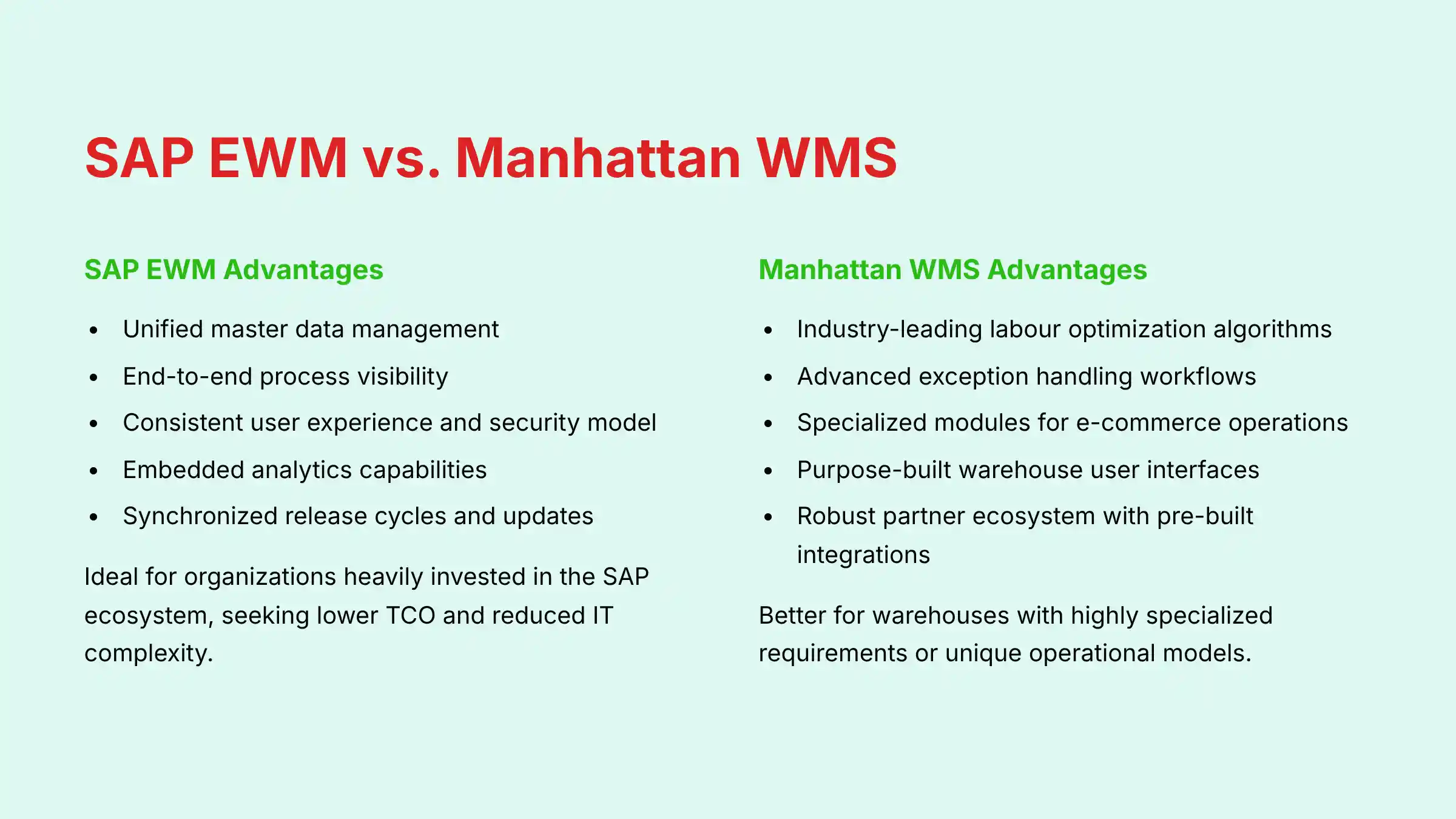
For companies operating within the SAP ERP ecosystem, the choice between SAP EWM and Manhattan WMS represents a strategic decision with significant long-term implications for warehouse operations and AI capabilities.
Integration Advantages of SAP EWM:
When paired with SAP S/4HANA, EWM offers seamless native integration that eliminates many of the challenges associated with cross-vendor solutions:
- Unified master data management ensures product information, customer data, and configuration settings automatically flow between systems
- End-to-end process visibility allows complete tracking from sales order to delivery with no technical handoffs
- Consistent user experience and security model reduces training requirements and simplifies access management
- Embedded analytics capabilities provide holistic supply chain insights without complex data extraction
- Synchronized release cycles and updates ensure compatibility and reduce testing requirements
For organizations heavily invested in the SAP ecosystem, these integration benefits translate into lower total cost of ownership and reduced IT complexity. The unified data model is particularly valuable for AI and machine learning initiatives, as it eliminates the data silos that often hamper predictive analytics projects.
Manhattan WMS Specialized Capabilities:
Manhattan WMS stands out for its deep specialization in warehouse operations with some distinctive advantages:
- Industry-leading labor optimization algorithms with sophisticated task interleaving
- Advanced exception handling workflows for complex fulfillment scenarios
- Specialized modules for high-volume e-commerce and omnichannel operations
- Purpose-built user interfaces optimized for warehouse efficiency
- Robust partner ecosystem with pre-built integrations to specialized warehouse technologies
For warehouses with highly specialized requirements or unique operational models, Manhattan's depth of warehouse-specific functionality may outweigh the integration benefits of staying within the SAP ecosystem.
The optimal decision ultimately depends on your strategic priorities. Organizations emphasizing enterprise-wide process integration, unified data models for AI development, and simplified IT landscapes typically find greater long-term value in SAP EWM. Conversely, companies requiring the most advanced specialized warehouse functionality and willing to manage more complex integration may benefit from Manhattan's depth of warehouse-specific capabilities.
What is the realistic Total Cost of Ownership (TCO) for an SAP EWM implementation?
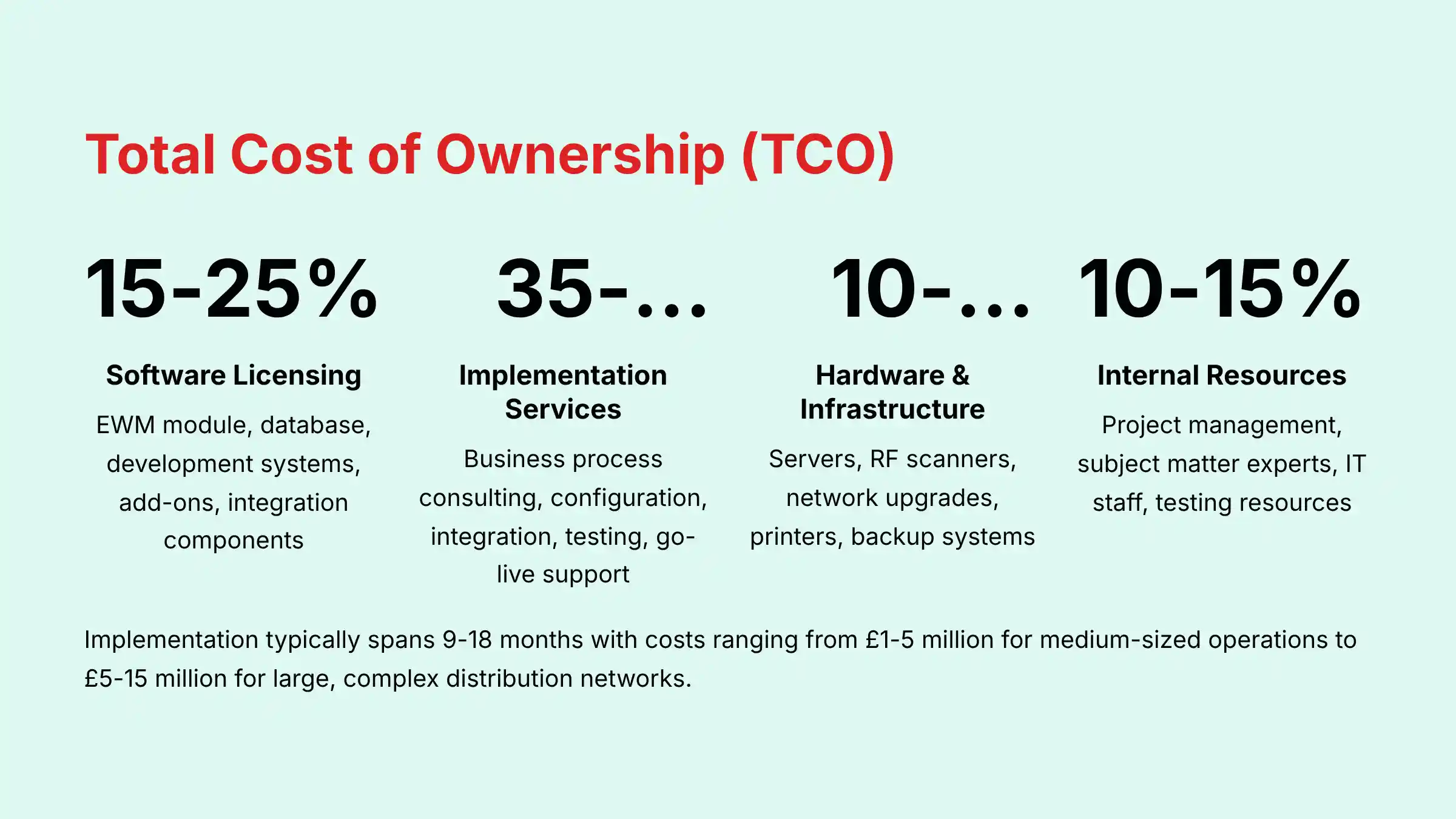
The realistic Total Cost of Ownership (TCO) for an SAP EWM implementation extends far beyond initial software licensing and requires comprehensive budgeting across multiple dimensions. For organizations planning AI-enabled warehouse operations, understanding the full financial commitment is crucial for accurate ROI calculations.
Key TCO Components:
1. Software Licensing (15-25% of TCO):
- EWM module licensing based on transaction volume or users
- Database licensing (typically HANA)
- Development/testing system licenses
- Add-on modules for specialized functions (Yard Management, Labor Management)
- Integration components for automation systems
2. Implementation Services (35-50% of TCO):
- Business process consulting and blueprint development
- System configuration and customization
- Integration development with other systems
- Testing and quality assurance
- Go-live support and hypercare
3. Hardware and Infrastructure (10-20% of TCO):
- Servers or cloud computing resources
- RF scanners, mobile devices, and terminals
- Network infrastructure upgrades
- Printers and labeling equipment
- Backup and disaster recovery systems
4. Internal Resource Costs (10-15% of TCO):
- Project management personnel
- Subject matter experts partially dedicated to the project
- IT staff for infrastructure support
- Testing resources from the business
- Overtime costs during implementation phases
5. Data Management and Migration (5-10% of TCO):
- Data cleansing and preparation
- Master data enrichment (adding dimensions, weights, etc.)
- Historical data migration
- Data quality assurance processes
6. Change Management and Training (10-15% of TCO):
- End-user training development and delivery
- Super-user programs and certification
- Documentation creation
- Communication campaigns
- Post-implementation support and coaching
For organizations implementing EWM to support intelligent warehouse operations, it's essential to allocate adequate budget for data quality initiatives, as AI systems require clean, structured data to deliver accurate results. Similarly, change management deserves significant investment, as the transition to AI-augmented processes often requires substantial shifts in workforce skills and operational procedures.
A realistic implementation timeline typically spans 9-18 months depending on warehouse complexity, with costs that commonly range from $1-5 million for medium-sized operations to $5-15 million for large, complex distribution networks with multiple facilities.
How does SAP EWM ensure data security and support regulatory compliance?
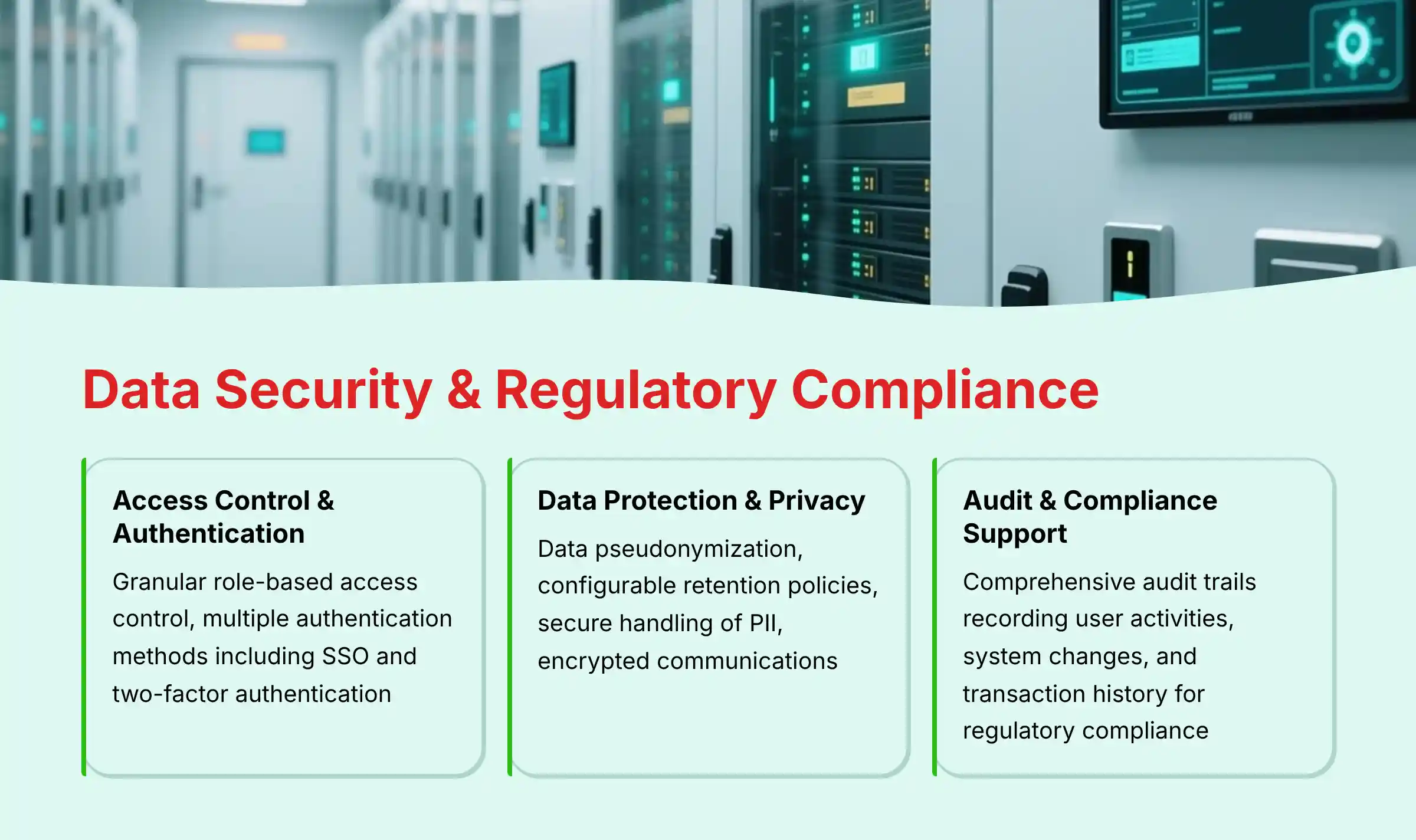
SAP EWM ensures data security and regulatory compliance through a comprehensive, multi-layered approach inherited from the robust ABAP Platform and S/4HANA architecture upon which it is built. This security framework is essential for protecting sensitive supply chain data while maintaining operational efficiency in AI-enabled warehouse environments.
Access Control and Authentication:
EWM implements granular role-based access control (RBAC) that allows precise definition of user permissions. This ensures warehouse operators, supervisors, and managers can access only the specific functions and data necessary for their roles. The system supports multiple authentication methods, including single sign-on (SSO), two-factor authentication, and integration with identity management solutions, providing flexibility while maintaining security standards.
Data Protection and Privacy:
For organizations handling sensitive customer information or operating in regulated industries, EWM provides mechanisms to support compliance with data protection regulations like GDPR:
- Data pseudonymization capabilities for testing environments
- Configurable data retention policies for transaction logs
- Secure handling of personally identifiable information (PII) in shipping documents
- Encryption of communications between mobile devices and central systems
Audit and Compliance Support:
EWM maintains comprehensive audit trails that record user activities, system changes, and transaction history. These logs are critical for demonstrating compliance with regulations like the Sarbanes-Oxley Act (SOX), FDA 21 CFR Part 11, and industry-specific requirements. The system can generate compliance reports showing who accessed what information and what changes were made, creating accountability throughout warehouse operations.
Supply Chain Security Features:
Beyond basic IT security, EWM includes specialized capabilities to support secure supply chain operations:
- Secure label printing with anti-counterfeiting features
- Controlled handling of high-value or regulated goods
- Hazardous materials management and documentation
- Serialization and track-and-trace capabilities for regulated industries
For organizations implementing AI capabilities within their warehouse operations, EWM's security framework extends to protect machine learning models and training data. The system ensures that automated decision-making maintains compliance with regulatory requirements through appropriate access controls, audit trails, and validation processes.
Organizations should work with certified security specialists during implementation to ensure their specific deployment aligns with industry regulations and internal security policies, particularly when implementing advanced AI functionalities that may introduce new security considerations.
For comprehensive answers to security-related questions and other implementation concerns, our detailed SAP Extended Warehouse Management (EWM) FAQs addresses the most common compliance and security questions faced by warehouse managers during EWM deployments.
What are the critical success factors for a successful SAP EWM migration project?
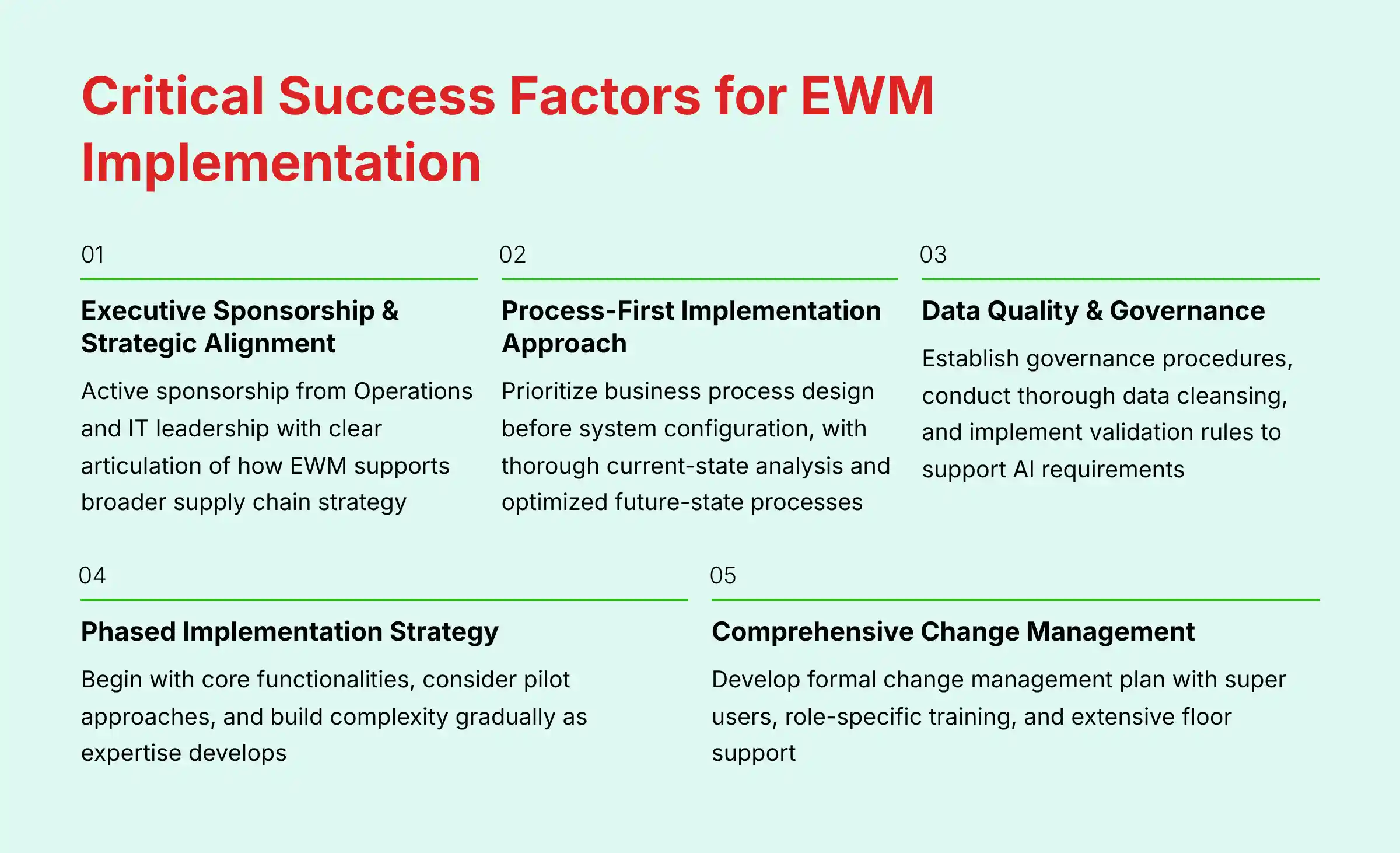
A successful SAP EWM migration requires strategic alignment, technical expertise, and organizational readiness—particularly when implementing AI-enabled warehouse capabilities. Based on extensive implementation experience, these critical success factors significantly impact project outcomes:
1. Executive Sponsorship and Strategic Alignment
Successful EWM implementations require active executive sponsorship from both Operations and IT leadership. This sponsorship must go beyond project approval to include:
- Clear articulation of how EWM supports broader supply chain strategy
- Regular steering committee participation to remove obstacles
- Visible championship of the change throughout the organization
- Commitment to resource allocation even when competing priorities emerge
- Direct involvement in critical decision points and scope management
2. Process-First Implementation Approach
Organizations that succeed with EWM prioritize business process design before system configuration:
- Conduct thorough current-state analysis to identify pain points and opportunities
- Design optimized future-state processes that leverage EWM capabilities rather than simply replicating existing workflows
- Document detailed process flows with decision points and exception handling
- Validate process designs with frontline workers who understand operational realities
- Define clear performance metrics for each process to measure success
3. Data Quality and Governance
Data quality is particularly critical for AI-enabled warehouse operations:
- Establish data governance procedures before migration begins
- Conduct thorough data cleansing of material master data, focusing on physical attributes (dimensions, weights) that impact warehouse processes
- Implement validation rules to prevent poor data quality in the new system
- Develop a master data management strategy for ongoing maintenance
- Ensure data models support future analytics and AI requirements
4. Phased Implementation Strategy
Successful implementations typically follow a phased approach:
- Begin with core functionalities before implementing advanced features
- Consider a pilot approach with a limited product range or specific warehouse area
- Implement one facility at a time for multi-site deployments
- Allow sufficient stabilization between phases
- Build complexity gradually as the organization develops expertise
5. Comprehensive Change Management
Effective change management is the single most important differentiator between successful and struggling implementations:
- Develop a formal change management plan addressing communication, training, and resistance management
- Identify and develop “super users” who can provide peer support and feedback
- Create role-specific training that focuses on day-to-day tasks rather than system features
- Establish feedback mechanisms to identify and address issues quickly
- Provide extensive floor support during and after go-live to reinforce training
Organizations that excel in these five areas consistently achieve more successful EWM implementations, realizing the full potential of their investment in warehouse digitalization and establishing the foundation for advanced AI capabilities.

Leave a Reply