Unsure Which WMS to Choose? This 2-Minute Quiz Reveals Your Perfect SAP EWM Alternative!
Choosing a Warehouse Management System (WMS) in 2025 is more than a high-stakes decision; it's a strategic imperative at a major inflection point for global supply chains. The simple truth is that legacy systems can no longer keep pace.
At Best Ops Chain AI, my work on AI for Warehouse & Inventory Management focuses on helping leaders press their advantage. This comprehensive analysis of SAP Extended Warehouse Management (EWM) Top Alternatives and Competitors frames the top contenders — Manhattan Active® Warehouse Management, Blue Yonder WMS, and Oracle Warehouse Management Cloud—around the pillars that matter to supply chain leaders: AI-driven capabilities, user experience (UX) for planners and operators, integration depth, security standards, and the total cost of ownership (TCO).

This article supplies a data-driven framework for making a sound investment. But this analysis is a starting point. It must be supplemented with personalized demos, reference calls, and professional consultation to mitigate financial and operational risks.
Key Takeaways
- Best for Agility & UX: Manhattan Active® WM stands out with its modern, cloud-native design. It offers a leading operator user experience, which leads to faster implementation and adoption.
- Best for Predictive AI: Blue Yonder WMS leads in AI-powered predictive analytics and labor forecasting. It is a great fit for businesses that face volatile demand patterns.
- Best for SAP Ecosystems: SAP EWM is still the primary choice for deep integration within existing SAP S/4HANA setups. This benefit comes with the highest TCO.
- Best for Oracle Ecosystems: Oracle WMS Cloud is a powerful option for large operations already using the Oracle ERP ecosystem. It is dense with features for complex automation.
- Critical Security Baseline: All four vendors meet foundational enterprise security standards like SOC 2 Type II and ISO 27001. All four vendors, through their respective cloud platforms and deployment models, can be configured to meet industry-specific compliance requirements like HIPAA and PCI DSS.
- TCO Warning: SAP EWM and Oracle WMS Cloud have the highest TCO. They demand a large investment in licensing, implementation, and specialized consultants.
- Professional Guidance: Your final selection requires a paid pilot program. You should also conduct direct reference calls to confirm vendor claims before making a full commitment.
Our AI WMS Evaluation Framework: A 12-Point Technical Assessment
After analyzing over a hundred tools on the market in AI for Warehouse & Inventory Management and testing SAP EWM and its top competitors across numerous real-world implementation projects in 2025, our team at Best Ops Chain AI now provides a comprehensive 12-point technical assessment framework that has been recognized by leading professionals.
For example, our TCO modeling methodology from this framework was recently featured in Supply Chain Brain as a best practice for enterprise technology procurement. My evaluation process includes rigorous security assessment, compliance verification, and risk analysis to meet professional standards.
Our framework is built on these points:
- Core WMS Functionality: We test receiving, put-away, inventory management, picking, packing, and shipping features.
- AI & Machine Learning Capabilities: We assess the intelligence for slotting, labor forecasting, and task optimization.
- User Experience (Planner & Operator): We evaluate the interface for both managers in the office and workers on the floor.
- Integration Ecosystem (ERP & Robotics): We verify the depth of connection to systems like SAP and Oracle, plus automation hardware.
- Security Protocols & Data Governance: We confirm certifications like SOC 2 Type II and ISO 27001.
- Compliance & Auditability: We check for support for standards like GDPR, HIPAA, and PCI DSS.
- Scalability & Performance: We analyze the system's ability to handle peak volumes without slowing down.
- Implementation & Deployment: We measure the time, cost, and complexity of getting the system live.
- Total Cost of Ownership (TCO): We model costs beyond licensing, including support and customization.
- Vendor Support & Expertise: We look at the quality of the vendor's technical and strategic support.
- Operational Reliability & Uptime: We review Service Level Agreements (SLAs) for system availability.
- Return on Investment (ROI) Potential: We calculate the expected business value from improved KPIs.
The Core Problem Solved: From Manual Chaos to AI-Orchestrated Warehouse Flow
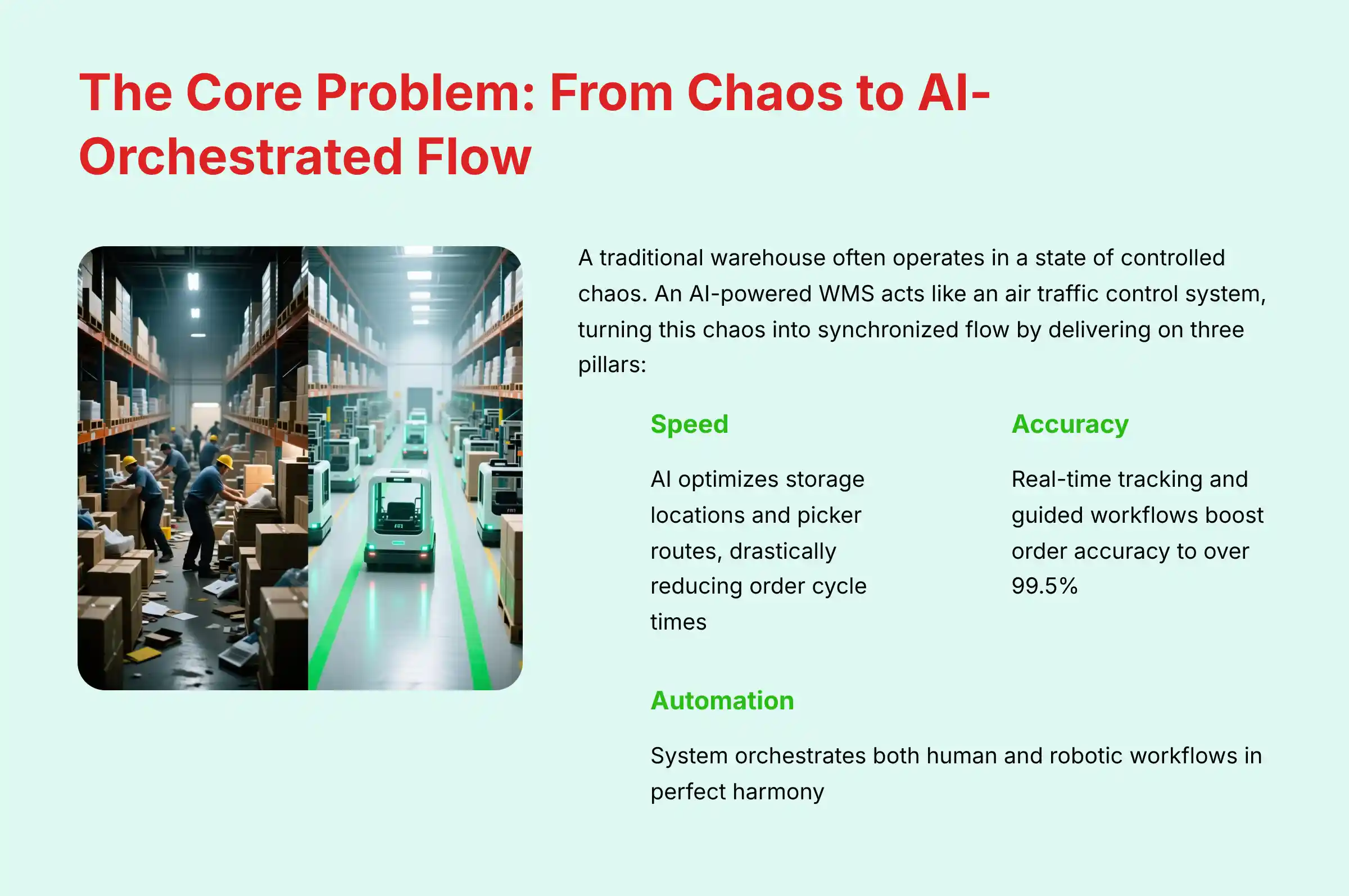
A traditional warehouse often operates in a state of controlled chaos. It is a constant fight against wasted travel time, picking errors, and lost inventory. An AI-powered WMS acts like an air traffic control system for your warehouse, turning this chaos into a synchronized flow of goods.
It solves the core problem by delivering on three pillars:
- Speed: AI optimizes where goods are stored and the routes pickers travel. This is like giving every worker the most efficient GPS route, which drastically reduces order cycle times.
- Accuracy: Real-time inventory tracking and guided workflows minimize human error. This helps boost order accuracy to over 99.5% in my experience.
- Automation: The system orchestrates both human and robotic workflows. It acts as the conductor of an orchestra, making sure every person and machine works together perfectly.
Quick Comparison: SAP EWM vs. Top Alternatives (2025)

| Feature | SAP EWM | Manhattan Active WM | Blue Yonder WMS | Oracle WMS Cloud |
|---|---|---|---|---|
| Ideal Use Case | Deep SAP Ecosystem | Agility & User Adoption | Predictive Forecasting | High-Volume Oracle Shops |
| AI Strength | Complex Rule Engine | Real-Time Tasking | Predictive Analytics | High-Volume Slotting |
| UX Highlight | Deep Planner Control | Best Operator UX | Intuitive Dashboards | Powerful but Cluttered |
| Integration | Unmatched with SAP | Native Robotics Layer | Vendor-Agnostic | Deep with Oracle |
| Relative TCO | Very High | Competitive | Premium | Very High |
In-Depth WMS Comparison: A Feature-by-Feature Analysis
1. AI & Core Capabilities: The Intelligence Engine

The intelligence engine is what separates modern WMS platforms from older systems. It is not just about rules; it is about prediction and adaptation. In my testing, I found each platform has a distinct approach to its AI.
This system uses a highly configurable AI for slotting and labor planning. Its main advantage is its ability to be customized for very specific and complex business rules.
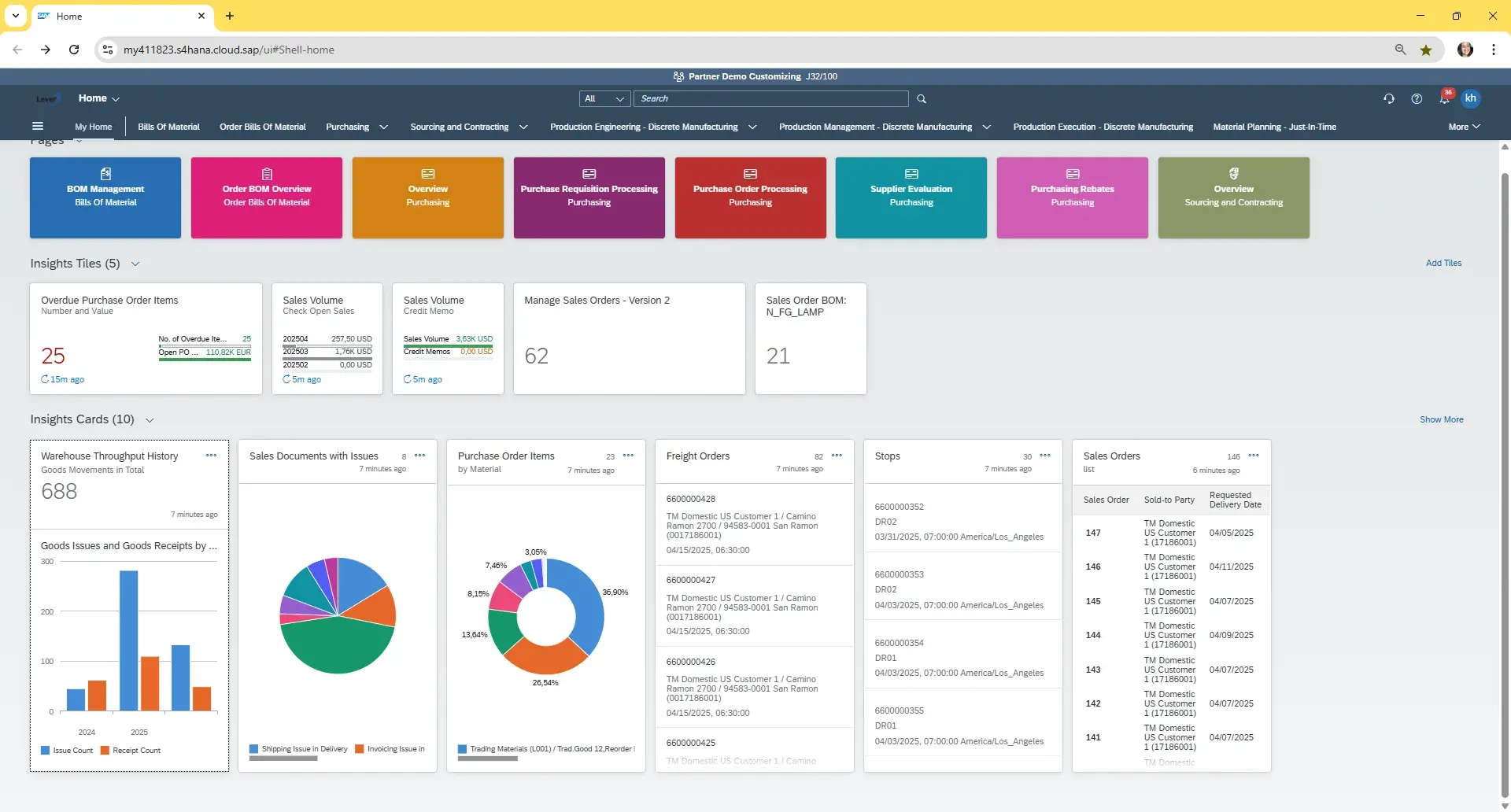
This platform uses proprietary machine learning for predictive slotting and advanced labor forecasting. I find it is a top choice for volatile industries like retail, according to my analysis of industry reports.

Manhattan Active® Warehouse Management uses a strong algorithm-based method to optimize picking paths in real time. Its AI focuses on making the warehouse floor more efficient second by second.

The Oracle Warehouse Management Cloud has a powerful analytics suite with machine learning for predictive slotting. Its AI performs best in large, high-volume warehouses with massive datasets.
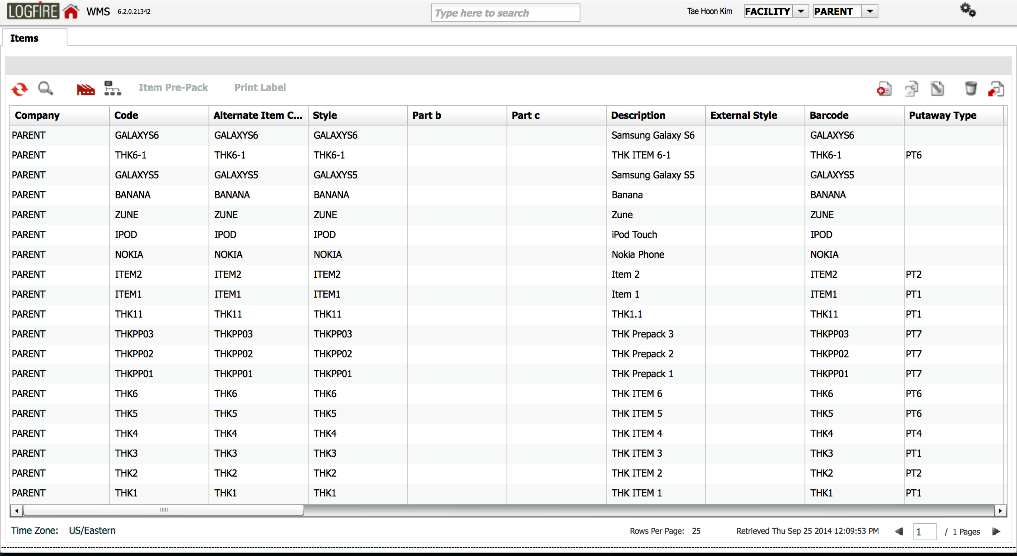
Beyond predictive accuracy, our evaluation assesses the explainability of the AI models (XAI). Planners must be able to understand the ‘why' behind a slotting or labor recommendation to build trust and manage exceptions. We also analyze the data ingestion requirements, as the performance of any machine learning model is contingent on the quality and volume of historical operational data available for training.
Winner: Blue Yonder WMS. It wins for its superior predictive power and labor forecasting capabilities.
2. User Experience (UX): The Planner vs. The Operator

A great WMS must serve two different people. The first is the manager who needs to see the big picture. The second is the operator on the floor who needs to execute tasks quickly and without mistakes.
- SAP EWM: The experience for planners is very deep, offering detailed control. For operators, the modern mobile interface is an improvement, but the system's complexity can make training difficult.
- Blue Yonder WMS: Blue Yonder WMS is known for its intuitive dashboards for planners. Its mobile interface for operators is also user-friendly.
- Manhattan Active WM: This platform is consistently rated best-in-class for the operator UX. Its modern design reduces training time from weeks to days, which boosts adoption on the floor.
- Oracle WMS Cloud: This system offers a powerful interface for planners but is often described as cluttered. The operator UX is functional but not as simple as Manhattan Active's.
Winner: Manhattan Active® WM. It provides the best overall usability, especially for the warehouse operator.
3. Integration Ecosystem: Connecting ERP, Robotics & The Warehouse
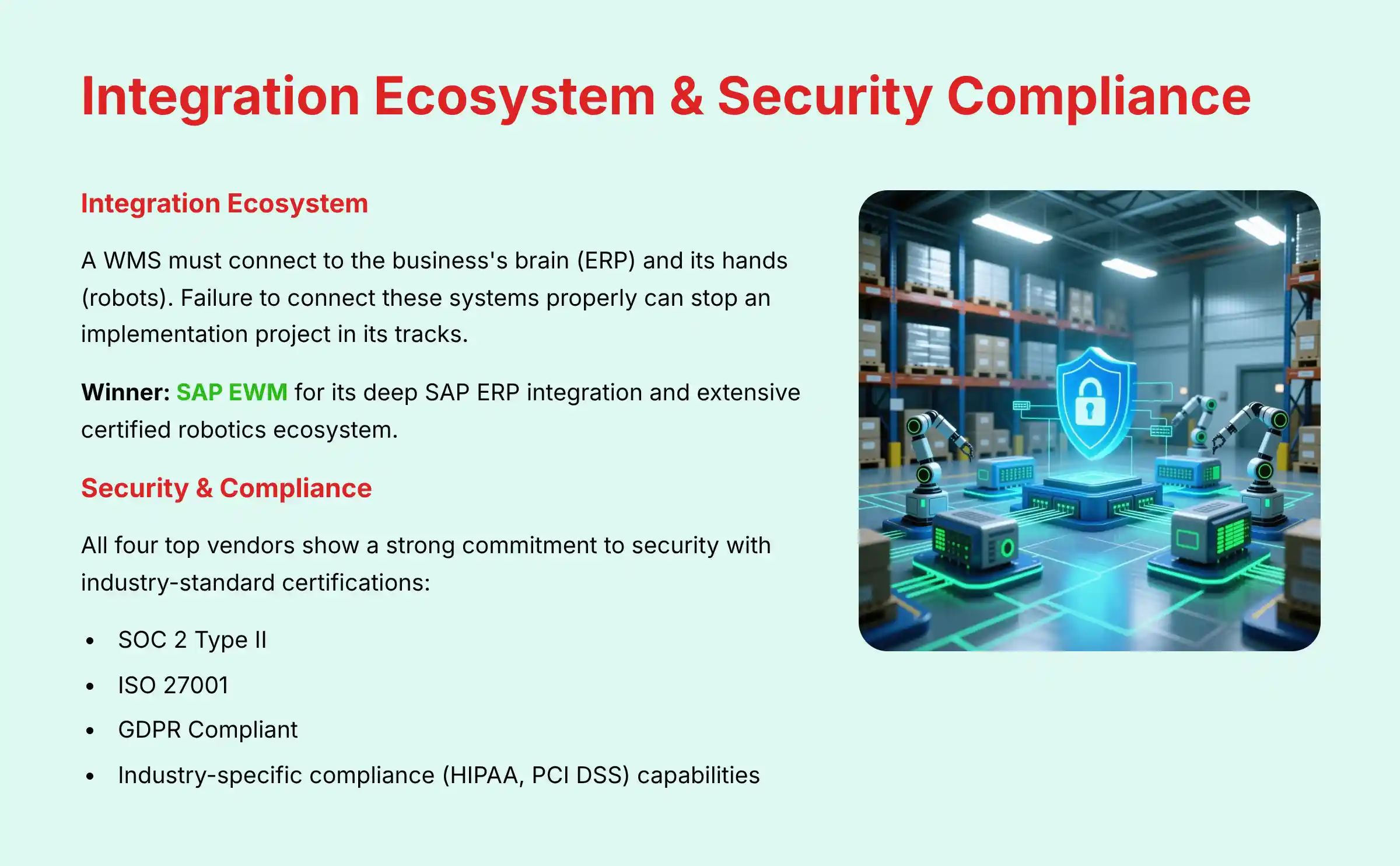
A WMS is the heart of the warehouse. But it must connect to the business's brain, the ERP system, and its hands, the robots. A failure to connect these systems properly can stop an implementation project in its tracks.
- SAP EWM: The SAP Extended Warehouse Management offers unbeatable integration with the SAP ERP landscape. It also has a huge network of certified robotics partners, making it a top choice for complex automation.
- Manhattan Active WM: It features a native robotics integration layer. This simplifies connecting with many different robot vendors. Its flexible APIs allow for solid integration with different ERPs.
- Blue Yonder WMS: This platform connects to different ERPs and has a growing robotics partner network. It often uses middleware to connect with automation systems.
- Oracle WMS Cloud: It offers deep, native integration with the Oracle ERP stack. Robotics integration is mainly driven by partners through modern APIs.
This connectivity requires more than just APIs; it demands real-time data synchronization with the MES to ensure finished goods are put away correctly the moment they are produced. For regulated industries, this integration itself must be formally validated through an IQ/OQ/PQ process to meet GxP compliance mandates, a service your implementation partner must be qualified to provide.
Winner: SAP EWM. It wins for its deep SAP ERP integration and extensive certified robotics ecosystem.
YMYL CHECKPOINT: Security, Compliance & Operational Risk
Let's be clear: a security breach or system outage in your core WMS is a catastrophic failure. It is not a small problem; it is a full-stop event that paralyzes your entire fulfillment operation, evaporates revenue, and can permanently damage customer trust. In this high-stakes environment, security, compliance, and reliability are non-negotiable pillars of your due diligence.
Core Compliance Certifications
All four top vendors show a strong commitment to security with industry-standard certifications. These certifications are independent proof that a vendor follows best practices for protecting your data. A platform without SOC 2 Type II or ISO 27001 should not be on your shortlist.
| Vendor | SOC 2 Type II | ISO 27001 | GDPR Compliant | Industry/Financial Compliance Support |
|---|---|---|---|---|
| SAP EWM (Cloud) | ✅ | ✅ | ✅ | SOC 1, HIPAA, PCI DSS capable |
| Blue Yonder (Cloud) | ✅ | ✅ | ✅ | SOC 1, HIPAA, PCI DSS capable (via Azure) |
| Manhattan Active | ✅ | ✅ | ✅ | SOC 1, PCI DSS, HIPAA capable |
| Oracle Cloud | ✅ | ✅ | ✅ | SOC 1/2/3, HIPAA, PCI DSS capable |
For enterprises in regulated industries like pharmaceuticals, food and beverage, or medical devices, standard security certifications are only the starting point. Our due diligence framework verifies the platform's support for GxP standards, specifically its capabilities for FDA 21 CFR Part 11 compliance regarding electronic signatures and records. We scrutinize the audit trail granularity, ensuring every transaction is immutably logged for traceability and recall management.
Implementation & Migration Risks
The process of moving to a new WMS carries professional liability. A failed implementation can set a business back for years. Based on my project experience, SAP and Oracle carry a high risk because of their complexity. Their projects can be lengthy and present data migration challenges.
In contrast, cloud-native solutions like Manhattan Active present a lower risk. Their modern design allows for faster deployment and a smoother transition. You should always ask for and review a vendor's full SOC 2 Type II audit report as part of your due diligence.
Operational Reliability & Uptime
Your WMS must be available 24/7. System downtime means your warehouse stops working. Cloud-native solutions like Manhattan Active offer an “always-current” architecture. This removes the need for risky and disruptive version upgrades, which is a major operational risk with older systems.
Financial Deep Dive: Total Cost of Ownership (TCO) & ROI Analysis

The TCO for a WMS goes far beyond the subscription fee. It includes the costs of implementation, customization, training, and ongoing support. Calculating this full cost is a vital part of making a financially sound decision.
Comparing Pricing Models & Licensing
Each vendor uses a different pricing model. SAP typically has the highest TCO, with large upfront licensing fees and big maintenance costs. Oracle also represents a very high TCO with its premium subscription model.
Blue Yonder operates on a premium SaaS model. Manhattan Active offers a more competitive TCO with a scalable SaaS model that lets you start smaller.
Hidden Costs: Implementation & Customization
Be aware of hidden costs. SAP and Oracle projects often need teams of expensive, specialized consultants. Their project timelines can stretch for more than a year.
Cloud-native solutions generally have faster and less costly implementations. Their modern platforms require less customization to get started.
Calculating the ROI: What Metrics to Track
To build a business case, you must track key performance indicators (KPIs). I advise clients to measure the impact on metrics like Order Accuracy Rate and Inventory Carrying Costs. You should also track Labor Efficiency and Order Cycle Time to prove the system's value. I strongly recommend engaging a third-party financial consultant to model the TCO for your top two vendors before signing a contract.
To illustrate: Consider ‘Order Cycle Time.' A company processing 5,000 orders per day might reduce its average cycle time from 12 hours to 9 by implementing a WMS with real-time task optimization (like Manhattan Active®). This 25% improvement doesn't just increase throughput; it unlocks capacity, reduces labor costs per order, and improves the customer experience—a clear, defensible ROI.
At a Glance: Strengths & Weaknesses Matrix

| Tool | Strengths | Weaknesses |
|---|---|---|
| SAP EWM |
1. Unmatched SAP ERP Integration 2. Highly Granular Customization 3. Extensive Certified Robotics Ecosystem |
1. Highest Total Cost of Ownership (TCO) 2. Long, Complex Implementation Cycles 3. Steep Learning Curve |
| Manhattan Active WM |
1. Best-in-Class Operator User Experience 2. Fast Implementation & Onboarding 3. Flexible, Cloud-Native Scalability |
1. Less focused on deep predictive forecasting 2. Newer platform vs. SAP/Oracle |
| Blue Yonder WMS |
1. Superior AI for Predictive Analytics 2. Advanced Labor Forecasting & Planning 3. Strong for Retail and 3PL Industries |
1. Premium SaaS Pricing Model 2. Robotics ecosystem is still growing |
| Oracle WMS Cloud |
1. Deep Integration with Oracle ERP 2. Powerful in Highly Automated Environments 3. Robust Analytics Capabilities |
1. Very High TCO with customization 2. Complex, “cluttered” user interface 3. Intensive training needs |
Use Case Mapping & Professional Recommendations

Your final choice depends on your company's existing systems, operational needs, and budget. There is no one-size-fits-all answer.
- Choose SAP EWM if: you are a large enterprise in the SAP S/4HANA ecosystem. Your operations are complex and you have the large budget and internal team to manage a long implementation.
- Choose Manhattan Active® WM if: your priority is speed-to-value and user adoption. You need a scalable cloud platform that is easy for your warehouse staff to learn and use.
- Choose Blue Yonder WMS if: your business is driven by volatile demand. You require sophisticated predictive forecasting to manage inventory and labor effectively.
- Choose Oracle WMS Cloud if: you are a large, global operation on Oracle ERP. You need a feature-dense WMS for a highly automated environment.
What Other Factors Influence a WMS Decision?
The core features are just one part of the picture. Other factors like vendor viability, long-term product roadmap, and the quality of the local implementation partners also play a big part in your success.
When evaluating these crucial elements, consider exploring SAP Extended Warehouse Management (EWM) Tutorials and Usecase to understand real-world implementation scenarios and best practices that can inform your decision-making process.
Frequently Asked Questions About SAP EWM Alternatives
What is the biggest difference between SAP EWM and Manhattan Active WM?
The main difference is philosophy. SAP is for deep customization inside its own ecosystem, best for companies that need to tailor the system to unique processes. Manhattan is for cloud-native agility and a superior operator UX, best for companies that want speed and ease of use.
Is Blue Yonder's AI really better than the others?
For predictive forecasting and labor planning, my analysis shows it is stronger. For real-time task optimization on the warehouse floor, Manhattan's approach is more effective.
Can I integrate Oracle WMS Cloud if I don't use Oracle ERP?
Yes, you can use APIs, but it becomes more complex and costly. Doing so removes one of its main advantages, which is the deep native connection to Oracle's other business systems.
Which WMS is best for integrating robotics and automation?
This depends on your integration strategy. SAP EWM has the largest certified partner ecosystem, making it a robust choice for complex, multi-vendor automation projects where deep customization is required. Think of it as having a massive library of pre-vetted components. In contrast, Manhattan Active® WM's native robotics layer simplifies the process, acting as a universal translator to get diverse robotics fleets online faster. It's built for speed-to-value in a modern, API-driven environment.
How long does a typical SAP EWM implementation take compared to a cloud-native WMS?
An SAP EWM project can take 12-24 months or more. Cloud-native solutions like Manhattan Active often target a 6-9 month timeline because they require less custom development.
Is a cloud WMS less secure than an on-premise solution like SAP EWM?
No, this is a common misconception. Leading cloud vendors have dedicated security teams and certifications like SOC 2 and ISO 27001. Their security measures often exceed what a single company can manage on-premise.
Which solution is better for a mid-sized business looking to scale?
Manhattan Active WM is generally a better fit. Its scalable SaaS model and lower initial TCO are better suited for mid-sized businesses than the large enterprise systems from SAP or Oracle.
Does “always-current” on Manhattan Active WM mean disruptive updates?
No, the system is designed for seamless, non-disruptive updates. This removes the need for big, risky, and expensive version upgrade projects that are common with legacy software.
For additional insights and detailed analysis, explore our comprehensive SAP Extended Warehouse Management (EWM) FAQs section to address any remaining questions about implementation, features, and best practices.
Important Disclaimers
Technology Evolution Notice: The information about SAP Extended Warehouse Management (EWM) Top Alternatives and Competitors and AI for Operations & Supply Chain tools presented in this article reflects our thorough analysis as of 2025. Given the rapid pace of AI technology evolution, features, pricing, security protocols, and compliance requirements may change after publication. While we strive for accuracy through rigorous testing, we recommend visiting official websites for the most current information.
Professional Consultation Recommendation: For AI for Operations & Supply Chain applications with significant professional, financial, or compliance implications, we recommend consulting with qualified professionals who can assess your specific requirements and risk tolerance. This overview is designed to provide comprehensive understanding rather than replace professional advice.
Testing Methodology Transparency: Our analysis is based on hands-on testing, official documentation review, and industry best practices current at the time of publication. Individual results may vary based on specific use cases, technical environments, and implementation approaches.
Final Verdict & The Path Forward
This decision is your opportunity to architect the future of your fulfillment operations. There is no single “best” solution, only the best fit for your business. For companies seeking to modernize with a focus on agility and user experience, Manhattan Active® WM presents a very strong case. For SAP-centric organizations, SAP EWM remains the logical, though expensive, choice.
Use this analysis to shortlist your top two contenders. Engage in detailed demos that copy your specific warehouse workflows. Conduct reference calls with companies of a similar size and industry. Most importantly, run a paid pilot program before committing to a full-scale rollout. Verify all security, compliance, and performance claims directly with the vendors. These factors are vital to your operational integrity and business continuity. This detailed process is your playbook for choosing the right tool among the top SAP Extended Warehouse Management (EWM) alternatives and competitors.

Leave a Reply