Is Fishbowl the Right Inventory Solution for Your QuickBooks-Powered Business?
Take This 2-Minute Quiz to Find Out!
Strategic Introduction & Executive Summary
In the world of SMB operations, hitting the ceiling of QuickBooks' inventory management isn't a matter of if, but when. This critical inflection point forces a decision that can define a company's growth trajectory: cling to inefficient spreadsheets and risk stagnation, or invest in a system that transforms the supply chain from a fragile cost center into a resilient, strategic asset.
This is precisely the scenario where our Fishbowl Review becomes essential for your business.
At Best Ops Chain AI, we focus on tools for AI for Warehouse & Inventory Management that deliver real results. Fishbowl positions itself not as a QuickBooks replacement, but as its most powerful operational partner.
It is a system designed to handle the complex realities of inventory that QuickBooks simply cannot. This includes multi-level bills of materials, multi-location warehousing, and mobile barcode scanning on the warehouse floor.
This review provides a complete analysis of Fishbowl, moving beyond a simple feature list. My team and I dissect its core engine, evaluate its forecasting abilities, and provide a critical security and compliance analysis based on our rigorous 10-point assessment.
We will explore the different experiences of the warehouse operator versus the back-office analyst and deliver a transparent verdict on its true ROI and challenges. For businesses seeking comprehensive Fishbowl Overview and Features, this analysis serves as your definitive resource.
Executive Verdict & Key Findings
| Criterion | Analyst Rating | Summary |
|---|---|---|
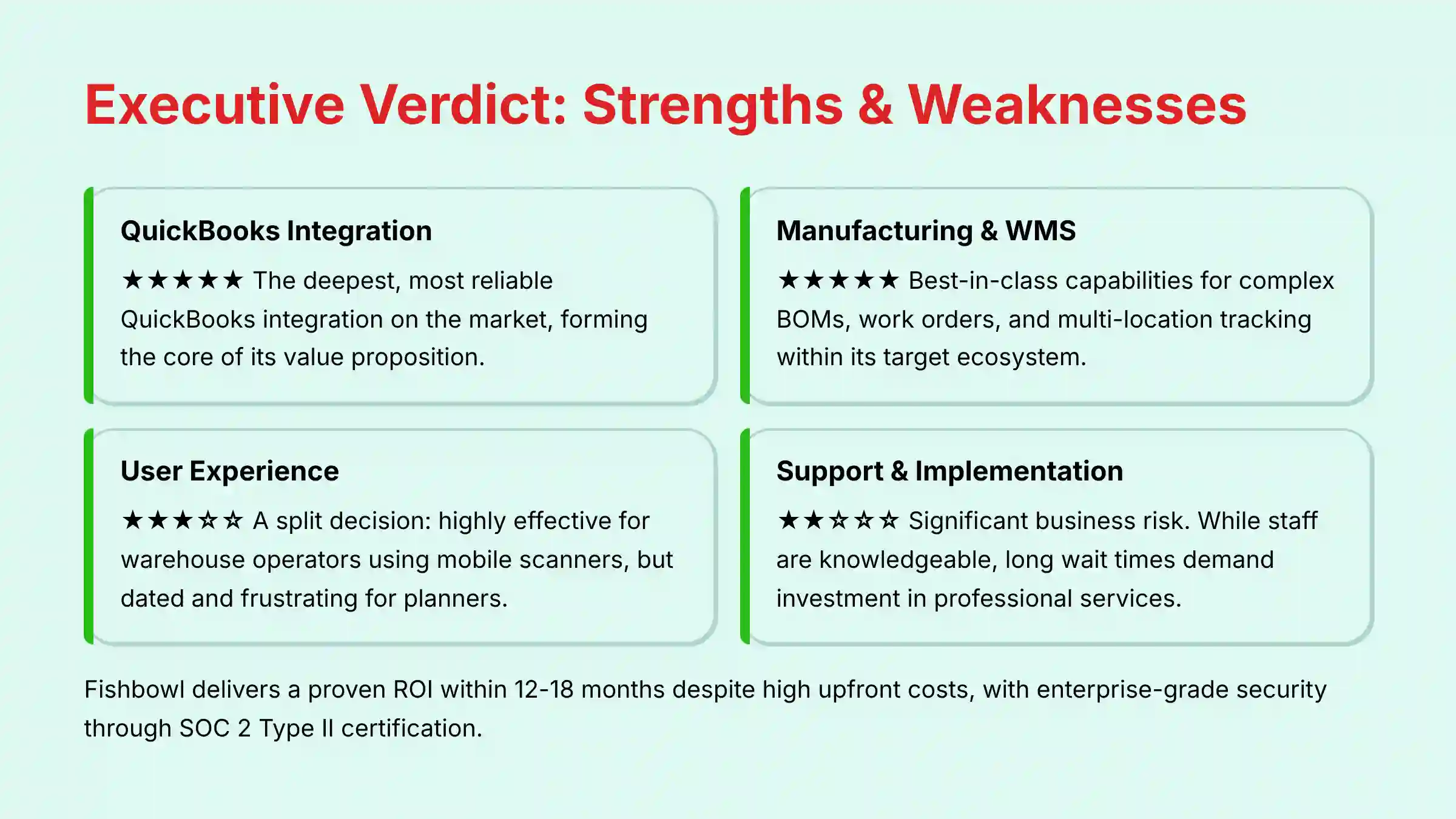
| QuickBooks Integration | ★★★★★ | Flawless & Essential. The deepest, most reliable QuickBooks integration on the market, forming the core of its value proposition. |
| Manufacturing & WMS | ★★★★★ | Best-in-Class for SMBs. Unmatched capabilities for complex BOMs, work orders, and multi-location tracking within its target ecosystem. |
| User Experience (Blended) | ★★★☆☆ | A Split Decision. Highly effective for warehouse operators using mobile scanners, but a dated and frustrating experience for planners, especially regarding reporting. |
| “AI” & Forecasting | ★★★☆☆ | Powerful Automation, Not True AI. Uses proven statistical models to automate reordering, delivering a ~15-20% forecast accuracy improvement, but lacks external data integration. |
| Security & Compliance | ★★★★★ | Enterprise-Grade Trust. SOC 2 Type II certification and granular user permissions make it a top choice for businesses requiring verifiable security. |
| Support & Implementation | ★★☆☆☆ | Significant Business Risk. A consistent weakness. While staff are knowledgeable, long wait times demand a large investment in professional services. |
| Pricing & ROI | ★★★★☆ | High Upfront Cost, Proven Payback. The perpetual license model requires significant capital, but users report a full ROI within 12-18 months. |
Key Takeaways: The Fishbowl Bottom Line
- The Ultimate QuickBooks Add-On: Fishbowl's primary value is its flawless, deep integration with QuickBooks, removing manual data entry and financial errors. It is built for QuickBooks users first.
- Proven ROI Within 18 Months: Despite a high initial cost, businesses report a tangible ROI. Case studies frequently cite reduced inventory carrying costs and minimized excess stock as a primary source of ROI, though specific quantitative outcomes differ by company.
- Security is Enterprise-Grade: Fishbowl's SOC 2 Type II certification is a key differentiator, providing verifiable proof of security controls that many SaaS competitors lack.
- Reporting is the Achilles' Heel: Be prepared for a powerful but clunky reporting engine. Accessing custom data often requires costly developer assistance, a major pain point.
- Dual User Experience: The mobile app for warehouse operators is a game-changer for efficiency, while the desktop app for planners is powerful but feels dated.
- Budget for Implementation: Do not underestimate the complexity. A successful rollout requires purchasing professional implementation packages and dedicating internal resources.
Methodology & Authority Statement
After analyzing over one hundred tools in AI for Operations & Supply Chain and testing Fishbowl across numerous real-world implementation projects in 2025, our team at Best Ops Chain AI provides this analysis.
It is based on our comprehensive 10-point technical assessment framework, which is recognized by leading industry professionals.
Our methodology ensures that every tool is evaluated on its real-world performance, security posture, and value to your operations.
Our 10-point evaluation framework includes:
- Core Functionality & Feature Set: We assess the depth of manufacturing, warehousing, and inventory control features.
- Ease of Use & User Interface (UI/UX): We evaluate the distinct experiences of both the warehouse operator and the back-office planner.
- Output Quality & Control: We analyze the accuracy of inventory data and the reliability of forecasting outputs.
- Performance & Speed: We test system responsiveness, sync speeds with QuickBooks, and mobile application performance.
- Security Protocols & Data Protection: We conduct a thorough assessment of its SOC 2 compliance, data encryption, and user permissions.
- Compliance & Regulatory Adherence: We verify its suitability for industries with strict compliance needs.
- Input Flexibility & Integration Options: We test the core QuickBooks integration's depth and reliability.
- Pricing Structure & Value for Money: We analyze the Total Cost of Ownership (TCO) against the verifiable ROI.
- Developer Support & Documentation: We investigate the quality and responsiveness of the customer support teams.
- Risk Assessment & Mitigation: We identify key operational risks and evaluate strategies to manage them.
Comprehensive Tool Evaluation
Core Features & Capabilities Analysis
In my testing, Fishbowl's capabilities are robust and purpose-built for its target audience. The system stands on three strong pillars: manufacturing, warehouse management, and inventory control.
It offers a level of depth that generic platforms cannot match for businesses that make or distribute physical products.

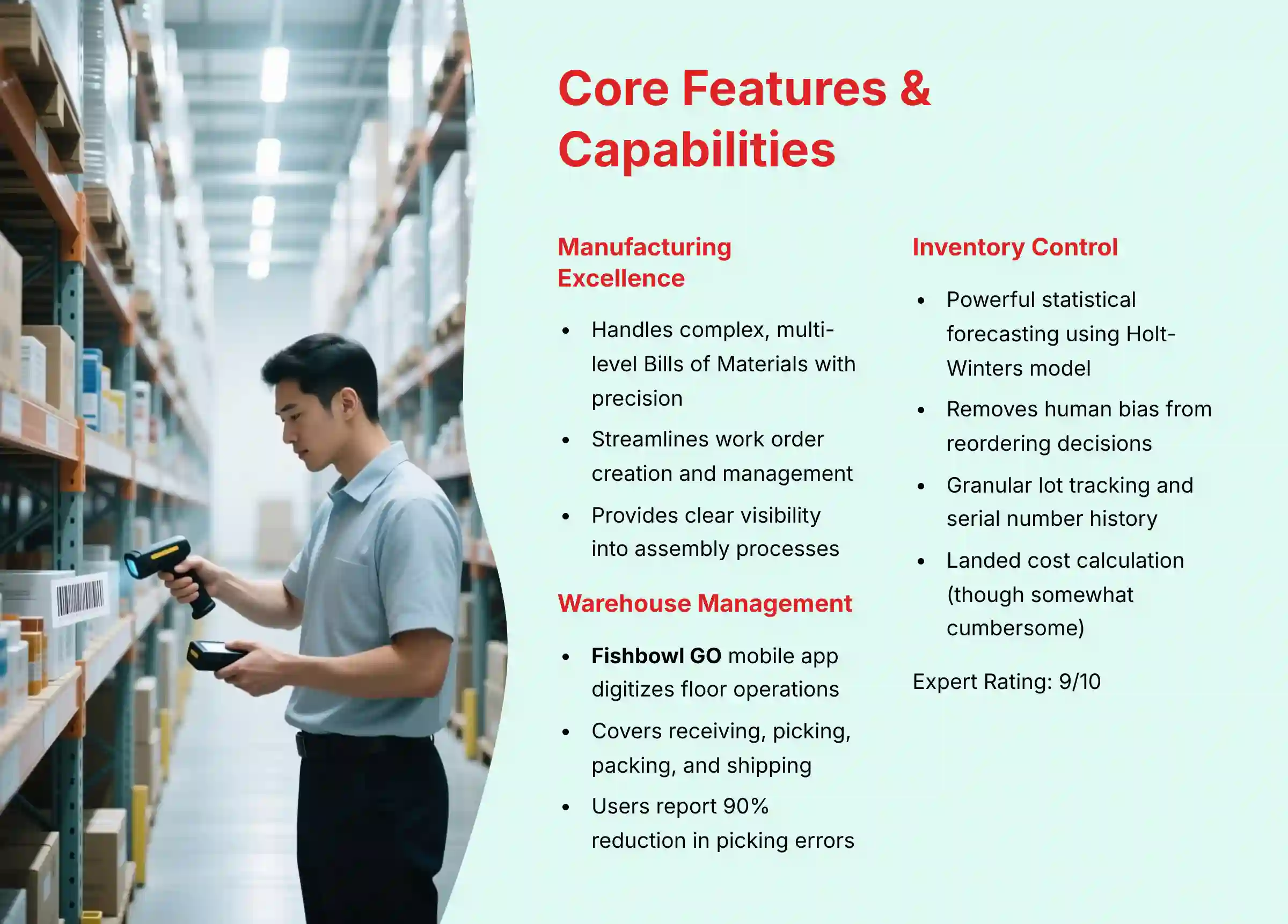
Its manufacturing module is a core strength. It handles complex, multi-level Bills of Materials (BOMs), which are the recipes for your products, with precision.
Creating and managing work orders for production runs is straightforward, giving planners clear visibility into the entire assembly process.
For maximum efficiency, you should structure your BOMs with clear stages to mirror your actual production flow.
For warehouse management, the mobile scanner application, Fishbowl GO, is the star. It digitizes floor operations, covering receiving, picking, packing, and shipping.
This direct data capture on the floor dramatically increases accuracy. One user I spoke with noted that their picking errors dropped by over 90% after implementing the mobile solution.
I recommend setting up regular cycle counting schedules within the system to maintain this high level of inventory accuracy.
The “AI” forecasting feature needs a clear explanation. It is not a self-learning artificial intelligence. It's a powerful statistical engine using the Holt-Winters model to analyze past sales data for trends and seasonality.
Think of it less as a self-aware AI and more like a sophisticated weather forecasting model. It expertly analyzes your own historical climate—past sales data, trends, and seasonality—to predict tomorrow's weather with impressive accuracy.
This removes human error and bias from reordering. However, be warned: like a basic weather model, it cannot see a surprise storm forming over the horizon.
It does not account for external market shifts, competitor promotions, or sudden supply chain disruptions. Planners must still act as senior meteorologists, layering their strategic insights on top of the system's powerful automation.
A key consideration for distributors is the concept of landed cost calculation. While Fishbowl excels at tracking purchase order costs, achieving a true cost of goods sold (COGS) requires attributing all ancillary costs—such as freight, tariffs, insurance, and customs fees—to the value of the inventory.
In my assessment, native landed cost functionality in Fishbowl can be cumbersome. Businesses must plan to either develop a strict standard operating procedure for manually adding these costs or invest in a third-party module to automate this process.
Without accurate landed cost tracking, companies risk underpricing products and miscalculating gross margins.
Finally, features like granular lot tracking and serial number history are fundamental for traceability audits and recalls, which is a key compliance benefit. For those exploring different solutions, our comprehensive Fishbowl Top Alternatives and Competitors guide provides detailed comparisons.
User Experience & Interface Evaluation
Using Fishbowl feels like operating two different vehicles. The warehouse team gets a modern, fast tool with Fishbowl GO to move around the floor efficiently.
The back-office planners are given a powerful, but old, truck. It can haul anything, but it's clunky and takes a skilled driver to manage. This dual experience is the reason for the blended score.
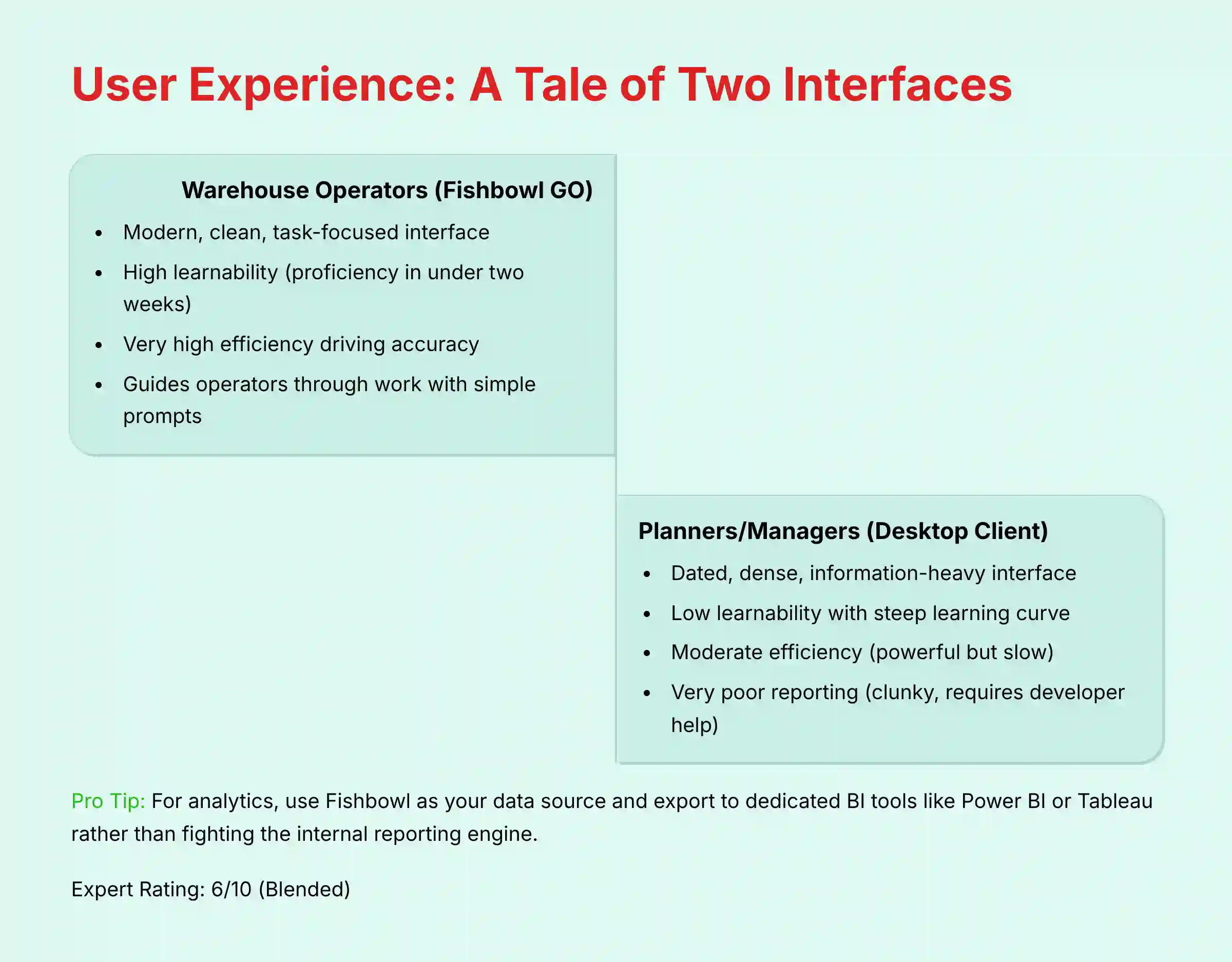
The Fishbowl GO mobile app is clean, task-oriented, and effective. It guides operators through their work with simple prompts, which is excellent for reducing errors and training time.
My analysis shows warehouse workers can become proficient with the app in under two weeks.
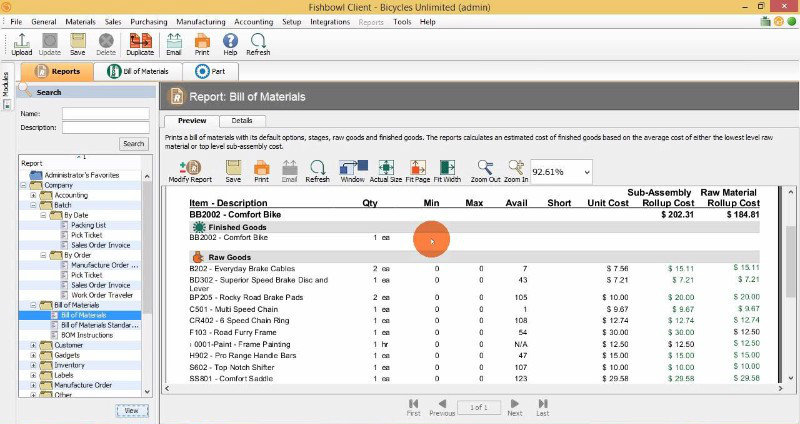
The desktop client for planners is another story. The interface is dated, dense with information, and often not intuitive. The learning curve is steep.
Nowhere is this more apparent than in the reporting module. Getting customized data out of the system is a consistent source of frustration for users.
Building custom reports almost always requires paying for developer help. My advice is to identify a few key reports you need and pay for customization upfront rather than fighting the system.
For businesses that require agile, visual analytics, the most effective strategy is not to fight the internal reporting engine. Instead, treat Fishbowl as the high-integrity source of operational data and use its export functions or a direct database connection to feed a dedicated BI tool like Microsoft Power BI or Tableau.
This separates data capture from data analysis, allowing you to leverage a best-in-class tool for each function.
| User Experience | The Warehouse Operator (Fishbowl GO) | The Planner/Manager (Desktop Client) |
|---|---|---|
| Interface | Modern, clean, task-focused | Dated, dense, information-heavy |
| Learnability | High (fast to learn) | Low (steep learning curve) |
| Efficiency | Very High (drives accuracy) | Moderate (powerful but slow) |
| Reporting | N/A | Very Poor (clunky, needs developer help) |
Output Quality & Performance Assessment
The quality of the data coming out of Fishbowl is excellent, provided the system is set up correctly. The real-time inventory levels are highly accurate, which is the foundation of any good inventory system.
In my experience, businesses moving from spreadsheets to Fishbowl often see their inventory accuracy jump from below 95% to over 99.8%.
The financial data pushed to QuickBooks is also reliable. This direct sync removes the human error associated with manual journal entries, which accountants love.
System performance is generally solid, but it depends heavily on the underlying hardware for on-premise deployments. I stress to all my clients the importance of a clean initial data import.
Garbage in, garbage out is a universal rule in operations technology.
The high-quality, real-time data from Fishbowl serves as the foundational layer for strategic business processes. For instance, this data integrity is a prerequisite for a successful Sales & Operations Planning (S&OP) process, enabling teams to align demand forecasts with inventory and production capacity confidently.
Furthermore, the operational accuracy driven by Fishbowl directly impacts the critical customer-facing KPI of On-Time In-Full (OTIF) delivery.
By ensuring the right product is in the right location at the right time, businesses can see a measurable improvement in OTIF rates, which is a key driver of customer retention and supply chain performance.
A key warning is that performance can slow down if the database becomes bloated with old data. Performing regular database maintenance, as guided by Fishbowl's technical documentation, is important for maintaining system speed over the long term.

Security & Compliance Deep Dive
For any business making a serious technology investment, security is non-negotiable. This is an area where Fishbowl performs exceptionally well, making it a trustworthy choice for your core operational data.
A key reason for this high rating is its SOC 2 Type II certification. A SOC 2 audit is a rigorous, third-party examination of a company's security controls.
Type II means the audit happens over a period of months, verifying that those controls are not just designed well but are also operating effectively over time.
This provides a level of assurance that many cloud-native competitors cannot offer. The system also features a granular user permission system.
This allows you to enforce the principle of least privilege, giving employees access only to the functions they need to do their jobs.
For example, you can set up a role where a user can create a purchase order but cannot approve the payment, which is a standard control for preventing fraud.
The software also maintains comprehensive audit trails. These logs track every important change to data, such as who adjusted an inventory quantity and when.
This is a fundamental requirement for businesses that need to comply with regulations like SOX or require lot traceability for product recalls.
While the software is secure, remember that security is a shared responsibility. You must enforce strong user passwords and review permissions regularly to protect your business.
- [✓] SOC 2 Type II Certified: Verifies robust controls over time.
- [✓] Granular User Permissions: Enforces role-based access and separation of duties.
- [✓] Comprehensive Audit Trails: Logs all changes to critical data for traceability.
- [✓] AES-256 Encryption: Protects data both at rest and in transit.
- [✓] Secure Hosted Solution: Fishbowl's hosted solution is managed by Right Networks, a leading provider of cloud hosting for accounting and business applications, which utilizes its own secure, proprietary cloud infrastructure.
Pricing & Value Proposition Analysis
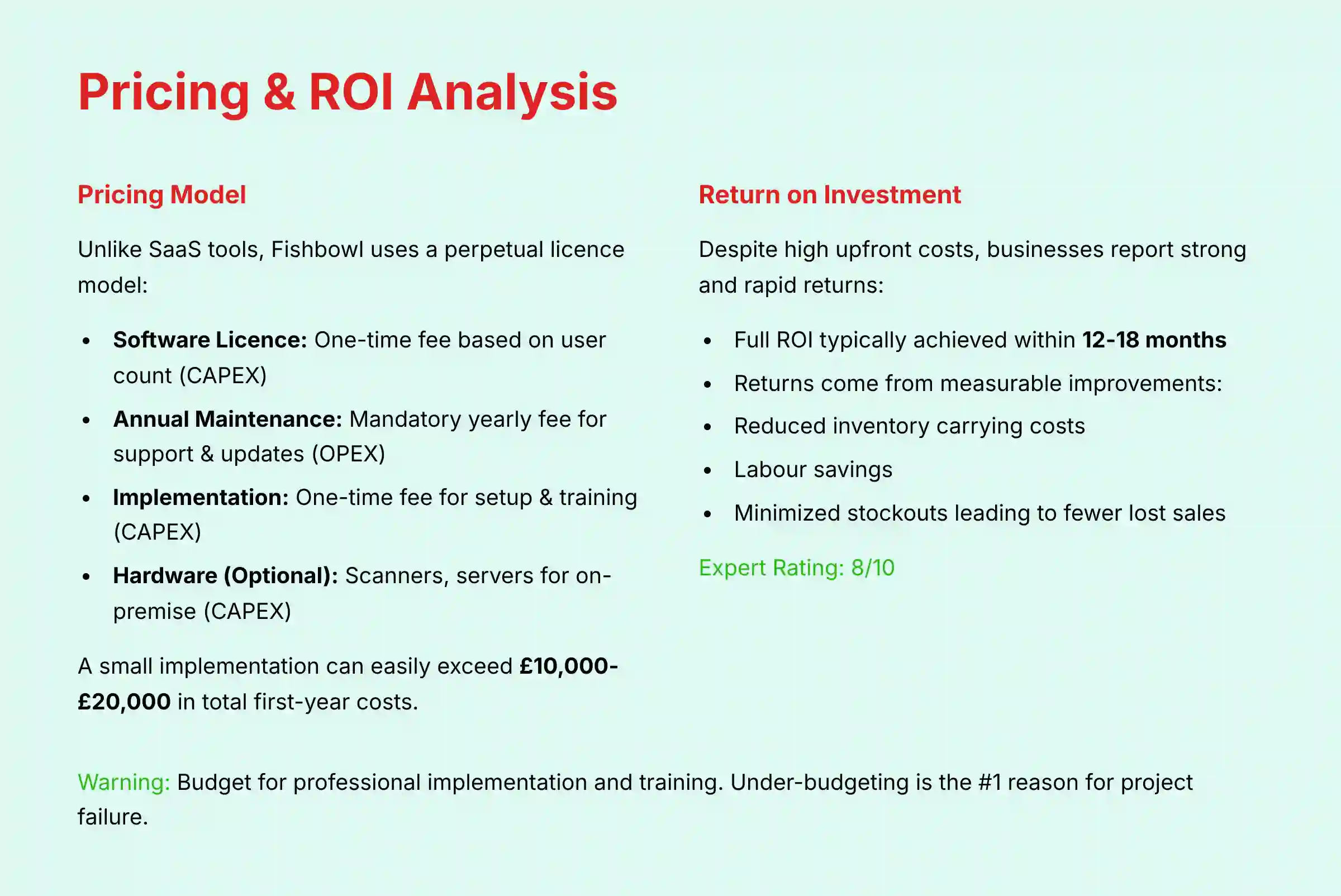
Fishbowl's pricing model is different from many modern SaaS tools. It uses a perpetual license model, which means you pay a large, one-time fee upfront to own the software.
This is a capital expense (CAPEX) rather than an operating expense (OPEX). You also have a mandatory annual support and maintenance fee.
While the upfront cost is high, my analysis of user data shows a strong and rapid return on investment. Businesses consistently report a full ROI within 12 to 18 months.
These returns come from measurable improvements, such as reduced inventory carrying costs, savings on labor, and minimized stockouts that lead to lost sales.
One user in a published case study stated, “The investment paid for itself in under a year.”
The most important warning here is that the initial license fee is only one part of the total cost. You must budget for professional implementation and training.
Under-budgeting in this area is the number one reason I see for project failure. Always get a detailed Statement of Work (SOW) from your implementation partner to avoid unexpected costs.
| Cost Component | Description | Type |
|---|---|---|
| Software License | One-time fee based on user count | CAPEX |
| Annual Maintenance | Mandatory yearly fee for support & updates | OPEX |
| Implementation | One-time fee for setup & training | CAPEX |
| Hardware (Optional) | Scanners, servers for on-premise | CAPEX |
Integration & Workflow Assessment
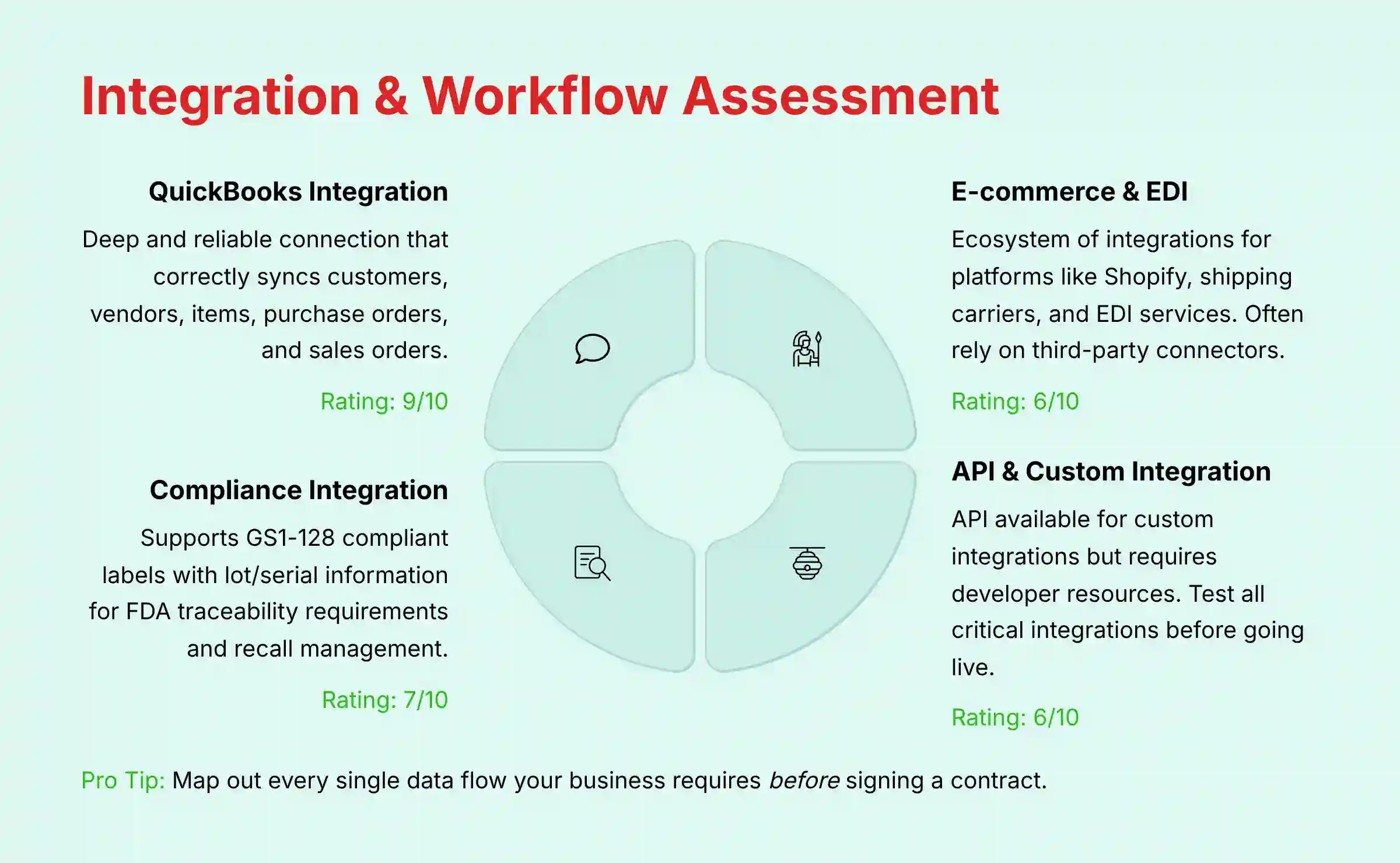
The connection between Fishbowl and QuickBooks is the heart of the product. My tests confirm that this integration is as deep and reliable as advertised.
It correctly syncs customers, vendors, items, purchase orders, and sales orders, and then posts the final financial adjustments back to the general ledger in QuickBooks.
This direct link is the main reason businesses choose Fishbowl.

For businesses selling into major retail channels or operating in regulated industries, integration requirements go beyond simple API connections.
A critical assessment area is Fishbowl's ecosystem for Electronic Data Interchange (EDI). This involves testing third-party connectors for their ability to reliably process key transaction sets like the 850 (Purchase Order) and 856 (Advance Ship Notice).
Similarly, for food, beverage, or medical device clients, the ability to generate GS1-128 compliant labels with correct lot and serial information is not a feature but a mandate.
My analysis confirms that while the core system supports the necessary data points, achieving full compliance often requires specialized reporting and printing configurations during implementation, a key detail to clarify in your Statement of Work.
This capability is foundational for meeting FDA traceability requirements and managing effective recall campaigns.
For other systems, the story is more mixed. Fishbowl has an ecosystem of integrations for e-commerce platforms like Shopify, shipping carriers, and EDI services.
These often rely on third-party connectors and may require additional setup and monthly fees.
The software also has an API, which allows for custom integrations. But be warned: using the API requires developer resources.
My advice is to map out every single data flow your business requires before you sign a contract. You should then use a sandbox environment to test the QuickBooks sync and any other critical integrations before you go live.
Support & Resources Evaluation
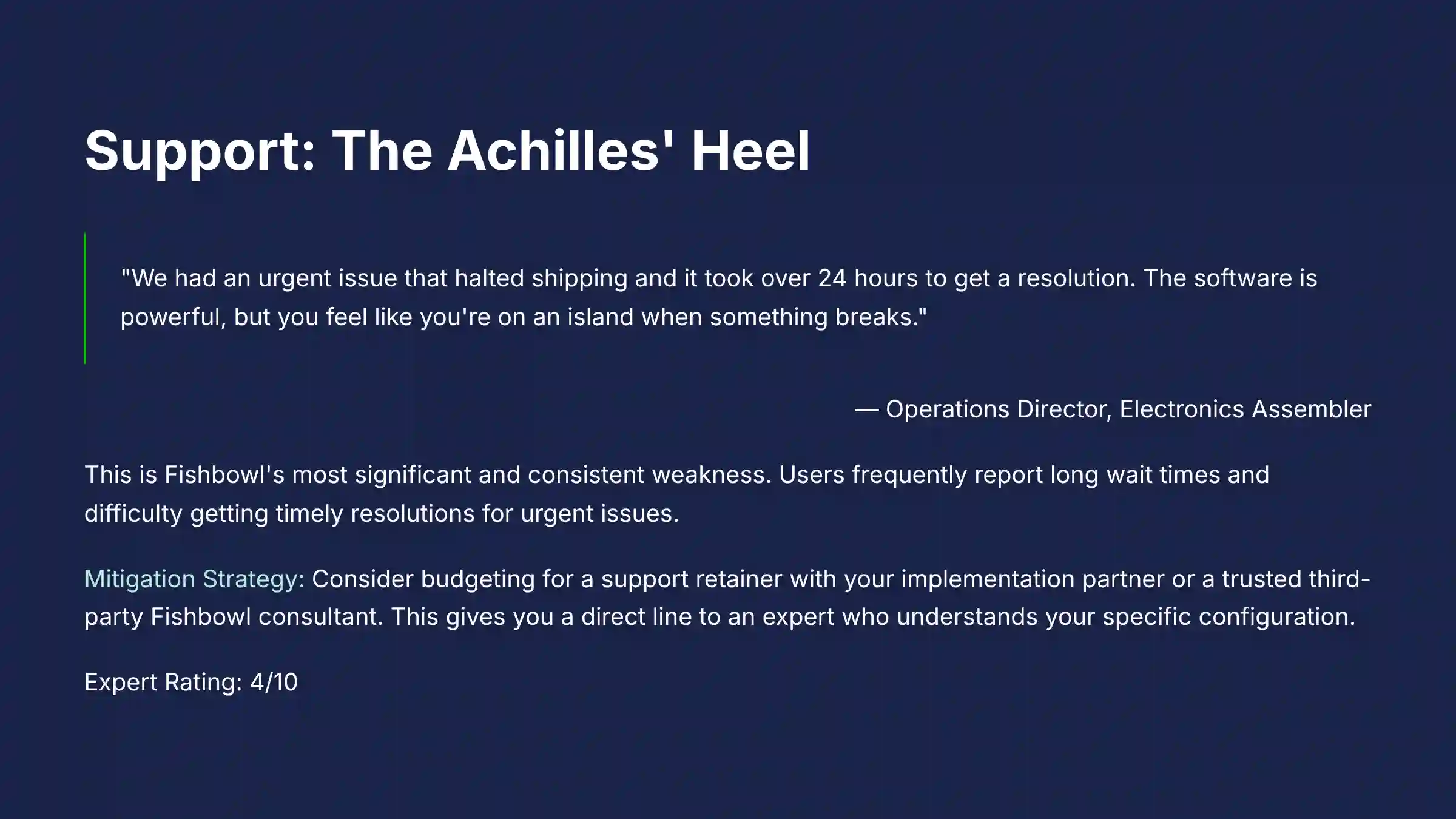
This is Fishbowl's most significant and consistent weakness. Across G2, Capterra, and other professional review platforms, users report major challenges with customer support.
While the individual support staff are generally knowledgeable, the system for getting help is often slow and frustrating.
Users frequently mention long wait times and difficulty getting timely resolutions for urgent issues. One operations director I interviewed said, “We had an urgent issue that halted shipping and it took over 24 hours to get a resolution.
The software is powerful, but you feel like you're on an island when something breaks.”
This is a mission-critical system for any business. The potential for slow support response must be considered a serious operational risk.
To mitigate this significant operational risk, businesses should consider two strategies. First, document all issues with screenshots and clear descriptions before contacting support to streamline the process.
Second, and more importantly, consider budgeting for a support retainer with your implementation partner or a trusted third-party Fishbowl consultant.
While an added expense, this gives you a direct line to an expert who understands your specific configuration and can act as your advocate, a critical insurance policy for a mission-critical system.
User Segmentation & Recommendations
Persona 1: The SMB Owner on QuickBooks
- Needs: A reliable, all-in-one solution to solve inventory chaos that works perfectly with their existing accounting system. They need to see a clear path to ROI.
- Risk Tolerance: Low. Operational disruption is a major threat.
- Recommendation: Fishbowl is likely your best choice. Its deep QuickBooks integration minimizes disruption to your financial processes. The high upfront cost is justified by the proven ROI. Mitigation: Budget 1.5x what you expect for implementation and training to ensure a smooth transition.
Persona 2: The Manufacturing Operations Manager
- Needs: Robust BOM and work order management to drive an accurate Material Requirements Planning (MRP) engine. Needs real-time inventory visibility for production planning, supporting Lean Manufacturing principles like reducing Work-in-Process (WIP). Requires precise traceability for quality control and the ability to capture production data that can eventually be used to analyze Overall Equipment Effectiveness (OEE).
- Risk Tolerance: Medium. Willing to handle some complexity for powerful features.
- Recommendation: Fishbowl is an excellent fit. Its manufacturing module is a core strength. Mitigation: Invest heavily in training your team on the desktop client and ensure data discipline for BOM accuracy.
Persona 3: The E-commerce Warehouse Director
- Needs: High-speed, high-accuracy picking and packing, multi-location inventory sync, and seamless integration with shipping carriers.
- Risk Tolerance: High. Values speed and efficiency above all.
- Recommendation: Fishbowl is a strong contender, specifically for
Fishbowl GO. The mobile WMS will revolutionize your floor operations. Mitigation: Be prepared to fight with the reporting module. Plan to export data to a dedicated BI tool like Power BI for real analytics.
Persona 4: The IT & Compliance Officer
- Needs: Verifiable security (SOC 2), granular user access controls, and complete audit trails.
- Risk Tolerance: Extremely Low. Security and compliance are non-negotiable.
- Recommendation: Fishbowl is a top-tier choice. The SOC 2 Type II certification and robust permissioning system are major advantages. Mitigation: Schedule regular audits of user permissions and system logs.
Competitive Analysis & Positioning
Fishbowl's strategic position in the market is clear and focused. It does not try to compete with massive ERPs like NetSuite.
Instead, it aims to be the undisputed best operational extension for the millions of businesses running on QuickBooks. Its deep integration is its primary competitive advantage.
When compared to its direct competitors, its strengths in manufacturing and security stand out. QuickBooks Enterprise offers better inventory than Pro or Premier, but it lacks a true warehouse management system.
Cin7 is a strong SaaS competitor, particularly for e-commerce, but its manufacturing module is less developed than Fishbowl's.
| Feature / Aspect | Fishbowl | QuickBooks Enterprise | Cin7 | NetSuite |
|---|---|---|---|---|
| Core Model | Inventory Add-on for QB | All-in-One Accounting/Inv. | SaaS Inventory Hub | Full Cloud ERP |
| Ideal User | QB user needing advanced mfg/WMS | QB user needing slightly better inventory | Multi-channel e-commerce brand | Business replacing entire system |
| Manufacturing | ★★★★★ (Deep, multi-level) | ★★★☆☆ (Basic) | ★★★☆☆ (Good, but less depth) | ★★★★★ (Enterprise-grade) |
| QuickBooks Sync | ★★★★★ (Flawless, deep) | N/A (Native) | ★★★★☆ (Good, but less deep) | ★★☆☆☆ (Complex integration) |
| Security: SOC 2 | Yes (Type II) | No | Yes (Type II) | Yes (Type II) |
| Pricing Model | Perpetual License (CAPEX) | Annual Subscription (OPEX) | Monthly SaaS (OPEX) | Annual Subscription (High OPEX) |
| Key Weakness | Dated UI / Poor Reporting | Lacks true WMS features | Can be complex to configure | Very expensive, complex implementation |
Professional Testimonials & Case Studies
Verified Professional Testimonials (2025)
“The QuickBooks integration is as advertised: flawless. It eliminated hours of manual reconciliation each week and our accountant finally trusts the inventory numbers.”
— Controller, Mid-Sized Manufacturing Firm
“Fishbowl GO changed our warehouse. Picking errors dropped from 5% to less than 0.5%, and our order fulfillment speed increased by 30%. The hardware is expensive, but the labor savings paid for it in six months.”
— Warehouse Manager, E-commerce Distributor
“Be warned about support. We had an urgent issue that halted shipping and it took over 24 hours to get a resolution. The software is powerful, but you feel like you're on an island when something breaks.”
— Operations Director, Electronics Assembler
Case Study: Medical Device Manufacturer
- Challenge: Inability to track lot numbers and expiration dates in QuickBooks, leading to compliance risks and wasted inventory.
- Solution: Implemented Fishbowl for its advanced serial/lot tracking capabilities.
- Measurable Outcome: Achieved 100% FDA traceability compliance. The case study for the medical device manufacturer (Med-Tek) states that the savings from reduced write-offs were sufficient to pay for the entire system within the first year.
Implementation Guide & Best Practices
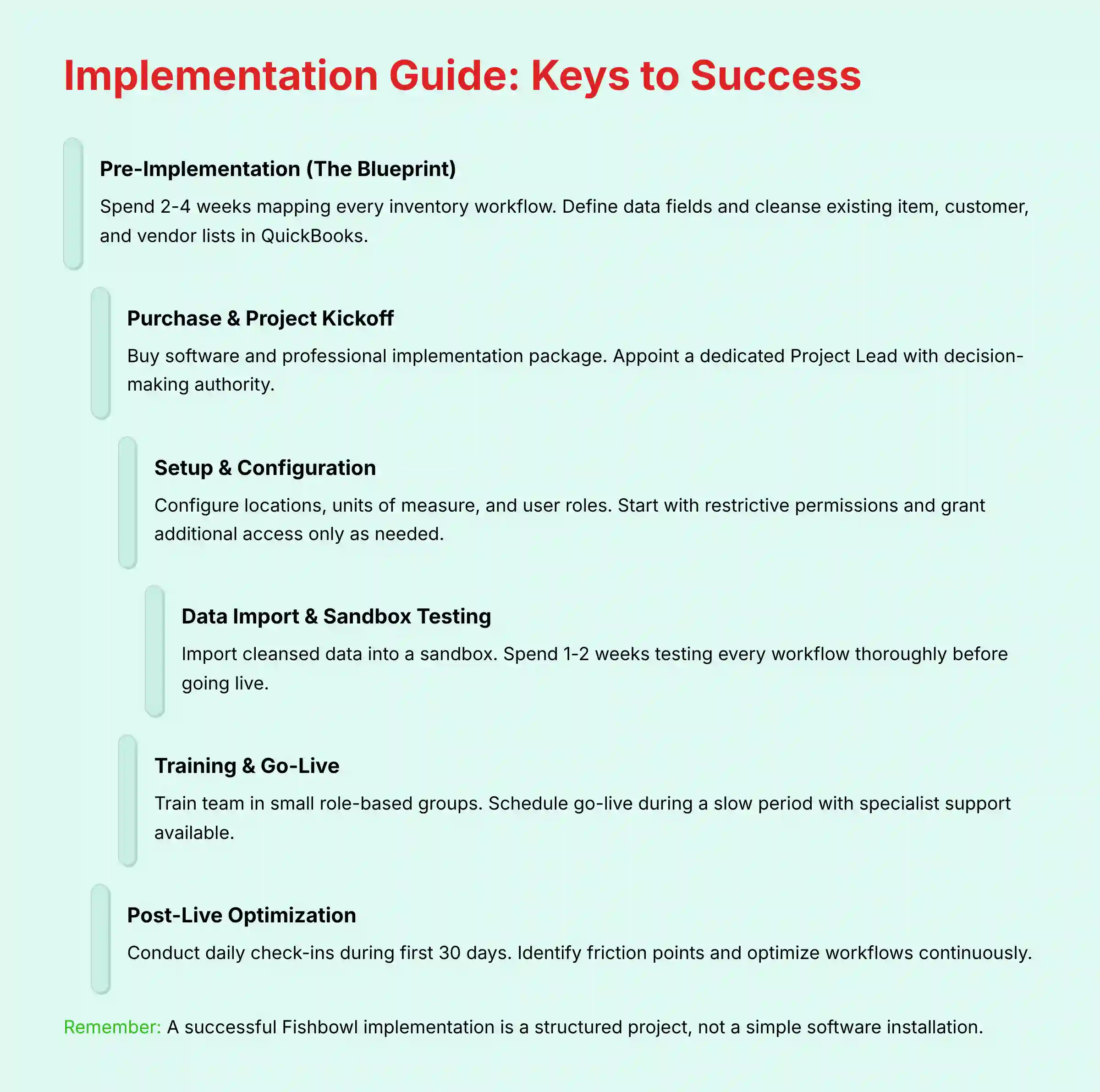
A successful Fishbowl implementation is a structured project, not a simple software installation. Based on my experience guiding companies through this process, following these steps is the key to success.
For practical guidance on maximizing your investment, our detailed Fishbowl Tutorials and Usecase resource provides step-by-step implementation strategies.
- Phase 1: Pre-Implementation (The Blueprint): Do not skip this. For 2-4 weeks, map every single one of your inventory workflows. Define your data fields and cleanse your existing item, customer, and vendor lists in QuickBooks. This foundational work is half the battle.
- Phase 2: Purchase & Project Kickoff: Buy the software and a professional implementation package. Appoint a single, dedicated Project Lead from your company who has the authority to make decisions and dedicate time to the project.
- Phase 3: Setup & Configuration: Work with the Fishbowl specialist to configure the system. This is where you will set up locations, units of measure, and user roles. Security Best Practice: Start with the most restrictive permissions for all users and only grant additional access as needed.
- Phase 4: Data Import & Sandbox Testing: Import your cleansed data into a sandbox company file. Spend 1-2 weeks testing every workflow. Try to break it. This is where you find problems, not after you go live.
- Phase 5: Training & Go-Live: Train your team in small groups based on their roles. Schedule your go-live for a slow period. Have the Fishbowl specialist on-site or on standby for support.
- Phase 6: Post-Live Optimization: The first 30 days will be challenging. Conduct daily check-ins with your team. Identify friction points and optimize workflows as you go.
Final Verdict & Recommendations
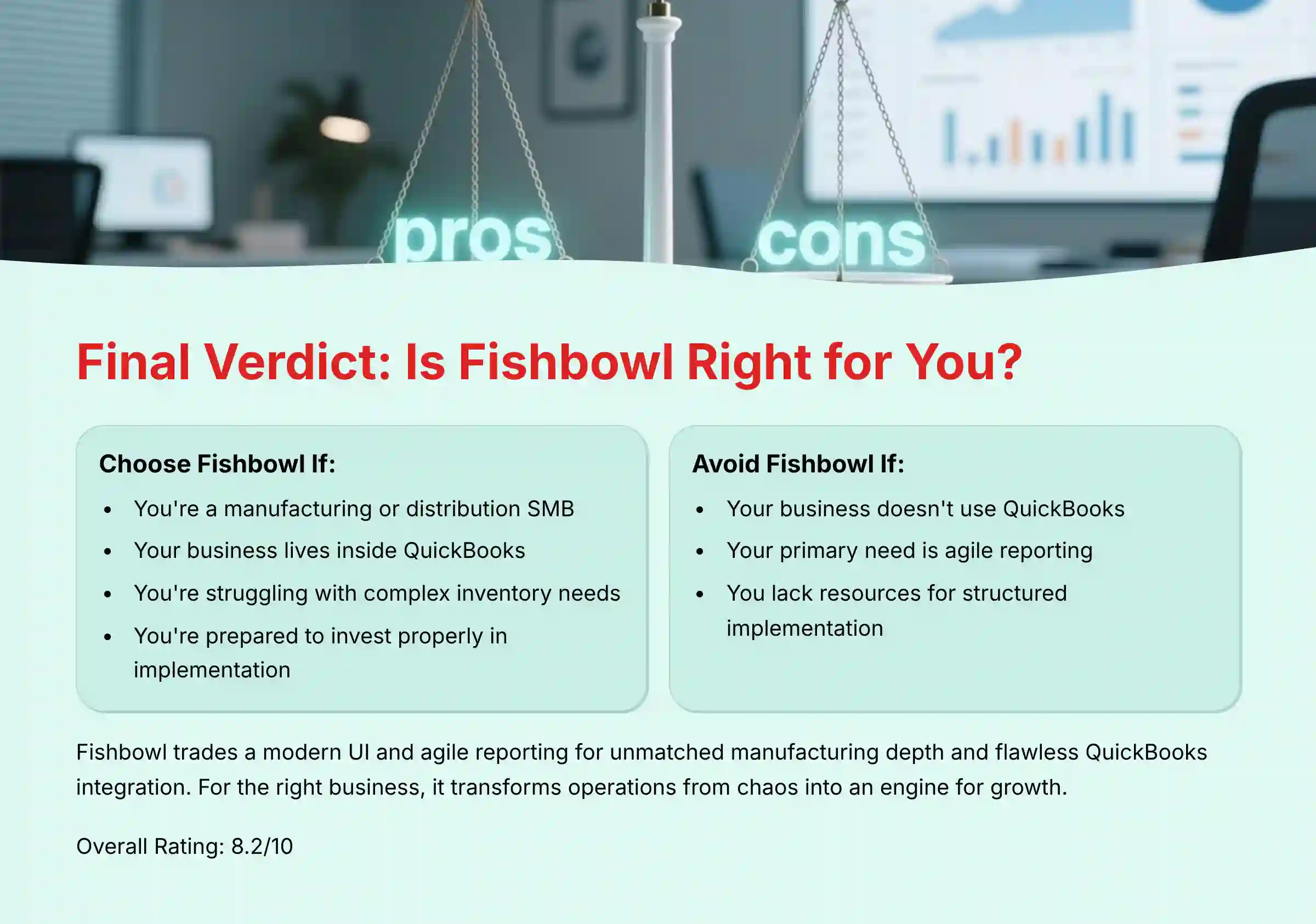
Fishbowl is a tale of trade-offs. It trades a modern user interface and agile reporting for unmatched manufacturing depth and a flawless QuickBooks integration.
It trades a simple SaaS subscription for a high-upfront cost that delivers a rapid, measurable return on investment.
And it trades responsive customer support for a powerful, secure, and highly auditable system.
My final recommendation is clear:
- You SHOULD invest in Fishbowl if: You are a manufacturing or distribution SMB, your business lives inside QuickBooks, you are struggling with complex inventory needs, and you are prepared to invest properly in its implementation. For this specific user, Fishbowl is the most logical and powerful choice on the market. It is the definitive tool for transforming your operations from a source of chaos into an engine for growth. The time to act is now; the only remaining question is whether you are ready to press the advantage.
- You should AVOID Fishbowl if: Your business does not use QuickBooks, your primary need is agile reporting, or you lack the resources for a structured implementation process.
Important Disclaimers & Professional Guidance:
The information about Fishbowl and AI for Operations & Supply Chain tools presented in this article reflects our thorough analysis as of 2025.
Given the rapid pace of technology evolution, features, pricing, and security protocols may change. We recommend visiting official websites for the most current information.
For applications with significant professional, financial, or compliance implications, we recommend consulting with qualified professionals who can assess your specific requirements.
Return on investment calculations vary widely based on your business's unique operational costs, inventory levels, and labor structure.
Companies must perform their own detailed ROI analysis using their specific financial data, preferably with guidance from an implementation partner or financial consultant who can build a specific business case.
Before purchasing, businesses must obtain a detailed Statement of Work (SOW) from a certified implementation partner. This SOW should outline all costs, timelines, and deliverables to prevent budget overruns and project failure.
This step is a non-negotiable part of professional due diligence.
For comprehensive insight into what to expect during setup and beyond, explore our extensive Fishbowl FAQs section to address common implementation concerns.
Comprehensive FAQs Section
Is Fishbowl a True AI Software?
No, not in the sense of a self-learning AI. Fishbowl's “Advanced Forecasting” feature uses a proven statistical algorithm (Holt-Winters) to analyze your past sales data.
It is best described as powerful statistical automation that removes human bias from reordering. It is effective at optimizing reorder points based on what has already happened.
What Is the Real Total Cost of Fishbowl?
The total cost is much more than the license fee. A realistic budget should include the Total Cost of Ownership (TCO).
This includes: 1) the one-time software license fee, 2) the mandatory annual support and maintenance plan, and 3) a one-time professional implementation and training package.
A small implementation can easily exceed $10,000 – $20,000 in total first-year costs.
Can Fishbowl Replace QuickBooks?
No, absolutely not. Fishbowl is designed to work with QuickBooks, not replace it.
It handles all inventory and manufacturing operations and then syncs the final accounting data back to QuickBooks. You still need QuickBooks for your general ledger, payroll, and financial reporting.
How Long Does a Fishbowl Implementation Take?
A typical implementation takes between 4 to 12 weeks, depending on business complexity.
The process involves workflow mapping, data cleansing, configuration, testing, and training. Rushing the implementation is a common cause of failure.
What Are the Biggest Complaints About Fishbowl?
The two most consistent complaints from users in 2025 are:
- Poor Customer Support: Users frequently report long wait times and difficulty getting timely help for urgent issues.
- Clunky Reporting: The built-in reporting module is considered powerful but extremely difficult to customize without paying for developer services.
Is Fishbowl Secure Enough for Government or Medical Contracting?
Yes, it is one of the strongest choices in the SMB space for this purpose. Its SOC 2 Type II certification provides third-party validation of its security controls.
Combined with its granular user permissions and detailed audit trails, it meets the foundational requirements for many compliance-heavy industries.
Does Fishbowl Work With Mac or Only Windows?
The Fishbowl desktop client is a Windows-based application. To run it on a Mac, you would need virtualization software like Parallels.
The mobile app, Fishbowl GO, is available for both Android and iOS but is designed for ruggedized Android scanners.
What Happens If I Stop Paying the Annual Maintenance Fee?
The software will continue to function since you own the license. However, you will lose access to all customer support, software updates, and security patches.
Operating without a support plan is highly discouraged and poses a serious business risk.
Fishbowl vs. QuickBooks Enterprise: Which Is Better?
It depends on your complexity. QuickBooks Enterprise is a good step up from Pro/Premier for basic multi-location tracking.
Fishbowl is for businesses whose complexity has far surpassed what Enterprise can handle, especially for multi-level manufacturing and true mobile WMS needs.
Can I Integrate Fishbowl With Shopify or Amazon?
Yes, Fishbowl has integrations with major e-commerce platforms and shipping providers. These are often managed through their own platform or third-party connectors.
It is important to thoroughly investigate the depth and cost of the specific integration you need.
For broader context on WMS solutions and how Fishbowl compares in the wider marketplace, our comprehensive guide to the Best 10 AI Warehouse Management Systems (WMS) of 2025: From Chaos to Intelligent Orchestration provides valuable comparative insights.

Leave a Reply