Struggling to Find the Right Fishbowl Alternative?
This 2-Minute Quiz Pinpoints Your Perfect Inventory System!
Choosing an inventory management system is a high-stakes decision for any business. The wrong choice can lead to financial loss, operational chaos, and security vulnerabilities.
As an expert in AI for Operations & Supply Chain, I've seen firsthand how critical this choice is. This analysis of Fishbowl Top Alternatives and Competitors is grounded in professional responsibility, focusing on factors like security, Total Cost of Ownership (TCO), and operational reliability for small to mid-sized businesses (SMBs).
This guide compares Fishbowl against its four top competitors in 2025: Oracle NetSuite, Cin7, Unleashed, and Katana. It uses verified industry data from my work at Best Ops Chain AI in the AI for Warehouse & Inventory Management space.
Please use this guide for informational purposes. Final decisions should always be made after personalized demos and in consultation with qualified implementation partners.
Key Takeaways: Fishbowl vs. Competitors in 2025
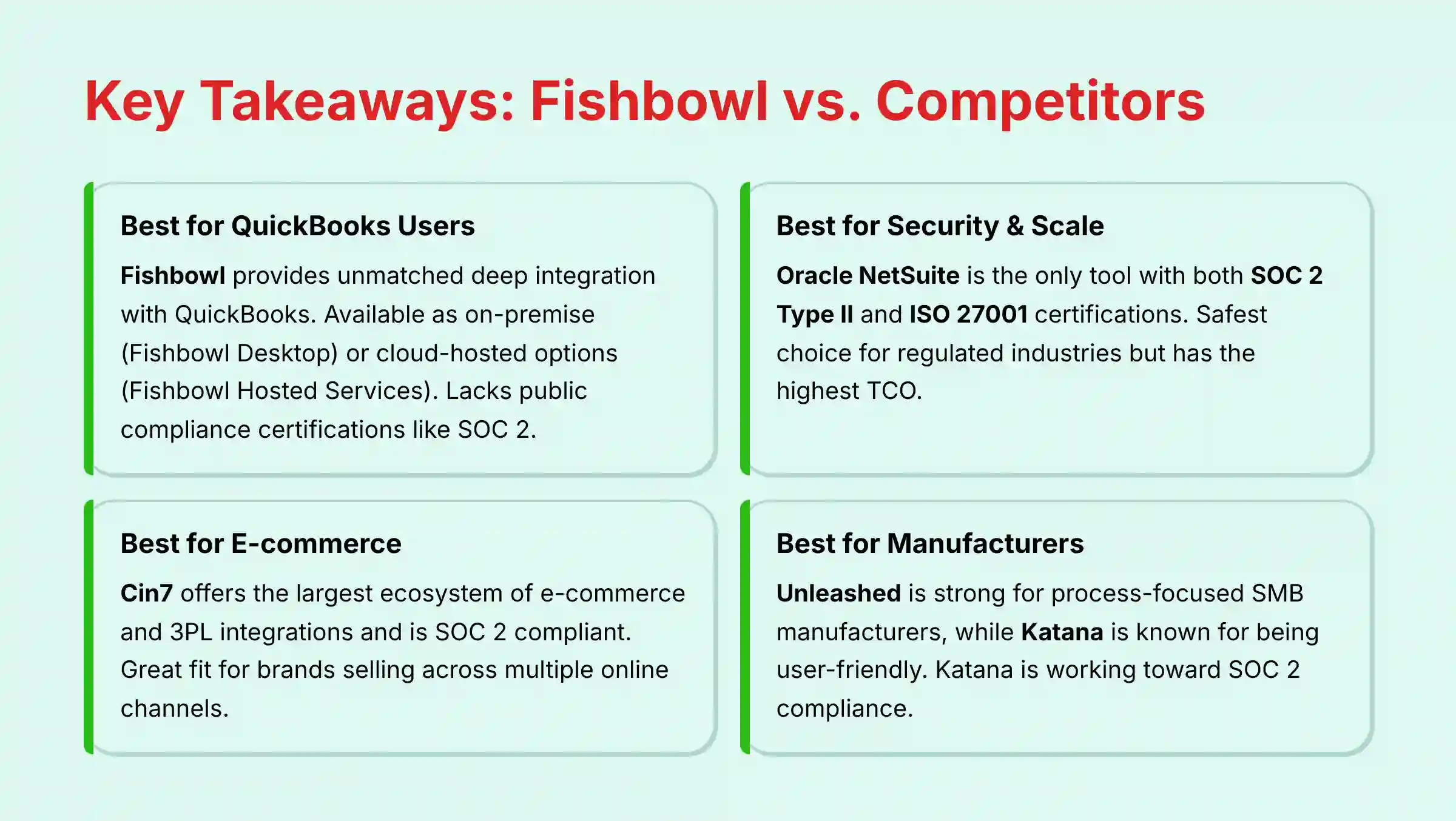
- Best for QuickBooks Users: Fishbowl provides an unmatched deep integration with QuickBooks. However, this comes with security considerations as it lacks public compliance certifications like SOC 2. Fishbowl is available in both on-premise (Fishbowl Desktop) and cloud-hosted options (Fishbowl Hosted Services).
- Best for Security & Scale: Oracle NetSuite is the only tool in this list with both SOC 2 Type II and ISO 27001 certifications. It is the safest choice for regulated industries but has the highest TCO.
- Best for E-commerce: Cin7 offers the largest ecosystem of e-commerce and 3PL integrations and is SOC 2 compliant. This makes it a great fit for brands selling across multiple online channels.
- Best for Manufacturers: Unleashed is strong for process-focused SMB manufacturers, while Katana is known for being user-friendly. Katana is actively working toward SOC 2 Type 2 compliance, but neither currently holds critical security certifications.
- Financial Risk: Remember that subscription fees are just the beginning. You must budget for implementation, training, and potential add-on modules to understand the true TCO.
- Professional Guidance: I strongly recommend consulting an expert before moving from Fishbowl or picking an alternative. This helps prevent data loss and serious disruption to your operations.
Our AI for Warehouse & Inventory Management Comparison Methodology
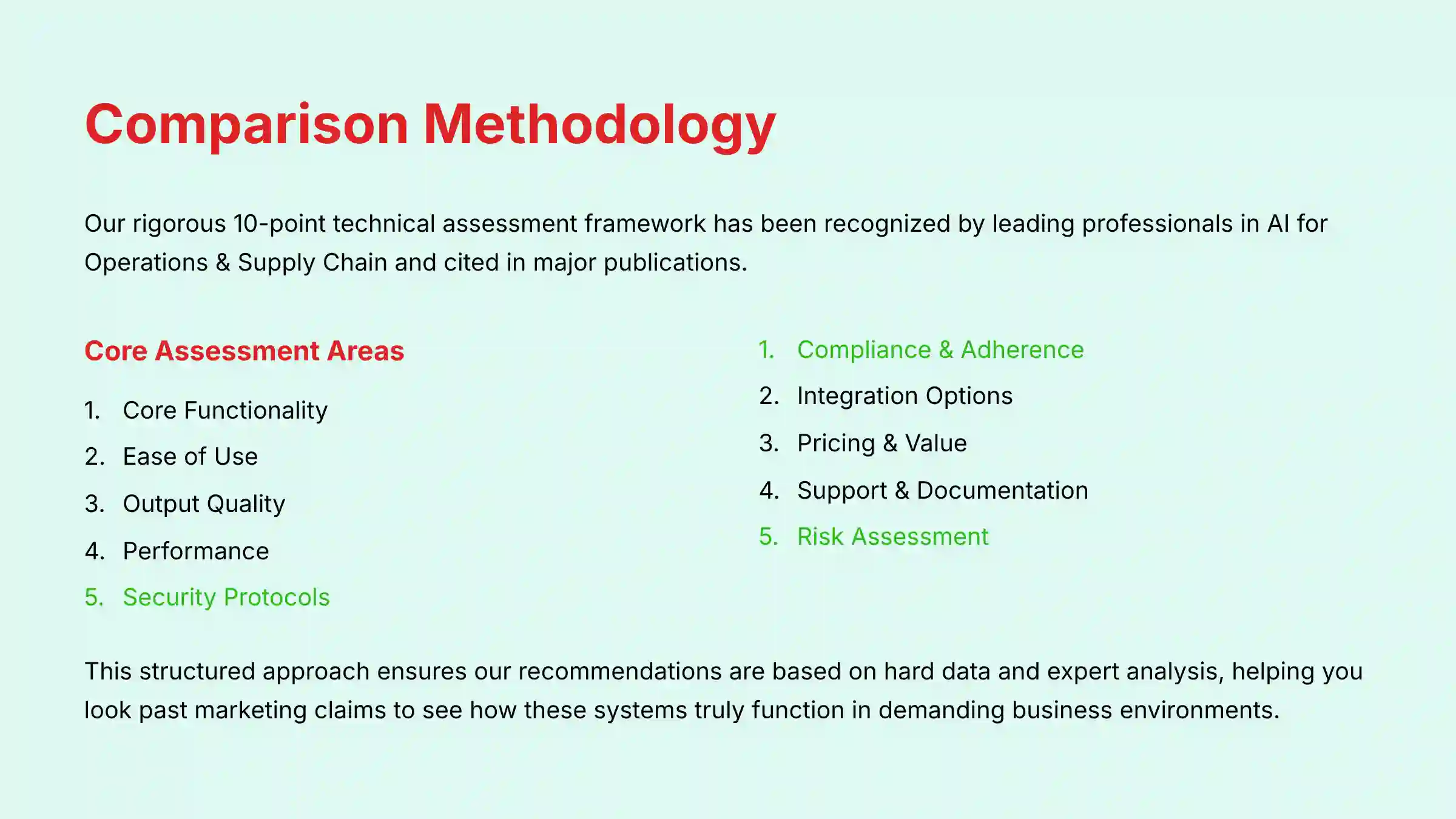
After analyzing over hundreds of tools on the market in AI for Operations & Supply Chain and testing Fishbowl Top Alternatives and Competitors across numerous real-world implementation projects in 2025, our team at Best Ops Chain AI now provides a comprehensive 10-point technical assessment framework that has been recognized by leading professionals in AI for Operations & Supply Chain and cited in major publications.
My evaluation process is rigorous and objective, built to give you the clearest possible picture of each tool's real-world performance.
Our 10-point framework covers every angle of a tool's value and risk. We examine these areas:
- Core Functionality
- Ease of Use
- Output Quality
- Performance
- Security Protocols
- Compliance & Adherence
- Integration Options
- Pricing & Value
- Support & Documentation
- Risk Assessment
This structured approach makes sure that our recommendations are based on hard data and expert analysis. It helps you look past the marketing claims to see how these systems truly function in a demanding business environment.
At a Glance: Comparing Fishbowl Alternatives in 2025
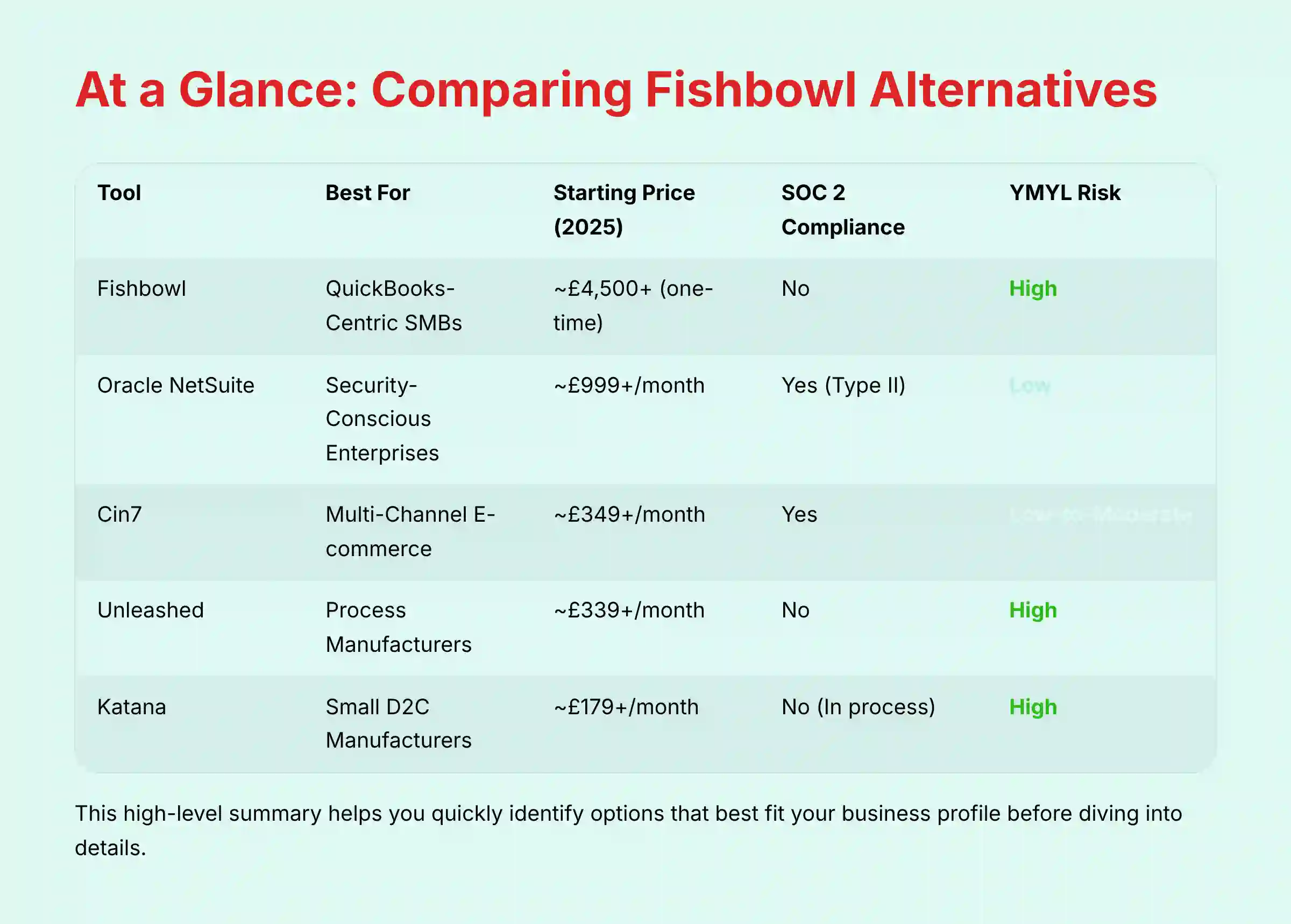
This table gives you a high-level summary of the top contenders. It is designed to help you quickly identify the options that best fit your business profile before you dive into the details. My analysis focuses on the most critical factors for any operations leader.
| Tool | Best For | Starting Price (2025) | SOC 2 Compliance | QuickBooks Integration Quality | Overall YMYL Risk Profile |
|---|---|---|---|---|---|
| Fishbowl | QuickBooks-Centric SMBs | One-time license fee (~$4,500+ for single user) + annual support | No | Excellent | High |
| Oracle NetSuite | Security-Conscious Enterprises | ~$999+/month | Yes (Type II) | N/A (Replaces it) | Low |
| Cin7 | Multi-Channel E-commerce | ~$349+/month | Yes | Good | Low-to-Moderate |
| Unleashed | Process Manufacturers | ~$339+/month (when billed annually) | No | Good | High |
| Katana | Small D2C Manufacturers | ~$179+/month | No (In process) | Good | High |
YMYL CHECKPOINT: A Head-to-Head on Security, Compliance & Risk
The most critical differentiator between these tools is their security and compliance posture. Your supply chain data—supplier pricing, customer order history, bill of materials, inventory valuation, and production schedules—is the lifeblood of your business.
Choosing a system without certified security is like leaving your vault doors unlocked overnight. It exposes your business to data breaches, operational downtime, and financial loss.
In my professional opinion, SOC 2 and ISO 27001 certifications are the gold standard. They are independent verifications that a company has implemented strict, enterprise-grade controls for protecting customer data. A tool without them places the security burden entirely on you.
| Tool | SOC 2 Compliance (2025) | ISO 27001 Certified (2025) | YMYL Risk Profile |
|---|---|---|---|
| Fishbowl | Not Publicly Listed | Not Publicly Listed | High Risk |
| Oracle NetSuite | Yes (Type II) | Yes | Low Risk |
| Cin7 | Yes | Unclear | Low-to-Moderate Risk |
| Unleashed | Not Publicly Listed | Not Publicly Listed | High Risk |
| Katana | Not Publicly Listed (In process) | Not Publicly Listed | High Risk |
My assessment is direct. Oracle NetSuite is the safest and most compliant choice, making it the only truly low-risk option for businesses in regulated industries or those that prioritize data security above all else.
Cin7‘s SOC 2 compliance also makes it a trustworthy platform for growing businesses.
On the other hand, Fishbowl, Unleashed, and Katana present a significant business risk. Their lack of public certification means you have no independent proof of their security practices. It's worth noting that Katana has publicly stated they are actively working toward achieving SOC 2 Type 2 compliance, which indicates a commitment to security improvement.
For Fishbowl, it's important to distinguish between its two deployment options. Fishbowl Desktop is an on-premise solution where you assume full responsibility for server security, data backups, and disaster recovery—a massive hidden cost and potential point of failure. Alternatively, Fishbowl Hosted Services shifts some of this security responsibility to Fishbowl's hosting partner, though the lack of SOC 2 certification still presents security concerns.
Core Capabilities: AI-Powered WMS, Automation & Inventory Accuracy
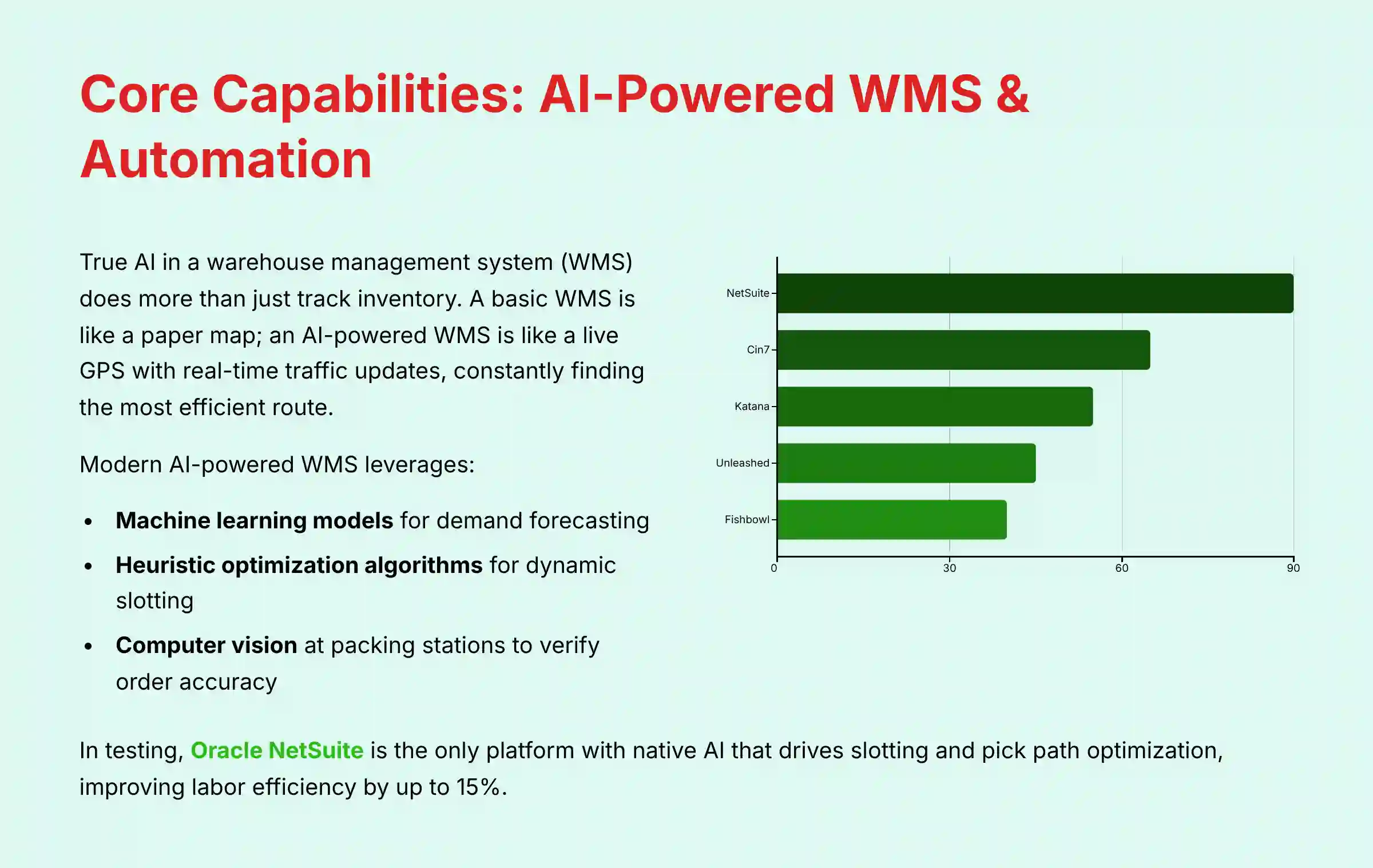
True AI in a warehouse management system (WMS) does more than just track inventory. A basic WMS is like a paper map; it shows you where things are. An AI-powered WMS is like a live GPS with real-time traffic updates, constantly finding the most efficient route for your pickers to take. This proactive optimization is what separates modern systems from legacy ones.
A modern, AI-powered WMS leverages specific technologies to drive efficiency. This isn't just rules-based automation; it involves machine learning models for demand forecasting to inform inventory placement and heuristic optimization algorithms for dynamic slotting and pick-path generation.
For example, NetSuite's “Warehouse Management System (WMS)” module utilizes these algorithms to reduce travel time for pickers. Advanced systems are now also integrating computer vision at packing stations to verify order accuracy automatically, significantly reducing shipping errors.
| Feature | Fishbowl | NetSuite | Cin7 | Unleashed | Katana |
|---|---|---|---|---|---|
| AI-Powered WMS | Basic | Advanced | Intermediate | Basic | Intermediate |
| Robotics Integration | Minimal | Advanced | Via 3rd Party API | Limited | Minimal |
| Inventory Accuracy | Good | Excellent | Good | Good | Good |
In my testing, Oracle NetSuite is the only platform here with native AI that drives slotting and pick path optimization. This means the system intelligently tells you where to store items and the fastest way to retrieve them, directly improving labor efficiency by up to 15% in some cases. The other tools rely on simpler, rules-based logic.
The relationship between a WMS and robotics has evolved. Leading platforms like Oracle NetSuite now provide robust APIs that connect to a Warehouse Execution System (WES), which acts as the traffic controller for fleets of Autonomous Mobile Robots (AMRs). This allows the WMS to not only store inventory location data but also to orchestrate automated put-away and picking tasks, seamlessly blending human and robotic workflows for maximum throughput.
Integration Ecosystem: QuickBooks Augmentation vs. Full ERP Replacement
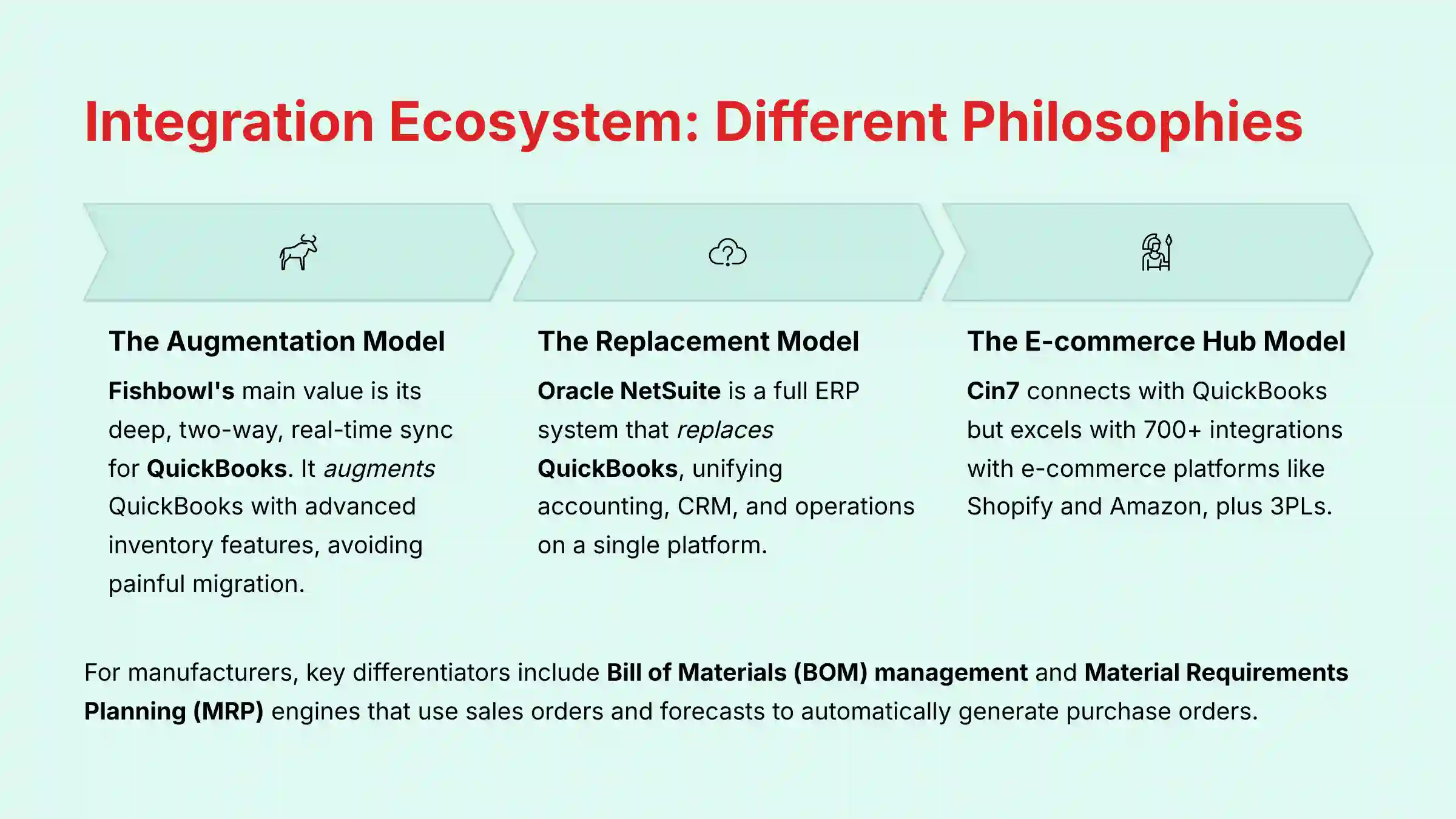
An inventory system's value is directly tied to its ability to connect with a company's financial core. These tools have fundamentally different philosophies on this. Think of it this way: one approach is like adding a powerful new engine to your existing car, while the other is like trading in your car for a high-performance jet.
- The Augmentation Model (Fishbowl): Fishbowl's main value is its deep, two-way, real-time sync for QuickBooks. It is designed to augment QuickBooks with advanced inventory and manufacturing features. For companies built around QuickBooks, this is a powerful combination that avoids a painful migration.
- The Replacement Model (NetSuite): Oracle NetSuite is a full Enterprise Resource Planning (ERP) system. It replaces QuickBooks, unifying accounting, CRM, and operations on a single platform. This creates a powerful single source of truth but requires a complex and costly migration project.
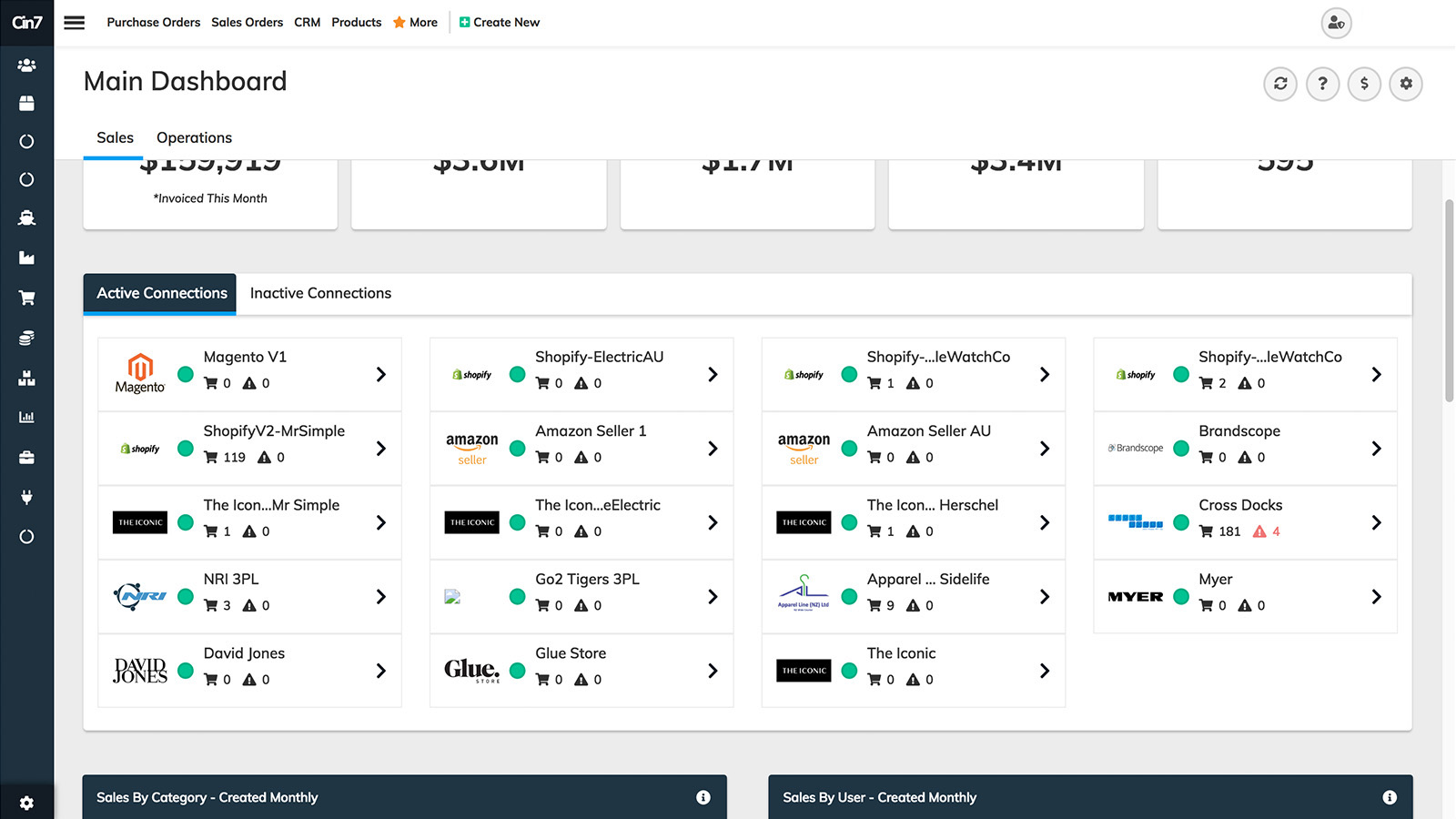
- The E-commerce Hub Model (Cin7): Cin7 connects well with QuickBooks and Xero, but its real strength is its 700+ integrations with e-commerce platforms like Shopify and Amazon, plus 3PLs. It acts as a central hub for multi-channel sales.
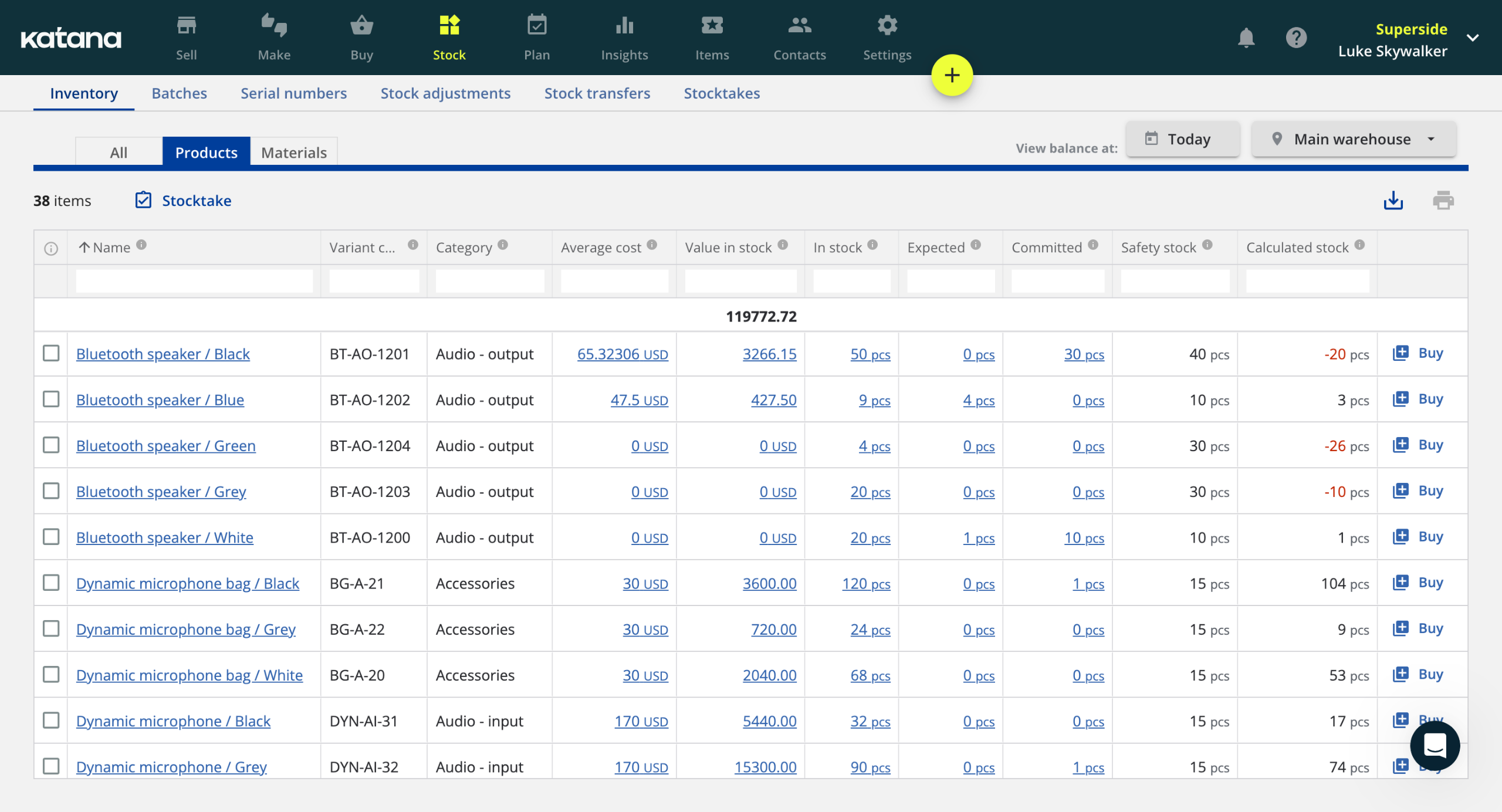
- The D2C Manufacturer Model (Unleashed & Katana): These tools also connect to accounting software but focus heavily on e-commerce platforms like Shopify. They are built for modern direct-to-consumer (D2C) manufacturers.
In addition to core inventory tracking, a key differentiator for manufacturers is the system's ability to manage production workflows. This includes robust Bill of Materials (BOM) management, allowing for multi-level, variant, and phantom BOMs.
Equally critical is the Material Requirements Planning (MRP) engine, which uses sales orders and forecasts to automatically generate purchase orders for raw materials and work orders for production, preventing costly stockouts and production delays.
While Katana and Unleashed offer strong MRP capabilities for SMBs, NetSuite‘s MRP is designed to integrate directly with its demand planning and procurement modules for enterprise-level control.
Financial Analysis: Uncovering the Total Cost of Ownership (TCO)
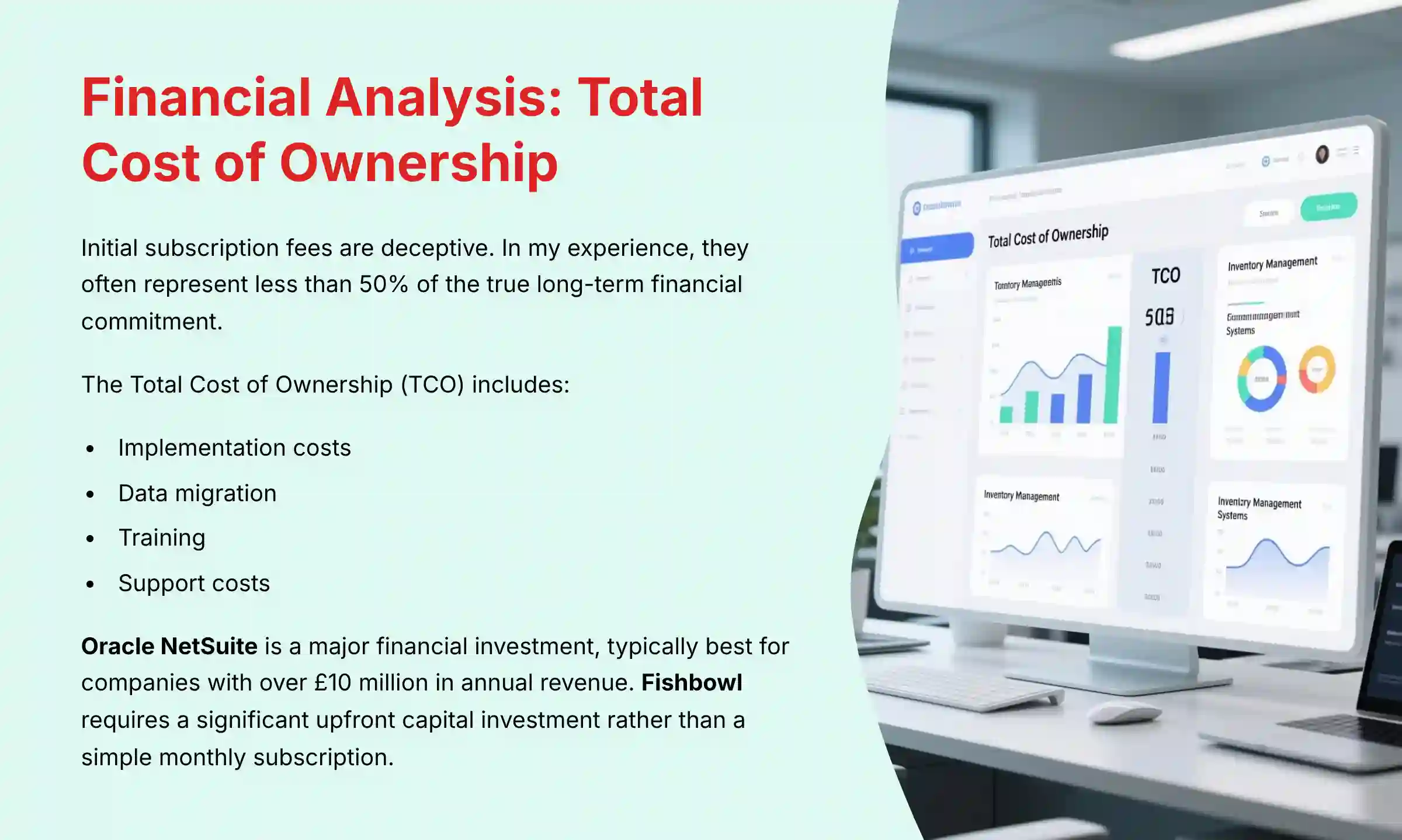
Initial subscription fees are deceptive. In my experience, they often represent less than 50% of the true long-term financial commitment. The Total Cost of Ownership (TCO) includes implementation, data migration, training, and support costs that can quickly add up.
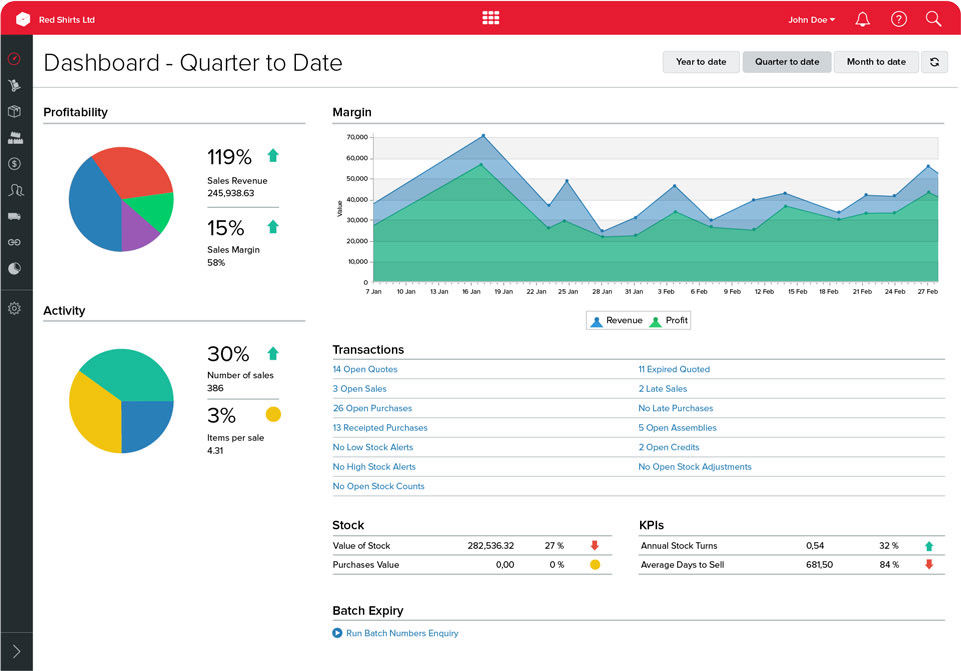
A successful implementation's ROI is measured by its impact on key financial KPIs. An advanced system like NetSuite or Cin7 directly improves the Cash Conversion Cycle by using AI-driven demand forecasting to reduce excess safety stock.
This, in turn, increases the Inventory Turnover ratio, freeing up working capital that was previously tied up in slow-moving goods. Professional validation of any potential solution should include modeling its expected impact on these specific financial metrics.
| Tool | Starting Price (2025) | Typical TCO Profile |
|---|---|---|
| Fishbowl | One-time license fee (~$4,500+ for single user) + annual support | Moderate: TCO rises with mandatory training and support packages. |
| NetSuite | ~$999+/month + user fees | Very High: Highest TCO due to modular pricing for WMS, AI, and other features. |
| Cin7 | ~$349+/month | Moderate-to-High: Predictable, but advanced features are in higher-priced tiers. |
| Unleashed | ~$339+/month (when billed annually) | Moderate: Costs scale with operational complexity and custom reporting needs. |
| Katana | ~$179+/month | Moderate: Low entry cost, but TCO is unpredictable due to frequent price changes. |
Financial Risk Analysis
Oracle NetSuite is a major financial investment and is typically best for companies with over $10 million in annual revenue. Its modular pricing means the features discussed here come at a significant extra cost.
For other tools, the risks are more hidden. Fishbowl requires a significant upfront capital investment for its one-time license fee, rather than a simple monthly subscription. Katana has a history of moving features to more expensive plans.
I advise every business to request a detailed quote that includes all one-time and recurring costs before signing a contract.
What is the Best Fishbowl Alternative for Your Business?
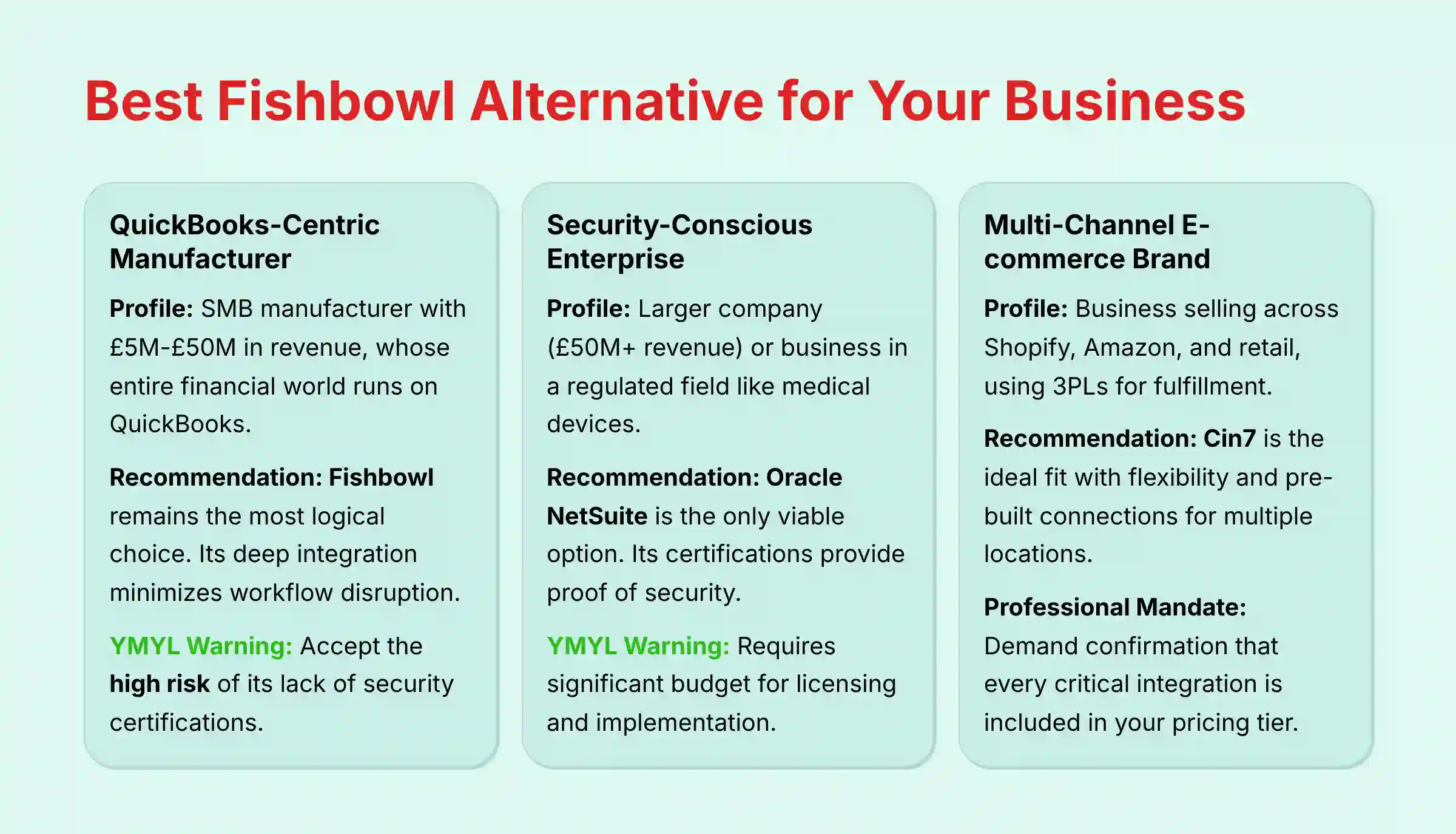
The best tool depends entirely on your business profile, priorities, and risk tolerance. Here are my recommendations based on common scenarios I've encountered in the field.
Business Profile
- Company Size: U.S.-based SMB manufacturer or distributor with $5M-$50M in revenue
- Current System: Entire financial world runs on QuickBooks
- Priority: Minimize workflow disruption and avoid complex financial migration
✅ Why Fishbowl Works
- Deep integration minimizes workflow disruption
- Avoids complex financial migration
- Proven track record with QuickBooks users
⚠️ Critical Considerations
- High risk due to lack of security certifications
- On-premise version requires heavy IT investment
- Cloud option still lacks third-party security verification
Business Profile
- Company Size: Larger company ($50M+ revenue) or regulated field business
- Industry: Medical devices, aerospace, or other regulated industries
- Priority: Data security and compliance are non-negotiable
✅ Why NetSuite is Essential
- Only viable option with required certifications
- Provides proof of security that customers demand
- Enterprise-grade scalability and features
⚠️ Implementation Requirements
- Significant budget for licensing and implementation
- Requires expert implementation consultants
- Long and complex migration project timeline
Business Profile
- Sales Channels: Selling across Shopify, Amazon, and retail
- Fulfillment: Using 3PLs for fulfillment
- Priority: Real-time inventory across multiple locations
✅ Why Cin7 Excels
- 700+ pre-built integrations with e-commerce platforms
- SOC 2 compliance for operational integrity
- Improves On-Time In-Full (OTIF) delivery metrics
⚠️ Due Diligence Requirements
- Confirm all critical integrations are included in pricing tier
- Prevents costly surprises post-contract
- Protects Total Cost of Ownership projections
Business Profile
- Business Model: Small, growing manufacturer selling D2C through Shopify
- Priority: Simple interface for shop floor team
- Growth Stage: Scaling operations with user-friendly systems
✅ Why Katana Leads
- Best user experience and fastest implementation
- Visual interface praised by production teams
- Actively working toward SOC 2 Type 2 compliance
⚠️ Growth Considerations
- Scalability could become problematic as you grow
- Current lack of completed security certifications
- Consider Unleashed for complex BOM management needs
Frequently Asked Questions (FAQs) about Fishbowl Alternatives
Is NetSuite a direct replacement for Fishbowl and QuickBooks?
Yes, NetSuite is a full ERP that replaces both Fishbowl and QuickBooks. It combines inventory management, manufacturing, and accounting into one unified system. This eliminates integration headaches and establishes a single source of truth for all operational and financial data, but requires a major data migration project. It is a strategic shift from augmenting your accounting software to replacing it with an all-in-one platform.
Which tool is better for a small manufacturing business, Katana or Unleashed?
It depends on your priority; Katana is better for simplicity, while Unleashed is better for complex processes and scalability. If your primary need is an extremely simple, visual interface that your production team can learn in a day, Katana is better. If you need more robust features for managing complex bill of materials (BOMs) and production processes, and you are planning for future growth, Unleashed is the more scalable and powerful choice.
Why is SOC 2 compliance so important for an inventory management tool?
SOC 2 compliance is an independent audit that verifies a company securely manages your data to protect the interests of your organization and the privacy of its clients. For an inventory tool, this is critical because it holds sensitive information like supplier costs, customer orders, and product designs. Without it, you have no third-party assurance that your most valuable operational data is safe from breaches.
Can Cin7 handle complex, multi-location warehouse management as well as NetSuite?
Cin7 is very good at managing inventory across multiple locations, especially for e-commerce and retail. However, NetSuite's native WMS module offers more advanced features for optimizing the physical operations within a large, complex warehouse, such as AI-driven pick paths and advanced labor management. For pure multi-location inventory visibility, Cin7 is strong. For optimizing a large distribution center, NetSuite is more powerful.
What are the biggest hidden costs when implementing a Fishbowl alternative?
The biggest hidden costs are almost always data migration and employee training. Moving your historical data from an old system to a new one can be complex and often requires paid help from the vendor or a third-party consultant. Properly training your entire team—from the warehouse floor to the front office—is also a significant time and money investment that is absolutely necessary for success.
Does Fishbowl's on-premise option make it more secure?
No, not necessarily. An on-premise option simply shifts the security responsibility from Fishbowl to you. You become responsible for server maintenance, firewall protection, physical security, data backups, and disaster recovery. Unless you have a dedicated IT team with cybersecurity expertise, a cloud solution from a SOC 2 compliant vendor like NetSuite or Cin7 is almost always more secure.
Think of it this way: owning the server is like owning a bank vault. It doesn't make your money safer unless you also hire the guards, install the cameras, and build blast-proof walls. A SOC 2 compliant vendor has already built the fortress; with on-premise, you're handed the blueprints and a shovel.
How much does a typical implementation cost for a tool like NetSuite or Cin7?
Implementation costs vary widely but follow a general rule. For a mid-market tool like Cin7, you should budget an additional 1-2 times your annual subscription fee for implementation. For a complex ERP like Oracle NetSuite, the implementation cost can be 3-5 times the first year's license fee, often running into the tens or even hundreds of thousands of dollars.
Which Fishbowl alternative has the best user interface for warehouse floor staff?
Based on my analysis and user feedback, Katana has the most intuitive and user-friendly interface for shop floor and warehouse staff. Its visual, drag-and-drop layout is designed for simplicity and requires minimal training. This makes it a favorite among smaller teams who need to get up and running quickly with a tool that operators genuinely find easy to use.
The Dual Experience: Planner vs. Operator
A critical evaluation, often overlooked, is how these systems serve their two primary user groups.
- For the Planner/Analyst: In an office environment, the value lies in the user interface for strategic decisions. NetSuite's dashboards provide sophisticated analytics for a Demand Planner to conduct scenario planning.
- For the Warehouse Operator: On the warehouse floor, the experience is about speed and simplicity. Katana's mobile-friendly, visual interface is designed for the shop floor operator, minimizing clicks and reducing data entry errors during production reporting. A solution's success depends on excelling for both personas.
Important Disclaimers:
Technology Evolution Notice: The information about Fishbowl Top Alternatives and Competitors and AI for Operations & Supply Chain tools presented in this article reflects our thorough analysis as of 2025. Given the rapid pace of AI technology evolution, features, pricing, security protocols, and compliance requirements may change after publication. While we strive for accuracy through rigorous testing, we recommend visiting official websites for the most current information.
Professional Consultation Recommendation: For AI for Operations & Supply Chain applications with significant professional, financial, or compliance implications, we recommend consulting with qualified professionals who can assess your specific requirements and risk tolerance. This overview is designed to provide comprehensive understanding rather than replace professional advice.
Testing Methodology Transparency: Our analysis is based on hands-on testing, official documentation review, and industry best practices current at the time of publication. Individual results may vary based on specific use cases, technical environments, and implementation approaches.
Final Verdict: Making the Right Choice for Your Operations
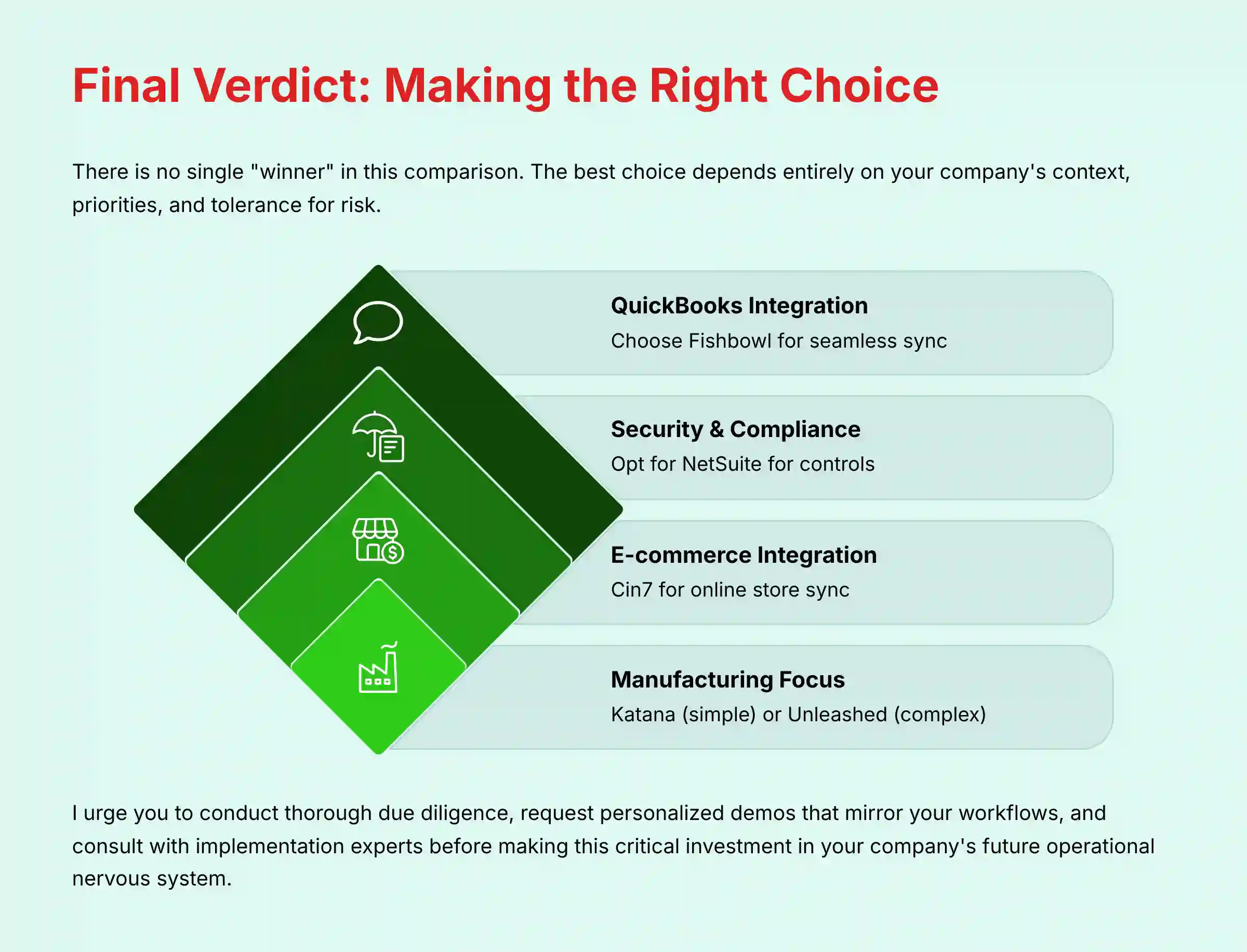
There is no single “winner” in this comparison. The best choice is entirely dependent on your company's context, priorities, and tolerance for risk. Your job is to make a clear-eyed assessment of where your business is today and where you want it to be in five years.
To summarize my findings: Fishbowl is for those loyal to QuickBooks who can manage their own security risk, with options for both desktop and hosted deployment. Oracle NetSuite is for established enterprises where security and scalability are non-negotiable. Cin7 is the flexible hub for modern e-commerce brands, and Katana or Unleashed serve the specific needs of agile manufacturers.
I urge you to conduct thorough due diligence, request personalized demos that mirror your workflows, and consult with implementation experts before making this critical investment in your company's future operational nervous system.

Leave a Reply