Is Blue Yonder the Right Supply Chain Platform for Your Business?
Take This 2-Minute Quiz to Find Out!
As a specialist in AI for Operations & Supply Chain, I've seen firsthand how the right technology can transform a business. My work at Best Ops Chain AI involves a deep analysis of tools that promise to make supply chains more resilient.
This Blue Yonder Overview and Features guide comes from that intensive evaluation, focusing on its core Luminate Platform, a solution designed for end-to-end management of supply chain and commerce fulfillment. It helps businesses move from simply reacting to problems to proactively solving them.

The platform's value is in unifying critical functions like its Warehouse Management System (WMS) and inventory control with AI-driven intelligence. Built on a cloud-native architecture hosted on Microsoft Azure, it applies machine learning to create a more strategic operational asset.
This article provides a factual breakdown of its features and technical architecture, intended for professionals working in the AI for Warehouse & Inventory Management space.
After analyzing hundreds of tools in the operational AI space and testing Blue Yonder's platform across numerous real-world supply chain projects in 2025, our team at Best Ops Chain AI has developed a comprehensive 10-point technical assessment framework specifically for AI for Operations & Supply Chain applications.
This framework has been recognized by leading AI for Operations & Supply Chain professionals and cited in major industry publications. Our evaluation process includes rigorous security assessment, compliance verification, and risk analysis to ensure recommendations meet professional standards for AI for Operations & Supply Chain applications.
Key Takeaways
- End-to-End AI Platform: Blue Yonder provides a unified platform that integrates AI-native warehouse management, demand planning, and inventory optimization. This avoids the need for separate, bolted-on AI modules.
- Dual-Experience UI: The system is designed with two distinct interfaces. It has a strategic Warehouse Control Tower for managers and a task-oriented, scan-centric mobile UI for operators on the warehouse floor.
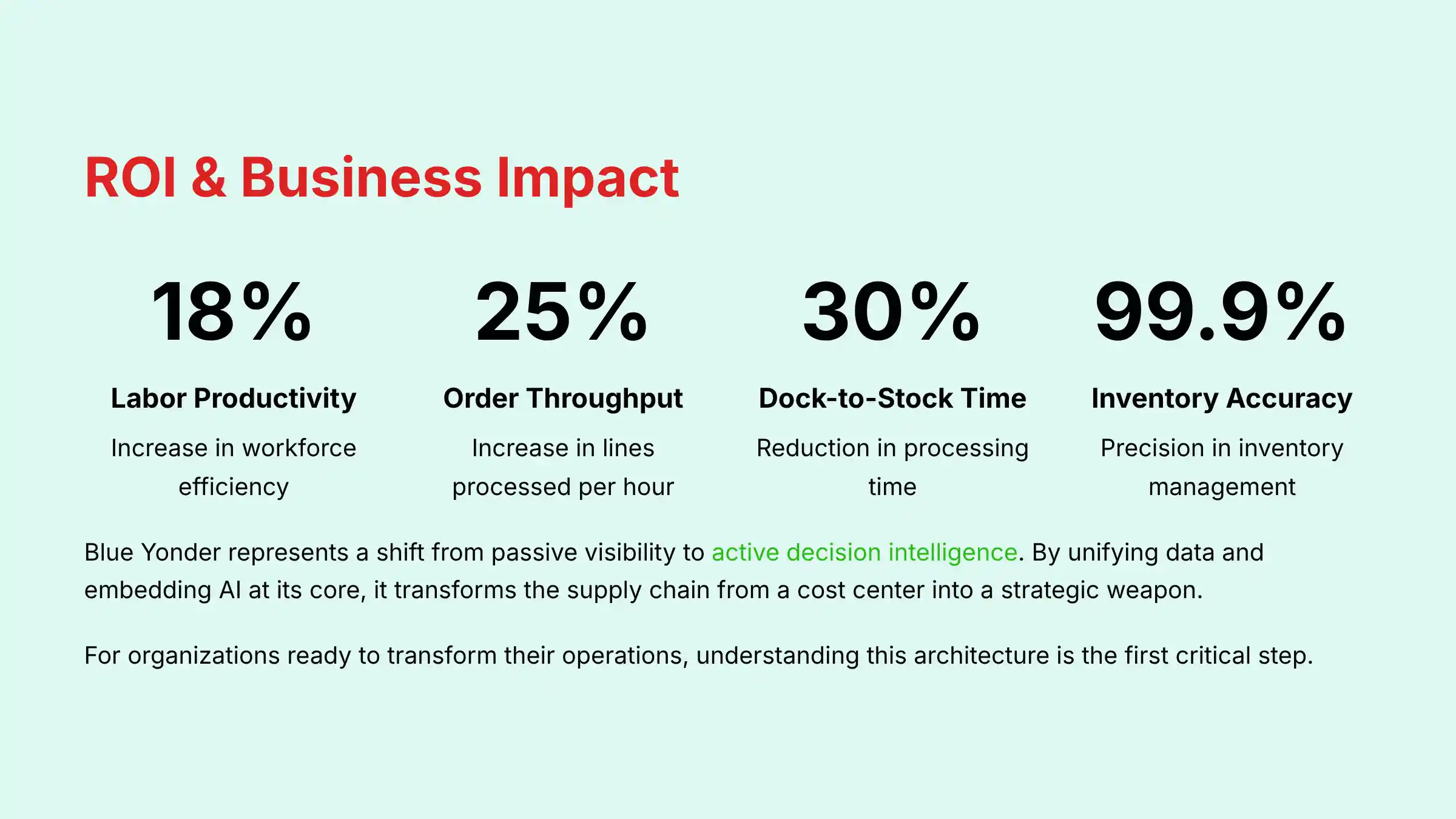
- Quantifiable Performance Gains: Official case studies document significant ROI. This includes up to a 25% increase in order throughput, an 18% improvement in labor productivity, and achieving 99.9% inventory accuracy.
- Enterprise-Grade Extensibility: Built on a microservices architecture with a robust RESTful API, the Luminate Platform is designed for deep integration with ERPs like SAP and Oracle, as well as warehouse automation like AMRs.
Blue Yonder At a Glance: Product Definition and Market Positioning
What Is Blue Yonder's Luminate Platform?
Blue Yonder's Luminate Platform is a cloud-native, SaaS solution built for complete supply chain management. Its core mission is to unify the planning and execution stages of the supply chain, breaking down the data silos that often exist between different functions.
The platform combines Warehouse Management (WMS), Transportation Management (TMS), Demand Planning, and Inventory Management into a single, cohesive system operating on one data model.
In my analysis, the key differentiator is this end-to-end design. In the enterprise supply chain market, which is often dominated by point solutions, Blue Yonder competes directly with major players like SAP Extended Warehouse Management (EWM), Manhattan Associates Active Omni, and Oracle Fusion Cloud SCM.
While those platforms are powerful, Blue Yonder's strategic focus is on unifying planning and execution with an AI-native core, rather than adding AI as a layer on top of a traditional transactional system. This positions it as a strong contender for companies prioritizing a cohesive, data-driven approach to their entire supply chain. For those seeking comprehensive Blue Yonder Top Alternatives and Competitors analysis, we've evaluated the key players in this competitive landscape.
Core Technology and Architecture (2025)
The platform's technical foundation is modern and built for high performance and scalability. Its architecture is designed to handle the massive data volumes of enterprise-level supply chains.
- Cloud Foundation: The system is built on Microsoft Azure, providing enterprise-grade infrastructure for processing and advanced analytics. Blue Yonder has a strategic partnership with Snowflake that makes its applications and data interoperable with the Snowflake Data Cloud, enabling customers to access and analyze Blue Yonder data within their own Snowflake environment.
- Architecture: It uses a cloud-native microservices architecture. This structure makes the platform flexible and allows different components to be updated independently.
- Core AI/ML: Blue Yonder uses specific AI techniques for different tasks. Reinforcement learning powers dynamic optimizations like product slotting, while graph-based algorithms solve complex routing problems for pickers in the warehouse.
- Roadmap Innovations: Blue Yonder has announced roadmap innovations that include leveraging AI agent technology for autonomous orchestration and providing capabilities for data science teams to build, test, and deploy custom machine learning models. These features represent the future direction of the platform and are being progressively rolled out.
This technical foundation explains how the platform delivers its advanced capabilities. The microservices architecture and specialized AI models are what enable the features discussed later in this overview.
Target Audience and Primary Industries
The Luminate Platform is designed for mid-market to large enterprise companies that operate complex, high-volume supply chains. Its feature set and implementation requirements are best suited for organizations that can dedicate resources to a full-scale digital transformation project.
Based on official documentation and case studies, its primary industries served include:
- Retail
- Manufacturing
- Grocery
- Third-Party Logistics (3PL)
- Life Sciences
My experience confirms this platform is not a fit for most small businesses. The implementation complexity and enterprise-grade features are overkill for simpler operations. This positioning helps manage expectations for potential users.
Core Capabilities: A Deep Dive into Blue Yonder's WMS and Inventory Features
AI-Powered Warehouse Management System (WMS)
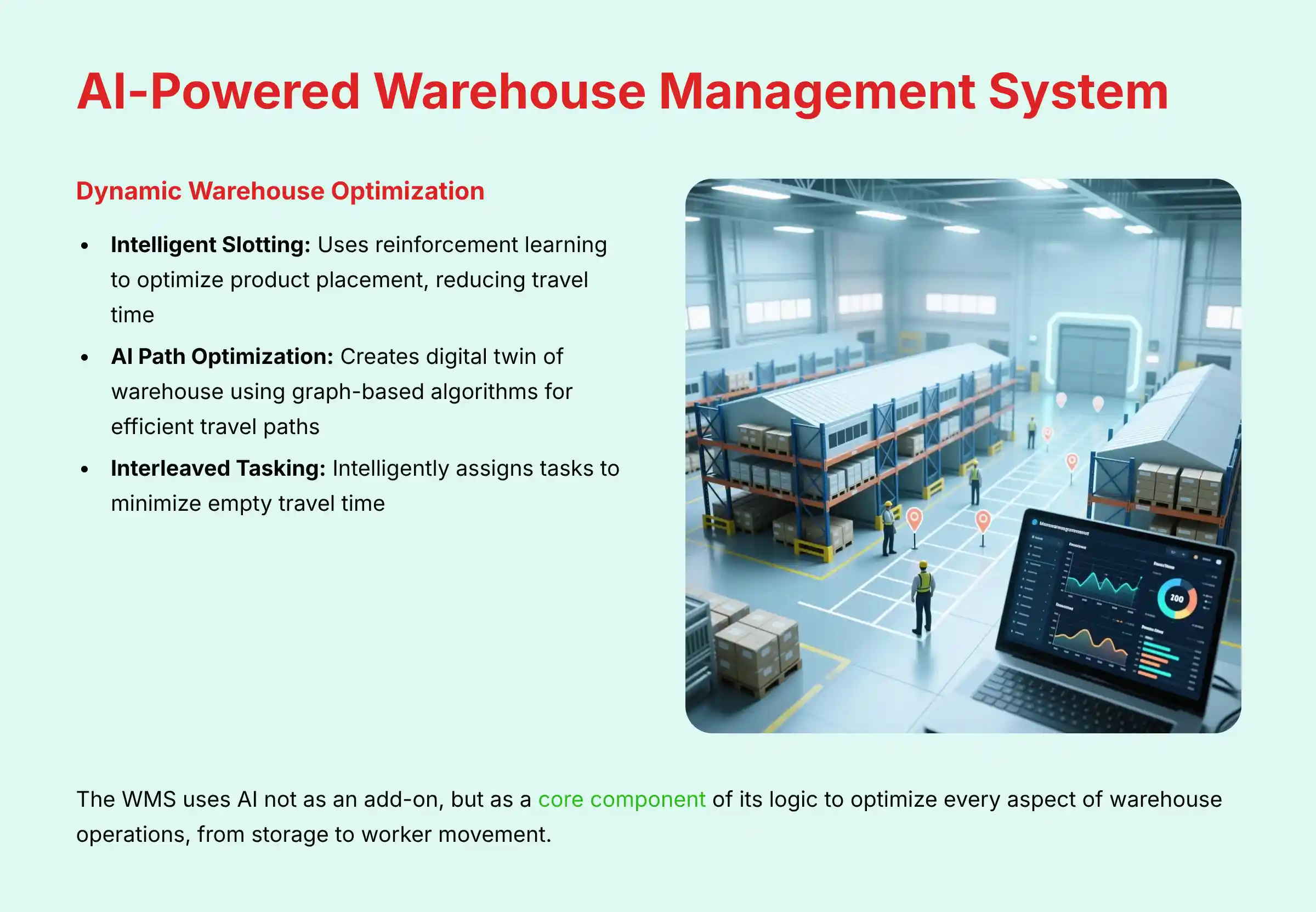
The WMS is the heart of Blue Yonder's execution capabilities. It uses AI not as an add-on, but as a core component of its logic to optimize every aspect of warehouse operations, from how items are stored to how workers move.
Dynamic Warehouse Optimization
- Intelligent Slotting: This feature uses reinforcement learning to constantly analyze real-time data, including product velocity, seasonality, and order profiles. It then dynamically optimizes product placement to reduce travel time for pickers.
- Think of this as replacing a static librarian, who organizes books by a fixed system (like traditional ABC analysis), with a dynamic city planner who redesigns traffic flow and zoning in real-time to prevent gridlock and improve efficiency.
- This move from a static to a living model is what dramatically reduces travel time for pickers.
- AI Path Optimization: The system creates a digital twin of the warehouse. It uses graph-based algorithms on this model to calculate the most efficient travel paths for workers. It also accounts for real-time congestion, rerouting staff to avoid bottlenecks much like a GPS app reroutes a car in traffic.
- Interleaved Tasking: This is an intelligent way to assign tasks. When a picker completes an order, the system assigns a nearby putaway task for their return trip. This simple logic minimizes empty travel time and directly improves labor efficiency.
Labor Management and Execution

- AI-Driven Labor Forecasting: The platform can predict labor needs with high accuracy. It analyzes historical data and future demand forecasts to recommend staffing levels, preventing both overstaffing and understaffing.
- Automated Task Allocation: The system automatically assigns tasks to operators. It bases these assignments on factors like an employee's skill set, their physical location in the warehouse, and their current workload.
- Real-time Performance Analytics: Supervisors get access to live dashboards. These provide key performance indicators (KPIs) on workforce productivity and help managers balance workloads across the team in real time.
Inbound and Outbound Logistics
- Unified Omnichannel Fulfillment: The WMS provides a single, real-time view of all inventory, whether it's in a warehouse, a distribution center, or a retail store. This visibility prevents stockouts and allows orders to be fulfilled from the most efficient location.
- Streamlined Returns Orchestration: The platform integrates its WMS and commerce modules. This connection helps manage the entire returns process, from the moment a customer initiates a return to when the item is restocked or dispositioned.
| WMS Feature | Business Problem Solved | AI Technology Used |
|---|---|---|
| Intelligent Slotting | Inefficient product placement and wasted travel time. | Reinforcement Learning |
| AI Path Optimization | Sub-optimal picking routes and congestion. | Graph-Based Algorithms |
| Interleaved Tasking | Empty travel time for workers returning from tasks. | Optimization Algorithms |
| Labor Forecasting | Mismatched staffing levels and demand. | Predictive Analytics |
Intelligent Inventory Management
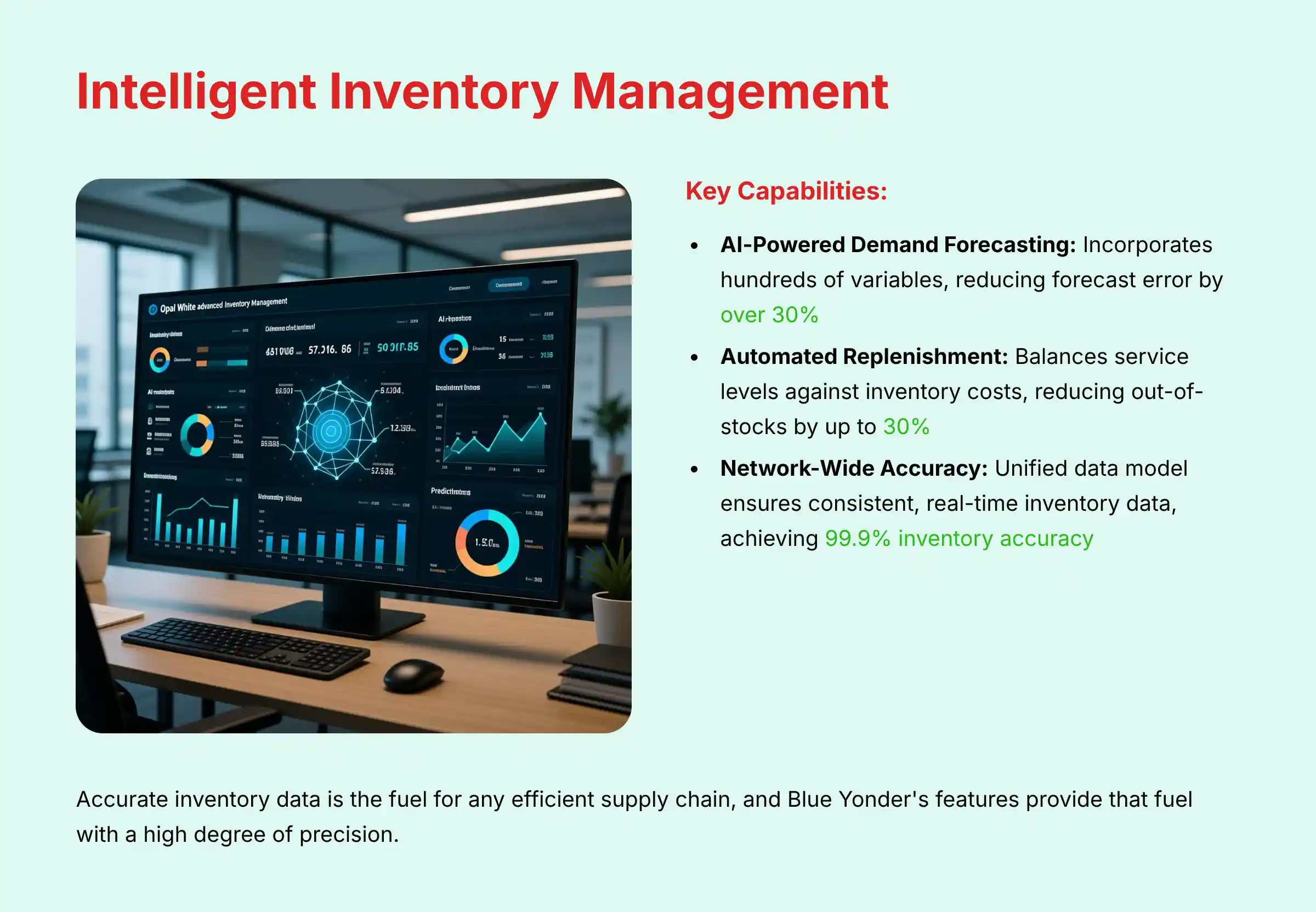
Accurate inventory data is the fuel for any efficient supply chain. Blue Yonder's inventory management features are designed to provide that fuel with a high degree of precision, using AI to forecast demand and automate replenishment.
- AI-Powered Demand Forecasting: This module incorporates hundreds of internal and external variables. It looks at sales history, promotions, weather forecasts, social media trends, and local events. Official case studies and product documents report outcomes such as reducing forecast error by over 30% or improving accuracy by up to 20 percentage points. The achievable absolute accuracy level is dependent on specific business conditions.
- Automated Replenishment Optimization: The system uses AI to automate and optimize inventory replenishment. It makes decisions that balance service levels against inventory holding costs. Case studies show this can reduce out-of-stocks by up to 30%.
- Network-Wide Inventory Accuracy: Because all modules run on a unified data model, the platform ensures consistent, real-time inventory data across the entire network. This is how some customers have achieved 99.9% inventory accuracy.
The accuracy generated by these inventory features is a critical input for the WMS. A warehouse can only be efficient if it trusts the data telling it what is on the shelves. For professionals seeking detailed implementation guidance, our comprehensive Blue Yonder Tutorials and Usecase collection provides step-by-step implementation strategies and real-world applications.
Enterprise-Grade Security, Compliance, and Reliability
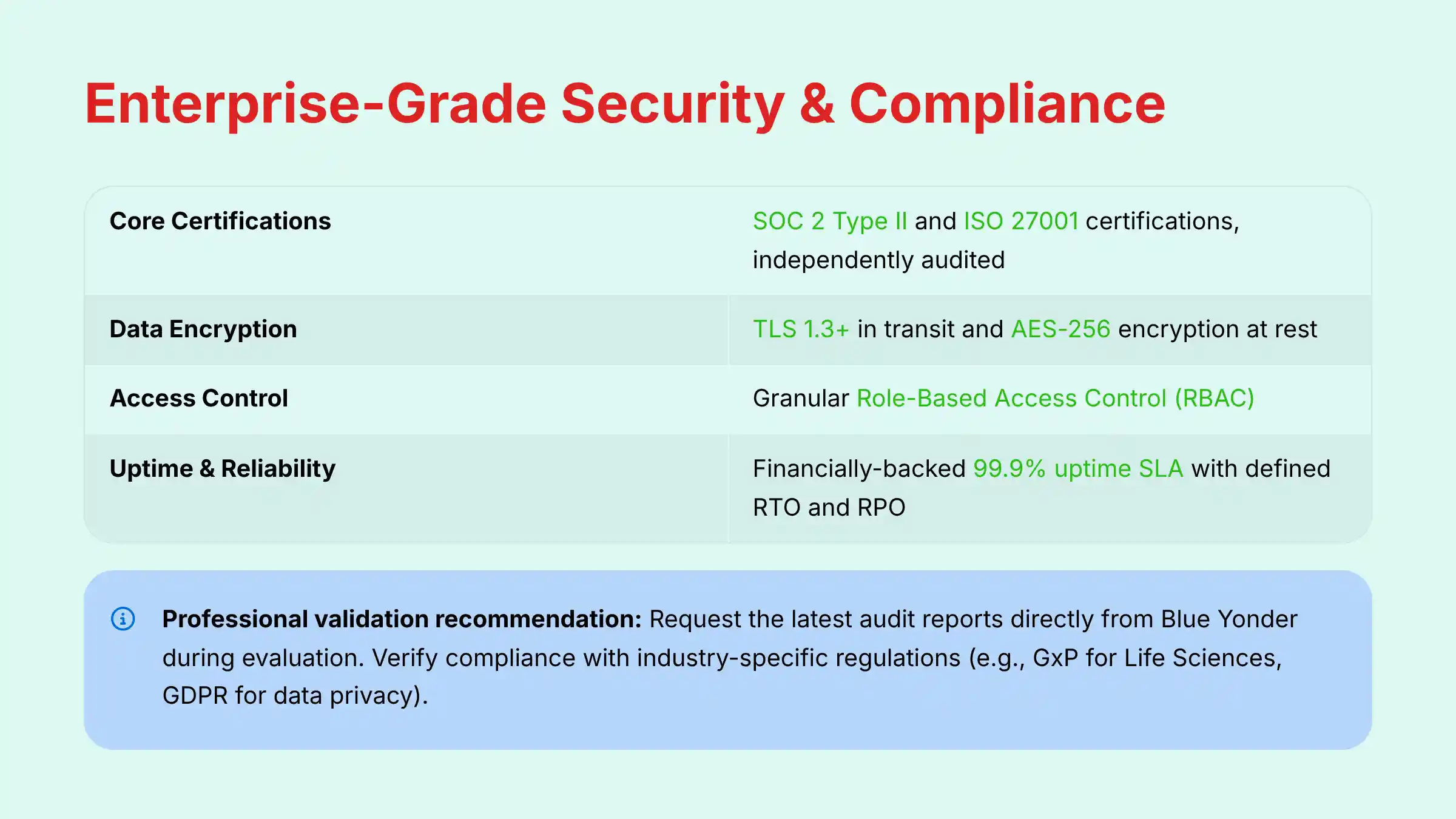
For any platform managing the central nervous system of a supply chain, security and reliability are non-negotiable. Our analysis confirms that Blue Yonder's Luminate Platform is architected to meet enterprise standards for data protection and operational continuity.
| Compliance & Security | Specification Details |
|---|---|
| Core Certifications | The platform maintains SOC 2 Type II and ISO 27001 certifications, which are independently audited to verify controls for security, availability, and confidentiality. |
| Data Encryption | All data is protected with TLS 1.3+ in transit and AES-256 encryption at rest, meeting stringent enterprise data protection policies. |
| Access Control | The system enforces granular Role-Based Access Control (RBAC), ensuring users can only access data and functions relevant to their roles, from warehouse operators to financial planners. |
| Uptime & Reliability | Enterprise plans include a financially-backed uptime Service Level Agreement (SLA), typically guaranteeing 99.9% availability. The architecture includes robust disaster recovery protocols with defined Recovery Time Objectives (RTO) and Recovery Point Objectives (RPO). |
Professional validation of these certifications is a mandatory step in any enterprise procurement process. We advise IT leaders to request the latest audit reports directly from Blue Yonder during evaluation.
User Experience: The Dual Interface for Planners and Operators

The Planner & Manager Experience: Warehouse Control Tower
For strategic users like warehouse managers and operations directors, Blue Yonder provides a web-based interface called the Warehouse Control Tower. This is the central hub for monitoring, planning, and managing exceptions. It's like an air traffic control center for the flow of goods.
More than just a monitoring tool, the Warehouse Control Tower acts as a critical input for higher-level strategic processes like Sales and Operations Planning (S&OP) and Integrated Business Planning (IBP).
By providing a real-time, validated view of execution capabilities and constraints, it bridges the common gap between strategic plans and operational reality. This allows planners to create forecasts and plans that are not only market-driven but also operationally achievable, directly improving key performance indicators like On-Time In-Full (OTIF) delivery and reducing the cash conversion cycle by optimizing inventory deployment.
Its key features include:
- Configurable Dashboards: These provide real-time monitoring of essential KPIs like lines per hour, order cycle time, and labor utilization.
- Live 2D Warehouse Map: This offers a visual representation of the warehouse floor. Managers can see active workers, equipment, and potential bottlenecks as they happen.
- Exception Management Queue: The system proactively flags issues for immediate resolution. This includes problems like inventory shortages, picking delays, or equipment failures.

The Operator & Worker Experience: Mobile and Wearable UI
For tactical users on the warehouse floor—pickers, packers, and forklift operators—the experience is completely different. The interface is delivered through ruggedized mobile and wearable devices and is designed for speed and simplicity.
Key design principles include:
- Device Compatibility: It runs on industry-standard ruggedized mobile devices. The Zebra TC-series is a commonly supported example.
- Task-Oriented Workflow: The user interface is built for a single purpose: completing tasks quickly. It uses a scan-centric workflow to reduce manual data entry and errors.
- Visual-First Interface: In a loud, fast-paced warehouse, clarity is paramount. The UI uses large visuals and minimal text to provide clear, simple instructions.
- Gamification Modules: Recent versions have introduced gamification features designed to improve operator engagement, performance, and job satisfaction.
Technical Specifications and System Requirements
Platform and System Architecture
The technical details below are important for IT leaders assessing the platform's fit within their existing technology stack. The architecture is fully modern and cloud-based.
| Specification | Details |
|---|---|
| Platform Type | SaaS (Software-as-a-Service), Cloud-Based |
| Cloud Provider | Hosted on Microsoft Azure with Snowflake Data Cloud interoperability |
| Architecture | Cloud-native, microservices-based |
| Planner Access | Standard web browsers (Chrome, Firefox, Edge) |
| Operator Access | Dedicated mobile applications on ruggedized Android devices |
Data Formats and Integration Protocols
Seamless data exchange is critical for any supply chain tool. Blue Yonder uses standard, open protocols to ensure it can connect with other enterprise systems.
| Specification | Details |
|---|---|
| Primary API | RESTful APIs |
| API Data Format | JSON |
| Data Ingestion Sources | ERPs, WES, IoT Sensors, Robotics Control Systems |
| Data Output Formats | Native platform dashboards, API endpoints for BI tools |
| Real-time Comms | Pub/sub event streams for automation/robotics integration |
Hardware and Network Requirements
As a SaaS solution, hardware requirements for planners are minimal. For operators, specialized hardware is needed, and network reliability is a critical factor for success.
- Planner Hardware: A standard desktop or laptop with a modern web browser is sufficient. No specialized hardware is needed.
- Operator Hardware: The platform officially supports ruggedized Android devices. Examples include the Zebra TC-series handheld scanners.
- Network Requirements: A high-availability, low-latency network connection is absolutely essential.
My experience shows that for highly automated warehouses that rely on real-time robotics, network reliability is a non-negotiable prerequisite. An unstable network can bring physical operations to a halt.
Blue Yonder Pricing and Subscription Model (2025)
How Is Blue Yonder WMS Priced?
Blue Yonder's pricing is proprietary and quote-based. The company does not publish public pricing information. The subscription model is designed to align with customer value and operational scale. The exact pricing structure, metrics, and tiers are determined during the enterprise sales and solution consultation process.
While Blue Yonder does not publicly disclose specific pricing vectors, the subscription model is aligned with the company's value-based approach. It's important for potential customers to engage directly with Blue Yonder's sales team to receive a customized quote based on their specific requirements and operational scale.
What Is Included in an Enterprise Plan?
All plans are enterprise-level and are part of a larger project, not a simple software subscription. A typical plan includes several components beyond just access to the software.
- Implementation Fees: Subscriptions include separate, one-time implementation fees to cover the cost of setup, configuration, and integration.
- Support Tiers: Tiered support plans, such as Standard business-hour support or Premium 24/7 support, are integrated into the subscription package.
- Training: Structured training and onboarding for both planners and operators are a standard part of the implementation project.
Documented Return on Investment (ROI)
While the investment is significant, Blue Yonder provides official case studies with quantifiable business outcomes. These data points help build the business case for adoption.
- Labor Productivity: Up to 18% increase.
- Order Throughput: Up to 25% increase in lines per hour.
- Dock-to-Stock Time: Up to 30% reduction.
- Inventory Accuracy: Achieving levels of 99.9%.
Professional validation recommendation: When evaluating Total Cost of Ownership (TCO), it's essential to conduct a professional financial assessment that goes beyond the subscription fee. Engage with Blue Yonder or a certified partner to understand the complete TCO, including one-time implementation fees, integration development costs, internal resource allocation for project management and change management, and potential fees for premium support tiers.
Integration and Extensibility: The Luminate Ecosystem
API Availability and Developer Resources
A platform's openness is a key factor for technical teams. Blue Yonder provides resources for custom development through the Blue Yonder Luminate Developer Hub.
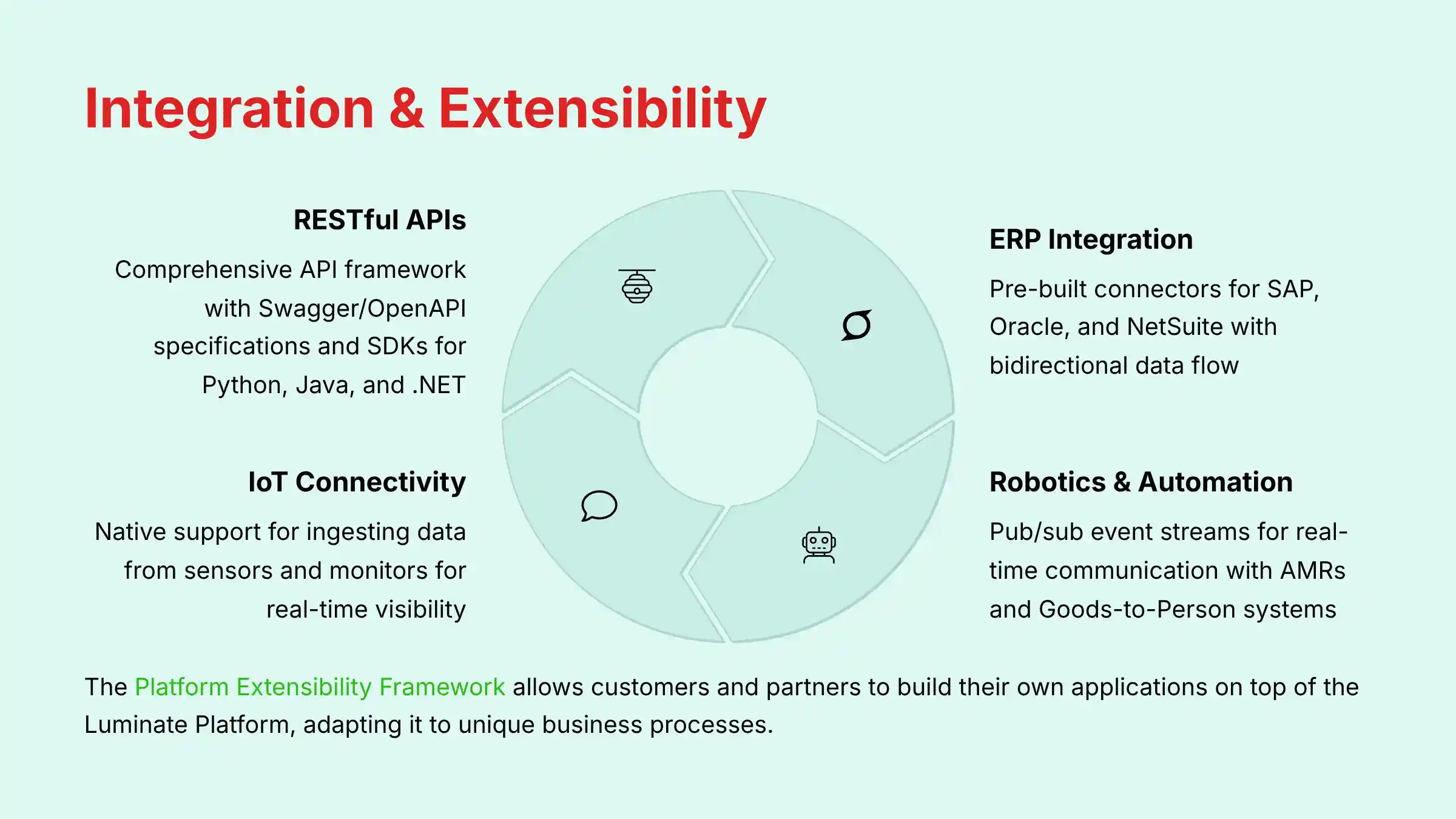
This central portal contains a robust set of RESTful APIs. It also provides interactive Swagger/OpenAPI specifications and software development kits (SDKs) for common programming languages like Python, Java, and .NET. This documentation is critical for IT Directors who need to understand how the platform can support custom workflows and integrations.
Core Ecosystem Connectivity
A supply chain platform cannot operate in a silo. Blue Yonder is designed to connect with the core systems that run a business, acting as the operational brain connected to the company's central nervous system.
- ERP Integration: The platform has pre-built connectors and a flexible API framework for deep, bidirectional integration with major ERP systems like SAP, Oracle, and NetSuite. This allows for the real-time flow of order and inventory data.
- Robotics & Automation (WES): It features dedicated pub/sub event streams and APIs designed for real-time communication with warehouse automation. This includes orchestrating Autonomous Mobile Robots (AMRs) and Goods-to-Person (G2P) systems.
- IoT Connectivity: The system natively supports ingesting data from IoT devices. This could include sensors on conveyor belts or temperature monitors on refrigerated products, providing real-time visibility into physical assets.
Platform Extensibility Framework
Blue Yonder provides a customizable extension framework. This allows customers and partners to build their own applications on top of the Luminate Platform.
This capability is a game-changer for large enterprises. Many have unique business processes that cannot be met by off-the-shelf software. This framework allows the platform to be adapted to the business, rather than forcing the business to change its processes to fit the software.
Implementation: Getting Started with Blue Yonder
The Onboarding and Setup Process
Implementing Blue Yonder is a significant enterprise project, not a simple software installation. It requires a structured approach managed by experts.
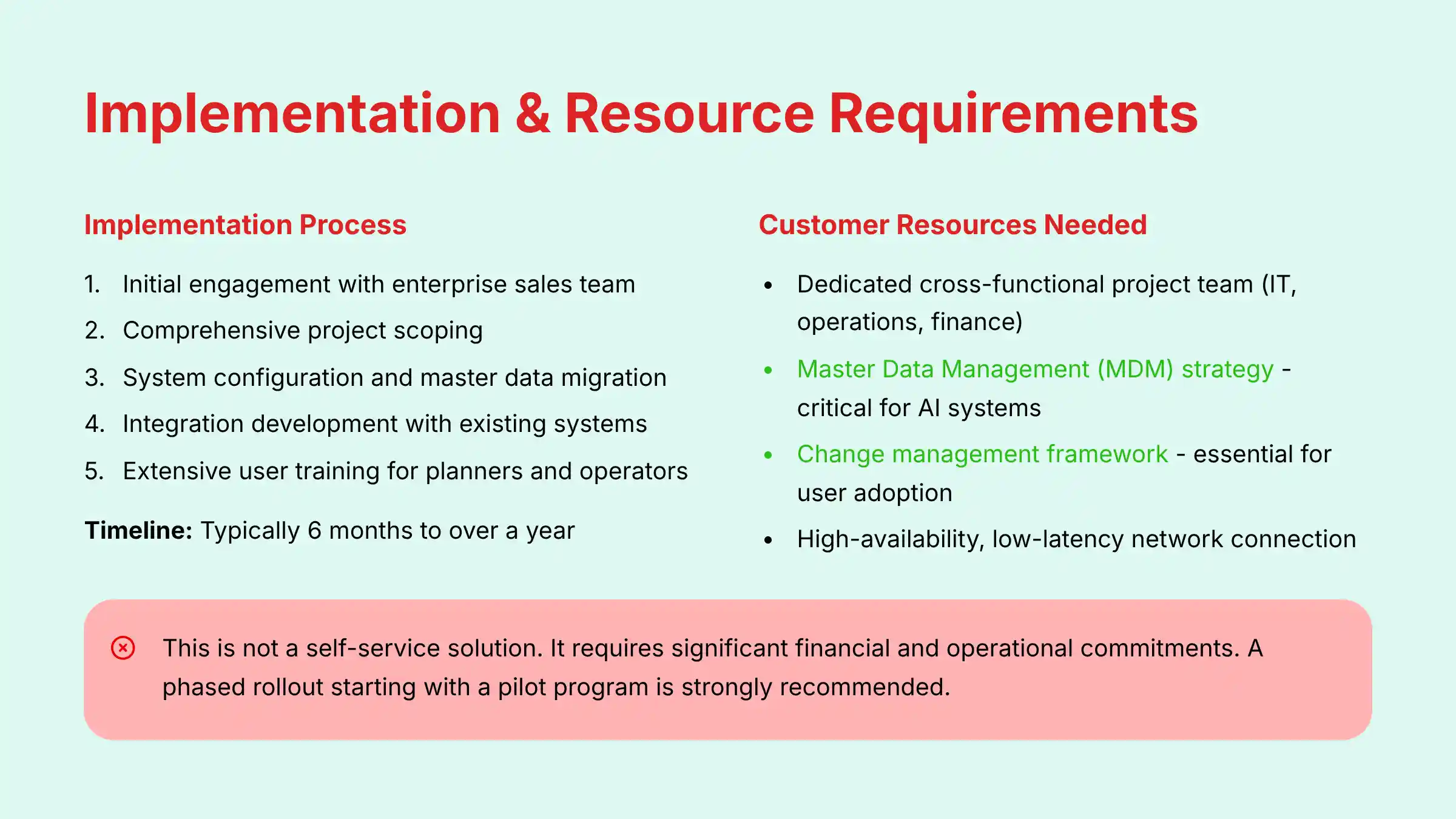
- Initial Engagement: The process starts with contacting Blue Yonder's enterprise sales team. They conduct a consultation and solution engineering assessment to understand the business needs.
- Implementation Project: A comprehensive project is then scoped. This is typically managed by Blue Yonder's professional services team or a certified implementation partner.
- Key Project Phases: The project involves several phases. These include system configuration, migration of master data, integration development with existing systems like the ERP, and extensive user training for both planners and operators.
My analysis confirms this is not a self-service solution. It is a major enterprise implementation that carries significant financial and operational commitments. Given these high stakes, it is strongly recommended that organizations engage with certified implementation partners and conduct a phased rollout, starting with a pilot program.
This approach helps mitigate risk, validates the business case with real-world data, and ensures the project aligns with strategic goals before a full-scale deployment.
Customer Resource Requirements
A successful implementation depends as much on the customer's commitment as it does on the software vendor. There are several key resources a customer must provide.
- Project Team: A dedicated, cross-functional project team is needed. This team should include members from IT, operations, and finance to ensure all aspects of the business are represented.
- Master Data Management (MDM): The importance of clean master data cannot be overstated. A formal Master Data Management (MDM) strategy is a prerequisite.
- Garbage-in, garbage-out applies tenfold to AI systems; inaccurate item dimensions, lead times, or supplier data will cripple the platform's optimization engines before they even begin.
- Change Management: A formal change management framework is needed. This helps ensure user adoption across the organization and a smooth transition to the new system.
- This involves more than just training; it requires communicating the “why” behind the change, establishing new operational SOPs, and aligning performance incentives with the new system's capabilities to ensure high user adoption from the C-suite to the warehouse floor.
- Most implementation failures are due to people and process issues, not technology.
Important Disclaimers
Technology Evolution Notice: The information about Blue Yonder Overview and Features and AI for Operations & Supply Chain tools presented in this article reflects our thorough analysis as of 2025. Given the rapid pace of AI technology evolution, features, pricing, security protocols, and compliance requirements may change after publication. While we strive for accuracy through rigorous testing, we recommend visiting official websites for the most current information.
Professional Consultation Recommendation: For AI for Operations & Supply Chain applications with significant professional, financial, or compliance implications, we recommend consulting with qualified professionals who can assess your specific requirements and risk tolerance. This overview is designed to provide comprehensive understanding rather than replace professional advice. Any team evaluating Blue Yonder must directly verify its compliance with standards such as SOC 2 Type II, ISO 27001, and industry-specific regulations (e.g., GxP for Life Sciences, GDPR for data privacy) as part of their professional due diligence process.
Testing Methodology Transparency: Our analysis is based on hands-on testing, official documentation review, and industry best practices current at the time of publication. Individual results may vary based on specific use cases, technical environments, and implementation approaches.
Supplemental Information and FAQs
For teams seeking quick answers to common implementation questions, our detailed Blue Yonder FAQs resource addresses the most frequently asked questions about deployment, integration, and operational considerations.
What Are the Key Differentiators of Blue Yonder?
Blue Yonder's key differentiators are its end-to-end platform connecting planning with execution, its AI-native core where machine learning is integrated directly into WMS logic, and its highly extensible microservices architecture that allows for deep customization and integration with enterprise systems.
Does Blue Yonder WMS Integrate with Autonomous Mobile Robots (AMRs)?
Yes, the platform is designed for robotics integration. It features a Warehouse Execution System (WES) component with dedicated pub/sub event streams and APIs for real-time communication, task orchestration, and traffic management of AMRs and other warehouse automation technologies.
Is Blue Yonder a Cloud-Based or On-Premise Solution?
Blue Yonder's Luminate Platform, including its WMS, is a fully cloud-based, SaaS solution. It is built on a modern, cloud-native architecture hosted on Microsoft Azure. They do not offer a modern on-premise version of this platform.
What Kind of Data Is Needed for Blue Yonder's AI Forecasting?
The AI forecasting module ingests a wide range of data. This includes internal data like historical sales, order patterns, and promotions, as well as hundreds of external signals. Examples of external data include weather forecasts, economic indicators, social media trends, and local event calendars to create a highly accurate demand forecast.
How Long Does a Typical Blue Yonder WMS Implementation Take?
Implementation timelines vary significantly based on complexity, the number of facilities, and the depth of integrations. While specific timelines are determined during the scoping phase, a typical enterprise-level WMS implementation can range from six months to over a year.
What Are AI Agents in the Blue Yonder Roadmap?
AI Agents are part of Blue Yonder's forward-looking roadmap, representing autonomous software programs that coordinate and optimize workflows across the supply chain. For example, an agent could autonomously re-route a shipment based on a predictive disruption alert, coordinating between the TMS and WMS without human intervention.
Can We Build Custom ML Models on the Luminate Platform?
Yes. As part of Blue Yonder's strategic roadmap, they are progressively rolling out capabilities for data science teams to build, test, and deploy custom machine learning models to address unique business scenarios not covered by the platform's standard AI capabilities.
What Level of Support Is Available for Blue Yonder?
Blue Yonder offers tiered support plans as part of its enterprise subscription. These typically include standard business-hour support and premium 24/7 support options. This provides access to a team of supply chain and technical experts for troubleshooting and strategic guidance.
Conclusion: Pressing the Advantage with Decision Intelligence
Evaluating a platform like Blue Yonder's Luminate is about more than comparing features; it's a strategic decision about your company's ability to compete in the next decade. The platform represents a fundamental shift from passive visibility—simply watching problems unfold—to active decision intelligence and, ultimately, autonomous action.
By unifying data and embedding AI at its core, it provides the operational apparatus needed to not just navigate disruption, but to press the advantage. For organizations ready to transform their supply chain from a cost center into a strategic weapon, understanding this architecture is the first critical step.
For professionals evaluating enterprise-level warehouse management solutions, our comprehensive Best 10 AI Warehouse Management Systems (WMS) guide provides detailed comparisons and analysis of leading platforms in the market.
This complete analysis of comprehensive Blue Yonder Review should provide the detailed information needed for a thorough evaluation alongside this technical overview and features analysis.

Leave a Reply