Is Blue Yonder the Right AI Supply Chain Solution for Your Business?
Take This 2-Minute Quiz to Find Out!
Key Takeaways
- AI-Powered Platform: Blue Yonder's Luminate™ Platform transforms traditional supply chains into intelligent, autonomous networks using AI and machine learning to predict and pivot in response to market changes.
- ERP Integration: Blue Yonder complements existing ERP systems as a specialized supply chain intelligence layer, rather than replacing them, with bidirectional data flow.
- JDA Evolution: Blue Yonder represents the strategic evolution of JDA Software, signaling an AI-first approach and cloud transformation since the February 2020 rebranding.
- ROI Impact: Companies typically achieve 15-30% inventory reduction, 10-25% warehouse productivity improvement, and 5-15% transportation cost savings with 12-24 month payback periods.
- Enterprise Security: Blue Yonder maintains SOC 2 Type II and ISO 27001 certifications with comprehensive cloud infrastructure security on Microsoft Azure platform.
Blue Yonder's comprehensive AI-powered supply chain management solutions address the critical challenges facing modern warehouse and inventory management professionals. As companies navigate increasingly complex global supply chains, the need for intelligent, autonomous systems becomes paramount.
What is Blue Yonder's Luminate Platform and how does it use AI?

Blue Yonder's Luminate™ Platform is an end-to-end supply chain management solution that leverages artificial intelligence (AI) and machine learning (ML) to help businesses predict and pivot in response to market changes. Unlike traditional systems that rely on historical data and static rules, Luminate creates a live, intelligent digital twin of your entire supply chain ecosystem.
The platform's AI capabilities are infused across all applications to transform reactive processes into proactive, autonomous operations:
- Predictive Demand Forecasting: Luminate ingests hundreds of internal and external data signals (weather patterns, social media trends, promotional activities, IoT sensor data) to generate forecasts that are significantly more accurate than traditional statistical methods. This helps warehouse managers anticipate inventory needs with greater precision.
- Autonomous Decision-Making: For routine decisions, such as replenishing inventory or optimizing a shipment route, the AI can execute the best course of action without human intervention. This frees up planners to focus on strategic exceptions and high-value activities instead of routine tasks.
- Prescriptive Recommendations: When disruptions occur, the platform doesn't just alert you to the problem; it runs multiple simulations to recommend the optimal solution, such as identifying an alternative supplier or rerouting a shipment to mitigate delays.
- Self-Learning Algorithms: The platform continuously improves its predictions by learning from outcomes, comparing forecasted versus actual results to refine its models automatically.
In warehouse and inventory management specifically, Blue Yonder's AI moves beyond simple reorder points. It analyzes demand signals, lead time variability, and potential disruptions to dynamically position inventory where it will be needed most, minimizing both stockouts and costly excess inventory situations.
This AI-driven approach transforms the supply chain from a cost center into a strategic, resilient asset that can adapt to changing market conditions in real-time. For professionals seeking to explore more about Blue Yonder Overview and Features, the platform offers comprehensive capabilities that go far beyond traditional supply chain tools.
Is Blue Yonder an ERP system?
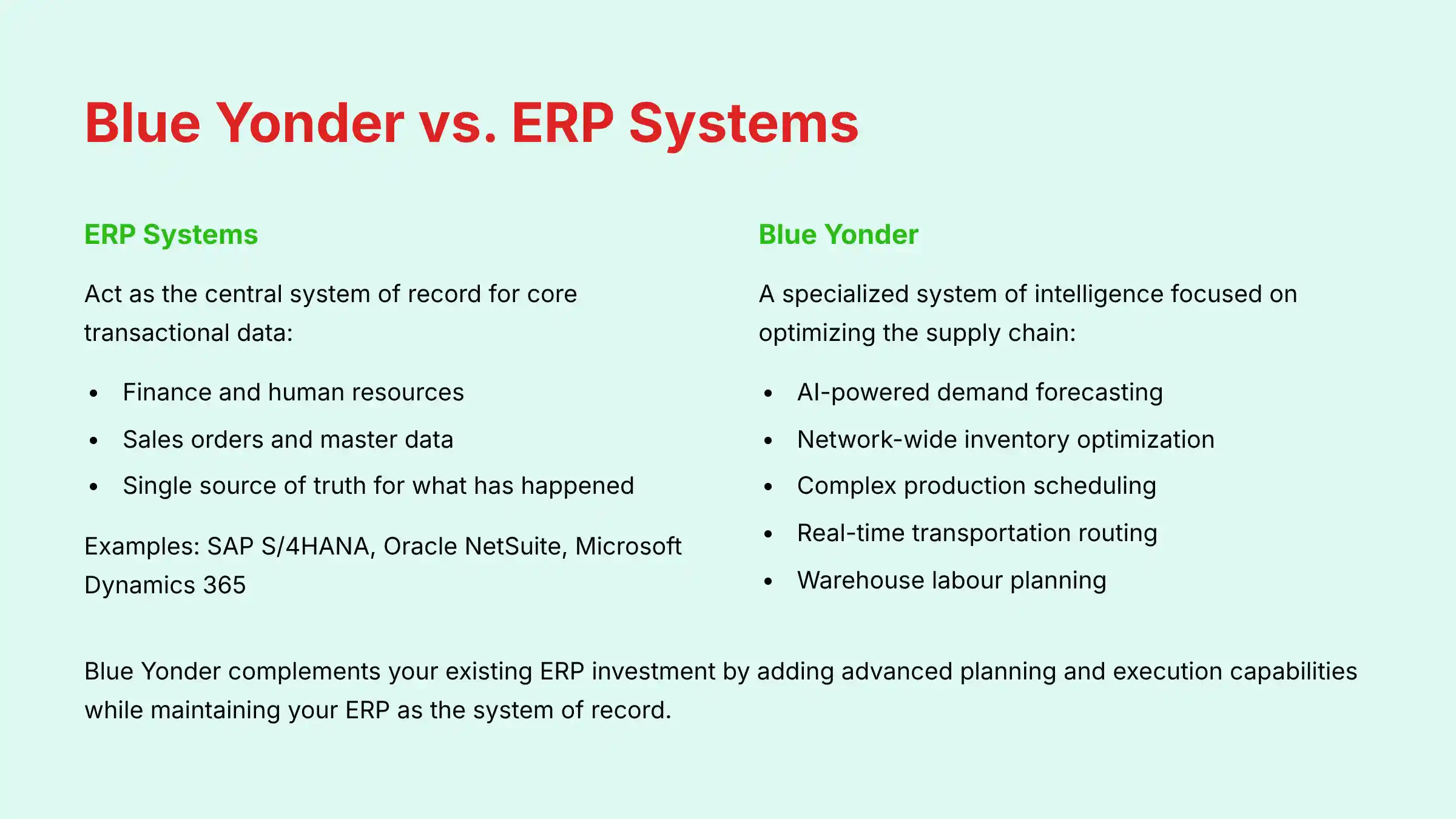
No, Blue Yonder is not an Enterprise Resource Planning (ERP) system. Instead, it is a specialized, best-of-breed supply chain planning and execution platform designed to work with and enhance a company's core ERP system rather than replace it.
An ERP system (like SAP S/4HANA, Oracle NetSuite, or Microsoft Dynamics 365) acts as the central system of record for a business's core transactional data—finance, human resources, sales orders, and master data. It serves as the single source of truth for what has happened across the business.
Blue Yonder, by contrast, is a system of intelligence and decision-making focused exclusively on optimizing the supply chain. It operates through a bidirectional data flow:
- Data Input: Blue Yonder pulls data from the ERP (such as sales orders and inventory records) and combines it with external data sources
- Processing: It applies advanced AI and ML algorithms to this data
- Data Output: After making decisions—for example, generating an optimized fulfillment plan—Blue Yonder then pushes the execution commands back to the ERP system
This specialized focus allows Blue Yonder to perform advanced supply chain functions that ERPs are typically not built for, such as:
- AI-powered demand forecasting with machine learning models
- Network-wide inventory optimization across multiple facilities
- Complex production scheduling with constraint-based planning
- Real-time transportation routing with dynamic optimization
- Warehouse labor planning and optimization
For warehouse and inventory management professionals, this means Blue Yonder complements your existing ERP investment by adding advanced planning and execution capabilities while maintaining your ERP as the system of record. The deep, bidirectional integration is critical because a powerful supply chain tool cannot operate in isolation; its intelligence is only valuable when seamlessly connected with the company's core transactional backbone.
What is the relationship between JDA and Blue Yonder?

Blue Yonder is the new name for the company formerly known as JDA Software. JDA Software, a long-established leader in supply chain and retail software, officially rebranded to Blue Yonder in February 2020.
This name change represented a significant strategic shift that emphasized the company's commitment to AI, machine learning, and cloud-based solutions. The rebranding followed JDA's 2018 acquisition of Blue Yonder GmbH, a German company specializing in AI and ML for retail and supply chain optimization founded by former CERN scientist Professor Michael Feindt.
The acquisition and subsequent rebranding signaled three important developments:
- AI-First Strategy: By adopting the Blue Yonder name, the company signaled that advanced AI/ML capabilities were no longer just a feature but the core of their entire platform, particularly the flagship Luminate™ Platform.
- Cloud Transformation: The rebranding coincided with Blue Yonder's accelerated shift toward cloud-native solutions, moving away from the on-premises legacy systems that JDA was historically known for.
- Industry Evolution: The name change reflected the company's evolution from traditional supply chain software to a provider of intelligent, autonomous supply chain solutions.
For warehouse and inventory management professionals using JDA's WMS or other supply chain solutions, this means you're now working with Blue Yonder products. The foundational systems you rely on have evolved to incorporate more advanced AI and predictive capabilities, particularly in areas like inventory optimization, labor management, and slotting.
The rebranding consolidated JDA's deep industry expertise and robust supply chain functionality with Blue Yonder's forward-looking vision of an AI-native technology company, positioning the unified organization as a leader in the digital transformation of supply chain management. Those interested in understanding competitive positioning can explore Blue Yonder Top Alternatives and Competitors to see how the company stacks up in today's market.
How does Blue Yonder's AI forecasting compare to competitors like SAP IBP, o9, and Kinaxis?

Blue Yonder differentiates itself from competitors like SAP IBP, o9 Solutions, and Kinaxis primarily through its deep industry-specific expertise, particularly in retail and manufacturing, and its end-to-end platform scope that spans from planning to warehouse and transport execution.
When evaluating AI forecasting solutions for warehouse and inventory management, here's how the platforms compare:
Blue Yonder:
- Key Strength: Comprehensive, integrated suite covering the full supply chain lifecycle
- AI Advantage: The Luminate Platform's AI models are fed by a vast data ecosystem, including execution-level data from its own WMS and TMS solutions, creating a rich feedback loop for forecast improvement
- Best Fit: Complex, high-volume environments like omnichannel retail and manufacturing, where optimizing order fulfillment and inventory placement across multiple channels is critical
- Warehouse Integration: Native integration with Blue Yonder WMS provides seamless execution of forecasting plans
SAP IBP (Integrated Business Planning):
- Key Strength: Native integration with the SAP S/4HANA ERP ecosystem
- AI Advantage: While improving rapidly, its AI capabilities have historically been seen as less mature than specialized competitors
- Best Fit: Companies heavily invested in SAP who prioritize seamless data flow and a unified user experience
- Warehouse Integration: Requires additional integration work with SAP EWM or third-party WMS systems
o9 Solutions:
- Key Strength: “Digital Brain” platform with powerful knowledge graph technology creates a dynamic digital twin of the entire enterprise
- AI Advantage: Extremely flexible and rapid scenario planning capabilities
- Best Fit: Organizations seeking to connect planning across supply chain, commercial, and financial departments
- Warehouse Integration: Requires integration with third-party WMS solutions
Kinaxis:
- Key Strength: Pioneered “concurrent planning,” allowing planners to see the end-to-end impact of any change across the network in near real-time
- AI Advantage: In-memory computing engine enables rapid simulations and what-if analysis
- Best Fit: Companies with complex, global supply networks requiring rapid response to disruptions
- Warehouse Integration: Focuses primarily on planning; requires integration with execution systems
For warehouse and inventory management professionals, Blue Yonder offers the advantage of tighter integration between forecasting and execution, potentially reducing the friction between what is planned and what is actually implemented on the warehouse floor. This creates a more seamless flow from prediction to action, particularly important in high-velocity inventory environments.
A comprehensive Blue Yonder Review can provide deeper insights into how these competitive advantages translate into real-world warehouse operations and performance improvements.
How does the Luminate Control Tower provide supply chain visibility?

Blue Yonder's Luminate Control Tower acts as a central, real-time “nerve center” for a company's entire supply chain, providing the end-to-end visibility needed to manage disruptions proactively. It transforms how warehouse and inventory professionals monitor and respond to supply chain events by eliminating siloed data and fragmented operational views.
The Control Tower achieves comprehensive visibility through a four-step process:
- Unified Data Aggregation:
- Ingests and harmonizes data from internal systems (ERP, WMS, TMS) and external sources (suppliers, 3PLs, IoT sensors, weather feeds, news alerts)
- Creates a single, consolidated view of all inventory, orders, and shipments, whether they're in a warehouse, in production, or in transit
- Eliminates the traditional data silos that prevent true end-to-end visibility
- Dynamic Digital Twin Creation:
- Constructs a live digital representation of the entire supply chain network
- Maps all nodes, connections, and dependencies in your supply chain
- Enables managers to visualize the current state of every warehouse, distribution center, and in-transit inventory position
- AI-Powered Exception Management:
- Continuously monitors data streams for anomalies and potential disruptions
- Uses machine learning to identify which events are truly critical versus normal variability
- Prioritizes exceptions based on business impact rather than just technical thresholds
- For example, correlates a weather event with shipment routes to automatically flag orders at risk of delay
- Collaborative Resolution Workflow:
- Brings relevant stakeholders together in a virtual “war room” when critical exceptions are identified
- Provides shared visibility to ensure everyone sees the same data
- Enables simulation capabilities to model different resolution scenarios (e.g., “What if we expedite this shipment?” vs. “What if we source from another location?”)
- Tracks the execution of the chosen resolution and captures learnings for future events
For warehouse and inventory managers, this means you gain unprecedented visibility not just within your facility, but across the entire network. You can see incoming shipments before they arrive, anticipate potential disruptions, and collaborate with suppliers and transportation partners to develop mitigation strategies. This transforms visibility from a passive reporting function into an active, intelligent, and collaborative decision-making capability that directly impacts inventory accuracy and warehouse efficiency.
What are Blue Yonder's capabilities for Warehouse (WMS) and Transportation (TMS) Management?

Blue Yonder offers robust, AI-infused Warehouse Management Systems (WMS) and Transportation Management Systems (TMS) that are recognized as industry-leading solutions for optimizing logistics execution. These systems transform traditional warehouse and transportation operations into intelligent, adaptive networks.
Warehouse Management System (WMS):
Blue Yonder's WMS goes beyond basic inventory tracking to orchestrate the flow of goods and labor intelligently. Key capabilities include:
- Intelligent Slotting: The system analyzes demand patterns, item dimensions, and picking velocity to recommend the optimal physical location for each product in the warehouse. This minimizes travel time for workers and optimizes warehouse space utilization, potentially reducing picking travel distance by 15-30%.
- AI-Powered Labor Management: The WMS forecasts labor needs based on inbound and outbound order volumes and creates optimized task assignments. It uses machine learning to continuously improve labor standards and can adjust staffing levels based on predicted workload fluctuations.
- Robotics Hub: Blue Yonder provides a seamless integration layer to orchestrate diverse fleets of warehouse robots (AMRs and AGVs) from different vendors. This vendor-agnostic approach ensures humans and machines work together efficiently without being locked into a single robotics provider.
- Waveless Fulfillment: The system enables continuous, dynamic order fulfillment rather than traditional batch processing, allowing warehouses to adapt to real-time demand signals and prioritize orders based on delivery promises and resource availability.
- Yard Management: Integrated yard capabilities provide visibility and control over trailers and dock scheduling, reducing detention charges and optimizing dock utilization.
Transportation Management System (TMS):
Blue Yonder's TMS focuses on reducing freight spend while improving delivery performance. Key capabilities include:
- Dynamic Route Optimization: The AI continuously analyzes factors like traffic, weather, and new delivery orders to adjust routes in real-time, potentially reducing fuel costs by 5-15% and avoiding delays.
- Automated Load Building & Carrier Selection: The system intelligently consolidates orders into optimal shipments and automatically tenders them to the best carrier based on cost, performance, and capacity constraints, improving trailer utilization by 10-20%.
- Real-Time Visibility & ETA Prediction: By integrating with carrier telematics and IoT data, the TMS provides accurate, real-time tracking of shipments and uses machine learning to predict precise arrival times, enabling proactive notification of delays.
- Freight Audit & Payment: The system automates the validation of carrier invoices against contracted rates and actual services performed, potentially recovering 2-5% in freight spend through error identification.
- Network Optimization: Advanced modeling capabilities help identify optimal transportation network design, including carrier mix, mode selection, and consolidation opportunities.
What sets Blue Yonder apart is how these execution-level systems create a powerful feedback loop with planning tools. Real execution data continuously improves forecast accuracy and planning decisions, creating a virtuous cycle of optimization across the entire supply chain.
For practical implementation guidance, professionals can explore Blue Yonder Tutorials and Usecase to understand how these capabilities translate into real-world warehouse and transportation scenarios.
How does Blue Yonder integrate with a core ERP like SAP or Oracle?
Blue Yonder is designed for deep, bidirectional integration with core ERP systems like SAP S/4HANA and Oracle, as this connectivity is essential for its function as a supply chain intelligence layer. For warehouse and inventory management professionals, this integration is critical to ensure consistent data flow between planning and execution systems.
The integration architecture follows a continuous, two-way loop:
- ERP to Blue Yonder (Data Input):
- Master Data: The ERP provides foundational information including item attributes, customer and vendor details, facility locations, and product hierarchies
- Transactional Data: Current inventory levels, sales orders, purchase orders, production orders, and goods movements
- Financial Data: Cost information, pricing, and GL account structures for accurate valuation and reporting
- Blue Yonder Processing:
- Blue Yonder's AI and optimization engines process this ERP data alongside external signals
- The platform enriches the raw ERP data with additional intelligence and context
- Machine learning models generate forecasts, optimized plans, and execution recommendations
- Blue Yonder to ERP (Data Output):
- Planned Orders: Optimized purchase requisitions or manufacturing orders are sent back to the ERP
- Inventory Adjustments: Warehouse movements update ERP inventory levels
- Shipment Confirmations: Transportation events close out orders in the ERP
- Execution Instructions: Work orders and tasks flow to the execution systems
This integration is typically achieved through:
- Pre-built Connectors: Blue Yonder offers standardized integration adapters for major ERP systems that handle common data mapping scenarios
- RESTful APIs: Modern, well-documented APIs enable custom integration points and real-time data exchange
- Integration Platform as a Service (iPaaS): Many implementations leverage middleware solutions like MuleSoft or Dell Boomi to orchestrate complex data flows
For warehouse managers, this integration ensures that inventory transactions in the Blue Yonder WMS are immediately reflected in the ERP's financial and planning modules. When a pallet is received, picked, or shipped, the information flows automatically to update the system of record, maintaining data consistency across the enterprise.
To ensure integration success, it's critical to conduct a thorough data mapping exercise before implementation. Identify every required data point in Blue Yonder and trace it back to its source in your ERP. This exercise often reveals data quality issues or gaps that must be addressed for the integration to function properly. Working with an implementation partner experienced in both Blue Yonder and your specific ERP can significantly reduce integration risks.
What are the biggest challenges or risks when migrating to the Blue Yonder platform?

Migrating to the Blue Yonder platform represents a significant business transformation that extends far beyond software installation. For warehouse and inventory management professionals, understanding and preparing for these challenges is essential for a successful implementation.
The three most significant challenges are:
- Data Quality and Governance Issues:
- The Challenge: Blue Yonder's AI algorithms require clean, consistent data to function effectively. Many organizations discover their existing data is fragmented across legacy systems, spreadsheets, and tribal knowledge.
- The Impact: Poor data quality leads to inaccurate forecasts, suboptimal inventory recommendations, and ultimately undermines trust in the system.
- Mitigation Strategy: Begin with a comprehensive data audit. Identify master data inconsistencies (e.g., duplicate SKUs, inconsistent units of measure, missing attributes) and establish data cleansing procedures. Implement formal data governance with clear ownership responsibilities for ongoing data maintenance.
- Warehouse-Specific Concern: Accurate physical inventory data, location mapping, and labor standards are particularly critical for WMS implementations.
- Change Management and User Adoption Challenges:
- The Challenge: Warehouse managers and planners accustomed to legacy systems or spreadsheets often resist new workflows, particularly those driven by AI algorithms they may not fully understand or trust.
- The Impact: Without proper adoption, even the most advanced system becomes “shelfware” as users revert to manual workarounds and shadow processes.
- Mitigation Strategy: Invest in comprehensive training programs tailored to different user roles. Identify and empower internal champions who can demonstrate success and build credibility. Create transparent documentation explaining how the AI makes recommendations.
- Warehouse-Specific Concern: Floor workers need simplified mobile interfaces and clear instructions on new processes, while supervisors need visibility into KPIs and exception handling.
- Process Re-engineering Requirements:
- The Challenge: Simply digitizing existing processes limits the value of Blue Yonder. Organizations must be willing to fundamentally rethink their planning, inventory, and fulfillment processes.
- The Impact: Failing to redesign processes results in a sophisticated system being used for basic functions, delivering minimal ROI.
- Mitigation Strategy: Before implementation, map current processes and identify pain points. Use Blue Yonder's capabilities as an opportunity to redesign these processes. Establish clear governance for process changes and ensure executive sponsorship.
- Warehouse-Specific Concern: Warehouse layouts, picking strategies, and labor assignments may need significant redesign to leverage Blue Yonder's optimization capabilities.
The most effective approach to mitigate these risks is to start with a focused pilot program. Select a specific business unit or product category with high potential impact but manageable scope. Use this pilot to prove the value of the platform, refine your approach to the challenges above, and build internal expertise before expanding to full-scale deployment.
For warehouse managers specifically, consider piloting a discrete function like inbound receiving or a specific picking zone before rolling out across the entire facility. This allows you to validate the system's performance in your unique environment and build credibility with the warehouse team.
What is the typical ROI that companies achieve after implementing Blue Yonder?

The Return on Investment (ROI) from implementing Blue Yonder varies by industry and implementation scope, but companies typically see measurable improvements across three key categories: cost reduction, capital efficiency, and revenue growth. For warehouse and inventory management specifically, these benefits can be substantial and relatively quick to realize.
Key ROI Metrics for Warehouse and Inventory Management:
- Inventory Optimization (Capital Efficiency)
- Typical Impact: 15-30% reduction in overall inventory levels
- Financial Benefit: Immediate working capital release and reduced carrying costs (storage, insurance, obsolescence)
- Mechanism: AI-powered forecasting improves accuracy by 20-40% over traditional methods, allowing for more precise inventory positioning and reduced safety stock requirements
- Example: A major retailer reduced inventory by $1.2B while maintaining 98% service levels by implementing Blue Yonder's forecasting and replenishment solutions
- Warehouse Labor Productivity (Cost Reduction)
- Typical Impact: 10-25% improvement in labor productivity
- Financial Benefit: Reduced labor costs or increased throughput without additional staffing
- Mechanism: Optimized task assignment, improved slotting, and more efficient picking paths reduce travel time and increase picks per hour
- Example: A distribution company increased warehouse throughput by 18% without adding staff by implementing Blue Yonder's WMS with intelligent labor management
- Transportation Spend Optimization (Cost Reduction)
- Typical Impact: 5-15% reduction in freight costs
- Financial Benefit: Direct reduction in one of the largest supply chain cost categories
- Mechanism: Load consolidation, route optimization, and carrier selection automation reduce empty miles and improve vehicle utilization
- Example: A consumer goods manufacturer saved $24M annually on transportation by implementing Blue Yonder's TMS
- Improved On-Time In-Full (OTIF) Delivery (Revenue Protection)
- Typical Impact: 2-10 percentage point improvement in OTIF performance
- Financial Benefit: Avoided penalties from retailers, improved customer satisfaction, and potential revenue growth
- Mechanism: Better planning, execution, and visibility reduce stockouts and shipping delays
- Example: A food manufacturer improved OTIF from 86% to 96%, avoiding $5M in retailer penalties and strengthening key customer relationships
When calculating ROI, it's important to look beyond direct cost savings to measure improvements in operational resilience and agility:
- Time-to-Recovery: How much faster can you detect and respond to disruptions?
- Cash Conversion Cycle: How has working capital efficiency improved due to inventory optimization?
- Planner Productivity: How much planner time has shifted from data manipulation to strategic decision-making?
For warehouse managers specifically, tracking metrics like perfect order rate, dock-to-stock time, and picking accuracy before and after implementation provides tangible evidence of improvement. Most companies achieve payback within 12-24 months, with some high-impact implementations breaking even in less than a year.
To build a realistic business case, start by benchmarking your current performance against industry standards, identify specific improvement targets, and work with Blue Yonder to model the expected benefits based on reference customers in your industry. For additional insights, exploring Best 10 AI Warehouse Management Systems (WMS) can provide context on ROI expectations across different AI-powered WMS solutions.
How does Blue Yonder handle data security and compliance?

Blue Yonder treats data security and compliance as a mission-critical priority, employing a comprehensive, multi-layered approach to protect sensitive supply chain information. For warehouse and inventory management professionals handling valuable inventory data and personally identifiable information (PII), understanding these security measures is essential.
The company's security architecture is built on several key pillars:
Cloud Infrastructure Security:
- Blue Yonder's platform is primarily hosted on Microsoft Azure, leveraging Azure's extensive physical and network security capabilities
- Benefits from Azure's $1B+ annual security investment, 3,500+ security experts, and continuous threat monitoring
- Utilizes Azure's geo-redundant data centers to ensure business continuity and disaster recovery capabilities
- Implements defense-in-depth security with multiple protective layers from the physical data center to the application level
Application Security Framework:
- Follows a secure software development lifecycle (SSDLC) with security reviews at each development phase
- Conducts regular penetration testing and vulnerability assessments by independent third parties
- Implements granular, role-based access control (RBAC) that restricts users to only the data necessary for their specific job functions
- Particularly important in warehouse environments where different roles (pickers, receivers, supervisors) require different access levels
Data Protection Measures:
- Encrypts all customer data both in transit (using TLS 1.2+) and at rest (using AES-256 encryption)
- Implements data loss prevention (DLP) controls to prevent unauthorized extraction of sensitive information
- Maintains logical separation between customers in multi-tenant environments
- Applies strict data retention and destruction policies aligned with industry regulations
Compliance Certifications:
- Maintains SOC 2 Type II certification, validating the effectiveness of controls related to security, availability, processing integrity, confidentiality, and privacy
- Holds ISO 27001 certification for its information security management system (ISMS)
- Complies with industry-specific regulations relevant to supply chain data
- Regularly updates compliance documentation to address evolving regulatory requirements
Regulatory Compliance Support:
- Designed to help customers meet obligations under major data privacy regulations:
- GDPR (General Data Protection Regulation) in Europe
- CCPA (California Consumer Privacy Act) in the US
- Industry-specific requirements like FDA CFR Part 11 for life sciences customers
- Provides data processing agreements (DPAs) that clearly define data handling responsibilities
For warehouse operations specifically, Blue Yonder's security features help protect sensitive information like inventory values, customer orders, and employee productivity data. The granular access controls ensure warehouse associates only see the information needed for their assigned tasks, while managers maintain broader visibility.
When evaluating Blue Yonder, request their latest security documentation, including SOC 2 reports and compliance certifications. Have your internal security and compliance teams review these documents to ensure alignment with your organization's specific requirements. Additionally, consider how Blue Yonder's security controls integrate with your existing warehouse security procedures, particularly for operations using RF scanners, mobile devices, and IoT sensors.
What modules does Blue Yonder offer for warehouse and inventory optimization?
Blue Yonder offers a comprehensive suite of modules specifically designed for warehouse and inventory optimization. These solutions can be implemented individually to address specific challenges or as an integrated platform for end-to-end optimization.
Core Warehouse Management Modules:
- Warehouse Management System (WMS): The foundation of Blue Yonder's warehouse offering, providing comprehensive inventory control, work order management, and operational visibility. The system orchestrates all warehouse activities from receiving to shipping with advanced capabilities for:
- Wave and waveless order fulfillment strategies
- Cross-docking and flow-through processing
- Serial number and lot tracking for regulated industries
- Multiple picking methodologies (zone, batch, cluster)
- Integrated cycle counting and inventory adjustments
- Warehouse Labor Management (WLM): Advanced labor planning and performance management capabilities that:
- Establish engineered labor standards for warehouse tasks
- Track individual and team performance against standards
- Forecast labor requirements based on expected workload
- Optimize task assignment to balance workload and minimize travel
- Provide coaching opportunities through performance analytics
- Warehouse Slotting Optimization: Intelligent placement of inventory within the warehouse:
- Analyzes product characteristics, demand patterns, and picking velocity
- Recommends optimal storage locations to minimize travel distance
- Balances workload across warehouse zones
- Adapts slotting recommendations for seasonal demand shifts
- Considers product affinities for complementary item placement
- Yard Management System (YMS): Extends warehouse control to the yard:
- Manages trailer movements and yard locations
- Optimizes dock scheduling and dock door assignments
- Provides visibility into trailer contents and status
- Reduces detention fees through improved trailer turnaround
Inventory Optimization Modules:
- Demand Planning & Forecasting: AI-powered forecasting that:
- Incorporates hundreds of demand signals beyond historical sales
- Automatically selects the best forecasting algorithm for each item
- Recognizes and adjusts for seasonal patterns and special events
- Provides forecast accuracy metrics and exception management
- Inventory Optimization: Advanced inventory policy setting:
- Determines optimal safety stock levels by item/location
- Balances service level targets against inventory costs
- Adapts inventory policies to demand volatility and lead time variability
- Optimizes replenishment parameters (reorder points, order quantities)
- Replenishment: Automated inventory replenishment that:
- Generates optimized purchase orders and transfer orders
- Considers capacity constraints and economic order quantities
- Supports various replenishment methods (time-based, min/max, forecast-based)
- Prioritizes critical replenishments based on risk of stockout
- Robotics Hub: Orchestration layer for warehouse automation:
- Integrates with various robotic vendors (AMRs, AGVs, AS/RS)
- Optimizes robot task assignment and routing
- Provides unified management of human and robotic resources
- Ensures smooth handoffs between automated and manual processes
These modules can be deployed on-premises or in the cloud, with most new implementations leveraging Blue Yonder's cloud-native Luminate Platform for improved scalability and faster access to new features. The modular approach allows organizations to start with their most pressing needs and expand over time, creating a roadmap for progressive warehouse and inventory optimization.
For maximum value, these warehouse-specific modules typically integrate with Blue Yonder's broader supply chain planning and execution suite, creating a closed-loop system where execution data continuously improves planning accuracy. For common questions and detailed answers about implementation, professionals can reference comprehensive Blue Yonder FAQs to understand module-specific capabilities and deployment considerations.
How does Blue Yonder's WMS compare to other top warehouse management systems?

Blue Yonder's Warehouse Management System (WMS) distinguishes itself from other leading solutions through its AI capabilities, extensive configurability, and seamless integration with broader supply chain planning. When comparing to other top WMS providers like Manhattan Associates, Körber (formerly HighJump), Oracle WMS Cloud, and SAP EWM, several key differentiators emerge.
Core Strengths of Blue Yonder WMS:
- AI-Powered Optimization: While most WMS solutions offer rules-based decision making, Blue Yonder applies machine learning to continuously improve warehouse operations:
- Adaptive task optimization that learns from actual execution patterns
- Dynamic labor standards that adjust based on performance history
- Predictive analytics for workload forecasting and resource planning
- Self-tuning slotting that evolves with changing demand patterns
- Unmatched Configurability: Blue Yonder offers exceptional flexibility without custom code:
- Extensive business rule configuration through visual interfaces
- User-definable workflows that adapt to unique warehouse processes
- Configurable mobile interfaces for different worker roles and devices
- Ability to support multiple operating models within a single instance
- Supply Chain Integration: Unlike point solutions, Blue Yonder WMS seamlessly connects with broader supply chain processes:
- Native integration with Blue Yonder's planning, forecasting, and TMS solutions
- Closed-loop optimization between planning and execution
- End-to-end visibility from the warehouse to the extended supply chain
- Consistent data model across planning and execution systems
Comparative Analysis with Key Competitors:
- vs. Manhattan Associates:
- Both offer tier-1 enterprise capabilities and extensive configurability
- Manhattan has strong embedded labor management, but Blue Yonder excels in AI-driven optimization
- Blue Yonder offers tighter integration with supply chain planning
- Manhattan has a slight edge in parcel management for high-volume shipping
- vs. Körber Supply Chain:
- Körber offers a more modular approach with specialized solutions
- Blue Yonder provides more robust native optimization capabilities
- Körber may be more cost-effective for mid-sized operations
- Blue Yonder has stronger AI capabilities and predictive analytics
- vs. Oracle WMS Cloud:
- Oracle provides strong native integration with Oracle ERP systems
- Blue Yonder offers more sophisticated labor management and optimization
- Oracle may be more attractive for Oracle ERP users seeking unified platforms
- Blue Yonder has more extensive experience in complex warehouse environments
- vs. SAP Extended Warehouse Management (EWM):
- SAP EWM provides seamless integration with SAP S/4HANA
- Blue Yonder offers more advanced labor management and optimization
- SAP might be preferred by organizations standardized on SAP
- Blue Yonder provides superior slotting optimization and workload planning
Implementation Considerations:
Blue Yonder WMS implementations typically require more specialized expertise compared to simpler systems, but this complexity enables the solution to handle highly sophisticated warehouse operations. The system is well-suited for organizations with:
- High-volume distribution centers (processing 10,000+ lines per day)
- Complex fulfillment requirements (e-commerce, wholesale, omnichannel)
- Advanced automation and robotics
- Stringent regulatory requirements (pharmaceuticals, food, aerospace)
For maximum ROI, organizations should consider Blue Yonder's WMS not as a standalone system but as part of an integrated approach to warehouse and inventory optimization, potentially implementing it alongside Blue Yonder's planning and transportation management solutions.
What are Blue Yonder's AI capabilities for inventory optimization?
Blue Yonder leverages advanced AI and machine learning to transform traditional inventory management into a dynamic, predictive discipline. These capabilities help organizations simultaneously reduce inventory costs while improving service levels and resilience.
Core AI-Powered Inventory Optimization Capabilities:
- Multi-Echelon Inventory Optimization (MEIO):
- Analyzes the entire network simultaneously rather than optimizing each node in isolation
- Considers interdependencies between distribution centers, hubs, and stores
- Recommends the optimal inventory placement across all network tiers
- Reduces overall inventory by 15-30% while maintaining or improving service levels
- Uses probabilistic modeling to account for demand and supply uncertainty
- Demand Sensing & Short-Term Forecasting:
- Detects demand patterns in near real-time (daily or hourly)
- Incorporates POS data, online shopping patterns, and market signals
- Automatically adjusts forecasts based on early sales indicators
- Reduces forecast error by 20-40% for short-term horizons
- Enables more responsive inventory positioning for fast-moving items
- Adaptive Safety Stock Calculation:
- Dynamically adjusts safety stock levels based on changing conditions
- Considers demand volatility, lead time variability, and service level targets
- Applies different inventory strategies for different product segments
- Reduces safety stock requirements without increasing stockout risk
- Automatically identifies opportunities to consolidate safety stock at higher network tiers
- Intelligent Exception Management:
- Prioritizes inventory exceptions based on business impact
- Distinguishes between normal variability and significant deviations
- Focuses planner attention on the most critical inventory issues
- Recommends specific actions to resolve exceptions
- Learns from resolution patterns to improve future recommendations
- Supply Chain Risk Sensing:
- Monitors for potential disruptions that could impact inventory
- Correlates external events with specific inventory positions
- Recommends preemptive inventory adjustments to mitigate risks
- Simulates the impact of potential disruptions on service levels
- Suggests alternative sourcing or expediting strategies when risks materialize
Practical Applications for Warehouse Managers:
For warehouse and inventory management professionals, these AI capabilities translate into tangible operational improvements:
- Dynamic Slotting: AI continuously analyzes picking patterns and recommends inventory repositioning to minimize travel time and maximize picking efficiency.
- Replenishment Timing: The system calculates optimal timing for internal replenishment (from reserve to forward pick locations) based on labor availability and upcoming order waves.
- Cross-Dock Identification: AI identifies inbound shipments that should bypass storage and go directly to outbound staging, reducing handling costs and accelerating throughput.
- Inventory Balancing: The system recommends inventory transfers between locations to resolve imbalances, preventing simultaneous overstock and stockout situations across the network.
- Seasonal Preparation: AI forecasts space requirements for seasonal inventory buildups and recommends optimal timing for pre-season receiving.
Blue Yonder's inventory optimization AI leverages a machine learning feedback loop that continuously improves over time. The system compares predicted outcomes against actual results, identifies patterns in the variances, and refines its models accordingly. This creates a self-improving system that becomes increasingly accurate and valuable with continued use.
What distinguishes Blue Yonder from basic inventory management tools is this ability to move beyond rules-based optimization to true predictive and prescriptive capabilities that can identify opportunities and risks before they become apparent to human planners.

Leave a Reply