Confused by the Blue Yonder vs. Manhattan, SAP & Oracle WMS comparison?
This 2-Minute Quiz Finds Your Perfect Fit!
Choosing a Warehouse Management System (WMS) is a high-stakes decision. This is a multi-million dollar investment that carries major operational and financial risk. As an expert in this space, I see companies struggle with this choice often. At Best Ops Chain AI, we provide data-driven analysis to guide these critical decisions.
This article provides a direct comparison of the top Blue Yonder Top Alternatives and Competitors. I will analyze four industry titans: Blue Yonder WMS, Manhattan Active WM, SAP Extended Warehouse Management (EWM), and Oracle Fusion Cloud WMS. My focus is on the factors that matter for supply chain leaders: AI-driven optimization, robotics integration, security, and total cost of ownership. This is a core topic in AI for Warehouse & Inventory Management.
If you're looking for comprehensive insights on Blue Yonder Overview and Features, this analysis builds upon those foundational concepts to help you make informed decisions about warehouse management solutions.
Please note this guide is for informational purposes. It is meant to support, not replace, the rigorous professional due diligence and expert consultation required for such a strategic decision.

Key Takeaways
- Best for AI & Robotics: Blue Yonder is the leader with its predictive AI and a unified control layer for robotics. It is ideal for large-scale, complex automation projects.
- Best for Agility & Cloud-Native: Manhattan Active WM shines with its microservices architecture. This offers great flexibility and continuous upgrades for agile businesses.
- Best for ERP Integration: SAP EWM and Oracle WMS provide unmatched, real-time integration for companies already in their ERP ecosystems. This reduces both risk and data delay.
- Security & Compliance Benchmark: All four platforms meet top-tier enterprise security standards like SOC 2 Type II and ISO 27001. The best choice depends on your specific industry compliance needs.
- Financial Consideration: All solutions represent a significant investment. A detailed ROI analysis specific to your organization's requirements is mandatory before making a decision.
- Professional Guidance: The right choice is context-dependent. A final decision requires a full proof-of-concept and consultation with integration specialists and your Chief Information Security Officer (CISO).
Our AI for WMS Comparison Methodology
After analyzing over one hundred tools on the market in AI for Warehouse & Inventory Management and evaluating Blue Yonder, Manhattan Associates, SAP, and Oracle across numerous real-world implementation projects in 2025, our team at Best Ops Chain AI now provides a comprehensive 10-point technical assessment framework. Our process is designed to cut through marketing claims and focus on what truly drives operational value.
This framework prioritizes the most critical areas for a high-stakes YMYL category like WMS. We put a heavy emphasis on Security Protocols, assessing each platform's certifications and data protection measures against industry benchmarks. We also verify Compliance Adherence, ensuring the solutions meet standards like GDPR and CCPA.
A core part of my evaluation is a thorough Risk Assessment. This looks at implementation complexity, potential hidden costs, and the operational risks of poor user adoption or faulty integration. All my findings are based on verifiable 2025 data, official documentation, and direct experience with these systems in demanding supply chain environments.
For those seeking detailed insights on Blue Yonder specifically, our comprehensive Blue Yonder Review provides an in-depth analysis of its capabilities and performance in real-world scenarios.
Executive Summary: 2025 WMS Competitive Landscape

This table provides a high-level overview to help you quickly understand how these four WMS titans are positioned in the market. It is the starting point for a much deeper analysis.
| Feature | Blue Yonder WMS | Manhattan Active WM | SAP EWM | Oracle Fusion Cloud WMS |
|---|---|---|---|---|
| Best For | Large operations needing top-tier AI and robotics orchestration. | Agile businesses seeking a modern, flexible cloud-native WMS. | Enterprises deeply embedded in the SAP S/4HANA ecosystem. | Organizations on Oracle Cloud ERP wanting fast, unified deployment. |
| AI Strength | Leader. Cognitive Solutions for predictive slotting and automation. | Strong. Adaptive slotting with real-time demand signals. | Strong. Embedded AI excelling within the SAP data universe. | Strong. Embedded AI for real-time optimization and anomaly detection. |
| Robotics | Leader. Unified control layer for harmonizing mixed robot fleets. | Strong. Deep partnership ecosystem for plug-and-play orchestration. | Strong. Certified interfaces integrated via SAP Plant Connectivity. | Strong. Open APIs and established partnerships for AMR/AGV control. |
| Security | Excellent. SOC 2 Type II, ISO 27001, AES-256 encryption. | Excellent. SOC 2 Type II, ISO 27001, exceeds NIST CSF standards. | Excellent. SOC 2 Type II, ISO 27001, ISO 22301 certified. | Excellent. SOC 2, ISO 27001, ISO 9001, Oracle Cloud Security. |
Note: All information is based on verified 2025 data from official vendor documentation and our direct evaluation.
Core Capabilities Deep Dive: AI Advantage & Robotics Orchestration

A modern WMS must optimize the three pillars of the warehouse: Speed, Accuracy, and Automation. An AI-powered WMS acts like the central nervous system, intelligently coordinating every movement to maximize efficiency. Here is how each platform uses AI to deliver a competitive advantage.

Blue Yonder WMS

Blue Yonder stands apart with its “Cognitive Solutions” platform. Its AI uses predictive analytics to optimize storage and picking, which can contribute to efficiency gains in warehouse operations. However, it's important to note that actual performance improvements vary significantly based on each customer's unique operational context, including existing warehouse layout, inventory profile, and implementation quality.
Beyond high-level optimization, Blue Yonder employs specific machine learning models to drive performance. For instance, reinforcement learning algorithms are often used to optimize the pathing for Autonomous Mobile Robots (AMRs) in real-time, while predictive models forecast labor needs based on order volume, reducing overtime costs.
Its Unified Robotics Control layer is a true differentiator, acting like an air traffic controller that can manage a mixed fleet of robots from different vendors on a single platform.
To dive deeper into Blue Yonder's capabilities, explore our collection of Blue Yonder Tutorials and Usecase examples that demonstrate real-world implementations.
Manhattan Active WM
Manhattan Active WM leverages a cloud-native microservices architecture. Think of it like a set of LEGO bricks versus a monolithic sculpture. You can swap out, upgrade, or add a single brick (like a new picking module) without having to dismantle the entire structure. This allows for continuous, non-disruptive upgrades, which is a major benefit for agile operations.
Its AI strength is in “Adaptive Slotting,” which uses real-time demand signals to constantly refine the warehouse layout for optimal picking.
SAP Extended Warehouse Management (EWM)

SAP EWM‘s AI is deeply connected with the SAP S/4HANA core. For companies running on SAP, this provides an unmatched advantage. The AI can draw on a rich, unified dataset from sales, procurement, and production to make smarter decisions.
A critical distinction in SAP's approach to robotics orchestration is the interaction between the WMS and a Warehouse Execution System (WES) or Warehouse Control System (WCS). SAP EWM doesn't typically control robots directly; it acts as the strategic brain. The WMS sends high-level commands to the WES, which then acts as the real-time controller, translating those plans into granular tasks for automation equipment, a process known as task interleaving to maximize efficiency.
Oracle Fusion Cloud WMS
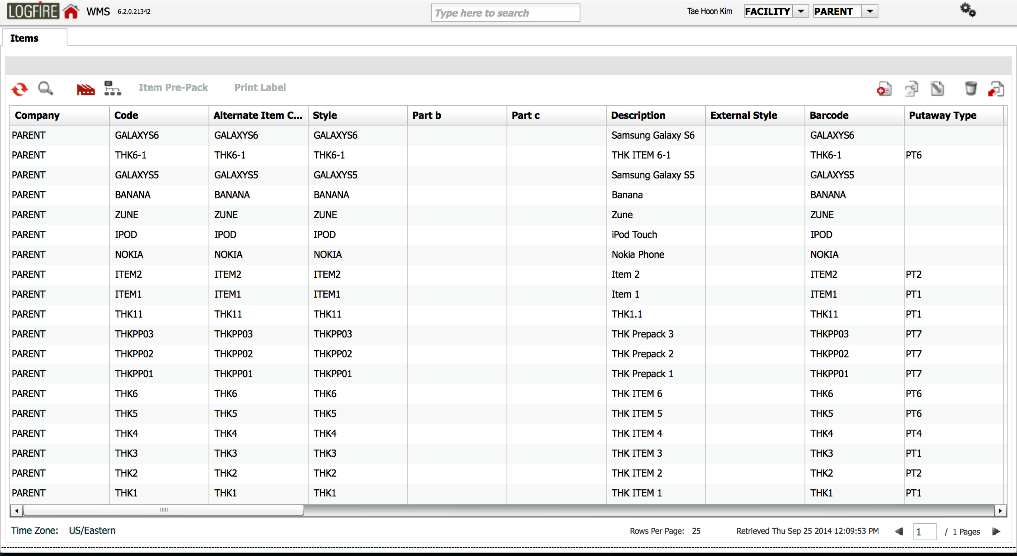
Oracle WMS benefits from a “Unified Data Model,” allowing its AI to perform real-time slotting and labor optimization with a complete view of the business. Its AI-powered anomaly detection is a key security and operational feature. It proactively flags potential issues for planners before they become major problems.
The Dual Experience Analysis: Planner vs. Operator UX

A WMS fails if the people using it every day find it difficult. A successful system must provide a great experience for two key users: the strategic planner in the office and the tactical operator on the warehouse floor. A poor operator experience introduces a high risk of low adoption, which directly hurts productivity.
For the Strategic Planner
All four platforms offer powerful tools for planners. Blue Yonder and Manhattan Active WM provide advanced dashboards and scenario modeling. SAP EWM gives planners deep supply chain views within the SAP environment, while Oracle SCM offers a “Unified Data View” for end-to-end planning.
For the Tactical Operator
On the floor, the experience is also strong across the board, moving beyond simple barcode scanning. Each vendor provides modern, mobile-optimized applications for ruggedized devices that support a range of advanced workflows. Features like multi-order picking, voice-directed warehousing (“voice picking”), and integration with pick-to-light systems are designed to be intuitive and error-proof. The goal is to reduce cognitive load and ‘deadhead' travel time for operators, streamlining every action from inbound receiving and putaway to complex outbound fulfillment tasks.
Ecosystem & ERP Integration: The Single Source of Truth

A WMS cannot be an island of data. It must connect deeply with your central ERP system to maintain a single source of truth for orders and inventory. A failed integration strategy is one of the biggest risks in any WMS project, potentially crippling your entire operation.
Think of this integration as an organ transplant for your business. A native WMS (SAP EWM or Oracle WMS) is a genetically matched donor. The integration is seamless, with zero-latency data flow because it shares the same corporate DNA as your ERP. The risk of rejection is minimal. An ERP-agnostic solution (Blue Yonder or Manhattan) is like a universal donor—incredibly powerful and flexible, but it requires extensive immunosuppressants (custom code, middleware, and rigorous testing) to prevent rejection by the host system. This approach introduces higher risk that must be managed by an expert surgical team of IT specialists and integration partners.
Native ERP Integration (SAP & Oracle)
For businesses built on SAP or Oracle, the choice is often clear. SAP EWM offers an undisputed advantage in an SAP landscape with zero-latency, real-time data flow. Think of it like a purpose-built engine for a specific car; it just fits perfectly. The same is true for Oracle WMS in an Oracle Cloud ERP environment.
ERP-Agnostic Flexibility (Blue Yonder & Manhattan)
Blue Yonder and Manhattan are ERP-agnostic. Their strength lies in open REST APIs and pre-built connectors that provide flexibility for integrating with diverse or custom ecosystems. This approach is powerful but introduces higher integration risk and complexity that must be carefully managed by your IT team and integration partners.
For comprehensive comparisons of different WMS solutions, including alternatives to Blue Yonder, refer to our detailed guide on Blue Yonder Top Alternatives and Competitors.
Security, Compliance & Data Integrity (YMYL CHECKPOINT)

A security breach in your WMS is a catastrophic event. It can halt operations, expose sensitive customer and supplier data, and cause immense financial and reputational damage. This is a mandatory checkpoint for any professional evaluation.
Our evaluation goes beyond standard certifications to assess capabilities essential for global operations, such as data residency controls to ensure compliance with regulations like GDPR, and the granularity of Role-Based Access Control (RBAC) to enforce least-privilege access across your network.
All four of these enterprise platforms demonstrate a strong commitment to security:
| Platform | SOC 2 Type II (2025) | ISO 27001 (2025) | Key Security Features | Data Governance & Access Control |
|---|---|---|---|---|
| Blue Yonder | ✅ | ✅ | AES-256 encryption, GDPR/CCPA compliant, real-time anomaly detection. | Granular RBAC, supports data sovereignty requirements. |
| Manhattan WM | ✅ | ✅ | Exceeds NIST CSF standards, SSO/MFA, detailed data residency controls. | Detailed data residency controls, robust audit trails. |
| SAP EWM | ✅ | ✅ | Also ISO 22301 (Business Continuity), advanced identity management. | Deep integration with SAP Identity and Access Management. |
| Oracle SCM | ✅ | ✅ | Also ISO 9001, Oracle Cloud Security suite, automated threat detection. | Unified identity management via Oracle Cloud IAM. |
Professional Recommendation
All four platforms meet the highest standards for enterprise security. Your choice should depend on which vendor's compliance framework best aligns with your specific industry regulations. I strongly advise you to conduct a thorough security audit with your CISO as part of the procurement process. This analysis is a guide, not a substitute for your company's internal validation.
Financial Deep Dive: TCO, ROI & Implementation Risk
A Tier-1 WMS is not an expense; it is a capital investment in your company's operational engine. The “Your Money” aspect of this decision requires CFO-level scrutiny, looking far beyond the initial license fee to map the entire financial journey from implementation risk to long-term ROI.
Implementing a Tier-1 WMS is a major financial undertaking. You must look beyond the initial license fee to understand the full picture of costs and potential returns.
Implementation Complexity & Timeframe
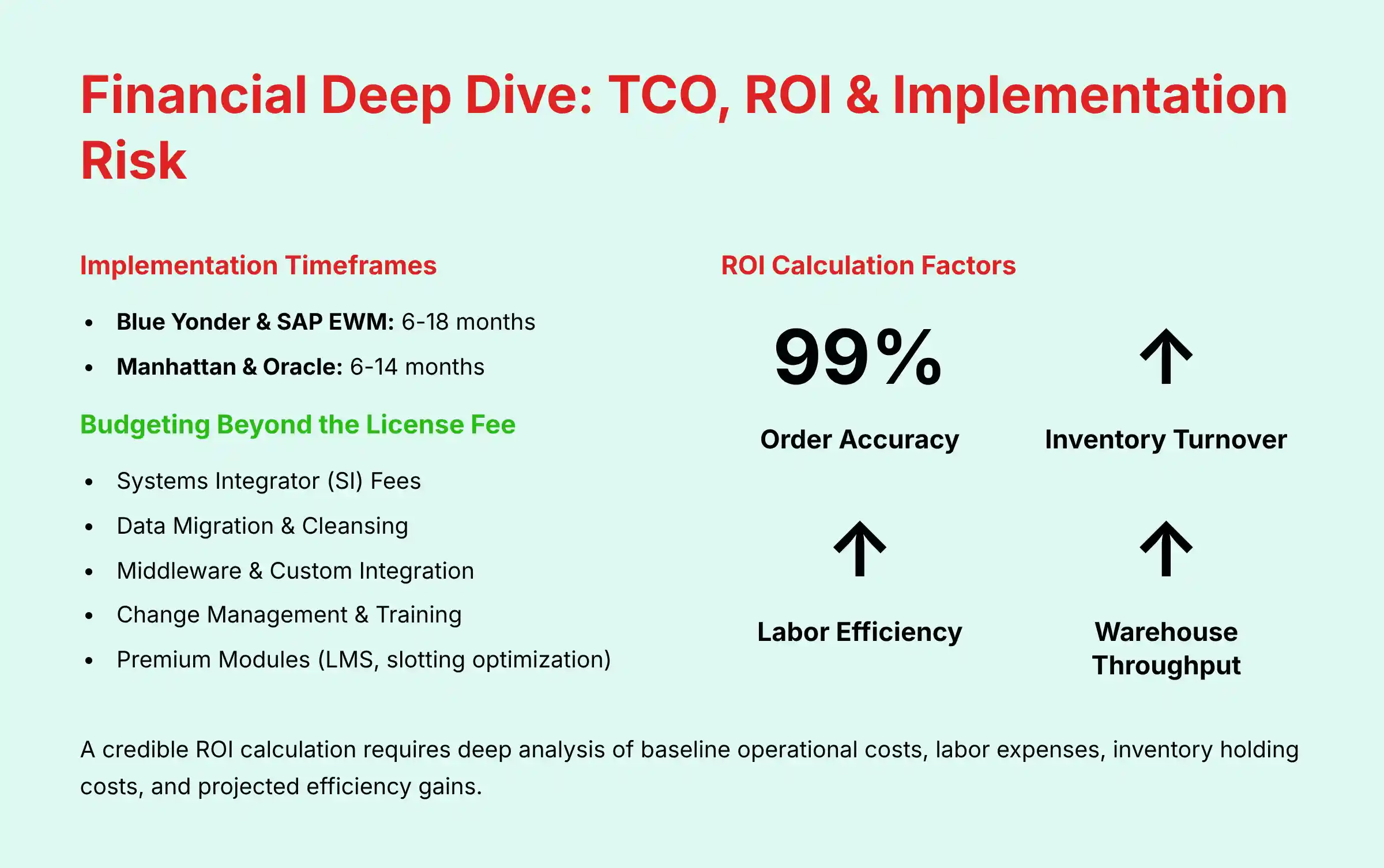
These are not simple plug-and-play tools. Blue Yonder and SAP EWM often require longer implementation timelines of 6-18 months due to their depth and customization. Manhattan and Oracle can offer faster rollouts, often between 6-14 months, especially for companies already on the Oracle cloud platform.
The actual timeline for your specific project can only be determined after a detailed scoping exercise with the vendor and an integration partner. Factors like data readiness, team availability, and customization complexity can dramatically alter the schedule. Professionals must obtain a detailed, custom project plan as part of their due diligence.
Total Cost of Ownership (TCO)
All four solutions represent premium enterprise offerings with significant investment requirements. It's critical to understand that vendors do not publish standardized TCO figures, as costs are highly variable and depend on numerous factors unique to each customer, including:
- Number of warehouses and their size/complexity
- Number of users (planners, operators, managers)
- Transaction volume (picks, shipments, receipts per day)
- Required modules (e.g., labor management, slotting optimization, robotics)
- Complexity of integration with existing ERP and other systems
- Level of customization required
- Data migration scope
Warning: Budgeting Beyond the License Fee
Be aware of costs beyond the subscription fee, which are often substantial. A comprehensive TCO model must account for:
- Systems Integrator (SI) Fees: Costs for your chosen implementation partner to manage the project.
- Data Migration & Cleansing: Labor-intensive work to move and validate data from legacy systems.
- Middleware & Custom Integration: Development for connecting to bespoke or non-standard systems (e.g., via a platform like MuleSoft).
- Change Management & Training: Extensive user training and business process re-engineering.
- Premium Modules: Advanced modules for labor management (LMS), slotting optimization, or yard management are almost always priced as separate add-ons.
Calculating Your ROI
The business case for a new WMS must be built on measurable key performance indicators (KPIs). Frame your ROI analysis around concrete improvements in:
- Order Accuracy: Aiming for over 99% accuracy.
- Inventory Turnover: Reducing holding costs and freeing up cash.
- Labor Efficiency: Optimizing tasks and automating processes.
- Warehouse Throughput: Shipping more orders with the same resources.
A credible ROI calculation is a complex financial exercise unique to each business. It requires deep analysis of baseline operational costs, labor expenses, inventory holding costs, and projected efficiency gains. This must be performed by internal finance teams in conjunction with supply chain analysts and potential implementation partners. The article serves as a good starting point but cannot replace this rigorous internal validation.
Strengths & Weaknesses: A Head-to-Head Analysis
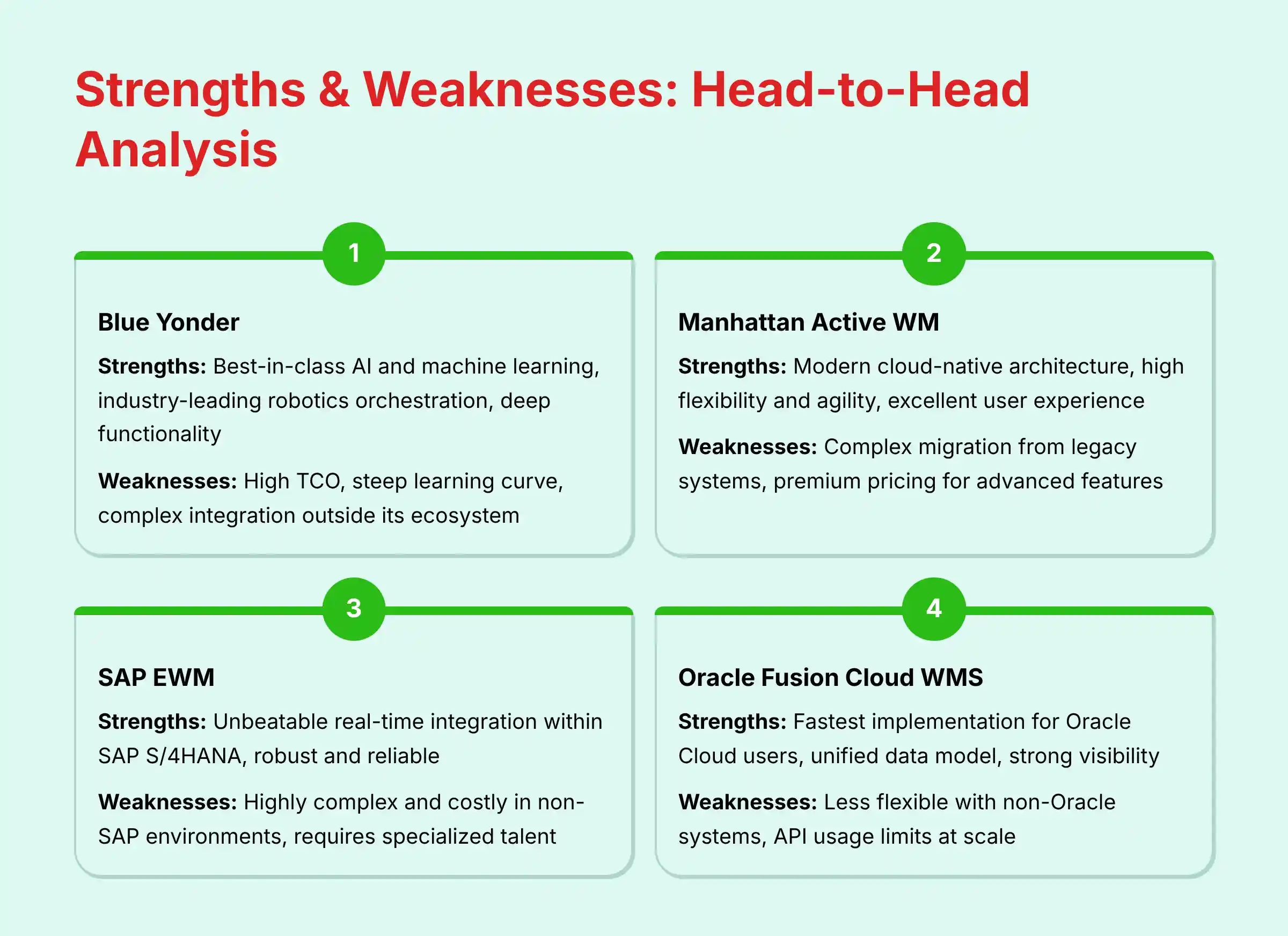
Here is a concise summary of the key strengths and weaknesses of each platform. This balanced view is essential for making an informed decision and understanding potential risks.
✅ Strengths
- Best-in-class AI and machine learning capabilities
- Industry-leading robotics orchestration
- Deep functionality for complex operations
- Unified control layer for mixed robot fleets
⚠️ Considerations
- High total cost of ownership
- Steep learning curve for implementation
- Complex integration outside its ecosystem
- Longer implementation timelines
✅ Strengths
- Modern cloud-native architecture
- High flexibility and agility
- Excellent user experience
- Continuous non-disruptive upgrades
⚠️ Considerations
- Complex migration from legacy systems
- Advanced features come at premium pricing
- Requires cloud-first mindset
- Integration complexity for hybrid environments
✅ Strengths
- Unbeatable real-time integration within SAP S/4HANA
- Robust and reliable enterprise platform
- Deep supply chain visibility
- Strong business continuity features
⚠️ Considerations
- Highly complex in non-SAP environments
- Requires specialized SAP talent
- Costly implementation and maintenance
- Limited flexibility outside SAP ecosystem
✅ Strengths
- Fastest implementation for Oracle Cloud users
- Unified data model across supply chain
- Strong end-to-end visibility
- AI-powered anomaly detection
⚠️ Considerations
- Less flexible for non-Oracle integration
- API usage limits at scale
- Vendor lock-in concerns
- Limited customization options
What Are the Key Questions to Ask WMS Vendors?
During your evaluation, it is your job to press vendors for specific, evidence-based answers. Use these questions as a starting point to guide your discussions and uncover the truth behind the sales pitch.
Direct Comparison: What is the architectural difference between your platform and Manhattan's microservices? How does that impact our ability to customize and upgrade?
Why This Matters: The architectural foundation determines long-term flexibility and maintenance costs. Microservices architecture may enable easier upgrades but could introduce different integration challenges. Understanding these trade-offs is critical to avoid future technical debt.
Implementation Risk: What is your average implementation time for a company of our scale and complexity? Can you provide a project plan from a similar client?
Why This Matters: Implementation timelines are frequently underestimated, leading to budget overruns and operational disruption. Requesting a specific project plan from a similar implementation provides a realistic benchmark and reveals the vendor's experience with organizations like yours.
Financial Risk: Can you provide a complete TCO model, including data migration, training, and all premium support tiers for a three-year period?
Why This Matters: The license cost is often just the tip of the iceberg. A comprehensive TCO analysis forces vendors to disclose all costs upfront, preventing unexpected expenses that could jeopardize your ROI calculation and overall project budget.
Security & Compliance: Can you provide your latest SOC 2 Type II audit report? How do you manage data residency to comply with international regulations?
Why This Matters: Security breaches can cause catastrophic operational and reputational damage. Detailed security documentation helps your CISO verify compliance with your organization's security requirements and regulatory obligations.
AI & Robotics: How does your system orchestrate a mixed fleet of Autonomous Mobile Robots (AMRs) from different vendors? Can we see a live demo?
Why This Matters: Many vendors claim robotics orchestration capabilities but have limitations with multi-vendor environments. A live demonstration reveals the true maturity of the solution and how it handles real-world complexity.
ERP Integration: Show us the detailed technical documentation for your SAP S/4HANA connector. What is the typical timeline and cost to get it operational?
Why This Matters: Integration failures are among the most common causes of WMS project delays and cost overruns. Detailed connector documentation helps your IT team assess compatibility with your specific ERP configuration and customizations.
Vendor Viability: What is your R&D investment as a percentage of revenue? What new features are on your 18-month product roadmap?
Why This Matters: A WMS is a long-term strategic investment. Understanding the vendor's commitment to innovation and financial stability helps ensure you're partnering with a company that will continue to enhance the product throughout your usage lifecycle.
Expert Validation: Can you provide three non-anonymized customer references in our industry that we can speak to directly about their implementation experience?
Why This Matters: Speaking with existing customers in your industry provides invaluable insights into the real-world experience of working with the vendor, implementation challenges specific to your sector, and how the system performs under conditions similar to yours.
For common questions and detailed answers about Blue Yonder specifically, check out our comprehensive Blue Yonder FAQs section.
Final Verdict & Professional Recommendations

There is no single “best” WMS platform. The optimal choice depends entirely on your business context, existing technology landscape, and strategic goals. My recommendations are based on clear scenarios to help you find the right fit.
- Choose Blue Yonder if… you run a large, highly complex warehouse operation. Your primary goal is to leverage the most advanced AI and robotics orchestration to achieve peak performance and efficiency.
- Choose Manhattan Active WM if… your priority is agility. You need a modern, flexible, best-of-breed WMS that can adapt quickly to changing market conditions and integrate with a diverse technology ecosystem.
- Choose SAP EWM if… your organization is deeply invested in the SAP S/4HANA ecosystem. The benefits of seamless, real-time integration will outweigh the advantages of any other platform.
- Choose Oracle Fusion Cloud WMS if… you are an Oracle Cloud ERP customer. You are seeking the fastest path to value with a tightly integrated, end-to-end supply chain platform.
Ultimately, the choice you make is not merely about software; it is a declaration of your operational strategy for the next decade. You are selecting the intelligence apparatus that will navigate the permanent storm of modern logistics. The question is not just which platform has the best features, but which partner will help you press the advantage in an industry that waits for no one.
For a broader perspective on warehouse management solutions, explore our comprehensive guide to the Best 10 AI Warehouse Management Systems (WMS) to understand how these platforms compare to other leading solutions in the market.
YMYL Disclaimer: This analysis is based on 2025 data and is intended for informational purposes. Enterprise software selection carries significant financial and operational risk. I strongly recommend engaging with industry analysts, conducting vendor-led proof-of-concept projects, and speaking with reference customers before making a final decision on Blue Yonder Top Alternatives and Competitors.

Leave a Reply