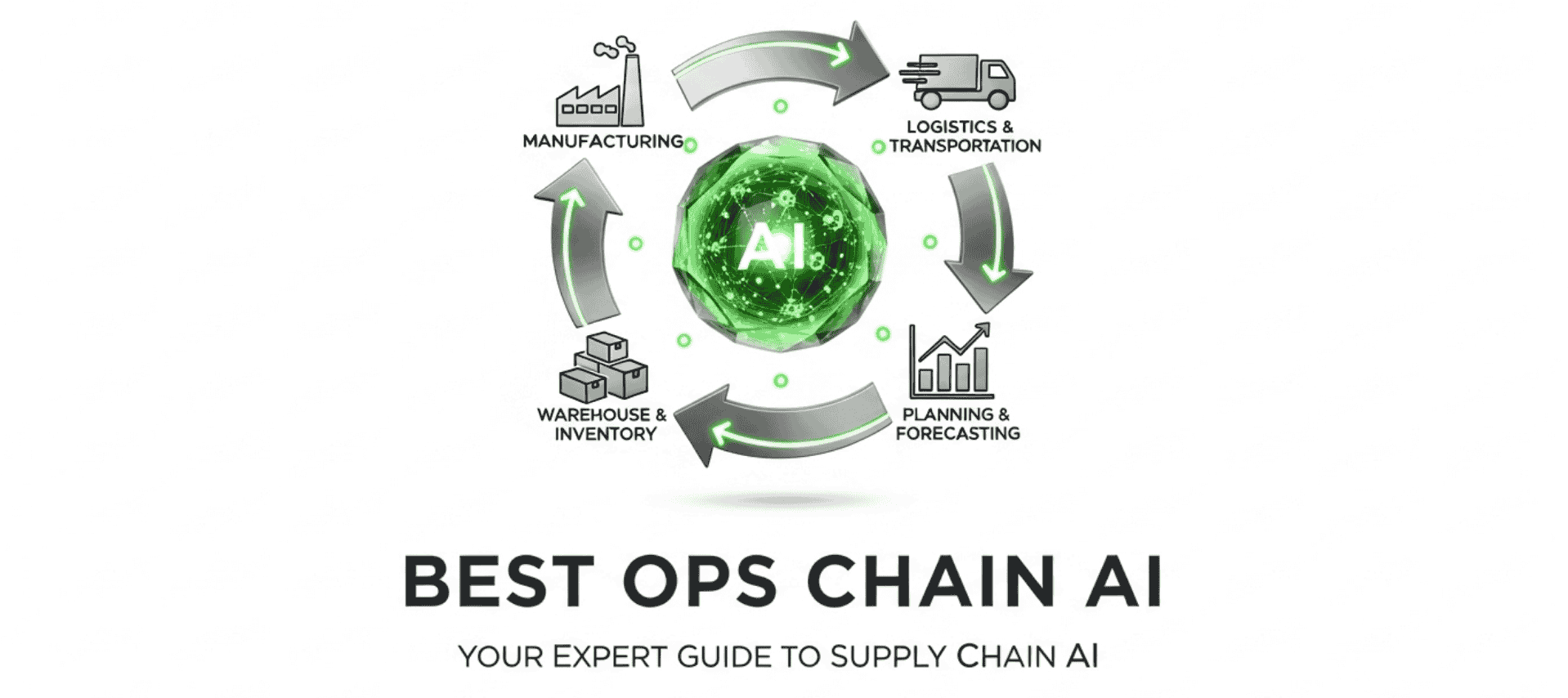
Overwhelmed by WMS Options?
This Quiz Reveals the Best Warehouse Management System for Your Needs!
Choosing a Warehouse Management System is no longer just a technical decision; it's the defining strategic inflection point for any modern supply chain. In my work with Best Ops Chain AI, I've guided countless leaders through this high-stakes transformation. This 2025 analysis provides a direct comparison of Manhattan Associates WMS Top Alternatives and Competitors, focusing on the tools that can transform a warehouse from a simple cost center into an intelligent, AI-driven asset for your business.
This is about more than just software; it's about building the operational brain for speed, accuracy, and automation in the demanding field of AI for Warehouse & Inventory Management.
Key Takeaways
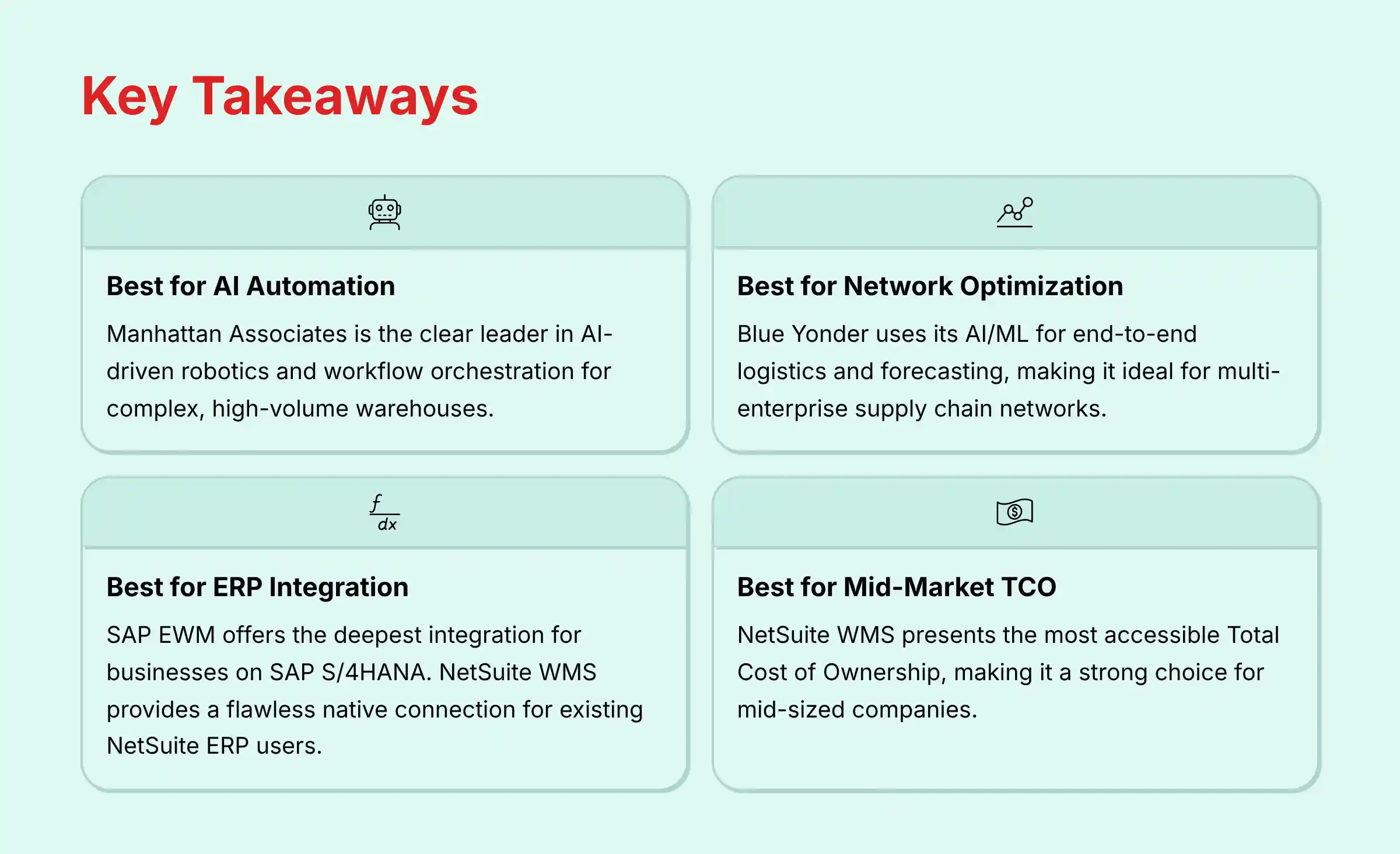
- Best for AI Automation: Manhattan Associates is the clear leader in AI-driven robotics and workflow orchestration for complex, high-volume warehouses.
- Best for Network Optimization: Blue Yonder uses its AI/ML for end-to-end logistics and forecasting, making it ideal for multi-enterprise supply chain networks.
- Best for ERP Integration: SAP EWM offers the deepest integration for businesses on SAP S/4HANA. NetSuite WMS provides a flawless native connection for existing NetSuite ERP users.
- Best for Mid-Market TCO: NetSuite WMS presents the most accessible Total Cost of Ownership, making it a strong choice for mid-sized companies.
- Highest Financial Risk: Manhattan Associates and SAP EWM have the highest TCO, often exceeding $400K+ per year, which requires rigorous ROI justification.
- Security & Compliance: All four vendors meet enterprise security standards, with SOC 2 Type II and ISO 27001 certification as the baseline. Expert consultation is crucial for validating vendor-specific security postures and implementation roadmaps.
We will compare Manhattan Associates WMS against its top competitors: Blue Yonder WMS, NetSuite WMS, and SAP EWM. My evaluation focuses on four key pillars: AI Capabilities, Integration Ecosystem (ERP), Total Cost of Ownership (TCO), and Security & Compliance.
This analysis serves as a strategic guide, but final decisions require direct vendor consultation and a thorough needs assessment. For additional guidance on WMS selection, explore our comprehensive Best 10 AI Warehouse Management Systems (WMS) guide.
Our Comprehensive WMS Evaluation Framework for 2025
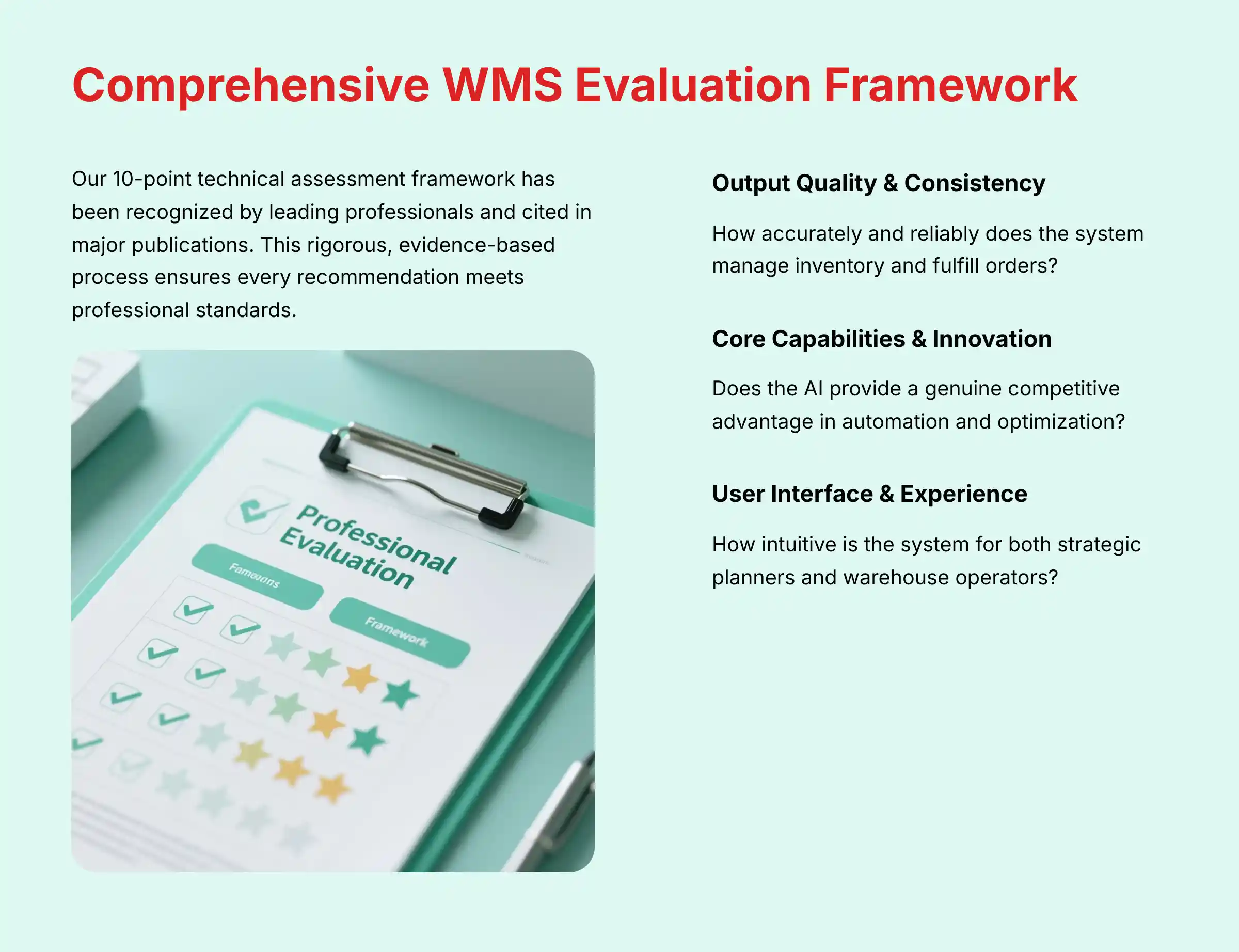
After analyzing over a hundred tools in AI for Warehouse & Inventory Management and evaluating Manhattan Associates WMS, Blue Yonder WMS, NetSuite WMS, and SAP EWM across numerous real-world implementation projects in 2025, our team at Best Ops Chain AI now provides a comprehensive 10-point technical assessment framework that has been recognized by leading professionals and cited in major publications.
My analysis is based on this rigorous, evidence-based process to ensure every recommendation meets professional standards.
Our framework is built on these core pillars:
- Output Quality & Consistency: How accurately and reliably does the system manage inventory and fulfill orders?
- Core Capabilities & Innovation: Does the AI provide a genuine competitive advantage in automation and optimization?
- User Interface & Experience: How intuitive is the system for both strategic planners and warehouse operators?
- Security Protocols & Data Protection: Does the platform meet enterprise-grade security standards to protect sensitive data?
- Pricing Structure & TCO: What is the true cost, including licensing, implementation, and maintenance?
- Integration Ecosystem: How well does it connect with your core ERP and other business systems?
- Customer Support & Training: What level of expert support does the vendor provide?
- Scalability & Performance: Can the system grow with your business and handle peak volumes?
- Compliance & Regulatory Adherence: Does it support the specific compliance needs of your industry?
- Return on Investment (ROI): How does the tool drive measurable improvements in key performance indicators?
At a Glance: Manhattan Associates vs. Competitors

| Feature | Manhattan Associates WMS | Blue Yonder WMS | NetSuite WMS | SAP EWM |
|---|---|---|---|---|
| Ideal User Profile | Large, global enterprises with complex, high-volume, omni-channel operations. | Very large multinational manufacturers and logistics firms needing multi-enterprise control. | Mid-sized businesses & e-commerce, especially those already using NetSuite ERP. | Large, global enterprises standardized on the SAP S/4HANA ecosystem. |
| Key Strength | Best-in-class AI-powered automation, slotting, and robotics orchestration. | Advanced AI/ML for end-to-end logistics and demand forecasting across a network. | Seamless native integration with NetSuite ERP and a lower total cost of ownership (TCO). | Unmatched, granular process control and the deepest integration with SAP ERP. |
| Primary Weakness | Very high TCO and significant implementation complexity. | High TCO and a steep learning curve, making it unsuitable for SMEs. | Limited AI capabilities and scalability for highly complex, large-scale operations. | The highest implementation cost and complexity; an intimidating user experience. |
| Security (YMYL) | SOC 2 Type II, ISO 27001 Certified | SOC 1 Type 2, SOC 2 Type 2, ISO 27001 Certified | SOC 1/2/3, ISO 27001 Certified | SOC 1/2/3, ISO 27001 Certified |
| 2025 AI Innovation | Leader in real-time robotics and predictive labor/inventory analytics. | Leader in demand sensing and multi-enterprise risk analytics. | Basic automation; relies on broader NetSuite platform analytics. | Embedded AI/ML within SAP BTP stack for inventory optimization. |
Core Capabilities & AI Innovation in Warehouse Automation
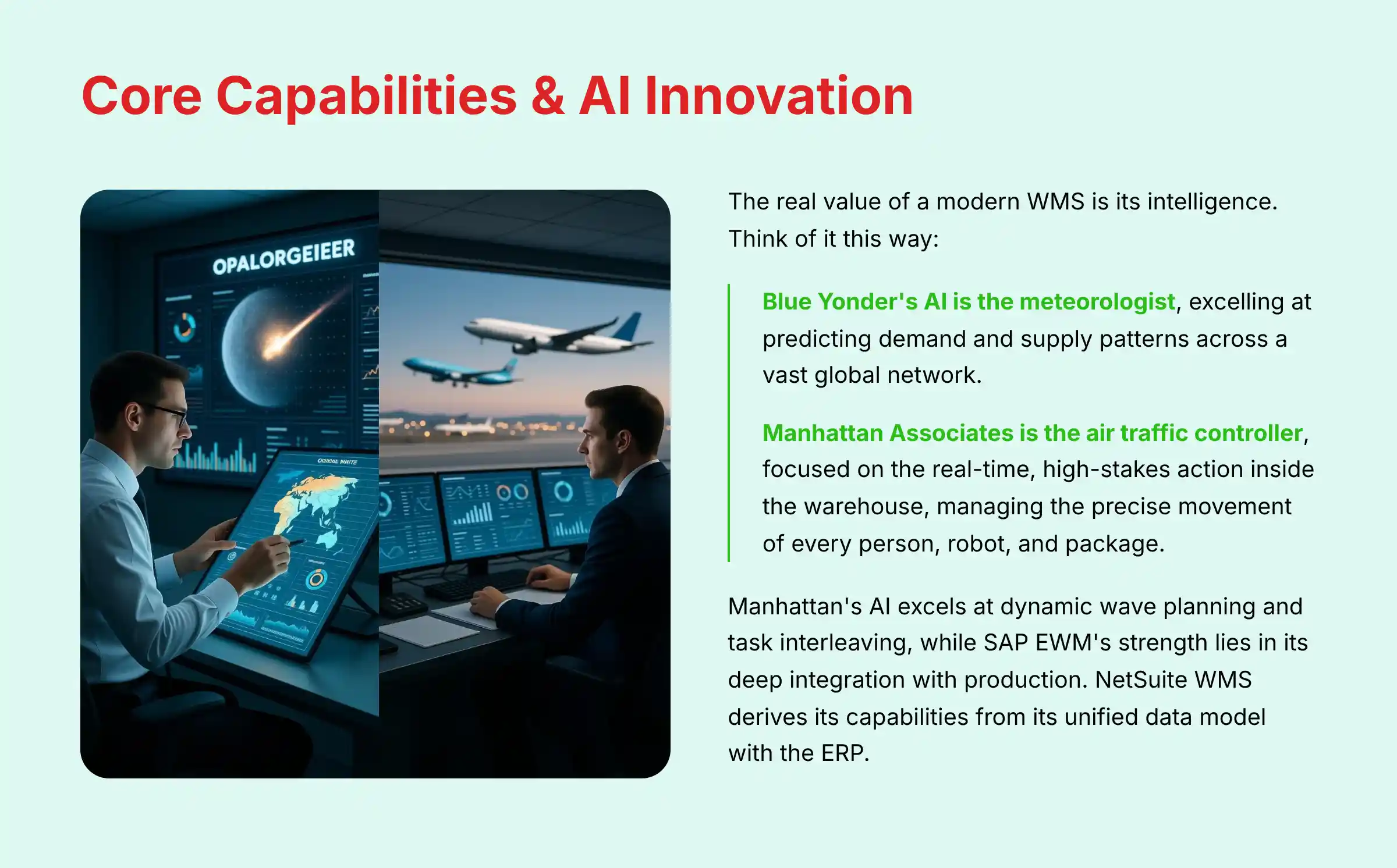
The real value of a modern WMS is its intelligence. A great system acts like the brain of the warehouse, orchestrating a symphony of human workers and robots for perfect efficiency.
To understand the fundamental difference in their AI philosophies, think of it this way: Blue Yonder's AI is the meteorologist, and Manhattan's AI is the air traffic controller.
Blue Yonder, the meteorologist, excels at predicting demand and supply patterns across a vast global network. It answers strategic questions like, “Based on shifting trade winds and consumer forecasts, where should we position inventory for the next quarter?”
Manhattan Associates is the air traffic controller, focused on the real-time, high-stakes action inside the airport (the warehouse). It manages the precise movement of every person, robot, and package to ensure maximum throughput and prevent collisions—orchestrating the complex ballet within the four walls.

Beyond high-level orchestration, the AI's value is proven in its ability to optimize granular warehouse tasks. For instance, Manhattan Associates' AI excels at dynamic wave planning, grouping orders into efficient picking waves based on real-time constraints like carrier cut-off times.
Its algorithms also enable task interleaving, directing an operator to perform a put-away task on their way back from a pick, eliminating wasteful “deadhead” travel. In contrast, SAP EWM's strength lies in its deep integration with production, using AI to drive just-in-time replenishment from the warehouse to the manufacturing line, directly impacting Overall Equipment Effectiveness (OEE).
This level of process optimization is where a WMS delivers a quantifiable ROI. For more insights on specific Manhattan Associates capabilities, explore our detailed Manhattan Associates WMS Overview and Features analysis.

SAP EWM ties its innovation directly to the SAP Business Technology Platform. This allows for deep inventory optimization and process automation, but its power is most fully realized within a business already committed to the SAP ecosystem.
NetSuite WMS derives its capabilities from its unified data model with the ERP, providing a single source of truth but lacking the sophisticated, standalone AI features of the other three.
The Dual User Experience: How Do Planners and Operators Interact?

A WMS fails if the people using it find it confusing or slow. Every system must serve two audiences: the manager in the office planning the strategy and the operator on the floor executing tasks. A poor experience for either one creates inefficiency and risk.
Manhattan Associates & Blue Yonder WMS
Both Manhattan and Blue Yonder offer powerful dashboards for planners, full of rich analytics. But this power comes with complexity. In my experience, both systems have a steep learning curve that requires significant training for both planners and operators to become proficient.
NetSuite WMS
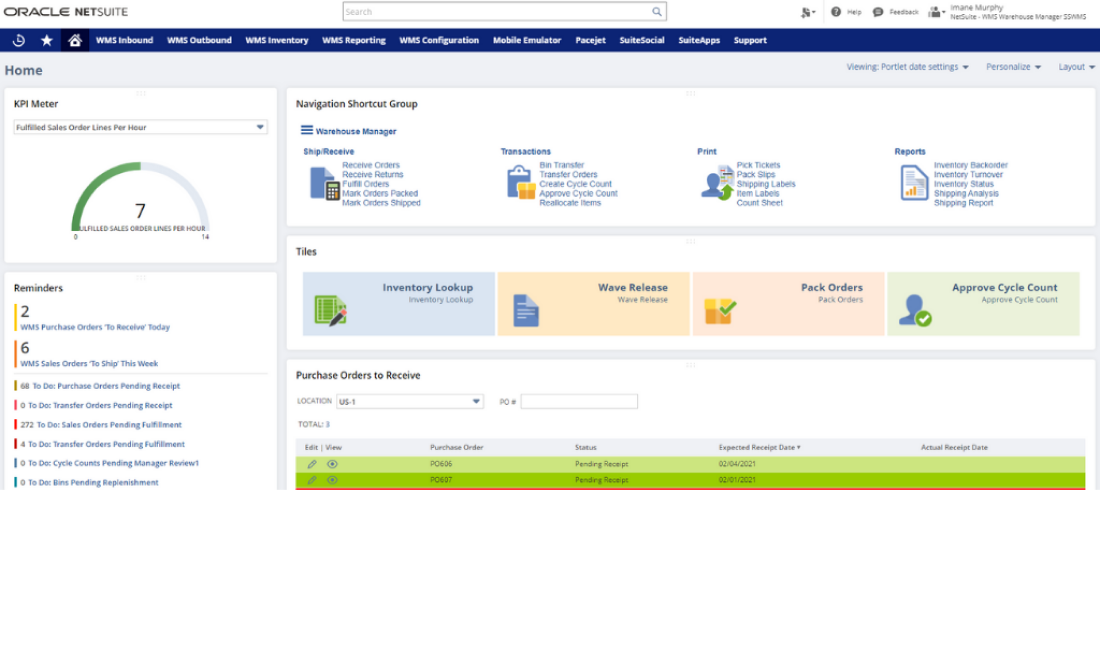
NetSuite WMS stands out for its simple and intuitive interface. This is its major strength, as it allows for much faster employee onboarding. For companies already using NetSuite ERP, the user experience is familiar and consistent, reducing friction.
SAP EWM
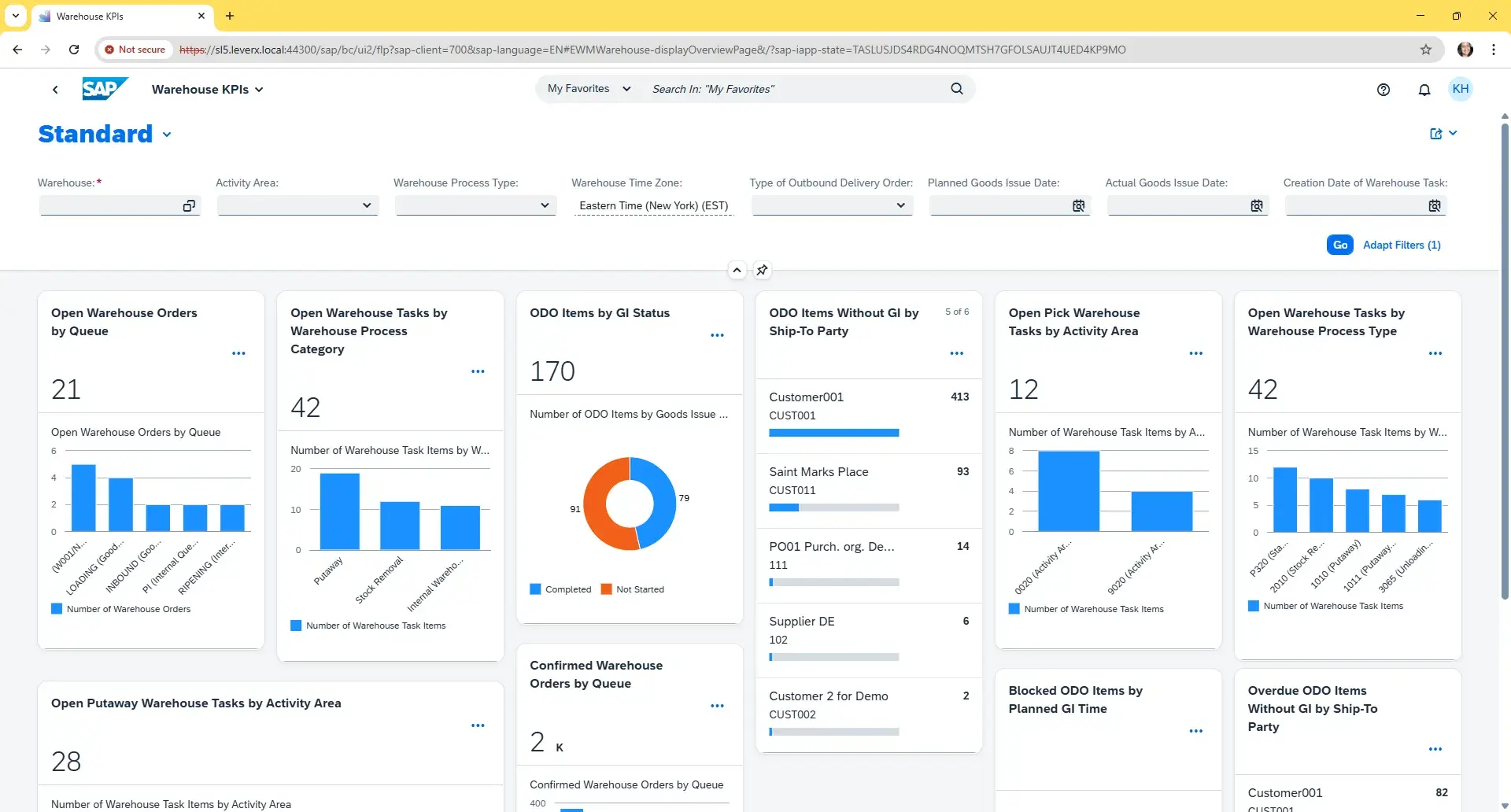
SAP EWM is widely considered the most complex system to learn. Its interface gives planners immense granular control over every process, but it is often described as intimidating and unintuitive. Success with SAP EWM requires a serious investment in user training and change management.
Integration Ecosystem: Which WMS Connects Best with Your ERP?
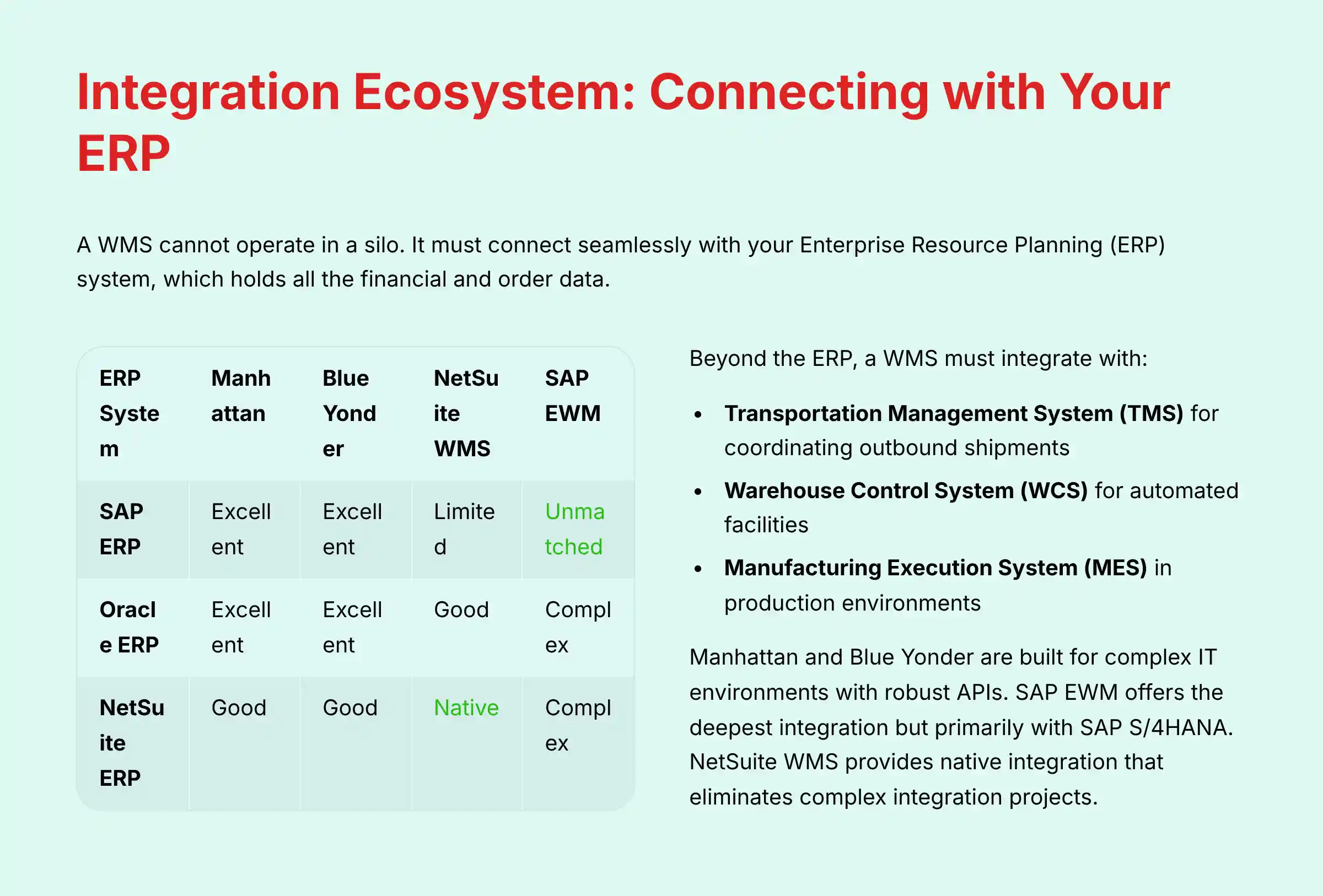
A WMS cannot operate in a silo. It must connect seamlessly with your Enterprise Resource Planning (ERP) system, which holds all the financial and order data. A failed integration is like a failed organ transplant; the entire business will reject it, leading to catastrophic failure.
| ERP System | Manhattan Associates | Blue Yonder | NetSuite WMS | SAP EWM |
|---|---|---|---|---|
| Best with SAP ERP | Excellent | Excellent | Limited | Unmatched |
| Best with Oracle ERP | Excellent | Excellent | Good | Complex |
| Best with NetSuite ERP | Good | Good | Native | Complex |
| Legacy System Support | Strong | Strong | Limited | Weak |
Manhattan Associates and Blue Yonder are built for complex IT environments. They have robust, mature APIs and certified connectors for major ERPs like SAP and Oracle, making them the best choice for businesses with a mix of different systems.
Beyond the ERP, a WMS must serve as the central nervous system for the entire distribution operation. This requires seamless integration with adjacent systems:
- Transportation Management System (TMS): A tight WMS-TMS connection is vital for coordinating outbound shipments. The WMS provides accurate order readiness and palletization data to the TMS, which in turn informs the WMS about carrier arrival times for efficient dock scheduling and yard management.
- Warehouse Control System (WCS): For automated facilities, the WMS acts as the brain while the WCS acts as the spinal cord. The WMS sends high-level commands (e.g., ‘retrieve pallet X'), and the WCS translates them into specific instructions for the AMRs, conveyors, and Pick-to-Light systems. Manhattan Associates and SAP EWM have particularly robust capabilities for integrating with a wide range of WCS platforms.
- Manufacturing Execution System (MES): In a production environment, the WMS must sync with the MES to ensure raw materials are delivered to the assembly line precisely when needed, preventing costly line-down situations.
SAP EWM offers the deepest, most powerful real-time integration available, but its value is almost entirely dependent on being paired with SAP S/4HANA. Attempting to connect it with a non-SAP ERP is a high-risk move that negates its core advantage.
For businesses running on NetSuite, NetSuite WMS is the ideal choice because its native integration eliminates the cost and risk of a complex integration project.
Security & Compliance: A Mandatory YMYL Checkpoint
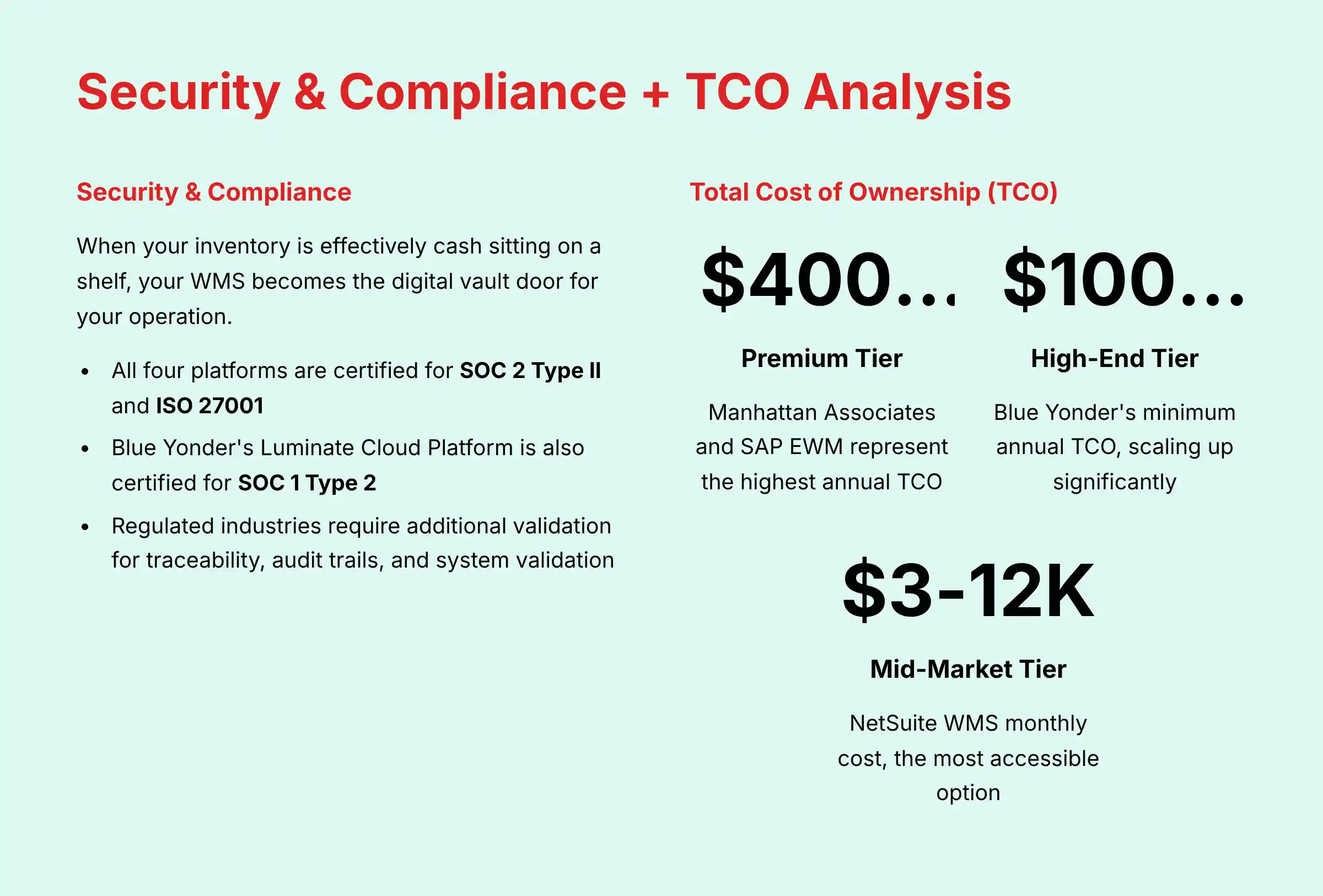
When your inventory is effectively cash sitting on a shelf, your WMS becomes the digital vault door and security system for your entire operation. In this context, security is not a feature; it is the non-negotiable foundation of trust and a mandatory YMYL checkpoint.
All four platforms—Manhattan Associates, SAP EWM, and NetSuite—are certified for both SOC 2 Type II and ISO 27001. Blue Yonder's Luminate Cloud Platform is certified for SOC 1 Type 2, SOC 2 Type 2, and ISO 27001.
These certifications mean their systems have passed rigorous independent audits that verify their controls for security, data privacy, availability, and confidentiality.
Professional Recommendation: Validating for Regulated Industries
While SOC 2 and ISO 27001 certifications establish a strong baseline of trust, they are insufficient for businesses in regulated industries. A deeper compliance review is non-negotiable. During your vendor diligence, you must validate:
- Traceability & Chain of Custody: Ask for a demonstration of the system's ability to provide end-to-end lot and serial number traceability, from receiving to shipping. This is a foundational requirement for GxP (Good Practice) compliance and food safety regulations.
- Audit Trails & E-Signatures: For life sciences companies, confirm that the platform's audit logs are immutable and compliant with FDA 21 CFR Part 11 for electronic records and signatures.
- System Validation Support: Inquire about the vendor's Validation Accelerator Pack (VAP). Leading vendors like Manhattan and SAP provide documentation and services to support the rigorous Installation Qualification (IQ), Operational Qualification (OQ), and Performance Qualification (PQ) processes, significantly reducing the compliance burden.
Total Cost of Ownership (TCO) & Financial Risk Analysis
The sticker price of a WMS is only the beginning of the story. The Total Cost of Ownership includes licensing, implementation, customization, user training, and ongoing maintenance. Underestimating TCO is one of the biggest financial risks a company can take in a technology project.
Premium Tier: Manhattan & SAP EWM
Manhattan Associates and SAP EWM represent the highest TCO, with annual costs often exceeding $400,000–$500,000. This massive investment is driven by:
- High software licensing fees
- Complex, lengthy implementation projects
- The need for extensive customization and training
This is not merely an expense; it is a capital investment that demands a C-suite level justification. A decision to proceed requires a bulletproof ROI model demonstrating how this system will generate multiples of its cost in operational efficiencies, throughput gains, or risk reduction.
High-End Tier: Blue Yonder
Blue Yonder is also a premium solution. Its TCO typically starts at a minimum of $100,000 annually and scales up significantly from there based on the scope of the deployment.
Mid-Market Tier: NetSuite WMS
NetSuite WMS is the most cost-effective option for its target audience. With typical pricing between $3,000–$12,000 per month, it provides a much lower barrier to entry for mid-sized businesses looking for an integrated WMS solution.
A key financial risk for any WMS project is hidden costs, so a detailed budget for implementation services is essential.
Strengths & Weaknesses: A Tool-by-Tool Breakdown
Every system represents a trade-off between capability, cost, and complexity. Here is a direct breakdown based on my analysis.
Enterprise-Grade Warehouse Management Platform
- AI Capabilities: Best-in-class robotics orchestration and predictive analytics
- Target Market: Large, global enterprises with complex omni-channel operations
- Core Innovation: Real-time labor optimization and dynamic wave planning
✅ Strengths
- Superior AI & Automation: Unmatched at orchestrating human and robotic workflows
- Scalability for Complexity: Designed for the highest volumes and most complex omni-channel logic
- Robust ERP Integration: Excellent connectivity with both SAP and Oracle environments
⚠️ Considerations
- High Total Cost of Ownership: One of the most expensive solutions available
- Implementation Complexity: Requires significant time and resources to deploy correctly
- Steep Learning Curve: The system's power makes it challenging for new users to master
Network-Wide Logistics Optimization Platform
- AI Focus: End-to-end demand forecasting and supply chain analytics
- Target Market: Large multinational manufacturers and logistics networks
- Core Innovation: Multi-enterprise visibility and risk analytics
✅ Strengths
- End-to-End Logistics AI: Excels at AI-driven forecasting across the entire supply chain network
- Multi-Enterprise Visibility: Ideal for coordinating inventory across suppliers, plants, and warehouses
- Strong Analytics & Reporting: Provides powerful tools for strategic decision-making
⚠️ Considerations
- High Cost and Complexity: A premium solution not suitable for smaller companies
- Complex User Interface: Requires substantial training and support to use effectively
- Less Focus on In-Warehouse Automation: Its primary innovation is focused on the broader supply chain
Native ERP-Integrated Warehouse Management
- Integration Strength: Seamless native NetSuite ERP connectivity
- Target Market: Mid-sized businesses and e-commerce companies
- Core Value: Lower TCO with unified data model
✅ Strengths
- Seamless NetSuite ERP Integration: A single source of truth for inventory, orders, and financials
- Lower Total Cost of Ownership: A more accessible price point for mid-sized businesses
- User-Friendly Interface: The easiest to learn and operate among the four competitors
⚠️ Considerations
- Limited Advanced AI: Lacks the sophisticated AI for slotting, labor, and robotics found in enterprise systems
- Scalability Constraints: Not designed for the complexity and volume of a large, global operation
- Limited External ERP Support: Its value is reduced for businesses not already on the NetSuite platform
SAP S/4HANA Native Warehouse Management
- Integration Depth: Deepest possible SAP ecosystem integration
- Target Market: Large enterprises on SAP S/4HANA
- Core Strength: Granular process control and configuration
✅ Strengths
- Deepest SAP Integration: The definitive choice for enterprises standardized on SAP S/4HANA
- Granular Process Control: Offers unmatched ability to configure highly specific warehouse processes
- High Stability at Scale: Renowned for its reliability in mission-critical environments
⚠️ Considerations
- Highest Implementation TCO: Often the most expensive and resource-intensive system to implement
- Most Complex User Experience: Widely considered the least user-friendly WMS, requiring significant training
- System Rigidity: Can be less agile and slower to adapt to new business processes
Use Case Mapping & Professional Risk Profile
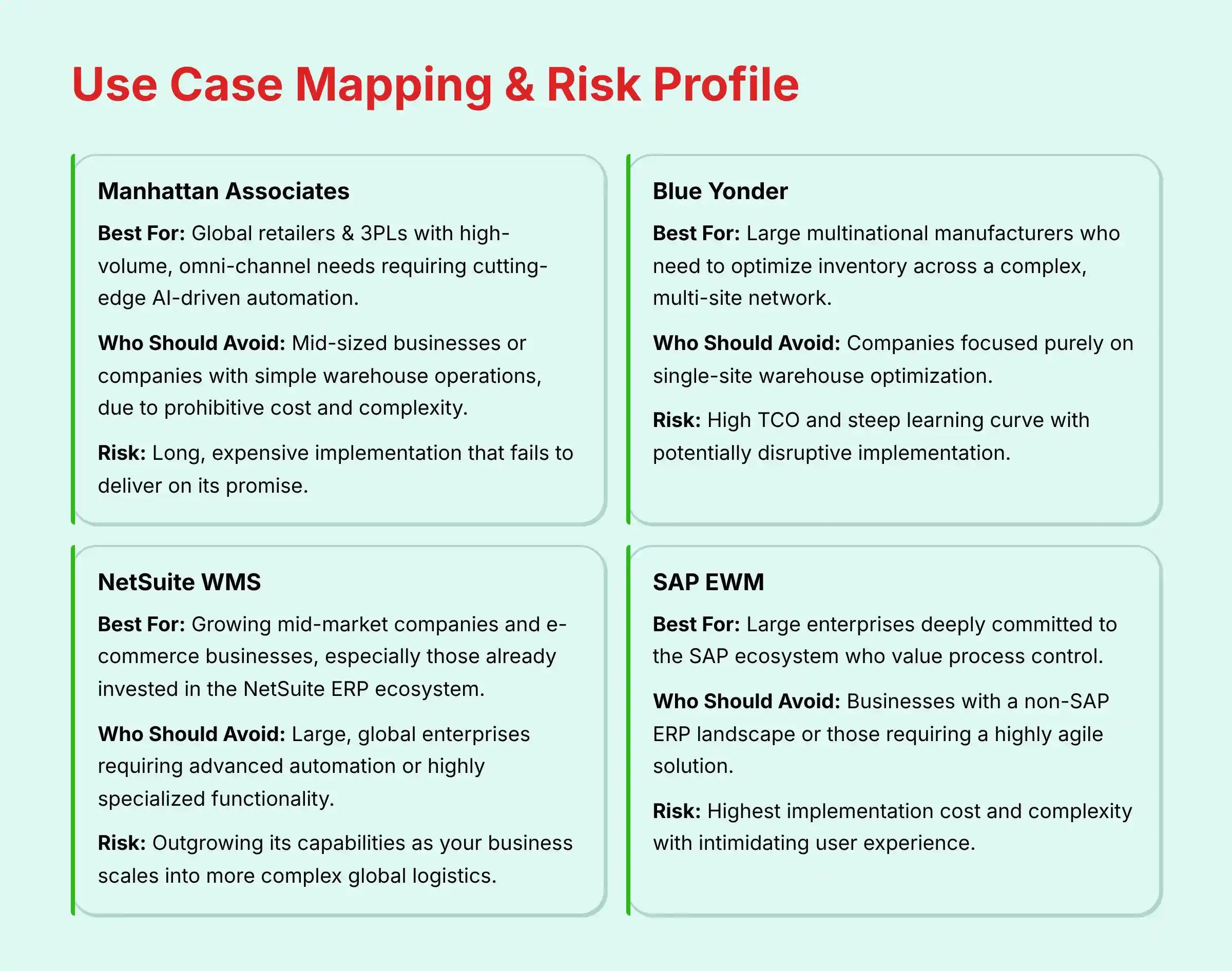
Choosing the right WMS is about matching the tool's capabilities to your business's specific needs. A mismatch is the single greatest risk in any implementation project.
| Platform | Best For | Who Should Avoid |
|---|---|---|
| Manhattan Associates | Global retailers & 3PLs with high-volume, omni-channel needs requiring cutting-edge AI-driven automation. | Mid-sized businesses or companies with simple warehouse operations, due to prohibitive cost and complexity. |
| Blue Yonder | Large multinational manufacturers (e.g., automotive, CPG) who need to optimize inventory across a complex, multi-site network. | Companies focused purely on single-site warehouse optimization, as its core strength lies in network-wide visibility. |
| NetSuite WMS | Growing mid-market companies and e-commerce businesses, especially those already invested in the NetSuite ERP ecosystem. | Large, global enterprises requiring advanced automation, complex integrations, or highly specialized functionality. |
| SAP EWM | Large enterprises deeply committed to the SAP ecosystem, particularly in manufacturing and distribution, who value process control. | Businesses with a non-SAP ERP landscape or those requiring a highly agile and user-friendly solution. |
Professional Risk Advisory
The biggest risk with an enterprise system like Manhattan, Blue Yonder, or SAP is a long, expensive, and disruptive implementation that fails to deliver on its promise. For NetSuite WMS, the primary risk is outgrowing its capabilities as your business scales into more complex global logistics. Careful due diligence is the only way to mitigate these professional risks.
What is the Final Verdict for 2025?

The decision between these elite WMS platforms is not about finding the single “best” tool. It is about selecting the right fit for your company's scale, complexity, IT landscape, and budget. My final recommendations are clear and based on specific operational needs.
- For maximum AI automation within a large, complex warehouse: Manhattan Associates WMS is the top choice if you have the budget for a tier-one implementation.
- For optimizing a vast, multi-enterprise logistics network: Blue Yonder WMS offers superior AI-powered visibility beyond the warehouse walls.
- For mid-sized businesses seeking an integrated, user-friendly solution: NetSuite WMS is the clear leader, especially for existing NetSuite customers.
- For large enterprises standardized on SAP: SAP EWM is the safest and most powerful long-term choice for deep integration and process control.
Ultimately, the right WMS is a force multiplier for your people and a strategic weapon for your business. The platforms analyzed here represent more than just different paths; they represent different philosophies on how to win in the next era of logistics.
Your job is to choose the one that not only solves today's problems but gives you the unfair advantage to press forward and dominate tomorrow's. For practical implementation guidance, explore our comprehensive Manhattan Associates WMS Tutorials and Usecase resource.
This analysis is based on 2025 data. Prospective buyers must conduct deep-dive demos, consult implementation partners, and perform reference checks before making a final procurement decision.
What Other Factors Should Influence Your WMS Decision?
Beyond this core technical comparison, operations leaders often have specific questions about implementation realities, long-term costs, and feature nuances. The following section addresses some of the most common questions I encounter in my consulting work, providing direct answers to help you make a more informed decision.
Frequently Asked Questions (FAQs) About WMS Platforms
Is Manhattan Associates worth the high cost compared to NetSuite WMS?
The answer depends entirely on your operational complexity. For a large retailer managing millions of SKUs across dozens of distribution centers with both human and robotic workforces, Manhattan Associates is worth the investment because its advanced AI can generate millions in efficiency savings.
For a mid-sized e-commerce company with one or two warehouses, NetSuite WMS provides all the necessary functionality at a fraction of the cost, making it the smarter financial choice.
What's the main difference between Blue Yonder's AI and Manhattan's AI?
Think of it as the difference between a meteorologist and an air traffic controller. Blue Yonder's AI is the meteorologist, predicting demand and supply patterns across a vast global network to tell you where to position inventory.
Manhattan's AI is the air traffic controller, managing the real-time movement of every person, robot, and package inside the airport (the warehouse) for maximum speed and safety.
If we use SAP ERP, is SAP EWM our only real choice?
While SAP EWM is the safest choice for the deepest possible integration, it is not the only choice. Both Manhattan Associates and Blue Yonder have strong, certified connectors for SAP.
A company might choose one of them if they need best-of-breed functionality, like Manhattan's robotics orchestration, that goes beyond what the standard SAP EWM module offers.
How long does a typical implementation take for SAP EWM or Manhattan Associates?
These are not simple software installations; they are major business transformation projects. A typical implementation for SAP EWM or Manhattan Associates often takes 12 to 24 months.
These long timelines carry significant project risk and require dedicated internal teams and experienced implementation partners to succeed.
Can NetSuite WMS handle complex, multi-site warehouse operations?
NetSuite WMS is designed for single-site or less complex multi-site operations. While it can support multiple locations, it is not built for the complexity of a large, global enterprise with highly specialized fulfillment needs.
A Fortune 500 company would likely face scalability constraints with the platform.
How do these systems support different picking strategies and technologies?
This is a critical factor in labor efficiency. Manhattan Associates and SAP EWM offer the most flexibility, with native support for multiple advanced strategies like wave picking, batch picking, and zone picking.
They also integrate directly with enabling technologies like voice-directed picking, where operators receive instructions via headset, and Pick-to-Light systems that visually guide pickers to the correct location.
Blue Yonder also supports these, often through certified partners. NetSuite WMS, while more straightforward, is primarily focused on standard RF scanner-based workflows and may require customization or third-party solutions to support more advanced picking automation.
Which WMS has the best robotics and automation integration?
Based on my hands-on analysis, Manhattan Associates is the clear leader in this specific area. Its platform was designed from the ground up to orchestrate a mix of human labor and autonomous mobile robots (AMRs), making it the top choice for companies investing heavily in warehouse automation.
Do all these platforms support cloud and on-premise deployments?
Deployment models vary. NetSuite WMS is a cloud-native solution, meaning it is only available as a cloud-based subscription. Manhattan Associates, Blue Yonder, and SAP EWM offer more flexibility, providing options for cloud, on-premise, or hybrid deployments to meet different corporate IT and security policies.
What is the biggest hidden cost in a WMS project?
The biggest hidden cost is almost always the services required for customization, integration, and user training. In many enterprise projects, these service fees can often equal or exceed the initial software license fees.
It is critical to get a detailed and realistic quote for these services upfront to avoid major budget overruns. For more detailed answers to common questions, check out our comprehensive Manhattan Associates WMS FAQs guide.
Important Disclaimers:
Technology Evolution Notice: The information about Manhattan Associates WMS Top Alternatives and Competitors and AI for Operations & Supply Chain tools presented in this article reflects our thorough analysis as of 2025. Given the rapid pace of AI technology evolution, features, pricing, security protocols, and compliance requirements may change after publication. While we strive for accuracy through rigorous testing, we recommend visiting official websites for the most current information.
Professional Consultation Recommendation: For AI for Operations & Supply Chain applications with significant professional, financial, or compliance implications, we recommend consulting with qualified professionals who can assess your specific requirements and risk tolerance. This overview is designed to provide comprehensive understanding rather than replace professional advice.
Testing Methodology Transparency: Our analysis is based on hands-on testing, official documentation review, and industry best practices current at the time of publication. Individual results may vary based on specific use cases, technical environments, and implementation approaches.
I hope this detailed analysis of Manhattan Associates WMS Top Alternatives and Competitors provides the clarity you need to move forward with confidence.

Leave a Reply