
Is Manhattan Associates WMS Right for Your Warehouse?
This 2-Minute Quiz Reveals Your Fit!
Key Takeaways
- AI-Powered Optimization: Manhattan WMS uses advanced AI/ML for intelligent slotting, labor management, and order streaming to maximize warehouse efficiency.
- Cloud-Native Architecture: Manhattan Active WM offers versionless, zero-downtime upgrades with continuous innovation in a fully managed SaaS environment.
- Enterprise-Scale Solution: Best suited for complex, high-volume operations in retail, 3PL, CPG, and pharmaceutical industries requiring sophisticated warehouse management.
- Implementation Partnership Required: Typical implementations take 9-18 months and require certified partners for successful deployment and risk mitigation.
- Robotics Integration: Features comprehensive automation orchestration capabilities with pre-certified integrations for AMRs, AGVs, and various warehouse robotics solutions.
What is Manhattan Associates WMS and how does it use AI to optimize warehouse operations?

Manhattan Associates Warehouse Management System (WMS) is an enterprise-level software solution designed to manage and optimize every aspect of a distribution center, from receiving and put-away to picking, packing, and shipping. It acts as the central brain of the warehouse, providing real-time visibility and control over inventory, labor, and equipment.
Its primary advantage in a modern supply chain lies in its sophisticated use of Artificial Intelligence (AI) and Machine Learning (ML). Unlike traditional WMS platforms that rely on fixed rules, Manhattan's AI infuses intelligence into core processes:
- Predictive Slotting Optimization: AI algorithms analyze historical and real-time demand patterns, product dimensions, and picking velocity to dynamically recommend the most efficient storage location (slot) for each item. This minimizes travel time for workers and maximizes space utilization.
- Intelligent Labor Management: The system uses AI to forecast labor requirements based on predicted order volumes and assigns tasks to the most appropriate worker and equipment combination, factoring in skill sets, proximity, and current workloads.
- Advanced Order Fulfillment Logic: It employs ML to optimize order batching, picking paths, and fulfillment strategies (e.g., “waveless” or “order streaming”) in real-time, ensuring the system adapts fluidly to incoming order priorities and resource availability, rather than being constrained by rigid wave-based plans.
This AI-driven approach transforms the warehouse from a reactive cost center into a proactive, highly efficient strategic asset capable of improving accuracy, speed, and throughput. For professionals seeking to understand more about Manhattan Associates WMS Overview and Features, the platform represents a significant advancement in warehouse management technology.

What are the deployment options for Manhattan Associates WMS (Cloud vs. On-Premise)?
Manhattan Associates offers flexible deployment options to meet different enterprise IT strategies, but its flagship offering is purpose-built for the cloud.
The primary deployment models are:
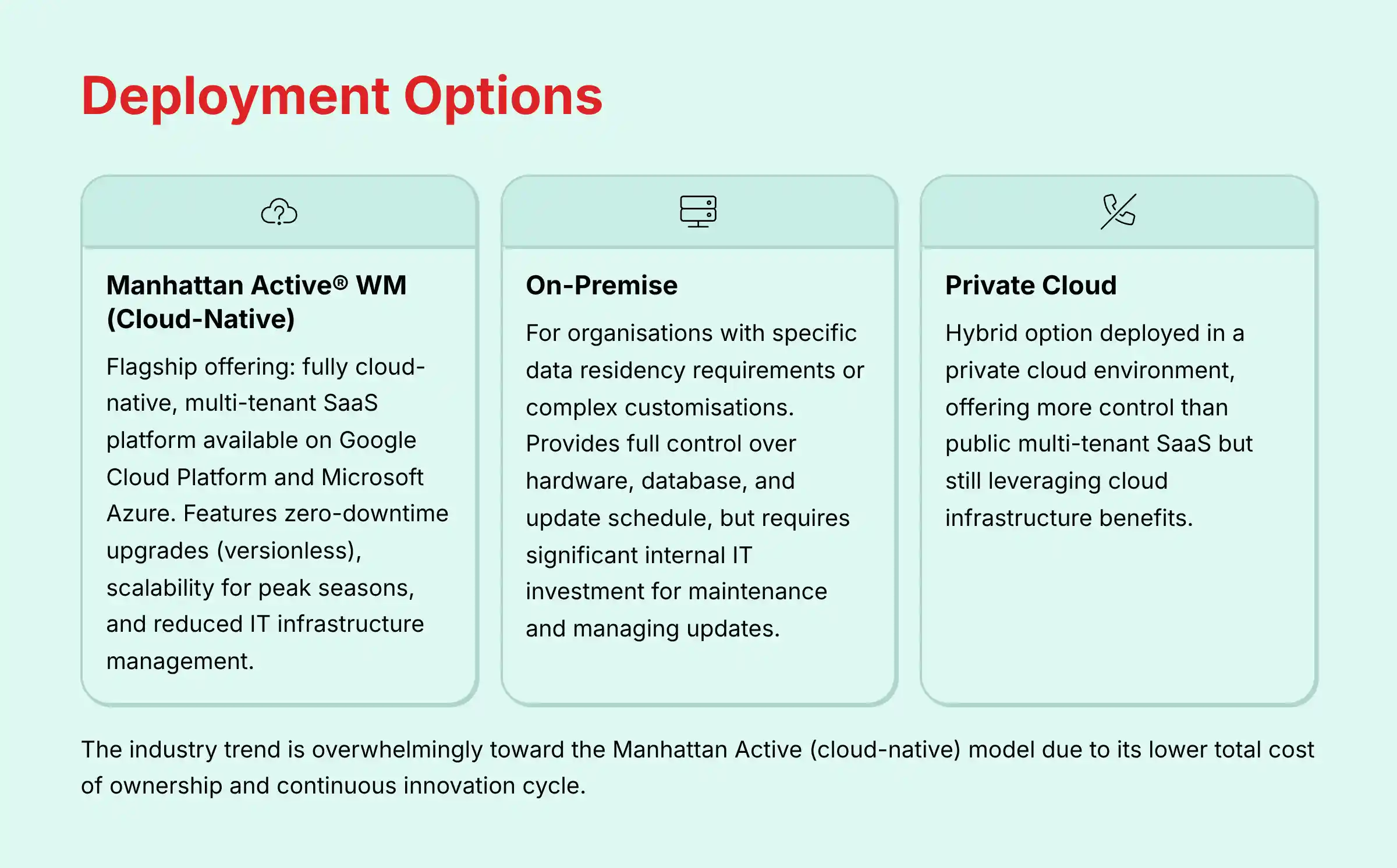
- Manhattan Active® WM (Cloud-Native): This is the company's strategic, state-of-the-art solution. It is a fully cloud-native, multi-tenant Software-as-a-Service (SaaS) platform, available on both Google Cloud Platform (GCP) and Microsoft Azure following a 2023 expanded partnership with Microsoft. The key benefits of this model include zero-downtime upgrades (it's versionless, meaning you always have the latest features), scalability to handle peak seasons effortlessly, and reduced reliance on internal IT infrastructure management. This is the recommended path for businesses seeking maximum agility and innovation.
- On-Premise: For organizations with specific data residency requirements, complex customizations, or a capital expenditure (CapEx) investment model, Manhattan still offers an on-premise deployment. This option provides the organization with full control over the hardware, database, and update schedule. However, it requires a significant internal IT investment for server maintenance, security, and managing periodic version upgrades, which often involve more planning and potential downtime.
- Private Cloud: A hybrid option where the WMS is deployed in a private cloud environment, offering more control than a public multi-tenant SaaS model but still leveraging cloud infrastructure benefits.
The industry trend is overwhelmingly toward the Manhattan Active (cloud-native) model due to its lower total cost of ownership (TCO) and continuous innovation cycle.
What specific industries is Manhattan Associates WMS best suited for?

Manhattan Associates WMS is a Tier 1 solution designed for complex, high-volume, and high-velocity distribution operations. It is not typically a fit for small businesses with simple warehousing needs. The platform has deep, domain-specific functionality tailored for several key industries:
- Retail & eCommerce: This is a core strength. The WMS excels at managing the complexities of omnichannel fulfillment, including e-commerce orders, buy-online-pickup-in-store (BOPIS), and direct-to-consumer (DTC) shipping alongside traditional store replenishment. Its ability to handle massive order volumes and SKU counts makes it ideal for large retailers.
- Third-Party Logistics (3PL): The system is built with robust multi-tenant capabilities, allowing 3PL providers to manage inventory and billing for numerous distinct clients within a single warehouse, each with unique business rules and requirements.
- Consumer Packaged Goods (CPG) & Food & Beverage: The WMS has strong features for managing batch/lot control, expiration dates (FEFO – First Expired, First Out), and traceability, which are critical for regulatory compliance and quality control in these sectors.
- Pharmaceuticals & Life Sciences: Similar to CPG, the platform supports the strict serialization, tracking, and validation requirements common in the highly regulated pharmaceutical supply chain.
Essentially, any organization whose competitive advantage depends on fulfillment speed, accuracy, and the ability to manage complex inventory rules across multiple channels is a prime candidate for Manhattan WMS. For those exploring implementation options, our detailed Manhattan Associates WMS Tutorials and Usecase guide provides practical insights into industry-specific applications.
How does Manhattan WMS compare to major competitors like Blue Yonder and SAP EWM?

Manhattan Associates WMS, Blue Yonder WMS, and SAP Extended Warehouse Management (EWM) are consistently ranked as leaders in Gartner's Magic Quadrant, but they have distinct strengths that appeal to different enterprise needs.
Here's a strategic comparison:
- Manhattan Associates WMS: Often considered the best-of-breed leader focused purely on supply chain execution. Its key differentiator is the Manhattan Active® WM cloud-native platform, which is “versionless” and allows for seamless, continuous innovation and upgrades. Its strengths lie in its deep, embedded AI/ML capabilities for optimization (slotting, labor, order streaming) and its user-friendly interface for both managers and floor operators. It's a top choice for complex, high-volume retail, 3PL, and omnichannel operations seeking maximum agility.
- Blue Yonder WMS: A very strong competitor with a similarly broad and deep feature set. Blue Yonder's strength often lies in its end-to-end platform integration, connecting WMS with its planning, forecasting, and transportation (TMS) solutions. Companies already invested in the Blue Yonder (formerly JDA) ecosystem may find it a compelling choice. The comparison often comes down to the modernity of the cloud architecture and the specific nuances of their AI-driven optimization engines.
- SAP EWM: SAP's primary advantage is its native, “out-of-the-box” integration with the SAP S/4HANA ERP. For businesses that are “wall-to-wall” SAP, using EWM can significantly reduce the complexity and cost of integration, as master data and transaction flows are tightly coupled. However, historically, some users have found its interface to be less intuitive than Manhattan's, and it may require more customization to match the specialized, best-of-breed functionality found in Manhattan WMS for highly complex, non-standard workflows.
The decision often boils down to this: choose SAP EWM for the tightest ERP integration in an SAP-centric landscape, and choose Manhattan WMS for best-of-breed functionality and cloud-native agility, especially in complex, non-SAP environments. For comprehensive insights on this comparison, explore our Manhattan Associates WMS Top Alternatives and Competitors analysis.
How does Manhattan WMS leverage AI to integrate with and orchestrate warehouse automation and robotics (AMRs/AGVs)?
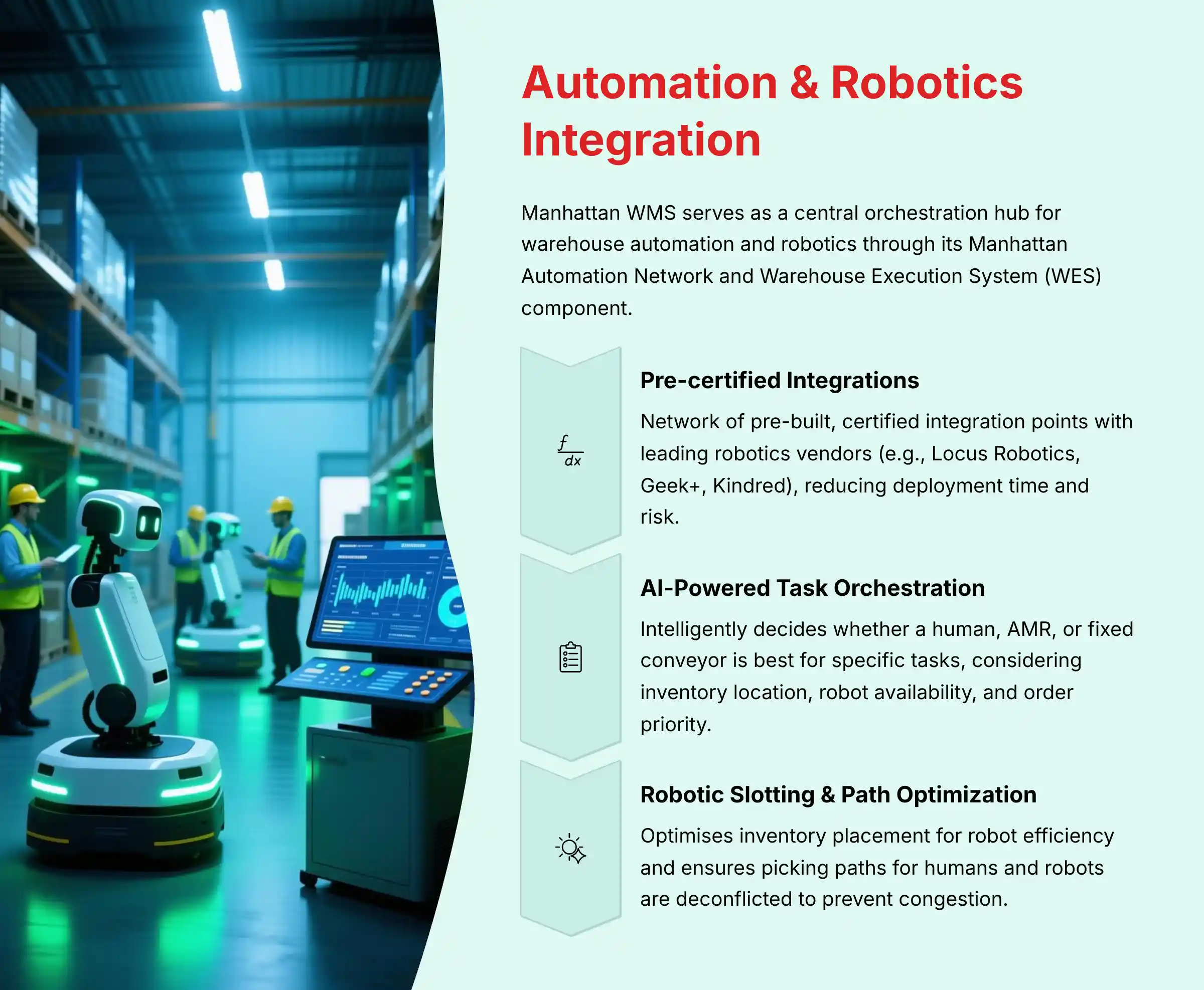
Manhattan Associates WMS goes beyond simple integration; it is designed to be a central orchestration hub for a diverse ecosystem of warehouse automation and robotics. This is achieved through its Manhattan Automation Network and a purpose-built Warehouse Execution System (WES) component that intelligently manages the flow of work between humans and machines.
The AI-driven approach to automation includes several key layers:
- Pre-certified Integrations: Manhattan has a growing network of pre-built, certified integration points with leading robotics vendors (e.g., Locus Robotics, Geek+, Kindred). This significantly reduces the time, cost, and risk of deploying new automation, as the communication protocols and workflows are already established.
- AI-Powered Task Orchestration: The system's AI doesn't just send a batch of work to the robots. It decomposes tasks and intelligently decides whether a human, an Autonomous Mobile Robot (AMR), or a fixed conveyor is the best resource for a specific task at a specific moment. It considers inventory location, robot availability, and overall order priority to make real-time dispatching decisions.
- Robotic Slotting and Path Optimization: The WMS's AI understands the capabilities and constraints of the robotic fleet. It can optimize inventory slotting to place high-velocity items in areas best served by AMRs and ensures that picking paths for both humans and robots are deconflicted and optimized to prevent congestion and maximize efficiency.
This “robot-agnostic” orchestration platform makes the WMS future-proof, allowing businesses to add or change automation vendors without having to re-architect their entire fulfillment process.
Expert's Insight: Avoiding the “Islands of Automation” Trap A common mistake when implementing warehouse automation is creating “islands of automation,” where a fleet of robots works efficiently in one process (e.g., picking) but creates a bottleneck downstream (e.g., packing) because the overall system isn't orchestrating the end-to-end flow. The true value of a system like Manhattan WMS is its ability to use its WES capabilities to balance the workload across both automated and manual processes simultaneously. Before investing in robotics, use the WMS data to identify your true bottleneck, not just the most obvious task to automate.
How does Manhattan WMS integrate with core business systems like an ERP and TMS?

Deep and seamless integration with Enterprise Resource Planning (ERP) and Transportation Management Systems (TMS) is non-negotiable for a WMS, as it cannot function in a silo. Manhattan WMS is designed for robust connectivity with this core ecosystem, primarily through a well-documented set of APIs and standard integration templates.
The integration framework operates on several key principles:
- ERP as the Single Source of Truth: The ERP (like SAP S/4HANA, Oracle NetSuite, or Microsoft Dynamics 365) remains the master system for financial data, sales orders, purchase orders, and item master data. Manhattan WMS integrates to pull this essential information in real-time. For example, when a sales order is created in the ERP, it is automatically sent to the WMS to begin the fulfillment process.
- Real-Time Inventory Synchronization: As inventory is received, moved, picked, or shipped within the WMS, it sends real-time updates back to the ERP. This ensures that the entire organization has an accurate, up-to-the-minute view of enterprise-wide inventory levels, which is critical for Available-to-Promise (ATP) calculations and preventing stockouts.
- TMS for Shipment Execution: Once an order is picked and packed in the WMS, it passes the shipment details (weight, dimensions, destination, required delivery date) to the TMS. The TMS then handles carrier selection, rate shopping, and route optimization. After the TMS finalizes the plan, it sends the carrier assignment and shipping labels back to the WMS for the final shipping process on the warehouse floor.
Integration is typically managed through modern REST APIs or traditional methods like EDI and file-based transfers, depending on the capabilities of the connecting system. A successful implementation relies heavily on a thorough mapping of business processes and data flows between the systems.
What are the key AI-driven optimization features in Manhattan WMS, such as order streaming and intelligent slotting?

Manhattan WMS differentiates itself through advanced AI-driven features that move beyond static, rule-based warehousing to a more dynamic and intelligent model of fulfillment. Two of the most impactful features are intelligent slotting and order streaming.
1. AI-Driven Slotting Optimization:
Traditional slotting is a manual, project-based effort done periodically. Manhattan's AI-driven slotting is continuous and proactive. The system's machine learning algorithms constantly analyze thousands of data points, including:
- Demand Seasonality: It anticipates seasonal peaks (e.g., holidays) and moves popular items to forward-picking locations before the rush begins.
- Product Affinity: It identifies items that are frequently bought together and suggests placing them near each other to streamline multi-item picks.
- Product Characteristics: It considers weight, size, and fragility to place heavy items on lower racks and prevent product damage.
The system generates slotting recommendations that can be reviewed by a manager or executed automatically, ensuring the warehouse layout is always optimized for the current and predicted order mix, drastically reducing picker travel time.
2. Order Streaming (Waveless Fulfillment):
Legacy WMS platforms use “wave planning”—grouping orders into large batches that are released to the floor periodically. This creates start-stop productivity and makes it difficult to prioritize urgent orders. Order Streaming, or waveless fulfillment, uses AI to eliminate these rigid waves. It constantly pulls from the entire pool of open orders and releases work to the floor in a continuous, real-time flow. The AI prioritizes orders based on carrier cut-off times, customer SLAs, and resource availability, ensuring that the highest-priority orders are always being worked on without creating bottlenecks. This makes the entire operation more agile and responsive.
Expert's Insight: Start with Slotting to Maximize ROI Many new users are eager to jump into complex features like robotics or waveless picking. However, the single biggest “quick win” for almost any warehouse implementing Manhattan WMS is to focus on the AI-driven slotting recommendations first. Poor slotting is the root cause of excessive travel time, which often accounts for over 50% of a picker's day. By trusting the AI's slotting intelligence for the first three months, you can achieve a significant boost in labor productivity with minimal process change. This builds momentum and provides a clean operational baseline from which to measure the impact of more advanced features later.
For professionals looking to master these optimization features, our Manhattan Associates WMS Tutorials and Usecase guide provides hands-on implementation guidance.
What is the pricing model for Manhattan Associates WMS?

Manhattan Associates does not publish a standard pricing list, as the cost is highly dependent on the scale and complexity of the customer's operation. The pricing model is enterprise-grade and tailored to each specific implementation. However, the structure is primarily based on the deployment model chosen.
The main pricing components are:
- Manhattan Active® WM (SaaS Model): For the cloud-native version, pricing is typically a recurring subscription fee (SaaS). This fee is usually calculated based on one or more key operational metrics, such as:
- The number of distribution centers (sites).
- The volume of transactions (e.g., number of orders or shipments processed annually).
- The number of users (though this is often a less significant factor than volume).
This subscription model converts the cost from a large, upfront capital expenditure (CapEx) to a predictable operating expense (OpEx). The fee includes the software license, cloud hosting, maintenance, security, and all future software updates.
- On-Premise Model: For the traditional on-premise deployment, the pricing model consists of a significant, one-time perpetual license fee paid upfront. In addition to this, there is an ongoing annual maintenance and support fee, which is typically a percentage (e.g., 18-22%) of the initial license cost. This model does not include hardware, database licenses, or the internal IT labor required to manage the system.
Prospective customers must engage directly with the Manhattan Associates sales team to enter a detailed discovery process, after which a custom quote will be provided based on their specific operational scope and volume.
Expert's Insight: Focus on Total Cost of Ownership (TCO), Not Just the License Fee A critical mistake in evaluating WMS pricing is focusing solely on the initial software cost. You must calculate the Total Cost of Ownership (TCO) over a 5-7 year period. For the on-premise model, be sure to factor in the costs of servers, database licenses (e.g., Oracle), IT staff for maintenance, and the significant business disruption and cost of major version upgrades every few years. For the SaaS model, while the recurring fee may seem higher initially, it often results in a lower TCO because it includes hardware, maintenance, and seamless, non-disruptive upgrades, eliminating the risk of falling behind on technology.
How long does a typical implementation of Manhattan Associates WMS take?
A typical implementation of Manhattan Associates WMS for a single, large-scale distribution center is a significant undertaking and generally ranges from 9 to 18 months. The exact timeline can vary widely based on several key factors:
- Complexity of Operations: A warehouse with highly complex processes, extensive value-added services (like kitting or personalization), or sophisticated automation will naturally require a longer implementation timeline than a more straightforward pallet-in, case-out operation.
- Integration Requirements: The number and complexity of integrations are major drivers of the timeline. Integrating with a single, modern ERP via pre-built connectors is much faster than building custom integrations to multiple legacy homegrown systems.
- Data Migration: Cleansing, formatting, and migrating clean master data (item masters, location data, vendor information) from legacy systems into the new WMS is a time-consuming but critical step that is often underestimated.
- Customization vs. Configuration: Implementations that can adhere closely to the WMS's standard, “out-of-the-box” workflows through configuration will be significantly faster than those requiring extensive software customization to accommodate unique business processes. The goal is always to configure, not customize.
- Resource Availability: The project's speed is highly dependent on the availability and dedication of the client's own subject matter experts, project managers, and IT resources.
A phased approach is often recommended, where core functionality is rolled out first, followed by more advanced features or additional facilities in subsequent phases.
Do I need an official implementation partner for Manhattan Associates WMS?

Yes, for the vast majority of companies, engaging an official implementation partner or Manhattan Associates' own Professional Services team is not just recommended—it is essential for success. Self-implementation is extremely rare and only feasible for organizations that possess an exceptionally large, experienced in-house team with deep expertise specifically in Manhattan WMS.
Here's why a certified partner is critical:
- Deep Product Expertise: Manhattan WMS is a powerful and highly configurable system. Implementation partners have teams of certified consultants who understand the system's architecture, best practices, and potential pitfalls. They know how to configure the system to meet business requirements without resorting to risky customizations.
- Structured Methodology: Partners follow a proven implementation methodology that covers every stage of the project, from initial design and configuration to testing, training, and go-live support. This structured approach helps keep the project on time and on budget.
- Industry-Specific Knowledge: Many partners specialize in specific industries (e.g., retail, 3PL, pharma) and bring valuable experience from dozens of similar implementations. They can provide insights on industry best practices that the client may not be aware of.
- Risk Mitigation: A WMS implementation touches every part of your operation. An experienced partner knows how to anticipate and mitigate common risks related to integration, data migration, and change management, reducing the chance of a costly go-live failure.
While using a partner adds to the overall project cost, the value they provide in terms of expertise, risk reduction, and speed-to-value far outweighs the investment. It is a necessary cost of doing business when implementing a Tier 1 WMS.
What kind of technical support and training does Manhattan Associates offer post-implementation?
Manhattan Associates offers a comprehensive, multi-tiered support and training ecosystem designed to ensure long-term customer success after the initial go-live.
Technical Support:
The support structure is typically organized into tiers, ensuring issues are routed to the appropriate level of expertise.
- Customer Portal & Knowledge Base: The first line of support is a comprehensive online portal that includes a knowledge base, product documentation, community forums, and a case management system for logging support tickets.
- Tiered Support Team: For issues that cannot be self-resolved, Manhattan provides a global support team. Cases are typically categorized by severity (e.g., Severity 1 for a system-down emergency to Severity 4 for a minor inquiry), with guaranteed response times based on the Service Level Agreement (SLA).
- Dedicated Support Manager: For larger enterprise clients, a dedicated Customer Success Manager or Account Manager is often assigned to provide a single point of contact, manage escalations, and facilitate strategic reviews. For Manhattan Active WM customers, support is tightly integrated, as Manhattan manages the underlying cloud infrastructure.
Training & Education:
Manhattan offers a robust educational program called the “Manhattan Academy.” This includes:
- Role-Based Training: Courses are tailored to different user roles, from warehouse associates and super-users to system administrators.
- Delivery Formats: Training is available in multiple formats, including instructor-led classes (both virtual and in-person), self-paced eLearning modules, and custom on-site training sessions.
- Certification Programs: They offer formal certification paths for individuals to become certified professionals on the platform, which is valuable for building a strong internal center of excellence.
For teams looking to maximize their investment in Manhattan WMS through comprehensive training and best practices, our Manhattan Associates WMS FAQs resource provides additional guidance on support and training considerations.
Manhattan Associates WMS represents the pinnacle of warehouse management technology, combining AI-driven optimization with cloud-native architecture to deliver unparalleled operational efficiency. Whether you're considering implementation, evaluation alternatives, or seeking to optimize your current deployment, understanding these fundamental aspects will guide your decision-making process.
For organizations ready to transform their warehouse operations with cutting-edge technology, Manhattan WMS offers a comprehensive solution backed by industry-leading expertise and support. To explore more about warehouse management systems and AI-powered solutions, check out our comprehensive guide on the Best 10 AI Warehouse Management Systems (WMS).

Leave a Reply