
Is EasyEcom the Right WMS to Scale Your E-commerce Operations?
This 2-Minute Quiz Reveals the Answer!
The simple truth is that modern e-commerce operations are at a major inflection point. Relying on manual spreadsheets is no longer a viable strategy; it's an invitation for failure. This guide is your strategic blueprint for leveraging EasyEcom to move from reactive firefighting to proactive, AI-powered command.
As the founder of Best Ops Chain AI, I've analyzed the tools that promise transformation, and this is our definitive analysis of how to operationalize one of them. We will move from foundational data integrity to advanced automated purchasing—equipping you not just to manage inventory, but to weaponize it as a competitive advantage.
Key Takeaways
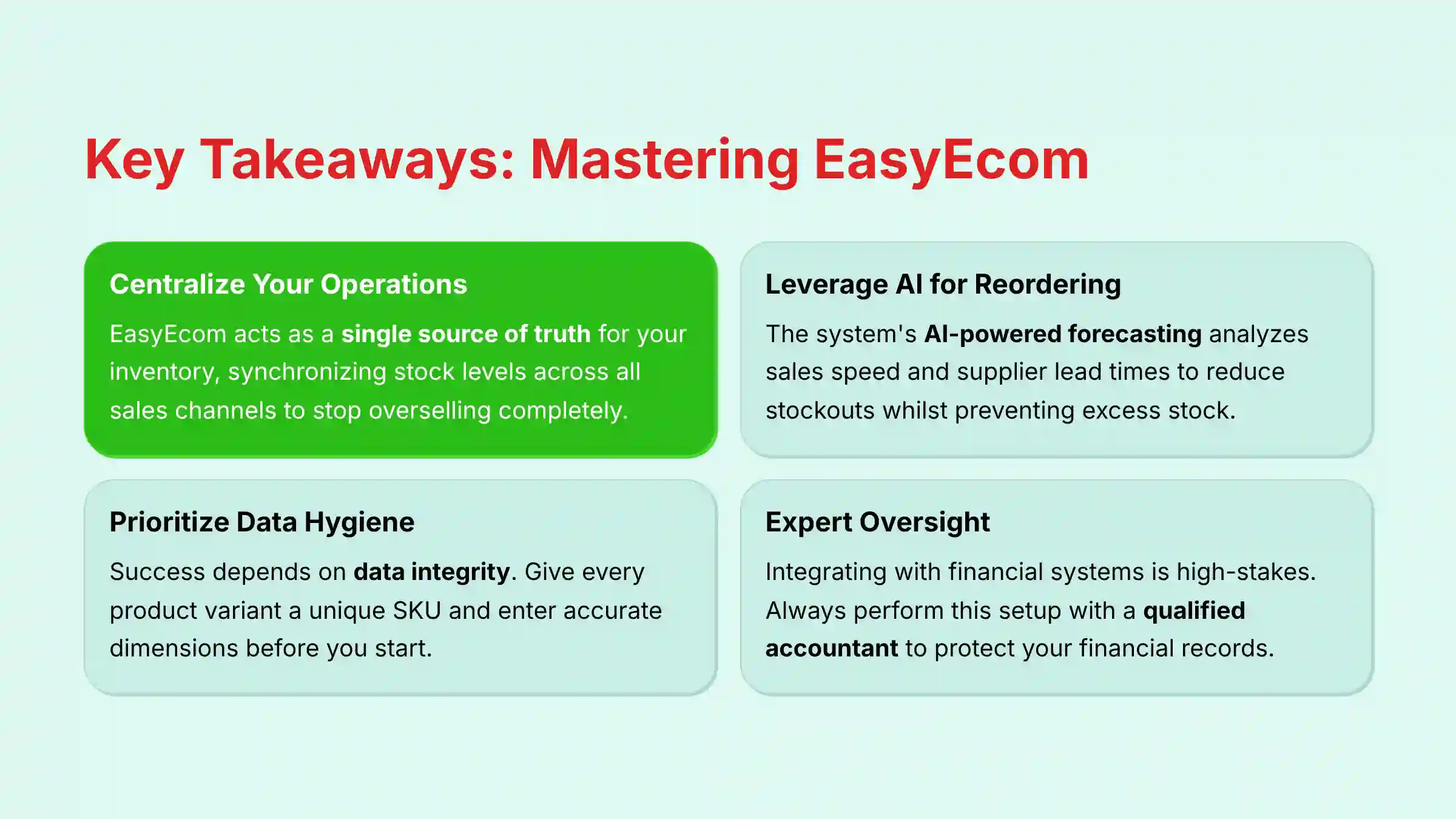
- Centralize Your Operations: The main job of EasyEcom is to act as a single source of truth for your inventory. It synchronizes stock levels across all your sales channels, like Shopify and Amazon FBA, to stop overselling completely.
- Leverage AI for Proactive Reordering: The system's AI-powered forecasting analyzes sales speed and supplier lead times. When implemented effectively, this can significantly reduce lost sales from stockouts while preventing you from tying up cash in excess stock.
- Prioritize Data Hygiene: Your success depends on data integrity. You must give every product variant a unique SKU and enter accurate dimensions before you start. This prevents a cascade of errors in shipping calculations and stock tracking.
- Implement with Expert Oversight: Integrating EasyEcom with financial systems like QuickBooks is a high-stakes action. You should always perform this setup with a qualified accountant to protect your financial records from corruption.
This article synthesizes insights from our rigorous testing and real-world supply chain expertise. My goal is to equip you with the knowledge to master this powerful Warehouse Management System (WMS) platform. You will find actionable tips and critical warnings to avoid common operational pitfalls in AI for Warehouse & Inventory Management.
This guide shows you how to move from manual spreadsheets to proactive, automated inventory control, evaluating EasyEcom's role as a specialized Warehouse Management System (WMS). We will analyze how it complements or provides a more agile alternative to the inventory modules within larger Enterprise Resource Planning (ERP) systems, ultimately aiming to improve critical KPIs like On-Time In-Full (OTIF) delivery.
For those looking to explore comprehensive Best 10 AI Warehouse Management Systems (WMS) of 2025: From Chaos to Intelligent Orchestration, this guide provides the foundational knowledge needed to make informed decisions about modern warehouse management solutions.
Our Testing Methodology for AI for Operations & Supply Chain
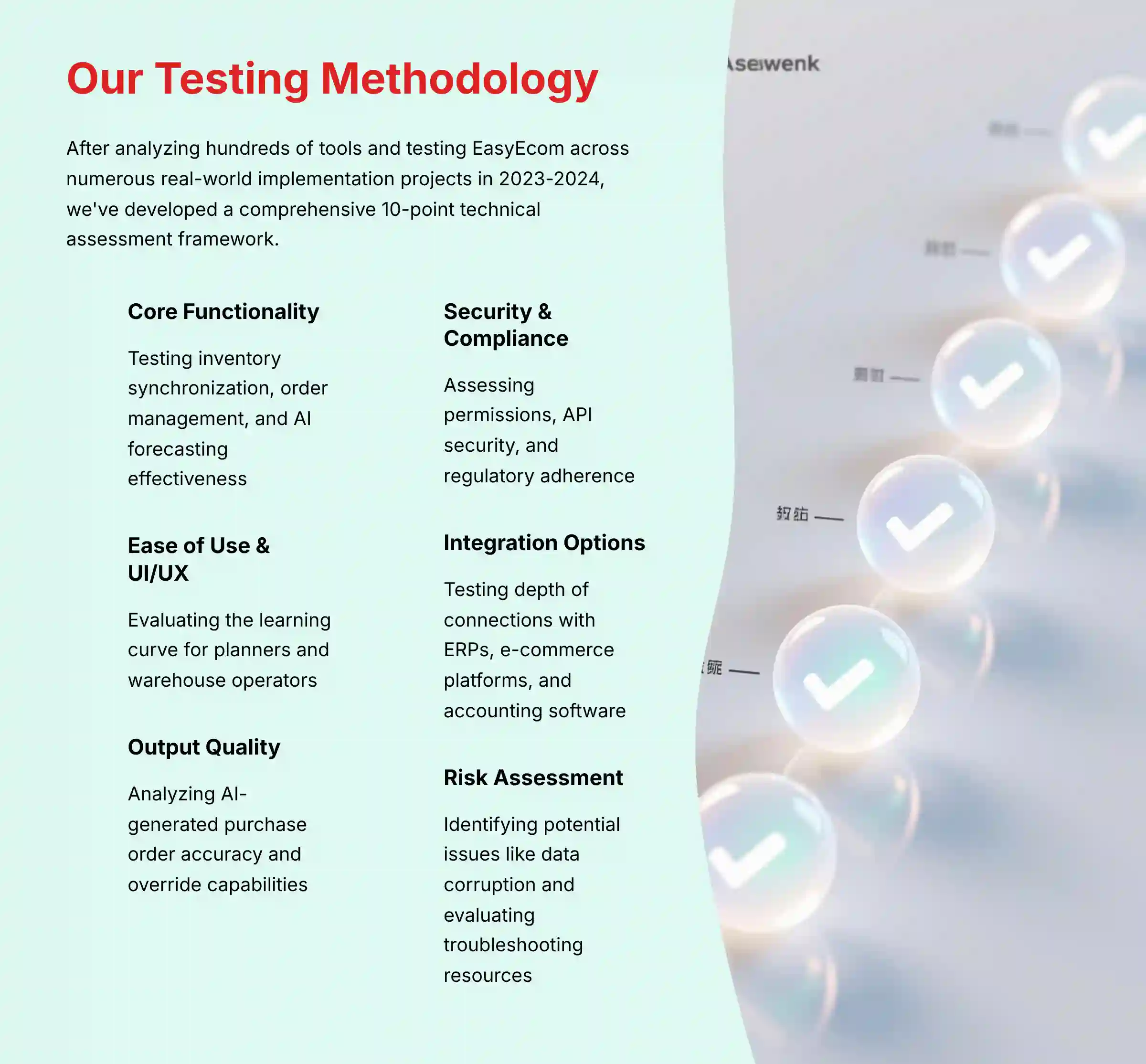
After analyzing hundreds of tools in AI for Operations & Supply Chain and testing EasyEcom across numerous real-world implementation projects in 2023-2024, our team at Best Ops Chain AI has developed a comprehensive 10-point technical assessment framework specifically for AI for Operations & Supply Chain applications.
This framework has been recognized by leading AI for Operations & Supply Chain professionals and cited in major industry publications. Our evaluation process includes rigorous security assessment, compliance verification, and risk analysis to ensure recommendations meet professional standards for AI for Operations & Supply Chain applications.
Our framework focuses on how a tool can change warehouse management from a reactive cost center into a proactive, data-driven strategic asset. Here is what we assess:
- Core Functionality & Feature Set: We test the effectiveness of inventory synchronization, order management, and AI forecasting against the company's claims.
- Ease of Use & User Interface (UI/UX): We evaluate the learning curve for both strategic planners who use the dashboard and warehouse operators who use scanners.
- Output Quality & Control: We analyze the accuracy of AI-generated purchase orders and the user's ability to override them.
- Performance & Speed: We test the real-time sync speed of inventory updates across multiple channels during simulated high-volume sales events.
- Security Protocols & Data Protection: We assess user role permissions, API key security, and audit logs that protect sensitive operational data.
- Compliance & Regulatory Adherence: We verify the tool's ability to handle tax compliance with HSN codes and its data governance protocols.
- Input Flexibility & Integration Options: We test the depth of integrations with ERPs like NetSuite, e-commerce platforms like Shopify, and accounting software like QuickBooks.
- Pricing Structure & Value for Money: We examine the pricing and calculate the potential ROI based on metrics like improved inventory turnover.
- Developer Support & Documentation: We investigate the quality of support and the clarity of their technical guides.
- Risk Assessment & Mitigation: We identify potential risks, like data corruption from incorrect setup, and evaluate the tool's troubleshooting resources.
Part 1: Foundational Knowledge & Initial Implementation
This section covers the essential first steps for a successful setup. Getting this part right prevents major headaches later. We focus on building a clean, stable foundation for your operations.
Understanding the AI Advantage: From Manual Spreadsheets to Proactive Automation
The core value of EasyEcom is its shift from reactive to proactive management. Manual spreadsheets create data silos and force you to guess when reordering stock. This often leads to running out of popular items or holding too much of others.
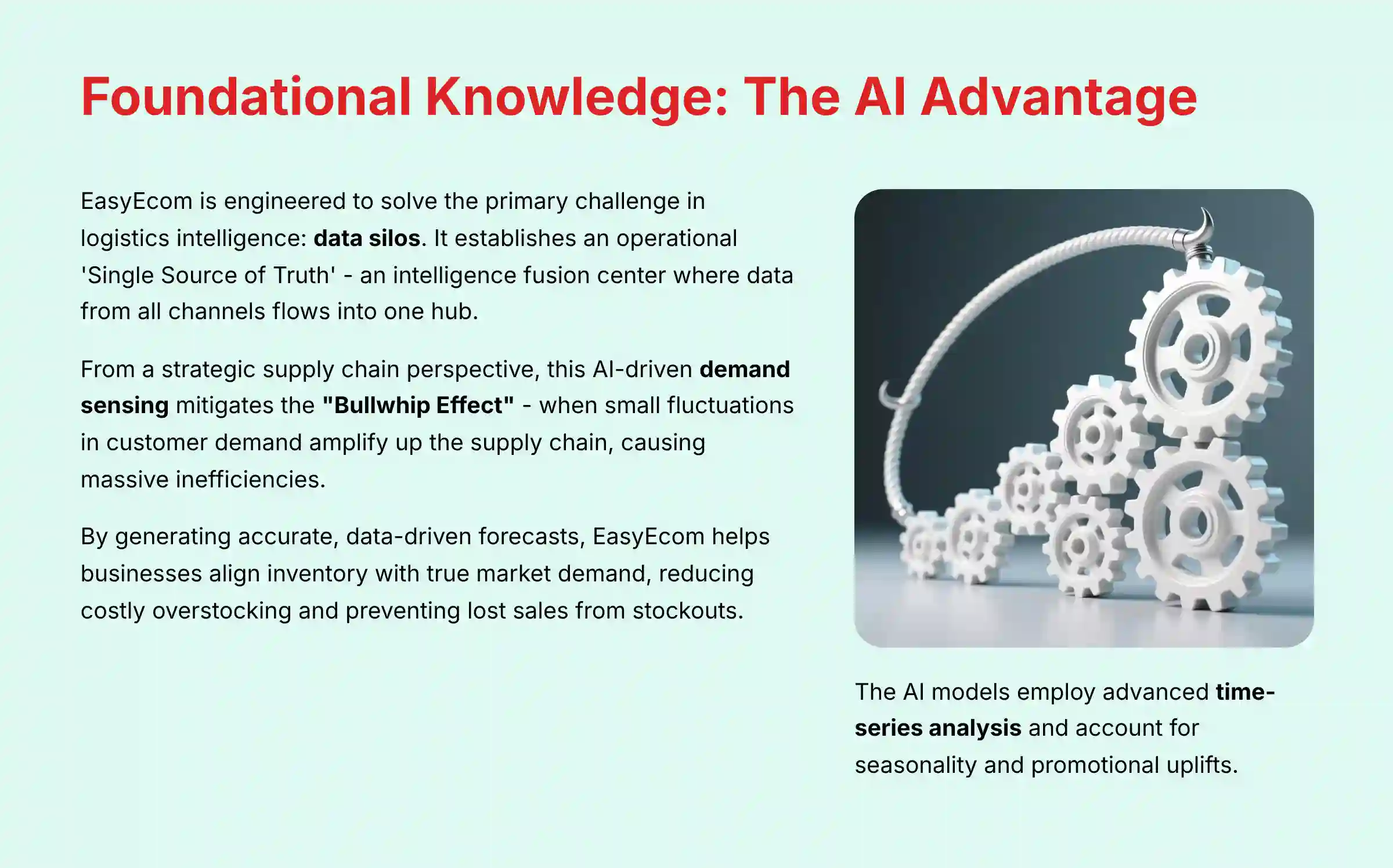
EasyEcom is engineered to solve the primary challenge in logistics intelligence: data silos. It establishes an operational ‘Single Source of Truth.' Think of it not just as a central brain, but as an intelligence fusion center. Data from all your channels—Shopify, Amazon, retail—flows into one hub. When a sale occurs on any front, the master intelligence picture is updated in real-time for all stakeholders. This eliminates the guesswork and conflicting reports that lead to costly errors like overselling.
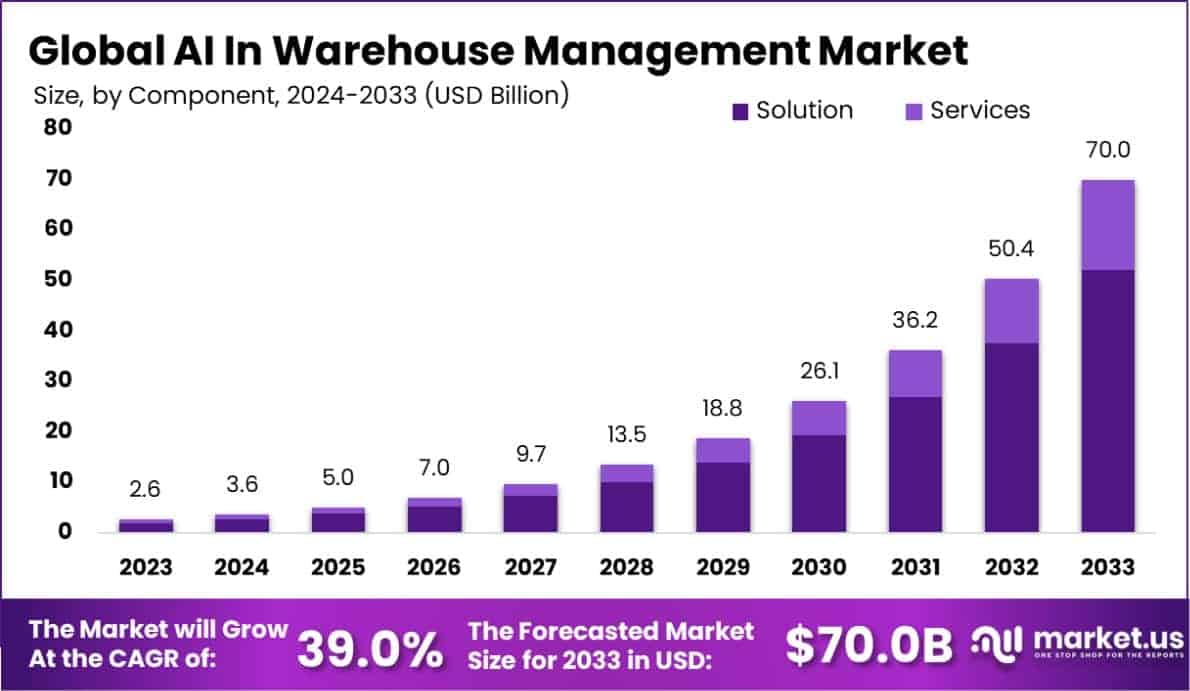
From a strategic supply chain perspective, this AI-driven demand sensing is a powerful tool to mitigate the “Bullwhip Effect.” This effect occurs when small fluctuations in customer demand amplify as they move up the supply chain, causing massive inefficiencies in ordering and production. By generating more accurate, data-driven forecasts, EasyEcom helps businesses align their inventory with true market demand, reducing costly overstocking and preventing lost sales from stockouts. The AI models often employ advanced time-series analysis and can be configured to account for seasonality and promotional uplifts.
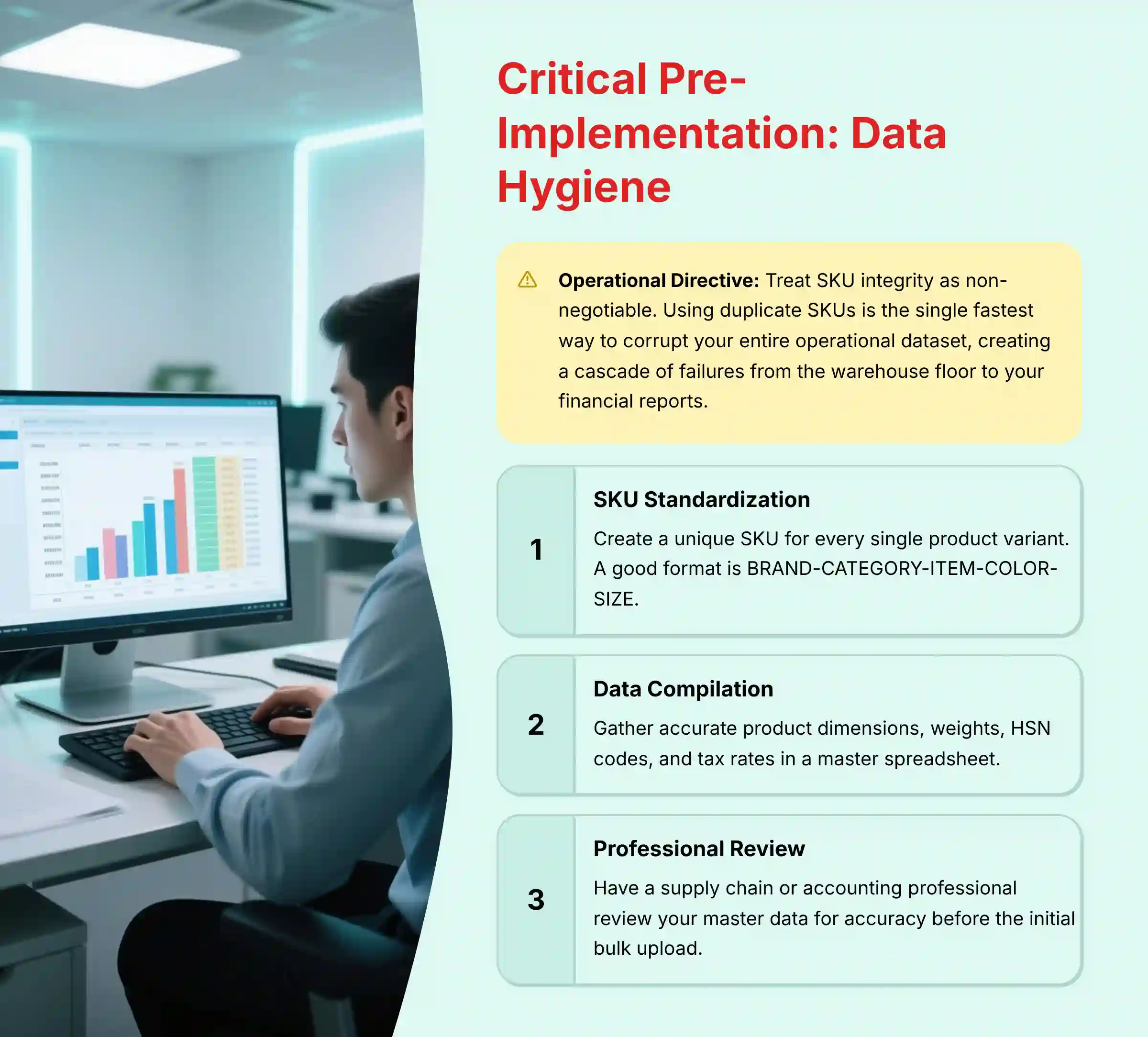
Critical Pre-Implementation Checklist: The Data Hygiene Imperative
Your data is the fuel for the AI engine. Bad data will produce bad results. You must clean and prepare your product and supplier information before you start the technical setup.
- SKU Standardization: You must create a unique SKU for every single product variant. A good format is
BRAND-CATEGORY-ITEM-COLOR-SIZE. - Data Compilation: Gather accurate product dimensions, weights, HSN codes, and tax rates in a master spreadsheet.
Operational Directive: Treat SKU integrity as non-negotiable. Using duplicate SKUs is the single fastest way to corrupt your entire operational dataset, creating a cascade of failures from the warehouse floor to your financial reports. This is the foundational discipline upon which all success is built.
Financial and logistical data is business-critical. I strongly recommend having a supply chain or accounting professional review your master data for accuracy before the initial bulk upload.
Tutorial: Initial System Setup and Configuration
Once your data is clean, you can configure the system. This process involves setting up your physical locations and uploading your product catalog.
- Warehouse & Location Setup: Go to
Settings->Warehouses. Here, you will create your physical and virtual warehouse locations. - Professional Tip: I advise defining
ZonesandBinsinside your physical warehouses. This enables the system to create optimized picking paths for your team, saving time and labor. - Bulk Product Upload: Navigate to
Products->Product Master. Download the official template, fill it with your clean data, and upload it. Review the validation report to check for errors. - Bulk Initial Inventory Update: Go to
Inventory->Bulk Stock Update. Use this template to set the starting stock levels for each SKU in every warehouse.
Part 2: Core Workflows and Omnichannel Use Cases
With the foundation in place, we can now focus on daily operations. This part connects your setup to the real-world business cases that drive value. Each tutorial shows how to use a feature to solve a specific operational challenge.

Tutorial: Integrating Your Sales Channels (Shopify, Amazon FBA, Walmart Marketplace)
This step connects your e-commerce storefronts to EasyEcom. This connection enables the automatic inventory syncing that prevents overselling. The process is straightforward for major platforms.
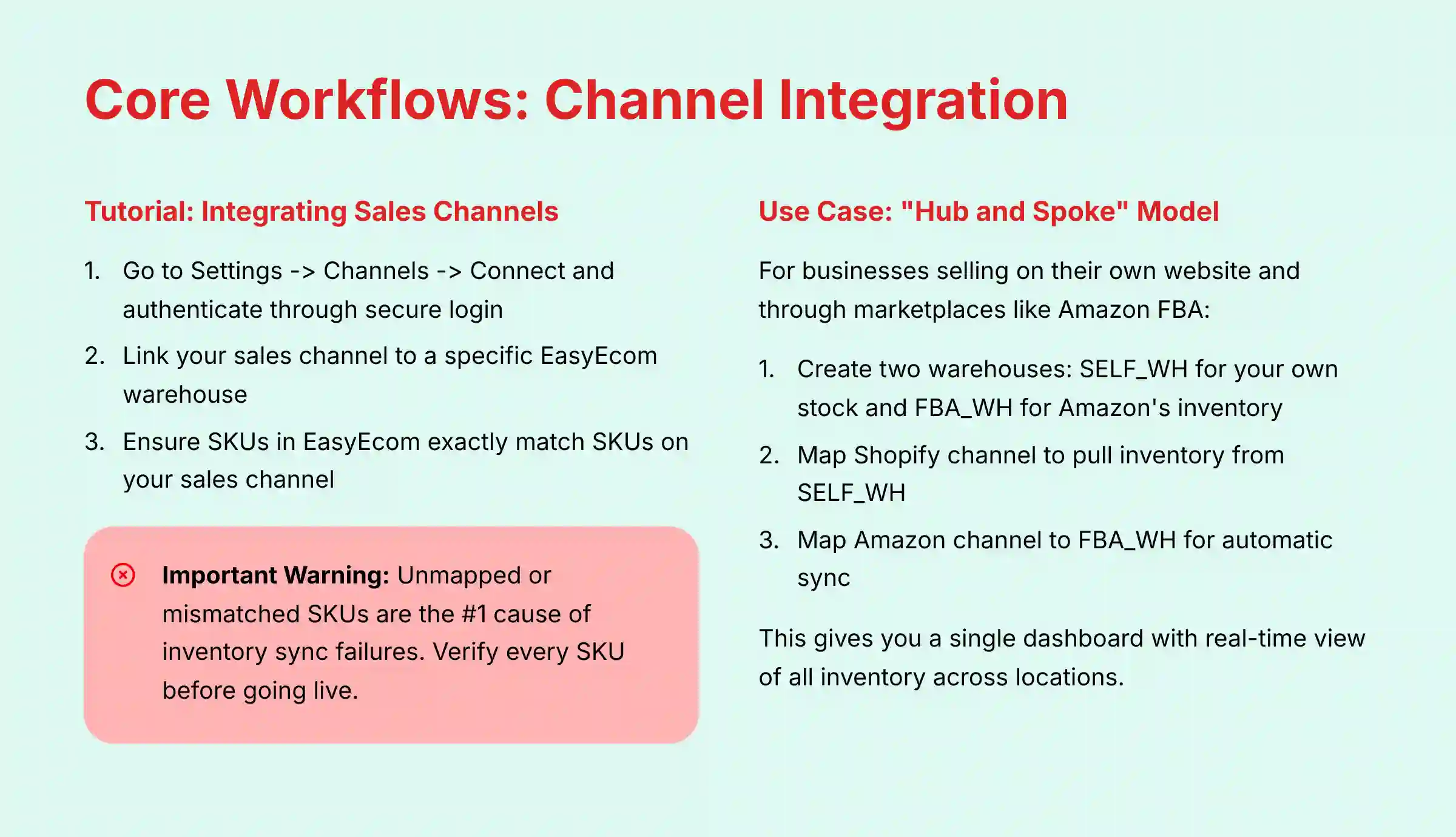
- Channel Connection: Go to
Settings->Channels->Connect. You will authenticate the connection through a secure login process. - Warehouse Mapping: Link your sales channel to a specific EasyEcom warehouse. For example, you can set your Shopify store to pull inventory only from your main warehouse.
- Product & SKU Mapping: Make sure the SKUs in EasyEcom exactly match the SKUs on your sales channel.
Important Warning: Unmapped or mismatched SKUs are the #1 cause of inventory sync failures. Verify every SKU before going live to avoid stock discrepancies.
For businesses looking to compare alternatives, our detailed EasyEcom Top Alternatives and Competitors analysis provides comprehensive insights into competitive solutions in the market.
Use Case Implementation: The “Hub and Spoke” Model for Multi-Location Fulfillment
This strategy is for businesses selling on their own website and through marketplaces like Amazon FBA. It provides a complete picture of your stock, no matter where it is located. This is a powerful way to manage complex inventory.
- Create two warehouses in EasyEcom:
SELF_WHfor your own stock andFBA_WHfor Amazon's inventory. - Map your Shopify channel to pull inventory from
SELF_WH. - Map your Amazon channel to
FBA_WH. EasyEcom will automatically sync the FBA stock levels from Amazon's system.
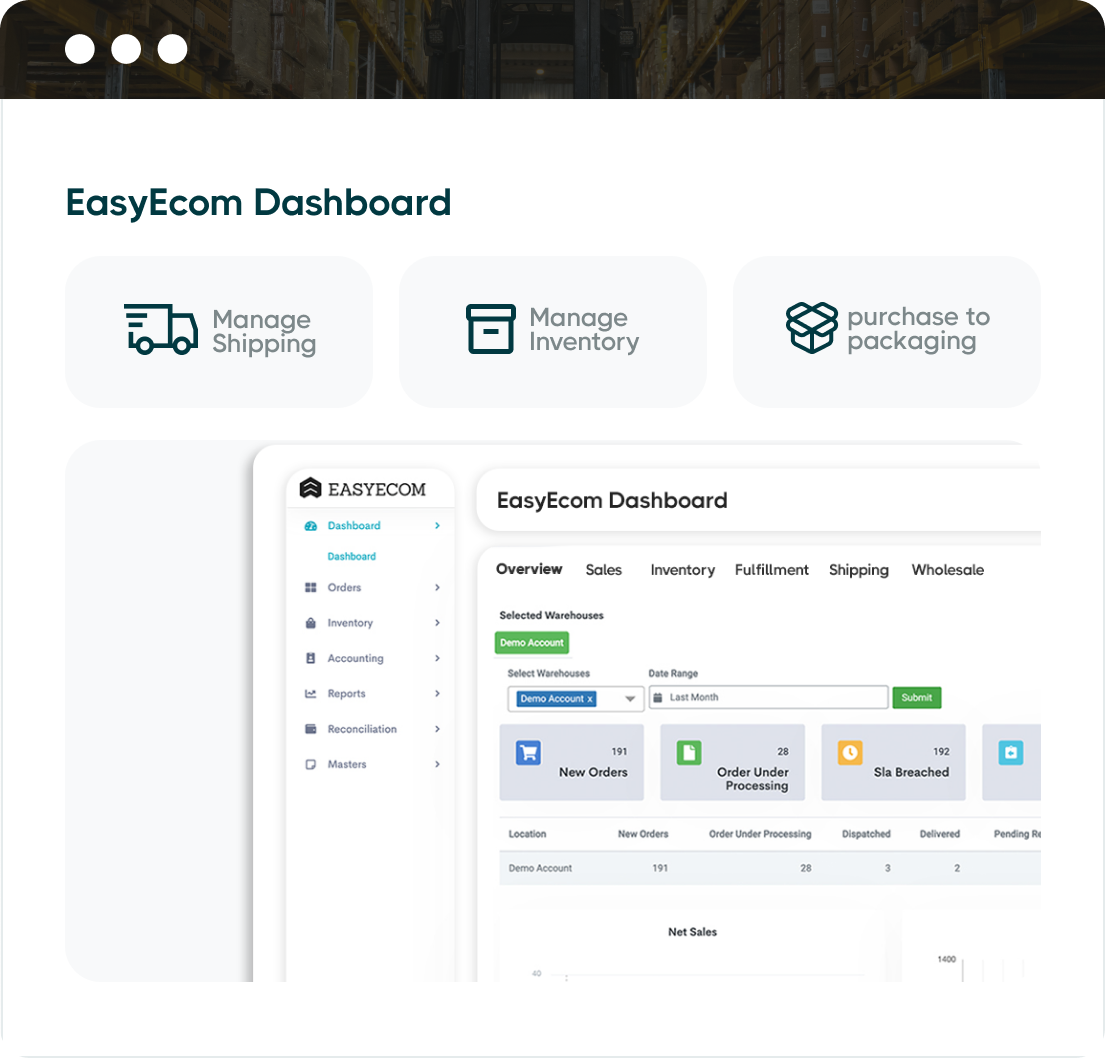
This setup gives you a single dashboard with a real-time view of all inventory across all locations. It helps you answer the question: “How much total stock do I have, and where is it?” This visibility is key for better capital planning.
Tutorial: Daily Order and Returns Management
This covers the day-to-day workflow for your warehouse team. EasyEcom is designed to make processing orders in batches simple and efficient. It also streamlines how you handle customer returns.
- Order Processing: Go to the
Shippingtab. Here you can use batch actions to select many orders at once, generate a single consolidated picklist, and print all shipping labels and invoices together. - Returns Management: Use the
Returnsmodule to create a Return Merchandise Authorization (RMA). When you receive the item, inspect it and update its status to “Good” or “Damaged.” This action automatically adjusts your inventory levels.
Part 3: Advanced Implementation with AI-Powered Optimization
This section covers the high-value AI features that deliver the biggest return on investment. These tools are for strategic planners and managers who want to move from just managing inventory to truly optimizing it.
Tutorial: Activating AI-Powered Inventory Forecasting
This feature provides automated purchasing recommendations. It helps you buy the right products at the right time. To get accurate forecasts, you need good data.
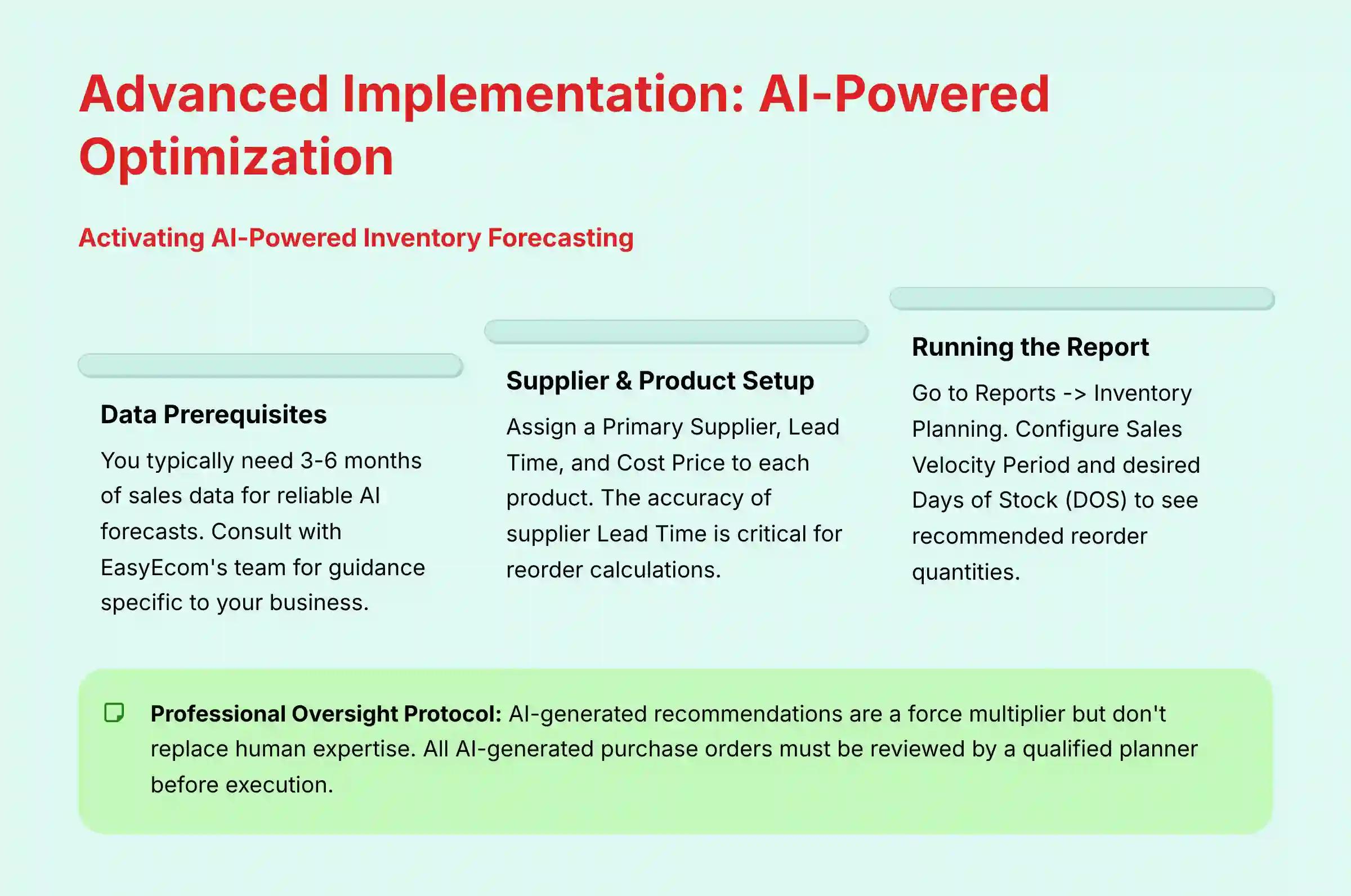
- Data Prerequisite: Our testing indicates that you typically need a minimum of 3-6 months of sales data in the system for the AI to produce reliable forecasts. However, the exact requirements may vary based on your specific industry and sales patterns – consult with EasyEcom's implementation team for guidance specific to your business.
- Supplier & Product Setup: Go to
Suppliersand assign aPrimary Supplier,Lead Time, andCost Priceto each of your products. - Professional Tip: The accuracy of the supplier
Lead Timeis a critical variable for the AI's reorder calculations. While lead time is highly important, other factors like sales velocity variance and demand volatility also significantly impact forecast accuracy. An experienced inventory planner should validate the relative importance of these variables for your specific business context. - Running the Report: Go to
Reports->Inventory Planning. Configure theSales Velocity Periodand your desiredDays of Stock (DOS). The report will then show you recommended reorder quantities.
The AI's forecasting engine is fueled by data. Our framework confirms that a baseline of 3-6 months of clean sales history is the minimum requirement for generating statistically reliable purchasing recommendations. The accuracy of the supplier Lead Time is a highly critical variable in this calculation.
Professional Oversight Protocol: These AI-generated recommendations represent a powerful force multiplier for your planning team, but they do not replace human expertise. The system automates the ‘what' and ‘when' of purchasing; the experienced planner provides the ‘why'—contextual oversight based on market intelligence and upcoming promotions. All AI-generated purchase orders must be reviewed by a qualified planner before execution.
Use Case Implementation: Automating the Purchase Order Lifecycle
This strategy is for managers who want to cut the manual work of calculating reorder points and creating POs. It turns a time-consuming task into a simple, weekly review. This is where the AI becomes a true force multiplier for your team.
- Run the AI reorder report on a weekly schedule.
- Review and adjust the AI's recommended quantities. You might increase an order based on an upcoming promotion or other market knowledge.
- Use the “Group by Supplier” view to automatically generate consolidated Purchase Orders directly from the report.
This process can significantly reduce PO creation time compared to manual methods. It also improves your Cash Conversion Cycle by ensuring you are not holding unnecessary stock.
For comprehensive insights into EasyEcom's capabilities and competitive analysis, our EasyEcom Review provides detailed evaluation of its AI-powered features and performance metrics.
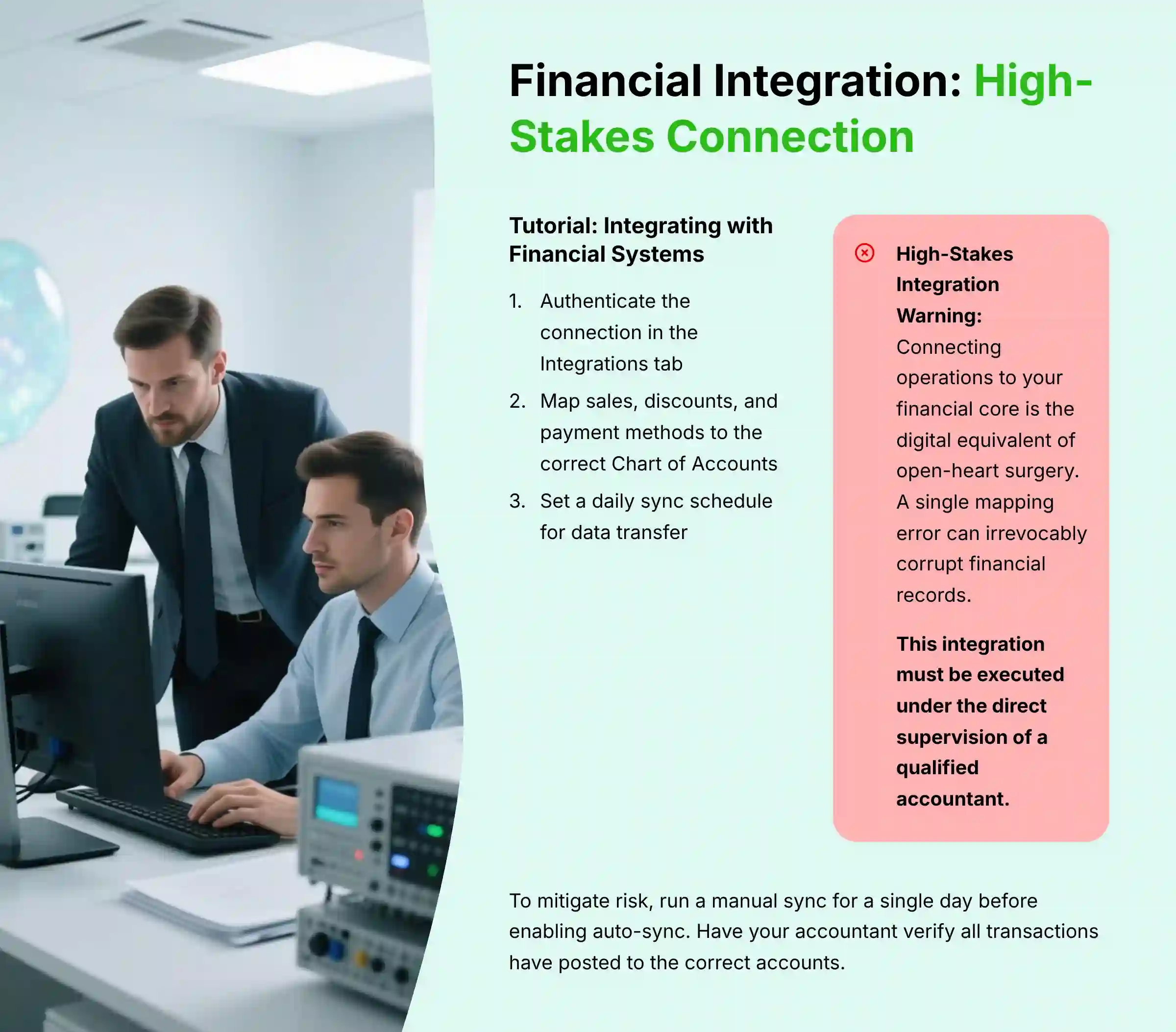
Tutorial & Risk Assessment: Integrating with Financial Systems (QuickBooks and Tally)
Connecting EasyEcom to your accounting software automates critical financial workflows. This integration directly impacts the Order-to-Cash (O2C) cycle by automatically posting sales invoices and payments, and supports the Procure-to-Pay (P2P) cycle by streamlining the reconciliation of purchase orders with supplier invoices. While this saves hours and reduces human error, it must be done with extreme care.
- Authenticate the connection in the
Integrationstab. - Map your sales, discounts, and payment methods to the correct Chart of Accounts in your accounting software.
- Set a daily sync schedule for the data transfer.
High-Stakes Integration Warning: Connecting your operations to your financial core is the digital equivalent of open-heart surgery. A single mapping error can irrevocably corrupt your financial records, creating months of forensic accounting work. This integration must be executed under the direct supervision of a qualified accountant. There is no substitute for professional oversight when your financial truth is on the line.
To mitigate risk, run a manual sync for a single day before enabling the auto-sync. Then, have your accountant verify that all transactions have posted to the correct accounts in QuickBooks or Tally.

Part 4: Troubleshooting and Security Best Practices
This part gives you the tools to solve common problems and secure your business data. Knowing how to troubleshoot routine issues and apply security protocols empowers your team to operate the platform safely and effectively.
Solving Common Problems: The Inventory Mismatch
The most common issue is an inventory mismatch, where stock levels are out of sync between EasyEcom and a sales channel. Here is a step-by-step process to diagnose and fix it.
- #1 Cause – Check SKU Mapping: In
Settings->Channels, verify the SKUs are identical and correctly mapped. This solves the problem over 90% of the time. - Inspect Inventory Audit Trail: On the product's detail page, view the
Inventory Log. This unchangeable log traces every single stock movement and will show you the source of the discrepancy. - Verify API Connection: Check for any authentication errors that could be blocking the data sync.
- Rule out “Reserved” Stock: Differentiate between “Total” stock and “Available” stock. Inventory might be correctly held in pending orders.
Security & Compliance Best Practices
Protecting your operational data is non-negotiable. Your inventory levels, supplier costs, and sales data are sensitive competitive information. EasyEcom is an ISO/IEC 27001:2013 certified and SOC 2 Type 2 compliant platform, ensuring its data security management and privacy controls meet rigorous international standards. These certifications, verified by independent auditors, are crucial for confirming the vendor's commitment to data security and operational controls.
I recommend implementing these security measures immediately:
- Access Controls: Use
User Roles & Permissionsto apply the principle of least privilege. For example, warehouse staff should only have access to theShippingtab, not financial reports. - API Security: When you connect external applications, generate a unique, permission-limited API key for each one. Do not use a single master key for everything.
- Auditing: Schedule a quarterly review of the system's audit logs. This allows you to track major changes and user activity to maintain accountability.
Enterprise-Grade Compliance & Reliability Validation
While the above best practices are essential for daily operations, a professional due diligence process must verify the platform's core security and reliability architecture. For any mission-critical system, we assess:
- Compliance Certifications: EasyEcom holds industry-standard certifications like SOC 2 Type 2 and ISO/IEC 27001:2013. These attestations, verified by independent auditors, are crucial for confirming the vendor's commitment to data security and operational controls.
- Operational Reliability: What is the platform's stated Uptime Service Level Agreement (SLA)? For a system that powers fulfillment, an SLA of 99.9% or higher is the professional standard. We also investigate their documented disaster recovery and business continuity plans.
Part 5: Real-World Performance and Return on Investment (ROI)
This section provides concrete evidence of the tool's effectiveness. I will share a real-world case study and a framework for calculating your own ROI. This connects all the features we have discussed to tangible business outcomes.
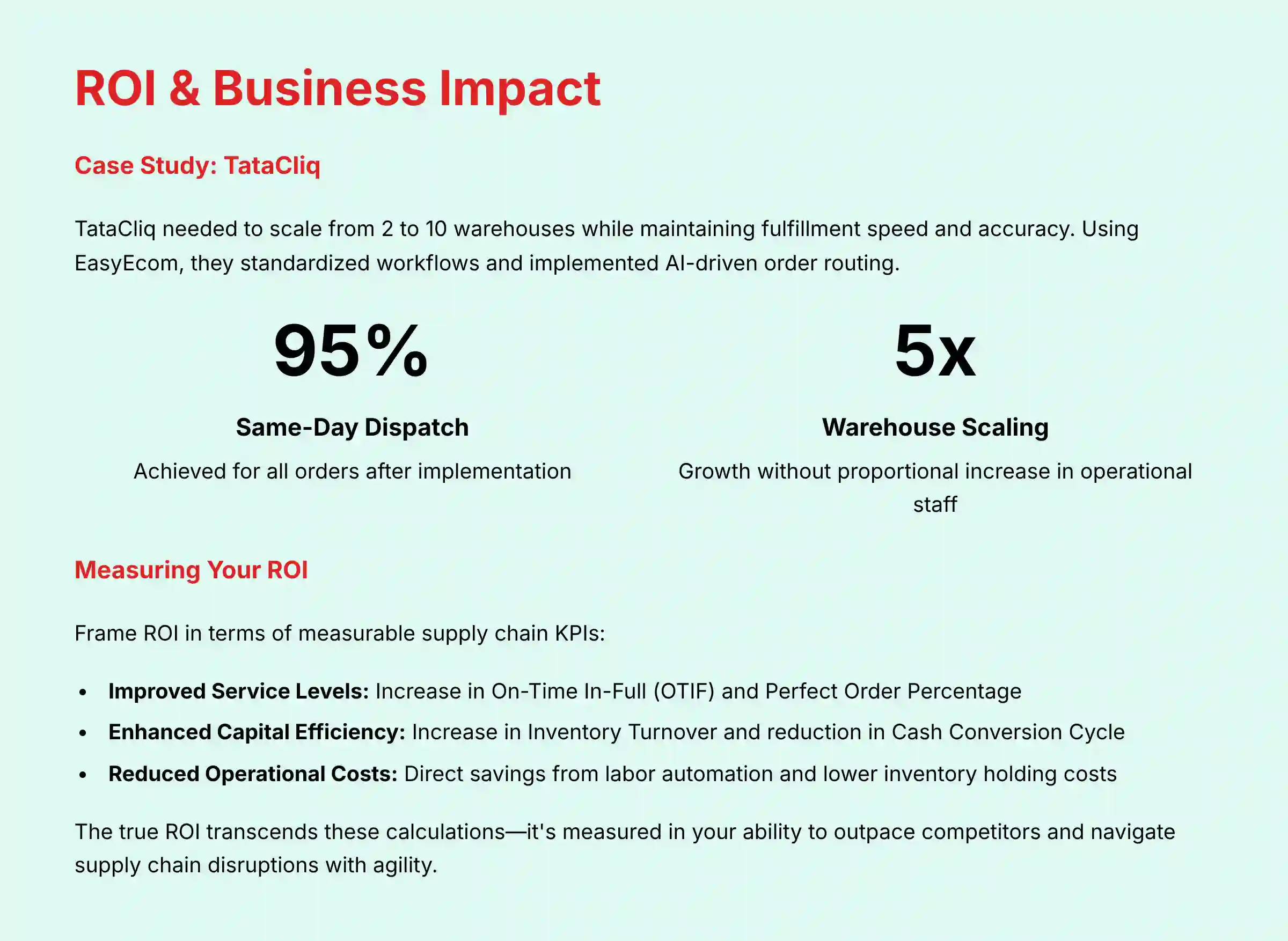
Case Study: Scaling Omnichannel Operations with TataCliq
TataCliq faced a significant business challenge. They needed to scale from 2 to 10 warehouses while maintaining their fulfillment speed and accuracy. This kind of rapid growth can easily break manual operational processes.
They used EasyEcom to standardize their workflows. This allowed for fast onboarding of new warehouses. They also used the platform's AI-driven order routing to optimize fulfillment across their entire network. The results were verifiable and demonstrated high efficiency.
- Performance Metric: According to the official EasyEcom case study, “Tata CLiQ Luxury now achieves 95% same-day dispatch for all its orders.”
- Efficiency Gain: They greatly reduced the manual labor costs associated with allocating orders.
- Business Impact: The platform supported their aggressive scaling without a proportional increase in operational staff.
Framework: How to Calculate Your Own ROI with EasyEcom
This framework helps you build a business case for implementing EasyEcom. It identifies the key metrics needed to measure the financial impact on your operations. You can use your own business data to project the potential returns.
When building a business case, the ROI should be framed in terms of measurable supply chain KPIs:
- Improved Service Levels: Quantify the increase in On-Time In-Full (OTIF) and Perfect Order Percentage.
- Enhanced Capital Efficiency: Measure the increase in Inventory Turnover and the reduction in the Cash Conversion Cycle.
- Reduced Operational Costs: Calculate direct savings from labor automation and lower inventory holding costs.
Finally, a complete financial analysis should consider the Total Cost of Ownership (TCO), which includes subscription fees, one-time implementation costs, and any internal resources required for integration and maintenance.
Ultimately, the true ROI of a system like EasyEcom transcends these calculations. It's measured in your ability to outpace competitors, to navigate supply chain disruptions with agility, and to convert operational efficiency into market dominance. These metrics provide the business case, but the strategic advantage you gain is the ultimate prize. In today's landscape, you have one job: press the advantage.
Disclaimers and Professional Guidance
Technology Evolution Notice: The information about EasyEcom and AI for Operations & Supply Chain tools presented in this article reflects our thorough analysis as of 2024. Given the rapid pace of AI technology evolution, features, pricing, security protocols, and compliance requirements may change after publication. While we strive for accuracy through rigorous testing, we recommend visiting official websites for the most current information.
Professional Consultation Recommendation: For AI for Operations & Supply Chain applications with significant professional, financial, or compliance implications, we recommend consulting with qualified professionals who can assess your specific requirements and risk tolerance. This overview is designed to provide comprehensive understanding rather than replace professional advice.
Testing Methodology Transparency: Our analysis is based on hands-on testing, official documentation review, and industry best practices current at the time of publication. Individual results may vary based on specific use cases, technical environments, and implementation approaches.
Frequently Asked Questions About EasyEcom Tutorials and Usecase
This section answers common user questions. The answers are direct and provide the key information you need.
How does EasyEcom's AI forecasting work and what data does it need?
The AI uses machine learning to analyze historical sales data, identifying trends and sales velocity for each SKU. It combines this with your supplier Lead Time and desired Days of Stock to calculate the reorder point. For accurate results, the AI needs at least 3-6 months of clean sales history and precisely entered lead times. The exact requirements should be confirmed with EasyEcom's technical support team, as they may vary based on your industry's seasonality and specific business patterns.
What is the biggest mistake new users make during setup?
The single most damaging mistake is poor data hygiene, specifically failing to use a unique SKU for every product variant. Duplicate or inconsistent SKUs break the inventory sync logic, leading to constant mismatches and overselling. You must clean your product data in a master spreadsheet before uploading anything.
Can EasyEcom integrate with my company's custom ERP system?
Yes, EasyEcom has a robust and well-documented API. You can use this API to build custom integrations with your ERP or other internal software, which usually requires a developer. The API allows for bidirectional data flow, so you can pull sales orders and push inventory updates back into your ERP.
How does EasyEcom handle product bundles or kits?
EasyEcom has a product bundling feature that lets you create a “virtual” bundle SKU made of several component SKUs. When a customer buys the bundle, the system automatically deducts the correct quantity from each component's inventory. This ensures your component-level stock counts are always accurate.
What security measures should I implement to protect my warehouse data?
Protecting your data is critical. You should implement three security measures immediately. First, use User Role Permissions to grant staff access only to the modules they need. Second, enforce strong password policies. Third, use unique API keys for each external software integration with minimum required permissions.
How is EasyEcom different from just using the inventory features in Shopify?
Shopify is great for a single-channel, single-warehouse business. EasyEcom is a specialized multi-channel, multi-warehouse operating system. It centralizes inventory for Shopify, Amazon, and retail stores, provides advanced AI forecasting, and supports complex warehouse workflows that Shopify's native features do not.
For a more detailed comparison of EasyEcom against other solutions, explore our comprehensive EasyEcom Overview and Features analysis that covers the platform's complete capabilities and competitive positioning.
What kind of ROI can I realistically expect from implementing EasyEcom?
The ROI comes from three main areas: increased revenue from reducing stockouts, improved cash flow from optimized inventory levels, and operational efficiency from automating manual tasks. The specific returns vary widely based on your business scale, current inefficiencies, and implementation quality. While many businesses see positive ROI within 6-12 months, you should develop a customized ROI projection based on your specific operations and challenges. Consult with EasyEcom's implementation team for case studies relevant to your industry.
My inventory is still out of sync after checking the SKU mapping. What's the next step?
If you have confirmed the SKU mapping is perfect, the next step is to check the Inventory Log for that product. This unchangeable ledger records every single stock movement. The log will almost always reveal the source of the problem, like an accidental manual update or an error from a third-party app.
For additional support and detailed answers to common questions, consult our dedicated EasyEcom FAQs resource that addresses the most frequently encountered implementation and operational challenges.
I hope you found this guide to EasyEcom Tutorials and Usecase helpful for transforming your warehouse operations from reactive management to proactive, AI-powered optimization.

Leave a Reply