Is Manual Warehouse & Inventory Management Slowing You Down?
This 2-Minute Quiz Reveals if EasyEcom is Your Solution.
Key Takeaways
- AI-Powered Intelligence: EasyEcom transforms traditional warehouses into predictive systems using AI for slotting optimization, demand forecasting, and intelligent automation
- Massive Efficiency Gains: Increase pick-and-pack speed by 30%+, achieve 99.9% inventory accuracy, and reduce picker travel time by up to 50%
- Strategic Implementation: 4-8 week structured implementation with minimal learning curve for operators and comprehensive integration capabilities
- Future-Ready Platform: Seamless robotics integration, advanced automation support, and continuous AI learning for evolving warehouse operations
Welcome to the complete EasyEcom FAQ knowledge hub that answers every critical question about transforming your warehouse operations through AI-powered intelligence. Whether you're managing multi-channel inventory, optimizing warehouse layouts, or implementing robotics integration, this comprehensive guide provides expert insights and actionable solutions.
What is EasyEcom, and how is it different from a traditional Warehouse Management System (WMS)?
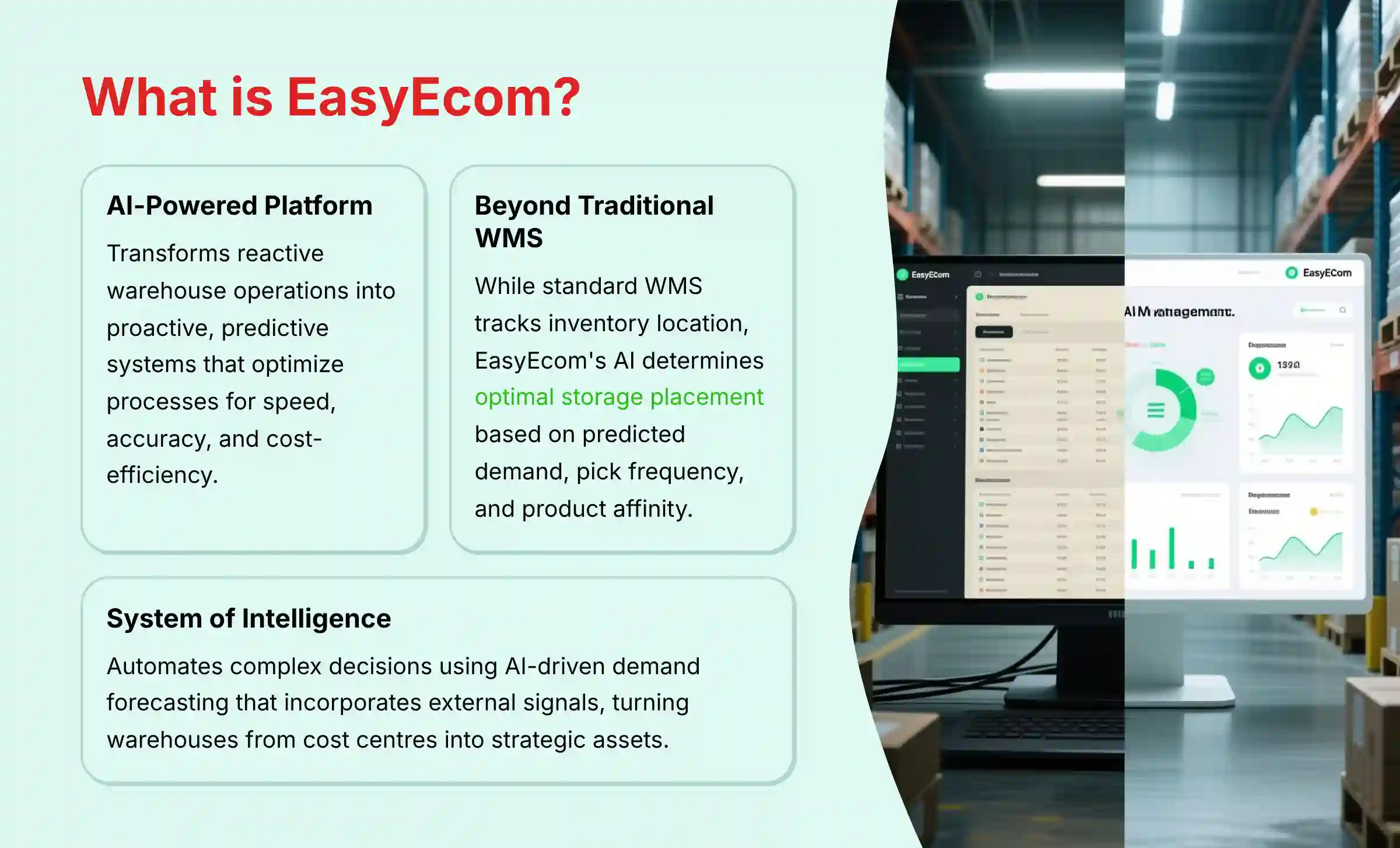
EasyEcom is an AI-powered platform for warehouse and inventory management designed to transform reactive warehouse operations into proactive, predictive systems. While a traditional WMS primarily tracks the movement of inventory and manages storage locations, EasyEcom leverages artificial intelligence to optimize these processes, leading to significant improvements in speed, accuracy, and cost-efficiency.
The key difference lies in its predictive capabilities. A standard WMS can tell you where a product is located; EasyEcom's AI can tell you the optimal place to store it (a practice known as AI-powered slotting) based on predicted demand, pick frequency, and product affinity, thereby minimizing travel time for warehouse operators. Furthermore, its AI-driven demand forecasting goes beyond simple historical averages, incorporating external signals to anticipate stock needs more accurately. This prevents costly stockouts and reduces excess inventory holding costs. In essence, a traditional WMS is a system of record, while EasyEcom is a system of intelligence that automates and optimizes complex decisions, turning the warehouse from a cost center into a strategic asset.
Who is the ideal user for EasyEcom?
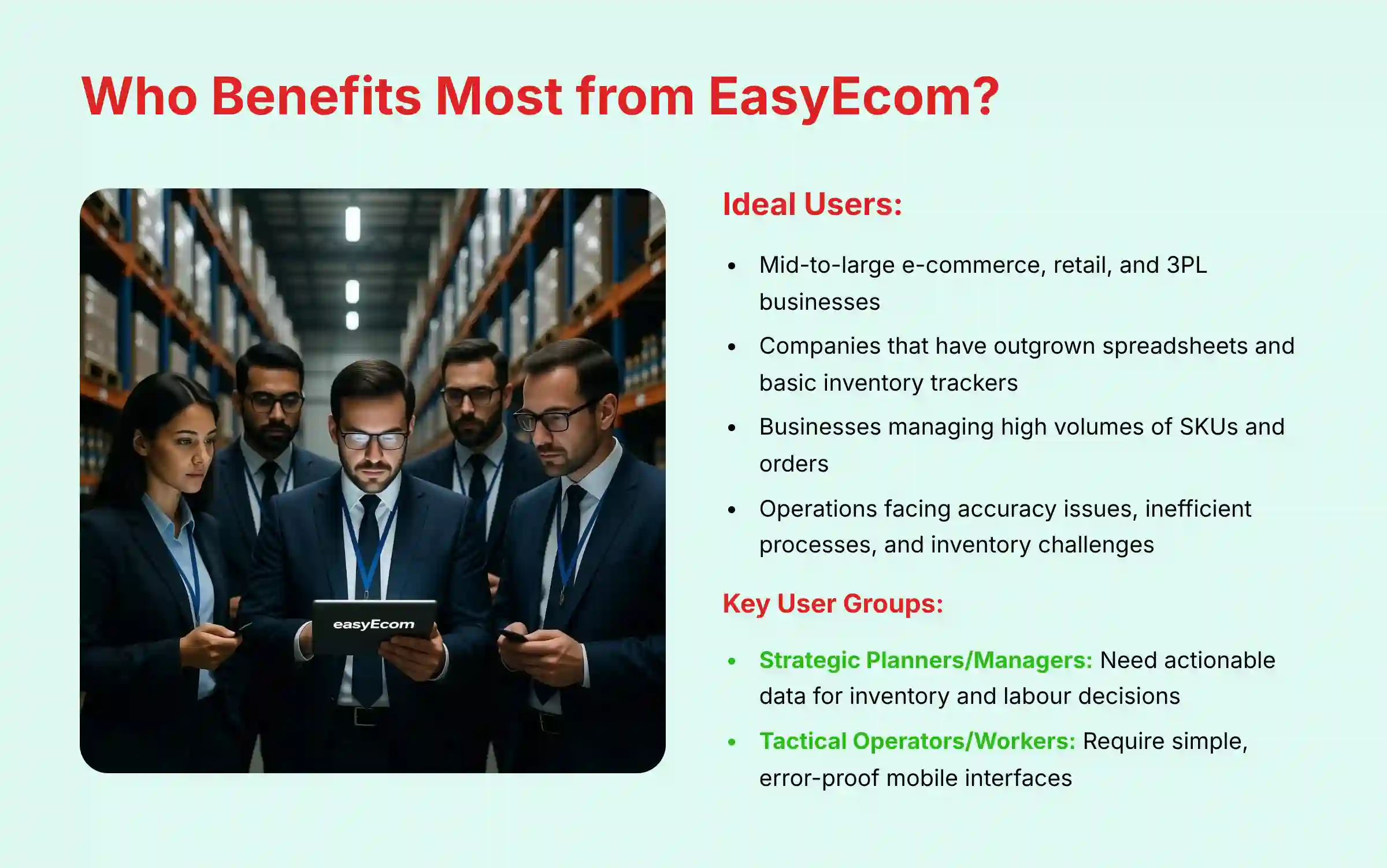
EasyEcom is ideal for operations, supply chain, and warehouse managers in mid-to-large-sized e-commerce, retail, and 3PL (third-party logistics) businesses that are struggling with the limitations of manual processes or legacy WMS systems. The platform is specifically designed for companies that have outgrown spreadsheets and basic inventory trackers and are facing challenges like inaccurate inventory counts, inefficient picking and packing processes, high labor costs, and frequent stockouts or overstocking issues.
An ideal user profile would be a business that manages a high volume of SKUs and orders, where small inefficiencies multiply into significant costs. They likely have two key user groups who will benefit directly:
- Strategic Planners/Managers: Those who need clear, actionable data from an intuitive dashboard to make decisions about inventory levels, labor allocation, and warehouse layout. They are looking to improve key metrics like inventory turnover and on-time-in-full (OTIF) delivery.
- Tactical Operators/Workers: The team on the warehouse floor who needs a simple, fast, and error-proof mobile or scanner interface to execute tasks like receiving, put-away, picking, and packing with maximum efficiency.
If your organization aims to use data-driven insights to increase throughput, improve order accuracy to over 99.9%, and reduce operational costs, EasyEcom Overview and Features shows that EasyEcom is built for you.
What are the main benefits of using EasyEcom's AI for inventory management?
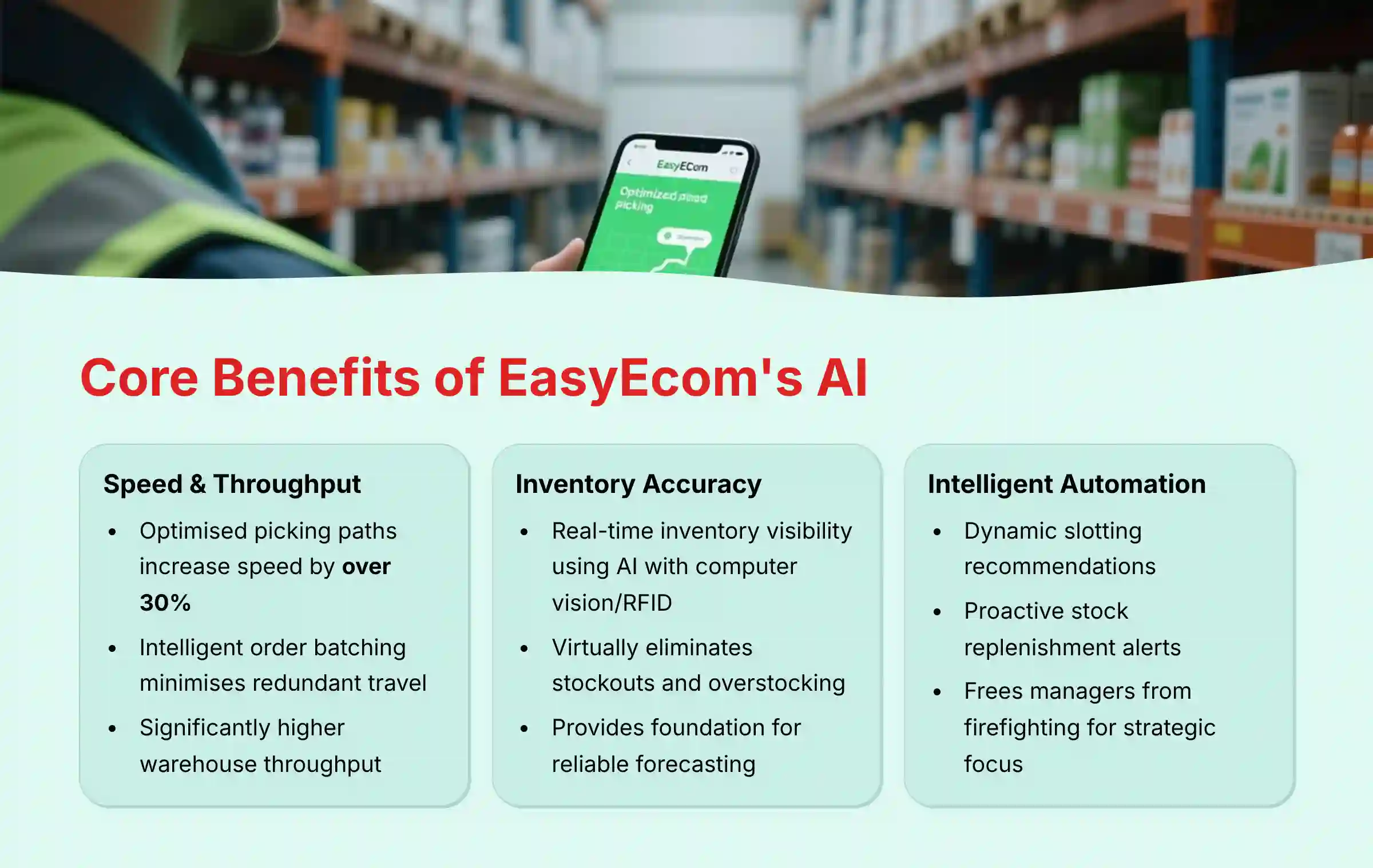
The primary benefits of using EasyEcom's AI are a significant increase in operational efficiency, a drastic reduction in costs, and enhanced supply chain resilience. It achieves this by focusing on three core areas: speed, accuracy, and automation.
First, it dramatically improves Speed and Throughput. The AI optimizes picking paths, ensuring operators take the shortest possible route to fulfill an order, which can increase pick-and-pack speed by over 30%. It also enables intelligent batching of orders, grouping similar items or locations together to minimize redundant travel.
Second, it delivers near-perfect Inventory Accuracy. By leveraging AI with technologies like computer vision or RFID, EasyEcom maintains a real-time, highly accurate view of inventory levels. This virtually eliminates the discrepancies that lead to stockouts (lost sales) or overstocking (tied-up capital and high holding costs). Accurate data is the foundation for reliable demand forecasting and efficient capital allocation.
Finally, it drives Intelligent Automation. EasyEcom automates complex decisions that are nearly impossible for humans to optimize in real-time. This includes dynamic slotting recommendations (placing high-demand items in easily accessible locations) and proactive stock replenishment alerts based on predictive sales forecasts. This frees up managers from constant firefighting to focus on strategic improvements.
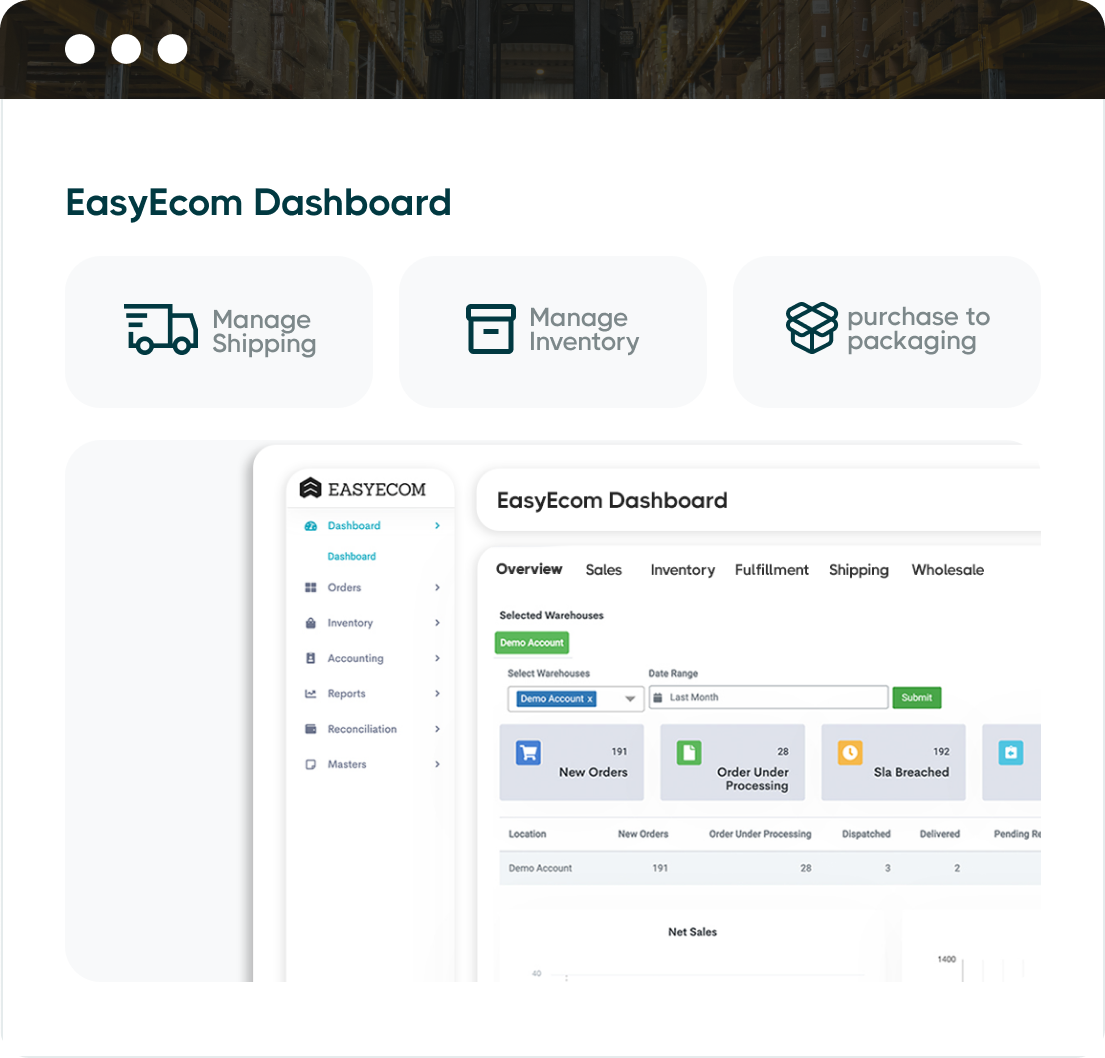
How does EasyEcom integrate with existing ERP and WMS systems?
EasyEcom is designed to act as an intelligent layer that enhances, rather than replaces, your core business systems. The platform provides integration capabilities with a range of business systems, with a primary focus on e-commerce platforms, marketplaces, and accounting software.
The integration process typically works as follows:
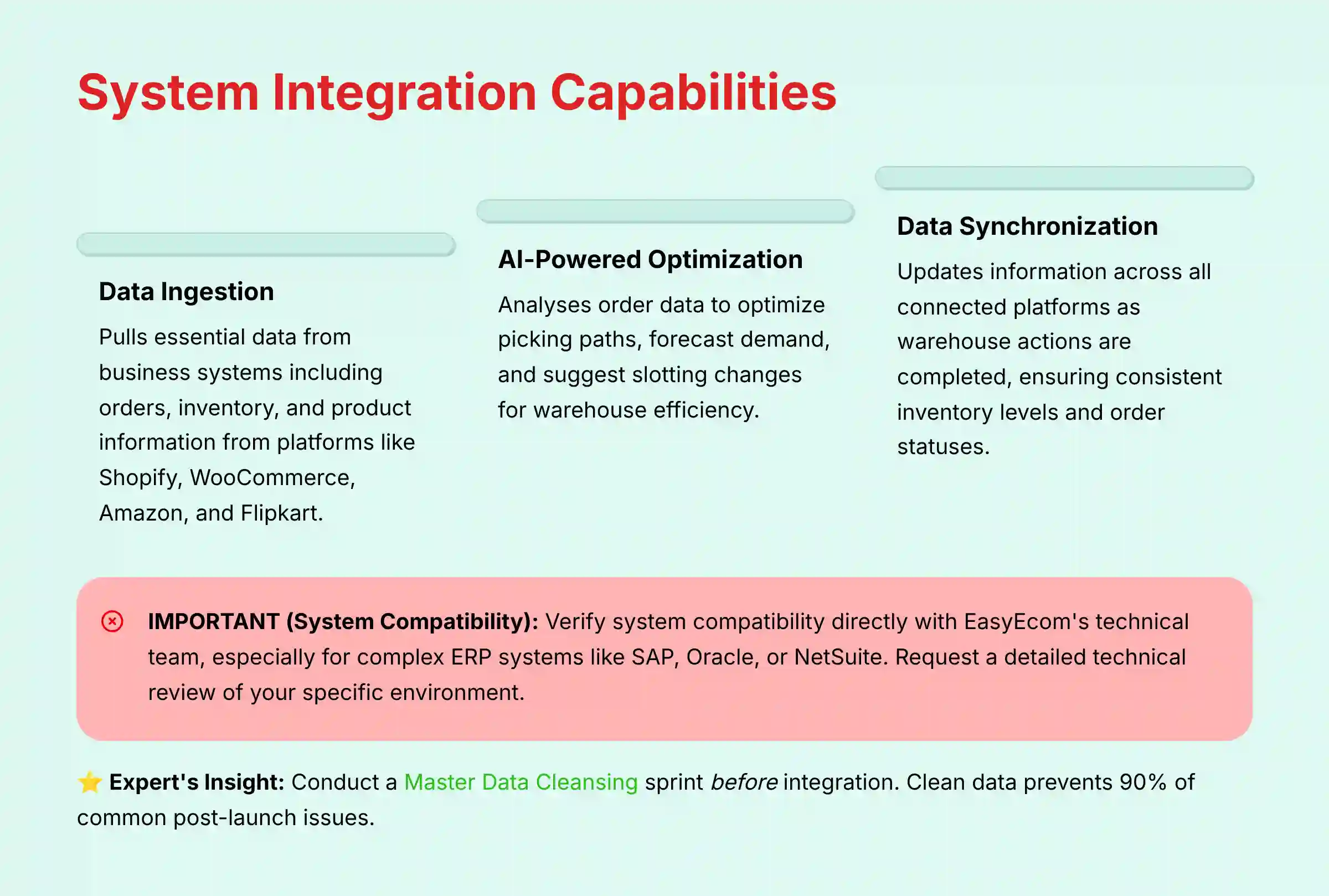
- Data Ingestion: EasyEcom pulls essential data from your business systems, including orders, inventory, and product information. For e-commerce businesses, it connects directly with platforms like Shopify, WooCommerce, and marketplaces such as Amazon and Flipkart.
- AI-Powered Optimization: Once the data is ingested, EasyEcom's AI engine gets to work. It analyzes the order data to optimize picking paths, forecasts future demand to recommend inventory levels, and suggests slotting changes for warehouse efficiency.
- Data Synchronization: As actions are completed in the warehouse (e.g., an order is shipped, inventory is received), EasyEcom updates this information across all connected platforms, ensuring consistent inventory levels and order statuses.
For businesses using major ERP systems like SAP, Oracle, or NetSuite, it's important to note that EasyEcom does not currently list these as standard pre-built integrations. Integration with these systems would likely require a custom integration project using EasyEcom's API.
IMPORTANT (System Compatibility): Before making a purchasing decision, businesses should verify system compatibility directly with EasyEcom's technical team, especially if you rely on complex ERP systems. Request a detailed technical review of your specific environment to ensure proper integration is possible and understand any additional costs or timelines this might involve.
⭐ Expert's Insight: A common mistake during integration is focusing only on the technical API connection. The real key to a successful launch is a Master Data Cleansing sprint before you integrate. EasyEcom's AI is powerful, but its forecasts are only as good as the data it receives. Garbage in, garbage out. Before you even connect the systems, dedicate time with your operations team to validate and standardize your product master data (SKU names, dimensions, weights, units of measure). A clean dataset from day one will prevent 90% of common post-launch issues and allow the AI to deliver accurate, valuable insights almost immediately.
Can EasyEcom help optimize warehouse layout and slotting?
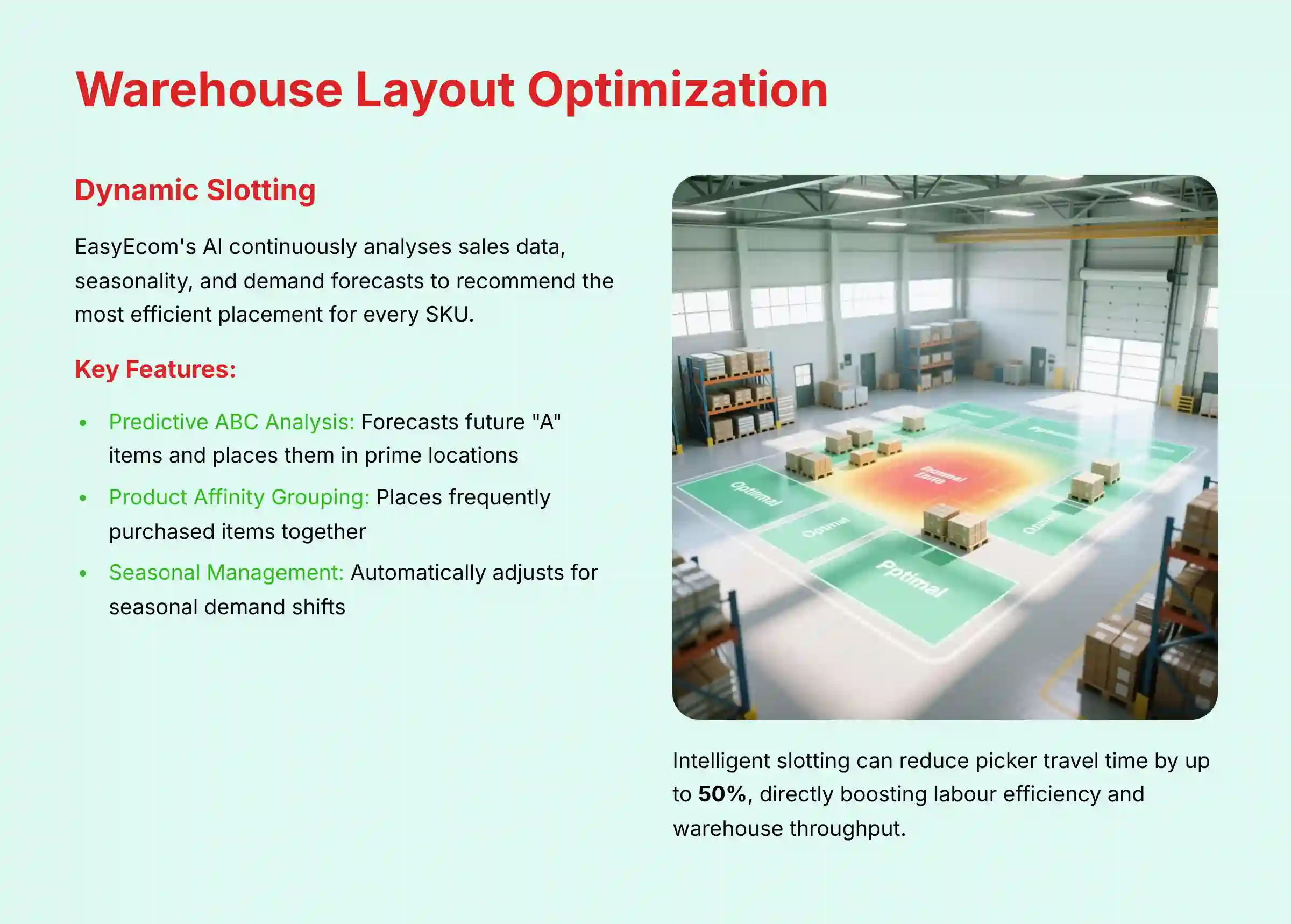
Yes, optimizing warehouse layout and slotting is one of EasyEcom's most powerful AI-driven features. The platform uses a concept called dynamic slotting, which is a significant advancement over the static slotting (fixed bin locations) used in many traditional warehouses. It continuously analyzes sales data, seasonality, and demand forecasts to recommend the most efficient placement for every SKU in your facility.
Here's how it delivers value:
- ABC Analysis on Steroids: Traditional ABC analysis categorizes items based on historical sales volume. EasyEcom's AI takes this further by using predictive analytics to forecast which items will be your “A” items in the near future. It then recommends moving these high-velocity products to prime, easily accessible locations (e.g., near the packing stations, at waist level) to drastically cut down on picker travel time.
- Product Affinity Grouping: The AI identifies items that are frequently purchased together. It then suggests placing these items near each other in the warehouse. This facilitates faster picking for multi-item orders, as the operator can collect all related products from the same general area.
- Manages Seasonality: The system automatically recognizes seasonal demand shifts. For example, it will proactively recommend moving popular holiday gift items to forward-picking locations in October and then suggest moving them back to bulk storage in January, ensuring your layout is always optimized for the current sales cycle.
This intelligent slotting feature alone can reduce picker travel time by up to 50%, directly boosting labor efficiency and overall warehouse throughput. For those exploring EasyEcom Tutorials and Usecase, the dynamic slotting capabilities represent one of the most impactful features for operational efficiency.
What is the typical implementation process and learning curve for a warehouse team?
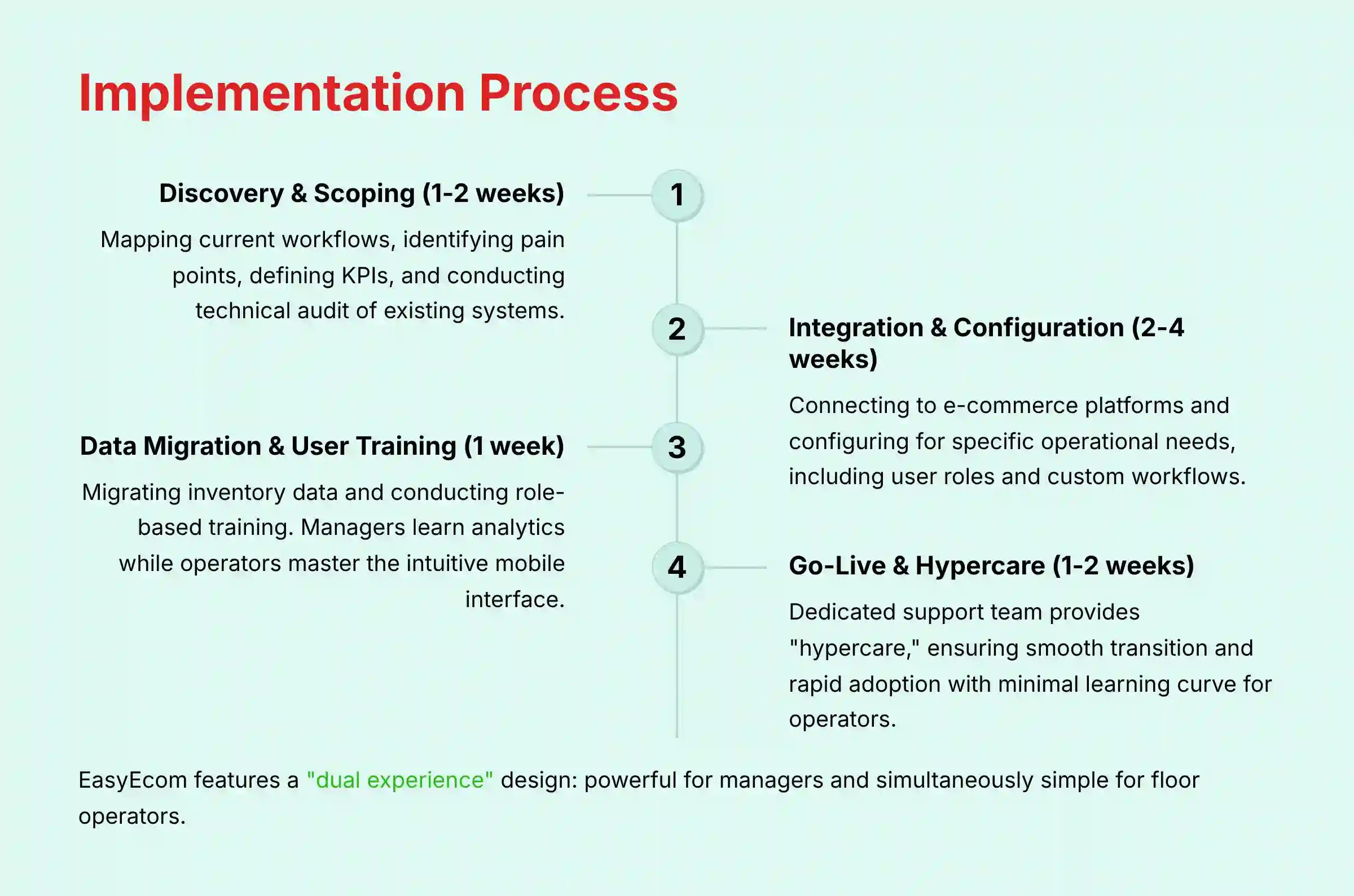
The implementation process for EasyEcom is designed to be collaborative and structured, typically spanning several weeks, and is broken down into four key phases. The platform was built with a “dual experience” focus, ensuring it is powerful for managers and simultaneously simple for floor operators.
- Discovery & Scoping (1-2 weeks): The process begins with EasyEcom's team working with you to map your current warehouse workflows, identify key pain points, and define clear success metrics (KPIs). This phase also involves a technical audit of your existing systems to plan the integration strategy.
- Integration & Configuration (2-4 weeks): This is the core technical phase where EasyEcom is connected to your e-commerce platforms, marketplaces, and other business systems. The platform is configured to match your specific operational needs, including user roles, permissions, and custom workflows.
- Data Migration & User Training (1 week): Your existing inventory and product data is migrated into EasyEcom. This is followed by targeted training sessions. Managers and planners receive in-depth training on the analytics dashboard and reporting features, while warehouse operators are trained on the intuitive mobile scanner interface, which typically takes less than an hour to master due to its simple, guided workflow design.
- Go-Live & Hypercare (1-2 weeks): After going live, a dedicated EasyEcom support team provides “hypercare” support, closely monitoring the system and assisting your team to ensure a smooth transition and rapid adoption.
The learning curve for operators is intentionally minimal, as the handheld app provides clear, step-by-step instructions for each task. For managers, the primary learning involves shifting from a reactive mindset to trusting and leveraging the AI's predictive insights for strategic planning.
How does EasyEcom leverage AI to improve demand forecasting and reduce stockouts?
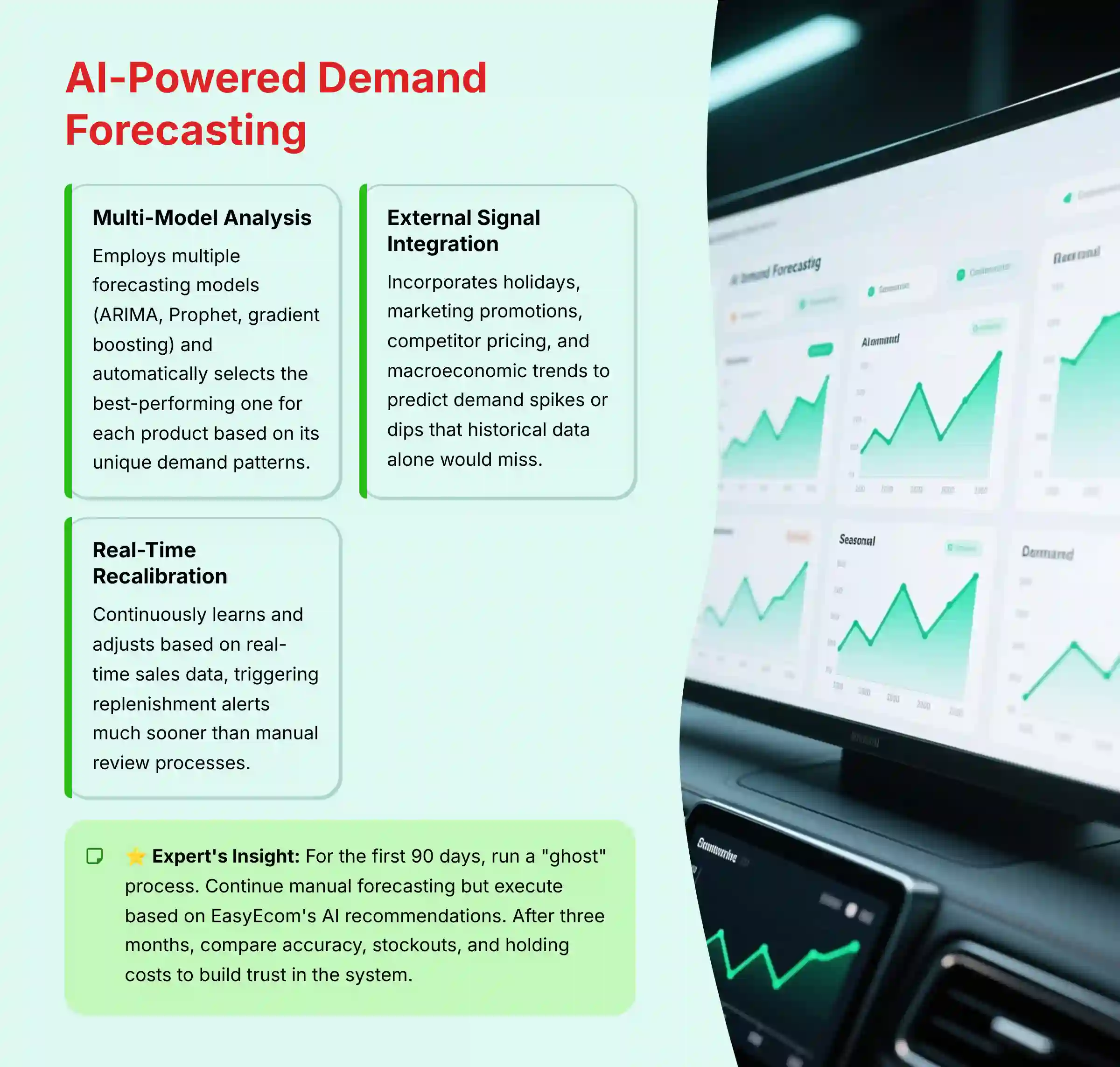
EasyEcom improves demand forecasting by using advanced machine learning models that go far beyond the simple moving averages or historical sales data used by traditional systems. Its AI engine creates a more accurate and dynamic picture of future demand by analyzing a wide range of internal and external variables, directly reducing both stockouts and costly overstocking.
The process involves several layers of intelligence:
- Multi-Model Analysis: Instead of relying on a single algorithm, EasyEcom employs a suite of forecasting models (like ARIMA, Prophet, and gradient boosting) and automatically selects the best-performing one for each specific product based on its demand patterns (e.g., stable, seasonal, erratic).
- Incorporating External Signals: This is a key differentiator. The AI can be configured to ingest and learn from external data signals that influence demand, such as upcoming holidays, planned marketing promotions, competitor pricing changes, and even macroeconomic trends. This allows the system to predict demand spikes or dips that historical data alone would miss.
- Real-Time Recalibration: The forecast is not static. The AI models continuously learn and recalibrate based on real-time sales data. If a product suddenly starts selling faster than anticipated, the system will automatically adjust its forecast and trigger a replenishment alert much sooner than a manual review process would.
By providing a significantly more accurate demand forecast, EasyEcom enables businesses to set optimized reorder points and maintain leaner safety stock levels. This directly improves the cash conversion cycle by reducing the capital tied up in slow-moving inventory while simultaneously preventing lost sales from out-of-stock events.
⭐ Expert's Insight: The biggest mistake new users make is “overriding” the AI's recommendations too often during the first month. Your team's gut feeling has run the warehouse for years, and it's tempting to distrust the machine. My Pro Tip: For the first 90 days, run a “ghost” process. Continue your manual forecasting method in a spreadsheet but execute purchases and warehouse moves based on EasyEcom's AI recommendations. After three months, compare the forecast accuracy, stockout incidents, and inventory holding costs between the AI and your manual system. The data will almost certainly prove the AI's superiority and build the critical trust your team needs to fully embrace the system and unlock its maximum ROI.
What does the EasyEcom pricing model look like?
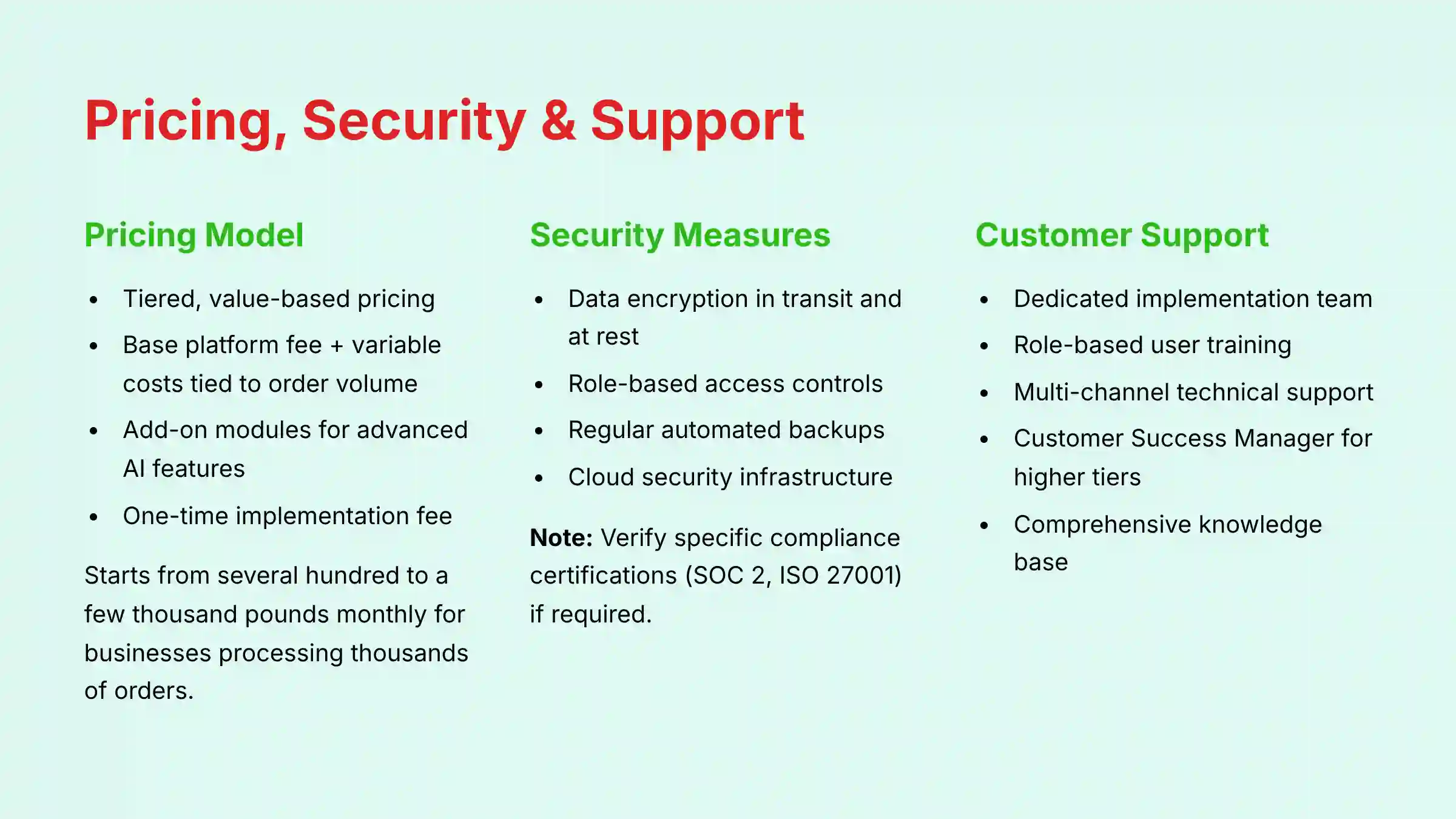
EasyEcom utilizes a tiered, value-based pricing model that is designed to scale with the complexity and volume of your operations. While specific pricing requires a custom quote, the model is primarily based on factors like the number of monthly orders, the number of SKUs under management, and the number of users requiring access to the platform. This approach ensures that smaller businesses are not paying for enterprise-level features they don't need, while larger operations get a plan that fully supports their scale.
The pricing tiers typically include:
- A base platform fee: This covers access to the core WMS and inventory management modules, standard integrations, and ongoing support.
- Variable costs: These are tied to your operational volume (e.g., cost per X number of orders). This ensures that your software costs align with your business activity.
- Add-on modules: Advanced AI features, such as dynamic slotting optimization, AI-powered demand forecasting, and robotics integration, may be offered as add-on modules or included in higher-tier plans.
Additionally, there is usually a one-time implementation and onboarding fee. This covers the entire process from initial discovery and workflow mapping to system integration, data migration, and comprehensive team training. This upfront investment is crucial for ensuring the platform is configured correctly to deliver maximum ROI.
For businesses that process thousands of orders monthly, expect pricing to start in the range of several hundred to a few thousand dollars per month, depending on your specific requirements and the advanced features you need. For a detailed breakdown and to get a quote tailored to your business, it's best to contact their sales team directly. For those comparing options, our EasyEcom Review provides additional insights into value proposition and ROI considerations.
What level of data and operational security does EasyEcom provide?
EasyEcom provides several security measures to protect your operational data, though it's important to understand the specific security protocols and certifications the platform currently offers.
Key security features typically include:
- Data Encryption: EasyEcom likely employs standard encryption protocols to protect data in transit (between your systems and their platform) and at rest (stored on their servers).
- Access Controls: The platform allows for the configuration of role-based access controls, ensuring that users can only see and act on the data relevant to their specific job function (e.g., a picker cannot access financial reports, and a planner cannot change system-wide settings).
- Regular Backups: To prevent data loss, the system likely performs regular automated backups of your operational data.
- Cloud Security: As a cloud-based solution, EasyEcom benefits from the security infrastructure of its hosting provider.
IMPORTANT (Security & Compliance): As of the latest review of EasyEcom's official website, they do not publicly list specific compliance certifications such as SOC 2 Type II or ISO 27001. These are industry-standard audits that verify a vendor's controls for protecting sensitive customer data. If your organization has specific compliance requirements or handles regulated data, you should:
- Request documentation on EasyEcom's current security certifications and practices
- Ask for their security white paper or documentation detailing their approach to data protection
- Inquire about any third-party security audits they have undergone
- Determine if their security measures align with your organization's requirements
Organizations, especially enterprises with strict regulatory requirements, should perform due diligence on security and compliance capabilities before entrusting a vendor with sensitive operational and financial data.
What kind of customer support and training is available?
EasyEcom provides comprehensive customer support and training, viewing their role as a long-term partner rather than just a software vendor. Their support model is designed to ensure customers not only get a smooth start but also continue to extract maximum value from the platform over time.
Support and training resources typically include:
- Dedicated Implementation Team: During the initial setup, a dedicated team guides you through every step, from workflow discovery to go-live.
- Role-Based User Training: The initial training is tailored to different user groups. Managers and planners receive in-depth training on dashboards, analytics, and strategic features, while warehouse operators get hands-on training with the simplified mobile interface.
- Technical Support: Post-launch, customers have access to a support team via multiple channels, including email and a dedicated support portal. Support is typically tiered, with clear response times based on the urgency of the issue.
- Ongoing Success Management: Higher-tier plans may include a dedicated Customer Success Manager (CSM). This individual serves as your advisor, conducting regular business reviews, providing insights on how to better leverage the platform's features, and keeping you informed about new product updates that can benefit your operations.
- Knowledge Base & Resources: Customers have access to an online knowledge base with documentation, video tutorials, and best-practice guides to help maximize their use of the platform.
For businesses that operate warehouses across multiple shifts or in different time zones, it's important to verify the availability hours of EasyEcom's support team to ensure coverage aligns with your operational hours. Additionally, ask about the support team's expertise in warehouse operations—ideally, you want support staff who understand not just the software but also the real-world challenges of warehouse management. For additional guidance, check our comprehensive EasyEcom FAQs resource.
How does EasyEcom support integration with robotics and automation systems?
EasyEcom is designed to work as an intelligent orchestration layer that can communicate with various types of warehouse automation technologies. This capability allows businesses to gradually introduce automation while maintaining a unified system for inventory management and order fulfillment.
The platform supports integration with several types of warehouse automation:
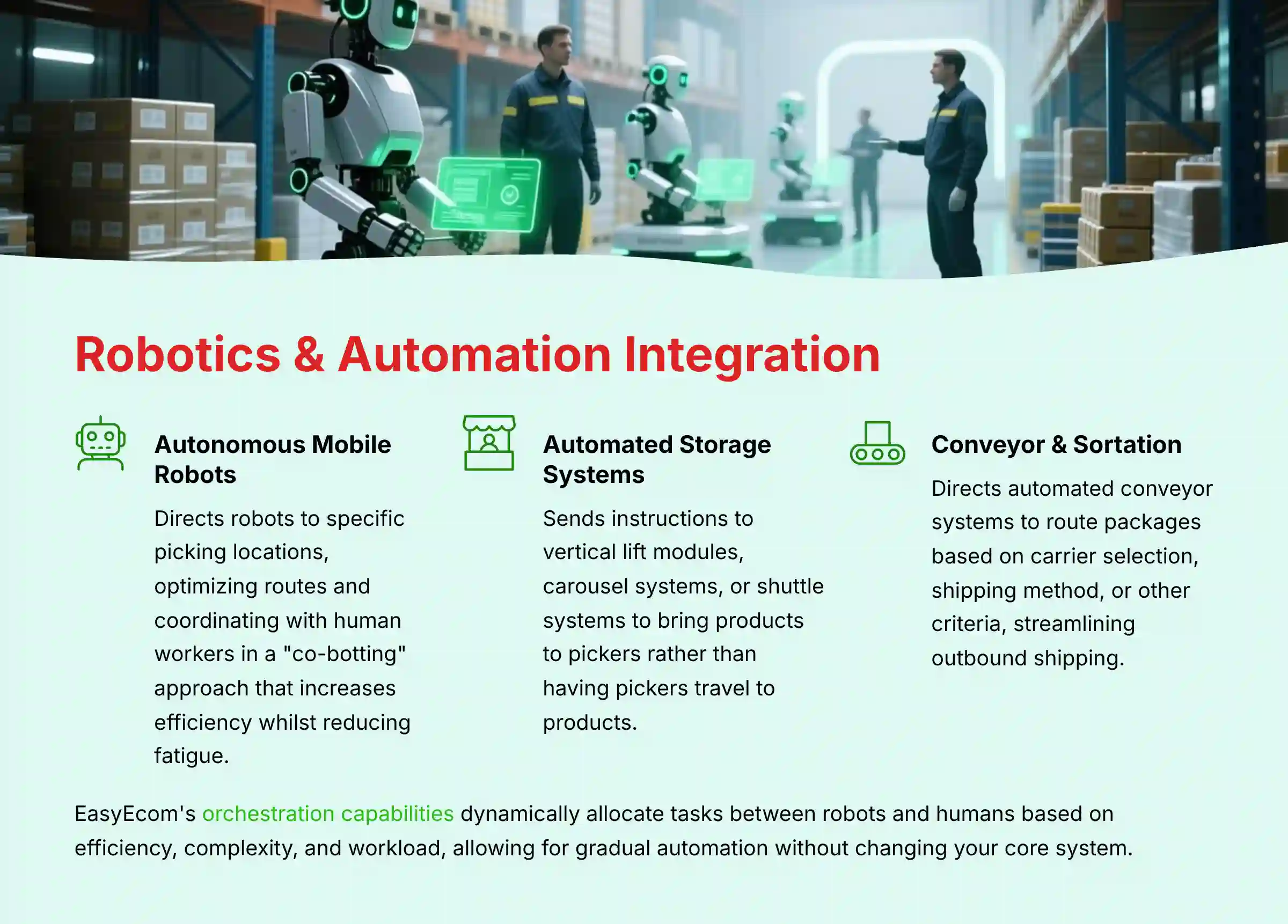
- Autonomous Mobile Robots (AMRs): EasyEcom can direct robots to specific picking locations, optimizing their routes and coordinating them with human workers. This collaborative approach, sometimes called “co-botting,” significantly increases picking efficiency while reducing worker fatigue from excessive walking.
- Automated Storage and Retrieval Systems (AS/RS): The platform can send instructions to vertical lift modules, carousel systems, or shuttle systems to retrieve specific items, bringing the product to the picker rather than having the picker travel to the product.
- Pick-to-Light and Put-to-Light Systems: EasyEcom integrates with these visual guidance systems that use LED lights to direct operators to the correct picking or put-away locations, dramatically reducing errors and training time.
- Conveyor and Sortation Systems: The software can direct automated conveyor systems to route packages based on carrier selection, shipping method, or other criteria, streamlining the outbound shipping process.
The real value of EasyEcom's robotics integration lies in its orchestration capabilities. The AI constantly evaluates which tasks should be assigned to robots versus human workers based on efficiency, complexity, and current workload. This dynamic allocation ensures optimal use of both automated and human resources.
For businesses planning a gradual automation journey, EasyEcom offers an advantage: you can start with a standard manual operation and incrementally add automation without changing your core warehouse management system. The software adapts as your level of automation grows, providing continuity and protecting your initial software investment.
Before implementing any robotics integration, conduct a thorough ROI analysis with the EasyEcom team to identify which processes would benefit most from automation given your specific order profiles, product characteristics, and labor costs.
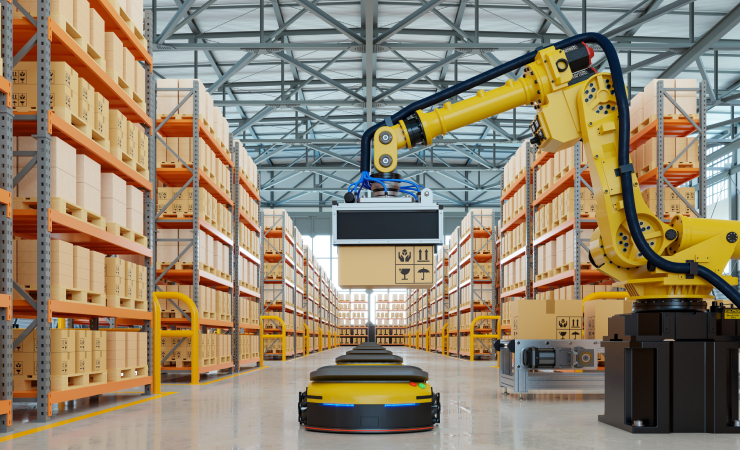
This comprehensive EasyEcom FAQ knowledge hub covers the essential questions about transforming your warehouse operations through AI-powered intelligence. From understanding the core differences between EasyEcom and traditional WMS systems to implementing robotics integration, each section provides actionable insights for making informed decisions.
For businesses ready to transform their warehouse operations from reactive to predictive, EasyEcom represents a strategic investment in operational excellence. The platform's AI-driven capabilities in slotting optimization, demand forecasting, and intelligent automation deliver measurable ROI through increased efficiency, reduced costs, and enhanced supply chain resilience.
Ready to explore how EasyEcom can revolutionize your warehouse operations? Consider checking out EasyEcom Top Alternatives and Competitors to understand your options, or dive deeper into Best 10 AI Warehouse Management Systems (WMS) of 2025: From Chaos to Intelligent Orchestration for a comprehensive comparison of leading AI-powered WMS solutions.

Leave a Reply