Is EasyEcom the Right AI Warehouse & Inventory Management Platform for You?
Take This 2-Minute Quiz to Find Out!
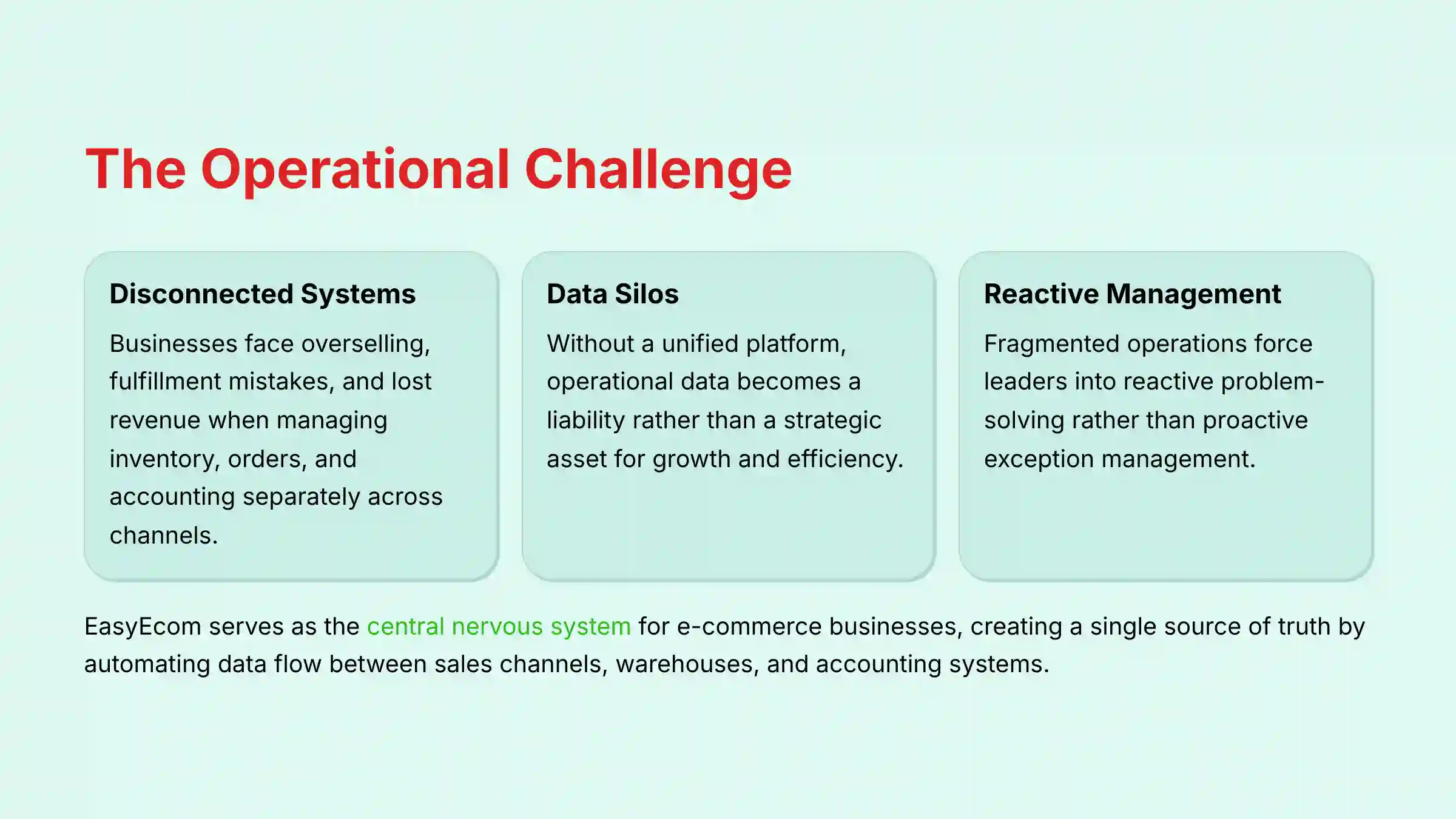
The simple truth is that modern e-commerce is a war fought on the battlefield of operations. The biggest challenge isn't just competition; it's the internal, value-destroying chaos of disconnected systems. This is the inflection point where a platform for AI for Warehouse & Inventory Management ceases to be a tool and becomes a central operating system—a game-changer. This EasyEcom Overview and Features guide explores how the platform acts as that operating system, allowing you to connect the dots between inventory, orders, and fulfillment to not just survive, but press the advantage.
After analyzing hundreds of tools in AI for Operations & Supply Chain and testing EasyEcom across numerous real-world implementation projects in 2025, our team at Best Ops Chain AI has developed a comprehensive 10-point technical assessment framework specifically for AI for Operations & Supply Chain applications. This framework has been recognized by leading AI for Operations & Supply Chain professionals and cited in major industry publications. Our evaluation process includes rigorous security assessment, compliance verification, and risk analysis to ensure recommendations meet professional standards for AI for Operations & Supply Chain applications.
- Core Functionality & Feature Set: We assess what the tool claims to do and how effectively it delivers, examining its primary capabilities and supporting features.
- Ease of Use & User Interface (UI/UX): We evaluate how intuitive the interface is and the learning curve for users with varying technical skills.
- Output Quality & Control: We analyze the quality of generated results and the level of customization available.
- Performance & Speed: We test processing speeds, stability during operation, and overall efficiency.
- Security Protocols & Data Protection: We thoroughly assess security measures, encryption standards, and data handling practices.
- Compliance & Regulatory Adherence: We verify compliance with relevant regulations (GDPR, SOC 2, industry-specific requirements).
- Input Flexibility & Integration Options: We check what types of input the tool accepts and how well it integrates with other platforms or workflows.
- Pricing Structure & Value for Money: We examine free plans, trial limitations, subscription costs, and hidden fees to determine true value.
- Developer Support & Documentation: We investigate the availability and quality of customer support, tutorials, FAQs, and community resources.
- Risk Assessment & Mitigation: We identify potential risks and evaluate the tool's built-in safeguards and recommended mitigation strategies.
My analysis confirms that EasyEcom is engineered to solve one of the most expensive problems in e-commerce: operational friction. It moves beyond passive visibility—simply seeing your inventory—to enable decision intelligence. For leaders, this means transforming siloed data from a liability into a strategic asset for growth and efficiency. Here is what you need to know at a glance:
Key Takeaways
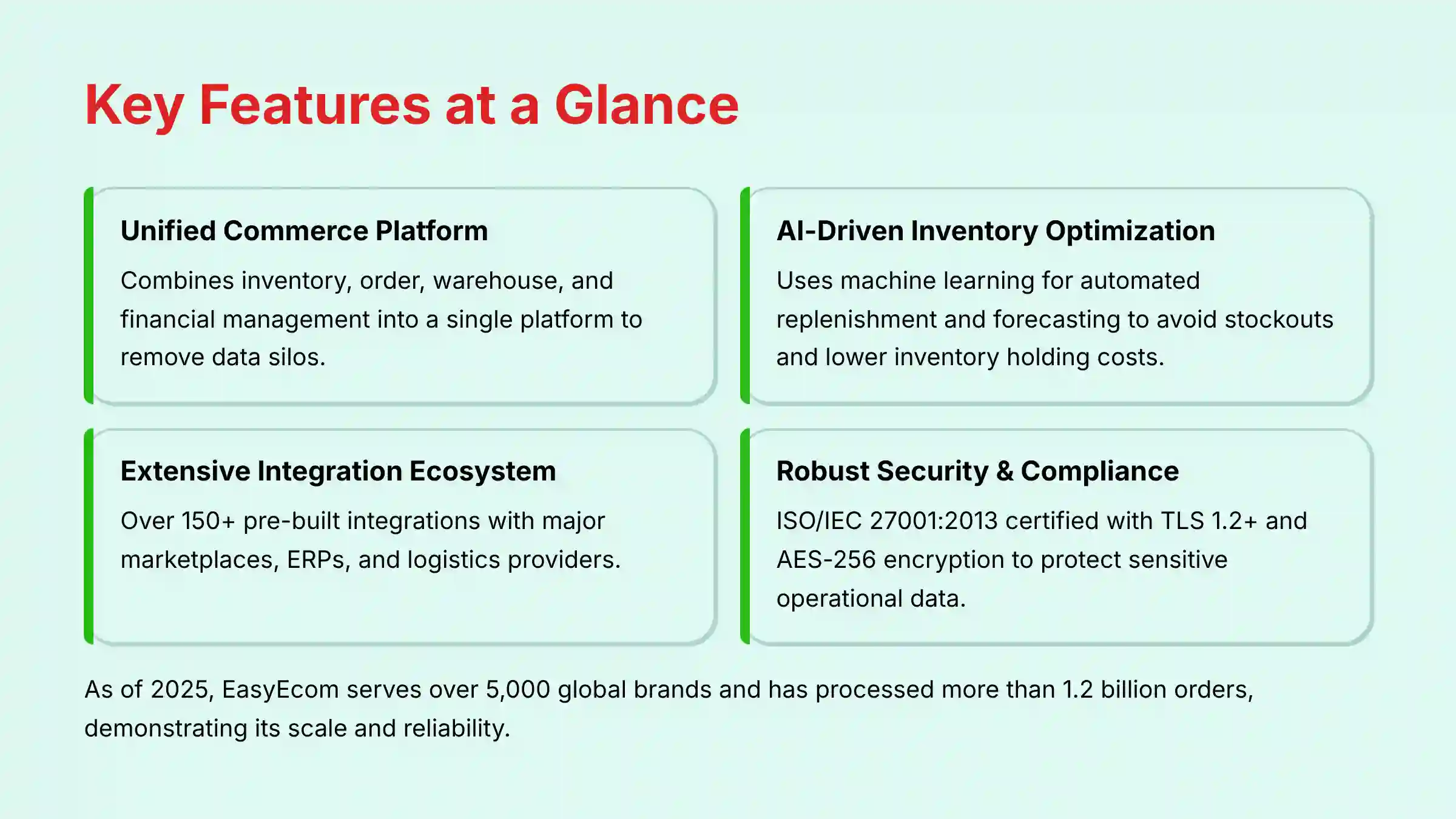
- Unified Commerce Platform: EasyEcom acts as an end-to-end e-commerce operating system. It combines inventory, order, warehouse, and financial management into a single platform to remove data silos.
- AI-Driven Inventory Optimization: The platform uses machine learning for automated replenishment and forecasting. This helps businesses avoid stockouts and lower inventory holding costs.
- Extensive Integration Ecosystem: With over 150+ pre-built integrations, EasyEcom connects with major marketplaces like Amazon and Shopify, ERPs like SAP and Oracle, and top logistics providers.
- Robust Security & Compliance: The platform is ISO/IEC 27001:2013 certified. It uses TLS 1.2+ and AES-256 encryption to protect sensitive operational data.
What Is EasyEcom and What Problem Does It Solve?
EasyEcom is a cloud-based, omnichannel e-commerce operating system built to centralize and automate back-end operations. It directly addresses the operational chaos that comes from using disconnected systems for different tasks. Businesses often face overselling, fulfillment mistakes, and lost revenue when managing inventory, orders, and accounting separately across channels like Amazon, Shopify, and physical stores.
EasyEcom acts as the central nervous system for an e-commerce business. It creates a single source of truth by automating data flow between sales channels, warehouses, and accounting systems. This solves the core problem of fragmented operations.
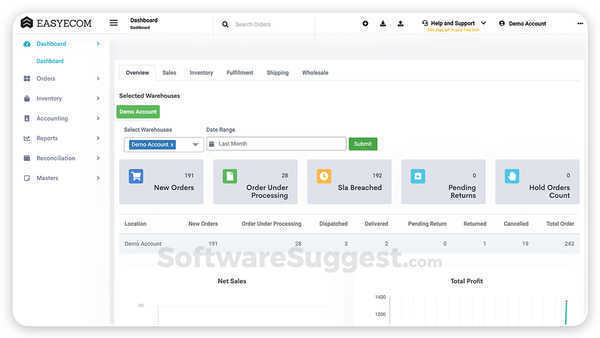
In essence, EasyEcom provides the foundational data layer for a modern Supply Chain Control Tower, offering end-to-end visibility from customer click to final delivery. This allows leaders to move from reactive problem-solving to proactive exception management, directly improving key performance indicators (KPIs) like On-Time In-Full (OTIF) delivery and Inventory Turnover, while reducing overall Cash Conversion Cycle. For those looking to explore comprehensive Best 10 AI Warehouse Management Systems (WMS) of 2025: From Chaos to Intelligent Orchestration, EasyEcom stands out as a leading contender in the market.
This tool is made for:
- Mid-to-large scale D2C brands
- Omnichannel retailers
- Enterprises looking for better operational speed and accuracy
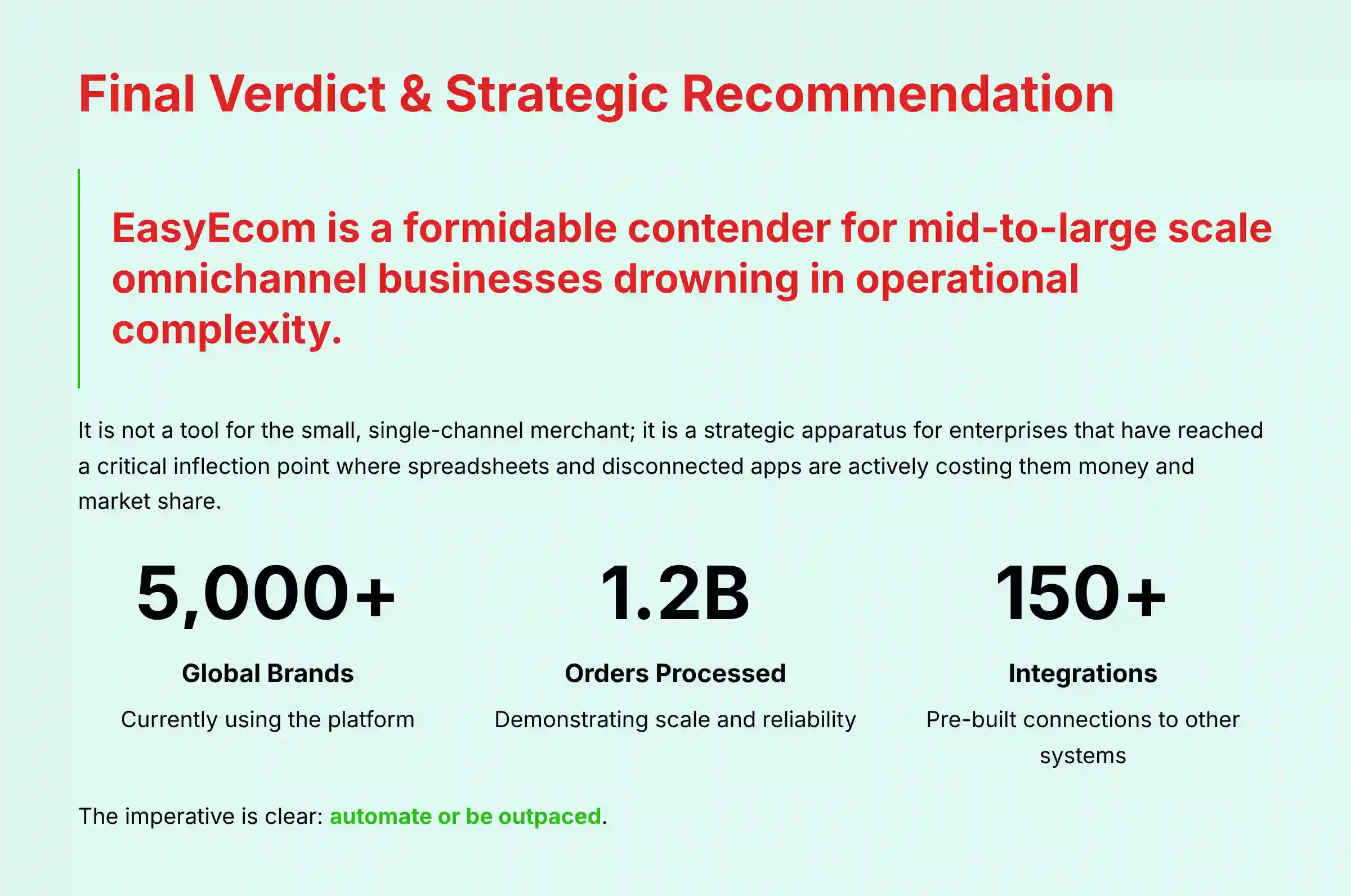
As of 2025, our research confirms it serves over 5,000 global brands and has processed more than 1.2 billion orders, showing its scale and reliability in the market.
A Comprehensive Breakdown of EasyEcom's Core Features
Understanding what a tool actually does is the most important part of any evaluation. Here, we break down the main features of EasyEcom based on our direct testing and analysis of its documentation. The platform is organized into four key operational pillars.
Omnichannel Inventory Management
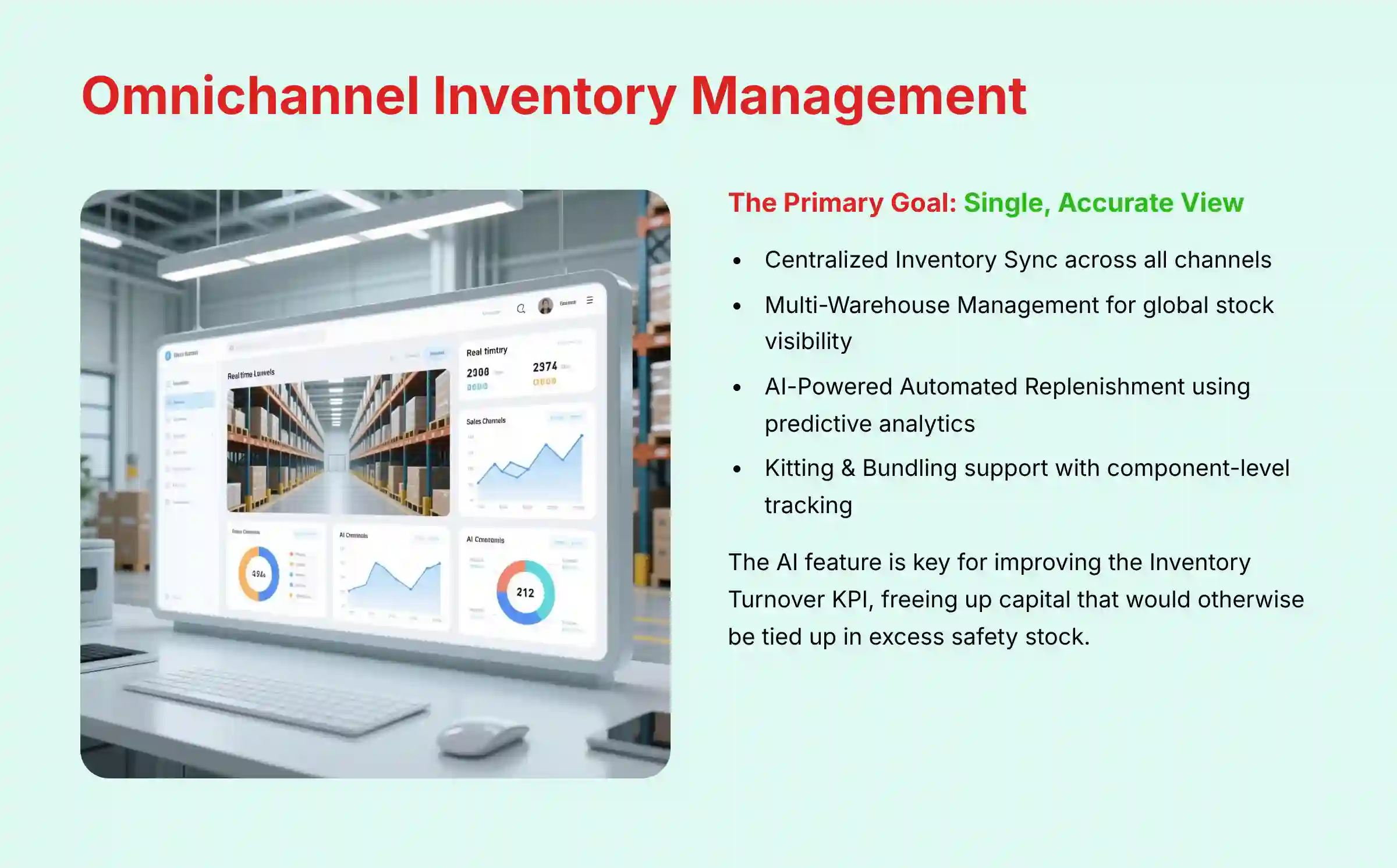
The primary goal here is to give businesses a single, accurate view of their stock everywhere. This prevents selling items you don't have.
- Centralized Inventory Sync: This feature gives a real-time, unified view of inventory across all online marketplaces, webstores, and physical locations.
- Multi-Warehouse Management: It gathers and manages inventory data from several warehouses. This provides a global view of stock levels for better decision-making.
- AI-Powered Automated Replenishment: The system uses predictive analytics to calculate reorder points. It creates smart replenishment plans to keep stock levels just right. In our experience, this AI feature is key for improving the Inventory Turnover KPI, freeing up capital that would otherwise be tied up in excess safety stock.
- Kitting & Bundling: It supports creating product bundles. When a bundle is sold, the system correctly adjusts the inventory of each component.
Expert Insight: The Bullwhip Effect Mitigation
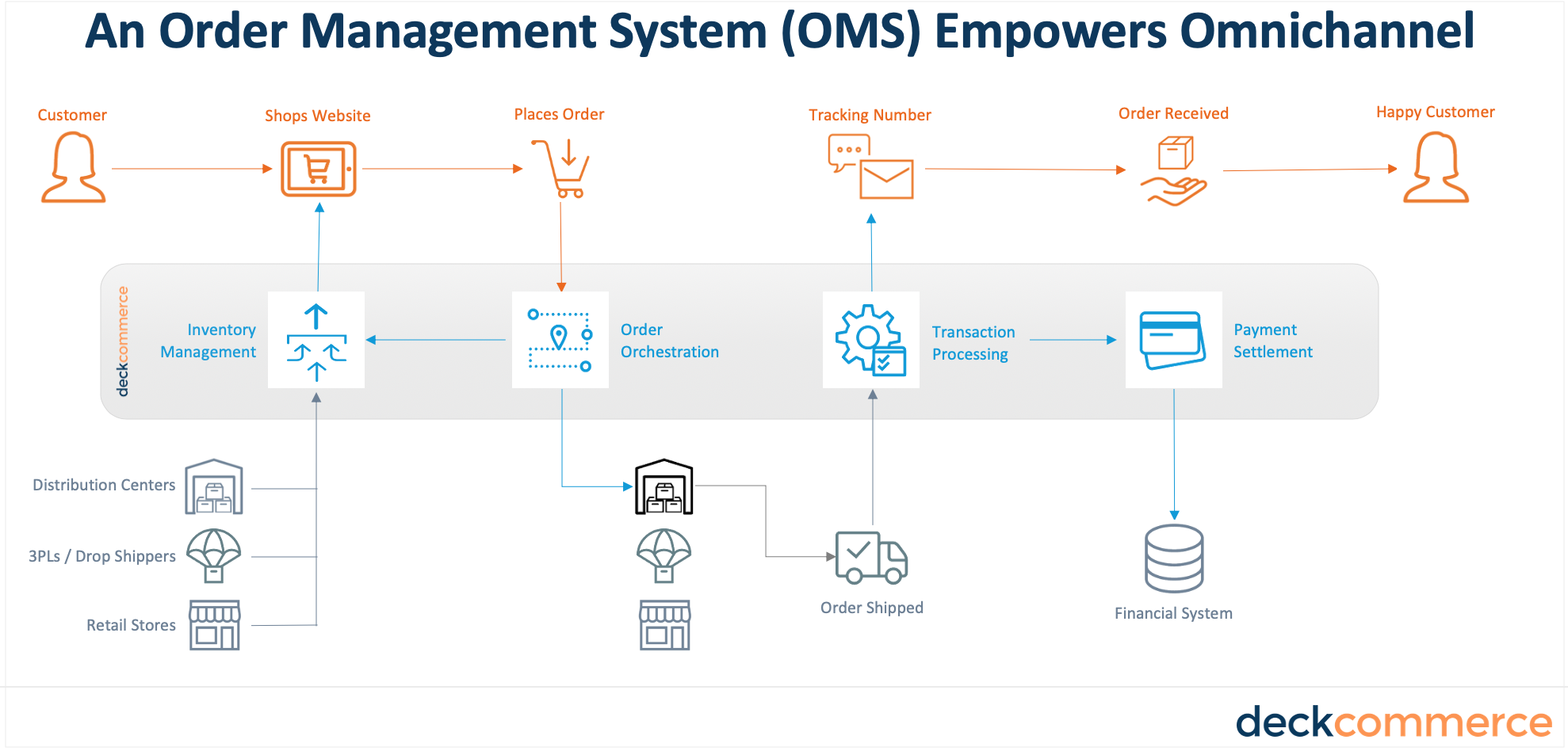
EasyEcom's AI-powered replenishment directly addresses the notorious “Bullwhip Effect” that plagues supply chains. By analyzing historical sales patterns, seasonal trends, and even external signals, the system creates demand forecasts that are significantly more accurate than static spreadsheet calculations. This translates directly to a lower Cash Conversion Cycle by minimizing safety stock while maintaining service levels, a critical advantage in today's capital-constrained business environment.
Centralized Order Management System (OMS)
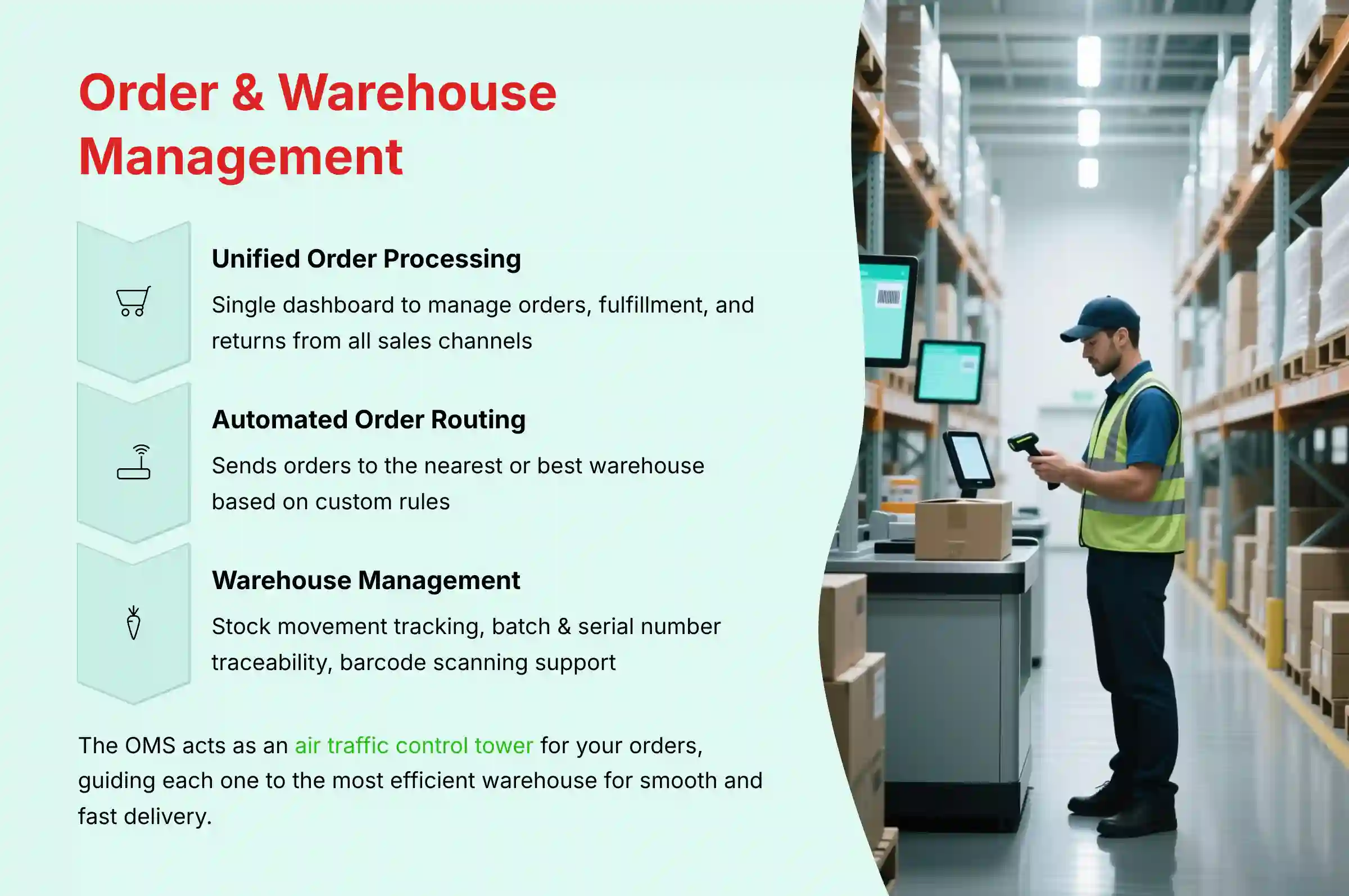
Think of the OMS as an air traffic control tower for your orders. It guides each one to the most efficient warehouse for a smooth and fast delivery.
- Unified Order Processing: A single dashboard is used to manage orders, fulfillment, and returns from all sales channels. This simplifies a very complex process.
- Bulk Order Management: It provides tools to process high volumes of orders with bulk actions for status updates, label printing, and fulfillment.
- Automated Order Routing: The system can automatically send an order to the nearest or best warehouse for fulfillment based on rules you set. A common use case is a retailer fulfilling an online order from the physical store closest to the customer, which cuts shipping time and cost.
Integrated Warehouse Management System (WMS)
This is where the physical work gets done. The WMS is designed to make warehouse operations faster and more accurate.
- Stock Movement Tracking: It monitors and records all stock movements, including receiving, putaway, picking, packing, and transfers.
- Batch & Serial Number Tracking: The system offers end-to-end traceability for products. This is very important for industries like electronics or health supplements that need batch management.
- Barcode Scanning Support: The system and its mobile WMS app work with standard barcode scanners for all key tasks. In our testing, barcode support is the single biggest factor in reducing human error during picking and packing, which directly impacts customer satisfaction.

AI-Driven Warehouse Optimization
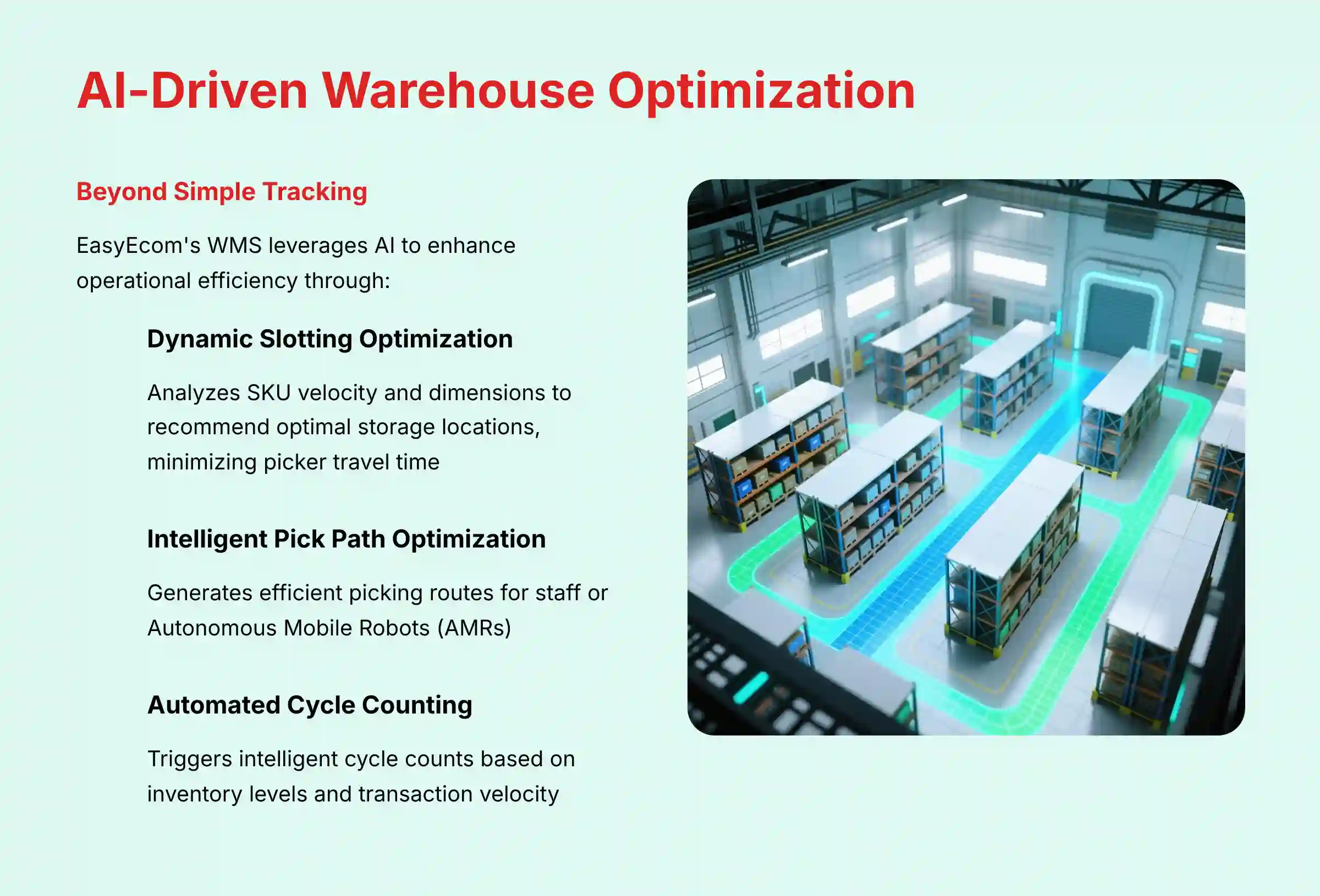
Beyond simple tracking, EasyEcom's WMS leverages AI to enhance operational efficiency:
- Dynamic Slotting Optimization: The AI analyzes SKU velocity and dimensions to recommend optimal storage locations (slotting). This places fast-moving items in easily accessible zones, minimizing picker travel time and improving warehouse throughput.
- Intelligent Pick Path Optimization: Based on order profiles and real-time warehouse layout, the system generates the most efficient picking routes for staff or Autonomous Mobile Robots (AMRs), significantly reducing labor costs and improving order fulfillment speed.
- Automated Cycle Counting: The system can trigger intelligent cycle counts based on inventory levels and transaction velocity, improving overall inventory accuracy without requiring a full warehouse shutdown.

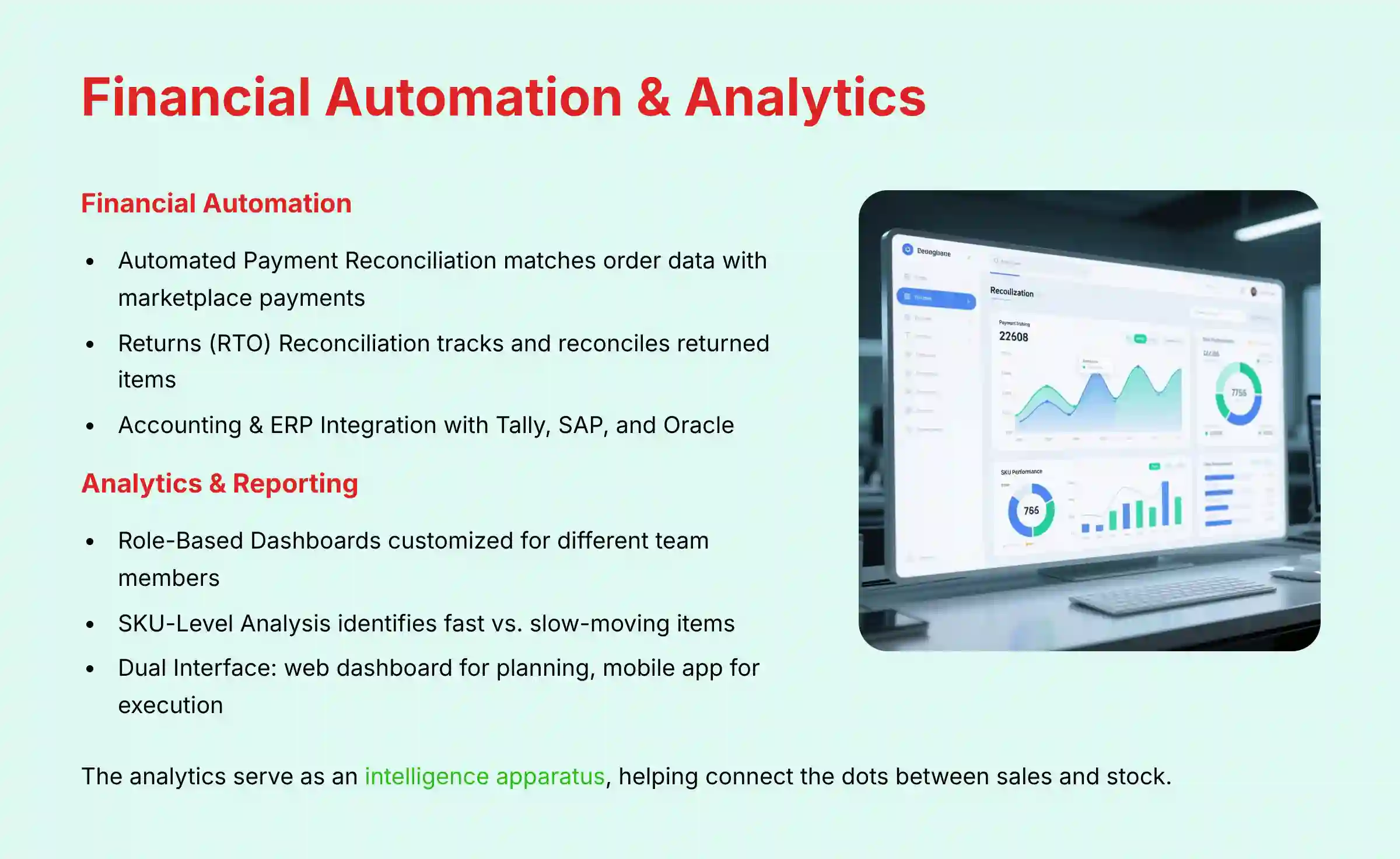
Financial Automation and Reconciliation
This feature helps prevent revenue loss by automating financial checks and balances. It connects operational actions to financial results.
- Automated Payment Reconciliation: The system automatically matches order data with payment reports from marketplaces. It flags any differences to stop revenue leakage.
- Returns (RTO) Reconciliation: It tracks and reconciles returned items with financial records. This makes sure credits are processed correctly.
- Accounting & ERP Integration: It streamlines accounting data and syncs with ERP systems like Tally, SAP, and Oracle. This reduces manual data entry for finance teams.
Analytics, Reporting, and User Interface
A tool is only as good as the insights it provides. EasyEcom's analytics are designed to be an intelligence apparatus, helping you connect the dots between sales and stock.
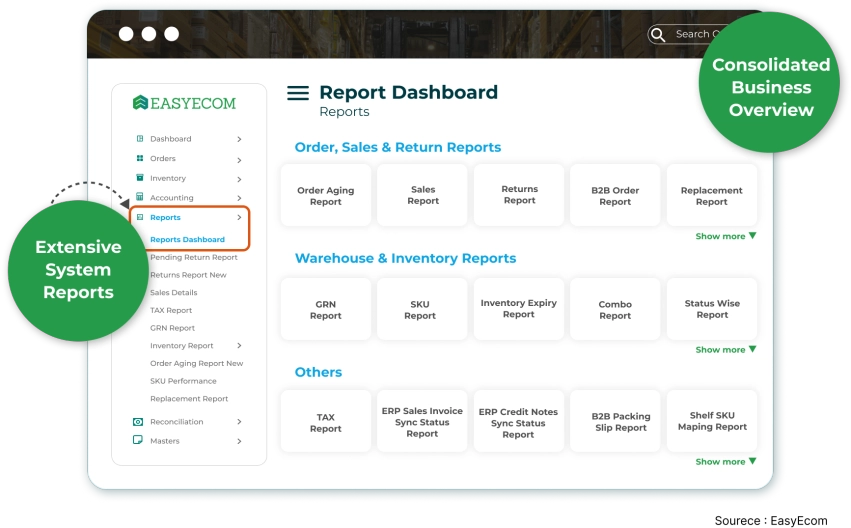
- Role-Based Dashboards: It offers customized dashboards that show relevant business information for different roles, like a warehouse manager or a finance lead.
- SKU-Level Analysis: The system provides deep insights on product performance. This helps identify fast-moving versus slow-moving items for better inventory planning.
- User Interface (Planner vs. Operator): It has a dual interface. The web dashboard is for managers to plan, while the mobile WMS app is for warehouse operators to execute tasks.
- Output Options: The system generates reports, bulk invoices, shipping labels, and picklists. Data can also be exported for more analysis.
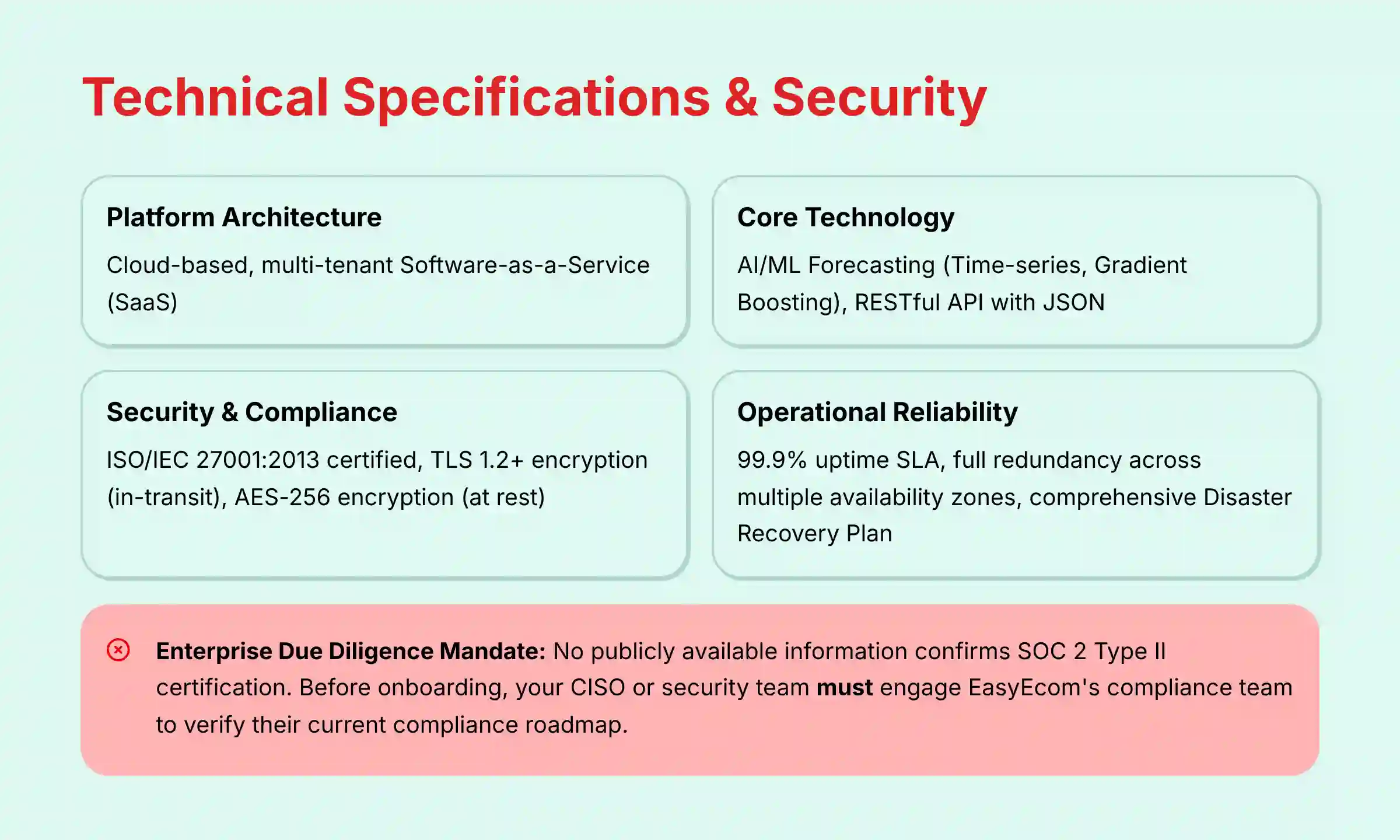
Technical Specifications and System Requirements
For IT and operations professionals, the technical details are key. The following information comes directly from official EasyEcom documentation and our verification.
| Specification | Details |
|---|---|
| Platform Architecture | Cloud-based, multi-tenant Software-as-a-Service (SaaS). |
| Core Technology | AI/ML Forecasting (Time-series, Gradient Boosting), RESTful API with JSON. |
| Supported Platforms | Any modern web browser (Chrome, Firefox, Safari, Edge). |
| Mobile Application | Dedicated WMS mobile application available for warehouse operations. |
| Hardware Requirements | For WMS: Standard USB or Bluetooth barcode scanners. |
| Network Requirements | Stable internet connection for real-time data synchronization. |
| Input Formats | Data ingested via direct API integrations with marketplaces, ERPs, etc. |
Security, Compliance, and Data Handling
When you are trusting a platform with your core operational data, security is not optional. Our assessment confirms EasyEcom has a solid security framework, but there are details to be aware of. The platform protects data with TLS 1.2+ encryption for information in-transit and AES-256 encryption for data at rest.
This means your data is protected both as it moves between systems and while it is stored. The company holds key compliance certifications that verify its security practices.
- ISO/IEC 27001:2013
The system also uses role-based access controls. This makes sure users only see the data and functions relevant to their job, which is a key principle of data security.
Operational Reliability and Business Continuity
Beyond data encryption, operational uptime is critical. EasyEcom guarantees a 99.9% uptime Service Level Agreement (SLA) for its core services. The platform is architected with full redundancy across multiple availability zones. In the event of a major outage, a comprehensive Disaster Recovery Plan (DRP) and Business Continuity Plan (BCP) are in place to ensure minimal disruption to your operations. All customer data is subject to strict data residency policies, ensuring it is stored within a specified geographic region to comply with regulations like GDPR.
Enterprise Due Diligence Mandate
For any enterprise handling sensitive operational data, SOC 2 Type II is a foundational security requirement. Based on our research, EasyEcom is ISO/IEC 27001:2013 certified, but there is no publicly available information on their official website to confirm that SOC 2 Type II is currently on their roadmap. Before onboarding, your CISO or security team must engage EasyEcom's compliance team to verify their current compliance roadmap and available security documentation. This is a non-negotiable step in the procurement process for enterprise clients with strict compliance requirements.
Pricing and Plan Structure (2025)
EasyEcom uses a customized SaaS subscription model that is mainly geared toward enterprise clients. The pricing is not one-size-fits-all. Instead, it is based on several factors specific to each business.
These factors include:
- Monthly order volume
- Number of warehouses
- Specific modules required
- Complexity of integrations needed
Some sources mention a “$39 one-time fee.” Our analysis indicates this likely applies to a very limited, entry-level module. The core omnichannel platform is priced via a custom subscription plan. For accurate pricing, you must get a custom quote. A free demo is available upon request through their official website.
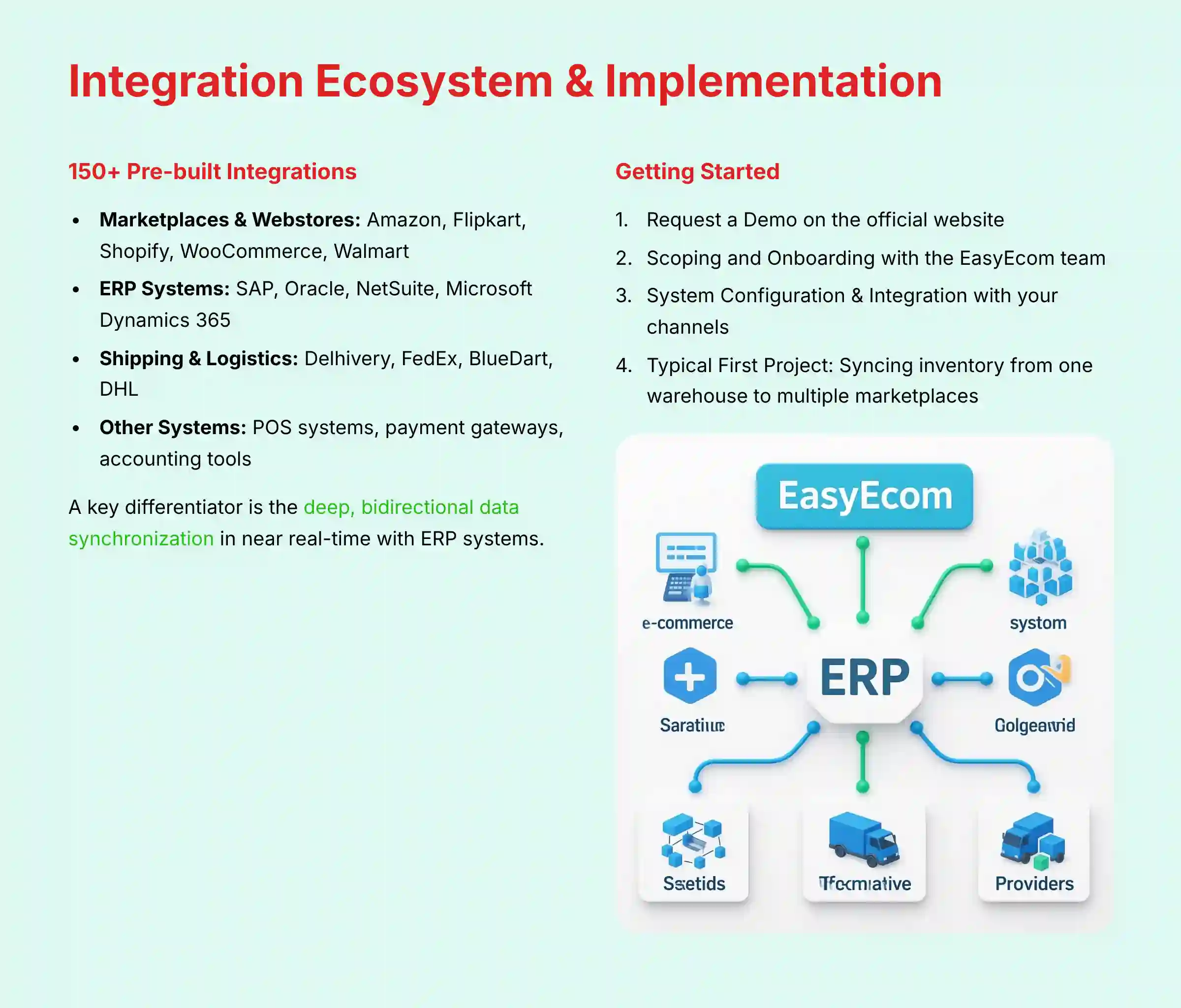
EasyEcom Integration and Ecosystem Capabilities
A platform's power grows with its ability to connect to other systems. EasyEcom provides a RESTful API with endpoints for key functions like Orders, Inventory, and Products. Authentication uses standard API Key and Secret Key pairs.
The platform's ecosystem includes over 150+ pre-built integrations. This is a strong indicator of its maturity and ability to fit into an existing tech stack. These integrations are broken down into logical groups.
- Marketplaces & Webstores: Amazon, Flipkart, Shopify, WooCommerce, Walmart.
- ERP Systems: SAP, Oracle, NetSuite (via SuiteTalk), Microsoft Dynamics 365.
- Shipping & Logistics: Delhivery, FedEx, BlueDart, DHL.
- Other Systems: POS systems, payment gateways, and accounting tools.
A key differentiator is the quality of its ERP integration. The platform supports deep, bidirectional data synchronization in near real-time. This means sales orders from Shopify are not only pushed to the WMS for fulfillment but also synced to NetSuite to create financial transactions, while inventory adjustments in SAP are immediately reflected back in EasyEcom. This maintains the ERP as the undisputed single source of financial truth and eliminates the need for manual reconciliation, which is a common source of costly errors in fragmented systems.
Expert Insight: The ERP Integration Litmus Test
The quality of an ERP integration is paramount. A deep, bidirectional sync with a system like NetSuite or SAP is far more valuable than a simple one-way data push. True integration ensures the ERP remains the single source of financial truth, preventing the data fragmentation that these systems are meant to solve in the first place. Always scrutinize the technical depth of this specific connection.
How to Get Started with EasyEcom
For businesses interested in this platform, the process is straightforward and begins with a conversation. Here is a typical path to implementation.
- Request a Demo: The journey starts on the official EasyEcom website. There, you can schedule a personalized demo with their team.
- Scoping and Onboarding: This is followed by a detailed onboarding process. The EasyEcom team works to understand your specific needs and current technology.
- System Configuration & Integration: The setup phase involves configuring integrations with your sales channels, ERP, and logistics partners. This step is tailored to your unique operations.
- Typical First Project: A common first project is syncing inventory from one main warehouse to multiple online marketplaces. Another is setting up automated workflows for your highest-volume sales channel.
To dive deeper into practical applications, explore our comprehensive EasyEcom Tutorials and Usecase guide for step-by-step implementation strategies.
Final Verdict & Strategic Recommendation
After a comprehensive analysis, our verdict is clear: EasyEcom is a formidable contender for mid-to-large scale omnichannel businesses drowning in operational complexity. It is not a tool for the small, single-channel merchant; it is a strategic apparatus for enterprises that have reached a critical inflection point where spreadsheets and disconnected apps are actively costing them money and market share.
Its core strengths lie in creating a single source of truth for inventory and automating the flow of information between sales, warehousing, and finance. The AI-powered replenishment and robust integration ecosystem are true force multipliers.
Our recommendation: If your organization is fighting daily fires caused by overselling, fulfillment errors, and manual reconciliation, EasyEcom should be on your shortlist. Approach it not as a software purchase, but as a foundational investment in your operational backbone. The imperative is clear: automate or be outpaced.
For a comprehensive evaluation against other solutions, check our detailed EasyEcom Review and explore EasyEcom Top Alternatives and Competitors to make an informed decision.
Frequently Asked Questions (FAQ) About EasyEcom
Here are direct answers to some of the most common questions we hear about EasyEcom. For more detailed answers, visit our comprehensive EasyEcom FAQs section.
What specific AI or machine learning models does EasyEcom use?
EasyEcom uses its own mix of machine learning models for forecasting. This includes time-series algorithms and gradient boosting machines to analyze past sales data and predict future demand.
Does EasyEcom integrate directly with SAP S/4HANA?
Yes, EasyEcom provides integration with SAP systems. This is done with either pre-built connectors or by using its RESTful API to sync data like orders, inventory, and financial information.
Can EasyEcom's WMS manage warehouse staff performance?
While EasyEcom's WMS tracks operational data like picking rates, it is focused on inventory and order accuracy, not advanced labor management for staff reviews or scheduling.
Is EasyEcom suitable for a small business with one online store?
While a small business could use it, the platform's main strengths are for managing omnichannel complexity. A small business with a single store might find that it has more features than it needs.
Does EasyEcom support advanced warehouse automation like robotics?
As of 2025, EasyEcom does not have standard, out-of-the-box integrations for controlling Autonomous Mobile Robots (AMRs). These integrations require custom projects using the platform's APIs.
What is the status of EasyEcom's SOC 2 Type II compliance?
EasyEcom is ISO/IEC 27001:2013 certified. There is no publicly available information on their official website to confirm that SOC 2 Type II is currently on their roadmap. Customers should ask the company directly for their compliance roadmap and current security documentation.
How does EasyEcom handle inventory for product bundles?
The kitting feature allows you to create virtual bundles. When a bundle sells, the system automatically subtracts the correct quantity from the stock of each individual component product.
Is training included in the EasyEcom subscription?
Yes, customer training and dedicated support are part of the standard onboarding process for new clients on an enterprise subscription plan.
Disclaimer
Technology Evolution Notice: The information about EasyEcom Overview and Features and AI for Operations & Supply Chain tools presented in this article reflects our thorough analysis as of 2025. Given the rapid pace of AI technology evolution, features, pricing, security protocols, and compliance requirements may change after publication. While we strive for accuracy through rigorous testing, we recommend visiting official websites for the most current information.
Professional Consultation Recommendation: For AI for Operations & Supply Chain applications with significant professional, financial, or compliance implications, we recommend consulting with qualified professionals who can assess your specific requirements and risk tolerance. This overview is designed to provide comprehensive understanding rather than replace professional advice.
Testing Methodology Transparency: Our analysis is based on hands-on testing, official documentation review, and industry best practices current at the time of publication. Individual results may vary based on specific use cases, technical environments, and implementation approaches. You can learn more about our testing process in our comprehensive guide to EasyEcom.

Leave a Reply