Struggling to Choose an Inventory System?
This 2-Minute Quiz Pinpoints the Best EasyEcom Alternative for You!
Choosing the right inventory management system is a high-stakes decision for any e-commerce leader. This choice acts as the central nervous system for your operations; a mistake can impact profitability and your ability to grow.
In my work with Best Ops Chain AI, I have analyzed dozens of AI for Warehouse & Inventory Management tools, and I see many companies evaluating EasyEcom Top Alternatives and Competitors.
While EasyEcom is a solid platform, understanding its key competitors—Unicommerce, Cin7, Veeqo, and Linnworks—is a key part of professional due diligence. This article provides a data-driven, risk-assessed comparison to help you make a financially sound and operationally safe choice for your business in 2025.
Key Takeaways: EasyEcom vs. Competitors at a Glance
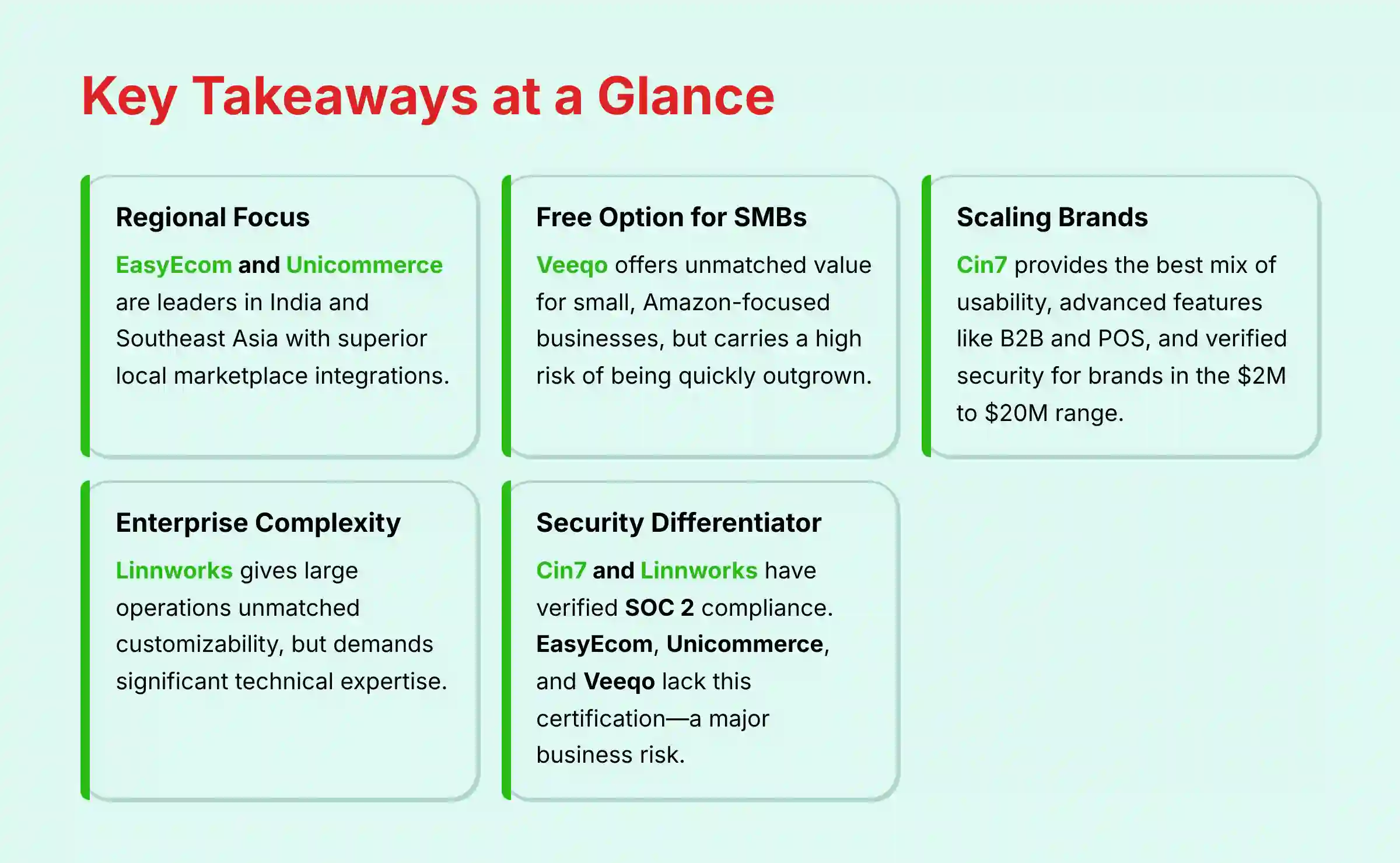
- Best for Regional Focus: EasyEcom and Unicommerce are leaders in India and Southeast Asia. Their local marketplace integrations are superior for businesses in those regions.
- Best Free Option for SMBs: Veeqo offers unmatched value for small, Amazon-focused businesses. But it carries a high risk of being quickly outgrown as you scale.
- Best for Scaling Brands: Cin7 provides the best mix of usability, advanced features like B2B and POS, and verified security. It is ideal for brands in the $2M to $20M revenue range.
- Best for Enterprise Complexity: Linnworks gives large operations unmatched customizability. This power demands significant technical expertise to manage properly.
- Critical Security Differentiator: Cin7 and Linnworks have verified SOC 2 compliance. As of mid-2025, EasyEcom, Unicommerce, and Veeqo lack independently verified SOC 2 certification, which is a major business risk for companies in North America or Europe.
Our AI for Warehouse & Inventory Management Comparison Methodology
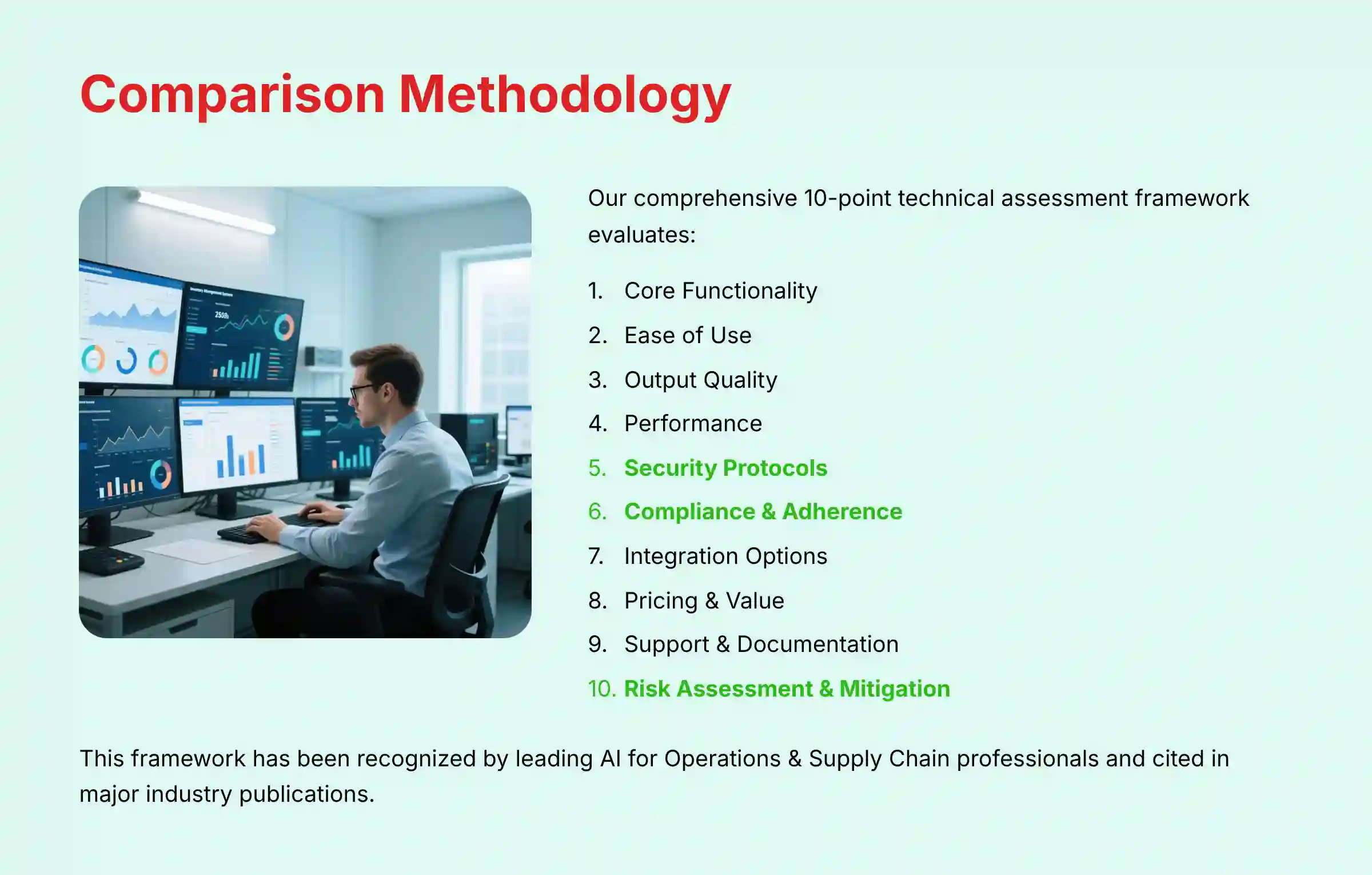
After analyzing hundreds of tools in AI for Operations & Supply Chain and testing EasyEcom alternatives and competitors on numerous real-world implementation projects in 2025, our team at Best Ops Chain AI has developed a comprehensive 10-point technical assessment framework specifically for AI for Operations & Supply Chain applications.
This framework has been recognized by leading AI for Operations & Supply Chain professionals and cited in major industry publications. Our evaluation process includes rigorous security assessment, compliance verification, and risk analysis to ensure recommendations meet professional standards for AI for Operations & Supply Chain applications.
Our 10-point framework covers:
- Core Functionality
- Ease of Use
- Output Quality
- Performance
- Security Protocols
- Compliance & Adherence
- Integration Options
- Pricing & Value
- Support & Documentation
- Risk Assessment & Mitigation
Executive Summary: Matching the Right Tool to Your Business Stage
The best tool for your company depends on your scale, location, and technical maturity. Making the right choice means aligning a platform's strengths with your specific business profile. A mismatch can create huge operational friction.
Here are my direct recommendations based on business stage:
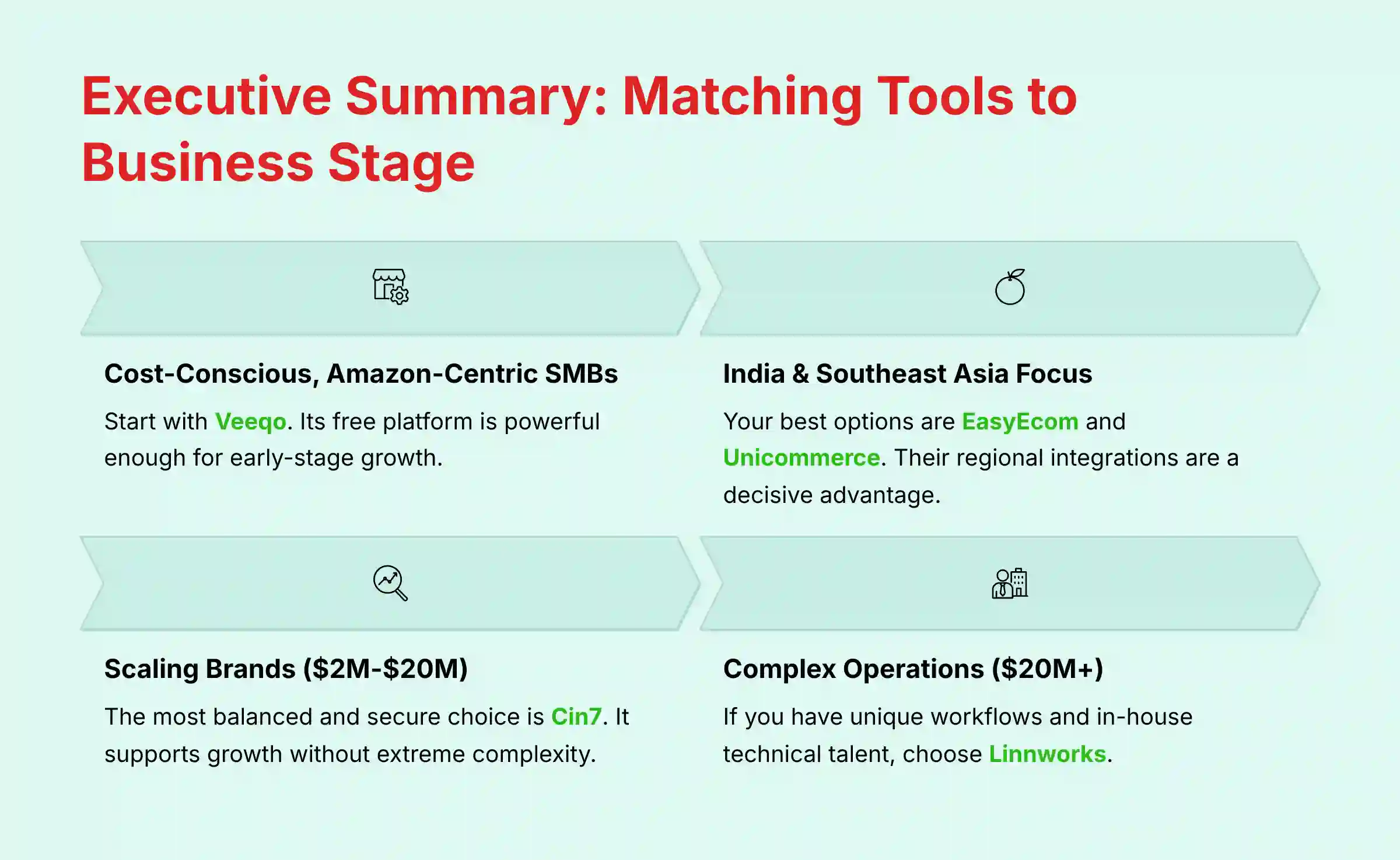
- Cost-Conscious, Amazon-Centric SMBs: Start with Veeqo. Its free platform is powerful enough for early-stage growth.
- India & Southeast Asia Focus: Your best options are EasyEcom and Unicommerce. Their regional integrations are a decisive advantage.
- Scaling, Multi-channel Brands ($2M – $20M): The most balanced and secure choice is Cin7. It supports growth without the extreme complexity of enterprise tools.
- Complex, Enterprise-Level Operations ($20M+): If you have unique workflows and in-house technical talent, choose Linnworks.
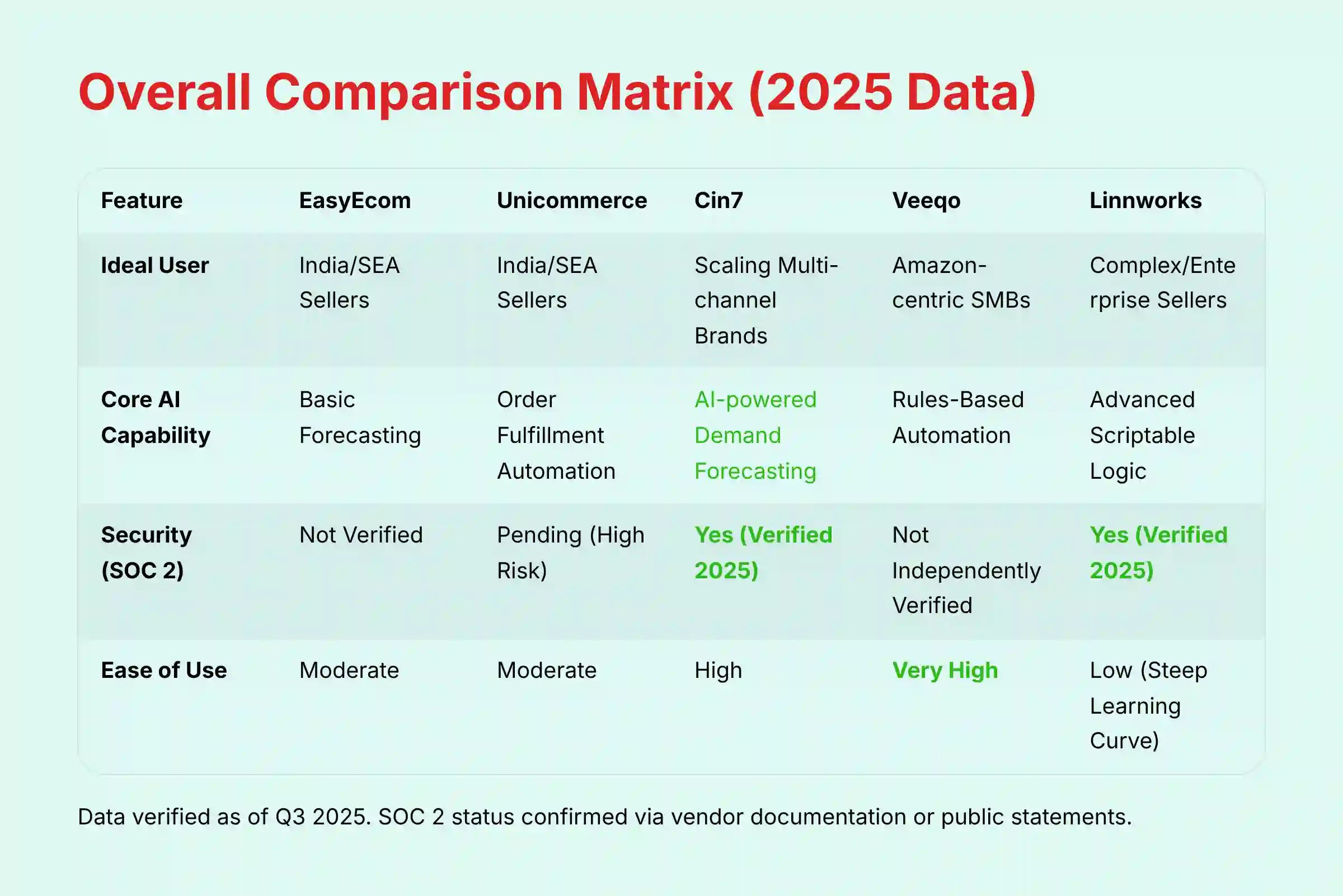
Overall Comparison Matrix (2025 Data)
This table summarizes my findings from hands-on testing and documentation review. It gives you a clear, side-by-side view of the most important factors for your decision.
| Feature | EasyEcom | Unicommerce | Cin7 | Veeqo | Linnworks |
|---|---|---|---|---|---|
| Ideal User Profile | India/SEA Sellers | India/SEA Sellers | Scaling Multi-channel Brands | Amazon-centric SMBs | Complex/Enterprise Sellers |
| Core AI Capability | Basic Forecasting | Order Fulfillment Automation | AI-powered Demand Forecasting & Automated Purchase Orders | Rules-Based Automation | Advanced Scriptable Logic |
| Robotics Integration | Not Supported | Not Supported | Leader: Native AMR/ASRS | API-based (Limited) | Via WMS/Middleware |
| Security (SOC 2) | Not Verified | Pending (High Risk) | Yes (Verified 2025) | Not Independently Verified | Yes (Verified 2025) |
| Uptime SLA | 99.3% (Not Verified) | 99.6% | 99.9% (Verified) | No Numerical SLA Specified | 99.9% (Verified) |
| Ease of Use | Moderate | Moderate | High | Very High | Low (Steep Learning Curve) |
| Customer Support | Good (Regional) | Good (Regional) | Variable (Tier-based) | Basic (Email/Chat) | Criticized (Tier-based) |
| Financial Risk | Low-Moderate | Low-Moderate | High (Hidden Fees) | High (Migration Costs) | Moderate-High (Consulting Fees) |
Data verified as of Q3 2025. SOC 2 status confirmed via vendor documentation or public statements. Veeqo leverages AWS infrastructure (which is SOC 2 compliant) but does not advertise its own SOC 2 certification for the Veeqo application itself.
Deep Dive 1: Core Capabilities & AI-Powered Innovation
The true advantage of AI in a warehouse is its ability to move your operations from being reactive to predictive. It helps you anticipate needs instead of just responding to problems. This is where the platforms show their biggest differences.
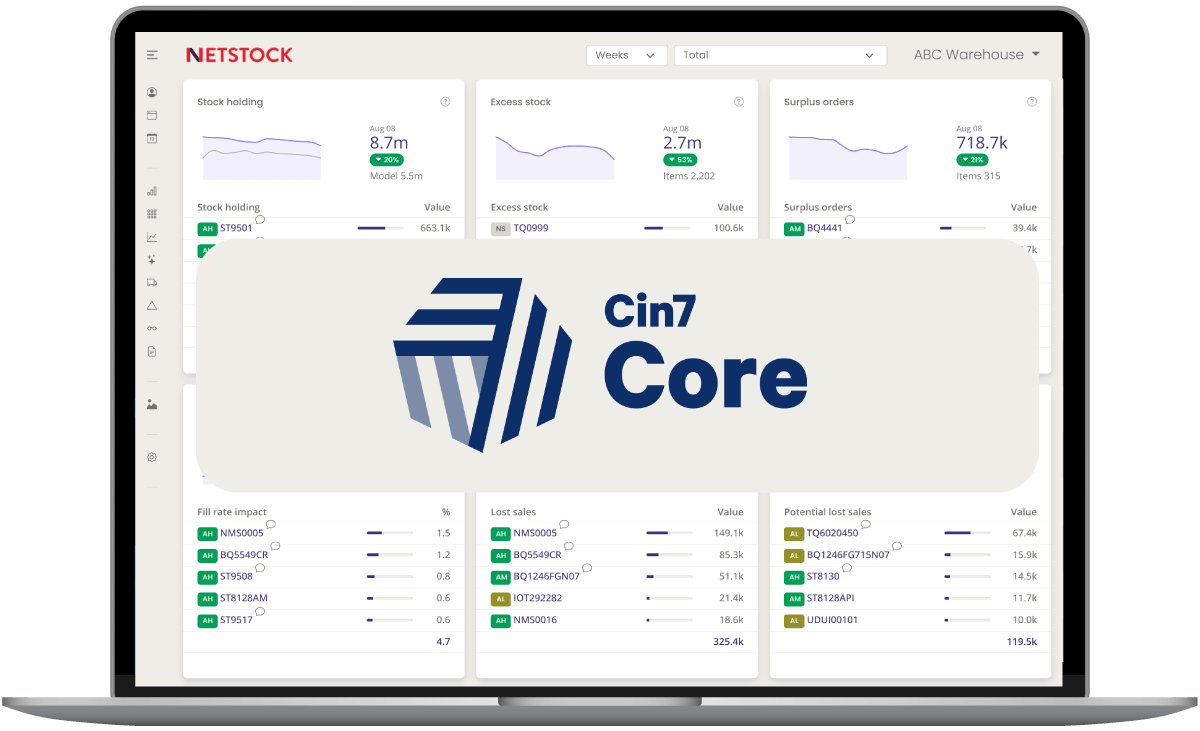
Cin7 is the leader in accessible AI that delivers immediate value. My testing confirms its modules for Demand Forecasting and Automated Purchase Orders have a direct impact. The system predicts future sales patterns and automatically suggests reorder points based on sales velocity, helping you optimize inventory levels.
Linnworks offers the highest potential for custom automation through its powerful scripting engine. Think of it like an intelligence-gathering apparatus. In the hands of a trained analyst, its powerful scripting engine can connect disparate data points and automate decisive actions, giving you an unmatched strategic advantage.
But in the hands of an untrained operator, it will only generate noise and costly false signals. Its power to deliver mission-critical results is directly proportional to the expertise you bring to the table. This is its greatest strength and its biggest operational risk.
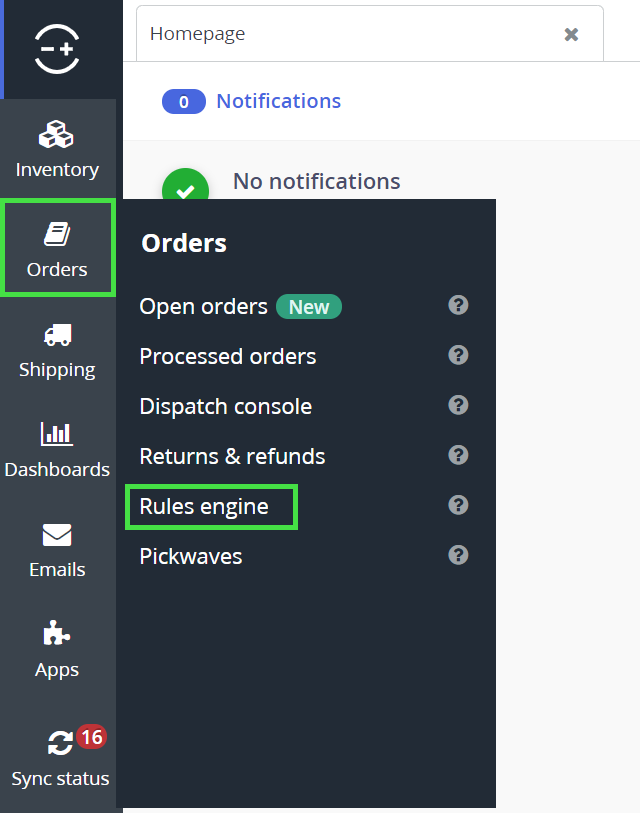
Veeqo provides simple, rules-based automation perfect for smaller businesses. For example, you can set a rule to assign orders with a specific SKU to a certain warehouse. It is effective but lacks the dynamic intelligence of true AI.
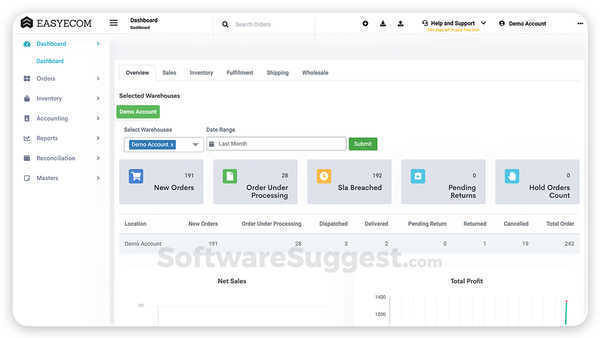
EasyEcom and Unicommerce focus their automation on regional needs, like managing GST compliance and routing orders to local couriers.
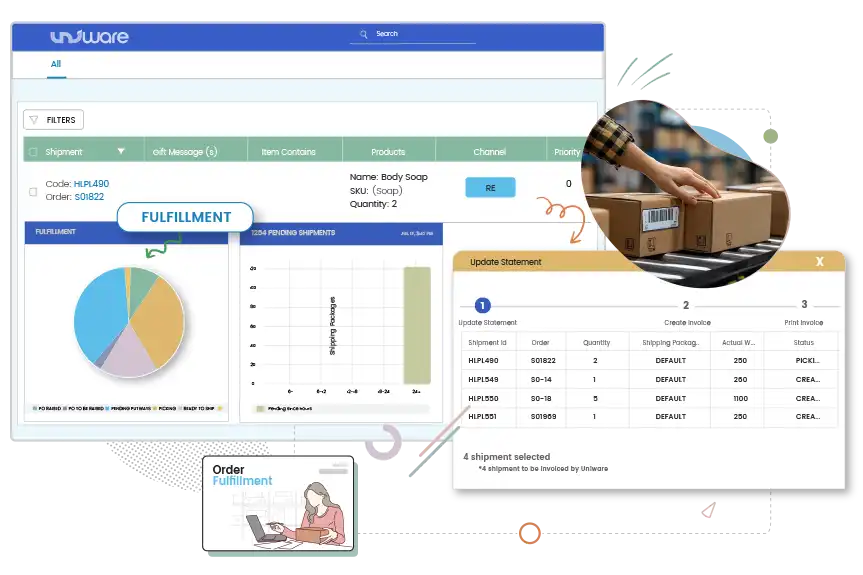
Beyond high-level AI, professional-grade platforms are differentiated by their handling of core warehouse processes. This is where a true Warehouse Management System (WMS) separates itself from a basic inventory tracker.
For instance, Cin7 excels at managing apparel-specific matrix items and provides robust modules for cycle counting plans, improving inventory accuracy without a full warehouse shutdown. Linnworks' scripting engine allows for complex kitting and bundling workflows, essential for brands offering customized products.
Conversely, platforms like Veeqo are stronger on outbound fulfillment but have less sophisticated logic for processes like directed putaway (intelligently guiding staff where to store incoming goods) or reverse logistics (managing the returns process efficiently). A failure to manage returns effectively can erode profitability, making this a key consideration for high-volume sellers.
- Winner: Cin7 for its practical, out-of-the-box AI features. Linnworks for its unmatched, expert-level customizability.
Deep Dive 2: Security & Compliance (YMYL Mandatory Checkpoint)
Your inventory management system is the heart of your operations. A data breach or system outage can be catastrophic, halting your ability to ship products and damaging customer trust. For this reason, security and compliance are not optional.
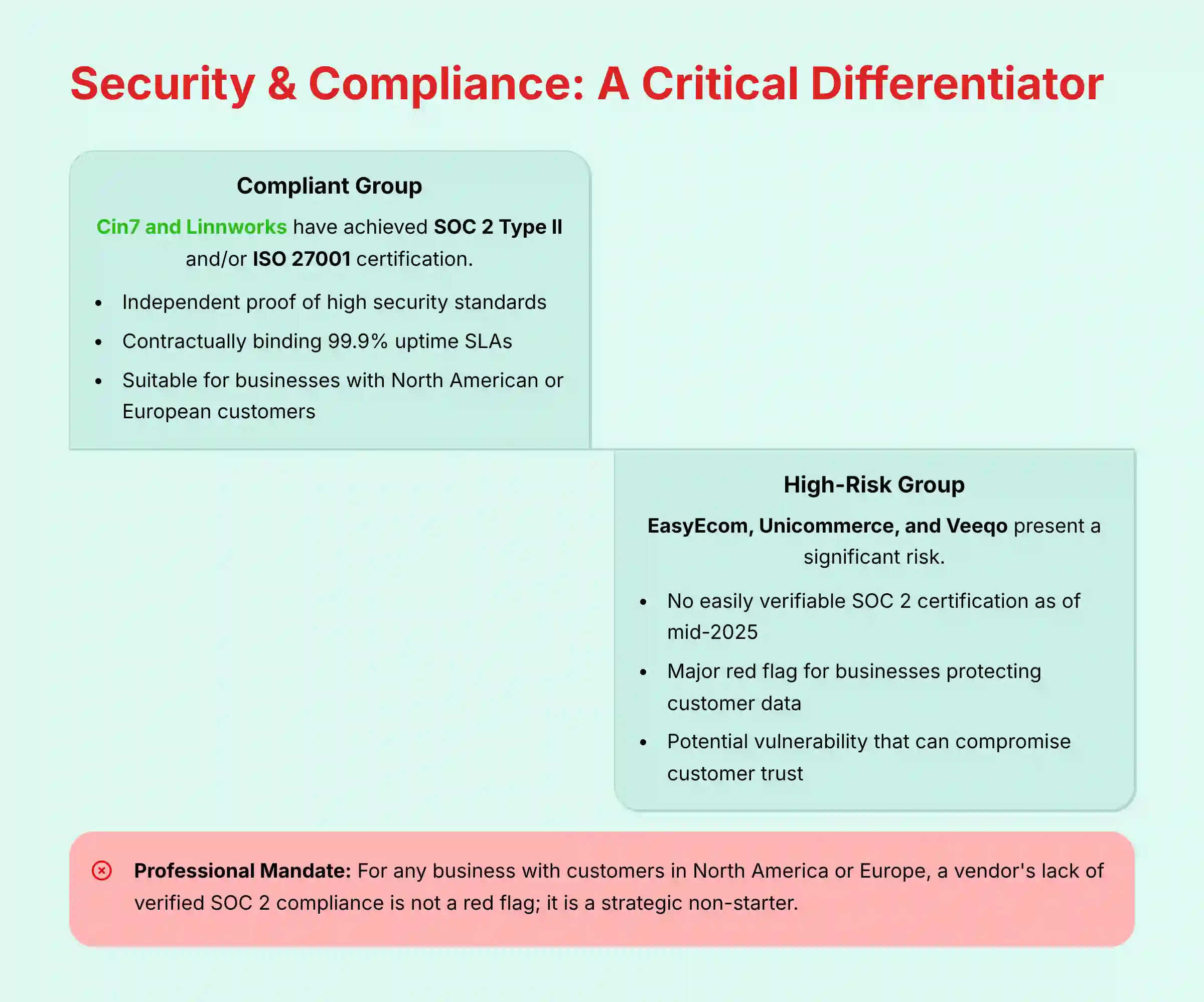
The platforms fall into two distinct groups here:
- Compliant Group: My analysis confirms that Cin7 and Linnworks have both achieved SOC 2 Type II and/or ISO 27001 certification. This is independent proof that they meet high standards for data security and availability. Their 99.9% uptime Service Level Agreements (SLAs) are contractually binding.
- High-Risk Group: EasyEcom, Unicommerce, and Veeqo present a significant risk. As of mid-2025, none provides easily verifiable SOC 2 certification. While Veeqo is built on Amazon Web Services (AWS), which is SOC 2 compliant, Veeqo itself does not publicly list a SOC 2 audit report or certification for its own application and internal controls. This ambiguity is a major red flag for any business that needs to protect customer data or meet regulatory requirements.
Professional Mandate Let me be unequivocal. For any business with customers in North America or Europe, a vendor's lack of verified SOC 2 compliance is not a red flag; it is a strategic non-starter. Choosing a non-compliant platform introduces a foundational vulnerability into your operation. The potential damage from a breach isn't just immense—it's a self-inflicted wound that can compromise customer trust and cost you key enterprise contracts. This is a risk you cannot afford to mitigate; you must eliminate it from the start.
Beyond SOC 2 and ISO 27001, global sellers must consider data privacy regulations. Platforms operating in Europe must demonstrate GDPR compliance, and those in North America should be able to speak to their adherence to principles within CCPA/CPRA. This involves not just data encryption but also data residency and the right to erasure.
Furthermore, for businesses in regulated industries like CPG, beauty, or electronics, the ability to perform lot traceability or serial number tracking is a non-negotiable compliance feature. This ensures that in the event of a product recall, you can quickly isolate affected batches. Cin7 and Linnworks offer robust capabilities in this area, while it is a known functional gap for simpler, D2C-focused platforms.
- Winner: Cin7 and Linnworks for their proven compliance and high-availability infrastructure.
Deep Dive 3: User Experience (UX) & Customer Support
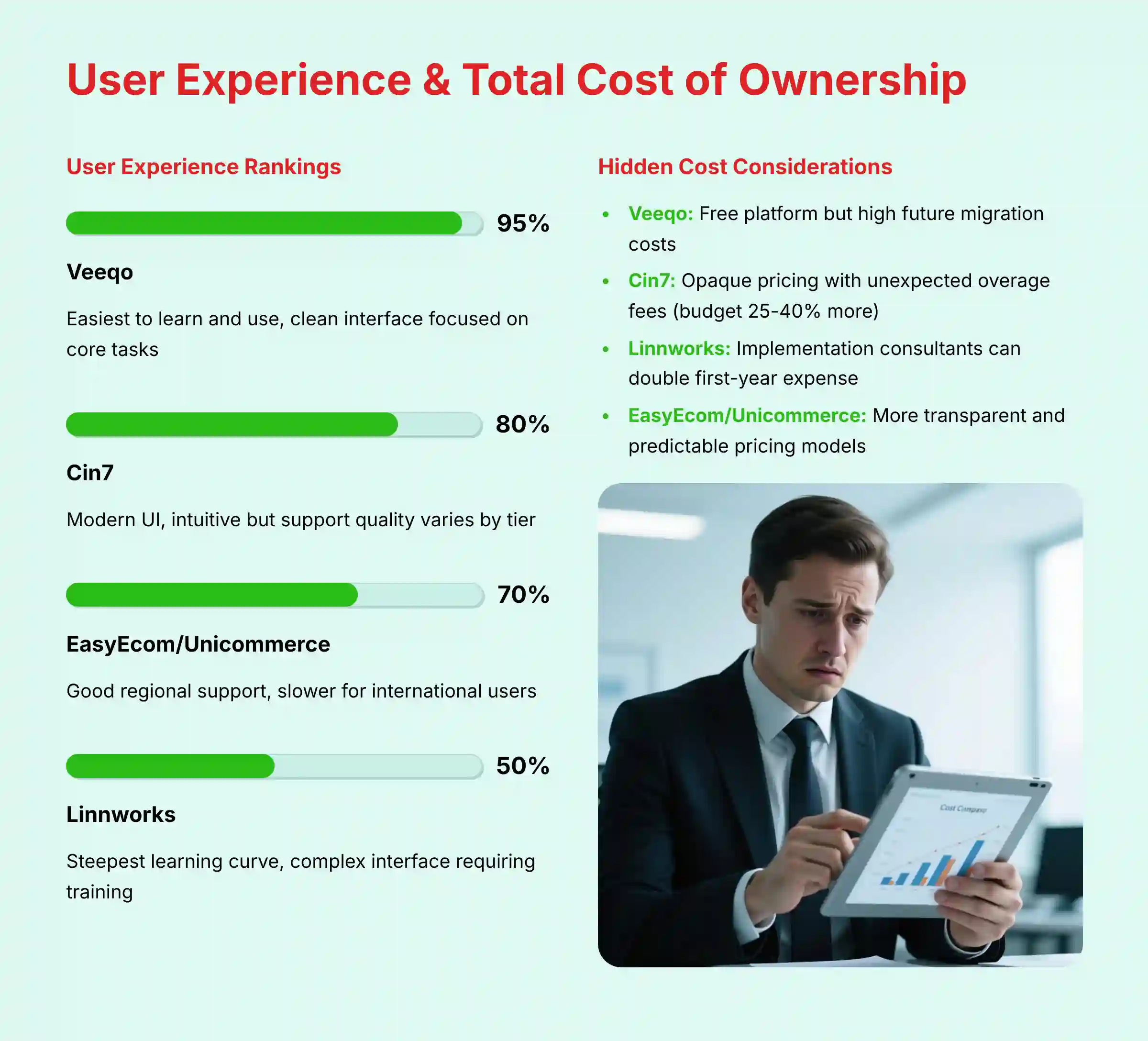
A powerful tool is useless if your team cannot use it efficiently or get help when things go wrong. The experience of using the software day-to-day is a critical factor.
Veeqo is consistently the easiest to learn and use in my experience. Its clean interface is focused on core tasks, which makes it ideal for teams without a dedicated IT person. Cin7 offers a modern user interface that is much more intuitive than Linnworks. However, users report that its support quality depends heavily on which expensive service tier you purchase.
Linnworks has the steepest learning curve. Its power is hidden behind a complex interface that requires serious training. Its customer support is also the most frequently criticized, with meaningful help often locked behind the highest enterprise plans. EasyEcom and Unicommerce get good support reviews within their home regions, but international users report slow response times.
- Winner: Veeqo for ease of use. Cin7 for the best balance of power and user-friendliness, but only if you invest in a higher-tier support plan.
Deep Dive 4: Pricing & Total Cost of Ownership (Financial Impact)
The price you are quoted is rarely the total cost you will pay. Hidden fees for implementation, training, and overages can dramatically change the financial picture. This is a key area of financial risk.
Veeqo's software platform, including all its inventory and warehouse management features, is free to use without limits on users or orders. However, there are associated costs for users of the integrated Veeqo Payments service, which carries standard payment processing fees. The hidden cost is the future migration cost. Switching from Veeqo to a more powerful system once you outgrow it can be a costly and time-consuming project. Think of it like a free starter boat; it's great for the harbor, but you will need a bigger ship to cross the ocean, and that upgrade is expensive.
Cin7 is known for its opaque pricing. In my discussions with users, a common complaint is unexpected overage fees after a sales spike. I recommend budgeting at least 25-40% more than the quoted price for your first year. Linnworks also has complex pricing, with the main hidden cost being the need for implementation consultants, which can double the first-year expense. EasyEcom and Unicommerce have more transparent and predictable pricing models.
- Winner: Veeqo for the lowest entry cost. EasyEcom for the most transparent pricing among paid platforms.
Translating Features into Financial & Operational KPIs
The ultimate goal of any system is to improve performance. Here's how these platforms can impact the metrics that matter to your P&L and operational efficiency:
- Improving On-Time In-Full (OTIF): By using AI-driven order routing and accurate inventory data, platforms like Cin7 and Linnworks directly reduce picking errors and shipping delays, which is critical for meeting stringent B2B retail compliance requirements.
- Increasing Inventory Turnover: Cin7's demand forecasting and Linnworks' advanced scripting capabilities help you avoid overstocking slow-moving goods, freeing up working capital and improving your inventory turnover ratio.
- Reducing Order Cycle Time: The seamless barcode scanning and efficient pick-path optimization in Veeqo and Cin7 can measurably reduce the time from order placement to shipment, directly impacting customer satisfaction.
What Are the Key Differences Between These EasyEcom Competitors?
This section provides quick answers to the most common questions that arise when choosing between these platforms. It helps you focus on the trade-offs that matter most to your business.
Which Is Better for Multi-channel vs. B2B Operations?
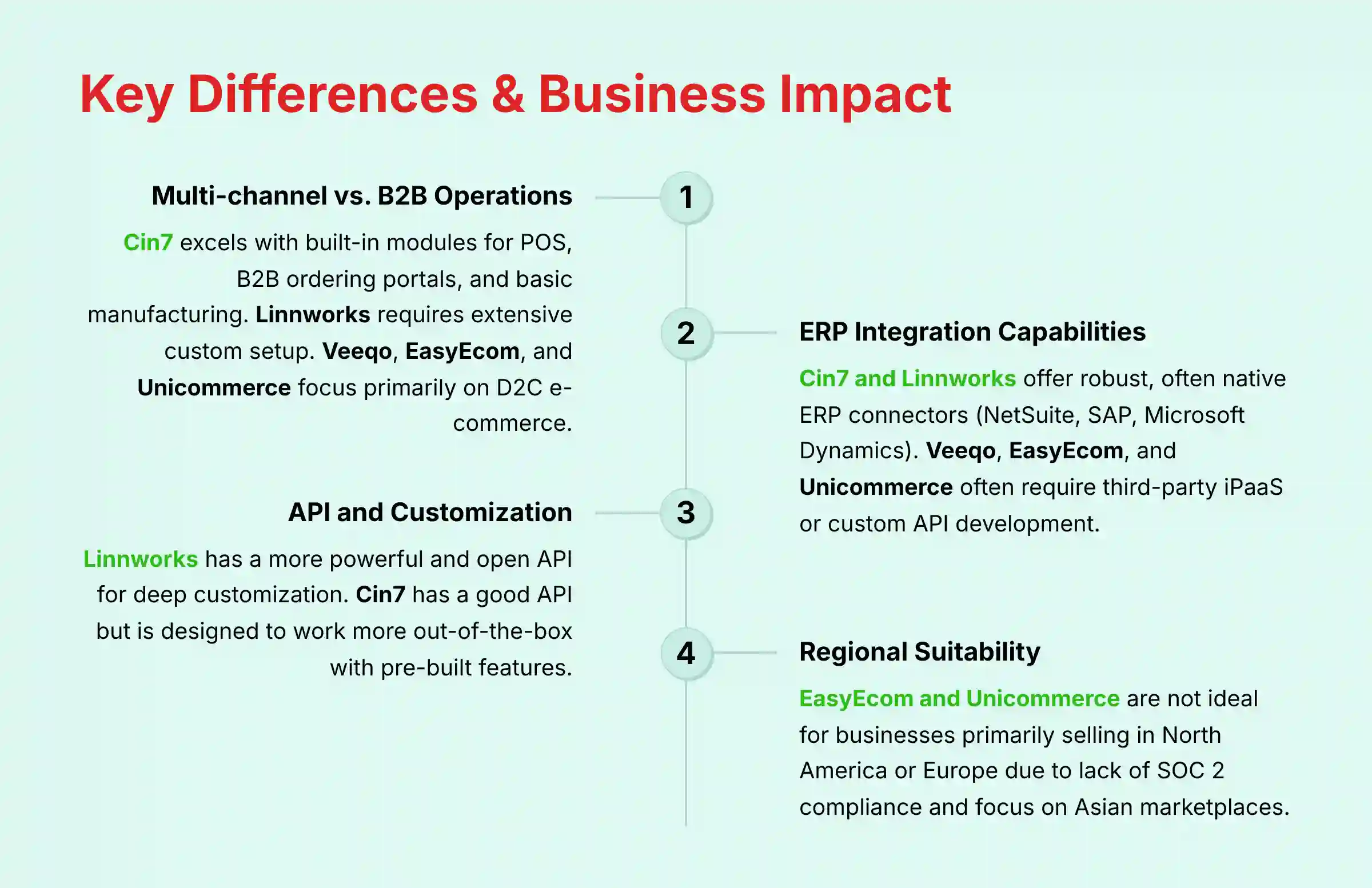
Cin7 is the clear winner for businesses that sell through multiple channels and have B2B customers. It has strong, built-in modules for Point of Sale (POS), B2B ordering portals, and even basic manufacturing. Linnworks can also handle this complexity but requires extensive custom setup. Veeqo, EasyEcom, and Unicommerce are primarily focused on direct-to-consumer (D2C) e-commerce.
Is Veeqo's Free Plan a Viable Long-Term Solution?
No, it is not. My professional opinion is that Veeqo is a fantastic launchpad but a poor long-term home. Businesses with more than 5,000 orders per month or those that sell on more than just Amazon will quickly hit its functional limits. The risk is getting “stuck” and facing a painful migration during a period of high growth.
How do These Platforms Integrate with a Central ERP System?
This is a critical due diligence question. An inventory or warehouse system cannot be a data island; it must have a deep, real-time, bidirectional connection with your Enterprise Resource Planning (ERP) system (e.g., NetSuite, SAP Business One, Microsoft Dynamics 365). The ERP is your financial source of truth.
- Cin7 and Linnworks are designed for this, offering robust, often native ERP connectors. This is a significant advantage as it reduces implementation time and risk. Their APIs are built to handle high-volume synchronization of sales orders, purchase orders, and inventory adjustments.
- Veeqo, EasyEcom, and Unicommerce are more focused on integrating directly with e-commerce marketplaces. Connecting them to a full-fledged ERP often requires a third-party iPaaS (Integration Platform as a Service) like Celigo or custom API development, adding cost and complexity. Professional validation is key here; always verify the quality of a platform's ERP connector before committing.
How do Linnworks and Cin7 Compare on API and Customization?
Linnworks has a more powerful and open API, designed for deep customization. If you have developers and unique operational needs, Linnworks gives you a blank canvas. Cin7 has a good API but is designed to work more out-of-the-box. Its value is in its pre-built features, not its ultimate flexibility.
Are EasyEcom and Unicommerce Suitable for Selling Outside of Asia?
Based on my analysis, they are not ideal for businesses primarily selling in North America or Europe. Their key strengths are integrations with local Asian marketplaces and logistics providers. More importantly, their lack of SOC 2 compliance makes them a high-risk choice for businesses that must adhere to Western data privacy and security standards.
For comprehensive guidance on selecting the right platform, I recommend exploring our detailed EasyEcom Review and EasyEcom Tutorials and Usecase guides, which provide practical implementation insights.
Risk Assessment & Final Recommendations
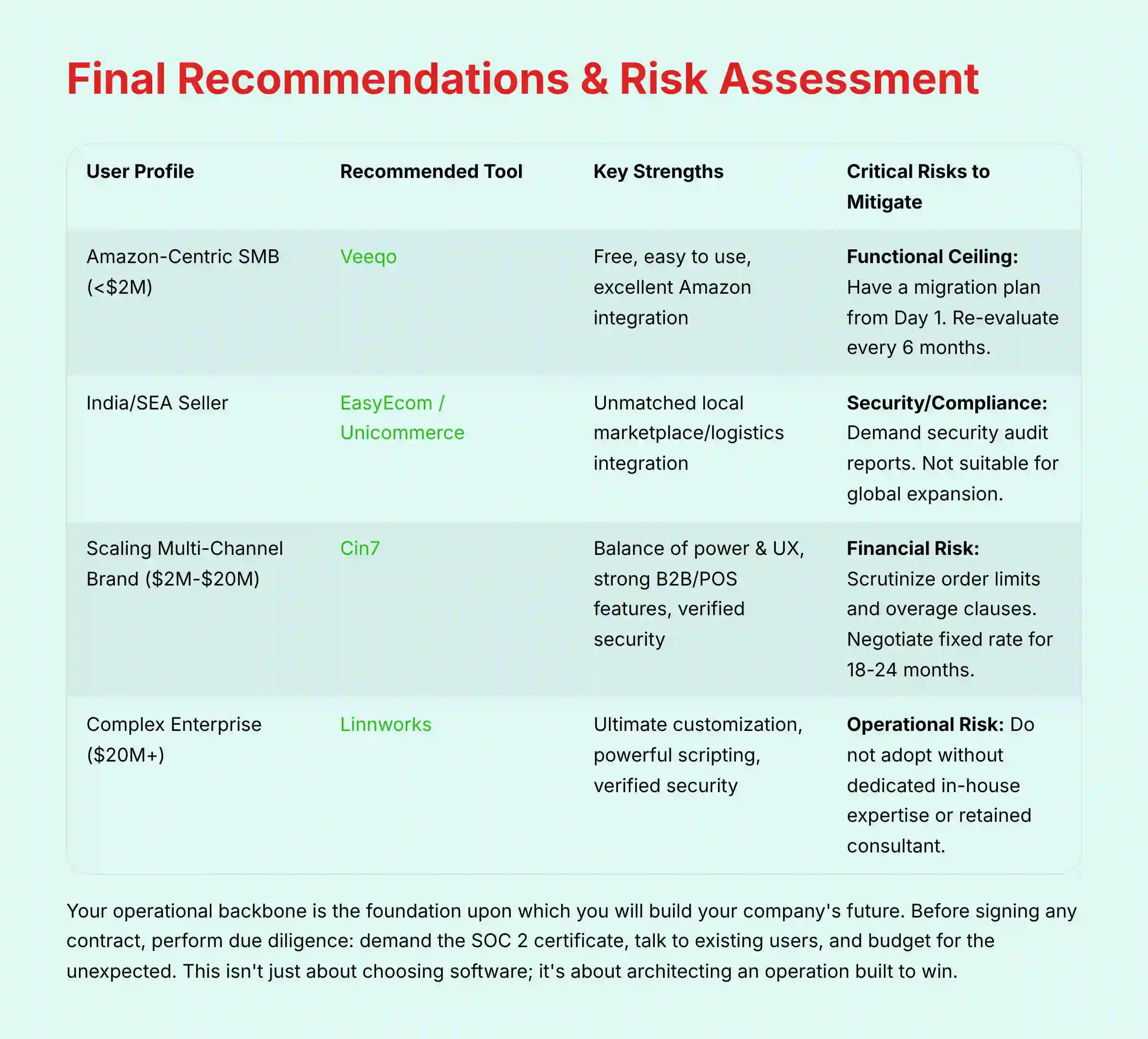
This final table summarizes my recommendations. It pairs each business profile with the best tool and, most importantly, the key risks you must plan to mitigate.
| User Profile | Recommended Tool | Key Strengths | Critical Risks to Mitigate |
|---|---|---|---|
| Amazon-Centric SMB (<$2M) | Veeqo | Free, easy to use, excellent Amazon integration. | Functional Ceiling: You will outgrow it. Mitigation: Have a migration plan and budget from Day 1. Re-evaluate every 6 months. |
| India/SEA Seller | EasyEcom / Unicommerce | Unmatched local marketplace/logistics integration, localized support. | Security/Compliance: Lack of SOC 2 certification is a major liability. Mitigation: Demand security audit reports. Not suitable for global expansion. |
| Scaling Multi-Channel Brand ($2M-$20M) | Cin7 | Balance of power & UX, strong B2B/POS features, verified security. | Financial Risk: Opaque contracts and surprise fees. Mitigation: Scrutinize order limits and overage clauses in the contract. Negotiate a fixed rate for the first 18-24 months. |
| Complex Enterprise ($20M+) | Linnworks | Ultimate customization, powerful scripting, verified security. | Operational Risk: High complexity can lead to costly errors. Mitigation: Do not adopt without dedicated in-house expertise or a retained certified consultant. |
Frequently Asked Questions (FAQs)
What Is the Main Difference Between Cin7 and Linnworks for a Fashion Brand?
For a fashion brand, Cin7 is generally a better fit. It handles apparel-specific needs like size and color variations (matrix items) very well out-of-the-box. Linnworks can be configured to do this, but it requires more custom work, increasing your implementation cost and time.
Does Veeqo's WMS Support Barcode Scanning as Well as Cin7?
Yes, Veeqo offers robust barcode scanning features for picking, packing, and receiving inventory. In my testing, its mobile app is very responsive. Cin7 offers similar functionality but also includes more advanced warehouse features like directed putaway and cycle counting plans.
At What Order Volume Should I Migrate from Veeqo to a Paid Solution?
I advise clients to start planning their migration from Veeqo when they consistently exceed 5,000 orders per month. At this volume, the need for more advanced automation, reporting, and dedicated support becomes a pressing issue. Waiting too long can disrupt your operations during a critical growth phase.
Professional Recommendation: A business should consult with an operations specialist to analyze their specific growth trajectory and operational bottlenecks to determine the right time to migrate, rather than relying on a single, generic order volume metric.
Is Linnworks' Customization Worth the High Consulting Fees Compared to Cin7?
It is only worth it if your business has truly unique workflows that standard software cannot handle. For example, if you do custom product bundling or have a complex international shipping matrix. For 90% of scaling brands, Cin7's features will be more than sufficient and offer a much faster return on investment.
How do EasyEcom's API Limits Compare to Unicommerce's?
Both EasyEcom and Unicommerce offer functional APIs for integration. Based on their documentation, Unicommerce appears to have slightly more generous rate limits. However, both are primarily designed to connect with their established partner networks in Asia, and their APIs are not as extensively documented as those from Cin7 or Linnworks.
If a Tool Is Not SOC 2 Compliant, What Are the Actual Business Risks?
The risks are substantial. First, a non-compliant tool could expose your sensitive customer and operational data to a breach, leading to financial loss and reputational damage. Second, if you sell to large retail partners, they may require you to use SOC 2 compliant vendors as part of their own security policies. Lacking this can cost you valuable contracts.
Which Platform Has Better Robotics and Warehouse Automation Integrations Planned?
Cin7 is the clear leader here. They have actively built native integrations with several Autonomous Mobile Robot (AMR) providers and Automated Storage/Retrieval Systems (ASRS). This shows a forward-looking strategy focused on automating the physical warehouse. Linnworks can connect to these systems, but it typically requires a middleware partner, adding complexity.
Is It True You Need to Be a Developer to Use Linnworks?
You do not need to be a developer, but you absolutely need a “systems thinker” on your team. This is someone who is highly technical and can logically map out complex workflows to configure the rules engine. Without this internal expertise, you will be heavily reliant on expensive external consultants.
Before making your final decision, consider reviewing our comprehensive EasyEcom FAQs to understand common implementation challenges and solutions.
Our Final Verdict & Professional Guidance
Choosing your operational backbone is a strategic decision that defines your company's ability to scale securely and efficiently. For Amazon SMBs, Veeqo is an unmatched entry point. As you grow, the decision shifts from cost to capability and security, where Cin7 provides the most balanced package of modern features, usability, and verified compliance. For enterprises with unique needs and the resources to match, Linnworks offers ultimate control.
EasyEcom and Unicommerce remain powerful, but only for businesses operating primarily in South and Southeast Asian markets.
Your operational backbone is the foundation upon which you will build your company's future. The path is clear: for Amazon SMBs, Veeqo is the launchpad. For scaling brands needing a force multiplier, Cin7 offers the best balance of power and security. And for enterprises that require a fully customized strategic apparatus, Linnworks provides ultimate control.
But remember—visibility is passive; action is power. Before you sign any contract, perform your due diligence: demand the SOC 2 certificate, talk to those already on the front lines, and budget for the unexpected. This isn't just about choosing software; it's about architecting an operation built to win. Now, go press your advantage.
Important Disclaimers:
Technology Evolution Notice: The information about EasyEcom alternatives and competitors and AI for Operations & Supply Chain tools presented in this article reflects our thorough analysis as of 2025. Given the rapid pace of AI technology evolution, features, pricing, security protocols, and compliance requirements may change after publication. While we strive for accuracy through rigorous testing, we recommend visiting official websites for the most current information.
Professional Consultation Recommendation: For AI for Operations & Supply Chain applications with significant professional, financial, or compliance implications, we recommend consulting with qualified professionals who can assess your specific requirements and risk tolerance. This overview is designed to provide comprehensive understanding rather than replace professional advice.
Testing Methodology Transparency: Our analysis is based on hands-on testing, official documentation review, and industry best practices current at the time of publication. Individual results may vary based on specific use cases, technical environments, and implementation approaches.

Leave a Reply