Is 3PL Warehouse Manager the Right WMS for Your Logistics Business?
Take This Quick Quiz to Find Out!
The logistics industry continues to evolve rapidly, with third-party logistics providers (3PLs) playing an increasingly critical role in supporting modern supply chains. As businesses look to optimize their warehouse operations, understanding the right warehouse management system becomes essential for success.
Key Takeaways
- Multi-Tenant Architecture: 3PL Warehouse Manager is specifically designed for logistics providers managing multiple clients' inventory in shared warehouse environments
- Cloud-Based SaaS Platform: Eliminates infrastructure costs and provides scalable operations with 99.9%+ uptime SLAs
- Automated Billing Engine: Captures billable activities in real-time, typically increasing 3PL revenue by 15-20% within first quarter
- Automation Support: Integrates with modern warehouse technologies including AMRs, AS/RS systems, and robotic automation
- Implementation Timeline: Standard deployment ranges from 4-12 weeks with comprehensive training and support included
What exactly is 3PL Warehouse Manager and who is its ideal user?
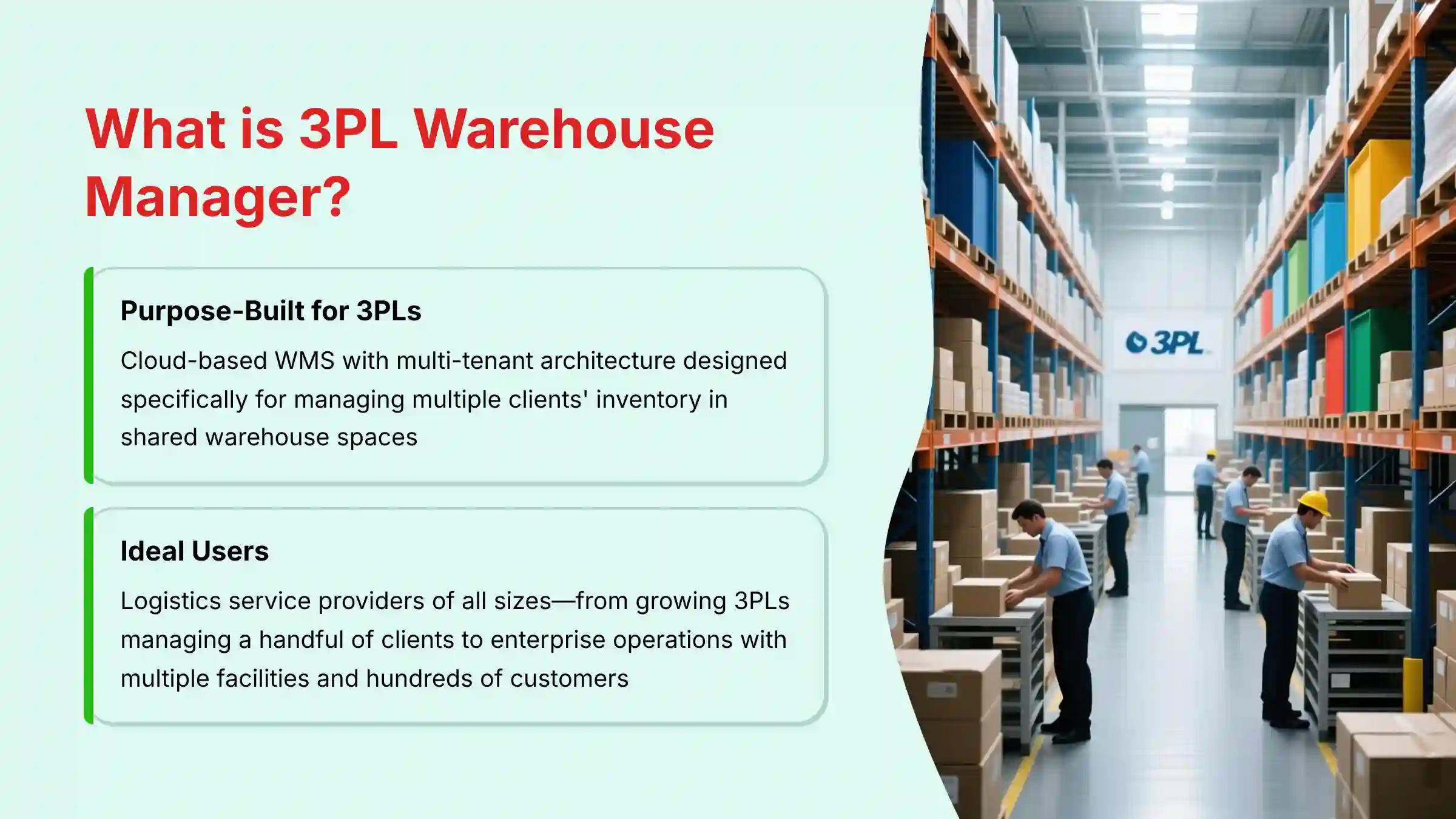
3PL Warehouse Manager is a cloud-based warehouse management system (WMS) specifically designed for third-party logistics (3PL) providers managing inventory for multiple clients within shared warehouse environments. Unlike general-purpose WMS solutions, it features a multi-tenant architecture built from the ground up to handle the complexities of 3PL operations.
The platform is ideal for logistics service providers of all sizes—from growing 3PLs managing a handful of clients to enterprise operations with multiple facilities and hundreds of customers. Its core strength lies in simultaneously managing distinct client inventories, workflows, and billing requirements within a unified system.
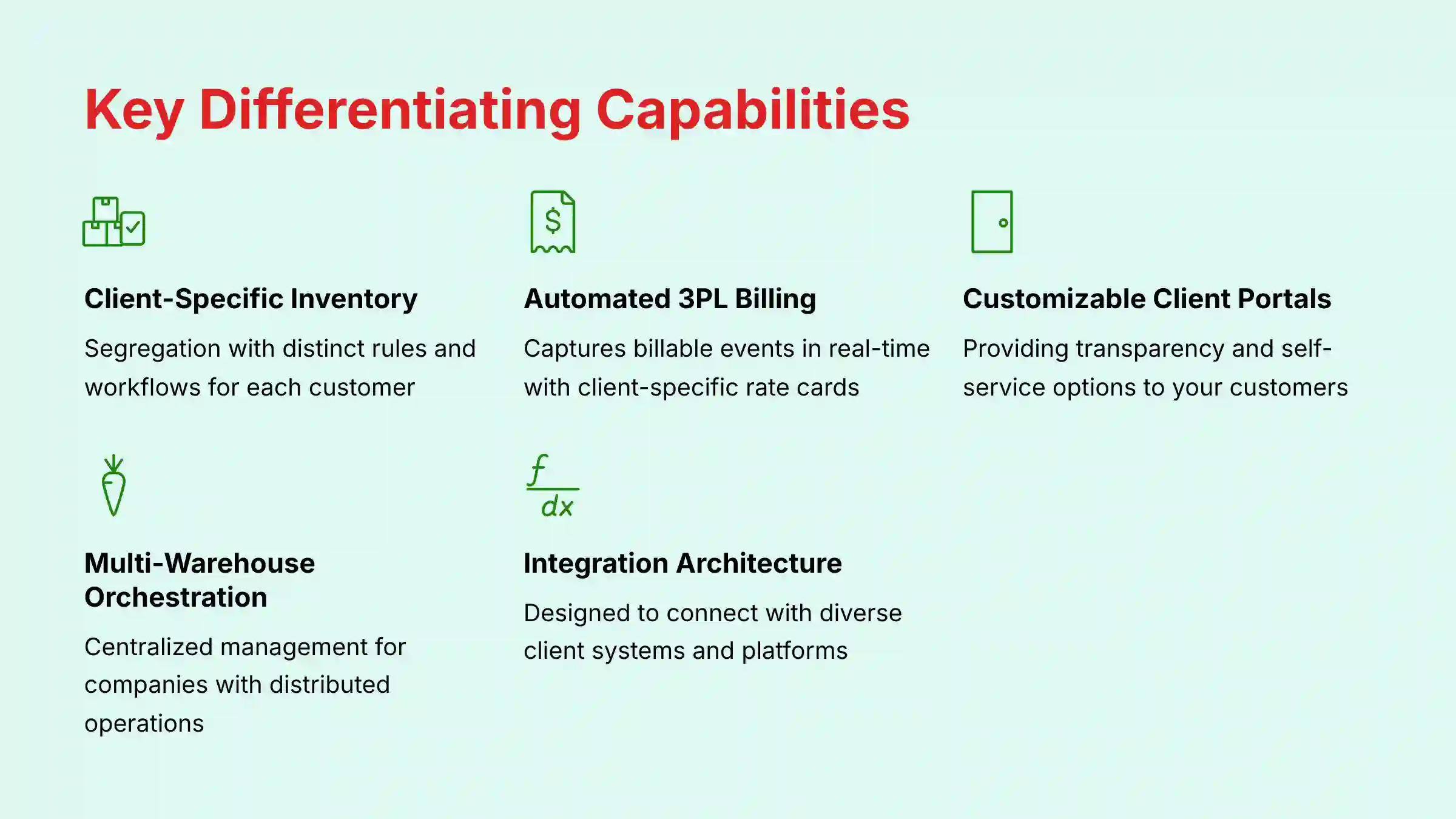
Key differentiating capabilities include:
- Client-specific inventory segregation with distinct rules and workflows for each customer
- Automated 3PL billing engine that captures billable events in real-time
- Customizable client portals providing transparency to your customers
- Multi-warehouse orchestration for companies with distributed operations
- Integration architecture designed to connect with diverse client systems
The system serves as the operational backbone for 3PLs, addressing the fundamental challenge of efficiently managing multiple clients' inventory in shared spaces while maintaining accurate accountability and billing. If your business stores, picks, packs, and ships products on behalf of other companies, 3PL Warehouse Manager provides specialized tools tailored to these unique requirements.
For warehouses implementing AI-driven operations, the platform provides the foundational data layer needed to support advanced analytics and automation initiatives across your fulfillment network. Learn more about these capabilities in our comprehensive 3PL Warehouse Manager Overview and Features guide.
Is 3PL Warehouse Manager a cloud-based (SaaS) platform? What does this mean for my business?

Yes, 3PL Warehouse Manager is a fully cloud-based Software-as-a-Service (SaaS) platform. This cloud-native architecture provides several strategic advantages for 3PL operations compared to traditional on-premise warehouse management systems:
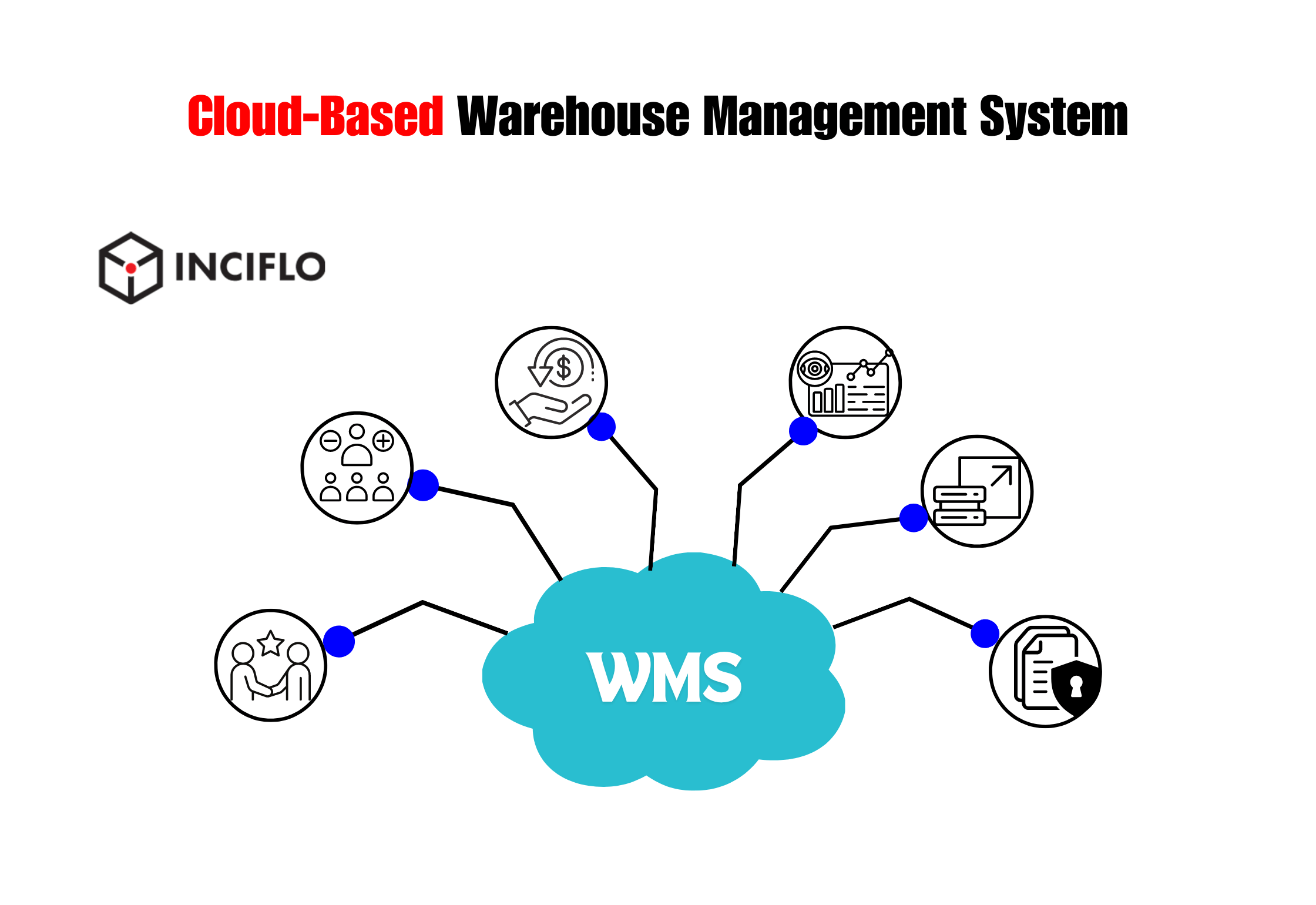
Financial Benefits:
- Elimination of large upfront capital expenditures on servers and IT infrastructure
- Predictable subscription-based pricing model that scales with your business
- Reduced IT staffing requirements for system maintenance and updates
- Lower total cost of ownership over the system's lifecycle
Operational Advantages:
- Anywhere, anytime access for warehouse staff, management, and clients
- Seamless support for multi-facility operations from a centralized platform
- Automatic software updates with new features and security patches
- Rapid deployment compared to on-premise solutions (weeks vs. months)
Business Continuity:
- Enterprise-grade data redundancy across geographically distributed data centers
- Comprehensive disaster recovery capabilities with minimal recovery time
- 99.9%+ uptime SLAs ensuring warehouse operations remain functional
- Automatic data backups without manual intervention
For 3PLs embracing AI-powered operations, the cloud-based architecture provides the necessary foundation for implementing advanced analytics, machine learning algorithms for demand forecasting, and integration with automated warehouse systems. The platform's ability to collect, centralize, and process large volumes of operational data is essential for logistics providers looking to leverage AI for competitive advantage.
As logistics operations become increasingly data-driven, having your WMS in the cloud enables the seamless data flow required for implementing predictive analytics and optimization algorithms across your fulfillment network. For a detailed comparison with alternatives, check out our 3PL Warehouse Manager Top Alternatives and Competitors analysis.
How does 3PL Warehouse Manager handle complex, client-specific billing?
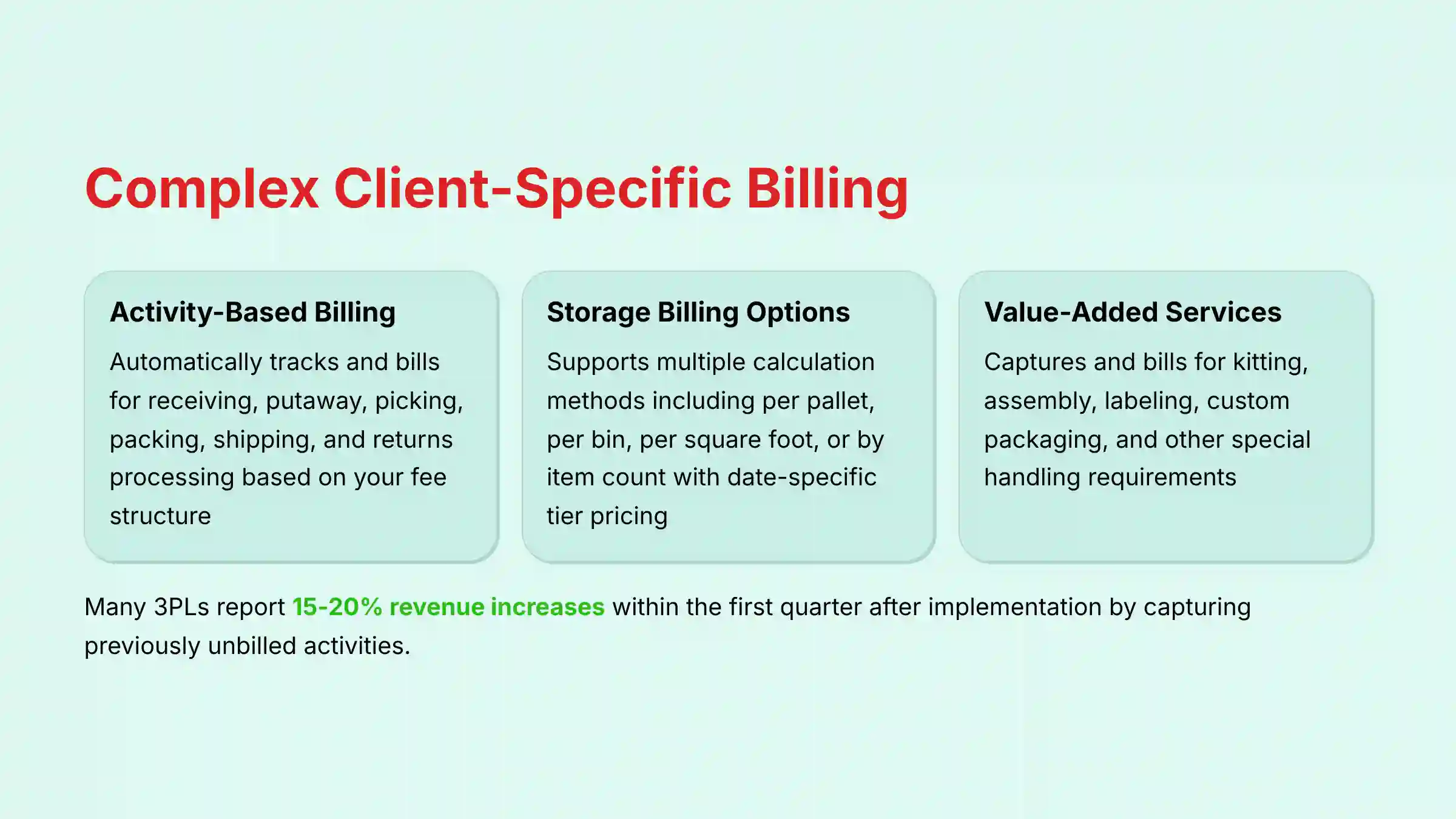
3PL Warehouse Manager's billing automation is a core differentiator designed specifically to address the complex billing requirements of third-party logistics providers. The system replaces error-prone manual processes with a sophisticated rules engine that automatically captures billable activities and generates accurate invoices.
Comprehensive Billing Capabilities:
- Activity-Based Billing: Automatically tracks and bills for receiving, putaway, picking, packing, shipping, and returns processing based on your fee structure
- Storage Billing Options: Supports multiple calculation methods including per pallet, per bin, per square foot, or by item count with date-specific tier pricing
- Value-Added Services: Captures and bills for kitting, assembly, labeling, custom packaging, and other special handling requirements
- Client-Specific Rate Cards: Maintains separate billing rules and rates for each customer
- Recurring Charges: Automates fixed monthly fees, minimum charges, and subscription-based services
The system's real power comes from its ability to capture billable events at the moment they occur within warehouse workflows. For example, when a warehouse associate scans a pallet during receiving, the system automatically logs this as a billable event against the appropriate client account with the correct fee.
Implementation Best Practices:
For optimal results, warehouse operators should completely rethink their billing approach during implementation rather than trying to replicate existing spreadsheet-based systems. By categorizing every service offering and building standardized “billing wizards” in the system, 3PLs can ensure comprehensive revenue capture.
This automated approach typically uncovers significant previously unbilled activities, with many 3PLs reporting 15-20% revenue increases within the first quarter after implementation. The system also improves client relationships by providing transparent, detailed invoices that clearly document all charges, reducing billing disputes and improving cash flow predictability.
For logistics operations implementing AI and analytics, these detailed billing records create valuable datasets that can be analyzed to identify service profitability, optimize pricing strategies, and develop more accurate forecasting models. To see this in action, explore our detailed 3PL Warehouse Manager Tutorials and Usecase guide.
What are 3PL Warehouse Manager's integration capabilities with e-commerce platforms, ERPs, and shipping carriers?
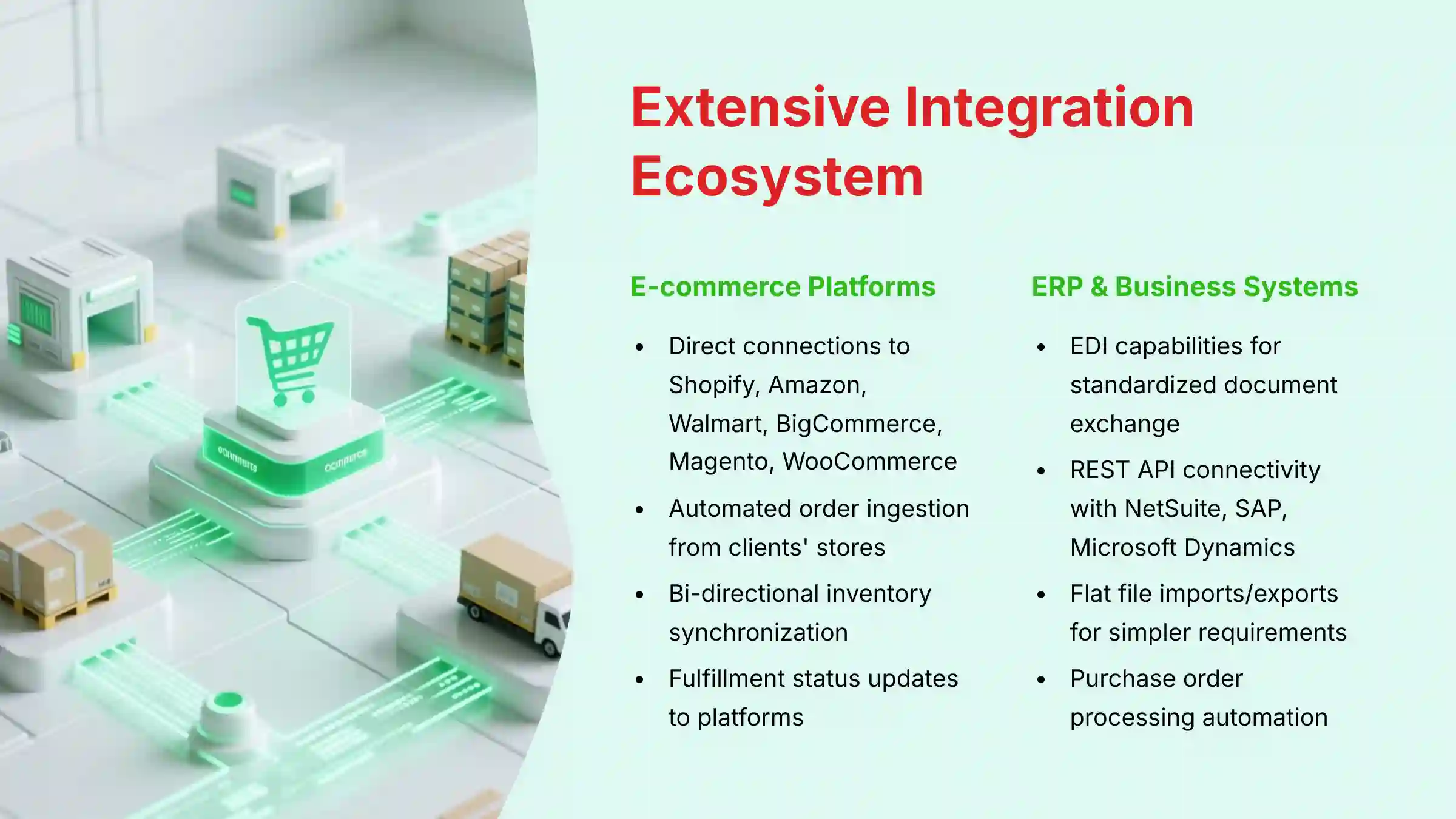
3PL Warehouse Manager features an extensive integration ecosystem designed to connect seamlessly with the diverse technology stacks used by both 3PL providers and their clients. This connectivity is essential for automating data flow throughout the supply chain and eliminating manual data entry.
E-commerce Platform Integrations:
- Direct connections to major platforms including Shopify, Amazon, Walmart, BigCommerce, Magento, and WooCommerce
- Automated order ingestion pulling orders directly from clients' stores
- Bi-directional inventory synchronization updating stock levels across all sales channels
- Fulfillment status updates pushing tracking and delivery information back to the platforms
ERP and Business System Connections:
- EDI capabilities for standardized document exchange with client systems
- REST API connectivity with major ERP platforms including NetSuite, SAP, and Microsoft Dynamics
- Flat file imports/exports for clients with simpler technical requirements
- Purchase order processing automating inbound inventory expectations
- Accounting system integration for streamlined financial reconciliation
Shipping and Carrier Integration:
- Direct carrier connections with FedEx, UPS, USPS, DHL, and regional carriers
- Rate shopping capabilities to automatically select optimal shipping methods
- Label generation and printing directly from the platform
- Tracking number capture and distribution to clients and end customers
- Parcel auditing support for freight bill reconciliation
Open API Framework:
The platform includes a well-documented API that enables custom integrations with proprietary systems or specialized applications. This extensibility is particularly valuable for 3PLs serving clients with unique technical requirements or those implementing custom AI solutions for specific operational challenges.
For warehouse operations implementing advanced AI capabilities, these integrations provide the comprehensive data pipeline necessary for effective machine learning models. By connecting upstream demand signals from e-commerce platforms with internal warehouse operations and downstream shipping data, 3PLs can develop more accurate forecasting models and optimize resource allocation across their operations.
Can 3PL Warehouse Manager support warehouse automation and robotics?
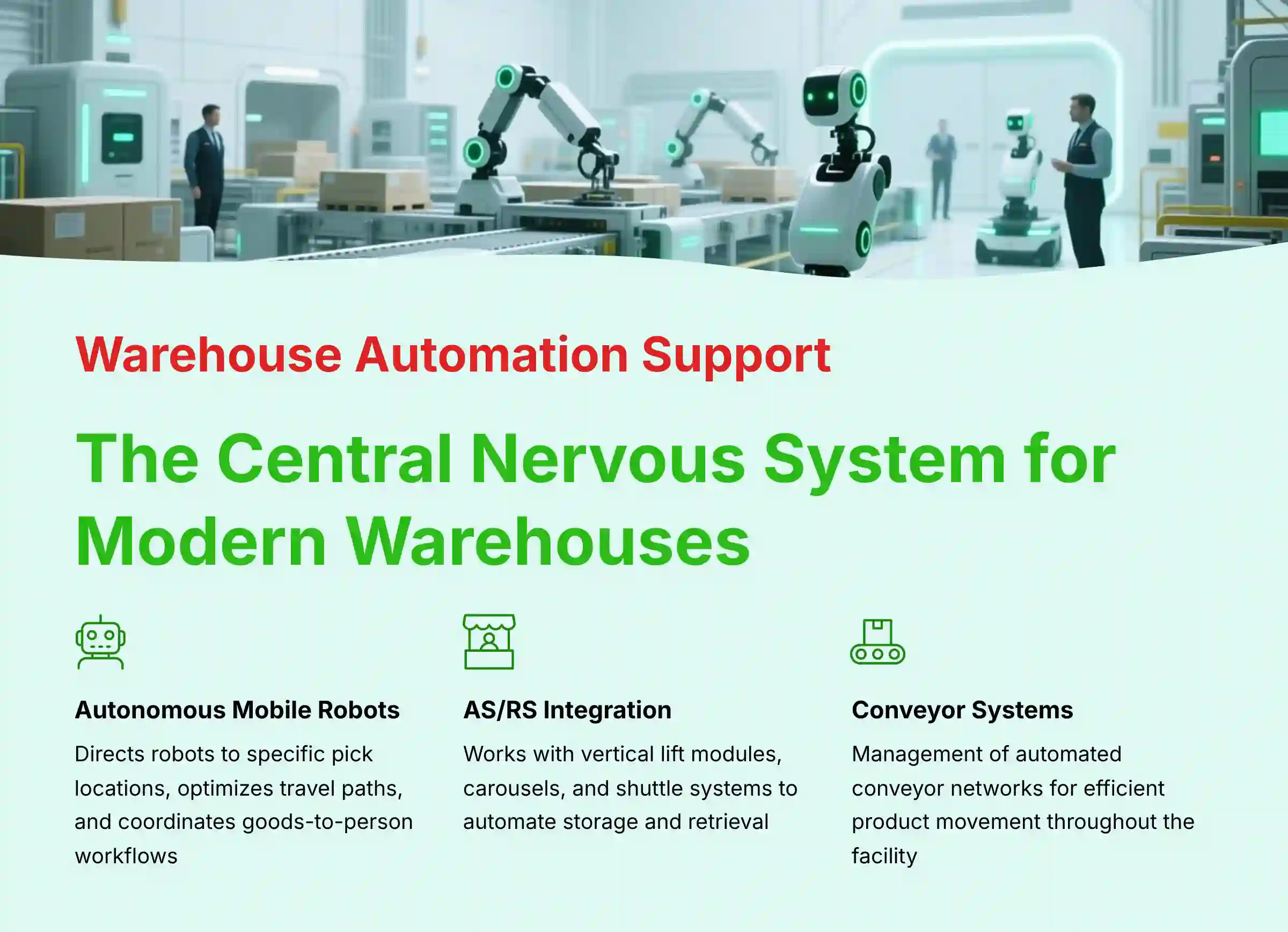
Yes, 3PL Warehouse Manager is designed to support and orchestrate modern warehouse automation technologies, including advanced robotics systems. As labor costs rise and order volumes increase, this integration capability has become increasingly important for competitive 3PLs.
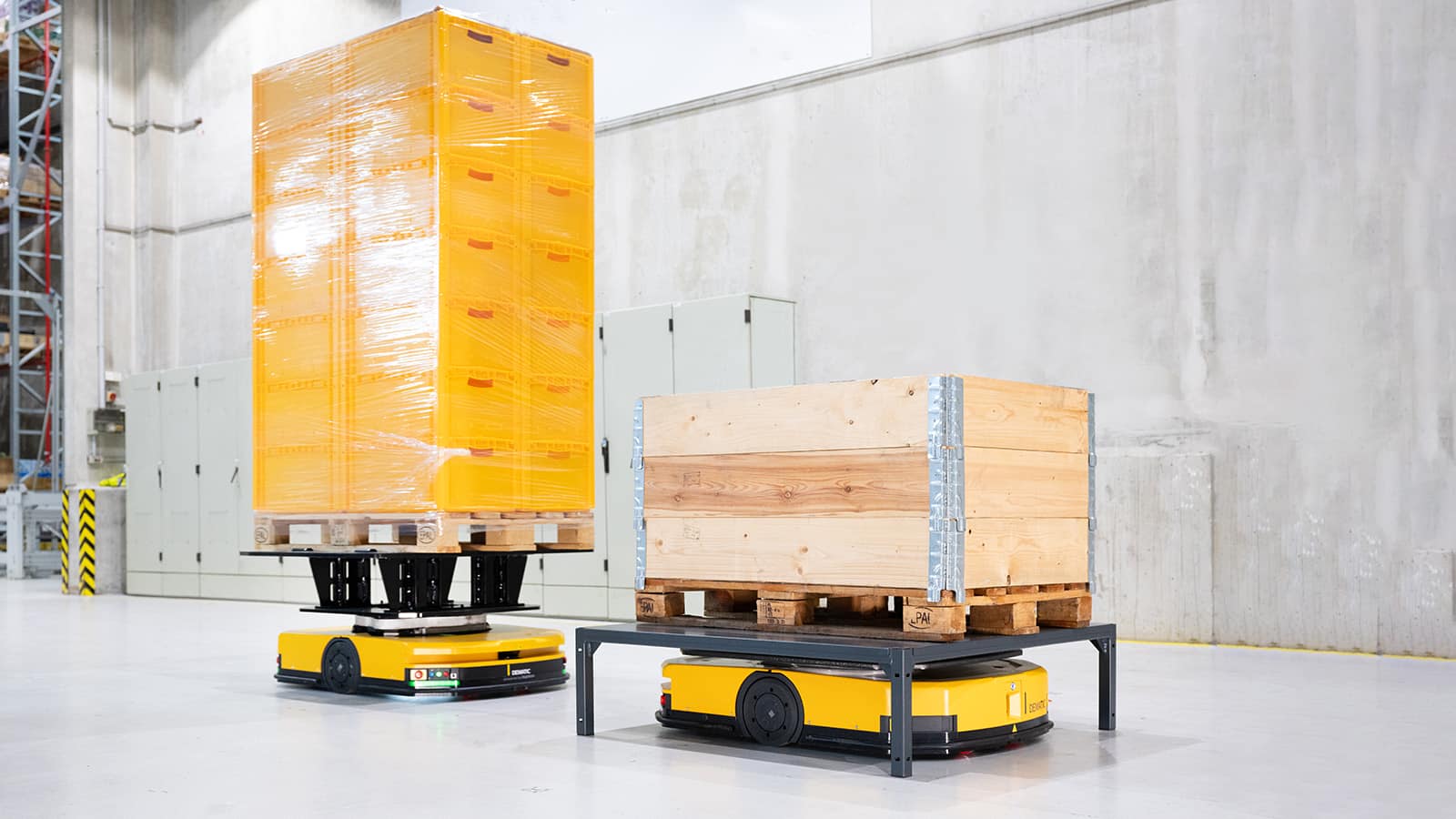
Automation Integration Capabilities:
- Autonomous Mobile Robots (AMRs): The system can direct robots to specific pick locations, optimize travel paths, and coordinate goods-to-person workflows
- Automated Storage and Retrieval Systems (AS/RS): Integration with vertical lift modules, carousels, and shuttle systems to automate storage and retrieval operations
- Pick-to-Light/Put-to-Light Systems: Coordination with light-directed picking technologies to improve accuracy and efficiency
- Conveyor Systems: Management of automated conveyor networks for efficient product movement
- Automated Sortation: Direction of parcels to the correct packing stations or shipping lanes
- Voice-Directed Picking: Integration with voice technologies for hands-free operation
AI-Enhanced Capabilities:
The platform serves as the central nervous system for these technologies, using artificial intelligence to optimize task assignment and sequencing. For example, the WMS can analyze order patterns in real-time and dynamically adjust picking strategies, balancing workloads between human pickers and robotic systems for maximum throughput.
Implementation Approach:
When implementing automation, 3PLs typically take a phased approach, starting with core WMS functionality and gradually adding automation components. This allows for proper process optimization before introducing complex robotics. The system's modular architecture supports this incremental approach, enabling warehouses to add automation capabilities as their operations mature and volumes increase.
For 3PLs serving multiple clients with varying requirements, the platform's ability to support different fulfillment methodologies within the same facility is particularly valuable. One client's orders might be fulfilled using traditional methods while another's leverage full automation, all orchestrated through the same WMS.
As warehouse automation technologies continue to advance, 3PL Warehouse Manager's open architecture ensures compatibility with emerging solutions, protecting your technology investment while enabling continuous operational improvement. For more insights on AI integration in warehouse management, explore our comprehensive guide on Best 10 AI Warehouse Management Systems (WMS) of 2025: From Chaos to Intelligent Orchestration.
How does 3PL Warehouse Manager compare to alternatives like NetSuite WMS or Fishbowl?
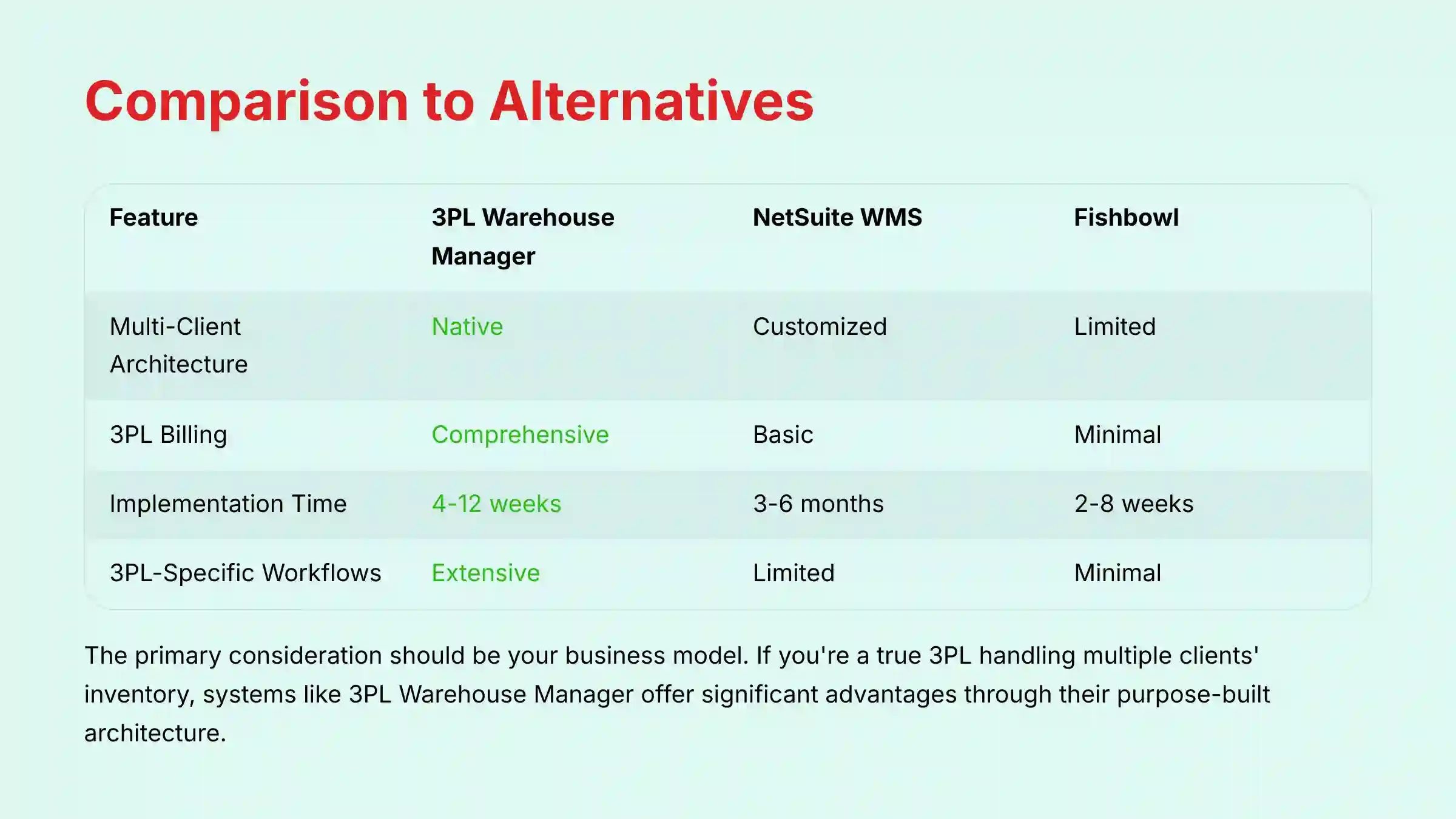
3PL Warehouse Manager differs fundamentally from alternatives like NetSuite WMS and Fishbowl in its specialized design for third-party logistics operations. This distinction goes beyond feature comparisons to the core architecture and data model of the systems.
3PL Warehouse Manager vs. NetSuite WMS:
NetSuite WMS is a module within NetSuite's comprehensive ERP system, designed primarily for companies managing their own inventory within their business operations. While powerful, its multi-client capabilities are additions to a single-company architecture, not native capabilities.
Key differences:
- Client Segmentation: 3PL Warehouse Manager's multi-tenant design inherently separates clients' inventory, billing, and operations, while NetSuite requires significant customization to achieve similar segregation
- Billing Focus: NetSuite excels at internal costing and standard invoicing, while 3PL Warehouse Manager provides specialized activity-based billing capturing warehouse operations
- System Scope: NetSuite offers broader business functionality (accounting, CRM, etc.) while 3PL Warehouse Manager delivers deeper warehouse-specific capabilities
- Implementation Complexity: NetSuite typically requires longer, more complex implementations compared to the 3PL-specific templates in 3PL Warehouse Manager
3PL Warehouse Manager vs. Fishbowl:
Fishbowl is popular among small to medium businesses managing their own inventory, particularly those using QuickBooks. It's designed for manufacturers and distributors handling their own products, not 3PL service providers.
Key differences:
- Multi-Client Architecture: Fishbowl lacks native multi-client capabilities essential for 3PLs
- Scale and Performance: 3PL Warehouse Manager handles significantly higher transaction volumes and concurrent users
- 3PL-Specific Workflows: Fishbowl doesn't support specialized 3PL processes like client billing, client portals, or customer-specific workflows
- Integration Ecosystem: 3PL Warehouse Manager offers a broader range of pre-built integrations with e-commerce and shipping platforms
Strategic Selection Considerations:
When evaluating these platforms, the primary consideration should be your business model. If you're a true 3PL handling multiple clients' inventory, systems like 3PL Warehouse Manager offer significant advantages through their purpose-built architecture. Implementing a general-purpose WMS for 3PL operations typically requires extensive customization and workarounds that increase both implementation costs and ongoing operational complexity.
For logistics providers implementing AI and automation initiatives, having a WMS with a data model that inherently understands the complexities of multi-client operations creates a stronger foundation for advanced analytics and process optimization. For a comprehensive comparison, visit our detailed 3PL Warehouse Manager Top Alternatives and Competitors analysis.
How scalable is 3PL Warehouse Manager for a 3PL with multiple warehouses or a rapidly growing client base?
3PL Warehouse Manager is architected for scalability across multiple dimensions, making it suitable for growing 3PLs at various stages of development. The platform's scalability encompasses several critical aspects of 3PL operations:
Volume Scalability:
- Order Processing Capacity: The system can scale from handling hundreds to tens of thousands of orders daily
- SKU Management: Supports catalogs ranging from a few thousand to millions of unique products
- Concurrent Users: Accommodates growing warehouse teams with hundreds of simultaneous users
- Transaction History: Maintains accessible historical data even as transaction volumes grow
Geographic Scalability:
- Multi-Facility Management: Centralized control of operations across multiple warehouses
- Network-Wide Inventory Visibility: Real-time view of stock across all locations
- Distributed Order Fulfillment: Intelligent routing of orders to optimal fulfillment locations
- Standardized Processes: Consistent operations across your entire warehouse network
Client Scalability:
- Rapid Onboarding: Templated setup processes for quickly adding new clients
- Replicable Workflows: Standardized processes that can be applied to new customers
- Mass Configuration Tools: Bulk updates and changes across multiple clients
- Resource Isolation: Performance protection even as client count increases
Technical Scalability:
- Cloud Infrastructure: Automatic resource scaling during peak periods
- Elastic Databases: Growing data storage without performance degradation
- Microservices Architecture: Independent scaling of different system components
- Load Balancing: Distributed processing for consistent performance
For 3PLs experiencing rapid growth, the platform's templated approach to client onboarding is particularly valuable. Once core workflows and billing rules are established, new customers can be implemented in days rather than weeks, significantly reducing time-to-revenue for new business.
The system's ability to support various fulfillment models simultaneously is also important for scaling 3PLs, allowing different clients to utilize different operational approaches based on their requirements and order profiles. This flexibility enables 3PLs to serve a diverse client base without creating operational silos.
For logistics providers implementing AI-driven optimization, the platform's ability to maintain consistent data structures across growing operations creates valuable datasets for machine learning models to identify patterns and improvement opportunities throughout your expanding network.
What is the typical implementation process and timeline for 3PL Warehouse Manager?
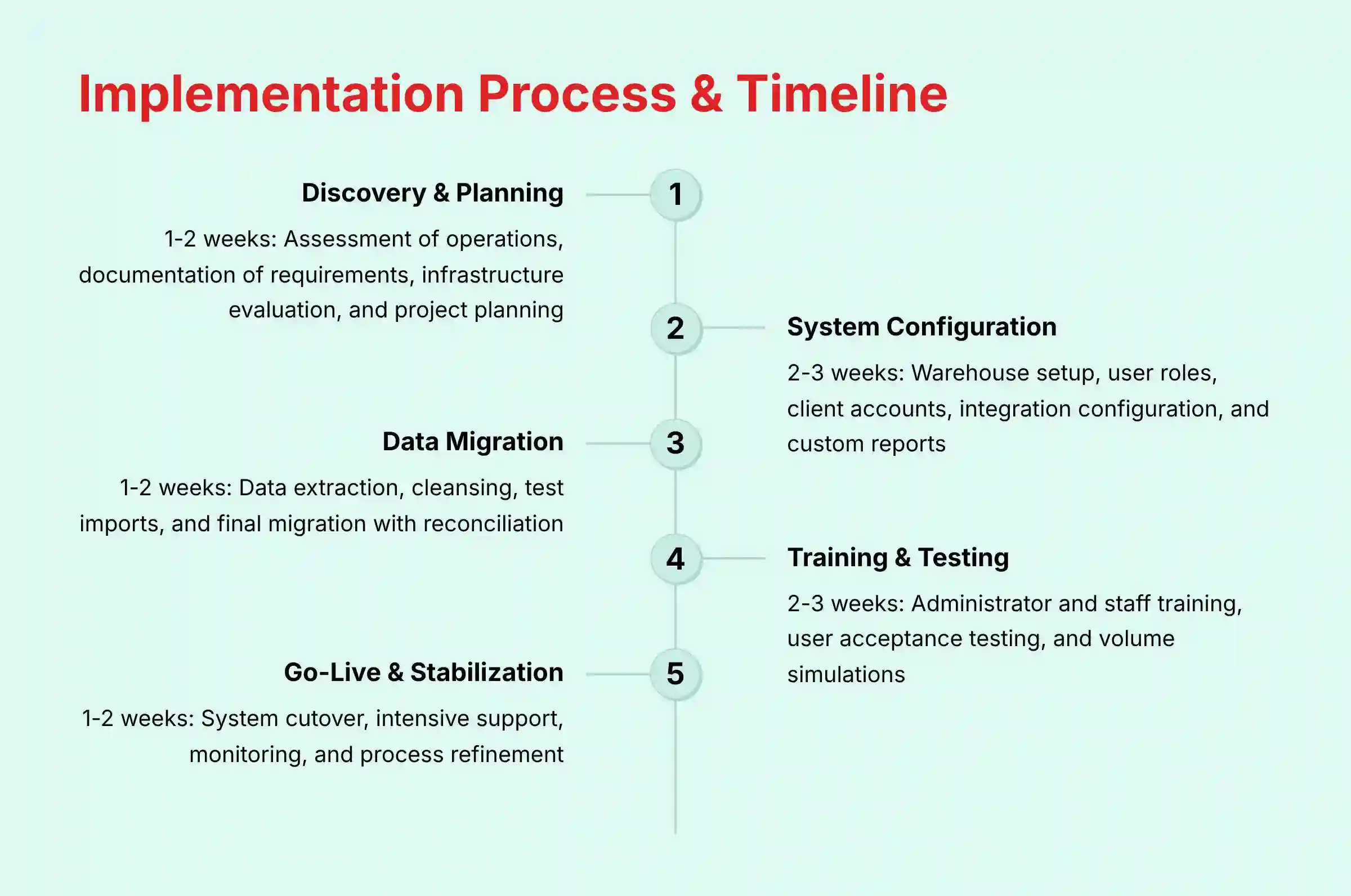
The implementation process for 3PL Warehouse Manager follows a structured methodology designed to ensure successful deployment while minimizing operational disruption. While timelines vary based on complexity, most implementations follow a 4-12 week timeline with distinct phases:
1. Discovery & Planning (1-2 weeks)
- Detailed assessment of current operations and workflows
- Documentation of client-specific requirements and billing rules
- Hardware evaluation and network infrastructure assessment
- Integration requirements mapping
- Project plan development with clear milestones and responsibilities
2. System Configuration (2-3 weeks)
- Warehouse setup including locations, zones, and workflows
- User role and permission configuration
- Client account setup with specific rules and billing parameters
- Integration configuration with e-commerce, shipping, and client systems
- Custom report development
3. Data Migration (1-2 weeks)
- Inventory data extraction from legacy systems
- Data cleansing and standardization
- Test imports to validate data integrity
- Final data migration and reconciliation
4. Training & Testing (2-3 weeks)
- Administrator training for system configuration
- Warehouse staff training on daily operations
- Client portal training for customers
- User acceptance testing across all workflows
- Simulation of peak volume scenarios
5. Go-Live & Stabilization (1-2 weeks)
- Phased or full cutover from legacy systems
- Intensive support during initial operations
- Daily monitoring and performance tuning
- Process refinement based on real-world usage
Critical Success Factors:
Successful implementations typically share several characteristics:
- A dedicated internal project manager from the 3PL side
- Clear executive sponsorship and commitment to change management
- Thorough testing of all processes before go-live
- Realistic timeline planning accounting for peak seasons
- Incremental approach starting with core functionality
Many 3PLs choose to implement with a phased approach, beginning with a subset of clients or a single facility before expanding to their full operation. This approach reduces risk and allows the team to build expertise with the system before broader deployment.
For warehouses implementing AI and automation technologies, integration with these systems is typically scheduled as a second phase after core WMS functionality is stabilized, ensuring a solid operational foundation before adding advanced capabilities.
What kind of customer support and training is included with 3PL Warehouse Manager?
3PL Warehouse Manager provides a multi-layered support and training ecosystem designed to ensure successful system adoption and ongoing operational excellence. The standard subscription includes:
Implementation Support:
- Dedicated Implementation Manager: An experienced logistics technology specialist guides your team through the entire setup process
- Configuration Assistance: Expert help with system setup tailored to your specific warehouse operations
- Data Migration Support: Technical assistance with transferring inventory and client data from legacy systems
- Integration Configuration: Help establishing connections with your e-commerce, shipping, and client systems
Initial Training:
- Admin Training: Comprehensive training for system administrators covering configuration and maintenance
- Operations Training: Hands-on instruction for warehouse personnel on daily workflows
- Client Portal Training: Guidance for teaching your customers how to use their dedicated portals
- Custom Documentation: Tailored training materials specific to your configured workflows
Ongoing Support:
- Technical Support Desk: Access to support specialists via phone, email, and ticketing system
- Knowledge Base: Extensive library of articles, videos, and step-by-step guides
- Regular Webinars: Ongoing educational sessions covering new features and best practices
- User Community: Forums connecting users across different companies for peer support
Additional Support Options:
- Premium Support Packages: Enhanced SLAs with faster response times and weekend coverage
- Dedicated Account Management: Assigned representative for strategic guidance and business reviews
- Professional Services: On-demand consulting for optimization, custom development, and special projects
- Onsite Training: In-person instruction available for larger implementations (additional fees apply)
The level of included support varies by subscription tier, with higher-tier packages including more personalized assistance and faster response times. All clients receive critical system support for urgent issues, with typical response times ranging from 1-4 hours depending on severity.
For warehouses implementing AI-driven operations, Extensiv (the company behind 3PL Warehouse Manager) also offers specialized consulting services to help leverage system data for predictive analytics, demand forecasting, and optimization algorithms, though these advanced services typically involve additional professional services fees. For comprehensive training resources, check out our 3PL Warehouse Manager Tutorials and Usecase collection.
How is 3PL Warehouse Manager priced, and are there hidden costs I should be aware of?
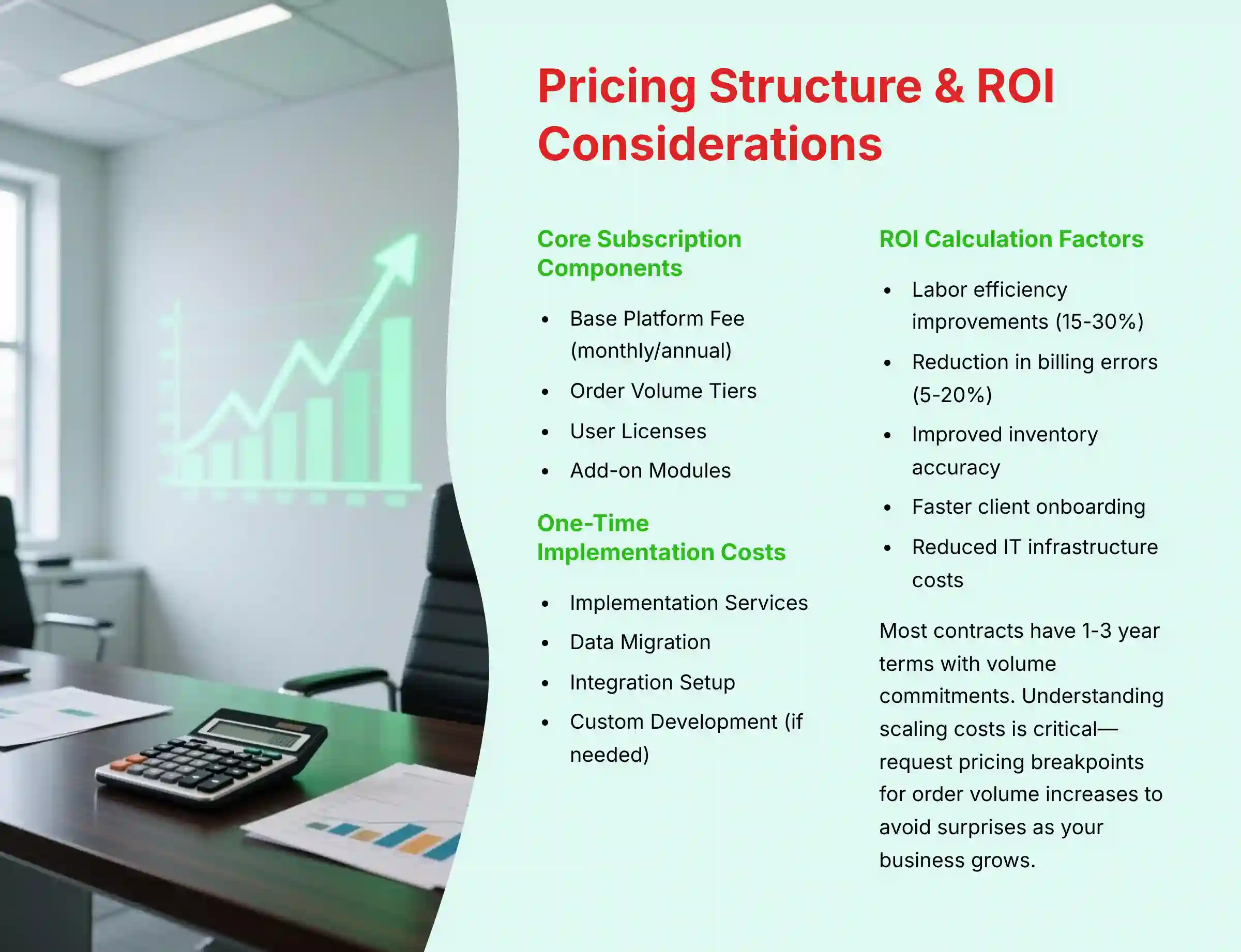
3PL Warehouse Manager employs a customized subscription pricing model that scales with your business size and operational complexity. While specific pricing is tailored to each customer's requirements, understanding the pricing structure and potential additional costs helps with accurate budgeting:
Core Subscription Components:
- Base Platform Fee: Monthly or annual subscription cost for the core system
- Order Volume Tiers: Pricing typically increases with monthly order volume (e.g., 0-5,000 orders, 5,001-15,000 orders)
- User Licenses: Additional fees may apply for exceeding a base number of user accounts
- Module Selection: Advanced features like analytics, yard management, or kitting may be priced as add-on modules
One-Time Implementation Costs:
- Implementation Services: Professional services for system setup, configuration, and training
- Data Migration: Technical assistance transferring data from legacy systems
- Integration Setup: Configuration of connections to e-commerce, ERP, and shipping systems
- Custom Development: Any specialized programming for unique requirements
Potential Additional Costs:
- Hardware: Barcode scanners, mobile devices, label printers, and networking equipment
- Integration Development: Custom API work for non-standard system connections
- Additional Training: Specialized or refresher training beyond initial implementation
- Premium Support: Enhanced service levels with faster response times
- Sandbox Environment: Test instance for trying configuration changes before production
Contract Considerations:
Most 3PL Warehouse Manager contracts have 1-3 year terms with volume commitments. Understanding scaling costs is critical—request pricing breakpoints for order volume increases to avoid surprises as your business grows. Many contracts include automatic renewal clauses and price increase provisions that should be carefully reviewed.
ROI Calculation Factors:
When evaluating the investment, consider these potential return factors:
- Labor efficiency improvements (typically 15-30%)
- Reduction in billing errors and revenue leakage (often 5-20%)
- Improved inventory accuracy reducing write-offs
- Faster client onboarding accelerating time-to-revenue
- Reduced IT infrastructure costs compared to on-premise systems
For 3PLs implementing AI and advanced analytics, the structured data captured by the system creates additional value through optimized operations and strategic insights, though realizing this value may require additional analytical tools or expertise beyond the core platform. For more detailed pricing information and comprehensive reviews, visit our 3PL Warehouse Manager Review page.

Leave a Reply