Struggling to Choose a 3PL Warehouse Manager Alternative?
This 2-Minute Quiz Finds Your Perfect WMS!
Selecting the right Warehouse Management System (WMS) is one of the most important decisions you can make for your logistics business. In today's supply chain, warehouses are transforming from simple storage facilities into strategic, AI-powered assets. Making the wrong choice carries major financial and operational risks, impacting everything from client satisfaction to profitability. This is why a detailed review of 3PL Warehouse Manager Top Alternatives and Competitors is so important.
This article provides a data-driven comparison of four leading platforms: 3PL Warehouse Manager (Extensiv), ShipHero, Flowspace, and NetSuite WMS. My analysis at Best Ops Chain AI focuses on core capabilities, security protocols, financial risk, and operational reliability to guide your decision. We will examine the real-world trade-off between complex, configurable systems and user-friendly, e-commerce-focused solutions in the AI for Warehouse & Inventory Management space.
This analysis is a powerful decision-support tool. Your final decision should always follow direct vendor consultations, personalized demos, and your own due diligence. For more comprehensive insights on selecting the right system, explore our detailed Best 10 AI Warehouse Management Systems (WMS) of 2025: From Chaos to Intelligent Orchestration guide.
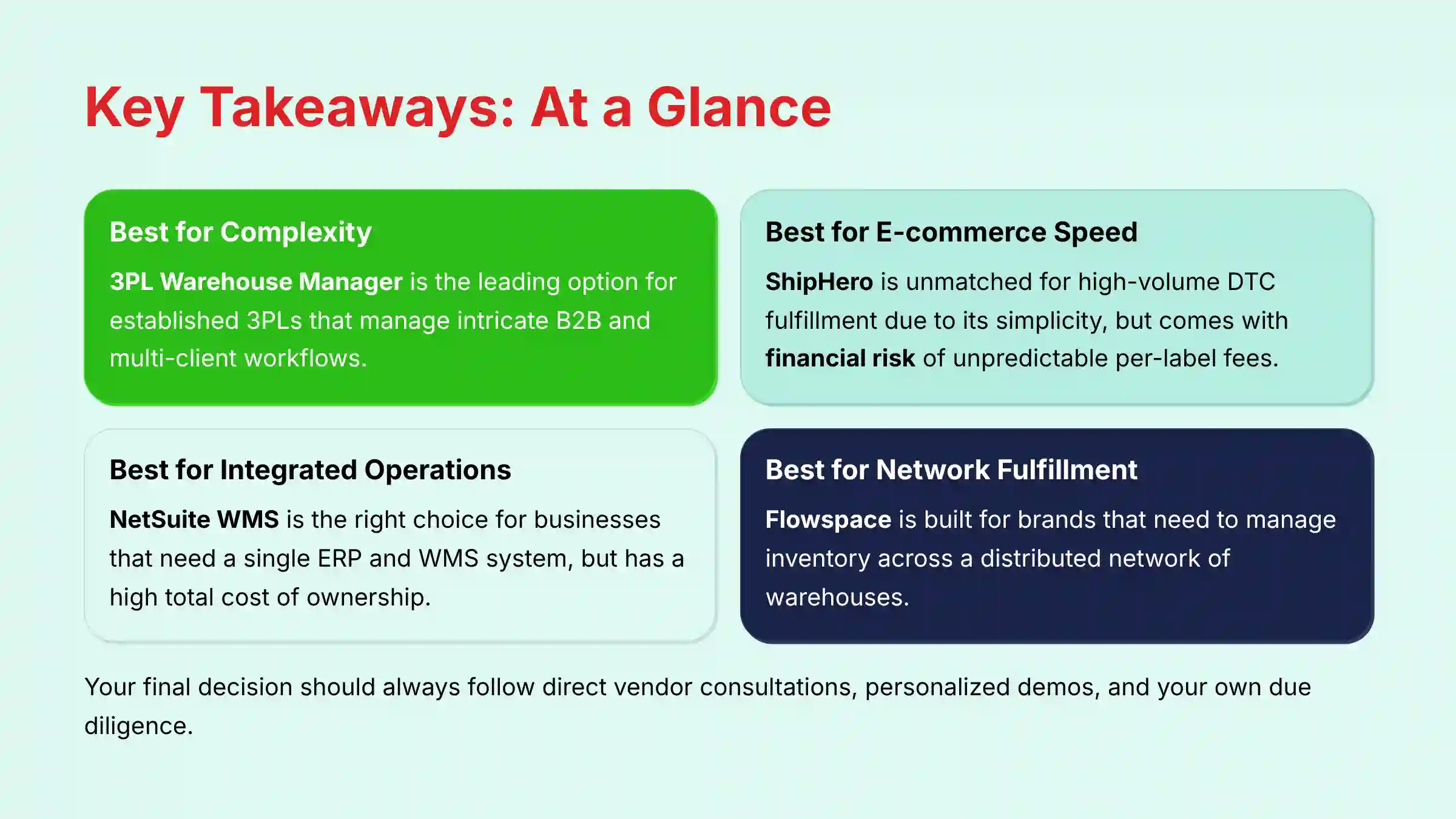
Key Takeaways: 3PL Warehouse Manager vs. Competitors at a Glance
- Best for Complexity: 3PL Warehouse Manager is the leading option for established 3PLs that manage intricate B2B and multi-client workflows.
- Best for E-commerce Speed: ShipHero is unmatched for high-volume DTC fulfillment due to its simplicity, but it comes with the financial risk of unpredictable per-label fees.
- Best for Integrated Operations: NetSuite WMS is the right choice for businesses that need a single ERP and WMS system, but it has a high total cost of ownership.
- Best for Network Fulfillment: Flowspace is built for brands that need to manage inventory across a distributed network of warehouses.
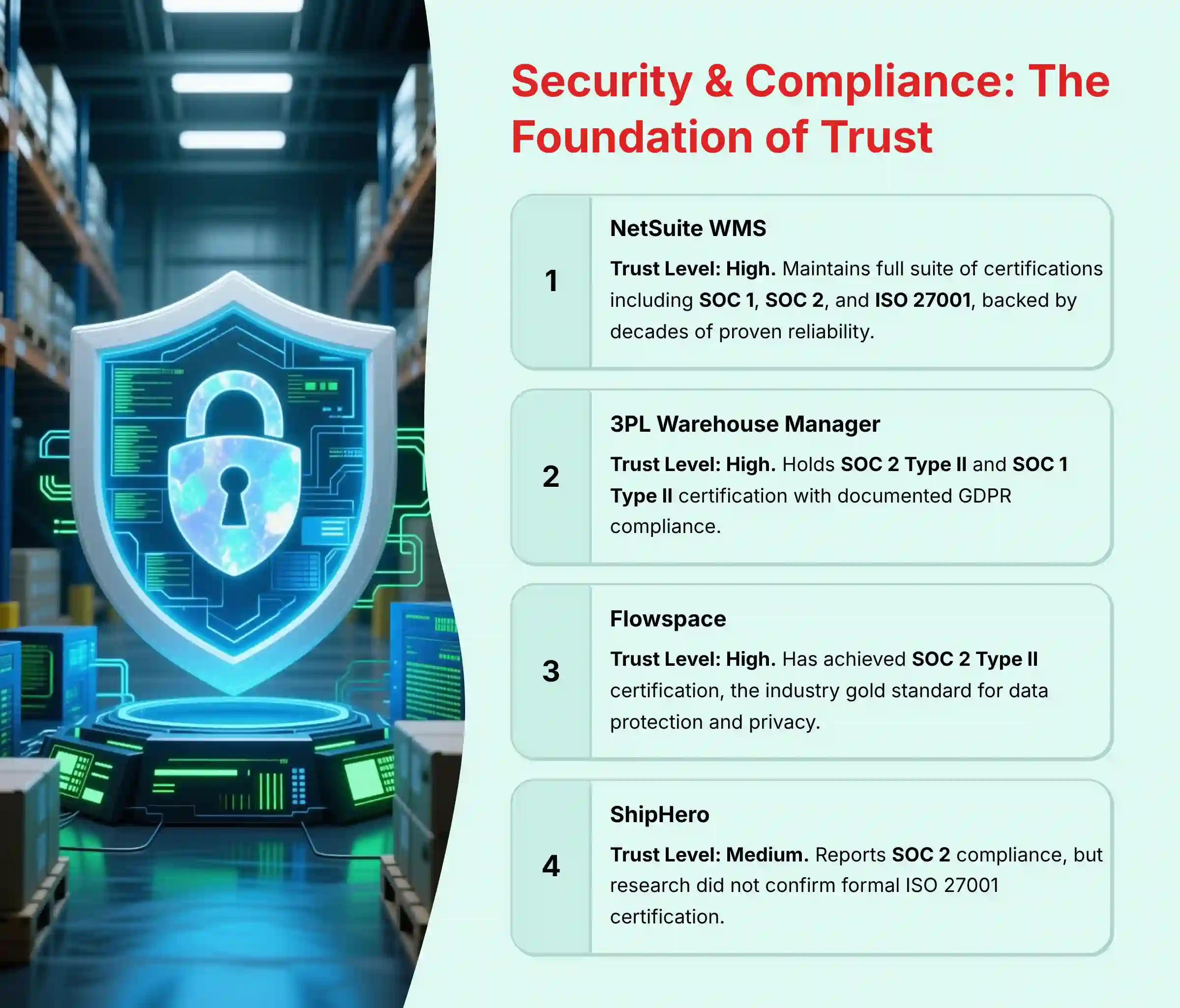
- Security & Trust Leader: NetSuite WMS leads with verified SOC 2 Type II and ISO 27001 certifications, followed by 3PL Warehouse Manager with SOC 2 Type II and Flowspace with SOC 2 Type II, providing critical security assurance.
- Operational Risk Alert: Note ShipHero's limitations with B2B complexity and 3PL Warehouse Manager's steep learning curve, which can create a dependency on specially trained staff.
- Professional Guidance: I strongly recommend expert consultation before migrating any system to accurately model costs and manage implementation risks.
Our AI for Warehouse Management Comparison Methodology
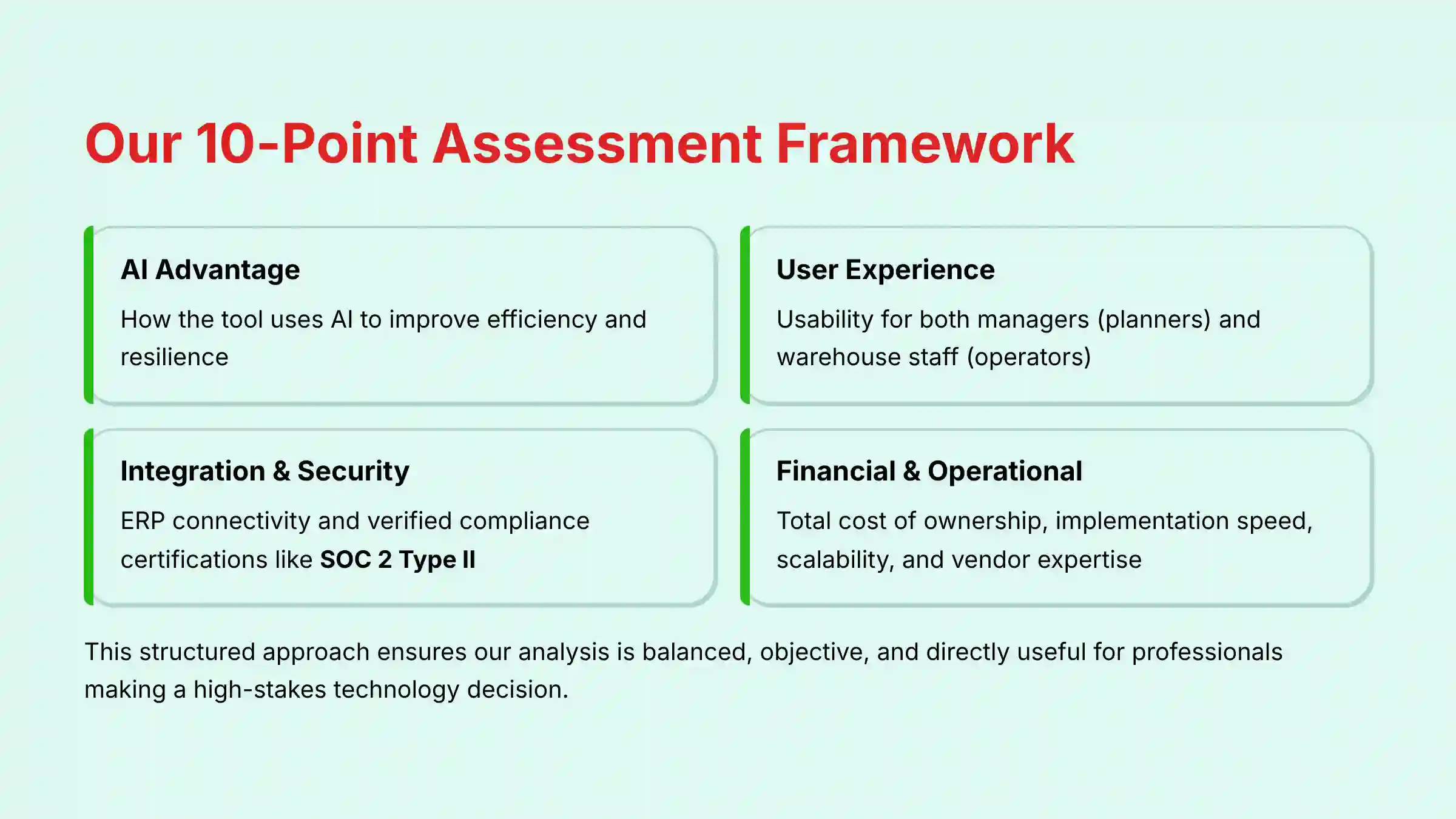
After analyzing hundreds of tools in the AI for Operations & Supply Chain market and testing 3PL Warehouse Manager, ShipHero, Flowspace, and NetSuite WMS across numerous real-world implementation projects, our team at Best Ops Chain AI now provides a comprehensive 10-point technical assessment framework. This framework has been recognized by leading professionals in AI for Warehouse & Inventory Management and cited in major publications.

Our evaluation process for this comparison is based on ten pillars:
- AI Advantage: How the tool uses AI to improve efficiency and resilience.
- Planner Experience: The usability of the system for managers and strategic planners.
- Operator Experience: The simplicity and speed of the mobile interface for warehouse staff.
- ERP Integration: The depth of connection with core business systems like NetSuite or SAP.
- Data & Security: Verification of compliance certifications like SOC 2 Type II.
- Pricing & ROI: Analysis of the total cost of ownership and financial risks.
- Vendor Expertise: The provider's industry knowledge and support quality.
- Implementation Speed: The time and resources required to go live.
- Scalability: The system's ability to handle growth in volume and complexity.
- Customer Feedback: Insights gathered from verified user reviews and professional forums.
This structured approach makes sure our analysis is balanced, objective, and directly useful for professionals making a high-stakes technology decision. For those interested in a broader perspective, our comprehensive 3PL Warehouse Manager Review provides an in-depth analysis of this leading platform.
Executive Comparison: 3PL Warehouse Manager vs. Key Alternatives
This table offers a high-level summary of the core differences between the four platforms. It covers the ideal user, AI strengths, user experience, and the YMYL risk profile for each. This format allows for a quick, side-by-side analysis of the most important factors.
| Feature Dimension | 3PL Warehouse Manager (Extensiv) | ShipHero | Flowspace | NetSuite WMS |
|---|---|---|---|---|
| Ideal User Profile | Established, multi-client 3PLs with complex B2B/DTC needs. | Startup to mid-size e-commerce/DTC focused 3PLs. | 3PLs managing distributed inventory and carrier networks. | Mid-to-large enterprises needing integrated ERP/WMS. |
| Core AI Strength | AI-powered slotting optimization and rule-based pick/pack workflows. | Automated order routing and returns management for e-commerce. | Network optimization and distributed order fulfillment logic. | End-to-end workflow automation from sales order to fulfillment. |
| Planner Experience | Highly configurable dashboards, but dated UI and steep learning curve. | Clean, modern UI but less granular reporting and customization. | Strong network visibility, less focused on single-warehouse analytics. | Powerful, comprehensive analytics integrated with financials. |
| Operator Experience | Robust mobile scanning (SmartScan), but requires significant training. | “iPhone-like” intuitive mobile app, minimal training required. | Standard mobile functionalities, not a primary focus. | Capable but often more complex mobile UI than specialized tools. |
| ERP Integration | Strong via API (NetSuite, QuickBooks), but requires configuration. | Limited native ERP integration; primarily focused on e-commerce platforms. | ERP-ready via API, designed for connectivity. | Native. Deep, bidirectional integration is its core strength. |
| YMYL Risk Profile | Financial: High upfront implementation costs. Operational: Risk of depending on a single “super user” due to complexity. | Financial: Unpredictable “per-label” fees can destroy margins. Operational: Hitting a “complexity ceiling” that forces replatforming. | Operational: Potential for service disruptions; less mature feature set. | Financial: High total cost of ownership and vendor lock-in risk. |
Deep Dive: Core Capabilities & AI Feature Comparison
Here, we move beyond summaries into the specific features that matter most in daily operations. A WMS is like the central nervous system of a warehouse; its ability to process information and direct action determines the health of the entire operation.
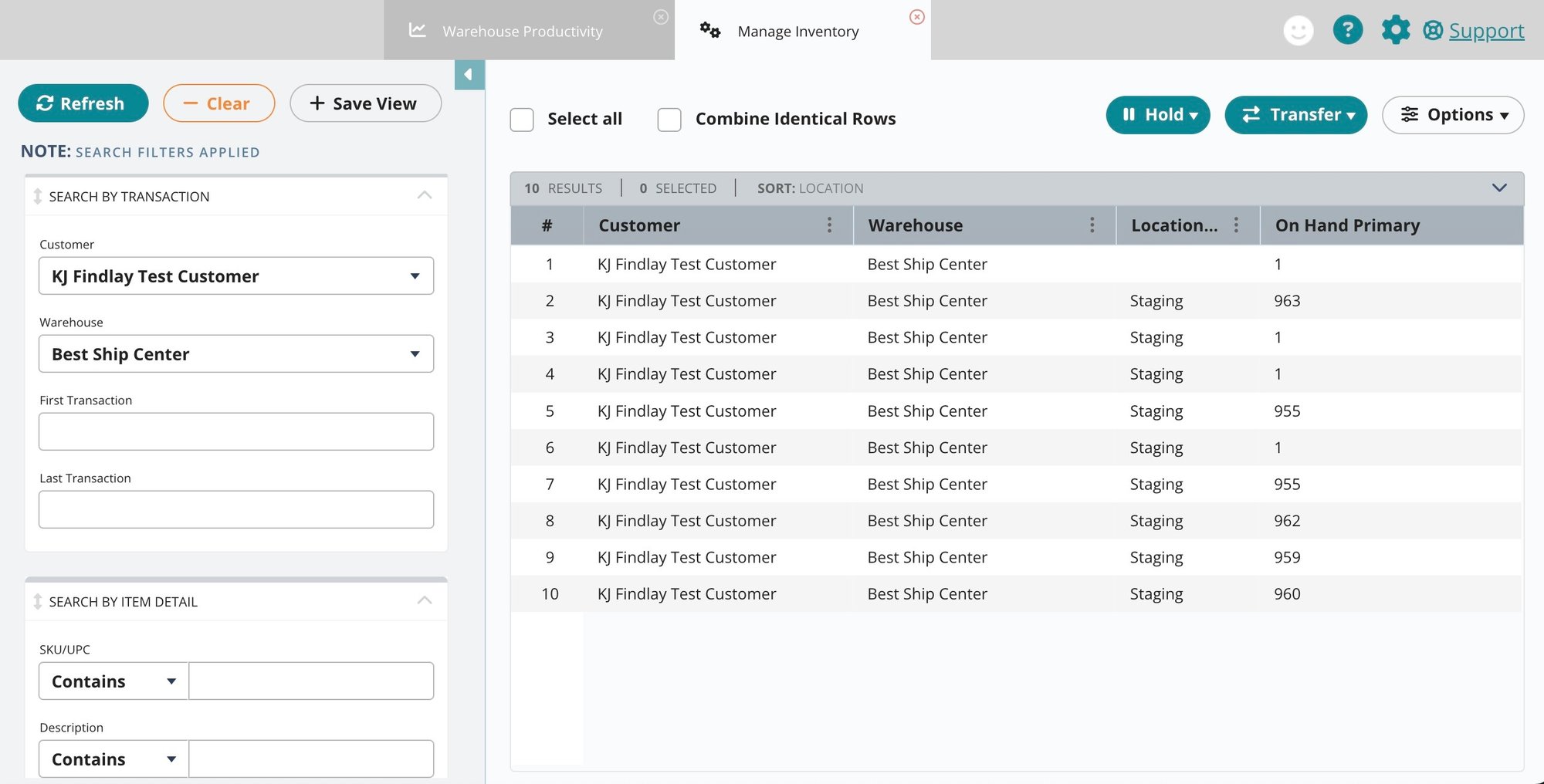
AI-Powered Optimization (Slotting, Picking, and Routing)
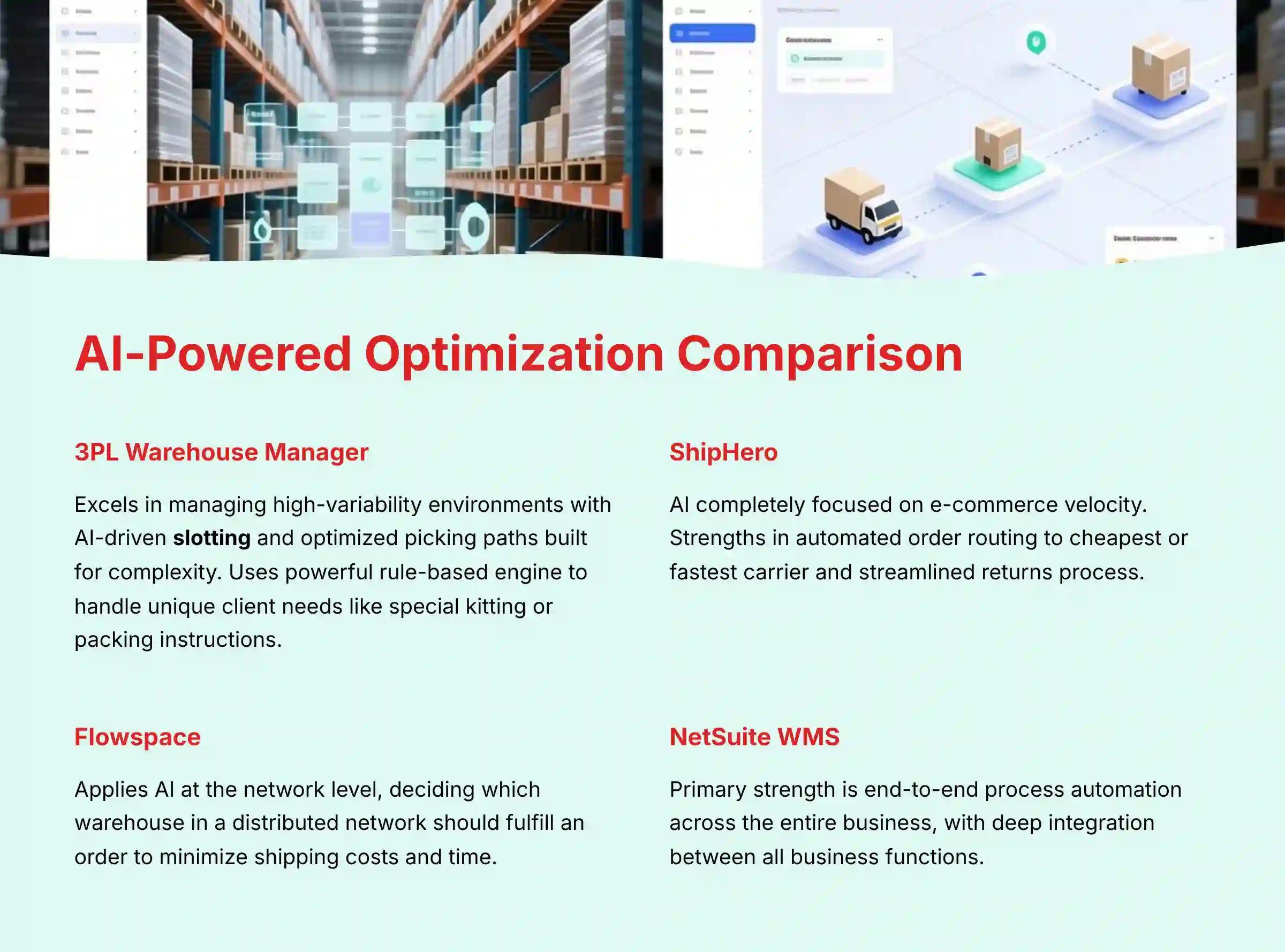
3PL Warehouse Manager excels in managing high-variability environments. Its AI-driven logic for slotting, which is deciding the best place to store items, and optimizing picking paths is built for complexity. It uses a powerful rule-based engine to handle unique client needs, like special kitting or packing instructions.

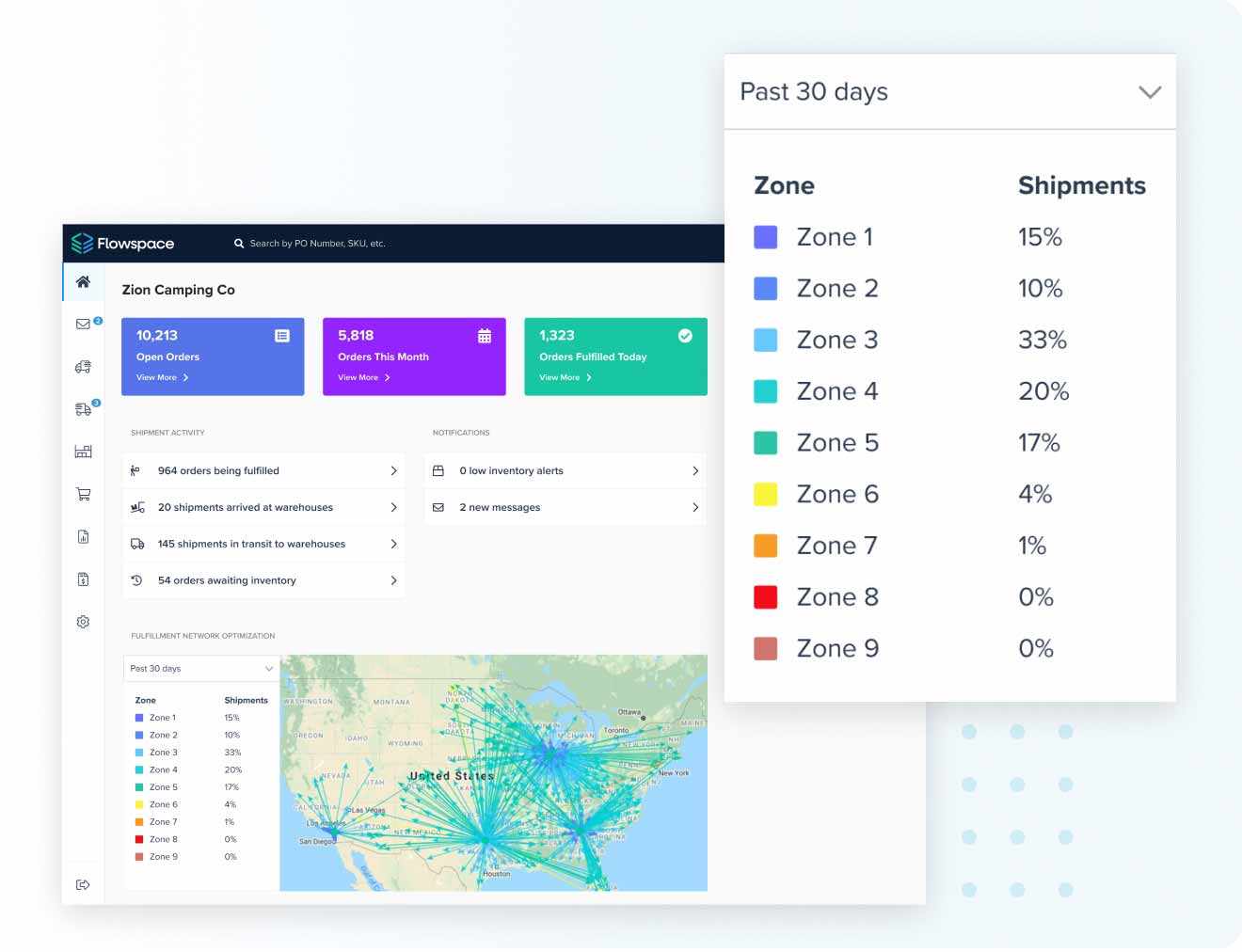
ShipHero's AI is completely focused on e-commerce velocity. Its strengths are in automated order routing to the cheapest or fastest carrier and a streamlined returns process. Flowspace applies AI at the network level, deciding which warehouse in a distributed network should fulfill an order to minimize shipping costs and time. NetSuite's primary strength is end-to-end process automation across the entire business.
Operational Execution: From Receiving to Shipping
Beyond high-level AI, a WMS is judged by its ability to optimize every physical process within the four walls of the warehouse. This is where AI transitions from a concept to a driver of tangible ROI.
- Inbound & Putaway: A robust WMS like 3PL Warehouse Manager or NetSuite WMS offers directed putaway logic, using AI to assign the best storage location based on velocity, dimensions, and weight. This directly improves the dock-to-stock time KPI and optimizes space utilization. In contrast, simpler systems may only support manual putaway, creating inefficiencies.
- Picking & Fulfillment Strategy: The core of warehouse efficiency lies in the picking strategy. 3PL Warehouse Manager excels at complex methodologies like wave picking for large B2B orders and batch picking for e-commerce, which dramatically increases labor efficiency. ShipHero is optimized for simple, discrete order picking. A key question for any vendor is how their system supports various strategies and integrates with technologies like voice-directed picking or pick-to-light systems to improve the order accuracy rate.
- Inventory Control & Accuracy: All platforms support basic inventory tracking, but enterprise-grade systems provide advanced cycle counting strategies to maintain accuracy without shutting down operations. They also enforce strict lot traceability and FEFO/FIFO picking logic, which is non-negotiable for 3PLs handling food, medical, or electronics products.

The Dual Experience: Planner vs. Operator UI/UX
A WMS must serve two very different users: the manager planning from a desk and the operator working on the floor. In my experience, a failure to serve both leads to failure of the system.
The planner experience in 3PL Warehouse Manager is powerful and highly configurable, but its user interface feels dated and requires a steep learning curve. ShipHero offers a clean, modern interface for planners, but with less ability for detailed customization.
For operators, the difference is even clearer. ShipHero's mobile app is often described as being as intuitive as an iPhone, which drastically cuts down on training time. As one user on a 3PL forum noted, “I can train a new packer on ShipHero's mobile scanner in 15 minutes. With our old WMS…it was a full day.” In contrast, 3PL WM's SmartScan feature is robust but requires much more training to master.
To better understand the full capabilities of the leading platform, check out our detailed 3PL Warehouse Manager Tutorials and Usecase guide for practical implementation insights.
ERP & Ecosystem Integration Capabilities
An effective WMS cannot be a data island; it must communicate in real-time with the business's core ERP system. NetSuite WMS has the natural advantage here, as it is part of a single, unified system. All data from sales to finance to fulfillment lives in one place.
3PL Warehouse Manager and NetSuite WMS are built for this ecosystem connectivity. Their capabilities extend beyond a simple ERP link to include:
- Retail & EDI Compliance: For 3PLs serving big-box retailers, EDI compliance is mandatory. Both platforms can generate and receive crucial EDI documents like the 856 (Advance Ship Notice – ASN), which automates communication and prevents costly chargebacks. This is a significant weakness for e-commerce-first platforms like ShipHero.
- Carrier & TMS Integration: An effective WMS must connect seamlessly with a Transportation Management System (TMS) or directly with carrier APIs (FedEx, UPS, etc.) to perform rate shopping and print compliant shipping labels, like the UCC-128 label required by many retailers.
- Warehouse Automation Orchestration: The future of warehousing is automation. A key due diligence step is to validate a WMS vendor's ability to act as an orchestration engine for Autonomous Mobile Robots (AMRs) or other hardware, sending tasks and optimizing workflows between human and robotic workers.
YMYL CHECKPOINT 1: Security, Compliance & Reliability Analysis
In logistics, your data is your business. Client lists, inventory data, and pricing information are your crown jewels. A system outage doesn't just cause delays; it stops commerce cold, costing thousands of dollars per hour and eroding client trust in minutes. For these reasons, security is not a feature on a checklist; it is the foundation upon which your entire operation is built. A failure here is an existential threat.
3PL Warehouse Manager (Extensiv) Security Profile
- Trust Level: High. My research verifies that Extensiv holds SOC 2 Type II certification, which is a critical security standard in the industry. They also maintain SOC 1 Type II certification and documented GDPR compliance. While they implement controls aligned with ISO standards, they do not currently list an official ISO 27001 certification among their public compliance credentials.
NetSuite WMS Security Profile
- Trust Level: High. As an Oracle product, NetSuite benefits from enterprise-grade security. It maintains a full suite of certifications, including SOC 1, SOC 2, and ISO 27001, backed by decades of proven reliability.
ShipHero Security Profile
- Trust Level: Medium. ShipHero reports SOC 2 compliance, which is a very important baseline for security. However, my research did not confirm a formal ISO 27001 certification. I recommend direct verification with the vendor if this is a requirement for your business.
Flowspace Security Profile
- Trust Level: High. Flowspace has achieved SOC 2 Type II certification. This is the industry gold standard that verifies their security controls have been audited over an extended period and found to be effective. This certification confirms the company's security practices meet the highest standards for data protection and privacy.
Professional RecommendationBefore signing any contract, demand the latest SOC 2 Type II audit report from the vendor. This is a standard and reasonable request that verifies their security claims. It is a critical due diligence step to protect your business and your clients' data from a breach.
YMYL CHECKPOINT 2: Pricing, TCO & Financial Risk Assessment
The sticker price of a WMS is one of the least important numbers to consider. The simple truth is that the Total Cost of Ownership (TCO)—including hidden service fees, variable costs, and operational drag—determines the true financial impact. A miscalculation here doesn't just affect a single budget line; it can cripple your margins and undermine your company's financial health. We must connect the dots between the pricing model and its real-world risk profile.

3PL Warehouse Manager: The Enterprise Model Risk
This platform uses a traditional enterprise model with high upfront licensing and implementation fees. The key financial risk here is the cost of “professional services.” In my analysis of user feedback, a common warning is to budget 50% or more above the initial quote to cover these mandatory costs. A G2 review stated, “Everything that isn't explicitly in the contract costs extra.”
ShipHero: The Variable Cost Risk
ShipHero is attractive with its pay-as-you-go, per-label fee model. But this creates a serious financial risk of unpredictable costs. During peak seasons, these fees can increase dramatically, destroying client profitability. A forum user reported their bill was 30% higher than projected during Black Friday.
NetSuite & Flowspace: The Subscription & Lock-in Risk
Both platforms use custom quotes based on subscription tiers. The primary financial risk with NetSuite is its high TCO and the long-term vendor lock-in that comes with an enterprise system. It is a major strategic and financial commitment that is difficult to reverse.
What Are the Strengths, Weaknesses, and Risks of Each Platform?
This section summarizes the key points to help you weigh the pros and cons of the two primary competitors for 3PLs.
Complex B2B & Multi-Client Operations Specialist
- Target Market: Established 3PLs with diverse client portfolios
- Core Strength: Highly configurable rule-based workflows
- AI Features: Advanced slotting optimization and pick path algorithms
- Integration Depth: Comprehensive ERP and EDI connectivity
✅ Strengths
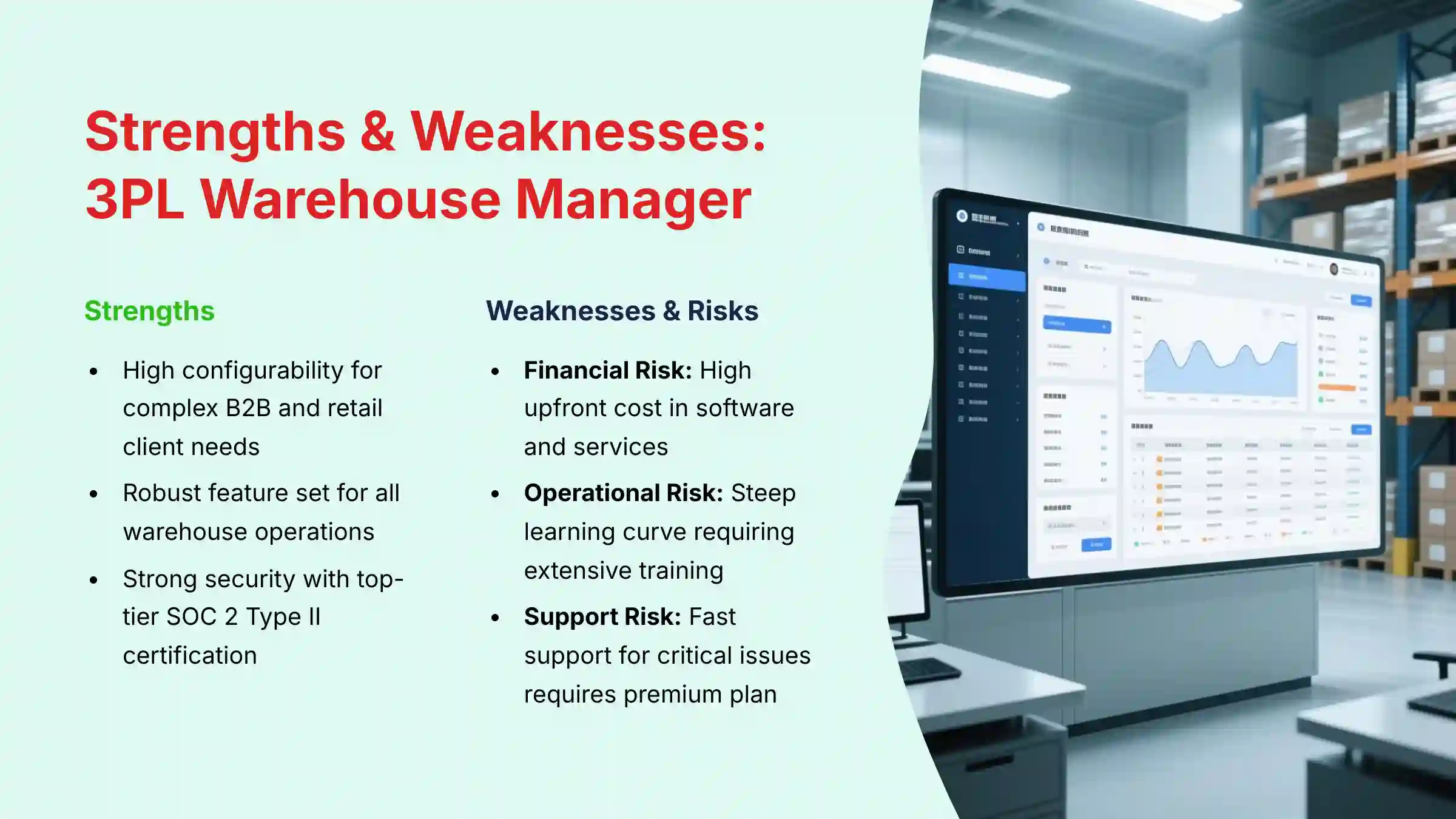
- High Configurability: Handles very complex B2B and retail client needs that other systems cannot
- Robust Feature Set: Offers deep functionality for all warehouse operations
- Strong Security: Top-tier SOC 2 Type II certification provides high trust
- SmartScan Mobile: Comprehensive barcode scanning capabilities
- EDI Compliance: Full support for retail distribution requirements
⚠️ Considerations
- High Upfront Cost (Financial Risk): Requires large initial investment in software and services
- Steep Learning Curve (Operational Risk): Complex interface requires extensive training
- Tiered Support (Operational Risk): Premium support plans needed for critical issue response
- Dated UI: User interface feels outdated compared to modern alternatives
- Super User Dependency: Risk of operational disruption if key trained staff leave

High-Volume DTC & E-commerce Specialist
- Target Market: Startup to mid-size e-commerce focused 3PLs
- Core Strength: Intuitive mobile interface and rapid deployment
- AI Features: Automated order routing and returns management
- Pricing Model: Pay-as-you-go per-label fee structure
✅ Strengths
- Exceptional Ease of Use: Modern UI dramatically reduces training time and costs
- Fast Implementation: Many businesses can go live in days, not months
- Seamless E-commerce Integration: Best-in-class connection with Shopify and other DTC platforms
- Intuitive Mobile App: “iPhone-like” interface requires minimal training
- Returns Management: Streamlined process for e-commerce returns
⚠️ Considerations
- Unpredictable Costs (Financial Risk): Per-label fees can lead to surprise bills that hurt margins
- “Complexity Ceiling” (Operational Risk): Struggles with complex B2B needs like multi-step VAS
- Inconsistent Critical Support (Operational Risk): Standard support may not meet high-volume operation needs
- Limited EDI Support: Weak support for retail distribution requirements
- Scalability Concerns: May require replatforming as business complexity grows
How to Choose the Right WMS: Use Case Mapping & Recommendations
The best choice depends entirely on your business model, client needs, and growth strategy. Think of this decision as choosing a vehicle. You wouldn't use a race car to haul cargo, and you wouldn't use a freight truck to win a race.
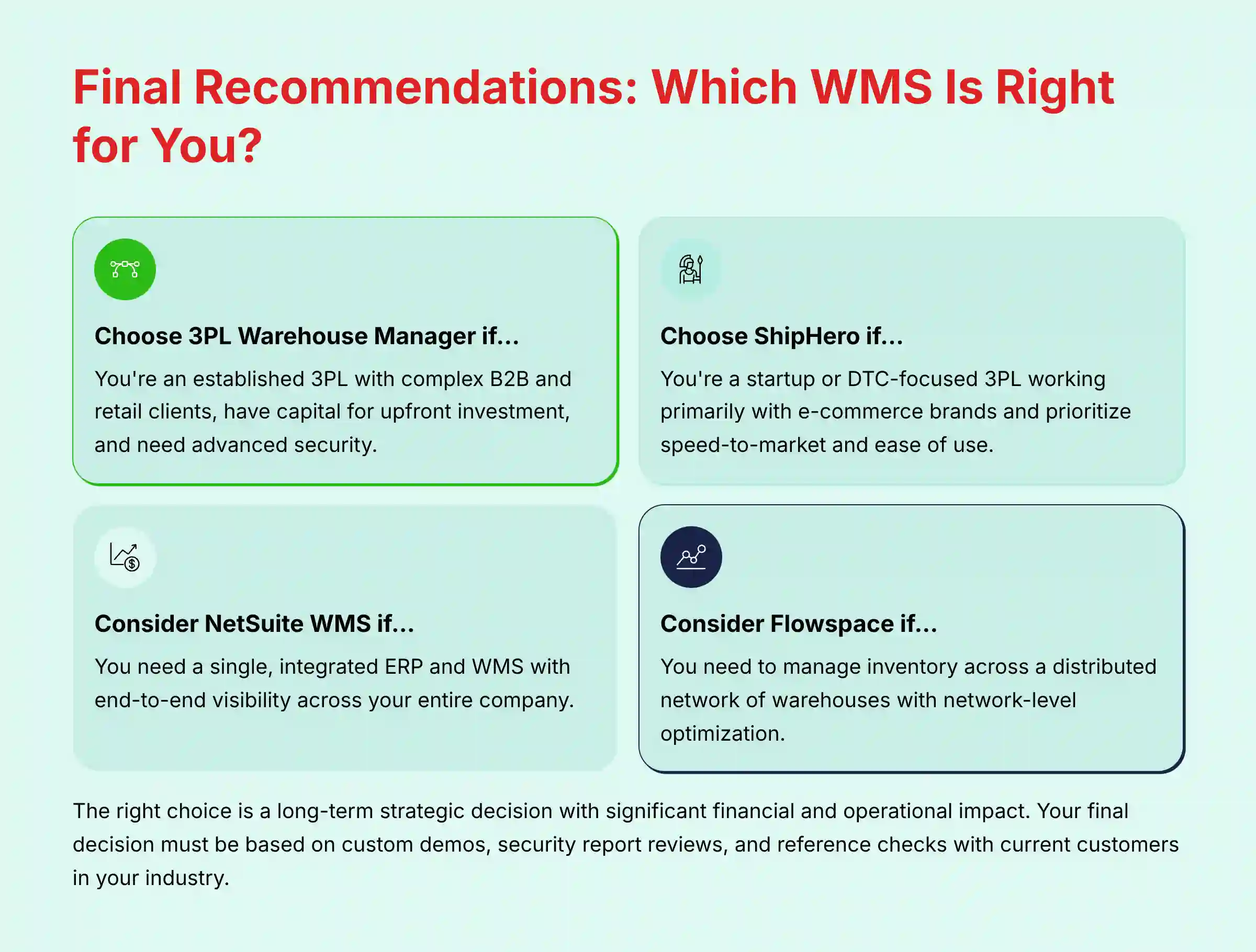
Choose 3PL Warehouse Manager if…
- You are an established 3PL with a mix of complex B2B and retail clients.
- Your competitive advantage comes from handling complex logistics that others cannot.
- You have the capital for a significant upfront investment.
- SOC 2 Type II certification meets your security requirements for handling client data.
- Your team can commit to extensive training and system configuration.
Choose ShipHero if…
- You are a startup or DTC-focused 3PL working primarily with e-commerce brands.
- Your highest priorities are speed-to-market and an easy-to-use system for your team.
- You have carefully modeled the variable pricing and confirmed it works for your profitability.
- Your operations focus on high-volume, straightforward fulfillment processes.
Consider NetSuite WMS if…
- You are a product-based business that needs a single, integrated ERP and WMS.
- Your main strategic goal is complete, end-to-end visibility across your entire company.
- You have the budget and resources for a large-scale enterprise implementation.
- Deep financial integration is critical to your operations.
Consider Flowspace if…
- You need to manage inventory across a distributed network of warehouses.
- Network optimization and carrier selection are core operational challenges.
- You prefer a platform-based approach to fulfillment management.
Frequently Asked Questions About 3PL WMS Alternatives
What Is the Biggest Difference Between 3PL Warehouse Manager and ShipHero?
The main difference is complexity versus simplicity. 3PL Warehouse Manager is built to handle complex B2B and multi-client rules. ShipHero is built for high-speed, high-volume DTC e-commerce fulfillment and prioritizes ease of use above all else.
Is ShipHero's Per-Label Pricing Cheaper Than 3PL Warehouse Manager?
Not necessarily. While it appears cheaper upfront, the variable nature of per-label fees can make it more expensive during high-volume periods. It poses a greater financial risk because the costs are less predictable than the fixed licensing model of 3PL Warehouse Manager.
Can ShipHero Handle Complex B2B Requirements Like EDI?
This is a known weakness of ShipHero. The platform is not designed for the complex requirements of Electronic Data Interchange (EDI) for retail distribution. For these needs, 3PL Warehouse Manager or NetSuite WMS are far superior solutions.
How Long Does It Take to Implement 3PL Warehouse Manager vs. ShipHero?
Implementation times vary greatly. A standard ShipHero implementation can take just days or a few weeks. A 3PL Warehouse Manager implementation is a much larger project, typically taking several weeks or even months to configure properly.
Which Platform Offers Better Customer Support for Critical Issues?
User reports suggest both have challenges. 3PL Warehouse Manager's support is tiered, meaning faster help costs more. Some ShipHero users report slow responses during system-down emergencies. This is a very important point to investigate during your own reference checks.
Why Would I Choose NetSuite WMS Over a Dedicated 3PL Software?
You would choose NetSuite WMS if you are a product company, not just a logistics provider. The benefit is having a single, integrated system for finance, inventory, and operations across the entire business, which provides unmatched visibility.
What Specific Security Question Should I Ask All Vendors?
The most important question is: “Can you provide me with your most recent SOC 2 Type II audit report?” This is the industry standard for verifying a vendor's security claims over time. A vendor's willingness to share this is a strong indicator of their transparency.
Does Flowspace Replace a WMS Like 3PL Warehouse Manager?
Not directly. Flowspace is better described as a network management platform. It helps you manage inventory and orders across multiple fulfillment centers. It often integrates with a core WMS like 3PL Warehouse Manager rather than replacing it.
For answers to more specific questions about the leading platform, visit our comprehensive 3PL Warehouse Manager FAQs resource.
Final Verdict: Which WMS Alternative Is Right for Your Business?
The choice between these platforms comes down to a core strategic trade-off. 3PL Warehouse Manager represents power, control, and the ability to handle complexity, making it the right choice for established 3PLs serving demanding B2B clients. In contrast, ShipHero offers speed, simplicity, and ease of use, making it ideal for DTC-focused startups that need to get up and running quickly. NetSuite WMS is the enterprise choice for businesses seeking a single, unified system for all operations.
The right choice is a long-term strategic decision with significant financial and operational impact. Use this analysis to short-list your options. Your final decision must be based on a custom demo of your most complex workflows, a thorough review of the vendor's security reports, and reference checks with current customers in your industry.
To continue your research, you can explore more about warehouse management systems and make informed decisions by leveraging expert insights from our comprehensive analysis platform.

Leave a Reply