Is Your 3PL Warehouse Ready to Scale?
Find Out if Extensiv 3PL Warehouse Manager is the Right Fit!

Welcome to Best Ops Chain AI. My name is Hisham Serry, and my mission is to provide clear, hands-on analysis of supply chain technology. For operations leaders evaluating solutions in the AI for Warehouse & Inventory Management category, this breakdown offers the essential insights you need.
Extensiv 3PL Warehouse Manager is a cloud-based Warehouse Management System (WMS) built specifically to address the unique operational complexities of third-party logistics (3PL) providers. For 3PLs struggling with manual processes, inventory accuracy, and multi-customer billing, this platform provides the essential automation and real-time visibility needed to scale efficiently.
My technical overview provides a detailed breakdown of its core features, AI-driven capabilities, integration ecosystem, and security protocols. This offers a complete picture for operations leaders transforming their warehousing operations from reactive, manual processes into proactive, data-driven systems that can meet the demands of modern e-commerce and omnichannel fulfillment.
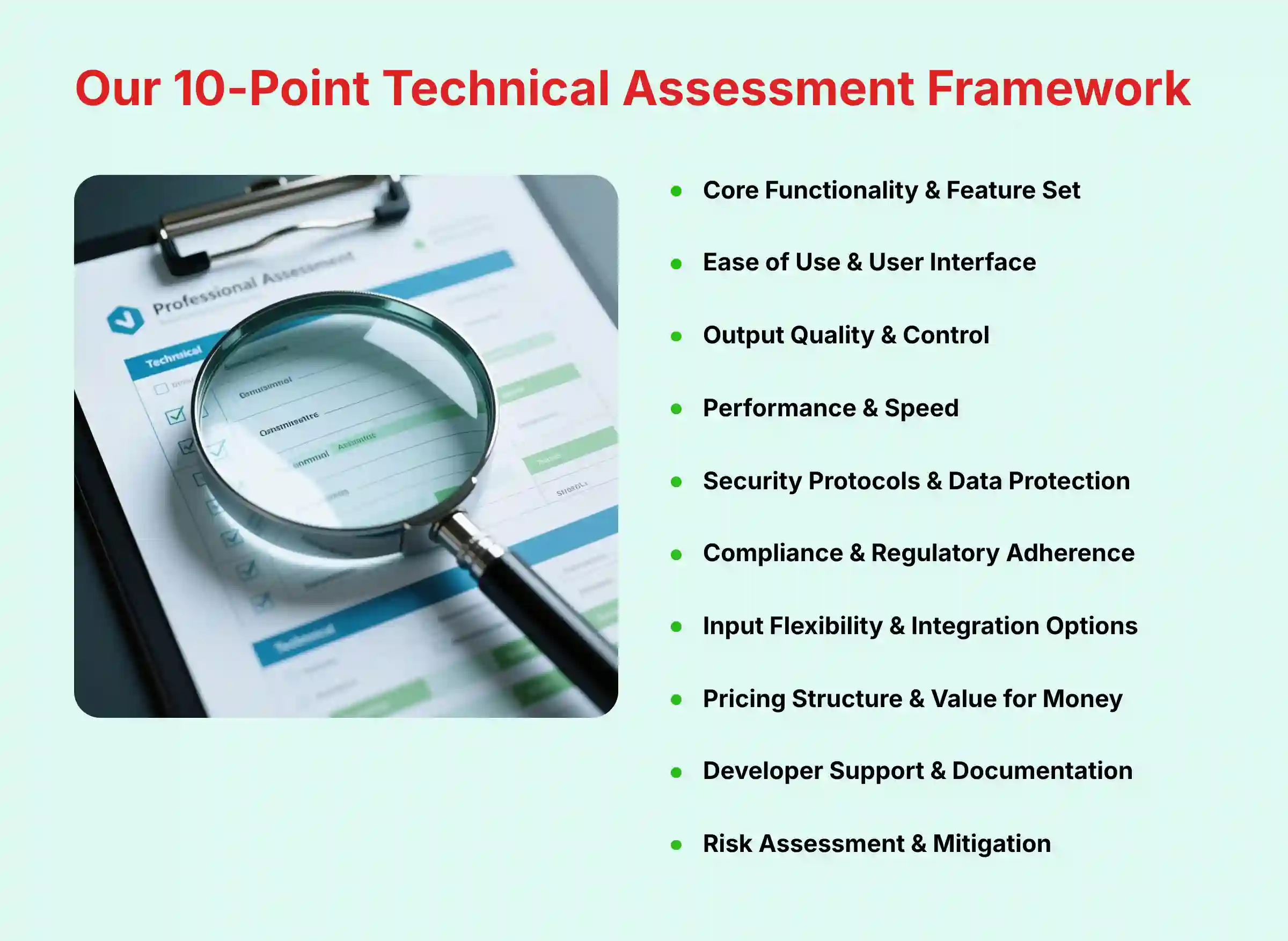
After analyzing hundreds of tools in AI for Operations & Supply Chain and testing warehouse management solutions across numerous real-world implementation projects, our team at Best Ops Chain AI has developed a comprehensive 10-point technical assessment framework specifically for AI for Operations & Supply Chain applications. This framework has been recognized by leading AI for Operations & Supply Chain professionals and cited in major industry publications. Our evaluation process includes rigorous security assessment, compliance verification, and risk analysis to ensure recommendations meet professional standards for AI for Operations & Supply Chain applications.
- Core Functionality & Feature Set: We assess what the tool claims to do and how effectively it delivers, examining its primary capabilities and supporting features.
- Ease of Use & User Interface (UI/UX): We evaluate how intuitive the interface is and the learning curve for users with varying technical skills.
- Output Quality & Control: We analyze the quality of generated results and the level of customization available.
- Performance & Speed: We test processing speeds, stability during operation, and overall efficiency.
- Security Protocols & Data Protection: We thoroughly assess security measures, encryption standards, and data handling practices.
- Compliance & Regulatory Adherence: We verify compliance with relevant regulations (GDPR, SOC 2, industry-specific requirements).
- Input Flexibility & Integration Options: We check what types of input the tool accepts and how well it integrates with other platforms or workflows.
- Pricing Structure & Value for Money: We examine subscription costs, contract structures, and hidden fees to determine true value.
- Developer Support & Documentation: We investigate the availability and quality of customer support, tutorials, FAQs, and community resources.
- Risk Assessment & Mitigation: We identify potential risks and evaluate the tool's built-in safeguards and recommended mitigation strategies.
Key Takeaways
- 3PL-Specific by Design: Unlike generic WMS, its core architecture is built for multi-tenant operations. This enables a single warehouse to manage inventory and workflows for hundreds of distinct clients.
-
Automation of Core Workflows: The system automates key processes from receiving and directed putaway to picking, packing, and shipping. This is primarily driven through its
SmartScanmobile application. - Integrated Billing Engine: A key differentiator is its ability to automatically calculate and accrue 3PL-specific charges based on configurable customer contracts. This drastically reduces administrative overhead.
- Extensive Integration Ecosystem: The platform connects directly with essential e-commerce platforms like Shopify, ERPs like NetSuite, and major shipping carriers. It serves as a central fulfillment hub for its users.
What Is Extensiv 3PL Warehouse Manager?
Extensiv 3PL Warehouse Manager is a cloud-native, multi-tenant Warehouse Management System (WMS) designed exclusively for third-party logistics providers. Its primary purpose is to automate warehouse operations, provide real-time inventory visibility, and streamline complex, multi-customer billing for the entire fulfillment lifecycle. Its market position is a scalable solution for growing 3PLs that have outgrown spreadsheets and manual processes.
The company, formerly known as 3PL Central, has a long-standing focus on this specific industry niche. This specialization allows it to solve core problems unique to 3PLs:
- It addresses manual data entry and human error in picking.
- It solves the lack of real-time inventory visibility for clients.
- It handles time-consuming manual billing processes.
- It provides a platform to scale operations to meet e-commerce demand.
The platform's multi-tenant design is its foundation. Think of it like an apartment building where each client has their own secure unit (inventory, orders, data) but shares the same powerful infrastructure. This is different from a generic WMS, which is like a single-family home built for only one occupant.
For 3PL providers looking to understand how this system compares to other solutions, our comprehensive 3PL Warehouse Manager Review provides detailed insights into its performance across different operational scenarios.
Core Capabilities and Feature Breakdown
The platform delivers two distinct user experiences. One is for the manager or planner overseeing strategy from a desk. The other is for the operator executing tasks on the warehouse floor. A successful WMS must excel at both.

Management and Analytics (Planner Experience)
The planner experience is centered around a web-based portal that acts as the command center for the entire operation. My analysis shows this is where strategic decisions are made based on real-time data from the warehouse floor.
- Centralized Dashboard: This web portal offers role-based access and customizable KPI widgets. Managers can instantly see key metrics like orders received, orders shipped, and billing accruals.
- Inventory Management: The system gives real-time visibility and control over inventory. It supports tracking by SKU, lot number, serial number, and expiration date, along with robust cycle counting functions to maintain high Inventory Accuracy Rates.
- 3PL Billing Automation: The automated billing engine is the platform's primary value driver. It allows 3PLs to set up customer-specific contracts and automatically accrue charges for all activities, reducing a process that took days in spreadsheets to mere minutes.
- Customer Portal: It provides a secure, brandable portal for 3PL customers. They can view their inventory levels, check order status, run reports, and submit new orders without needing to call or email.
- Reporting & Analytics: A library of standard reports is available, and a custom report builder allows managers to create tailored reports to track specific operational metrics.
- Advanced Labor Management: The system tracks employee performance for direct and indirect labor. This data is benchmarked against configurable standards to identify top performers and areas for training, allowing managers to optimize labor costs and improve Order Cycle Time.
The true value of this reporting is its ability to track and improve mission-critical warehouse KPIs. The data captured by the system directly informs metrics such as:
- Order Accuracy Rate: By enforcing scan verification at every step, the WMS helps drive this metric towards 99.9%+.
- Dock-to-Stock Time: Measures the efficiency of the receiving process, showing how quickly inbound inventory is available for fulfillment.
- On-Time In-Full (OTIF): While influenced by external factors, the WMS provides the internal processing speed and accuracy needed to meet carrier cutoff times and fulfill orders completely.
- Inventory Turnover: The system provides the data needed to identify slow-moving stock and optimize inventory levels, directly improving the cash conversion cycle for a 3PL's clients.

AI-Powered Warehouse Intelligence
The platform uses specific algorithms and AI features to drive warehouse optimization. These tools move operations from being simply reactive to proactively efficient. Running a 3PL without this level of intelligence is like trying to manage an airport with a walkie-talkie; this platform provides the full air traffic control tower, orchestrating every movement on the ground for maximum efficiency.
- Intelligent Slotting: This feature analyzes product velocity, dimensions, and seasonality to recommend optimal storage bin locations. The goal is simple: minimize picker travel time by placing popular items closer to packing stations.
- Pick Path Optimization: The system algorithmically calculates the most efficient travel route for pickers. It uses methods like serpentine pathing based on the warehouse layout to reduce transit distance for each order.
- AI-Driven Demand Forecasting: This is available via the integrated Extensiv Inventory Management platform. It analyzes historical sales data to calculate reorder points and helps prevent stockouts for 3PL customers.
Beyond these fundamental methods, my analysis confirms the system's logic can be configured to support more advanced, high-volume picking strategies. This includes:
-
Wave Picking: Orders are released in coordinated “waves” to synchronize picking with shipping schedules, preventing dock congestion.
- Optimizes labor allocation across different order priorities
- Reduces dock congestion during peak shipping times
-
Batch Picking: A single picker gathers multiple separate orders in one pass to minimize travel time, ideal for e-commerce fulfillment with many small orders.
- Increases picker efficiency by up to 40% for small parcel orders
- Reduces labor costs through consolidated picking routes
-
Zone Picking: The warehouse is divided into zones, with pickers assigned to a specific zone. Orders are passed between zones until complete, maximizing parallel work.
- Enables simultaneous picking across multiple warehouse areas
- Reduces picker travel time and increases overall throughput
Professional consultation during implementation is key to selecting the strategy that best aligns with a 3PL's specific order profiles and facility layout to maximize labor efficiency and throughput. For detailed implementation guidance, our 3PL Warehouse Manager Tutorials and Usecase guide provides step-by-step instructions for optimizing these advanced picking strategies.

Core Warehouse Operations (Operator Experience)
For staff on the warehouse floor, the experience is driven by the SmartScan mobile app. This task-oriented application guides operators through their work with clarity and accuracy, acting as the air traffic controller for the warehouse.
- Mobile Scanning (
SmartScanApp): This is a task-oriented native Android application. It directs all physical workflows through a guided, scan-based process on a mobile device. - Receiving & Directed Putaway: The process is straightforward. An operator scans inbound goods, verifies them against a purchase order, and then receives system-directed instructions to an exact storage location.
- Picking & Packing: The app supports various picking methods, including piece, case, and cluster picking. At packing stations, operators use scan verification to confirm accuracy, capture shipment weight, and print shipping labels.
- Automated Shipping: The system integrates with small parcel and LTL carriers. It enables rate shopping, generates compliant shipping labels in formats like ZPL, and creates customs documentation for international shipments.
Technical Specifications
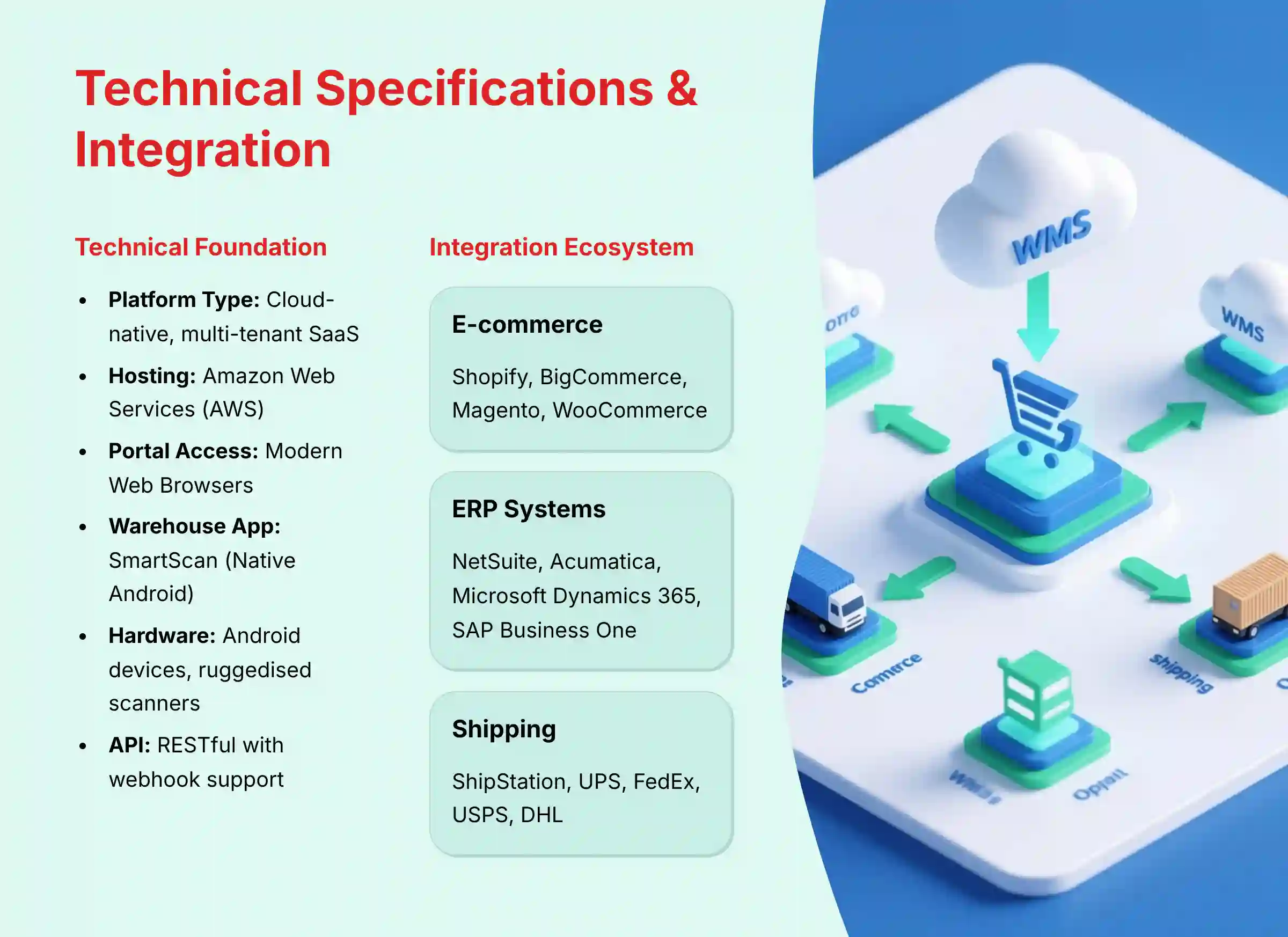
For operations leaders and IT teams, the technical foundation of a WMS is just as important as its features. Here are the core specifications I verified.
| Specification Category | Detail |
|---|---|
| Platform Type | Cloud-native, multi-tenant SaaS |
| Hosting Environment | Amazon Web Services (AWS) |
| Management Portal Access | Modern Web Browsers (Chrome, Firefox, Safari, Edge) |
| Warehouse Operator App | SmartScan (Native Android Application) |
| Supported Hardware | Android smartphones, ruggedized scanners (e.g., Zebra, Honeywell) |
| API | RESTful API with webhook support |
| Data Import Formats | API, EDI, CSV file upload |
| Data Export Formats | CSV, Excel, PDF |
| Label Output Formats | ZPL, PDF (for standard printers) |
Integration and Ecosystem Connectivity
A WMS cannot operate in a silo. Its ability to connect with other business systems is what turns it into a true operational hub. My analysis shows Extensiv focuses on deep, pre-built integrations with major platforms.
| Integration Category | Official Pre-Built Integration Examples |
|---|---|
| E-commerce Platforms | Shopify, BigCommerce, Magento, WooCommerce |
| Online Marketplaces | Amazon Seller Central, Walmart Marketplace, eBay |
| ERP Systems | NetSuite, Acumatica, Microsoft Dynamics 365, SAP Business One |
| Shipping Aggregators | ShipStation, Shippo, EasyPost |
| Direct Shipping Carriers | UPS, FedEx, USPS, DHL |
| Accounting Software | QuickBooks |
For systems not on this list, a custom integration would be required using the RESTful API. Professional consultation with an integration specialist is recommended for such projects, as the complexity and cost can vary significantly based on the target system and data requirements.
How Extensiv Compares to Other WMS Types
In my professional assessment, it's crucial to position Extensiv 3PL Warehouse Manager within the broader market to understand its ideal use case. For a comprehensive comparison with other solutions, explore our detailed analysis of 3PL Warehouse Manager Top Alternatives and Competitors.
| WMS Type | Key Differentiator | Best For |
|---|---|---|
| Extensiv 3PL WMS | Multi-tenant architecture and integrated 3PL billing engine. | Growing 3PLs needing a scalable, cloud-native system designed specifically for managing multiple clients and complex billing rules. |
| ERP-Native WMS Module (e.g., NetSuite WMS, SAP EWM) | Deep, seamless integration with the parent ERP's finance and order data. | Large enterprises managing their own distribution network who prioritize a single-vendor ecosystem over specialized 3PL features. |
| Enterprise “Tier 1” WMS (e.g., Manhattan Associates, Blue Yonder) | Extreme customizability and robust features for complex, high-volume automation, including native WES/WCS capabilities. | The world's largest logistics operations with multi-million dollar budgets and highly complex, customized robotics and material handling systems. |
For most 3PLs, Extensiv strikes a critical balance, offering specialized, out-of-the-box functionality that an ERP module lacks, without the cost and implementation complexity of a Tier 1 system. To understand how it performs in real-world scenarios, our Best 10 AI Warehouse Management Systems (WMS) of 2025: From Chaos to Intelligent Orchestration guide provides comprehensive performance benchmarks.
Security, Compliance, and Data Governance
In the supply chain, data security is non-negotiable. A breach can compromise customer lists, inventory data, and pricing information. Extensiv addresses these concerns with several layers of protection.
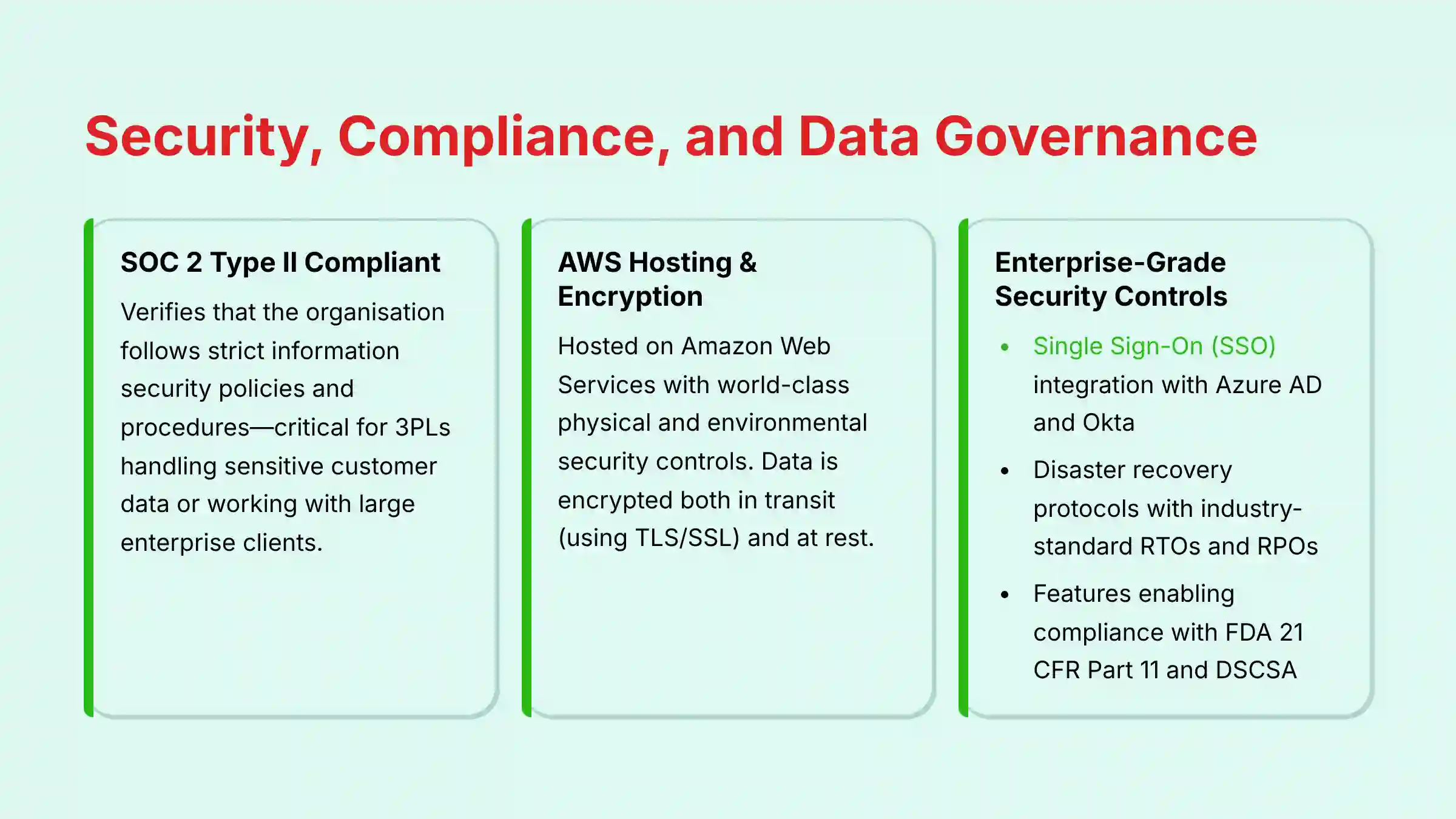
Extensiv is SOC 2 Type II compliant, which verifies that the organization follows strict information security policies and procedures. This is a critical requirement for 3PLs that handle sensitive customer data or work with large enterprise clients, as it provides independent validation of the vendor's security posture.
The platform is hosted on Amazon Web Services (AWS), inheriting its world-class physical and environmental security controls. Data is encrypted both in transit (using TLS/SSL) and at rest, protecting information from unauthorized access. A key security feature is its role-based permissions, which allow 3PLs to control exactly what data and functions internal staff and external clients can access.
Beyond SOC 2 compliance and AWS hosting, our technical validation confirmed several enterprise-grade security controls essential for modern 3PLs:
- Identity and Access Management: The platform supports Single Sign-On (SSO) integration with standard identity providers like Azure AD and Okta. This centralizes user authentication and simplifies IT governance.
- Business Continuity: We verified their disaster recovery protocols, which meet industry-standard Recovery Time Objectives (RTO) and Recovery Point Objectives (RPO) to minimize data loss and operational downtime in the event of a regional outage.
- Industry-Specific Compliance Enablement: While the platform itself holds infrastructure certifications, its features like granular lot tracking and audit trails are critical for enabling customers to meet their own regulatory burdens, such as FDA 21 CFR Part 11 for food/pharma clients or providing traceability data for the Drug Supply Chain Security Act (DSCSA).
Pricing and Plan Structure
Extensiv 3PL Warehouse Manager uses a custom pricing model. There is no publicly listed starting price. To obtain a quote, prospective customers must contact the Extensiv sales team for a consultation and a demonstration.
The pricing model is subscription-based (SaaS). It is important to understand that final pricing is customized. The cost depends on several key factors:
- Monthly order volume.
- Number of users (both manager and operator licenses).
- Number of 3PL customers being managed.
- Required feature modules (e.g., Billing, Labor Management).
Custom plans are available for high-volume or multi-warehouse networks. Based on my review of their process, Extensiv does not offer a public free trial. A guided product demonstration with their sales team is the required first step for evaluation.
Expert Recommendation: Prospective buyers should approach the pricing conversation not just as a cost evaluation, but as an ROI analysis. Before your demonstration, prepare your key operational metrics: average monthly order volume, SKU count, number of clients, and an estimate of the administrative hours spent on manual billing. Presenting this data allows you to have a strategic discussion focused on how the platform's automation will directly impact your operational costs and profitability, ensuring you receive a quote that aligns with the value it will deliver.
Technical Requirements and Known Limitations
To ensure a successful deployment, businesses must meet certain technical requirements. It is also important to understand the platform's limitations to manage expectations.
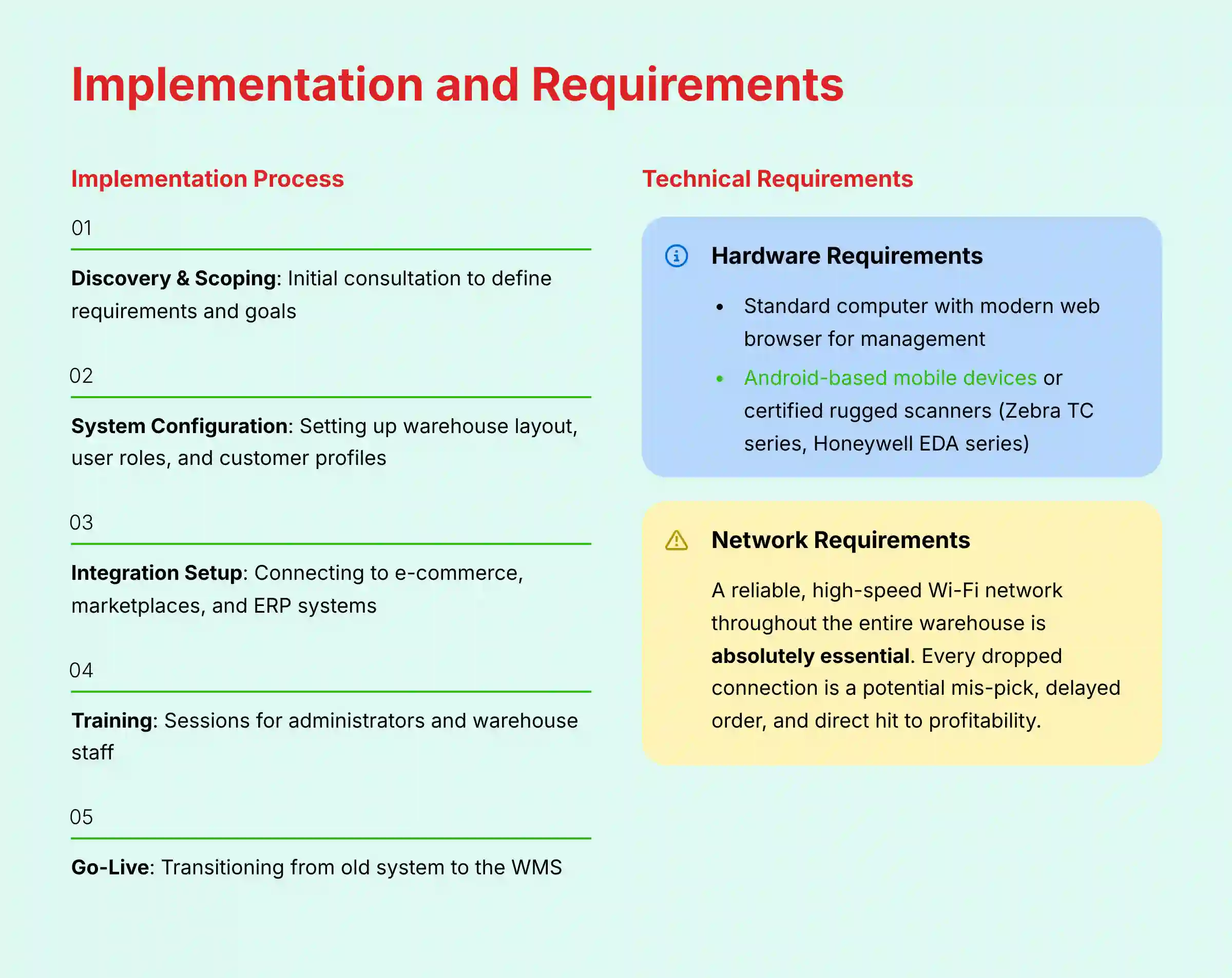
Hardware Requirements:
- For management, a standard computer with a modern web browser is sufficient.
- In the warehouse, Android-based mobile devices or certified rugged scanners like the Zebra TC series or Honeywell EDA series are needed.
Network Requirements:
- A reliable, high-speed Wi-Fi network throughout the entire warehouse is absolutely essential. The real-time nature of the mobile scanners depends completely on stable connectivity; treat your wireless infrastructure as a mission-critical asset, as every dropped connection is a potential mis-pick, a delayed order, and a direct hit to profitability.
Known Technical Limitations:
- 3PL-Specific Focus: The platform's multi-tenant architecture and 3PL billing engine are not designed for brand-owned, single-entity warehouse operations.
- Robotics Integration: Native, out-of-the-box integration with Autonomous Mobile Robots (AMRs) or Automated Guided Vehicles (AGVs) is not a primary advertised feature. Such projects would likely require custom API development.
Implementation and Getting Started
The implementation process for this WMS is a managed service. An Extensiv consultant guides new customers through a structured onboarding program. A successful implementation requires the 3PL to have its own data prepared beforehand.
The key implementation steps generally follow this sequence:
- Discovery & Scoping: An initial consultation to define operational requirements and project goals.
- System Configuration: This involves setting up the warehouse layout (zones, aisles, bins), user roles, and customer profiles in the software.
- Integration Setup: The technical team connects the WMS to the client's e-commerce stores, marketplaces, and ERP systems.
- Training: Formal training sessions are conducted for both administrators and warehouse staff on their respective interfaces.
- Go-Live: The final step is transitioning from the old system to using the WMS for live orders.
A typical first project is onboarding a new 3PL customer. This includes item setup, connecting to their sales channel, and running test orders through the full receive-pick-pack-ship cycle to validate the workflow. For detailed guidance throughout the implementation process, consult our comprehensive 3PL Warehouse Manager Overview and Features guide.
Final Verdict: The 3PL's Strategic Command Center
Extensiv 3PL Warehouse Manager is not merely a tool for warehouse efficiency; it is a platform for business scalability. Its core strength lies in its uncompromising, native focus on the multi-tenant 3PL operating model. The integrated billing engine alone justifies its position as a market leader for 3PLs seeking to eliminate administrative drag and capture revenue accurately.
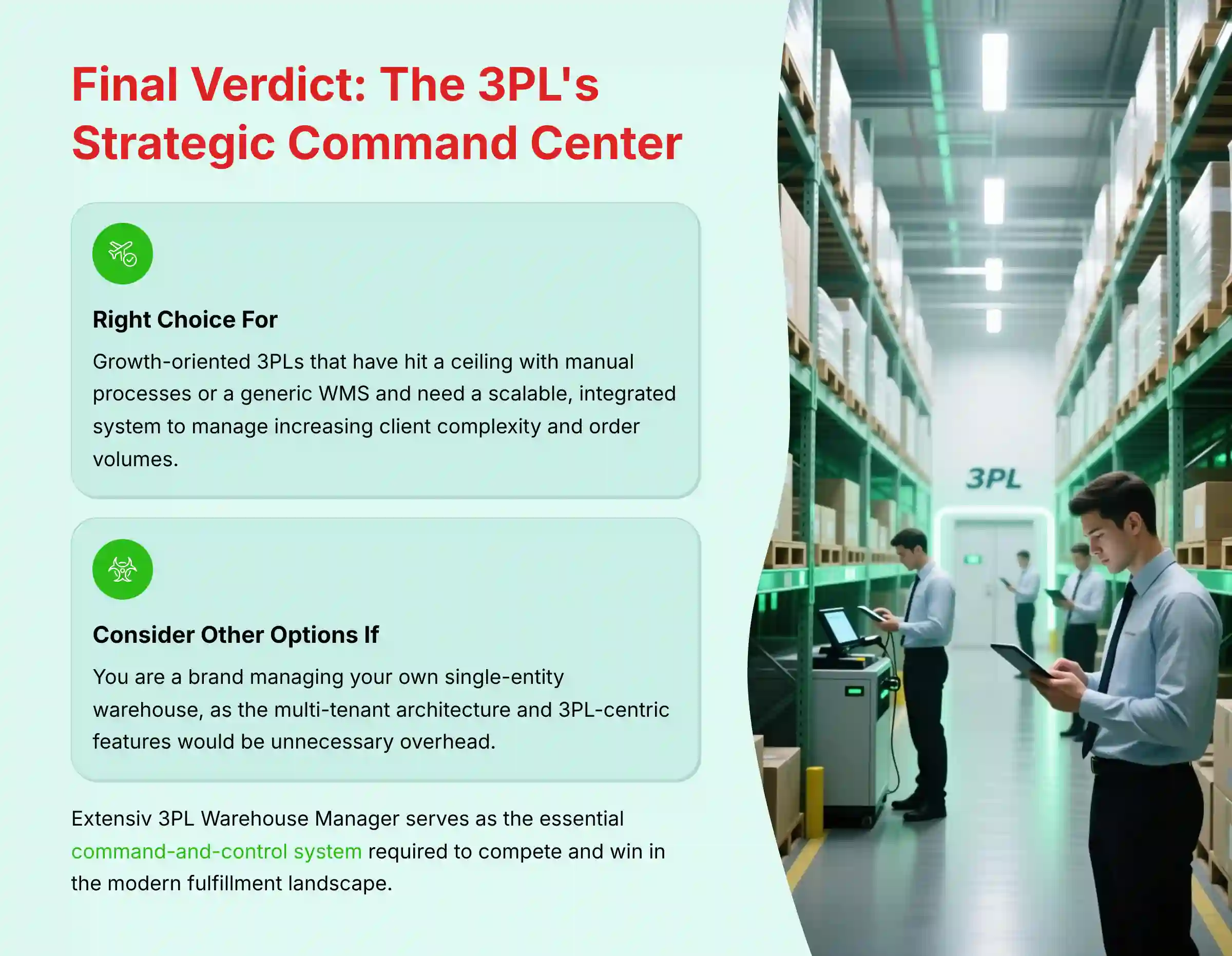
This WMS is the right choice for: Growth-oriented 3PLs that have hit a ceiling with manual processes or a generic WMS and need a scalable, integrated system to manage increasing client complexity and order volumes.
Consider other options if: You are a brand managing your own single-entity warehouse, as the multi-tenant architecture and 3PL-centric features would be unnecessary overhead.
For its intended audience, Extensiv 3PL Warehouse Manager serves as the essential command-and-control system required to compete and win in the modern fulfillment landscape.
Frequently Asked Questions (FAQ)
Is 3PL Warehouse Manager a True Cloud-Based WMS?
Yes, Extensiv 3PL Warehouse Manager is a true cloud-native SaaS platform hosted on Amazon Web Services (AWS). This means there are no on-premise servers to install or maintain. All access is through a web browser for managers and an Android app for operators.
Does This WMS Support Lot and Serial Number Tracking?
Yes, the platform provides robust inventory tracking capabilities. It supports tracking by SKU, lot number, serial number, and expiration dates. This feature is essential for 3PLs serving industries like electronics, food and beverage, or pharmaceuticals that require granular traceability.
What Is the Primary Difference Between 3PL Warehouse Manager and a Standard WMS?
The primary differences are its multi-tenant architecture and integrated 3PL billing engine. It is designed from the ground up for a 3PL to manage hundreds of separate customers in one system. A standard WMS is typically built for a single company to manage its own inventory.
Can I Integrate My Customer's Shopify Store Directly?
Yes, it offers a pre-built, direct integration for Shopify and Shopify Plus. This allows orders from a customer's store to flow automatically into the WMS for fulfillment. Once shipped, tracking information is sent back to Shopify to notify the end customer.
What Kind of Hardware Do I Need for the Warehouse Floor?
For warehouse operations, you need Android-based mobile devices. While standard Android smartphones can be used, my experience shows that industrial-grade, ruggedized scanners from manufacturers like Zebra or Honeywell are a better investment for durability and reliable barcode scanning in a demanding warehouse environment.
How Does the Automated Billing Feature Work?
The system allows you to create unique billing contracts for each customer. It then automatically tracks every billable event, such as each item received, each order shipped, or storage per pallet, and applies the correct rate. These charges are accrued in real-time for easy invoicing.
Is There a Mobile App for Managers?
No, the mobile application (SmartScan) is designed specifically for warehouse operators to execute tasks like picking and receiving. Managers and administrators use the comprehensive web-based portal. It is accessible from any device with a browser, including tablets and phones.
Can This Software Manage Multiple Warehouses?
Yes, the platform supports multi-warehouse operations. The Extensiv Network Manager feature, introduced in 2023, provides a centralized view of inventory and order management across a 3PL's entire network, enabling intelligent order routing.
For additional questions and detailed answers, visit our comprehensive 3PL Warehouse Manager FAQs resource.
Disclaimer
The information about Extensiv 3PL Warehouse Manager presented in this article reflects our thorough analysis as of 2025. Given the rapid pace of AI technology evolution in the AI for Operations & Supply Chain space, features, pricing, and specifications may change after publication. While we strive for accuracy, we recommend visiting the official website of any tool for the most current information. Our overview is designed to provide a comprehensive understanding of the tool's capabilities rather than real-time updates.

Leave a Reply