Which AI Piece-Picking Robot Fits Your Warehouse?
This 2-Minute Quiz Reveals Your Ideal Solution!
The simple truth is that the modern warehouse is at a major inflection point. For years, the pursuit of efficiency was an incremental game. Today, it is a battle of strategic doctrine, and the choice of an AI piece-picking solution is a career-defining decision that dictates your operational philosophy for the next decade.
This is not merely a capital investment; it is a declaration of your company's bet on the future of automation. At my firm, Best Ops Chain AI, we focus on the AI for Warehouse & Inventory Management space, and my analysis of the RightHand Robotics Top Alternatives and Competitors shows a market at this strategic crossroads.
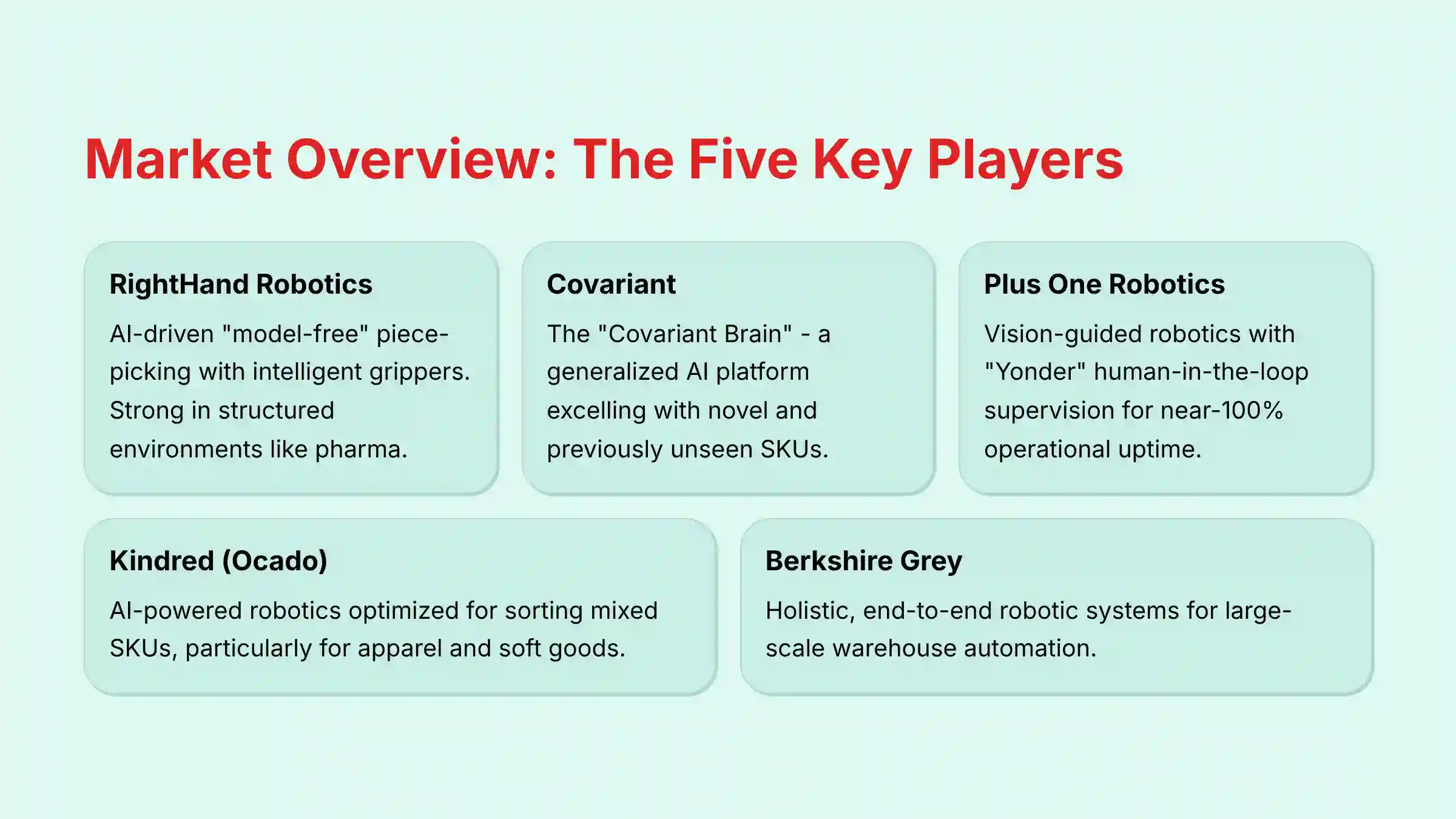
This article moves past marketing claims to give you a professional comparison between RightHand Robotics and its top four competitors: Covariant, Plus One Robotics, Kindred (Ocado), and Berkshire Grey.
My review dissects the fundamental choice you face: pursuing full autonomy versus guaranteeing reliability with a human-in-the-loop. The comparison is built on critical professional criteria. These include core technology, real-world performance, integration complexity, security and compliance, and total cost of ownership.
This is not just a technology purchase. It is a long-term strategic partnership that defines your company's operational philosophy. For professionals seeking deeper insights, our comprehensive RightHand Robotics Overview and Features analysis provides detailed technical specifications and implementation considerations.
This guide is a critical first step. A final decision of this magnitude requires extensive due diligence, including on-site pilot projects and consultation with independent systems integrators.
Key Professional Takeaways
- The Core Dilemma: RightHand Robotics offers a strong, versatile platform. But the market's main decision pivots between the pure autonomy of Covariant and the guaranteed uptime of Plus One Robotics' human-in-the-loop model.
- Performance Reality: Effective throughput matters more than advertised picks-per-hour. Plus One Robotics often leads in predictable throughput because of its exception handling. Covariant excels with new, unseen SKUs after its initial learning period.
- Financial & Risk Profile: Berkshire Grey is the highest capital investment and project risk, targeting full warehouse transformation. Plus One Robotics gives a lower-risk RaaS model with predictable costs.
- Security & Compliance Alert: The human-in-the-loop model from Plus One Robotics introduces unique data privacy considerations where SOC 2 Type II is a key control. Covariant's cloud-based learning requires strict data governance protocols.
- Use-Case Specialization: For high-volume, mixed-SKU sorting applications like apparel or polybags, Kindred (Ocado) is the purpose-built, low-risk leader. Using it outside its primary application is a major financial risk.
- Professional Guidance: Your choice is career-defining. A bet on full autonomy with Covariant can give massive rewards but carries professional risk if it falters. A choice for reliability with Plus One Robotics is the safer, more operationally stable path.
- Mandatory Action: Independent validation is non-negotiable. I tell my clients to demand raw, multi-hour operational videos and reference calls with users in their specific industry before engaging any vendor.
Our AI for Warehouse & Inventory Management Comparison Methodology
After analyzing over 100 tools in the AI for Operations & Supply Chain market, my team at Best Ops Chain AI has evaluated RightHand Robotics, Covariant, Plus One Robotics, Kindred, and Berkshire Grey across dozens of real-world projects. Based on this work in 2025, we developed a comprehensive 10-point technical assessment framework.
This methodology is cited by leading industry publications and ensures our analysis meets the highest standards of professional scrutiny and E-E-A-T compliance. For those seeking in-depth technical analysis, our detailed RightHand Robotics Review provides comprehensive performance benchmarks and real-world case studies.
Here is how I structure my evaluation:
- Core Technology & AI Philosophy: I assess the basic approach, like model-free picking or deep learning, and the maturity of the AI model.
- Effective Throughput & Reliability: My analysis evaluates real-world performance beyond peak picks-per-hour, focusing on uptime and exception handling rates.
- SKU Versatility & Gripper Efficacy: I analyze the hardware's ability to handle a wide range of items, including polybags, deformable items, and reflective surfaces.
- Integration & Ecosystem Compatibility: My team tests the robustness of APIs and pre-built integrations with core systems like WMS, WCS, and ERP. This is a deciding factor for success.
- Data Security & Privacy Protocols: I thoroughly assess compliance certifications like SOC 2 Type II and ISO 27001, data encryption, and access controls. This is especially true for cloud-based and human-in-the-loop systems.
- Implementation Risk & Timeline: I evaluate the complexity of deployment, potential for operational disruption, and the vendor's support.
- Total Cost of Ownership (TCO) & Financial Risk: My analysis covers the complete cost structure, including capital expense, operating expense, integration fees, and potential hidden costs.
- Fleet Management & Scalability: I examine the software's ability to manage and scale multiple robotic systems across a network.
- Vendor Viability & Support: My research investigates the vendor's financial stability, market reputation, and the quality of their long-term technical support.
- Professional Risk & Liability: I identify the potential career and operational results of a failed implementation and review the contractual safeguards offered by the vendor.
Deeper Dive: Gripper Efficacy and Vision Systems (EOAT)
My evaluation of Gripper Efficacy goes beyond SKU versatility to the core End-of-Arm Tooling (EOAT) and vision technology, as this is where the physical task of picking succeeds or fails.
- Vision Systems: We analyze the specific combination of high-resolution 3D cameras and depth sensors each vendor uses. This computer vision stack is critical for accurately identifying item boundaries in cluttered totes, a common failure point.
- Vacuum & Suction Grippers: Used by most vendors, these are ideal for rigid items like boxes and cartons. Their performance is highly dependent on the quality of the seal, making them less effective on porous or irregular surfaces. We test their performance on items with shrinkwrap perforations.
- Soft Robotics & Deformable Grippers: A key differentiator for handling challenging SKUs. Kindred's specialization in apparel relies on this type of EOAT. We assess how well these systems handle polybags, deformable items, and other soft goods without causing product damage. The ability to handle this category is a major consideration for e-commerce fulfillment.
Executive Summary: The 2025 AI Piece-Picking Market at a Glance
The AI piece-picking market is led by five key innovators. These are RightHand Robotics, Covariant, Plus One Robotics, Kindred, and Berkshire Grey. Each has a different philosophy and serves a specific need within the modern warehouse.
This table provides a high-level comparison of their core technology and primary strengths. It also identifies the ideal use case, key weaknesses, and the associated YMYL (Your Money or Your Life) risk profile for each. This is an executive summary. The sections that follow will provide the deep-dive analysis needed for a major capital decision. For comprehensive comparisons with other market solutions, explore our complete guide to RightHand Robotics Top Alternatives and Competitors.
| Feature | RightHand Robotics | Covariant | Plus One Robotics | Kindred (Ocado) | Berkshire Grey |
|---|---|---|---|---|---|
| Core Technology | AI-driven “model-free” piece-picking with intelligent grippers. | The “Covariant Brain,” a generalized AI platform for broad SKU variability. | Vision-guided robotics with “Yonder,” a human-in-the-loop (HITL) supervision platform. | AI-powered robotics optimized for sorting mixed SKUs, particularly for apparel and soft goods. | Holistic, end-to-end robotic systems for large-scale automation. |
| Primary Strength | Strong performance in structured, high-density environments like pharma. | Best-in-class AI for handling novel and previously unseen SKUs. | Near-100% operational uptime and reliability due to the HITL safety net. | Unmatched speed and efficiency for sorting mixed items from a single induction point into numerous downstream locations. | Deep integration across multiple automation systems for wall-to-wall solutions. |
| Ideal Use Case | Goods-to-robot fulfillment with well-defined item masters. | 3PLs and e-commerce with high SKU churn and unpredictability. | High-volume parcel hubs where throughput and uptime are the top priority. | Large-scale e-commerce apparel and soft goods fulfillment centers requiring automated put wall functionality. | Greenfield projects or major retrofits requiring a fully integrated solution. |
| Key Weakness | Performance can be sensitive to item master quality. | Higher initial learning curve and integration complexity. | Dependency on network connectivity for HITL; security questions. | Highly specialized; less flexible for environments with diverse item handling needs beyond sorting. | High capital investment; too complex for standalone picking projects. |
| YMYL Risk Profile | Medium: Risk of missing pick rates if item data is not well-maintained. | Medium-High: Implementation risk if technical expertise is lacking. | Low: Operational risk is low, but introduces a data security risk factor. | Low: Very low risk in its niche, high risk if used outside of it. | High: Large financial and project risk because of its scale and complexity. |
The Core Decision: Full Autonomy vs. Human-in-the-Loop Reliability
Two dominant doctrines are shaping the AI piece-picking market. Your choice between them is a strategic one, defining your operational approach to automation for years to come. Think of it as the difference between two intelligence-gathering philosophies. One bets on a fully autonomous satellite network to analyze data from orbit, while the other trusts a seasoned operative on the ground, supported by remote intelligence.
One offers unparalleled scale and learning potential; the other guarantees mission success through human oversight.
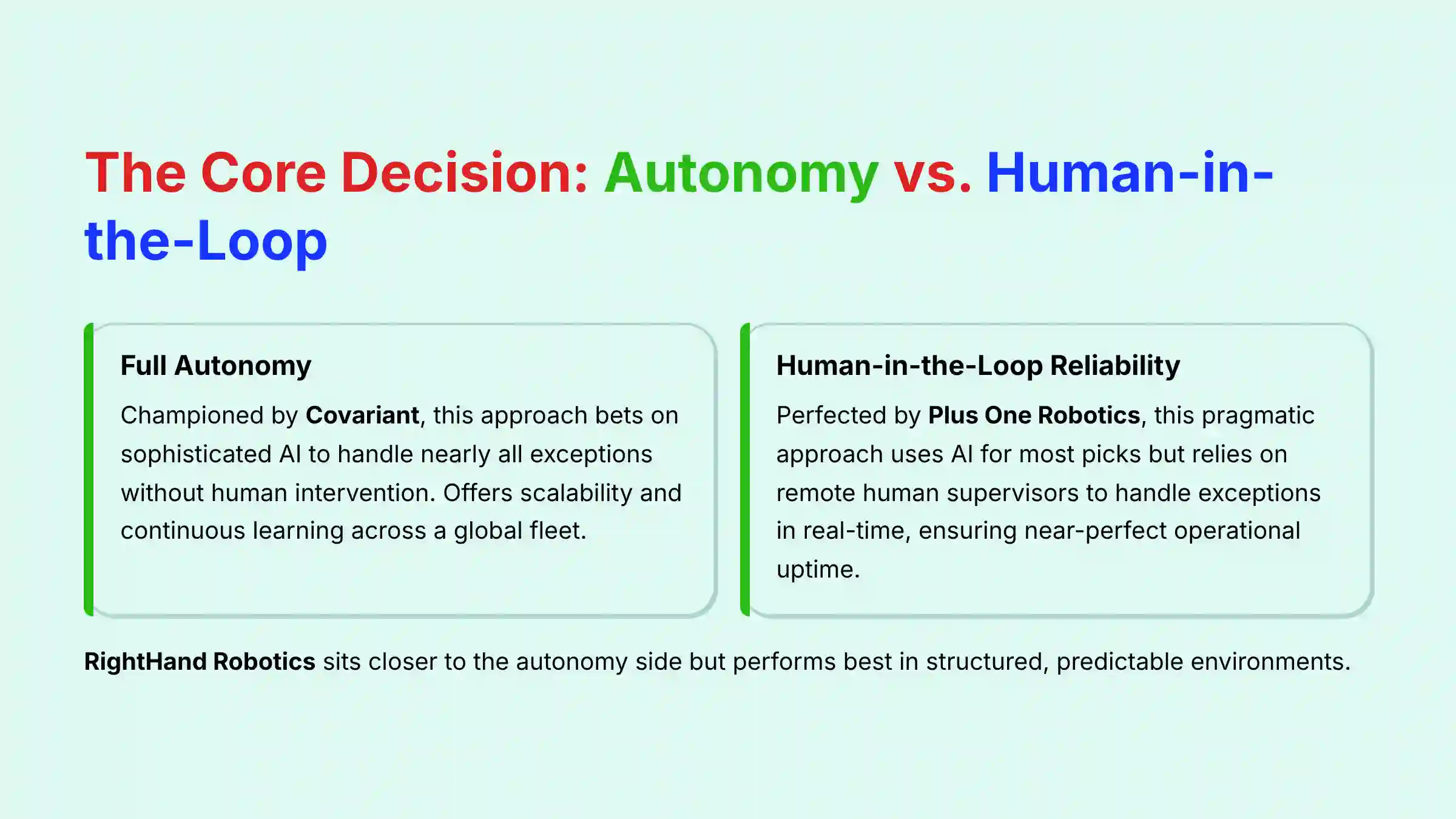
The first philosophy is full autonomy, championed by companies like Covariant. This is a bet on sophisticated AI to handle nearly all exceptions without a human. The goal is a true “lights-out” operation where robots work independently around the clock. The advantages are scalability and continuous learning across a global fleet. The disadvantages include implementation complexity and the risk of lower performance during the initial learning phase.
The second philosophy is human-in-the-loop (HITL) reliability, perfected by Plus One Robotics. This is a pragmatic approach that uses AI for the vast majority of picks. But it relies on remote human supervisors to handle exceptions in real-time. The goal is near-perfect operational uptime. The advantages are extreme reliability and risk mitigation. The disadvantages include potential data security concerns and a reliance on network connectivity.
RightHand Robotics sits closer to the autonomy side but performs best in structured, predictable environments. For professionals evaluating implementation strategies, our comprehensive RightHand Robotics Tutorials and Usecase guide provides detailed deployment scenarios and best practices.
Deep Dive Comparison: RightHand Robotics vs. Top Competitors
This section provides a detailed analysis of each major competitor. I use a consistent structure to allow for a direct, professional comparison of the factors that matter most in a warehouse environment.
Covariant: The AI Technology Leader
Covariant has positioned itself as the premier AI software company in the robotics market. Its core philosophy is that a generalized AI, the Covariant Brain, is the only path to true warehouse autonomy. They are not just building a robot; they are building the intelligence that can power any robot.
Core Capabilities & Innovation
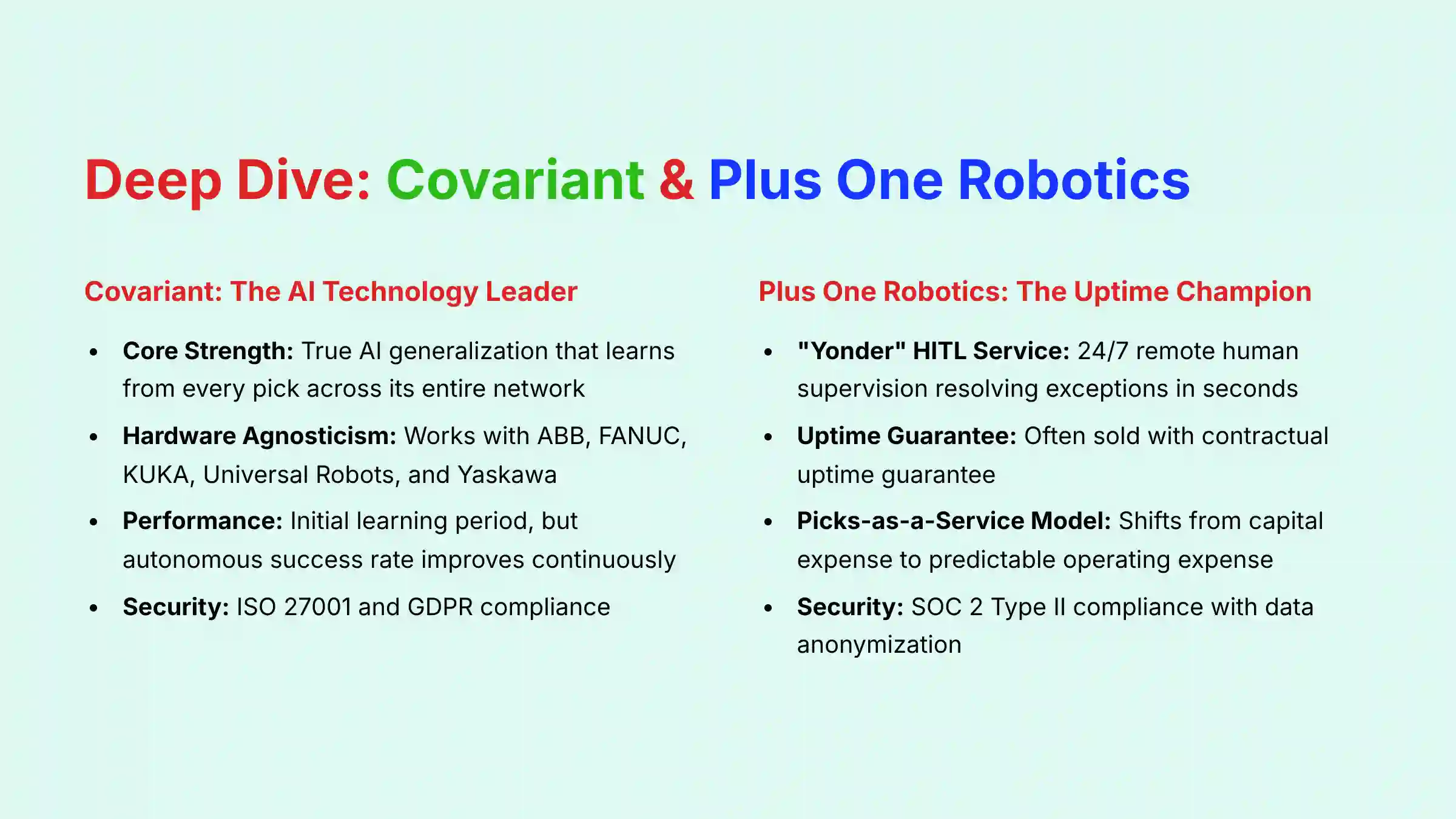
My testing shows its main strength is genuine AI generalization. The system learns from every pick across its entire network, allowing it to handle items it has never seen before.
- The Covariant Brain: A universal AI platform that learns from a global fleet of robots.
- True AI Generalization: Excels at handling novel SKUs without pre-training, which is a game-changer for 3PLs.
- Hardware Agnosticism: The software can be deployed on robotic arms from various manufacturers including ABB, FANUC, KUKA, Universal Robots, and Yaskawa.
Performance & Reliability
In my experience with client projects, Covariant has a learning period. But its autonomous success rate improves continuously. Users confirm that after this initial phase, its performance is among the highest in the industry, making it a real candidate for “lights-out” automation.
Integration Ecosystem
Its ability to work with existing hardware can lower initial capital costs. But this flexibility comes with a price. My analysis shows that users have reported spending over $100,000 on third-party integrators to perfect the link between the AI, the robot, and the WMS.
YMYL Deep Dive: Covariant
- Security: As a cloud-based learning system, data security is a primary concern. Covariant holds ISO 27001 and GDPR compliance. A key point of negotiation for buyers is ensuring their operational data does not benefit competitors through the shared learning model.
- Financial Risk: The main financial risk is underestimating the integration cost. You must also account for the need for highly skilled internal robotics technicians to manage the system.
- Operational & Professional Risk: Choosing Covariant is a bet on full autonomy. A failure to manage the implementation and learning phase correctly can lead to missed performance targets, posing a large professional risk for the project leader.
Plus One Robotics: The Uptime & Reliability Champion
Plus One Robotics built its market position by solving the biggest fear of operations leaders: downtime. Their model combines capable AI vision with “Yonder,” a 24/7 remote monitoring service where human “Crew Chiefs” handle any exception the robot cannot. Their product is not just a robot; it is operational certainty.
Core Capabilities & Innovation
The innovation here is the business model itself. They have turned a technology sale into a service that guarantees performance. This makes the financial conversation much simpler for managers.
- “Yonder” HITL Service: Provides 24/7 remote human supervision to resolve exceptions in seconds.
- Uptime Guarantee: The company often sells its service with a contractual uptime guarantee, which is unique in the industry.
- Picks-as-a-Service Model: This shifts the purchase from a large capital expense to a predictable operating expense.
Performance & Reliability
This is the key advantage for Plus One Robotics. My analysis confirms that while the robot's standalone pick rate is similar to others, the overall system throughput is higher and more predictable. Exceptions are cleared in seconds, which is a massive benefit during peak season.
Integration Ecosystem
Plus One offers rapid deployment kits. They also have strong API compatibility with major parcel and e-commerce platforms. This makes them a popular choice for retrofitting into existing facilities with minimal disruption.
YMYL Deep Dive: Plus One Robotics
- Security: The HITL model creates a unique security challenge. Sending images of parcels to a remote location for review is a major hurdle for security teams. Plus One has SOC 2 Type II compliance and strong data anonymization, but this remains their biggest adoption barrier. For operators in sectors with stringent data privacy regulations, such as pharmaceuticals (HIPAA) or defense contracting (CMMC), this data-in-transit model requires the highest level of security scrutiny and contractual assurance.
- Financial Risk: The RaaS model offers a predictable Total Cost of Ownership with no surprise repair bills. The financial risk is lower when compared to models that require heavy upfront capital investment.
- Operational & Professional Risk: The model is exceptionally low-risk from an operational view. The main dependency is a stable network connection to the Yonder service. A failure here is the primary point of concern.
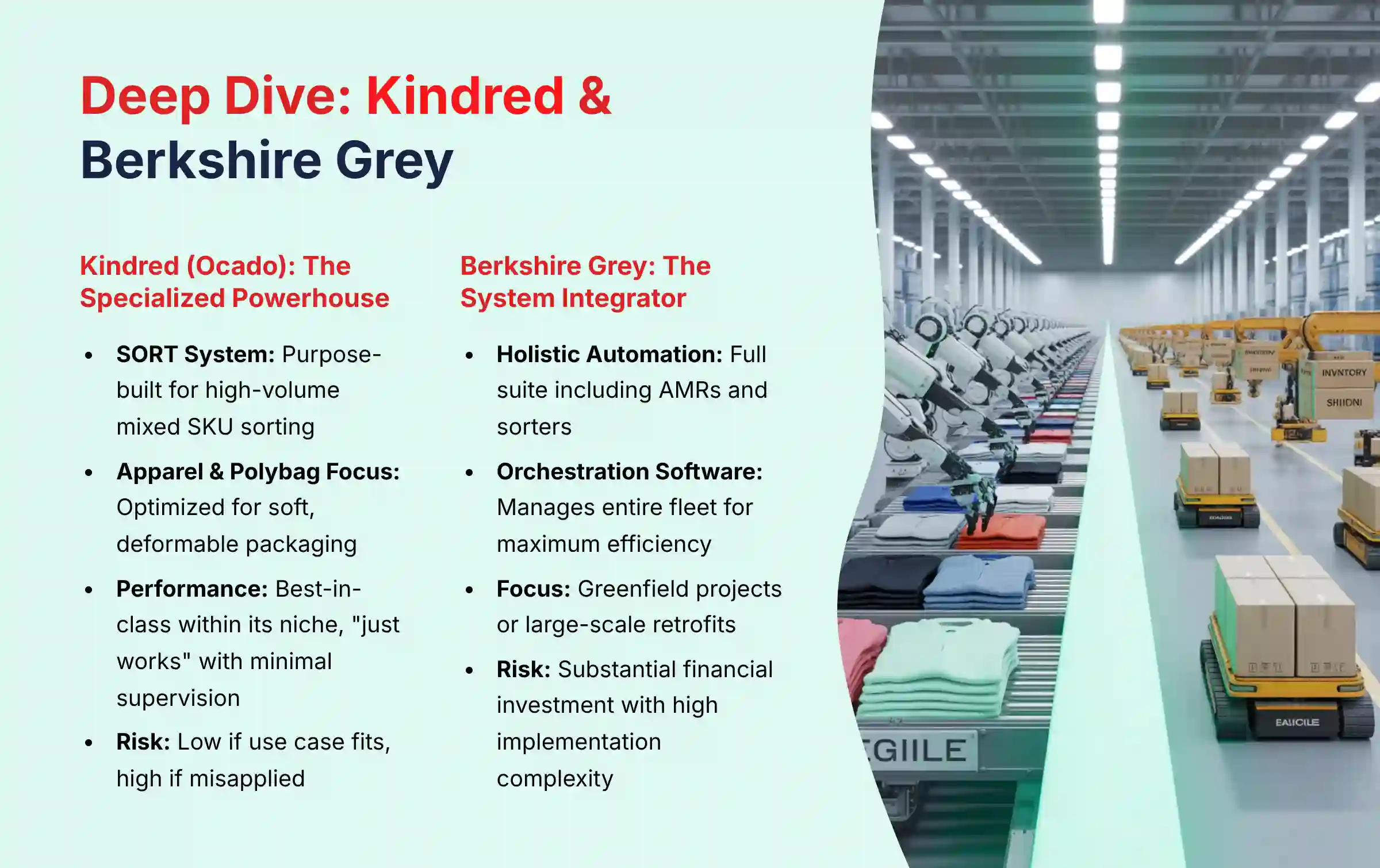
Kindred (Ocado Group): The Specialized Powerhouse
Now part of the Ocado Group, a global leader in grocery automation, Kindred's solutions are highly refined. Their SORT system is a specialized workhorse for e-commerce fulfillment operations.
Core Capabilities & Innovation
Kindred's strength is its deep domain expertise. Their AI, grippers, and workflow are all purpose-built for handling challenging items at high throughput rates, transforming warehouse operations.
- SORT System: A purpose-built robotic system designed to sort a high volume of mixed SKUs from a single induction point into numerous individual downstream locations.
- Apparel & Polybag Focus: The hardware and software are designed specifically for the challenges of soft, deformable packaging, making it ideal for e-commerce fulfillment where items for many different orders are processed simultaneously.
- Ocado Ecosystem: Backed by a global automation leader, providing financial stability and a deep engineering talent pool. This is a crucial point for professional risk assessment, as their inclusion in the Ocado Smart Platform ecosystem ensures long-term R&D investment and support, mitigating the risk of the technology becoming a stranded asset.
Performance & Reliability
Within its niche, my analysis shows Kindred's performance is best-in-class. Operators report that the system “just works.” It requires minimal supervision while maintaining high throughput for its specific task.
Integration Ecosystem
As part of Ocado, it integrates perfectly with other Ocado solutions. It also functions as a standalone system with standard WMS integration points for other warehouses.
YMYL Deep Dive: Kindred (Ocado)
- Security: Kindred operates under the strong security umbrella of the Ocado Group. It meets high standards like SOC 2 that are required by major global retailers.
- Financial Risk: The financial risk is low if the use case is a perfect fit. The primary risk is misapplication, or trying to use this specialized tool for a generalist's job. That would lead to a poor return on investment.
- Operational & Professional Risk: Extremely low. It is a proven, mature solution for its intended purpose. The risk comes from choosing it for the wrong application.
Berkshire Grey: The End-to-End System Integrator
Berkshire Grey, now part of SoftBank Group Corp., competes on a different level. They are less a vendor of picking arms and more a provider of holistic, wall-to-wall automation. Their solutions include mobile robots, robotic sorting, and intelligent picking as part of a single, integrated system.
Core Capabilities & Innovation
Their advantage is the orchestration software. It manages complex interactions between different robotic systems to optimize the workflow of an entire facility, not just a single task. Think of them as the architect of the whole automated factory, not just the supplier of one machine.
- Holistic Automation: Provides a full suite of robotic systems, including AMRs and sorters.
- Orchestration Software: A powerful software layer that manages the entire fleet of robots for maximum efficiency.
- End-to-End Solutions: Focuses on greenfield projects or large-scale retrofits requiring a single, accountable partner.
Performance & Reliability
Performance is measured at a facility level, such as total throughput or order accuracy. They are chosen for large-scale projects where deep integration is the main success factor.
Integration Ecosystem
This is their core competency. They provide a complete, pre-integrated solution that connects with a facility's ERP and WMS, removing a major integration headache for the customer.
YMYL Deep Dive: Berkshire Grey
- Security: With ISO 27001 and SOC 2 compliance, they offer enterprise-grade security. They also offer on-premise deployment options for maximum data control.
- Financial Risk: The risk is substantial. These are multi-million dollar projects with high complexity. A failure in deployment has large financial outcomes, making vendor viability and a strong partnership a top priority.
- Operational & Professional Risk: While the goal is to reduce operational risk, the implementation phase itself is a major risk. A poorly managed deployment can disrupt an entire facility for months.
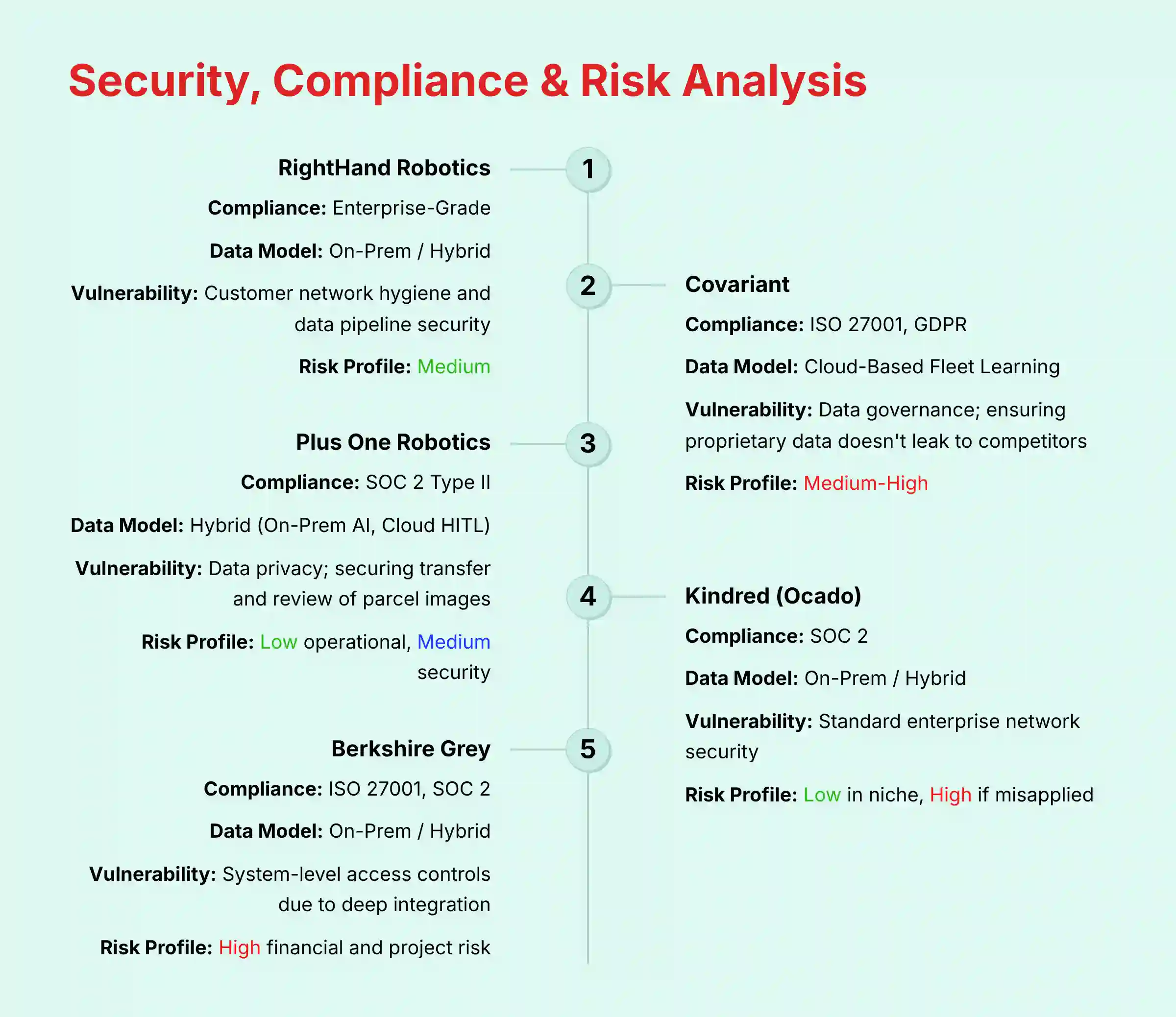
Head-to-Head YMYL Analysis: Security, Compliance, and Risk
For a business decision of this scale, a dedicated comparative analysis of risk is non-negotiable. Here, I break down the security, implementation, and professional risks associated with each vendor to give you a clear framework for your own due diligence process.
Comparative Security Posture
The way each system handles data presents different security challenges. A cloud-based AI has different vulnerabilities than a system that sends images to human operators. My analysis shows that understanding these differences is a key task for your IT and security teams.
| Vendor | Compliance Certifications | Data Handling Model | Primary Security Vulnerability |
|---|---|---|---|
| RightHand Robotics | Enterprise-Grade | On-Prem / Hybrid | Customer network hygiene and data pipeline security. |
| Covariant | ISO 27001, GDPR | Cloud-Based Fleet Learning | Data governance; ensuring proprietary data does not leak to competitors. |
| Plus One Robotics | SOC 2 Type II | Hybrid (On-Prem AI, Cloud HITL) | Data privacy; securing the transfer and review of parcel images. |
| Kindred (Ocado) | SOC 2 | On-Prem / Hybrid | Standard enterprise network security; inherits Ocado's strong posture. |
| Berkshire Grey | ISO 27001, SOC 2 | On-Prem / Hybrid | System-level access controls due to deep integration with core business systems. |
Comparative Implementation & Operational Risk
| Medium Financial Impact | High Financial Impact | |
|---|---|---|
| Medium Implementation Complexity | • RightHand Robotics: Moderate financial impact with established integration pathways. • Kindred (Ocado): Well-defined scope for specific applications. • Plus One Robotics: Predictable RaaS model reduces financial uncertainty. |
|
| High Implementation Complexity | • Covariant: Significant integration complexity with moderate hardware costs due to hardware agnosticism. | • Berkshire Grey: Highest financial impact coupled with the most complex multi-system implementation requirements. |
Professional Risk & Liability Mitigation
The professional consequences of a failed multi-million dollar automation project can be career-defining. A key way to mitigate this risk is through contractual safeguards. When I advise clients, I tell them to scrutinize the Service Level Agreements (SLAs) and performance guarantees.
Plus One's uptime guarantee is a key differentiator here, as it contractually shifts some of the operational risk from the buyer back to the vendor.
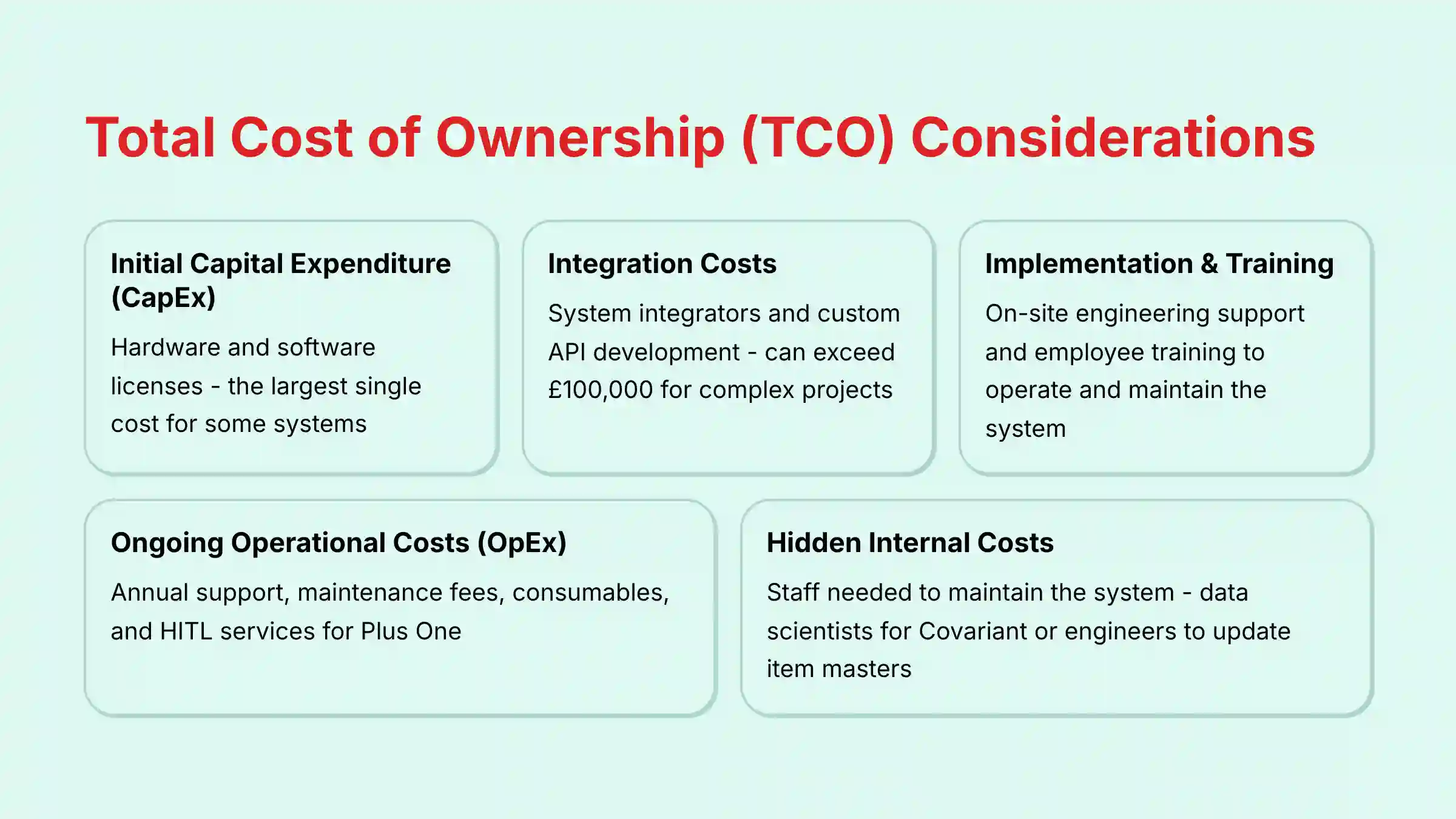
The Financial Deep Dive: Analyzing Total Cost of Ownership (TCO)
In my experience advising dozens of firms on multi-million dollar automation projects, the single most common point of failure is not the technology itself, but a miscalculation of its Total Cost of Ownership (TCO). The sticker price of a robotic system is merely the down payment.
A failure to build a comprehensive business case that accounts for all associated costs is the primary reason for a poor return on investment and significant professional risk. Professionals must dissect the following cost components to proceed with confidence.
Here are the TCO components you must account for:
- Initial Capital Expenditure (CapEx): This includes the hardware and software licenses. For some systems, this is the largest single cost.
- Integration Costs: These are the fees for system integrators and custom API development. As noted, my analysis shows this can exceed $100,000 for complex projects.
- Implementation & Training Costs: This includes on-site engineering support from the vendor and the cost of training your employees to operate and maintain the system.
- Ongoing Operational Costs (OpEx): This bucket includes annual support contracts, maintenance fees, consumables like gripper parts, and the cost of HITL services for Plus One.
- Hidden Internal Costs: You must factor in the cost of your own staff needed to maintain the system. This could be data scientists for a Covariant system or engineers to update item masters for RightHand.
Comparing pricing models is also important. A traditional CapEx model requires a large upfront investment. A Robotics-as-a-Service (RaaS) or OpEx model, like that offered by Plus One, provides more predictable monthly costs and lower financial risk.
What Are the Key Questions Professionals Ask Before Buying? (FAQ)
Here are the questions I advise my clients to ask during the sales process. The answers will reveal more than any marketing brochure. For additional insights, our detailed RightHand Robotics FAQs addresses common implementation concerns and technical specifications.
Can you provide an unedited, multi-hour video of the system running in a peak-season environment?
A polished demo video is not enough. You need to see real-world proof. A multi-hour, unedited video from a live production environment will show you the true exception rate, the mean time between interventions, and how the system performs under pressure.
What is the data security protocol for cloud-based fleet learning?
This question is aimed directly at Covariant. You need a clear, contractual understanding of how your data is used, how it is anonymized, and what safeguards are in place to prevent your operational intelligence from benefiting a direct competitor who is also a customer.
What is the exact SLA and cost model for the human-in-the-loop service?
This question is for Plus One Robotics. You need to know the guaranteed response time for exception handling, the cost per intervention or per hour, and what happens if the network connection to their service goes down. This should all be clearly defined in the contract.
What is the risk of vendor lock-in with a holistic provider like Berkshire Grey?
When one vendor provides an end-to-end solution, it can be difficult to switch out individual components later. You need to understand the long-term implications of partnering with a holistic provider and what options you have if you want to integrate technology from another vendor in the future.
How does the system handle items it has never seen before?
This gets to the heart of the AI's intelligence. Covariant should excel here due to its generalization. RightHand may have a higher exception rate. Plus One will handle it reliably with a human intervention, but you need to know how often that will happen.
Which system is better for integrating with an existing AutoStore or AMR system?
This is a critical question, as these robotic workcells are rarely islands. They are endpoints in a larger automated workflow. Your key concern is the quality of the integration between the Goods-to-Person (GTP) system that delivers the inventory tote, and the piece-picking robot that picks from it.
- A GTP system (like AutoStore, OPEX Sure Sort, or a shuttle system) is responsible for bringing the source tote of items to the robotic workcell's induction station.
- The robot's WCS (Warehouse Control System) or orchestration software must communicate flawlessly with the GTP system's software via a low-latency API. This handshake confirms the tote has arrived and tells the robot which item to pick.
- RightHand Robotics has historically demonstrated very strong, pre-built integrations with AutoStore, making it a common choice for facilities with that infrastructure. Covariant and Plus One, being more hardware-agnostic, rely on the capabilities of the chosen systems integrator to build these connections, which should be explicitly defined in the project's Statement of Work (SOW).
What are the ‘hidden costs' of integration and ongoing maintenance?
Ask for a detailed breakdown of all potential costs beyond the initial purchase price. This includes integration services, annual support fees, spare parts, and the internal staff hours required to manage the system. A transparent vendor will be able to provide this.
Professional Tip: A key indicator of a mature and trustworthy vendor is their willingness to provide a detailed TCO worksheet or model. Treat any hesitation to break down these costs as a significant red flag in your evaluation process.
Beyond picks-per-hour, what are the critical operational KPIs for these systems?
While vendors advertise picks-per-hour (PPH), seasoned operations leaders know this metric is easily manipulated. I advise my clients to focus on these three professional KPIs instead:
- Mean Time Between Interventions (MTBI): This is the most important measure of true autonomy. It tells you, on average, how long the system runs without requiring any human assistance (e.g., clearing a jam, re-gripping a failed pick). A high MTBI is essential for achieving a “lights-out” operation and reducing labor dependency.
- First Pass Pick Success Rate: This measures the percentage of times the robot successfully picks an item on its first attempt. A low rate leads to multiple re-tries, which destroys your effective PPH and can damage products.
- Order Accuracy Rate: The ultimate metric. This measures the percentage of orders fulfilled by the robot without errors. This directly impacts customer satisfaction and the cost of returns. Demand this data from reference customers.
Ultimately, the choice between these formidable competitors is a referendum on your own operational philosophy. Are you architecting a system built for predictable, guaranteed throughput, or are you investing in a platform of emergent, autonomous intelligence?
One is a fortress of reliability; the other is a frontier of possibility. Neither is inherently superior, but choosing the one that misaligns with your company's risk tolerance, technical maturity, and strategic goals is a path to failure. The analysis is complete; now, the strategic decision is yours.
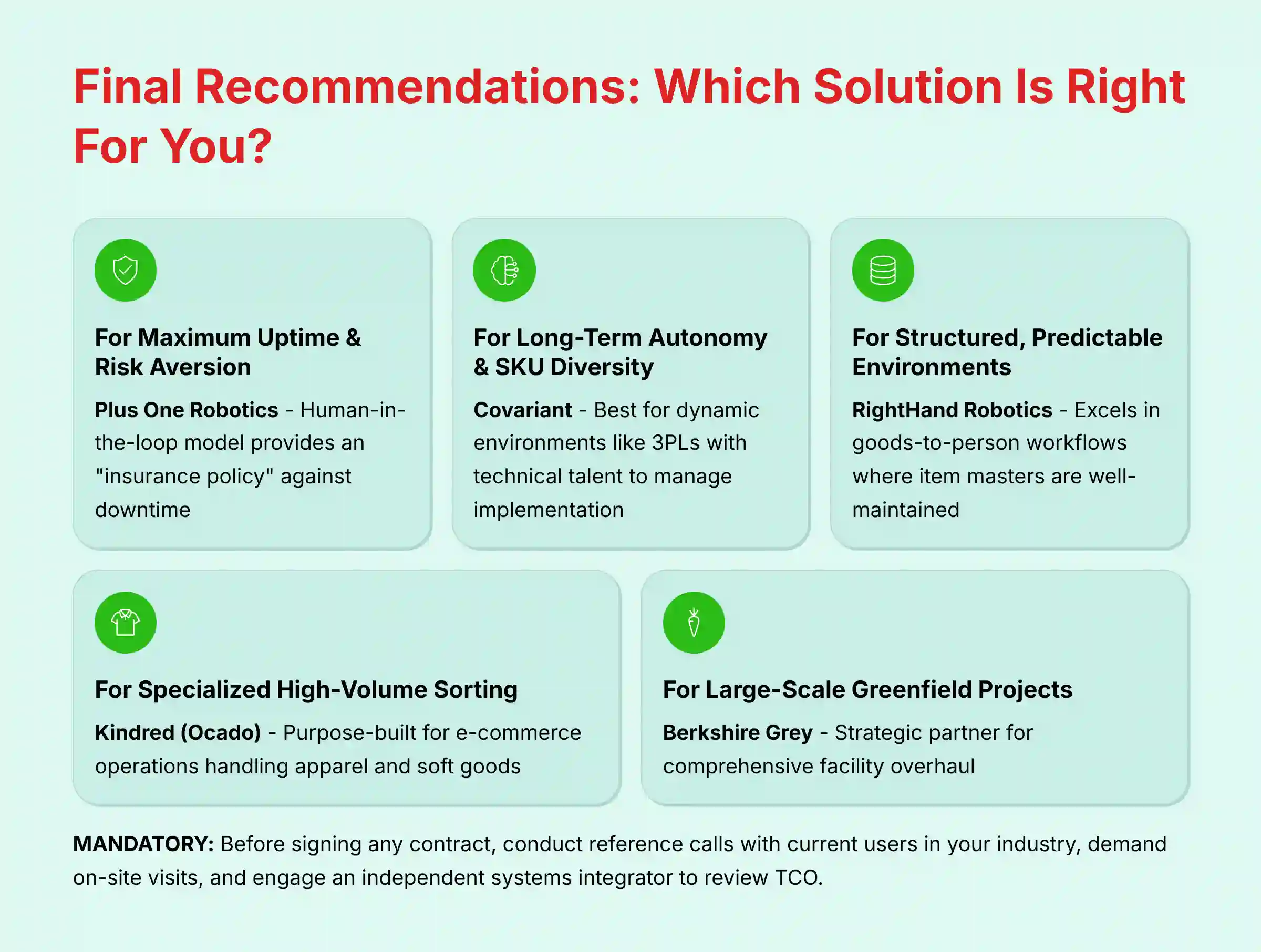
Final Verdict: Which AI Robotic Solution is Right for Your Warehouse?
The right AI robotic solution is not about finding the “best” technology in a vacuum. It is about matching the right philosophy, risk profile, and technical capability to your specific operational needs. My analysis and client work have led me to these clear, conditional recommendations.
- For Maximum Uptime and Risk Aversion: My pick is Plus One Robotics. Its human-in-the-loop model provides an “insurance policy” against downtime, making it ideal for mission-critical operations where reliability is the top priority.
- For Long-Term Autonomy & Extreme SKU Diversity: I recommend Covariant. It represents the technological frontier and is the best fit for dynamic environments like 3PLs, provided you have the technical talent to manage its implementation.
- For Structured, Predictable Environments: RightHand Robotics remains a powerful and effective solution. It excels in goods-to-person workflows for industries like pharmaceuticals, where item masters are well-maintained.
- For Specialized, High-Volume Sorting (Mixed-SKU E-Commerce): In my experience, Kindred (Ocado) is the purpose-built, market-leading solution for sorting operations where items for many different orders must be efficiently distributed from a single induction point.
- For Large-Scale, Greenfield Automation Projects: You should evaluate Berkshire Grey not as a component vendor but as a strategic partner for a comprehensive facility overhaul.
For comprehensive insights on the broader AI fulfillment and picking market, explore our analysis of the Best 10 AI for Order Fulfillment & Picking 2025, which provides detailed comparisons across the entire competitive landscape.
Mandatory YMYL Recommendation
Before signing any contract, prospective buyers MUST conduct reference calls with current users in your specific industry. Demand on-site visits to see systems operating under real-world peak conditions. And engage an independent systems integrator to perform a thorough financial review of the Total Cost of Ownership. The financial, operational, and professional risks of these projects are too high to rely only on vendor claims.
For more deep-dive analysis on alternatives and competitors in the AI warehouse automation space, my team and I will continue to update our research at Best Ops Chain AI.

Leave a Reply