Is RightHand Robotics the Right Automation for Your Warehouse?
This 2-Minute Quiz Reveals Your Perfect Fit!
Key Takeaways
- AI-Powered Automation: RightHand Robotics RightPick™ solves critical piece-picking challenges in warehouses using advanced computer vision and machine learning
- No Pre-Programming Required: System handles new items without manual setup through adaptive AI and continuous learning algorithms
- Flexible Deployment Options: Available as CapEx purchase ($150K-$250K) or RaaS subscription ($3.5K-$7K monthly) with 18-36 month ROI
- Comprehensive Support: 24/7 monitoring, predictive maintenance, and 98%+ uptime with intelligent exception handling workflows
RightHand Robotics stands at the forefront of warehouse automation, transforming how modern fulfillment centers handle the complex challenge of piece-picking through intelligent robotic solutions. Their comprehensive FAQ guide addresses the most critical questions that warehouse operators, supply chain professionals, and technology decision-makers need to understand when evaluating automated picking systems.
What is RightHand Robotics and what specific problem does its RightPick™ system solve in warehouse operations?
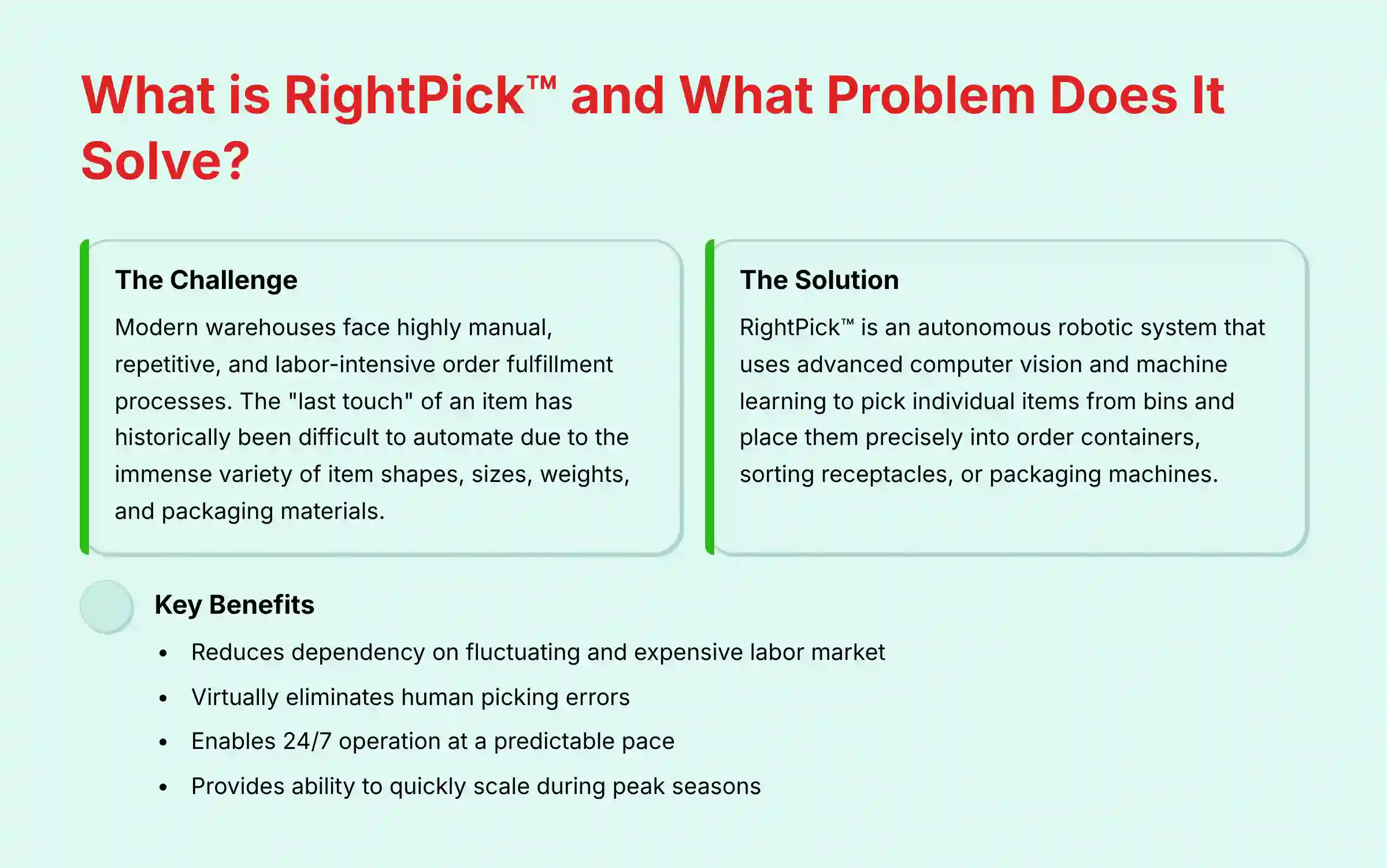
RightHand Robotics is an AI-powered robotics company that addresses the critical operational challenge of piece-picking in modern warehouses and e-commerce fulfillment centers. The RightPick™ system is an autonomous robotic solution that uses advanced computer vision and machine learning to pick individual items from bins or totes and place them precisely into order containers, sorting receptacles, or packaging machines.
The system directly solves one of the most persistent and costly challenges in supply chain operations: the highly manual, repetitive, and labor-intensive nature of order fulfillment. This “last touch” of an item has historically been one of the most difficult processes to automate because of the immense variety of item shapes, sizes, weights, and packaging materials encountered in modern distribution centers.
For professionals seeking deeper insights into RightHand Robotics capabilities, our comprehensive RightHand Robotics Overview and Features guide provides detailed technical specifications and implementation strategies.
RightPick™ tackles several critical warehouse pain points simultaneously:
- Labor Scarcity: Reduces dependency on a fluctuating and increasingly expensive labor market for physically demanding, repetitive work
- Order Accuracy: Virtually eliminates human picking errors, which significantly reduces costly returns, improves customer satisfaction, and protects brand reputation
- Throughput & Consistency: Enables 24/7 operation at a predictable pace across multiple shifts, increasing facility capacity without proportional labor costs
- Scalability: Provides the ability to quickly scale operations during peak seasons without the recruitment and training challenges
What truly differentiates RightPick™ is its ability to handle items it has never encountered before using its AI-driven vision and grasping systems, transforming an unpredictable manual process into a reliable, data-driven automated operation that integrates seamlessly with existing warehouse management systems.
How does the AI vision system in RightHand Robotics' RightPick™ work without pre-programming for every item?
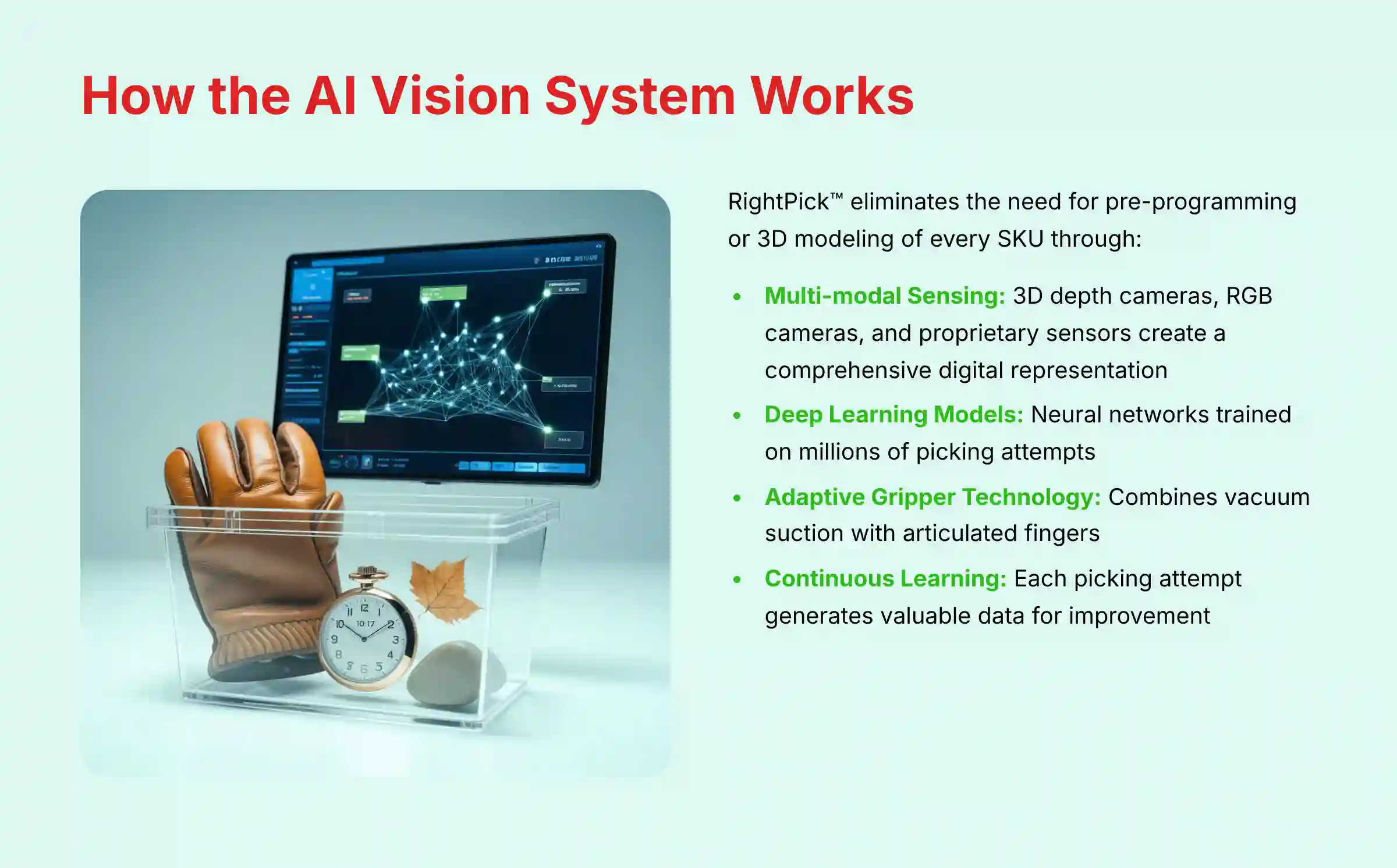
The RightPick™ system's AI vision represents a fundamental shift from traditional industrial robotics by eliminating the need for pre-programming or 3D modeling of every SKU. This capability—critical for modern warehouses handling tens of thousands of unique items—is achieved through a sophisticated combination of advanced hardware sensors and deep learning algorithms.
The system operates through a data-driven approach with several key components:
- Multi-modal Sensing: High-resolution 3D depth cameras, standard RGB cameras, and proprietary sensors create a comprehensive digital representation of the bin contents in real-time. This multi-layered data provides the AI with crucial information about item geometry, orientation, texture, and position.
- Deep Learning Models: The core AI leverages neural networks trained on millions of picking attempts across countless item types. Rather than identifying specific products by name or SKU, the AI analyzes visual and spatial patterns to determine optimal grasp points and picking strategies.
- Adaptive Gripper Technology: The system's intelligent gripper combines vacuum suction with articulated fingers, allowing it to dynamically select the appropriate grasping method based on the AI's real-time analysis of each item's characteristics.
- Continuous Learning: Each picking attempt—successful or not—generates valuable data that's used to improve the overall system intelligence. This “fleet learning” approach means that the entire network of deployed RightPick™ systems constantly becomes more capable and adaptable.
- Real-time Decision Making: The AI processes all this information in milliseconds, calculating not just where to pick an item but also the optimal motion path, gripper pressure, and placement strategy.
This approach enables the system to handle new product introductions, seasonal packaging changes, and even randomly oriented items without manual intervention or reprogramming. For warehouse operations, this translates to exceptional flexibility and resilience in an environment where SKU proliferation and product variability continue to accelerate.
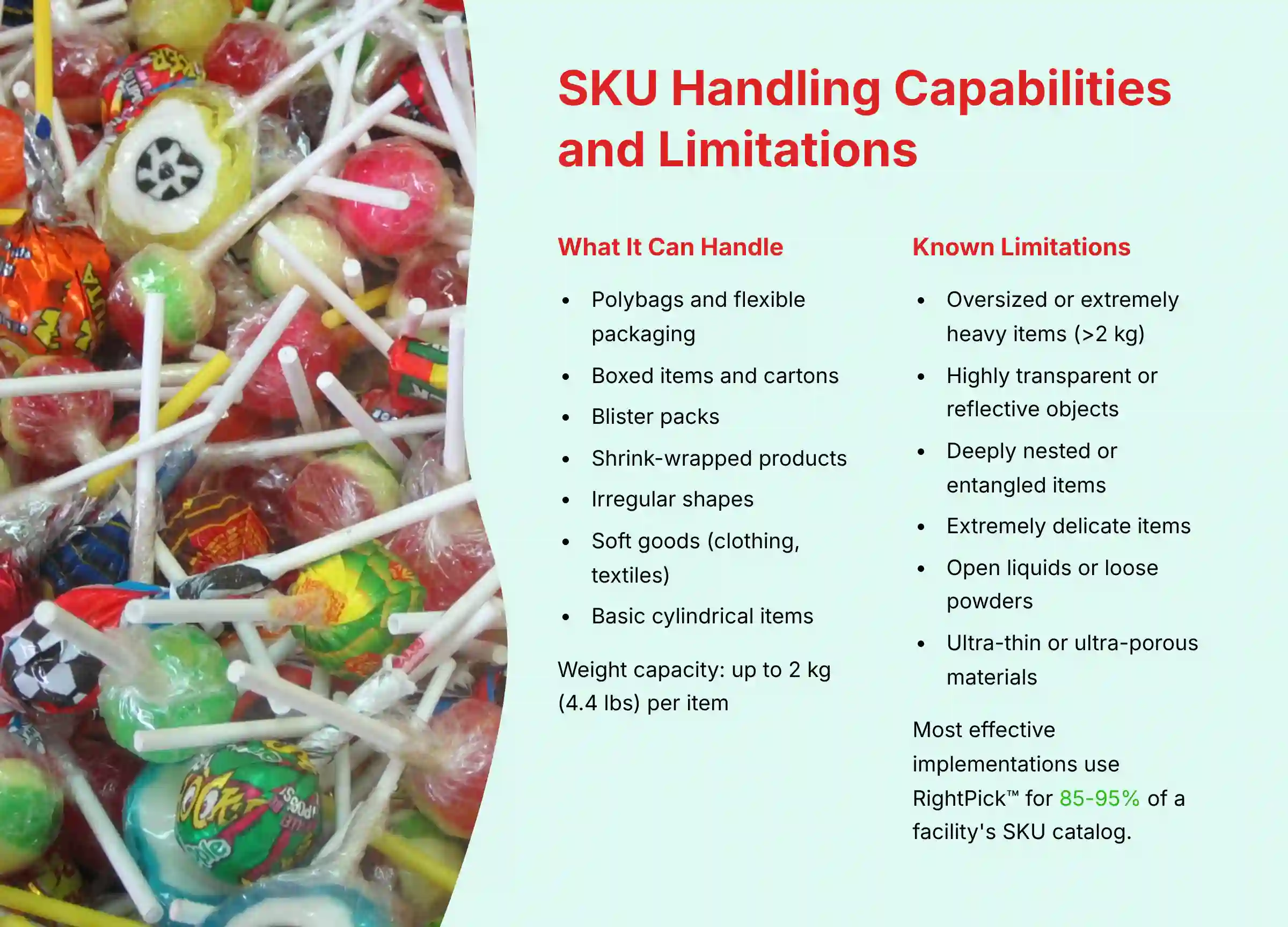
What specific types of SKUs and packaging can RightHand Robotics' RightPick™ reliably handle, and what are its known limitations?
RightHand Robotics' RightPick™ system demonstrates remarkable versatility across a wide spectrum of common warehouse items, making it suitable for diverse fulfillment operations. The system reliably handles:
- Polybags and Flexible Packaging: Notoriously difficult for traditional automation, the system can pick flimsy polybags, jiffy mailers, and bubble mailers with high success rates
- Boxed Items: Cartons, rectangular packages, and cardboard containers in various sizes
- Blister Packs: Common in pharmaceuticals, cosmetics, and consumer electronics
- Shrink-Wrapped Products: Including bundled items and multipacks
- Irregular Shapes: Many cosmetics, toys, and consumer goods with non-standard geometries
- Soft Goods: Clothing items, small textiles, and similar soft products
- Basic Cylindrical Items: Bottles, cans, and tube-shaped packages
The system's weight capacity extends to approximately 2 kg (4.4 lbs) per item, covering the vast majority of e-commerce, grocery, and pharmaceutical products.
However, understanding the system's limitations is equally important for successful implementation:
- Oversized or Extremely Heavy Items: Products exceeding the 2 kg payload capacity or physical size limits of the gripper are unsuitable
- Highly Transparent or Reflective Objects: While improving with each software update, very clear glass or highly reflective metallic surfaces can still challenge the vision system
- Deeply Nested or Entangled Items: Products that are physically interlocked or tightly nested together may require human intervention
- Extremely Delicate Items: While gentle, the system isn't designed for handling extremely fragile items like raw eggs or delicate glassware
- Open Liquids or Loose Powders: The system works with sealed containers but isn't designed for exposed liquids or powders
- Ultra-Thin or Ultra-Porous Materials: Single sheets of paper or highly porous mesh materials that defeat suction capabilities
The most effective implementations typically involve using RightPick™ for 85-95% of a facility's SKU catalog while creating an efficient exception-handling workflow for the small percentage of challenging items. This balanced approach maximizes automation benefits while maintaining operational flexibility.
To explore alternative solutions and compare capabilities, refer to our detailed analysis of RightHand Robotics Top Alternatives and Competitors for comprehensive market insights.
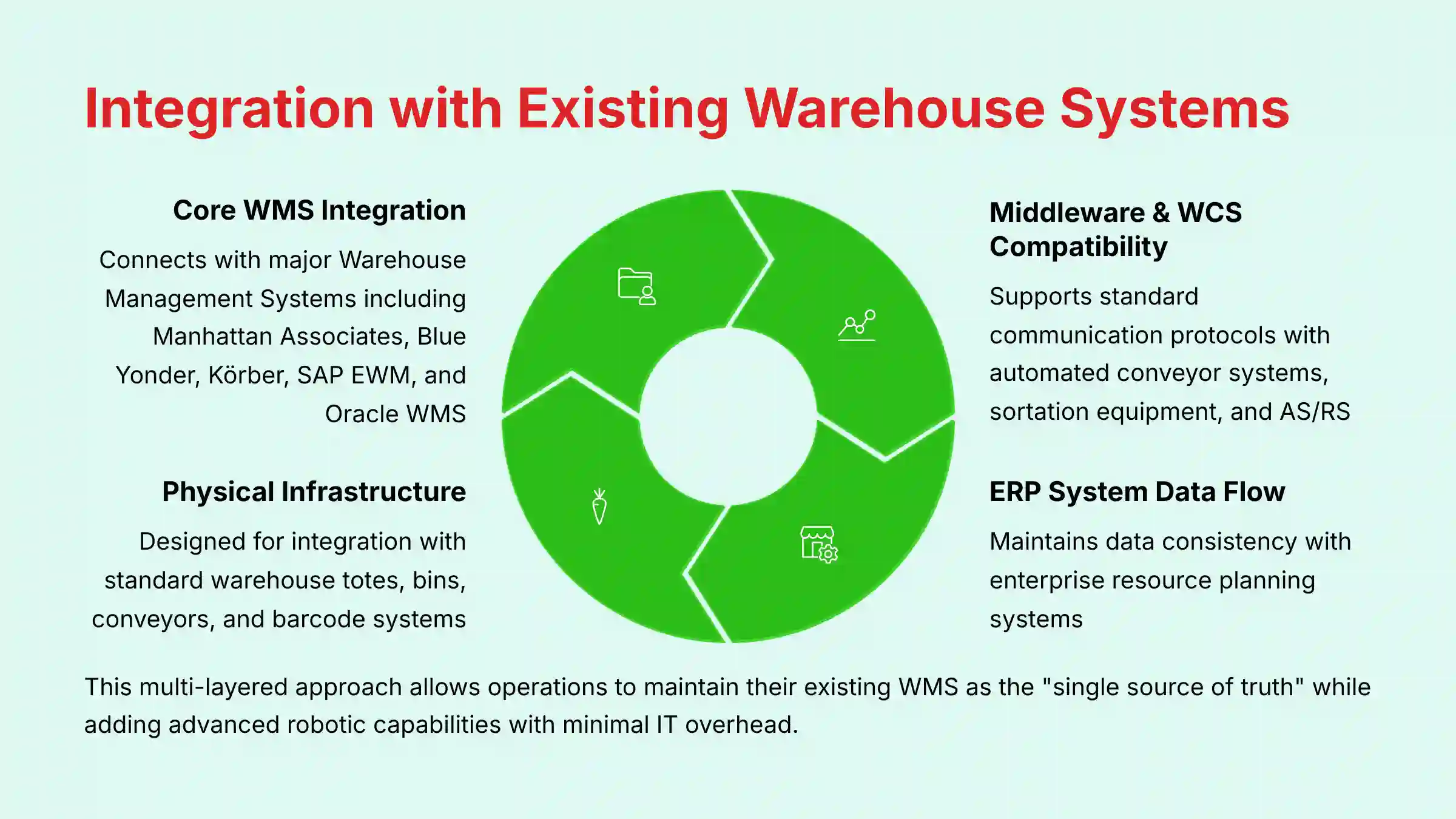
How does RightHand Robotics integrate with existing Warehouse Management Systems (WMS) and broader supply chain technology?
RightHand Robotics has developed a sophisticated yet flexible integration architecture that allows the RightPick™ system to function as a seamlessly connected node within broader warehouse ecosystems rather than as an isolated technology island. This integration approach is crucial for maintaining operational continuity and maximizing the return on automation investment.
The integration framework operates on multiple levels:
Core WMS Integration:
The system connects bidirectionally with all major Warehouse Management Systems including Manhattan Associates, Blue Yonder (formerly JDA), Körber (formerly HighJump), SAP EWM, and Oracle WMS through standardized APIs. This integration enables:
- Real-time task assignment from the WMS to the robot
- Immediate confirmation of completed picks back to the WMS
- Automatic inventory adjustments and record updates
- Exception notification and handling protocols
Middleware and WCS Compatibility:
For facilities using Warehouse Control Systems (WCS) or middleware layers, RightPick™ supports standard communication protocols to ensure smooth data exchange with:
- Automated conveyor systems
- Sortation equipment
- Automated storage and retrieval systems (AS/RS)
- Pick-to-light and other manual picking technologies
ERP System Data Flow:
The system maintains data consistency with enterprise resource planning systems, ensuring that inventory levels, order status, and operational metrics remain synchronized across the organization.
Physical Infrastructure Integration:
Beyond software connections, RightPick™ is designed for physical integration with:
- Standard warehouse totes and bins
- Common conveyor heights and configurations
- Industry-standard barcode formats and scanning systems
- Existing facility layouts with minimal modification requirements
Cloud Connectivity:
The RightHand Intelligence Platform provides secure cloud-based monitoring, analytics, and remote support capabilities without compromising local operational functionality.
This multi-layered integration approach allows operations to maintain their existing WMS as the “single source of truth” while adding the advanced capabilities of robotic automation. The system is specifically designed to minimize IT overhead and integration complexity, typically requiring only 2-4 weeks for complete integration depending on the complexity of the existing systems.
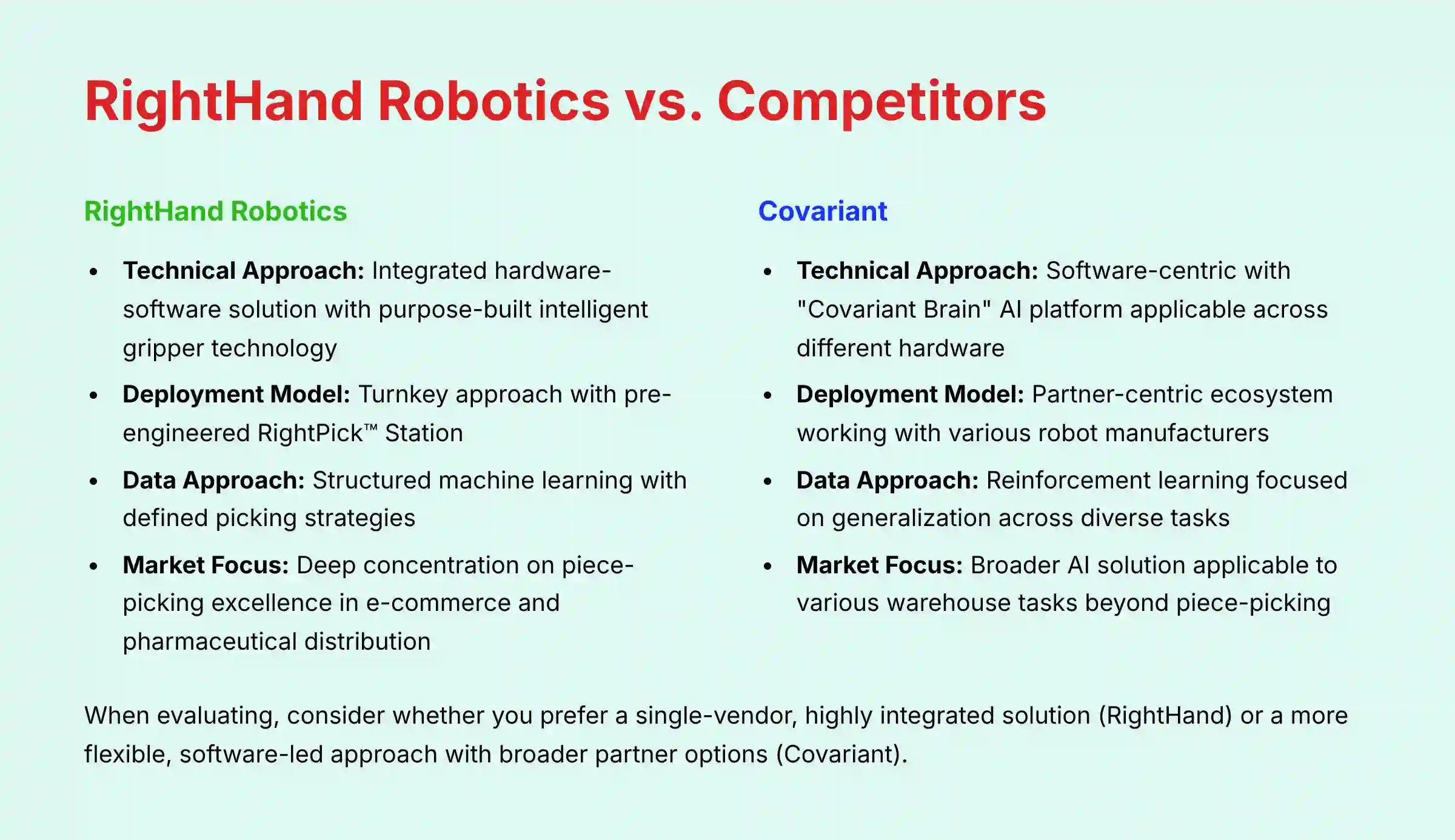
What are the key differences between RightHand Robotics and its main competitors like Covariant in the AI picking space?
RightHand Robotics and Covariant both target the automated piece-picking challenge, but their approaches, technical architectures, and go-to-market strategies reveal important distinctions that warehouse operators should consider when evaluating solutions:
Technical Philosophy & Core Competencies:
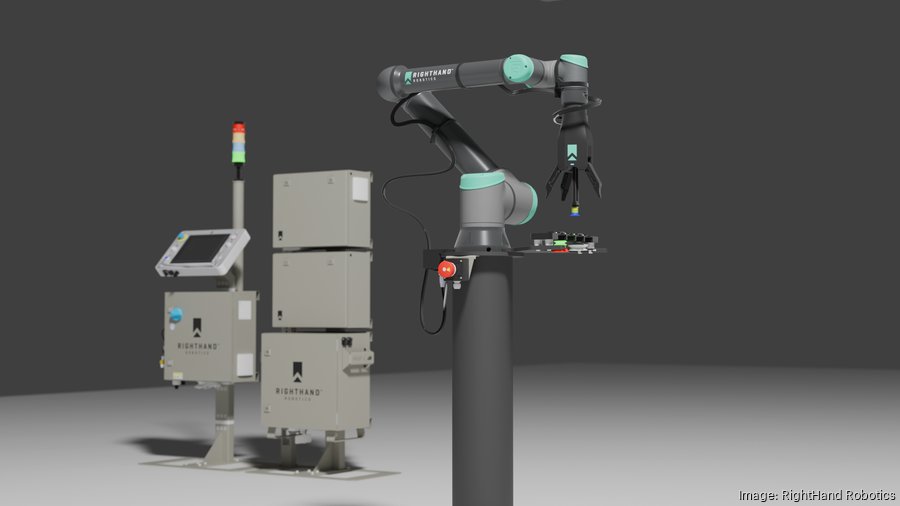
- RightHand Robotics: Emphasizes an integrated hardware-software approach with particular strength in their purpose-built intelligent gripper technology. Their multi-function end effector combines vacuum suction with articulated fingers, providing versatility across diverse items. This hardware-informed AI approach suggests that better sensor data leads to more reliable picking performance.
- Covariant: Positions the “Covariant Brain” AI platform as their primary innovation, with a more software-centric approach. They focus on neural network capabilities that can be applied across different robotic hardware platforms, emphasizing the universality of their AI rather than specialized hardware.
Deployment & Integration Models:
- RightHand Robotics: Offers a more turnkey approach with their pre-engineered RightPick™ Station, creating a standardized solution that can be rapidly deployed. This vertically integrated approach means they control the entire technology stack from gripper to software.
- Covariant: Utilizes a more partner-centric ecosystem, working with various industrial robot manufacturers and system integrators. This can offer flexibility in hardware selection but may introduce more variables in implementation and support processes.
Data Approach & Learning Methods:
- RightHand Robotics: Employs a more structured approach to machine learning with defined picking strategies enhanced by AI, built on years of deployment data across specific use cases. Their system emphasizes reliability and predictable performance.
- Covariant: Leverages reinforcement learning and broader AI techniques focused on generalization across diverse tasks beyond piece-picking, including sortation and induction.
Market Focus:
- RightHand Robotics: Has historically concentrated more deeply on piece-picking excellence, particularly in e-commerce fulfillment and pharmaceutical distribution.
- Covariant: Positions itself as a broader AI solution applicable to various warehouse tasks, emphasizing the versatility of their core technology.
When evaluating these solutions, warehouse operators should consider their specific operational priorities: Do you prefer a single-vendor, highly integrated solution with purpose-built hardware (RightHand Robotics), or a more flexible, software-led approach with broader partner options (Covariant)? The ideal choice depends on your existing infrastructure, technical capabilities, and long-term automation strategy.
For comprehensive market comparisons and detailed technical specifications, explore our in-depth RightHand Robotics Review which covers performance benchmarks and competitive analysis.
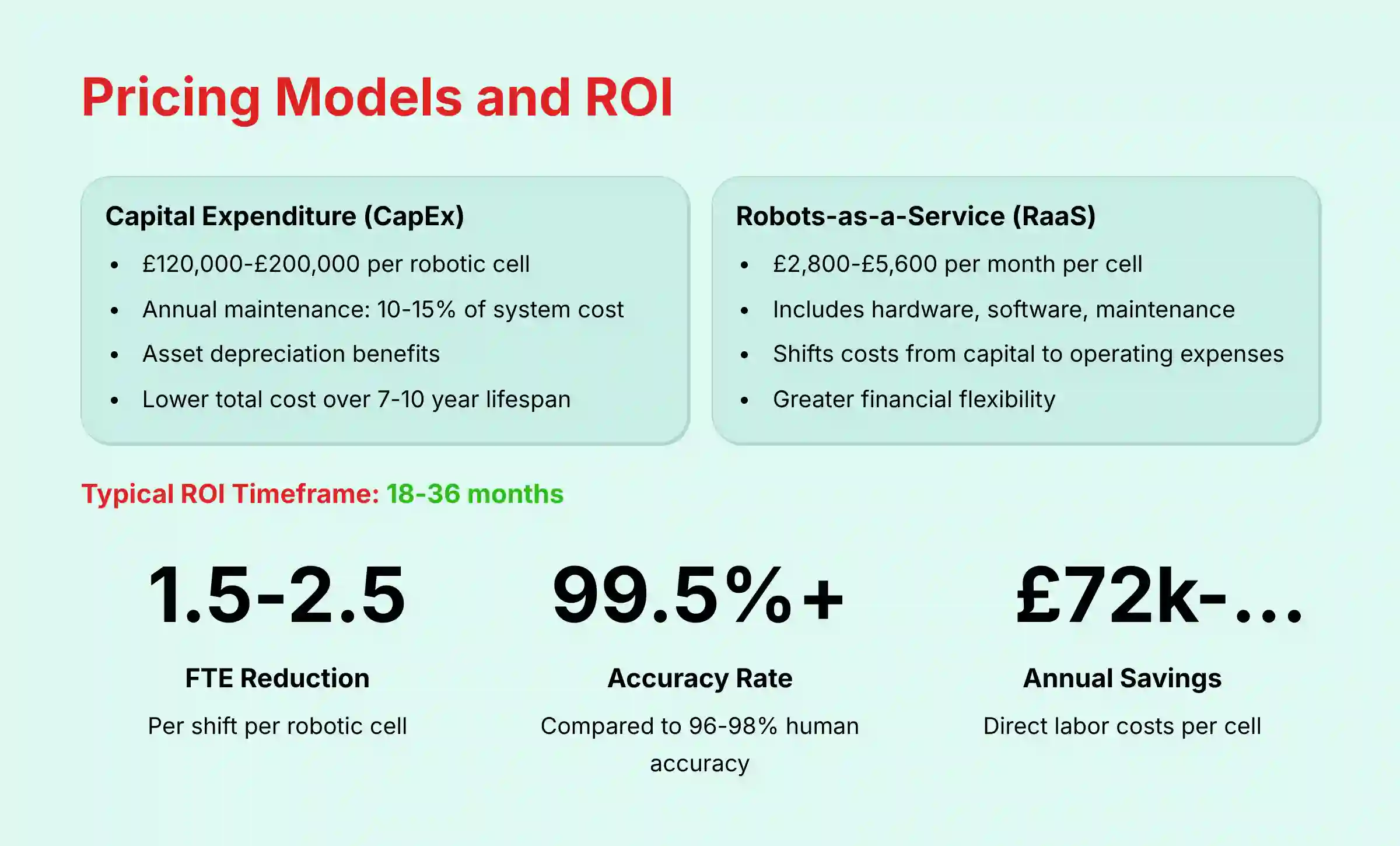
What is the pricing model for RightHand Robotics? Is it a CapEx purchase or a Robots-as-a-Service (RaaS) model?
RightHand Robotics offers flexible financial models that accommodate different budgeting approaches and risk profiles, recognizing that the path to warehouse automation varies significantly across organizations. Customers can choose between traditional capital expenditure (CapEx) purchasing and Robots-as-a-Service (RaaS) subscription models, with several hybrid options available.
Capital Expenditure (CapEx) Model:
- Structure: Outright purchase of the RightPick™ hardware and software platform
- Typical Cost Range: $150,000-$250,000 per robotic cell, depending on configuration and integration requirements
- Additional Costs: Annual maintenance contract (typically 10-15% of system cost) for software updates, technical support, and preventative maintenance
- Financial Advantages: Asset depreciation benefits, potential tax incentives for automation investments, and lower total cost of ownership over the full lifespan of the system (7-10 years)
- Ideal For: Organizations with available capital budget, clear long-term automation strategy, and internal technical resources
Robots-as-a-Service (RaaS) Model:
- Structure: Monthly or quarterly subscription payments with minimal upfront costs
- Typical Cost Range: $3,500-$7,000 per month per robotic cell, varying based on contract length, volume, and service level agreements
- What's Included: Hardware, software, maintenance, support, updates, and typically performance guarantees
- Financial Advantages: Shifts costs from capital to operating expenses, aligns vendor incentives with performance, and provides greater financial flexibility
- Ideal For: Organizations prioritizing cash flow management, those looking to prove the concept before larger investments, or operations with seasonal fluctuations
Hybrid Options:
Some customers opt for hybrid models that combine elements of both approaches, such as:
- Reduced upfront payment with ongoing operational fees
- Performance-based pricing where costs align with actual throughput
- Lease-to-own structures that transition from OpEx to CapEx over time
The trend in warehouse automation is increasingly favoring the RaaS model, as it reduces implementation risk and creates mutual accountability for system performance. This subscription approach also ensures customers continuously benefit from the latest AI and software improvements without additional capital investments.
When evaluating these options, operations leaders should consider not just the direct costs, but also implementation timelines, internal technical capabilities, and how the financial structure aligns with broader supply chain transformation initiatives.
What is the typical ROI and payback period for a RightHand Robotics' RightPick™ system?
The Return on Investment (ROI) for a RightHand Robotics' RightPick™ system typically ranges from 18 to 36 months, though some high-volume operations have reported breakeven points as early as 12 months. The variability in payback period stems from several operational factors that significantly impact the value calculation.
A comprehensive ROI analysis should include these key value drivers:
Direct Labor Cost Reduction:
- Elimination of 1.5-2.5 full-time equivalent (FTE) positions per shift per robotic cell
- Reduction in overtime premiums during peak periods
- Decreased reliance on temporary staffing agencies and their associated markups
- Reduction in management overhead required to supervise manual picking operations
Quality and Accuracy Improvements:
- Near-elimination of picking errors (99.5%+ accuracy rates compared to typical human accuracy of 96-98%)
- Significant reduction in costly returns processing (typically $15-70 per return depending on the product)
- Decreased customer service interactions related to order errors
- Improved brand reputation and customer loyalty
Operational Efficiency Gains:
- Consistent throughput of 400-1,000+ picks per hour depending on configuration
- Ability to operate 24/7 without shift change disruptions or fatigue-related productivity declines
- Reduction in training time and associated costs (typically 40-80 hours per new picker)
- More predictable operation allowing for precise capacity planning
Strategic Business Benefits:
- Increased ability to scale operations quickly during peak periods
- Reduced risk from labor market volatility and rising wage pressures
- Improved workplace safety with fewer repetitive motion injuries
- Enhanced data collection providing deeper operational insights
The most dramatic ROI improvements occur in facilities with:
- Multi-shift operations that maximize robot utilization
- High labor costs (urban areas, competitive markets)
- Complex SKU mixes that challenge human pickers
- Strict accuracy requirements (pharmaceuticals, luxury goods)
- Difficulty hiring and retaining qualified workers
For a typical e-commerce fulfillment operation running two shifts, processing 5,000+ orders daily, with fully-loaded labor costs of $20-25/hour, a single RightPick™ cell often generates annual savings of $90,000-$120,000 in direct labor costs alone. When including the “soft” benefits of improved accuracy, reduced training, and operational predictability, the total value can exceed $150,000-$200,000 annually per cell.
When evaluating ROI, operations leaders should create comprehensive business cases that include both quantitative metrics and qualitative improvements in operational resilience and scalability.
For detailed implementation guidance and best practices, our comprehensive RightHand Robotics Tutorials and Usecase resource provides practical deployment strategies and success stories.
How does RightHand Robotics handle exceptions and items it cannot successfully pick?
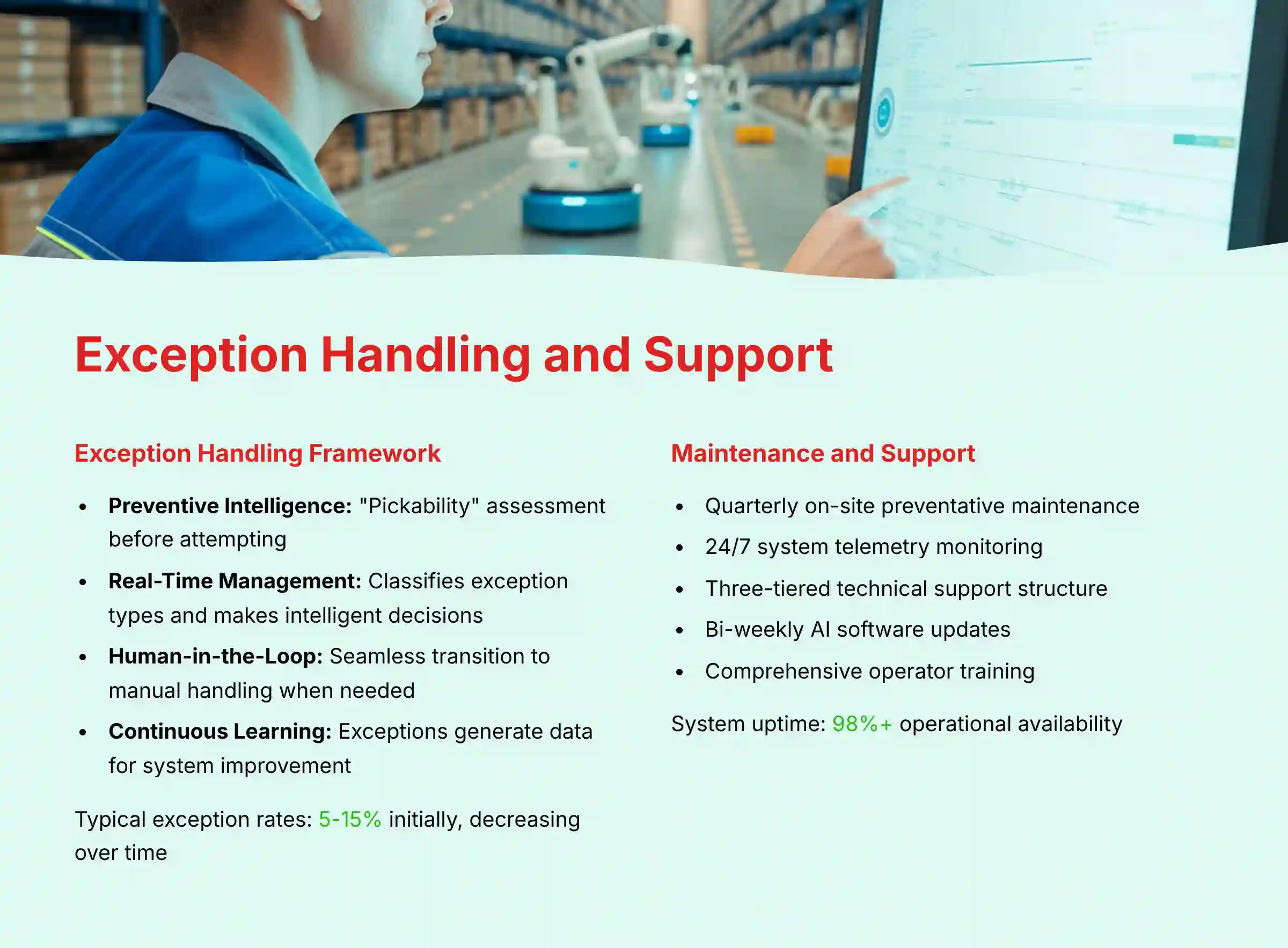
RightHand Robotics has developed a sophisticated exception handling framework that ensures operational continuity even when the system encounters items it cannot successfully pick. This approach recognizes that no robotic system achieves 100% pick success across all possible SKUs and conditions, making intelligent exception management a critical component of successful deployment.
The RightPick™ exception handling system operates on multiple levels:
Preventive Intelligence:
Before attempting a pick, the system's AI performs a real-time “pickability” assessment of each item. If it determines an item has a low probability of success (due to positioning, characteristics, or environmental factors), it can proactively:
- Request a bin shake or rotation to improve item presentation
- Ask for the item to be routed to a manual station before multiple failed attempts
- Identify items that require specific handling instructions
Real-Time Exception Management:
When an exception occurs during operation, the system:
- Precisely classifies the exception type (e.g., suction failure, slip detection, vision uncertainty)
- Records detailed data about the exception for future learning
- Makes intelligent decisions about retry attempts versus escalation
- Prioritizes maintaining throughput of the overall operation
Human-in-the-Loop Collaboration:
For items that cannot be successfully picked after multiple attempts, the RightPick™ system seamlessly transitions to a human-in-the-loop approach:
- The problematic bin is automatically routed to a manual exception handling station
- A clear notification identifies the specific item requiring attention
- The operator quickly resolves the issue and returns the bin to the automated workflow
- This interaction becomes training data to improve future performance
Continuous System Learning:
Each exception generates valuable data that feeds into the system's ongoing improvement:
- Weekly software updates incorporate learnings from the entire fleet of deployed systems
- New picking strategies are developed for challenging item categories
- Vision algorithms are refined to better recognize difficult items
- The percentage of successfully picked items steadily increases over time
Operational Integration:
The exception handling framework integrates with warehouse management systems to maintain inventory accuracy and order progress tracking. This ensures that even when manual intervention is required, the operation maintains data integrity and fulfillment accuracy.
Most facilities implementing RightPick™ typically see exception rates of 5-15% initially, which steadily decrease as the system learns and improves. Well-designed exception handling stations allow a single operator to support multiple robotic cells, maintaining high overall automation levels while addressing the small percentage of challenging items that require human dexterity or decision-making.
What kind of maintenance and support does RightHand Robotics provide for their robotic systems?
RightHand Robotics provides a comprehensive maintenance and support ecosystem designed to maximize system uptime, performance, and longevity. Their approach combines proactive maintenance protocols with responsive support structures to ensure consistent operational reliability—critical for warehouse environments where downtime directly impacts fulfillment capabilities.
Preventative Maintenance Program:
- Scheduled Service Visits: Quarterly on-site inspections by certified RightHand technicians
- Component Lifecycle Management: Proactive replacement of wear parts based on usage metrics rather than failure
- Calibration and Optimization: Regular recalibration of vision systems, gripper mechanisms, and motion controls
- Environmental Assessment: Evaluation of environmental factors (dust, temperature, vibration) that might affect performance
Remote Monitoring and Diagnostics:
- 24/7 System Telemetry: Continuous monitoring of over 100 performance metrics per robot
- Predictive Analytics: AI-powered analysis to identify potential issues before they cause downtime
- Secure Remote Access: Ability for RightHand engineers to diagnose and often resolve issues without site visits
- Performance Benchmarking: Comparison of system metrics against the entire fleet to identify optimization opportunities
Technical Support Structure:
- Tiered Support System: Three levels of technical expertise from basic troubleshooting to advanced engineering support
- Response Time Guarantees: SLA-backed response times based on issue severity (typically 15 minutes to 4 hours)
- 24/7 Emergency Support: Round-the-clock availability for critical issues affecting production
- Dedicated Customer Success Manager: Single point of contact for escalations and ongoing optimization
Training and Knowledge Transfer:
- Initial Operator Training: Comprehensive training for warehouse staff on daily operation and basic troubleshooting
- Advanced Technical Training: Deeper technical training for maintenance personnel
- Knowledge Base Access: Online portal with documentation, videos, and troubleshooting guides
- Regular Refresher Sessions: Quarterly virtual training sessions on new features and best practices
Software Updates and Improvements:
- Regular AI Updates: Bi-weekly software updates that improve picking capabilities across the entire fleet
- Feature Enhancements: Quarterly major releases with new functionality
- Security Patches: Immediate deployment of any security-related updates
- Custom Optimization: Performance tuning specific to each customer's unique SKU mix and operational patterns
For facilities operating under a Robots-as-a-Service (RaaS) model, this comprehensive support package is typically included in the subscription. For CapEx customers, tiered Annual Maintenance Contracts (AMCs) are available, with most customers selecting plans that include all software updates and preventative maintenance.
The effectiveness of this support ecosystem is evident in RightHand Robotics' system uptime statistics, with most deployed systems maintaining 98%+ operational availability—significantly higher than many traditional automated systems in warehouse environments.
This comprehensive FAQ guide addresses the most critical questions about RightHand Robotics and their RightPick™ system, providing warehouse operators and supply chain professionals with the detailed information needed to make informed automation decisions. The system represents a significant advancement in warehouse automation technology, offering scalable solutions that adapt to diverse operational requirements while maintaining high performance standards.
For additional resources and frequently asked questions, visit our complete RightHand Robotics FAQs section, and explore our comparative analysis of the Best 10 AI for Order Fulfillment & Picking 2025 to understand how RightHand Robotics fits within the broader landscape of warehouse automation solutions.

Leave a Reply