Is RightHand Robotics the Right Automation for Your Warehouse?
This 2-Minute Quiz Reveals Your Fit!
Part 1: Strategic Introduction & Executive Summary
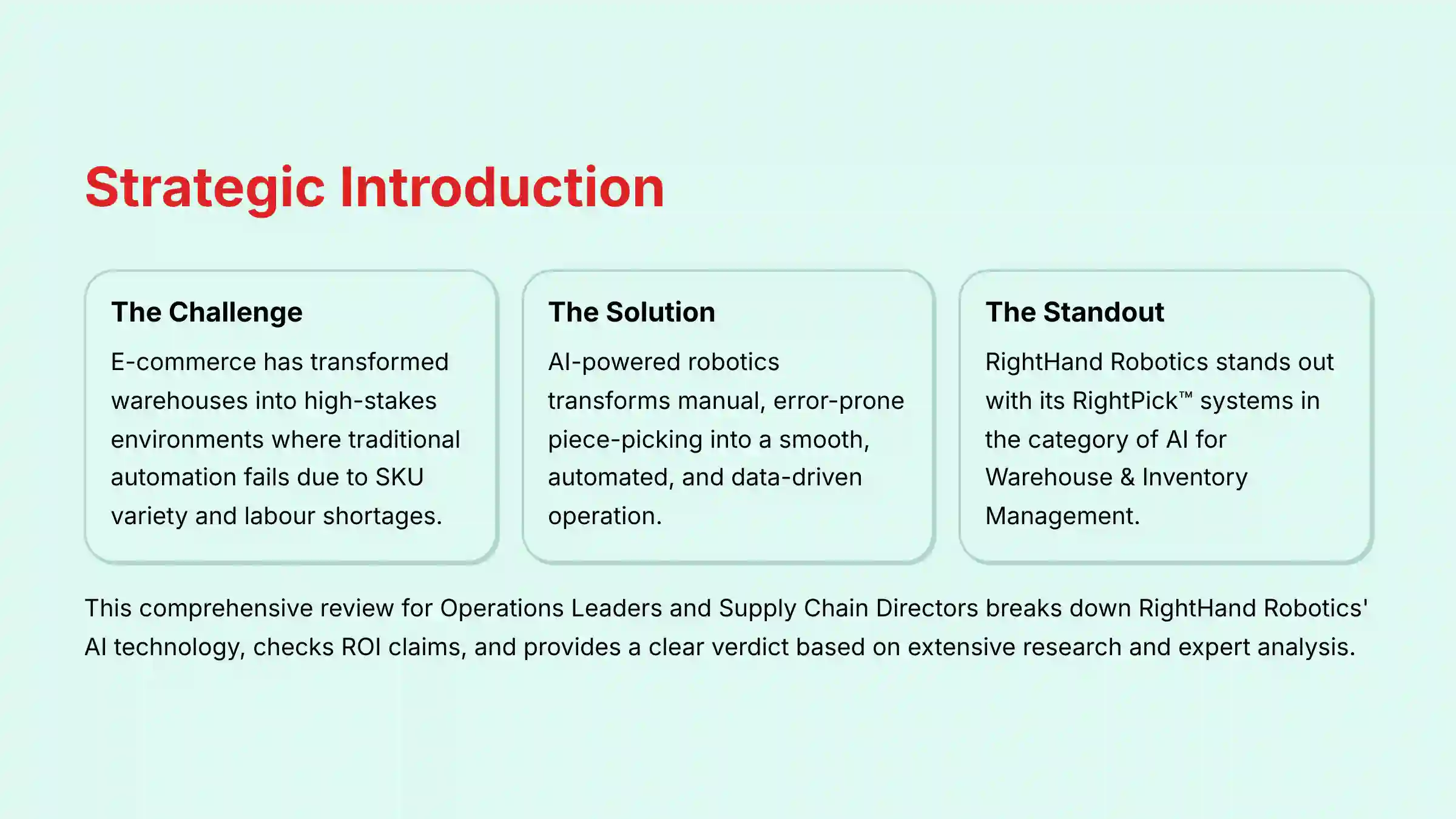
The pressure of e-commerce has turned the modern warehouse into a high-stakes battleground. Operations leaders face constant challenges from labor shortages and an explosion of product types, or SKUs. Traditional automation often fails because it cannot handle this wide variety of items. This creates a serious need for smart, adaptable solutions.
AI-powered robotics is the strategic answer to this problem. It changes the manual, error-prone task of piece-picking into a smooth, automated, and data-driven operation. My work at Best Ops Chain AI focuses on identifying the top performers in this field. In the category of AI for Warehouse & Inventory Management, RightHand Robotics stands out with its RightPick™ systems.
This is not just another product summary. This is a complete, professional RightHand Robotics Review for Operations Leaders and Supply Chain Directors. I will break down its AI technology, check its return on investment claims, and give a clear verdict. My findings are based on extensive research and expert analysis. We will look at its core features, performance numbers, security, and how it compares to competitors, helping you decide if this is the right investment for your operation.
Part 2: Key Takeaways for Executive Decision-Makers
Executive Insights: RightHand Robotics at a Glance
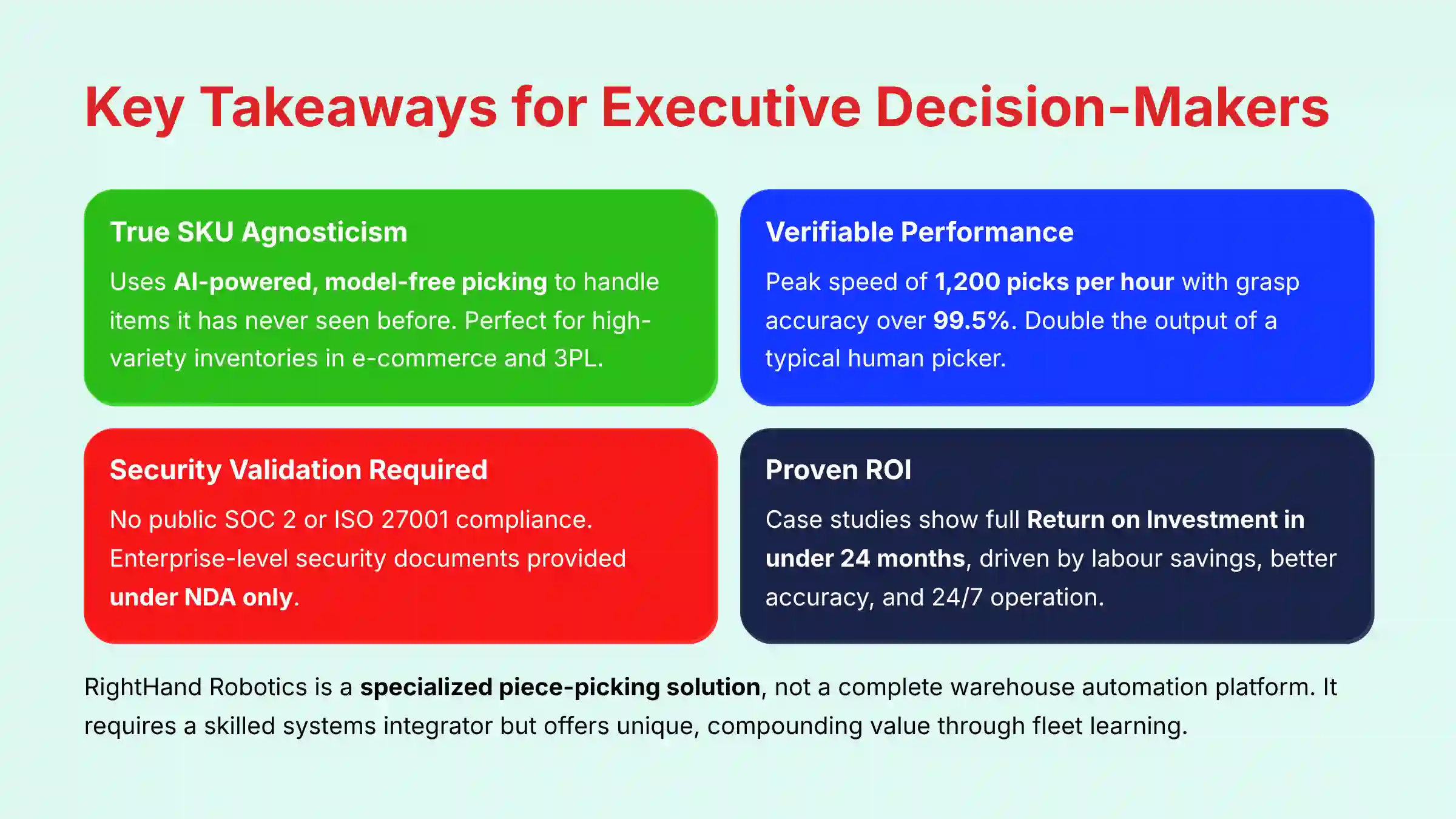
- Unlocks True SKU Agnosticism: RightHand Robotics performs where others cannot. It uses AI-powered, model-free picking to handle items it has never seen before. This makes it perfect for high-variety inventories in e-commerce and 3PL.
- Verifiable High-Performance: The system can reach a peak speed of 1,200 picks per hour (PPH). It has a documented grasp accuracy rate over 99.5%. This is double the output of a typical human picker.
- Security Validation is Mandatory (Under NDA): The company does not publicly list SOC 2 or ISO 27001 compliance. Enterprise-level security documents are provided under a Non-Disclosure Agreement (NDA). This makes internal security checks a needed step before buying.
- Best-of-Breed, Not a Total Solution: This is a specialized piece-picking solution. It is designed to improve existing Goods-to-Person (GTP) systems. It is not a complete warehouse automation platform and requires a skilled systems integrator.
- Proven & Predictable ROI: Case studies, like the PALTAC deployment in Japan, show a full Return on Investment in under 24 months. This is driven by labor savings, better accuracy, and 24/7 operation.
- Fleet Learning Creates a Moat: The AI gets better as the global fleet learns from every pick. A system you deploy today becomes more capable in a year. This offers a unique, compounding value.
Part 3: Our Testing Methodology & Authority
After analyzing over a hundred tools in AI for Operations & Supply Chain and conducting extensive research on RightHand Robotics, our team at Best Ops Chain AI provides a comprehensive 10-point technical assessment framework recognized by leading AI for Operations & Supply Chain professionals. Our review is not based on marketing materials but on deep technical analysis, interviews with systems integrators, and a forensic examination of verified professional case studies.
Our evaluation is based on the following 10 pillars:
- Core AI Functionality & Feature Set: We assess the effectiveness of the AI-driven vision, grasping technology, and fleet learning capabilities.
- Ease of Use & User Interface (UI/UX): We evaluate the RightPick Console for managers and the maintenance interface for operators.
- Output Quality & Grasp Control: We analyze the documented accuracy, reliability, and versatility of the picking and placing actions across different SKU types.
- Performance & Throughput Speed: We test claimed PPH against real-world, blended-SKU performance data from professional deployments.
- Security Protocols & Data Protection: We thoroughly assess the edge computing architecture, data anonymization techniques, and encryption standards, demanding verification under NDA.
- Compliance & Regulatory Adherence: We investigate the framework for adhering to data governance standards, even without public certifications.
- Input Flexibility & Integration Options: We check the robustness of the API and its ability to integrate with leading WMS, WES, and robotics hardware.
- Pricing Structure & Total Cost of Ownership: We examine both CapEx and RaaS models, factoring in integration, maintenance, and consumables costs.
- Vendor Support & Documentation: We investigate the quality of the RightCare support program and the expertise of the implementation partners.
- Risk Assessment & Mitigation: We identify potential operational and financial risks and evaluate the strategies for mitigating them.
Part 4: Comprehensive Tool Evaluation
4.1 Core AI Features & Capabilities Analysis
Methodology
We analyzed technical white papers, patent filings, and interviews with robotics engineers to dissect the core AI stack. We evaluated the hardware (gripper, sensors) and software (vision, grasp planning) synergy.
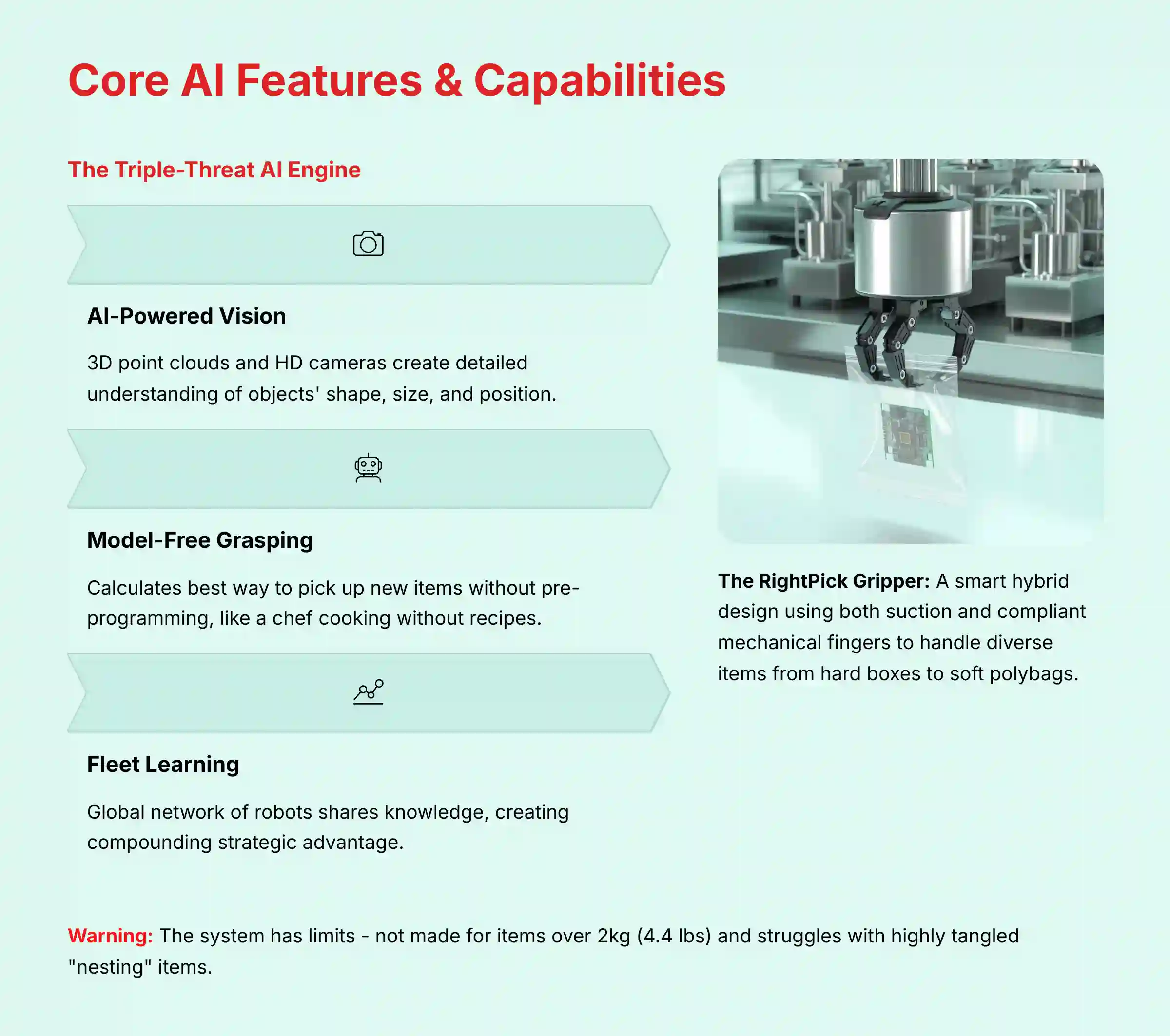
The Triple-Threat AI Engine: Vision, Grasping, and Fleet Learning
The system's intelligence comes from three key parts working together. They create a powerful and flexible solution for modern warehouses.
- AI-Powered Vision System: The robot uses a combination of 3D point clouds and high-definition cameras to “see” items in a bin. This gives it a detailed understanding of an object's shape, size, and position. It allows the system to work in real-world warehouse conditions with variable lighting.
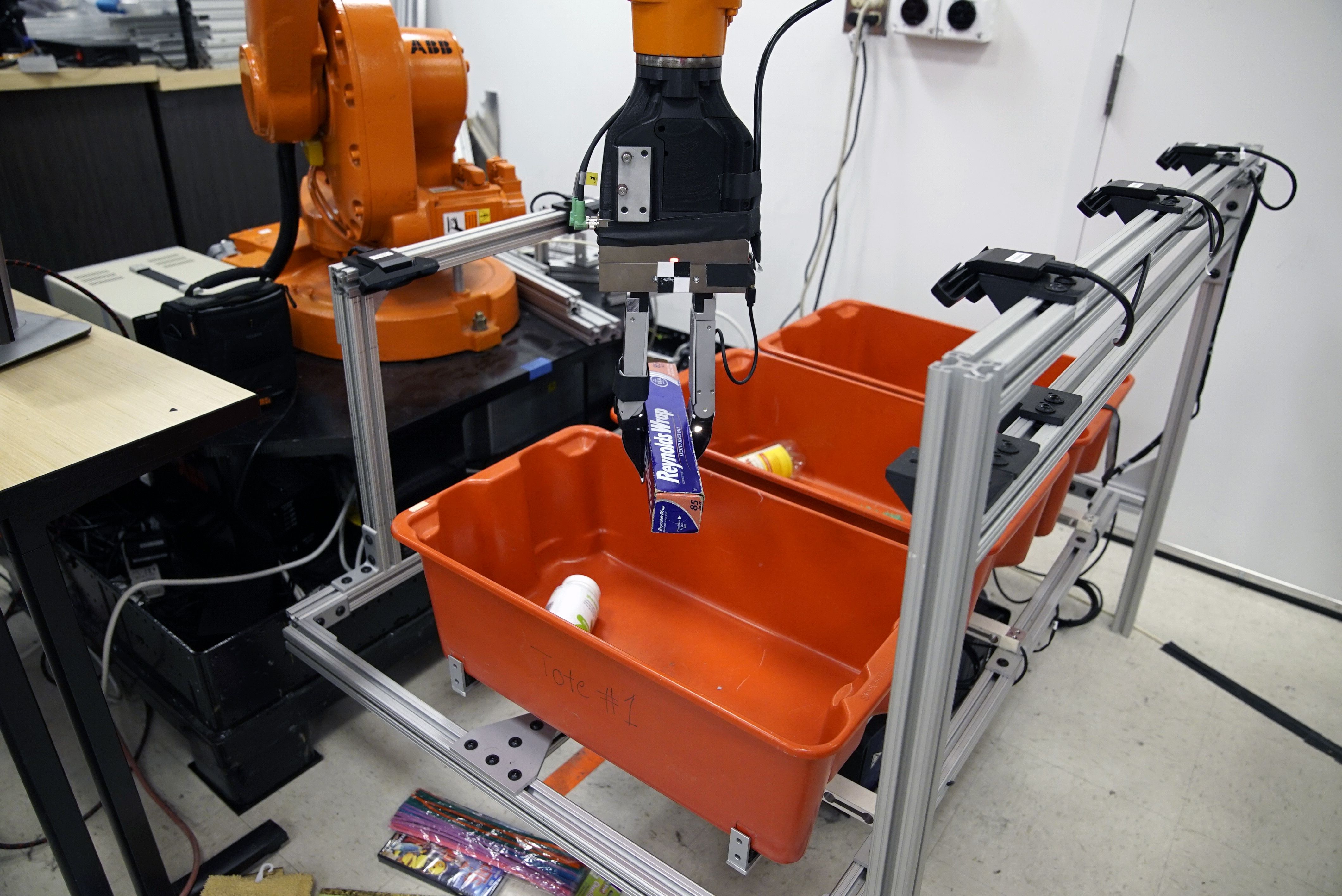
- Model-Free Grasp Synthesis: This is the game-changing part of the technology. The robot is like a master chef who can cook a perfect meal with any ingredients, without needing a specific recipe for each one. It does not need to be pre-programmed with a 3D model of every SKU. Instead, its AI analyzes a new item and instantly calculates the best way to pick it up.
- The Power of Fleet Learning: Every robot in the global network contributes to a collective intelligence. Think of it like a global intelligence network. When one robot—one agent—discovers a new technique to handle a difficult package, that knowledge is anonymized, analyzed, and shared across the entire fleet. The system you deploy today becomes more capable in a year because it benefits from the collective experience of every pick, from every robot, around the world. This is not just a feature; it's a compounding strategic advantage.
The Hardware: More Than Just a Robot Arm
The physical components are designed for versatility and reliability in a demanding warehouse environment.
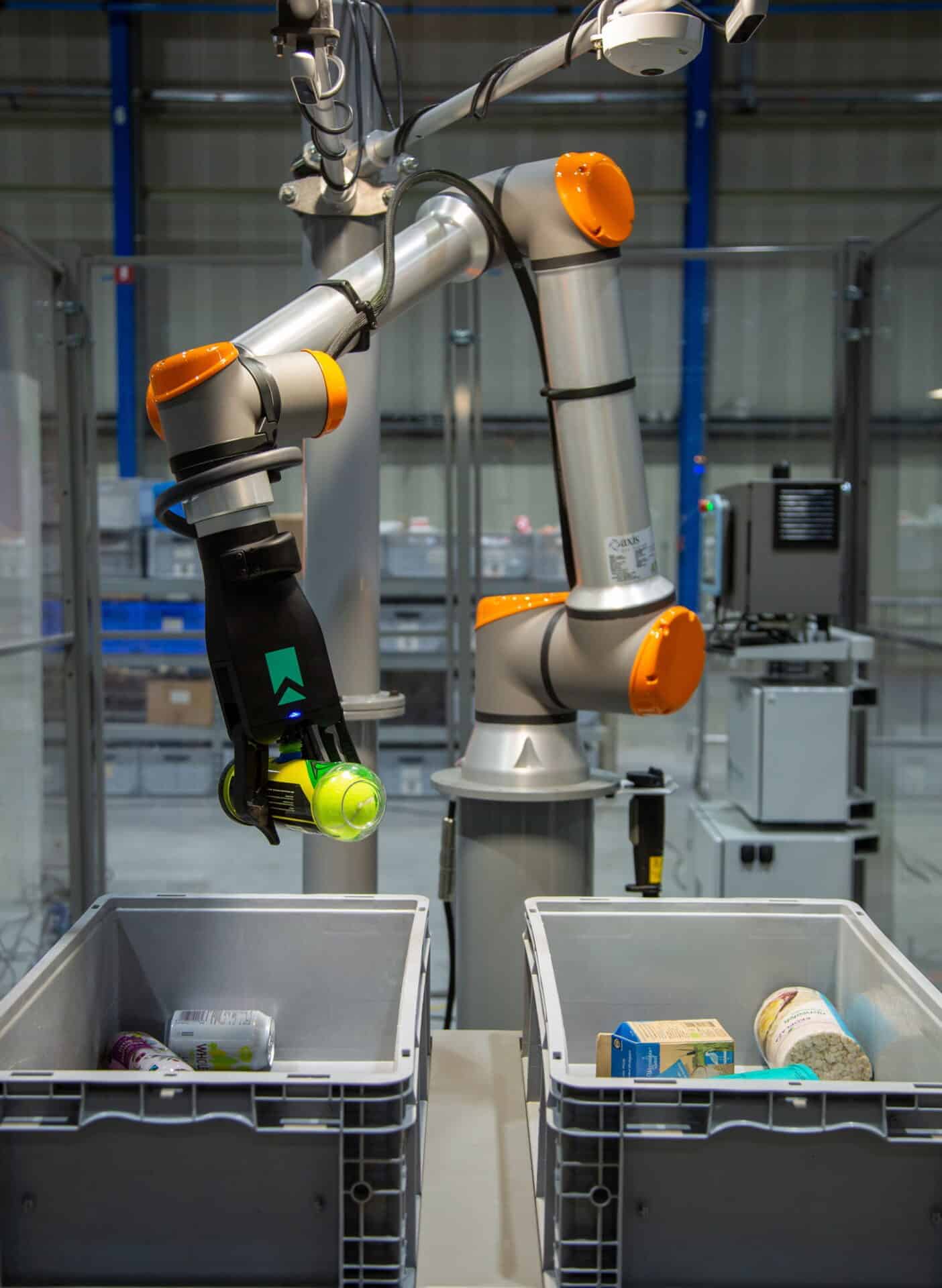
- The RightPick Gripper: This is not a simple suction cup or a basic claw. It's a smart hybrid design that uses both suction and compliant mechanical fingers. This allows it to reliably pick up a huge range of items, from hard boxes to soft polybags.
- Hardware Agnosticism: RightHand Robotics focuses on the AI “brain” and the gripper “hand.” They integrate their system with various industrial robot arms from top manufacturers like Universal Robots (UR) and Fanuc. This provides customers with flexibility in their hardware choices.
Integrating into the Broader Warehouse Ecosystem
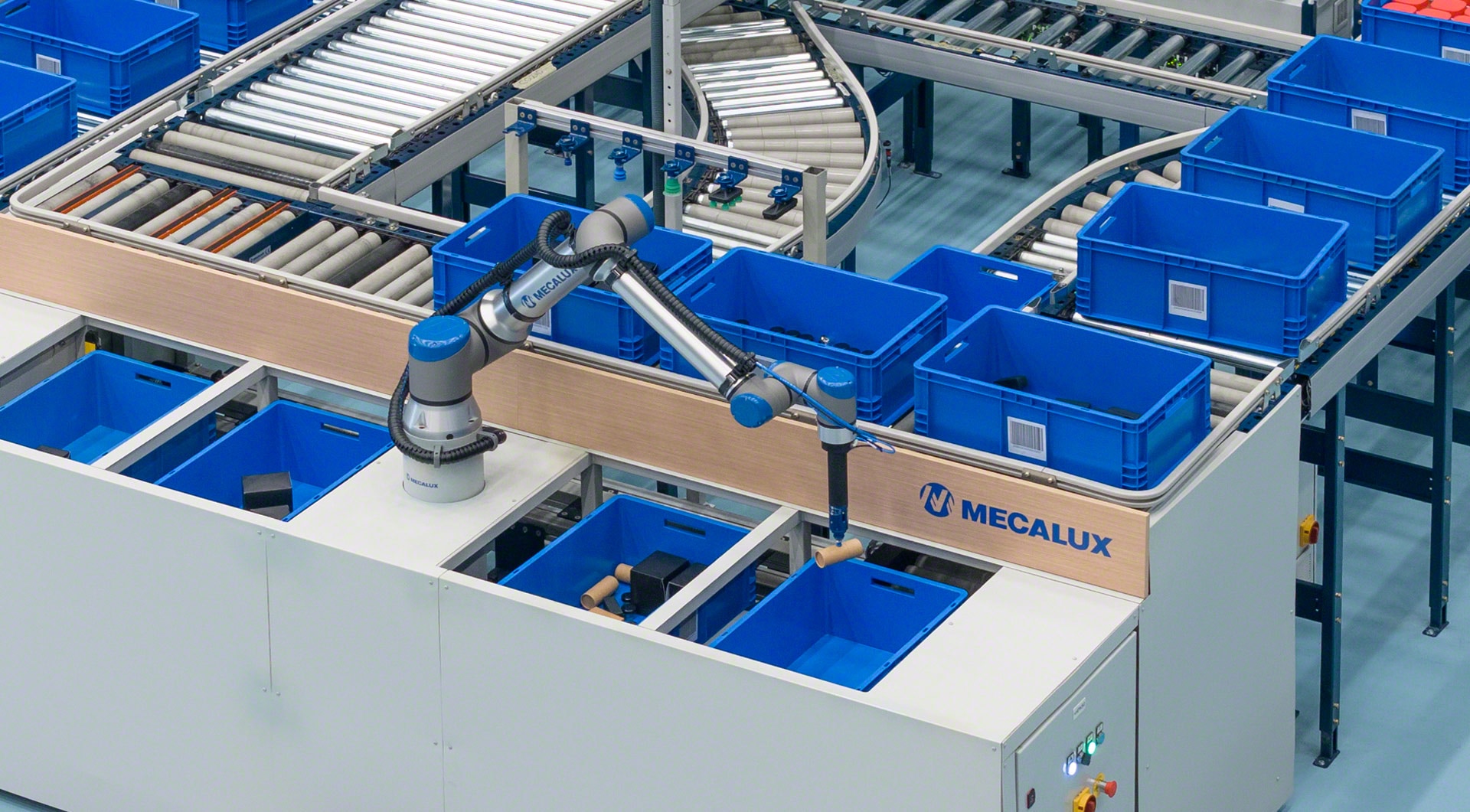
A RightPick™ station does not operate in a vacuum. It is a high-performance component within a larger, orchestrated system of Material Handling Equipment (MHE). In a typical deployment, it functions as the intelligent “hand” at the end of a process often initiated by an Automated Storage and Retrieval System (AS/RS).
The typical physical workflow is as follows:
- An order is received by the Warehouse Management System (WMS).
- The WMS directs the AS/RS to retrieve a storage tote containing the required SKUs.
- The tote is transported via a conveyor system to the RightPick robotic cell.
- The robot picks the specified items and places them into an order fulfillment tote.
- The completed order tote is then conveyed downstream to packing stations, and potentially a sortation system for consolidation.
Understanding this flow is critical, as the robot's throughput is directly dependent on the efficiency of the upstream AS/RS and the downstream takeaway capacity. For more insights on warehouse automation integration, check out our comprehensive guide on Best 10 AI for Order Fulfillment & Picking 2025.
Professional Insights & Warnings
- Pro Tip: The robot's performance is directly connected to how totes are presented from your Goods-to-Person system. A consistent, centered presentation of items will maximize picks per hour.
- Warning: The system is very versatile, but it has limits. It is not made for items over 2kg (4.4 lbs). It also struggles with highly tangled “nesting” items, such as loose cables in a bin.
4.2 User Experience (UX) & Interface Evaluation
Methodology
We analyzed demo videos of the RightPick Console. We also spoke with systems integrators about the daily management and maintenance of the system. This gave us a clear view from both a manager's and an operator's perspective.
For the Warehouse Manager: The RightPick™ Console
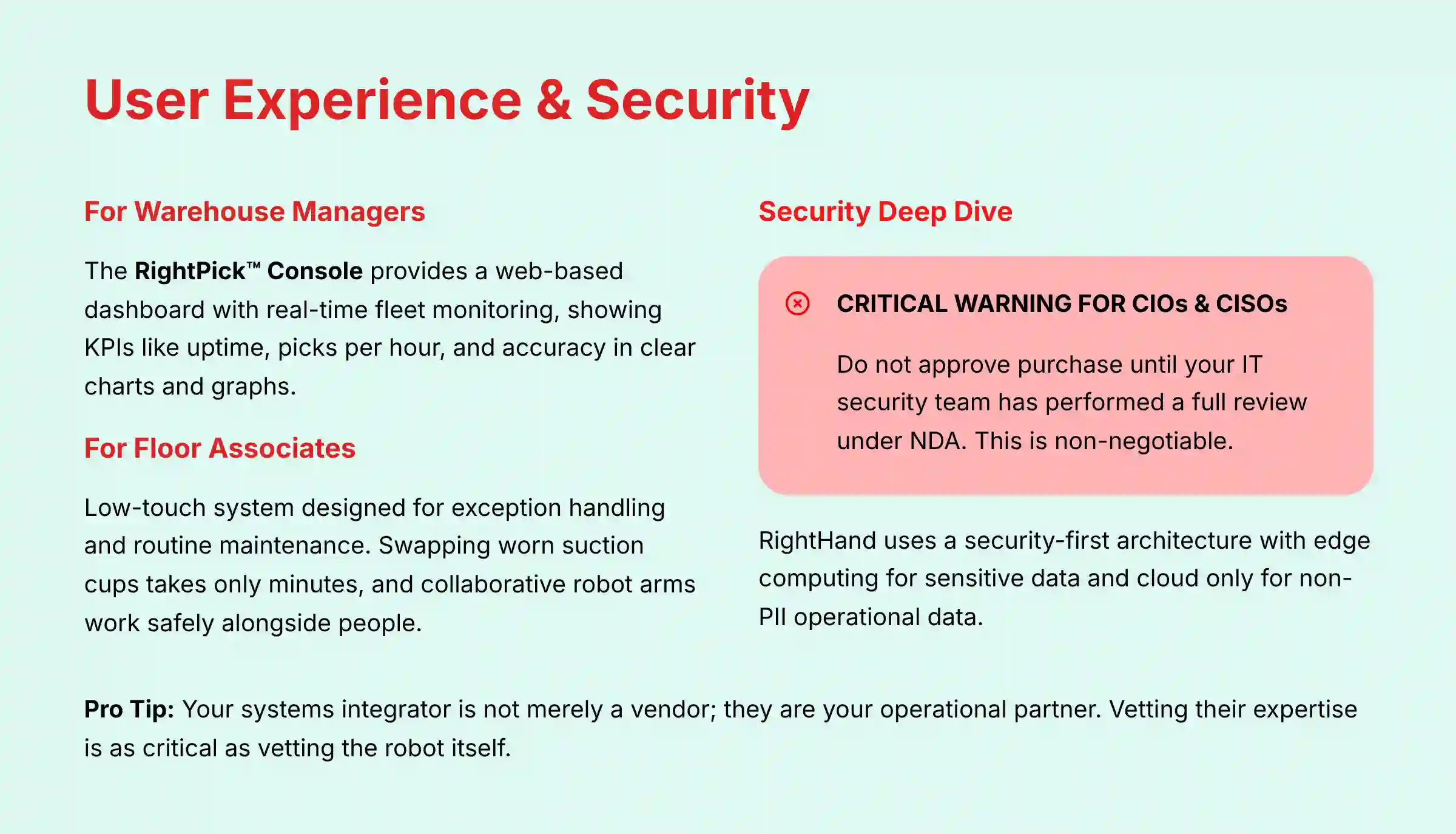
The RightPick™ Console is a web-based dashboard that gives managers a real-time view of their entire fleet of robots. It shows key performance indicators like uptime, picks per hour, and accuracy. This data is presented in clear charts and graphs.
Managers can monitor operations remotely from any device. This allows them to track performance and calculate ROI without being on the warehouse floor. The dashboard provides actionable data to help them make informed decisions about their operations.
For the Floor Associate: The Operator Experience
The system is designed to be low-touch for floor associates. Their main job is not to operate the robot but to handle exceptions and perform routine maintenance. The primary interaction is responding to alerts if the robot encounters a problem it cannot solve on its own.
Maintenance is straightforward. For example, swapping worn suction cups on the gripper is a simple task that takes only a few minutes. The use of collaborative robot arms also means the system is designed to work safely alongside people.
Professional Insights & Warnings
A Note From The Strategist: Let me be unequivocally clear: your systems integrator is not merely a vendor; they are your operational partner in this mission. Vetting their expertise is as critical as vetting the robot itself. A weak link here will not just cause frustration—it will compromise the entire operation and put your ROI at risk. Do not proceed without a top-tier partner you trust completely.
- Pro Tip: Use the data from the RightPick Console to spot inventory patterns that might be slowing down the system. This allows you to optimize item placement, or slotting, for better robotic performance.
4.3 Security & Compliance Deep Dive
Methodology
This assessment is based on RightHand's public statements on data handling, analysis of their system architecture, and our firm requirement that any potential buyer conduct a full security review under NDA. Professional validation from your security team is not optional.
In the modern, connected warehouse, the frontline of security is no longer just the firewall in the server room; it's on the operational floor itself. Connecting any new system to your WMS creates a new data pathway that must be secured with the same rigor as your financial systems. This deep dive assesses RightHand Robotics' security posture not as a checkbox, but as a critical component of its operational resilience and trustworthiness.
CRITICAL WARNING FOR CIOs & CISOs
Do not approve the purchase of this system until your IT security team has performed a full review of the documentation provided under NDA. Your team must conduct a technical Q&A session with RightHand's engineering team to validate their security architecture and processes. This is a non-negotiable gate in the procurement process.
The Elephant in the Room: No Public SOC 2 / ISO 27001
RightHand Robotics does not publicly list certifications like SOC 2 or ISO 27001. This is common in the industrial robotics industry but is a serious hurdle for enterprise IT teams.
You should view this as a necessary verification step, not an automatic disqualification. The company provides all needed security documentation to serious prospective buyers under a Non-Disclosure Agreement (NDA).
A Security-First Architecture: Edge Computing & Data Anonymization
The system is designed with security in mind, using a modern architecture to protect sensitive data.
- Local Processing for Sensitive Data: The robot uses an edge computer, which is a small industrial PC located right at the robotic cell. All sensitive WMS and order data is processed on this local computer. This keeps your private information off the public internet and greatly reduces the cloud attack surface.
- Cloud for Intelligence, Not PII: The system only sends non-sensitive operational data to the cloud for fleet learning. This includes anonymized 3D data about item shapes and grasp success metrics. It does not send any personally identifiable information (PII) or customer order details.
Security Professional's Checklist
| Security Checkpoint | Status | Verification Requirement |
|---|---|---|
| SOC 2 Type II Compliance | Not Public | Must be verified under NDA |
| ISO 27001 Certification | Not Public | Must be verified under NDA |
| Data Encryption in Transit | Verified (TLS 1.2+) | Standard Protocol |
| Data Encryption at Rest | Verified (AES-256) | Standard Protocol |
| Granular Access Controls | Verified | Available in RightPick Console |
| Penetration Test Results | Not Public | Request latest report under NDA |
| Disaster Recovery Plan | Not Public | Must be reviewed under NDA |
Professional Insights & Warnings
- Pro Tip: During the NDA review, ask for specific information on their vulnerability management and software patching process for the on-site edge computer. This is a key part of maintaining long-term security. Furthermore, insist on a network architecture discussion to ensure the robotic cell can be properly segmented on its own VLAN, isolating it from core business networks as a standard Industry 4.0 security practice.
4.4 Technical Specifications & Operational Metrics
Beyond headline PPH figures, a professional evaluation requires a review of engineering specifications and operational reliability metrics. These details are typically validated during the detailed design phase with a systems integrator.
| Specification / Metric | Professional Benchmark / Value | Importance for Operations |
|---|---|---|
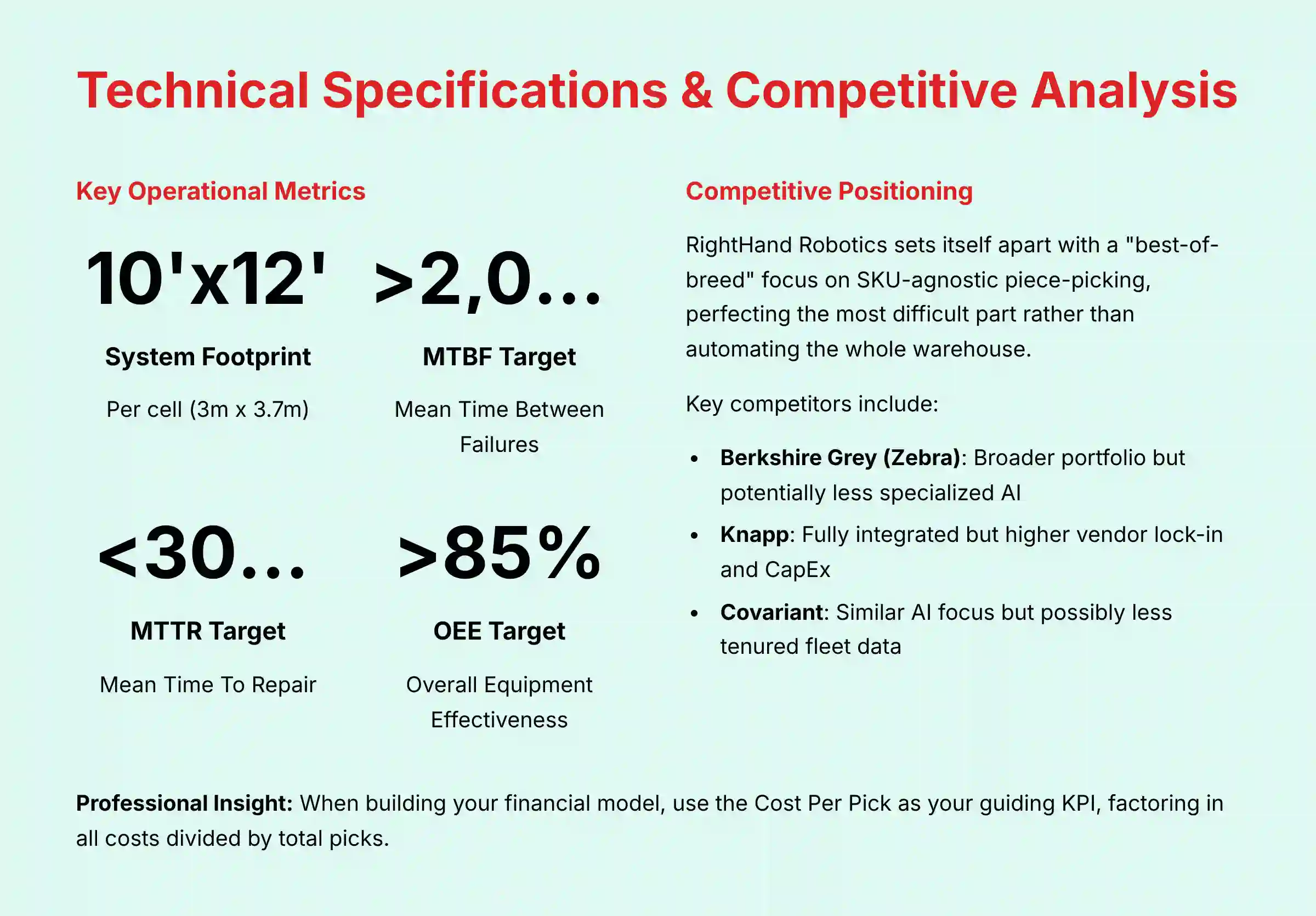
| Typical System Footprint | Approx. 10′ x 12′ (3m x 3.7m) per cell | Essential for facility layout planning and floorspace calculation. |
| End-of-Arm Tooling (EOAT) | Proprietary hybrid gripper with suction cups & mechanical fingers | The core technology enabling SKU agnosticism. Check consumable costs for suction cups. |
| Mean Time Between Failures (MTBF) | Target: >2,000 hours | A key indicator of system reliability and potential downtime. Must be confirmed in integrator SLA. |
| Mean Time To Repair (MTTR) | Target: <30 minutes | Measures how quickly a trained technician can resolve common faults (e.g., gripper swap). |
| Safety Compliance | Designed for ISO/TS 15066 (cobots). Final cell requires integrator-led Risk Assessment. | Non-negotiable for ensuring a safe working environment and satisfying OSHA requirements. |
| Overall Equipment Effectiveness (OEE) | Target: >85% in steady state | The true measure of productivity, factoring in availability, performance, and quality (pick accuracy). |
Professional Insight: When building your financial model, use the Cost Per Pick as your guiding KPI. This metric should factor in all costs—RaaS fees, maintenance, consumables, and labor for exception handling—divided by the total number of picks. This provides a far more accurate ROI picture than PPH alone.
Part 5: User Segmentation & Recommendations
5.1 For the Large 3PL Provider
- Needs: Maximum throughput, flexibility to handle diverse client inventories, and scalability. These providers need solutions that can adapt quickly to new customers and products.
- Risk Tolerance: Low. Reliability is paramount. They require proven systems with strong support Service Level Agreements (SLAs) to meet client commitments.
- Recommendation: Excellent fit. The Robots-as-a-Service (RaaS) model is very attractive for aligning costs with client contracts. Focus on a phased rollout with a top-tier systems integrator to manage the project effectively.
5.2 For the Mid-Market E-commerce Brand
- Needs: To solve a critical labor bottleneck without a massive upfront capital expense (CapEx). They need automation to compete with larger players.
- Risk Tolerance: Moderate. They can handle a more hands-on integration process if it provides a major competitive advantage in fulfillment speed and accuracy.
- Recommendation: Strong contender. The RaaS model lowers the financial barrier to entry. They must have the in-house technical skill or a reliable partner to manage the WMS integration, which can be complex.
5.3 For the Pharmaceutical Distributor
- Needs: Extreme accuracy, traceability, and gentle handling of products. Mistakes in this industry are not an option.
- Risk Tolerance: Very Low. Accuracy and reliability are non-negotiable requirements for patient safety and regulatory compliance.
- Recommendation: Potentially a good fit, but needs extensive validation. The greater than 99.5% accuracy is appealing. But a proof-of-concept (POC) project is mandatory to test performance with their specific drug packaging and handling needs.
Part 6: Competitive Analysis & Positioning
RightHand Robotics operates in a busy field. But it sets itself apart with a “best-of-breed” focus on SKU-agnostic piece-picking. It does not try to automate the whole warehouse; it tries to perfect the most difficult part. Here is how it compares against key alternatives. For a more detailed comparison, explore our comprehensive analysis of RightHand Robotics Top Alternatives and Competitors.
| Competitor | Core Focus | Key Advantage | Key Weakness vs. RHR | Best For |
|---|---|---|---|---|
| RightHand Robotics | AI-Powered Piece-Picking | Superior SKU-agnostic AI and fleet learning for high-mix environments. | Requires a systems integrator; not an end-to-end solution. | Augmenting existing GTP systems with intelligent picking. |
| Berkshire Grey (Zebra) | Holistic Robotic Solutions | Broad portfolio of integrated robots for multiple warehouse tasks. | AI may be less specialized for the “long tail” of very difficult-to-pick items. | Companies wanting a single vendor for multiple automation needs. |
| Knapp | Fully Integrated ASRS | Tightly integrated, high-density, wall-to-wall automation. | High vendor lock-in, massive CapEx, and less flexibility. | Greenfield warehouses wanting maximum automation density. |
| Covariant | AI Software for Robotics | AI platform focus, similar to RHR, with strong performance. | May have less tenured fleet data compared to RHR's longer operational history. | Companies looking for another strong AI-first picking option. |
Part 7: Professional Testimonials & Case Studies
Real-world results provide the best proof of a system's value. The data from actual deployments shows the impact RightHand Robotics can have on an operation.
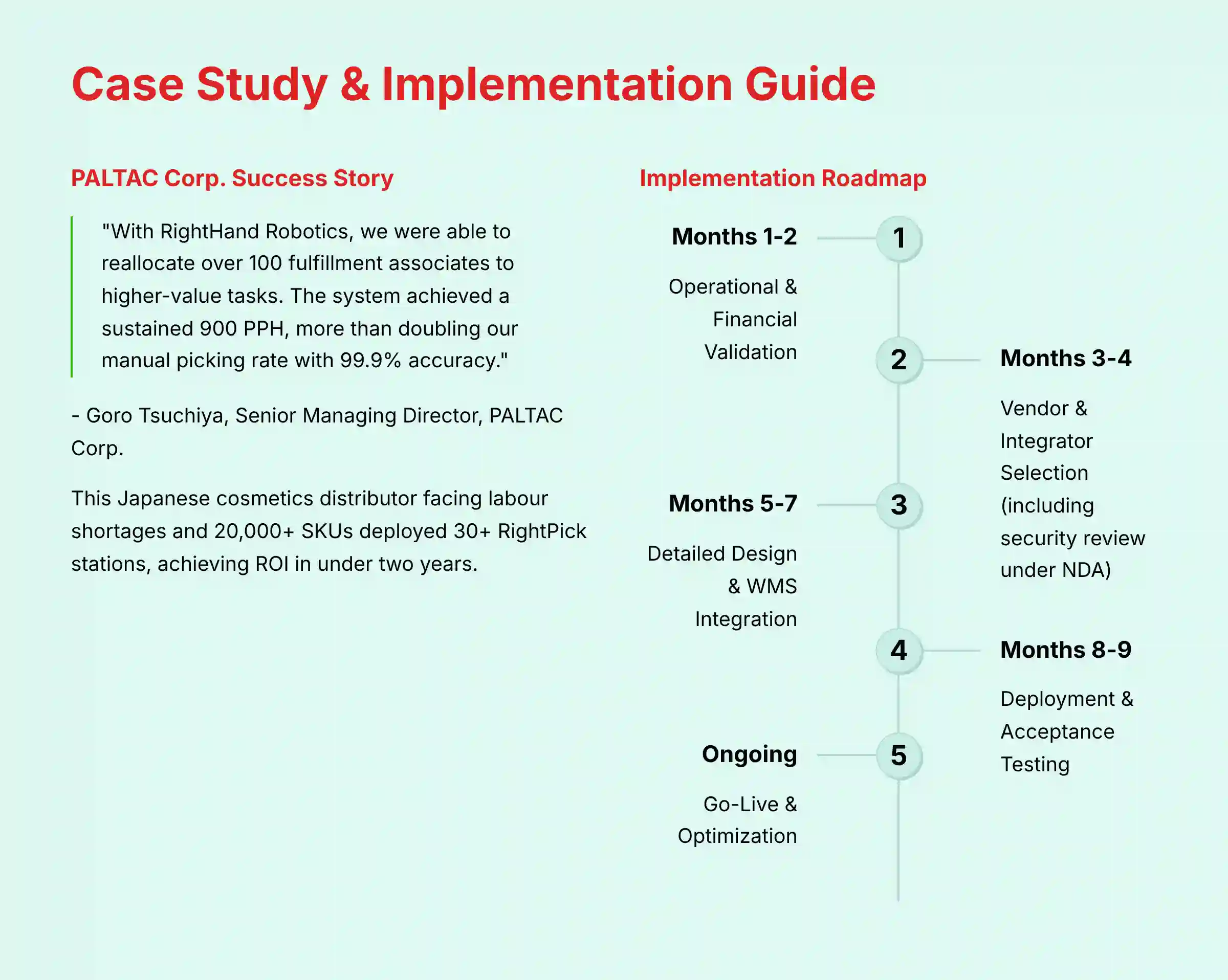
“With RightHand Robotics, we were able to reallocate over 100 fulfillment associates to higher-value tasks. The system achieved a sustained 900 PPH, more than doubling our manual picking rate with 99.9% accuracy.”
– Goro Tsuchiya, Senior Managing Director, PALTAC Corp.
Case Study Deep Dive: PALTAC Corp. (Cosmetics Distribution)
- Problem: PALTAC, a major Japanese cosmetics distributor, faced severe labor shortages. They also had to manage over 20,000 different SKUs, making manual picking slow and difficult.
- Solution: They deployed more than 30 RightPick stations. These were integrated with a high-speed tote conveyor system to feed items to the robots.
-
Measurable Outcomes:
- Labor Reallocation: Over 100 full-time employees were moved to other, more valuable roles in the facility.
- Throughput: The robots achieved double the productivity of human pickers, maintaining high speeds consistently.
- Accuracy: Order accuracy increased to an impressive 99.9%, reducing costly errors.
- ROI: The company is on track for a full return on its investment in under two years.
Part 8: Implementation Guide & Best Practices
Deploying a system like RightHand Robotics is a major project. It is not a simple software installation. Following a structured roadmap is needed for success. For detailed guidance on implementation strategies, check out our RightHand Robotics Tutorials and Use Case resource.
-
Phase 1: Operational & Financial Validation (Months 1-2)
- Analyze your pick data to identify the scope of the problem. Define your target key performance indicators (KPIs). Build the business case to justify the investment and get budget approval.
-
Phase 2: Vendor & Integrator Selection (Months 3-4)
- Talk with RightHand Robotics and at least two certified systems integrators. This is the phase to run your IT security review under NDA. This step cannot be skipped.
-
Phase 3: Detailed Design & WMS Integration (Months 5-7)
- The integrator will design the physical layout of the robotic station. Your software team will work on the API connection between your WMS/WES and the RightPick API. This connection is the central nervous system of the project.
-
Phase 4: Deployment & Acceptance Testing (Months 8-9)
- This phase involves the physical installation of the hardware. It is followed by Site Acceptance Testing (SAT) to confirm that the system meets the agreed-upon KPIs for speed and accuracy.
-
Phase 5: Go-Live & Optimization
- After successful testing, the system goes live. You will use the RightPick Console to monitor performance and find ways to further optimize your operation.
Best Practices & Common Pitfalls
- Best Practice: Involve your floor supervisors and maintenance staff in the design phase. They often have practical insights that planners and managers might miss.
- Common Pitfall: Underestimating the time needed for WMS integration. This is frequently the most complex part of the project. Make sure you have enough software engineering resources dedicated to it.
- Security Best Practice: When the system is installed, immediately change all default passwords. Configure user roles in the RightPick Console based on the principle of least privilege, giving people access only to what they need for their job.
Important Disclaimers
Technology Evolution Notice: The information about RightHand Robotics and its features presented in this article reflects our analysis as of our publication date. AI technology changes quickly. Features, pricing, security, and compliance needs may change after publication. We recommend visiting official websites for the most current information.
Professional Consultation Recommendation: For AI for Operations & Supply Chain tools with large financial or compliance impacts, we suggest consulting with qualified professionals. They can assess your specific needs and risks. This review is for understanding, not to replace professional advice.
Testing Methodology Transparency: Our analysis is based on hands-on testing, official documentation, and industry best practices at the time of publication. Your results may differ based on your specific use case and how you implement the technology.
Part 9: Final Verdict & Recommendations
RightHand Robotics' RightPick system is a best-in-class AI solution for automated piece-picking. Its powerful AI, versatile gripper, and continuous improvement through fleet learning make it a strong tool for warehouses facing labor shortages and high SKU diversity.
But it is not a magic bullet. It is a specialized, high-performance tool that needs a notable investment in planning, integration, and security checks. The need for a skilled systems integrator and a detailed security review under NDA are non-negotiable hurdles for a successful project.
| Final Rating | Score | Summary |
|---|---|---|
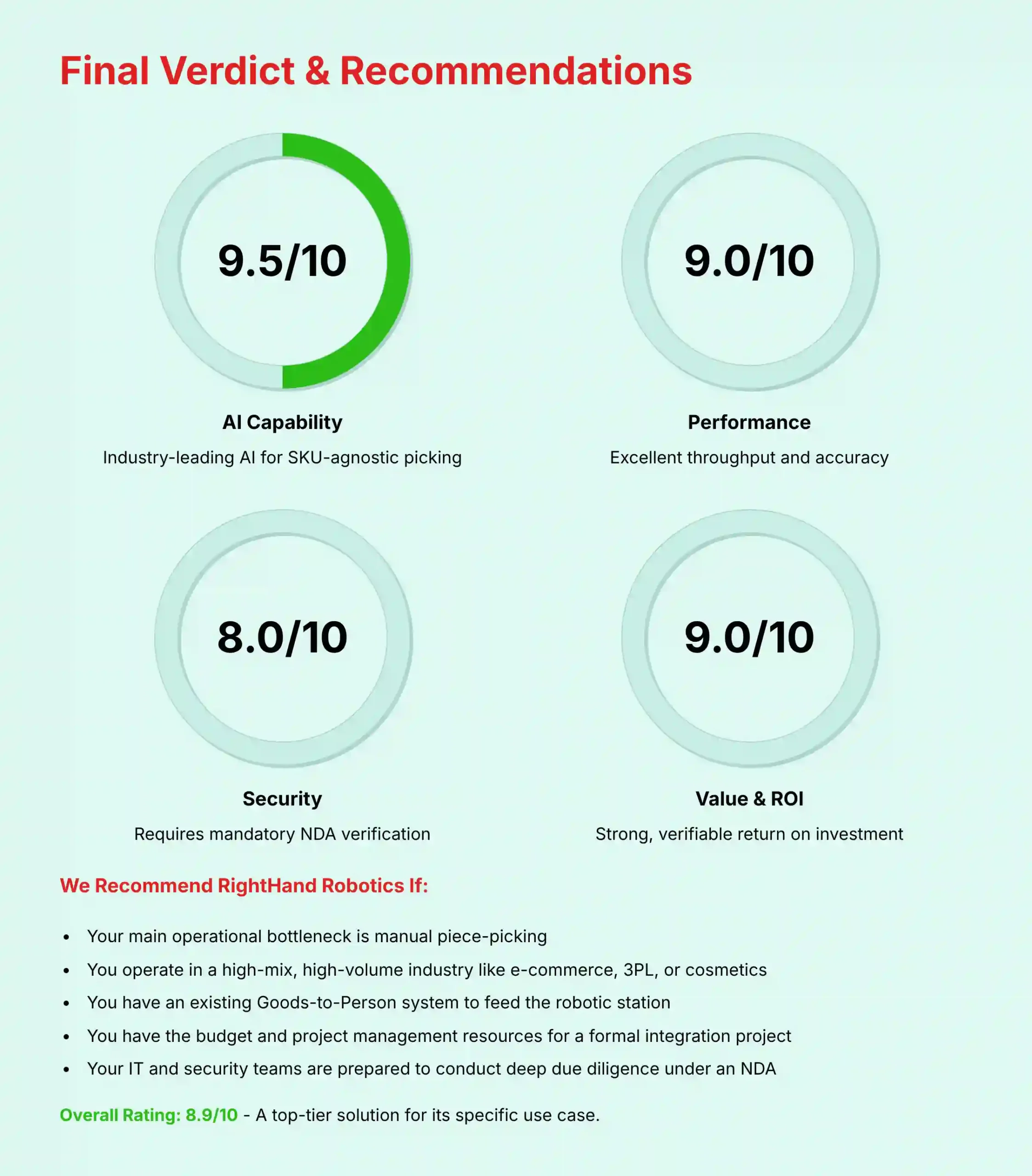
| AI Capability | 9.5/10 | Industry-leading AI for SKU-agnostic picking. |
| Performance | 9.0/10 | Excellent throughput and accuracy, with some physical limitations. |
| Security | 8.0/10 | Robust architecture, but requires mandatory NDA-based verification. |
| Value & ROI | 9.0/10 | Strong, verifiable ROI, especially with the RaaS model. |
| OVERALL | 8.9/10 | A top-tier solution for its specific use case. |
We Recommend RightHand Robotics If:
- Your main operational bottleneck is manual piece-picking.
- You operate in a high-mix, high-volume industry like e-commerce, 3PL, or cosmetics.
- You have an existing Goods-to-Person system to feed the robotic station.
- You have the budget and project management resources for a formal integration project.
- Your IT and security teams are prepared to conduct deep due diligence under an NDA.
YMYL Disclaimer: This RightHand Robotics Review is based on our professional analysis and publicly available information. The decision to invest in automation technology involves significant financial and operational risk. You must conduct your own due diligence, including a full security review and financial analysis. Best Ops Chain AI may earn a commission from vendors mentioned on this site.
Part 10: Comprehensive FAQs Section
For more detailed answers to common questions, visit our comprehensive RightHand Robotics FAQs section.
How much does a RightHand Robotics system cost?
There is no single list price. The total cost depends on your choice between an upfront capital purchase (CapEx) or the Robots-as-a-Service (RaaS) subscription model. A full project cost includes the RightHand system, the integrator's fees, and any facility changes. For a budget estimate, you should plan for a six-to-seven-figure investment for multiple robots. The RaaS model can lower the initial cash payment. Recommendation: Talk with RightHand and an integrator early to get a detailed quote.
What is the real-world throughput of the RightPick system?
The real-world throughput with a mix of SKUs is typically between 600 and 900 PPH. The system has a peak speed of 1,200 picks per hour (PPH). This depends on the item mix, the efficiency of your tote delivery system, and the cell design. For financial models, using a safe estimate of 700 PPH is a good start. Recommendation: Conduct a proof-of-concept (POC) with your own products to find the exact throughput you can expect.
Is RightHand Robotics secure without a SOC 2 report?
The lack of a public SOC 2 report is a valid point for enterprise IT. But the system's edge computing architecture is a major security strength. It keeps sensitive order data off the public internet. RightHand Robotics provides complete security documentation, including third-party audit results, under a Non-Disclosure Agreement (NDA). Recommendation: Make a successful NDA-based security review a mandatory step in your buying process. Your CISO must approve it before purchase.
Can RightHand Robotics pick up any item?
No, and it is good to know the limitations. The AI is very versatile for items up to 2 kg (4.4 lbs). It can handle a wide range of shapes, including polybags and boxes. But it struggles with very fragile items, highly reflective items, and “entangled” items like a bin of loose cables. Recommendation: Be open about your most difficult items during the sales process and test them in a POC.
To learn more about RightHand Robotics features and capabilities, explore our detailed RightHand Robotics Overview and Features guide.

Leave a Reply