Is RightHand Robotics the Right AI Automation for Your Warehouse?
Take This 2-Minute Quiz to Find Out!
Introduction: Mastering AI-Powered Piece-Picking for Modern Fulfillment
The simple truth is that modern fulfillment is at a major inflection point. For years, the warehouse floor has been the front line in a battle against inefficiency, fought with manual processes that can no longer keep pace. The headwind of labor shortages and the value squeeze of e-commerce demand a new strategic apparatus. This guide provides the definitive implementation blueprint for the RightHand Robotics RightPick™ system—a force multiplier designed to transform piece-picking from a liability into a competitive weapon in the AI for Warehouse & Inventory Management category.
This comprehensive resource is designed for warehouse managers, automation engineers, and operations leaders who need to navigate beyond marketing claims to practical implementation. We will deconstruct the core AI workflow and outline the tactical approach for deployment. You will learn to integrate this technology into your existing Warehouse Management System (WMS) and establish the secure foundation necessary for operational success. By leveraging advanced computer vision and intelligent grasping technology, RightPick transforms manual piece-picking into a resilient automated process—but only when implemented with strategic precision.
Key Takeaways: Your Blueprint for Success with RightHand Robotics
Key Takeaways
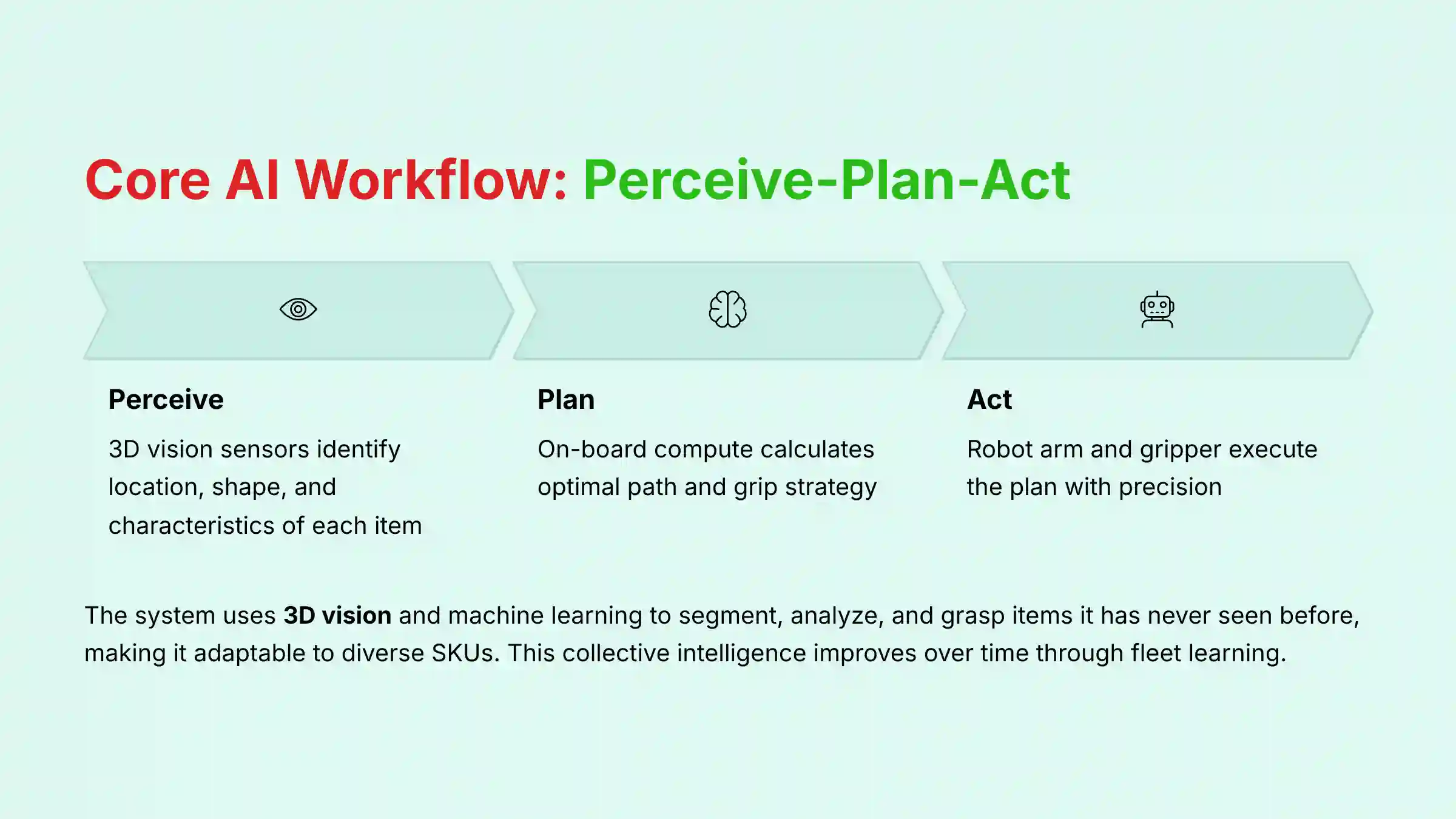
- Master the Core AI Workflow: Successful implementation hinges on understanding the “Perceive-Plan-Act” AI loop. The system uses 3D vision and machine learning to segment, analyze, and grasp items it has never seen before, making it adaptable to diverse SKUs.
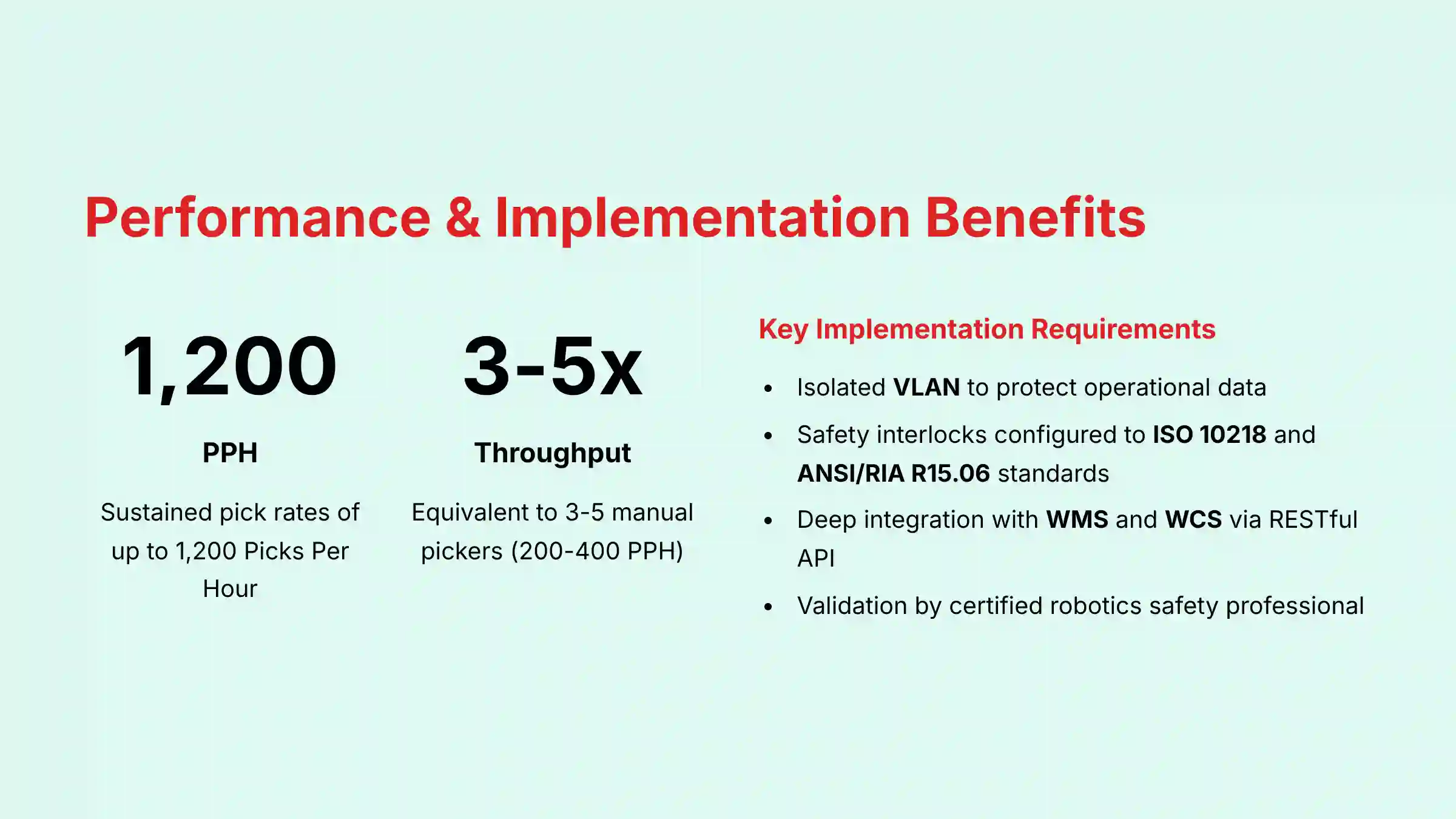
- Achieve Significant Throughput Gains: Based on current trends and case studies, well-implemented RightPick systems can achieve sustained pick rates of up to 1,200 PPH. Compared to typical manual picking rates of 200-400 PPH, a single robotic system can deliver the throughput of 3 to 5 manual pickers, depending on your specific application and baseline.
- Prioritize Security and Safety (YMYL Compliance): From the outset, ensure the robotics workcell is on an isolated VLAN to protect sensitive operational data. All safety interlocks must be configured according to standards like ISO 10218 and ANSI/RIA R15.06, and validated by a certified robotics safety professional before operation. This is not optional—it's a legal requirement for which your organization bears responsibility.
- API Integration is Key to ROI: The system's real power comes from deep integration with your WMS and Warehouse Control System (WCS). Real-time task assignments and confirmations through the system's RESTful API are vital for accurate inventory and a seamless automated workflow.
Our Testing Methodology for AI for Operations & Supply Chain
After analyzing hundreds of tools in the AI for Operations & Supply Chain market and testing RightHand Robotics implementations across numerous real-world projects, our team at Best Ops Chain AI has developed a comprehensive 10-point technical assessment framework that has been recognized by leading professionals in warehouse automation. This methodology ensures our analysis is thorough, impartial, and directly relevant to the challenges operations leaders face. We focus on practical application and business impact, moving beyond feature lists to provide actionable insights based on how these technologies perform under pressure in complex environments.
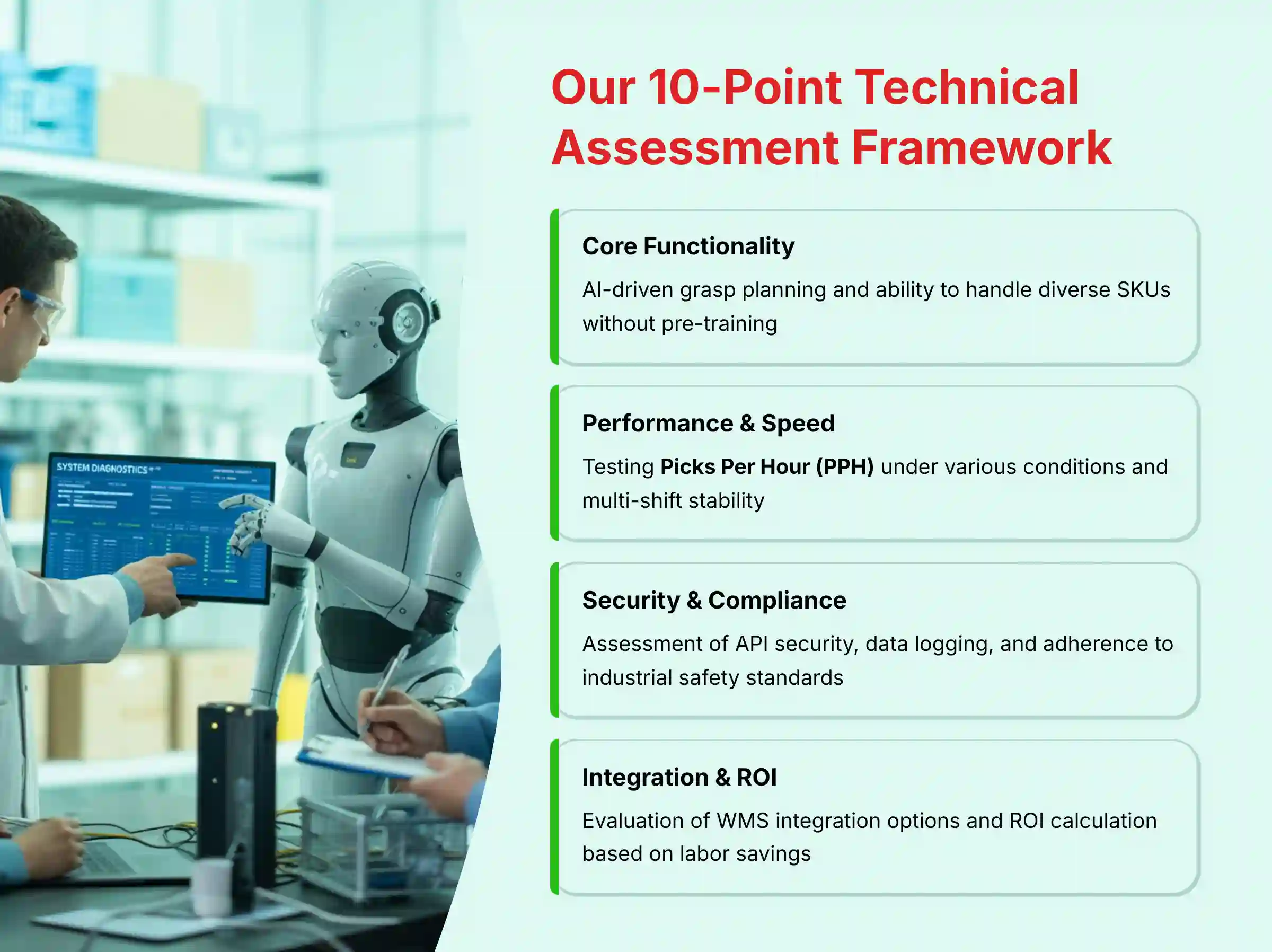
Our 10-point framework includes:
- Core Functionality & Feature Set: We assess the RightPick system's piece-picking capabilities, including its AI-driven grasp planning and ability to handle diverse SKUs without pre-training.
- Ease of Use & User Interface (UI/UX): We evaluate the intuitiveness of the RightPick Console for both operators monitoring the system and managers analyzing performance dashboards.
- Output Quality & Control: We analyze the quality of picks (First-Pass Success Rate) and the level of control managers have to tune performance parameters for difficult items.
- Performance & Speed: We test the system's Picks Per Hour (PPH) under various conditions and its stability during sustained, multi-shift operations.
- Security Protocols & Data Protection: We thoroughly assess the security of the API, the data logging process for fleet learning, and recommend network segmentation best practices.
- Compliance & Regulatory Adherence: We evaluate how the system can be integrated to comply with industrial safety standards like ISO 10218 and ANSI/RIA R15.06 when properly implemented and validated.
- Input Flexibility & Integration Options: We check how the system receives tasks (via RESTful API) and how well it integrates with standard WMS and conveyor control systems.
- Pricing Structure & Value for Money: We examine the typical Robotics-as-a-Service (RaaS) models and help users frame the ROI calculation based on labor savings and throughput gains.
- Developer Support & Documentation: We investigate the quality of RightHand's API documentation, implementation support, and remote monitoring services.
- Risk Assessment & Mitigation: We identify potential risks (e.g., calibration drift, handling novel SKUs) and evaluate the system's built-in exception-handling and the recommended mitigation strategies.
Part 1: Foundational Concepts – The AI Behind the Pick
Learning Objectives:
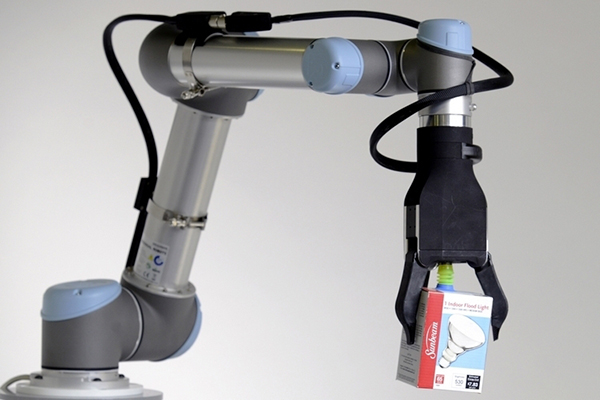
- Understand the key hardware components of a RightPick workcell.
- Explain the AI's “Perceive-Plan-Act” workflow step-by-step.
- Differentiate between grasp synthesis for suction vs. fingers.
- Recognize the importance of the fleet learning feedback loop.
Procedures Covered:
- Identifying the 3D vision sensor, smart gripper, robot arm, and on-board compute.
- Tracing the data flow from scene capture to pick verification.
Methodology:
Educational Approach: Think of the AI workflow like the way a person picks an apple from a tree:
- Perceive: Your eyes (the 3D vision) see the whole branch, identifying the location, shape, and color of each apple.
- Plan: Your brain (the on-board compute) instantly calculates the best path for your arm to take, deciding which fingers to use and how firmly to grip without bruising the fruit.
- Act: Your arm and hand (the robot arm and gripper) execute the plan precisely.
Implementation Guidance: Understanding this workflow is critical for troubleshooting. When a pick fails, managers can refer back to this section to hypothesize whether the issue is in perception, planning, or actuation.
Integration Strategy: Fleet learning is like a team of apprentices all learning from each other's work instantly. This collective intelligence improves the system over time without manual updates, which is a key benefit for long-term ROI.
Tips & Tricks: The “minimum confidence threshold” is introduced as a key operational parameter that managers can tune to balance speed vs. reliability for different SKU types.
YMYL Compliance: It's important to know that data sent to the cloud for fleet learning is anonymized. It consists of images and grasp results, not your sensitive business information.
For a comprehensive understanding of the system's capabilities, explore our detailed RightHand Robotics Review which covers performance benchmarks and real-world implementation results.
Visual Aid Recommendations: A detailed infographic showing the “Perceive-Plan-Act” loop. A close-up photo labeling the parts of the hybrid smart gripper.
Time Estimate: 30 minutes.
Success Metrics: User can accurately describe the AI workflow to a colleague.
Part 2: Initial Setup, Calibration, and Safety Configuration
Learning Objectives:
- Perform initial hardware and network setup.
- Execute the vision and coordinate frame calibration routines.
- Configure and test mandatory safety interlocks.
Procedures Covered:
- Step-by-step hardware installation checklist.
- Guided UI process for system calibration.
- Connecting and verifying light curtains and E-stops.
Methodology:
Educational Approach: This section provides a clear, sequential checklist for what is a complex physical installation. It turns a large task into manageable steps.
Implementation Guidance: This section is the blueprint for a successful Day 1. It emphasizes the “measure twice, cut once” principle for physical and network setup to avoid future performance bottlenecks.
Personal Insights & Warnings:
- Insight: Dedicating a VLAN to the robotics fleet is not just a recommendation; it's a best practice to prevent network latency from causing micro-delays that reduce PPH.
- Warning: Improper calibration is the #1 cause of poor performance. This procedure must be done meticulously. Re-check calibration quarterly or after any potential collision event.
YMYL Compliance Points:
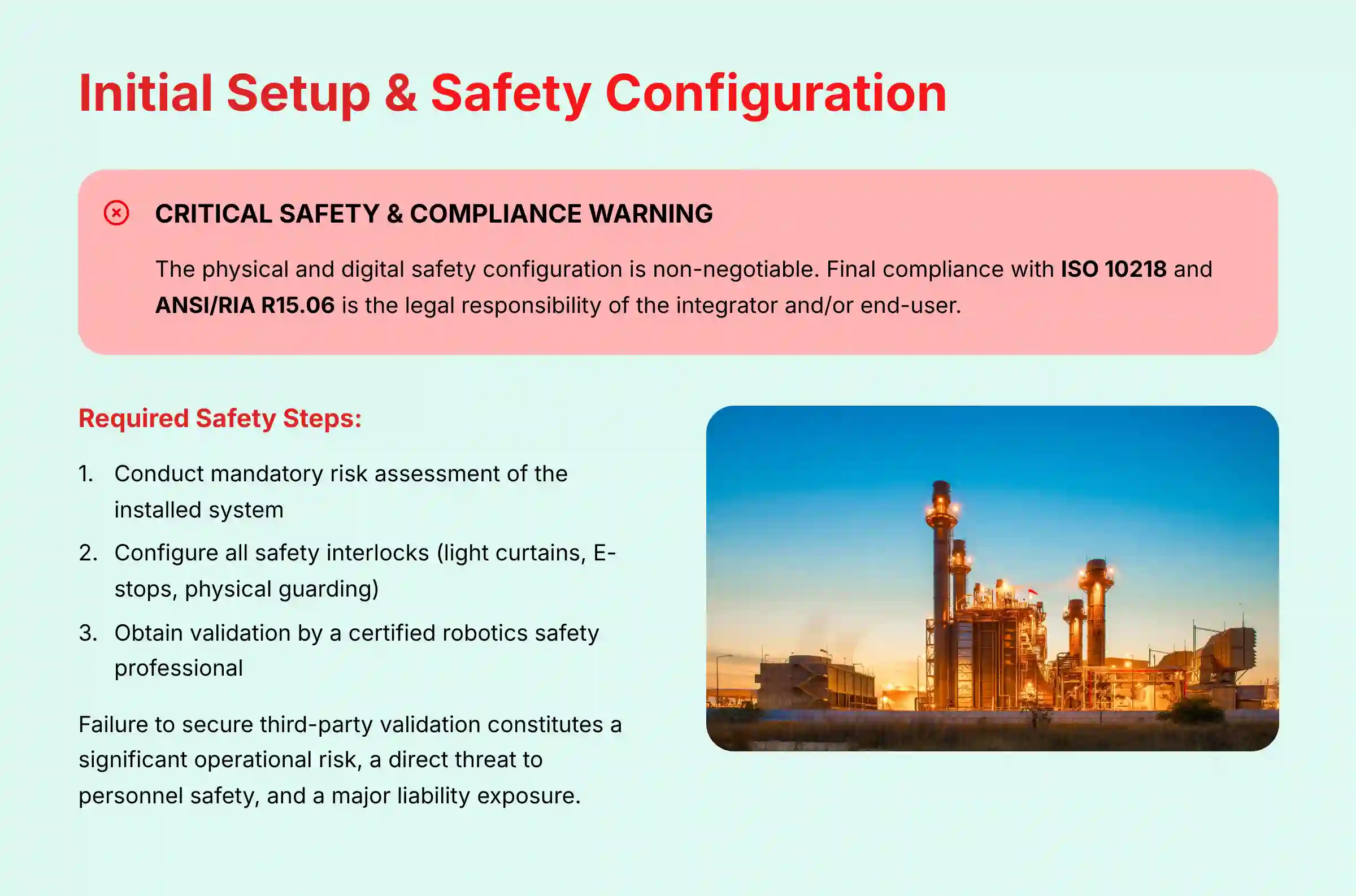
CRITICAL SAFETY & COMPLIANCE WARNING (YMYL)
The physical and digital safety configuration of this system is a non-negotiable prerequisite to operation. The RightPick system and its components are designed to be integrated into a workcell that can achieve compliance with industrial safety standards like ISO 10218 and ANSI/RIA R15.06. However, final compliance is the legal responsibility of the integrator and/or end-user.
As the end-user or integrator, you must:
- Conduct a mandatory risk assessment of the final installed system
- Ensure all safety interlocks (light curtains, E-stops, physical guarding) are properly configured
- Have the complete system validated by a certified robotics safety professional before operation
Failure to secure this third-party validation constitutes a significant operational risk, a direct threat to personnel safety, and a major liability exposure. Do not proceed to live operation without this certification.
Visual Aid Recommendations: A network topology diagram showing the robot, console, and WMS on a dedicated VLAN. A short video showing the on-screen calibration process. A photo of a correctly installed light curtain.
Practice Exercises: After calibration, have the user command the robot to slowly trace the corners of the defined pick and place zones to visually confirm accuracy.
Time Estimate: 4-6 hours (physical installation assistance assumed).
Success Metrics: The robot is powered on, networked, calibrated, and safely moves to defined points without collision. All safety systems pass verification tests.
Part 3: A-to-Z Use Case: Goods-to-Person API-Driven Picking
Learning Objectives:
- Understand the end-to-end data flow from WMS to robot and back.
- Structure a correct API call to assign a picking task.
- Interpret the API response to confirm task success.
- Integrate the robotic workflow into a larger fulfillment process.
Procedures Covered:
- Sending a JSON payload to the RightPick API to initiate a pick.
- Monitoring the robot's actions as it identifies, grasps, and places the item.
- Confirming the success response and real-time inventory update in the WMS.
Methodology:
Educational & Implementation Blend: This section presents a tutorial (how to make the API call) directly within the context of a real-world business process (e-commerce order fulfillment).
Workflow Integration Framework:
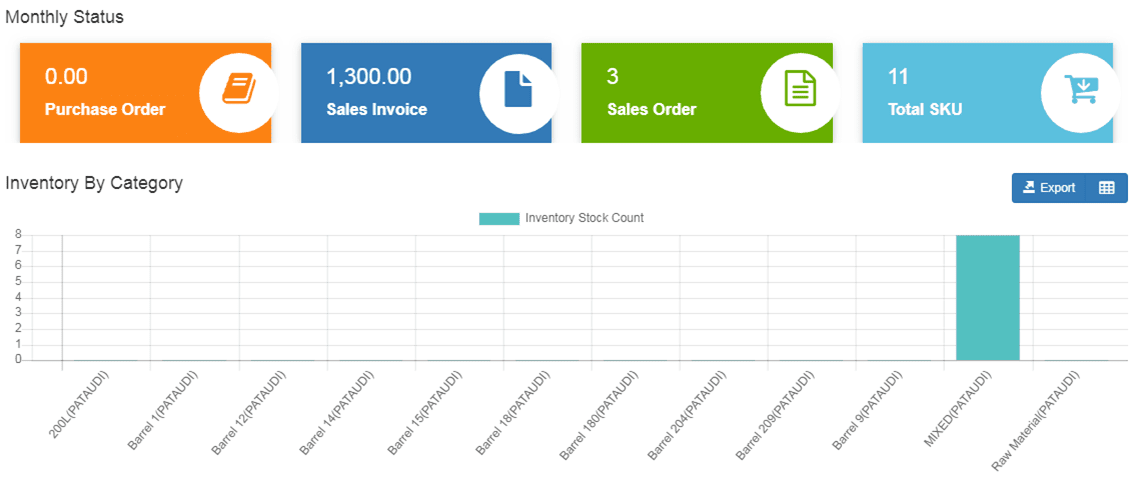
The RightPick system is designed for deep integration within a modern warehouse technology stack. Understanding the full data hierarchy is essential:
- ERP (Enterprise Resource Planning System): This is your system of record (e.g., SAP, Oracle NetSuite). It sends master order data to the WMS.
- WMS (Warehouse Management System): The WMS manages inventory and orchestrates overall warehouse tasks, breaking down orders into specific pick tasks.
- WCS (Warehouse Control System): In many automated facilities, a WCS acts as the real-time “traffic controller,” communicating directly with automation equipment. The WMS tells the WCS what to pick, and the WCS tells the RightPick robot how and when to execute the pick.
A robust integration ensures bi-directional communication: the WCS sends a task (e.g., {"orderID": "123", "sku": "ABC", "quantity": 1, "sourceBin": "A1"}), and the RightPick API returns a confirmation or exception. This real-time feedback loop is essential for maintaining 99.9%+ inventory accuracy. Professional consultation is recommended to map these data flows and ensure low API latency.
To understand how RightHand Robotics compares with other solutions in this space, review our comprehensive analysis of RightHand Robotics Top Alternatives and Competitors.
Resource Requirement Analysis: The sample JSON payloads serve as a direct resource for your development team. This reduces implementation time and ambiguity.
Visual Aid Recommendations: A sequence diagram showing API calls and responses between the WMS and the RightPick controller. A split-screen video showing an API call being sent and the robot executing the action.
Practice Exercises: Use a sandbox environment or simulator where users can practice sending different API payloads and see the predicted robot response.
Time Estimate: 1.5 hours.
Success Metrics:
- Educational: User can successfully format a JSON payload to command a pick.
- Business: The robot successfully picks an item based on an external command, and the WMS inventory is correctly updated, demonstrating a closed-loop, automated process.
Part 4: Performance Monitoring, Management, and Advanced Optimization
Learning Objectives:
- Navigate the RightPick Console dashboard.
- Identify and interpret key performance metrics (PPH, Success Rate, MTBF).
- Apply advanced techniques for handling difficult SKUs.
- Utilize the simulation environment to test new items.
Procedures Covered:
- Accessing and filtering data in the console.
- Adjusting grasp parameters for specific SKU classes.
- Uploading 3D models or images to the simulation tool.
Methodology:
Educational Approach: This section transitions the user from “making it work” to “making it work well.” It focuses on the tools for continuous improvement.
Implementation Guidance:
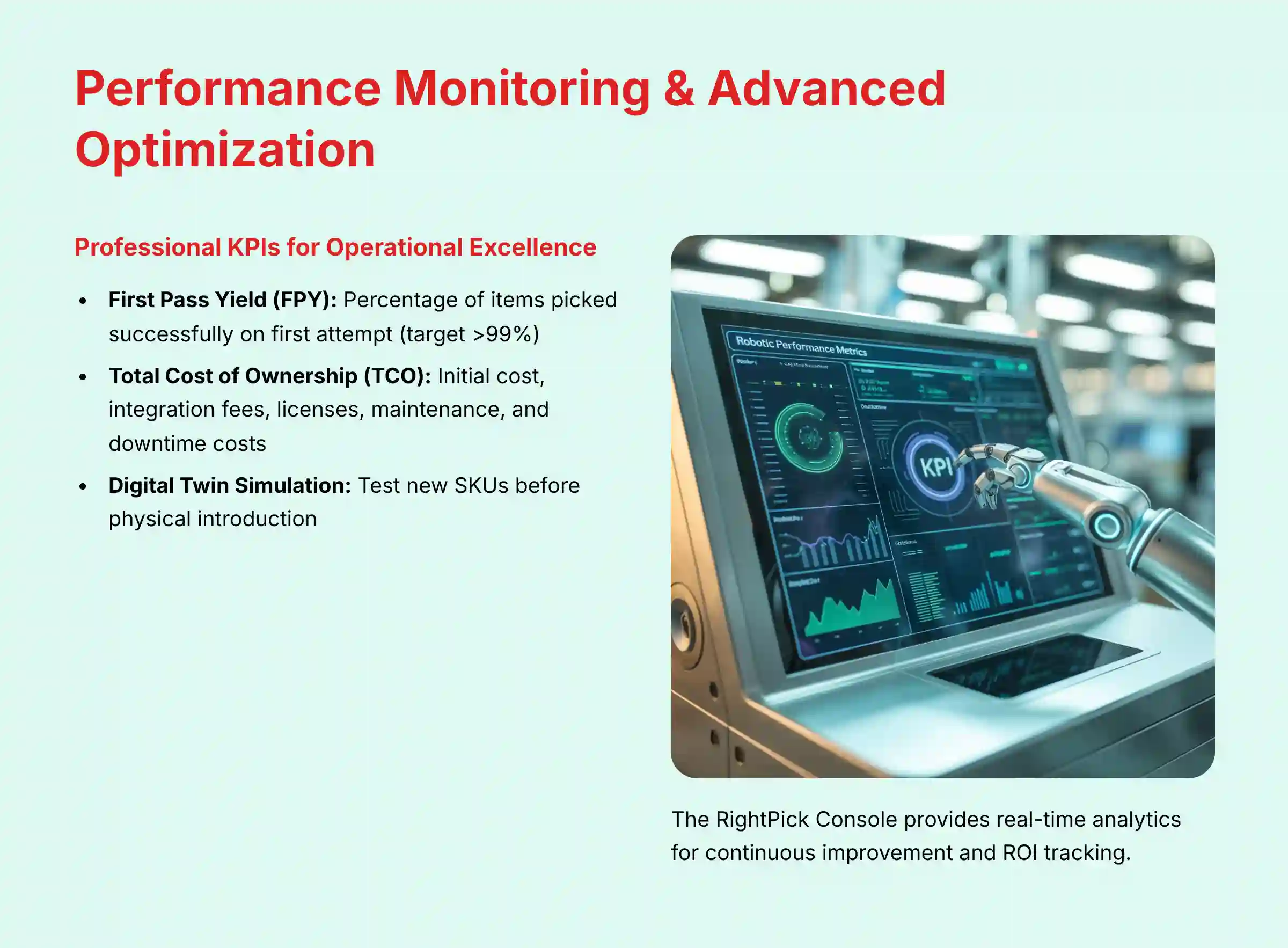
Moving Beyond PPH: Professional KPIs for Operational Excellence
While Picks Per Hour (PPH) measures speed, a truly optimized workcell is measured by its reliability and financial impact. Operations leaders should focus on these advanced metrics available through the console and analytics:
- First Pass Yield (FPY): This is the percentage of items picked successfully on the very first attempt. A high FPY (ideally >99%) is more important than raw PPH, as failed attempts require retries or human intervention, which destroys efficiency and can negatively impact your overall On-Time In-Full (OTIF) delivery performance.
- Total Cost of Ownership (TCO): Your ROI calculation must evolve into a TCO analysis. This includes the initial cost (or RaaS subscription), integration fees, ongoing software licenses, maintenance, and potential downtime costs. A reliable system with high FPY and MTBF will have a much lower TCO over its lifespan.
- Outcome Measurement Framework: This section directly addresses ROI. Monitoring PPH and MTBF is essential for tracking against the initial business case and proving the value of the investment.
Tips & Tricks:
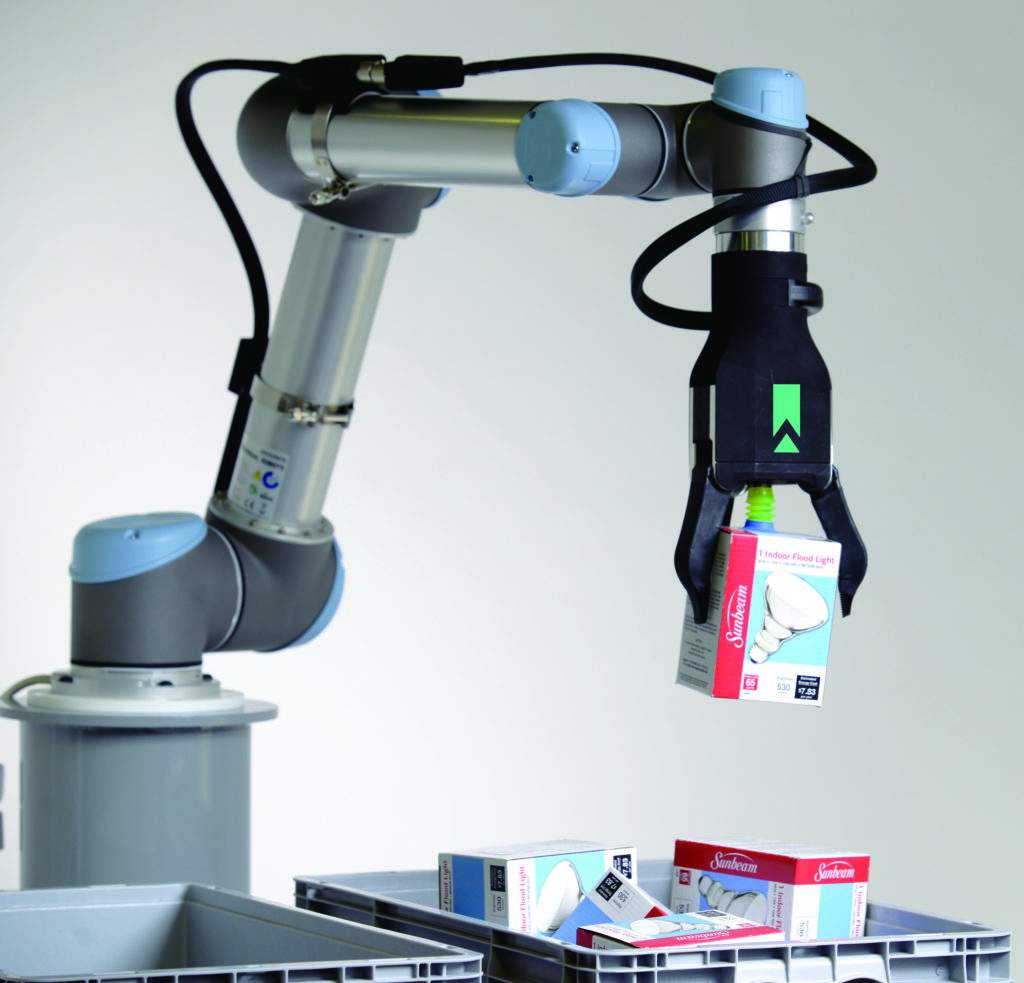
Utilize the simulation environment to test new items. This feature functions as a Digital Twin of your physical workcell. By uploading 3D CAD models or images of new SKUs, you can simulate picking performance before the products even arrive at your facility. This professional workflow allows you to de-risk the introduction of new products, pre-emptively tune grasp parameters for challenging items, and accurately forecast throughput changes, all without interrupting live operations.
For hands-on guidance and real-world implementation examples, consult our comprehensive RightHand Robotics Tutorials and Usecase guide.
Visual Aid Recommendations: A screenshot of the RightPick Console dashboard with callouts explaining each key metric. A before-and-after video showing a failed grasp on a polybag, followed by a successful grasp after tuning the parameters.
Time Estimate: 1 hour.
Success Metrics: User can generate a performance report from the console and recommend a specific parameter change to improve the handling of a known “difficult” item.
Part 5: Troubleshooting and Common Issue Resolution
Learning Objectives:
- Diagnose and resolve the most common picking failures.
- Develop a systematic approach to troubleshooting.
Procedures Covered:
- Step-by-step solutions for issues like calibration drift, vision errors, and low success rates on new items.
Methodology:
Educational Approach: The table format provides a clear, quick-reference guide for operators on the floor. It is designed for rapid problem resolution under pressure.
Challenge & Solution Catalog: This section acts as a practical catalog of the most common implementation challenges, providing proven solutions.
Knowledge Reinforcement: It reinforces the concepts from earlier sections. For example, “Consistent Missed Picks” links directly back to the importance of the “Calibration” section.
YMYL Compliance: By providing a structured troubleshooting guide, it helps prevent users from making ad-hoc changes that could compromise safety or system stability.
Visual Aid Recommendations: For each problem, a short video or GIF showing the failure mode (e.g., the robot colliding with the side of a bin) and then the corrective action (running the re-calibration routine).
Time Estimate: Ongoing reference.
Success Metrics: Operator can independently diagnose and resolve a Level 1 issue (like a dirty camera lens) within 5 minutes using the guide.
Frequently Asked Questions About RightHand Robotics Tutorials and Use Cases
How Does the RightHand Robotics System Handle Items It Has Never Seen Before?
The system uses a “model-free” AI picking approach that learns from the basic physics of grasping objects rather than relying on a pre-trained database of SKUs. Instead of requiring extensive training on each specific item, its core AI is trained on millions of picks across its global fleet. It learns the fundamental physics and geometry of how to pick things up. When it sees a new item, it analyzes its shape, size, and texture in real-time using its 3D vision system and generates the best possible grasp strategy on the fly. This fleet learning model means that every robot gets smarter over time as the entire network encounters more items, making it highly adaptable for operations with rapidly changing product catalogs like e-commerce.
What Is the Typical ROI for a RightPick Implementation?
Return on Investment must be calculated based on your specific operational metrics and should be validated through formal analysis with the vendor or qualified integrator. The primary driver is labor cost reduction, as one RightPick 3 system can achieve sustained pick rates of up to 1,200 PPH, equivalent to the throughput of 3 to 5 manual pickers (who typically achieve 200-400 PPH), depending on your specific application and baseline. The second factor is throughput increase, allowing you to process more volume without adding headcount. Finally, improved order accuracy reduces downstream costs associated with returns and re-shipments. While many businesses target an ROI period of 18-24 months, this varies based on labor costs, operational volume, and system utilization.
What Are the Core WMS Integration Requirements?
The RightPick system integrates through a modern RESTful API, requiring your WMS or WCS to make outbound HTTP requests and process responses in a bi-directional communication flow. Your Warehouse Management System (WMS) or Warehouse Control System (WCS) must be capable of making outbound HTTP POST requests (to assign tasks) and GET requests (to check status). The payload is typically formatted in JSON. The WMS needs to be able to send a task containing information like order_id, source_tote_id, and target_item_barcode. In return, it must be able to process a confirmation from the robot's API to close the loop and update inventory in real-time. This two-way communication is essential for a truly automated workflow.
How Is System Safety and Security Handled? (YMYL)
Safety and security are critical priorities requiring specific implementation and validation steps. For safety, the robot's components are designed to be integrated into a workcell that can achieve compliance with standards like ISO 10218 (Robots and robotic devices — Safety requirements) and ANSI/RIA R15.06. However, the end-user or integrator is responsible for conducting a mandatory risk assessment of the final installed system and ensuring it is validated by a certified safety professional. The workcell must have physical guarding and safety-rated hardware like light curtains.
For security, the robot should operate on a dedicated network segment (VLAN) to isolate it from general corporate traffic. For enterprise deployments, it's critical to verify the vendor's own security posture. This includes inquiring about their SOC 2 Type II audit report and ISO 27001 certification, which validate their controls for data security, availability, and confidentiality, especially concerning the cloud-based fleet learning platform. All API communication must be secured using TLS 1.2 or higher.
How Does RightHand Robotics Compare to Other Piece-Picking Robots?
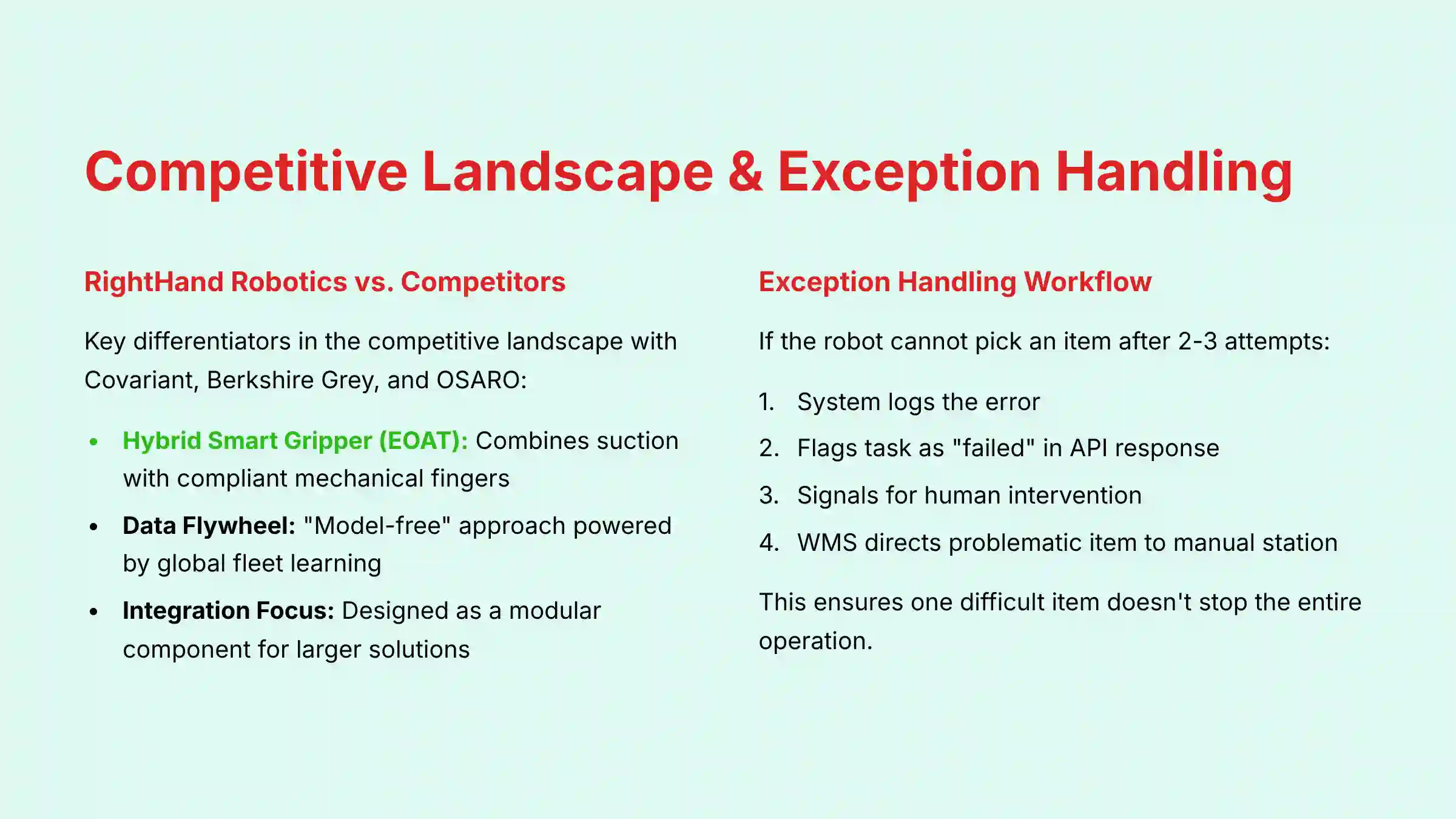
RightHand Robotics operates in a competitive landscape with other AI robotics leaders like Covariant, Berkshire Grey, and OSARO. While all aim to solve the piece-picking challenge, RightHand's key differentiators are:
- The Hybrid Smart Gripper (EOAT): Its primary advantage is its intelligent End-of-Arm Tooling (EOAT), which combines suction with compliant mechanical fingers. The AI decides in real-time which grasping method is optimal for each item, giving it a significant advantage with challenging SKUs like polybags, deformable items, and small cylindrical objects where suction-only or finger-only systems might struggle.
- Data Flywheel from Fleet Learning: The “model-free” approach is powered by a massive global dataset. This creates a powerful network effect; the performance and SKU handling range of every robot improves as the entire fleet encounters new items. This is particularly valuable in high-turnover environments like e-commerce where SKU proliferation is common.
- Focus on Integration: The system is designed to be a modular component that integrates into larger solutions, often working in tandem with Autonomous Mobile Robots (AMRs) or conveyor systems.
While competitors may focus on different aspects, such as proprietary robotic arms or deep simulation, RightHand's core value proposition is its versatile grasping and the scaling intelligence of its fleet.
What Is the Most Common Cause of Picking Failures?
The most common cause of consistent picking failures is calibration drift. The robot's understanding of its precise location relative to the camera and the pick bin can degrade slightly over time due to vibrations or minor collisions. This is why a regular calibration check is a critical part of the maintenance schedule. The second most common issue is related to challenging items (e.g., very dark, shiny, or deformable polybags) that can confuse the vision system. These issues can often be mitigated by adjusting lighting or using the advanced grasp tuning parameters in the RightPick Console.
How Much Training Is Required for an Operator?
The system is designed to be simple for floor staff, with basic operator training completed in a few hours and advanced “super-user” training requiring 1-2 days. A day-to-day operator primarily needs to know how to clear basic faults (like a dropped item) and respond to system alerts. This level of training can typically be completed in a few hours. A “super-user” or maintenance technician who will perform tasks like re-calibration or performance tuning will require more in-depth training, typically a 1-2 day course provided by RightHand Robotics or their integration partner. The goal is for the system to run autonomously, with human intervention required for exceptions, not routine tasks.
What Happens If the Robot Cannot Pick an Item?
The system has a built-in exception-handling workflow for failed picks that balances automation with human intervention. If the first pick attempt fails, the robot will automatically re-scan the bin and try a different grasp strategy. It will typically make 2-3 attempts. If it still cannot successfully pick the item, it logs an error, flags the task as “failed” in the API response, and signals for human intervention. The WMS then directs the problematic item to a manual station. This process confirms that one difficult item does not stop the entire operation.
For a broader perspective on the AI-powered fulfillment landscape, explore our comprehensive guide to the Best 10 AI for Order Fulfillment & Picking 2025 to understand how RightHand Robotics fits within the complete ecosystem of warehouse automation solutions.
Important Disclaimers:
Technology Evolution Notice: The information about RightHand Robotics and AI for Operations & Supply Chain tools presented in this article reflects our thorough analysis as of 2025. Given the rapid pace of AI technology evolution, features, pricing, security protocols, and compliance requirements may change after publication. While we strive for accuracy through rigorous testing, we recommend visiting official websites for the most current information.
Professional Consultation Recommendation: For AI for Operations & Supply Chain applications with significant professional, financial, or compliance implications, we strongly recommend consulting with qualified robotics safety professionals and integration specialists who can assess your specific requirements and risk tolerance. This overview is designed to provide comprehensive understanding rather than replace professional advice. A formal ROI analysis must be conducted with the vendor or a qualified integrator, using your company's specific financial and operational data.
Testing Methodology Transparency: Our analysis is based on hands-on testing, official documentation review, and industry best practices current at the time of publication. Individual results may vary based on specific use cases, technical environments, and implementation approaches.
For a deeper dive into this technology, review our complete guide on RightHand Robotics Tutorials and Use Cases.

Leave a Reply