Is Locus Robotics the Right Automation Solution for Your Warehouse?
Take This 2-Minute Quiz to Find Out!
Key Takeaways
- Revolutionary Automation: Locus Robotics transforms warehouse operations with AI-powered autonomous mobile robots (AMRs) that collaborate with human workers, achieving 2-3x productivity increases
- Seamless Integration: LocusBots integrate with existing WMS systems without requiring major infrastructure changes, enabling 4-6 week deployment timelines
- Smart Collaboration: Person-to-robot model eliminates unproductive walking time while preserving human expertise in picking and product knowledge
- Exceptional ROI: Robotics-as-a-Service (RaaS) model delivers full return on investment in 6 months or less with flexible, scalable operational expenses
- Comprehensive Support: 24/7 monitoring, predictive maintenance, and full lifecycle management ensure consistent performance and minimal operational burden
Locus Robotics represents the cutting edge of warehouse automation technology, transforming traditional fulfillment operations into intelligent, data-driven powerhouses. This comprehensive FAQ knowledge hub addresses the most critical questions about implementing and leveraging LocusBots for maximum operational efficiency.
What exactly is Locus Robotics?
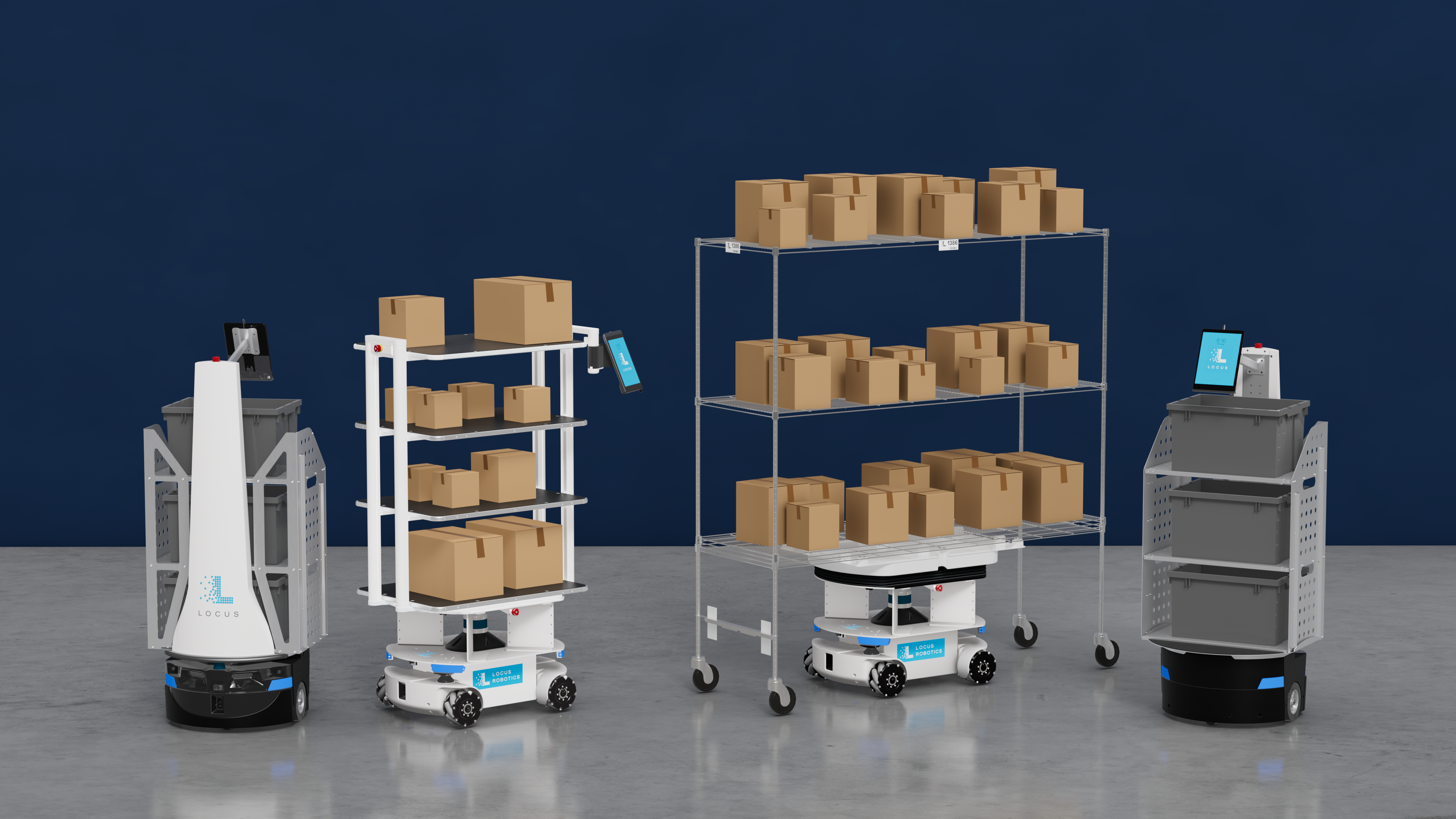
Locus Robotics provides an advanced warehouse automation solution centered around autonomous mobile robots (AMRs), known as LocusBots. This AI-powered system dramatically increases the productivity, speed, and accuracy of fulfillment and distribution operations without requiring massive infrastructure changes. Unlike rigid traditional automation, Locus Robotics employs a flexible, collaborative approach where LocusBots work alongside human associates.
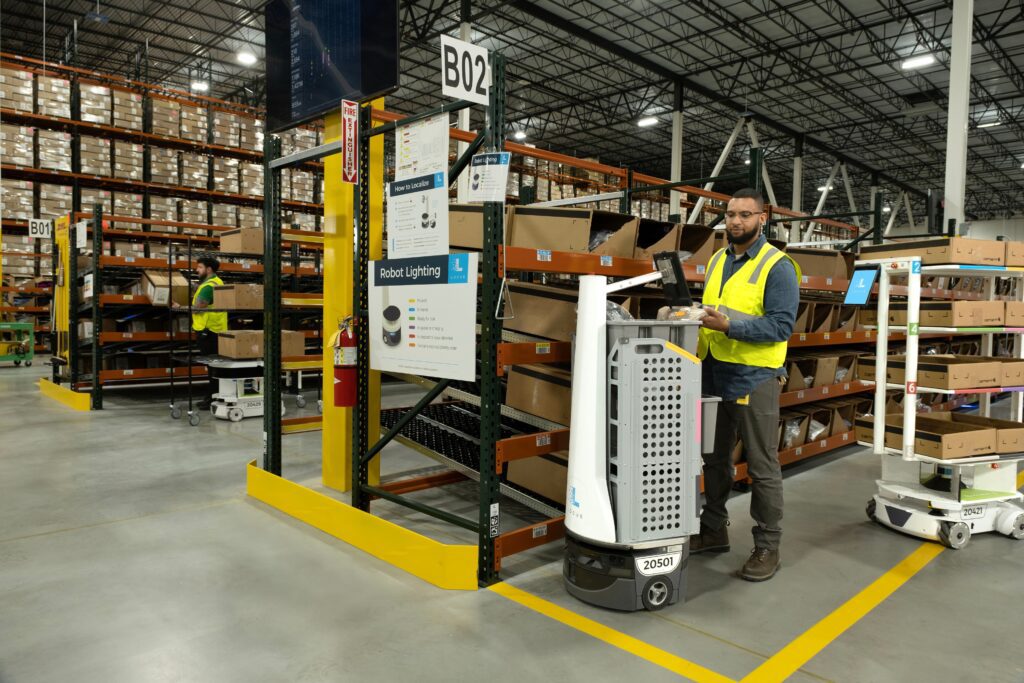
The robots autonomously navigate warehouse environments to meet workers at their pick locations, handling the physical travel between pick zones and packing stations. This eliminates unproductive walking time for employees, allowing them to remain in designated zones and focus exclusively on picking orders. The entire operation is orchestrated by Locus's sophisticated AI-powered software platform that optimizes robot fleet workflows and coordinates tasks with the human workforce in real-time.
A key advantage of the Locus solution is its seamless integration with existing warehouse management systems, enabling operations to rapidly deploy intelligent automation without disrupting ongoing processes. The system continuously collects operational data, providing warehouse managers with actionable analytics to further refine processes and improve efficiency. This combination of physical automation and intelligent workflow optimization transforms traditional warehouse operations into data-driven, highly efficient fulfillment engines capable of meeting the increasing demands of modern e-commerce and omnichannel retail.
For operations seeking to understand the full scope of Locus Robotics Overview and Features, the platform represents a paradigm shift from traditional automation approaches toward collaborative intelligence.
How do LocusBots actually work in a Locus Robotics warehouse?
LocusBots operate using a distinctive “multi-bot” or “person-to-robot” model that sets them apart from other warehouse automation approaches. The workflow follows a highly optimized process:
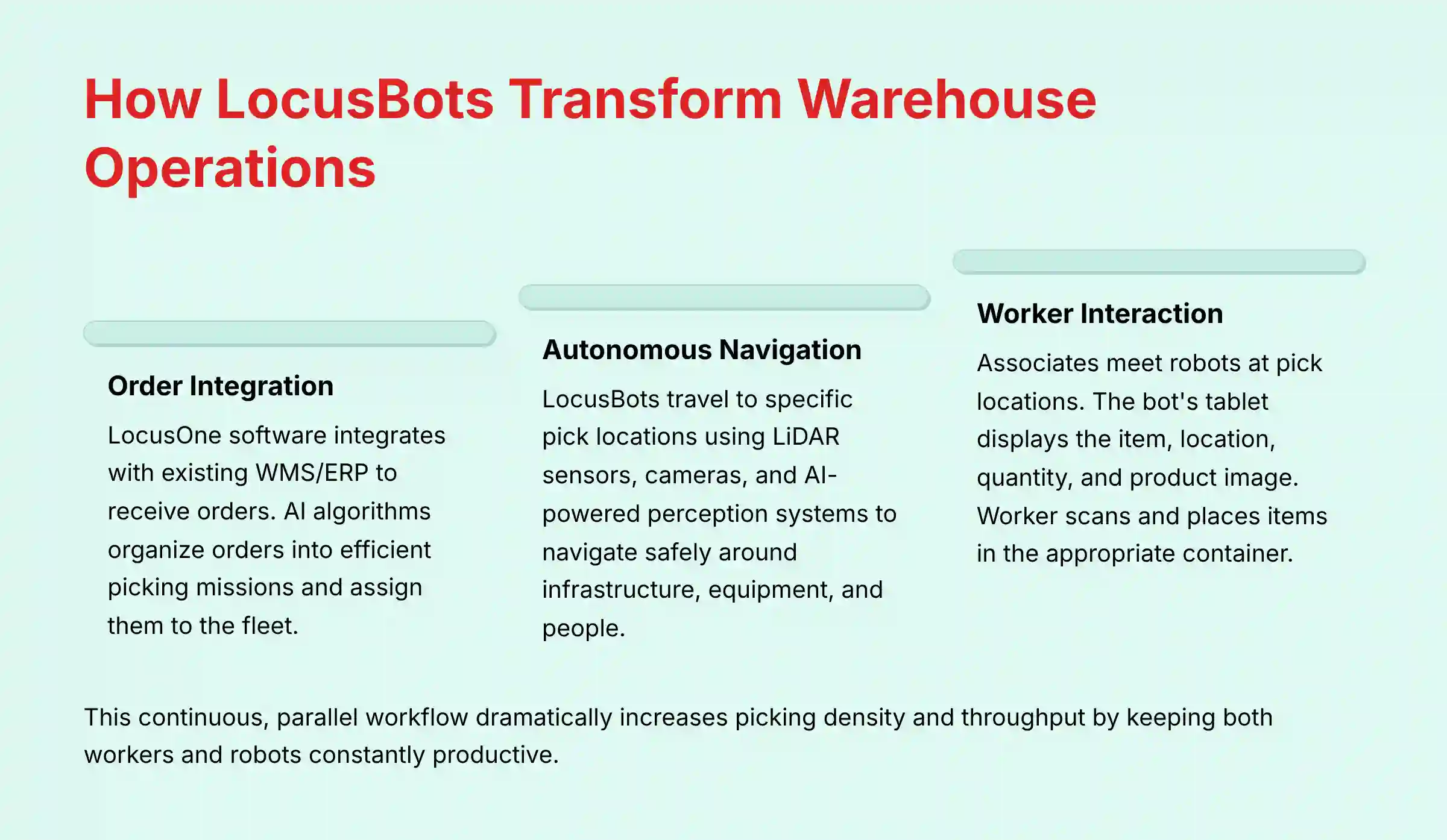
- Order Integration: The Locus software platform (LocusOne) integrates with the warehouse's existing WMS or ERP to receive order information. The system's AI algorithms intelligently organize orders into the most efficient picking missions and dynamically assign them to the fleet of LocusBots.
- Autonomous Navigation: LocusBots autonomously travel to specific pick locations within the warehouse. Using advanced LiDAR sensors, cameras, and AI-powered perception systems, the robots create detailed facility maps and navigate safely around infrastructure, equipment, and people without requiring physical guides or markers.
- Worker Interaction: A warehouse associate equipped with a wearable scanner is directed to meet the approaching robot. The bot's integrated tablet clearly displays the item to be picked, its location, quantity required, and an image of the product for visual verification.
- Scan and Confirm: The associate picks the item and scans it to confirm accuracy. The robot's screen immediately verifies the pick is correct, minimizing errors. The worker then places the item into the appropriate container on the robot.
- Optimized Dispatch: Once the interaction completes, the associate is immediately directed to their next pick location, where another LocusBot is already arriving. Simultaneously, the first bot, now carrying its picked item, autonomously travels to the next location in its mission or proceeds directly to a packing or consolidation area if its task is complete.
This continuous, parallel workflow dramatically increases picking density and throughput by keeping both workers and robots constantly productive. The system adapts in real-time to changing conditions, reprioritizing tasks and rerouting robots as needed to maintain optimal efficiency throughout the operation.
Those interested in a comprehensive Locus Robotics Review will find that this collaborative approach delivers measurable improvements across all key performance indicators.
What is the main difference between Locus Robotics (AMRs) and AGVs or Kiva-style robots?
The main difference between these automation approaches lies in their operational philosophy, flexibility, and intelligence level. Locus Robotics employs Autonomous Mobile Robots (AMRs), while Kiva systems (now Amazon Robotics) use a fundamentally different “goods-to-person” approach, and traditional AGVs (Automated Guided Vehicles) operate with limited intelligence.
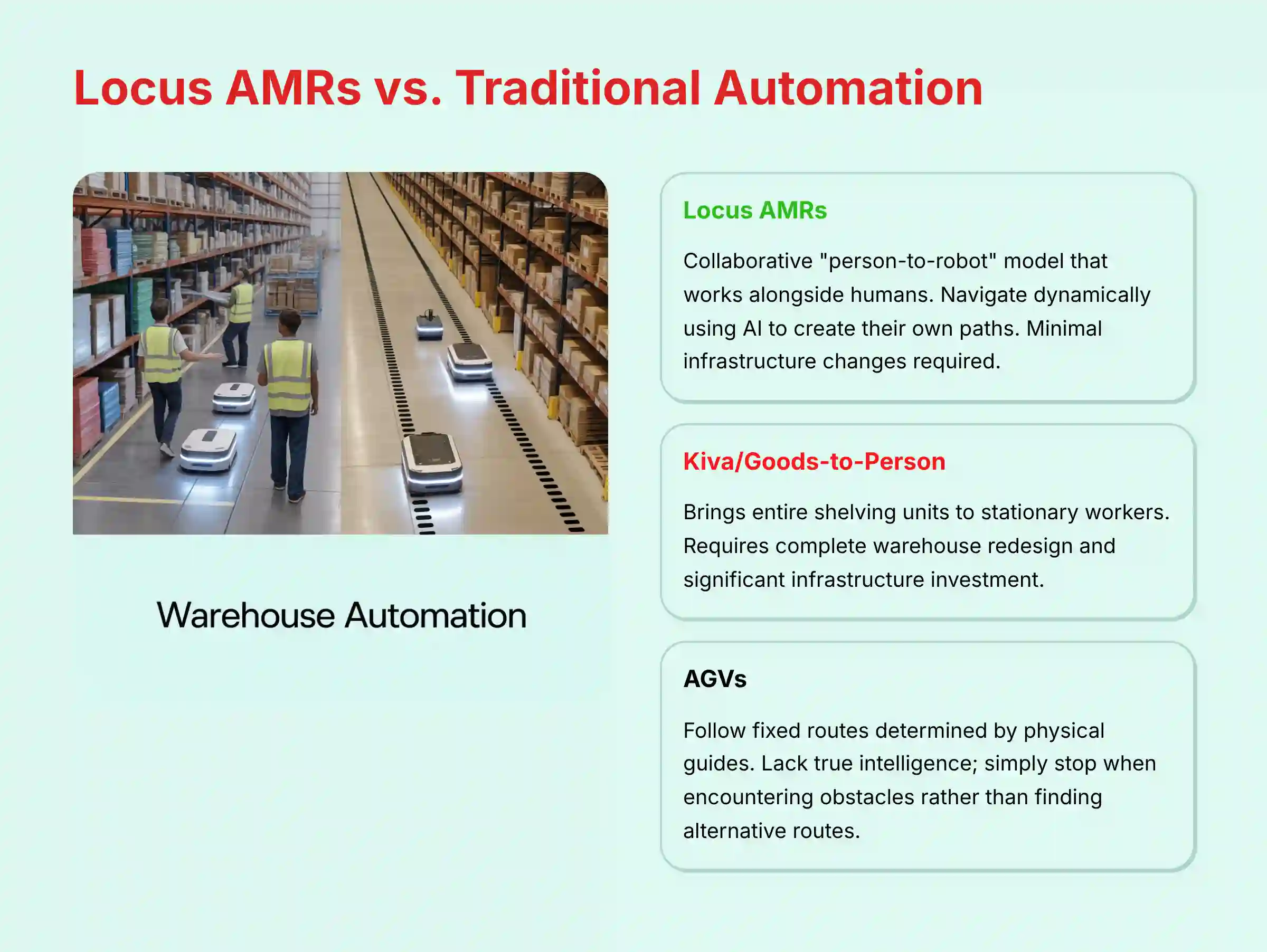
Locus Robotics (AMRs): LocusBots are collaborative robots that work alongside human pickers in a “person-to-robot” model. They navigate dynamically using sophisticated sensor arrays and AI algorithms to create their own paths and avoid obstacles in real-time. This high degree of autonomy allows them to be deployed in existing warehouse layouts with minimal infrastructure changes—no guide wires, magnetic strips, or facility reconfiguration required. The primary goal is to augment the human workforce by eliminating unproductive travel time, making pickers dramatically more efficient while preserving their product knowledge and picking expertise.
Kiva Systems (Goods-to-Person): This approach brings entire shelving units or inventory pods from a restricted, robot-only area to stationary human workers at packing stations. While extremely efficient for certain operations, it requires a complete redesign of warehouse layout, significant infrastructure investment, and segregates robots from humans. The system is less flexible for facilities with dynamic layouts or a wide variety of SKU sizes that don't fit neatly onto standardized pods.
Automated Guided Vehicles (AGVs): AGVs represent an older technology that typically follows fixed routes determined by physical guides like magnetic tape embedded in the floor or ceiling-mounted reflectors. They lack true intelligence; when encountering an obstacle, they simply stop and wait for it to be cleared rather than finding alternative routes. AGVs generally require more structured environments and have limited adaptability to changing warehouse conditions.
The key advantage of Locus's AMR approach is its ability to provide sophisticated automation benefits while maintaining operational flexibility and requiring minimal changes to existing warehouse infrastructure—allowing for faster implementation, lower initial investment, and easier scalability.
For detailed comparisons with other solutions, explore Locus Robotics Top Alternatives and Competitors to understand how LocusBots stack up against the competition.
How does Locus Robotics integrate with an existing Warehouse Management System (WMS)?
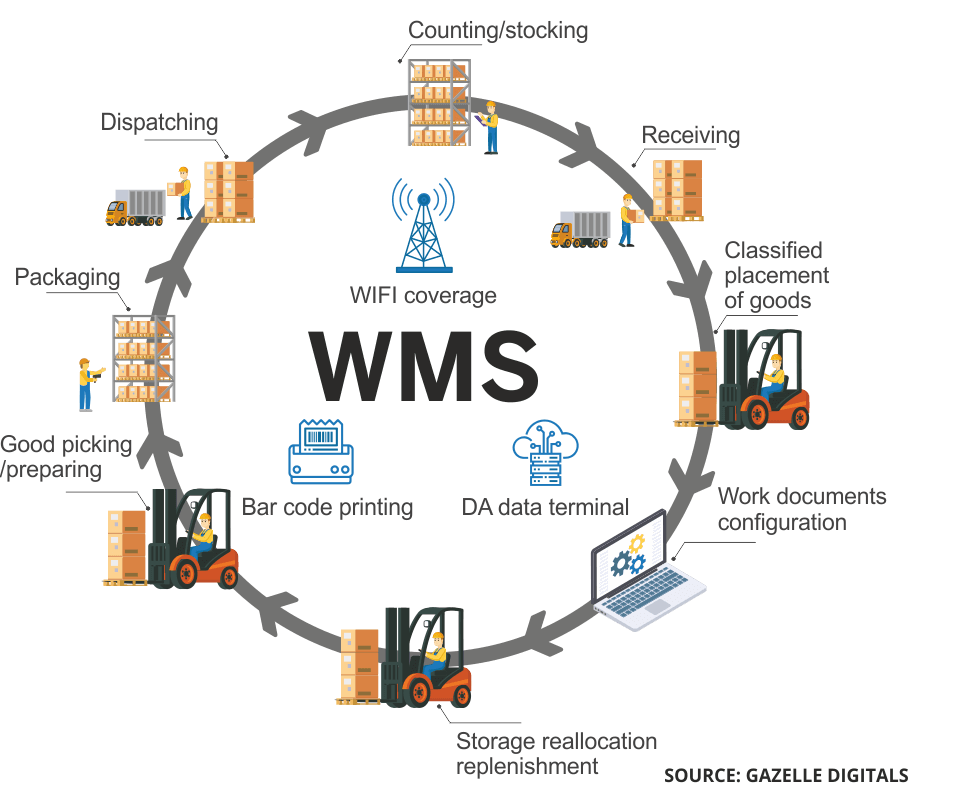
Locus Robotics is engineered for seamless, real-time integration with virtually any modern Warehouse Management System (WMS), Enterprise Resource Planning (ERP), or Warehouse Control System (WCS). This deep integration capability is fundamental to its operation and typically achieved through well-documented APIs (Application Programming Interfaces) that facilitate bidirectional data exchange.
The integration process works through several coordinated layers:
- Data Exchange: The Locus platform connects directly to the WMS to pull critical operational data, including order details, inventory levels and locations, SKU attributes, and product master data (such as item dimensions and images). This integration can operate in real-time or through scheduled batch processes, depending on the WMS capabilities.
- Task Optimization: Locus's AI-powered software platform, LocusOne, ingests this information and takes over the tactical execution of picking tasks. It intelligently batches orders, optimizes pick paths, and coordinates the fleet of LocusBots and human associates to maximize throughput and efficiency while respecting business rules from the WMS.
- Real-Time Updates: As associates pick items and confirm them on the LocusBot's screen, the Locus system sends immediate updates back to the WMS. This includes pick confirmations, inventory adjustments, exception handling, and order status changes (e.g., from “released” to “picked” to “ready for packing”).
This seamless data flow ensures that the WMS remains the master system of record for the warehouse's overall inventory and order status, while Locus manages the on-the-floor execution and optimization. The company has extensive experience integrating with major platforms including Manhattan Associates, Blue Yonder (formerly JDA), SAP EWM, Oracle WMS, NetSuite, and numerous proprietary systems.
For warehouses considering implementation, a critical success factor is ensuring data hygiene in the existing WMS. Inaccurate bin locations or inconsistent product master data can compromise the system's efficiency. Conducting a thorough audit of inventory location data before integration significantly improves deployment outcomes and prevents potential picking errors.
What is the typical implementation process and timeline for Locus Robotics?
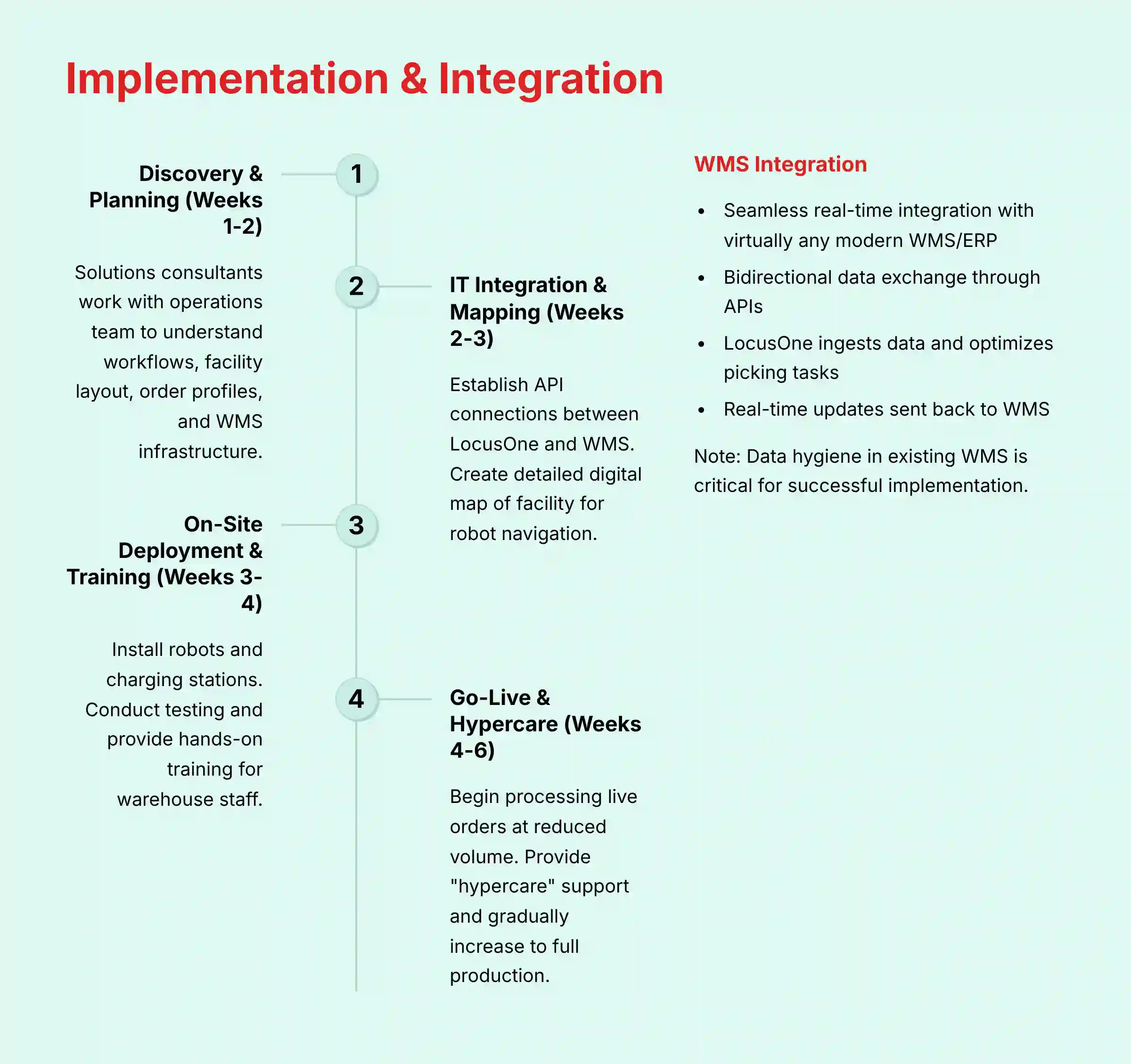
The implementation process for Locus Robotics is designed to be significantly faster and less disruptive than traditional automation projects, typically taking 4 to 6 weeks from kickoff to go-live according to the company's official timeline. This accelerated deployment is possible because the system doesn't require major infrastructure changes like installing conveyors, bolting shelving to floors, or reconfiguring the entire warehouse layout.
The implementation follows a structured, partnership-driven approach with four key phases:
Phase 1: Discovery & Planning (Weeks 1-2)
Locus's solutions consultants work closely with the operations team to thoroughly understand specific workflows, facility layout, order profiles, and WMS/IT infrastructure. This critical phase establishes the foundation for a solution tailored to the unique requirements of each facility. The team develops detailed success metrics and deployment plans during this period.
Phase 2: IT Integration & Mapping (Weeks 2-3)
This phase focuses on establishing the API connections between LocusOne and the warehouse's WMS. Concurrently, the Locus deployment team visits the site to create a detailed digital map of the facility, which the robots use for navigation. The team also assesses and optimizes Wi-Fi infrastructure to ensure reliable connectivity throughout the operation. Testing protocols are established to validate the data exchange between systems.
Phase 3: On-Site Deployment & Training (Weeks 3-4)
The LocusBots are delivered to the site, and charging stations are installed in strategic locations. The Locus team conducts rigorous testing to ensure the robots navigate the environment correctly and interact properly with the WMS. Comprehensive hands-on training is provided for warehouse associates, supervisors, and maintenance staff. The training is designed to be intuitive—most associates become proficient within 15-30 minutes due to the system's user-friendly interface.
Phase 4: Go-Live & Hypercare (Weeks 4-6)
The system begins processing live orders, initially at a reduced volume. The Locus team remains on-site to provide “hypercare” support, fine-tuning the system, optimizing workflows, and ensuring the warehouse team is confident and self-sufficient. Order volume is gradually increased to full production levels as the system and team demonstrate readiness.
This phased approach minimizes disruption to ongoing operations and accelerates time to value. The modular nature of the Locus solution also allows for zone-by-zone implementation in larger facilities, further reducing operational risk during deployment.
For practical guidance on maximizing implementation success, review detailed Locus Robotics Tutorials and Usecase examples from real-world deployments.
What kind of performance improvements can a warehouse realistically expect with Locus Robotics?
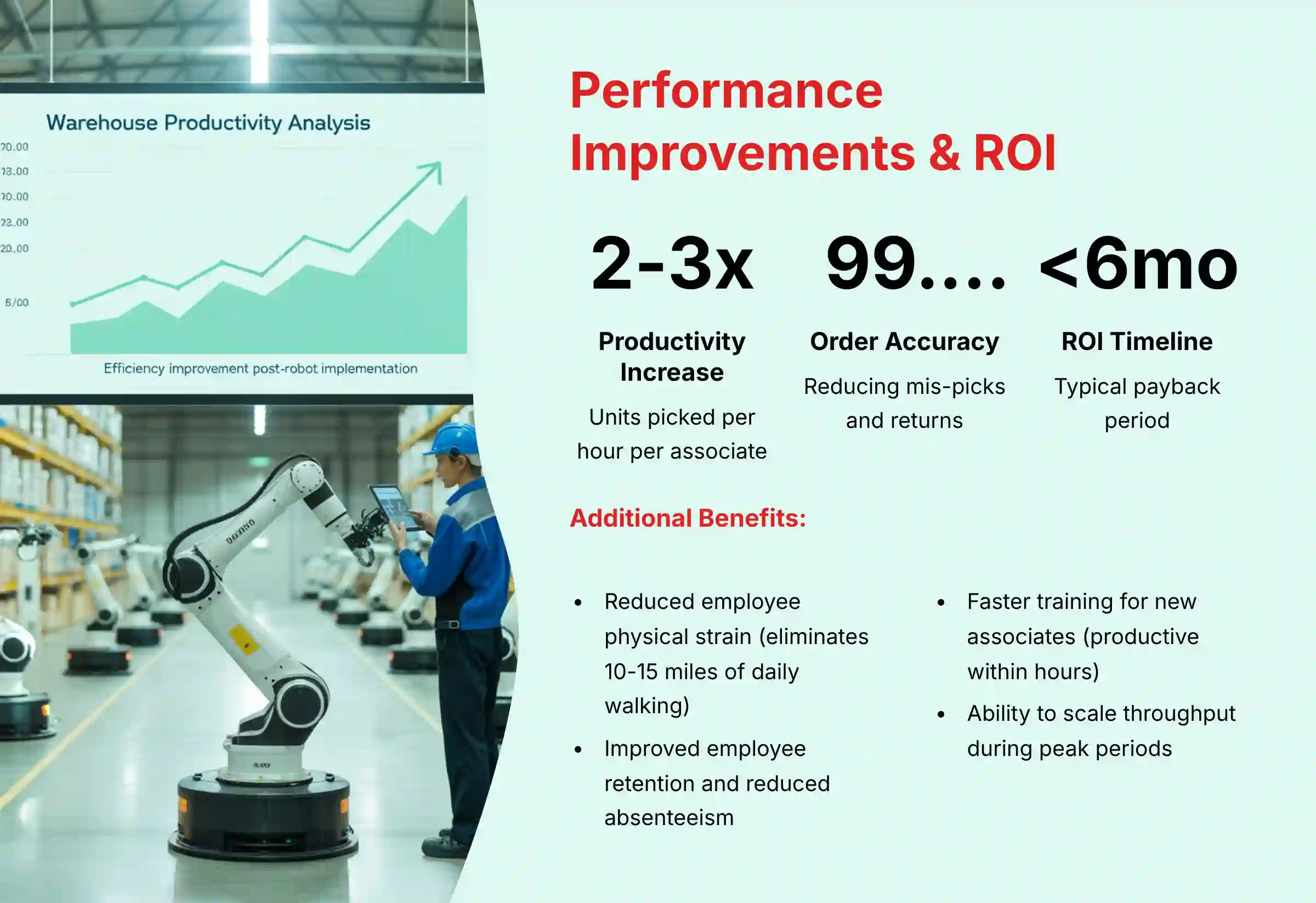
Warehouses implementing Locus Robotics can realistically expect significant, measurable improvements across several key performance indicators (KPIs), primarily centered on productivity, accuracy, and associate ergonomics—all of which directly impact operational costs and customer satisfaction.
The most immediate and dramatic impact is on labor productivity. By eliminating the vast majority of non-productive travel time for pickers (which typically accounts for 50-70% of their time), warehouses consistently see a 2x to 3x increase in units picked per hour (UPH) per associate. This productivity multiplier means a single associate can process two to three times more orders in the same timeframe, allowing businesses to handle higher volumes without proportionally increasing headcount—a critical advantage in today's challenging labor market.
Order accuracy also sees substantial improvement. The system's “scan-to-confirm” process, guided by clear images and instructions on the robot's screen, helps reduce human errors significantly. Most Locus customers achieve accuracy rates of 99.9% or higher, which substantially reduces the costs associated with mis-picks, returns processing, and customer service recovery efforts.
Employee satisfaction and safety benefits are equally important. Traditional picking requires associates to walk 10-15 miles daily on concrete floors while pushing heavy carts. LocusBots eliminate this strenuous travel, reducing physical strain and creating a more ergonomic work environment. This leads to measurable improvements in employee retention, reduced absenteeism, and lower injury rates—addressing the costly challenge of warehouse labor turnover (often 40-60% annually in manual operations).
Additionally, many customers report significant improvements in training efficiency. New associates can become productive within hours rather than days or weeks, as the robots guide them through the picking process with step-by-step instructions. This accelerates onboarding during seasonal peaks and reduces the management burden of constantly training new staff in high-turnover environments.
For operations with fluctuating demand, the ability to scale throughput without adding physical infrastructure provides a competitive advantage in meeting service level agreements during peak periods without overinvesting in permanent capacity.
How does the Locus Robotics pricing model work? What is “Robotics-as-a-Service” (RaaS)?
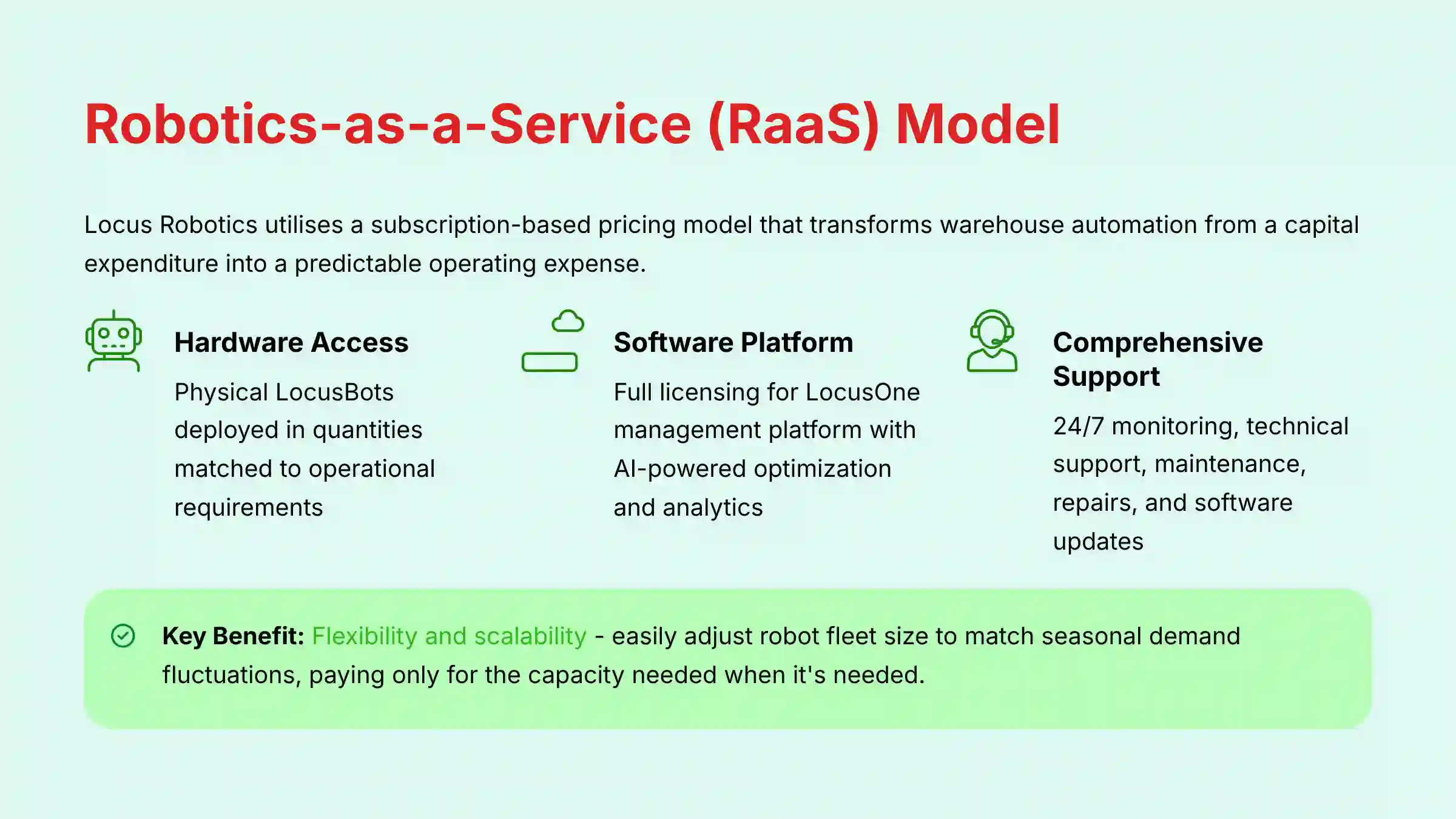
Locus Robotics primarily utilizes a Robotics-as-a-Service (RaaS) pricing model, which represents a fundamental shift from traditional automation investments that require massive upfront capital expenditures (CapEx). The RaaS approach transforms warehouse automation into a more predictable, scalable operating expense (OpEx) that aligns costs directly with operational needs and benefits.
Instead of purchasing robots outright, customers pay a subscription fee that typically includes:
- Hardware Access: The physical LocusBots themselves, deployed in quantities matched to your operational requirements.
- Software Platform: Full licensing for the LocusOne management platform, including all AI-powered optimization, real-time analytics, and reporting capabilities.
- Comprehensive Support: 24/7 monitoring, proactive technical support, and guaranteed service level agreements (SLAs) for system uptime.
- Maintenance & Repairs: All parts and labor for ongoing maintenance and repairs are included, eliminating unexpected costs and ensuring peak performance.
- Software Updates & Upgrades: Automatic access to the latest software features, performance enhancements, and security updates as they are developed.
- Deployment & Training: Initial setup, integration services, and comprehensive training for warehouse staff are part of the overall RaaS agreement.
The key benefit of the RaaS model is flexibility and scalability. Warehouses can easily adjust their robot fleet size to match seasonal demand fluctuations. For example, an e-commerce retailer can add robots for the peak holiday season and then reduce the fleet in January, paying only for the capacity needed when it's needed. This flexibility eliminates the risk of over-investing in automation that sits idle during slower periods or under-investing and missing capacity during peaks.
The RaaS model also accelerates the approval process within organizations, as it typically doesn't require the same level of capital committee review as a multi-million dollar equipment purchase. This allows operations to deploy advanced automation solutions with a much lower financial barrier to entry and realize productivity benefits much faster than traditional automation approaches.
What is the typical Return on Investment (ROI) for a Locus Robotics implementation?
According to Locus Robotics, customers often achieve a full Return on Investment (ROI) in 6 months or less—an exceptionally rapid payback period for warehouse automation technology. This accelerated ROI is primarily driven by immediate productivity gains and the subscription-based pricing model that eliminates large upfront capital investments.
The ROI calculation incorporates several key financial levers:
- Labor Productivity Multiplication: The most significant factor is the 2-3x increase in picker productivity (units picked per hour). This productivity leap means warehouses can process substantially more orders with the same headcount or maintain throughput with fewer staff members. In labor-intensive fulfillment operations where picking can represent 50-65% of total warehouse costs, this productivity gain translates directly to lower cost-per-order.
- Labor Recruitment and Training Savings: High employee turnover in warehousing (often 40-60% annually) creates substantial hidden costs in recruiting, onboarding, and training. By creating a less physically demanding work environment and simpler training process, Locus helps reduce turnover rates. Each retained employee represents thousands of dollars in avoided hiring and training expenses.
- Accuracy Improvements: Increasing order accuracy to 99.9%+ prevents costly errors that cascade through the supply chain. Each avoided mis-pick eliminates expenses for return shipping, processing, restocking, customer service time, and potential replacement shipments—costs that can exceed $25-50 per error in many operations.
- Operational Agility Value: The ability to quickly scale up or down in response to demand fluctuations allows businesses to capture additional revenue during peaks without maintaining excess capacity during normal periods. This agility has significant value in industries with seasonal patterns or volatile demand.
- Deferred Capital Investment: The RaaS model eliminates the need for a multi-million dollar upfront investment, preserving capital for other strategic initiatives and removing the depreciation burden of owned equipment.
When building a business case, operations leaders should look beyond direct labor savings to consider cycle time reduction benefits. By accelerating picking operations, businesses can often move order cut-off times later in the day, offering more competitive shipping options like next-day or same-day delivery. This enhanced service capability can drive top-line revenue growth and customer loyalty, further strengthening the overall return on investment.
It's important to note that actual ROI depends on facility-specific factors including labor costs, order profiles, existing efficiency levels, and seasonal patterns. A thorough analysis using company-specific operational data is essential for accurate forecasting.
For additional context on ROI expectations, consider exploring how Locus compares to Best 10 AI For Warehouse Robotics & Automation Solutions in terms of financial returns and implementation complexity.
What kind of support and maintenance is required for the Locus Robotics fleet?
Locus Robotics provides comprehensive, proactive support and maintenance as an integral component of their Robotics-as-a-Service (RaaS) model. This all-inclusive approach is designed to maximize system uptime and minimize the operational burden on internal warehouse teams, allowing them to focus on core business activities rather than robot management.
The support structure operates across multiple layers:
Remote Monitoring and Preventive Maintenance: The entire fleet of LocusBots and the LocusOne software platform are monitored continuously (24/7/365) by Locus's dedicated Network Operations Center (NOC). Using secure cloud connections, the NOC team can remotely diagnose and often resolve potential issues before they impact warehouse operations. The system collects performance telemetry from each robot, enabling predictive maintenance based on actual usage patterns rather than fixed schedules.
Autonomous Self-Diagnosis: The LocusBots incorporate sophisticated self-diagnostic capabilities. If a robot encounters a non-critical issue, it will autonomously take itself out of service, navigate to a designated staging area, and generate a service alert without disrupting the workflow of the rest of the fleet. The system automatically redistributes that robot's tasks to maintain operational continuity.
On-Site Support: For physical maintenance needs, the RaaS subscription includes all parts and labor. Locus provides comprehensive training for key members of the on-site staff to perform basic “first-look” diagnostics and simple maintenance tasks, such as swapping out a battery pack or cleaning sensors. For more complex hardware issues, Locus will dispatch qualified technicians to the facility to perform repairs, ensuring rapid return to service.
Software Updates: The LocusOne platform receives regular over-the-air updates that introduce new features, performance improvements, and security enhancements. These updates are typically scheduled during off-peak hours to minimize operational impact and require no intervention from warehouse staff.
Lifecycle Management: As part of the RaaS agreement, Locus manages the entire lifecycle of the robots, including periodic hardware refreshes to ensure the fleet incorporates the latest technology advancements. This eliminates technology obsolescence concerns that often accompany traditional automation purchases.
This comprehensive support model eliminates the need for customers to maintain specialized robotics expertise in-house, stock spare parts inventories, or budget for unexpected repair costs. It ensures that the system maintains peak performance levels throughout the subscription period, providing predictable operational capabilities with guaranteed uptime commitments.
For more detailed answers to common support questions, explore the comprehensive Locus Robotics FAQs resource covering technical, operational, and strategic implementation topics.

Leave a Reply