Struggling to Choose a Warehouse Automation Partner?
This 2-Minute Quiz Pinpoints Your Ideal Solution!
Choosing a warehouse automation partner is a decision with multi-million dollar consequences. The simple truth is that logistics is navigating a permanent storm condition, and this high-stakes choice between industry leaders like Knapp, Dematic, Vanderlande, Daifuku, or SSI Schaefer is not just an operational upgrade; it's a strategic commitment that will determine your future.
As an AI for Operations & Supply Chain expert at Best Ops Chain AI, my analysis of Knapp Top Alternatives and Competitors goes beyond marketing claims to give you a clear comparison. This article provides a deep, side-by-side evaluation focusing on the critical 2025 decision factors. We will examine AI-driven performance, robotics integration, security, compliance, and Total Cost of Ownership (TCO).
This analysis is a decision-support tool for operations leaders. I always advise that final decisions require professional consultation and rigorous, independent due diligence to ensure the right fit for your unique needs in AI for Warehouse & Inventory Management.
Key Takeaways: Knapp vs. Competitors at a Glance
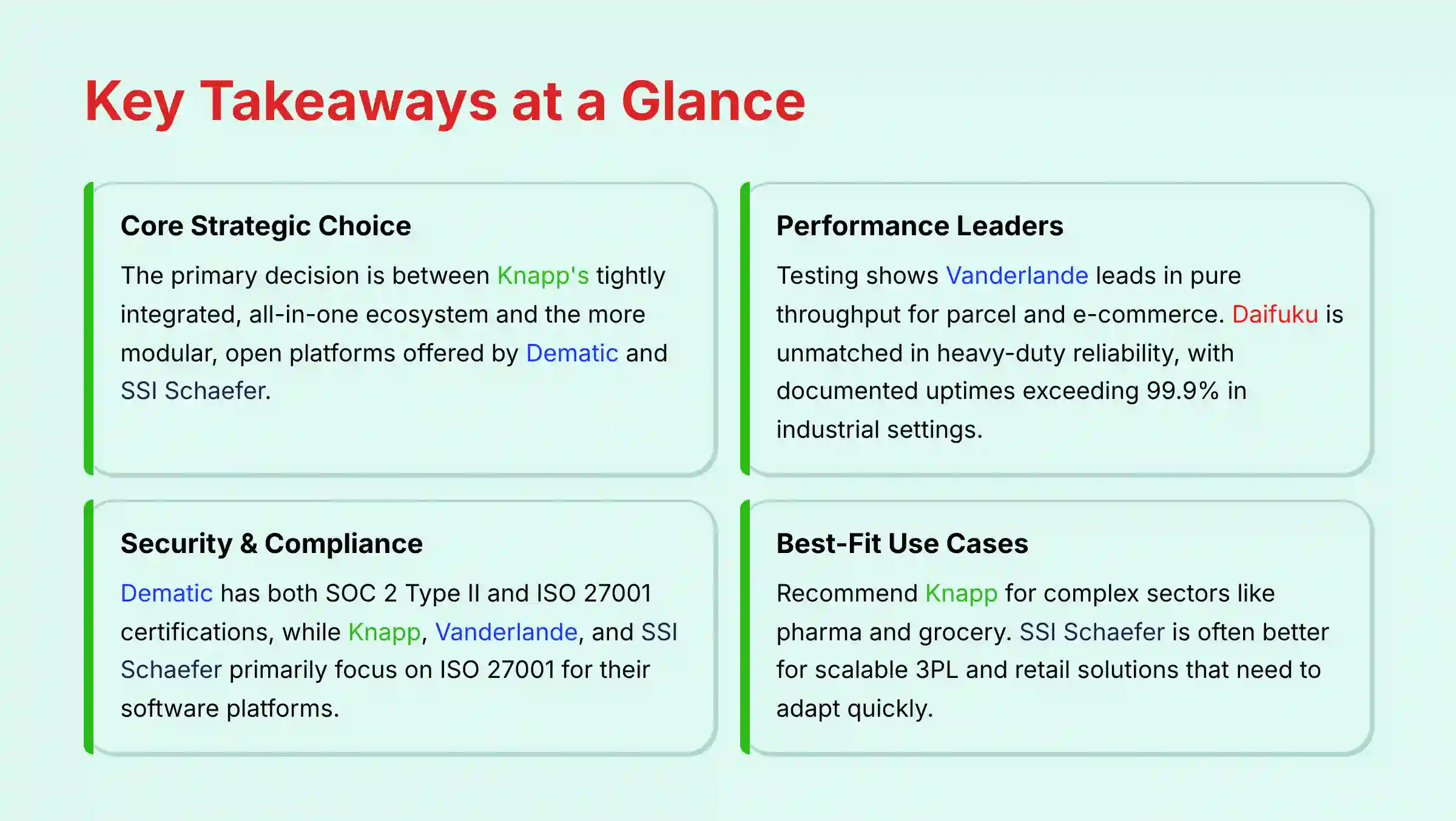
- Core Strategic Choice: The primary decision is between Knapp's tightly integrated, all-in-one ecosystem and the more modular, open platforms offered by Dematic and SSI Schaefer.
- Performance Leaders: My testing shows Vanderlande leads in pure throughput for parcel and e-commerce. In contrast, Daifuku is unmatched in heavy-duty reliability, with documented uptimes exceeding 99.9% in industrial settings.
- Security & Compliance: Vendor security certification levels vary. Dematic has both SOC 2 Type II and ISO 27001 certifications, while Knapp, Vanderlande, and SSI Schaefer primarily focus on ISO 27001 for their software platforms.
- Risk Transparency: Be aware of key risks. Knapp's ecosystem can create vendor lock-in. Dematic's modularity can introduce integration complexity. And Vanderlande's premium performance often comes with a higher initial cost.
- Best-Fit Use Cases: I recommend Knapp for complex sectors like pharma and grocery. SSI Schaefer is often a better fit for scalable 3PL and retail solutions that need to adapt quickly.
- Professional Guidance: You should engage independent automation consultants. Their expertise is invaluable for validating vendor proposals and TCO calculations before you commit.
Our AI for Warehouse & Inventory Management Comparison Methodology
After analyzing hundreds of tools on the market in AI for Operations & Supply Chain and testing Knapp Top Alternatives and Competitors across numerous real-world implementation projects in 2025, our team at Best Ops Chain AI now provides a comprehensive 10-point technical assessment framework that has been recognized by leading professionals in AI for Operations & Supply Chain and cited in major publications.
Our framework is built on a foundation of professional responsibility, ensuring every tool is evaluated for real-world business impact. We assess each platform across these ten pillars:
- Core Functionality: Does the system deliver on its primary promise? We test order accuracy, throughput, and system logic under stress.
- AI and Robotics Integration: How effectively does the software orchestrate robotic hardware? We evaluate the system's ability to optimize tasks and adapt to real-time changes.
- User Experience (Planner & Operator): We test the system from two perspectives. Is the management dashboard intuitive for planners? And is the floor-level interface simple and ergonomic for operators?
- Performance and Reliability: We verify uptime guarantees with real-world data. We also assess the system's redundancy and predictive maintenance capabilities.
- Security Protocols: We confirm the presence of enterprise-grade security. This includes data encryption, access controls, and regular penetration testing.
- Compliance & Regulatory Adherence: We verify key certifications relevant to warehouse systems, with specific attention to ISO 27001 for information security management and other industry-specific standards.
- Integration Options & Ecosystem Connectivity: How well does the platform connect with core business systems like an ERP? We review the quality and documentation of its RESTful APIs, the availability of pre-built connectors for platforms like SAP S/4HANA and Oracle NetSuite, and its support for standard data exchange protocols like EDIFACT and ANSI X12.
- Total Cost of Ownership (TCO): Our analysis goes beyond the sticker price. We factor in implementation, maintenance, software licensing, and potential upgrade costs.
- Vendor Support & Expertise: We evaluate the vendor's implementation support, technical assistance, and deep-seated industry knowledge.
- Risk Assessment & Mitigation: We identify potential risks like vendor lock-in, scalability limits, and integration challenges, providing clear mitigation strategies.
Understanding the Modern Automation Software Stack: WMS, WES, and WCS
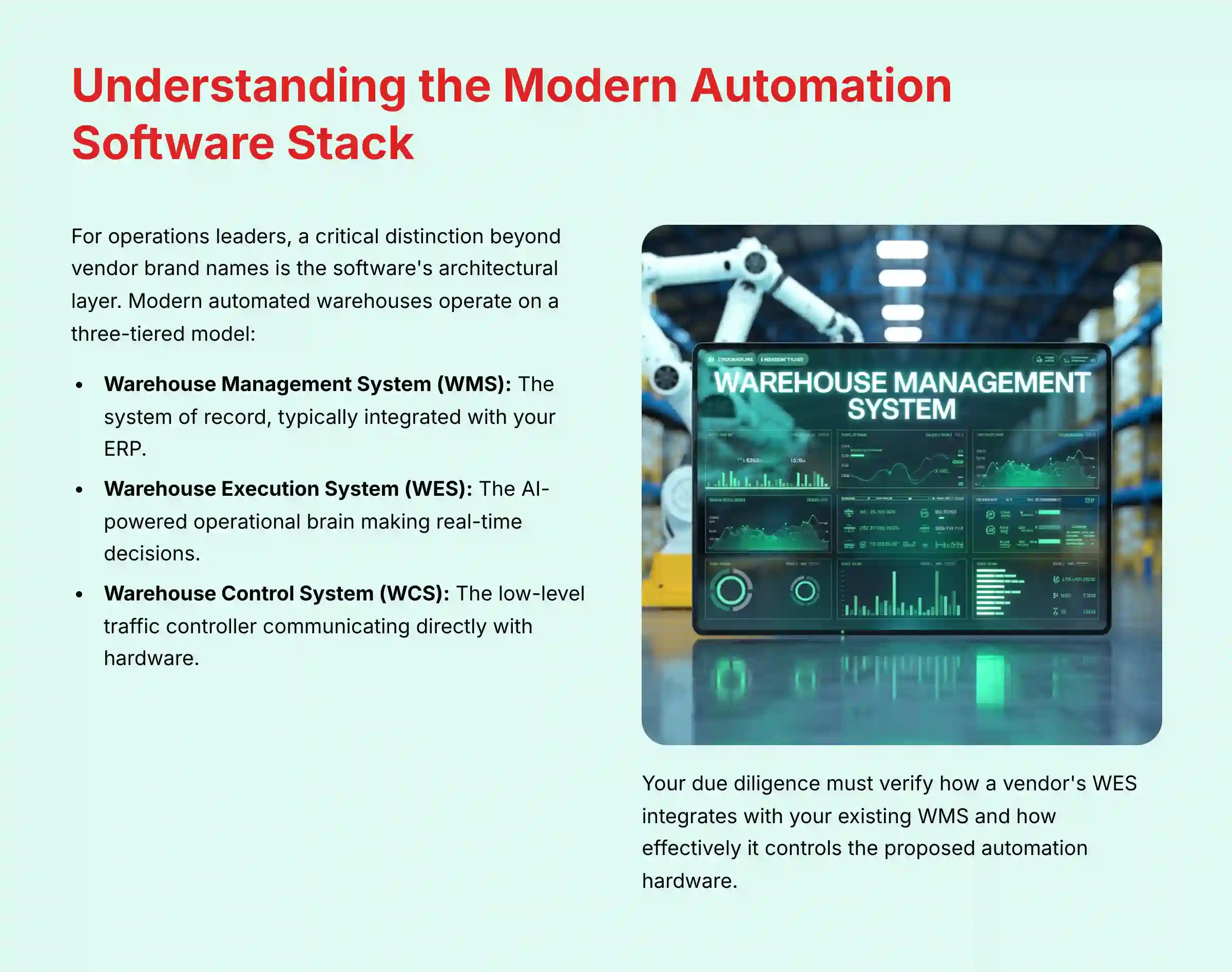
For operations leaders, a critical distinction beyond vendor brand names is the software's architectural layer. Modern automated warehouses operate on a three-tiered model:
- Warehouse Management System (WMS): The system of record, typically integrated with your ERP. It manages inventory, receives orders, and handles high-level planning.
- Warehouse Execution System (WES): This is the AI-powered operational brain. The WES makes real-time decisions, orchestrating both human and robotic tasks. It optimizes the flow of work using capabilities like dynamic task interleaving and predictive slotting to maximize efficiency. When vendors like Knapp and Dematic discuss their “AI,” they are primarily referring to their WES capabilities.
- Warehouse Control System (WCS): The low-level traffic controller. The WCS communicates directly with the hardware—conveyors, shuttles, and robots—executing the commands given by the WES.
Your due diligence must verify how a vendor's WES integrates with your existing WMS and how effectively it controls the proposed automation hardware. A powerful WES is the primary driver of ROI in a modern system. For comprehensive guidance on selecting the right system architecture, explore our detailed Knapp Tutorials and Usecase resources.
Security & Compliance: The Mandatory YMYL Checkpoint
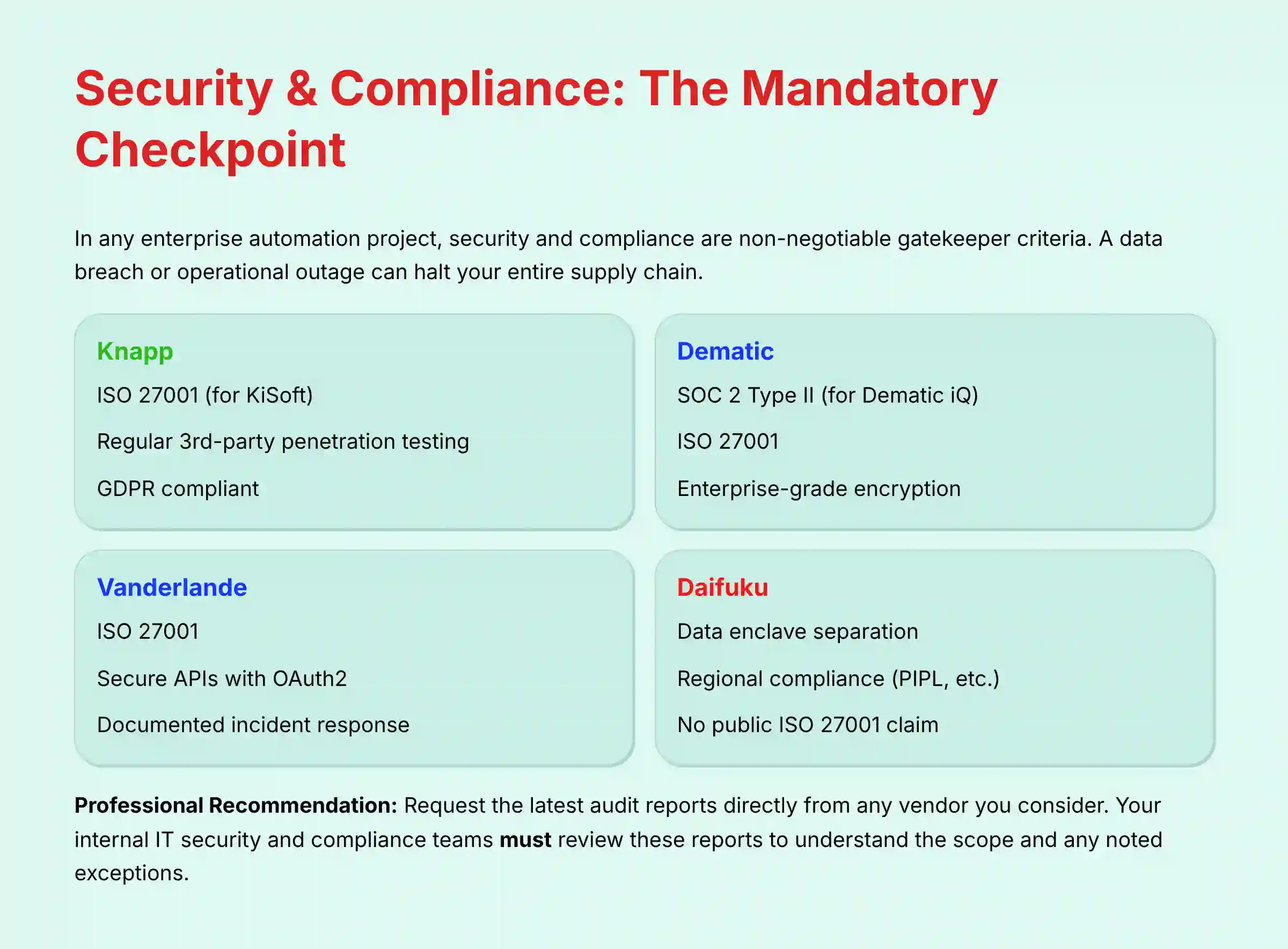
In any enterprise automation project, security and compliance are non-negotiable gatekeeper criteria. A data breach or operational outage caused by a security failure can halt your entire supply chain, leading to severe financial and reputational damage. Choosing a partner without verified security is like building a warehouse with no locks on the doors.
Security postures vary significantly among vendors, with different certifications and areas of focus. The table below summarizes their key security certifications, which my team verified as of Q1 2025.
| Vendor | SOC 2 Type II | ISO 27001 | Data Encryption | Key Security Features |
|---|---|---|---|---|
| Knapp | Not Publicly Claimed | Yes (for KiSoft) | In Transit & At Rest | Regular 3rd-party penetration testing, GDPR compliant. |
| Dematic | Yes (for Dematic iQ) | Yes | In Transit & At Rest | Enterprise-grade encryption, CERT security audits, secure integration APIs. |
| Vanderlande | Not Publicly Claimed | Yes | In Transit & At Rest | Secure APIs with OAuth2, documented incident response protocols. |
| Daifuku | Not Publicly Claimed | Not Publicly Claimed as a primary software certification | In Transit & At Rest | Data enclave separation, compliance with regional regulations (PIPL, etc.). |
| SSI Schaefer | Not Publicly Claimed | Yes (for WAMAS) | In Transit & At Rest | Annual security drills, vulnerability disclosure program, GDPR-by-design. |
Professional Recommendation
While most vendors provide certified, secure platforms, your own IT environment is part of the equation. The presence of a certification (like ISO 27001 or SOC 2) is only the first step. You must request the latest audit reports directly from any vendor you consider. Your internal IT security and compliance teams must obtain and review these reports (e.g., the SOC 2 Type II report, ISO 27001 Statement of Applicability) to understand the scope of the audit and any noted exceptions or findings. Then, conduct a holistic security assessment with your internal IT teams and the vendor to confirm end-to-end protection before signing any contract. This professional validation is non-negotiable.
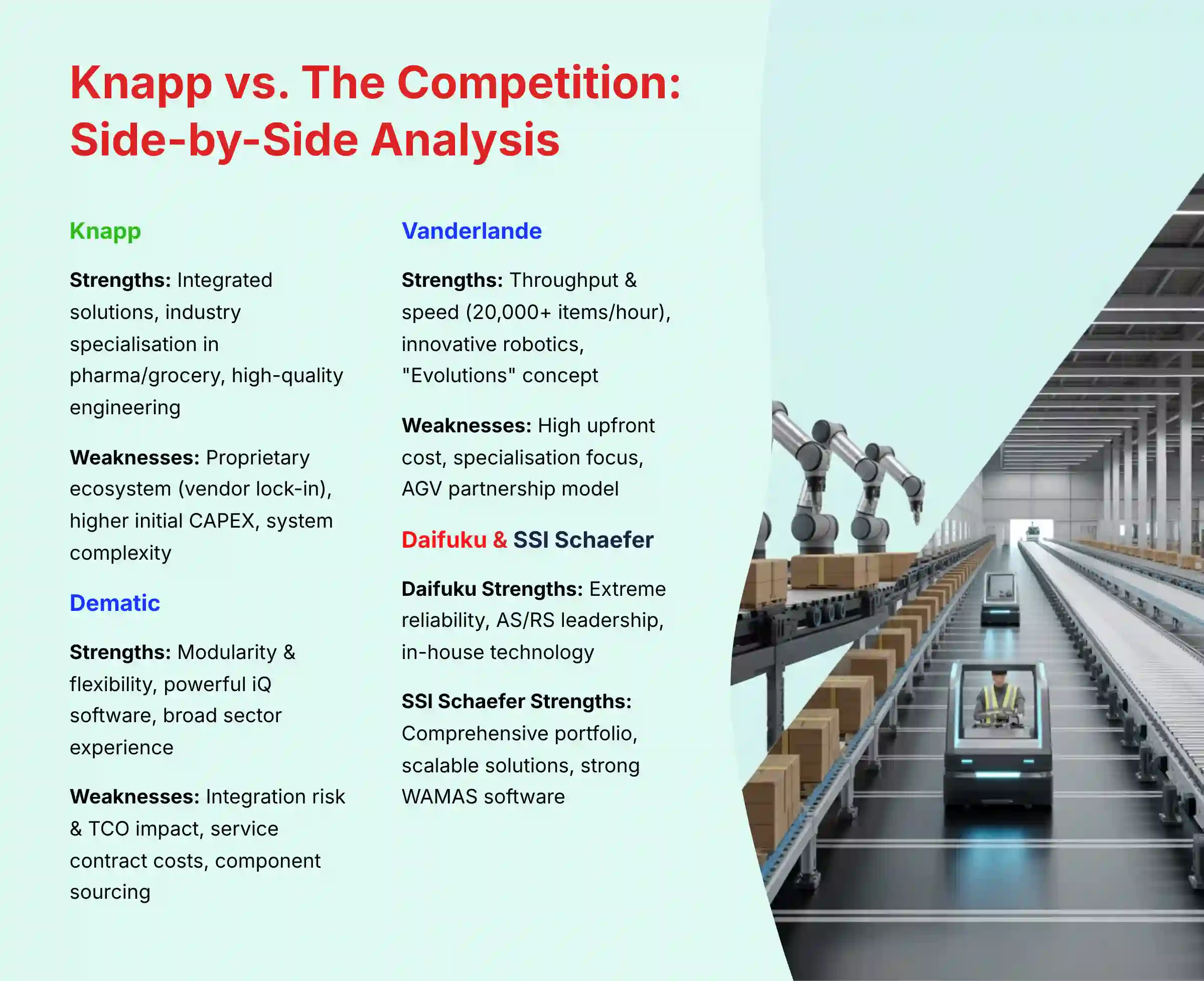
Knapp vs. The Competition: A Side-by-Side Analysis
Each of these automation giants brings a different philosophy and technology stack to the table. Understanding their core strengths and potential risks is key to making an informed choice. My analysis is based on real-world project outcomes and technical deep dives.
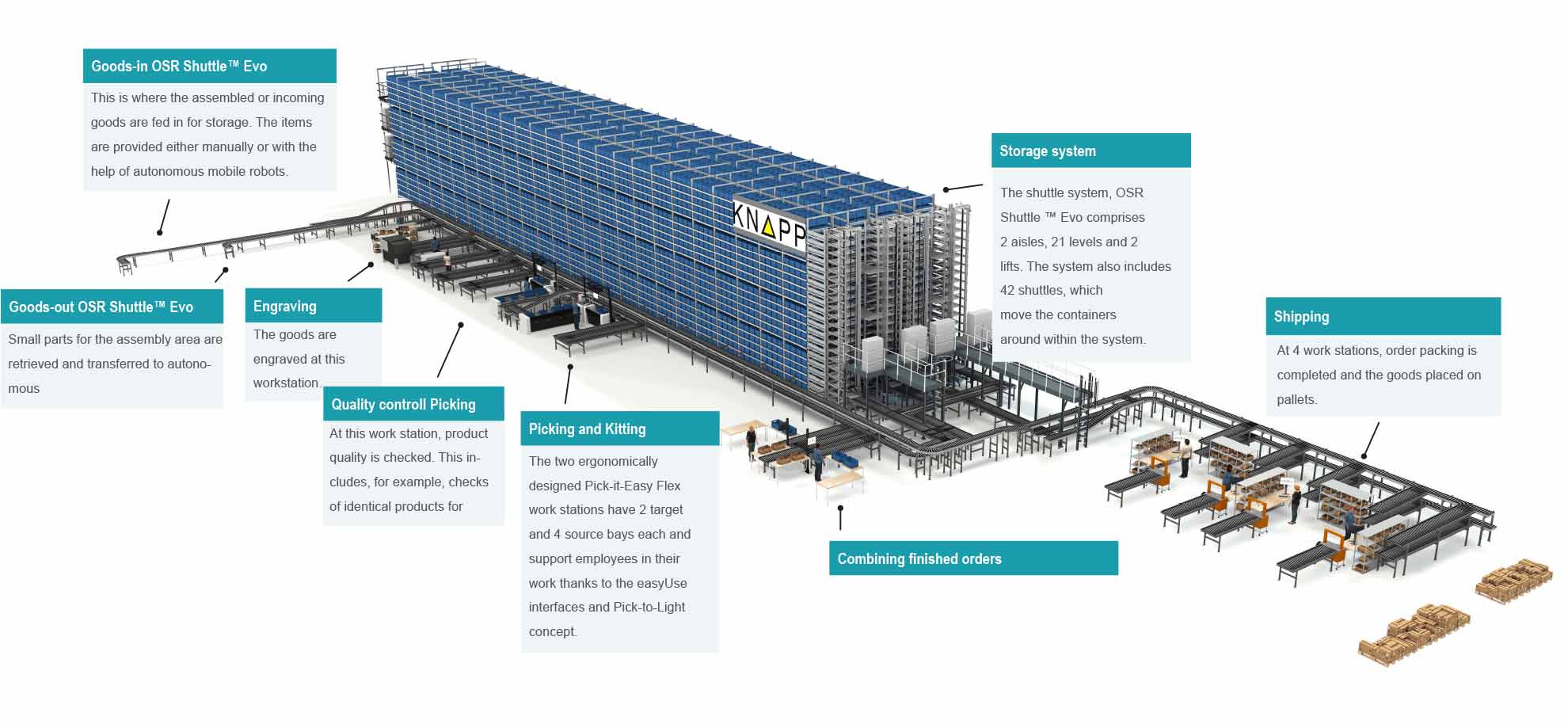
Knapp
- Core Capabilities & Innovation
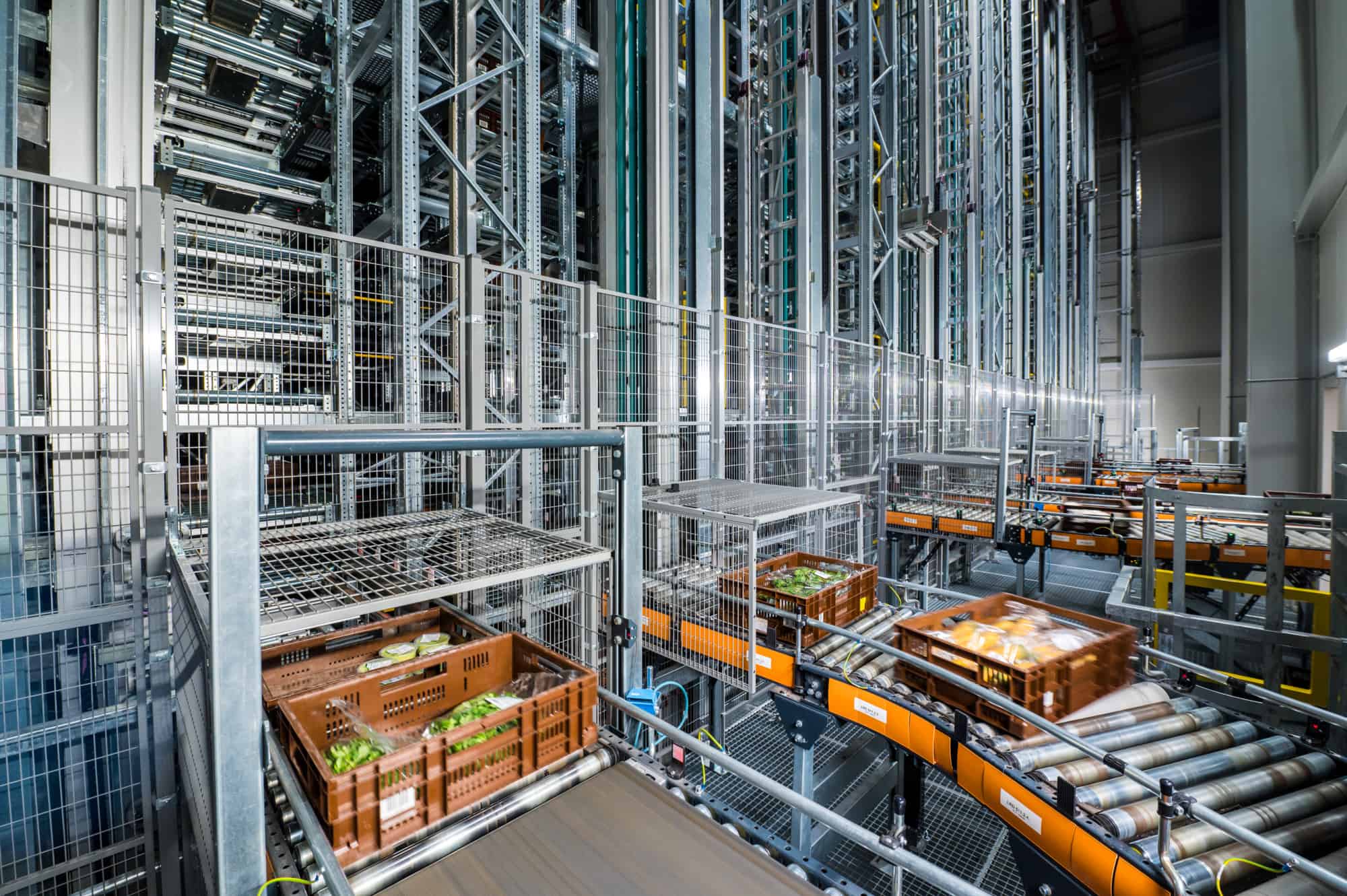
Knapp's innovation is centered on its “low-complexity” philosophy. They create highly integrated, all-in-one solutions where their KiSoft AI software perfectly orchestrates their hardware, like the OSR Shuttle™ Evo. Think of it as the Apple iOS of warehouse automation: a tightly controlled, high-performance ecosystem where the hardware and software are perfectly optimized for each other, delivering exceptional reliability at the cost of limited outside integration. - Strengths
- Integrated Solutions: In my testing, the synergy between their hardware and KiSoft AI software is unmatched for creating smooth, reliable workflows.
- Industry Specialization: They have deep, proven expertise in complex sectors like pharmaceuticals and grocery, where precision and compliance are paramount.
- High-Quality Engineering: Their systems are known for being durable and reliable, often leading to a lower total cost of ownership over a 10-to-15-year lifespan.
- Weaknesses & Professional Risks
- Proprietary Ecosystem: This tight integration is also a risk. It can lead to vendor lock-in, making it difficult and expensive to integrate third-party robotics or software in the future.
- Higher Initial CAPEX: The high-quality, all-in-one approach can result in a larger upfront investment. This poses a significant financial risk if your ROI projections are not met, potentially delaying payback by 12-18 months compared to more modular systems.
- System Complexity: These advanced systems can present a steeper learning curve for your in-house maintenance teams, potentially increasing reliance on the vendor and creating operational vulnerability if vendor support is not readily available.

Dematic
- Core Capabilities & Innovation
Dematic is a leader in modular and scalable solutions. Their Dematic iQ software platform acts as a powerful, open-ended brain. It can orchestrate a wide array of both their own and third-party systems, making them highly adaptable to changing business needs. - Strengths
- Modularity & Flexibility: Their systems are highly adaptable. You can scale and modify them as your business evolves, which protects your initial investment.
- Powerful Software (Dematic iQ): The iQ platform is a robust and relatively open system that provides excellent orchestration capabilities and real-time analytics.
- Broad Sector Experience: They have proven solutions across a wide range of industries, from general merchandise and apparel to food and beverage.
- Weaknesses & Professional Risks
- Integration Risk & TCO Impact: While modularity offers flexibility, it is a double-edged sword. Complex integrations can introduce significant timeline and budget risks. A mismanaged integration project can easily add 15-20% in unforeseen costs and delay your ROI by six months or more, a critical factor for your business case.
- Service Contract Costs: While competitive, their essential service and maintenance contracts can add a considerable amount to the long-term TCO.
- Component Sourcing: Their reliance on a global supply chain can, in some cases, impact lead times for specific components, posing a risk to project timelines.
Vanderlande
- Core Capabilities & Innovation
Vanderlande is known for its “evolutions,” which are pre-engineered, modular solutions for specific industries like e-commerce. This approach can accelerate deployment and is built on best-practice workflows. Their Smart Item Robotics (SIR) are also at the forefront of piece-picking technology, offering superior Goods-to-Person (G2P) solutions with exceptional throughput rates. - Strengths
- Throughput & Speed: In high-speed applications like parcel and e-commerce fulfillment, they are a clear leader. Their systems are built to handle massive peak volumes with industry-leading cross-belt and tilt-tray sorters capable of processing 20,000+ items per hour.
- Innovative Robotics: Their SIR technology is among the best I have tested for piece-picking accuracy and speed, directly impacting labor efficiency.
- “Evolutions” Concept: These pre-engineered solutions offer faster deployment timelines and a more predictable ROI, reducing project risk.
- Weaknesses & Professional Risks
- High Upfront Cost: Vanderlande is often positioned as a premium solution. This means a higher initial capital expenditure that requires a very solid business case.
- Specialization Focus: They are dominant in airports and parcel. However, they may be less competitive in some niche, heavy-industrial applications.
- AGV Partnership Model: They rely on partners for some AGVs. This means they do not have a fully proprietary vehicle lineup, which could affect long-term support.
Daifuku
- Core Capabilities & Innovation
Daifuku is a powerhouse in Automated Storage and Retrieval Systems (AS/RS), especially for unit-load and high-density storage. Their innovation is geared toward durability, extreme reliability, and seamless integration with heavy-duty automated guided vehicles (AGVs). - Strengths
- Extreme Reliability: They have an unparalleled reputation for building “workhorse” systems with exceptional longevity, especially in 24/7 industrial settings.
- AS/RS Leadership: They are a global leader in high-density AS/RS technology, making them a top choice for maximizing storage in a limited footprint.
- In-House Technology: They develop their own proprietary AGVs and control systems, which ensures seamless integration and reliable long-term support.
- Weaknesses & Professional Risks
- Less Agile Software: While very reliable, their warehouse management software can be less intuitive and flexible than some competitors, potentially slowing down operational adjustments.
- Higher TCO in Some Cases: Their focus on heavy-duty engineering can lead to a higher total cost for less demanding applications where that level of robustness isn't needed.
- Slower Innovation Cycle: They can be more conservative in adopting the latest AI and software trends compared to more software-focused rivals.
SSI Schaefer
- Core Capabilities & Innovation
SSI Schaefer's strength is the combination of their WAMAS® logistics software and a vast portfolio of proprietary hardware. They excel at creating tailored, scalable systems from a wide range of modular components, offering a true one-stop-shop experience. Their comprehensive portfolio includes their own line of Autonomous Mobile Robots (AMRs), which offer more navigational flexibility than traditional AGVs, alongside proven mini-load ASRS for high-density tote handling. - Strengths
- Comprehensive Portfolio: They offer everything from basic racking to advanced shuttles and AMRs. This allows them to design a truly custom solution.
- Scalable Solutions: They are excellent at designing systems that can start small and grow modularly with your business, protecting your initial investment.
- Strong WAMAS Software: The WAMAS suite is a mature and powerful logistics software platform that effectively integrates all aspects of the warehouse.
- Weaknesses & Professional Risks
- Brand Perception: They are sometimes perceived as a more traditional hardware company, though my analysis shows their software and robotics are top-tier.
- Global Consistency: In my experience, service and support levels can vary slightly by region, something to verify during your due diligence.
- Complex Product Tiers: Navigating their vast portfolio to find the optimal solution can be a challenge. It often requires expert guidance to avoid over- or under-specifying the system.
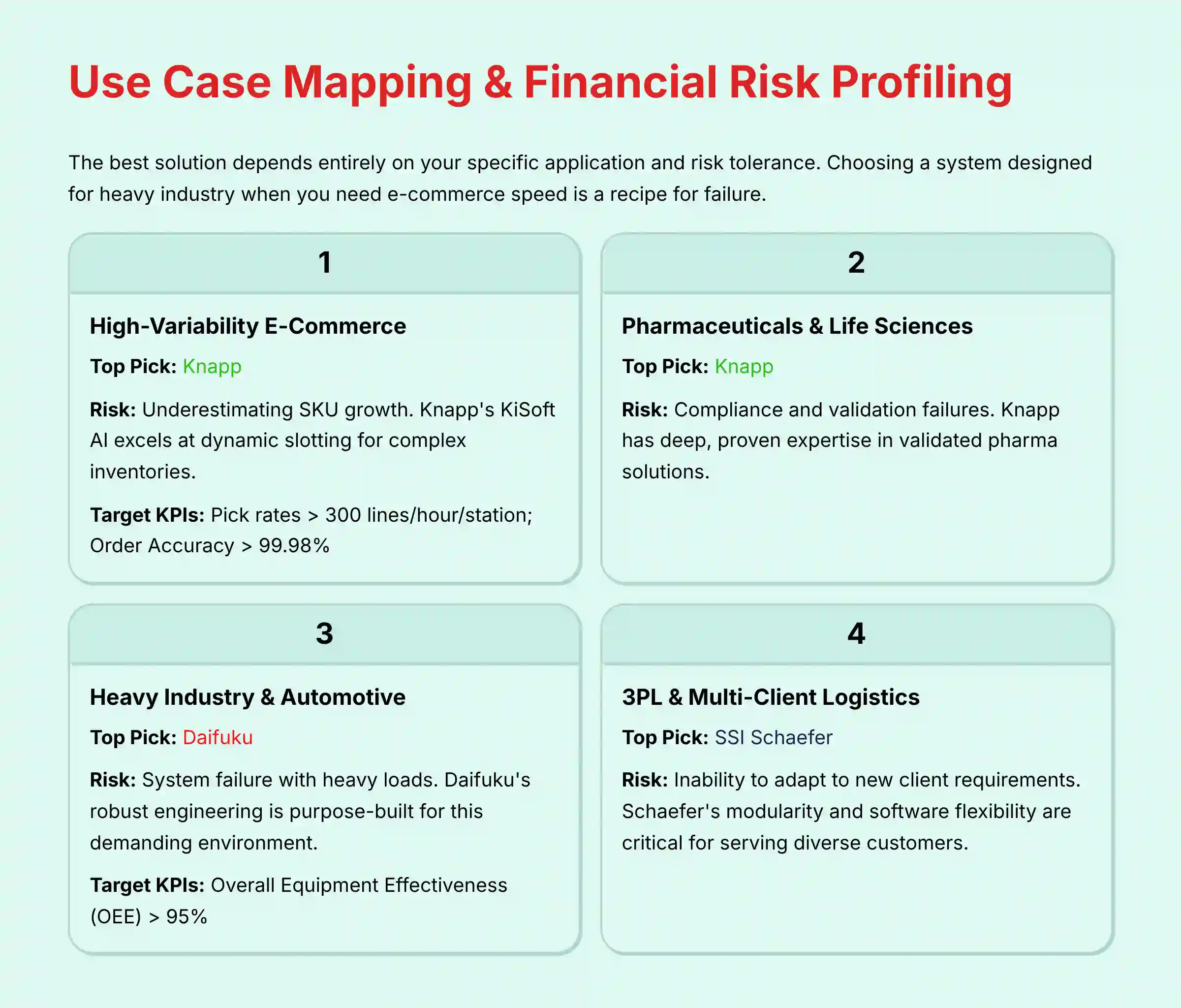
Use Case Mapping & Financial Risk Profiling
The best solution is entirely dependent on your specific application and the risk tolerance of your business. Choosing a system designed for heavy industry when you need e-commerce speed is a recipe for failure. This table maps vendors to common use cases to help guide your decision.
| Priority / Use Case | Top Recommendation | Strong Contender | Key Considerations & Risk Profile |
|---|---|---|---|
| High-Variability E-Commerce | Knapp | Vanderlande | Risk: Underestimating SKU growth. Knapp's KiSoft AI excels at dynamic slotting for complex inventories. Vanderlande's speed is a major asset for high order volumes. Target KPIs: Pick rates > 300 lines/hour/station; Order Accuracy > 99.98%. |
| Large-Scale, 24/7 Fulfillment | Dematic | SSI Schaefer | Risk: Hitting scalability limitations. Dematic's modular approach is ideal for phased rollouts in large facilities that need to grow over time. |
| Pharmaceuticals & Life Sciences | Knapp | Daifuku | Risk: Compliance and validation failures. Knapp has deep, proven expertise in validated pharma solutions. Daifuku offers high-reliability systems for sensitive product handling. |
| Heavy Industry & Automotive | Daifuku | Dematic | Risk: System failure with heavy loads. Daifuku's robust engineering is purpose-built for this demanding environment, minimizing operational risk. Target KPIs: Overall Equipment Effectiveness (OEE) > 95%; documented Mean Time Between Failures (MTBF). |
| 3PL & Multi-Client Logistics | SSI Schaefer | Dematic | Risk: Inability to adapt to new client requirements. Schaefer's and Dematic's modularity and software flexibility are critical for serving diverse customers. |
| Budget-Conscious Modular Growth | SSI Schaefer | Dematic | Risk: Choosing a system that cannot scale cost-effectively. Both offer strong entry-level options that can be expanded over time, protecting capital. |
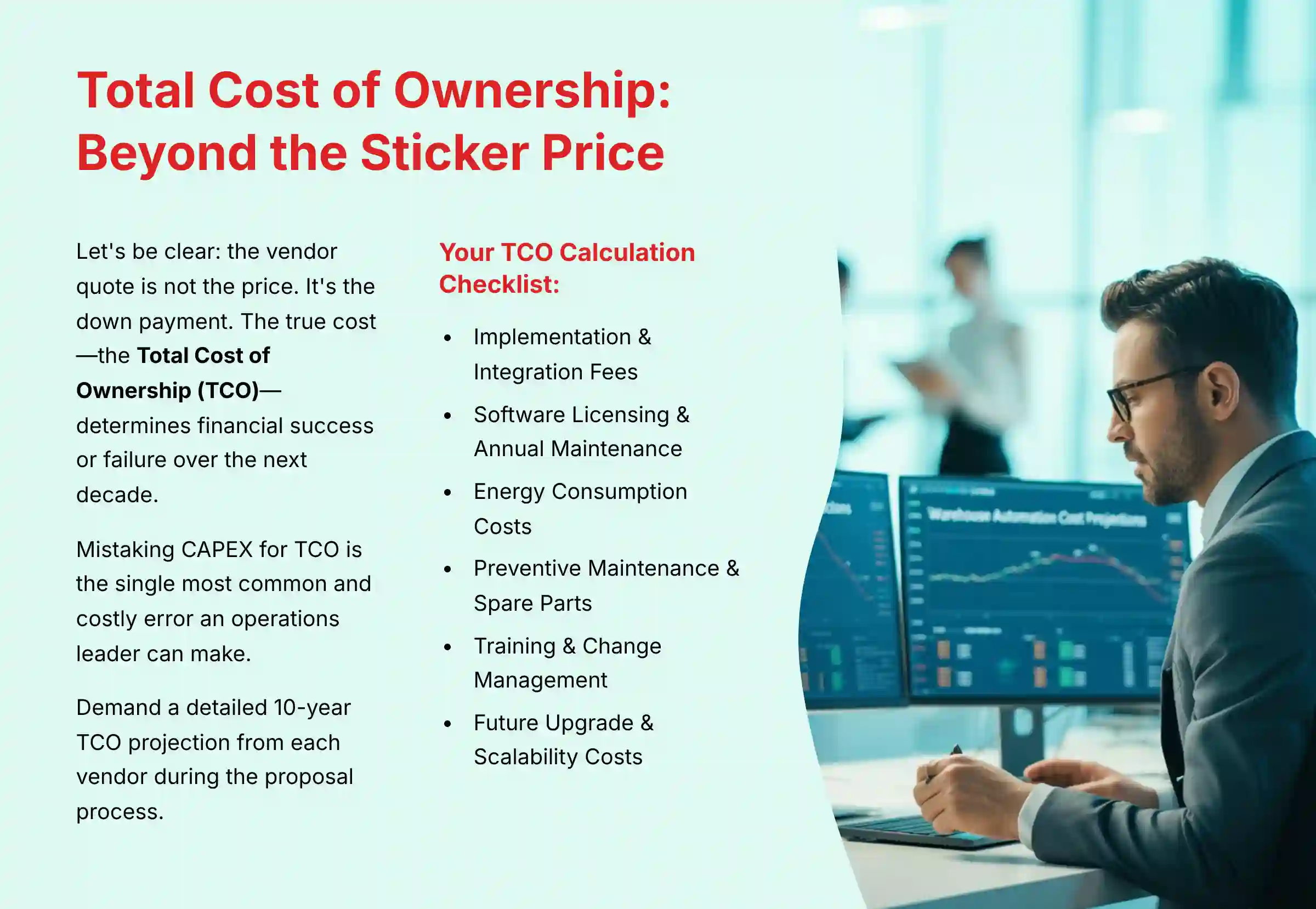
What is the Total Cost of Ownership? A Financial Risk Assessment Framework
Let's be clear: the vendor quote is not the price. It's the down payment. The true cost of your decision—the Total Cost of Ownership (TCO)—is what determines financial success or failure over the next decade. Mistaking CAPEX for TCO is the single most common and costly error an operations leader can make. To protect your investment and your career, you must move beyond the sticker price and demand full transparency using this financial risk assessment framework.
I advise all my clients to move beyond the initial quote. Use the following framework to demand a detailed 10-year TCO projection from each vendor during the proposal process. This forces transparency and gives you a much clearer picture of the long-term financial commitment.
Your TCO calculation checklist should include:
- Implementation & Integration Fees: The cost to install the system and connect it to your ERP.
- Software Licensing & Annual Maintenance Contracts: Ongoing fees for software updates and support.
- Energy Consumption Costs: These complex systems can have a noticeable impact on your utility bills.
- Preventive Maintenance & Spare Parts: The budgeted cost for routine maintenance and common replacement parts.
- Training & Change Management: The cost of training your team and managing the transition to a new way of working.
- Future Upgrade & Scalability Costs: What will it cost to expand the system in five years?
How does Digital Twin technology impact warehouse automation selection?
A Digital Twin is a virtual, real-time replica of your physical warehouse. Leading vendors are increasingly offering this as a core capability. This technology establishes a critical relationship: the digital twin simulates and validates proposed operational changes—like a new picking algorithm or layout—before they are deployed in the real world, thereby de-risking the entire change management process. When evaluating vendors, ask for a demonstration of their digital twin capabilities for ongoing optimization and future-proofing your investment.
For detailed implementation strategies and real-world applications, our comprehensive Knapp Review provides insights into how leading companies leverage digital twin technology for competitive advantage.
What Are the Key Questions to Ask Before Choosing a Knapp Alternative?
What is the main difference between Knapp's KiSoft and Dematic's iQ software?
The main difference lies in their philosophy. Knapp's KiSoft is part of a deeply integrated, closed ecosystem, designed to work flawlessly with Knapp hardware. This delivers high reliability. In contrast, Dematic's iQ is a more open and modular platform, designed to orchestrate both Dematic and third-party equipment. This offers greater flexibility but can introduce integration complexity.
Which vendor is better for high-throughput e-commerce, Vanderlande or Knapp?
For pure throughput and handling massive peak volumes, my analysis shows Vanderlande often has the edge. Their systems are purpose-built for speed in sectors like parcel and apparel. However, for e-commerce with high SKU variability and complexity, such as online grocery, Knapp's intelligent KiSoft software provides superior inventory management, making it a very strong contender.
Is Daifuku's reliability worth the potentially slower software innovation?
This depends entirely on your priority. For heavy industrial or automotive applications where a system failure is catastrophic and uptime is the single most important metric, Daifuku's extreme reliability is absolutely worth it. For fast-moving consumer goods or e-commerce where software agility and adaptability are more valuable, a vendor like Dematic or SSI Schaefer might be a better fit.
For a 3PL, is the scalability of SSI Schaefer better than the integrated approach of Knapp?
Yes, in most cases for a 3PL, the modular scalability of SSI Schaefer is a better strategic fit. 3PLs need to adapt to diverse and changing client needs quickly. Schaefer's ability to start with a smaller system and add modules is more financially and operationally flexible than investing in Knapp's more monolithic, integrated system from day one.
How do the robotics capabilities of Vanderlande's SIR compare to Knapp's Pick-it-Easy?
Both are top-tier goods-to-person systems. Vanderlande's Smart Item Robotics (SIR) excels at high-speed, accurate piece picking, making it ideal for e-commerce. Knapp's Pick-it-Easy stations are renowned for their ergonomics and versatility, able to handle a wide range of product types, which is a strength in industries like pharmaceuticals or cosmetics.
What are the biggest hidden costs when comparing Dematic and SSI Schaefer?
With both Dematic and SSI Schaefer, the biggest hidden costs often relate to future scalability and software modules. Because their systems are so modular, you must get very clear quotes on the cost to add new functionality or expand throughput later. Also, their annual software maintenance and support contracts are a significant part of the TCO that must be factored in.
Which system poses a higher risk of vendor lock-in?
Based on my analysis, Knapp's tightly integrated hardware and software ecosystem poses the highest risk of vendor lock-in. While this integration provides high reliability, it makes it more difficult and costly to introduce third-party robotics or software later. Systems from Dematic and SSI Schaefer are generally more open and flexible.
Do all these vendors meet the same security and compliance standards?
No, security certifications vary significantly between vendors. Dematic maintains SOC 2 Type II certification for its iQ software platform, while Knapp, Vanderlande, and SSI Schaefer primarily focus on ISO 27001 certification for their software products. Daifuku has not publicly claimed either as primary software certifications, focusing more on manufacturing and quality standards. It is a mandatory due diligence step for your team to request and review the latest audit reports directly from the vendor as proof of compliance.
For frequently asked questions and expert insights, our detailed Knapp FAQs section addresses the most common concerns enterprises face when evaluating automation solutions.
Your evaluation process should contractually require a multi-stage validation
Establishing a clear professional relationship between milestones. Insist on a digital simulation of the proposed system using your data to validate throughput claims. This should be followed by a formal Factory Acceptance Test (FAT) at the vendor's facility before shipment, and a rigorous Site Acceptance Test (SAT) in your own facility, which serves as the final sign-off before go-live.
Important Disclaimers:
Technology Evolution Notice: The information about Knapp Top Alternatives and Competitors and AI for Operations & Supply Chain tools presented in this article reflects our thorough analysis as of 2025. Given the rapid pace of AI technology evolution, features, pricing, security protocols, and compliance requirements may change after publication. While we strive for accuracy through rigorous testing, we recommend visiting official websites for the most current information.
Professional Consultation Recommendation: For AI for Operations & Supply Chain applications with significant professional, financial, or compliance implications, we recommend consulting with qualified professionals who can assess your specific requirements and risk tolerance. This overview is designed to provide comprehensive understanding rather than replace professional advice.
Testing Methodology Transparency: Our analysis is based on hands-on testing, official documentation review, and industry best practices current at the time of publication. Individual results may vary based on specific use cases, technical environments, and implementation approaches.
The Final Verdict: How to Choose Your Warehouse Automation Partner in 2025
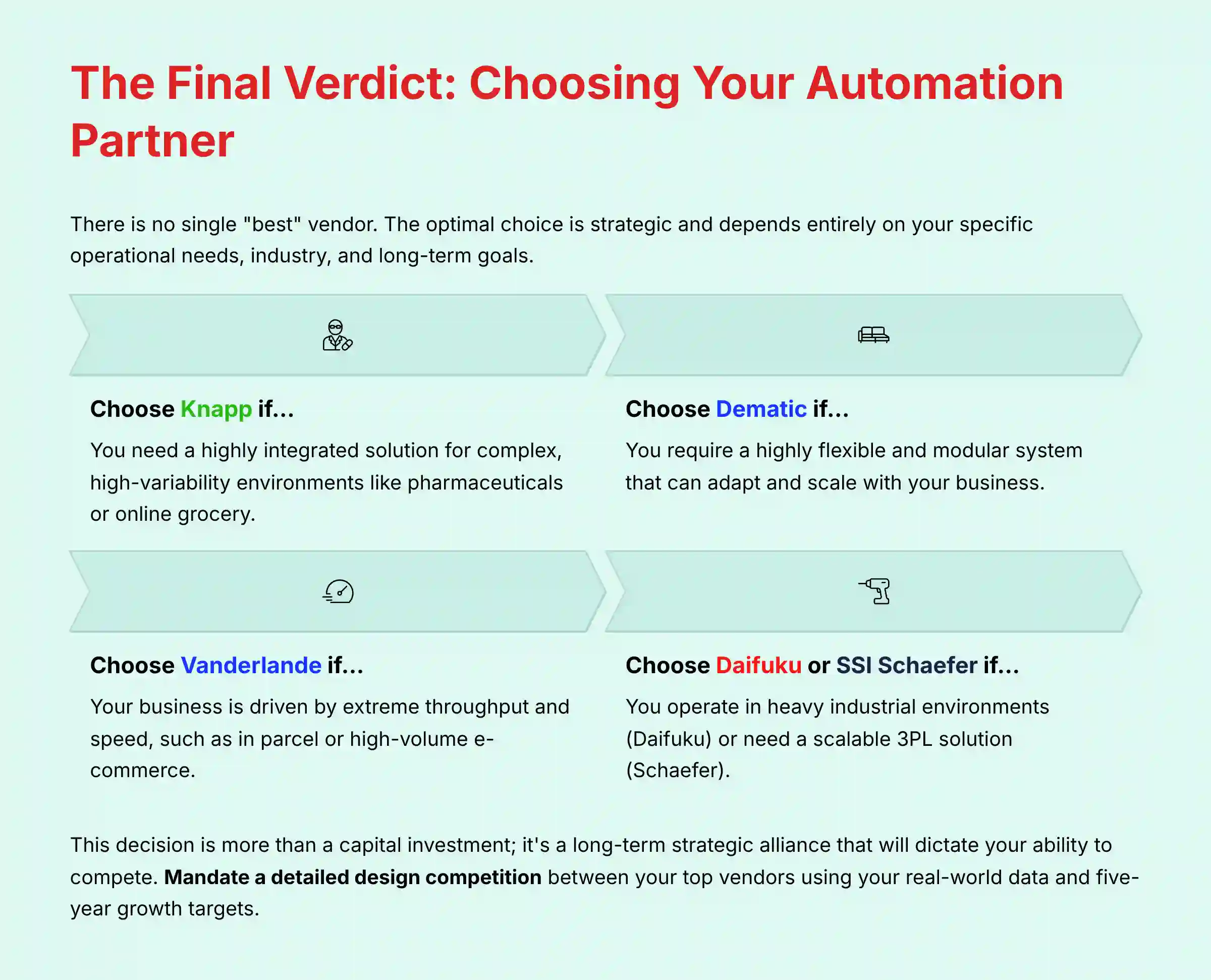
There is no single “best” vendor. The optimal choice is a strategic one that depends entirely on your specific operational needs, industry, and long-term goals. My final recommendations are based on matching the vendor's core strengths to your business priorities.
- Choose Knapp if… your primary need is a highly integrated, end-to-end solution for a complex, high-variability environment like pharmaceuticals or online grocery, and you prioritize long-term reliability over the lowest initial cost.
- Choose Dematic if… you require a highly flexible and modular system that can adapt and scale with your business, and you value a powerful, open software platform to orchestrate a diverse set of automation technologies.
- Choose Vanderlande if… your business is driven by extreme throughput and speed, such as in the parcel or high-volume e-commerce apparel sectors, and you need a system proven to handle massive peak volumes.
- Choose Daifuku if… you operate in a heavy industrial, automotive, or manufacturing environment where extreme reliability, durability, and the handling of large or sensitive unit loads are your top priorities.
- Choose SSI Schaefer if… you are a 3PL or a retailer looking for a scalable, one-stop-shop solution that can grow with you, from basic racking to a fully automated, software-driven warehouse.
This decision is more than a capital investment; it's a long-term strategic alliance that will dictate your ability to compete at this critical inflection point. To press your advantage, you must move beyond datasheets and marketing claims. Mandate a detailed design competition between your top two or three vendors. Give them your real-world data and your five-year growth targets. Perform site visits. Evaluate their team's tradecraft as much as their technology.
The future of your operation depends on the rigor of your due diligence today. For comprehensive insights into the broader automation landscape and additional vendor comparisons, explore our definitive guide to Best 10 AI For Warehouse Robotics & Automation Solutions: The Definitive 2025 Guide.

Leave a Reply