Is a Knapp AI Warehouse System the Right Investment for Your Operation?
This 2-Minute Quiz Reveals the Answer!
The simple truth is, navigating the complexities of modern Knapp AI Warehouse & Inventory Management is no longer optional; it's an imperative. Our industry faces relentless headwinds—labor shortages, surging demand, and the ever-present pressure to do more with less.
This comprehensive FAQ guide by Best Ops Chain AI cuts through the marketing hype, offering the objective, data-driven insights you need to understand Knapp's transformative potential. We'll delve into how Knapp's OSR Shuttle™ and KiSoft software serve as an intelligence apparatus, optimizing inventory, boosting operational efficiency, and delivering substantial ROI.
From strategic scalability and implementation timelines to critical data security and compliance, consider this your definitive briefing on leveraging Knapp to press the advantage in AI for Warehouse & Inventory Management. Are you ready to transform your warehouse into a proactive, strategic asset?
Key Takeaways
- Comprehensive Coverage: This guide addresses every critical aspect of Knapp's AI warehouse automation, from core technology to implementation challenges
- ROI Focus: Typical payback period of 2-4 years with high-volume operations achieving returns in 18-24 months
- Strategic Investment: Systems typically range from $5-30+ million requiring substantial upfront capital but delivering transformative operational capabilities
- Productivity Transformation: Goods-to-Person systems increase picking efficiency by 200-500% while reducing error rates to less than 0.1%
- Implementation Timeline: End-to-end deployment typically spans 12-24 months with phased go-live approach minimizing operational disruption
What is Knapp, and what are its core AI warehouse automation solutions?
Knapp AG is an Austrian-based international technology company specializing in intelligent automation solutions for warehouse logistics and manufacturing. As a major player in the AI for Warehouse & Inventory Management sector, Knapp provides integrated systems that combine advanced robotics, mechatronics, and sophisticated AI-powered software to optimize end-to-end supply chain operations.
Their solutions address critical warehouse challenges like labor shortages, increasing customer expectations for fulfillment speed, and the need for maximum inventory accuracy and storage density. The foundation of Knapp's approach is the “Goods-to-Person” (GTP) methodology, where automated systems bring inventory directly to workers, dramatically reducing travel time and boosting productivity.
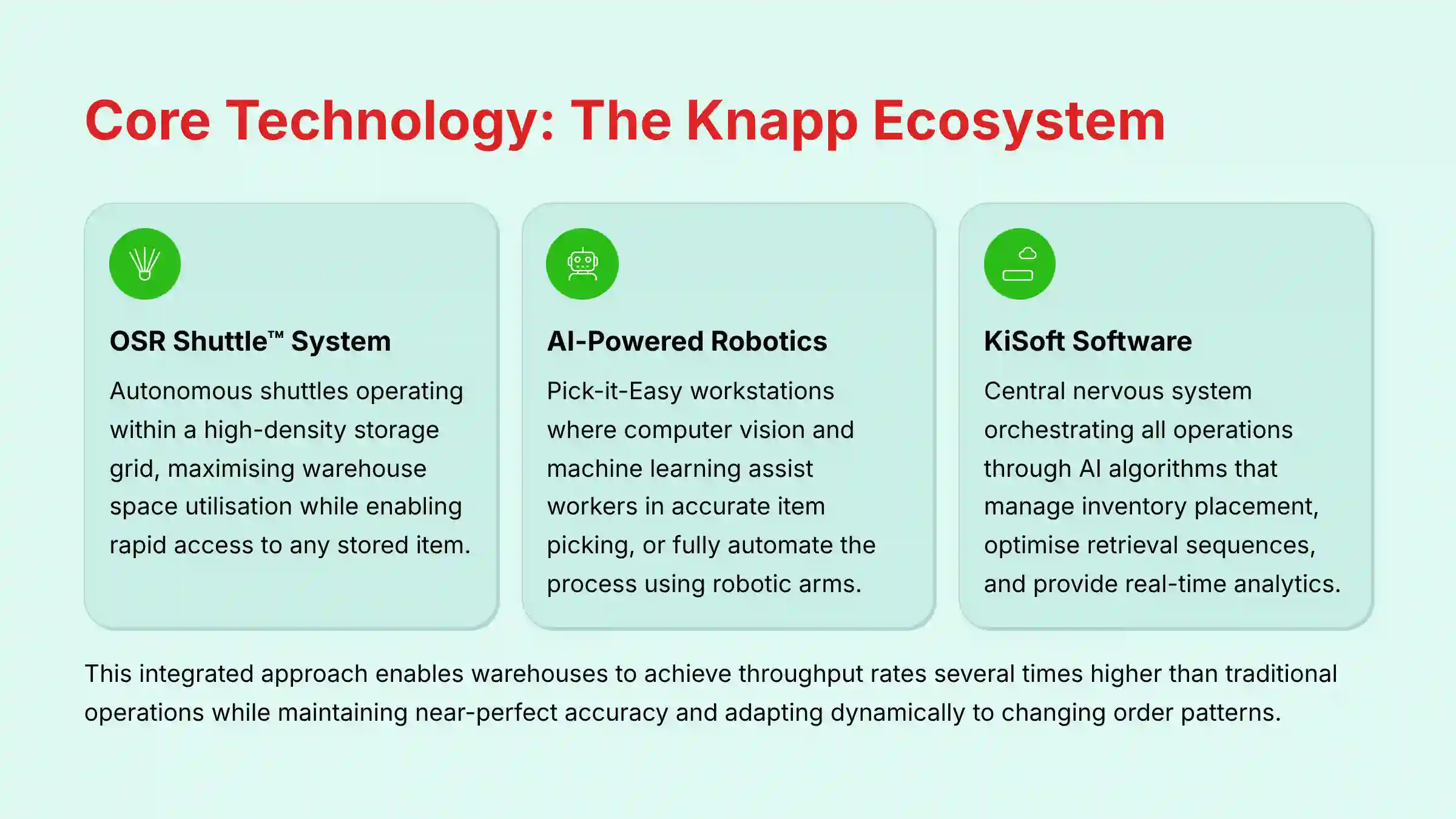
Knapp's core technology ecosystem consists of three integrated pillars:
- Automated Storage and Retrieval Systems (ASRS): The flagship OSR Shuttle™ uses autonomous shuttles operating within a high-density storage grid, maximizing warehouse space utilization while enabling rapid access to any stored item.
- AI-Powered Robotics: This includes the Pick-it-Easy series of ergonomic workstations where computer vision and machine learning assist workers in accurate item picking, or in some configurations, fully automate the picking process using robotic arms.
- Intelligent Software: The KiSoft software suite functions as the central nervous system, orchestrating all operations through AI algorithms that manage inventory placement, optimize retrieval sequences, control robotic movements, and provide real-time analytics for continuous improvement.
This integrated approach enables warehouses to achieve throughput rates several times higher than traditional operations while maintaining near-perfect accuracy and adapting dynamically to changing order patterns and seasonal peaks. For a detailed exploration of these capabilities, you can review our comprehensive Knapp Overview and Features analysis.
How does the Knapp OSR Shuttle™ system work?
The Knapp OSR Shuttle™ system represents the cutting edge of automated storage and retrieval system (ASRS) technology, providing exceptionally dense storage with high-speed inventory access. It forms the physical foundation of Knapp's “Goods-to-Person” (GTP) methodology, designed to eliminate the 60-70% of warehouse worker time typically spent walking to locate items.
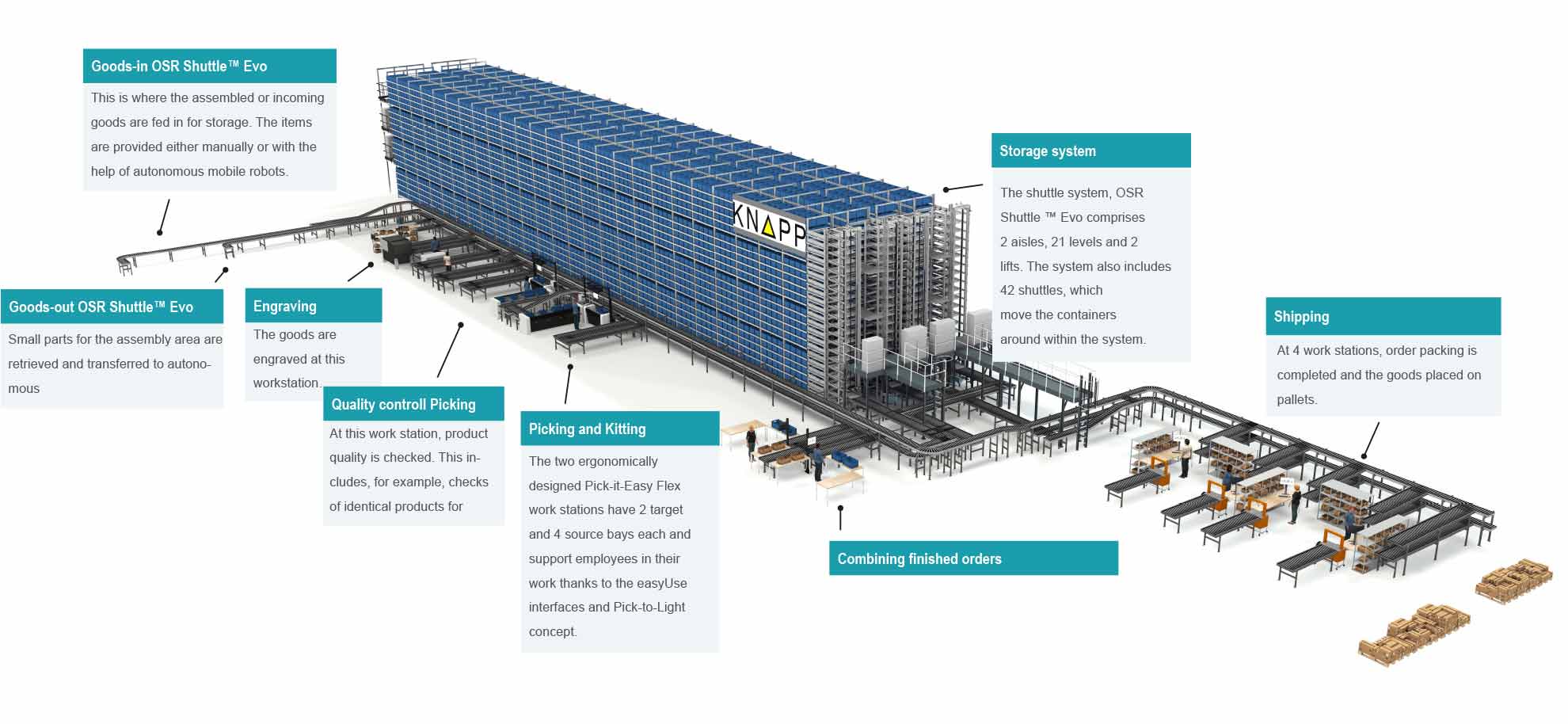
The system functions as a highly coordinated, multi-dimensional robotic ecosystem:
- Multi-Level Storage Grid: Inventory is stored in standardized totes or cartons within a tall, multi-aisle steel racking structure. This vertical design typically increases storage density by 300-400% compared to traditional shelving, maximizing cubic utilization of warehouse space.
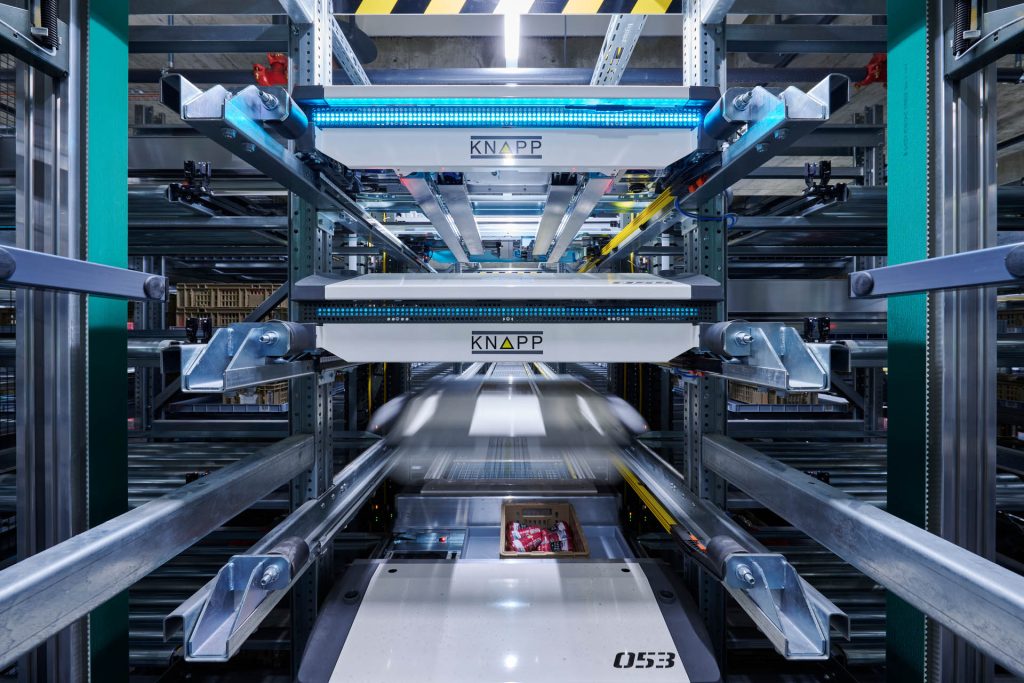
- Autonomous Shuttle Robots: Each level of the storage grid features autonomous robotic shuttles that travel horizontally along the aisles at speeds up to 4 meters per second. Using AI-optimized pathing algorithms, these shuttles navigate to precise storage locations to retrieve or store totes.
- High-Speed Vertical Lifts: Positioned at the ends of aisles, these lifts transport totes (and sometimes the shuttles themselves) between different levels of the structure at speeds up to 5 meters per second, enabling rapid vertical movement throughout the system.
- AI-Driven Retrieval Orchestration: When an order enters the system, the KiSoft Warehouse Control System (WCS) uses machine learning algorithms to determine the optimal retrieval sequence. It dispatches the nearest available shuttle to retrieve the specific tote, considering factors like current shuttle positions, system congestion, and order priority.
- Intelligent Workstation Delivery: Retrieved totes are transported via a network of conveyors directly to GTP workstations like Pick-it-Easy stations. Here, workers or robots select the required items before the tote is automatically returned to storage.
The system's distributed architecture provides exceptional redundancy—if a shuttle requires maintenance, others continue operating, ensuring 99.5%+ system availability. This orchestrated process creates a continuous, high-velocity flow of goods that dramatically increases order fulfillment throughput while minimizing labor requirements and error rates.
What is the difference between “Goods-to-Person” (GTP) and traditional warehouse picking?
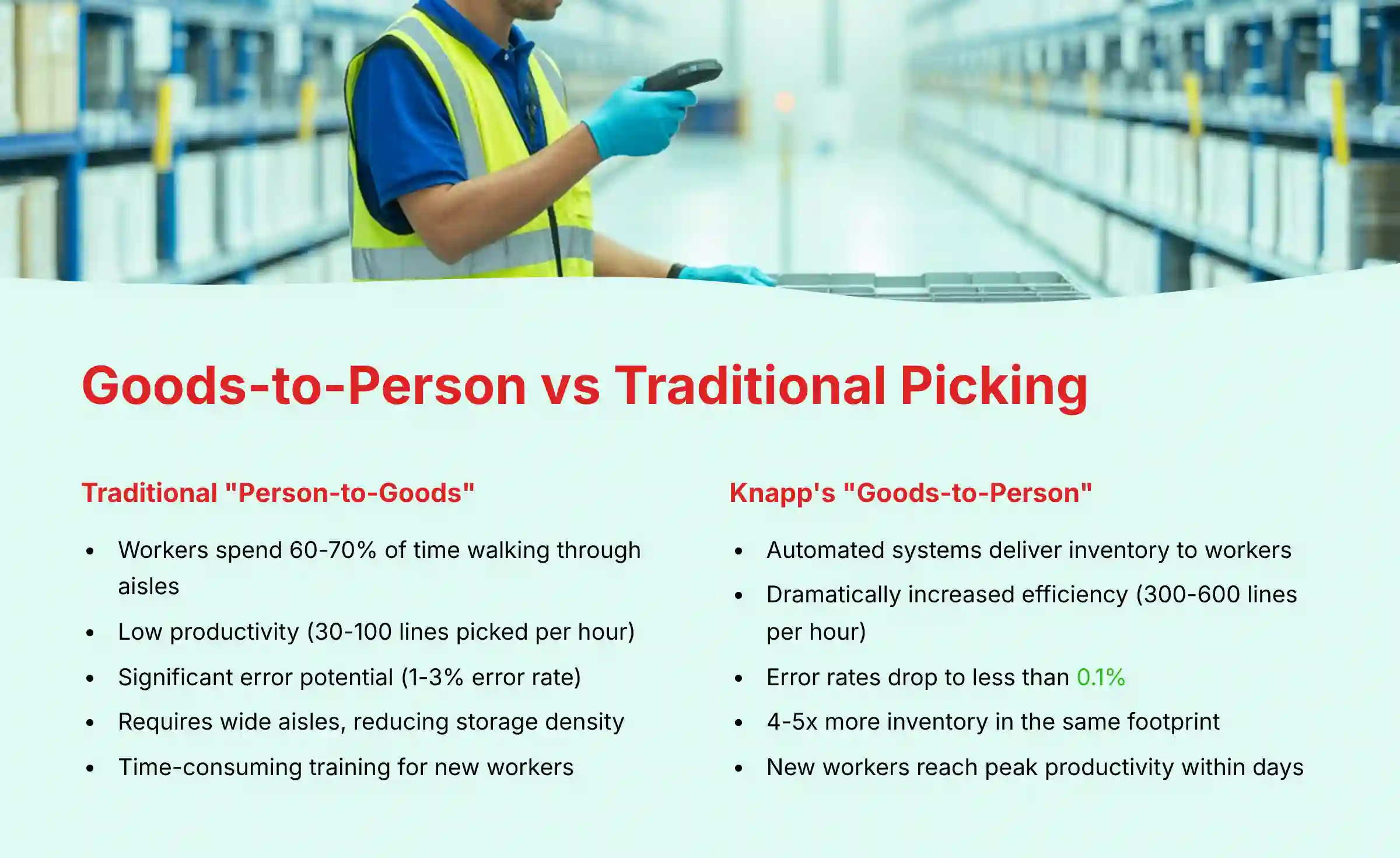
“Goods-to-Person” (GTP) represents a fundamental paradigm shift in warehouse operations compared to traditional “Person-to-Goods” picking methodology. This transformation is central to understanding the value proposition of systems like Knapp's OSR Shuttle™.
In traditional warehouse picking, workers spend the majority of their time—typically 60-70%—walking or driving through aisles locating items on their pick lists. This approach:
- Requires extensive physical exertion
- Results in low productivity (often 30-100 lines picked per hour)
- Creates significant error potential as workers must locate correct items among thousands
- Requires wide aisles for human access, reducing storage density
- Makes training new workers time-consuming and costly
GTP completely inverts this model. Instead of sending workers to the inventory, automated systems deliver inventory directly to stationary workers at ergonomic workstations. The impact is substantial across multiple key performance indicators:
- Productivity: GTP systems typically increase picking efficiency by 200-500%. Workers can achieve 300-600 lines per hour because they focus exclusively on the value-added task of picking items rather than traveling to locate them.
- Accuracy: Error rates drop dramatically from industry averages of 1-3% to often less than 0.1%. This occurs because the system directs the exact inventory tote to the picker and often employs pick-to-light technology or computer vision systems to highlight the precise item and quantity required.
- Labor Optimization: In traditional picking, productivity is highly variable based on worker experience and knowledge of the warehouse. GTP standardizes the process, enabling new workers to reach peak productivity within days rather than weeks or months.
- Space Utilization: GTP systems pair naturally with high-density ASRS like the OSR Shuttle™, which can store 4-5 times more inventory in the same footprint as conventional racking, dramatically reducing facility costs.
- Worker Ergonomics: GTP workstations present items at optimal working heights, eliminating bending, stretching, and climbing that contribute to workplace injuries and fatigue.
The shift to GTP represents not just an incremental improvement but a fundamental reimagining of warehouse workflows, moving from a labor-intensive manual process to an orchestrated, AI-driven system where technology handles repetitive travel and retrieval tasks. To understand how this compares across different providers, our Knapp Top Alternatives and Competitors guide provides valuable insights.
How does Knapp's KiSoft software use AI for inventory and order optimization?
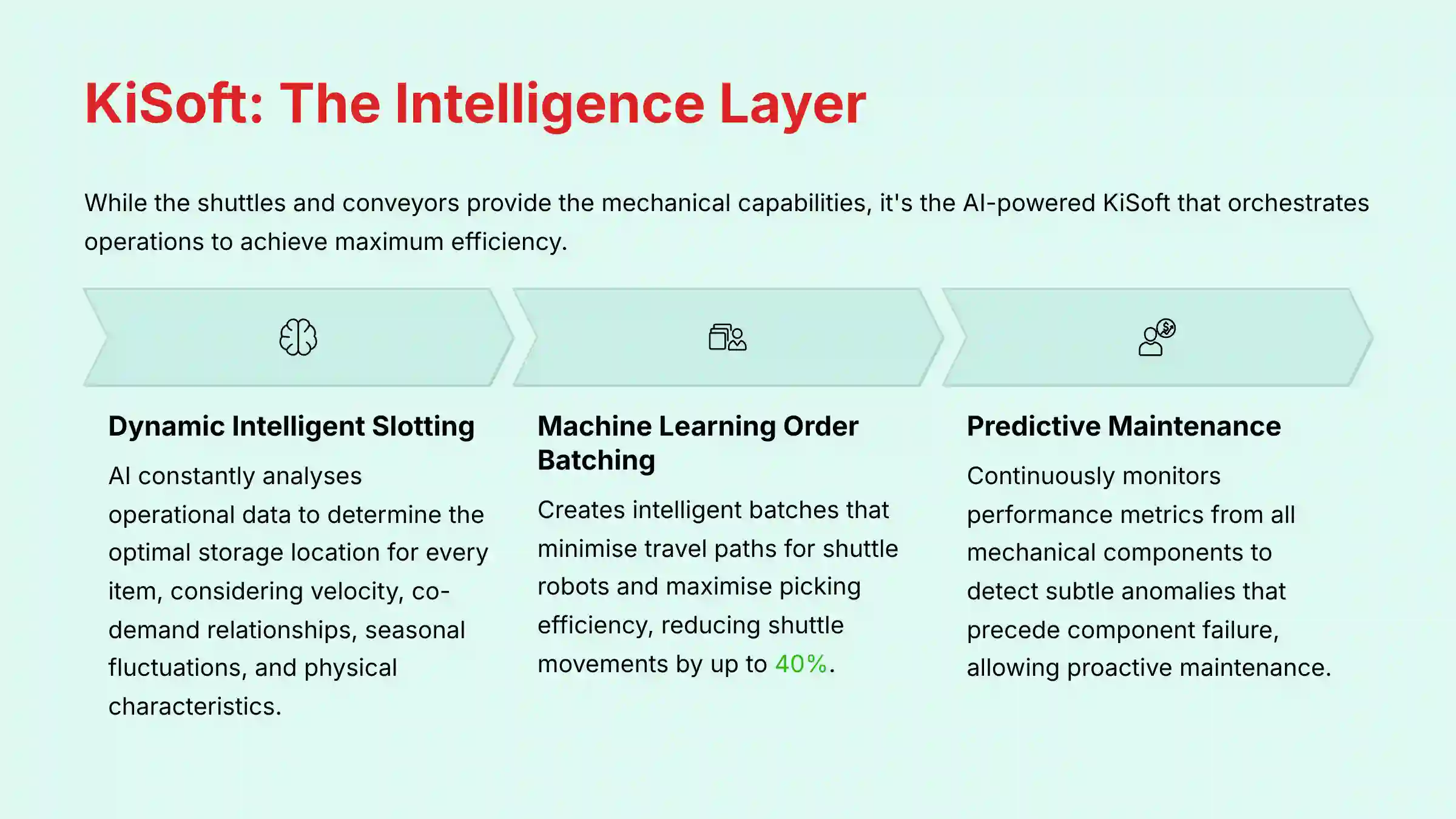
Knapp's KiSoft software suite represents the intelligence layer that transforms physical automation hardware into a truly smart system. While the shuttles and conveyors provide the mechanical capabilities, it's the AI-powered KiSoft that orchestrates operations to achieve maximum efficiency, functioning as both a Warehouse Control System (WCS) and, when fully implemented, a comprehensive Warehouse Management System (WMS).
KiSoft leverages several advanced AI applications to optimize warehouse operations:
- Dynamic Intelligent Slotting: Rather than using static storage rules, KiSoft's AI constantly analyzes operational data to determine the optimal storage location for every item. This goes far beyond basic ABC categorization to consider multidimensional factors:
- Item velocity and picking frequency patterns
- Co-demand relationships (items frequently ordered together)
- Seasonal demand fluctuations
- Physical characteristics (weight, dimensions, fragility)
- Remaining shelf life for perishables
The system automatically repositions fast-moving items to prime locations closer to workstations or on lower, faster-access levels of the OSR Shuttle™, reducing retrieval times and maximizing throughput.
- Machine Learning Order Batching: The AI analyzes the entire order pool in real-time and uses pattern recognition to identify optimal grouping strategies. Rather than processing orders chronologically, it creates intelligent batches that minimize travel paths for shuttle robots and maximize picking efficiency. For example, it might recognize that several small orders require items from the same aisle section and batch them together to reduce shuttle movements by up to 40%.
- Predictive Maintenance Analytics: The system continuously monitors performance metrics from all mechanical components—including motors, drives, belts, and sensors. Using machine learning algorithms trained on millions of operational hours, it can detect subtle anomalies that precede component failure, such as a gradual increase in motor temperature or slight changes in vibration patterns. This allows maintenance to be scheduled proactively during planned downtime rather than reacting to failures.
- AI-Driven Workload Balancing: The software uses predictive analytics to forecast incoming order volumes based on historical patterns, current trends, and external factors like promotions or seasonal events. It then dynamically allocates resources—activating or deactivating workstations, adjusting conveyor paths, and redistributing orders across the system—to prevent bottlenecks before they occur.
This continuous optimization creates a self-adjusting warehouse ecosystem that responds in real-time to changing conditions, dramatically improving resource utilization and operational performance. For practical implementation guidance, explore our Knapp Tutorials and Usecase resources.
What is the typical ROI for a Knapp warehouse automation system?
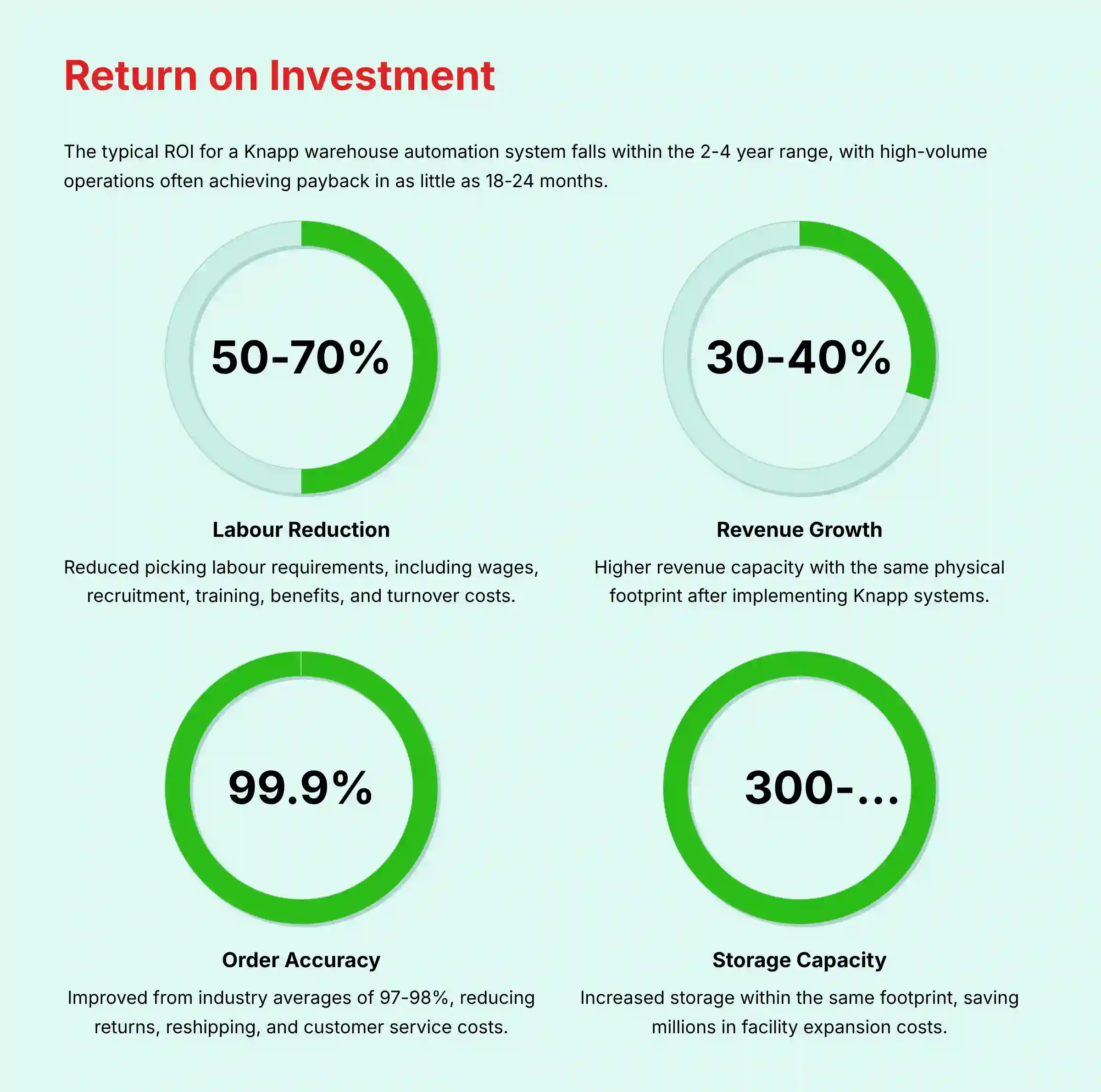
The typical Return on Investment (ROI) for a Knapp warehouse automation system centered around the OSR Shuttle™ generally falls within the 2-4 year range, with high-volume operations often achieving payback in as little as 18-24 months. However, a comprehensive ROI calculation must extend beyond simplistic labor reduction metrics to capture the full strategic value.
A complete ROI analysis should incorporate these key value drivers:
- Direct Labor Efficiency: The most immediately quantifiable benefit comes from labor optimization. By implementing a Goods-to-Person system, companies typically reduce picking labor requirements by 50-70%, including not just wages but also associated costs of recruitment, training, benefits, and turnover. In locations with labor shortages or rapidly rising wages, this benefit accelerates ROI significantly.
- Throughput Expansion and Revenue Growth: Automation enables operations to handle substantially higher order volumes without proportional increases in labor or facility size. This expanded capacity allows businesses to capture growth opportunities without the capital expense of new facilities. Many e-commerce retailers report 30-40% higher revenue capacity with the same physical footprint after implementing Knapp systems.
- Order Accuracy Improvement: GTP systems coupled with KiSoft's validation technology typically boost accuracy rates from industry averages of 97-98% to over 99.9%. This seemingly small percentage difference has enormous financial impact when quantified across thousands of daily orders:
- Reduced return processing costs ($15-70 per return)
- Eliminated reshipping expenses
- Avoided customer service interactions ($5-25 per contact)
- Preserved customer lifetime value (one missed order can permanently lose a customer)
- Real Estate Optimization: The high-density nature of the OSR Shuttle™ system increases storage capacity by 300-400% within the same footprint. In high-cost real estate markets, this space efficiency can save millions in facility expansion or leasing costs. One European retailer avoided a planned $12M facility expansion by implementing a Knapp system that quadrupled their storage capacity.
- Inventory Control Precision: The perpetual, real-time inventory visibility provided by KiSoft typically reduces safety stock requirements by 15-30% while simultaneously decreasing stockouts by up to 80%. This releases working capital tied up in excess inventory while capturing previously lost sales opportunities.
- Energy and Sustainability Benefits: The compact footprint of high-density automation systems results in quantifiable energy savings from reduced lighting, heating, and cooling requirements. These sustainability benefits increasingly translate to tangible financial advantages through carbon credits, regulatory compliance, and consumer preference for eco-friendly operations.
When calculating ROI, forward-thinking companies look beyond direct cost reduction to consider how automation enables strategic capabilities—like same-day shipping or perfect order fulfillment—that drive market share gains and competitive differentiation in the rapidly evolving logistics landscape.
How does Knapp compare to major competitors like Dematic and Swisslog?
Knapp, Dematic, and Swisslog represent the top tier of warehouse automation providers globally, and while they compete for many of the same projects, each has distinctive strengths, technological approaches, and industry specializations that make them better suited for specific automation scenarios.
Core Technology & System Architecture:
- Knapp is renowned for its OSR Shuttle™ ecosystem, which excels in applications requiring exceptional speed, accuracy, and handling of diverse product ranges. Their tightly integrated approach—where hardware and software are designed as a unified system—creates highly optimized performance for complex order profiles. Knapp's Pick-it-Easy workstations are particularly advanced in ergonomics and vision-guided picking assistance, making them the preferred choice for operations with high SKU counts and complex picking requirements.
- Dematic offers the most comprehensive technology portfolio, with their Multishuttle system directly competing with Knapp's OSR. Dematic's approach emphasizes modularity and flexibility, allowing for more customization and easier system expansion over time. Their AutoStore implementation (a cube-based storage system) provides an alternative for smaller footprint, lower throughput applications. Dematic excels at being a “one-stop shop” capable of implementing everything from traditional conveyor systems to cutting-edge robotics.
- Swisslog, now part of the KUKA robotics group, differentiates through its deep integration with advanced robotics and its leadership in implementing the ultra-high-density AutoStore system (for which they are the largest global integrator). Their CycloneCarrier shuttle system competes directly with Knapp and Dematic's offerings but often at a somewhat lower price point. Swisslog has particularly strong robotic picking solutions leveraging KUKA's expertise in articulated robotic arms.
Software Intelligence & Integration Capabilities:
- Knapp's KiSoft software is regarded as having the most sophisticated AI-driven optimization algorithms for slotting and order sequencing. It functions best as an all-in-one control and management system but can be somewhat less flexible when integrating with diverse third-party hardware.
- Dematic's iQ platform excels in managing heterogeneous automation environments, making it particularly strong for implementations that combine equipment from multiple vendors or that need to integrate with existing legacy systems.
- Swisslog's SynQ (Synchronized Intelligence) platform is designed with an open architecture specifically to orchestrate both their own and third-party robotics. Its modular approach allows customers to implement only the functionality they need.
Industry Specialization & Market Focus:
- Knapp has demonstrated particular strength in pharma/healthcare, fashion/apparel e-commerce, and grocery/food distribution. Their systems excel at handling high SKU diversity and complex picking requirements, such as those found in pharmaceutical order fulfillment or fashion retail with extensive size/color variations.
- Dematic has historically been dominant in retail distribution, particularly large-scale retail DC operations and e-commerce fulfillment. They have the broadest industry coverage of the three providers.
- Swisslog shows particular expertise in food & beverage, pharmaceuticals, and retail. Their AutoStore implementations have been especially popular in smaller footprint applications like micro-fulfillment centers.
The optimal choice between these providers depends heavily on specific operational requirements, existing technology ecosystem, and industry-specific needs rather than a universal “best” solution. For an in-depth analysis of these trade-offs, our detailed Knapp Review provides comprehensive comparison insights.
What are the biggest limitations of Knapp's AI and automation?
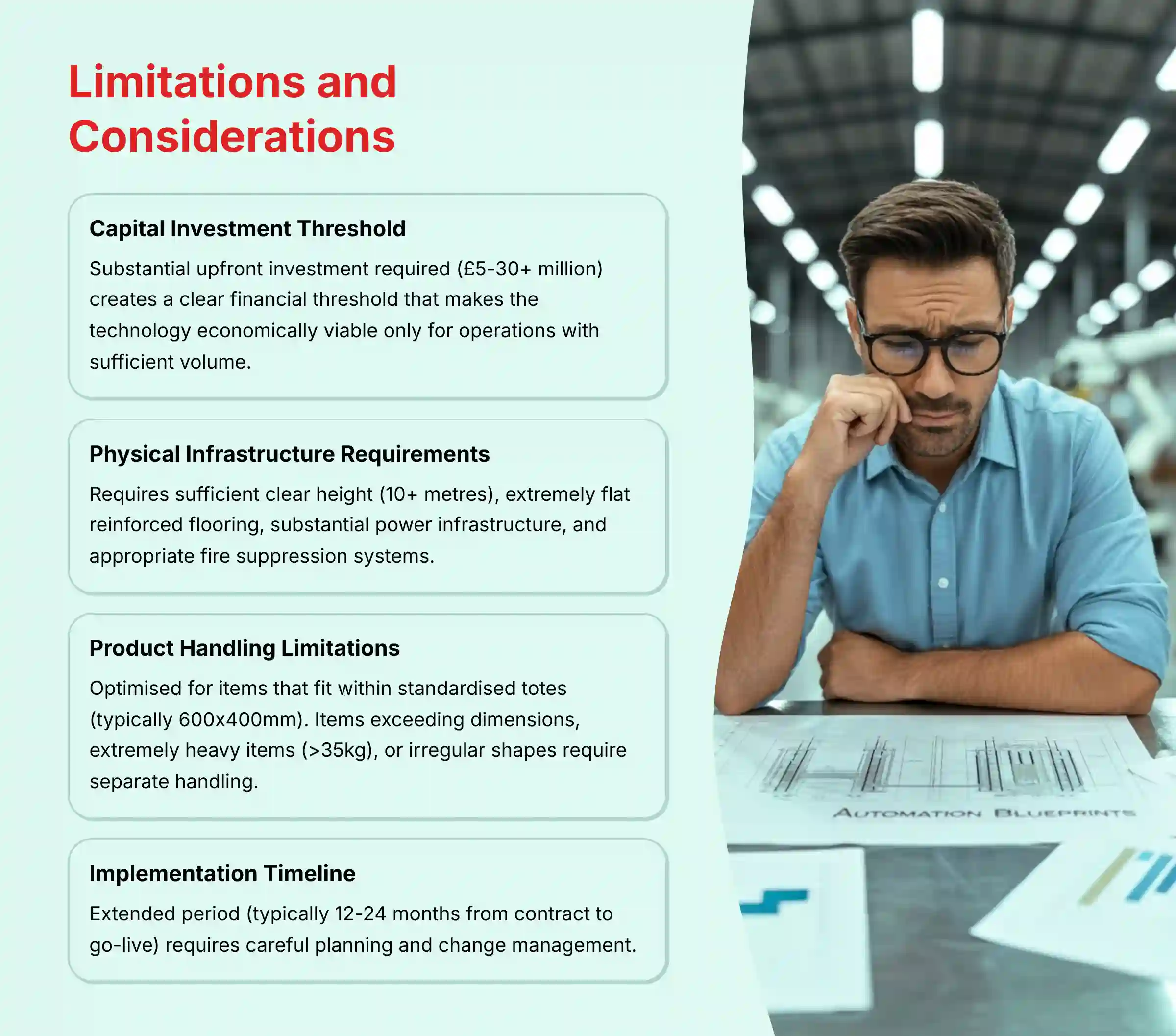
While Knapp's automation and AI solutions represent the cutting edge of warehouse technology, they have inherent limitations that must be carefully considered during the evaluation process. Understanding these constraints is essential for making informed investment decisions and setting realistic expectations.
1. Capital Investment Threshold
The most significant barrier is the substantial upfront investment required. A comprehensive Knapp OSR Shuttle™ implementation typically starts at $5-7 million for smaller installations and can exceed $30 million for large-scale facilities. This creates a clear financial threshold that makes the technology economically viable only for operations with sufficient volume to generate adequate ROI. For small to mid-sized companies, this capital requirement can be prohibitive without creative financing approaches like equipment leasing or third-party logistics partnerships.
2. Physical Infrastructure Requirements
Knapp's systems demand specific facility characteristics:
- Sufficient clear height (typically 10+ meters for optimal efficiency)
- Extremely flat and reinforced flooring (floor flatness of FF35 or better)
- Substantial power infrastructure and often backup generation capability
- Appropriate fire suppression systems designed for high-density storage
Retrofitting existing facilities that lack these characteristics can add significant cost to the project or, in some cases, make implementation impractical without new construction.
3. Product Handling Limitations
The OSR Shuttle™ system is optimized for items that fit within standardized totes (typically 600x400mm in various heights). Products with these characteristics must comprise a significant percentage of total inventory to justify the investment:
- Items exceeding tote dimensions require separate handling processes
- Extremely heavy items (typically over 35kg) may exceed shuttle capacity
- Irregular shapes that cannot be reliably grasped by picking robots need manual handling
- Very small items (less than 5mm in any dimension) may challenge vision systems
Operations with a high percentage of non-conveyable items may not achieve the expected efficiency gains if too much inventory requires exception handling.
4. Operational Flexibility Constraints
Once installed, the physical infrastructure represents a relatively fixed asset:
- Major changes to storage capacity require significant construction
- Adapting to radically different product dimensions may be challenging
- Relocating the system to a new facility is complex and costly
- Retrofitting new technologies to an existing system may have limitations
This creates a strategic commitment that requires confidence in long-term business direction and product profiles.
5. Implementation Timeline and Change Management
The extended implementation period (typically 12-24 months from contract to go-live) requires careful planning:
- Operations must continue during implementation
- Financial benefits are delayed while capital is committed
- Substantial organizational change management is required
- Staff training and adaptation to new workflows takes time
The gap between investment and realized benefits creates a “valley of despair” that must be carefully managed from both financial and organizational perspectives.
Understanding these limitations allows businesses to realistically assess if Knapp's solutions align with their operational needs, financial capabilities, and physical infrastructure. When properly matched to the right application, the limitations become manageable constraints rather than implementation barriers.
How scalable are Knapp's solutions for handling growth and seasonal peaks?
Knapp's automation solutions are engineered with scalability as a foundational principle, but understanding the distinct approaches for handling short-term demand fluctuations versus long-term growth is crucial for effective capacity planning.
Tactical Scalability for Seasonal Peaks and Demand Spikes
Knapp systems excel at absorbing significant short-term volume increases through several AI-driven capabilities:
- Dynamic Throughput Allocation: The KiSoft software can temporarily reallocate system resources to prioritize specific order types or channels during peak periods. For example, during a flash sale, the system might dedicate more shuttles and picking stations to e-commerce fulfillment while temporarily reducing resources allocated to wholesale replenishment.
- Predictive Wave Planning: Using historical data and machine learning, KiSoft predicts incoming order patterns and proactively adjusts the system configuration before the peak arrives. It pre-positions high-demand SKUs in optimal locations, reconfigures pick station layouts for maximum efficiency, and optimizes batching strategies specific to the anticipated order profile.
- Variable Speed Operation: Unlike many mechanical systems with fixed throughput rates, the OSR Shuttle™ can temporarily increase operating speeds during peak periods. The shuttles and lifts can run at up to 130% of standard speed for limited durations when maximum throughput is required.
- Workstation Flexibility: The Pick-it-Easy stations are designed for rapid activation or deactivation. During normal operations, a facility might run with 60% of workstations active, but during peaks, all stations can be staffed and operating simultaneously, creating an immediate 66% increase in processing capacity.
Strategic Scalability for Long-Term Business Growth
For sustained business expansion, Knapp's systems offer modular growth paths:
- Incremental Shuttle Deployment: The initial installation typically includes the full racking infrastructure but only a portion of the possible shuttles. As volume grows, additional shuttles can be added to the existing infrastructure with minimal disruption, increasing throughput capacity proportionally. Some customers start with as few as 50% of the potential shuttles, adding more as needed.
- Storage Capacity Expansion: The OSR Shuttle™ system can be extended in multiple dimensions:
- Vertical expansion by adding levels (if ceiling height permits)
- Horizontal expansion by extending existing aisles
- System expansion by adding new aisles or modules adjacent to the existing structure
- Processing Capacity Enhancement: The picking and packing capacity can be expanded independently from the storage system:
- Additional Pick-it-Easy stations can be integrated as throughput requirements increase
- New technologies like robotic picking can be retrofitted to existing stations
- Additional inbound and outbound processing lanes can be added to the periphery
- Software-Driven Capacity Unlocking: As KiSoft collects more operational data, its AI algorithms continuously improve slotting, batching, and sequencing efficiency. This creates “algorithmic capacity expansion” where the same physical infrastructure yields greater throughput over time through more intelligent operation.
A key advantage of Knapp's approach is the ability to make these expansions with minimal disruption to ongoing operations. The modular nature of the system allows new components to be integrated during scheduled maintenance windows or even during normal operations, avoiding the business interruption that would occur with a complete system replacement.
What is the typical cost and pricing model for a Knapp automation solution?
The cost of a Knapp automation solution falls firmly in the enterprise capital expenditure category, with complete systems typically ranging from $5 million to $30+ million depending on scale and complexity. Understanding the cost structure and pricing model is essential for proper financial planning and ROI analysis.
Key Cost Components and Drivers
The total project cost is determined by several interrelated factors:
- System Scale and Capacity: The primary cost drivers are:
- Total storage capacity required (number of bin locations)
- Peak throughput requirements (orders/lines per hour)
- Number of SKUs to be managed
These factors determine the physical size of the OSR Shuttle™ racking, the quantity of shuttle robots needed, and the number of workstations required. A small e-commerce operation processing 5,000 lines per day might invest $5-8 million, while a major retail distribution center handling 50,000+ lines daily could exceed $25 million.
- Technology Configuration: The level of automation and intelligence significantly impacts cost:
- Basic Pick-to-Light workstations are less expensive than fully-robotized stations
- Vision-guided picking assistance adds cost but improves accuracy
- Fully automated robotic picking stations represent the highest investment tier
- Advanced AI modules for demand forecasting or predictive maintenance add to software costs
- Software Scope: The KiSoft software component typically represents 15-25% of the total project cost:
- Basic WCS (Warehouse Control System) functionality is the entry point
- Full WMS (Warehouse Management System) capabilities increase the software investment
- Advanced analytics, simulation, and optimization modules add further cost
- Custom integrations with ERP, OMS, or other systems require additional development
- Building Modifications: Facility requirements can add significant cost in retrofit scenarios:
- Floor reinforcement to support the system weight
- Fire suppression system modifications for high-density storage
- Electrical system upgrades for power requirements
- HVAC modifications for equipment cooling
Pricing Model Structure
Knapp's pricing model typically consists of several components:
- Capital Expenditure (CapEx): The primary investment includes:
- Hardware (shuttles, racking, conveyors, workstations)
- Software licenses (KiSoft modules)
- Implementation services (design, project management, installation)
- Testing and commissioning
- Operating Expenditure (OpEx): Ongoing costs include:
- Annual software maintenance (typically 15-20% of software license cost)
- Hardware maintenance contracts (preventive maintenance, parts, support)
- System optimization services
- Software updates and new feature releases
Some customers are now exploring alternative financing models, including:
- Equipment leasing arrangements
- “Robotics as a Service” (RaaS) models with lower upfront costs
- Performance-based contracts with payments tied to throughput achievements
While the initial investment is substantial, the total cost of ownership (TCO) analysis typically demonstrates that automation becomes more economical than manual operations over a 5-7 year horizon, particularly in regions with high labor costs or significant labor shortages.
How does Knapp's KiSoft software integrate with an existing ERP like SAP or Oracle?
Seamless integration between Knapp's KiSoft software and a company's core Enterprise Resource Planning (ERP) system is critical for operational success. This integration creates a bidirectional data flow that allows each system to focus on its strengths while maintaining a single source of truth for inventory and orders.
Integration Architecture and Methodology
Knapp has developed a standardized yet flexible integration framework that accommodates the unique requirements of different ERP platforms:
- Standard Host Interface Layer: KiSoft provides a well-documented integration framework that defines all necessary data exchange points. This isn't a rigid, one-size-fits-all API but rather a proven template that can be configured to match specific business processes and ERP structures.
- Connection Methods: The technical connection typically employs one or more of these approaches:
- Web Services: RESTful APIs or SOAP services for real-time transactions
- Message Queues: For asynchronous, high-volume data exchange using platforms like IBM MQ, RabbitMQ, or Apache Kafka
- File-Based Integration: Structured file exchanges (XML, JSON, CSV) via SFTP for batch processes
- Direct Database Connections: In some cases, secured database links for high-performance requirements
- Specific ERP Connectors: Knapp has developed optimized connectors for major ERP systems:
- SAP Integration: Using SAP's IDocs (Intermediate Documents) structure or SAP PI/PO (Process Integration/Process Orchestration)
- Oracle Integration: Leveraging Oracle Integration Cloud (OIC) or Oracle Data Integrator
- Microsoft Dynamics: Using Dynamics 365 Supply Chain Management connectors
- Custom ERP Systems: Using the standard host interface adapted to the specific ERP
Critical Data Flows and Synchronization
The integration involves several key data streams that must remain synchronized:
- Master Data Synchronization:
- Item Master: The ERP sends comprehensive product data (dimensions, weights, handling requirements, etc.) to KiSoft
- Business Rules: Allocation priorities, shipping methods, customer segmentation
- Location Structure: Warehouse organization, zones, and shipping lanes
- Inventory Management:
- Inventory Receipts: ERP initiates with ASN (Advanced Shipping Notice), KiSoft confirms actual received quantities
- Inventory Adjustments: KiSoft reports discrepancies, cycle counts, and damage
- Inventory Transfers: Movement between warehouse zones or facilities
- Inventory Snapshots: Regular reconciliation to ensure systems remain aligned
- Order Processing:
- Order Creation: ERP sends orders to KiSoft with required details (items, quantities, priorities)
- Allocation: KiSoft determines specific inventory to allocate (lot selection, FEFO enforcement)
- Status Updates: KiSoft reports order progress (allocated, picked, packed, shipped)
- Shipping Confirmation: Final verification of shipped quantities and tracking information
Integration Best Practices and Pitfalls
Successful integration hinges on several critical factors:
- Clear System Boundaries: Establishing which system “owns” which processes and data elements is essential. A formal “System of Record” document should define the authoritative source for each data element.
- Data Cleansing: Before integration, existing product master data must be validated and enhanced with physical attributes required for automation (precise dimensions, weights, barcode information).
- Failure Handling: Robust error handling processes must address inevitable exceptions—what happens if the ERP is unavailable? How are transactions queued and reconciled?
- Performance Optimization: High-volume operations require careful tuning of integration points to prevent bottlenecks, especially during peak periods.
- Testing Methodology: Comprehensive integration testing must simulate various scenarios, including exception conditions and volume stress tests.
When properly implemented, this integration creates a seamless digital thread connecting customer orders to physical fulfillment, enabling end-to-end visibility and control throughout the supply chain.
What does the end-to-end implementation process with Knapp look like?
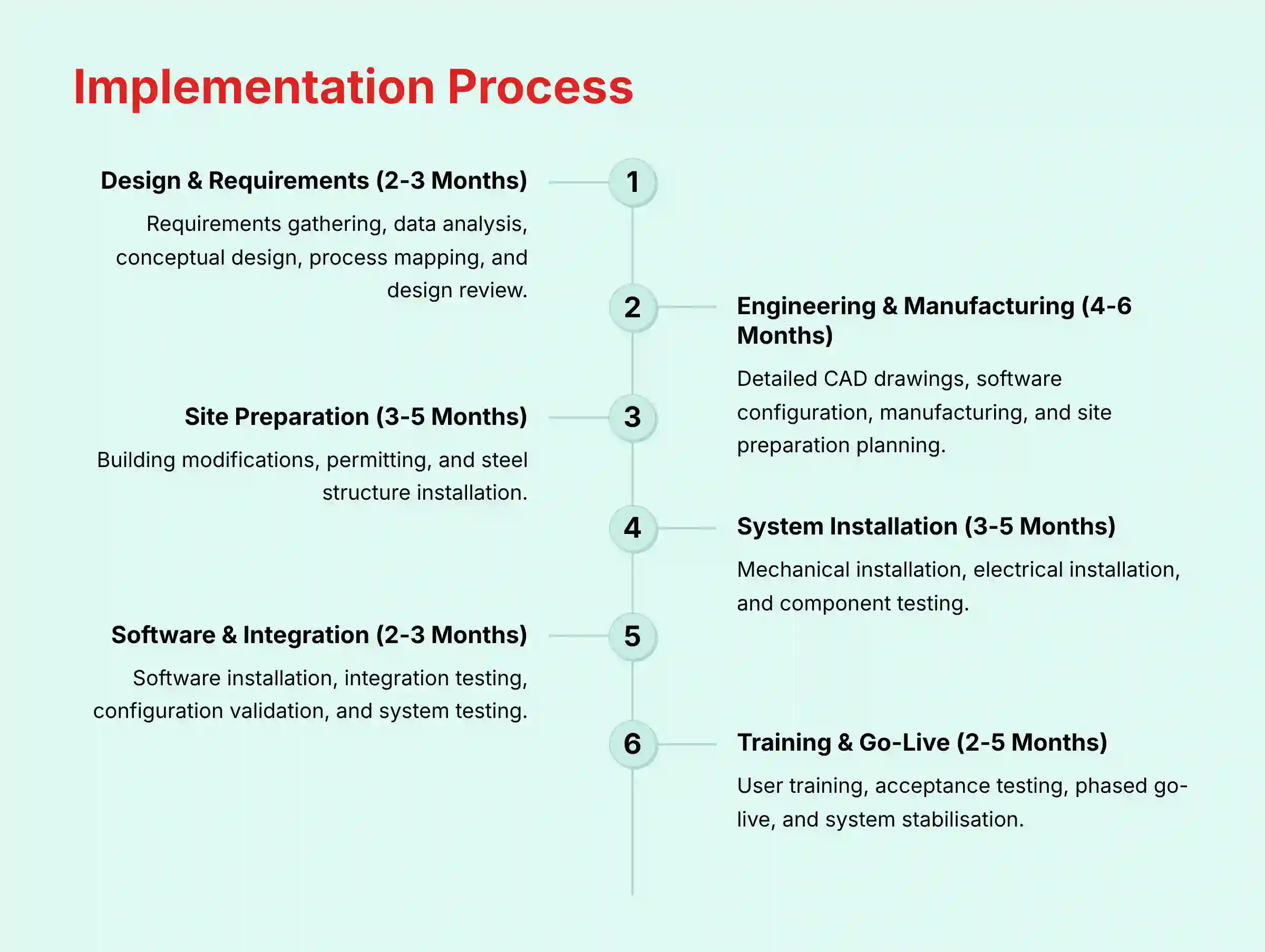
Implementing a Knapp automation system is a comprehensive, multi-phase project that typically spans 12-24 months from contract signing to full operational status. The process follows a structured methodology that has been refined through hundreds of implementations globally, ensuring predictable outcomes despite the complexity involved.
Phase 1: Design & Requirements Definition (2-3 Months)
This foundational phase establishes the detailed specifications that will guide the entire project:
- Detailed Requirements Gathering: Knapp's solution engineers conduct extensive workshops with stakeholders across operations, IT, and finance to document specific business requirements, operational constraints, and performance expectations.
- Data Analysis: Historical order data is analyzed to validate throughput requirements, identify seasonal patterns, and understand product characteristics that might affect system design.
- Conceptual Design: Based on requirements and data analysis, Knapp develops the initial system design, including:
- Preliminary layout and footprint
- Storage capacity calculations
- Throughput modeling and simulation
- Hardware specifications
- Software module selection
- Process Mapping: Detailed workflow documentation defines exactly how each process (receiving, putaway, picking, packing, shipping) will function in the new system.
- Design Review & Approval: A formal design review process ensures alignment between Knapp's proposal and stakeholder expectations before proceeding to detailed engineering.
Phase 2: Detailed Engineering & Manufacturing (4-6 Months)
Once the design is approved, the focus shifts to creating detailed plans and beginning equipment production:
- Mechanical & Electrical Engineering: Complete CAD drawings are developed for all system components, including:
- Racking and support structures
- Conveyor paths and connections
- Workstation designs
- Electrical and control systems
- Software Configuration: The KiSoft software is configured to match the documented business processes, including:
- User interface customization
- Business rule implementation
- Report development
- Integration mapping with host systems
- Manufacturing & Procurement: Physical components are manufactured at Knapp's production facilities, including shuttle robots, conveyor sections, and control systems.
- Site Preparation Planning: Detailed requirements are provided for the facility preparation, including floor loading specifications, power requirements, and network infrastructure.
Phase 3: Site Preparation & Construction (3-5 Months)
While components are being manufactured, the facility is prepared for installation:
- Building Modifications: Any necessary structural changes to the facility are completed, including:
- Floor reinforcement if required
- Fire suppression system modifications
- Electrical service upgrades
- Network infrastructure installation
- Permitting & Compliance: All necessary permits and regulatory approvals are secured before construction begins.
- Steel Structure Installation: The racking framework that will house the shuttle system is erected, creating the skeleton of the automation system.
Phase 4: System Installation & Mechanical Commissioning (3-5 Months)
As components arrive on-site, the physical assembly begins:
- Mechanical Installation: All hardware components are installed according to the engineering plans:
- Conveyor systems
- Shuttle rails and guide systems
- Lift mechanisms
- Workstations and peripherals
- Electrical Installation: Power and control systems are connected:
- Power distribution
- Control panels
- Safety systems
- Network connectivity
- Mechanical Testing: Each component is tested individually to verify proper operation:
- Shuttle movement
- Conveyor function
- Lift operation
- Safety system verification
Phase 5: Software Implementation & System Integration (2-3 Months)
With the hardware operational, the focus shifts to software and integration:
- Software Installation: The KiSoft software suite is installed on local servers or cloud infrastructure.
- Integration Testing: Connections between KiSoft and host systems (ERP, WMS) are established and verified.
- Configuration Validation: All business rules and process flows are tested against the requirements documentation.
- System Testing: Comprehensive testing of the integrated system using test scenarios derived from actual business operations.
Phase 6: User Training & Acceptance Testing (1-2 Months)
Before going live, staff must be thoroughly prepared:
- User Training: Structured training programs for different user roles:
- Operators (pick station workers)
- Supervisors
- Maintenance technicians
- IT support staff
- Standard Operating Procedure Development: Detailed documentation of all operational processes.
- User Acceptance Testing: Client stakeholders verify that the system meets all contractual requirements through structured testing scenarios.
Phase 7: Go-Live & Stabilization (1-3 Months)
The final phase involves transitioning to the new system:
- Phased Go-Live Strategy: Rather than a “big bang” approach, most implementations follow a phased strategy:
- Begin with a subset of products or order types
- Gradually increase volume and complexity
- Run parallel operations initially if possible
- On-Site Support: Knapp provides 24/7 on-site support during the initial weeks of operation to immediately address any issues.
- Performance Tuning: System parameters are adjusted based on actual performance data to optimize throughput and accuracy.
- Knowledge Transfer: Comprehensive handover to the client's operational and support teams.
Throughout this process, a dedicated Knapp project manager serves as the single point of accountability, coordinating all activities and ensuring alignment between the technical implementation and the client's business objectives.
What kind of data security and compliance (e.g., SOC 2) does Knapp's software provide?
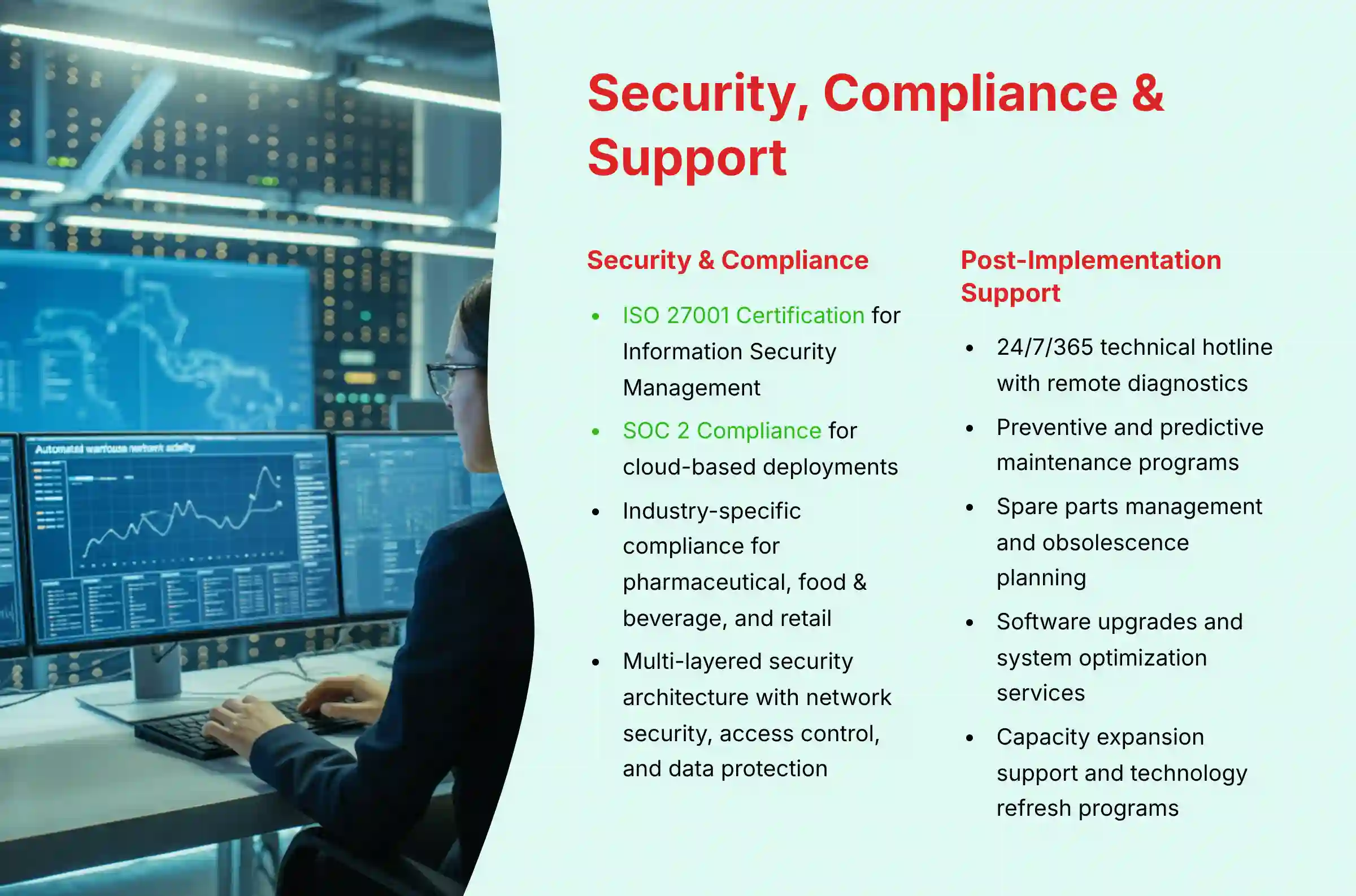
Data security and regulatory compliance are non-negotiable aspects of modern warehouse operations, especially as automation systems become increasingly connected and data-driven. Knapp addresses these concerns through a comprehensive, multi-layered security framework that protects both operational data and physical assets.
Security Certifications and Compliance Standards
Knapp's development processes and software solutions adhere to internationally recognized security standards:
- ISO 27001 Certification: Knapp maintains ISO 27001 certification for its Information Security Management System (ISMS), demonstrating adherence to globally recognized best practices for securing information assets. This framework encompasses people, processes, and technology with regular third-party audits.
- SOC 2 Compliance: For cloud-based deployments of KiSoft, Knapp has achieved SOC 2 (Service Organization Control 2) compliance, verifying that robust controls are in place for:
- Security: Protection against unauthorized access
- Availability: System uptime and reliability assurances
- Processing Integrity: Accurate, complete, and timely processing
- Confidentiality: Protection of sensitive information
- Privacy: Handling of personal data according to commitments
- Industry-Specific Compliance: For regulated industries, Knapp provides additional compliance capabilities:
- Pharmaceutical: Support for FDA 21 CFR Part 11 compliance (electronic records)
- Food & Beverage: Traceability features for FSMA compliance
- Retail/Consumer Goods: PCI DSS compatibility for handling payment card information
Technical Security Architecture
The KiSoft security architecture employs multiple defensive layers:
- Network Security: Defense-in-depth approach including:
- Segmented network architecture separating operational technology (OT) from information technology (IT)
- Industrial firewalls protecting automation components
- Encrypted VPN access for remote support
- Intrusion detection and prevention systems
- Authentication and Access Control:
- Role-based access control (RBAC) with granular permission settings
- Multi-factor authentication for administrative access
- Active Directory/LDAP integration for centralized identity management
- Biometric authentication options for sensitive operations
- Data Protection:
- End-to-end encryption for data in transit using TLS 1.2/1.3
- AES-256 encryption for sensitive data at rest
- Secure key management infrastructure
- Tokenization for sensitive customer information
- Application Security:
- Secure software development lifecycle (SSDLC) with security reviews at each stage
- Regular penetration testing by independent security firms
- Static and dynamic application security testing (SAST/DAST)
- Vulnerability management program with defined remediation timelines
Operational Security Controls
Beyond technical measures, Knapp implements operational security practices:
- Audit Logging and Monitoring:
- Comprehensive audit trails for all system actions
- Real-time monitoring for suspicious activities
- Security information and event management (SIEM) integration
- Automated alerting for security events
- Physical Security Integration:
- Badge access control integration with warehouse security systems
- CCTV monitoring of critical automation components
- Environmental monitoring (temperature, humidity, fire detection)
- Physical tamper protection for control systems
- Business Continuity and Disaster Recovery:
- Redundant system architecture for critical components
- Regular backup procedures with off-site storage
- Documented disaster recovery plans
- Annual recovery testing and validation
- Security Incident Response:
- Formal incident response procedures
- 24/7 security operations center (SOC)
- Defined escalation paths and communication plans
- Post-incident analysis and continuous improvement
Knapp's approach to security recognizes that warehouse automation systems are increasingly targets for cyber threats and ensures that protection of both data and physical operations remains a core design consideration rather than an afterthought.
What post-implementation support and maintenance does Knapp offer?
Knapp's relationship with customers extends far beyond the initial implementation, offering comprehensive post-implementation support and maintenance designed to maximize system performance, reliability, and longevity. This ongoing partnership is structured to provide both immediate operational support and long-term strategic value.
Support Tiers and Service Level Agreements
Knapp offers tiered support options to match different operational requirements:
- Standard Support Package:
- 24/7/365 technical hotline
- Remote diagnostics and troubleshooting
- 4-hour response time for critical issues
- Escalation procedures for complex problems
- Regular software updates and security patches
- Monthly performance reports and system health checks
- Premium Support Package:
- All standard support features
- 2-hour response time for critical issues
- Priority case handling
- Dedicated technical account manager
- Quarterly performance reviews with optimization recommendations
- Extended software version support
- Resident Support Option:
- Knapp technicians permanently stationed at the customer facility
- Immediate response to operational issues
- Preventive maintenance during operational windows
- Continuous system optimization
- Knowledge transfer to customer staff
- Particularly valuable for mission-critical operations with high throughput requirements
Maintenance Services and Programs
To ensure long-term system reliability, Knapp provides structured maintenance programs:
- Preventive Maintenance:
- Scheduled maintenance visits based on system usage metrics
- Systematic inspection of mechanical components (shuttles, lifts, conveyors)
- Lubrication and adjustment of moving parts
- Electronic component testing and calibration
- Software health checks and database optimization
- Customized maintenance schedules for specific operational patterns (e.g., more frequent during peak seasons)
- Predictive Maintenance:
- AI-driven monitoring of system performance metrics
- Early detection of potential component failures
- Automated alerts when performance parameters deviate from normal
- Wear prediction based on operational patterns
- Maintenance scheduling optimized around operational demands
- Spare Parts Management:
- Critical spares inventory recommendations
- On-site spare parts management options
- Expedited shipping for emergency parts
- Obsolescence management program for long-term component availability
- Consignment stock programs for high-value components
Long-Term System Evolution Services
Beyond day-to-day support, Knapp offers services focused on the continued evolution and improvement of the system:
- Software Upgrade Pathway:
- Regular KiSoft version upgrades with new features and performance improvements
- Managed upgrade projects with minimal operational disruption
- Backward compatibility assurance for custom configurations
- Long-term software roadmap alignment with customer business strategy
- System Optimization Services:
- Performance audits to identify efficiency opportunities
- Throughput analysis and bottleneck identification
- Algorithm tuning based on actual operational data
- Configuration adjustments to match evolving business requirements
- Capacity Expansion Support:
- Technical consultation for system expansion
- Integration of new technologies into existing infrastructure
- Migration planning for major system enhancements
- Phased implementation approaches to minimize operational impact
- Technology Refresh Programs:
- Strategic replacement of aging components
- Integration of newer generation hardware with existing infrastructure
- Gradual modernization approach to extend system lifespan
- ROI analysis for technology upgrade decisions
Through these comprehensive support offerings, Knapp ensures that automation investments continue to deliver value throughout their operational lifetime while adapting to changing business requirements and incorporating technological advancements as they become available.
For more detailed information about specific aspects covered in this guide, explore our additional resources including Knapp FAQs and our comprehensive overview of Best 10 AI For Warehouse Robotics & Automation Solutions: The Definitive 2025 Guide.

Leave a Reply