Is an AI Warehouse Management System Right for You?
Take This 2-Minute Quiz to Find Out!
Key Takeaways
- AI-Powered Transformation: Fullex Global and similar platforms transform traditional warehouses into intelligent, predictive operation centers that shift from reactive to proactive management
- Measurable ROI: AI warehouse solutions deliver 15-25% labor efficiency improvements, 99%+ inventory accuracy, and 15-30% increased storage density for qualified operations
- Target Market: Ideal for mid-to-enterprise operations processing 1,000+ daily orders, managing 50,000+ sq ft facilities, and requiring inventory accuracy above 98%
- Implementation Timeline: Typical deployment spans 12-20 weeks with structured phases from discovery to go-live, requiring dedicated operational champions for success
- Security & Compliance: Enterprise solutions maintain SOC 2 Type II and ISO 27001 certifications with comprehensive data protection and GDPR/CCPA compliance

What is Fullex Global and how does it improve warehouse management?
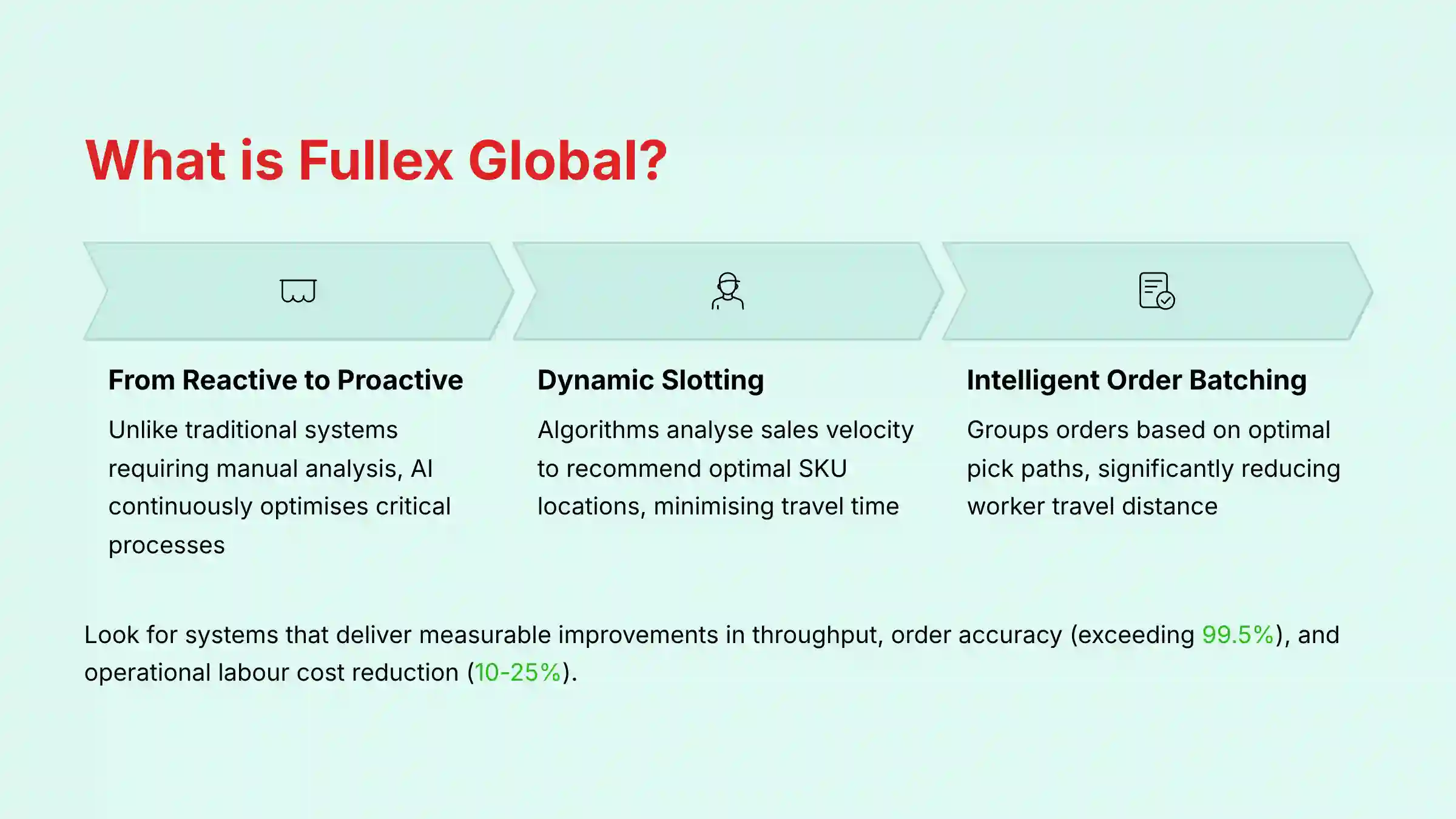
Fullex Global represents the emerging class of AI-powered platforms designed to transform traditional warehouses into intelligent, predictive operation centers. Modern warehouse management systems enhanced with AI capabilities can analyze historical data and real-time inputs to make smarter decisions that optimize space utilization, labor allocation, and inventory positioning.
The key advantage of AI-enhanced warehouse management lies in shifting operations from reactive to proactive. While traditional systems require managers to manually analyze reports and adjust layouts or staffing, advanced AI systems continuously optimize critical processes:
- Dynamic Slotting: AI algorithms analyze sales velocity, seasonality, and item dimensions to recommend optimal physical locations for every SKU, minimizing travel time for pickers. For example, the system would automatically suggest moving high-demand seasonal items to forward-picking zones when appropriate.
- Intelligent Order Batching: The AI groups orders together based on optimal pick paths, item locations, and shipping deadlines, significantly reducing the distance workers travel throughout the facility.
- Predictive Replenishment: Advanced algorithms forecast demand not just for customer orders but also for internal warehouse movements, ensuring that forward-picking locations are replenished from bulk storage before depletion, preventing costly picker downtime.
When evaluating AI warehouse management solutions like Fullex Global, look for systems that deliver measurable improvements in throughput, order accuracy (ideally exceeding 99.5%), and operational labor cost reduction (typically ranging from 10-25% in successfully implemented systems).
For comprehensive insights into Fullex Global Overview and Features, explore the detailed platform capabilities and technical specifications.
Note: When researching any AI warehouse solution, always verify the vendor's market presence through independent sources like Gartner, Forrester, or G2 Crowd reviews before making significant investment decisions.
What specific, measurable problems does Fullex Global solve?
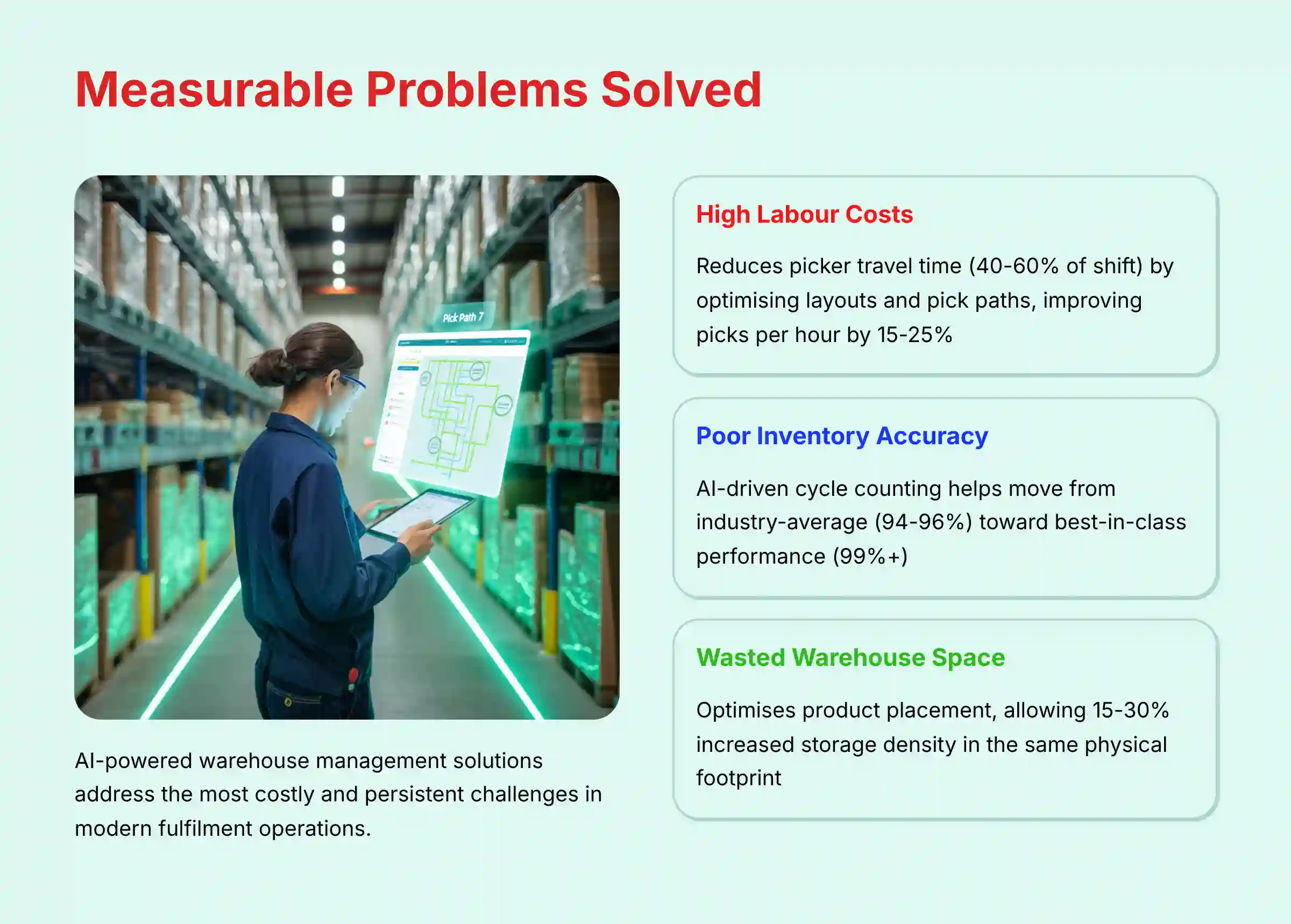
AI-powered warehouse management solutions like Fullex Global are engineered to address the most costly and persistent challenges in modern fulfillment operations. When properly implemented, these systems provide measurable improvements across key performance indicators (KPIs) that traditional systems cannot adequately address.
The most significant problems these AI solutions target include:
- High Labor Costs & Inefficiency: Advanced warehouse AI reduces picker travel time—which typically accounts for 40-60% of a picker's shift—by optimizing warehouse layouts and pick paths. This translates to higher picks per hour (often 15-25% improvement) and a measurable reduction in labor costs per order.
- Poor Inventory Accuracy: AI-driven cycle counting directs staff to verify specific, high-risk SKUs at strategically optimal times, helping operations move from industry-average accuracy (94-96%) toward best-in-class performance (99%+). This reduces stockouts, prevents lost sales, and minimizes excess safety stock carrying costs.
- Fulfillment Speed Bottlenecks: By automating decisions around order batching and releasing work to the floor in a coordinated manner, AI systems eliminate manual planning bottlenecks, helping businesses meet increasingly demanding next-day or same-day delivery promises.
- Wasted Warehouse Space: AI-driven slotting engines optimize product placement, allowing warehouses to store more inventory in the same physical footprint. This can delay or eliminate the need for costly facility expansions, with some implementations achieving 15-30% increased storage density.

Before investing in any AI warehouse solution, request concrete case studies with verified metrics from companies similar to yours, and consider running a controlled pilot to validate performance claims within your specific operational environment.
To understand how these solutions perform in real-world scenarios, check out this detailed Fullex Global Review covering implementation results and user experiences.
Who is the ideal customer for Fullex Global?

AI-powered warehouse management solutions are designed for mid-to-enterprise-level businesses whose success critically depends on the efficiency and accuracy of their fulfillment operations. While these platforms offer versatility, they deliver the highest ROI for companies facing high order volumes, complex inventory assortments, and increasing speed requirements.
The ideal customer profiles include:
- Third-Party Logistics (3PL) Providers: For 3PLs managing inventory for multiple clients with diverse requirements, AI solutions that optimize space and labor across varied product types create a significant competitive advantage. Companies like DHL, XPO Logistics, and regional 3PLs have been early adopters of warehouse AI.
- E-commerce & Direct-to-Consumer (DTC) Brands: Companies managing thousands of SKUs while facing pressure to meet fast shipping SLAs benefit enormously from AI-driven picking optimization and inventory accuracy. This is especially true for operations handling 1,000+ orders daily.
- Retail & Wholesale Distributors: Businesses operating large distribution centers supplying numerous retail outlets implement these systems to improve on-time, in-full (OTIF) delivery rates and manage complex replenishment schedules across multiple locations.
- Manufacturing Operations: Companies with on-site warehouses for raw materials or finished goods leverage AI platforms to ensure production lines maintain proper component supply while efficiently managing finished product storage and shipment.
Organizations typically become prime candidates for advanced warehouse AI when they manage facilities exceeding 50,000 square feet, process more than 1,000 orders daily, or struggle with inventory accuracy below 98%. Companies should also have mature existing ERP systems and data collection processes in place before implementing AI-enhanced warehouse management.
For businesses exploring alternative solutions, our comprehensive guide to Fullex Global Top Alternatives and Competitors provides detailed comparisons of leading warehouse AI platforms.
How does Fullex Global differ from traditional WMS and other AI competitors?

AI-enhanced warehouse management represents a significant evolution beyond traditional, rule-based Warehouse Management Systems (WMS), with important distinctions between different AI approaches in the market.
A traditional WMS functions primarily as a system of record. It executes tasks based on pre-configured, static rules, such as “always assign this SKU to this location.” While it can report where products are stored, it cannot determine optimal placement for efficiency. These systems require significant manual oversight from managers to analyze performance data and reconfigure operational strategies.
AI-driven warehouse platforms operate fundamentally differently as decision-making engines:
- Learning & Adaptation: Rather than relying on fixed rules, machine learning models continuously analyze new data on sales trends, receiving patterns, and picking performance. The system learns your operation's unique patterns and adapts recommendations automatically. When a product suddenly experiences demand changes, the AI proactively recommends location adjustments.
- Proactive Optimization: Advanced AI platforms don't just record historical events; they predict future scenarios and prescribe optimal courses of action, such as adjusting labor plans for anticipated order surges or optimizing pick routes based on real-time congestion.
When comparing different AI warehouse solutions, key differentiators often include:
- Integration Depth: The most effective platforms seamlessly integrate multiple AI modules (slotting, labor, inventory) into a unified system rather than offering point solutions.
- User Experience: Solutions vary significantly in interface design for both management planning and floor operations.
- Implementation Approach: Some vendors focus on “plug-and-play” configurations while others offer highly customized implementations.
- Data Requirements: Solutions differ in how much historical data they need for effective operation and how quickly they deliver measurable results.
Always request detailed product demonstrations using your actual data scenarios when evaluating any AI warehouse solution, as marketing materials often overstate AI capabilities that may not translate to your specific operational needs.
Can Fullex Global integrate with existing ERP systems (SAP, Oracle NetSuite, Microsoft Dynamics)?

Robust integration with core business systems, especially Enterprise Resource Planning (ERP) platforms, is a foundational requirement for any effective warehouse AI solution. Modern systems are designed to function as an intelligent execution layer alongside your ERP, which remains the authoritative source for financial data and master records.
Leading warehouse AI platforms typically offer flexible integration frameworks including:
- Pre-built Connectors: For major ERPs like SAP S/4HANA, Oracle NetSuite, and Microsoft Dynamics 365, established solutions provide pre-configured connectors that accelerate implementation. These handle the mapping of standard data objects such as sales orders, purchase orders, item masters, and inventory positions.
- REST APIs: For custom-built or less common systems, comprehensive API documentation enables technical teams to build bidirectional integrations ensuring real-time data flow. For example, when a sales order is created in your ERP, it should immediately route to the warehouse system for allocation and pick planning.
- Secure File Exchange: For legacy systems without API capabilities, data transfer can occur via standardized file formats (CSV, XML) through secure file transfer protocols (SFTP).
The integration ensures that inventory adjustments, order statuses, and shipment confirmations generated in the warehouse reflect back to the ERP in real-time, providing comprehensive visibility across the organization.
Expert Insight: The most critical pre-implementation step is often data hygiene. AI warehouse systems depend entirely on accurate master data. Before beginning technical setup, conduct a thorough audit of your item master data in the ERP. Verify that every SKU has accurate dimensions (length, width, height) and weight. Inaccurate physical attributes are the leading cause of suboptimal slotting recommendations and inefficient picking routes. Investing in data cleansing before implementation will dramatically improve outcomes.
Always request reference customers using the same ERP system as your organization when evaluating any warehouse AI solution.
For practical implementation guidance, explore our comprehensive Fullex Global Tutorials and Usecase collection covering ERP integration best practices.
How does the AI model adapt and learn from specific operational data?

The AI models in advanced warehouse management platforms are dynamic learning systems designed to become increasingly attuned to your specific business patterns over time. This adaptation process occurs through several distinct phases, creating a continuous improvement cycle.
During initial implementation, the system trains on your historical data—typically 12-24 months of sales orders, inventory movements, and receiving records. This foundational training establishes baseline understanding of your demand patterns, product seasonality, and operational constraints. Most systems require a minimum of 6 months of clean historical data for effective initial training.
Once operational, the real learning accelerates through:
- Continuous Data Ingestion: The platform constantly processes new real-time data streams: incoming orders, individual picking and packing times, inventory adjustments, and warehouse movement patterns. Advanced systems can ingest data from multiple sources including WMS transactions, IoT sensors, and even computer vision systems tracking worker movements.
- Pattern Recognition: Machine learning algorithms identify novel patterns and correlations within this data. For example, the system might discover that certain products are frequently purchased together and recommend co-locating them to enable multi-item picks from a single location, even when traditional category management would separate them.
- Performance Feedback Loops: The AI measures the outcomes of its own recommendations. After suggesting a new slotting plan, it analyzes the subsequent impact on picking efficiency. If the changes reduce average picking time by 10 seconds per item, that positive outcome reinforces the decision logic. Conversely, if a recommendation increases aisle congestion, the system learns to avoid similar suggestions.

This continuous feedback ensures the system automatically adapts to shifts in your product mix, customer buying patterns, or warehouse layout changes without requiring constant manual reconfiguration.
When evaluating AI warehouse solutions, inquire about the specific learning methodologies employed and the expected timeline for seeing measurable improvements in key metrics after implementation.
What is the typical pricing model for warehouse AI solutions like Fullex Global?
Advanced warehouse AI solutions typically employ value-based pricing models designed to scale with operational complexity and volume. When evaluating these systems, it's important to understand the complete Total Cost of Ownership (TCO), which generally comprises three main components:
- Annual Platform Subscription: This forms the core recurring cost, typically calculated based on factors correlated with the value delivered, such as:
- Annual order volume processed
- Number of concurrent system users
- Warehouse square footage managed
- Number of SKUs/inventory lines managed
For mid-sized operations (50,000-100,000 sq ft, 1,000-3,000 daily orders), annual subscription costs typically range from $75,000-$150,000, while enterprise implementations can reach $250,000+ annually. This subscription should include access to the complete software suite, standard updates, and ongoing AI model improvements.
- One-Time Implementation & Integration Fee: This covers the professional services required for system deployment, including discovery sessions, ERP integration work, AI model training with your historical data, and user training. Implementation fees typically range from 50-100% of the first-year subscription cost, varying based on:
- Complexity of your existing technology ecosystem
- Number of integration points required
- Data cleansing requirements
- Level of customization needed
- Optional Premium Support & Services: While standard support should be included in the subscription, premium service tiers often offer enhanced benefits:
- Dedicated Customer Success Manager
- 24/7 emergency support with guaranteed response SLAs
- Quarterly business reviews with optimization recommendations
- Advanced training and change management services
When evaluating any warehouse AI solution, request a detailed, all-inclusive quote after an initial discovery session. Be wary of providers who charge per-transaction fees or data usage surcharges, as these can create unpredictable costs during peak operational periods.
Always calculate expected ROI based on specific, measurable KPIs like labor efficiency improvements, inventory carrying cost reduction, and throughput increases to justify the investment.
Are warehouse AI platforms like Fullex Global compliant with key security standards?
Security and compliance are non-negotiable requirements for any technology managing mission-critical supply chain data. Leading warehouse AI platforms adhere to rigorous industry standards for data protection, privacy, and operational reliability. When evaluating solutions, verification of these credentials is essential.
Enterprise-grade warehouse AI systems should maintain, at minimum:
- SOC 2 Type II Compliance: This certification validates that the platform has implemented and maintains rigorous security controls over an extended period (typically 6-12 months). SOC 2 Type II specifically addresses availability, processing integrity, confidentiality, and privacy of your data. This is a baseline requirement for any publicly traded company or enterprise business.
- ISO 27001 Certification: This international standard certifies that the vendor follows a systematic, risk-based approach to managing sensitive information security. This includes protocols for data encryption (both at rest and in transit), access control, physical security of data centers, and incident response procedures.
Beyond these core certifications, leading platforms should support:
- GDPR Compliance: Essential for operations with European Union connections
- CCPA Compliance: Important for businesses handling California resident data
- Role-Based Access Control: Granular permissions ensuring employees access only data relevant to their specific responsibilities
- Single Sign-On (SSO) Integration: Compatibility with enterprise identity management solutions
- Penetration Testing: Regular third-party security assessments
Critical Security Verification Steps:
- Request copies of current certification documents directly from the vendor
- Verify certification status with the issuing audit firm if needed
- Ask for the vendor's security incident response plan
- Review their data backup and disaster recovery procedures
- Understand data retention and deletion policies
Never accept verbal assurances about security credentials. Always verify through documentation and third-party validation before sharing sensitive operational data with any warehouse technology provider.
For answers to additional security and compliance questions, refer to our detailed Fullex Global FAQs resource.
What does the typical implementation process look like and what is the timeline?

Implementing advanced warehouse AI systems follows a structured methodology designed to minimize operational disruption while accelerating time-to-value. For mid-sized operations, implementation typically spans 12-20 weeks, varying based on integration complexity, data quality, and organizational readiness.
The standard implementation process includes five key phases:
- Discovery & Planning (Weeks 1-2)
- Solution architects conduct deep-dive assessment of current warehouse workflows
- Technical team evaluates existing systems landscape and integration requirements
- Joint definition of project scope, success metrics, and detailed implementation roadmap
- Resource allocation and stakeholder alignment sessions
- System Integration & Data Migration (Weeks 3-8)
- Technical connection to ERP, WMS, and other core systems
- Historical data extraction and normalization (12-24 months of operational data)
- Master data cleansing and standardization
- Establishment of ongoing data synchronization protocols
- AI Model Training & Configuration (Weeks 9-12)
- Processing of historical data to train AI algorithms
- Configuration of user interfaces, dashboards, and workflow rules
- Business rule definition and exception handling setup
- Initial testing of AI recommendations against historical outcomes
- User Acceptance Testing & Training (Weeks 13-16)
- Creation of sandbox environment for real-world scenario testing
- “Conference room pilot” sessions with key stakeholders
- Comprehensive training for managers, supervisors, and floor staff
- Refinement of workflows based on user feedback
- Go-Live & Hypercare (Weeks 17-20+)
- Phased deployment, often starting with a specific warehouse zone or process
- On-site or remote “hypercare” support during initial weeks
- Daily performance monitoring and real-time adjustments
- Transition to ongoing support model

Implementation Success Factor: The most successful deployments always include a dedicated “Operational Champion” from the client organization—typically a respected warehouse or operations manager. This individual bridges the gap between technology and floor operations, explains the rationale behind AI recommendations, builds trust in the system, and gathers essential user feedback for continuous improvement. Treating implementation as an operational transformation rather than merely an IT project significantly increases success rates.
Always request detailed implementation timelines and resource requirements when evaluating warehouse AI platforms, and verify the vendor's claims through reference customer conversations.
To explore other leading solutions in this space, review our comprehensive analysis of the Best 10 AI for Order Fulfillment & Picking 2025.

Leave a Reply