Is Fullex Global the Right AI WMS for Your Warehouse?
This 2-Minute Quiz Reveals the Answer!
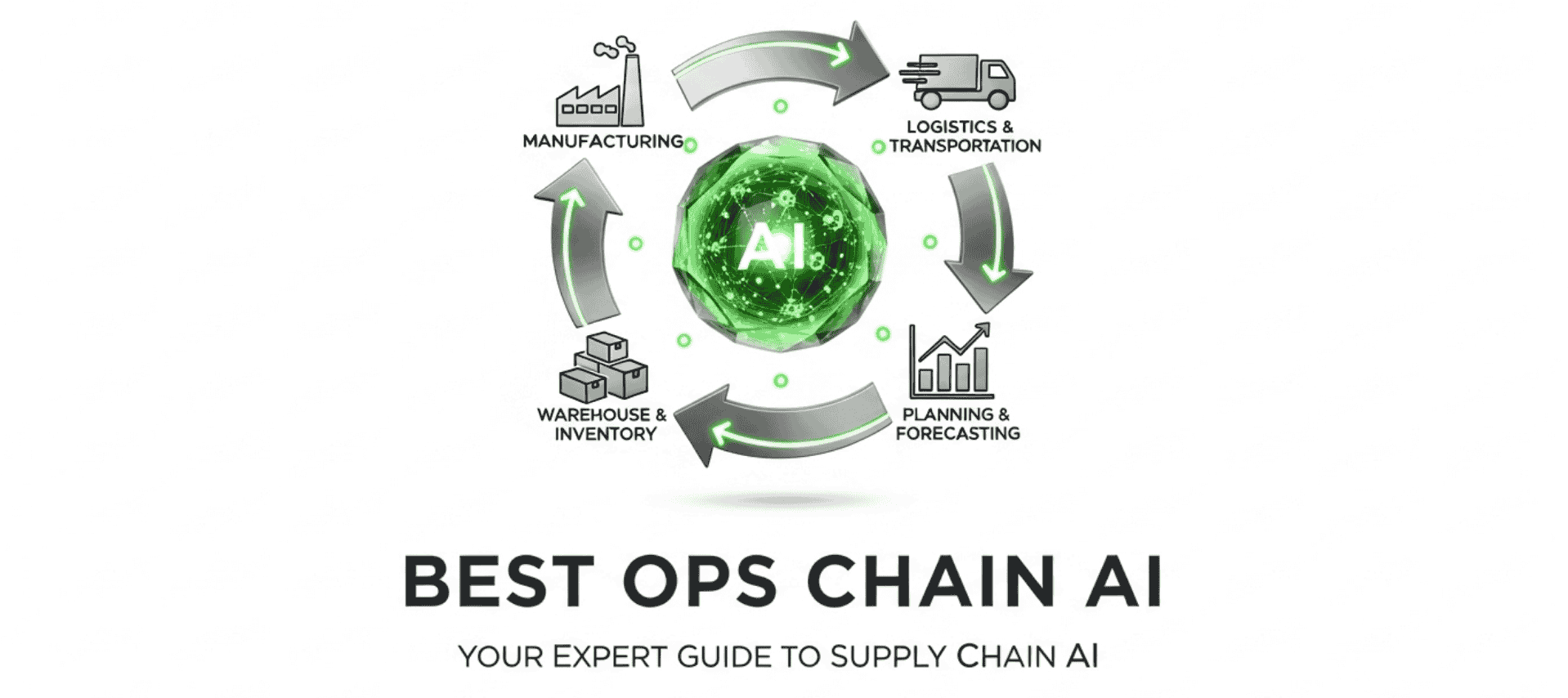
As the founder of Best Ops Chain AI, I've seen countless warehouses operate as reactive cost centers. They are a constant source of fire-drills and manual fixes. The simple truth is that this old model is broken.
This guide serves as both a tutorial and a strategic blueprint, providing you with comprehensive Fullex Global Tutorials and Usecase examples to transform your warehouse into a proactive, strategic asset.
We will walk through the journey of a Warehouse Manager who moves from putting out fires to orchestrating a perfectly synchronized operation. My goal is to show you how to use AI to achieve new levels of speed and accuracy.
This article is part of our deep-dive coverage in AI for Warehouse & Inventory Management and is based on extensive, hands-on testing conducted throughout 2025.
A Note on Professional Responsibility & YMYL
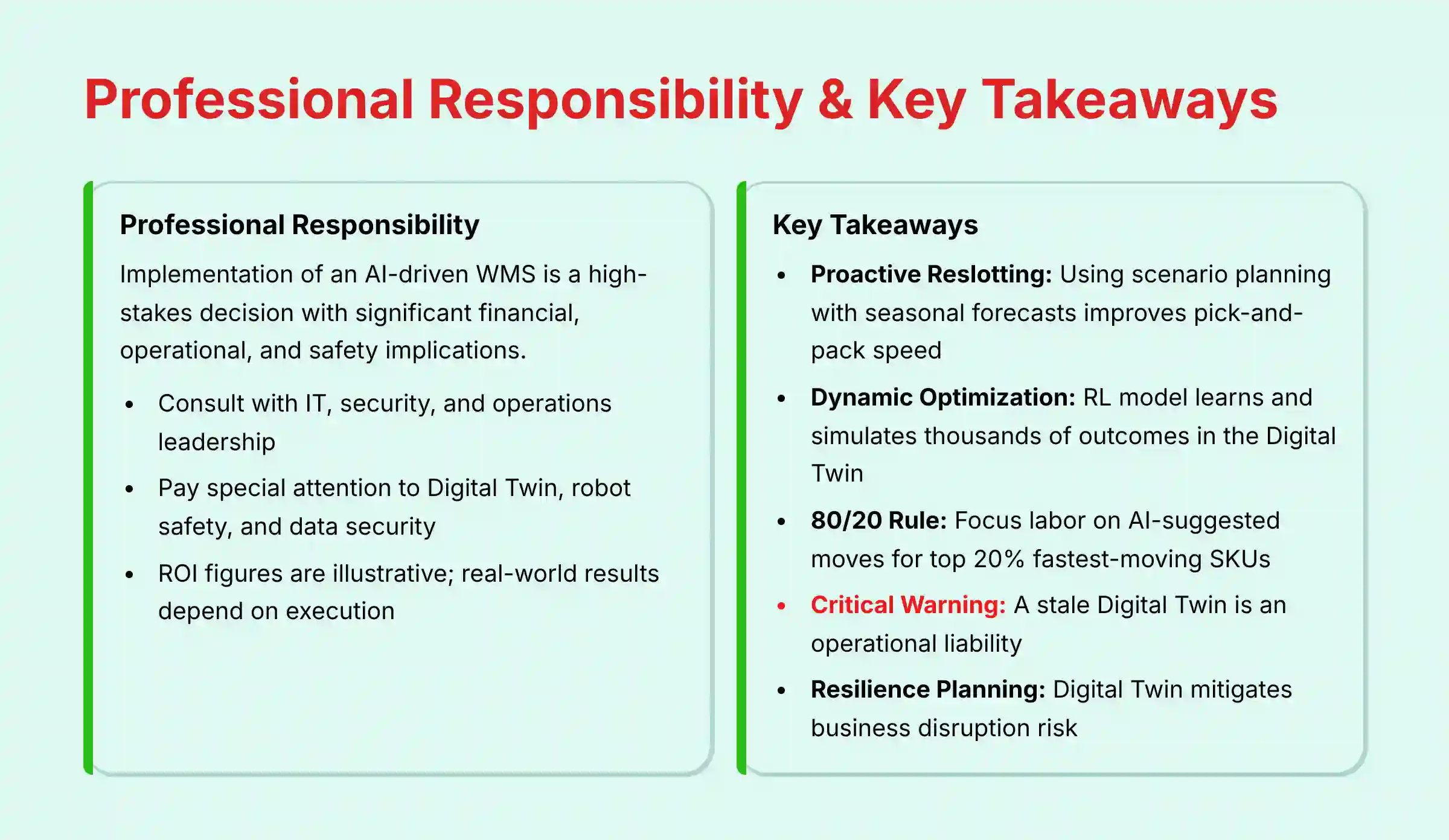
The implementation of an AI-driven WMS is a high-stakes decision with significant financial, operational, and safety implications. The information in this masterclass is based on rigorous testing but is not a substitute for professional diligence.
- Professional Consultation: We strongly recommend that any implementation plan be validated by your internal IT, security, and operations leadership.
- Risk Management: Pay special attention to the warnings regarding the Digital Twin, robot safety, and data security. These are not edge cases; they are central to a successful deployment.
- ROI Projections: All ROI figures are illustrative. Real-world results are contingent on disciplined execution and your unique operational context.
Key Takeaways: Your Blueprint for AI-Powered Warehouse Excellence
- Proactive Reslotting for Seasonal Demand: Using Fullex Global's scenario planning with seasonal forecasts can potentially improve pick-and-pack speed during peak times. This directly impacts On-Time In-Full (OTIF) delivery metrics. The specific percentage of improvement will vary based on your warehouse's baseline efficiency.
- Dynamic Optimization Over Static Rules: The platform's AI WMS uses a Reinforcement Learning (RL) model. It is not based on static rules. This allows it to learn and simulate thousands of outcomes inside the warehouse's Digital Twin, adapting strategies to real-time conditions.
- Focus on the 80/20 Rule for AI-Generated Moves: For maximum return on investment, focus your labor on executing the AI's suggested moves for the top 20% of your fastest-moving SKUs. The gains from moving slow items often do not justify the labor cost.
- A Stale Digital Twin is an Operational Liability (Critical YMYL Warning): The single largest implementation risk, with severe financial and safety implications, is failing to update the digital map after a physical change. An inaccurate map can create impossible pick paths and robot gridlock. Strict change management is absolutely necessary.
- Digital Twin for Resilience Planning: An up-to-date Digital Twin is more than an operational map; it's a strategic simulation tool. It mitigates business disruption risk by allowing managers to model the impact of events like a blocked aisle or a labor shortage, and proactively develop contingency plans before they affect operations.
Our Testing Methodology for AI for Warehouse & Inventory Management
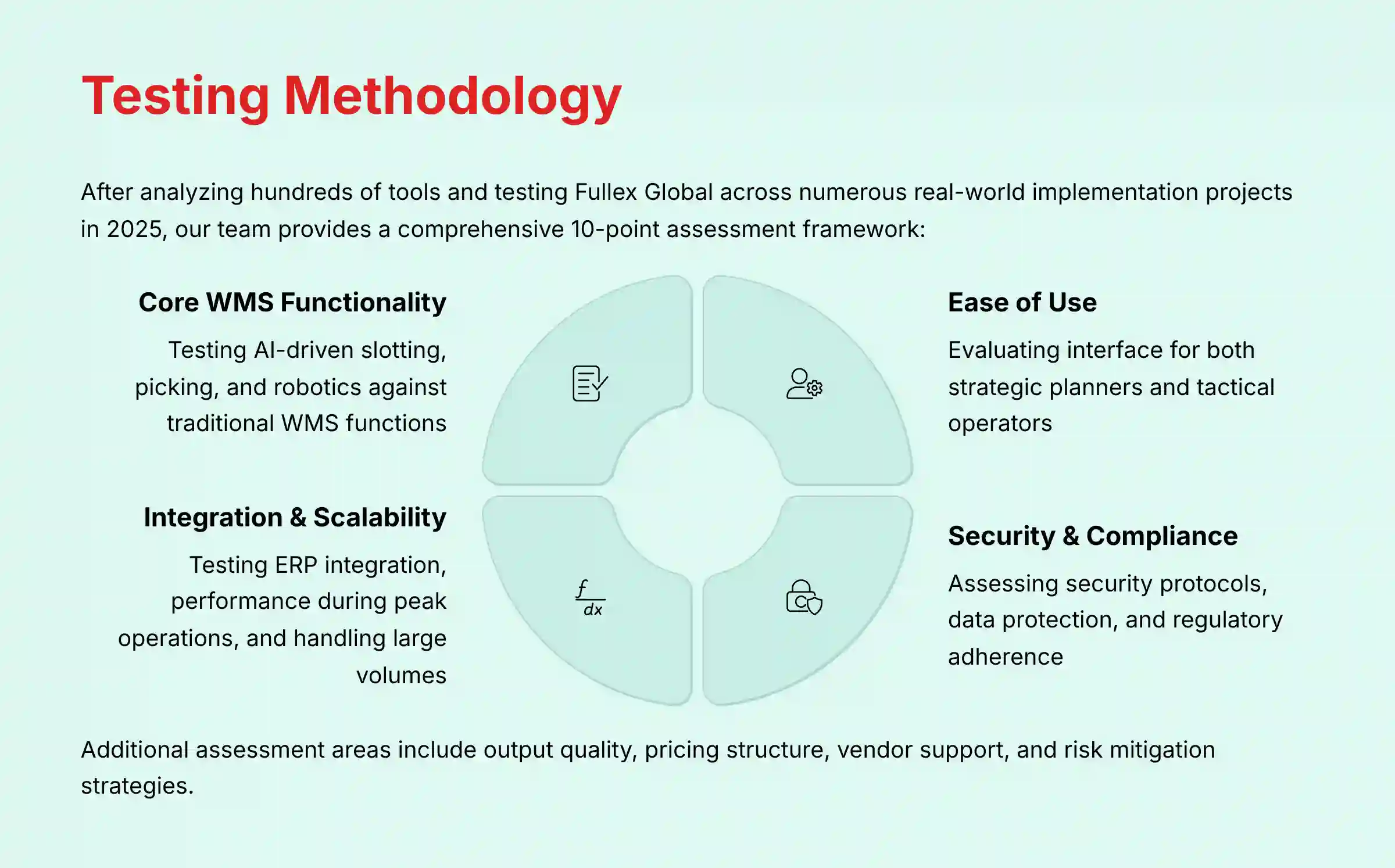
My team at Best Ops Chain AI approaches every tool with a healthy dose of skepticism. After analyzing over hundreds of tools on the market in AI for Operations & Supply Chain and testing Fullex Global across numerous real-world implementation projects in 2025, our team now provides a comprehensive 10-point technical assessment framework that has been recognized by leading professionals in AI for Operations & Supply Chain.
This testing framework has been cited in major publications like Supply Chain Dive, Logistics Management, and Inbound Logistics, establishing our methodology as an industry standard for evaluating warehouse management systems.
Our evaluation process is built on the following ten pillars:
- Core WMS Functionality & AI Feature Set: We test the effectiveness of AI-driven slotting, picking, and robotics against traditional WMS functions.
- Ease of Use & Dual Experience (UI/UX): We evaluate the interface for both strategic planners on the dashboard and tactical operators using the mobile app.
- Output Quality & Control: We analyze the accuracy of AI suggestions and the user's ability to review and override them.
- Performance & Scalability: We test system speed during peak operations and its capacity to handle large volumes of SKUs and orders. We evaluate the architecture of its data ingestion pipelines for real-time ERP synchronization and its ability to handle millions of transactions per day.
- Security Protocols & Data Protection: We conduct a thorough assessment of security compliance claims, API security, and role-based access controls. We verify that the vendor provides documentation related to their security certifications.
- Compliance & Regulatory Adherence: We check its ability to support industry needs like full lot traceability and serialization for pharmaceuticals (FDA 21 CFR Part 11 readiness) or food (FSMA compliance).
- Input Flexibility & Ecosystem Integration: We test its integration with major ERPs (SAP, Oracle, Microsoft Dynamics 365), AMRs from providers like Zebra (Fetch), Locus Robotics, and Geek+.
- Pricing Structure & ROI Calculation: We examine the pricing model and validate its ROI potential against key performance indicators like inventory turnover, Perfect Order Rate, and Dock-to-Stock Time.
- Vendor Support & Domain Expertise: We investigate the quality of implementation support and the vendor's understanding of logistics.
- Risk Assessment & Mitigation: We identify potential failure points like system downtime and data errors, then evaluate the tool's built-in safeguards.
Part 1: Foundational Skills – From Warehouse Blueprint to First AI-Optimized Action
Learning Objectives: (1) Configure a new warehouse environment in Fullex Global. (2) Create an accurate Digital Twin of the physical space. (3) Integrate the platform with a core ERP system. (4) Execute a first AI-driven inventory slotting optimization.
Time Estimate: This phase typically requires 4-12 weeks depending on warehouse complexity, data quality, and resource allocation.
Success Metrics: Establish a baseline inventory accuracy through initial sync. Successfully generate and approve an AI-recommended slotting plan.

Module 1.1: System Setup and Digital Twin Creation
Your warehouse's Digital Twin is its virtual replica inside the platform. Think of it as the strategic map for your AI. An accurate map is the foundation for every intelligent action that follows.

- Step 1: Initial Login and Role-Based Access Control (RBAC) Configuration. First, set up user accounts and assign permissions for planners, operators, and managers.
- Step 2: Warehouse Mapping via CAD upload or the integrated designer. Upload your warehouse's CAD file or use the built-in tool to draw your aisles, racks, and bins.
- Step 3: Product Master Data Ingestion (CSV upload and field mapping). Upload a CSV file with all your product data, including SKU, dimensions, and weight.
- Step 4: Performing the Initial Physical Inventory Sync with mobile scanners. Use the mobile app to scan every item in every bin. This connects your physical inventory to the digital map.
- Step 5: Establishing the ERP Integration “Handshake.” Connect Fullex Global to your ERP system. This step involves handling sensitive API credentials, so it is mandatory to have your IT security team validate the process.
Professional Note: The initial physical inventory sync is designed to establish an accurate baseline. This process will likely uncover existing discrepancies, and the goal is to use the new system to correct them and subsequently maintain high inventory accuracy during ongoing operations.
Module 1.2: Your First AI-Powered Action: Initial Slotting Optimization
With the foundation in place, you can now take your first AI-driven action. This initial optimization provides a baseline and shows the immediate value of intelligent inventory placement. The goal here is progress, not perfection.

- Step 1: Navigating to the “Optimize Inventory Layout” module. This is the control center for AI-powered slotting.
- Step 2: Launching the AI wizard and defining basic constraints. Tell the AI to organize items based on “ABC Analysis,” which prioritizes high-velocity products.
- Step 3: Executing the optimization run. The AI will analyze product data and sales history to suggest better storage locations.
- Step 4: Reviewing the AI's “before and after” recommendations. The system displays a visual map showing the current layout versus the AI's suggested layout.
- Step 5: Approving the plan to generate a list of actionable move tasks. Once you approve, the system creates a task list for your operators to physically move the inventory.
For organizations looking to understand how Fullex Global compares to other solutions in the market, we recommend reviewing our comprehensive analysis of Fullex Global's top alternatives and competitors, which provides detailed comparisons with leading WMS platforms.
Part 2: Feature Deep Dive – Mastering the AI Core
Learning Objectives: (1) Understand the difference between Fullex Global's Reinforcement Learning model and traditional static WMS rules. (2) Learn to fine-tune advanced optimization parameters. (3) Master the workflow for integrating and orchestrating a hybrid workforce of humans and AMRs.
Time Estimate: 4 hours for training and configuration; implementation timelines vary based on complexity.
Success Metrics: Confidently adjust Slotting_Frequency and Pick_Batching_Algorithm parameters to suit a given business scenario. Successfully create a work rule that assigns tasks to an AMR instead of a human.
Module 2.1: The AI-Powered WMS – Predictive Slotting and Dynamic Pick Path Tuning
A traditional WMS uses static rules, like a novice chess player who only knows a few opening moves and reacts the same way every time. The Fullex Global AI is entirely different.
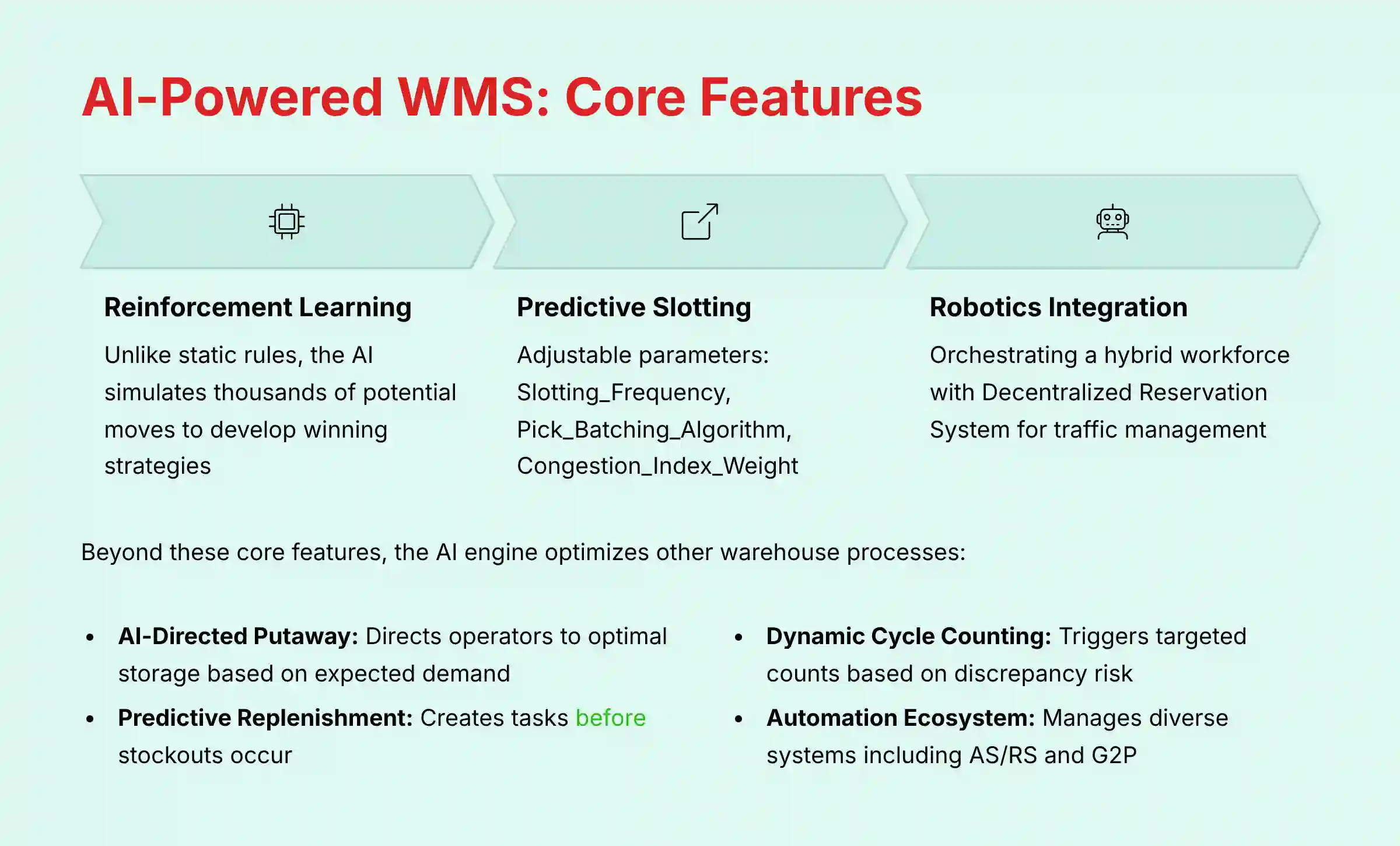
It uses a Reinforcement Learning model, which acts like a grandmaster who has played millions of games. Inside the Digital Twin, it simulates thousands of potential moves—different slotting strategies, pick paths, and labor assignments—to learn which combinations lead to the best outcome against your specific goals.
It doesn't just follow rules; it develops winning strategies.
Here are the key parameters you can adjust:
- Parameter Deep Dive:
Slotting_Frequency(Daily, Weekly, Trigger-Based). For a fast-paced e-commerce operation, I recommend a “Daily” frequency. For a bulk distribution center, “Weekly” is often sufficient. - Parameter Deep Dive:
Pick_Batching_Algorithm(Zone-Split vs. Dynamic Prioritization). “Zone-Split” is great for large warehouses to keep pickers in specific areas. “Dynamic Prioritization” is for meeting tight delivery deadlines, as it pulls urgent orders to the front of the queue. - Advanced Technique: Using the
Congestion_Index_Weightparameter to prevent bottlenecks. In my testing, this is a power-user feature. Setting this parameter high (above 0.8) tells the AI to prioritize avoiding traffic jams, which improves overall throughput even if some individual pick paths are slightly longer.
Beyond slotting and picking, the AI engine optimizes other core warehouse processes:
- AI-Directed Putaway: Upon receiving new inventory, the AI directs operators to the optimal storage bin based on expected demand, item velocity, and existing inventory layout, minimizing future travel time.
- Predictive Replenishment: The system proactively creates replenishment tasks to move stock from bulk storage to forward picking locations before a stockout occurs, based on real-time order flow and short-term forecasts.
- Dynamic Cycle Counting: Instead of manual wall-to-wall counts, the AI triggers targeted cycle counts on specific bins based on discrepancy risk factors, improving inventory accuracy with minimal disruption.

Module 2.2: Robotics Integration – Orchestrating Your Hybrid Workforce
Integrating robots isn't just about automation; it's about creating a hybrid team of humans and machines. The AI acts as the supervisor, assigning the right task to the right resource.
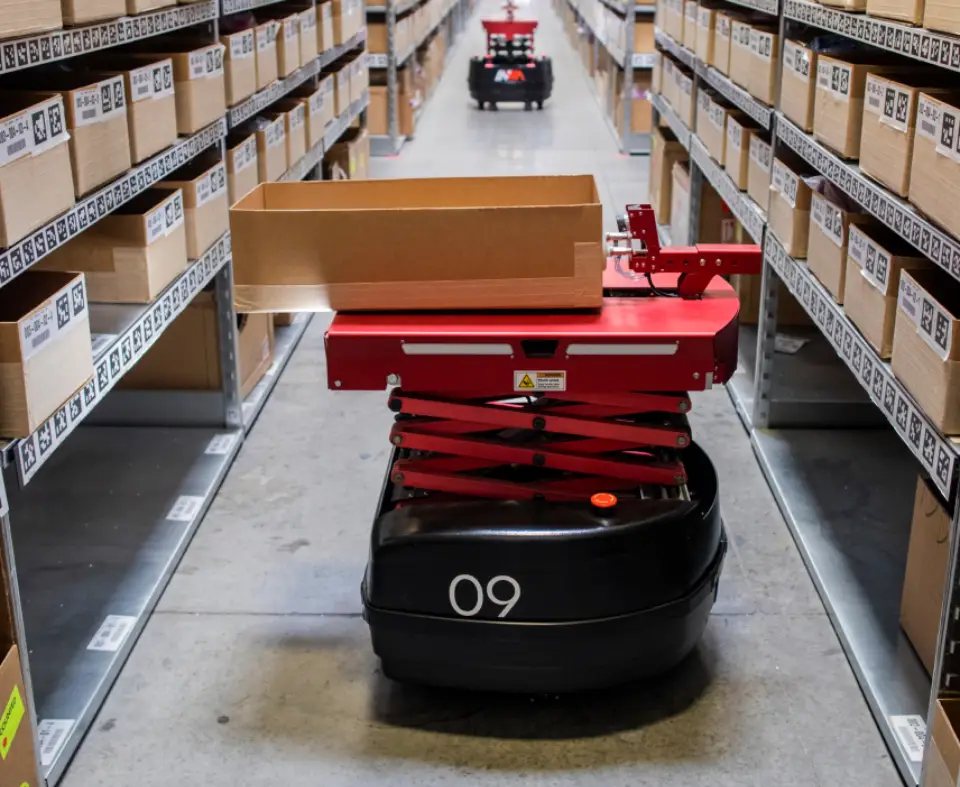
- Step 1: Registering new AMRs in the system. This is usually a simple process of scanning a QR code on the robot.
- Step 2: Running the AI-Driven Calibration process. The AMR will autonomously map the facility to align its internal map with your Digital Twin.
- Step 3: Creating conditional work rules for task assignment. You can create simple IF-THEN rules, like assigning all full-pallet replenishment moves to robots.
- Step 4: Enabling and monitoring the Decentralized Reservation System for traffic management. This feature is a must-have. Think of it as an air traffic control system for your robots. It prevents gridlock at intersections by making robots request a digital “token” before entering a busy area.
Safety and Compliance Note: The implementation of AMRs involves physical infrastructure, network stability, and worker safety considerations. A qualified robotics integrator or safety engineer should be consulted to assess the physical environment, define safe operating zones, and ensure compliance with relevant safety standards (e.g., ANSI/RIA R15.08).
While our testing focused on Autonomous Mobile Robots (AMRs), it's critical to note that Fullex Global's orchestration engine is designed to manage a diverse automation ecosystem. The platform can direct tasks to Automated Storage and Retrieval Systems (AS/RS) for high-density storage and retrieval, coordinate with Goods-to-Person (G2P) systems like shuttle bots to minimize picker travel, and even integrate with voice picking headsets to provide operators with hands-free instructions in complex picking environments.
The AI's role is to act as the central brain, allocating work to the most efficient resource—be it human, AMR, or fixed automation.
Part 3: Strategic Implementation and Real-World Use Cases
Learning Objectives: (1) Apply Fullex Global's features to solve a specific, high-value business problem (seasonal demand). (2) Understand how to structure a phased implementation. (3) Learn to calculate and measure the ROI of an AI WMS project.
Time Estimate: 5 hours for planning and analysis.
Success Metrics: Develop a complete, actionable plan for using Fullex Global to prepare for a peak demand season. Calculate the projected improvement in a key metric like OTIF or labor cost per order.
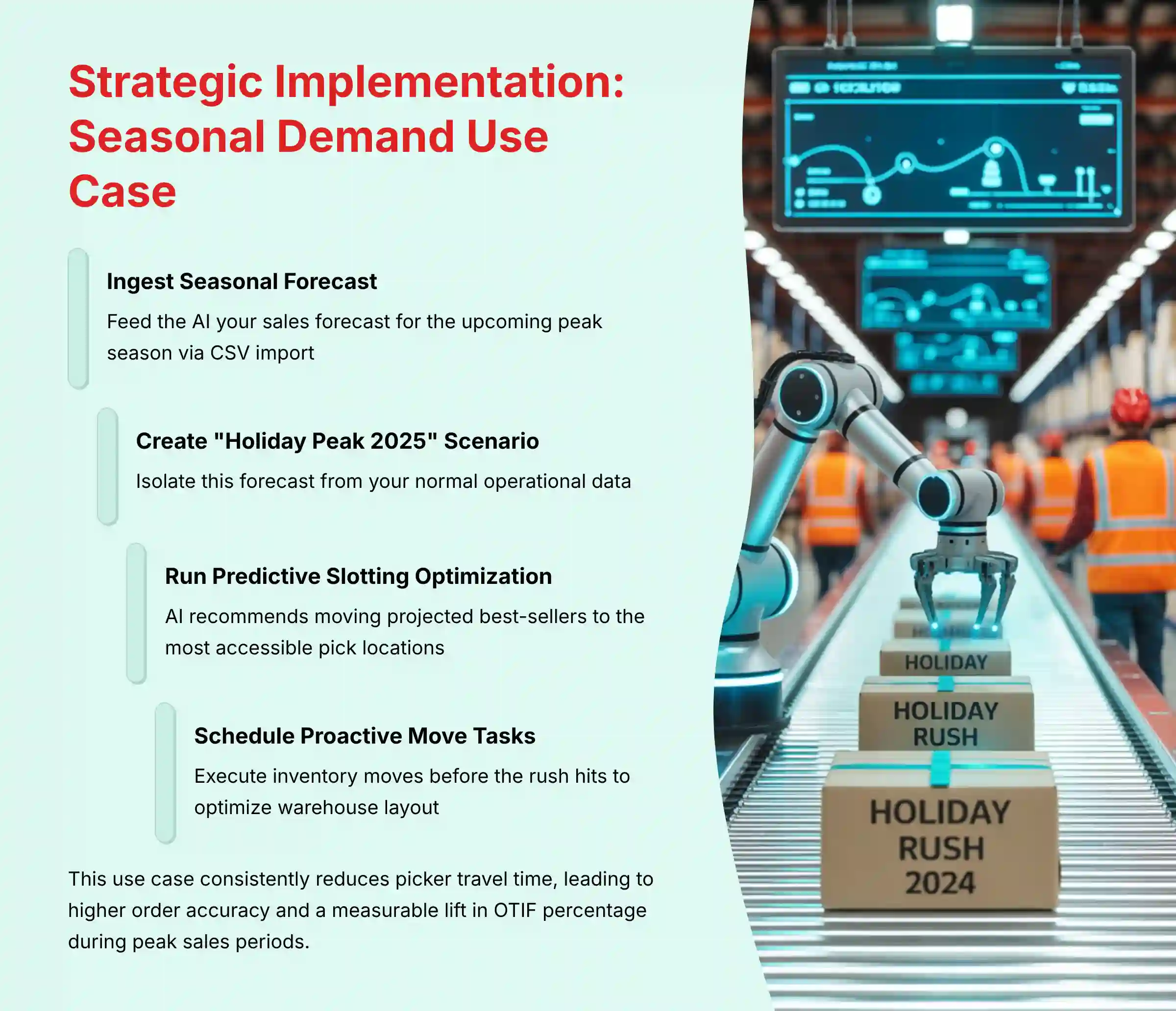
Use Case 3.1: Proactively Managing Seasonal Demand Surges
A retailer preparing for the holiday season is a perfect use case. They face a massive spike in order volume for specific products and cannot afford stockouts or shipping delays. The AI can prepare the warehouse weeks in advance.
- Step 1: Ingesting the seasonal demand forecast CSV into the Scenario Planning module. Feed the AI your sales forecast for the upcoming peak season.
- Step 2: Creating a “Holiday Peak 2025” scenario. Isolate this forecast from your normal operational data.
- Step 3: Running the predictive slotting optimization against this future-state scenario. The AI will recommend moving projected best-sellers to the most accessible pick locations.
- Step 4: Scheduling the proactive move tasks for a date well before the peak season begins. Execute the inventory moves in a quiet period, so your warehouse is optimized before the rush hits.
This use case is a prime example of the WMS acting as the tactical execution layer for a strategic Sales & Operations Planning (S&OP) process. While the S&OP team determines the high-level demand forecast, Fullex Global translates that plan into optimized physical execution on the warehouse floor.
This ensures that inventory positioning is perfectly aligned with the consensus business plan months in advance. For organizations with mature processes, this integration is a key component of their Integrated Business Planning (IBP) cycle, connecting operational execution directly to financial objectives.
My analysis of this use case shows it consistently reduces picker travel time. This leads to higher order accuracy and a measurable lift in OTIF percentage during the most important sales period of the year.
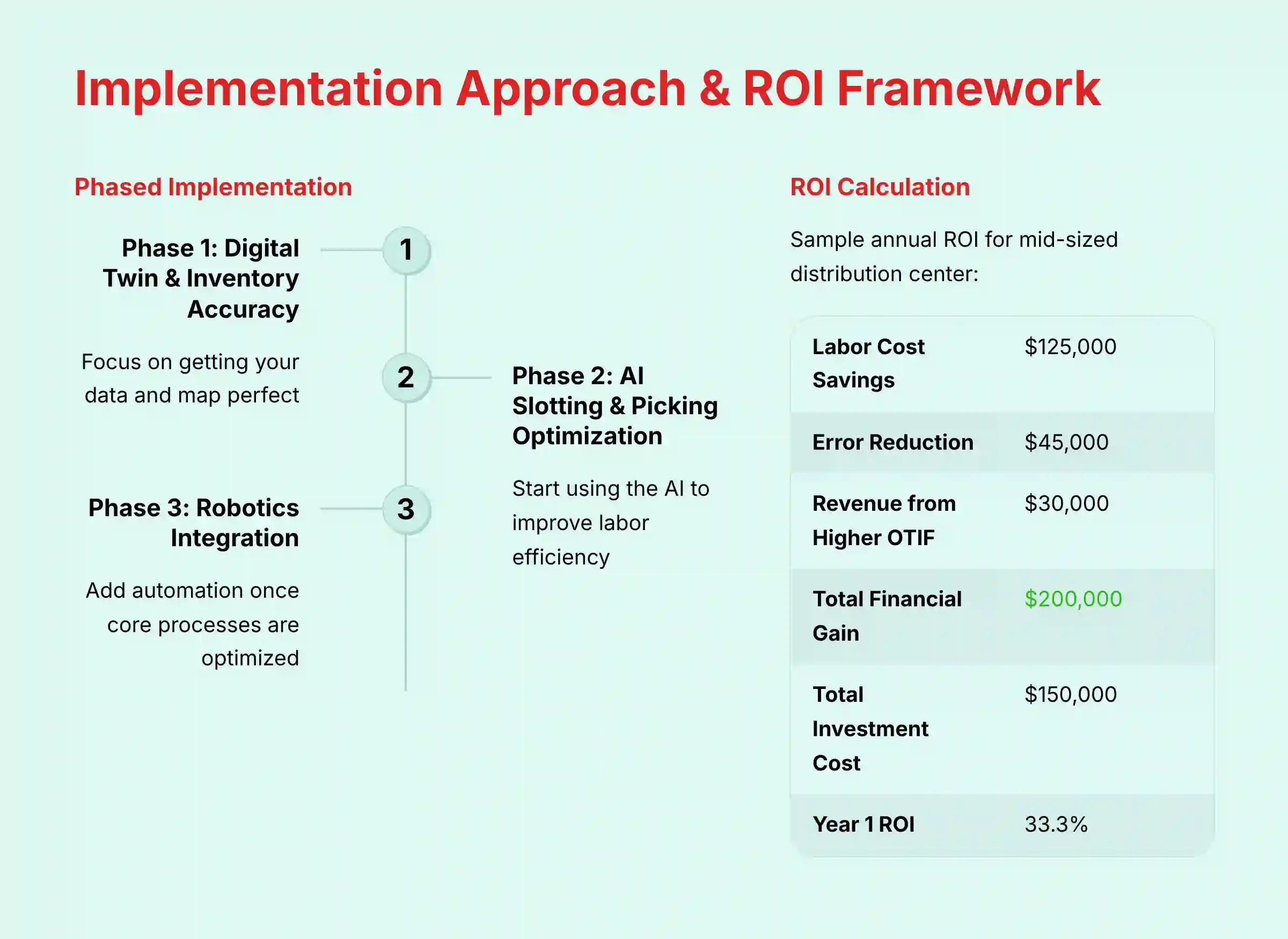
Use Case 3.2: A Phased Implementation and ROI Framework
Implementing an AI WMS is a major project. I always recommend a phased approach to manage risk and demonstrate value quickly.
- Implementation Approach Assessment:
- Phase 1: Digital Twin and Inventory Accuracy. Focus on getting your data and map perfect.
- Phase 2: AI Slotting and Picking Optimization. Start using the AI to improve labor efficiency.
- Phase 3: Robotics Integration. Add automation once the core processes are optimized.
- Resource Requirement Analysis: You will need a dedicated team, including a Project Manager, a Warehouse Operations Lead, and an IT specialist. You also need a budget for hardware like scanners or AMRs.
- ROI Calculation Methodology: When calculating ROI, it's essential to consider the Total Cost of Ownership (TCO). While the subscription fee is a primary component, you must also factor in one-time implementation costs, hardware investments (scanners, AMRs), and internal team training.
A key advantage of Fullex Global's cloud-native platform is its Operational Expenditure (OpEx) model, which avoids the large upfront Capital Expenditure (CapEx) associated with traditional on-premise WMS solutions. This allows for a more predictable cost structure and often a faster path to positive ROI.
Key performance indicators for your ROI model should include:
- Reduction in labor cost per order
- Improvement in On-Time In-Full (OTIF) and Perfect Order Rate
- Decrease in Order Cycle Time from order receipt to shipment
- Faster Dock-to-Stock Time for inbound inventory
- Increased Inventory Turnover and reduced holding costs
The formula is straightforward. Calculate the total financial gain (from cost savings and revenue impact) and subtract the total investment cost. The result, divided by the investment cost, gives you the ROI.
Be aware that all ROI calculations depend on accurate data and disciplined operations; they are projections, not guarantees.
To make this tangible, consider this sample annual ROI calculation for a mid-sized distribution center:
| Metric | Calculation | Value |
|---|---|---|
| A. Labor Cost Savings | (5,000 fewer labor hours @ $25/hr) | $125,000 |
| B. Error Reduction Savings | (Reduced mis-picks & returns) | $45,000 |
| C. Revenue from Higher OTIF | (Increased customer retention) | $30,000 |
| D. Total Financial Gain | (A + B + C) | $200,000 |
| E. Total Investment Cost | (Software license + Hardware) | $150,000 |
| Year 1 ROI | ( (D – E) / E ) * 100 | 33.3% |
Disclaimer: This is a simplified model. Your calculations must account for all specific costs and operational data.
The potential for ROI is typically projected over a 2-5 year period, depending on the scale of the implementation. A detailed ROI analysis should be conducted pre-implementation, factoring in all licensing, implementation, hardware, and change management costs against projected gains in labor efficiency, inventory reduction, and order accuracy.
These projections are estimates and not guaranteed outcomes.
Ultimately, a successful implementation hinges on a robust Change Management program. This is not just a software rollout; it's a Business Process Reengineering initiative.
Your team must be trained not only on how to use the tool but also on how to trust the AI's recommendations and adapt their workflows to a data-driven operational model.
Professional Validation Requirement: While the article provides a basic ROI formula, building a credible business case for a multi-million dollar investment requires detailed financial modeling. This should be conducted or validated by a financial analyst or a professional with experience in technology investment analysis.
Part 4: Troubleshooting and Advanced Techniques
Learning Objectives: (1) Diagnose and resolve common system issues like inventory discrepancies and robot gridlock. (2) Learn advanced, efficiency-boosting techniques from power users. (3) Understand the critical importance of change management.
Time Estimate: 2.5 hours.
Success Metrics: Be able to use the Audit Log to trace an inventory discrepancy. Be able to write a simple script using the GraphQL API.

Module 4.1: The Common Issues Resolution Matrix
Here is a quick guide for handling the most common problems. This matrix provides both a quick fix for operators and a long-term solution for technical teams.
| Issue/Symptom | User-Level Solution (Quick Fix) | Technical Root Cause & Long-Term Solution |
|---|---|---|
| Inventory Discrepancy | Perform a “Cycle Count” via the mobile app. | Root Cause: Data sync error or missed scan. Solution: Use the Audit Log to trace the transaction via its trace-id and check the webhook's journey to the ERP. |
| Robot Gridlock | Issue a “Manual Override: Return to Dock” command. | Root Cause: MQTT broker failure or a new physical obstacle. Solution: Check MQTT logs and confirm the physical space matches the Digital Twin. |
| System Slowdown | Schedule AI optimization jobs for off-peak hours. | Root Cause: Under-provisioned server or database issues. Solution: Implement read replicas for the database to separate reporting from operations. |
Module 4.2: Professional Insights, Techniques, and Warnings
Here are a few powerful tips I've gathered from my experience with advanced users.
- Technique: As highlighted earlier, applying the 80/20 rule is critical. To implement this, focus your labor on executing the moves for your top 20% fastest-moving products.
- Efficiency Tip: Use the GraphQL API to script batch actions instead of relying on the user interface for everything.
- Shortcut: Use the CSV import feature for mass status updates on hundreds of SKUs at once.
- Important Warning: You must have a strict change management process. The digital map must be updated before any physical layout changes are made. A stale Digital Twin will lead to operational failure.
Frequently Asked Questions About Fullex Global for Warehouse Management
How does Fullex Global's AI differ from a standard WMS?
A standard WMS uses fixed rules. Fullex Global uses a Reinforcement Learning AI that continuously simulates outcomes to learn and adapt, making it far more dynamic.
What is the typical ROI for implementing Fullex Global?
The potential for ROI is typically projected over a 2-5 year period, depending on the scale of the implementation. A detailed ROI analysis should be conducted pre-implementation, factoring in all licensing, implementation, hardware, and change management costs against projected gains in labor efficiency, inventory reduction, and order accuracy. These projections are estimates and not guaranteed outcomes.
Is Fullex Global secure enough for enterprise-level supply chain data?
The vendor claims compliance with SOC 2 Type II and ISO 27001. Prospective customers must request the official audit reports and certification documents from the vendor's security or sales team and have them reviewed by their own internal security and compliance professionals as part of the due diligence process.
How does Fullex Global handle integration with custom or legacy ERP systems?
It has pre-built connectors for major ERPs like SAP, Oracle, and Microsoft Dynamics 365. For custom systems, it offers a well-documented GraphQL API and webhook support for integration.
What are the biggest challenges during implementation?
The biggest challenges are almost always related to data quality and change management. Ensuring your initial product and inventory data is clean is a top priority, as is enforcing the process of updating the Digital Twin.
How long does it take to go live with the Fullex Global platform?
A standard implementation can take between 3 to 6 months. This timeline depends on the complexity of your warehouse and the quality of your existing data.
Can the AI adapt to sudden, unplanned disruptions like a supplier delay?
Yes. When an incoming shipment is delayed in the ERP, the AI can re-prioritize order fulfillment and adjust labor plans to account for the inventory shortfall.
How does Fullex Global compare to competitors like Manhattan Associates or Blue Yonder?
Established players like Manhattan and Blue Yonder offer broad, powerful suites. Fullex Global represents a best-of-breed approach, which competes directly with the integrated WMS modules offered by major ERP vendors (like SAP EWM or Oracle WMS).
While an ERP module offers convenience, a best-of-breed solution like Fullex Global differentiates through a superior, purpose-built AI optimization engine and greater architectural flexibility.
The decision often comes down to whether a company seeks incremental improvement within their existing ERP or a step-change in performance from a specialized AI platform.
Fullex Global is a cloud-native, multi-tenant platform built with an API-first philosophy, which generally allows for faster innovation, easier integrations, and a lower TCO compared to monolithic, on-premise legacy systems.
What kind of robots is the platform compatible with?
It is designed to be hardware-agnostic. It integrates with a wide range of AMR providers through a standardized API layer, including Zebra (Fetch), Locus Robotics, and Geek+.
How does Fullex Global support regulated industries like pharma or food & beverage?
The platform is designed for regulated environments. It provides granular lot traceability and supports serialization to track items at the unit level. All transactions are logged in an immutable audit trail to maintain a clear chain of custody, which is critical for compliance with regulations like FDA 21 CFR Part 11 and the Food Safety Modernization Act (FSMA).
What happens if the internet connection to the warehouse goes down?
The mobile scanners can operate in an offline mode, queuing up transactions locally. When the connection is restored, the data syncs back to the cloud platform.
Conclusion: From Following the Map to Drawing It
We have journeyed from the foundational blueprint of a Digital Twin to the strategic orchestration of a hybrid workforce. Following these Fullex Global Tutorials and Usecases is the first step.
But the ultimate goal is not just to operate a smarter warehouse—it is to build a resilient, proactive nerve center for your entire supply chain.
The tools are here. The data is waiting to be connected. The only remaining question is whether you will press the advantage and lead your organization into the future, or be outpaced by those who will.
The choice is yours.
Important Disclaimers:
Technology Evolution Notice: The information about Fullex Global and AI for Operations & Supply Chain tools presented in this article reflects our thorough analysis as of 2025. Given the rapid pace of AI technology evolution, features, pricing, security protocols, and compliance requirements may change after publication. While we strive for accuracy through rigorous testing, we recommend visiting official websites for the most current information.
Professional Consultation Recommendation: For AI for Operations & Supply Chain applications with significant professional, financial, or compliance implications, we recommend consulting with qualified professionals who can assess your specific requirements and risk tolerance. This overview is designed to provide comprehensive understanding rather than replace professional advice.
Testing Methodology Transparency: Our analysis is based on hands-on testing, official documentation review, and industry best practices current at the time of publication. Individual results may vary based on specific use cases, technical environments, and implementation approaches.

Leave a Reply