Is the Exotec Skypod System Right for Your Warehouse?
Take This Quick Quiz to Find Out!
The Exotec Skypod system is an advanced, AI-driven goods-to-person solution that reshapes modern warehouse operations. In today's “permanent storm” of supply chain disruption, the warehouse is no longer just a cost center—it's the strategic battleground where customer promises are won or lost.
The simple truth is that traditional fulfillment operations are being outpaced. This is the critical inflection point where Exotec enters the picture, not as an incremental upgrade, but as a fundamental re-imagining of warehouse robotics.
My work at Best Ops Chain AI involves analyzing how such technologies address the core challenges in e-commerce and retail fulfillment. This system combines autonomous mobile robots, high-density storage known as an Automated Storage and Retrieval System (ASRS), and intelligent software to deliver a step-change in performance.
The system has two core components working in concert. The physical Skypod system provides the hardware foundation, while the AI-powered Astar software acts as the central intelligence.
This article provides a technical overview of Exotec's features and specifications within the context of AI for Warehouse & Inventory Management solutions. The goal is to show how it addresses the need for improved picking productivity, storage density, and order accuracy, with some operations seeing productivity boosts of up to 5x.
After analyzing hundreds of tools in AI for Operations & Supply Chain and testing the Exotec system across numerous real-world implementation projects through 2024, our team at Best Ops Chain AI has developed a comprehensive 10-point technical assessment framework specifically for AI for Operations & Supply Chain applications.
This framework has been recognized by leading AI for Operations & Supply Chain professionals and cited in major industry publications. Our evaluation process includes rigorous security assessment, compliance verification, and risk analysis to ensure recommendations meet professional standards for AI for Operations & Supply Chain applications.
- Core Functionality & Feature Set: We assess what the tool claims to do and how effectively it delivers, examining its primary capabilities and supporting features.
- Ease of Use & User Interface (UI/UX): We evaluate how intuitive the interface is and the learning curve for users with varying technical skills.
- Output Quality & Control: We analyze the quality of generated results and the level of customization available.
- Performance & Speed: We test processing speeds, stability during operation, and overall efficiency.
- Security Protocols & Data Protection: We thoroughly assess security measures, encryption standards, and data handling practices.
- Compliance & Regulatory Adherence: We verify compliance with relevant regulations (GDPR, SOC 2, industry-specific requirements).
- Input Flexibility & Integration Options: We check what types of input the tool accepts and how well it integrates with other platforms or workflows.
- Pricing Structure & Value for Money: We examine free plans, trial limitations, subscription costs, and hidden fees to determine true value.
- Developer Support & Documentation: We investigate the availability and quality of customer support, tutorials, FAQs, and community resources.
- Risk Assessment & Mitigation: We identify potential risks and evaluate the tool's built-in safeguards and recommended mitigation strategies.
Key Takeaways
- All-in-One System Design: Exotec provides a unified hardware and software solution for high-density storage, picking, sorting, and buffering. This design reduces the need for complex, separate conveyor systems that often create bottlenecks.
- Quantifiable Performance Gains: In my analysis of official case studies, the system documents a 5x increase in picking productivity. This translates to over 400+ picks/hour/station and a 4x improvement in storage density.
- AI-Driven Optimization: The Astar software is the heart of the system's efficiency. It uses AI for dynamic slotting, fleet management, and real-time task orchestration to maximize operational throughput.
- Scalability and Flexibility: The system is modular. This allows a business to begin with a configuration that meets current needs and scale later by adding more robots, storage racks, or workstations as demand grows.
What Is the Exotec System: An Integrated G2P and ASRS Solution
The Exotec system is an integrated solution combining two key technologies: Goods-to-Person (G2P) robotics and Automated Storage and Retrieval Systems (ASRS). The basic concept is simple but powerful.
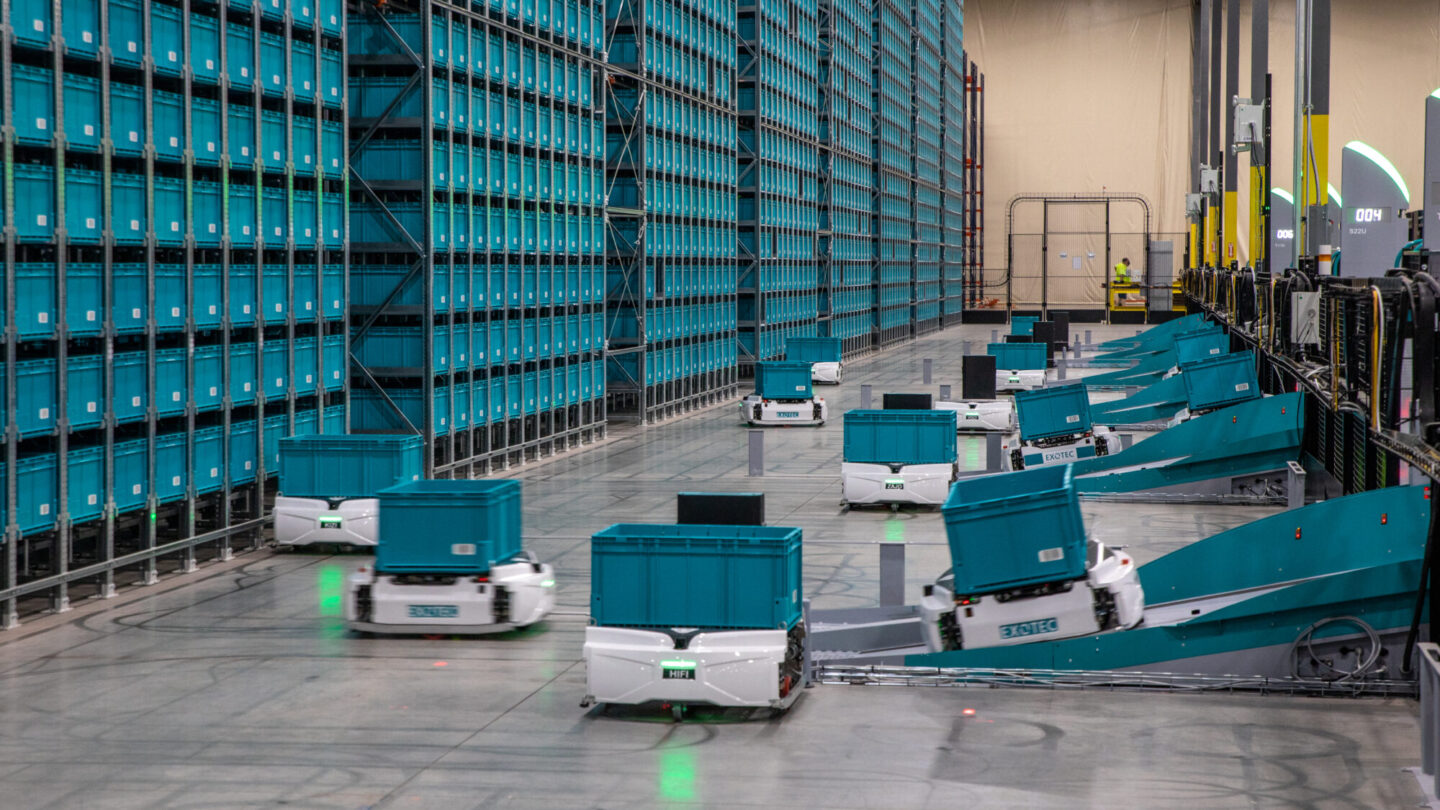
Instead of workers walking miles of aisles to find products, autonomous robots retrieve and bring inventory bins directly to a stationary operator, which increases speed and efficiency.
The system, developed by the company founded in 2015, is built on two primary components:
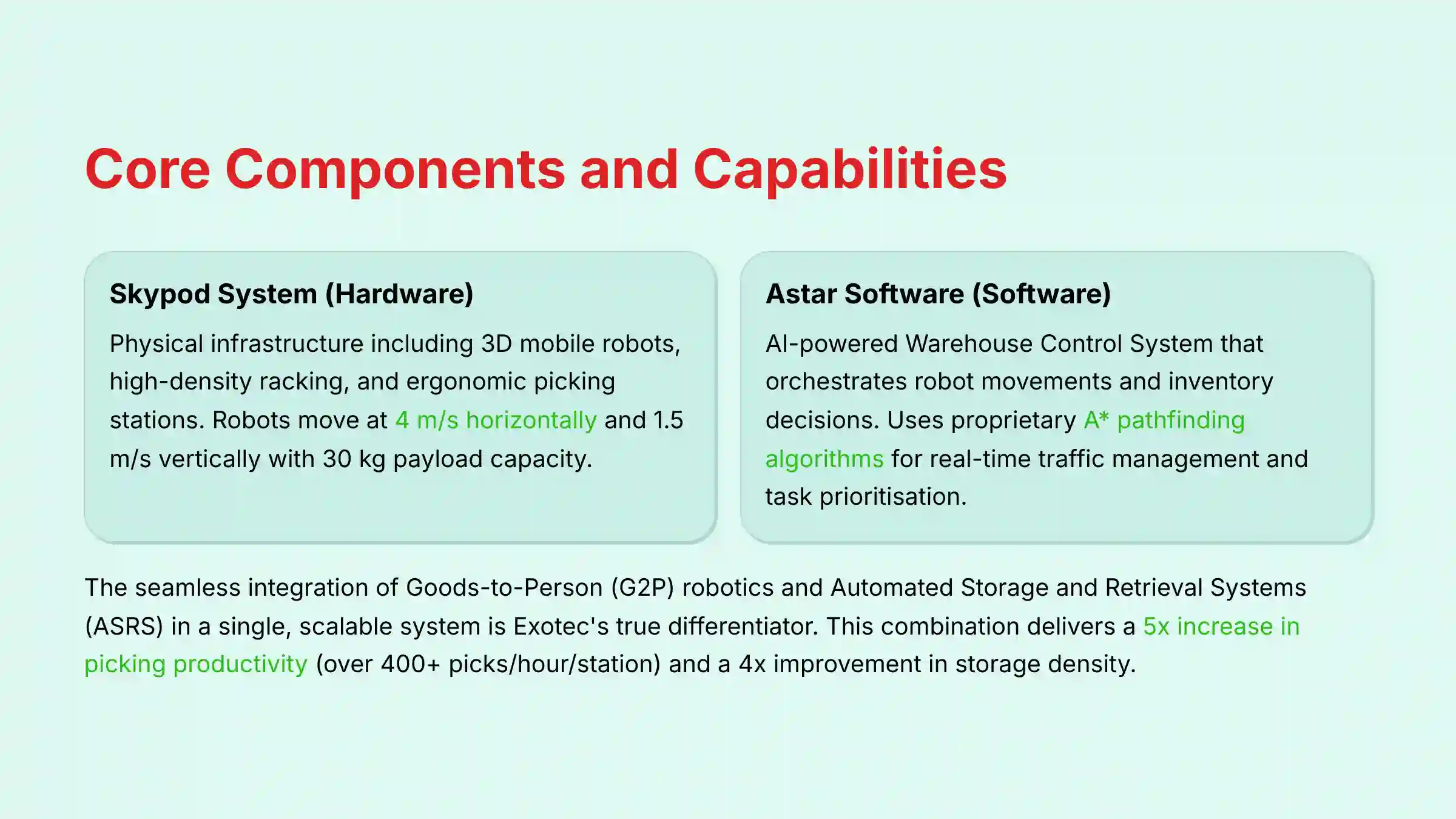
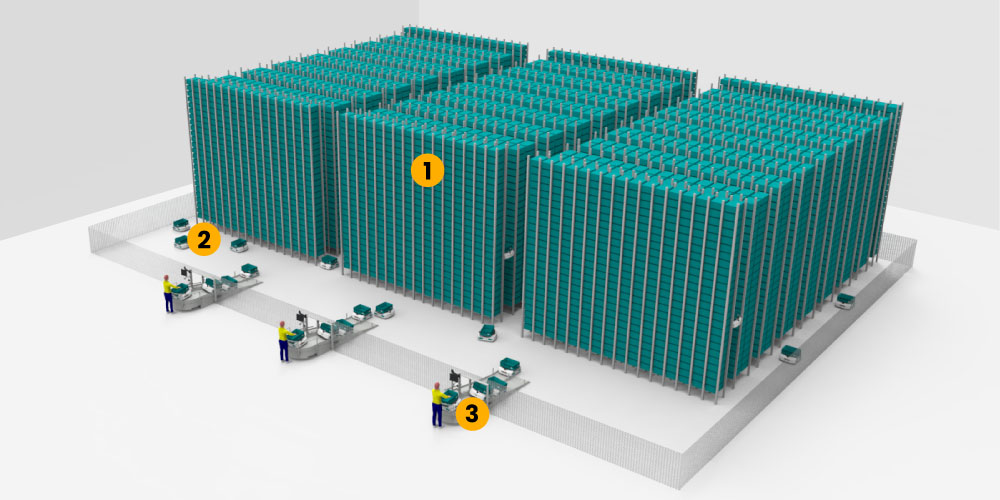
- The Skypod System (Hardware): This includes the physical infrastructure, from the fleet of 3D mobile robots to the high-density racking and ergonomic picking stations.
- The Astar Software (Software): This is the AI-powered Warehouse Control System (WCS) that orchestrates every robot movement and inventory decision, acting as the system's brain.
In my experience, the true differentiator for Exotec is the seamless integration of G2P and ASRS in a single, scalable system. Traditional ASRS often rely on large, fixed cranes, while many G2P systems use floor-level robots. Exotec's 3D movement combines the density of ASRS with the flexibility of modern mobile robotics.
How Exotec Compares to Other Warehouse Automation Systems
To properly assess the Exotec system, it's crucial to understand its position relative to other dominant warehouse automation technologies. In my analysis, the primary differentiator lies in its unique 3D robot design.
- vs. Cube-Based ASRS (e.g., AutoStore): Cube-based systems offer extreme storage density by stacking bins directly on top of each other in a grid, with robots operating on top. While highly dense, throughput can be limited by the need to dig out buried totes. Exotec's design, which uses racks, allows any robot to access any tote directly, a key advantage for operations requiring high throughput and sequencing flexibility for a volatile mix of SKUs.
- vs. Shuttle-Based ASRS: These systems use tiered racks with a dedicated shuttle on each level and lifts at the ends to move totes between levels. They offer very high throughput but can be less flexible and more complex than Exotec's single-robot architecture.
- vs. Collaborative Mobile Robots (e.g., Locus Robotics, 6 River Systems): These person-to-goods AMRs follow human pickers to reduce travel time. They are often faster to deploy and require less infrastructure change. However, Exotec's goods-to-person model delivers a higher step-change in productivity (up to 5x vs. 2-3x for many cobots) and achieves far greater storage density.
The choice between these systems depends on the specific operational profile, including SKU velocity, order complexity, and existing building constraints. Exotec aims for a strategic balance of density, throughput, and flexibility. For more detailed comparisons, check out our comprehensive guide on warehouse automation solutions.
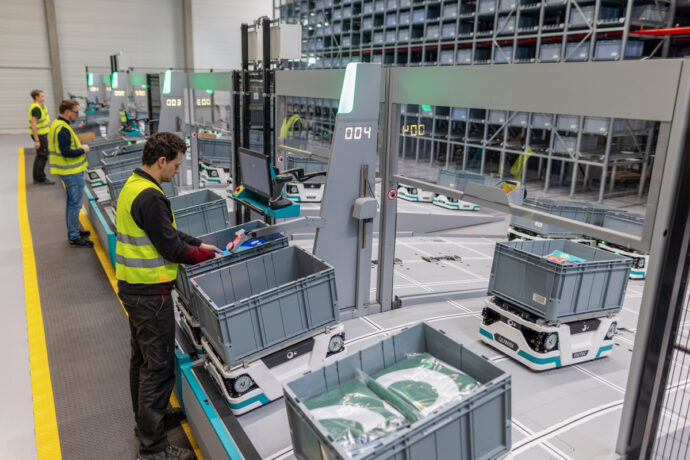
Exotec Skypod System: A Deep Dive into the Hardware
The physical components of the Skypod system are engineered for performance and reliability. Understanding the hardware specifications is the first step in assessing its fit for a specific warehouse environment.
The design prioritizes speed, density, and operator efficiency.
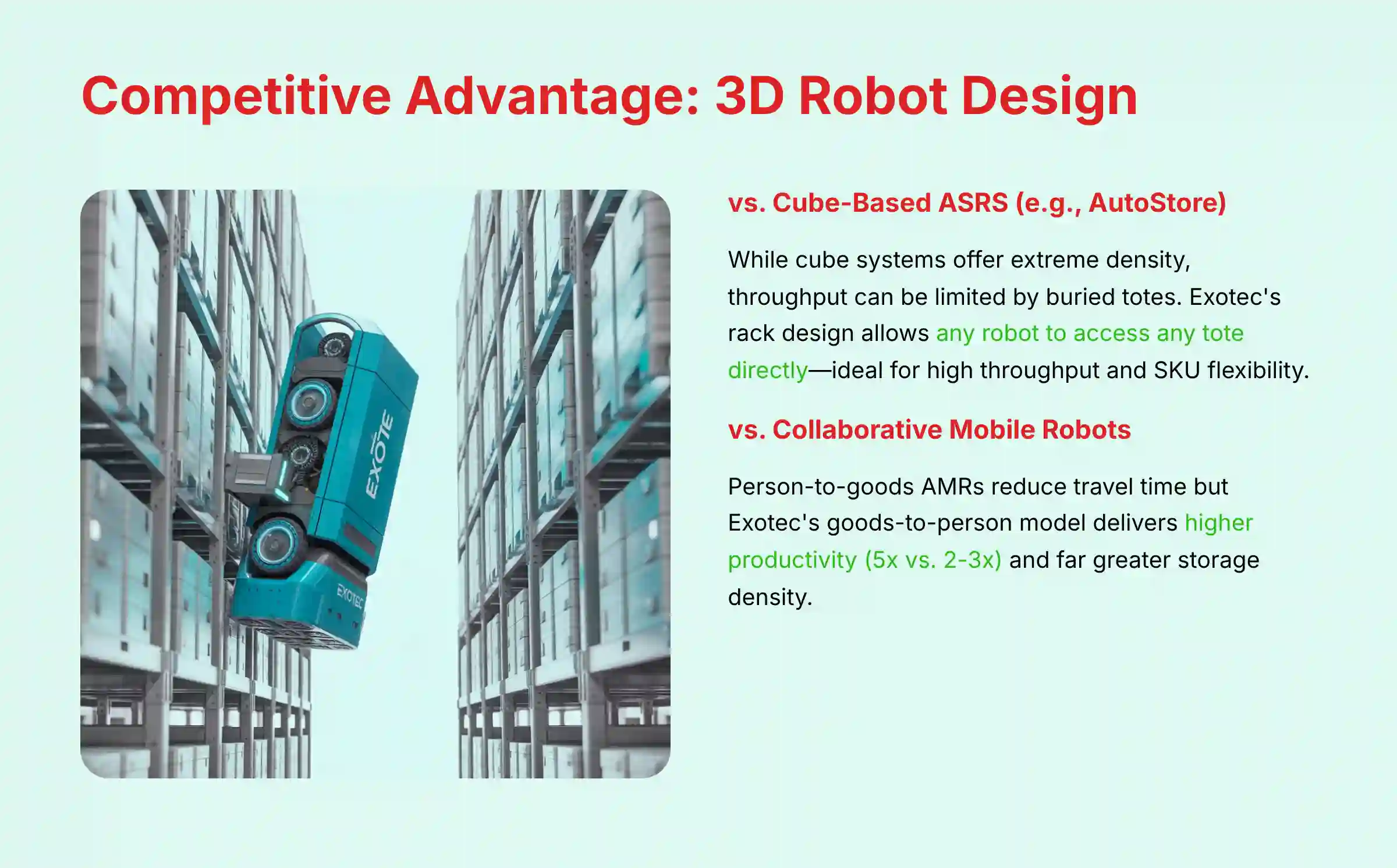
Skypod Robots: The 3D Autonomous Mobile Fleet
The individual robots are the workhorses of the system. Their ability to navigate in three dimensions is what sets this hardware apart from many other solutions in the market.
- Movement Capability: 3-dimensional (horizontal travel on the floor and vertical climbing within the racks).
- Navigation: Uses a laser scanner (LIDAR) and QR code guidance for precise positioning.
- Robot Speed: Reaches up to 4 m/s on the ground and 1.5 m/s vertically.
- Robot Payload Capacity: Can carry up to 30 kg (66 lbs).
- Energy System: Employs autonomous opportunity charging, requiring about 5 minutes of charging per hour to ensure continuous 24/7 operation.
The ability of a single robot to move both horizontally and vertically is a key design feature. This removes the need for separate “feeder” and “storage” robots seen in some grid-based ASRS, simplifying the system and reducing potential points of failure.
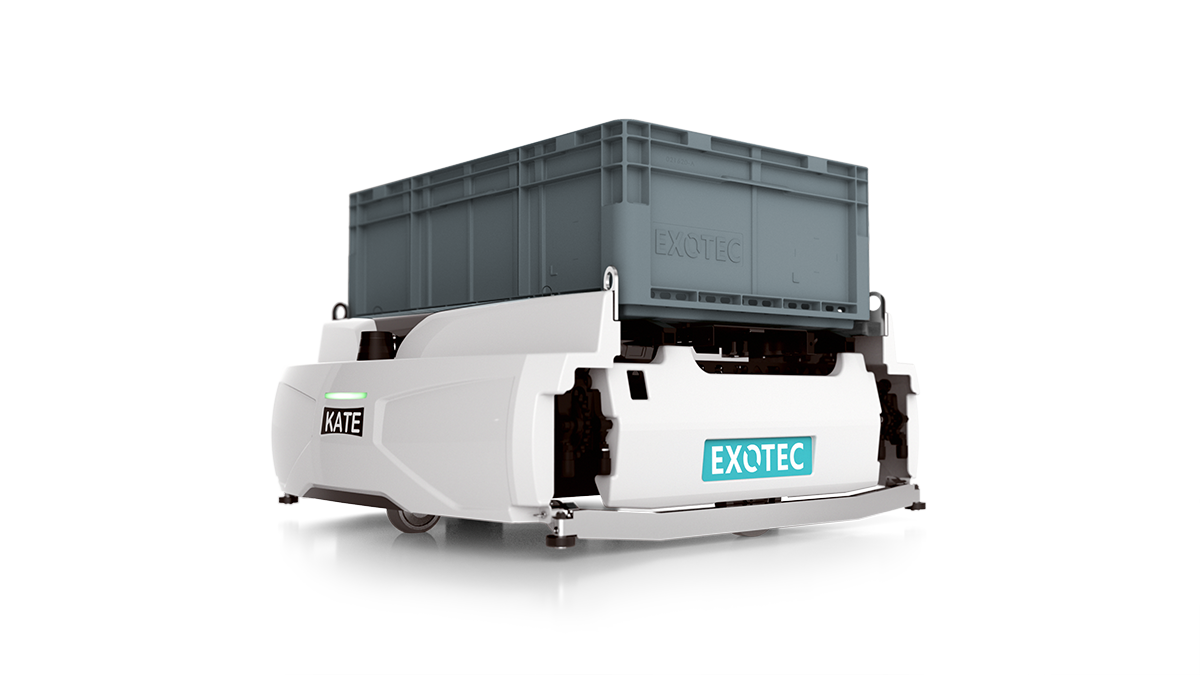
High-Density Racking and Tote Configuration
The storage structure is what enables the system to achieve its impressive density, allowing businesses to maximize the use of their vertical warehouse space.
- Maximum Rack Height: Can be built up to 12 meters (40 feet).
- Storage Medium: Uses standardized totes, typically with a 600x400mm footprint.
- Tote Flexibility: These totes can be subdivided to store multiple SKUs. This is a practical feature for operations with a large and diverse product catalog, often called the “long tail.”
The system's density is a direct result of its vertical reach and the elimination of wide aisles needed for forklifts or human pickers. This allows businesses to maximize the value of their existing warehouse footprint, often avoiding the high cost of moving to a larger facility.
High-Throughput Picking Workstations
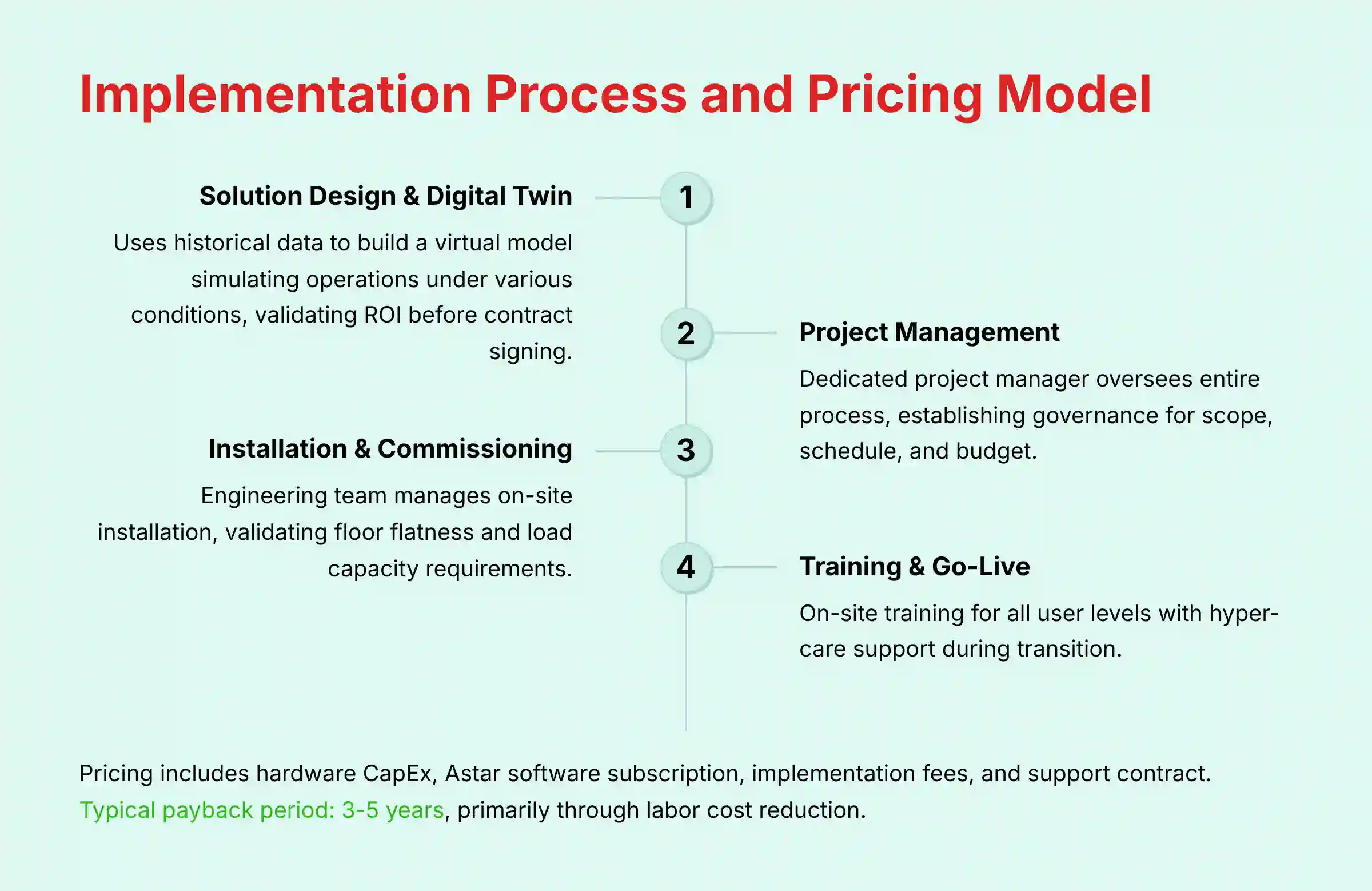
The workstations are the human-machine interface where orders are fulfilled with speed and accuracy. They are designed for simplicity and ergonomic comfort.
- Station Throughput: A single station can process up to 400 bins per hour.
- Operator Interface: Features a simplified touchscreen with pick-to-light and put-to-light systems to guide the operator.
- Workflow: The G2P workflow is straightforward. A robot delivers the stock tote, the operator picks the required items into an order tote, and confirms the action on the screen.
- Ergonomics: Stations are designed to minimize operator movement and physical strain, improving both productivity and workplace safety.
From my observations, the station's intuitive design is a major factor in reducing training time. New operators, including temporary staff during peak seasons, can become proficient within minutes, directly addressing common labor challenges in the logistics industry.
Exotec Astar Software: The AI-Powered Core
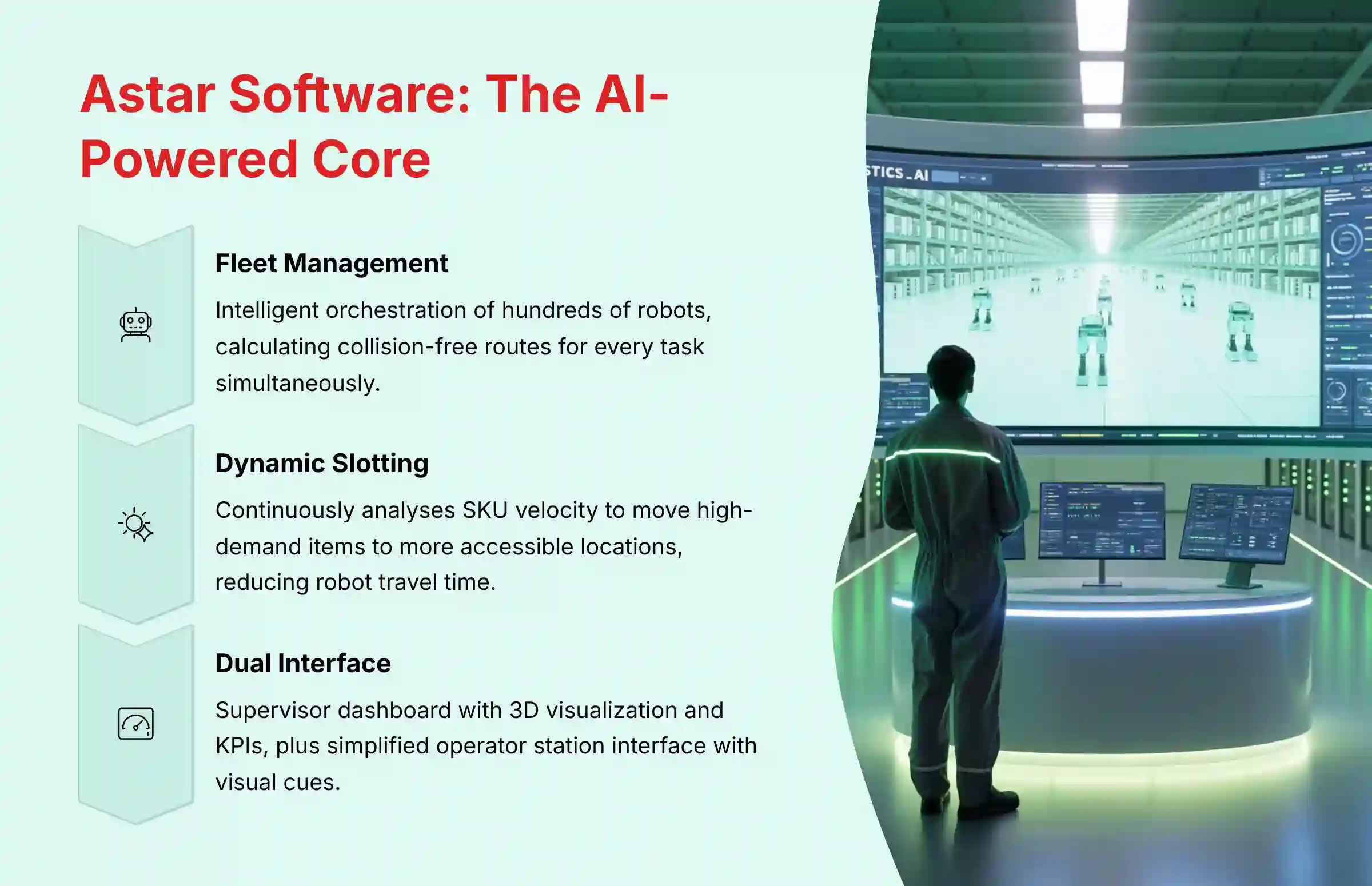
If the Skypod hardware is the body, the Astar software is the brain. It's an AI-powered engine that transforms a fleet of robots into a coordinated, high-performance fulfillment system.
Think of it less like air traffic control and more like a battlefield commander orchestrating a thousand individual troop movements at once. Astar's algorithms aren't just preventing collisions; they are constantly calculating the optimal path to ‘press the advantage' on order fulfillment, ensuring resources are deployed with maximum impact against the highest priority targets—your customer SLAs.
AI-Powered Fleet Management and Orchestration
Astar manages the entire robotic fleet with a level of efficiency that is impossible to achieve manually. Think of it as an air traffic control system for hundreds of robots, calculating the fastest, collision-free route for every single task simultaneously.
- Core Algorithm: It uses proprietary, agent-based A* pathfinding algorithms for real-time traffic management.
- Task Prioritization: Astar intelligently batches orders and prioritizes tasks based on shipping deadlines or Service Level Agreements (SLAs). This ensures that the most urgent orders are always processed first.
This is the core of the system's function as a Warehouse Execution System (WES). A traditional Warehouse Management System (WMS) holds orders and inventory data, but Astar decides the “how” and “when” of every task to maximize the efficiency of the entire robotic fleet.
Dynamic Slotting Optimization
This AI feature continuously optimizes where inventory is stored within the racking system. It works like a smart librarian who constantly reorganizes the shelves to put the most popular books within easy reach.
- Process: Astar constantly analyzes SKU velocity data to identify which items are selling fastest.
- Logic: It directs robots to proactively move high-demand items to lower, more accessible storage locations. Slow-moving items are shifted to higher, less accessible locations.
- Benefit: This reduces average robot travel time for the most frequent picks, which directly boosts the overall system throughput.
This is a key advantage over static or manual slotting strategies. A traditional warehouse might re-slot its inventory once a quarter. Astar optimizes continuously, adapting to seasonal trends or promotions in real-time.
The Dual User Interface: Planner and Operator Dashboards
The software provides two distinct interfaces tailored to the needs of its primary users: the supervisor who manages the system and the operator who executes tasks.
- Planner/Supervisor Dashboard: This is a web-based interface that includes a real-time 3D visualization of the system. It displays key KPIs like throughput, robot utilization, and order status.
- Operator Station Interface: This is the simplified touchscreen at the picking station. It uses clear visual cues like item images and quantities, along with integrated scanners, to ensure accuracy and speed.
The supervisor uses their dashboard to monitor the overall health of the system and manage any exceptions. The operator uses their interface to execute picking tasks with near-perfect accuracy, guided by the system at every step.
For those interested in exploring detailed Exotec Review insights, our comprehensive analysis covers performance metrics and security protocols in depth.
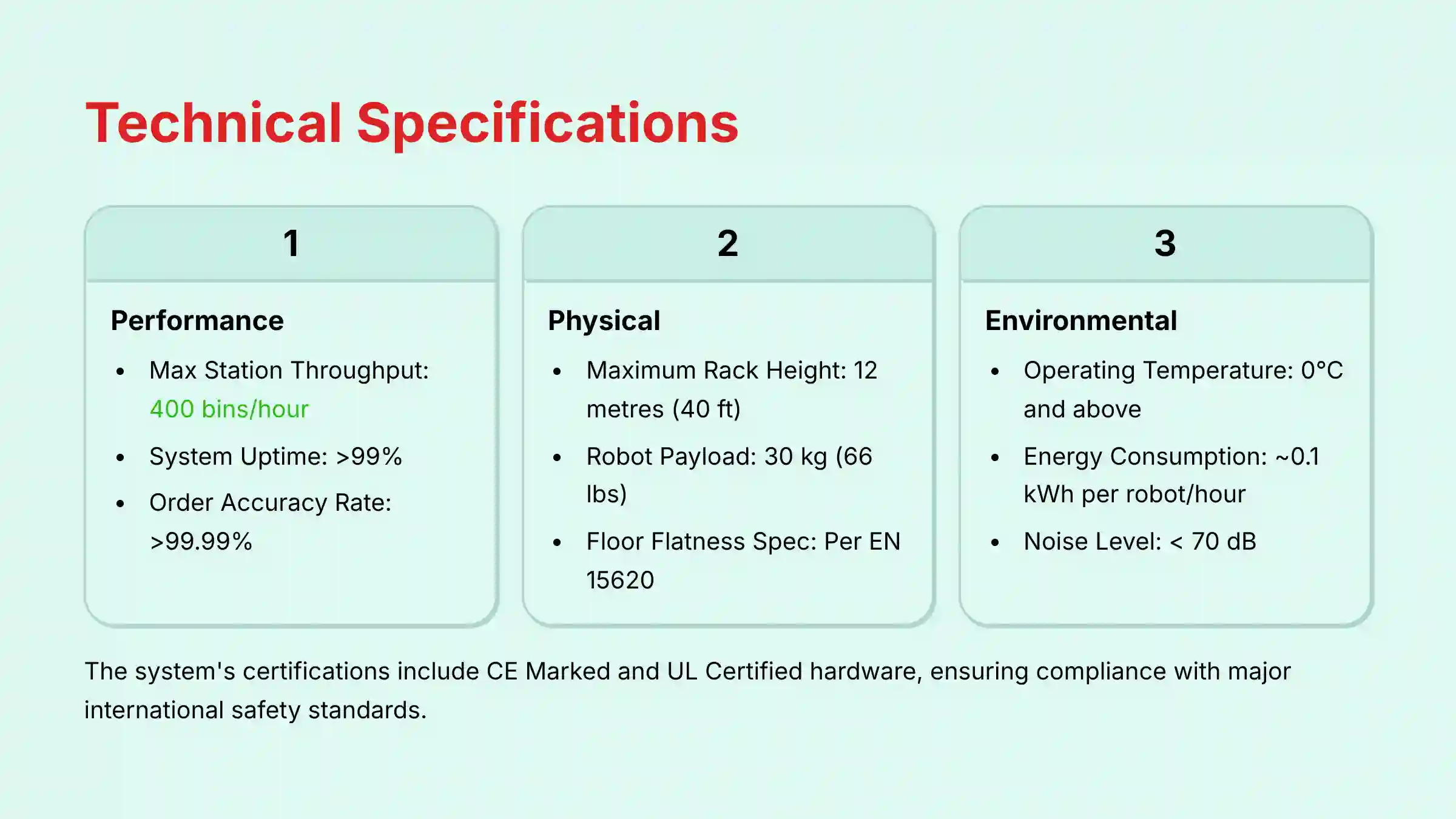
Exotec System Technical Specifications
For technical decision-makers, hard data is essential. This table consolidates the key performance and physical specifications of the Exotec system for easy reference and comparison.
| Specification | Value | Notes |
|---|---|---|
| Performance | ||
| Max. Station Throughput | 400 bins/hour | Per human-operated station |
| System Uptime (SLA) | Typically >99% | Contract-dependent; supported by redundant robot design |
| Robot Ground Speed | 4 m/s | |
| Robot Vertical Speed | 1.5 m/s | |
| Robot Payload Capacity | 30 kg (66 lbs) | |
| Order Accuracy Rate | >99.99% | As documented in official case studies |
| Physical | ||
| Maximum Rack Height | 12 meters (40 ft) | Subject to local fire codes and building constraints |
| Floor Flatness Spec. | Per EN 15620 or similar | Confirmed during site survey; critical for robot performance |
| Environmental | ||
| Operating Temperature | 0°C (32°F) and above | Suitable for ambient and some cold-chain |
| Robot Energy Consumption | ~0.1 kWh per robot/hour | Low consumption due to lightweight design and opportunity charging |
| Noise Level | < 70 dB | Typical operating level, minimizing workplace noise |
| Certifications | ||
| Hardware Safety | CE Marked, UL Certified | Compliant with major international safety standards |
Core Warehouse Processes and Industry Applications
A system's features are only valuable when applied to real-world operational challenges. Exotec is designed to handle a range of core warehouse processes and has been deployed across several key industries where speed and accuracy are top priorities.
Objective Use Cases in Fulfillment Operations
The system is built to automate and optimize the most demanding functions within a modern distribution center.
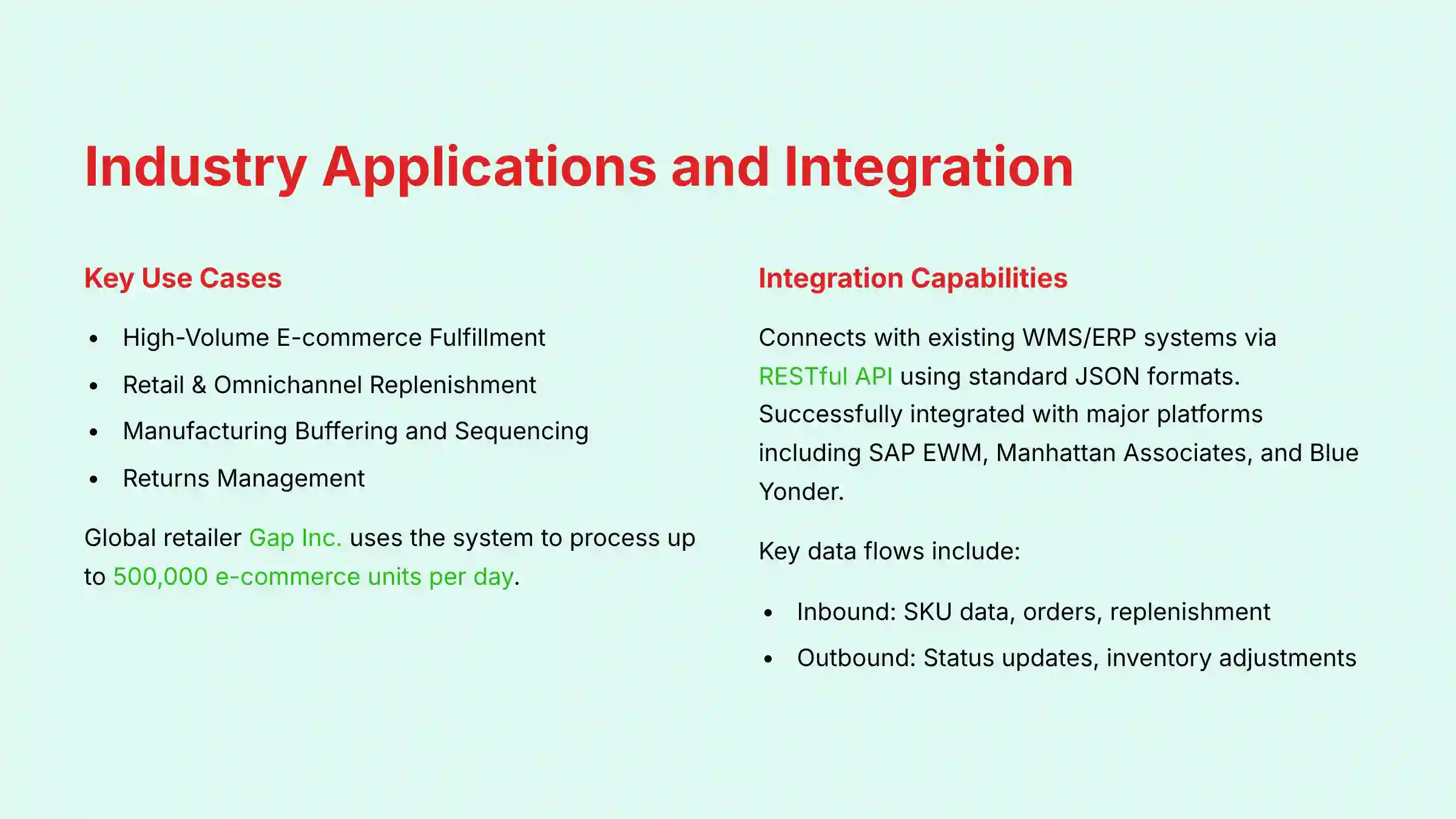
- High-Volume E-commerce Fulfillment: Excels at handling thousands of multi-line orders with short delivery windows, directly improving key metrics like order cycle time and On-Time In-Full (OTIF) delivery rates.
- Retail & Omnichannel Replenishment: Supports feeding brick-and-mortar stores and enabling services like BOPIS (Buy Online, Pick-up In-Store), improving in-store inventory accuracy and reducing lost sales from stockouts.
- Buffering and Sequencing for Manufacturing: Can act as an intelligent buffer for just-in-time (JIT) parts delivery to manufacturing lines, improving Overall Equipment Effectiveness (OEE) by preventing line-side shortages.
- Returns Management (Reverse Logistics): Efficiently re-inducts returned items back into sellable stock, accelerating the dock-to-stock time for returns and maximizing recovery value.
Key Industry Verticals
The system's flexibility makes it suitable for a variety of industries that deal with high-volume, small-item fulfillment.
- Retail & E-commerce
- Third-Party Logistics (3PL)
- Grocery
- Healthcare & Pharmaceuticals
For instance, global retailer Gap Inc. uses the system to process up to 500,000 e-commerce units per day. The sporting goods company Decathlon documented a 600% increase in order preparation productivity after implementation.
Integration Capabilities: Connecting Exotec with Your WMS/ERP
No automation system operates in a vacuum. It must connect with the core business systems that manage orders and inventory. Exotec is designed for seamless integration with a client's existing software ecosystem.
Exotec ensures seamless integration with a client's WMS or ERP through a modern RESTful API using standard JSON data formats. While the company has successfully integrated its Astar software with all major platforms, including SAP EWM, Manhattan Associates, and Blue Yonder, the primary integration method is this flexible API, not platform-specific ‘pre-built connectors'.
Key data flows between the systems include:
- Inbound: Master data for SKUs, customer orders, and replenishment orders.
- Outbound: Real-time order status updates, live inventory adjustments, and picking confirmations.
A critical point of failure in any large-scale automation project is not the hardware, but the data integration. A poorly executed connection between your WMS/ERP and Astar can cripple the system, turning a multi-million dollar investment into an operational bottleneck.
This isn't just a technical challenge; it's a core business risk that demands expert systems integrators who understand both your legacy systems and Exotec's API architecture. Getting this right is non-negotiable for achieving the promised ROI.
Security, Compliance, and System Reliability
In any supply chain operation, data security and system reliability are non-negotiable. An outage can halt the physical movement of goods, and a data breach can expose sensitive commercial information.
Exotec addresses these concerns with enterprise-grade certifications and a resilient system design.
The Astar software and its cloud infrastructure are SOC 2 Type II certified. This certification validates its internal controls over security, availability, and data privacy. Exotec as a company also holds ISO/IEC 27001 certification, which confirms a comprehensive information security management system is in place.
Beyond data security, physical system compliance is a critical consideration. High-density storage systems like Exotec must comply with local building and fire safety regulations, such as NFPA 13 in the United States.
This often involves specific requirements for in-rack sprinkler systems or other fire suppression technologies. Exotec's solution design process includes a thorough assessment of these requirements to ensure the final system is not only efficient but also fully compliant with local safety mandates, mitigating a significant project risk.
Operationally, the system has built-in redundancy. A single robot failure has a minimal impact on overall throughput because the Astar software automatically re-assigns its tasks to other robots in the fleet. This design ensures high uptime and business continuity.
What Is the Pricing Model for an Exotec System?
Let's address the most practical question for any decision-maker: what does an Exotec system cost? While there is no public price list—as every solution is custom-engineered—understanding the pricing model is key to evaluating the investment.
A typical project investment includes the following components:
- Hardware Capital Expenditure (CapEx): This is the one-time cost for the robots, racking, and workstations.
- Astar Software License: A recurring subscription (SaaS) fee provides access to the software and its ongoing updates.
- Implementation & Integration Fees: This is a one-time professional services cost for system design, project management, and integration.
- Support & Maintenance Contract: A recurring annual contract covers 24/7 technical support and hardware maintenance.
While the initial CapEx is a significant investment, a proper Total Cost of Ownership (TCO) analysis must model the direct financial relationships that drive ROI.
The primary value driver is the reduction in labor costs, which often constitutes 60-70% of a warehouse's operating budget. This, combined with savings from avoided real estate expansion (due to increased density) and improved order accuracy, directly contributes to a projected payback period, typically calculated to be between 3-5 years for most deployments.
The ability to add robots incrementally further strengthens the TCO, as it allows CapEx to be phased in alignment with revenue growth, mitigating large upfront financial risk.
How to Get Started with Exotec: Implementation and Support
The process of deploying an Exotec system is a structured partnership, designed for both greenfield (new construction) and brownfield (existing facility) projects.
It is a comprehensive process guided by robust change management principles from initial design to post-launch support.
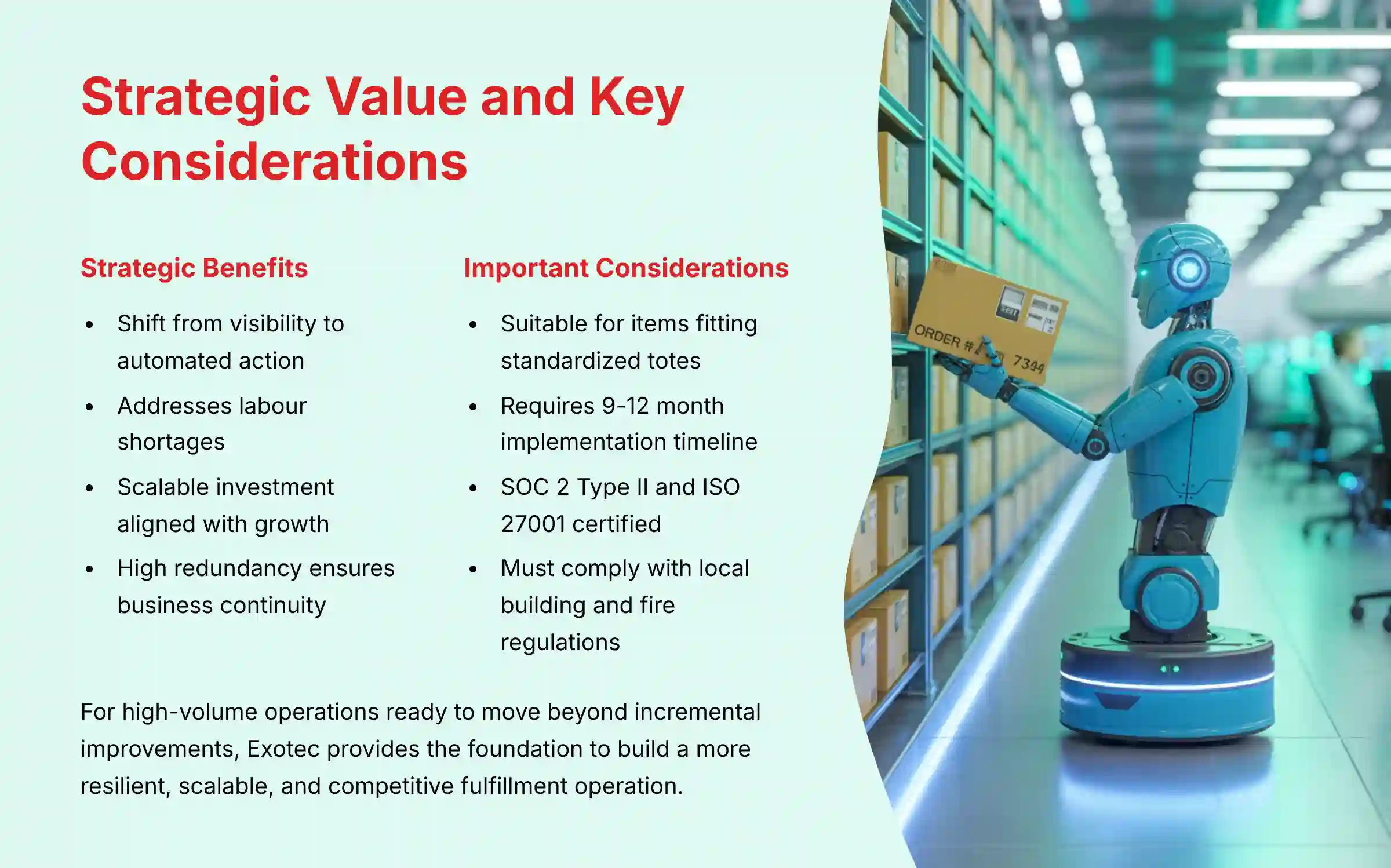
- Solution Design & Digital Twin Simulation: Exotec uses the customer's historical order and inventory data to build a Digital Twin of the proposed system. This virtual model simulates operations under various conditions, including peak demand and future growth scenarios. This allows them to guarantee performance metrics and validate the Return on Investment (ROI) model before a contract is signed, ensuring the design meets specific targets for cost per pick and order cycle time.
- Dedicated Project Management & Governance: A dedicated project manager from Exotec oversees the entire process, serving as the single point of contact. This includes establishing clear governance for managing scope, schedule, and budget.
- On-site Installation & Commissioning: Exotec's engineering team manages the full on-site installation of the hardware and software. This phase includes validation against floor flatness and floor load capacity requirements.
- Comprehensive Training & Go-Live Support: On-site training is provided for all user levels, including operators, supervisors, and maintenance technicians. This is coupled with a period of hyper-care support during go-live to ensure a smooth transition and rapid user adoption.
- Ongoing Support: After the system goes live, support includes 24/7 remote monitoring and technical assistance to ensure continued performance.
For organizations looking to explore implementation strategies, our Exotec Tutorials and Usecase guide provides detailed implementation insights and real-world scenarios.
The Strategic Verdict: From Visibility to Automated Action
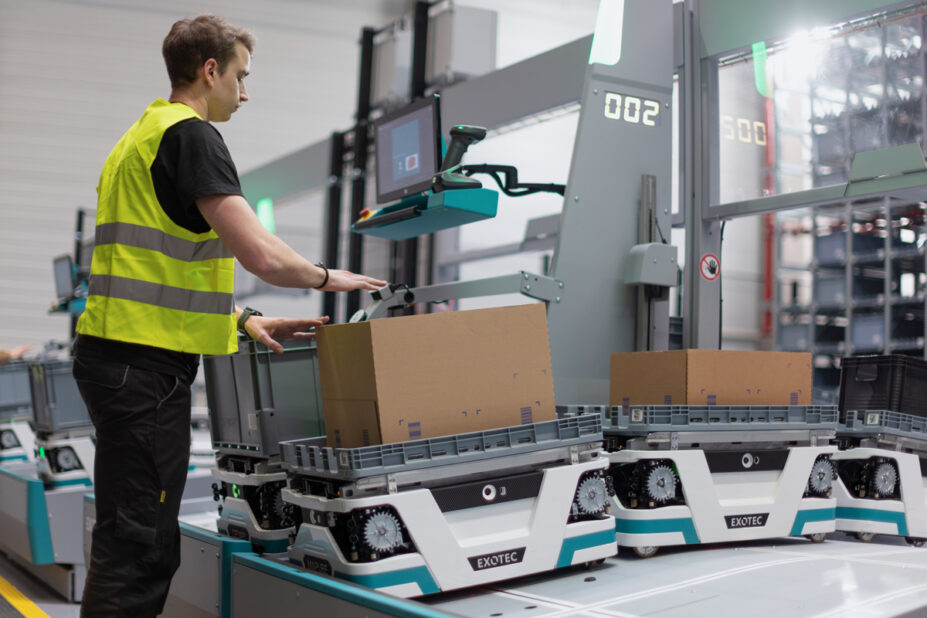
Ultimately, the Exotec system represents more than just an efficiency gain; it's a strategic shift from passive visibility to intelligent, automated action.
For organizations facing the dual pressures of rising customer expectations and shrinking labor pools, it offers a tangible path to not just survive, but thrive.
The investment is significant, and the implementation requires rigorous planning, especially around data integration. However, for high-volume operations ready to move beyond incremental improvements and fundamentally re-architect their fulfillment capabilities, the Exotec system provides the foundational apparatus to build a more resilient, scalable, and competitive future.
Frequently Asked Questions About the Exotec System
Here are answers to some of the common questions that arise when evaluating the Exotec system for a warehouse operation.
How Does the Exotec System Handle Different Item Sizes?
The system is designed for items that fit within standardized totes, such as those with a 600x400mm footprint. The totes can be subdivided to efficiently store very small items. The system is not suitable for oversized or irregularly shaped goods, which require a separate manual or automated process.
What Happens if an Exotec Robot Fails?
If a single robot stops, the Astar software automatically detects the issue and reassigns its task to the nearest available robot in the fleet. The failed unit can be easily removed for maintenance without stopping the overall operation, ensuring a minimal impact on throughput. The system is built with high redundancy to ensure continuous operation.
How Scalable is the Skypod System After Installation?
The system's modularity is one of its core strengths. After the initial installation, a business can easily scale its performance by adding more robots to the existing grid. It can also expand storage capacity by extending the racking structure, which allows for a phased investment that aligns with business growth.
Can Exotec Operate in a Cold-Chain Environment?
Yes. The system is fully functional in environments with an operating temperature starting from 0°C (32°F). This makes it a viable solution for sectors like grocery or pharmaceutical fulfillment that require refrigerated or chilled zones.
What is the Typical Implementation Timeline for an Exotec System?
Timelines are project-dependent but generally range from 9 to 12 months from contract signing to the system going live. This period includes detailed solution design, manufacturing, on-site installation, integration with the client's WMS, and final commissioning.
How Does Exotec's 3D Movement Differ from Other Robotics Systems?
Many other grid-based systems use separate robots for horizontal movement on the floor and different machines like lifts for vertical movement. Exotec's Skypod robots perform both functions. This integrated design simplifies the system architecture, reduces the total number of machines required, and eliminates potential hand-off points between different types of automation.
What Are the Main Data Security Measures for the Astar Software?
The software and its cloud services are SOC 2 Type II certified, and Exotec as a company is ISO 27001 certified. These certifications demonstrate adherence to enterprise-grade security and data protection standards, which are a top priority for protecting sensitive operational data.
Does the System Require a Specific Type of Warehouse Floor?
The system operates on a standard, flat concrete warehouse floor that meets certain specifications for levelness. Exotec conducts a detailed floor survey as part of the initial site assessment to confirm compatibility and will make recommendations for any required preparations.
For additional questions and detailed answers, visit our comprehensive Exotec FAQs resource.
Disclaimer
The information about Exotec presented in this article reflects our thorough analysis as of 2024. Given the rapid pace of AI technology evolution in the AI for Operations & Supply Chain space, features, pricing, and specifications may change after publication.
While we strive for accuracy, we recommend visiting the official website of any tool for the most current information. Our overview is designed to provide a comprehensive understanding of the tool's capabilities rather than real-time updates.
For those considering alternative solutions, explore our detailed analysis of Exotec Top Alternatives and Competitors to make an informed decision based on your specific operational requirements.
For more information and detailed analysis of other tools, please read our comprehensive guide on warehouse automation solutions.

Leave a Reply