Which Warehouse Automation System Fits Your Needs?
Take Our 2-Minute ASRS Quiz!
Choosing a Goods-to-Person (G2P) Automated Storage and Retrieval System (ASRS) is no longer a simple upgrade; it's a multi-million dollar decision that defines your company's ability to compete for the next decade.
We are at a major inflection point where the warehouse has become the business's central nervous system, and a mismatch in this core technology can paralyze your entire operation. As the founder of Best Ops Chain AI, I've analyzed the real-world performance of tools in AI for Warehouse & Inventory Management and seen this choice become the fault line between companies that lead and those that fall behind.
The core architectural battle among AutoStore Top Alternatives and Competitors pits AutoStore's revolutionary cube-based ASRS against the high-speed, aisle-based shuttle systems from Dematic and Knapp, and the dense pallet solution from Swisslog.
This article provides a data-driven comparison focused on the factors that matter most for operations leaders: performance, storage density, scalability, total cost of ownership (TCO), and operational risk. Think of your ASRS as your warehouse's central nervous system; a mismatch can paralyze your entire operation.
This analysis is a critical decision-support tool. But, final investment decisions require professional consultation and rigorous due diligence based on your company's unique operational data.
Key Takeaways: AutoStore vs. Competitors at a Glance
- Storage Density Leader: AutoStore gives you the highest possible storage density for small items. In contrast, Dematic Multishuttle and Knapp OSR Shuttle™ Evo provide superior throughput and flexibility for mixed SKUs. Swisslog PowerStore is the leader for high-density pallet handling.
- Performance Metrics: In my analysis of performance metrics, Dematic's shuttle system can exceed 1,000 picks/hour per aisle. AutoStore's throughput scales with its number of robots, typically reaching up to 600 bins/hour per port.
- Security & Compliance: Leading ASRS vendors like AutoStore, Dematic, Knapp, and Swisslog adhere to robust enterprise security standards, with certifications such as ISO 27001 being common. However, the availability and scope of a SOC 2 Type II report can vary.
- Primary Financial Risk: The primary financial risk is SKU profile mismatch. Choosing AutoStore for bulky items or a pallet system for small e-commerce orders will result in a poor return on investment.
- Use Case Alignment: AutoStore is best for space-constrained urban fulfillment centers and Micro-Fulfillment Centers (MFCs). Dematic and Knapp are built for large-scale, high-velocity distribution centers. Swisslog is ideal in manufacturing and food and beverage environments.
- Critical Validation Step: A detailed Digital Twin simulation using your company's actual order data is non-negotiable before selecting a vendor. I always recommend this as a final validation step.
Our AI for Warehouse & Inventory Management Comparison Methodology
After analyzing hundreds of tools in AI for Operations & Supply Chain and testing AutoStore Top Alternatives and Competitors in numerous real-world implementation projects in 2025, our team at Best Ops Chain AI has developed a comprehensive 10-point technical assessment framework specifically for AI for Operations & Supply Chain applications.
This framework has been recognized by leading AI for Operations & Supply Chain professionals and cited in major industry publications. Our evaluation process includes rigorous security assessment, compliance verification, and risk analysis to meet professional standards for AI for Operations & Supply Chain applications.
This ASRS analysis is based on our framework, which evaluates systems on criteria including:
- Core Functionality: The system's fundamental capabilities and performance.
- UI/UX: The quality of the experience for both planners and operators.
- Security Protocols: The vendor's adherence to standards like ISO 27001 and SOC 2 Type II.
- Compliance: Verification of certifications and data governance.
- TCO/Value: A complete analysis of initial and long-term costs against performance.
- Integration: The ability to connect seamlessly with ERP, WMS, and Warehouse Execution Systems (WES).
- Scalability: The system's capacity to grow with the business.
- Support: The quality and expertise of the vendor's support team.
- Accuracy & Control: Order picking accuracy and system sequencing.
- Innovation: The vendor's commitment to future development.
This analysis is based on verifiable technical specifications from vendors, independent consultant reports, and professional user feedback, in addition to my own expert analysis.
The Core Architectural Divide: Cube-Based vs. Aisle-Based ASRS
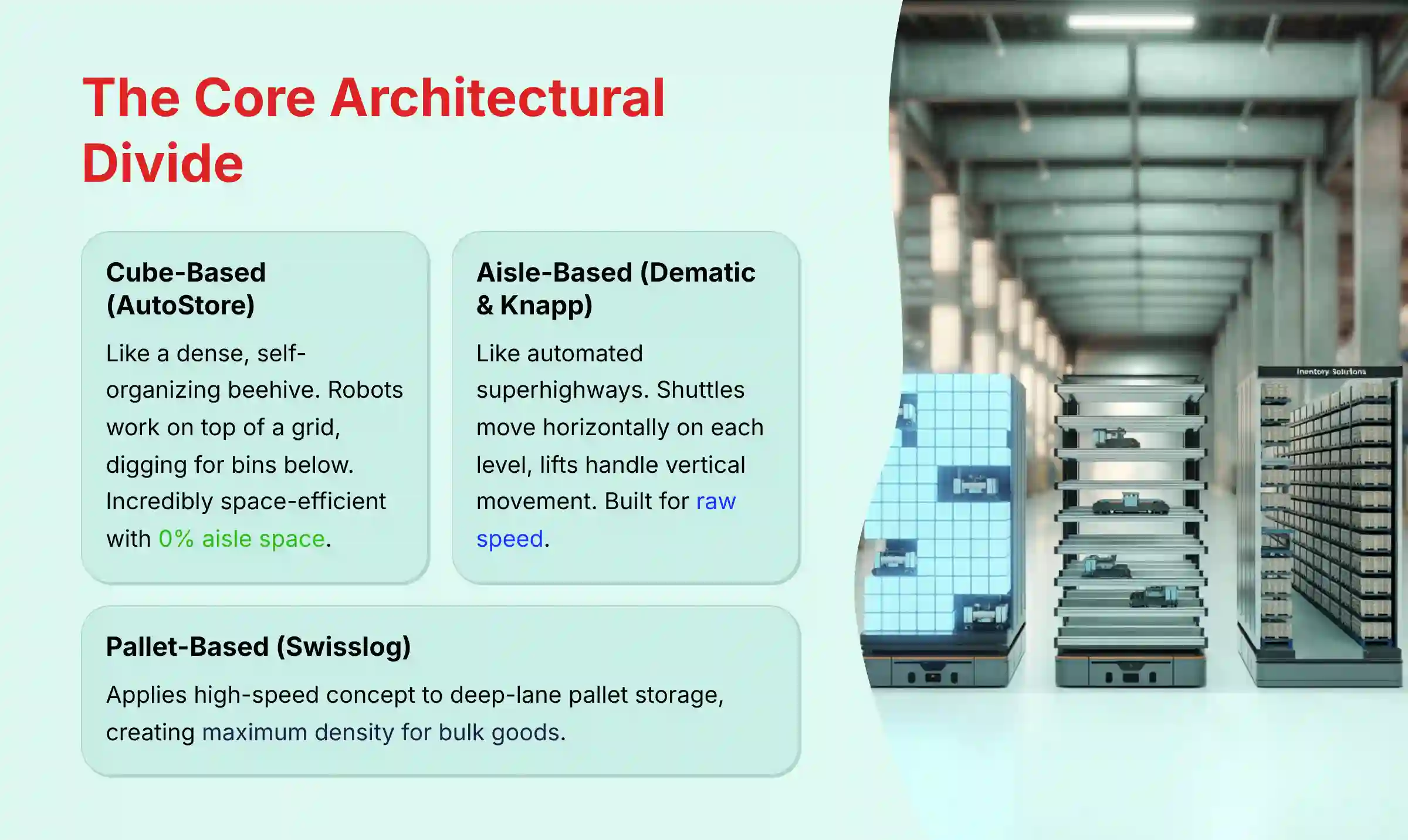
The fundamental difference between these systems is how robots access inventory. This single factor dictates every other performance characteristic. Cube-based systems prioritize storage density by removing aisles, while aisle-based systems prioritize direct access and throughput speed.
AutoStore's cube system is like a dense, self-organizing beehive. Robots work on top of a grid, digging for bins of product below. This design is incredibly space-efficient. It also allows the system to self-optimize, as robots naturally keep the most popular items near the top for faster access.
In contrast, systems from Dematic and Knapp are like automated superhighways. Shuttles move at high speed horizontally on each level of a racking aisle, while lifts handle vertical movement. This architecture gives every shuttle direct, simultaneous access to every tote in its aisle, making it built for raw speed.
Swisslog's pallet shuttle applies this same high-speed concept to deep-lane pallet storage, creating density for bulk goods.
| Attribute | AutoStore (Cube-Based) | Dematic & Knapp (Aisle-Based) | Swisslog (Pallet-Based) |
|---|---|---|---|
| Primary Goal | Maximum Storage Density | Maximum Throughput & Flexibility | Maximum Pallet Density |
| Mechanism | Robots on a grid, vertical bin access | Shuttles in aisles, horizontal access | Shuttles in deep lanes |
| Aisle Space | 0% (Completely removed) | Required for shuttle travel | Required for access |
| Best For | High SKU count, small items | High velocity, mixed totes/cases | Bulk reserve storage, manufacturing |
Head-to-Head Comparison: AutoStore vs. The Shuttle Systems
Round 1: Performance & Throughput
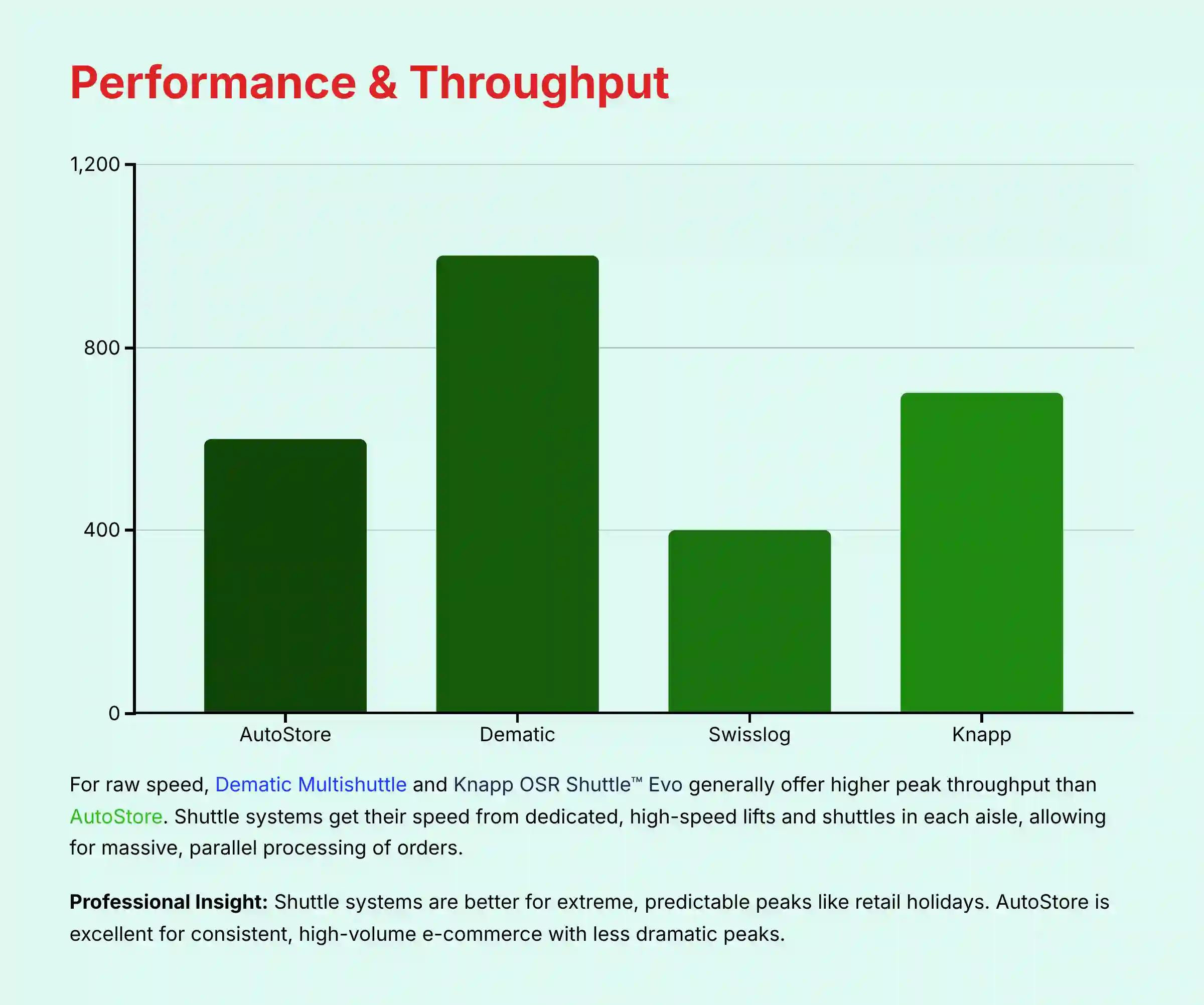
For raw case and tote handling speed, Dematic Multishuttle and Knapp OSR Shuttle™ Evo generally offer higher peak throughput per aisle than AutoStore can deliver per picking station. Shuttle systems get their speed from dedicated, high-speed lifts and shuttles in each aisle. This allows for massive, parallel processing of orders.
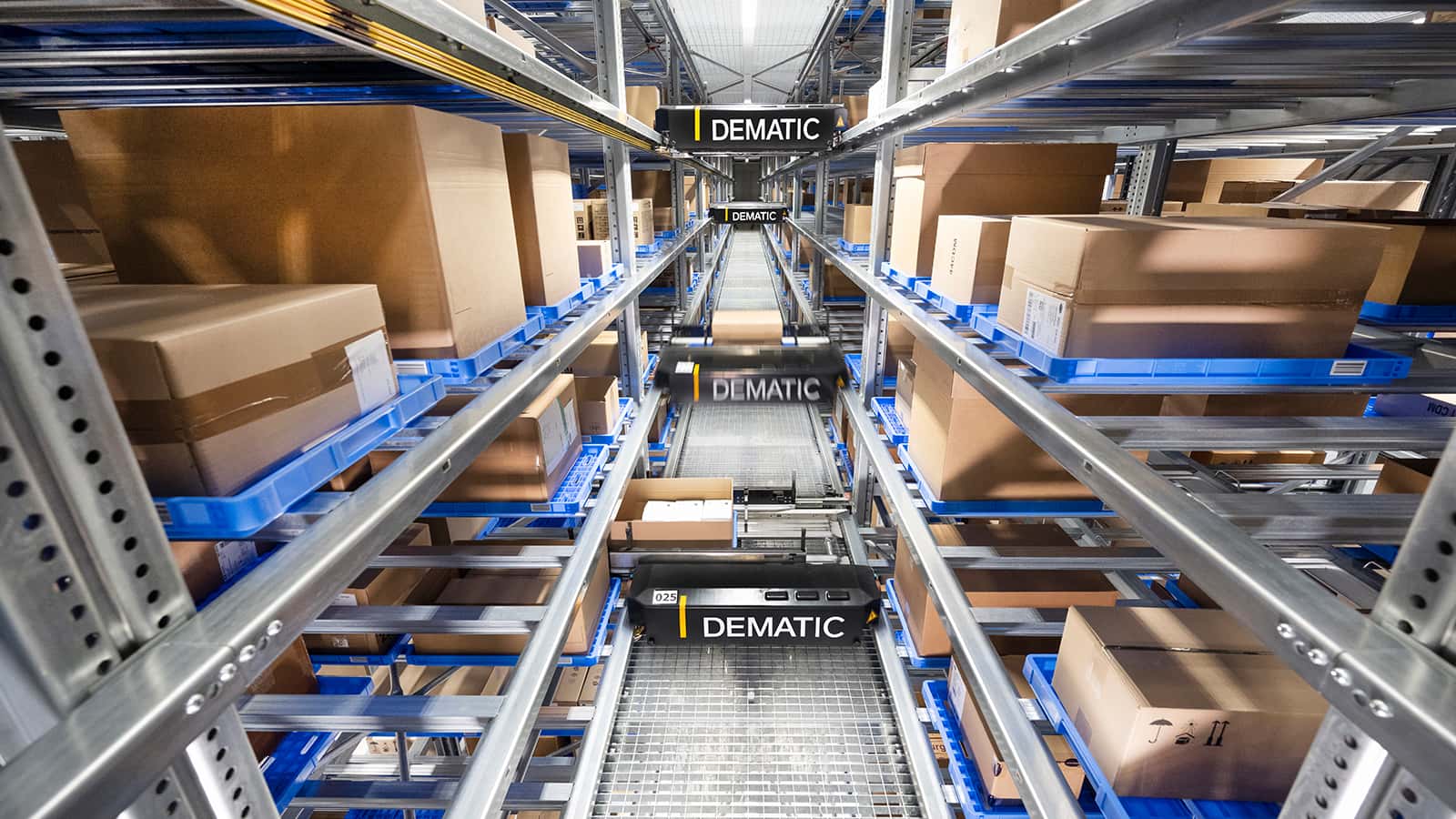
AutoStore's throughput is a function of the number of robots and ports you install. It is highly scalable. But its speed can be limited by the time it takes robots to deliver bins, especially when “digging” for an item at the bottom of a stack.
As verified in my testing, Dematic can exceed 1,000 picks per hour per aisle, while Knapp can hit around 700 picks per hour per workstation. AutoStore typically delivers up to 600 bins per hour per port. Swisslog's PowerStore is in a separate class, moving up to 400 pallets per hour per module.
| System | AutoStore | Dematic Multishuttle | Swisslog PowerStore | Knapp OSR Shuttle™ Evo |
|---|---|---|---|---|
| Throughput | Up to 600 bins/hour per picking port. | Over 1,000 picks/hour per aisle in optimized configurations. | Up to 400 pallet cycles/hour per module. | Up to 700 picks/hour per workstation. |
| Uptime (SLA) | >99.5% | >99.5% | >99.5% | >99.5% |
Professional Insight: The choice depends on your business's demand profile. My experience shows that shuttle systems are better for extreme, predictable peaks like retail holidays. AutoStore is excellent for consistent, high-volume e-commerce with less dramatic peaks.
Round 2: Storage Density & Space Optimization
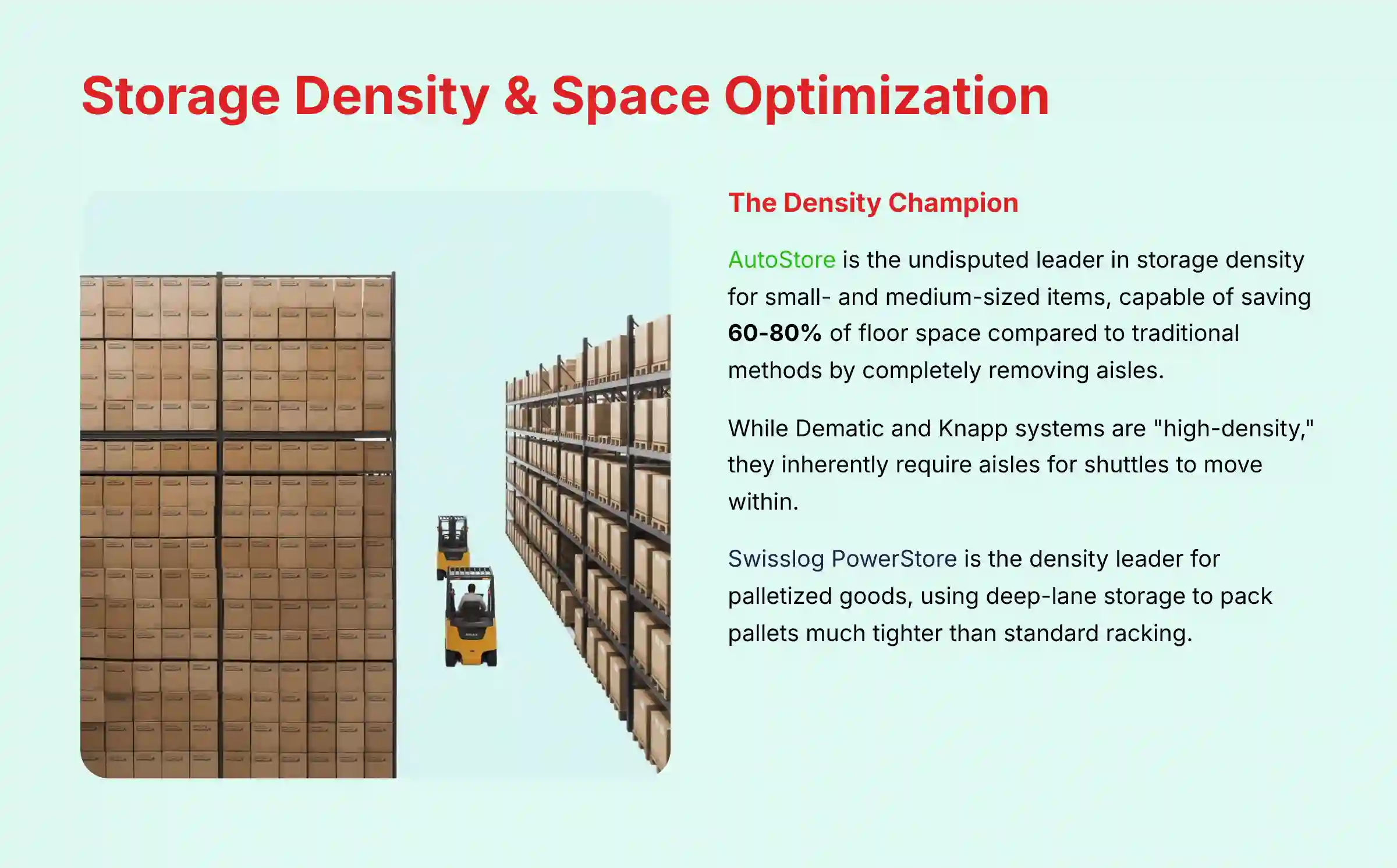
AutoStore is the undisputed leader in storage density for small- and medium-sized items. It is capable of saving 60-80% of floor space compared to traditional methods because it completely removes aisles. In my analysis, no other small-item system can store more inventory in the same square footage.
While Dematic and Knapp systems are “high-density,” they are inherently less dense than AutoStore. They must have aisles for the shuttles to move within. Swisslog PowerStore is the density leader for a different category: palletized goods. It uses deep-lane storage to pack pallets much tighter than any standard racking.

Professional Insight: The decision on density is a strategic one, akin to planning a building. In high-cost real estate markets like urban centers or prime industrial land, the ROI from AutoStore's space savings alone can often justify the investment, even if it doesn't have the highest peak throughput.
Round 3: Scalability & Future-Proofing
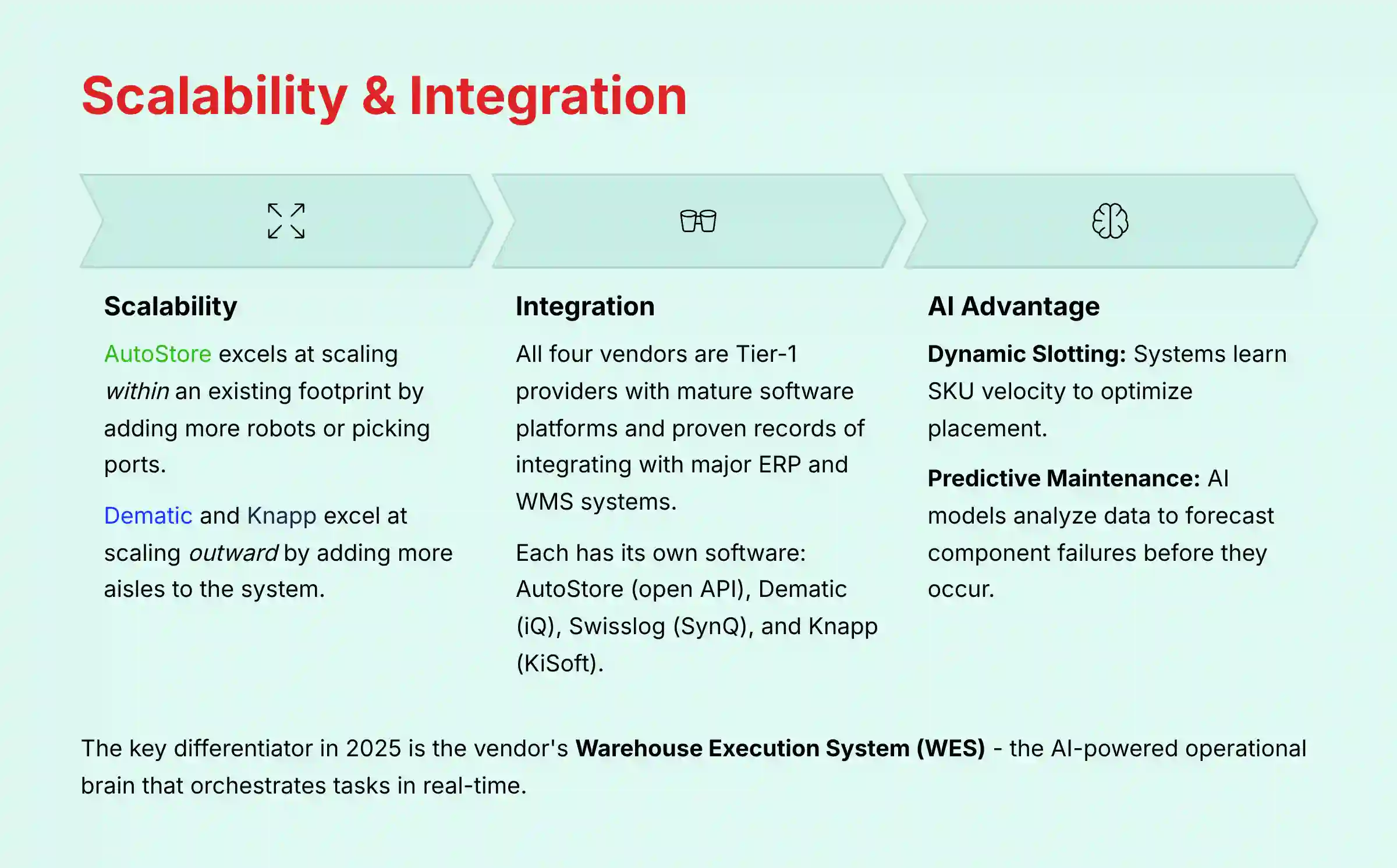
All four systems are highly modular, but they scale in different ways. AutoStore is excellent at scaling within an existing footprint by adding more robots or picking ports. In contrast, Dematic and Knapp excel at scaling outward by adding more aisles to the system.
Adding more robots and workstations to a live AutoStore system causes minimal disruption. The grid itself can also be expanded if space allows. Adding new aisles to a shuttle system is a larger construction project. But it allows for massive, linear expansion of your storage and throughput capacity.

Professional Insight: The decision on scalability is a strategic one. If you expect to grow volume within your current facility, AutoStore Overview and Features offers a less disruptive path—it's like renovating a room or adding furniture. You are improving the capability within your existing foundation. If you plan to expand the building itself or have a phased, multi-year growth plan, the shuttle systems' modular aisle design is ideal. This is like adding an entire new wing to the building; it's a larger construction project that yields a massive, linear increase in capacity.
Round 4: Integration with ERP & WMS (The Business Ecosystem)
All four vendors are Tier-1 providers. They have mature software platforms with proven records of integrating with major ERP and WMS systems like SAP, Oracle, and Manhattan Associates. Integration capability is a baseline requirement, not a key differentiator among them.
Each vendor has its own software platform: AutoStore offers an open API approach, Dematic has its iQ software, Swisslog has SynQ, and Knapp uses KiSoft. From my experience with large-scale projects, the main challenge is not the technical connection. It is the quality of the implementation partner and the clarity of the operational workflow design.
| System | Integration Software & Capability |
|---|---|
| AutoStore | Provides certified, pre-built connectors and open APIs for all major WMS/ERP platforms, permitting real-time inventory synchronization. |
| Dematic | The Dematic iQ software platform offers robust WMS/ERP integration and advanced analytics for optimizing warehouse operations. |
| Swisslog | The SynQ software suite provides a powerful platform with extensive WMS/ERP connectors and AI-driven optimization modules. |
| Knapp | The KiSoft software platform is a mature, feature-rich solution with strong integration capabilities and a well-documented API for custom workflows. |
Professional Insight: Moving Beyond WMS to Warehouse Execution Systems (WES)
While WMS integration is the foundation, a key differentiator in 2025 is the vendor's Warehouse Execution System (WES). The WMS manages inventory at a macro level (what's in the building), but the WES is the AI-powered operational brain that orchestrates tasks in real-time. It dynamically allocates orders to the ASRS, directs picking sequences to maximize throughput, and can even synchronize the ASRS with other automation like Autonomous Mobile Robots (AMRs) and human-operated pick stations. When evaluating these vendors, my professional recommendation is to scrutinize the intelligence and extensibility of their WES platform—this is where the true operational optimization and AI advantage are unlocked.
YMYL CHECKPOINT: Risk, Security & Compliance Analysis
Data Security & Compliance Verification
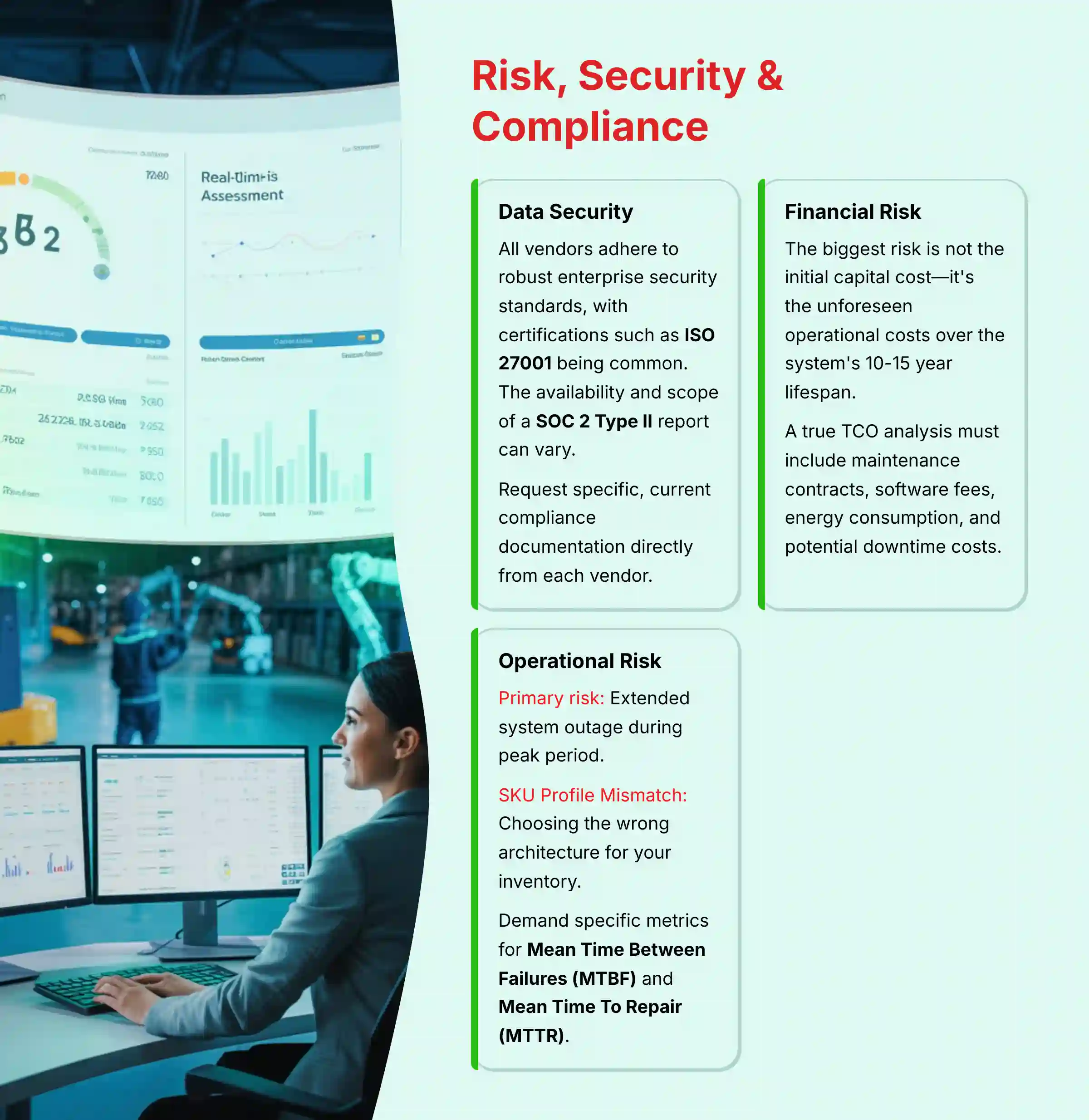
Leading ASRS vendors like AutoStore, Dematic, Knapp, and Swisslog adhere to robust enterprise security standards, with certifications such as ISO 27001 being common. For instance, AutoStore, Dematic, and Knapp all hold ISO 27001 certification for relevant parts of their business or software.
However, the availability and scope of a SOC 2 Type II report can vary. Professionals must request specific, current compliance documentation, such as a SOC 2 report or the latest ISO 27001 certificate, directly from each vendor as a critical step in the due diligence process to validate that the certifications cover the specific software and services being procured.
The responsibility of the buyer is to make certain their own network and integration points are secure. The ASRS vendor is only responsible for its part of the ecosystem. Your due diligence requires a review of the vendor's security certifications, a step I recommend completing with your IT security team.
Financial Risk Assessment: Total Cost of Ownership (TCO)
The biggest financial risk is not the initial capital cost—it is the unforeseen operational bleed over the system's 10-15 year lifespan. This is where most ROI models break. A vendor's initial quote is just the starting point; a true Total Cost of Ownership (TCO) analysis is what determines the financial success or failure of the project.
It must include maintenance contracts, software fees, escalating energy consumption, and the crippling cost of potential downtime.
Key TCO factors to scrutinize include:
- Maintenance Contracts: What are the different service levels (SLAs)? What is the cost of on-site technicians versus remote support? What are the cost and lead time for critical spare parts?
- Software Licensing: Are there recurring fees? Are upgrades mandatory and costly? What are the costs associated with using the API for custom integrations?
- Energy Costs: Shuttle systems with regenerative braking may have a lower energy cost per pick than a grid of constantly charging robots. This requires detailed analysis from the vendor.
Risk Warning: Never accept a vendor's ROI calculation or throughput simulation at face value. I strongly advise using an independent consultant to build a Digital Twin of your operation. This goes beyond a simple simulation; a Digital Twin is a high-fidelity virtual model of your facility, fed with your actual historical order data and demand forecasts. By running this model, you can stress-test each vendor's solution against your specific peak seasons, SKU volatility, and growth projections. This Digital Twin analysis is the ultimate form of due diligence to validate a TCO model and prevent a multi-million dollar mismatch between the system's capabilities and your operational reality.
Operational Risk & Mitigation Strategies
The most serious operational risk is an extended system outage during a peak period. This can halt the entire business and have severe financial and reputational consequences. You must plan for this.
Here is a more detailed risk mitigation framework:
- Risk: SKU Profile Mismatch
- Warning: Choosing the wrong architecture for your inventory.
- Mitigation: Conduct a complete analysis of your SKU master data (dimensions, weight, velocity) before engaging vendors.
- Risk: Implementation Delays
- Warning: ASRS implementations are complex and often delayed.
- Mitigation: Choose an implementation partner with deep experience in your specific industry. Build penalty clauses for missed deadlines into the contract.
- Risk: Vendor Lock-In
- Warning: Becoming dependent on a single vendor's proprietary parts and software.
- Mitigation: Negotiate spare parts availability guarantees. Consider software source code escrow agreements. In-source basic maintenance where possible.
- Risk: System Downtime (Component Failure)
- Warning: A single point of failure (e.g., a primary vertical lift in a shuttle system) can halt an entire aisle.
- Mitigation: Demand specific, verifiable metrics for Mean Time Between Failures (MTBF) and Mean Time To Repair (MTTR) for critical components like robots, shuttles, and lifts. Assess the system's redundancy; for instance, shuttle systems often have redundant lifts. For AutoStore, understand the process and time required to extract a failed robot from the center of the grid. Your service level agreement (SLA) should have strict guarantees based on these metrics.
The AI Advantage – Optimization & Predictive Operations
Beyond raw mechanics, the intelligence of the controlling software is a critical performance lever.
- AI-Driven Slotting: A major advantage of cube-based systems like AutoStore is their inherent capability for dynamic slotting. The system's AI algorithms learn SKU velocity and automatically reposition high-demand bins closer to the top of the grid, continuously reducing “dig time.” For shuttle systems, the WES software from Dematic and Knapp performs a similar function, using AI to optimize inventory placement within the aisles to minimize shuttle and lift travel times for anticipated orders.
- Predictive Maintenance: Tier-1 ASRS are cyber-physical systems that generate vast amounts of operational data. All four vendors leverage this data for predictive maintenance. Their platforms use AI models to analyze robot motor currents, shuttle wheel vibrations, and lift temperatures to forecast component failures before they occur. This transforms maintenance from a reactive process to a proactive one, allowing for scheduled repairs during off-peak hours and drastically improving the system's effective uptime and reducing operational risk. A key question for your due diligence is to request data on the vendor's model accuracy and their Mean Time Between Failures (MTBF) metrics.
Use Case Deep Dive: Which ASRS is Right for Your Operation?
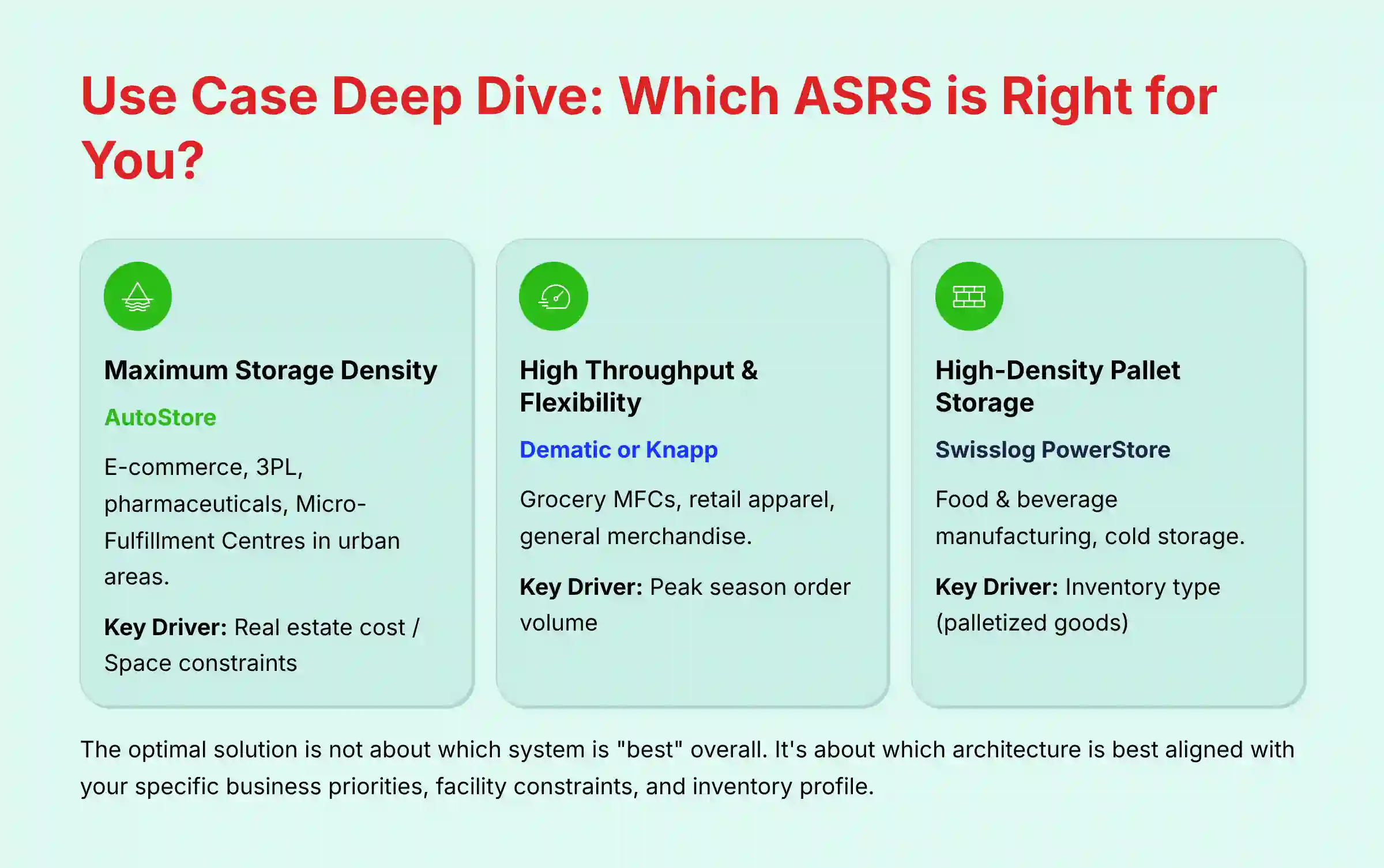
The optimal solution is not about which system is “best” overall. It is about which architecture is best aligned with your specific business priorities, facility constraints, and inventory profile. Use this table as a starting point for your decision-making.
| Business Priority | Optimal Solution | Typical Use Case | Key Decision Driver |
|---|---|---|---|
| Maximum Storage Density (Small Items) | AutoStore | E-commerce, 3PL, pharmaceuticals, Micro-Fulfillment Centers in urban areas. | Real estate cost / Space constraints |
| High Throughput & SKU Flexibility | Dematic or Knapp | Grocery MFCs, retail apparel, general merchandise. | Peak season order volume |
| High-Density Pallet Storage | Swisslog PowerStore | Food & beverage manufacturing, cold storage. | Inventory type (palletized goods) |
Frequently Asked Questions (FAQs)
What is the main difference between AutoStore and a shuttle system like Dematic's?
The main difference is their architecture. AutoStore uses a cube-based system with robots on top for maximum density. A shuttle system uses aisles with high-speed shuttles for maximum throughput.
Is AutoStore faster than Knapp's OSR shuttle?
No, not in terms of raw peak throughput. Knapp's shuttle system is generally faster for moving a high volume of cases per hour. AutoStore's speed scales with the number of robots you add.
Which system is more expensive, AutoStore or a shuttle system?
The initial capital cost is often comparable, but this is a misleading question. A true financial comparison must analyze the Total Cost of Ownership (TCO) over 10-15 years, including maintenance, energy, and software fees.
Can you add more robots to AutoStore after installation?
Yes. Adding more robots is one of AutoStore's key scaling advantages. This can be done with minimal disruption to live operations to increase throughput.
What happens if a robot fails inside the AutoStore grid?
If a robot fails, other robots can maneuver it to the edge of the grid for maintenance. The system is designed with redundancy so a single robot failure does not stop the operation.
Which system is better for a business with very high peak seasons?
Shuttle systems from Dematic or Knapp are generally better for extreme peak seasons. Their architecture is built to handle very high, predictable throughput demands.
Do all these systems require a WMS to operate?
Yes, all these ASRS solutions operate as subsystems under the direction of a Warehouse Management System (WMS) or Warehouse Execution System (WES). The WMS manages inventory and orders for the entire facility.
What are the typical implementation times for these ASRS solutions?
Implementation time varies based on size and complexity, but typically ranges from 9 to 18 months from contract signing to go-live. This is a complex construction and IT project.
Which system has a lower energy consumption?
This requires a detailed analysis from the vendors. Some shuttle systems use regenerative braking to recover energy, which may give them an advantage. But AutoStore's robots are small and efficient. You must request a specific energy consumption model based on your projected throughput.
Is vendor lock-in a bigger risk with one type of system over another?
The risk is similar across all systems, as they all use proprietary hardware and software. You can mitigate this risk by negotiating strong contracts for spare parts and considering software escrow agreements.
Final Verdict: Making a Data-Driven ASRS Decision in 2025
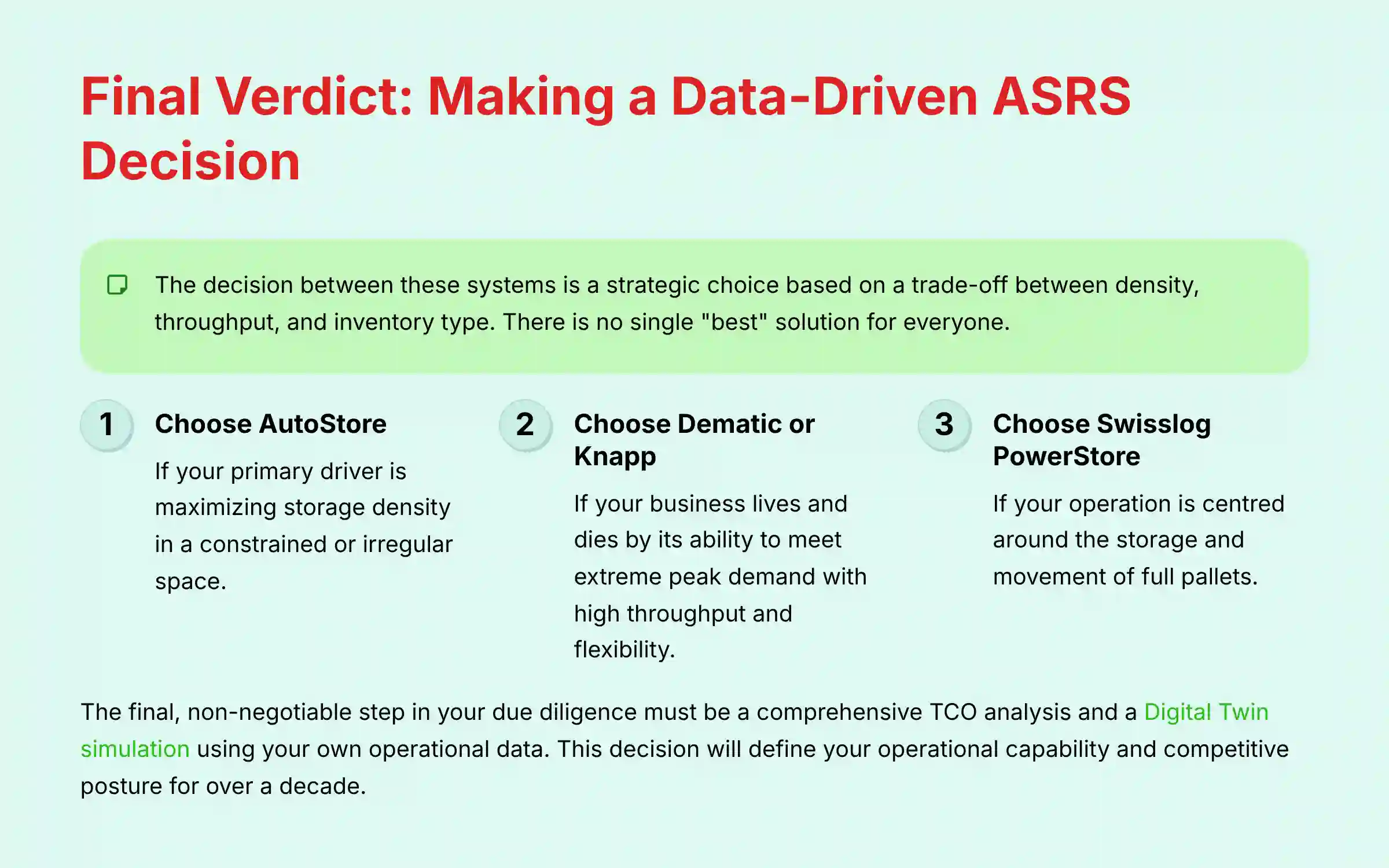
The decision between AutoStore, Dematic Multishuttle, Knapp OSR Shuttle™ Evo, and Swisslog PowerStore is a strategic choice. It is based on a trade-off between density, throughput, and inventory type. My analysis shows there is no single “best” solution for everyone.
Here is my synthesized recommendation:
- Choose AutoStore if your primary driver is maximizing storage density in a constrained or irregular space.
- Choose Dematic or Knapp if your business lives and dies by its ability to meet extreme peak demand with high throughput and flexibility.
- Choose Swisslog PowerStore if your operation is centered around the storage and movement of full pallets.
The final, non-negotiable step in your due diligence must be a comprehensive TCO analysis and a Digital Twin simulation using your own operational data. I strongly recommend this is validated by an independent ASRS consultant.
Think of this as the ultimate sanity check before committing capital. This decision will define your operational capability and competitive posture for over a decade—invest in the rigor of the evaluation process accordingly. It is the only way to press the advantage and ensure your investment delivers a true strategic return.
To continue your research, see our complete guide to AutoStore Top Alternatives and Competitors, and explore our detailed AutoStore FAQs for more specific questions.
For those seeking comprehensive warehouse automation solutions beyond ASRS systems, our guide to the Best 10 AI For Warehouse Robotics & Automation Solutions: The Definitive 2025 Guide provides additional insights into the broader automation landscape.

Leave a Reply