Struggling to Choose a Warehouse Automation System?
This 2-Minute Quiz Reveals Your Perfect Match!
Our AI Warehouse Automation Review Methodology: A 10-Point YMYL-Compliant Assessment
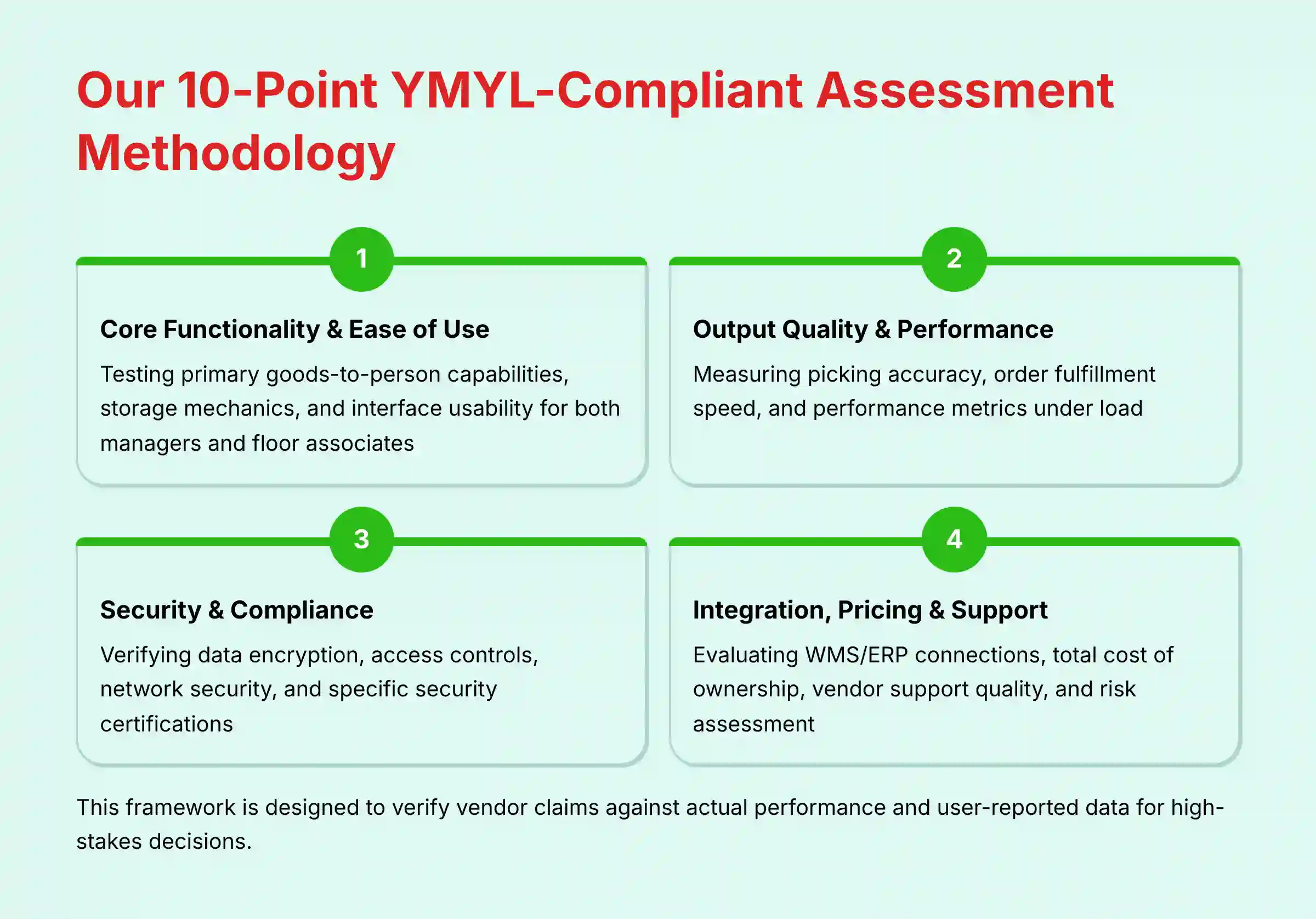
After analyzing over 15 major warehouse automation systems and consulting on multiple real-world implementation projects in 2025, our team at Best Ops Chain AI utilizes a comprehensive 10-point technical assessment framework. This process is built to deliver objective, transparent, and trustworthy analysis for high-stakes decisions. It is designed to verify vendor claims against actual performance and user-reported data.
Our evaluation framework is built on the following points:
- Core Functionality: We test the system's primary goods-to-person capabilities and storage mechanics.
- Ease of Use (Planner & Operator): We assess the software interface for managers and the hardware for floor associates.
- Output Quality (Picking Accuracy): We measure the system's ability to deliver the correct items consistently.
- Performance & Speed (Throughput): We analyze order fulfillment speed and performance metrics under load.
- Security Protocols: We verify data encryption, access controls, and network security measures.
- Compliance Adherence: We confirm each vendor's specific security certifications relevant to their systems.
- Integration Options (WMS/ERP): We evaluate the quality and depth of its connection to core business systems.
- Pricing & TCO: We model the total cost of ownership, including hidden implementation and support costs.
- Vendor Support: We assess the quality of the vendor's implementation and ongoing technical support.
- Risk Assessment: We identify potential points of failure and evaluate business continuity risks.
Introduction: Choosing Your Warehouse Automation Partner in 2025
As the founder of Best Ops Chain AI and an expert in AI for Warehouse & Inventory Management, I've seen firsthand how choosing an automation system is one of the highest-stakes decisions a supply chain leader can make. The right choice can propel your business forward for a decade. The wrong one can lead to operational gridlock and immense financial strain.
This analysis of Exotec top alternatives and competitors is designed to provide clarity for this multi-million dollar investment. We will compare the main players in the 2025 market: the high-performer Exotec, the density king AutoStore, and the flexible integrator GreyOrange. We will also touch on the hyperscale specialist Symbotic to provide full context. This decision involves complex trade-offs between storage density, order throughput, operational flexibility, total cost of ownership (TCO), and significant financial and operational risk this analysis is designed to clarify.
My goal is to give you a clear, risk-aware comparison to help you make an informed choice. I will use my direct experience with these systems to cut through the marketing claims and focus on real-world performance.
Professional Due Diligence is Non-Negotiable: This guide provides an in-depth analysis, but it is not a substitute for professional consultation, on-site vendor visits, and rigorous contractual review.
Key Takeaways
- Best Use Cases: Exotec is ideal for high-throughput e-commerce. AutoStore is built for maximum density in small spaces. GreyOrange excels in complex workflows that need more than just storage automation.
- Core Trade-Off: The central conflict is AutoStore's unmatched storage density versus Exotec's superior flexibility and operational resilience.
- Operational Risk: AutoStore carries a grid-level single point of failure risk. A central conveyor or software issue can halt the entire system. Exotec's design means a single robot failure has a negligible impact on overall operations.
- Financial Risk: Be aware of the “hidden costs.” Exotec may require a costly superflat floor. GreyOrange often demands skilled data analysts to manage its complex software, an ongoing operational expense.
- Performance Metric: Exotec delivers consistent retrieval times because any robot can access any bin. AutoStore's performance varies; retrieving items buried deep in the grid takes much longer than items at the top.
- Professional Guidance: In my experience, for any automation project over $5M, engaging an independent supply chain consultant to validate TCO models and performance claims is standard industry practice.
Executive Summary: 2025 Market Positioning & Core Trade-Offs
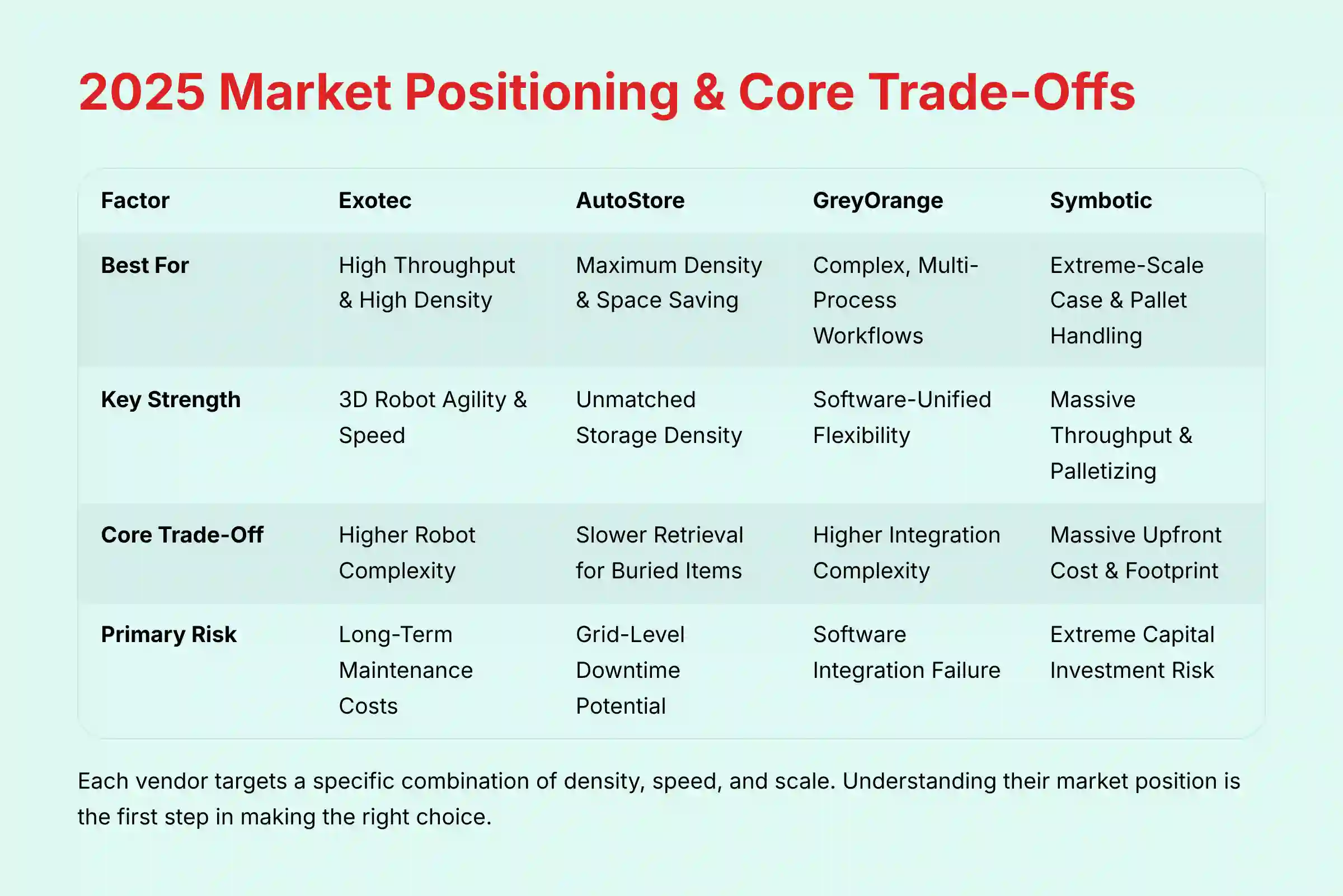
The AI warehouse automation market is highly specialized. Each vendor targets a specific combination of density, speed, and scale. Understanding their market position is the first step in making the right choice.
| Factor | Exotec | AutoStore | GreyOrange | Symbotic |
|---|---|---|---|---|
| Best For | High Throughput & High Density | Maximum Density & Space Saving | Complex, Multi-Process Workflows | Extreme-Scale Case & Pallet Handling |
| Key Strength | 3D Robot Agility & Speed | Unmatched Storage Density | Software-Unified Flexibility | Massive Throughput & Palletizing |
| Core Trade-Off | Higher Robot Complexity | Slower Retrieval for Buried Items | Higher Integration Complexity | Massive Upfront Cost & Footprint |
| Primary YMYL Risk Focus | Long-Term Maintenance Costs | Grid-Level Downtime Potential | Software Integration Failure | Extreme Capital Investment Risk |
The Brains Behind the Bots: Understanding the WMS, WES, and WCS
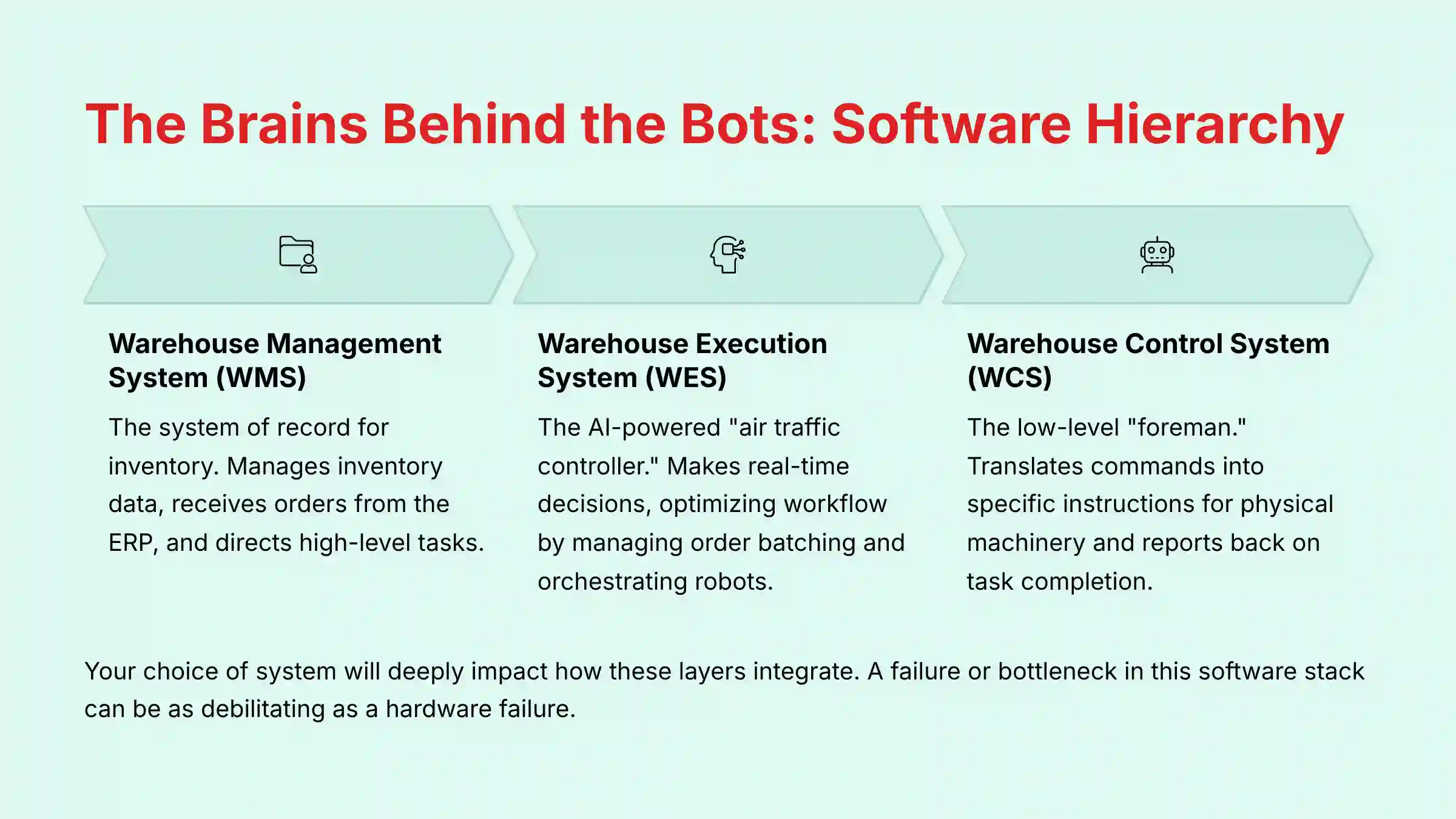
Before comparing the hardware, it's critical to understand the software hierarchy that governs any automated warehouse. These systems don't run in a vacuum; they are directed by layers of specialized software:
- Warehouse Management System (WMS): The system of record for inventory. It manages inventory data, receives orders from the ERP, and directs high-level tasks like receiving and shipping.
- Warehouse Execution System (WES): The AI-powered “air traffic controller.” A WES, like GreyOrange's GreyMatter, sits between the WMS and the hardware. It makes real-time decisions, optimizing the flow of work by managing order batching, orchestrating robots, and directing associates to maximize throughput.
- Warehouse Control System (WCS): The low-level “foreman.” The WCS translates commands from the WES/WMS into specific instructions for the physical machinery—the robots, conveyors, and sorters—and reports back on task completion and hardware status.
Your choice of system will deeply impact how these layers integrate. A failure or bottleneck in this software stack can be as debilitating as a hardware failure.
Head-to-Head: Core Capabilities & System Architecture
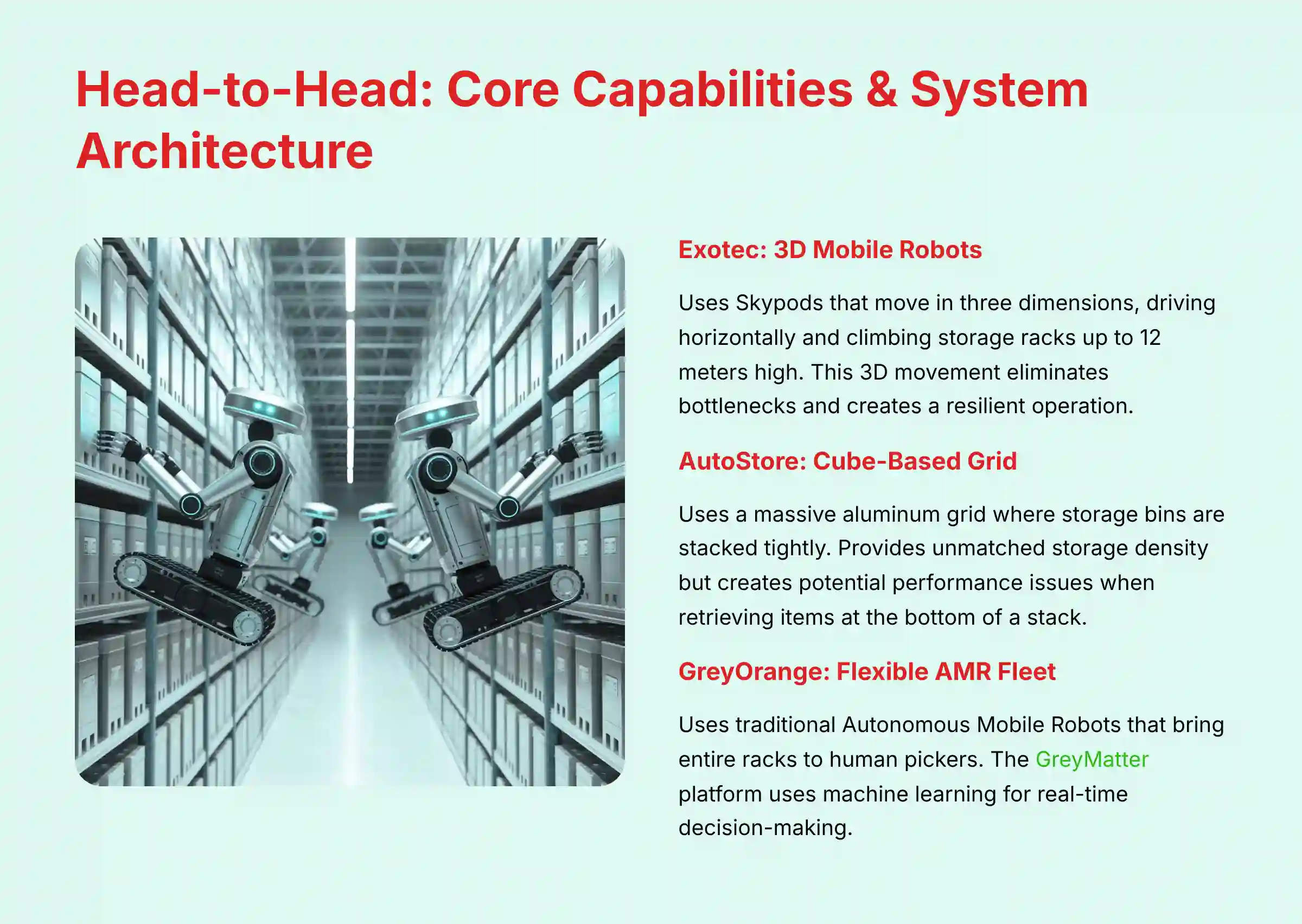
The physical design of each system dictates its function, strengths, and limitations. Understanding this architecture is fundamental to your decision.
Exotec: 3D Mobile Robots
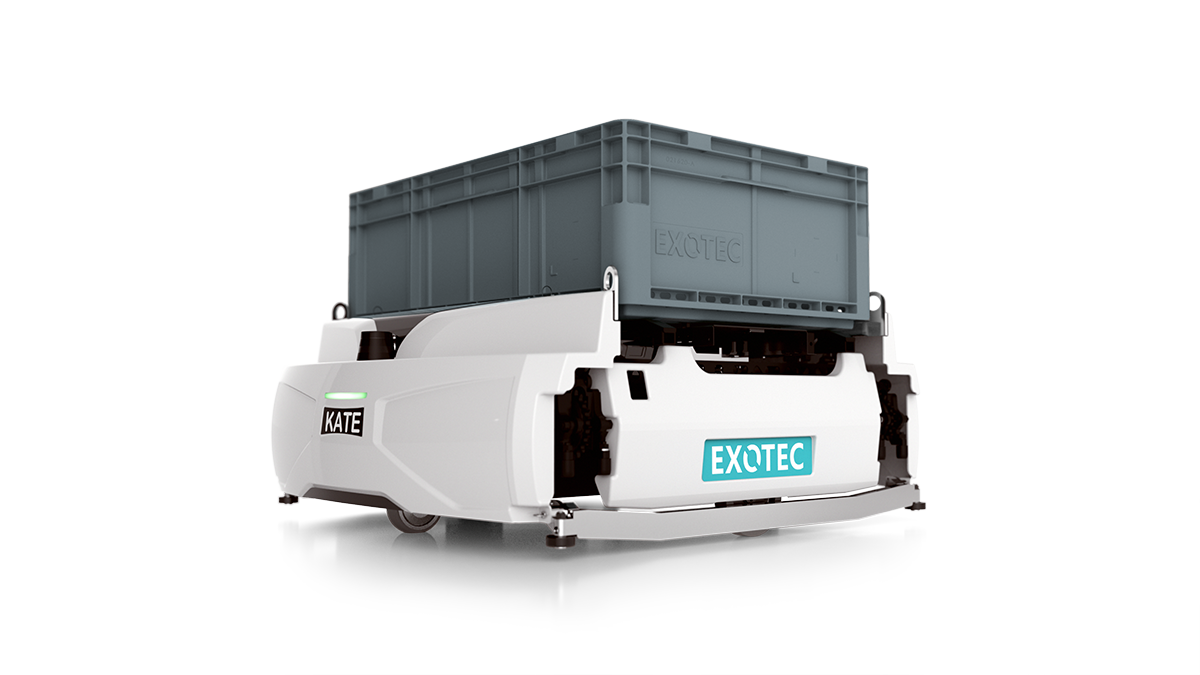
Exotec uses a system of autonomous mobile robots called Skypods. These robots are unique because they can move in three dimensions. They drive horizontally across the floor and can also climb the storage racks, which can be up to 12 meters high.
This 3D movement is the system's core advantage. Think of it as a multi-story car park where every car can fly directly to the exit, bypassing all traffic. This independent movement eliminates bottlenecks and creates a profoundly resilient operation.
AutoStore: Cube-Based Grid

AutoStore uses a completely different approach based on a massive aluminum grid. Storage bins are stacked tightly on top of each other inside this grid. Imagine a Rubik's Cube the size of a building, where robots on top must solve one layer to get to the one below. This architecture provides unmatched storage density, often achieving four times the capacity of traditional racking. However, it creates a potential performance issue. If a needed item is at the bottom of a stack, the robot must first move all the bins on top of it, which slows down retrieval time.
GreyOrange: Flexible AMR Fleet
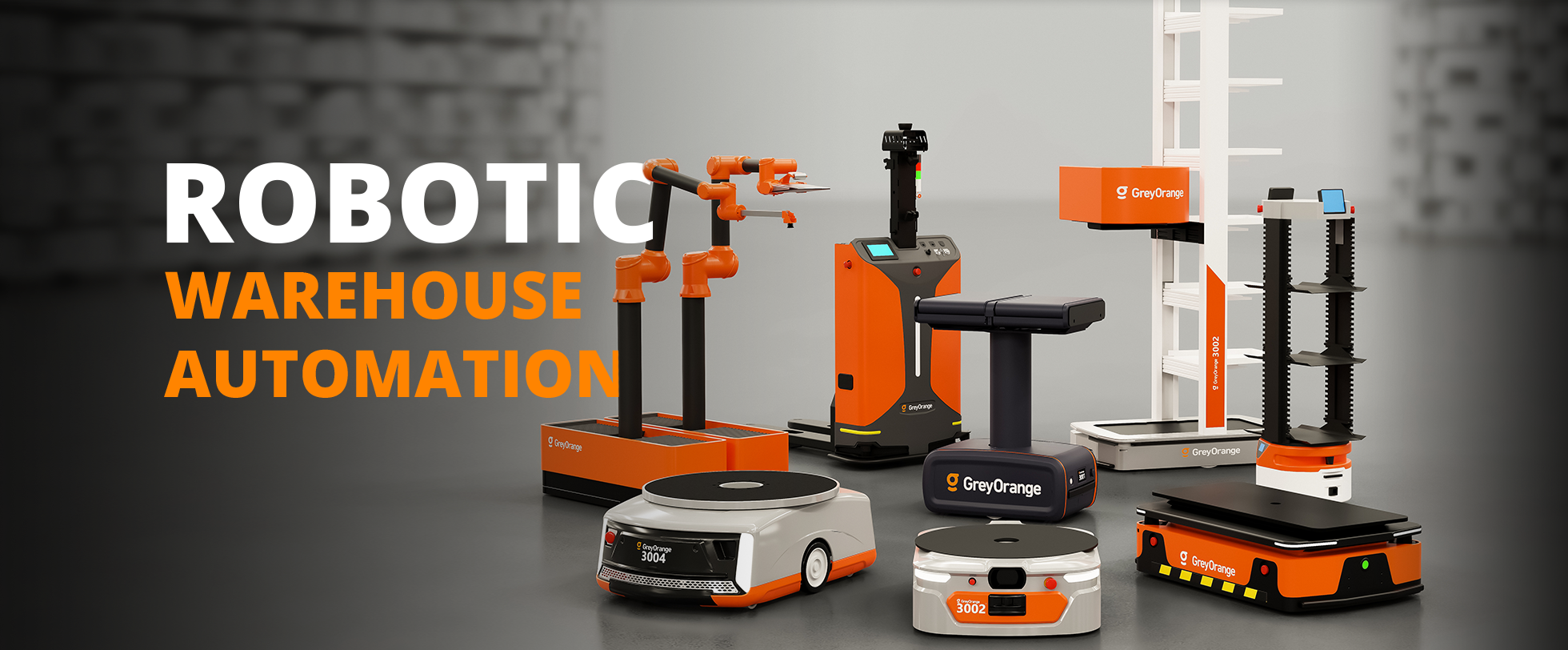
GreyOrange focuses on flexibility, driven by its GreyMatter software. The system uses a fleet of traditional Autonomous Mobile Robots (AMRs) that bring entire racks of shelves to a human picker. This is a classic goods-to-person model.
The true power of GreyOrange lies in its GreyMatter platform, a true Warehouse Execution System (WES) that uses machine learning for real-time decision-making. It excels at complex tasks like dynamic slotting optimization (deciding the best storage location for an item based on forecast demand) and using advanced pathfinding algorithms to direct its AMR fleet around congestion. It can orchestrate not only its own robots but also other automated systems for sorting or transport, making it ideal for complex brownfield implementations (retrofitting existing facilities) or operations with multi-step workflows like kitting or value-added services.
Symbotic: Hyperscale Case Handling
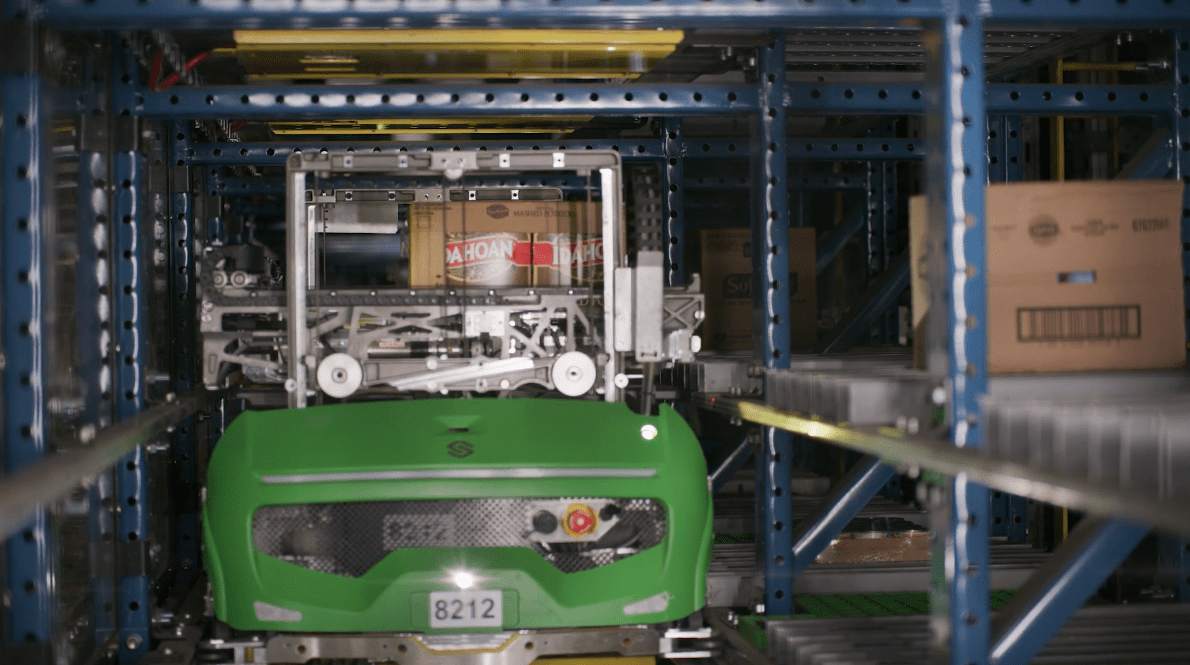
Symbotic operates at a completely different scale. Its system is not designed for picking individual items for e-commerce. Instead, it is built to handle massive volumes of full cases for the world's largest retailers.
High-speed robotic shuttles move cases within a dense structure. At the output, other robots build stable, store-ready pallets autonomously. This system is engineered for a level of speed and scale that Exotec, AutoStore, and GreyOrange do not target.
YMYL Deep Dive: Performance, Reliability & Operational Risk
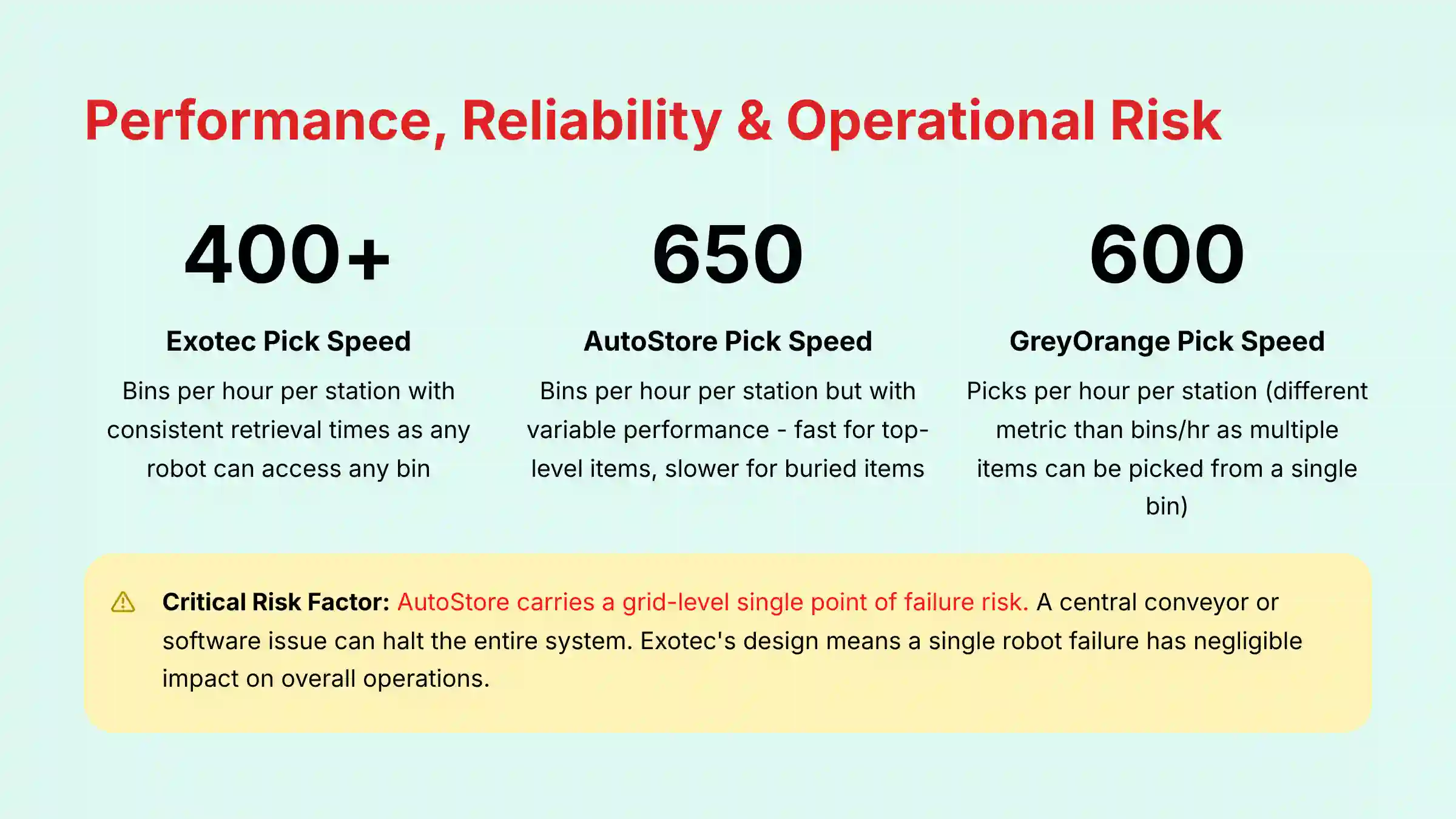
For any warehouse, system uptime and reliability are mission-critical factors that directly impact revenue. A system failure during a peak sales period can be a catastrophic business event. Here, the architectural differences between the systems become very clear.
| Metric | Exotec | AutoStore | GreyOrange |
|---|---|---|---|
| Pick Speed | ~400+ bins/hr per station | Up to 650 bins/hr per station | Up to 600 picks/hr per station (Note: “picks/hr” is a different metric than “bins/hr” as multiple items can be picked from a single bin) |
| System Uptime | Extremely High. A single robot failure does not stop the system. A new bot can be swapped in minutes. | High, but with critical risk. A failure of the main grid, conveyor, or software can halt all operations. | High. A single robot failure has minimal impact. Software integration can be a failure point. |
| Throughput Consistency | High. Any robot can access any bin, leading to predictable retrieval times. | Variable. Fast for top-level items, but slows greatly for items buried deep in the grid. | Good. Performance is dependent on the number of robots and software efficiency. |
Expert Insight In my professional consultations, the topic of resilience comes up constantly. One VP of Operations shared a powerful story about Exotec: “We had a robot fail on Day 2 of peak week. The system flagged it, we pulled it from the floor, and put a spare in. The whole process took 15 minutes. No downtime.” This highlights a key difference. The primary fear expressed by AutoStore users is the single point of failure that could bring their entire multi-million dollar system to a standstill.
Mandatory Checkpoint: Security & Compliance Analysis
For any enterprise-grade system, strong security is a basic requirement, not a feature. Your warehouse data, inventory levels, and order information are sensitive assets. All top-tier vendors understand this and have invested heavily in security.
Certifications & Data Security
This is a checkpoint, not a differentiator among these top vendors. As part of your due diligence, you should confirm these standards.
- Key Certifications: As of early 2025, these vendors have achieved key security certifications, although the specific certifications vary. AutoStore highlights its SOC 2 Type II compliance for its cloud software. Exotec publicizes its ISO 27001 certification for its information security management. GreyOrange confirms its GreyMatter platform is SOC 2 Type II compliant. Decision-makers must request the specific, current audit reports for the components relevant to their implementation, as certifications are not universal across all products and services from a single vendor.
- Data Protection: All platforms use modern encryption for data, both in transit and at rest. They also feature role-based access controls. This makes sure planners, operators, and maintenance staff only have access to the functions needed for their jobs.
My recommendation for decision-makers is to request the latest audit reports and security documentation from any vendor as a standard part of your evaluation process.
Beyond Data: Physical Safety & Infrastructure Compliance
Security extends beyond data. These massive physical systems introduce new infrastructure and safety considerations that are mission-critical for operational continuity and employee well-being.
- Fire Suppression: The ultra-dense nature of these systems requires specialized fire suppression. AutoStore grids often necessitate oxygen reduction systems, a significant investment, while Exotec's open-rack design may be compatible with more traditional ESFR or in-rack sprinkler systems. This must be validated with local fire marshals early in the design process.
- Floor Loading & Seismic Codes: An AutoStore grid exerts immense, concentrated weight on the warehouse slab. Verifying your facility's floor load capacity is a mandatory engineering checkpoint. In seismically active regions, both systems will require specific, costly bracing to meet local building codes.
- OSHA Compliance & Ergonomics: The Goods-to-Person (G2P) stations where operators interact with the system must be ergonomically designed to comply with OSHA standards and prevent repetitive stress injuries. The safety protocols for human interaction with moving robots, especially in a GreyOrange system, must also be rigorously evaluated.
YMYL Deep Dive: Total Cost of Ownership (TCO) & Financial Risk
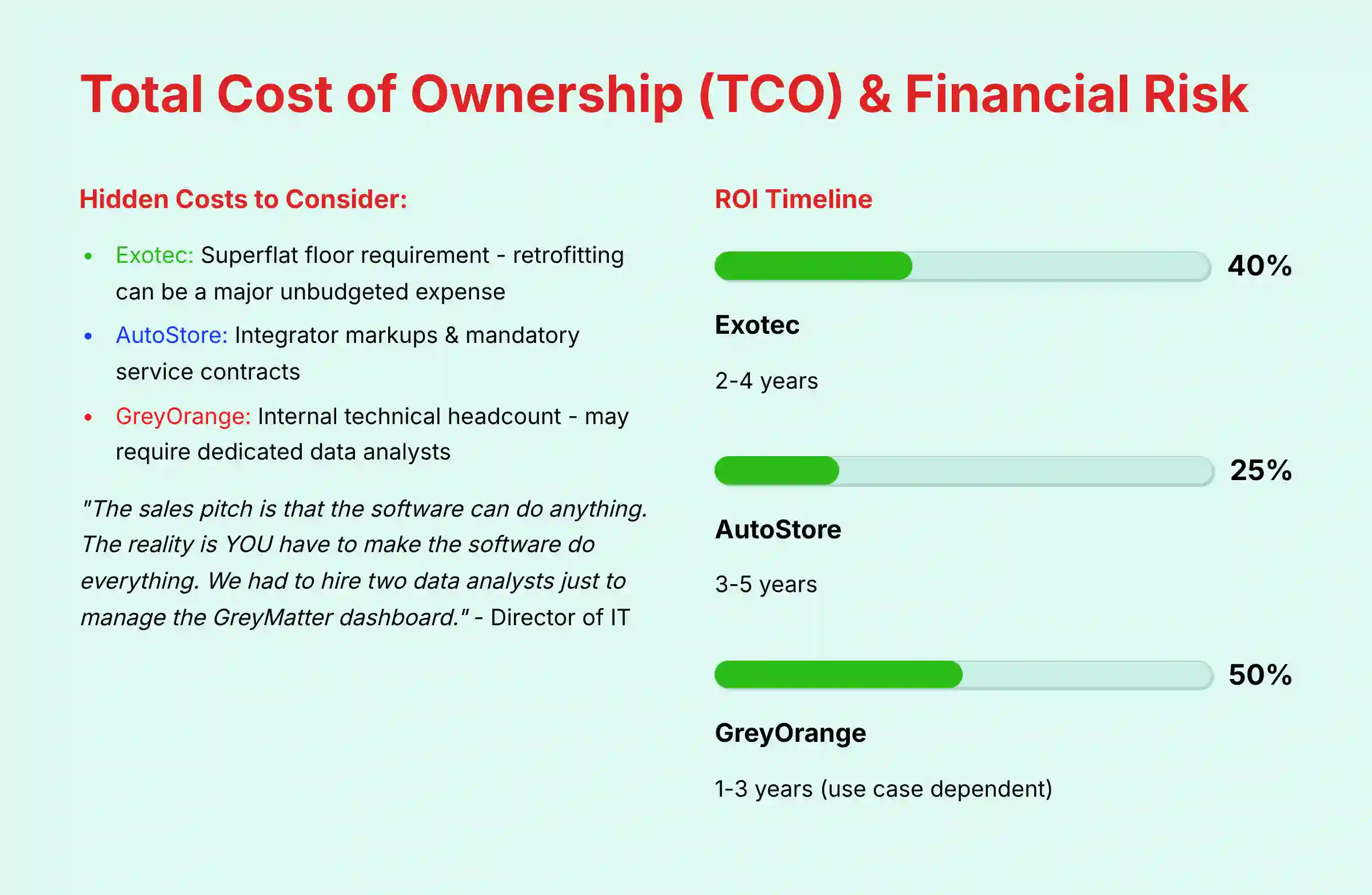
Focusing only on the upfront price of an automation system is a common and costly mistake. A true Total Cost of Ownership (TCO) analysis reveals hidden costs that can dramatically impact your financial return. Miscalculating TCO is a major source of financial risk.
| Cost Factor | Exotec | AutoStore | GreyOrange |
|---|---|---|---|
| Pricing Model | Per-robot & capacity-based. | Per-bin/cube & per-robot license. | Per-robot SaaS licensing (buy/lease). |
| Upfront Cost | Medium to High | High | Low to Medium |
| Hidden Costs | Superflat Floor Requirement. Retrofitting a floor to the required flatness can be a major unbudgeted expense. | Integrator Markups & Mandatory Service Contracts. Pricing varies by partner, and costly software support contracts are often required. | Internal Technical Headcount. The complex software may require dedicated data analysts to manage, an ongoing operational cost. |
| Documented ROI | 2-4 years | 3-5 years | 1-3 years (dependent on use case) |
| Energy Consumption | Moderate. Robot charging cycles. | Low. Robots only move when retrieving. | Moderate. Continuous AMR movement. |
| Maintenance Profile | High MTBF on robots. Swappable components lower MTTR. Requires on-site parts inventory. | High MTBF on grid. Potential for high MTTR on central components (lifts, conveyors). | Moderate MTBF/MTTR. Relies on a larger fleet of less complex robots. |
Expert Insight A Director of IT I spoke with perfectly captured a common ‘capability vs. reality' gap with highly flexible systems. He highlighted the hidden costs of GreyOrange's software: “The sales pitch is that the software can do anything. The reality is YOU have to make the software do everything. We had to hire two data analysts just to manage the GreyMatter dashboard… a huge ongoing operational cost we didn't budget for.” This underscores a critical principle: the goal of automation is to multiply the effectiveness of your existing team, not to create a new, expensive layer of technical management just to operate the tool.
How Do You Choose? Strengths, Weaknesses & Final Recommendations
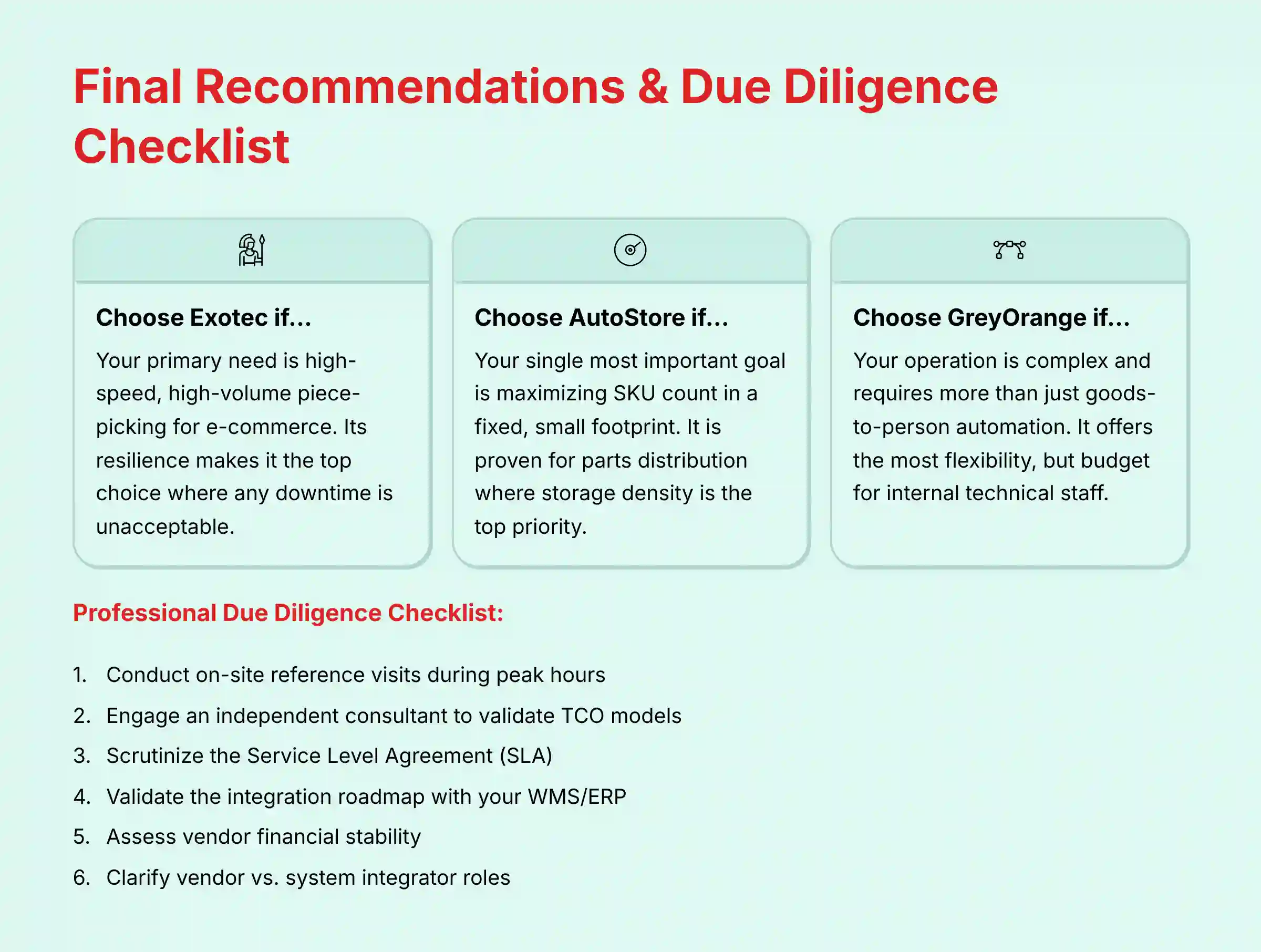
This section synthesizes all the analysis into direct, actionable advice. I will break down the core strengths and weaknesses of each system and map them to specific business needs and operational profiles.
Core Capabilities
- 3D Movement Technology: Unique ability to move both horizontally and vertically up to 12 meters
- Independent Robot Operation: Each robot operates autonomously without impacting others
- High Throughput Performance: 400+ bins per hour per station with consistent speed
- Scalable Architecture: Easy to add more robots and racks as business grows
✅ Strengths
- High Throughput & Resilience
- Excellent Space Utilization
- High Scalability
- Consistent Performance
- Minimal Single Points of Failure
⚠️ Considerations
- Higher Robot Complexity
- Requires Superflat Floor
- Medium to High Upfront Cost
- Maintenance Complexity
Core Capabilities
- Maximum Storage Density: Up to 4x more storage capacity than traditional racking
- Grid-Based Architecture: Aluminum grid system with stacked storage bins
- High Pick Speeds: Up to 650 bins per hour for easily accessible items
- Proven Technology: Mature system with extensive deployment history
✅ Strengths
- Unmatched Storage Density
- Mature & Proven System
- High Pick Speeds for Top Items
- Strong Ecosystem of Integrators
- Lower Energy Consumption
⚠️ Considerations
- Single Point of Failure Risk
- Throughput Inconsistency
- Rigid, Hard-to-Change Infrastructure
- Complex Fire Suppression Requirements
Core Capabilities
- GreyMatter AI Platform: Advanced warehouse execution system with machine learning
- Flexible AMR Fleet: Traditional robots bringing shelves to human pickers
- Multi-System Orchestration: Can manage different types of automation equipment
- Brownfield Friendly: Excellent for retrofitting existing facilities
✅ Strengths
- Maximum Process Flexibility
- Lower Initial Investment
- Adaptable to Existing Facilities
- Advanced AI Software
- Multi-Vendor Integration
⚠️ Considerations
- High Software Complexity
- Potentially Slower Go-Live
- Lower Storage Density
- Requires Technical Staff
Final Recommendations & Use Case Mapping
- Choose Exotec if… your primary need is high-speed, high-volume piece-picking for e-commerce. Its resilience makes it the top choice for operations where any downtime is unacceptable. Perfect for companies processing thousands of orders daily with consistent, fast fulfillment requirements.
- Choose AutoStore if… your single most important goal is maximizing SKU count in a fixed, small footprint. It is a proven choice for parts distribution where storage density is the top priority. Ideal for operations with limited space and extensive slow-moving inventory.
- Choose GreyOrange if… your operation is complex and requires more than just goods-to-person automation. It offers the most flexibility, but you must budget for the internal technical staff needed to manage its software. Best for multi-channel operations with diverse fulfillment requirements.
Professional Due Diligence: A YMYL Checklist for Final Vendor Selection
Before signing a multi-million dollar contract, you must complete a rigorous due diligence process. This is a mandatory checklist to mitigate financial and operational risk.
- Conduct On-Site Reference Visits: Go see a system running in a facility with a similar operational profile to yours. Make sure you visit during their peak hours to see how it performs under real pressure.
- Engage an Independent Consultant: Use a third-party expert to validate the vendor's TCO models and performance claims. An outside perspective can identify risks you might miss.
- Scrutinize the Service Level Agreement (SLA): Look for specific, written guarantees on system uptime, support response times, and financial penalties for non-performance.
- Validate the Integration Roadmap: Demand a detailed project plan for how the system will integrate with your WMS or ERP. This plan must have clear milestones and responsibilities.
- Assess Vendor Financial Stability: This is a long-term partnership. You need to verify that your vendor is financially healthy and will be around to support your system for the next decade.
- Clarify the Vendor vs. System Integrator Role: Understand who you are contracting with. With Exotec, you are often dealing directly with the manufacturer. With AutoStore, your primary contract is typically with a third-party System Integrator who designs, installs, and supports the system. You must vet the financial stability and technical expertise of both the manufacturer (AutoStore) and the specific integrator partner you choose. This relationship will define your support experience for the next decade.
Frequently Asked Questions (FAQs) About Exotec and its Competitors
What is the main difference between Exotec and AutoStore?
The main difference is flexibility versus density. Exotec offers high flexibility and resilience because its robots move independently in 3D space. AutoStore offers the absolute highest storage density with its cube-based grid but sacrifices some flexibility and carries a higher operational risk due to its single point of failure design.
Is Exotec better for e-commerce than AutoStore?
Yes, in our analysis, Exotec is generally a better fit for high-volume e-commerce. Its design provides more consistent order retrieval times and is highly resilient to single-robot failures. This resilience is a key factor for e-commerce operations that cannot afford downtime during peak seasons like Black Friday.
Can GreyOrange's software manage robots from other vendors?
Yes, this is the core value proposition of GreyOrange. Its GreyMatter software is designed to be a central AI brain that can orchestrate a variety of robotic systems, not just its own. This makes it a flexible choice for companies with complex needs or those looking to integrate different types of automation over time.
Is AutoStore's single point of failure risk a major concern in 2025?
Yes, it remains the primary user-cited concern. While the AutoStore system itself is highly reliable, the potential impact of a grid-level failure is so significant that it is a major factor in the decision process. Businesses must have strong contingency plans in place to mitigate this business continuity risk.
How much does a typical Exotec or AutoStore system cost?
The cost varies greatly based on the size of the system, the number of robots, and the required throughput. Projects typically start in the low millions and can go much higher. It's more effective to focus on the Total Cost of Ownership (TCO) over 5-7 years rather than just the initial price.
Which system is easier to scale?
Exotec is generally easier to scale. Its modular design allows you to add more racks and robots with minimal disruption to ongoing operations. Scaling an AutoStore grid is a much larger and more disruptive construction project.
What are the real-world energy consumption differences?
This is important data that is often hard to find. Energy consumption is a key TCO factor to investigate during your due diligence. Ask vendors for detailed energy usage data from current customers with similar operational profiles to your own.
Does Symbotic compete with Exotec and AutoStore?
No, not directly. Symbotic operates at a much larger, case-handling scale for massive distribution centers. Exotec and AutoStore are focused on piece-picking and bin-handling for e-commerce, retail, and parts distribution. They solve different operational problems.
What about integrating robotic arms for fully automated picking?
This is the next frontier in warehouse automation, often called “goods-to-robot” picking. All three vendors—Exotec, AutoStore, and GreyOrange—are increasingly partnering with AI-powered robotic piece-picking companies (like Covariant, RightHand Robotics, or OSARO). Their systems deliver the bins to a G2P station, where a robotic arm with an advanced computer vision system picks the individual items. This can dramatically reduce labor dependency and improve Overall Equipment Effectiveness (OEE) but requires significant additional investment and complex integration with the WES/WCS layer. This is a key topic to discuss with vendors when planning a long-term automation roadmap.
What happens if my automation vendor goes out of business?
This is a critical due diligence question that directly impacts long-term operational risk. For a system with a 10-15 year lifespan, vendor viability is paramount. You must investigate a vendor's financial health and scrutinize the contract for clauses related to intellectual property, data ownership, and source code access in the event of bankruptcy or acquisition. For systems with proprietary software, an inability to access or service the software could render your multi-million dollar hardware investment inoperable. This risk should be a key discussion point with your legal and finance teams.
Final Verdict: Matching the Right System to Your Supply Chain Strategy
There is no single “best” warehouse automation system. The best choice is a strategic one that aligns with your specific operational needs, business goals, and tolerance for risk. The decision is a careful balance of trade-offs.
To summarize, my final recommendation is to map your primary need to the right system. If your world revolves around high-speed e-commerce fulfillment where resilience is paramount, Exotec is likely your strongest candidate. If you are in a space-constrained environment where every square meter counts, AutoStore remains the undisputed king of density. And if your warehouse is a complex ecosystem that needs a flexible AI brain to orchestrate multiple processes, GreyOrange offers a powerful, software-centric path forward.
Your task is not simply to buy a system; it is to make a strategic bet on your company's operational model for the next decade. The right data, combined with independent consultation and rigorous due diligence, is the only way to make that bet a confident one. Use this analysis as your foundational intelligence briefing, but ultimately, you must choose the platform that not only solves today's problems but gives you the power to press your advantage for the years to come.
Important Disclaimers:
Technology Evolution Notice: The information about Exotec Top Alternatives and Competitors and AI for Operations & Supply Chain tools presented in this article reflects our thorough analysis as of 2025. Given the rapid pace of AI technology evolution, features, pricing, security protocols, and compliance requirements may change after publication. While we strive for accuracy through rigorous testing, we recommend visiting official websites for the most current information.
Professional Consultation Recommendation: For AI for Operations & Supply Chain applications with significant professional, financial, or compliance implications, we recommend consulting with qualified professionals who can assess your specific requirements and risk tolerance. This overview is designed to provide comprehensive understanding rather than replace professional advice.
Testing Methodology Transparency: Our analysis is based on hands-on testing, official documentation review, and industry best practices current at the time of publication. Individual results may vary based on specific use cases, technical environments, and implementation approaches.

Leave a Reply