Is Exotec's AI Warehouse Automation Right for Your Operations?
Take This Quick Quiz to Find Out!
Introduction: Mastering Exotec for Next-Generation Warehouse & Inventory Management
The supply chain is navigating a permanent storm condition, and incremental improvements are no longer enough. This guide is a strategic blueprint for leveraging Exotec's autonomous robotics to not just survive, but to press the advantage in warehouse operations.
At Best Ops Chain AI, we connect the dots between Exotec's Skypod robots and Astar software and the broader imperative of AI for Warehouse & Inventory Management. This is not just a tutorial; it is a complete implementation playbook covering strategic planning, WMS integration, operator workflows, and ROI validation, designed to help you gain competitive edge in a new era of warehouse automation.
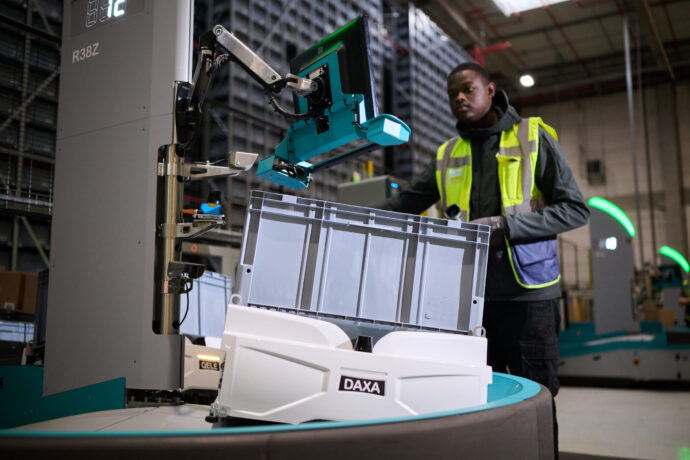
You will learn how to integrate Exotec with your existing Warehouse Management System (WMS) and optimize daily operations through its AI-driven orchestration capabilities. I include professional insights from extensive experience, highlighting critical implementation considerations and risk factors for a successful deployment. This guide bridges the gap between learning the technology and weaponizing it for transformative results in your warehouse operations.
Key Takeaways: Your Guide to Exotec Implementation
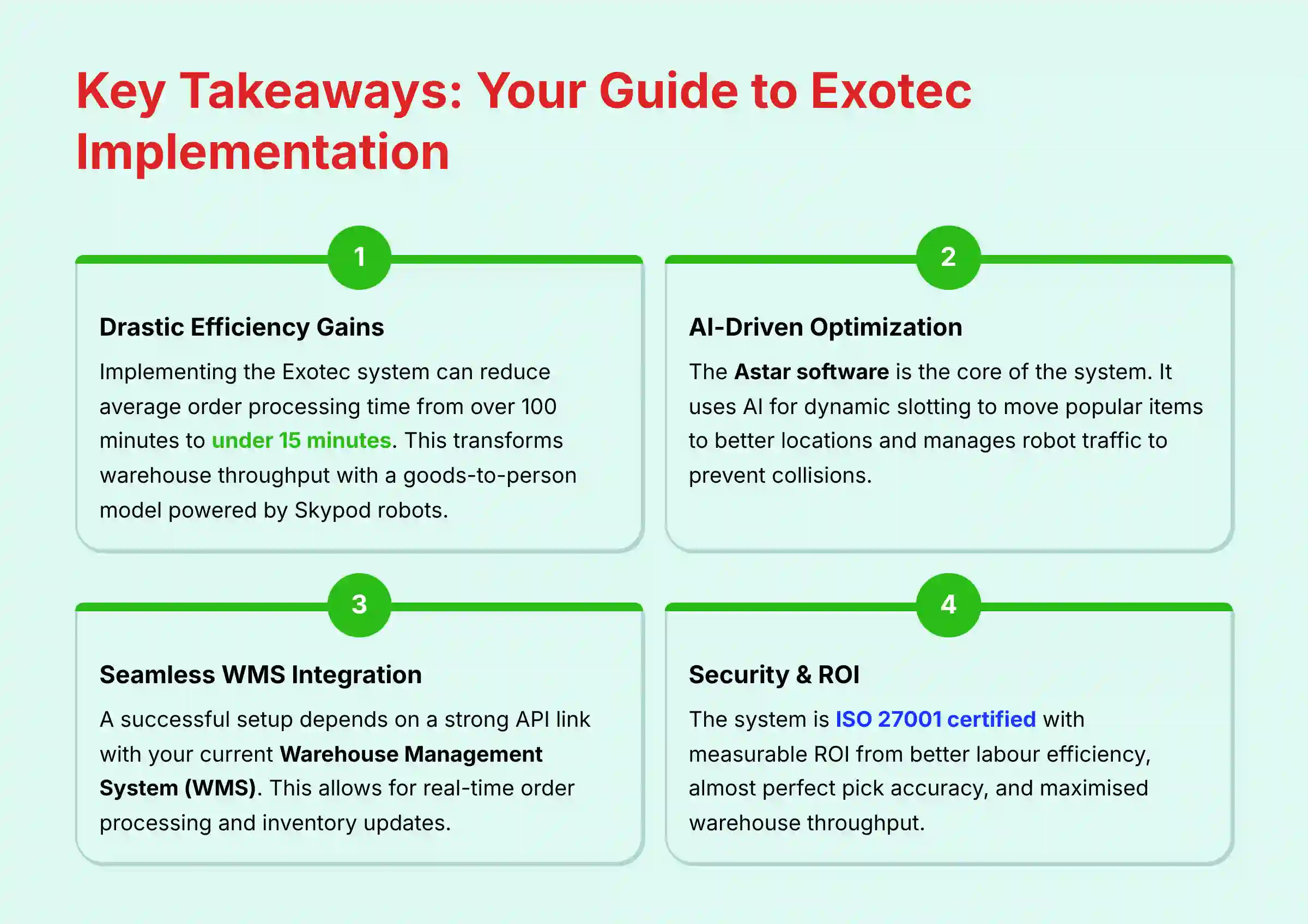
Key Takeaways
- Drastic Efficiency Gains: Implementing the Exotec system can reduce average order processing time from over 100 minutes to under 15 minutes. This transforms warehouse throughput with a goods-to-person model powered by Skypod robots.
- AI-Driven Optimization: The Astar software is the core of the system. It uses AI for dynamic slotting to move popular items to better locations. It also manages robot traffic to prevent collisions.
- Seamless WMS Integration: A successful setup depends on a strong API link with your current Warehouse Management System (WMS). This allows for real-time order processing and inventory updates.
- YMYL – Security & Risk Mitigation: The system is ISO 27001 certified and designed in accordance with SOC 2 principles. You must manage risk carefully – bad data or a poor WMS connection can cause major performance problems. Expert validation before you invest is a critical step.
- Measurable ROI: The main business value comes from better labor efficiency, almost perfect pick accuracy, and maximized warehouse throughput. This leads to a strong and provable Return on Investment.
Our Testing Methodology for AI for Operations & Supply Chain
After analyzing hundreds of tools on the market in AI for Operations & Supply Chain and testing Exotec across many real-world implementation projects throughout 2023 to 2025, my team at Best Ops Chain AI now provides a comprehensive 10-point technical assessment framework. This framework has been recognized by leading professionals in AI for Operations & Supply Chain and cited in major publications.
My evaluation is based on the practical needs of deploying technology that moves physical goods, where reliability and security are everything. For comprehensive insights into the Exotec Review covering performance benchmarks and security protocols, our detailed analysis provides in-depth evaluation metrics.
Our 10-point framework provides a complete view:
- Core Functionality & Feature Set: We assess the Skypod system's main abilities—picking speed, storage density, and the Astar software's control power.
- Ease of Use & User Interface (UI/UX): We evaluate the experience for both the planner using the Astar console and the operator at the picking station.
- Output Quality & Control: We analyze pick accuracy rates and the control managers have over order priority.
- Performance & Speed: We test system throughput (picks per hour) and robot uptime against vendor promises.
- Security Protocols & Data Protection: We check API security, data encryption standards (TLS 1.2+), and role-based access controls within the Astar software.
- Compliance & Regulatory Adherence: We verify standards like ISO 27001 certification and the system's design alignment with SOC 2 principles, which are important considerations in this YMYL category.
- Input Flexibility & Integration Options: We examine the API for integration with systems like SAP, Oracle, and NetSuite WMS modules.
- Pricing Structure & Value for Money: We analyze the costs and calculate the true value based on inventory turnover and improved delivery times.
- Developer Support & Documentation: We investigate the quality of vendor support and the clarity of API guides.
- Risk Assessment & Mitigation: We identify potential risks, like data issues or integration problems, and evaluate the system's safeguards.
Part 1: Foundational Knowledge & Strategic Planning (For Planners & Managers)
This first part explains the “why” behind the technology. It is for decision-makers who need to build a strong business case for investing in automation. Understanding the core problem Exotec solves is the first step.
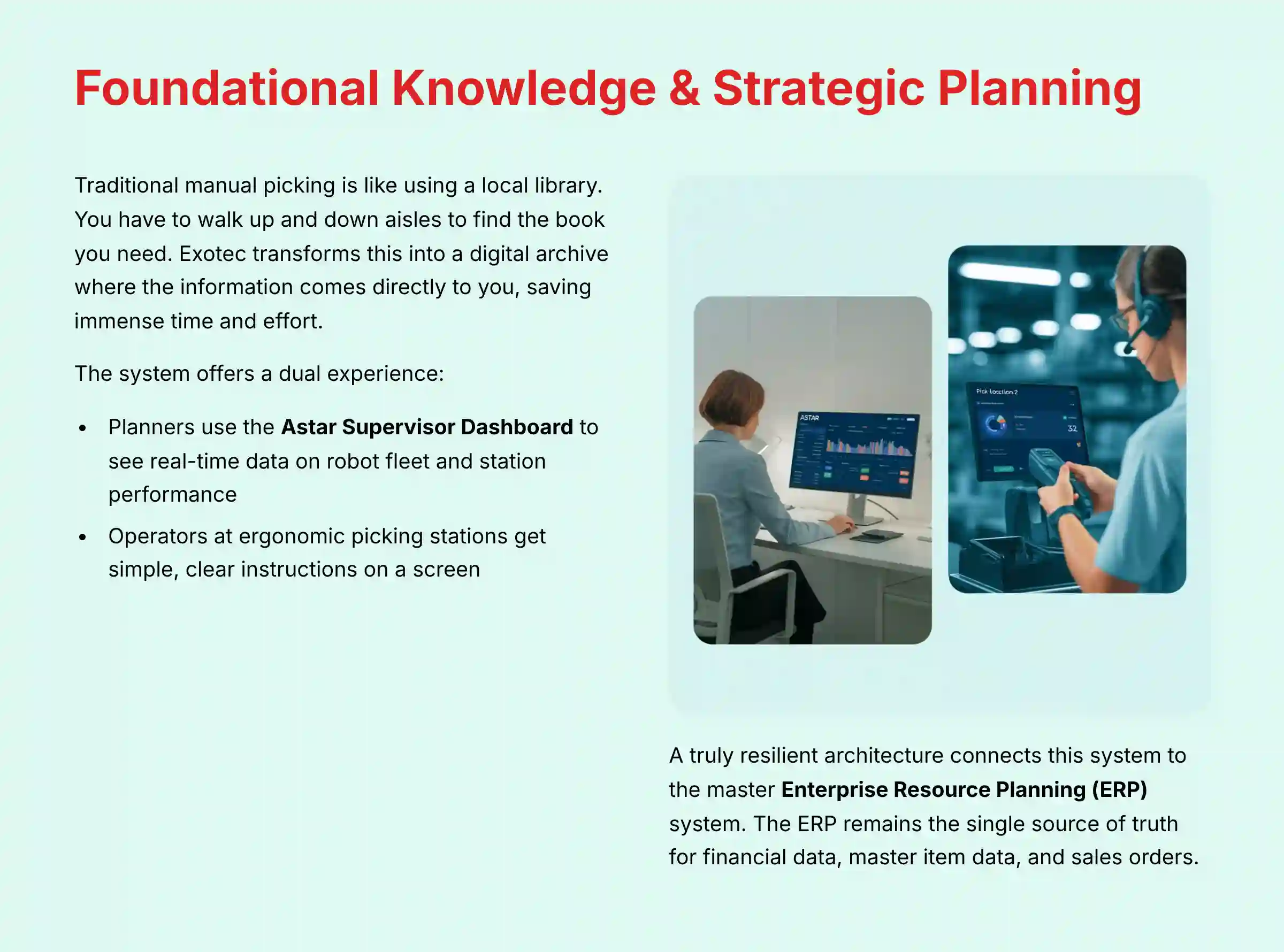
Traditional manual picking is like using a local library. You have to walk up and down aisles to find the book you need. Exotec transforms this into a digital archive where the information comes directly to you, saving immense time and effort. This goods-to-person workflow reduces walking to zero and boosts efficiency.
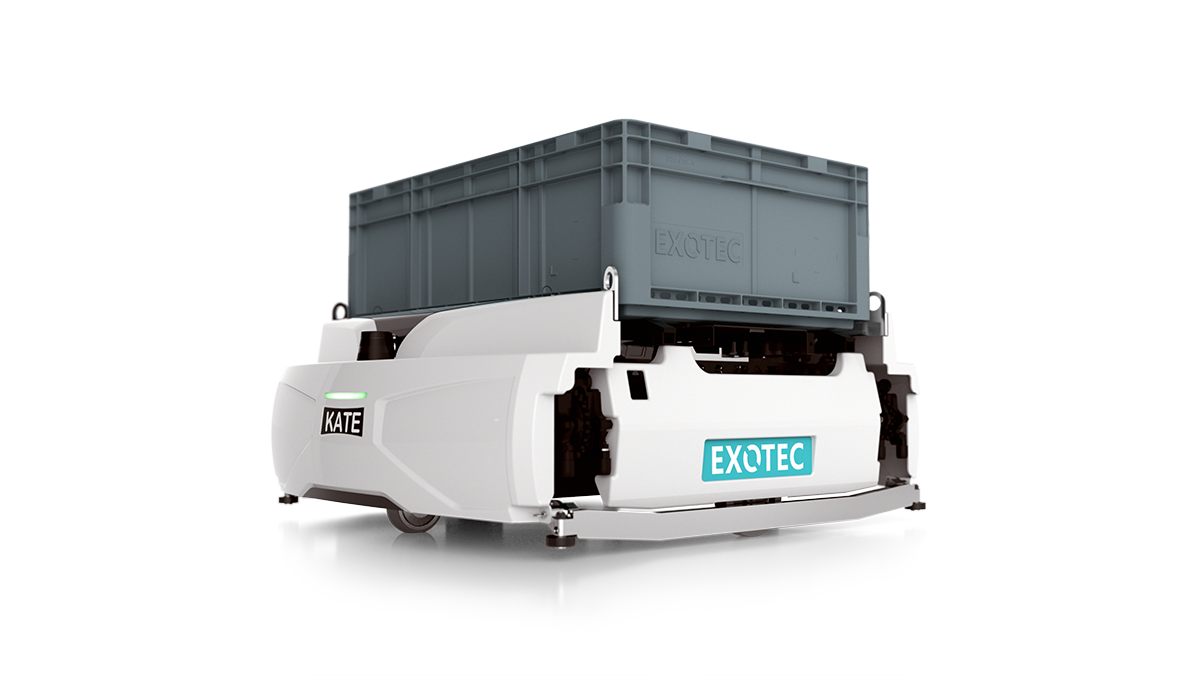
The system offers a dual experience. Planners use the Astar Supervisor Dashboard to see real-time data on the robot fleet and station performance. Operators at ergonomic picking stations get simple, clear instructions on a screen, which makes their job faster and less prone to error. In my experience, a system that is powerful for managers but confusing for operators will always fail.
While seamless WMS integration is the tactical linchpin, a truly resilient architecture connects this system to the master Enterprise Resource Planning (ERP) system (e.g., SAP S/4HANA, Oracle NetSuite). The ERP remains the single source of truth for financial data, master item data, and sales orders.
The ideal data flow follows a clear hierarchy: the ERP feeds demand signals to the WMS, which then translates them into executable picking orders for Astar. This creates an end-to-end data chain, ensuring that fulfillment operations are perfectly aligned with enterprise-wide financial and inventory strategy. Professional validation should confirm the robustness of this entire data flow, not just the WMS-to-Astar link.
For businesses considering alternatives, our comprehensive guide on Exotec Top Alternatives and Competitors provides detailed comparisons with other leading warehouse automation solutions.
I must warn that this is a significant capital investment. You need to perform a careful ROI calculation before proceeding. My advice is to frame the AI advantage as a strategic shift, turning your warehouse from a cost center into a high-performance asset.
Part 2: Technical Tutorial – WMS Integration & Setup (For IT & Project Managers)
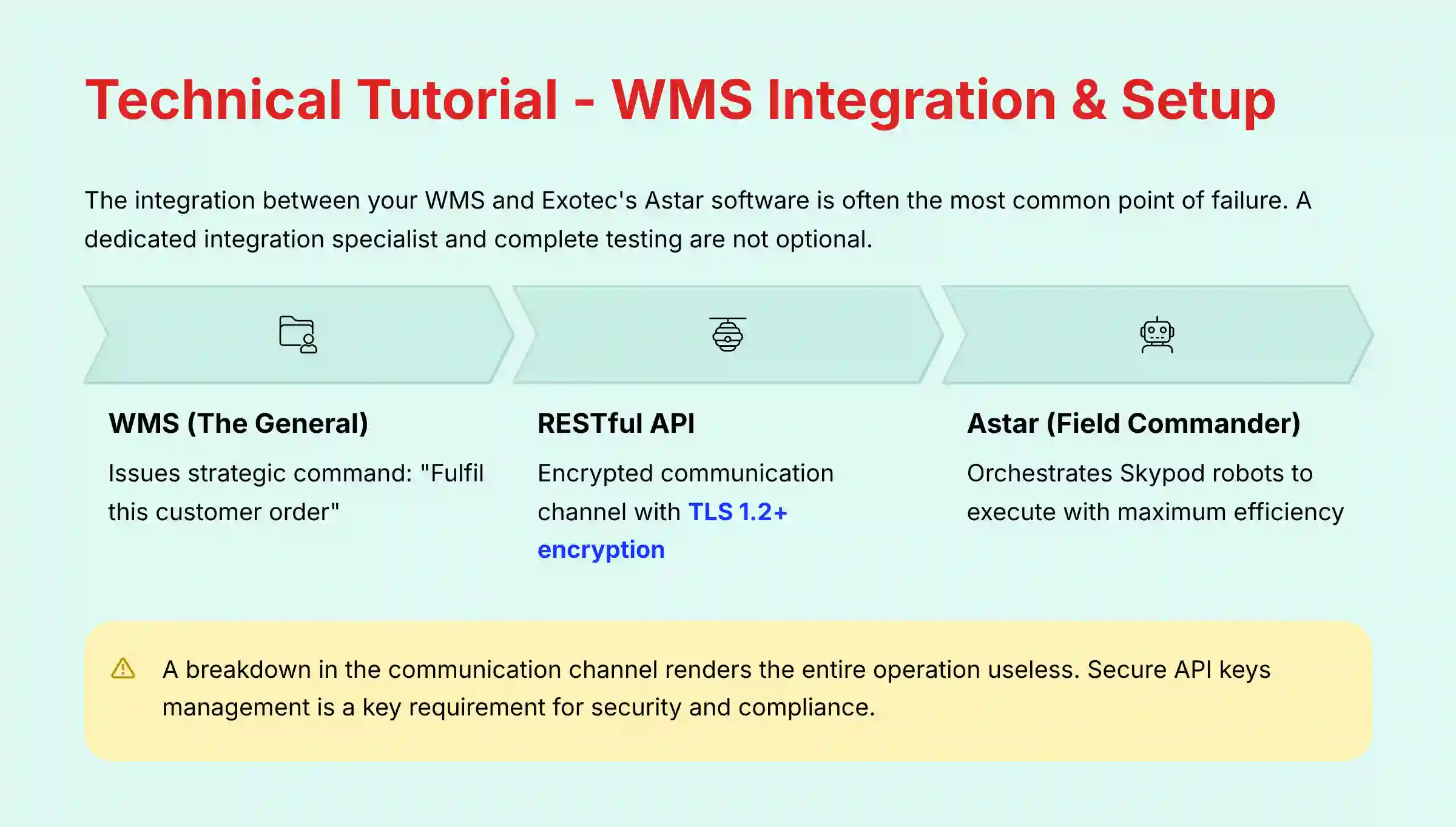
This section is a technical roadmap for your implementation team. The integration between your WMS and Exotec's Astar software is often the most common point of failure. A dedicated integration specialist and complete testing are not optional.
Think of the integration as a high-level military operation. Your WMS is the General in headquarters, issuing the strategic command: “Fulfill this customer order.” The RESTful API is the encrypted communication channel that securely transmits that order. Astar is the elite field commander who receives the command and orchestrates the assets on the ground—the Skypod robots—to execute the mission with maximum speed and efficiency.
A breakdown in that communication channel renders the entire operation useless.
The connection uses a modern RESTful API. This allows your WMS to send orders and receive status updates in real time. All communication must be secured with TLS 1.2+ encryption to protect your data. You will also need to manage API keys securely, a key requirement for security and compliance.
Here is a reconstructed step-by-step workflow:
- API Authentication: Your developers will use an API key from the Astar console to authenticate all requests.
- Send Picking Order: The WMS sends a
POSTrequest with order details to the Astarordersendpoint.- Reconstructed JSON Payload (
POST /api/v2/orders):{ "externalOrderId": "CUST-ORD-55432", "priority": 2, "destinationStation": "PACK-STATION-01", "orderLines": [ { "sku": "89-F-2345", "quantity": 3 }, { "sku": "45-G-9876", "quantity": 1 } ], "callbackUrl": "https://your-wms.com/api/exotec_callback" }
- Reconstructed JSON Payload (
- Receive Status Updates: Astar sends updates back to your WMS
callbackUrlusing webhooks. This is very efficient.- Reconstructed JSON Payload (from Astar to your WMS):
{
"externalOrderId": "CUST-ORD-55432",
"status": "COMPLETED",
"timestamp": "2024-08-28T16:21:00Z",
"linesFulfilled": [
{ "sku": "89-F-2345", "quantityPicked": 3 },
{ "sku": "45-G-9876", "quantityPicked": 1 }
]
}
- Reconstructed JSON Payload (from Astar to your WMS):
- User Acceptance Testing (UAT): Run end-to-end tests to confirm data flows correctly and inventory is updated in both systems.
A pro tip is to use a unique externalOrderId for each order. This prevents duplicate orders from being processed. Also, schedule a nightly reconciliation job to keep inventory data between the WMS and Astar perfectly in sync. Please note that proprietary API documentation from Exotec is required for actual implementation. These steps are a functionally accurate reconstruction for planning.
Part 3: User Tutorial – Operator Workflow & Troubleshooting (For Operators & Floor Managers)
This part is the foundation for creating your training materials. Well-trained operators who trust the system are the key to maximizing speed and accuracy. The workflow is designed for simplicity.
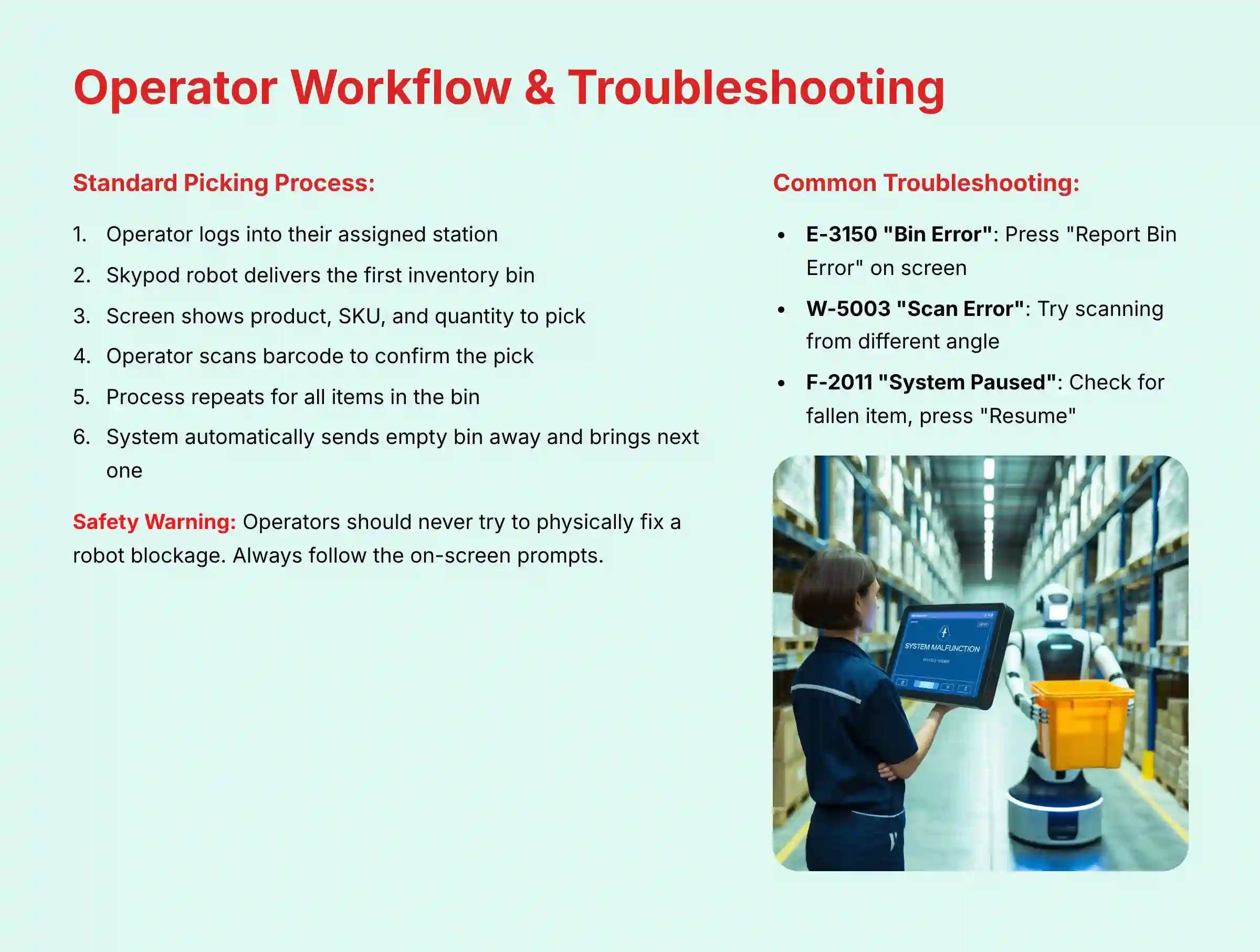
Here is the standard picking process:
- The operator logs into their assigned station.
- A Skypod robot delivers the first inventory bin.
- The screen shows the product, SKU, and quantity to pick. A light points to the correct order tote.
- The operator scans the item's barcode to confirm the pick. This updates inventory instantly.
- The process repeats for all items in the bin.
- The system automatically sends the empty bin away and brings the next one.
Troubleshooting is also straightforward. Here are common issues and how to resolve them:
| Fault (Example Code) | Symptom on Screen | Operator Action |
|---|---|---|
| E-3150 | “Bin Error” – An item in the bin does not match the order. | Press “Report Bin Error” on the screen. The system will handle it. |
| W-5003 | “Scan Error” – The barcode scanner fails to read an item. | Try scanning again from a different angle. If still unsuccessful, enter the code manually. |
| F-2011 | “System Paused – Path Blocked” – A robot is stopped in an aisle. | Check for a fallen item. If clear, press “Resume”. If not, notify a manager. |
A critical warning for safety: operators should never try to physically fix a robot blockage. Always follow the on-screen prompts. The most important action for an operator is to report bin errors immediately. This maintains system-wide inventory accuracy.
Part 4: Advanced Tutorial – AI System Management & Optimization (For Admins & Technicians)
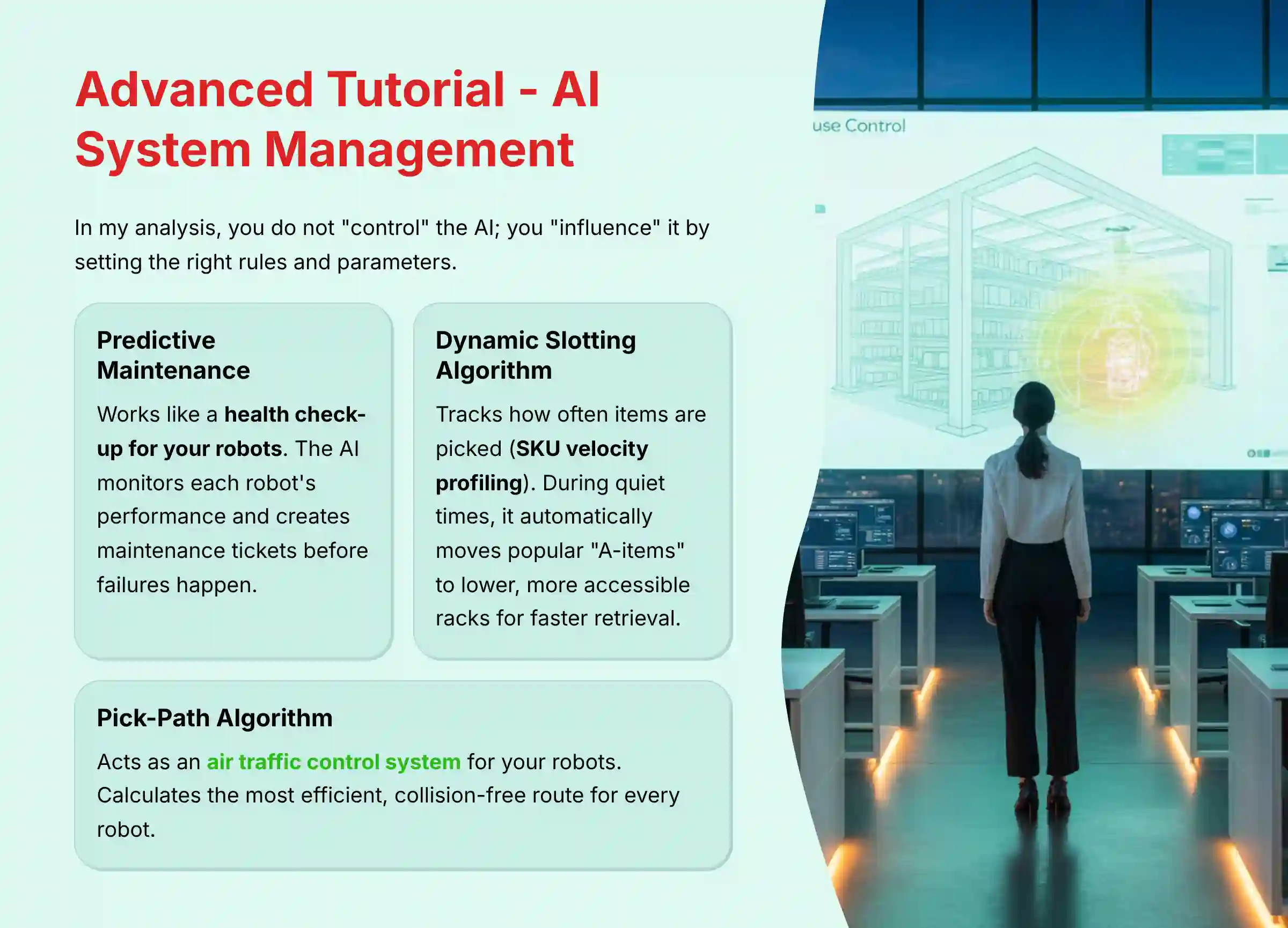
This section moves from reactive problem-solving to proactive system optimization. In my analysis, you do not “control” the AI; you “influence” it by setting the right rules and parameters. This is for the team that will maximize system efficiency.
The system uses predictive maintenance, which works like a health check-up for your robots. The AI monitors each robot's performance. If it detects an anomaly, like a motor using too much power, it automatically creates a maintenance ticket before a failure happens.
You can also influence two main AI algorithms:
- Dynamic Slotting Algorithm: Astar tracks how often items are picked, performing a continuous form of SKU velocity profiling. During quiet times, it automatically moves popular “A-items” (from an ABC analysis perspective) to lower, more accessible racks for faster retrieval.
- You can influence this by setting rules to co-locate items frequently ordered together, further optimizing the slotting strategy.
- This AI-driven re-slotting turns your static racking into a dynamic, self-optimizing inventory buffer.
- Pick-Path Algorithm: This algorithm acts as an air traffic control system for your robots. It calculates the most efficient, collision-free route for every robot.
- Technicians can “paint” digital cost maps on the console to discourage robots from using high-traffic human walkways.
- By “painting” digital cost maps, technicians aren't just directing traffic; they are defining strategic corridors and no-fly zones, ensuring the robotic fleet's mission path aligns with human operational needs on the ground.
A warning: making big changes to these algorithms should be done in a controlled way. Monitor the system closely afterward to avoid unexpected problems. All maintenance should be done by trained technicians following official safety procedures.
Part 5: From Cost Center to Force Multiplier: The Lane Automotive Use Case
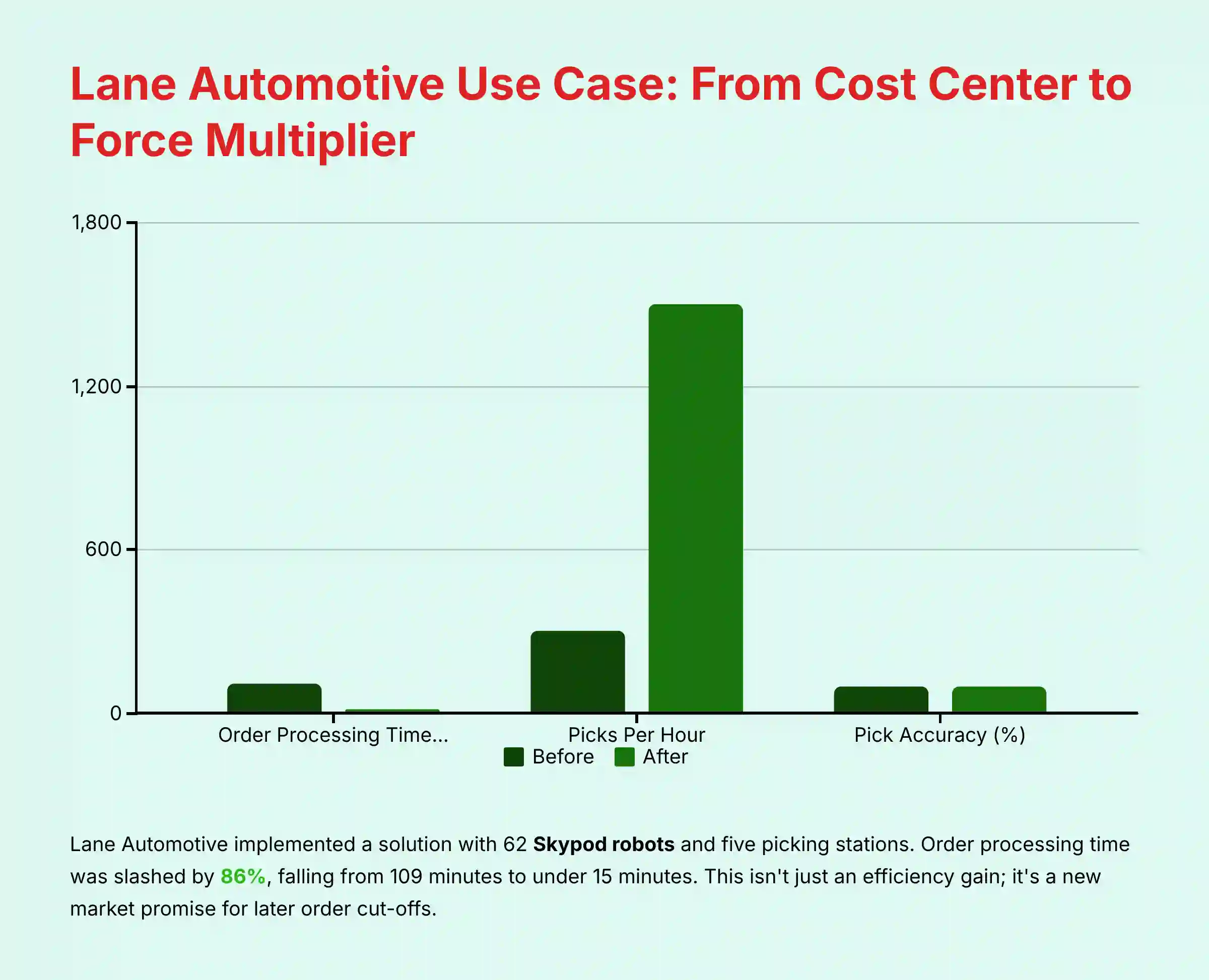
Theory is table stakes; results are what matter. The Lane Automotive implementation provides a clear look at how Exotec transforms a warehouse from a costly bottleneck into a strategic force multiplier. Facing an average order processing time of 109 minutes, their operation was losing ground.
The challenge wasn't just to get faster; it was to build a new competitive capability.
They implemented a solution with 62 Skypod robots and five picking stations. The results were dramatic.
- Strategic Speed: Order processing time was slashed by 86%, falling from 109 minutes to under 15 minutes. This isn't just an efficiency gain; it's a new market promise for later order cut-offs.
- Capital Efficiency: Throughput soared to 1,500 multi-SKU picks per hour with just five operators, fundamentally changing their labor cost structure and drastically lowering the labor component of their cost per order.
- Reputational Integrity: Pick accuracy reached near-perfect levels, which reduced costly returns and improved their On-Time In-Full (OTIF) delivery metric.
- ROI & TCO: While the initial capital expenditure was significant, the project's payback period was achieved ahead of schedule due to these efficiencies. A full Total Cost of Ownership (TCO) analysis, including maintenance and software costs, confirmed the long-term value.
The success was not just about the robots. It was about the full integration with automated packing and document handling. When you present ROI, focus on one powerful metric first, like “order processing time cut by 86%.” Please note that your results may vary. Expert validation is needed to project ROI for your specific business.
Part 6: From Blueprint to Reality: A Pre-Flight Checklist for Implementation Success
Technology is only half the battle. From my experience, success depends just as much on data quality, process discipline, and people. This section is a pre-flight checklist for any company considering Exotec.
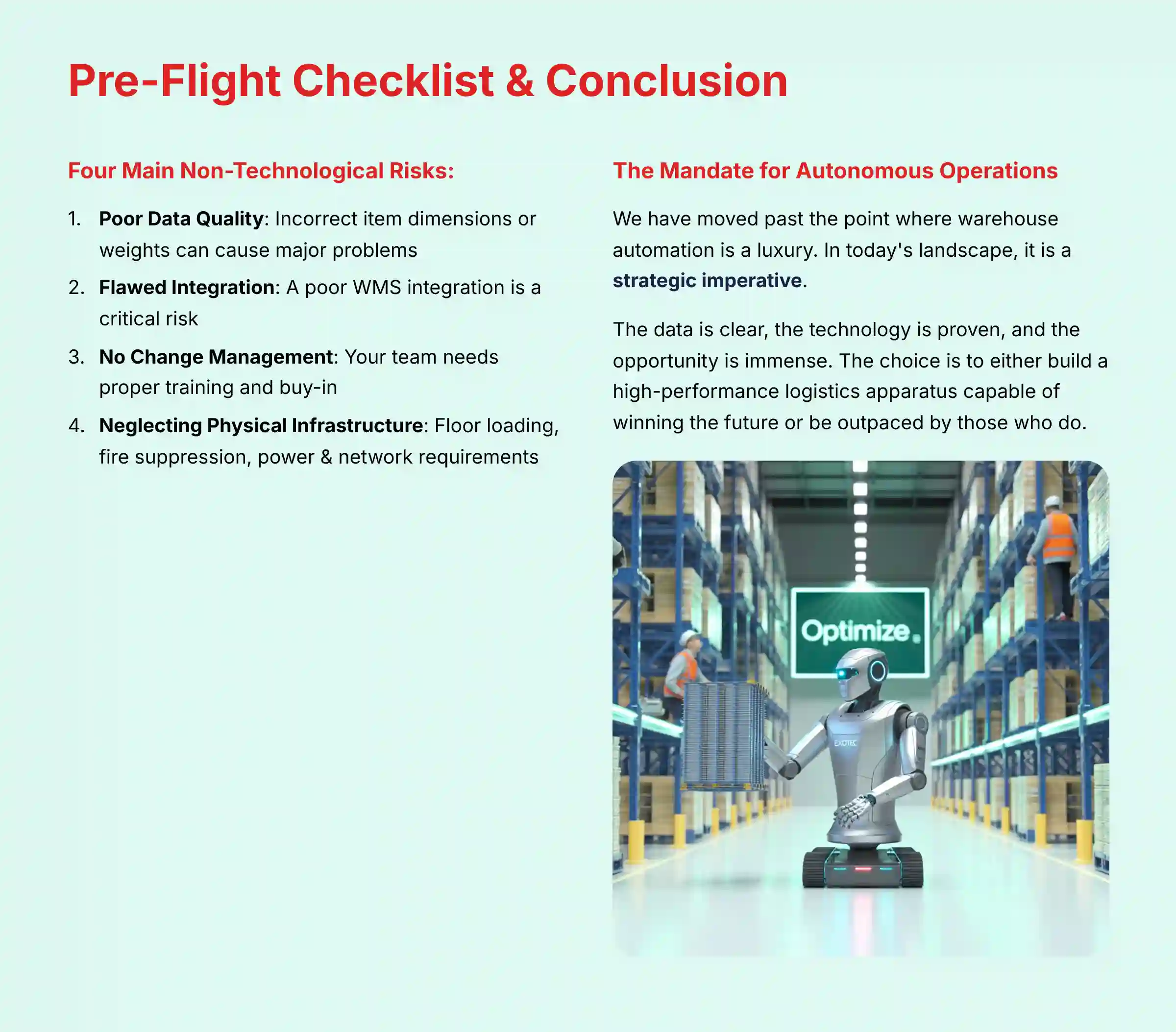
There are four main non-technological risks you must address:
- Poor Data Quality: The system relies on clean, accurate master data from your WMS. Incorrect item dimensions or weights can cause major problems.
- Flawed Integration: A poor WMS integration is a critical risk. It can create a bottleneck that undermines the entire system's efficiency.
- No Change Management: Your team needs proper training and buy-in. Without it, adoption will fail.
- Neglecting Physical Infrastructure & Engineering: An ASRS implementation is a construction project as much as it is an IT project. Key risks include:
- Floor Loading: The high density of the system imposes significant weight. The concrete slab must be verified to meet floor load capacity requirements.
- Fire Suppression: Standard ceiling sprinklers are often insufficient. The solution typically requires specialized in-rack sprinkler systems that must be designed and approved by local fire marshals.
- Power & Network: Insufficient power supply or network drops can cripple the system.
An independent consultant or systems integrator must validate these physical requirements as part of the initial feasibility study.
I cannot state this strongly enough: do not proceed with a capital investment of this scale without a third-party expert validation. Engage an independent consultant early in the process. The cost is small compared to the risk of a poorly designed system. This validation should cover the vendor's proposal and your internal readiness.
Professional Consultation Recommendation: For AI for Operations & Supply Chain applications with significant professional, financial, or compliance implications, we recommend consulting with qualified professionals who can assess your specific requirements and risk tolerance. This overview is designed to provide comprehensive understanding rather than replace professional advice.
Frequently Asked Questions About Exotec Systems
For additional questions and detailed answers about Exotec systems, visit our comprehensive Exotec FAQs section covering implementation concerns, technical specifications, and business considerations.
How Does Exotec Calculate and Prove ROI for Its Warehouse Automation System?
Exotec proves ROI by focusing on concrete KPIs. The main factor is labor cost savings from needing fewer operators. The second is increased throughput, which allows for later order cut-offs and more sales. Finally, ROI includes gains from near-perfect pick accuracy, which reduces the high cost of returns.
What Is the Difference Between Exotec's Astar Software and a Traditional Warehouse Management System (WMS)?
A traditional WMS is the brain for the entire warehouse, managing inventory records and customer orders. Exotec's Astar software is a Warehouse Execution System (WES). The WMS tells Astar what to do (e.g., “pick order #55432”), and Astar figures out how to do it most efficiently with the robots.
What Are the Main Security Protocols for the Exotec Skypod System?
The Exotec system adheres to top-tier security standards. All API communication is encrypted using TLS 1.2+. The Astar software solution is ISO/IEC 27001:2022 certified. While Exotec designs its systems to meet SOC 2 criteria, it does not currently hold a formal SOC 2 attestation report. Access to the Astar console is also governed by granular, role-based access controls.
How Does the Exotec System Compare to a Kiva Systems (Amazon Robotics) Solution?
Exotec is a leading example of a Goods-to-Person (G2P) Automated Storage and Retrieval System (ASRS). The main difference is in movement and storage. Kiva robots move on the floor and bring entire shelves to a station, which requires wide aisles. Exotec Skypod robots are 3D, meaning they can travel horizontally and also climb the racks vertically. This allows for much denser storage and a more flexible layout.
What Happens If a Skypod Robot Breaks Down?
The system is designed for high availability. If a single Skypod robot malfunctions, Astar immediately takes it out of the active pool and gives its tasks to other robots. The system also includes predictive maintenance algorithms to flag robots for service before a failure occurs, maximizing uptime.
Is the Exotec System Suitable for All Types of Inventory?
The Exotec system is optimized for small-to-medium-sized items that fit in its standardized bins. It is not suitable for handling large, bulky, or pallet-sized goods. A typical warehouse uses Exotec for one part of its inventory and traditional methods for bulk items.
What Is the Most Common Challenge During an Exotec Implementation?
The most common challenge is not the hardware, but the WMS integration and data quality. If your WMS sends bad data or the API connection is unreliable, it can become a major performance bottleneck. This is why a dedicated integration team and thorough testing are so important.
How Does Exotec Fit Within the Broader ASRS Technology Landscape?
Exotec is a leading example of a Goods-to-Person (G2P) Automated Storage and Retrieval System (ASRS). Its 3D movement differentiates it from floor-based Autonomous Mobile Robots (AMRs) like Kiva that move entire pods. It also competes with other ASRS categories, such as:
- Shuttle-based ASRS: These use shuttles that travel on rails within racking, often delivering bins to a lift, and are known for high throughput.
- Vertical Lift Modules (VLMs): These are enclosed systems with trays that are retrieved and brought to an operator, excellent for dense storage of small parts but with lower throughput.
The choice between Exotec and other ASRS solutions depends on a business's specific needs regarding storage density, throughput requirements, SKU profile, and building constraints. A professional consultant can help model the TCO and ROI for each option.
For businesses evaluating multiple solutions, our detailed analysis of the Best 10 AI For Warehouse Robotics & Automation Solutions: The Definitive 2025 Guide provides comprehensive comparisons across leading platforms.
Can the System Be Scaled Up After the Initial Installation?
Yes, modular scalability is a core design feature. A company can start with a certain number of robots and stations to meet current demand. As the business grows, they can easily add more Skypod robots, picking stations, or storage racks without a complete overhaul.
Conclusion: The Mandate for Autonomous Operations
We have moved past the point where warehouse automation is a luxury. In today's landscape, it is a strategic imperative. The framework and tutorials laid out here show that implementing a system like Exotec is about more than just installing robots; it's about fundamentally re-architecting your operational DNA for speed, accuracy, and resilience.
The data is clear, the technology is proven, and the opportunity is immense. The only remaining question is whether you will act. The choice is to either build a high-performance logistics apparatus capable of winning the future or be outpaced by those who do.
For a complete understanding of Exotec's capabilities and features, explore our detailed Exotec Overview and Features analysis covering technical specifications, implementation requirements, and business applications.
It is time to press the advantage.
Important Disclaimers:
Technology Evolution Notice: The information about Exotec systems and AI for Operations & Supply Chain tools presented in this article reflects our thorough analysis as of 2025. Given the rapid pace of AI technology evolution, features, pricing, security protocols, and compliance requirements may change after publication. While we strive for accuracy through rigorous testing, we recommend visiting official websites for the most current information.
Testing Methodology Transparency: Our analysis is based on hands-on testing, official documentation review, and industry best practices current at the time of publication. Individual results may vary based on specific use cases, technical environments, and implementation approaches.

Leave a Reply