Which AI-Powered Warehouse Automation System Fits Your Needs?
This 2-Minute Quiz Reveals the Answer!
The simple truth is that modern logistics is at a major inflection point, a permanent storm condition demanding a radical shift from passive visibility to decisive action. For operations leaders navigating this complex landscape, understanding transformative technologies isn't optional—it's an imperative.
Key Takeaways
- Revolutionary 3D Movement: Exotec Skypods move both horizontally and vertically, accessing any inventory bin directly without digging or blocking other robots
- AI-Powered Orchestration: Astar software intelligently manages fleet operations, inventory optimization, and order batching for maximum efficiency
- Independent Scalability: Throughput and storage can be scaled separately, offering greater flexibility than grid-based competitors like AutoStore
- Compelling ROI: Typically realized within 2-3 years through dramatic productivity gains, accuracy improvements, and space optimization
- Strategic Integration: Seamlessly integrates with existing WMS/ERP systems while transforming warehouse operations into a strategic business asset
This comprehensive guide, built around Exotec FAQs, cuts through the marketing hype to provide the expert insights you need on one of the most game-changing AI-powered warehouse automation systems available today. We'll demystify Exotec's innovative Skypod technology, dissect its core components, and illuminate how its agentic AI orchestrates unparalleled throughput, accuracy, and space utilization—all critical for your bottom line.
At Best Ops Chain AI, our mission is to empower decision-makers like you to press the advantage with strategic technology choices. This deep dive into Exotec will explain how the system works, how it stacks up against competitors, integrates with your existing ERP/WMS systems, and delivers a compelling ROI. Move beyond just seeing the problem—equip yourself with the knowledge to act and transform your AI for Warehouse & Inventory Management into a strategic asset, turning a reactive cost center into a proactive, data-driven force multiplier for your business.
What is the Exotec Skypod system and how does it work?
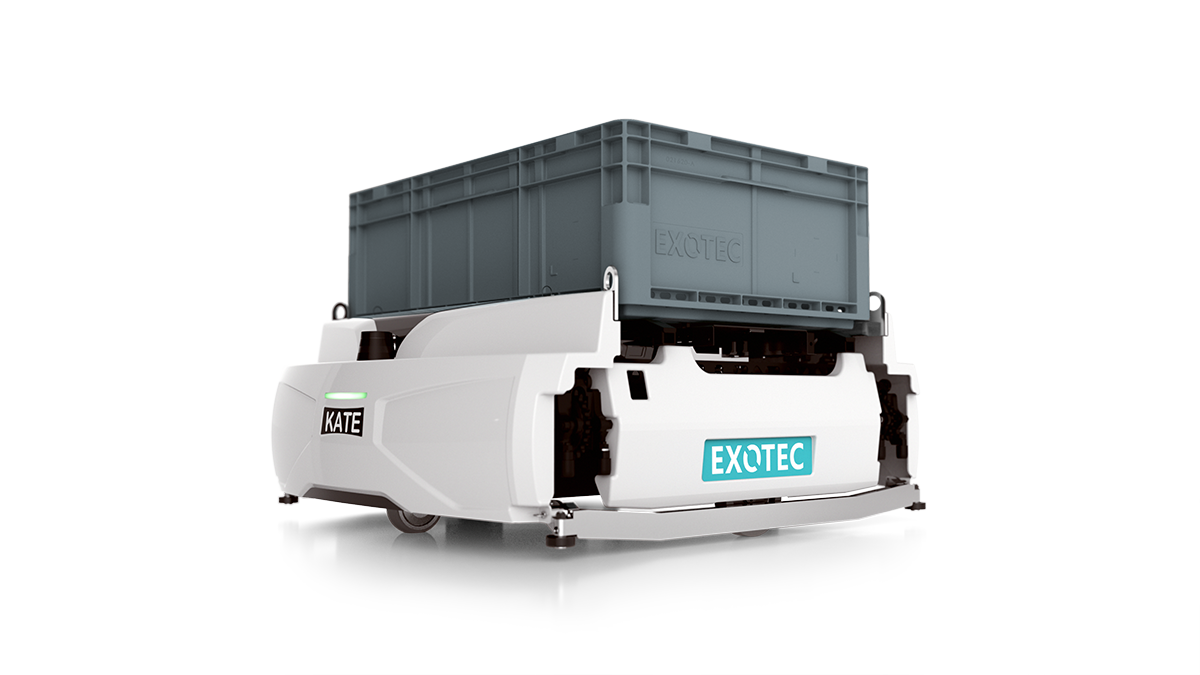
The Exotec Skypod system is an AI-powered, goods-to-person warehouse automation solution designed to optimize order fulfillment. It uses a fleet of autonomous mobile robots, called Skypods, that can move in three dimensions—horizontally across the warehouse floor and vertically up and down storage racks—to retrieve and deliver inventory bins to human-operated picking stations.
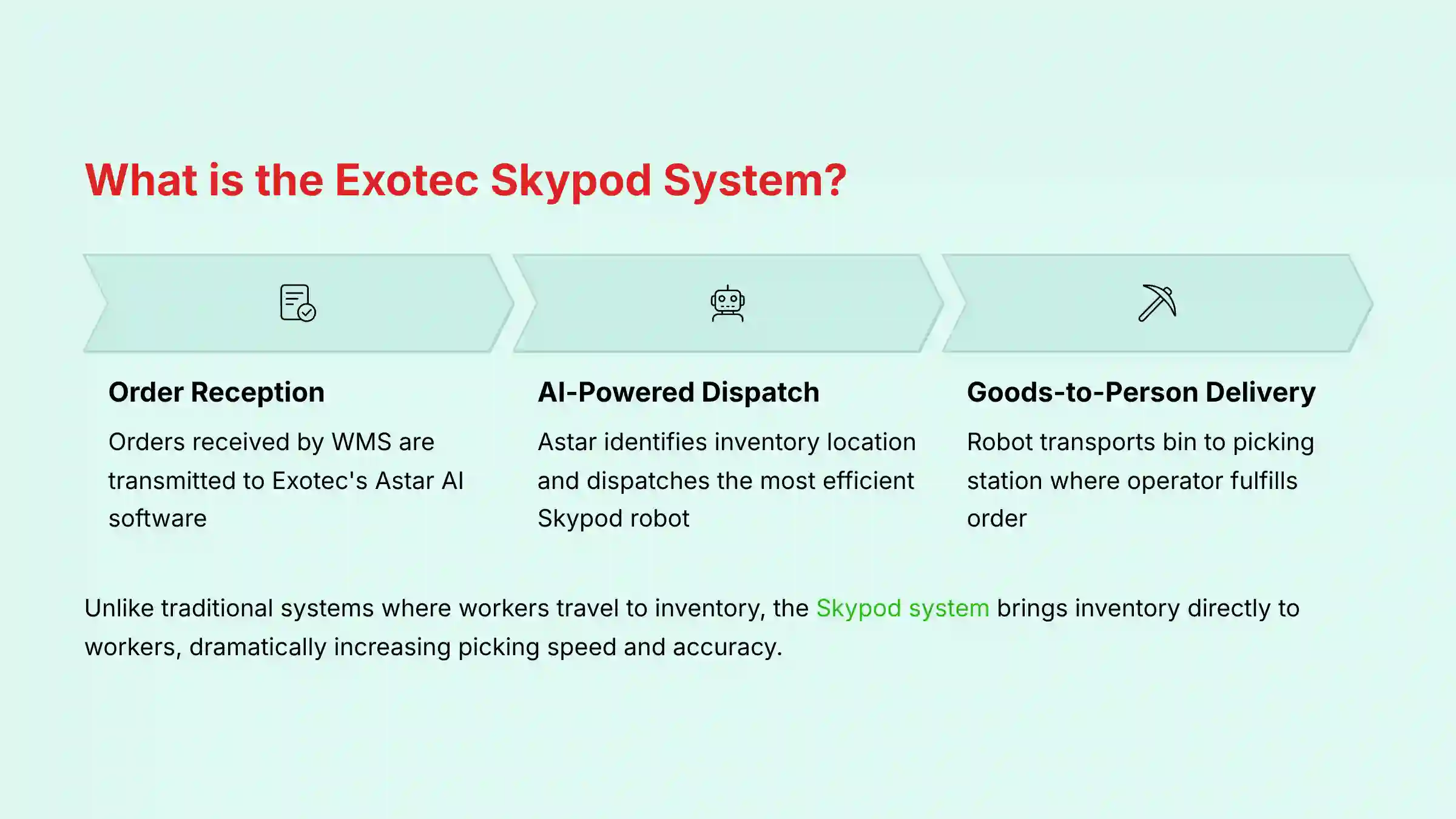
Unlike traditional systems where workers travel to inventory, the Skypod system brings the inventory directly to the worker. Here's a breakdown of the process:
- Order Reception: When an order is received by the Warehouse Management System (WMS), it is transmitted to Exotec's Astar AI software.
- AI-Powered Dispatch: Astar identifies the location of the required inventory and dispatches the most efficient Skypod robot to retrieve it. The AI continuously calculates the most efficient paths to prevent traffic jams and prioritize urgent orders.
- Robotic Retrieval: The Skypod robot navigates to the correct rack, ascends to the required height, and retrieves the specific bin containing the item.
- Goods-to-Person Delivery: The robot then transports the bin to a designated picking station.
- Human-Led Picking: An operator at the station is guided by on-screen instructions to pick the correct quantity of the item from the delivered bin and place it into an order container.
- Return and Optimization: The robot returns the inventory bin to the storage racks. The Astar AI uses this opportunity to “defragment” storage, moving high-demand items to more accessible locations to improve future retrieval times.
This process dramatically increases picking speed, improves accuracy, and maximizes warehouse storage density by utilizing vertical space up to 12 meters (approximately 39.4 feet). The comprehensive Exotec Overview and Features guide provides additional technical specifications and operational benefits.
How does Exotec use AI in its warehouse automation?
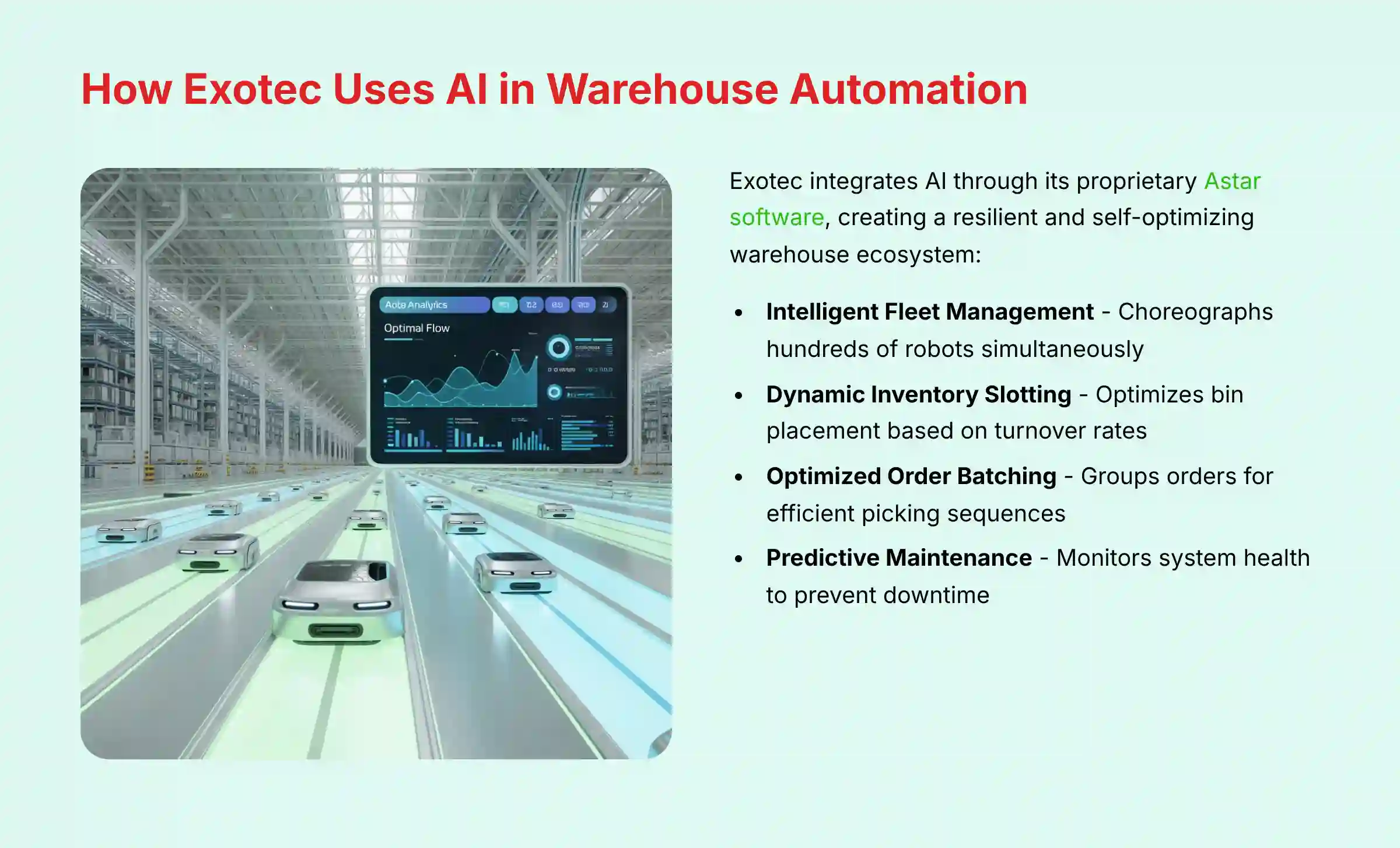
Exotec integrates Artificial Intelligence at the core of its system through its proprietary Astar software, which acts as the brain of the entire operation. The AI goes far beyond simple robot dispatch, creating a resilient and self-optimizing warehouse ecosystem.
The primary functions of the AI include:
- Intelligent Fleet Management: The Astar software choreographs the movements of hundreds of Skypod robots simultaneously. It calculates the most efficient travel paths in real-time, dynamically routing robots to avoid congestion and minimize travel time. This is analogous to an advanced air traffic control system for the warehouse floor, ensuring maximum throughput without collisions.
- Dynamic Inventory Slotting: The AI constantly analyzes inventory turnover rates. When a robot returns a bin after a pick, the Astar software may decide to place it in a new, more optimal location. Fast-moving products are automatically stored closer to the picking stations or at more accessible heights, continuously improving retrieval efficiency over time. This eliminates the need for manual slotting analysis by planners.
- Optimized Order Batching: The AI intelligently groups orders together to create the most efficient picking sequences. It can batch orders that require items from the same or nearby bins, minimizing the number of robot trips needed. This ensures that each bin delivered to a station allows for the maximum amount of picking activity, boosting operator productivity.
- Predictive Maintenance & System Health: The AI monitors the performance and status of all system components, including the robots and picking stations. It can predict potential maintenance needs based on usage patterns and sensor data, allowing for proactive service rather than reactive repairs, which minimizes unplanned downtime.
By leveraging AI, the Exotec system transforms the warehouse from a static environment into a dynamic and intelligent one that learns and adapts to changing demand patterns. For more detailed performance insights, explore our comprehensive Exotec Review that analyzes real-world implementation results.
What are the core components of an Exotec solution?
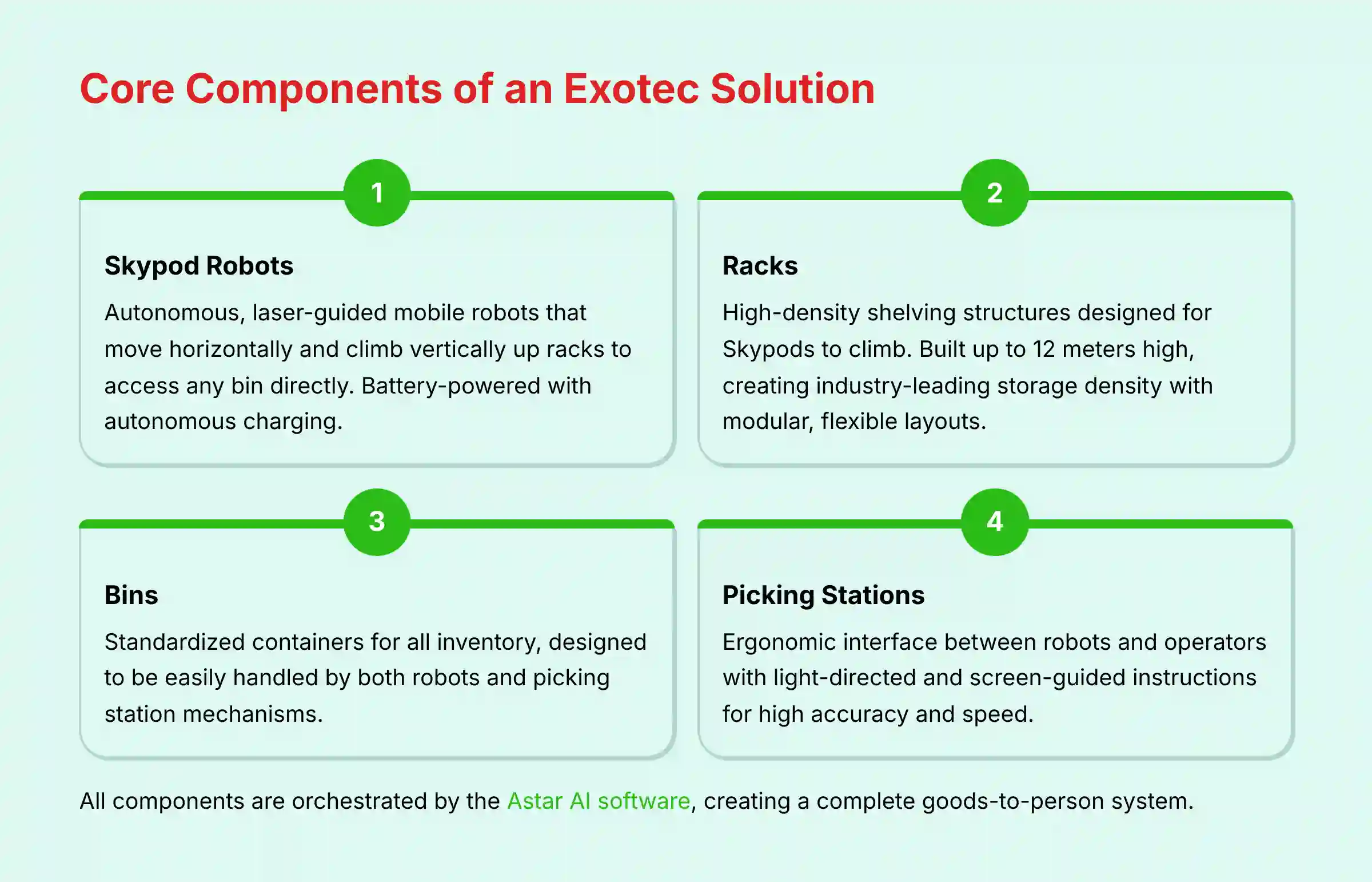
An Exotec Skypod system is comprised of four primary hardware components, all orchestrated by the Astar AI software. Understanding each component is key to grasping the system's operational flow and unique value proposition.
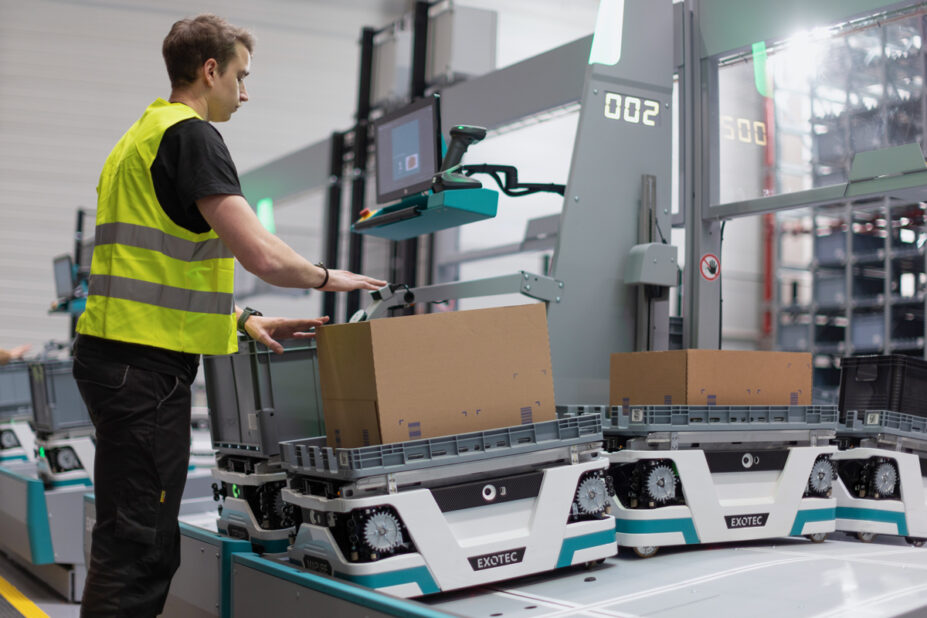
- Skypod Robots: These are the stars of the system. These autonomous, laser-guided mobile robots are the primary movers of inventory. Their key feature is the ability to move both horizontally on the floor and climb vertically up the racks. This 3D movement capability allows them to directly access any bin in the storage system without needing lifts, conveyors, or other robots to hand off tasks. They are battery-powered and autonomously return to charging stations when needed.
- Racks: This is the high-density shelving structure that houses the inventory bins. Exotec racks are specifically designed for the Skypods to climb. They can be built up to 12 meters (approximately 39.4 feet) high, capitalizing on a warehouse's vertical space to create industry-leading storage density. The structure is modular, allowing for flexible layouts and future expansion.
- Bins: These are the standardized containers used to hold all inventory within the system. Bins are retrieved by the robots and presented to the operators for picking. They are designed to be easily handled by both the robots and the picking station mechanisms.
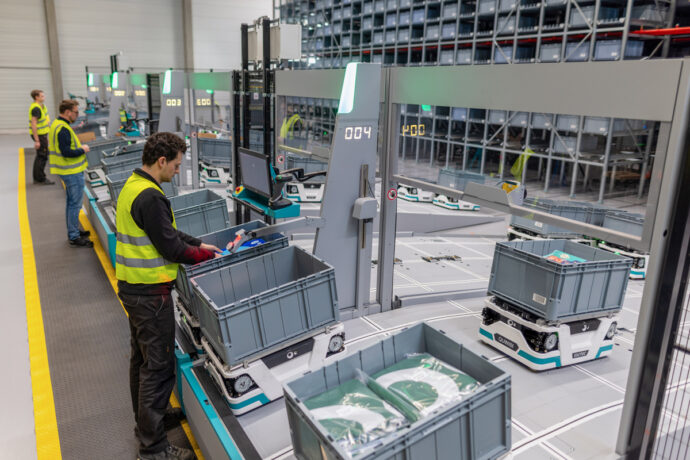
- Picking Stations: This is the ergonomic interface between the robots and the human operators. A typical station has multiple “presentation” bays where robots deliver inventory bins and a central area with order containers. Light-directed and screen-guided instructions tell the operator which item to pick from which bin and where to place it, ensuring extremely high accuracy and speed.
Together, these components, managed by the Astar AI software, create a complete, end-to-end goods-to-person system that handles everything from inventory storage to order picking. For practical implementation guidance, check out our detailed Exotec Tutorials and Usecase documentation.
How does Exotec compare to AutoStore?
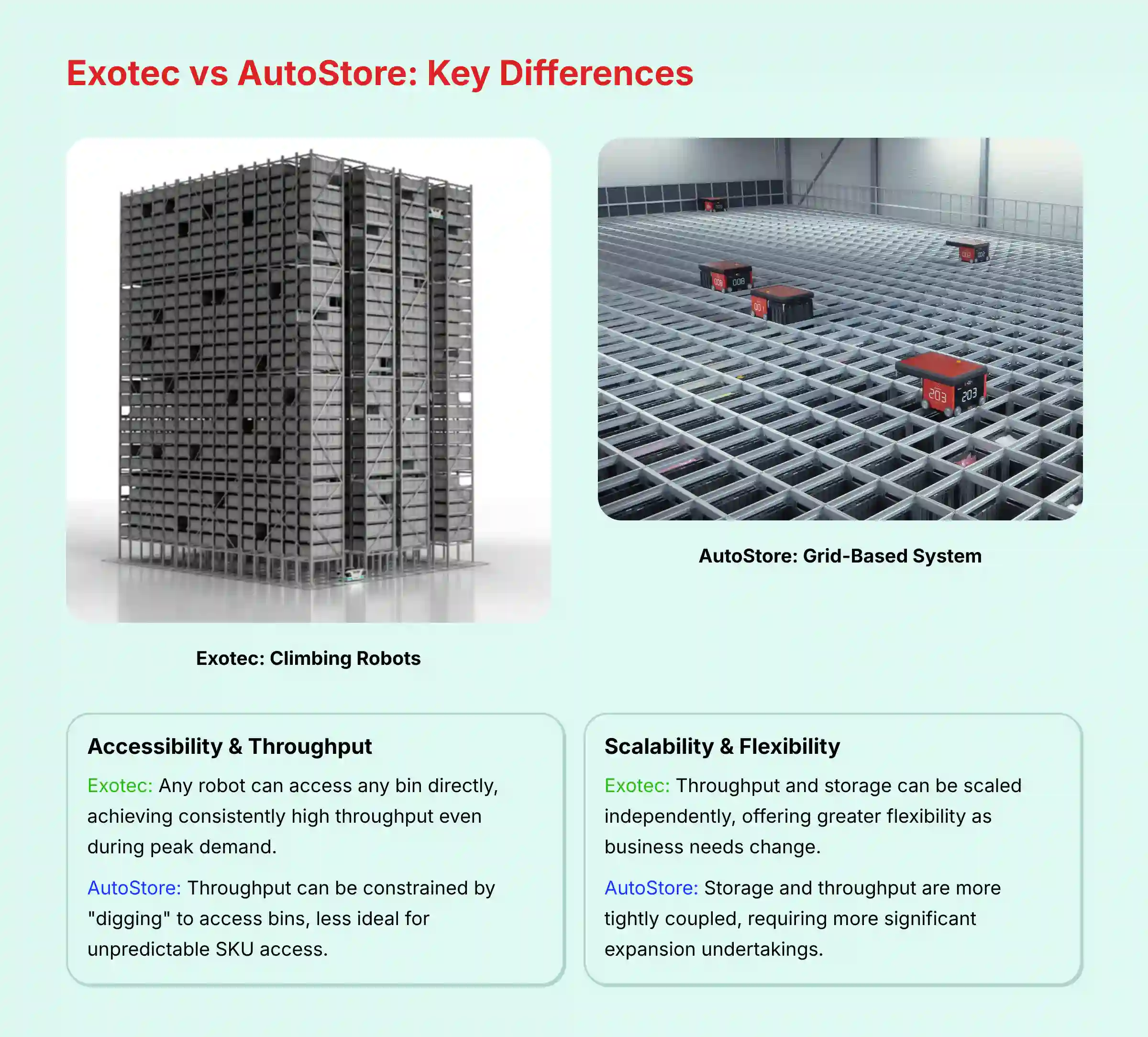
Exotec and AutoStore are both leading goods-to-person automation systems, but they are built on fundamentally different architectural philosophies. The primary distinction lies in robot accessibility and system flexibility.
AutoStore uses a grid-based system where robots travel on top of a dense cube of stacked bins. To access a bin at the bottom of a stack, the top robots must first dig out and move all the bins above it. Exotec's Skypod robots, by contrast, are climbers. They travel on the floor and then ascend the racks to retrieve bins from any level directly.
Here are the key operational differences stemming from this architectural choice:
- Accessibility & Throughput:
- Exotec: Because any robot can access any bin at any time, the system can achieve consistently high throughput. Robots do not block each other from accessing inventory, which is a significant advantage during peak demand.
- AutoStore: Throughput can be constrained by “digging,” where robots are occupied moving bins to access the one they need. This makes it less ideal for operations with a very high number of SKUs that are accessed with unpredictable frequency.
- Scalability & Flexibility:
- Exotec: Throughput and storage can be scaled independently. You can add more robots to increase fulfillment speed without adding more racks, or add racks to increase storage without necessarily adding more robots. This offers greater flexibility to adapt the system as business needs change.
- AutoStore: Storage and throughput are more tightly coupled. Expanding the grid typically requires expanding the entire cube structure, which can be a more significant undertaking.
- Resilience & Maintenance:
- Exotec: If a single robot fails, it is simply removed from the floor for maintenance while the rest of the fleet continues operating. The system is not dependent on any single robot.
- AutoStore: While also resilient, a failed robot on the grid must be removed, which can temporarily disrupt the robots operating in that specific area.
The choice between Exotec and AutoStore is not about which is “better,” but which is right for your specific operational profile. AutoStore often excels in environments requiring extreme storage density with a more predictable, lower-volume SKU mix. Exotec shines in high-velocity, high-SKU e-commerce or retail environments where demand is volatile and the ability to scale throughput and storage independently is a strategic advantage.
For a comprehensive comparison of available alternatives, explore our guide on Exotec Top Alternatives and Competitors to make the most informed decision for your specific operational requirements.
How does the Exotec system integrate with existing WMS/ERP systems?
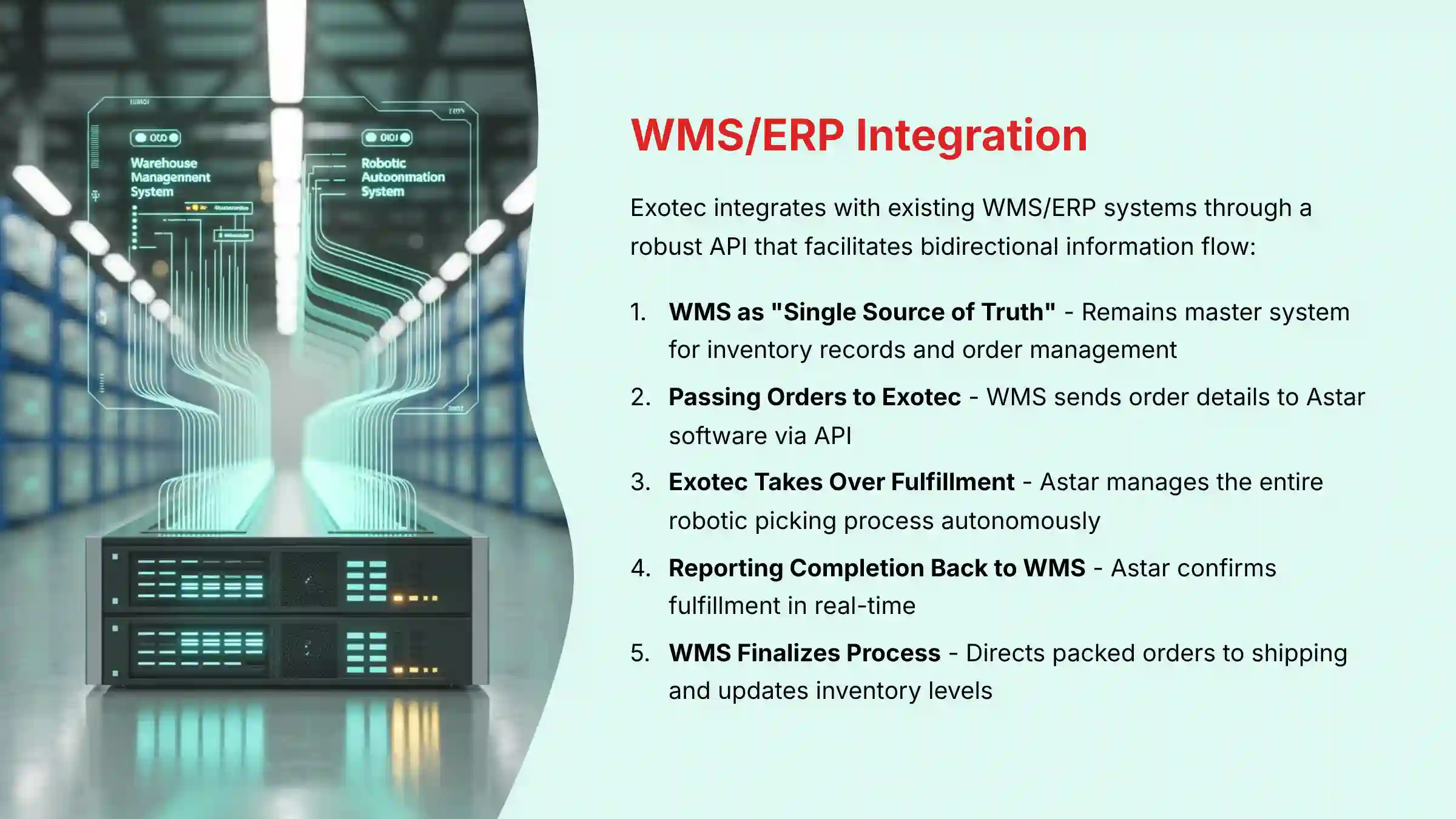
The Exotec system is designed to act as a specialized automation “island” that integrates deeply with a facility's existing core business systems, primarily the Warehouse Management System (WMS) or Enterprise Resource Planning (ERP) system (like SAP, Oracle, or Manhattan). It does not replace the WMS; it enhances it.
Integration is handled through a robust, modern API (Application Programming Interface) that facilitates a bidirectional flow of information. Here is the typical integration workflow:
- WMS as the “Single Source of Truth”: The WMS remains the master system for overall inventory records, order management, and receiving. It directs all high-level warehouse processes.
- Passing Orders to Exotec: When the WMS releases a wave of orders to be picked, it sends the relevant order details to Exotec's Astar software via the API. This includes the SKUs and quantities required.
- Exotec Takes Over Fulfillment: Astar takes this order list and manages the entire robotic picking process internally—dispatching robots, managing the fleet, and presenting bins to the stations. It operates with high autonomy to execute the “task” assigned by the WMS in the most efficient way possible.
- Reporting Completion Back to WMS: As operators complete picks at the stations, the Astar software confirms the fulfillment of each order line in real-time. It then reports this completion data back to the WMS via the API.
- WMS Finalizes the Process: Once the WMS receives confirmation that all items for an order have been picked, it proceeds with its standard workflow, which typically includes directing the packed order to shipping and updating inventory levels.
This API-driven approach ensures data integrity and operational security, as the core WMS/ERP maintains control. Exotec and its partners have extensive experience integrating with all major WMS/ERP providers, and the process is a standard part of any system implementation project.
What are the potential risks and limitations of implementing an Exotec system?
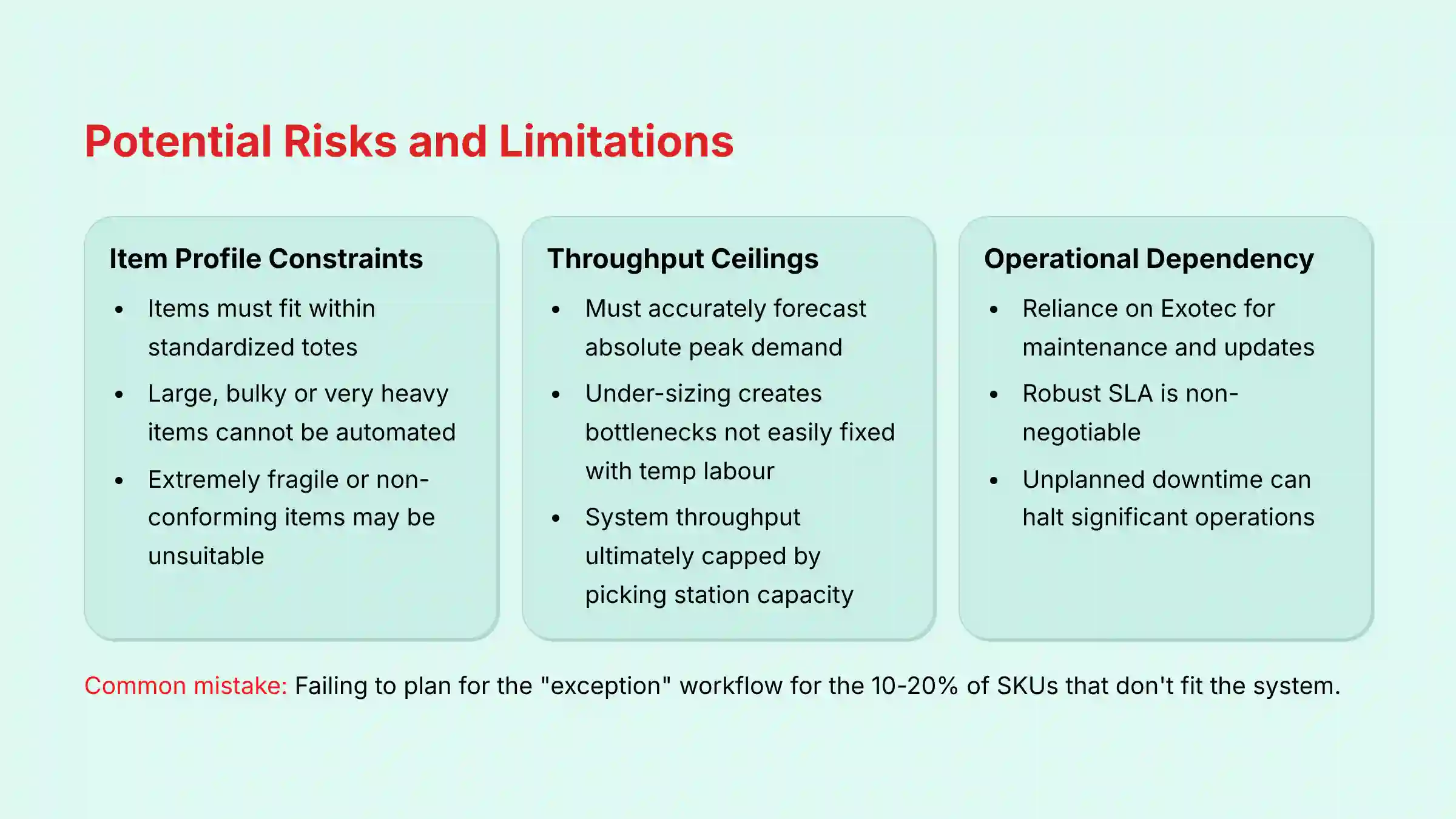
While the Exotec system offers transformative benefits in speed and accuracy, operations leaders must conduct thorough due diligence on its potential limitations and risks before making a commitment. A successful implementation depends on understanding where the system excels and where it requires complementary processes.
The main limitations fall into three categories:
- Item Profile Constraints: The system is fundamentally a standardized bin-based solution. It is not designed to handle “ugly” freight.
- Size & Weight: Items must fit within Exotec's standardized totes. Large, bulky, or very heavy items (e.g., furniture, large electronics, bags of dog food) cannot be automated with this system.
- Shape & Packaging: Extremely fragile, non-conforming, or un-packaged items may also be unsuitable for bin storage.
- Throughput Ceilings: While extremely fast, the system has a finite throughput capacity determined by the number of robots and picking stations installed.
- Peak Demand Planning: You must accurately forecast your absolute peak demand (e.g., Black Friday week) and invest in a system sized to handle it. Under-sizing the system can create a significant bottleneck that cannot be easily fixed with temporary labor.
- Station-Bound Productivity: Overall system throughput is ultimately capped by the number of picks your operators can perform at the stations. The robots may be able to deliver bins faster than your team can pick them if the stations are not adequately staffed.
- Operational Dependency: As with any large-scale automation, this represents a mission-critical investment that creates vendor dependency.
- Maintenance & Support: You are reliant on Exotec or their certified partners for high-level maintenance, software updates, and critical spare parts. A robust Service Level Agreement (SLA) is non-negotiable.
- System Downtime: While the system has high uptime (often 99%+), any unplanned downtime can halt a significant portion of your fulfillment operations. Business continuity and disaster recovery plans are essential.
The most common mistake beginners make is failing to plan for the “exception” workflow from day one. Don't just focus on the 80-90% of your SKUs that fit perfectly in the system. Proactively design and integrate a dedicated manual handling process for your oversized, non-conforming, and slow-moving “ugly” items to avoid creating operational bottlenecks.
For detailed answers to common implementation challenges, consult our comprehensive Exotec FAQs resource that addresses these limitations and provides mitigation strategies.
What is the expected ROI for an Exotec implementation and how is it calculated?
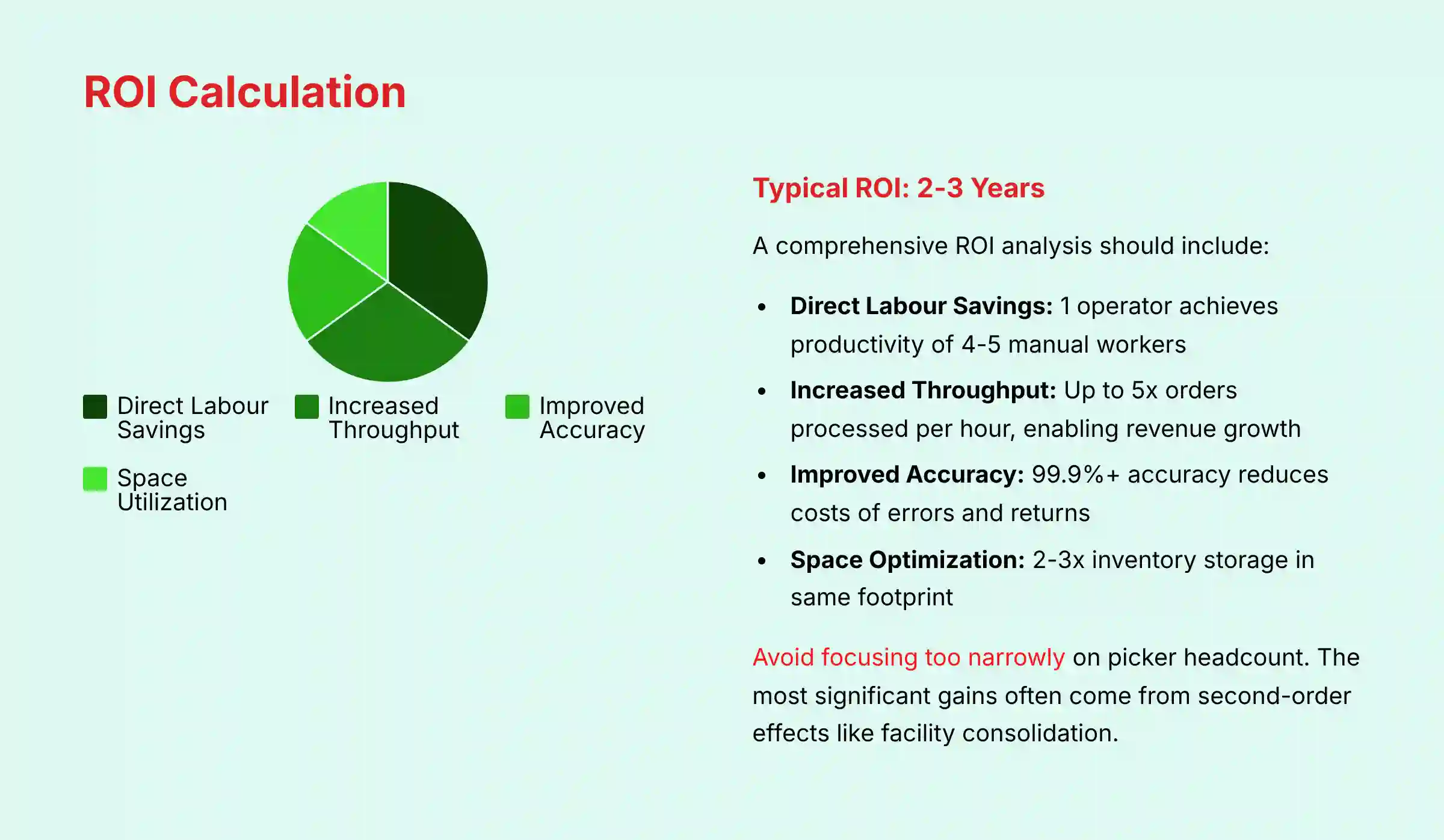
The Return on Investment (ROI) for an Exotec system is typically very strong, often realized within 2-3 years, but it must be calculated based on a holistic view of operational savings and throughput gains, not just direct labor costs. A comprehensive ROI analysis is a critical step in the purchasing process and should be developed in partnership with Exotec's solution design experts.
The calculation is based on several key pillars:
- Direct Labor Savings: This is the most obvious benefit. By having robots bring goods to the person, you can dramatically reduce or reallocate labor previously dedicated to walking and searching for items. A single operator at an Exotec station can achieve the productivity of 4-5 workers in a traditional manual picking environment.
- Increased Throughput & Revenue Enablement: The system can often 5x the number of orders processed per hour from the same footprint. This isn't just a cost saving; it's a revenue driver. It allows you to handle higher order volumes without expanding your facility, accept later order cut-off times, and meet peak season demand that you might otherwise miss.
- Improved Order Accuracy: With screen-guided, light-directed picking at ergonomic stations, order accuracy rates typically rise to 99.9%+. This generates significant savings by reducing the high costs associated with miss-picks, including customer service hours, return shipping costs, and inventory write-offs.
- Optimized Space Utilization: The system's ability to use high-density racks up to 12 meters tall can double or even triple the amount of inventory stored in a given footprint compared to traditional racking. This can delay or entirely eliminate the need for costly warehouse expansion or relocation.
A frequent mistake in calculating ROI is focusing too narrowly on replacing picker headcount. The most significant financial gains often come from second-order effects. For example, increased throughput might allow you to consolidate three separate distribution centers into one automated facility, creating massive savings in overhead, utilities, and management costs. Furthermore, achieving 99.9%+ accuracy might be the key to winning a major retail contract with strict compliance standards.
This comprehensive FAQ guide has equipped you with the essential knowledge to evaluate Exotec's transformative potential for your warehouse operations. From understanding the revolutionary 3D movement of Skypod robots to calculating realistic ROI projections, you now have the strategic insights needed to make an informed decision.
The key to success with any warehouse automation investment lies not just in the technology itself, but in how well it aligns with your specific operational profile, growth trajectory, and strategic objectives. Exotec's unique ability to scale throughput and storage independently, combined with its AI-powered optimization capabilities, makes it particularly well-suited for high-velocity, high-SKU environments where traditional solutions fall short.
Ready to transform your warehouse operations? Connect with Exotec's solution experts to develop a customized implementation strategy that addresses your specific challenges and unlocks your facility's full potential.

Leave a Reply