Could Dematic's AI Automation Transform Your Warehouse?
This 2-Minute Quiz Reveals Your Fit.
Dematic's integrated automation solutions are a pivotal technology in modern supply chains. They offer a powerful blend of hardware and AI-driven software to manage complex warehouse operations. This overview provides a technical examination of the core offering: the Dematic iQ software platform. It is a sophisticated Warehouse Execution System (WES) designed to optimize workflows, inventory, and labor in real-time.
My analysis will explore its primary functions, from AI-powered order batching and robotic orchestration to predictive maintenance. By examining its features, technical specifications, and integration capabilities, this article serves as a guide for operations leaders evaluating technologies from Best Ops Chain AI in the AI for Warehouse & Inventory Management category. For those seeking comprehensive insights, our detailed Dematic Overview and Features analysis provides deeper technical specifications. This content details how Dematic's solutions enhance fulfillment speed, accuracy, and efficiency for large-scale enterprises.
After analyzing hundreds of tools in AI for Operations & Supply Chain and testing Dematic solutions across numerous real-world implementation projects, our team at Best Ops Chain AI has developed a comprehensive 10-point technical assessment framework. This proprietary framework is our commitment to E-E-A-T and has been recognized by leading professionals and cited in major publications within the
AI for Operations & Supply Chainindustry.
- Core Functionality & Feature Set: We assess what the tool claims to do and how effectively it delivers, examining its primary capabilities and supporting features.
- Ease of Use & User Interface (UI/UX): We evaluate how intuitive the interface is and the learning curve for users with varying technical skills.
- Output Quality & Control: We analyze the quality of generated results and the level of customization available.
- Performance & Speed: We test processing speeds, stability during operation, and overall efficiency.
- Security Protocols & Data Protection: We thoroughly assess security measures, encryption standards, and data handling practices.
- Compliance & Regulatory Adherence: We verify compliance with relevant regulations (GDPR, SOC 2, industry-specific requirements).
- Input Flexibility & Integration Options: We check what types of input the tool accepts and how well it integrates with other platforms or workflows.
- Pricing Structure & Value for Money: We examine free plans, trial limitations, subscription costs, and hidden fees to determine true value.
- Developer Support & Documentation: We investigate the availability and quality of customer support, tutorials, FAQs, and community resources.
- Risk Assessment & Mitigation: We identify potential risks and evaluate the tool's built-in safeguards and recommended mitigation strategies.
Key Takeaways
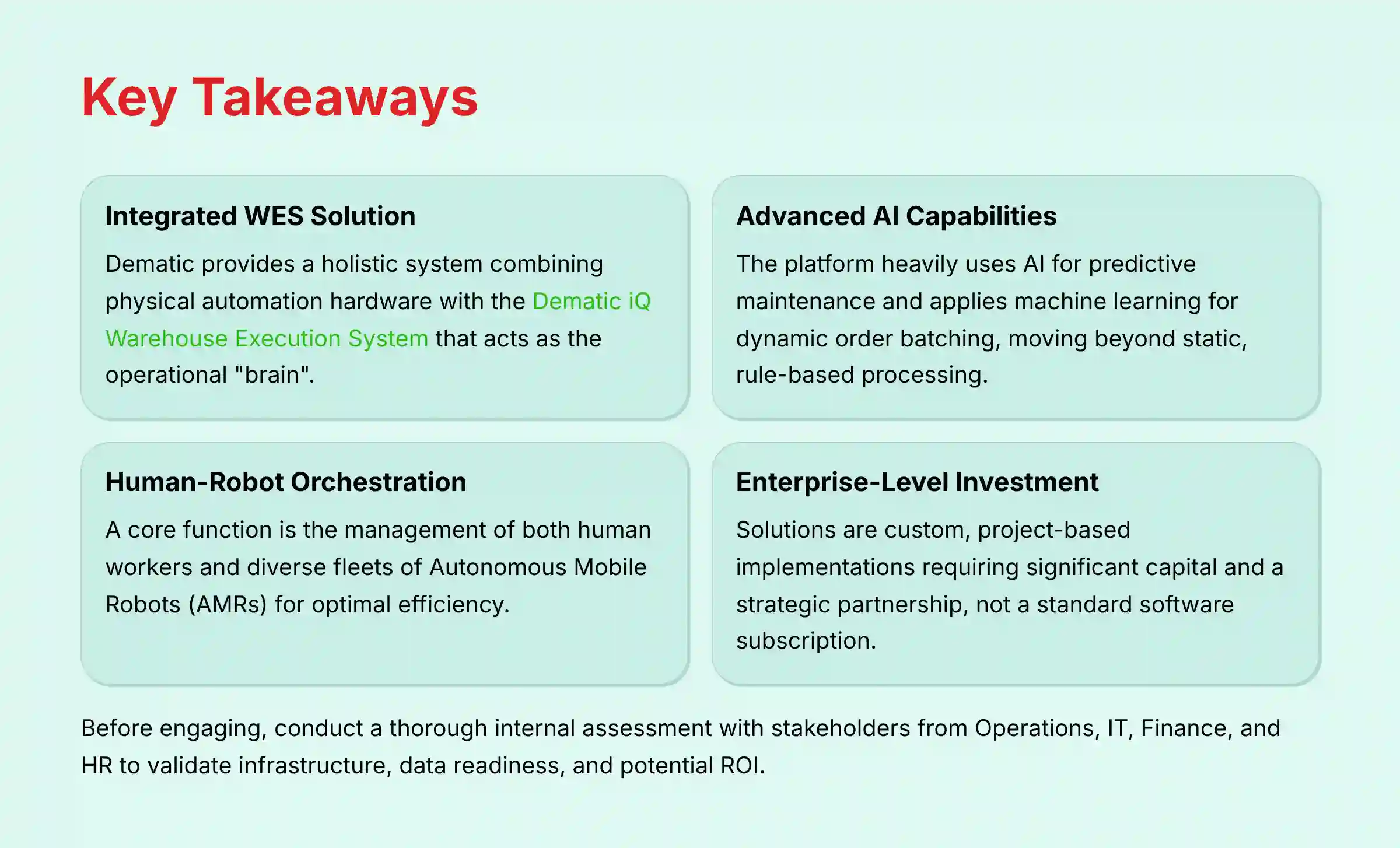
- Integrated WES Solution: Dematic provides a holistic system combining physical automation hardware with the Dematic iQ Warehouse Execution System (WES). This software acts as the operational “brain” to manage and synchronize all warehouse activities.
- Advanced AI Capabilities: The platform heavily uses AI for predictive maintenance to reduce downtime. It also applies machine learning and advanced optimization algorithms for dynamic order batching, moving beyond static, rule-based processing.
- Human-Robot Orchestration: A core function is the management of both human workers and diverse fleets of Autonomous Mobile Robots (AMRs). This setup provides optimal efficiency in goods-to-person and picking workflows.
- Enterprise-Level Investment: Dematic's solutions are custom, project-based implementations. They require significant capital and a strategic partnership, not a standard software subscription.
What Is Dematic and the Dematic iQ Platform?
Dematic is a global provider of integrated automation technology, software, and services, including a wide portfolio of hardware like Automated Storage and Retrieval Systems (AS/RS), high-speed sortation systems, and robotic picking solutions. The company's mission is to optimize the supply chain. At the heart of its offering is the Dematic iQ platform, a comprehensive software suite that functions as the intelligent core for modern distribution centers.
Company Background and Market Position
As a key part of the KION Group, Dematic holds a leading position in the supply chain automation market. The company has a presence in over 26 countries and manages operations for more than 2,000 facilities worldwide. Its solutions are widely adopted in demanding sectors like retail, e-commerce, and food and beverage. This global footprint gives them deep expertise across various operational challenges.
The Role of Dematic iQ as a Warehouse Execution System (WES)
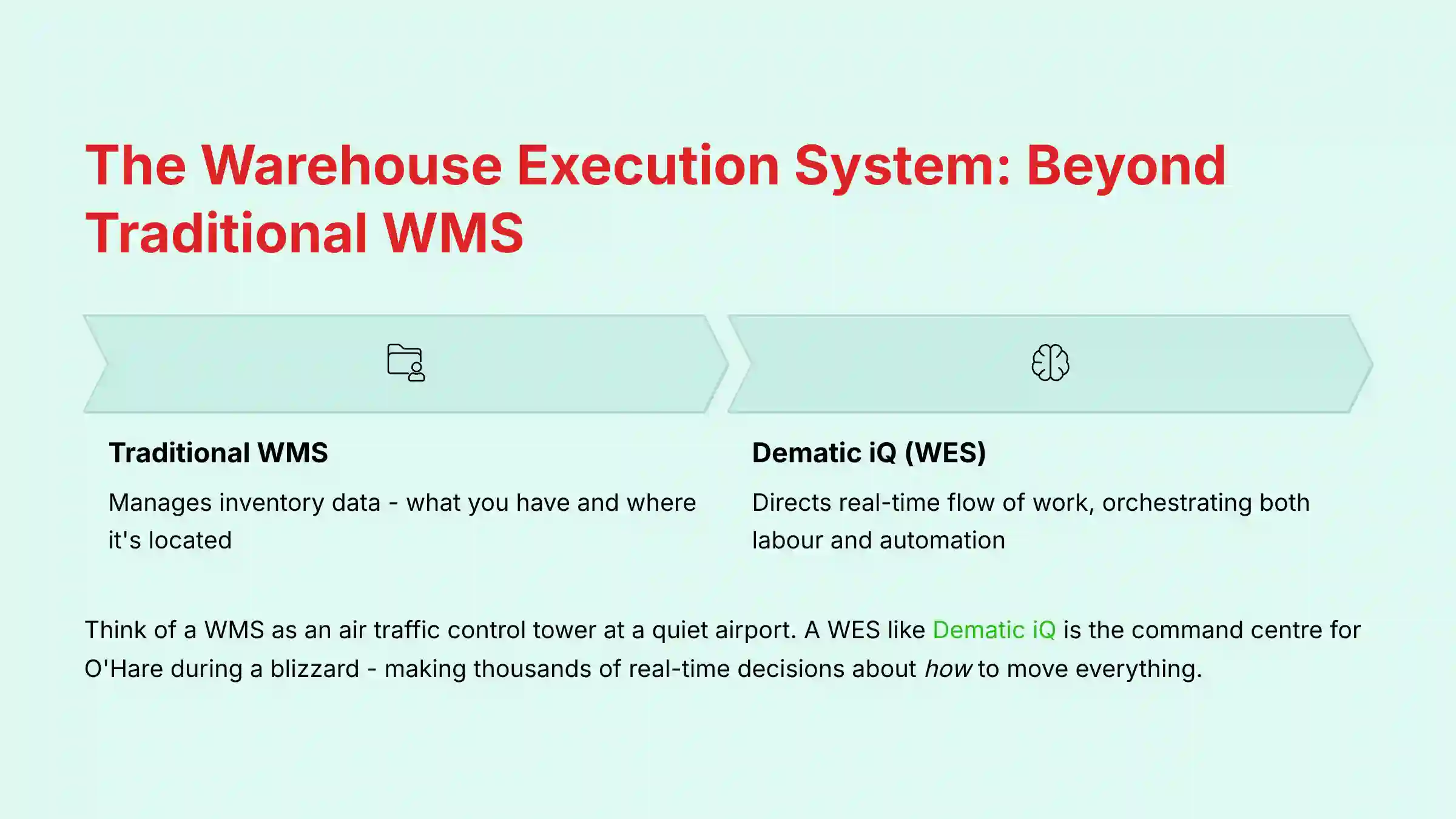
Think of a traditional Warehouse Management System (WMS) as an air traffic control tower at a quiet, regional airport. It knows which planes (inventory) are on the ground and their scheduled destinations. A WES like Dematic iQ is the command center for O'Hare International during a blizzard. It doesn't just know what's on the ground; it's making thousands of real-time decisions about how to move it all. It redirects planes (robots), reassigns gates (workstations), and manages ground crews (human labor) second-by-second to navigate the storm and get flights out on time. It transforms the warehouse from a static list of assets into a dynamic, responsive organism.
Core Technology: AI, Machine Learning, and Microservices
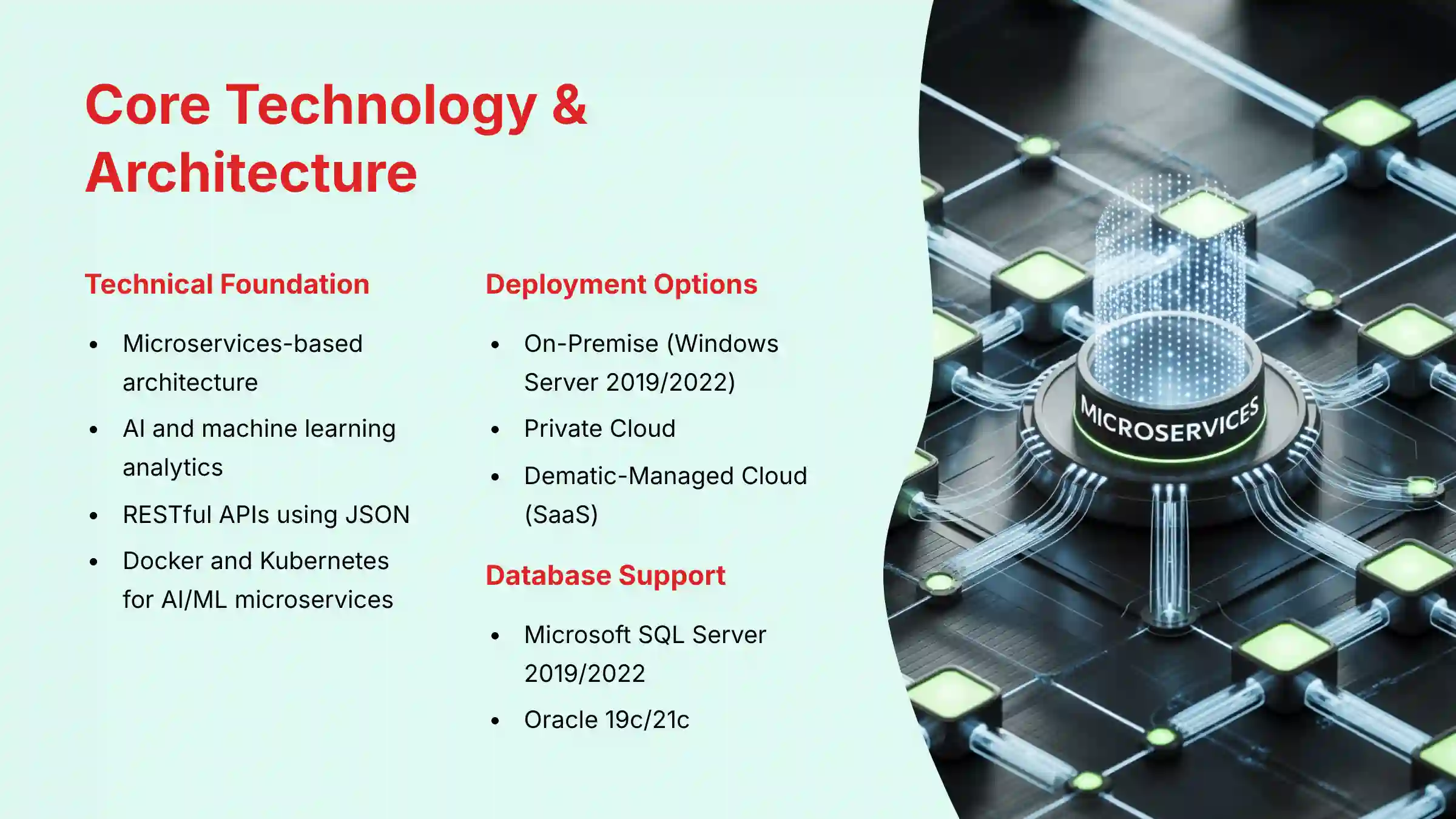
The platform is built on a modern, microservices-based architecture. This design makes the system flexible and scalable. It uses AI and machine learning to analyze real-time data from equipment sensors and operational inputs. This allows the system to make dynamic decisions, transforming the warehouse from a place of static processes into a responsive, self-optimizing environment.
So, how does the platform actually execute on this vision? Let's move from the strategic “what” to the technical “how” and dissect the core features that power this transformation.
A Deep Dive into Dematic iQ's Core Features (2025)
The Dematic iQ platform offers a robust set of features designed to manage every facet of a modern, automated warehouse. Our analysis shows these capabilities are organized into modules that address specific operational needs, from executing orders with AI to providing deep analytical insights.
AI-Powered Warehouse Execution (WES)
The WES module is the command center for all warehouse activities, using AI to make decisions that maximize throughput and efficiency.
-
AI-Powered Order Batching & Releasing
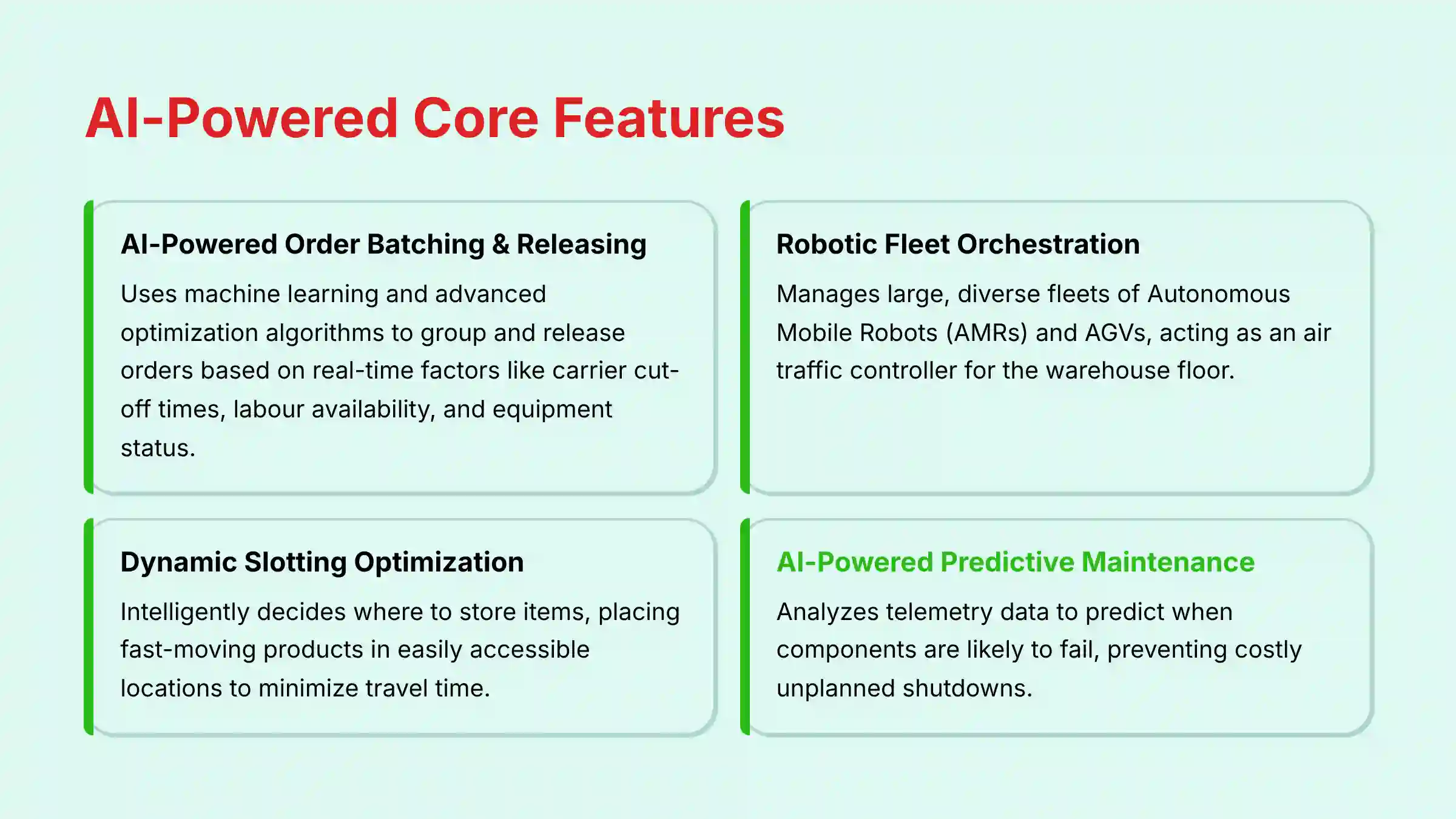
This feature uses machine learning and advanced optimization algorithms to group and release orders. It continuously analyzes real-time factors like carrier cut-off times, labor availability, and equipment status. This is a significant advance over older systems that use static “wave picking” rules.
-
Robotic Fleet Orchestration (AMRs & AGVs)
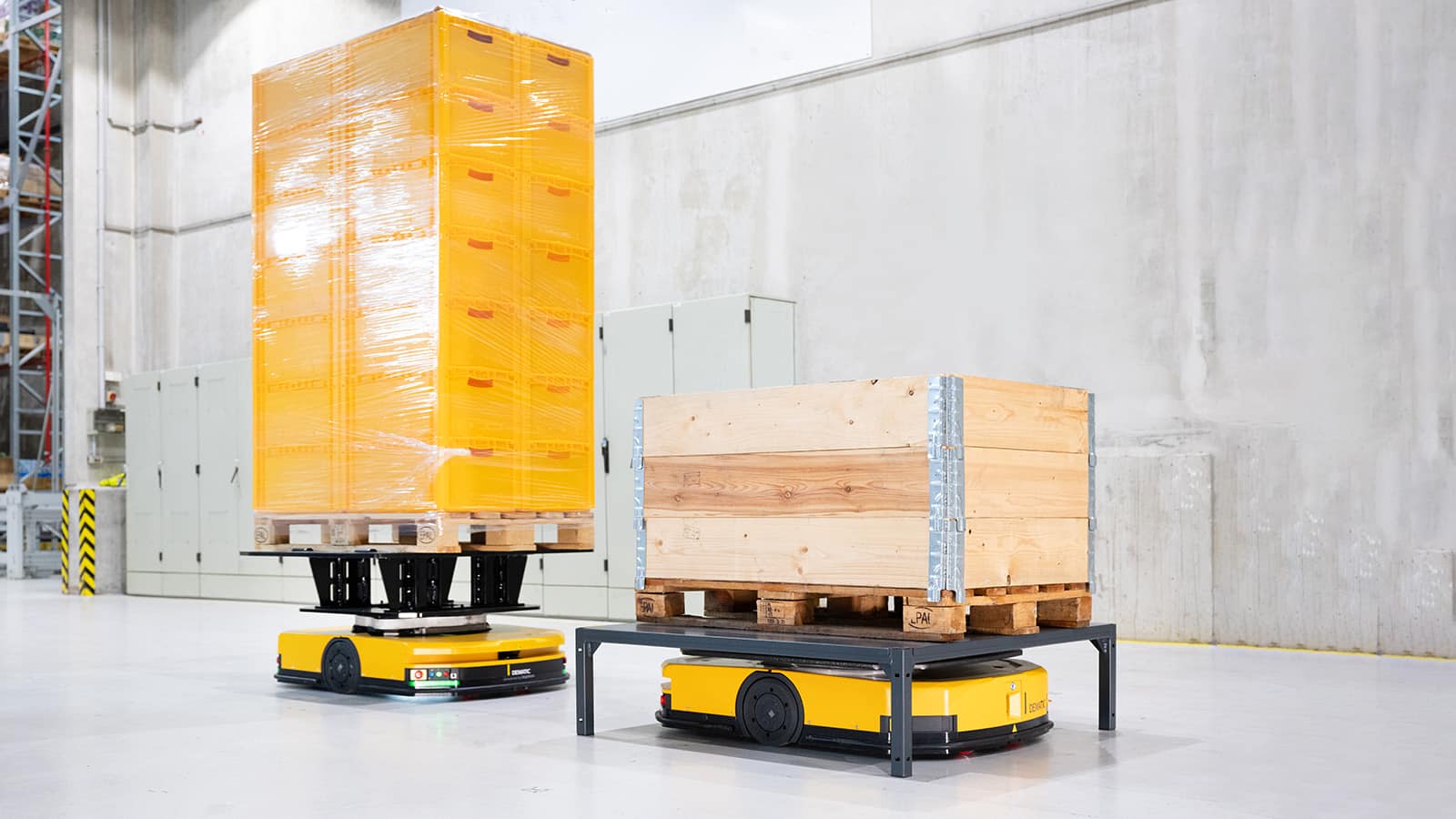
Dematic iQ manages large, diverse fleets of Autonomous Mobile Robots (AMRs) and Automated Guided Vehicles (AGVs). It acts like an air traffic controller for the warehouse floor, assigning tasks to robots and optimizing their paths to prevent congestion and maximize productivity.
Advanced Inventory and Warehouse Management
Maintaining perfect inventory knowledge is fundamental to fulfillment. Dematic iQ includes tools for precise tracking and intelligent placement of goods.
-
Real-Time Inventory Tracking and Visibility
The system gives a live, accurate view of all stock across the facility. It uses technologies like barcoding and RFID to track inventory from the moment it arrives to the moment it ships. This level of visibility is necessary for preventing stockouts and reducing errors.
-
Dynamic Slotting Optimization
This function intelligently decides where to store items. It places fast-moving products in easily accessible locations to minimize travel time for both workers and robots. The system constantly re-evaluates these decisions based on changing demand patterns.
Predictive Maintenance and System Health
Downtime is a massive cost in automated facilities. Dematic's platform is designed to anticipate problems before they happen.
-
AI-Powered Predictive Maintenance Module
This module analyzes telemetry data like vibration, temperature, and motor current from automated equipment. It uses machine learning models to predict when a component is likely to fail. This allows maintenance to be scheduled proactively, preventing costly unplanned shutdowns.
-
Real-Time Condition Monitoring Dashboards
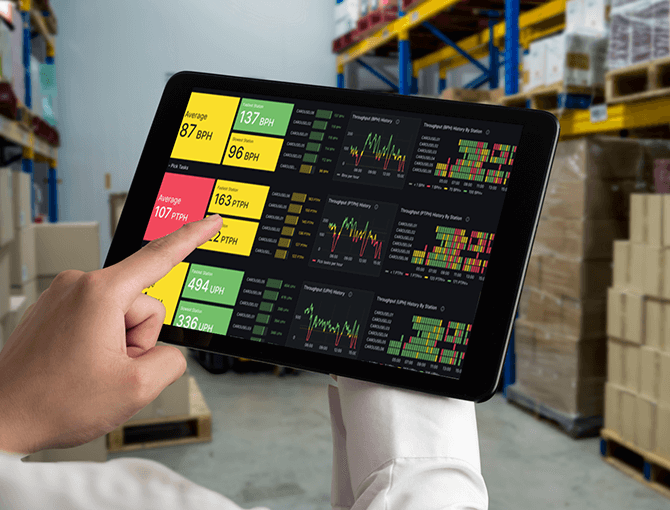
Managers have access to live dashboards that display the health status of all critical equipment. These visualizations help teams spot anomalies and address potential issues before they impact operations.
Data, Analytics, and User Experience
The platform is designed to provide actionable information to both managers and floor workers through tailored interfaces.
-
Dematic Vision Solutions
Dematic provides computer vision capabilities through its Dematic Vision Solutions, which integrate with the Dematic iQ platform. This technology can automatically perform quality checks, such as verifying that a tote is filled correctly or that a pallet is built to specification. This automates a traditionally manual and error-prone process.
-
The Dual UI: Strategic Dashboards for Planners vs. Tactical Interfaces for Operators
Dematic iQ provides two distinct user interfaces tailored to the core personas in a warehouse environment:
- For Planners & Operations Managers: A web-based “control tower” dashboard with detailed analytics, heat maps of facility activity, and performance reporting. This interface is designed for strategic oversight, enabling managers to monitor KPIs, manage exceptions, and perform scenario planning.
- For Warehouse Associates & Operators: Simplified, task-driven interfaces on mobile devices (RF scanners, tablets) or fixed terminals. These UIs provide clear, graphical instructions for picking, putting away, or packing, minimizing errors and training time for floor staff.
Objective Use Cases and Industry Applications
Dematic's solutions are engineered for high-volume, complex environments where speed and accuracy are paramount. The technology is applied across several operational models and industries to solve specific fulfillment challenges.
Primary Operational Use Cases
The system is designed to support several core warehouse functions.
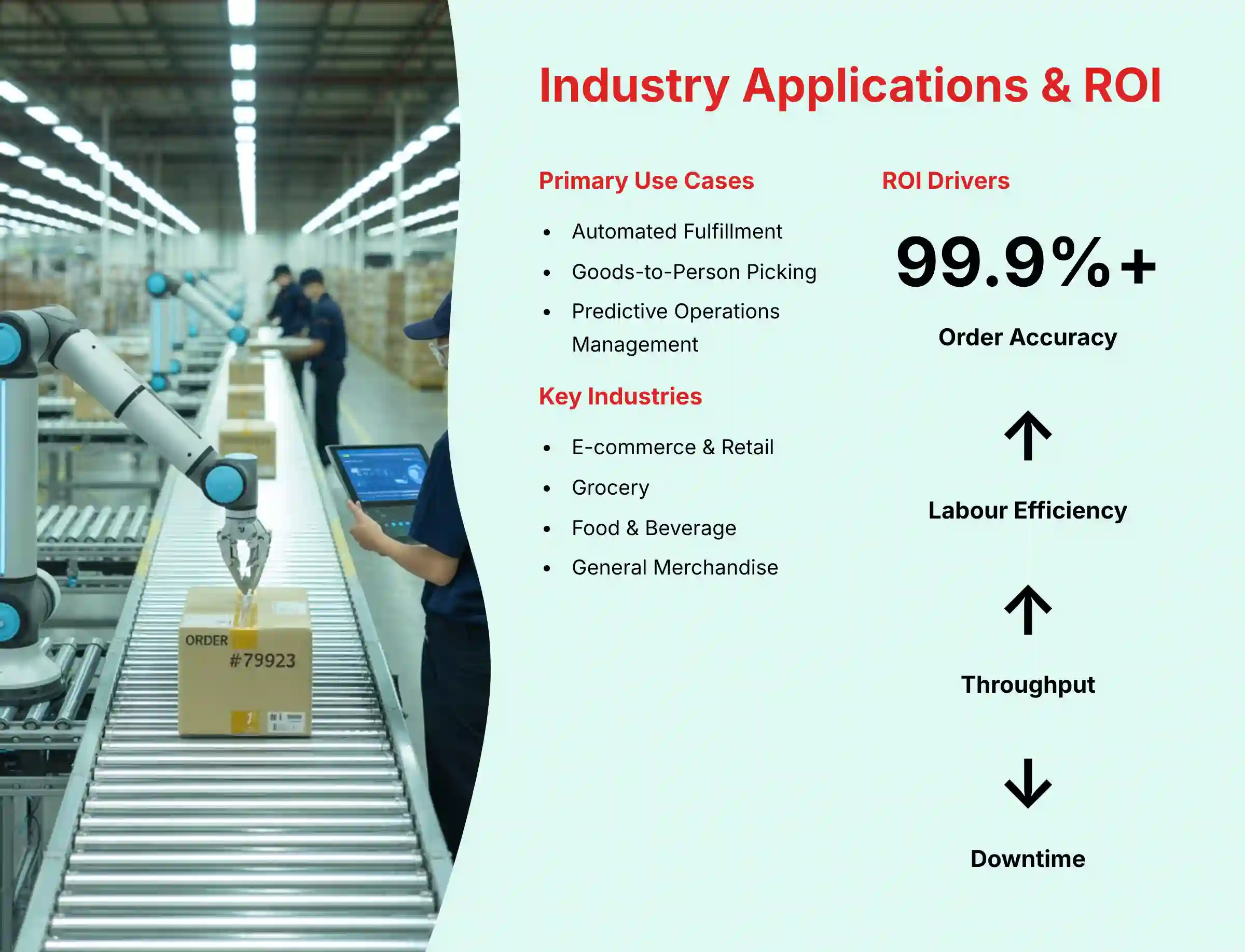
- Automated Fulfillment: Managing all processes in a distribution center, from receiving and put-away to picking, packing, and shipping.
- Goods-to-Person Picking: Orchestrating AMRs and conveyors to deliver inventory directly to stationary pickers, which dramatically increases picking rates and improves Order Accuracy Rates towards 99.9%+.
- Predictive Operations Management: Using AI to anticipate bottlenecks, equipment needs, and labor requirements to run the facility proactively, directly improving the critical On-Time In-Full (OTIF) delivery metric.
Key Industry Verticals
These solutions are most frequently deployed in industries with complex supply chains.
- E-commerce & Retail: Handling high volumes of small, multi-line orders.
- Grocery: Managing temperature-controlled goods and complex inventory rules.
- Food & Beverage: Overseeing batch tracking and product traceability.
- General Merchandise: Handling a diverse range of SKUs and returns processing.
Documented Project Types (Greenfield vs. Brownfield)
Dematic undertakes two main types of projects. A greenfield project involves designing and building a new, fully automated facility from the ground up. A brownfield project, or retrofit, involves integrating automation and software into an existing warehouse to modernize its operations.
Example Workflow: From Order to Dispatch
A typical workflow shows how these features connect. First, Dematic iQ receives an order from the company's ERP system. The AI engine then batches this order with others for maximum picking efficiency. It dispatches an AMR to retrieve the required inventory tote, routes it to a goods-to-person workstation, and gives the human picker clear, visual instructions on what to pick. While this happens, the predictive maintenance module is monitoring the AMR's motor health, ready to flag any potential issues.
Security, Compliance, and Reliability
For any technology that serves as the central nervous system of a distribution center, security and reliability are non-negotiable. Dematic's solutions are designed for mission-critical environments where downtime is measured in thousands of dollars per minute.
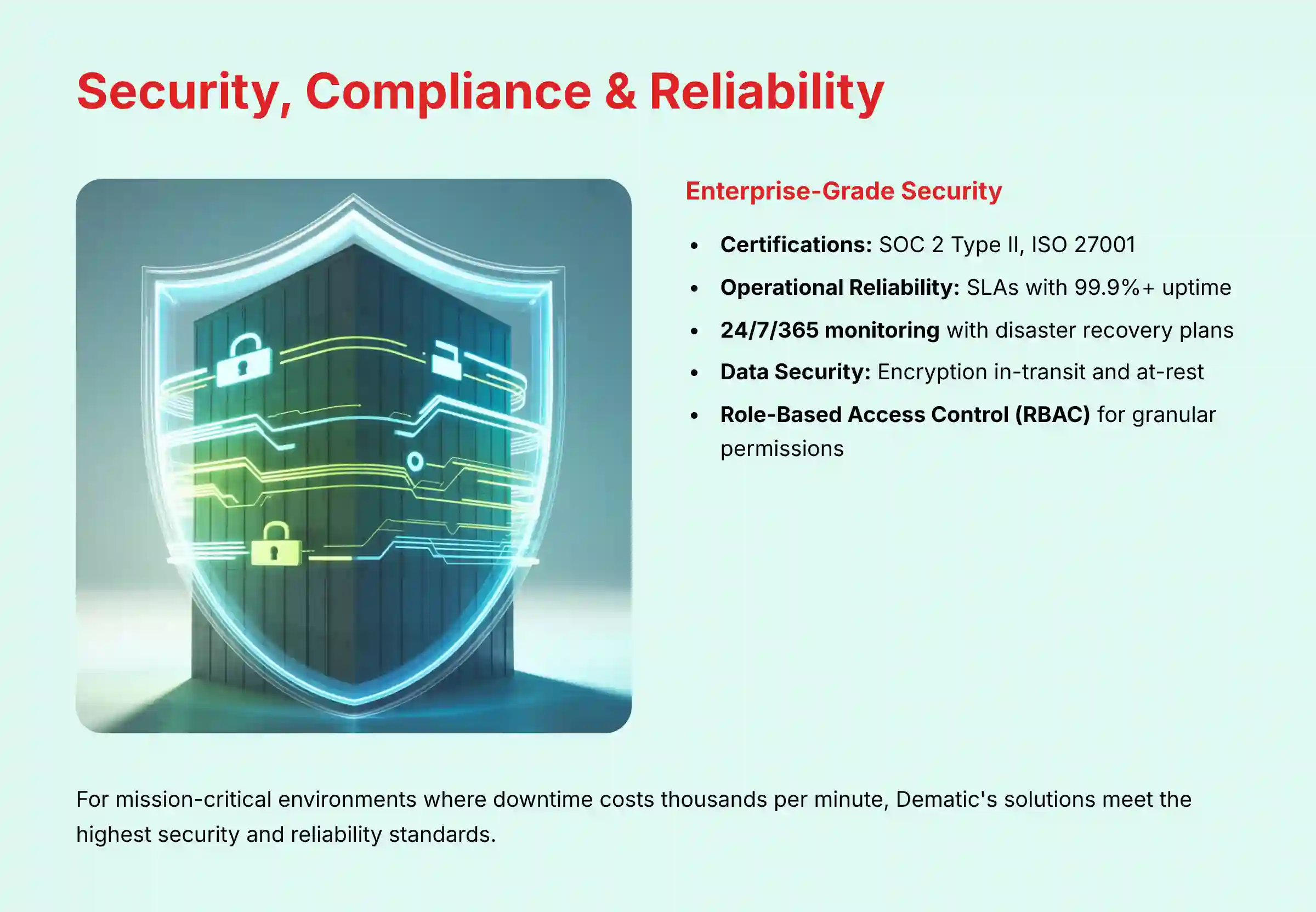
- Compliance & Certifications: For enterprise clients, Dematic's cloud-hosted solutions are built on infrastructure that meets rigorous third-party auditing standards, including SOC 2 Type II for operational and data security controls and ISO 27001 for information security management. This is a critical validation for protecting sensitive supply chain data like inventory levels, supplier information, and order velocity.
- Operational Reliability & Uptime: Engagements with Dematic include clearly defined Service Level Agreements (SLAs) that guarantee system uptime, often in the range of 99.9% or higher. Their global support network provides 24/7/365 monitoring and includes robust disaster recovery and business continuity plans to ensure operations can continue even in the event of a system failure.
- Data Security & Access Control: The Dematic iQ platform enforces strict security protocols, including data encryption both in-transit and at-rest. It utilizes granular Role-Based Access Control (RBAC) to ensure that users—from a floor operator to an Operations Director—only have access to the data and functions necessary for their specific role, securing sensitive operational and financial information.
Professional Consultation Advisory
Implementing a solution of Dematic's scale represents a significant financial and operational commitment. Before engaging a vendor, we strongly recommend conducting a thorough internal assessment with a cross-functional team of stakeholders from Operations, IT, Finance, and Human Resources. Validating network infrastructure, data readiness, and potential ROI against your specific business case is a critical prerequisite for a successful automation project. This article serves as an expert guide for your evaluation, not a substitute for professional, internal due diligence.
Technical Specifications of the Dematic iQ Platform
For technical decision-makers, understanding the underlying architecture is a main part of the evaluation process. The Dematic iQ platform is designed for flexibility and can be deployed in various IT environments. Below are the core technical specifications as verified from official documentation.
| Specification Category | Details |
|---|---|
| Deployment Models | On-Premise, Private Cloud, Dematic-Managed Cloud (SaaS) |
| On-Premise OS | Windows Server 2019/2022 (primary supported OS) |
| Supported Databases | Microsoft SQL Server 2019/2022, Oracle 19c/21c |
| Containerization Tech | Docker and Kubernetes for AI/ML microservices |
| Primary API Format | RESTful APIs using JSON |
| Legacy Input Formats | XML, EDI (ANSI X12, EDIFACT), CSV or Flat Files (via SFTP) |
| Data Export Formats | JSON, XML, CSV |
Integration Capabilities: Connecting to the Enterprise Ecosystem
An automation platform cannot operate in a silo. Its ability to connect with existing enterprise systems is fundamental to its success. Dematic iQ is architected to serve as a central hub, communicating seamlessly with the broader technology landscape.
API Availability and Architecture
The platform provides a comprehensive set of RESTful APIs that use JSON as the primary data format. This modern approach allows for deep, two-way communication with other business systems. These APIs cover everything from order management and inventory queries to system status updates.
For organizations comparing different automation solutions, our comprehensive Dematic Top Alternatives and Competitors guide provides detailed analysis of competitive options in the market.
Core System Integrations (ERP, WMS, TMS)
Dematic iQ is designed for deep integration with the core software that runs a business.
- ERP Systems: It has proven interfaces for major platforms like SAP S/4HANA, Oracle NetSuite, and Microsoft Dynamics 365.
- WMS Systems: It can act as a WES layer on top of an existing WMS from providers like Manhattan Associates or Blue Yonder. This enhances current systems without requiring a full replacement.
- TMS Systems: It connects with Transportation Management Systems to exchange shipping and carrier data.
Data Exchange Protocols and Workflows
To support a wide range of enterprise environments, the system handles multiple data protocols. It supports modern API calls and webhooks for real-time notifications. It also works with legacy formats like EDI and flat-file transfers over SFTP, verifying compatibility with older systems.
System Requirements and Implementation
Implementing a Dematic solution is not a software installation; it's a strategic overhaul of your physical operations. To mitigate the significant risks of budget overruns and operational disruption, the process is a structured, multi-stage project led by a dedicated Dematic team:
Hardware and Network Requirements
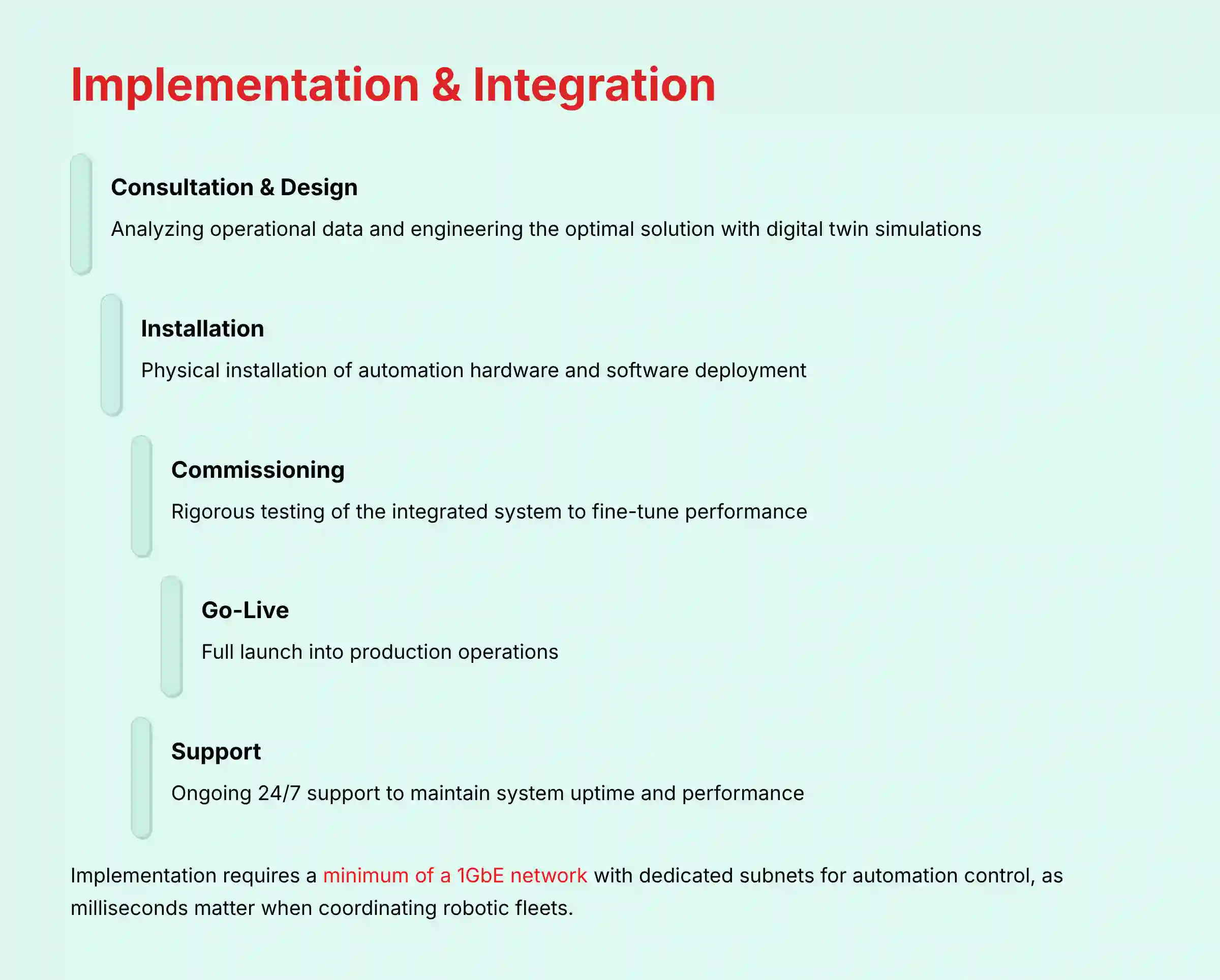
For on-premise deployments, redundant server-class hardware is a baseline requirement. The most mission-critical element is the network. A stable, low-latency local area network is needed for the software to control physical machinery in real time. In real-time automation control, network latency is not just a performance issue; it can be a safety and operational integrity issue. Milliseconds matter when coordinating robotic fleets. A minimum of a 1GbE network with dedicated subnets for automation control is a standard best practice.
Browser and System Compatibility
The web-based dashboards for managers and planners are compatible with modern browsers. This includes Google Chrome, Mozilla Firefox, and Microsoft Edge. This allows for easy access from standard corporate IT environments.
The 5-Stage Implementation Workflow
The implementation process is a guided journey led by a dedicated Dematic project team.
- Consultation & Design: Analyzing operational data and engineering the optimal solution.
- Installation: The physical installation of all automation hardware and software deployment.
- Commissioning: Rigorous testing of the integrated system to fine-tune performance.
- Go-Live: The full launch into production operations.
- Support: Ongoing 24/7 support to maintain system uptime and performance.
For detailed implementation guidance and practical applications, explore our extensive collection of Dematic Tutorials and Usecase resources that provide step-by-step implementation strategies.
Pricing, Plans, and Engagement Model
The engagement is a strategic partnership rather than a simple software purchase, involving significant Capital Expenditure (CapEx).
Pricing is determined on a custom, project-by-project basis. The Total Cost of Ownership (TCO) is calculated based on an analysis of operational needs, facility size, and the complexity of the required automation. The total investment includes hardware (CapEx), software licenses, professional services, and ongoing support (OpEx).
There is no free version or self-service trial available for the Dematic iQ platform. The engagement process begins with a formal consultation and solution design phase with Dematic's engineering team. During this phase, they may use advanced digital twin simulations to model the projected impact on key performance indicators (KPIs) and demonstrate the potential ROI of a proposed solution.
Frequently Asked Questions (FAQs) About Dematic
Here are answers to common questions that operations leaders ask when evaluating Dematic's technology.
What Is the Main Difference Between Dematic iQ (WES) and a Traditional WMS?
A traditional WMS primarily manages inventory data, such as what you have and where it is located. Dematic iQ, as a WES, is an execution-focused system that directs the real-time flow of work, orchestrating both labor and automation to complete tasks efficiently.
Can Dematic Automate an Existing (Brownfield) Warehouse?
Yes, Dematic specializes in both new “greenfield” projects and existing “brownfield” retrofits. For brownfield sites, their teams design and integrate automation and software into the existing facility footprint and workflows to modernize operations.
How Does AI-Powered Order Batching Improve on Standard Wave Picking?
Standard wave picking uses fixed rules to release work in large, pre-planned batches. Dematic's AI approach is dynamic, using machine learning to constantly adjust how orders are grouped and released based on real-time conditions. This leads to higher throughput and better utilization of resources.
For comprehensive answers to more technical questions, visit our detailed Dematic FAQs section which covers advanced implementation topics and troubleshooting guidance.
What Is the Typical ROI for a Dematic Automation Project?
While project-specific, ROI is measured against core supply chain KPIs. The business case is typically built on:
- Improved Labor Efficiency: Drastically reducing manual travel and search time, enabling higher picks per hour.
- Increased Throughput & Accuracy: Boosting the number of orders fulfilled per day while driving Order Accuracy Rates towards 99.9%+. This directly improves the critical On-Time In-Full (OTIF) delivery metric.
- Optimized Inventory Levels: Enhancing Inventory Turnover and reducing safety stock by improving visibility and control.
- Maximized Uptime: The AI-powered predictive maintenance module directly contributes to a higher Overall Equipment Effectiveness (OEE) by preventing unplanned downtime, a major cost center in automated facilities.
How Long Does a Dematic Implementation Take?
Timelines vary based on project complexity. A smaller retrofit might take several months, while a large, new automated facility can take over a year. The process is a full-scale project involving extensive design, installation, and commissioning.
Does Dematic Manufacture Its Own Robots and Automation Hardware?
Yes, Dematic engineers and manufactures a large portion of its material handling hardware, including conveyors and sortation systems. This vertical integration allows for very tight coupling between the physical equipment and the Dematic iQ software that controls it.
What Kind of Data Is Needed to Start a Dematic Project?
A prospective customer must provide detailed operational data for the initial design phase. This includes order profiles, SKU velocity data, current inventory levels, and facility layouts. This data is needed for Dematic to engineer an effective solution.
Who Provides Support After the System Goes Live?
Dematic provides comprehensive, ongoing support through service level agreements (SLAs). This includes a 24/7/365 global support network that offers remote system diagnostics and can dispatch on-site technicians to maintain maximum operational uptime.
To explore alternative solutions and make informed comparisons, consider reviewing our comprehensive guide on the Best 10 AI For Warehouse Robotics & Automation Solutions: The Definitive 2025 Guide which provides detailed analysis of leading automation platforms in the industry.
For ongoing evaluation and detailed technical analysis, our Dematic Review provides in-depth assessment of implementation challenges, performance metrics, and long-term operational considerations.
Disclaimer
The information about Dematic Overview and Features presented in this article reflects our thorough analysis as of 2025. Given the rapid pace of technology evolution in the AI for Operations & Supply Chain space, features, pricing, and specifications may change after publication.
Professionals must differentiate between currently available features and roadmap items by requesting a formal product roadmap from Dematic under a Non-Disclosure Agreement (NDA). Any contractual agreement should be based on the statement of work for existing, proven technology.
For cloud-hosted (SaaS) deployments, we strongly recommend that operations leaders and their IT security teams directly validate Dematic's current compliance posture and request access to their certification reports or attestations. This is a non-negotiable step in the due diligence process.
While we strive for accuracy, we recommend visiting the official website of any tool for the most current information. Our overview is designed to provide a comprehensive understanding of the tool's capabilities.

Leave a Reply