Is Dematic AI Warehouse Automation Right for Your Operations?
Take This 2-Minute Quiz to Find Out!
Key Takeaways
- AI-Powered Intelligence: Dematic iQ acts as the central AI brain, optimizing warehouse operations in real-time through machine learning and predictive analytics
- Comprehensive Problem Solving: Addresses labor scarcity, accuracy issues, slow fulfillment speeds, space inefficiency, and lack of real-time visibility
- Industry Leadership: Proven ROI with 3-7 year payback periods, serving e-commerce, grocery, pharmaceuticals, and manufacturing sectors
- Seamless Integration: Standardized API connectors ensure smooth integration with existing ERP and WMS systems like SAP and Oracle
- Comprehensive Lifecycle Support: 24/7 technical support, predictive maintenance, and extensive training programs ensure long-term success
Dematic represents the cutting-edge of warehouse and supply chain automation, transforming traditional distribution centers into intelligent, AI-powered operations. This comprehensive guide addresses the most frequently asked questions about Dematic's technology, implementation, and value proposition for modern enterprises.
What is Dematic and how does it use AI to automate supply chain operations?

Dematic is a global leader in designing, building, and supporting intelligent automated solutions for manufacturing, warehouse, and distribution environments. At its core, Dematic integrates advanced robotics, material handling systems, and sophisticated software to drastically improve the speed, accuracy, and efficiency of supply chain operations.
The “intelligent” aspect comes from its powerful software platform, Dematic iQ. This is where Artificial Intelligence (AI) and Machine Learning (ML) come into play. Instead of simply executing pre-programmed tasks, Dematic's AI-powered systems can:

- Optimize in Real-Time: Dematic iQ analyzes live data from across the warehouse—including order flow, inventory levels, and equipment status—to make dynamic decisions. For example, it can re-route goods to avoid a bottleneck or change picking strategies on the fly to accommodate a sudden surge in express orders.
- Predict and Adapt: Machine learning algorithms analyze historical data to forecast future demands, predict potential equipment maintenance needs before a failure occurs (predictive maintenance), and optimize the placement of goods within the warehouse (slotting) based on seasonal trends.
- Enable Smarter Robotics: AI powers the vision and navigation systems for Autonomous Mobile Robots (AMRs) and other robotics, allowing them to navigate dynamic environments safely and efficiently without fixed infrastructure like wires or magnets.
Essentially, Dematic uses AI to transform the warehouse from a rigid, reactive cost center into a proactive, resilient, and data-driven strategic asset that can continuously adapt to changing market conditions and customer demands.
For a comprehensive understanding of Dematic's capabilities and features, explore our detailed Dematic Overview and Features analysis that breaks down their complete technology stack and implementation strategies.
What specific operational problems does a Dematic intelligent automation system solve?
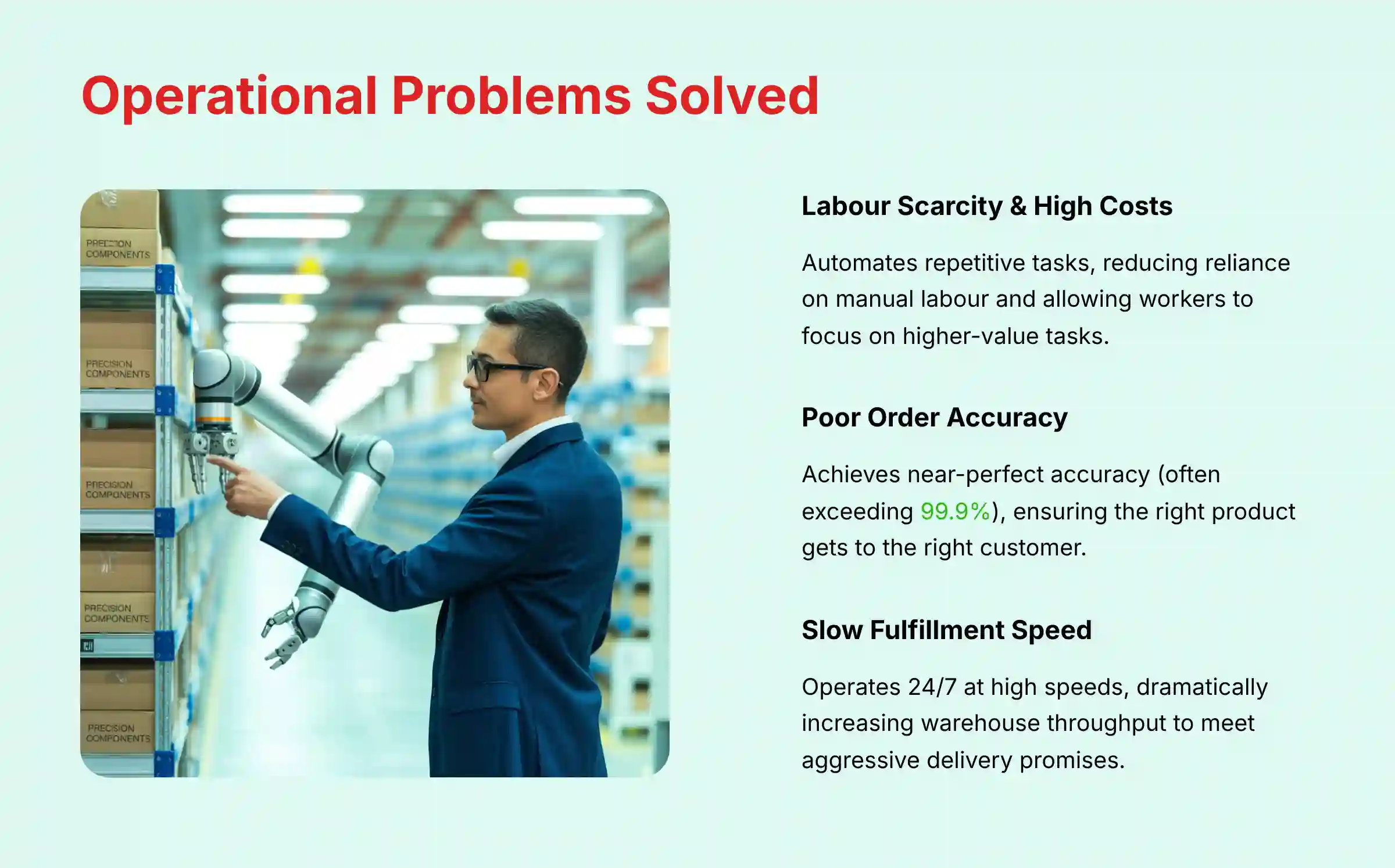
A Dematic intelligent automation system is designed to solve the most pressing and costly challenges that modern distribution and fulfillment centers face. It moves beyond simple automation to address complex operational inefficiencies head-on.
Key problems solved include:
- Labor Scarcity and High Costs: By automating repetitive and physically demanding tasks like picking, packing, sorting, and palletizing, Dematic systems directly reduce reliance on manual labor.
- Addresses challenges of labor shortages and high turnover rates
- Reduces rising wage costs significantly
- Allows human workers to focus on higher-value tasks
- Poor Order Accuracy and High Return Rates: Manual picking is prone to human error, leading to incorrect orders, costly returns, and dissatisfied customers.
- Dematic's automated systems achieve near-perfect accuracy (often exceeding 99.9%)
- Ensures the right product gets to the right customer every time
- Dramatically reduces return processing costs
- Slow Fulfillment Speed and Throughput: In the age of same-day delivery expectations, manual processes cannot keep up.
- Dematic systems operate 24/7 at high speeds
- Solutions like the Dematic Multishuttle can process thousands of totes per hour
- Enables businesses to meet aggressive delivery promises and handle peak season demand
- Inefficient Use of Space: Traditional warehouses often waste significant vertical space and require wide aisles for manual equipment.
- Automated Storage and Retrieval Systems (AS/RS) operate in narrow spaces
- Can reach significant heights, increasing storage density by up to 60%
- Defers or eliminates the need for costly facility expansion
- Lack of Real-Time Visibility and Control: Many operations run on outdated data, making it impossible to react to disruptions.
- Dematic iQ software provides a “control tower” view of the entire operation
- Offers real-time insights into inventory levels, order status, and system performance
- Enables managers to make informed decisions instantly

What industries are the best fit for Dematic's AI-powered solutions?
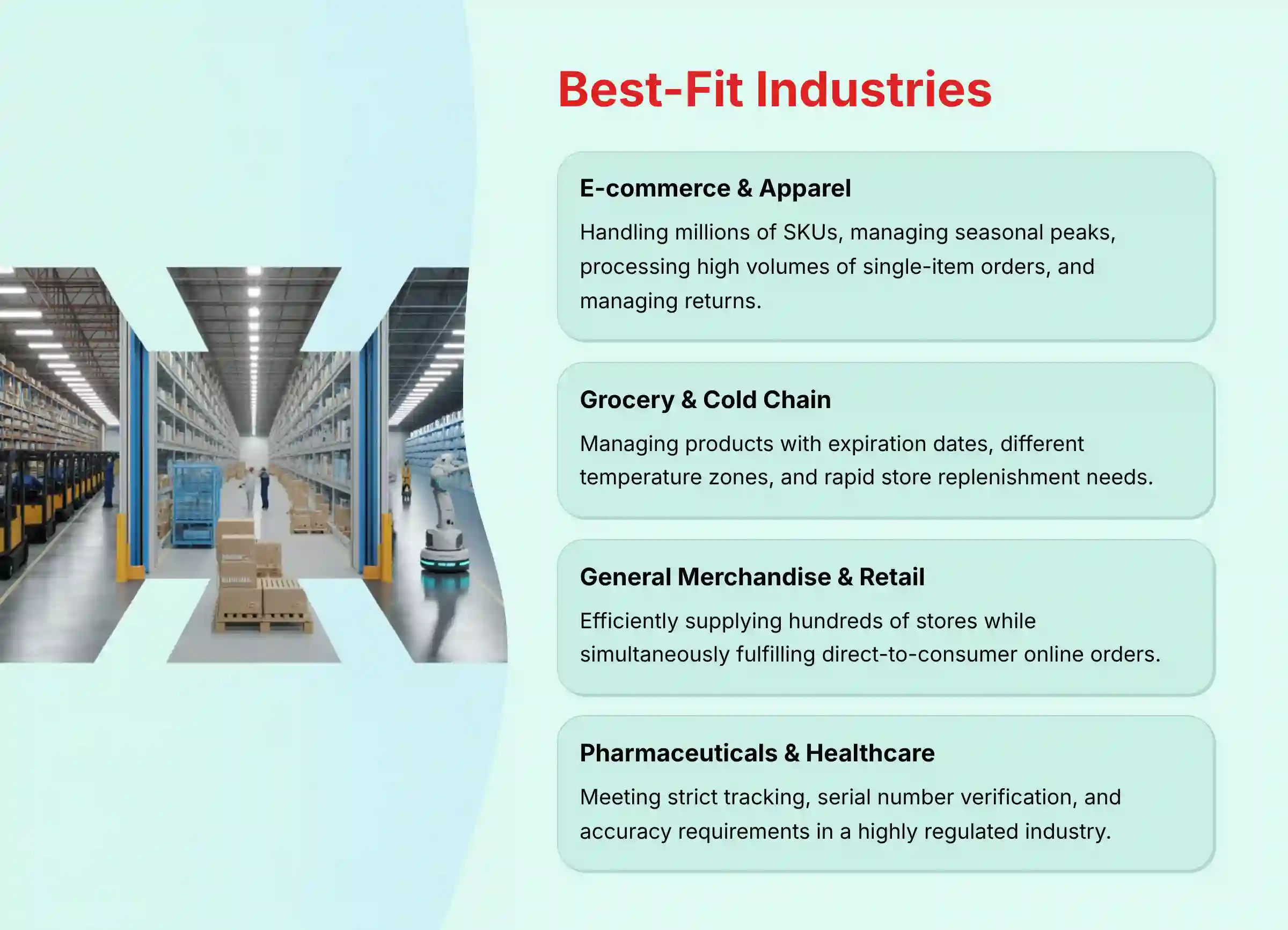
Dematic's AI-powered solutions are highly adaptable, but they deliver the most significant value in industries characterized by high volume, high complexity, and high-velocity fulfillment demands. The ideal fits are sectors where speed, accuracy, and labor efficiency are paramount to competitive success.
Key industries include:
- E-commerce & Apparel: This is a primary sector.
- Challenges of handling millions of individual SKUs
- Managing extreme seasonal peaks (like Black Friday)
- Processing high volume of single-item orders
- Dealing with large number of returns
- Perfect candidate for Dematic's goods-to-person and robotic sorting solutions
- Grocery & Cold Chain: The grocery industry requires specialized handling.
- Managing products with expiration dates
- Different temperature zones (ambient, chilled, frozen)
- Need for rapid replenishment to stores
- FIFO (First-In, First-Out) handling requirements
- Cold chain integrity maintenance for food safety
- General Merchandise & Retail: Large retailers face complex distribution challenges.
- Need to supply hundreds or thousands of stores efficiently
- Handle wide variety of products simultaneously
- Fulfill direct-to-consumer online orders
- Create “store-friendly” sequences for efficient shelf replenishment
- Food & Beverage Production: Manufacturing environments benefit from end-to-line automation.
- Automate palletizing and stretch wrapping processes
- Move finished goods from production to warehouse seamlessly
- Create efficient product flow throughout the facility
- Pharmaceuticals & Healthcare: This highly regulated industry demands precision.
- Strict tracking and serial number verification
- Pristine accuracy requirements for patient safety
- Process control and data logging for compliance
- Maintaining regulatory standards throughout operations
While these are the primary industries, any operation struggling with significant labor, space, or speed constraints is a potential candidate for a Dematic solution. To understand how Dematic compares to other solutions, read our comprehensive Dematic Top Alternatives and Competitors analysis.
What is Dematic iQ and how does it function as the AI ‘brain' for a warehouse?
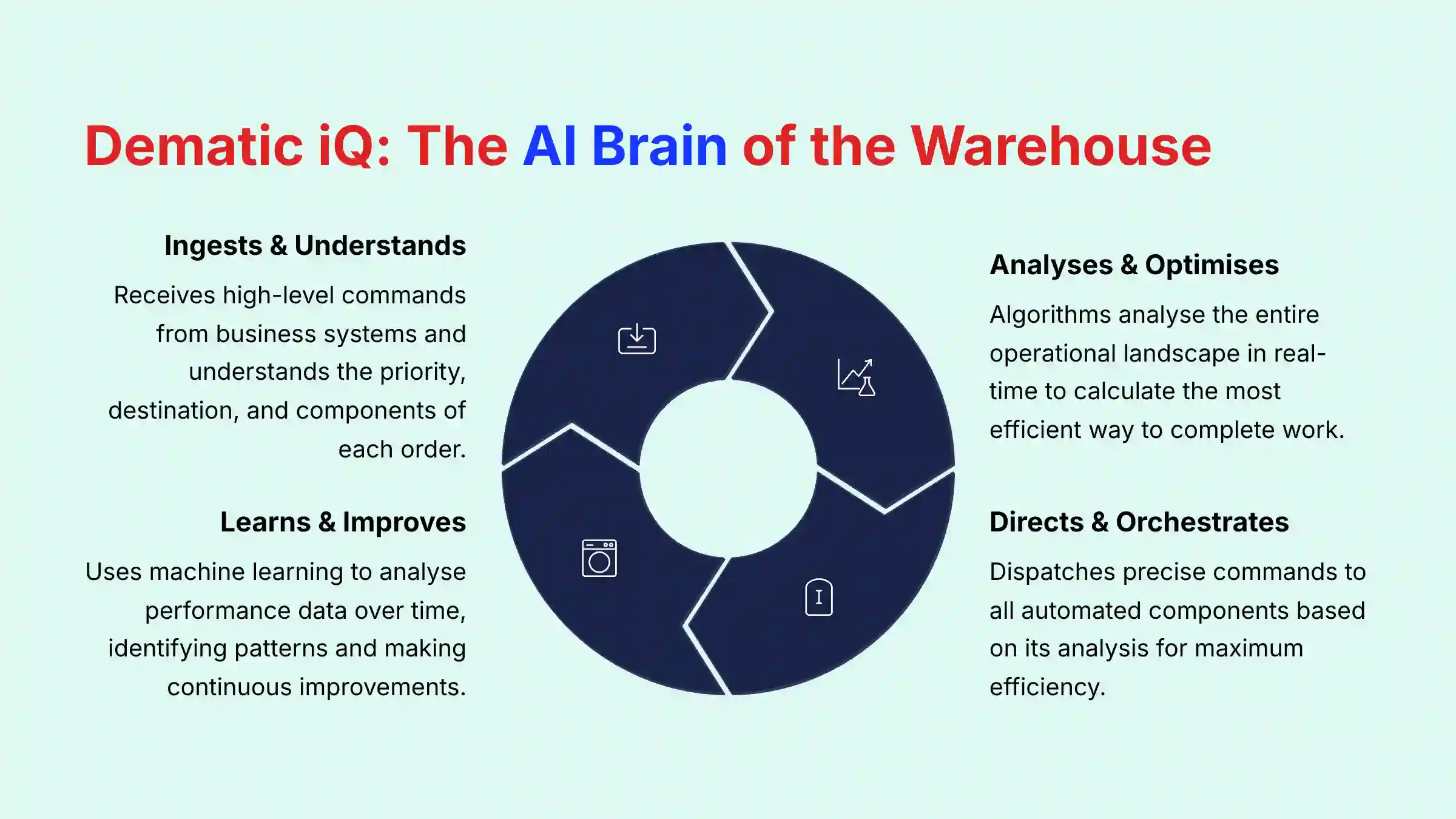
Dematic iQ is the intelligent, modular software platform that acts as the central nervous system—or “brain”—for a Dematic automated facility. It is far more than a simple Warehouse Control System (WCS); it's a comprehensive suite of performance-optimizing software that bridges the gap between a company's business-level ERP/WMS and the physical material handling equipment on the floor.

Here's how it functions as the AI brain:
- It Ingests and Understands:
- Receives high-level commands from the main business system
- Processes large waves of e-commerce orders intelligently
- Understands priority, destination, and components of each order
- It Analyzes and Optimizes: This is where the AI shines.
- Analyzes the entire operational landscape in real-time
- Considers equipment availability, current workloads, inventory locations, and order deadlines
- Calculates the most efficient way to fulfill orders with available resources
- Constantly optimizes for maximum speed and efficiency
- It Directs and Orchestrates:
- Dispatches precise commands to all automated components
- Tells the Multishuttle system which totes to retrieve
- Calculates most efficient paths for AMRs
- Instructs robotic sorters on package routing
- Guides human operators at goods-to-person workstations
- It Learns and Improves: Through machine learning capabilities:
- Analyzes performance data over time continuously
- Learns product ordering patterns for optimal slotting
- Identifies bottleneck patterns and adjusts workflows proactively
- Continuously improves operational efficiency
In essence, Dematic iQ provides the intelligence that makes the system truly “automated” rather than just “mechanized.” It ensures all the high-speed robotics and machinery work in a synchronized, intelligent, and highly efficient harmony.
For practical implementation examples and real-world applications, check out our detailed Dematic Tutorials and Usecase guide that showcases specific scenarios and outcomes.
How does Dematic's AI-powered automation compare to competitors like Swisslog, Vanderlande, or Honeywell Intelligrated?
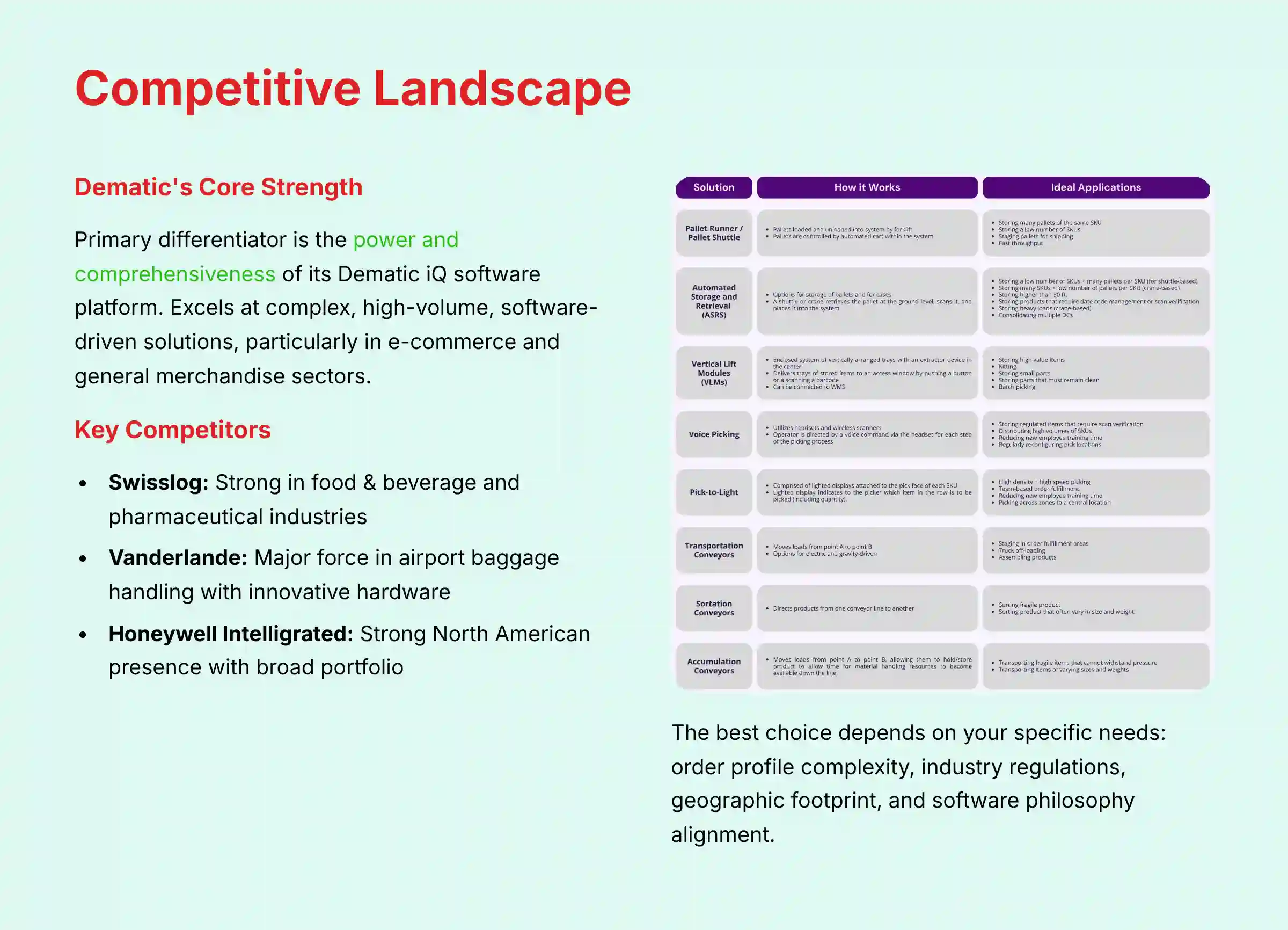
When comparing Dematic to other top-tier automation providers like Swisslog, Vanderlande, and Honeywell Intelligrated, the decision often comes down to specific technological strengths, software philosophy, and industry expertise rather than a simple “better or worse” judgment. All are leaders in the space, but they have distinct areas of focus.
- Dematic's Core Strength: Dematic's primary differentiator is often cited as the power and comprehensiveness of its Dematic iQ software platform.
- While all vendors have software, Dematic has heavily invested in making iQ a modular, scalable, and intelligent “brain”
- Provides deep, real-time optimization and analytics capabilities
- Excels at complex, high-volume, software-driven solutions
- Particularly strong in e-commerce and general merchandise sectors
- Global reach and extensive service network for multinational corporations
- Standardized solutions and support across different regions
- Swisslog: Often noted for its deep expertise in specific industries.
- Strong expertise in food & beverage and pharmaceutical industries
- Part of the KUKA robotics family
- Strong portfolio in cold chain and pallet-based automation
- SynQ software platform as direct competitor to Dematic iQ
- Choice often depends on industry-specific case studies and pre-built configurations
- Vanderlande: Major force in specialized markets with European strength.
- Dominant in airport baggage handling market
- Very strong presence in warehouse automation, particularly in Europe
- Known for innovative hardware like the ADAPTO shuttle system
- VIBES software suite is highly capable
- Comparison often involves specific shuttle technology and software fit
- Honeywell Intelligrated: Strong North American presence with ecosystem advantages.
- Strong presence in North America
- Broad portfolio of automation equipment and software
- Momentum WES (Warehouse Execution System) as powerful competitor
- Ability to bundle automation with other enterprise technologies
- Integration with voice solutions, scanners, and building controls
- Attractive for companies already invested in Honeywell ecosystem
Ultimately, the best choice depends on a deep analysis of your specific needs: the complexity of your order profiles, your industry regulations, your geographic footprint, and, most importantly, how well each vendor's software philosophy aligns with your operational strategy.
For detailed performance analysis and expert insights, visit our comprehensive Dematic Review that covers implementation experiences and comparative advantages.
How does Dematic ensure seamless integration with an existing ERP (like SAP or Oracle) and WMS?
Seamless integration with a client's core business systems, particularly the Enterprise Resource Planning (ERP) and Warehouse Management System (WMS), is a cornerstone of any successful Dematic implementation. A multi-million dollar automation system is useless if it cannot communicate effectively with the software that manages orders, inventory, and financials.
Dematic's approach is multi-layered and built on decades of experience.
The primary bridge between these systems is the Dematic iQ software platform. It is specifically designed to act as the “universal translator” and operational director. Here's how it works:
- Standardized API Connectors:
- Dematic iQ features a robust library of pre-built, standardized API connectors
- Supports major ERP and WMS providers including SAP, Oracle, NetSuite, and Manhattan Associates
- Handles common data exchanges like receiving order files, sending inventory updates, and confirming shipment completions
- Defined Data Exchange:
- Integration process begins with detailed “handshake” agreement
- Dematic specialists work with client's IT team to map every data point
- Defines who is the “master” for each piece of data
- ERP typically masters incoming orders; Dematic iQ masters real-time location tracking
- Real-Time vs. Batch Communication:
- Integration configured to match operational needs
- New customer orders might be received in batches every 15 minutes
- Order completion confirmations sent back to WMS in real-time
- Allows business to immediately update customers on order status
- Handling Exceptions:
- Critical part of integration is managing exceptions
- Pre-defined protocols for handling discrepancies
- Immediate flagging of issues like out-of-stock or damaged items
- Automatic communication back to WMS for decision-making
🔒 Expert's Insight: The Integration ‘Sandbox' A common mistake is underestimating the complexity of the data handshake. The official documentation may look straightforward, but real-world data is messy. Before going live, insist on a “sandbox” or “emulation” phase. Dematic can simulate the physical warehouse while connected to a test version of your live ERP/WMS. This allows you to run thousands of real order scenarios through the integrated system. You'll uncover hidden data mismatches, process gaps, and exception errors in a safe environment, preventing catastrophic failures on day one. This single step is the most critical part of de-risking a large-scale automation project.
How is a Dematic automation system priced, and what factors determine the Total Cost of Ownership (TCO)?

The pricing of a Dematic automation system is highly customized and cannot be summarized by a simple price list. It's a major capital investment, with costs varying from a few million to over $100 million, depending entirely on the project's scale, complexity, and performance requirements.
The final price is a result of a deep, consultative engineering process.
The initial purchase price is primarily determined by four key factors:
- Hardware & Technology: This is the most significant cost component.
- Physical automation equipment including steel racking for AS/RS
- Number of shuttles or AMRs required
- Length and complexity of conveyor systems
- Sophistication of robotic pickers
- Number of goods-to-person workstations
- Software Configuration (Dematic iQ):
- Cost depends on number of modules required
- Level of complexity determines final price
- Simple systems need only basic WCS functionality
- Complex e-commerce facilities require advanced AI-driven modules
- Includes order optimization, dynamic slotting, and analytics capabilities
- Integration & Implementation Services:
- Engineering and project management costs
- Installation labor requirements
- IT services for system integration
- Integration with existing facility and software (ERP/WMS)
- Facility Modifications:
- Necessary changes to building infrastructure
- Floor reinforcement requirements
- Electrical system upgrades
- Fire suppression systems for high-density storage compliance
However, the initial price is only part of the story. The Total Cost of Ownership (TCO) provides a more accurate picture of the long-term investment. TCO includes:
- Ongoing Software Licensing & Support:
- Annual fees for software updates and licenses
- Access to technical support services
- Continuous system optimization and improvements
- Maintenance & Spare Parts:
- Preventative maintenance contracts
- Service level agreements (SLAs)
- Budget allocation for spare parts inventory
- Energy Consumption:
- High-speed, 24/7 automation requires significant power
- Ongoing utility costs consideration
- Training & Personnel:
- Cost of training staff to operate new systems
- Ongoing maintenance training requirements
💰 Expert's Insight: Focus on ‘Cost Per Touch' Not Just Capex When evaluating the proposal, don't just fixate on the initial capital expenditure (Capex). Ask the Dematic team to help you model the ‘cost per touch' or ‘cost per order' both before and after automation. A well-designed system may have a high initial price but will drastically reduce the variable cost of fulfilling every single customer order. This metric—the reduction in operational cost (Opex)—is what truly defines the system's value and is the key to building a compelling ROI case for your CFO. A lower TCO over 10 years with a higher initial investment is often the smarter financial decision.
What is the verifiable ROI of a Dematic system, and can you provide specific case studies?
The Return on Investment (ROI) for a Dematic system is a primary justification for the significant capital expenditure, and it's typically realized through a combination of cost savings, productivity gains, and strategic advantages. While the exact ROI percentage varies widely based on the industry, the pre-existing operation, and the scale of the solution, most businesses target a full payback period of 3-7 years, with some high-utilization systems achieving it in under 2 years.
The ROI is calculated from verifiable improvements in key performance indicators (KPIs), including:
- Labor Savings: This is often the largest component.
- Calculated by reduction in headcount or overtime hours required
- Covers picking, packing, and other manual tasks
- Many companies see 50-70% reduction in labor requirements for given processes
- Increased Throughput:
- Process more orders per hour with same or fewer people
- Business can grow revenue without linear increase in operational costs
- Enables scaling without proportional workforce expansion
- Improved Accuracy:
- Financial impact of order errors is significant
- Costs include return shipping, labor for processing returns, and replacement shipping
- Moving from 98% accuracy to 99.9%+ saves millions annually for large operations
- Increased Storage Density:
- Avoiding or deferring cost of building new warehouse
- Eliminating need for leasing additional off-site storage
- Company realizes substantial capital savings
- “Cost avoidance” is critical part of ROI calculation
- Reduced Safety Incidents:
- Automating physically demanding and repetitive tasks
- Leads to safer work environment
- Lower costs associated with workplace injuries
Dematic provides numerous public case studies with verifiable data. For example, they have published results showing how they helped e-commerce giant Zalando achieve massive throughput in their European fulfillment centers, and how they enabled Coca-Cola Amatil in Australia to create a highly efficient, automated distribution hub.
When engaging with Dematic, you should request case studies specifically from your industry and, as part of the due diligence process, ask for references you can speak with directly about their experiences and verified ROI.
What levels of post-installation support, predictive maintenance, and training does Dematic offer?
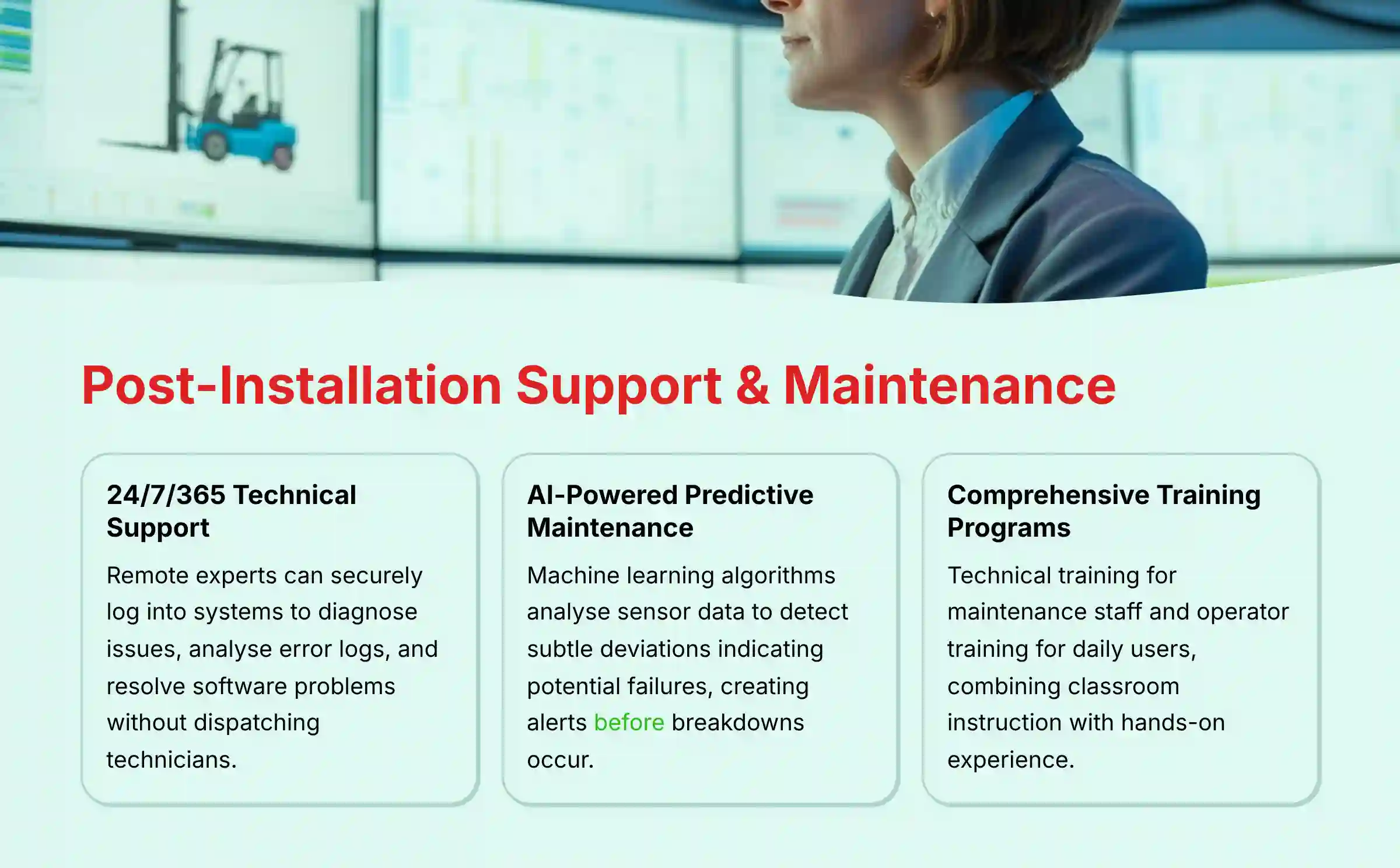
Dematic views the system “go-live” as the beginning of the partnership, not the end. Their post-installation support, known as Dematic Lifecycle Services, is a multi-tiered offering designed to ensure the system maintains peak performance, availability, and longevity throughout its operational life, which can be 15-20 years or more.
The support structure is typically broken down into several key areas:
- Technical Support & Helpdesk: This is the first line of defense.
- 24/7/365 remote technical support availability
- Experts can securely log into your system to diagnose issues
- Analyze error logs and resolve software-related problems remotely
- Often resolve issues without dispatching technician, minimizing downtime
- On-site Support & Maintenance: More comprehensive service level.
- Regularly scheduled preventative maintenance visits by certified technicians
- Physical inspections and component lubrication
- Replace worn components before they fail
- For critical operations: resident Dematic technicians permanently stationed at facility
- Predictive Maintenance (AI-Powered): This is a key benefit of the Dematic iQ software.
- AI and machine learning algorithms continuously analyze sensor data
- Learns normal operating parameters of motors, bearings, and components
- Detects subtle deviations indicating potential future failures
- Automatically creates alerts and generates work orders
- Allows scheduled maintenance during planned shutdown before unexpected breakdowns
- Technical and Operator Training:
- Comprehensive training programs under Lifecycle Services portfolio
- Specialized Technical Training for maintenance staff
- Operator Training for daily users
- Combines classroom instruction with hands-on experience
- “Train the trainer” methodologies for self-sufficiency
- Enables day-to-day operations and first-level troubleshooting capabilities
- Modernization and Upgrades:
- Services to upgrade and modernize existing systems as technology evolves
- Software enhancements and new feature implementations
- Retrofitting new, more efficient hardware
- Ensures initial investment continues delivering value for decades
The specific Service Level Agreement (SLA) is customizable, allowing you to choose the level of support that matches your operational criticality and in-house capabilities. For potential buyers, it's recommended to request the official training catalog and curriculum directly from a Dematic sales representative to confirm the specific training modules and certifications available for your proposed solution.
For additional frequently asked questions and detailed answers about Dematic implementations, visit our extensive Dematic FAQs resource center.
Related Resources & Further Reading
To gain deeper insights into warehouse automation and AI-powered solutions, explore our comprehensive guide on the Best 10 AI For Warehouse Robotics & Automation Solutions: The Definitive 2025 Guide that provides detailed comparisons and recommendations for various automation technologies.

Leave a Reply