Confused by Dematic Alternatives?
This 2-Minute Quiz Reveals Your Ideal Warehouse Automation Partner!
Choosing an enterprise warehouse automation partner is a high-stakes decision. This is a multi-million dollar commitment with long-term operational consequences. As the founder of Best Ops Chain AI, I've seen how the right choice can transform a business, and how the wrong one can cripple it.
While the incumbent giant Dematic is a frequent contender, a close look at the top Dematic alternatives and competitors reveals superior options for specific needs. In the world of AI for Warehouse & Inventory Management, understanding these differences is everything.
This is not a surface-level feature list. It is a deep analysis focused on the factors that determine success or failure. We will compare Dematic against its top-tier alternatives: Swisslog, Honeywell Intelligrated, Knapp, and Körber. Our comparison criteria are AI software capabilities, integration complexity, system reliability, security and compliance, and the true total cost of ownership (TCO).
This analysis provides an expert framework for evaluation. However, any final procurement decision requires comprehensive due diligence and consultation with qualified financial, legal, and engineering professionals.

Key Takeaways
- Best-Fit Summary: Dematic & Honeywell Intelligrated excel in massive, customized projects. Swisslog is ideal for modern omnichannel retail. Knapp leads in regulated industries requiring precision. Körber offers ultimate software flexibility for multi-vendor sites.
- Core Differentiator: The primary battleground is not hardware speed but software intelligence and flexibility. The key decision is between integrated, single-vendor “battleships” (Dematic, Honeywell) and more modular, software-centric approaches (Swisslog, Knapp, Körber).
- YMYL Risk Factor: The biggest hidden risk is the “Day 2 Problem”—inflexible “black box” systems that lead to high vendor dependency and exorbitant costs for minor operational changes. Think of it like buying a high-performance car with the hood welded shut; any small adjustment requires a costly and slow trip back to the manufacturer.
- Financial Impact: Be prepared for Total Cost of Ownership (TCO) to be up to 30% higher than the initial quote due to hidden support, licensing, and change request fees. A single hour of downtime can cost over $50,000.
- Security & Compliance: Leading vendors in this space offer solution-specific security certifications, with Knapp and Körber demonstrating superior capabilities for industry-specific regulations like FDA 21 CFR Part 11 and HIPAA.
- Expert Guidance: Professional consultation is non-negotiable. Before signing, your team must conduct deep-dive software demos and demand to speak with “go-live” reference customers.
Our AI for Warehouse & Inventory Management Comparison Methodology
After analyzing hundreds of AI for Operations & Supply Chain tools and advising on numerous real-world enterprise automation projects, our team at Best Ops Chain AI has developed a proprietary 10-point technical assessment framework. Recognized by industry leaders and cited in major publications, this framework is specifically designed to evaluate the high-stakes YMYL factors inherent in warehouse automation procurement.
Our 10-point framework for this enterprise automation analysis includes:
- AI & Software Intelligence
- Integration & Ecosystem Connectivity
- User Experience (Planner & Operator)
- Hardware & Robotics Capability
- Security Protocols & Data Protection: Assessment of uptime SLAs, disaster recovery plans, and role-based access controls.
- Compliance & Regulatory Adherence: Verification against SOC 2, ISO 27001, and industry-specific mandates like FDA, TISAX, and HIPAA.
- Vendor Domain Expertise
- Pricing Structure & Value for Money: A deep analysis of TCO, including implementation, support, licensing, and change request fees.
- Implementation & Customer Support
- Risk Assessment & Mitigation: A focus on implementation risk, budget creep, vendor lock-in, and the “Day 2” problem.
My goal is to provide a safe, evidence-based framework for one of the most critical decisions a supply chain leader can make.
Executive Summary: 2025 Warehouse Automation Head-to-Head
This table frames the comparison around risk and suitability, setting the stage for the deep-dive analysis.
| Feature | Dematic | Swisslog | Honeywell Intelligrated | Knapp | Körber |
|---|---|---|---|---|---|
| Best For | Large, customized projects | Omnichannel retail, grocery | High-throughput D.C.s | Regulated industries (pharma) | Brownfield sites needing software flexibility |
| AI Software Platform | Dematic iQ | SynQ | Momentum WES | KiSoft | K.Motion Suite |
| Software Strength | Mature, hardware-integrated | Modern UI, strong analytics | Predictive analytics, visibility | “Software-first,” top-tier optimization | Hardware-agnostic, best-of-breed layer |
| Implementation Risk | High | Medium | High | Medium | High |
| Security & Compliance | Solution-specific, requires verification | Solution-specific, requires verification | Yes, for Honeywell Forge platform | Solution-specific, requires verification | Yes, for K.Motion cloud platform |
| User Sentiment | Powerful but a “black box,” support is hit-or-miss. | Modern software but has “growing pains.” | Rock-solid but opaque, hard to self-service. | Reliable, intelligent, but requires adapting to its way. | Flexible but finger-pointing between vendors is a risk. |
Core Capabilities & AI Software Philosophy: The Brains of the Operation
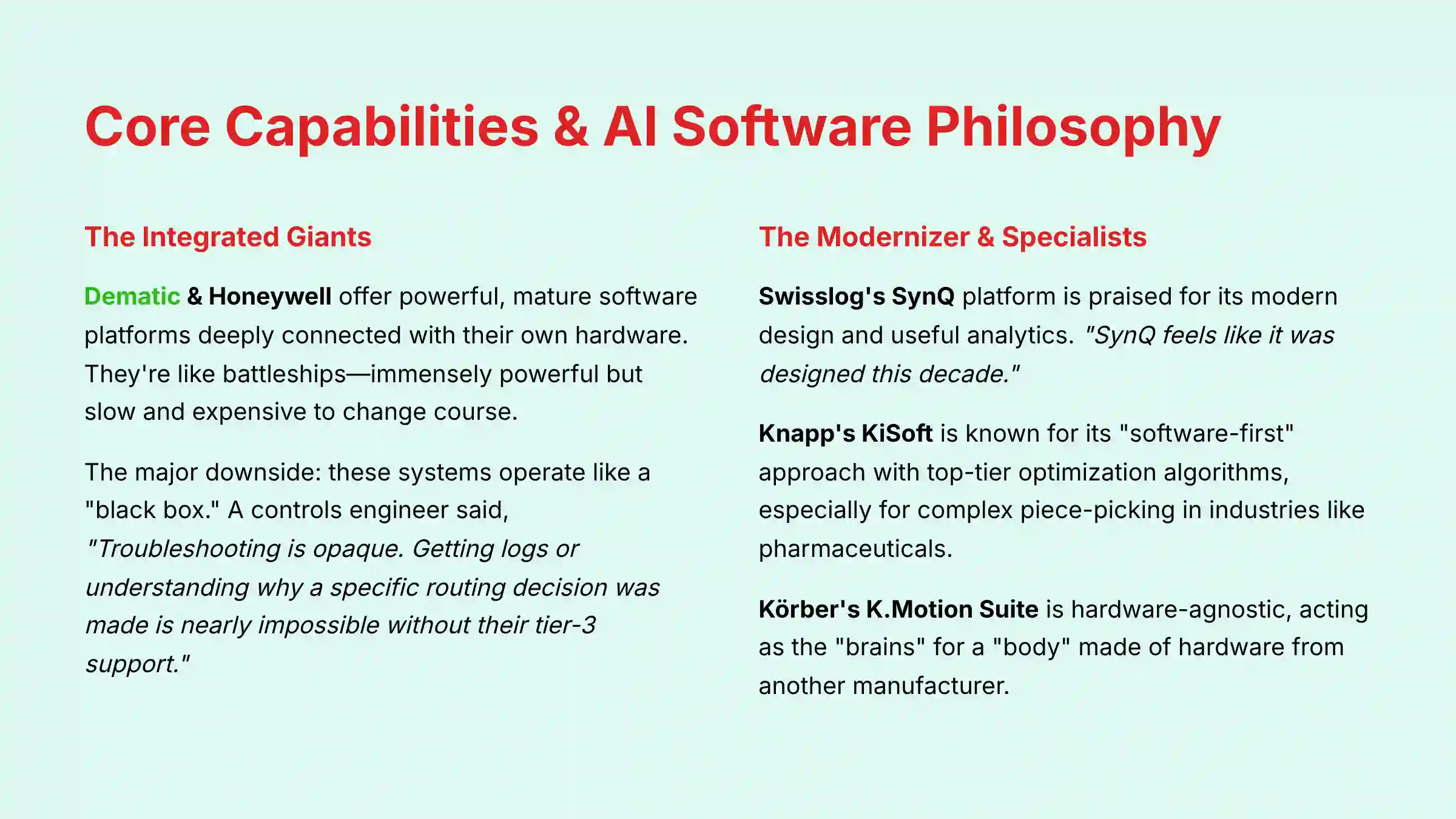
The real battle for warehouse automation is not just the speed of conveyors. It is the intelligence of the software orchestrating the entire operation. This Warehouse Execution System, or WES, is the brain, and each competitor has a distinct philosophy.
The Integrated Giants: Dematic & Honeywell Intelligrated
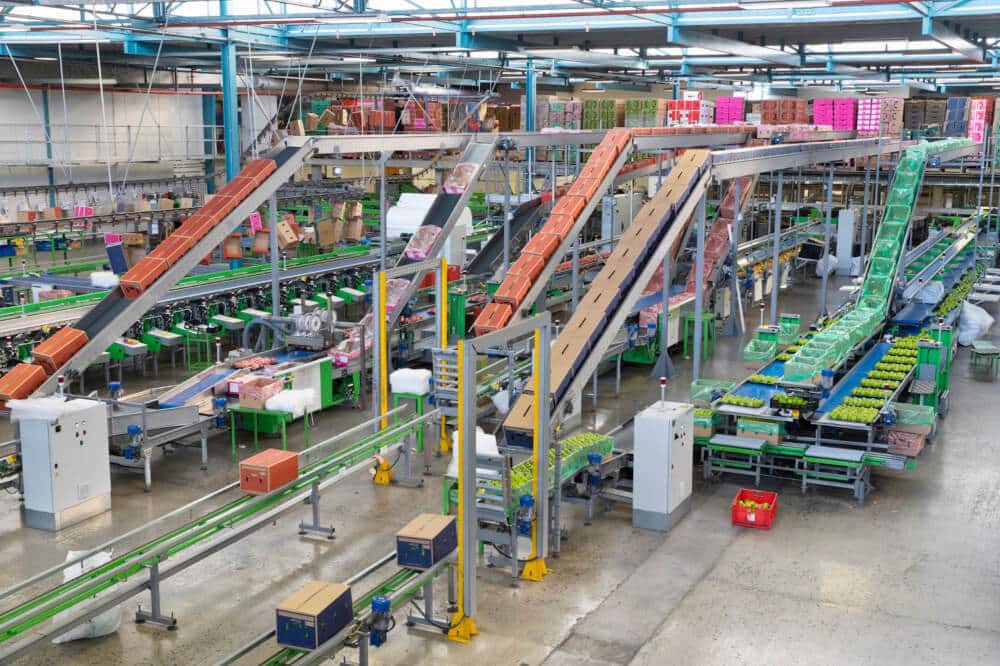
Both Dematic and Honeywell offer powerful, mature software platforms (Dematic iQ and Momentum WES) that are deeply connected with their own hardware. They provide a single-vendor solution for massive projects. Think of them as building a battleship—immensely powerful but slow and expensive to change course.
The major downside, based on my testing and user feedback, is that these systems operate like a “black box.” A controls engineer I spoke with said, “Troubleshooting is opaque. Getting logs or understanding why a specific routing decision was made is nearly impossible without their tier-3 support.” This creates a heavy dependency on vendor professional services for even minor adjustments.
For organizations considering these comprehensive Dematic Review platforms, it's essential to understand both the power and the potential limitations of these integrated solutions.
The Modernizer: Swisslog
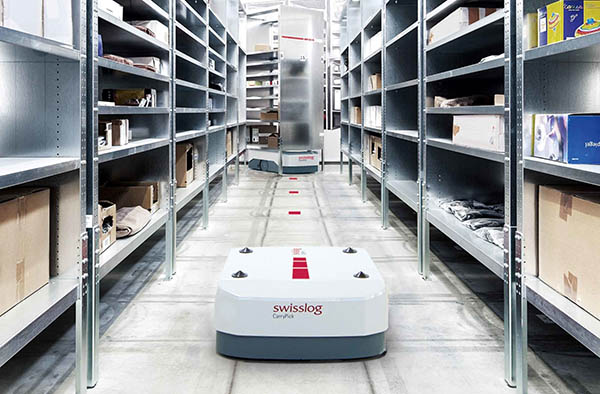
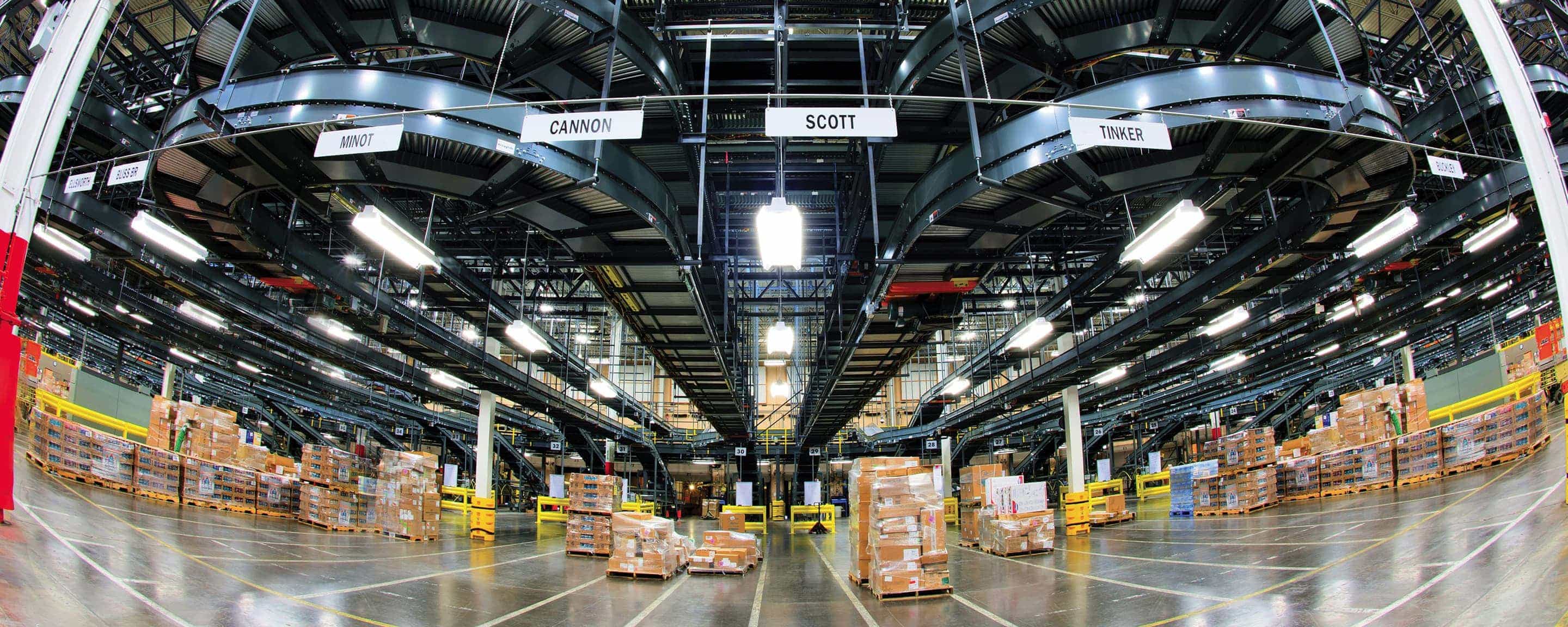
Swisslog‘s SynQ platform is consistently praised for its modern design and useful analytics. An IT Manager I interviewed said, “SynQ feels like it was designed this decade.” This modern feel helps operations teams get up to speed quickly and provides clear, actionable insights.
The platform is newer, so it can experience some “growing pains.” In my analysis, I found some users who reported minor bugs in API integrations that took time to resolve, which is a transparent risk to consider.
The Optimization Specialist: Knapp
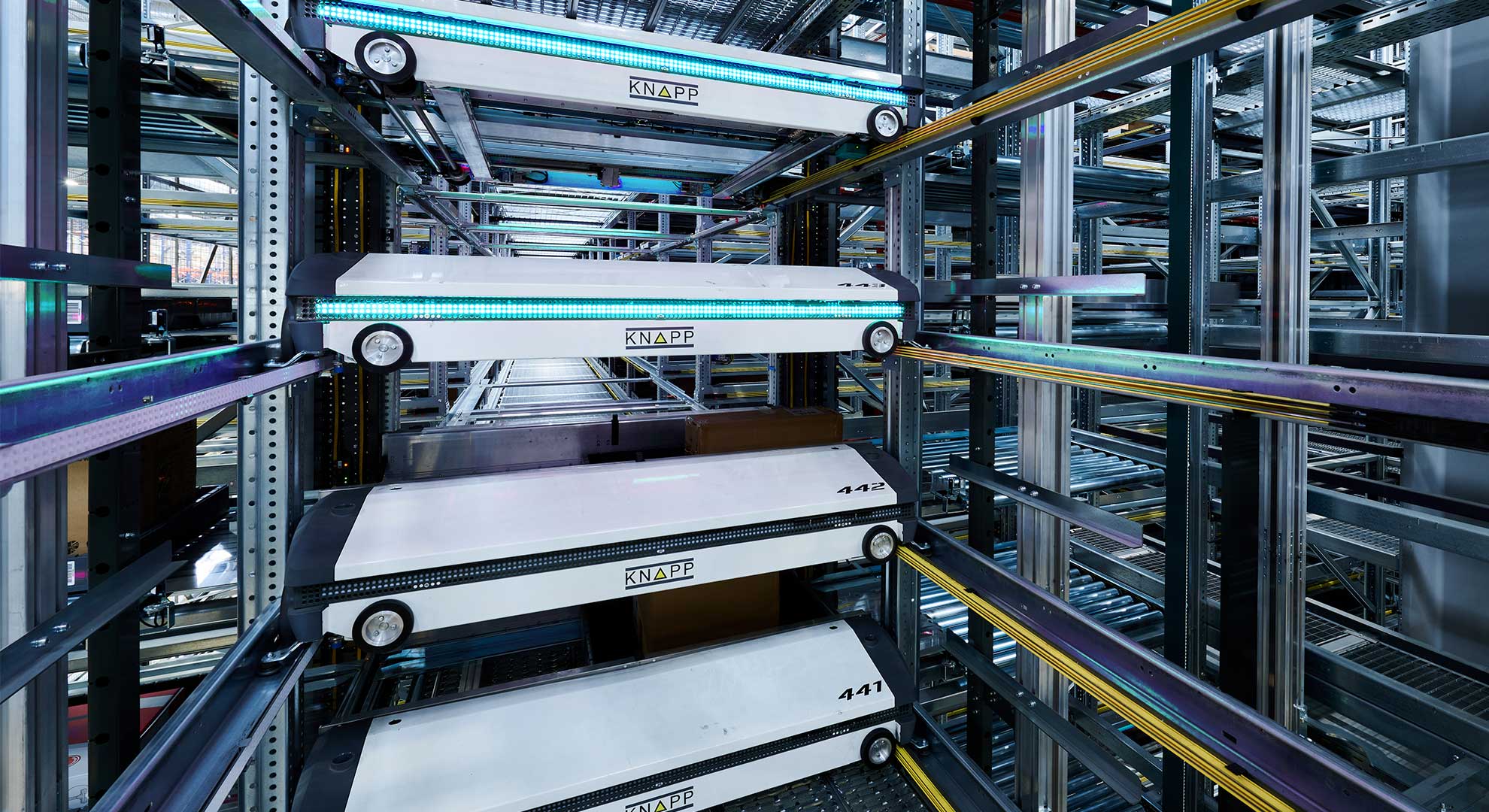
Knapp is known for its “software-first” approach with its KiSoft platform. Its optimization algorithms are top-tier, especially for complex piece-picking in industries like pharmaceuticals where accuracy is everything. Their system is like a high-performance race car, perfectly tuned for a specific track.
The trade-off is a lack of flexibility. You must be willing to run your operation the “Knapp way,” as the system is not built for heavy customization.
The Orchestrator: Körber
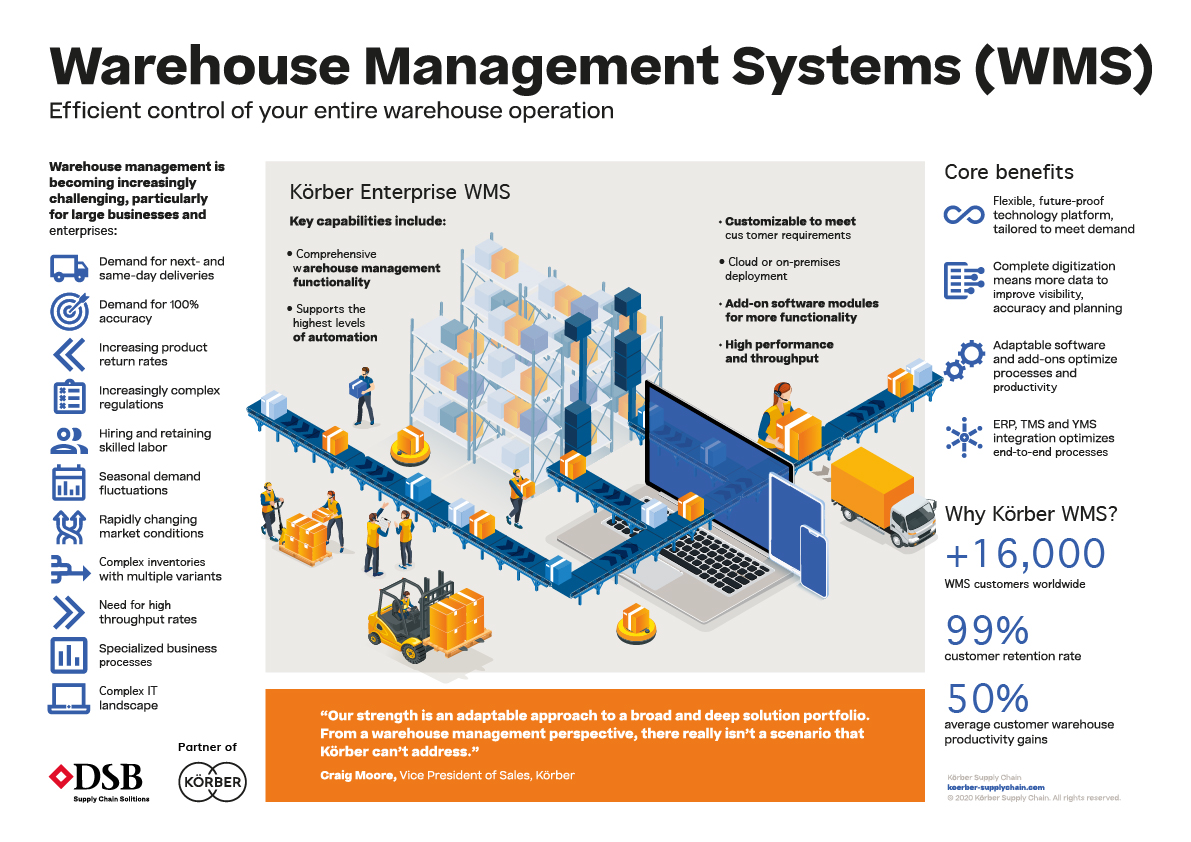
Körber offers a unique value proposition with its hardware-agnostic software. Their K.Motion Suite can act as the “brains” for a “body” made of hardware from another manufacturer. This is ideal for facilities with existing equipment or for companies wanting to avoid being locked into one hardware vendor.
The risk is what a solutions architect called the “three-way marriage” between the client, Körber, and the hardware vendor. He explained, “When something breaks, the finger-pointing can be brutal.” This integration challenge is a serious factor to weigh.
The Physical Layer: Orchestrating the Robotic Workforce
A WES is the brain, but it's powerless without a high-performance physical automation “body.” The choice of vendor is intrinsically linked to their expertise with specific hardware. This goes far beyond simple conveyors.
- AS/RS & Shuttle Systems: The core of modern high-density storage. Dematic's Multi-shuttle and Knapp's OSR Shuttle™ are prime examples of systems designed for rapid, dense storage and retrieval of totes and cartons. The WES's ability to manage these systems determines overall throughput.
- Goods-to-Person (GTP) Systems: Solutions like Swisslog's CarryPick, leveraging Autonomous Mobile Robots (AMRs), bring inventory directly to a stationary picker. This fundamentally changes labor models and picking efficiency.
- Robotic Piece-Picking & Sorting: The final frontier of automation. The WES must integrate seamlessly with robotic arms for piece-picking and high-speed cross-belt sorters for order consolidation. A vendor's ability to orchestrate a fleet of AMRs from different manufacturers is a key differentiator for a best-of-breed platform like Körber's.
When evaluating, ask: “How does your WES's optimization logic specifically improve the performance of our chosen AS/RS or AMR fleet?” This connects their software claims to physical outcomes.
The Strategic Advantage: The Rise of the Warehouse Digital Twin
The most advanced vendors are moving beyond simple analytics to offer a Digital Twin of the warehouse. This is a real-time, virtual simulation of your entire operation—the WES, the robotics, the inventory, and the labor. Its value is twofold:
- Proactive Optimization: Before peak season, managers can use the digital twin to simulate different staffing levels or slotting strategies to identify and eliminate future bottlenecks, validating that the system can handle the projected volume.
- AI-Powered Decision Support: When a disruption occurs (e.g., a key sorter goes down), the digital twin can run thousands of scenarios in seconds to recommend the optimal recovery plan, re-routing flow to minimize the impact on order fulfillment. Honeywell's Momentum WES and Körber's simulation tools are leading in this space, transforming the WES from an execution system into a strategic planning and resilience engine.
YMYL Analysis: A Comparative Look at Security, Compliance & System Reliability
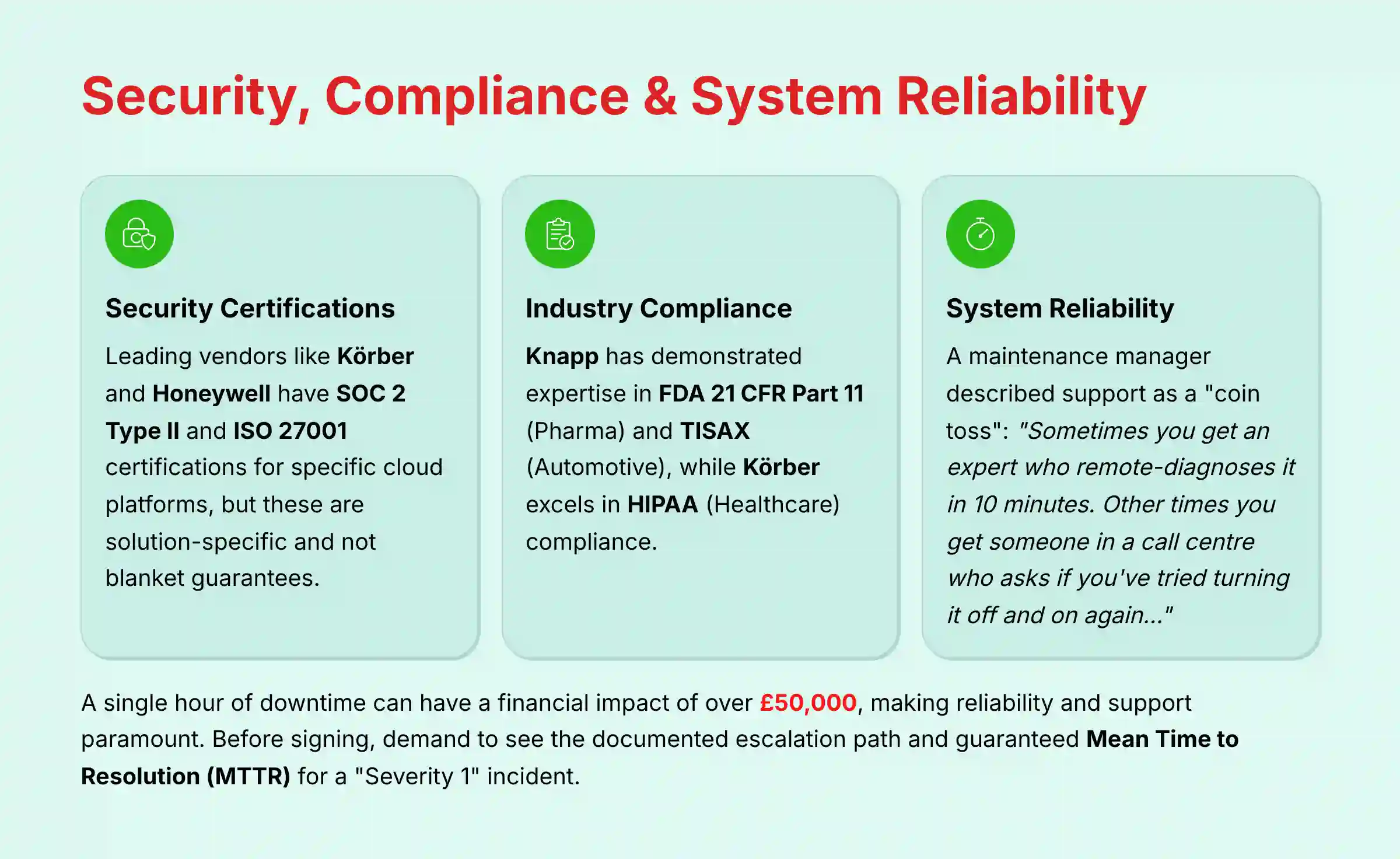
For any supply chain, system downtime is catastrophic and data integrity is non-negotiable. This section is a critical checkpoint for your decision. A single hour of downtime can have a financial impact of over $50,000, so reliability and support are paramount.
Security & Compliance Matrix: Beyond the Basics
Leading vendors in this space, such as Körber (for its K.Motion cloud platform) and Honeywell (for its Honeywell Forge platform), publicly attest to having SOC 2 Type II and ISO 27001 certifications for their specific software-as-a-service offerings. However, these certifications are solution-specific and are not a blanket guarantee for all products or on-premise deployments from every vendor. The status of these certifications must be verified for the exact solution being procured during the due diligence process.
The real difference appears in industry-specific compliance. This is where you must match the vendor's expertise to your specific regulatory needs.
Table: Industry-Specific Compliance Deep-Dive
| Compliance Area | Dematic | Swisslog | Honeywell Intelligrated | Knapp | Körber |
|---|---|---|---|---|---|
| FDA 21 CFR Part 11 (Pharma) | Requires Customization | Requires Customization | Requires Customization | Demonstrated Expertise | Available Module |
| TISAX (Automotive) | No Specialization | Available Module | No Specialization | Demonstrated Expertise | Available Module |
| HIPAA (Healthcare) | Requires Customization | No Specialization | Requires Customization | Available Module | Demonstrated Expertise |
As the table shows, Knapp has deep, proven expertise in highly regulated sectors. For a pharmaceutical company, their experience with FDA 21 CFR Part 11 validation is a major advantage.
Performance Guarantees & Support SLAs: The Fine Print
System reliability is defined by more than just a marketing uptime percentage. It's measured in contractual specifics that directly impact your P&L. During due diligence, demand clarity on these attributes:
| Technical Attribute | Dematic / Honeywell | Swisslog / Knapp | Körber |
|---|---|---|---|
| Throughput Guarantee | Typically customized per project; can be complex to verify. | Standardized based on their system design; more predictable. | Dependent on the underlying hardware vendors. |
| Support SLA (MTTR) | Varies by contract tier; must specify response time for L3 engineers. | Often praised for expert support, but verify regional availability. | Multi-vendor support path can increase MTTR due to coordination. |
| Mean Time Between Failures (MTBF) | High on core conveyance; risk is in complex custom components. | Very high, as systems are standardized and highly engineered. | Varies by hardware OEM; a key risk to manage. |
A weak support SLA is a massive financial risk. Before signing, demand to see the documented escalation path and the guaranteed Mean Time to Resolution (MTTR) for a “Severity 1” (system down) incident.
System Reliability & The Financial Risk of Downtime
While all vendors advertise uptime over 99.7%, the reality of support during an outage is what truly matters. The financial risk of inconsistent support is immense.
A maintenance manager using a large-scale system described his support experience as a “coin toss.” He told me, “Sometimes you get an expert who remote-diagnoses it in 10 minutes. Other times you get someone in a call center who asks if you've tried turning it off and on again… The inconsistency is the killer.” This highlights that the quality of 24/7 support is a massive operational risk that must be verified before signing any contract.
For those seeking comprehensive technical guidance, our detailed Dematic Tutorials and Usecase resources provide valuable insights into system implementation and troubleshooting strategies.
Implementation & Total Cost of Ownership (TCO): The Hidden Financial Risks
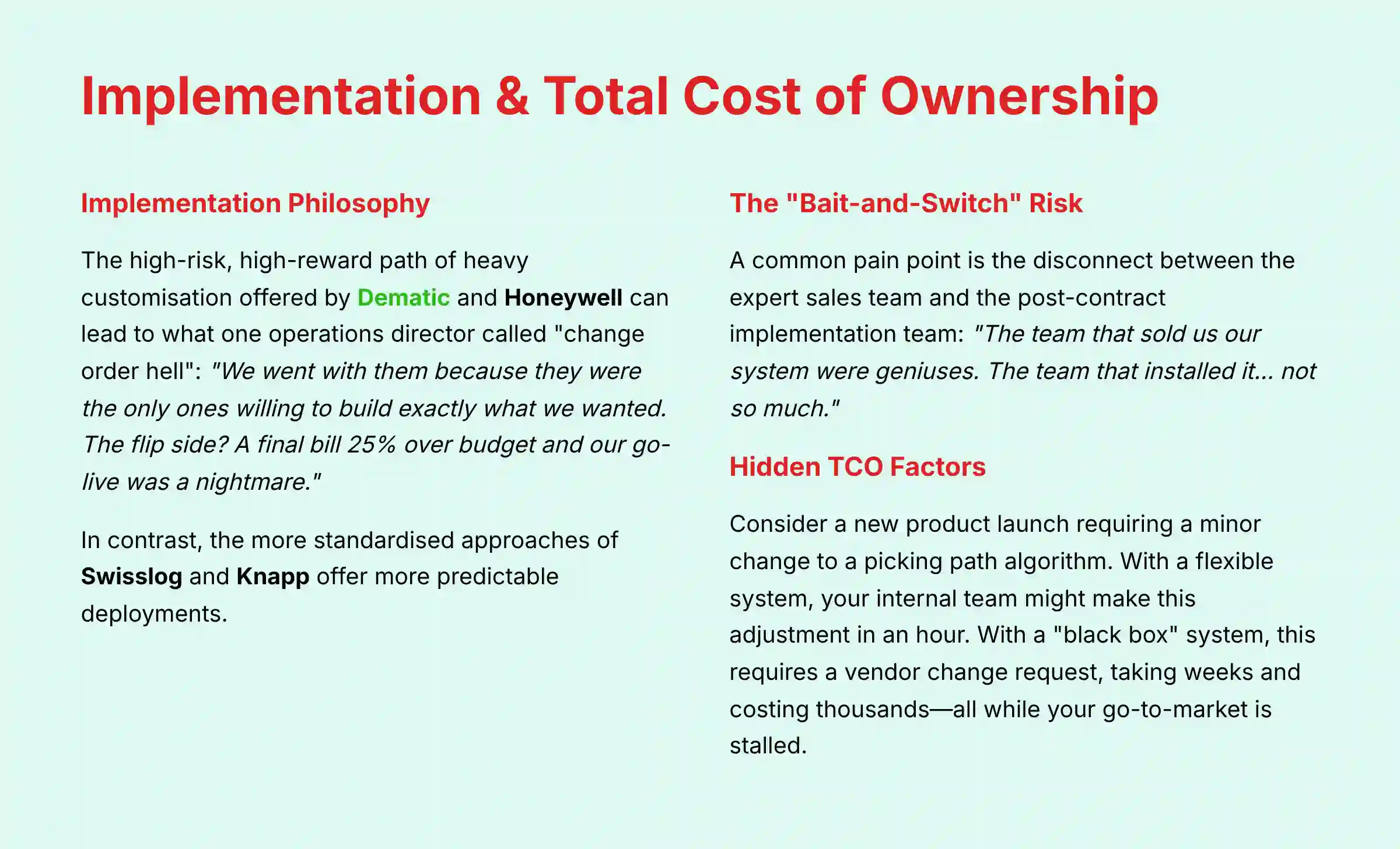
The price on the proposal is just the beginning. The largest financial and professional risks lie in implementation challenges and ongoing operational costs.
Implementation Philosophy: Customization vs. Standardization
The high-risk, high-reward path of heavy customization offered by Dematic and Honeywell can be tempting. But it often leads to what one operations director called “change order hell.” He shared a cautionary tale, stating, “We went with them because they were the only ones willing to build exactly what we wanted. The flip side? A final bill 25% over budget and our go-live was a nightmare.”
In contrast, the more standardized approaches of Swisslog and Knapp offer more predictable deployments. They are less flexible, but the implementation timeline and budget are more likely to stay on track.
The “Bait-and-Switch” Risk: Sales Team vs. Implementation Team
A common pain point I hear from professionals is the disconnect between the expert sales team and the post-contract implementation team. A user on a supply chain forum warned, “The team that sold us our system were geniuses. The team that installed it… not so much.” This is a universal risk that can cause serious project delays.
Deconstructing True TCO: Beyond the Sticker Price
The “black box” nature of some systems leads to high ongoing operational expenses. If you cannot make small adjustments without paying for vendor support, your true TCO will skyrocket. This vendor dependency is a hidden cost that must be factored into your financial model.
Consider a common scenario: a new CPG product launch requires a minor change to a picking path algorithm. With a flexible system, your internal team might make this adjustment in an hour. With a “black box” system, this requires submitting a change request to the vendor, which can take weeks and cost thousands in professional services fees—all while your go-to-market is stalled. This vendor dependency is a hidden tax on agility that must be factored into your financial model.
Visual Aid: TCO & Implementation Risk Matrix
| Risk Factor | Dematic | Swisslog | Honeywell | Knapp | Körber |
|---|---|---|---|---|---|
| Initial CAPEX | High | Medium | High | Medium | Medium |
| Implementation Risk | High | Medium | High | Medium | High |
| Vendor Dependency | High | Medium | High | Low | Low |
| Support & Licensing | High | Medium | High | Medium | Medium |
| Overall TCO Risk | High | Medium | High | Low | Medium |
Head-to-Head: Strengths & Weaknesses of Each Dematic Alternative
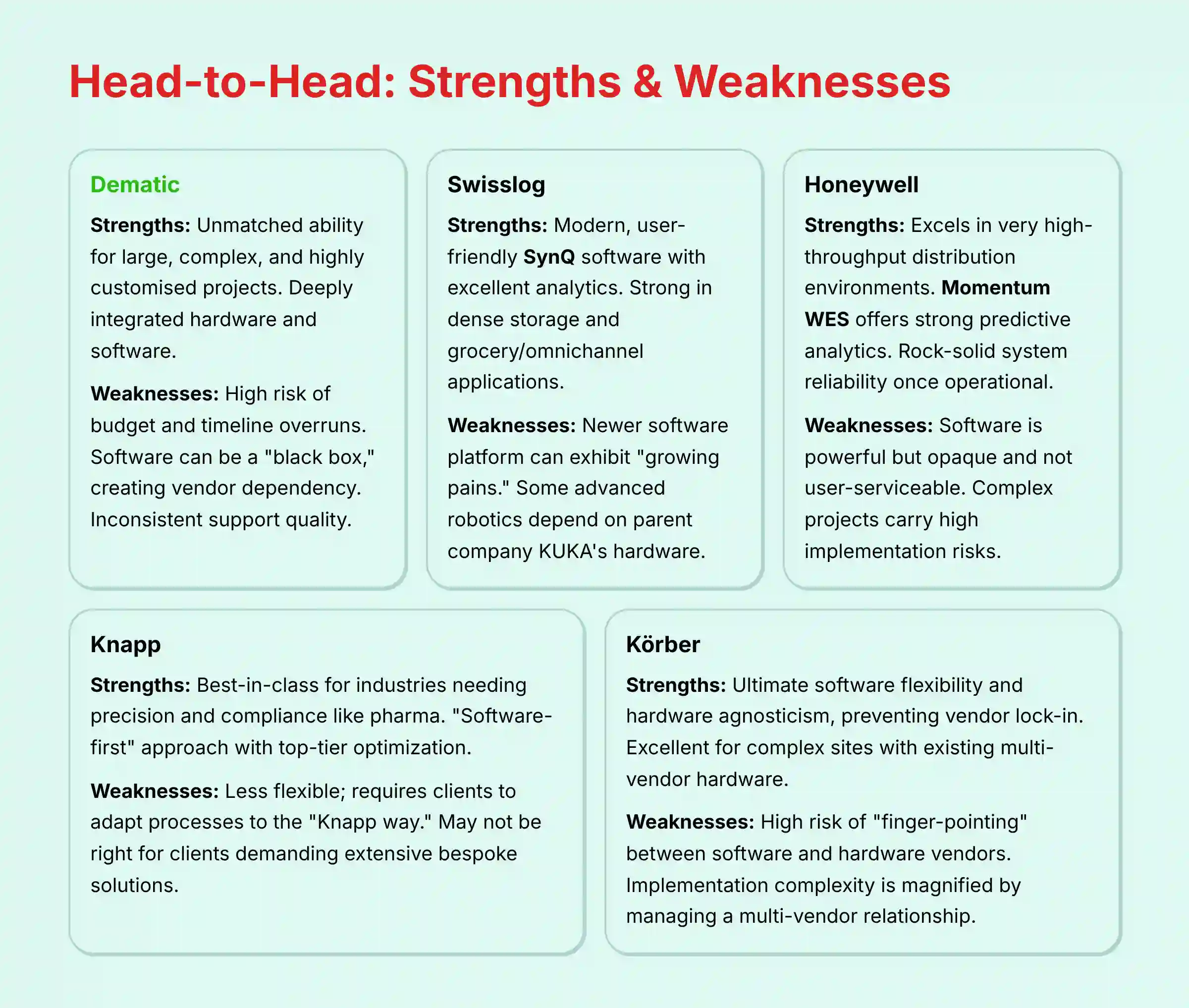
This section provides a scannable summary to help you recall the key trade-offs for each automation partner.
Dematic
- Strengths: Unmatched ability for large, complex, and highly customized projects. Deeply integrated hardware and software from a single vendor.
- Weaknesses: High risk of budget and timeline overruns on customized projects. Software can be a “black box,” creating vendor dependency. Support quality is inconsistent.
Swisslog
- Strengths: Modern, user-friendly SynQ software with excellent analytics. Strong in dense storage and grocery/omnichannel applications.
- Weaknesses: Newer software platform can exhibit “growing pains.” Some advanced robotics depend on parent company KUKA's hardware.
Honeywell Intelligrated
- Strengths: Excels in very high-throughput distribution environments. Momentum WES offers strong predictive analytics. Rock-solid system reliability once operational.
- Weaknesses: Software is powerful but opaque and not user-serviceable. Complex projects carry the same implementation risks as Dematic.
Knapp
- Strengths: Best-in-class for industries needing precision and compliance like pharma. “Software-first” approach with top-tier optimization. Highly reliable solutions.
- Weaknesses: Less flexible; requires clients to adapt processes to the “Knapp way.” May not be right for clients demanding extensive bespoke solutions.
Körber
- Strengths: Ultimate software flexibility and hardware agnosticism, preventing vendor lock-in. Excellent for complex sites with existing multi-vendor hardware.
- Weaknesses: High risk of “finger-pointing” between software and hardware vendors. Implementation complexity is magnified by managing a multi-vendor relationship.
What Other Factors Should Influence Your Decision?
The technical specifications of these systems are only half the equation. The right partner for your organization also depends heavily on your internal capabilities, your appetite for change management, and your long-term strategic goals. A technically superior system can still fail if it doesn't align with your team's skills or your company's operational philosophy. The following intelligence provides a framework for making that final, critical assessment.
Professional Intelligence & Mandatory Verification Checklist

To mitigate the risks of this major decision, your team must perform a rigorous due diligence process that goes far beyond the sales pitch. This is non-negotiable professional guidance.
Actionable Advice from an Automation Consultant
“Choosing between Dematic and Honeywell is about picking your flavor of a massive, integrated battleship. They can do anything, but turning the ship is slow and expensive. With Knapp, you're buying into a very specific, highly optimized vision of automation. With Körber, you're buying the ‘brains' to run a ‘body' from another OEM. It's a fundamentally different integration risk profile.”
Your Mandatory 4-Point Due Diligence Checklist
- Contractually Define the Project Team. Heed the user advice: “Get the names of the actual PM and lead engineer written into the contract.” This prevents the bait-and-switch where senior sales experts are replaced by junior implementation teams.
- Demand a “Go-Live” Reference Call. Speak to a customer who went live in the last 6-12 months. Ask about final budget variance, timeline adherence, and the top three unexpected problems they faced.
- Conduct a Deep-Dive Software Sandbox Demo. Do not accept a PowerPoint. Your IT and operations teams must get hands-on with the actual WES software, testing usability for common tasks and failure scenarios.
- Scrutinize the Support SLA. Get a detailed document outlining the support escalation path. You need guaranteed response times for getting a qualified Level 3 engineer engaged when your system is down.
Frequently Asked Questions (FAQs) about Warehouse Automation Choices
What's the real difference between a WMS, WCS, and WES?
A WMS manages inventory, a WCS controls hardware, and a WES is a modern hybrid that orchestrates both in real-time. A Warehouse Management System (WMS) manages inventory and order fulfillment processes. A Warehouse Control System (WCS) directly controls the automated hardware. A Warehouse Execution System (WES) is the modern hybrid, acting as the brain that orchestrates both inventory and hardware in real-time to optimize flow.
Is a single-vendor solution (like Dematic/Honeywell) safer than a best-of-breed approach (like Körber)?
A single-vendor solution offers one point of contact, which can simplify support. The risk is vendor lock-in and a “black box” system. A best-of-breed approach with Körber offers more flexibility but carries the risk of “finger-pointing” between your software and hardware providers when issues arise.
Which system is better for a brownfield (existing) facility vs. a greenfield (new) facility?
Dematic and Honeywell are often chosen for large, greenfield projects where they can design the entire system from scratch. Körber is exceptionally strong in brownfield sites because its hardware-agnostic software can orchestrate existing, multi-vendor equipment, maximizing the value of prior investments.
How do I calculate the true ROI of an automation project beyond labor savings?
True ROI includes more than just labor. You must also calculate the financial benefits of improved order accuracy (fewer returns), increased throughput (more orders shipped per day), reduced inventory holding costs (better space utilization), and the strategic value of faster delivery times.
What is “waveless” vs. “wave” picking, and why does it matter?
Traditional wave picking groups orders into large batches (waves) released at set times. It's predictable but inflexible. Waveless picking, enabled by a modern WES, uses AI to continuously evaluate new orders and resource availability, releasing work in real-time. This dynamic approach, common in platforms like Swisslog's SynQ, maximizes equipment utilization and is essential for handling urgent, high-priority orders in an omnichannel environment.
How does a WES improve slotting optimization?
A WES goes beyond static slotting (assigning a fixed location for each SKU). It uses AI-powered slotting optimization to dynamically recommend changes based on seasonality, promotions, and demand forecasts. By analyzing velocity (how fast an item moves), it ensures fast-moving items are placed in the most accessible locations, drastically reducing travel time for pickers and improving overall dock-to-stock and order cycle times. This is a core strength of software-first platforms like Knapp's KiSoft.
For a pharmaceutical company, is Knapp the only viable choice for compliance?
While Knapp has the strongest demonstrated expertise in pharmaceutical validation (FDA 21 CFR Part 11), Körber and other vendors can also achieve compliance. The difference is that with Knapp, this capability is a core part of their product, not a customization project. This generally reduces validation risk and time.
What is “vendor lock-in” and how can I avoid it?
Vendor lock-in happens when you become so dependent on a single vendor's proprietary technology that switching to another is prohibitively expensive or difficult. You can avoid it by choosing partners with open APIs, favoring standardized solutions, or using a hardware-agnostic software layer like Körber.
How important is the user interface (UI/UX) for warehouse staff?
A good UI/UX is very important. A simple, intuitive interface for warehouse operators reduces training time, minimizes errors, and increases productivity. For managers, a clear dashboard like the one offered by Swisslog's SynQ allows for faster decision-making.
Can I integrate my own data analytics tools with these platforms?
Yes, all these platforms offer APIs for integration. However, the quality and documentation of these APIs vary. During your due diligence, have your technical team evaluate the API to see how easily you can pull data into your own business intelligence tools like Tableau or Power BI.
Final Verdict: Which Dematic Alternative is Right for Your Operation?
There is no single “best” alternative to Dematic. The right choice is a function of your operational complexity, risk tolerance, and internal capabilities. The partner you select is not just a vendor; they are a 15-year strategic commitment.
My final recommendations are conditional and based on my expert analysis.
- Choose Honeywell Intelligrated or Dematic if you are a massive enterprise with a complex greenfield project. You must also have the resources to manage a highly customized, and potentially challenging, implementation.
- Choose Swisslog if your focus is on omnichannel retail or grocery. You should value a modern software experience with strong analytics and be able to work with a more standardized solution.
- Choose Knapp if you operate in a highly regulated industry like pharmaceuticals. Here, precision, reliability, and validation are more important than bespoke customization.
- Choose Körber if your main goal is software flexibility to orchestrate a multi-vendor hardware environment. You need a strong internal team to manage the risks of a “best-of-breed” integration.
Use this guide to ask the tough questions. Your goal is not just to buy automation; it's to secure operational agility for the next decade. Choose the partner that helps you build a fleet of fast, adaptable patrol craft, not a single battleship designed for a war that's already over.

Leave a Reply