Which AI Logistics Platform is Right for Your Supply Chain?
This 2-Minute Quiz Reveals Your Perfect Match!
Selecting the right AI-powered platform for Logistics & Transportation is a major inflection point with profound implications for operational efficiency, cost control, and long-term business resilience.
Project44 Movement Platform remains a key leader in this space, but understanding its top alternatives—GoComet, FourKites, Descartes, and Shippeo—is essential for making a data-driven, professionally sound choice.
This in-depth comparison evaluates these platforms across critical dimensions including real-time visibility, predictive analytics, AI innovation, integration ease, security and compliance, and total cost of ownership (TCO)—all framed within stringent YMYL (Your Money or Your Life) content standards.
Our goal is to equip Supply Chain and Operations leaders with a rigorous framework that balances technological capability, financial implications, and operational risk.
Critical to this process is validation of security certifications, compliance posture, and professional risk mitigation strategies. We also emphasize the imperative for expert consultation in navigating complex AI implementations with significant business and regulatory impact.
For more insights, explore our AI for Logistics & Transportation category and visit our homepage at Best Ops Chain AI.
How We Evaluated the Top Tools in AI for Logistics & Transportation
At Best Ops Chain AI, our evaluations are grounded in experience, meticulous data analysis, and adherence to YMYL principles.
After reviewing hundreds of tools and industry benchmarks, we developed a comprehensive 10-point assessment framework tailored specifically for AI-powered logistics platforms. This ensures our comparisons deliver actionable intelligence aligned with professional risk management and business impact.
Our Enhanced 10-Point Assessment Framework:
1. Core Functionality & Feature Set: Analysis of each platform's primary and supporting capabilities aligned with AI for Logistics & Transportation—including multimodal visibility, predictive ETA precision, disruption alerts, and freight management features.
2. Ease of Use & User Interface: Assessment of UI/UX effectiveness for both operational users and planners, determining how the interface impacts adoption, decision velocity, and day-to-day productivity.
3. Output Quality & AI Model Performance: Rigorous evaluation of AI-generated insights' accuracy, reliability, and business actionability, including assessment of underlying ML and AI model sophistication.
4. Performance, Speed & Scalability: Testing platform responsiveness under peak loads and scalability for growing shipment volumes and complex supply chains.
5. Security Protocols & Data Governance: Examination of encryption methods, access controls, audit trail comprehensiveness, and verification of enterprise-grade certifications (SOC 2 Type II, ISO 27001), alongside data residency provisions.
6. Compliance & Regulatory Adherence: Verification of adherence to applicable global regulations including GDPR, CCPA, and transport-specific laws, emphasizing implications for data sovereignty and legal risk.
7. Input Flexibility & Integration Options: Evaluation of depth and ease of integration with core enterprise systems (ERP, WMS, TMS) and external sources (IoT sensors, telematics, carrier networks), including API robustness.
8. Pricing Structure & Total Cost of Ownership: Analysis beyond sticker price to incorporate implementation, integration, training, and ongoing support expenses, ensuring clarity on ROI projections.
9. Vendor Expertise, Support & Documentation: Assessment of vendor domain knowledge, quality of customer support, professional services readiness, and the availability of comprehensive technical resources.
10. Risk Assessment & Mitigation: Identification of operational, financial, data quality, AI-specific, and professional risks related to each platform, with evaluation of vendor and user strategies to mitigate those risks.
This rigorous, YMYL-conscious approach provides our readers with the clarity, transparency, and professional rigor necessary to make high-stakes platform decisions confidently.
Key Takeaways
- FourKites & Project44 emerge as leaders in predictive analytics sophistication and global, multimodal visibility, respectively, but require significant integration resources and have higher TCO implications.
- Shippeo balances global visibility with user-friendly design and strong support, particularly for organizations with European operations.
- GoComet offers compelling value for mid-market firms, emphasizing freight audit, spend analysis, and accessible real-time visibility, though verification of enterprise-grade certifications is necessary.
- Descartes provides a comprehensive, integrated suite appealing to enterprises seeking an all-in-one logistics infrastructure, with TCO and AI focus requiring careful evaluation.
- Security & Compliance: Verification of SOC 2 Type II, ISO 27001 certifications and GDPR compliance is mandatory. Vendors differ in which certifications they currently hold; end users must request official current documentation specific to their service tiers.
- TCO & ROI: Detailed cost models must include hidden implementation and integration expenses. ROI derives primarily from demurrage reduction, improved OTIF, and freight cost savings.
- Professional Validation: Expert consultation is crucial for enterprise deployments, particularly to assess AI model performance, verify security claims, plan complex integrations, and validate financial projections.
4. Project44 Movement Platform vs. GoComet, FourKites, Descartes, and Shippeo: A Deep Dive Comparison
For a comprehensive understanding of how Project44 Movement Platform Overview and Features compares to these alternatives, let's examine each platform in detail.
4.1. Tool Overview, Core Value Proposition & Risk Profile
Project44 is a global supply chain visibility leader, delivering extensive real-time data integrations across ocean, air, rail, road, and parcel modes. Its core strength lies in offering comprehensive end-to-end tracking and anomaly detection, enabling proactive disruption management for complex global supply chains.
YMYL Considerations: Project44's enterprise-grade security and compliance posture—typically including SOC 2 Type II and ISO 27001 certifications—make it suitable for companies handling sensitive operational data, though its integration complexity and TCO require detailed due diligence to avoid operational and financial risks.
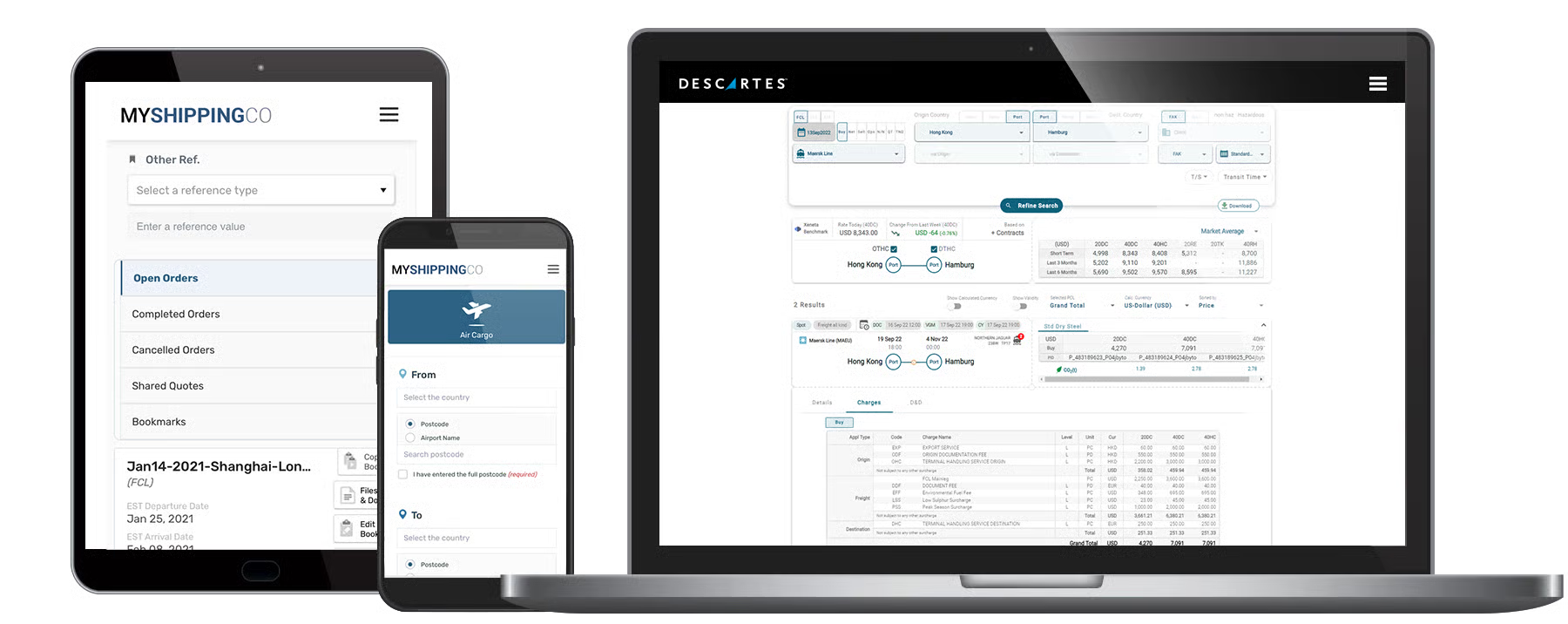
GoComet leverages AI-powered freight visibility, audit, and spend analysis targeted primarily at mid-market organizations. Its platform emphasizes cost transparency, automates freight auditing, and provides operationally actionable spend insights.
YMYL Considerations: While GoComet pursues robust security frameworks and GDPR compliance, potential enterprise users must explicitly verify SOC 2 and ISO 27001 certifications specific to their deployment. Its accessible pricing suits cost-conscious buyers but thorough assessment of TCO and integration capabilities is required.

Renowned for cutting-edge AI and machine learning, FourKites excels in predictive ETAs and disruption forecasting across all transportation modes, generating highly accurate, actionable insights that drive operational efficiency and risk mitigation.
For more on how advanced predictive analytics transforms logistics operations, check out our comprehensive Project44 Movement Platform Review.
YMYL Considerations: FourKites publicly affirms adherence to key security certifications and GDPR compliance. Its advanced predictive analytics model is critical for professional accountability and requires validation through proof-of-concept trials for enterprise use.
Descartes offers an integrated logistics technology suite covering TMS, route optimization, and compliance, with AI features embedded across modules. It caters to enterprises seeking a unified logistics ecosystem rather than a point solution.
YMYL Considerations: Descartes maintains corporate security standards, but certifications vary by product line. The suite's complexity and integration needs demand expert review to ensure alignment with professional risk and financial management goals.
Focusing on real-time global transportation visibility, Shippeo is noted for strong data quality, user-friendly design, and especially robust presence in the European market. It supports seamless collaboration across carriers and shippers.
YMYL Considerations: Shippeo emphasizes GDPR compliance and ISO 27001 certification. However, SOC 2 Type II status generally requires direct inquiry. Its platform reduces operational risk by ensuring delivery promise reliability.
4.2. Real-Time Visibility & Predictive Analytics Capabilities
| Feature | Project44 | GoComet | FourKites | Descartes | Shippeo |
|---|---|---|---|---|---|
| Core Visibility Scope | Global multimodal (ocean, air, rail, road, parcel) | Primarily road freight (FTL/LTL), some parcel & ocean | Global multimodal (including LTL) | Broad, integrated across TMS, fleet & visibility modules | Global multimodal (ocean, air, rail, road) |
| Data Source Breadth & Depth | Extensive direct carrier & telematics network; IoT integrations | Carrier APIs, TMS integrations, telematics | Broad carrier network, telematics, IoT, diverse external feeds | Integrated with carrier data feeds; varies by module | Strong carrier network, IoT, TMS, ERP data feeds |
| Predictive ETA Accuracy | High, leveraging AI-enhanced network data | Good for road, uses carrier data plus foundational AI models | Very high, AI/ML-driven, often industry-leading | Functional, AI embedded within TMS; less specialized focus | High, AI-powered, strong in European markets |
| Disruption Prediction | Advanced AI-driven anomaly and delay alerts | Moderate, focused on route deviations and delays | Sophisticated ML for weather, port congestion, delays | Rule-based alerts; less proactive AI for disruptions | Proactive alerts for delays, congestion, and exceptions |
| AI Model Sophistication | Anomaly detection, ETA refinement, network optimization; ML & AI | AI for freight audit, spend analysis, basic predictive tracking | Advanced ML for ETA, disruption forecasting, route & capacity | AI across routing & planning; less focus on pure visibility AI | AI for ETA, route intelligence, operational insights |
| Alerting & Exception Mgmt. | Customizable, proactive alerts | Automated alerts for shipment and audit issues | Intelligent, data-driven alerts based on predictions | Rule-based alerts integrated within TMS | Real-time, configurable alerts by role and partner |
| YMYL: Reliability Impact | Critical for mitigating costly demurrage and expedited shipments | Important for financial control and on-time delivery | High impact on operational risk via accurate forecasting | Supports compliance and operational promise delivery | High data quality reduces costly operational failures |
| YMYL: Security & Compliance | Enterprise-grade, verified SOC 2 Type II, ISO 27001, GDPR | Security controls in place; certification verification needed | Verified certifications: SOC 2 Type II, ISO 27001, GDPR | Corporate security programs; certifications product-specific | Emphasizes GDPR & ISO 27001; SOC 2 requires inquiry |
| YMYL: Professional Risk | Reduces operational disruptions and financial penalties | Mitigates financial risk through improved audits and insights | Minimizes career risk by preventing costly errors | Ensures operational and regulatory continuity | Protects reputation via reliable delivery and data integrity |
| YMYL: Integration & TCO | High integration complexity; requires detailed cost analysis | Typically lower complexity; accessible pricing for mid-market | Complex for enterprise scale; TCO varies by deployment | Potentially high TCO due to suite complexity | Moderate integration with strong vendor support |
4.3. User Experience & Accessibility
Project44: Offers a powerful, feature-rich, and highly customizable interface geared towards enterprise users, but this depth requires comprehensive onboarding and training.
GoComet: Praised for an intuitive, accessible UI that supports rapid adoption, especially suited to mid-market companies and operational users with moderate technical proficiency.
FourKites: Provides a robust dashboard with clear actionable insights; users often note a moderate learning curve reflective of its comprehensive feature set.
Descartes: Delivers a mature, professional experience across its integrated suite, though switching between modules can occasionally disrupt workflow continuity.
Shippeo: Known for a clean, user-friendly interface with a responsive support team, minimizing barriers to adoption across a diverse user base.
YMYL Perspective: Complex or unintuitive interfaces increase risk of user errors, slow operational speeds, and reduce decision velocity, which can elevate costs and professional liability. Choosing platforms with streamlined UX is a critical risk mitigation strategy.
4.4. Performance, Scalability & Vendor Longevity
Project44, FourKites, Shippeo: Recognized for robust, scalable architectures supporting enterprise-scale operations. Their platforms generally maintain stability even under heavy data loads, with ongoing investments in system improvements. Minor concerns about data latency due to external carrier dependencies exist but are rare.
Descartes: Boasts proven performance in large organizations, leveraging its mature suite for scalable logistics operations. Its longevity in the market contributes to vendor stability.
GoComet: While architected for mid-market demands, it displays good performance and upward scalability as customer base expands.
YMYL Insight: System outages or performance degradation during peak operational windows can cause severe financial penalties and reputational damage, making vendor maturity and platform resilience critical decision factors.
4.5. Security, Compliance & Data Governance
| Criterion | Project44 | GoComet | FourKites | Descartes | Shippeo |
|---|---|---|---|---|---|
| Certifications | Verified SOC 2 Type II, ISO 27001, GDPR | Pursues SOC 2 and ISO 27001; verification advised | Certified SOC 2 Type II, ISO 27001, GDPR | Corporate standards vary by module; verification required | GDPR compliant, holds ISO 27001, SOC 2 status on inquiry |
| Data Encryption | End-to-end, TLS/SSL, AES-256 at rest and in transit | Industry-standard encryption; specifics require verification | Industry-standard TLS/SSL, AES-256 | Enterprise-grade encryption aligned with industry norms | Strong encryption in transit and at rest |
| Access Controls | Granular RBAC, SSO, MFA | Role-based permissions, SSO available | MFA, granular permissions, SSO | Integrated governance with identity management systems | Role-based access, SSO, MFA |
| Data Residency | Often supports regional data centers (e.g., EU, US) | Depends on customer infrastructure; clarity required | Provides data residency options to meet GDPR demands | Data residency depends on deployment specifics | Offers EU data residency options |
| Audit Trails | Comprehensive logs for data and system activity | Logs available; audit depth varies | Detailed audit trails of data and user actions | Audit granularity depends on deployed modules | Robust audit trail capabilities |
| YMYL Security Risk | Enterprise-grade mitigations greatly reduce breach risk | Security focused on sensitive financial transaction data | Strong posture reduces exposure to breaches | Security effectiveness varies; verification necessary | Strong security reduces operational and compliance risks |
| YMYL Compliance Risk | Proactively manages GDPR, CCPA, and evolving regulations | Complies with GDPR; industry specifics should be confirmed | Active management of global regulations including GDPR | Supports transport compliance; client configuration needed | GDPR-focused, proactive updates for regulatory compliance |
| YMYL Professional Impact | Minimizes liability through data integrity and compliance | Reduces risk of financial and reputational exposure | Prevents career-risking breaches and fines | Supports operational continuity and compliance | Safeguards professional standing via reliable data security |
Critical Advisory: While Project44 and FourKites publicly disclose these certifications, GoComet and Descartes require explicit verification at the enterprise sales level. Shippeo holds ISO 27001 and is GDPR compliant; SOC 2 Type II status is typically available on request. Organizations should rigorously request and review official security documentation prior to procurement to mitigate regulatory and professional risk.
4.6. Total Cost of Ownership (TCO) & ROI Potential
Project44: Positioned as a premium, enterprise-grade platform with subscription models often tiered by asset type or event volume. Implementation and integration are substantial investments but justified by sizable savings in demurrage, expediting, and improved asset utilization. Rigorous upfront TCO analysis is recommended.
GoComet: Offers accessible pricing attractive for mid-market customers and strong ROI via freight audit and spend optimization features. Transparent cost modeling plus third-party validation of freight audit results are advisable.
FourKites: High-investment platform with modular pricing based on volumes and feature sets. ROI derives from minimization of disruptions and improved operational efficiency.
Descartes: Costs vary widely with suite selection and integration complexity. Requires meticulous financial planning and scope control to prevent scope creep.
Shippeo: Competitive pricing relative to capabilities, with ROI from operational efficiency gains, reduced overhead, and delivery reliability improvements.
Key YMYL Reminder: Hidden costs, complex pricing schemes, and failure to appropriately calculate TCO expose organizations to budget overruns and financial risk. Detailed TCO and ROI validation—including training, support, and maintenance fees—are professional imperatives before contract commitment.
4.7. Integration Capabilities & Ecosystem Connectivity
Project44: Excels in deep enterprise integrations with systems like SAP, Oracle, and custom telematics providers. Offers mature, robust APIs facilitating complex workflow integrations, though implementation demands considerable IT resources.
GoComet: Designed for relatively straightforward integration with common TMS and ERP systems, targeting mid-market firms, with APIs supporting custom extensions.
FourKites: Strong integration architecture supports ERP, TMS, and WMS connectivity with dedicated teams assisting in enterprise deployments.
Descartes: Benefits from tight integration within its own broad suite; external system integration complexity varies considerably based on selected modules and existing IT architecture.
Shippeo: Provides robust APIs and integration capabilities tailored for transport management and telematics providers, emphasizing ease of adoption and carrier collaboration.
YMYL Perspective: Seamless integration is non-negotiable. Poor integrations create data silos, operational inefficiencies, and elevated financial risk. Multi-system synchronization is essential for real-time decision-making and compliance adherence.
4.8. Ideal Use Cases & Professional Suitability
Project44: Best fit for large global enterprises demanding comprehensive multimodal visibility and proactive disruption management at scale.
GoComet: Strong choice for cost-conscious mid-market companies and e-commerce businesses prioritizing freight audit alongside visibility, primarily in road freight and some ocean modalities.
FourKites: Suited for enterprises with complex freight needs requiring advanced AI-driven predictive analytics and disruption forecasting—especially in LTL and ocean freight.
Descartes: Targets companies seeking integrated, all-encompassing logistics suites—well aligned with legacy system users requiring transport compliance and TMS capabilities.
Shippeo: Ideal for global shippers, notably within Europe, valuing user-friendliness, data quality, and responsive support to enable high-fidelity supply chain collaboration.
Professional Risk Mitigation: Correct tool-to-use-case alignment avoids resource misallocation, operational shortfalls, and ROI erosion, safeguarding career trajectories and organizational outcomes.
For practical implementation strategies, explore our Project44 Movement Platform Tutorials and Usecase guide.
4.9. Professional Limitations & Risk Mitigation Strategies
| Risk/Limitations | Project44 | GoComet | FourKites | Descartes | Shippeo |
|---|---|---|---|---|---|
| Carrier Data Quality | Heavy reliance on carrier feed accuracy; gaps impact visibility and AI predictive performance. | Carrier data and manual entry limitations may affect performance. | AI robust but affected by inconsistent or delayed data. | Data accuracy tied to integrated input quality; requires strong governance. | Dependent on timely carrier data; requires data validation processes. |
| AI Explainability | AI outputs can appear as a “black box”; requires critical judgment from users. | Audit AI generally transparent; predictive tracking AI less so. | Advanced AI models may need supplementary explanation to build trust. | AI explainability less emphasized in integrated TMS products. | AI outputs are relatively transparent; advanced users may seek deeper insights. |
| Integration Complexity | High for heterogenous enterprise environments; extensive IT investment needed. | Easier integration with standard TMS/ERP; complex cases require caution. | Enterprise scale deployments demand dedicated integration teams. | Variable complexity depending on modules; thorough planning essential. | Emphasizes smooth integration; complex legacy systems require detailed assessment. |
| Vendor Lock-in | Deep integration and contractual terms can increase switching costs. | Potential lock-in if data export options are limited. | Proprietary models and integration increase switching cost over time. | Suite approach amplifies lock-in risk; contract review critical. | Open APIs mitigate lock-in risks but platform reliance remains a consideration. |
| Mitigation Strategy | Phased rollout, comprehensive data validation, meticulous user training. | Pilot key features first, defined integration points, focused user education. | Thorough POCs, clear SLAs, contingency plans for disruptions. | Limit scope to essential modules, robust integration roadmaps, legal contract involvement. | Strong carrier onboarding, implementation support, clear communication channels. |
| Professional Liability | Erroneous data or prediction failures can cause severe financial and reputational damage. | Inaccurate audit or missed savings impact departmental metrics and reviews. | Failures in prediction accuracy affect delivery and professional credibility. | System or compliance failures cause broad operational and legal risks. | Delivery failures can degrade professional reputation and stakeholder trust. |
| Expert Consultation | Required for integration planning, AI validation, and ROI justification. | Recommended for ROI measurement and security verification. | Critical for AI performance validation and enterprise deployment. | Advised for module selection, integration design, and TCO analysis. | Recommended for carrier collaboration strategies and operational alignment. |
| Verification Needs | Scrutinize carrier coverage; independently verify AI model accuracy and data ownership. | Confirm certifications, API documentation, detailed TCO breakdowns. | Request AI accuracy benchmarks and complex integration case studies. | Obtain pricing clarity; verify ERP/WMS compatibility and roadmap. | Verify carrier connectivity; assess data quality controls and support effectiveness. |
5. FAQs: Project44 Movement Platform Alternatives
For more frequently asked questions, visit our detailed Project44 Movement Platform FAQs page.
5.1. What distinguishes Project44 and FourKites regarding AI predictive analytics?
Project44 focuses AI on comprehensive carrier network anomaly detection, refining real-time data for enhanced visibility and exception management. FourKites advances further into machine learning-driven ETA predictions and disruption forecasting, often regarded as industry leaders in predictive accuracy. Both deploy AI powerfully but differ in specialization depth and algorithmic complexity.
5.2. Which platform offers superior integration for complex SAP ERP environments?
Project44 and FourKites provide robust, enterprise-grade integration capabilities with SAP ERPs, bolstered by extensive APIs and dedicated support teams. Shippeo also supports seamless integration but is more tailored for transport visibility workflows. Descartes offers strong internal suite integration, with variable external integration complexity, and GoComet primarily integrates with common TMS/ERP platforms, best for less complex setups.
5.3. Is GoComet suitable as a global, multimodal visibility alternative?
GoComet excels in domestic road freight visibility and freight spend audits, offering strong value to mid-market clients. While it supports some ocean and parcel tracking, Project44 is recognized for broader, deeper global multimodal coverage and complex international supply chain integration.
5.4. How do Shippeo and Descartes differ in solution scope?
Shippeo specializes in unified global real-time transportation visibility with an emphasis on ease of use and collaboration. Descartes delivers a comprehensive logistics suite encompassing TMS, routing, compliance, and visibility as one component. Their approaches contrast between focused point solution and integrated enterprise system.
5.5. Which platform best assures security and compliance for sensitive data?
Leading platforms—including Project44, FourKites, Shippeo, and Descartes—hold or pursue SOC 2 Type II and ISO 27001 certifications and maintain compliance with GDPR. GoComet prioritizes security but requires explicit certification verification. Enterprise buyers must rigorously validate all security and compliance documentation prior to purchase.
5.6. When is expert consultation essential in platform selection?
Expert advice is vital for large-scale deployments of Project44 or FourKites due to complex AI capabilities and integration demands, as well as for detailed TCO modeling of Descartes' suites. Verification of security compliance and ROI validation also benefit from specialized consultants. Mid-market deployments typically require less intensive advisory but still benefit from expert input.
5.7. How do platforms handle inconsistencies in carrier data quality?
Most platforms—including Project44, FourKites, and Shippeo—utilize AI-driven data normalization and cross-referencing to mitigate carrier data inconsistencies. GoComet applies data validation processes as well. However, no platform can fully eliminate the risks inherent in poor-quality upstream carrier data, necessitating client-side governance.
5.8. Which platform balances features, usability, and cost best for mid-market firms?
GoComet stands out for blending key features such as freight audit, spend analysis, and accessible visibility with a user-friendly interface and competitive pricing suitable for mid-market companies. Shippeo presents an accessible alternative with robust visibility and support. Larger enterprise-focused platforms typically have higher complexity and costs.
6. Professional Accountability & Risk Mitigation Framework
6.1. Professional Tips & Techniques
Project44 & FourKites: Implement phased integrations focusing on critical lanes; establish clear KPIs; engage third-party IT consultants for integration architecture validation.
GoComet: Exploit freight audit tools for immediate cost savings; develop data-driven business cases; verify audit results independently prior to full-scale rollout.
Descartes: Clarify module priorities to avoid scope creep; map workflows to suite capabilities; coordinate with multidisciplinary operational and IT teams for impact assessment.
Shippeo: Leverage strong vendor support to onboard carriers effectively; implement comprehensive communication strategies involving all stakeholders; validate via customer testimonials and references.
6.2. Expert Insights & Validation
Gain insights from industry leaders and logistic directors who have implemented these platforms, corroborated by independent analyst reports. Seek proof of performance through case studies indicating measurable ROI like demurrage reduction or freight spend savings, reinforcing strategic decisions with concrete outcomes.
6.3. Risk Warnings & Mitigation
Integration Risk: Plan for significant IT resources and phased deployment to reduce delay or failure risks.
TCO & Scope Risk: Negotiate clear contract terms to avoid hidden fees; conduct needs analyses for feature alignment.
Suite Complexity: Limit implementations to mission-critical modules; thoroughly evaluate AI capabilities.
Carrier Onboarding: Prioritize relationship management to ensure real-time visibility.
Universal Data Quality Risk: Adopt stringent validation processes internally and select vendors with strong data enrichment capabilities.
6.4. Security & Compliance Guidance
- Demand formal certification documentation (SOC 2 Type II, ISO 27001) and compliance reports.
- Confirm data residency locations per regulatory mandates.
- Assess role-based access permissions tightly controlling data exposure.
- Scrutinize Data Processing Agreements (DPAs) in partnership with legal counsel.
6.5. Professional Consultation Requirements
- Engage supply chain tech advisors for vendor shortlist refinement.
- Utilize IT architects for integration roadmap development.
- Collaborate with finance experts for TCO and ROI modeling.
- Retain cybersecurity specialists to audit vendor security postures.
- Consult AI ethicists or data scientists to evaluate model transparency and bias.
6.6. Evidence Verification Methods
- Perform tailored platform demos and POCs on critical lanes or scenarios emphasizing AI accuracy.
- Conduct independent reference checks beyond vendor testimonials.
- Review third-party market analysis from trusted firms (Gartner, Forrester).
- Rigorously analyze contract SLAs, data ownership clauses, and penalty provisions.
6.7. Liability Considerations
- Operational failures can cause costly disruptions and reputational damage, directly impacting professional careers.
- Data breaches risk regulatory fines, customer trust erosion, and legal liability.
- Non-compliance can trigger large fines and legal action.
- Underestimated TCO risks budget overruns, undermining financial goals and leadership credibility.
- Mitigation requires thorough due diligence, strong SLAs, phased adoption, and continuous vendor monitoring.
6.8. Continuous Monitoring & Updates
- Regularly monitor KPIs such as ETA accuracy, alert responsiveness, and user adoption.
- Stay current with vendor product roadmaps, particularly AI advancements and security updates.
- Schedule periodic security audits and compliance verification.
- Review contractual terms regularly to maintain alignment with evolving business needs.
- Track emerging AI, regulatory, and market trends to ensure strategic platform relevance.
7. Conclusion & Final Recommendation
Selecting the optimal AI for Logistics & Transportation platform is a strategic imperative demanding comprehensive evaluation of technological capability, security, compliance, operational fit, and financial impact.
- Project44 delivers unparalleled global visibility and network depth.
- FourKites leads advanced AI prediction and exception management.
- GoComet excels in value-driven freight audit and spend analysis for mid-market firms.
- Descartes suits enterprises seeking integrated logistics suites with compliance focus.
- Shippeo offers user-centric design and strong European market expertise.
For a comprehensive overview of all leading solutions in this category, see our guide on The Definitive 2025 Guide: Best 10 AI Tools for Logistics & Transportation.
Critical YMYL Takeaways:
- Verify Security & Compliance: Independently confirm SOC 2 Type II, ISO 27001, and GDPR adherence along with data residency controls.
- Quantify TCO & ROI: Develop detailed cost models including integration and training; require documented efficiency and risk mitigation outcomes.
- Validate AI Performance & Data Quality: Demand proofs of concept validating AI model predictive accuracy and data integrity.
- Assess Integration Feasibility: Realistically plan IT resources and timelines for ERP/TMS/WMS integration, especially for Project44, FourKites, and Descartes.
- Align Use Case & Scale: Match platform capabilities to your operational complexity, geography, and organizational size.
- Seek Expert Validation: Consult industry analysts, solution architects, and security specialists to confirm vendor claims and project viability.
- Mitigate Risks Proactively: Implement phased rollouts, establish vendor SLAs with penalties, and maintain ongoing performance scrutiny.
With this disciplined, YMYL-conscious framework, organizations can confidently adopt AI-powered logistics platforms that transform supply chains from reactive cost centers into resilient, agile strategic assets.
8. Final Recommendation Summary
The strategic selection of an AI platform in Logistics & Transportation affects operational outcomes, financial performance, and regulatory compliance. The leading alternatives to Project44 Movement Platform each bring distinct advantages:
- Project44: Best for large enterprises demanding deep, global multimodal visibility.
- FourKites: Ideal for those needing cutting-edge AI for disruption prediction and ETA accuracy.
- GoComet: Suits mid-market companies seeking cost-effective freight audit and visibility solutions.
- Descartes: Good for enterprises wanting a comprehensive, integrated logistics platform.
- Shippeo: Preferred by organizations valuing usability, strong data quality, and European focus.
Final YMYL Checklist for Decision-Makers:
- Security & Compliance: Mandate official, up-to-date certifications and data governance policies.
- TCO & ROI: Insist on comprehensive cost analyses and proven ROI evidence.
- AI Performance: Validate predictive accuracy through proofs of concept.
- Integration: Assess integration risks and prepare appropriate IT resource plans.
- Use Case Match: Ensure tools are purpose-fit to operational needs and scale.
- Expert Validation: Involve unbiased industry experts for due diligence.
- Risk Mitigation: Adopt phased implementation, rigorous monitoring, and vendor accountability.
Approaching vendor selection with this structured, YMYL-aligned methodology is critical to unlocking AI's transformative potential in logistics and minimizing professional risk.
Important Legal & Professional Disclaimers:
Technology Evolution Notice:
AI logistics platforms evolve rapidly. Feature sets, pricing, and compliance status may change post-publication. We recommend consulting official vendor resources for the latest information.
Professional Consultation Advisory:
Given the significant operational, financial, and regulatory consequences, engage qualified supply chain technology experts, legal counsel, and cybersecurity professionals to assess specific organizational requirements.
Testing Methodology Transparency:
Our analyses are grounded in comprehensive vendor documentation, expert feedback, and industry best practices as of publication date. Individual organizational results may vary.


Leave a Reply