Struggling with Warehouse & Inventory Management?
This 2-Minute Quiz Reveals if Linnworks is Your Solution.
The modern supply chain is at a major inflection point, and managing your warehouse isn't just about moving boxes anymore; it's about intelligence and precision.
This comprehensive SkuVault Core FAQs guide, now focused on Linnworks Warehouse Management, cuts through the noise to deliver the definitive answers you need. We know that visibility is passive; action is power, and inefficient warehouse operations are a silent killer of profit.
You're a leader within the AI for Warehouse & Inventory Management space, seeking to transform your operations from a reactive cost center into a strategic asset. Here at Best Ops Chain AI, founded by Hisham Serry, our mission is to empower decision-makers like you. This guide will provide deep insights into how Linnworks Warehouse Management tackles critical challenges like stockouts, overstocking, and compliance, leveraging data to drive actionable outcomes.
It's time to equip yourself with the knowledge to reduce costs, enhance efficiency, and build resilience, turning fragmented data into a single source of truth for your entire operation. Dive into the future of inventory management and truly master your warehouse. Explore more expert analyses in our dedicated The Best 10 AI for Warehouse & Inventory Management (2025) section.
Key Takeaways
- Central Control Hub: Linnworks Warehouse Management serves as the single source of truth for physical inventory across all sales channels and warehouse locations
- Real-Time Accuracy: Barcode scanning ensures 99.9%+ inventory accuracy, eliminating manual tracking errors and overselling
- Proactive Inventory Control: Automated reorder points and sales velocity reporting prevent stockouts while optimizing capital allocation
- Regulatory Compliance: Built-in lot tracking, expiration date management, and FEFO picking logic ensure compliance for regulated industries
- Scalable ROI: Businesses typically achieve 6-12 month payback through labor efficiency gains, inventory cost reduction, and sales growth enablement
This comprehensive video introduction to Linnworks Warehouse Management provides expert insights into how the platform transforms warehouse operations from reactive to proactive management.

What is Linnworks Warehouse Management and who is it designed for?
Linnworks Warehouse Management (formerly known as SkuVault Core) is a cloud-based inventory management system (IMS) with integrated warehouse management system (WMS) functionalities, now part of the Linnworks Commerce Control Platform. It serves as a central source of truth for physical inventory, designed to eliminate the chaos of manual tracking methods like spreadsheets and provide real-time data accuracy. Its primary function is to track every unit of stock—from receiving to picking, packing, and shipping—across all sales channels, ensuring that what your system reports matches what actually exists on the warehouse shelf.
For businesses seeking deeper insights into SkuVault Core Overview and Features, the platform's comprehensive functionality extends beyond basic inventory tracking to include sophisticated workflow automation and integration capabilities.
Linnworks Warehouse Management is specifically designed for growing e-commerce retailers, multi-channel brands, and small to mid-sized third-party logistics providers (3PLs) who have outgrown basic inventory tracking methods. The ideal user is a business struggling with common scaling pains:
- Inaccurate inventory counts leading to overselling and stockouts
- Inefficient warehouse processes such as disorganized picking routes and manual order verification
- Lack of visibility across multiple sales channels (Shopify, Amazon, Walmart) and physical locations
- Difficulty managing complex inventory like bundles, kits, or serialized items
As part of the Linnworks ecosystem, this solution integrates seamlessly with order management (OMS), listing management across dozens of marketplaces, and shipping management capabilities. This positions it as more than a standalone tool—it's a component of an end-to-end commerce operations platform. If your business relies on the accurate and rapid movement of physical goods and faces operational bottlenecks that hinder growth, Linnworks Warehouse Management is built to address those core challenges while providing a pathway to broader commerce automation.
How does Linnworks Warehouse Management prevent costly issues like stockouts and overstocking?
Linnworks Warehouse Management directly combats stockouts (lost sales) and overstocking (tied-up capital) by shifting a business from reactive to proactive inventory control. It achieves this through a combination of real-time data visibility and intelligent automation features that address the root causes of inventory imbalances.
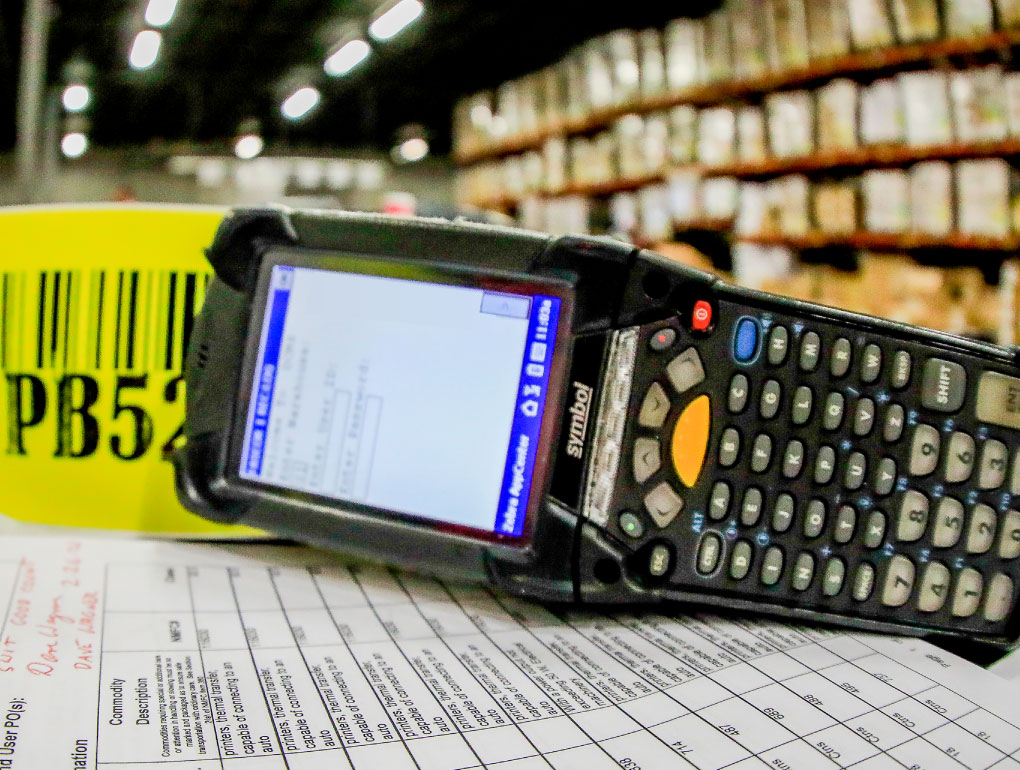
First, it establishes inventory accuracy as a baseline. By using barcode scanning for all key warehouse activities—receiving, put-away, picking, and cycle counting—it ensures the inventory data in the system is 99.9%+ accurate. This reliable data is the foundation for all optimization efforts, eliminating the guesswork that plagues spreadsheet-based operations.
With this accurate data foundation, Linnworks Warehouse Management provides several key features:
- Automated reorder points allow you to set minimum quantity thresholds and buffer stock levels for every SKU. When inventory dips to these levels, the system automatically alerts you or adds the item to a purchase order, ensuring you replenish before a stockout occurs.
- Sales velocity reporting analyzes historical sales data to show how quickly each product sells, helping you understand true demand, distinguish fast-movers from slow-movers, and make data-driven purchasing decisions instead of guessing.
The platform's demand forecasting tools analyze past sales trends to predict future demand, allowing you to plan purchasing more accurately, especially for seasonal items. This reduces the risk of being overstocked on products with waning demand. Inventory turnover reports provide clear data on how often inventory is sold and replaced, helping you identify capital tied up in slow-moving or dead stock, prompting strategic decisions like liquidations or promotional sales.
This comprehensive approach transforms inventory management from a reactive cost center into a proactive profit driver. Businesses looking to explore comprehensive assessments of similar solutions can reference our detailed SkuVault Core Review for comparative analysis.

How does Linnworks Warehouse Management integrate with essential business systems like ERPs, e-commerce platforms, and shipping carriers?
Linnworks Warehouse Management is designed as a central operational hub within the broader Linnworks ecosystem, connecting deeply with the rest of your business technology stack. Its integration strategy is two-pronged: a wide range of pre-built native integrations and a robust API for custom connections, reflecting its position as part of a comprehensive commerce platform.
For e-commerce and marketplace integrations, this is where Linnworks demonstrates its greatest strength. The platform has dozens of direct, pre-built integrations with platforms like Shopify, BigCommerce, Adobe Commerce (Magento), and major marketplaces such as Amazon (both FBM and FBA), Walmart, and eBay. These connections are typically deep and bidirectional, meaning they sync sales orders into Linnworks for fulfillment and push real-time inventory updates back to the sales channel to prevent overselling. This native integration depth is a direct result of Linnworks' acquisition strategy and focus on commerce automation.
For shipping carrier integrations, Linnworks Warehouse Management connects seamlessly with major shipping management platforms like ShipStation, ShippingEasy, and ShipWorks. This allows for a smooth workflow where the picking and packing process inside Linnworks ends with the automatic generation of a shipping label from your preferred carrier platform.
Connecting to an ERP (like NetSuite, SAP, or Acumatica) is critical for financial reconciliation and master data management. This is typically handled via Linnworks' API (Application Programming Interface). The API allows for the development of custom workflows to:
- Pull purchase order data from the ERP into Linnworks for receiving
- Push inventory valuation and adjustment data from Linnworks to the ERP for accounting
- Sync master product catalog data from the ERP to ensure consistency
Building this ERP connection requires technical resources (either in-house or a third-party developer), but it is essential for creating a single, authoritative source of truth across finance and operations—a critical requirement for YMYL compliance in supply chain operations.
How effectively does Linnworks Warehouse Management manage inventory and operations across multiple warehouses?
Linnworks Warehouse Management is highly effective at managing multi-warehouse operations, providing a consolidated view of inventory while allowing for location-specific execution. This is a critical feature for businesses scaling their fulfillment footprint to reduce shipping times and costs—a key competitive advantage in modern e-commerce and omnichannel retail.
The system's multi-location logic is built on several key principles:
- Centralized visibility allows you to see total inventory quantities for any SKU across all locations from a single dashboard. You can also drill down to see the specific quantities available, on-hand, and picked at each individual warehouse, providing the transparency needed for strategic decision-making.
- Location-specific fulfillment is a powerful feature—when an order comes in, you can route it to the most strategic warehouse for fulfillment based on rules you define, such as geographic proximity to the customer or stock availability. This intelligent routing reduces shipping costs and delivery times while optimizing inventory utilization across your network.
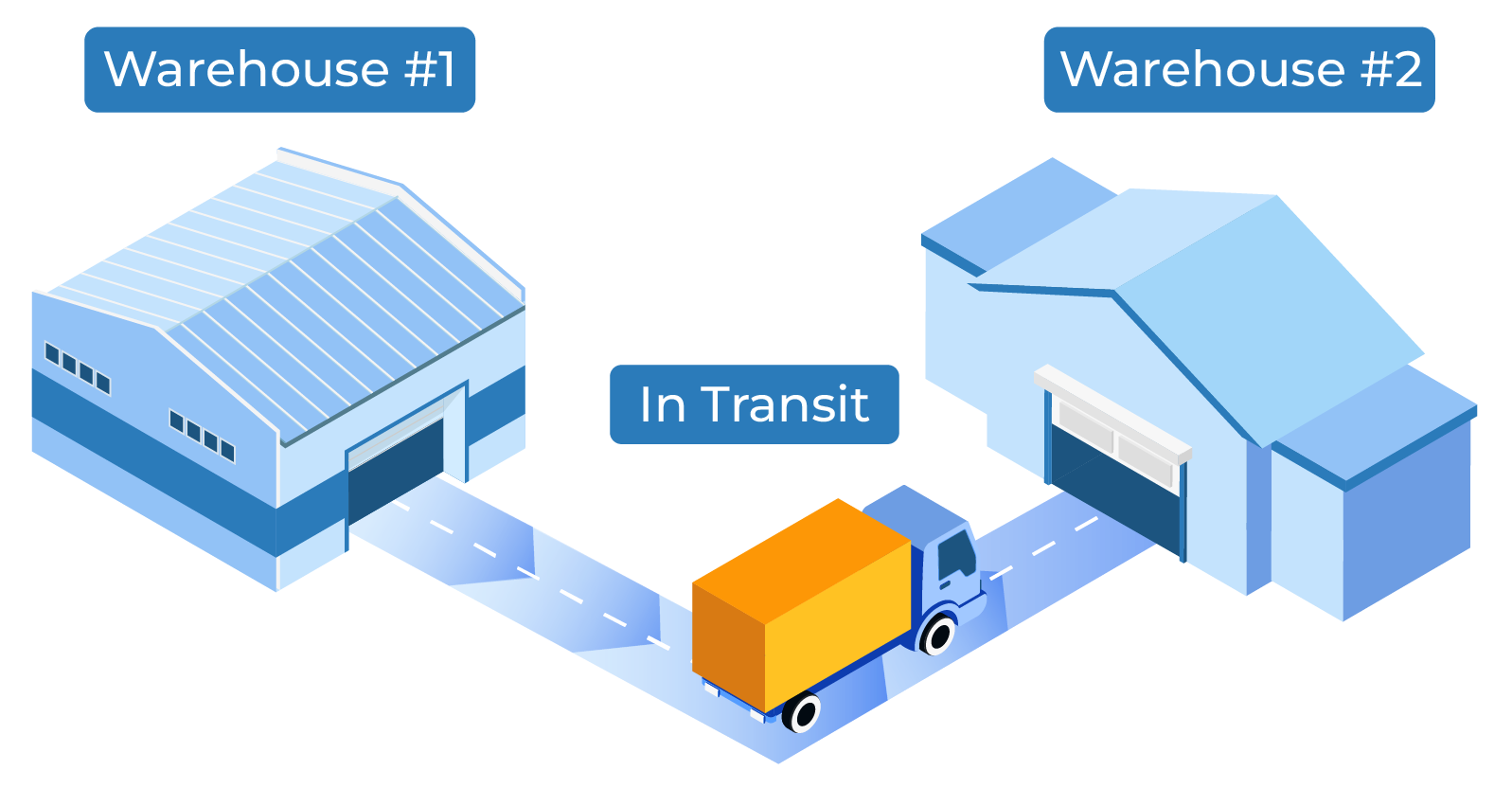
Warehouse transfers are streamlined through the platform. You can create transfer orders, track goods in transit, and receive them at the destination warehouse with full barcode-scanning validation, ensuring no inventory is lost in the process. This addresses a common pain point where inventory “disappears” during inter-facility moves.
Granular reporting capabilities allow you to run reports on a per-warehouse basis to analyze performance, inventory turnover, and sales velocity for each location independently. This helps you make smarter decisions about stock allocation and identify regional demand patterns. User permissions can be assigned to specific warehouses, ensuring that a picker in a California warehouse can only see and interact with inventory and orders relevant to their location, improving security and reducing operational confusion.
This comprehensive feature set transforms multiple warehouses from siloed operations into a cohesive, visible, and manageable fulfillment network—essential for businesses pursuing distributed inventory strategies to compete on delivery speed. For businesses evaluating market alternatives, our comprehensive analysis of SkuVault Core Top Alternatives and Competitors provides detailed comparisons.
How does Linnworks Warehouse Management handle advanced inventory workflows like kitting, bundling, and assemblies?
Linnworks Warehouse Management has robust features specifically designed to manage advanced inventory scenarios like kitting and bundling, which are crucial for many e-commerce businesses. It ensures that your component inventory levels remain accurate when a composite product is sold—a critical requirement for maintaining the inventory accuracy that prevents overselling.
The product kitting and bundling feature allows you to create a “kit” SKU that is made up of several individual “component” SKUs. For example, a “Gift Basket” kit might be composed of one bottle of wine, two glasses, and one corkscrew. The “Gift Basket” is what you list on your sales channel, but the system tracks the individual components.
Automatic component depletion is the core function: When a customer buys the “Gift Basket,” Linnworks automatically decrements the inventory counts for the individual components. It subtracts one wine bottle, two glasses, and one corkscrew from your available stock. This automatic depletion prevents overselling components that are part of a kit—a common failure point in manual or basic inventory systems.
The available-to-sell logic is intelligent: The system calculates the total number of kits you can sell based on the component with the lowest availability. If you have 100 wine bottles but only 10 corkscrews, Linnworks will report that you only have 10 “Gift Baskets” available to sell, preventing you from selling kits you cannot physically build.
For assemblies and light manufacturing workflows, you can use an “Assemble Kits” feature. This allows you to formally consume the component inventory and create new, finished-good kit inventory in a structured process, complete with barcode scanning to validate the components used. This is particularly valuable for businesses that pre-build kits during slower periods to accelerate fulfillment during peak demand.
A critical distinction for operations managers: Use the “Assemble Kits” feature only for items you physically build before an order comes in. For bundles sold on-the-fly, rely on the virtual kitting feature. This ensures your pickers are directed correctly—either to a pre-built kit location or to multiple component locations to pick-and-pack the bundle on demand. Misusing this functionality can create major picking inefficiencies on the warehouse floor.
What data analytics and reporting capabilities does Linnworks Warehouse Management offer for demand forecasting and inventory optimization?
While Linnworks Warehouse Management may not market itself as a heavy “AI” platform in the sense of using deep machine learning, it provides powerful data-driven analytics and rule-based automation that serve as the foundation for intelligent inventory optimization. Its strength lies in providing clean, actionable data to make smart decisions—a critical foundation for supply chain excellence.
The platform's advanced reporting suite includes several reports critical for forecasting and optimization:
- Sales velocity reports show how fast SKUs are selling
- Inventory turnover reports reveal how efficiently you're using capital
- Stock-taking reports provide variance analysis
This data is the raw material for any forecasting model and represents the operational intelligence needed to transform from reactive to proactive inventory management.
The demand forecasting tool analyzes historical sales data to predict future demand over a specified period. It allows you to input your lead times and desired stock levels (for example, “30 days of supply”) to generate recommended reorder quantities. This moves purchasing from guesswork to a data-driven process, reducing both stockouts and overstock situations.
Replenishment reporting automates the most time-consuming part of inventory management: The system can generate daily reports that automatically identify all SKUs that have fallen below their pre-set reorder points. This frees up planners to focus on strategic sourcing and negotiation rather than manual inventory reviews.
The sales data provided enables ABC analysis, where you categorize products based on their revenue contribution (A-items are top sellers, C-items are slow-movers). This allows you to apply different inventory policies to different product categories for better capital allocation—a best practice in inventory optimization.
A critical implementation note: The forecasting tool's output is only as good as the data you feed it. Before relying on it, spend time ensuring your warehouse team is executing every scan perfectly. Then, use the sales reporting features to identify your top-performing categories. Run your initial forecasting models on these high-volume, predictable categories first to build confidence and fine-tune your lead time and days-of-supply settings before applying them to products with more erratic demand patterns.
For practical implementation strategies and real-world applications, explore our comprehensive guide on SkuVault Core Tutorials and Usecase for step-by-step optimization workflows.
How does Linnworks Warehouse Management support regulatory compliance needs, such as lot tracking and expiration dates?
Linnworks Warehouse Management has strong capabilities for businesses that require lot number and expiration date tracking, making it suitable for industries like food and beverage, supplements, cosmetics, pharmaceuticals, and electronics. This functionality is critical for product recalls, quality control, and adhering to fulfillment requirements from channels like Amazon—representing essential YMYL (Your Money or Your Life) compliance features.
Lot number tracking is implemented at the receiving process: The system prompts warehouse staff to scan or enter the lot number associated with the incoming products. This creates a permanent record linking specific units of a product to their manufacturing batch. This data is tracked throughout the inventory lifecycle, from put-away to shipping, creating the traceability audit trail required by regulatory bodies.
Expiration date management works similarly: Expiration dates can be recorded at receiving. This allows for adherence to fulfillment rules, especially for grocery sellers or FBA (Fulfillment by Amazon) sellers who must meet strict shelf-life requirements. Failing to track expiration dates can result in costly marketplace suspensions or regulatory violations.
FEFO (First-Expired, First-Out) picking logic guides pickers to fulfill orders using intelligent rotation rules. The system directs them to the location holding the products with the nearest expiration date, ensuring older stock is sold first to minimize spoilage and waste. This is a crucial feature for any business dealing with perishable goods and represents a significant operational improvement over manual FIFO/FEFO management.
Traceability and recall reporting provides critical risk management capabilities: In the event of a product recall, you can run a report in Linnworks to see exactly which customers received products from a specific lot number. This allows for swift, targeted communication and is a non-negotiable requirement for many regulated industries. The ability to execute a recall within hours rather than days can be the difference between a manageable issue and a brand-destroying crisis.
For businesses in regulated industries, these features aren't optional—they're essential for compliance with FDA, USDA, or other regulatory bodies. The system's ability to maintain this data integrity while supporting high-volume operations represents a significant advantage over manual tracking methods.
How does Linnworks Warehouse Management ensure data security, integrity, and operational reliability?
Linnworks Warehouse Management, as a professional SaaS platform handling mission-critical business data, employs a multi-layered approach to security, integrity, and reliability. This is a crucial consideration for YMYL compliance, as any downtime or data breach could halt a company's entire fulfillment operation and expose sensitive competitive intelligence.
Data security follows industry-standard protocols: Linnworks utilizes data encryption both in transit (using TLS/SSL) and at rest (on their servers). The platform is hosted on major cloud infrastructure providers (like AWS or Google Cloud), which provides a high level of physical and network security, redundant systems, and compliance with international data protection standards.
For businesses evaluating this platform, it's essential to review Linnworks' current security certifications and compliance documentation. While specific certifications should be verified directly with Linnworks, professional WMS platforms typically maintain SOC 2 Type II and ISO 27001 certifications—critical benchmarks for enterprise procurement processes. Supply chain data represents highly sensitive competitive intelligence (supplier lists, costs, inventory levels, production plans), so robust security isn't optional.
Data integrity is built into the system's core design through barcode scanning: By enforcing scans for actions like receiving, transfers, and picking, it dramatically reduces the human error that corrupts inventory data in the first place. For system-to-system integrity, reliable API protocols ensure that data passed to and from other platforms (like an ERP) is consistent and validated.
Operational reliability is maintained through high uptime SLAs (Service Level Agreements), typically in the range of 99.9%. This is achieved through redundant server architecture and automatic failover systems. In the event of a server issue, operations can be rerouted to a backup with minimal disruption. Regular data backups protect against catastrophic data loss—a critical safeguard for business continuity.
Access controls provide granular security: The system features detailed user permissions. You can create roles (for example, “Picker,” “Receiving Manager,” “Admin”) and restrict access to specific functions and data. A picker can be granted access only to the mobile app for picking orders and cannot see financial data or system settings. This principle of least privilege is essential for both security and operational clarity.
Businesses should request current documentation on Linnworks' data processing agreements, sub-processor lists, GDPR compliance, and disaster recovery procedures as part of their due diligence process.
What are the known limitations or potential risks of implementing Linnworks Warehouse Management?
While Linnworks Warehouse Management is a powerful tool, no software is a perfect fit for every business. Understanding its limitations is key to making an informed decision and ensuring a successful implementation—critical for avoiding costly mistakes in supply chain technology investments.
The platform is not a full-fledged ERP: Linnworks Warehouse Management excels at inventory and warehouse operations but is not an accounting, CRM, or HR platform. It is designed to integrate with a central ERP (like NetSuite or SAP), not replace it. Businesses looking for a single, all-in-one system to run their entire company will find it too specialized. The platform's value proposition is depth in commerce operations, not breadth across all business functions.
Limited manufacturing capabilities represent another constraint: While it handles kitting and light assembly well, it is not a Manufacturing Execution System (MES). It does not manage complex, multi-stage production work orders, bill of materials (BOMs), or shop floor control. Discrete manufacturers with complex production processes will need a dedicated manufacturing module or system. This is appropriate for a WMS but important to understand for businesses with significant production operations.
Implementation requires organizational discipline: The biggest risk in any WMS implementation is a lack of process discipline. Linnworks Warehouse Management's value is directly tied to your team's commitment to scanning every item, every time. If your team develops “workarounds” or skips scans, the data integrity will be compromised, and the system's benefits will be nullified. Proper training and change management are non-negotiable. This isn't a software limitation—it's a human factor risk.
Reliance on third-party hardware: The system's performance is dependent on reliable hardware, such as barcode scanners and label printers. Investing in low-quality, consumer-grade hardware can lead to scanning errors, connectivity issues, and operational friction that can be incorrectly blamed on the software. Budget for industrial-grade equipment.
The most significant implementation risk isn't technical; it's cultural. Before signing a contract, get buy-in from your warehouse manager and team leads. Frame the adoption not as “corporate is forcing this on us” but as “we are getting a tool to eliminate errors and make your job easier.” Run a small pilot with your most tech-savvy team members first. Let them become champions for the new process, which will dramatically accelerate adoption across the entire floor.
For a deeper understanding of common implementation challenges and solutions, refer to our detailed SkuVault Core FAQs which covers troubleshooting and best practices.
What is the complete pricing structure for Linnworks Warehouse Management, including all potential costs?
Linnworks Warehouse Management utilizes a tiered SaaS (Software-as-a-Service) pricing model that is primarily based on monthly order volume or transaction count. This means the price scales with your business growth—appropriate for a platform targeting growing e-commerce operations. While specific pricing numbers require a direct quote from Linnworks, understanding the complete cost structure is essential for accurate Total Cost of Ownership (TCO) calculations.
The monthly subscription fee is the core recurring cost, determined by your pricing tier (for example, up to 2,000 orders per month, up to 5,000 orders per month, etc.). This fee typically includes access to the software for a set number of users and integrations. As your order volume grows, you'll move into higher pricing tiers, so factor growth projections into your budget analysis.
A one-time implementation and onboarding fee is standard for professional WMS platforms, including Linnworks Warehouse Management. This is not just a setup fee; it covers a critical service where their experts guide you through data migration, warehouse setup (locations, bins), workflow configuration, and team training. This investment is crucial for a successful launch and typically ranges from several thousand dollars to tens of thousands depending on complexity. Skimping on implementation is a false economy that leads to failed deployments.
Additional user licenses may be required: Your subscription tier will include a certain number of user seats. If you need more users than your plan allows, you will need to pay for additional licenses, typically on a per-user, per-month basis. Calculate your full user count including seasonal workers.
Hardware costs represent a significant upfront capital expense: Linnworks Warehouse Management does not provide hardware. You must budget for the purchase of compatible industrial-grade barcode scanners, label printers, mobile devices, and potentially RFID readers for your warehouse team. Depending on warehouse size, this can range from a few thousand dollars to over $50,000. Don't cut corners here—consumer-grade equipment will fail in warehouse environments.
Custom integration costs may apply: If you need to connect Linnworks Warehouse Management to a legacy system or an application without a pre-built integration, you will need to budget for API development work, either by hiring a developer or using a third-party integration service. This can add $10,000-$50,000+ depending on complexity.
Always request a detailed quote that explicitly outlines what is included in each fee, the contract terms, and the specific order volume thresholds for tier changes to avoid any surprises in your first year of operation.
What does the typical implementation process and timeline look like for Linnworks Warehouse Management?
A typical implementation for Linnworks Warehouse Management follows a structured, multi-week process managed by a dedicated implementation specialist from their team. The timeline can range from 4 to 8 weeks for standard deployments, though more complex operations with multiple warehouses, extensive SKU catalogs (50,000+ SKUs), or complex ERP integrations may require 12+ weeks. Understanding this timeline is critical for change management and operational planning.
Phase 1 (Discovery & Planning – Weeks 1-2): You are assigned an implementation manager who will work with you to understand your current workflows, pain points, and goals. Together, you will map out the project plan, define hardware needs, establish key milestones, and identify potential roadblocks. This phase includes documenting your current receiving, put-away, picking, packing, and shipping processes to design optimized workflows in Linnworks. Active participation from your warehouse manager and IT team is essential during this phase.
Phase 2 (System Setup & Data Migration – Weeks 2-4): This is the most data-intensive phase. You will work on cleaning and formatting your product data (SKUs, descriptions, costs, suppliers) for import into Linnworks. Data quality directly impacts system performance—invest time here. Concurrently, you will configure your physical warehouse in the system: defining warehouse zones, locations, bin labels, and picking routes. Your implementation manager will guide you through setting up integrations with your e-commerce platforms, marketplaces, and shipping systems. This phase often reveals data quality issues that must be resolved before go-live.
Phase 3 (Hardware Setup & Team Training – Weeks 4-6): You will receive and set up your barcode scanners, printers, and mobile devices. The Linnworks team will then conduct comprehensive training sessions for your entire team, covering every workflow from receiving and put-away to picking, packing, cycle counting, and exception handling. This phase is critical for user adoption—don't rush it. Consider role-based training where pickers, receivers, and managers each receive specialized instruction.
Phase 4 (Go-Live & Post-Launch Support – Weeks 6-8): This is the official switch-over. The implementation manager will be on hand (often remotely, sometimes on-site for larger deployments) to provide intensive support during the first few days of live operation, helping troubleshoot any issues in real-time. Plan for reduced throughput during the first week as your team adjusts. After a successful “go-live,” you will transition to the standard customer support team for ongoing assistance.
Thorough preparation and active participation from your team are the most important factors for keeping the implementation on schedule. Businesses that treat implementation as a “set it and forget it” IT project rather than an operational transformation consistently experience delays and suboptimal results.
What measurable ROI have similar companies achieved after implementing Linnworks Warehouse Management?
The Return on Investment (ROI) from implementing Linnworks Warehouse Management is typically measured across three primary areas: labor efficiency, inventory cost reduction, and sales growth enablement. While exact figures vary by company size, operational maturity, and starting baseline, the platform's heritage (as the former SkuVault) includes published case studies showcasing significant, measurable gains relevant to operations and supply chain leaders.
Labor efficiency and cost reduction represent the most immediate, measurable benefits: By enforcing barcode scanning for order verification, companies often report a reduction in mis-ships by over 99%. This drastically cuts down on costly returns, reverse logistics, expedited re-shipments, and negative customer experiences that damage lifetime value. With optimized picking paths (directing pickers in the most efficient route through the warehouse) and streamlined workflows, businesses often see a 25-50% increase in the number of orders fulfilled per hour, per employee. This allows you to ship more orders without increasing headcount—a critical advantage during peak seasons.
Inventory cost reduction delivers strategic financial benefits: Most companies achieve 99.9%+ inventory accuracy after implementation, validated through cycle counting. This accuracy allows them to lower their safety stock levels, freeing up capital that was previously tied up in “just in case” inventory. For a company with $1M in inventory, a 20% reduction in safety stock frees up $200,000 in working capital. Using the sales velocity and forecasting reports, businesses can reduce purchasing of slow-moving items, leading to a 10-30% reduction in capital tied up in dead stock. This improves cash conversion cycles and reduces warehouse space requirements.
Sales growth enablement provides competitive advantages: By syncing real-time, accurate inventory levels to all sales channels, Linnworks Warehouse Management eliminates the overselling that leads to canceled orders, angry customers, and marketplace penalties. This protects brand reputation and customer lifetime value—critical for long-term profitability. Increased efficiency often leads to a shorter order-to-ship cycle time, with many companies achieving same-day or next-day shipping. This improvement can be a significant competitive advantage, leading to higher conversion rates and customer loyalty, particularly in categories where Amazon has set high delivery expectations.
A successful implementation typically delivers a full return on investment within 6-12 months for mid-sized operations. The exact timeline depends on order volume, starting efficiency levels, and the rigor of the implementation process.
What level of customer support and training is provided with a Linnworks Warehouse Management subscription?
Linnworks Warehouse Management provides a multi-tiered support and training structure designed to ensure users are successful long after the initial implementation is complete. The quality of support, particularly the expertise of the implementation team, is frequently cited as a key strength of the platform—an important consideration for risk mitigation in mission-critical warehouse operations.
Initial training and onboarding: As covered in the implementation process, the initial onboarding is an intensive, hands-on training program led by a dedicated specialist. This is not just software training; it's a consultative process to help you adopt best practices for warehouse operations. The implementation specialist often brings deep domain expertise in e-commerce fulfillment and can provide strategic guidance beyond the software itself. This is included in the one-time implementation fee and represents significant value.
Ongoing customer support: After go-live, you have access to Linnworks' standard support channels, which typically include email and ticketing systems for standard, non-urgent queries and support requests. Phone support is available for more urgent issues that are actively impacting operations. Response times and availability often depend on your specific subscription tier, with higher tiers offering faster, priority support. Enterprise-level plans often include a dedicated account manager who serves as a single point of contact and provides proactive strategic advice—valuable for businesses treating their WMS as a strategic asset.
Self-service resources are extensive: Linnworks maintains an online knowledge base with detailed how-to articles, step-by-step guides, and video tutorials covering every feature in the platform. This is often the fastest way to get an answer to a common question and should be the first stop for troubleshooting. User communities, while not formal support channels, can be valuable resources for sharing tips and workflows with other businesses using the platform.
For businesses evaluating Linnworks Warehouse Management, request specifics on support SLAs (Service Level Agreements), the technical expertise of support staff, escalation procedures, and the availability of on-site support for critical issues. The quality and responsiveness of support can be the difference between a minor operational hiccup and a costly fulfillment shutdown. Consider asking for references from similar-sized companies in your industry to validate support quality before committing.

Leave a Reply