Is ShipBob the Right Fulfillment Partner for Your Brand?
Take This 2-Minute Quiz to Find Out!

Key Takeaways
- Technology-Driven 3PL: ShipBob transforms traditional fulfillment through AI-powered inventory distribution, automated warehouse management, and predictive analytics
- Ideal for Fast-Growing DTC Brands: Perfect for brands shipping 400-20,000 orders monthly who need white-label fulfillment with brand control
- Comprehensive Service Structure: Transparent pricing covers receiving, storage, pick/pack, and shipping with SOC 2 compliance and strong SLAs
- Multi-Channel Integration: Seamlessly connects with e-commerce platforms, ERPs, and marketplaces while providing actionable analytics and forecasting
- Strategic Advantage Over Competitors: Offers superior brand control compared to Amazon FBA and more DTC focus than enterprise solutions like Flexport

What is ShipBob, and how does it use AI and technology to automate fulfillment?
ShipBob is a technology-enabled third-party logistics (3PL) provider that manages e-commerce fulfillment for direct-to-consumer brands. Unlike traditional 3PLs that often rely on manual processes and disjointed systems, ShipBob's core value proposition is its proprietary, cloud-based software platform that automates and optimizes the entire fulfillment lifecycle, from inventory management to final delivery.
The platform's AI and automation capabilities manifest in several key areas:

- Inventory Distribution AI: The system analyzes historical order data to recommend optimal inventory placement across ShipBob's global network of fulfillment centers. This reduces shipping distances, which in turn lowers transit times and costs.
- Warehouse Management System (WMS): ShipBob's AI-powered WMS automates order processing within fulfillment centers, optimizing picking paths for warehouse staff to increase speed and accuracy.
- Predictive Analytics: The platform provides merchants with powerful analytics and reporting tools, offering insights into shipping performance, inventory velocity, and demand forecasting that go far beyond simple shipment tracking.
This technology transforms logistics from a reactive cost center into a proactive, data-driven strategic advantage. For operations managers in the supply chain space, ShipBob's platform represents a shift from managing logistics as a cost center to leveraging it as a competitive differentiator that enhances both customer experience and operational efficiency. To learn more about ShipBob's comprehensive features, explore our detailed ShipBob Overview and Features guide.
How does ShipBob's algorithm optimize inventory placement across its warehouse network?
ShipBob's inventory placement algorithm is a core component of its value proposition, designed to enable faster, more affordable shipping by strategically positioning products closer to end customers. The AI-driven process begins by analyzing a merchant's historical order data, examining metrics like order volume, shipping destinations by zip code, and product-specific sales velocity to identify geographic “hotspots” where demand is highest.
The system then runs sophisticated simulation models to evaluate different inventory distribution scenarios. For example, it might compare the cost and delivery speed outcomes of holding 100% of a SKU in a single central warehouse versus splitting it 60/40 between East Coast and West Coast facilities. The algorithm calculates the optimal distribution that minimizes time-in-transit and shipping zone costs for the majority of orders.
This data-driven approach is what ShipBob refers to as its “distributed inventory” model. Merchants receive these AI-generated recommendations directly within the ShipBob dashboard, showing which fulfillment centers they should send inventory to and in what quantities. By following these data-driven suggestions, brands can more easily offer competitive 2-day shipping options to a wider geographic area without concentrating all their stock—and risk—in one location.
The algorithm continually refines its recommendations based on new order data, seasonal trends, and network capacity, ensuring operations managers always have the most optimal inventory strategy as their business evolves. This transforms inventory placement from guesswork into a strategic decision that directly impacts customer satisfaction and profitability.
Who is the ideal customer for ShipBob?
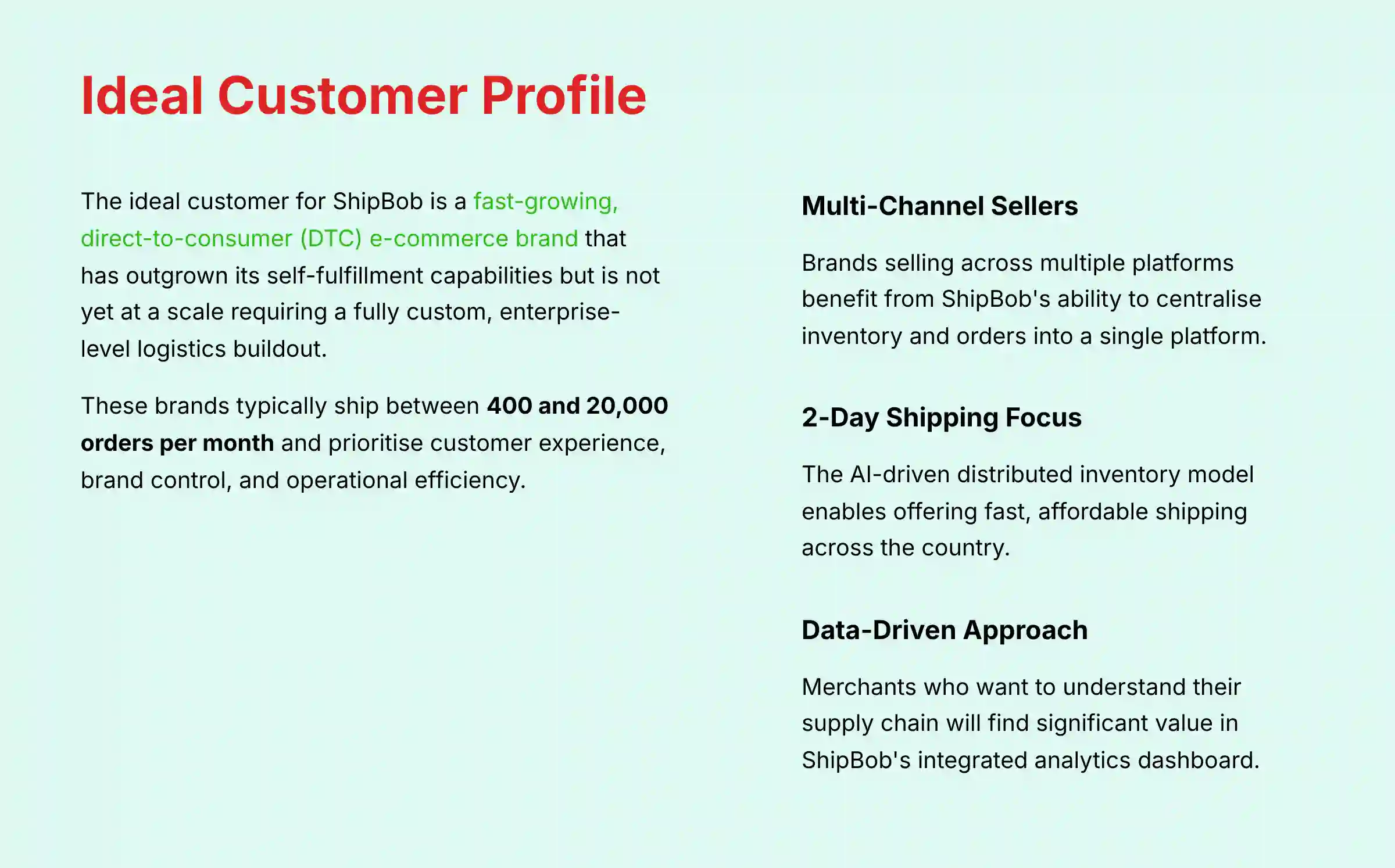
The ideal customer for ShipBob is a fast-growing, direct-to-consumer (DTC) e-commerce brand that has outgrown its self-fulfillment capabilities but is not yet at a scale requiring a fully custom, enterprise-level logistics buildout. These brands typically ship between 400 and 20,000 orders per month and prioritize customer experience, brand control, and operational efficiency.
Specifically, ShipBob is best suited for businesses that:
- Are Multi-Channel Sellers: Brands selling across multiple platforms (e.g., Shopify, Amazon, Walmart.com, social commerce) benefit immensely from ShipBob's ability to centralize inventory and orders into a single platform, preventing stockouts and data silos.
- Want to Offer 2-Day Shipping: The AI-driven distributed inventory model is the key enabler for offering fast, affordable shipping across the country. Brands whose customers are sensitive to shipping speed and cost see the most significant ROI.
- Value Data and Analytics: Merchants who are data-driven and want to understand their supply chain—analyzing shipping costs, inventory turnover, and fulfillment performance—will find significant value in ShipBob's integrated analytics dashboard.
- Lack In-House Logistics Expertise: ShipBob is a strong fit for founder-led brands or companies where the core competency is product and marketing, not warehousing and logistics. It allows them to outsource this complex function to a technology-focused partner.
Conversely, it may be less suitable for very low-volume startups (under 100 orders/month) where the costs might be prohibitive, or for massive enterprises with highly specialized or regulated products that require a custom-built 3PL solution. Operations leaders should consider their order volumes, growth trajectory, and the strategic importance of fulfillment to their customer experience when evaluating ShipBob. For a comprehensive evaluation of ShipBob's performance, check out our in-depth ShipBob Review.
What is the general pricing structure for ShipBob's services?
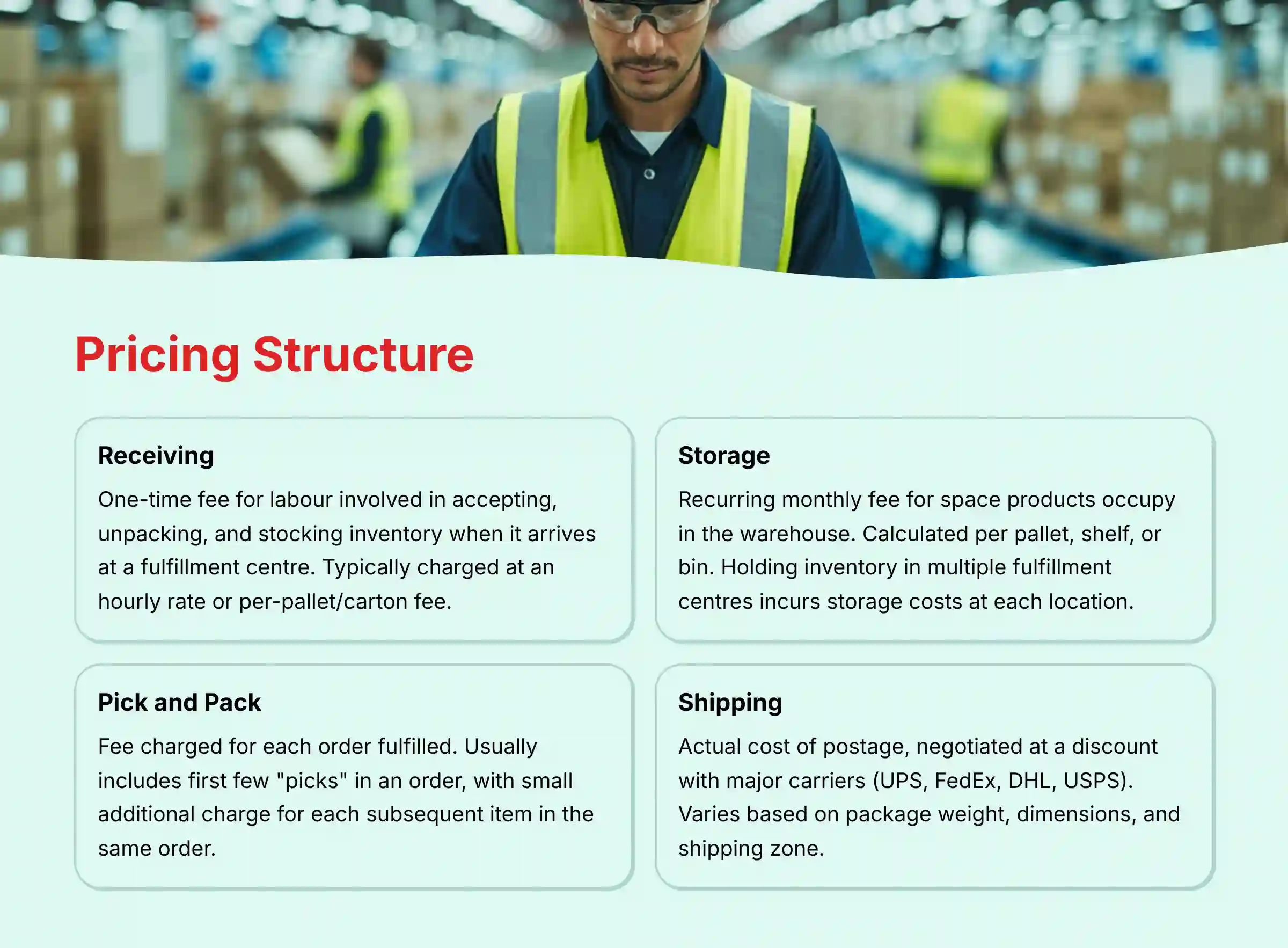
ShipBob's pricing is designed as a pay-as-you-go model based on four core service components. Unlike a simple flat rate, this structure is meant to align costs with a brand's actual usage of the fulfillment network, providing transparency and scalability. The primary fees are:
- Receiving: A one-time fee for the labor involved in accepting, unpacking, and stocking your inventory when it arrives at a ShipBob fulfillment center. This is typically charged at an hourly rate or a per-pallet/carton fee.
- Storage: A recurring monthly fee for the space your products occupy in the warehouse. This is calculated per pallet, shelf, or bin, and holding inventory in multiple fulfillment centers will incur storage costs at each location.
- Pick and Pack: A fee charged for each order that is fulfilled. This cost usually includes the first few “picks” (items) in an order, with a small additional charge for each subsequent item in the same order. This fee covers the labor of retrieving the items and packing them.
- Shipping: The actual cost of postage, which ShipBob negotiates at a discount with major carriers (like UPS, FedEx, DHL, and USPS). This cost is passed through to the merchant and varies based on package weight, dimensions, and the shipping zone it is being delivered to.
There is no separate “platform fee” for using their software; access to the dashboard, integrations, and analytics is bundled into the service costs. For supply chain operations managers, this pricing model offers clear cost visibility and the ability to directly tie fulfillment expenses to order volume, making budgeting and forecasting more predictable as you scale.

What specific analytics and forecasting data does the ShipBob dashboard provide?
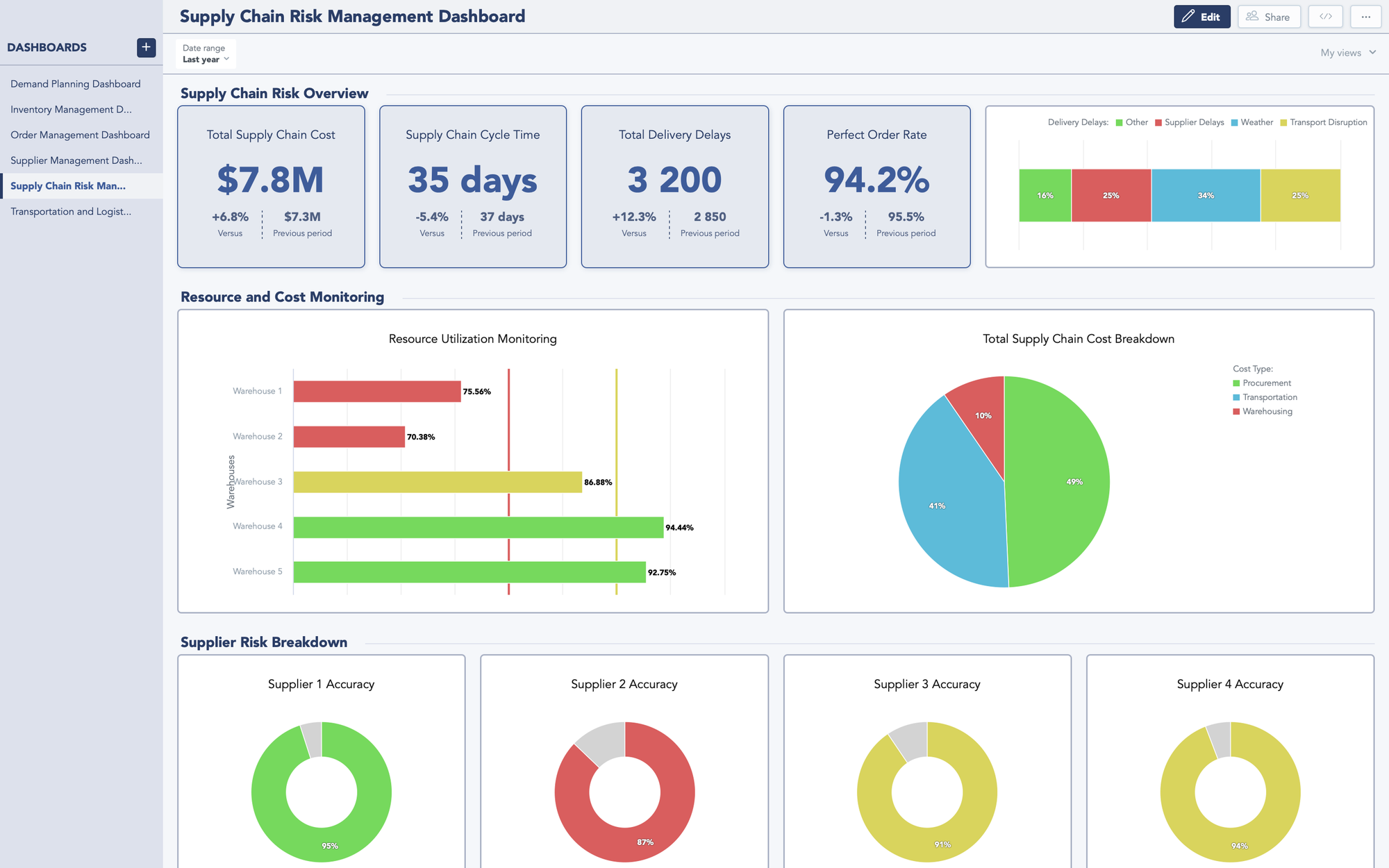
The ShipBob dashboard provides a suite of AI-enhanced analytics and reporting tools designed to give operations managers actionable insights into their supply chain health, moving beyond basic tracking to support strategic decision-making. The data is generally organized into three key categories:
1. Inventory Management & Forecasting:
- Inventory Levels: Real-time views of on-hand, committed, and available inventory at each fulfillment center.
- Reorder Point Notifications: Merchants can set low-stock thresholds for each SKU. The system automatically notifies them when it's time to reorder, helping to prevent stockouts.
- Inventory Velocity & Days of Supply: The platform calculates how quickly each SKU sells through, forecasting how many days of inventory are remaining based on recent sales history. This is crucial for demand planning and avoiding over-stocking slow-moving items.
2. Fulfillment & Shipping Performance:
- Fulfillment Cost Analysis: A breakdown of all fulfillment costs, including receiving, storage, and pick/pack fees, allowing brands to see their average cost per order.
- Shipping Cost & Transit Time: Detailed reports showing the average shipping cost and time-in-transit by shipping zone and carrier, helping merchants evaluate the effectiveness of their shipping strategy.
- Order Fulfillment Timeliness: Metrics on how quickly ShipBob is processing orders from receipt to shipment, which can be compared against their SLAs.
3. Sales & Order Data:
- Sales by Channel: For multi-channel sellers, the dashboard shows order volume and revenue broken down by each sales channel (e.g., Shopify, Amazon FBA).
- Geographic Order Distribution: A map-based visualization of where orders are being shipped, which is the primary data source for ShipBob's inventory distribution recommendations.
This centralized data hub allows operations managers to monitor performance, identify cost-saving opportunities, and plan inventory needs without resorting to disparate spreadsheets. The AI-driven insights help transform raw fulfillment data into strategic business intelligence that can drive better decision-making throughout the supply chain.

How does ShipBob compare to Amazon FBA for multi-channel brands?
ShipBob and Amazon FBA (Fulfillment by Amazon) both offer outsourced fulfillment, but they are designed for different strategic priorities, especially for multi-channel brands seeking to control their brand experience and data.
The primary difference lies in brand control and data ownership. With FBA, orders are shipped in Amazon-branded boxes, creating a customer experience that promotes Amazon, not your brand. FBA's Multi-Channel Fulfillment (MCF) can ship orders from other channels (like a Shopify store), but it still uses Amazon packaging and provides limited access to raw customer data. ShipBob, in contrast, is a white-label service. Orders are shipped in your brand's custom packaging, strengthening your direct relationship with the customer. You retain full ownership of your customer data, which is critical for marketing and retention efforts.
A second key difference is inventory and channel flexibility. FBA is optimized for the Amazon marketplace. While MCF exists, it is often more expensive and slower than fulfilling Prime orders. This can create a disjointed experience for customers on different channels. ShipBob's AI-powered platform integrates with numerous e-commerce platforms, marketplaces, and ERPs, providing a single pool of inventory and a consistent, fast fulfillment SLA for all your sales channels. This prevents the common problem of having inventory stuck in FBA that you can't easily use to fulfill an order from your own website.
Finally, pricing structure and support differ. FBA's pricing can be complex and opaque, with numerous fees (long-term storage, peak surcharges) that are hard to forecast. ShipBob aims for a more transparent model with itemized costs for receiving, storage, and picking. For support, ShipBob provides dedicated account managers and support teams, whereas FBA support is notoriously difficult to navigate, often managed through large, impersonal case-file systems.
For operations managers looking to build a truly omnichannel fulfillment strategy, ShipBob offers greater control and flexibility, while FBA excels at optimizing Amazon marketplace sales specifically. For exploring other competitive options, visit our comprehensive guide on ShipBob Top Alternatives and Competitors.
Is ShipBob SOC 2 compliant, and what are its data security measures?
Yes, ShipBob is SOC 2 (Service Organization Control 2) Type II compliant. This is a critical distinction for any business entrusting a third party with sensitive operational and customer data. A SOC 2 report, verified by an independent auditor, attests that a company has implemented stringent internal controls related to security, availability, processing integrity, confidentiality, and privacy of customer data.
Achieving SOC 2 Type II compliance means ShipBob not only has designed robust security policies (Type I) but has also proven that it consistently adheres to those policies over a period of time (Type II). This is a non-negotiable requirement for many enterprise-level clients and brands in regulated industries within the supply chain sector.
Beyond SOC 2, ShipBob's data security measures include:
- Data Encryption: All data, both in transit between your systems and ShipBob's platform and at rest within their databases, is encrypted using industry-standard protocols like TLS.
- Access Controls: The ShipBob platform enforces role-based access controls, meaning you can grant specific permissions to different members of your team, limiting access to sensitive information on a need-to-know basis.
- Network Security: They employ firewalls, intrusion detection systems, and other network security tools to protect their infrastructure from unauthorized access and cyber threats.
- Data Privacy: ShipBob's practices are designed to be compliant with major data privacy regulations like GDPR and CCPA, ensuring the proper handling of personal customer information.
This focus on security is essential for operations managers, as a breach could expose sensitive competitive intelligence (supplier lists, costs, order volumes) and customer PII (personally identifiable information). When evaluating any fulfillment partner, requesting a copy of their SOC 2 Type II attestation letter should be a standard part of your due diligence process.
How does ShipBob integrate with enterprise systems like NetSuite, SAP, or other ERPs?
ShipBob's integration capabilities are tiered to support businesses of varying technical maturity, from simple plug-and-play connections to robust, enterprise-grade integrations with ERP (Enterprise Resource Planning) systems like NetSuite or SAP.
For standard e-commerce platforms (Shopify, BigCommerce, WooCommerce), ShipBob offers pre-built, one-click integrations that sync products, orders, and tracking information automatically. This is the most common integration method for small to mid-sized brands.
For enterprise systems, the approach is more sophisticated:
- Pre-built Connectors for Major ERPs: ShipBob has developed direct, pre-built integrations for leading mid-market and enterprise ERPs, most notably NetSuite. This connector allows for bidirectional data flow, syncing orders, inventory levels, shipment tracking, and product information between the two systems, ensuring the ERP remains the central source of truth for financial data.
- EDI (Electronic Data Interchange): For legacy systems or large retail partners, ShipBob supports EDI, a standardized format for exchanging business documents like purchase orders (850), advance ship notices (856), and invoices (810). This is essential for brands that sell into major retail chains which mandate EDI compliance.
- Developer API: For custom ERPs, homegrown systems, or unique workflow requirements, ShipBob provides a comprehensive, well-documented REST API. This gives a company's developers the flexibility to build a completely custom integration. The API allows you to create orders, get real-time inventory counts, receive shipment notifications, manage returns, and more. This is the most powerful but also the most resource-intensive option.
The ability to connect with an ERP is critical for achieving end-to-end visibility in your supply chain operations. It ensures that when an order is fulfilled by ShipBob, the inventory is automatically depleted in the ERP, and the financial records are updated in real-time without manual data entry, reducing errors and administrative overhead. For operations managers, this integration capability is essential for maintaining a single source of truth across all business systems.
What are the common ancillary or “hidden” fees to be aware of beyond basic fulfillment costs?
While ShipBob's pricing model is designed to be transparent, a brand's final invoice will almost always include ancillary charges beyond the main four (receiving, storage, pick/pack, shipping). These fees are not “hidden” in the sense of being intentionally deceptive; rather, they are for non-standard events, special projects, or value-added services that fall outside the typical fulfillment workflow. Operations managers must account for these to create an accurate cost forecast.
Common ancillary fees include:
- B2B/Wholesale Order Fees: Fulfilling a wholesale order often requires special handling, like custom labeling, palletizing, or following specific retailer compliance guides (e.g., for a shipment to Target). These orders typically incur a separate, higher pick fee than standard DTC orders.
- Returns Processing: Managing returns is a separate workflow. ShipBob charges a fee per return to cover the labor of receiving the package, inspecting the item, and either restocking it or disposing of it based on your instructions.
- Kitting & Assembly: If you require ShipBob to bundle multiple SKUs into a new subscription box or promotional gift set, this is considered a special project. You will be charged a labor fee for the time it takes to assemble these kits before they can be stored as a single, sellable unit.
- Inbound Receiving Discrepancies: If a shipment of inventory arrives at the warehouse without a proper Warehouse Receiving Order (WRO) filed in advance, or if the contents don't match the WRO, ShipBob may charge an “Unidentified Receiving Order” (URO) fee for the extra labor required to identify and sort the products.
- Long-Term Storage Fees: ShipBob charges escalating long-term storage fees for any inventory unit that has been stored for more than 6 months. According to their official policy, fees are assessed monthly for units aged 6-9 months, with higher rates applied for units aged 9-12 months and 12+ months, to discourage the storage of slow-moving inventory.
For operations managers, it's crucial to monitor inventory aging reports within the ShipBob dashboard to proactively manage or liquidate stock before it reaches the 6-month threshold to avoid these mandatory, escalating fees. Always validate the most current fee structure directly with a ShipBob representative during the quoting process.
What are the key differences between ShipBob and other 3PLs like Flexport or Deliverr?
While ShipBob, Flexport, and Deliverr (now part of Flexport) all fall under the umbrella of “tech-enabled logistics,” they have different origins and core strengths, making them suitable for different types of supply chain operations.

ShipBob's Core Focus: High-Growth DTC Fulfillment. ShipBob is purpose-built for direct-to-consumer e-commerce brands that need a scalable, all-in-one fulfillment partner. Its strength lies in its user-friendly software, broad network of fulfillment centers optimized for 2-day shipping, and deep, plug-and-play integrations with the e-commerce ecosystem (like Shopify). The entire experience, from the dashboard to the support, is tailored to the needs of a brand owner or operations manager who values speed, simplicity, and brand control in their DTC channels.
Flexport's Core Focus: Global Freight & Enterprise Supply Chain. Flexport started as a digital freight forwarder, using technology to bring transparency and efficiency to the complex world of global ocean and air freight. Its expertise is in managing the entire supply chain, from the factory in Asia to the port, through customs, and into a warehouse. While they now offer e-commerce fulfillment (especially after acquiring Deliverr), their platform is more powerful for companies with complex international supply chains who need end-to-end visibility. Flexport is generally geared towards larger, more mature businesses that manage container-level shipments and require sophisticated freight and trade compliance solutions.
Deliverr's (now Flexport) Original Focus: Asset-Light, Fast-Tag Fulfillment. Before its acquisition, Deliverr's unique model was its “asset-light” approach, partnering with a network of third-party warehouses and using its technology to guarantee fast shipping “tags” (like ‘2-Day Delivery') on marketplaces like Walmart and Shopify. Its primary goal was to help merchants win on these platforms by meeting their strict delivery promises. Now integrated into Flexport, this capability adds a powerful DTC and marketplace fulfillment component to Flexport's global freight platform.
For operations managers, the choice often comes down to: Choose ShipBob for a streamlined, DTC-focused fulfillment solution with strong inventory management capabilities. Choose Flexport for managing a complex, global supply chain from factory to front door, especially if you move large amounts of freight internationally and need a solution that bridges the gap between freight forwarding and final fulfillment.
How does ShipBob's platform manage returns (reverse logistics)?
ShipBob's platform treats returns, or reverse logistics, as a distinct and managed workflow, providing merchants with control and visibility over the process. Rather than having returns show up unexpectedly, the system is designed to handle them systematically. The process generally follows these steps:
- Return Initiation & Label Generation: Merchants can configure their returns portal to allow customers to initiate a return and generate a shipping label directly. This can be integrated into the merchant's own website for a seamless brand experience. Alternatively, the merchant can create the return manually within the ShipBob dashboard.
- Receiving at the Warehouse: When the returned package arrives at the ShipBob fulfillment center, it is scanned. This updates the status of the return in the dashboard, notifying the merchant that the item has been received.
- Inspection & Disposition: Upon receipt, ShipBob's team inspects the returned item based on the merchant's pre-defined rules. The merchant sets the criteria for what constitutes “good” condition. Based on this inspection, the employee will execute one of several dispositions:
- Restock: If the item is in sellable, new condition, it is returned to active inventory.
- Quarantine: If the item is damaged or requires further review by the merchant, it can be placed in a separate, non-sellable quarantine location.
- Dispose: If the item is deemed unsellable, it can be disposed of according to the merchant's instructions.
- Data & Reporting: The ShipBob dashboard provides reporting on all returns, including the reasons for the return (if captured), the final disposition of each item, and the associated costs. This data can be invaluable for identifying product quality issues or patterns of customer behavior.
This structured process prevents returned inventory from getting lost, provides clarity on the condition of goods, and allows for faster restocking of sellable items, which helps to improve inventory efficiency and cash flow. For operations managers, the ability to monitor return trends and automate the reverse logistics workflow transforms what is often a painful, manual process into a more streamlined, data-driven component of the overall supply chain.

What specific Service Level Agreements (SLAs) does ShipBob guarantee for order accuracy and fulfillment speed?
ShipBob provides specific, measurable Service Level Agreements (SLAs) for its core operations, which are a critical part of its contract and value proposition. These SLAs are designed to give merchants confidence in the consistency and reliability of the fulfillment service. While specific terms can be negotiated in enterprise contracts, the standard SLAs generally cover three key areas:
- Dock-to-Stock Time: This SLA defines how quickly inbound inventory will be processed and made available for fulfillment after it arrives at the warehouse. A typical SLA is that inventory will be processed within 3 business days of receipt, provided it arrives with a correctly filed Warehouse Receiving Order (WRO). This is crucial for preventing stockouts after a new shipment arrives.
- Order Fulfillment Speed: This is one of the most important SLAs. ShipBob typically guarantees that orders imported into their system by a certain cutoff time (e.g., 12:00 PM local time) will be fulfilled—meaning picked, packed, and shipped—the same business day. This commitment is the foundation of their ability to enable a 2-day delivery experience.
- Order Accuracy: ShipBob guarantees a high level of order accuracy, typically in the range of 99.95%. This means that the right items are packed in the right quantities. If an error occurs that is determined to be ShipBob's fault (e.g., shipping the wrong SKU), they will typically cover the cost of reshipping the correct order and the associated fulfillment fees.
These SLAs are not just marketing promises; they are contractual obligations. ShipBob's platform allows merchants to track performance against these metrics directly. If SLAs are consistently missed, it provides a clear basis for discussion with account management to rectify the issues.
For operations managers, it's important to note that an SLA is only as good as the conditions attached to it and the recourse you have if it's missed. Before going live, conduct a small-batch test order for your most complex products to ensure your data is perfectly aligned with ShipBob's system. This proactive check is the best way to ensure their accuracy SLA actually protects you in practice.

What is the end-to-end process for migrating from another 3PL to ShipBob?
Migrating from another 3PL to ShipBob is a high-stakes project that requires careful planning to avoid disrupting sales or losing inventory. ShipBob has a structured onboarding process to manage this transition, which typically involves a dedicated implementation specialist. The end-to-end process can be broken down into five key phases:
1. Account Setup & Integration (Week 1):
- You'll be assigned an implementation specialist who will walk you through configuring your account.
- The first technical step is to connect your e-commerce stores (e.g., Shopify) and other systems to the ShipBob platform. You will then import your product catalog, ensuring all SKUs, product names, weights, and dimensions are accurate.
2. Inventory Planning & WRO Creation (Week 1-2):
- Based on your sales data, you and the specialist will decide on the optimal inventory distribution plan across ShipBob's network.
- You must coordinate with your outgoing 3PL to prepare the inventory for shipment. Crucially, you will create Warehouse Receiving Orders (WROs) in the ShipBob dashboard for each inbound shipment, detailing exactly which SKUs and quantities are in each box or on each pallet.
3. Transit & Go-Live Strategy (Week 2-3):
- You need to decide on a “go-live” date. The most critical decision is when to switch order flow from your old 3PL to ShipBob. Best practice is to not do this while inventory is in transit.
- A common strategy is to pause fulfillment for a short window, or continue fulfilling from your old 3PL until ShipBob has fully received and stocked your initial inventory. This prevents overselling.
4. Inbound Receiving & Stowing (Week 3-4):
- Your inventory arrives at ShipBob's fulfillment centers. Their team receives the shipments, scans them against the WROs you created, and stows the products in their storage locations. You can monitor this progress in real-time in your dashboard.
5. Go-Live & First Orders (Week 4-5):
- Once ShipBob confirms all inventory is stocked and available for fulfillment, you can officially switch your e-commerce integrations to push orders to ShipBob. It is highly recommended to place several test orders yourself to ensure the entire process works smoothly before resuming full marketing efforts.
A well-planned migration typically takes 4-6 weeks and requires close coordination between your team, your old 3PL, and your ShipBob implementation manager. For operations leaders, the key success factor is having a clear timeline with buffer periods built in, especially around high-volume seasons like Q4 when any migration issues could severely impact revenue. For detailed implementation guidance, explore our practical ShipBob Tutorials and Usecase resources.
How does ShipBob's system handle extreme order volumes during peak seasons like Black Friday?
Handling extreme order volumes during peak seasons like Black Friday / Cyber Monday (BFCM) is a critical test of a 3PL's capacity and technology. ShipBob prepares for and manages these surges through a combination of algorithmic load balancing, operational planning, and resource scaling.
First, the technology platform is designed for scalability. The system is architected to handle massive influxes of order data from thousands of merchants simultaneously without crashing. Within the warehouses, ShipBob's proprietary warehouse management system (WMS) helps to manage the chaos by algorithmically batching similar orders together. This creates highly efficient picking routes for warehouse associates, maximizing the number of orders they can pick per hour and reducing unnecessary travel time across the warehouse floor.
Second, operational planning begins months in advance. ShipBob uses historical data from its entire network to forecast expected volume increases at each fulfillment center. Based on these forecasts, they implement several measures:
- Labor Scaling: They hire and train a significant number of seasonal warehouse staff to handle the increased workload, ensuring there are enough hands to pick, pack, and ship orders.
- Carrier Coordination: ShipBob works closely with its shipping carrier partners (like UPS, FedEx, DHL) to schedule additional daily trailer pickups from their fulfillment centers. This prevents a bottleneck of packed orders sitting on the dock waiting for pickup.
- Inventory Deadlines: They set strict deadlines for merchants to have their holiday inventory arrive at the fulfillment centers (typically by early-to-mid November). This ensures all stock is received and stowed well before the BFCM rush begins, preventing receiving delays from impacting fulfillment.
This proactive, multi-faceted approach allows ShipBob to maintain its fulfillment SLAs even when order volumes increase by 10x or more, providing a level of reliability that is nearly impossible for individual brands to achieve with in-house fulfillment. For operations managers planning for peak seasons, understanding these deadlines and planning inventory arrivals accordingly is crucial for maintaining service levels during the most critical sales periods.
How does ShipBob manage international shipping, including customs and duties (DDP)?
ShipBob manages international shipping by providing integrated solutions for both customs documentation and duties/tax handling, aimed at creating a seamless cross-border experience for the end customer. Their primary offering in this area is Delivered Duty Paid (DDP) shipping.
With traditional Delivered Duty Unpaid (DDU) shipping, the customer is responsible for paying any import duties, taxes, or brokerage fees upon arrival in their country. This often results in surprise costs, customs delays, and a poor customer experience. To solve this, ShipBob leverages its partnership with carriers and its platform's technology to offer DDP.
Here's how it works:
- Landed Cost Calculation: When an international customer proceeds to checkout on a merchant's store, ShipBob's technology can, via integration, calculate the total “landed cost” in real-time. This includes the product price, shipping fee, and all import duties and taxes for that specific destination country and product type.
- Upfront Payment: This total landed cost is displayed to the customer at checkout. They pay the entire amount upfront, eliminating any surprise fees upon delivery. This transparency is proven to significantly reduce shopping cart abandonment for international orders.
- Automated Customs Documentation: ShipBob's system automatically generates the required customs forms (like commercial invoices) using the product information from the merchant's catalog. This ensures the documentation is accurate and reduces the chances of a shipment being held up in customs.
- Prepayment of Duties: Through its carrier network, ShipBob facilitates the prepayment of the duties and taxes to the destination country's customs authority. The package is delivered directly to the customer's door with no further payments required.
For operations managers looking to expand globally, this DDP capability is crucial because it allows you to maintain control over the end-to-end customer experience even across international borders. It transforms what is often a complex, opaque process into a predictable, manageable workflow that can be scaled across multiple countries without requiring in-house customs expertise.
What is the process for getting a detailed, custom pricing quote from ShipBob?
Getting a detailed, custom pricing quote from ShipBob is a consultative process designed to create a proposal that accurately reflects your business's unique fulfillment needs. It moves beyond generic price lists and requires you to provide specific data about your products and order volume. The process typically follows these steps:
1. Initial Contact & Qualification: The process begins by filling out a “Request a Quote” form on the ShipBob website. You'll provide basic information about your business (company name, e-commerce platform, monthly order volume). A ShipBob fulfillment expert will then contact you to confirm you meet their minimum order volume requirements (typically around 400 orders per month) and to schedule a more detailed discovery call.
2. The Discovery Call: This is the most important step. During this call, the ShipBob expert will ask for detailed information about your operations. Be prepared to share:
- Product Catalog Details: The number of unique SKUs you have, and the average weight and dimensions of your products.
- Order Volume & Seasonality: Your average monthly order volume, and any predictable peaks or seasonality in your sales.
- Storage Needs: How much inventory you typically hold, which will help them estimate your storage footprint (number of bins, shelves, or pallets).
- Order Profile: Your average items per order and your geographic order distribution (where your customers are located).
3. Quote Generation: Using the data collected during the discovery call, the fulfillment expert will model your expected costs within their system. This model will calculate your estimated monthly charges for receiving, storage, pick and pack, and shipping.
4. Proposal Review: You will receive a formal proposal that itemizes each of these costs. This is not just a price list; it's a comprehensive overview of the proposed solution. The ShipBob expert will walk you through the quote, explaining each line item and answering any questions. This is your opportunity to discuss different scenarios (e.g., “What if we expand to a second warehouse?”) and clarify any potential ancillary fees.
For operations managers, this data-driven approach ensures the final quote is a realistic forecast of your future fulfillment expenses, allowing you to make an informed financial decision. The most effective preparation is to have 3-6 months of order data and accurate product specifications ready before the discovery call to ensure the most precise estimate possible.
What level of customer support can I expect, and what are the support SLAs?
ShipBob offers a tiered customer support structure designed to provide both day-to-day assistance and strategic guidance. The level and type of support you receive depend on your order volume and pricing plan, but all merchants have access to a baseline level of support.
The primary support channels include:
- Help Center & Documentation: A comprehensive, self-service knowledge base with articles and guides covering everything from setting up integrations to understanding billing. This is the first stop for most common questions.
- Centralized Merchant Support: For specific issues related to an order, shipment, or WRO, all merchants can submit tickets through a centralized support portal within the ShipBob dashboard. This team handles the day-to-day tactical issues. Support SLAs for ticket response times vary, but the goal is typically to provide an initial response within a few hours during the business day.
- Dedicated Account Manager: Larger brands or those on higher-tier plans are often assigned a dedicated Account Manager. This person serves as your primary point of contact and strategic partner. They do not handle individual order-level tickets; instead, they work with you on higher-level planning, such as optimizing your inventory distribution, preparing for peak season, analyzing your fulfillment data, and providing guidance on using new features. They are your advocate within ShipBob and provide a more personalized, consultative relationship.
While ShipBob does offer phone support, the primary and most efficient method for resolving issues is through the ticketed support system, as it allows for clear documentation and tracking of the issue through to resolution.
For operations managers, understanding which channel to use is key: the support portal for specific, tactical problems (“This order shipped with the wrong item”) and your Account Manager for strategic, high-level guidance (“How can we reduce our shipping costs next quarter?”). This distinction helps ensure your inquiries are routed to the team best equipped to resolve them quickly and effectively.
Ready to optimize your fulfillment strategy? ShipBob's AI-enhanced warehouse and inventory management solution offers the perfect blend of technology, scalability, and brand control for growing e-commerce businesses. From intelligent inventory distribution to comprehensive analytics and seamless integrations, ShipBob transforms logistics from a cost center into a competitive advantage.
Whether you're looking to migrate from your current 3PL, explore alternatives to Amazon FBA, or scale your multi-channel operations, understanding ShipBob's capabilities is essential for making informed supply chain decisions. For more detailed information about implementation and optimization strategies, visit our comprehensive ShipBob FAQs resource center.

Leave a Reply