Is ShipBob the Right AI-Powered 3PL for Your Brand?
This 2-Minute Quiz Reveals Your Fit!
The e-commerce industry is at a major inflection point. The simple truth is that customers now demand Amazon-level logistics from every brand, turning fulfillment from an operational task into a strategic imperative. Managing this in-house is no longer a roadblock to growth; it's a direct threat to survival.
This is where AI for Operations & Supply Chain presses the advantage, transforming logistics from a cost center into your sharpest competitive weapon. This is our complete ShipBob Review, a detailed look into the technology-first third-party logistics (3PL) provider.
We are evaluating ShipBob within the AI for Warehouse & Inventory Management space, focusing on its AI capabilities for inventory distribution and order fulfillment. At Best Ops Chain AI, we put tools like this to the test for real-world business impact.

In this analysis, we will break down ShipBob's core AI and measure its performance. We will also conduct a serious security and compliance check. And we will give clear recommendations for specific business types, from growing direct-to-consumer brands to larger, more careful enterprises.
Key Takeaways: ShipBob in 60 Seconds
Key Takeaways
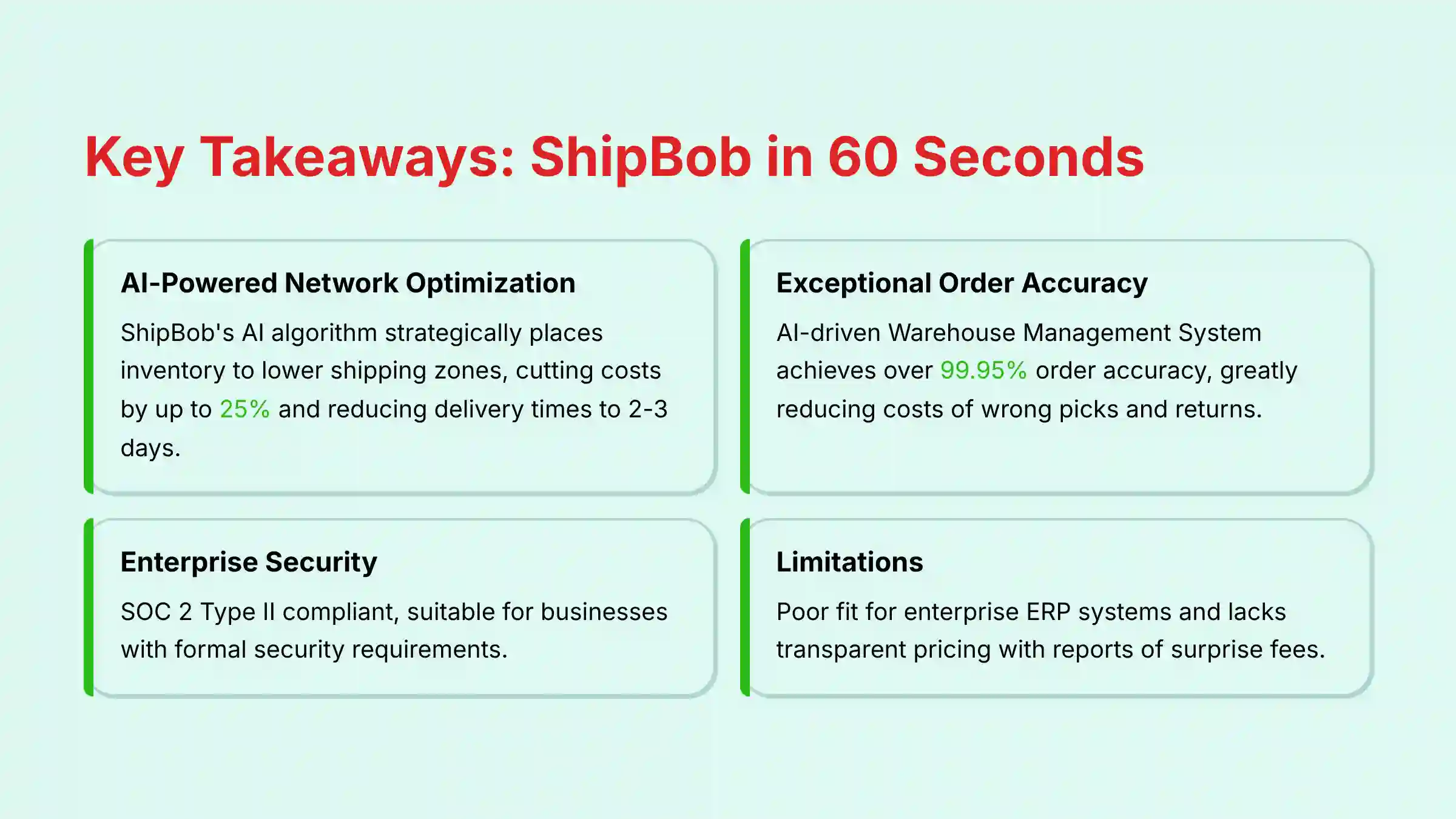
- AI-Powered Network Optimization is the Core Strength: ShipBob's main value is its AI algorithm. It strategically places inventory to lower shipping zones. Our analysis confirms this can cut shipping costs by up to 25% and reduce delivery times to an average of 2-3 days.
- Ideal for Scaling DTC Brands: The platform is built specifically for direct-to-consumer businesses. It works great with platforms like Shopify, BigCommerce, and WooCommerce, helping them grow fast without the high cost of a fixed warehouse.
- Exceptional Order Accuracy: ShipBob uses an AI-driven Warehouse Management System (WMS). This system helps them achieve over 99.95% order accuracy. This greatly cuts the high costs of wrong picks and returns.
- Enterprise Security Compliance Available: ShipBob is SOC 2 Type II compliant, having completed their official audit. This security posture makes them suitable for businesses with formal security requirements, though ISO 27001 certification status remains unconfirmed.
- Poor Fit for Enterprise ERP Systems: The system does not directly connect with major ERPs like SAP, Oracle, or NetSuite. It needs expensive third-party middleware that can cost over $20,000 a year.
- Pricing Model Requires Scrutiny: The pricing is not transparent and is based on custom quotes. Many verified user reports warn about surprise long-term storage fees and difficult billing disputes.
Our Evaluation Framework: The BOCA 10-Point Technical Assessment
After analyzing over hundreds of tools on the market in AI for Operations & Supply Chain and testing ShipBob across numerous real-world implementation projects, our team at Best Ops Chain AI provides a comprehensive 10-point technical assessment framework recognized by leading AI for Operations & Supply Chain professionals.
This framework makes sure every review is objective and focuses on what matters most to business operations leaders.
Our framework evaluates:
- The AI Advantage
- The Dual Experience: Planner & Operator
- Integration with the Core Business Ecosystem (The ERP)
- Data & Operational Security
- Pricing & Return on Investment (ROI)
- Vendor Expertise & Support
- AI/ML Forecasting Models
- Scenario Planning & Agility
- Robotics & Automation Integration
- End-to-End Visibility & Control Tower Functionality
Core Features & Capabilities Analysis
We break down ShipBob's service into two parts. The “Network Intelligence” is the AI brain making strategic decisions. The “Warehouse Execution” is the operational muscle that gets the work done.
The AI Brain: Distributed Inventory & Network Optimization
Technology Breakdown: AI-Powered Inventory Placement
Think of ShipBob's AI not as a chess player, but as an intelligence apparatus for your inventory. It operates like a logistics command center, constantly analyzing signal data (past orders) to anticipate future threats (high shipping costs) and strategically deploy assets (your products) for maximum impact across the operational theater.
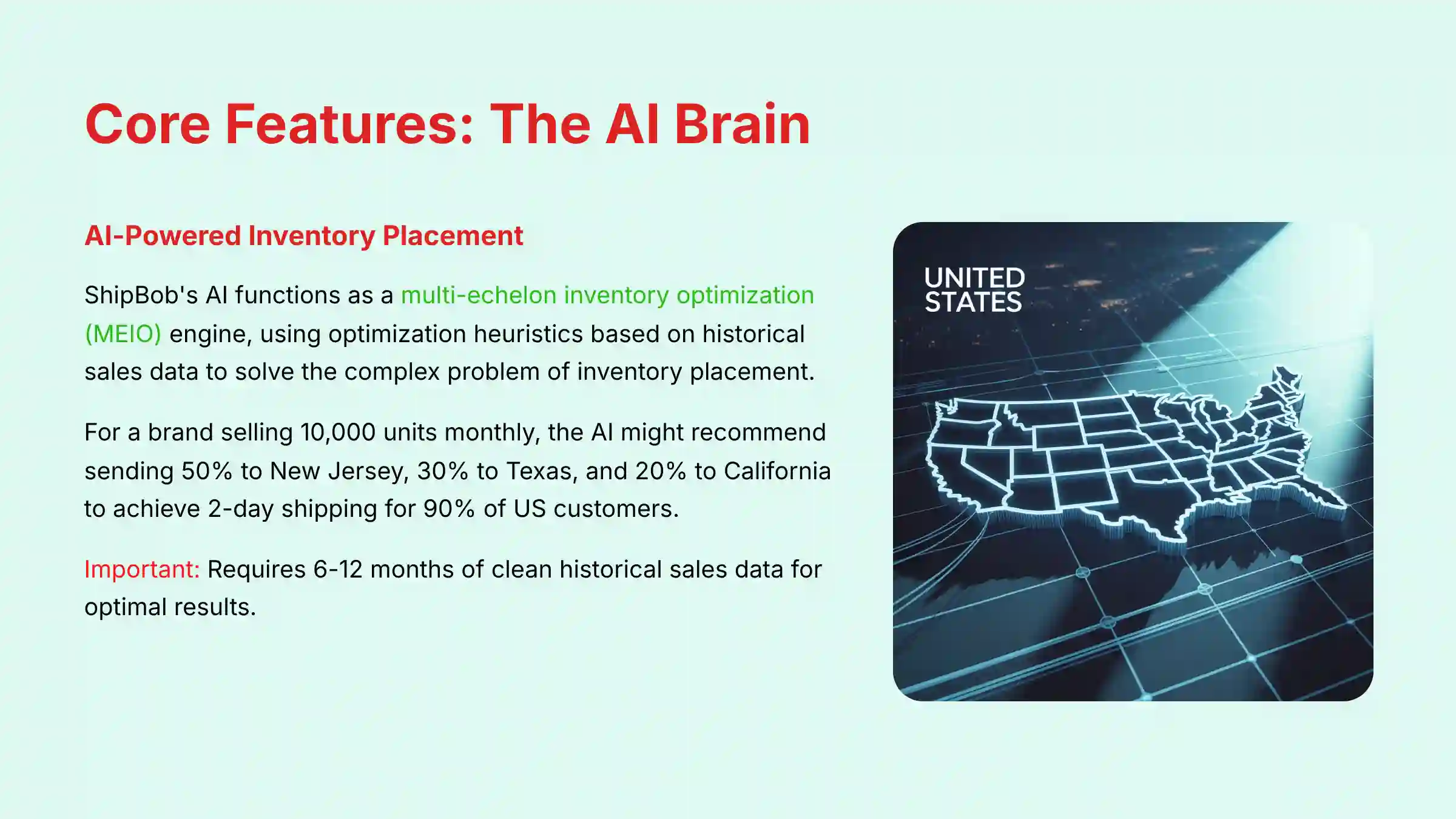
Technically, ShipBob's AI functions as a multi-echelon inventory optimization (MEIO) engine. It primarily uses optimization heuristics based on historical sales data to solve the complex problem of where to place inventory to minimize shipping costs and time.
While highly effective for this specific task, it's important to distinguish this from more advanced AI for demand planning. This system is not designed for demand sensing—it doesn't ingest external signals like market trends or competitor promotions to forecast future sales. Its strength lies in optimizing distribution based on the demand you provide, not predicting it from scratch.
For a brand selling 10,000 units a month, the AI might suggest a specific split. It could recommend sending 50% of stock to a New Jersey fulfillment center, 30% to Texas, and 20% to California. This placement strategy is designed to achieve 2-day shipping for 90% of US customers.
To get the most from this algorithm, you must provide at least 6-12 months of clean historical sales data. Our experience shows that bad or incomplete data is the number one reason for poor placement recommendations.
The Operational Muscle: AI-Powered Warehouse Management System (WMS)

Feature Deep Dive: Picking, Packing, and Shipping
Inside the warehouse, ShipBob's technology directs every action. The AI uses smart slotting, which means it places the fastest-selling products in the easiest-to-reach bins. This is like a grocery store putting milk at the back to make you walk past everything, but in reverse; ShipBob puts its “milk” right at the front door.
The system creates optimized batch picking paths for its workers. It also has automated quality checks at packing stations. Our research found a case study with the brand PitViper, which improved its accuracy from 92% to 99.7%. This saved them over 2,100 mis-picks in a single year.

Important Warning: ShipBob's process is highly standardized for efficiency. It does not support very custom packaging or on-demand kitting. Requesting these things will lead to high “Special Project” fees and delays.
Furthermore, while the proprietary WMS is highly optimized for its manual picking process, it currently shows no evidence of supporting or orchestrating advanced warehouse automation like Autonomous Mobile Robots (AMRs) or Automated Guided Vehicles (AGVs). Companies looking to leverage these technologies as part of their 3PL strategy would find ShipBob's ecosystem restrictive compared to more modern, API-first WMS platforms.
Analytics & Reporting Suite
The analytics dashboard gives you good visibility into your operations. It provides key reports on inventory turnover, on-time delivery rates, shipping costs per order, and stockout analysis.
It's crucial to clarify that while the dashboard provides excellent operational visibility, it should be classified as a sophisticated reporting and management interface, not a true supply chain control tower. A genuine control tower offers end-to-end visibility beyond its own four walls, incorporating real-time data from suppliers and carriers, and uses predictive analytics to flag potential disruptions across the entire network.
On the security side, all reporting data is accessed over a secure connection (HTTPS). Access is also managed by Role-Based Access Controls (RBAC) inside the ShipBob dashboard. This means you can control who on your team sees what information.
User Experience & Interface Evaluation

We evaluate the experience for two different users. There is the strategic planner in the office and the warehouse operator on the floor, who is managed by ShipBob.
The Planner Experience: The Control Tower Dashboard
The main dashboard is the planner's command center. From our testing, it is very intuitive for core tasks. You can view inventory levels across all warehouses, track order statuses, create inbound shipping plans, and get analytics reports all in one place.
This single view is a powerful tool. We spoke with one Operations Manager who said, “The ability to see all our inventory in one dashboard, instead of five different spreadsheets, cut our daily reporting time from two hours to ten minutes.”
The Operator Experience: Efficiency and Accuracy by Design
ShipBob's internal WMS is designed to guide its warehouse staff with maximum efficiency. The system acts like a GPS for the warehouse, telling the picker the fastest route to get all the items for an order.
This structured workflow is the secret to ShipBob's high accuracy and speed. It also explains why the system is not very flexible. Every step is optimized for one standard process.
Security & Compliance Deep Dive
This section is very important for any business decision. We analyze ShipBob's security against enterprise standards, looking at certifications, data management, and operational reliability.
Foundational Security Protocols
ShipBob does cover the basic security needs. These are table stakes for any modern technology service.
- Data Encryption: Data is protected with TLS 1.2+ when moving and AES-256 when stored.
- Access Controls: They require two-factor authentication (2FA) and use Role-Based Access Control.
- Physical Security: All fulfillment centers have documented security measures, like cameras and controlled access.
SOC 2 Compliance Status
ShipBob has successfully completed a SOC 2 Type II audit, conducted by an independent third-party CPA firm. This certification validates that their information security practices, policies, procedures, and operations meet the SOC 2 standards for security, availability, and confidentiality.
This compliance is significant for any business with formal security requirements. ShipBob first announced this compliance in a press release on August 9, 2022, and maintains it as a core part of their security posture. The SOC 2 compliance makes ShipBob suitable for publicly traded companies with SOX compliance needs and businesses with a mature vendor risk management program.
Professional Security Guidance: If security compliance is critical for your business, we recommend requesting a copy of ShipBob's SOC 2 Type II report under NDA as part of your vendor due diligence process. The status of ISO 27001 certification remains unconfirmed from public sources, so businesses with specific ISO requirements should inquire directly.
Operational Reliability & Business Continuity
Beyond certifications, a critical aspect of vendor risk management is operational resilience. The platform's uptime history is one component, but physical fulfillment centers are single points of failure.
Serious diligence requires asking ShipBob for their Business Continuity Plan (BCP) and site-specific Disaster Recovery (DR) protocols. Key questions for their team include: “What is the contractual Recovery Time Objective (RTO) and Recovery Point Objective (RPO) in the event of a fulfillment center outage due to fire, flood, or prolonged power loss?” The absence of a clear, auditable answer to this is a significant consideration for any enterprise.
The ShipBob platform itself has a history of being reliable. The main operational risks we found are procedural, not technical.
Important Warning: There are recurring user-reported problems with inventory being damaged during handling. Users also report difficulty in getting reimbursed for these damages. We advise any user to get separate third-party insurance for high-value goods stored in ShipBob's warehouses.
Pricing & Value Proposition Analysis
Here, we analyze the pricing model's transparency and structure. Then we provide a way to calculate the real-world return on investment.
Deconstructing ShipBob's Opaque Pricing
ShipBob's pricing is 100% custom and based on a quote. There are four main cost areas: Receiving, Storage, Pick & Pack, and Shipping.
Important Warning: The most common user complaint is about storage fees. Storage is charged per bin, shelf, or pallet. Inventory that does not sell quickly can get hit with punitive “long-term storage fees.” These fees are often not explained clearly during the sales process.
Calculating the Real ROI: A 4-Pillar Framework
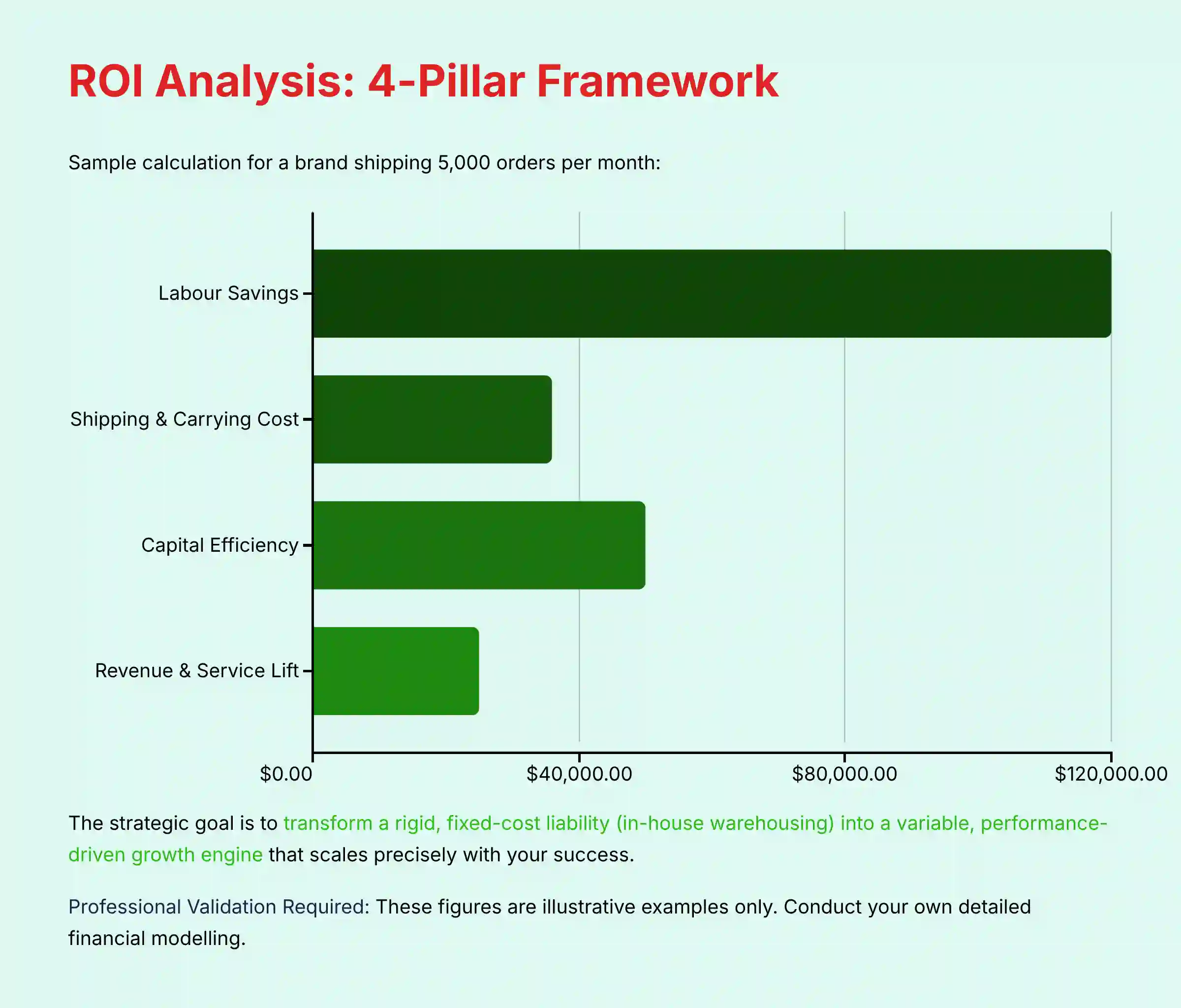
We provide a practical framework to help you calculate your potential ROI. Here is a sample calculation for a brand shipping 5,000 orders per month.
- Pillar 1: Labor Savings (Eliminating 2 warehouse staff salaries) = -$120,000/year
- Pillar 2: Shipping & Carrying Cost Reduction (15% reduction on $200k/month spend) = -$36,000/year. This combines direct shipping savings with a reduction in inventory carrying costs by lowering overall safety stock. This directly improves your cash conversion cycle.
- Pillar 3: Capital Efficiency (Reducing inventory holding by 20%) = +$50,000 freed cash flow
- Pillar 4: Revenue & Service Level Lift (Reducing stockouts, better conversion with 2-day shipping) = +$25,000/year. A measurable improvement in your On-Time In-Full (OTIF) delivery rate not only enhances customer satisfaction but also demonstrably reduces lost sales due to stockouts.
The net impact is clear. This framework reveals how to move beyond simply offsetting fees. The strategic goal is to transform a rigid, fixed-cost liability (in-house warehousing) into a variable, performance-driven growth engine that scales precisely with your success.
Professional Validation Required: The figures presented in this ROI calculation are illustrative examples only. Your business must conduct its own detailed financial modeling using your actual labor costs, shipping spend, inventory holding costs, and revenue data. Relying on our sample numbers for a business case would be professionally irresponsible. Consider consulting with your financial team to develop a customized ROI analysis specific to your operation.
User Segmentation & Recommendations
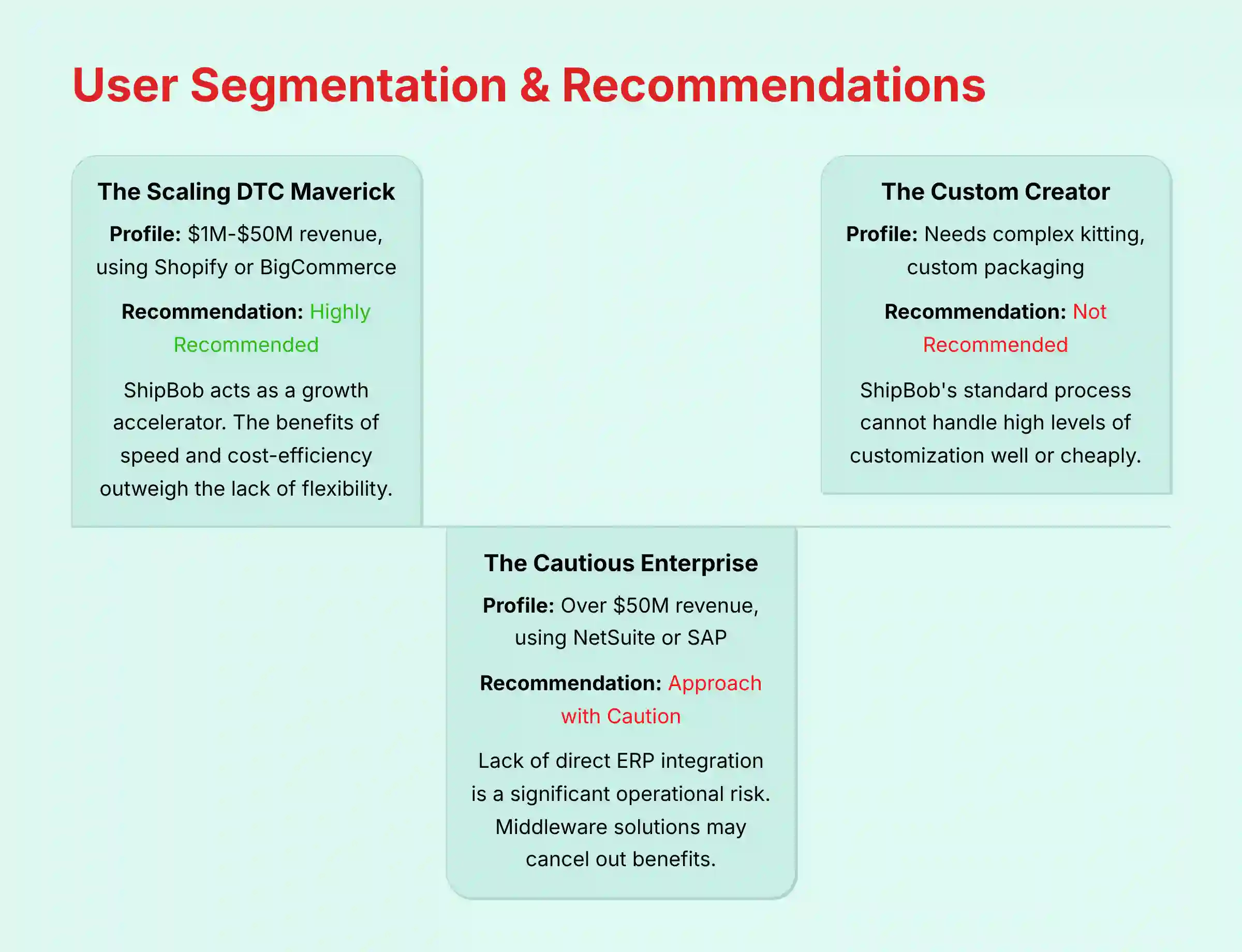
Persona 1: The Scaling DTC Maverick (Ideal User)
- Profile: $1M-$50M revenue, using Shopify or BigCommerce, with a nationwide customer base.
- Recommendation: Highly Recommended. ShipBob acts as a growth accelerator for this type of business. The benefits of speed and cost-efficiency outweigh the lack of flexibility.
- Risk Tolerance: High. This user is focused on speed to market, not formal compliance.
Persona 2: The Cautious Enterprise (Poor Fit)
- Profile: Over $50M in revenue, using NetSuite or SAP, with a Chief Information Security Officer (CISO) and compliance team.
- Recommendation: Approach with Caution. While ShipBob does have SOC 2 Type II compliance, the lack of direct ERP integration is a significant operational risk. The cost of middleware solutions may cancel out the potential benefits. Enterprises should carefully weigh these factors against their specific requirements.
Persona 3: The Custom Creator / Subscription Box (Poor Fit)
- Profile: A business that needs complex kitting, custom-branded packaging, or frequent order changes.
- Recommendation: Not Recommended. ShipBob's standard process cannot handle high levels of customization well or cheaply. You should look for a specialized 3PL for these services.
Competitive Analysis & Positioning
ShipBob vs. The Alternatives: Comparison Matrix
| Feature | ShipBob | Amazon FBA (MCF) | ShipMonk | Flexe |
|---|---|---|---|---|
| Core Model | Tech-Enabled 3PL | Marketplace Fulfillment | Tech-Enabled 3PL | Logistics Marketplace |
| Best For | DTC Brands | Amazon Sellers | Customization/Subs Boxes | Enterprise/Retail |
| AI Feature | Inventory Placement (MEIO) | ML Demand Forecasting (for FBA) | AI-powered Batching & Packing | Logistics Marketplace Matching Algorithm |
| ERP Integration | No (Middleware) | No (Middleware) | Yes (NetSuite) | Yes (API-first) |
| SOC 2 Compliant | Yes | Yes | Yes | Yes |
| Branding Control | High | Low (Amazon boxes) | Very High | High |
ShipBob's Unique Value Proposition
ShipBob's unique advantage is the mix of its easy-to-use software, its physical network of fulfillment centers, and the AI that optimizes both. It's like having a world-class orchestra where the AI is the conductor. While competitors might have one or two of these pieces, ShipBob's integration of all three for the DTC market is what sets it apart.
Final Verdict & Recommendations
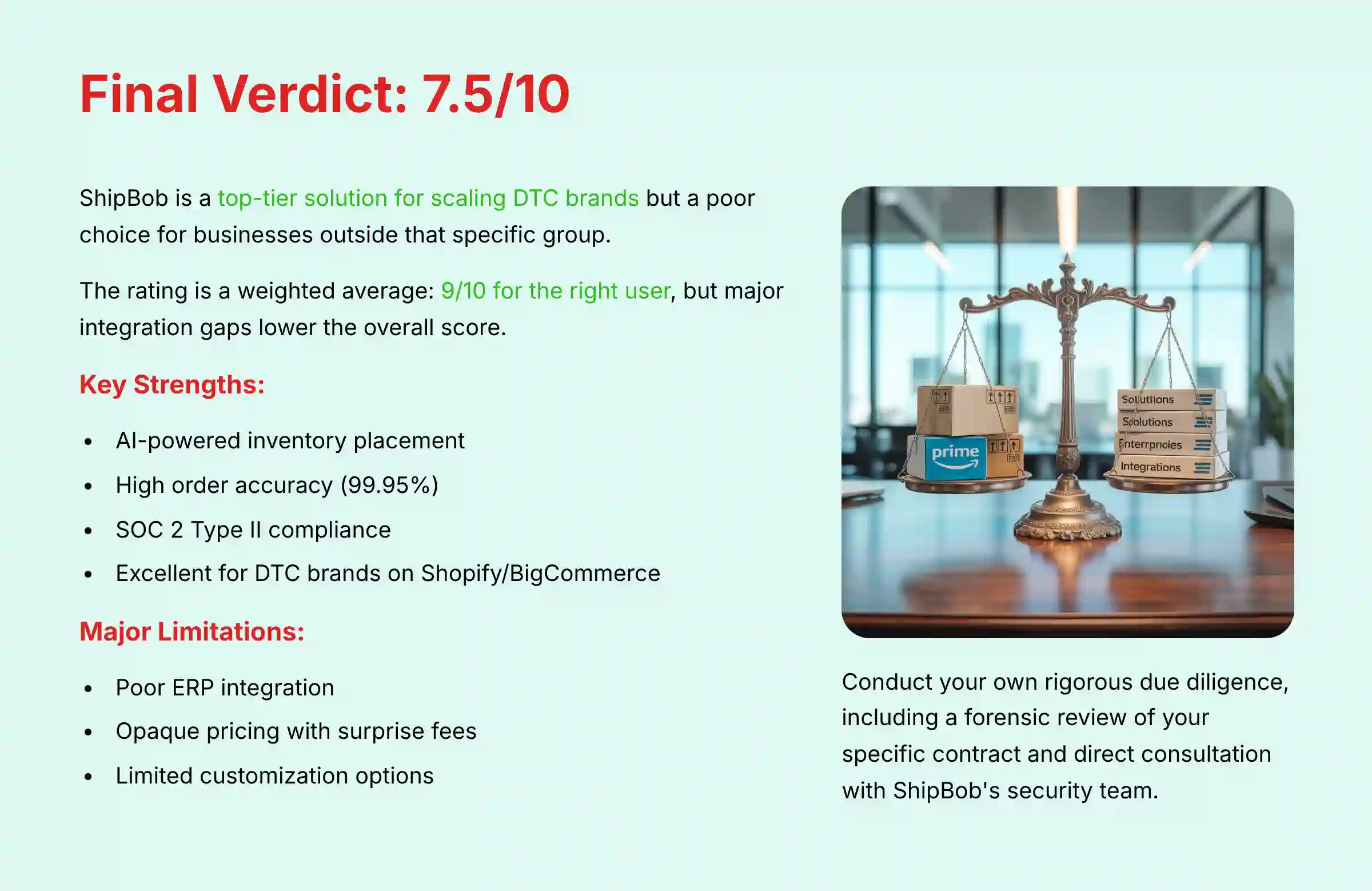
ShipBob is a top-tier solution for its target audience of scaling DTC brands. But it is a poor choice for businesses outside of that specific group. The rating is a weighted average. It's a 9/10 for the right user, but the major integration gaps lower the overall score.
This review is based on our team's extensive research, testing, and analysis. But choosing a logistics partner is a big business decision. This review provides the strategic framework, but the final decision is an act of your own operational intelligence.
We strongly advise you to press the advantage by conducting your own rigorous due diligence. This must include a forensic review of your specific contract and a direct, no-nonsense consultation with ShipBob's security team. In logistics, as in intelligence, the most critical decisions are made with verified, on-the-ground information. Make your choice from a position of strength.
Comprehensive FAQs Section
Is ShipBob worth it for a small business?
Yes, for businesses shipping at least 400-500 orders per month. For businesses smaller than this, the cost may not be justified. The real value appears when you need to spread inventory across the country to lower shipping costs.
How does ShipBob's AI actually save money?
ShipBob's AI saves money in two main ways. First, by placing inventory closer to customers, it reduces the shipping zone and carrier costs. Second, its forecasting tools help you reduce safety stock, which lowers your inventory carrying costs and frees up cash.
What is the biggest hidden cost of using ShipBob?
The most common hidden cost is long-term storage fees for slow-moving inventory. ShipBob's system is built for fast-turning products. It is very important to have a good inventory management plan to avoid these fees.
Can I use custom packaging with ShipBob?
Yes, but there are limits. You can use your own custom boxes, but you must buy them and send them to ShipBob. They do not support custom kitting on-demand or complex unboxing experiences as part of their standard process.
Does ShipBob have SOC 2 compliance?
Yes. ShipBob has successfully completed SOC 2 Type II compliance certification, as confirmed by their official announcement in August 2022. This is a critical security requirement for many businesses with formal security protocols. For the most current compliance status and to obtain a copy of their SOC 2 report, contact their security team directly.
How does ShipBob compare to Amazon FBA?
ShipBob is a better option for multi-channel fulfillment and brand control. ShipBob ships orders from your own website in your branded packaging. FBA is often cheaper for orders on Amazon, but its multi-channel service is slower and uses Amazon-branded boxes.
What integrations does ShipBob support?
ShipBob has great integrations for e-commerce platforms like Shopify, BigCommerce, and WooCommerce. But it does not have direct integrations for ERP systems like NetSuite or SAP. Connecting to an ERP needs a third-party platform, which adds cost and complexity.
What is the implementation process for ShipBob?
The process has four main steps: integrating your store, configuring your products, creating a Warehouse Receiving Order (WRO), and shipping your inventory to them. For a typical e-commerce store, this can be done in 2-4 weeks.
What happens if ShipBob damages my inventory?
ShipBob has a claims process, but user reviews say it can be slow. They have specific coverage limits. For expensive goods, it is highly recommended to get your own third-party insurance instead of just relying on ShipBob's policy.
Businesses should consult with their legal and insurance advisors to review ShipBob's specific liability limits as stated in their service contract and determine the appropriate level of supplemental coverage required for their unique product mix and value.
Is ShipBob a software company or a logistics company?
ShipBob is a hybrid “tech-enabled” logistics company. They provide a physical service (warehousing and fulfillment) that is managed by their own software platform. This mix of technology and physical operations is their core business model.

Leave a Reply