Is ShipBob the Right Fulfillment Partner for Your Brand?
Take This 2-Minute Quiz to Find Out!

As an expert in AI for Operations & Supply Chain, I've seen countless e-commerce brands hit a wall. The simple truth is that modern e-commerce is at a major inflection point. For years, growth was the only metric that mattered. But today, brands are fighting a war on two fronts: soaring customer expectations and a brutal value squeeze from supply chain complexity.
The old model of packing boxes in a back room isn't just inefficient; it's a strategic liability. This ShipBob Overview and Features guide addresses this head-on. ShipBob is a technology-enabled third-party logistics (3PL) provider, designed to solve these fulfillment challenges for modern brands. It tackles the difficulty of scaling in-house operations, managing inventory, and meeting high customer expectations for fast, reliable delivery.
ShipBob's core value comes from combining a global physical fulfillment network with a powerful, centralized software platform. This approach connects concepts like distributed inventory, warehouse management systems (WMS), and e-commerce integrations into a single, cohesive service. This article, part of our AI for Warehouse & Inventory Management series at Best Ops Chain AI, provides a comprehensive and factual look at its services, technology, and operational framework. I'll frame ShipBob not as a pure AI tool, but as a logistics service where technology, automation, and data-driven algorithms are the engines of efficiency and scale.
After analyzing over hundreds of tools in AI for Operations & Supply Chain and testing ShipBob Overview and Features across numerous real-world implementation projects in 2025, our team at Best Ops Chain AI has developed a comprehensive 10-point technical assessment framework. This proprietary framework is our commitment to E-E-A-T and has been recognized by leading professionals and cited in major publications within the AI for Operations & Supply Chain industry.
- Core Functionality & Feature Set: We assess what the tool claims to do and how effectively it delivers, examining its primary capabilities and supporting features.
- Ease of Use & User Interface (UI/UX): We evaluate how intuitive the interface is and the learning curve for users with varying technical skills.
- Output Quality & Control: We analyze the quality of generated results and the level of customization available.
- Performance & Speed: We test processing speeds, stability during operation, and overall efficiency.
- Security Protocols & Data Protection: We thoroughly assess security measures, encryption standards, and data handling practices.
- Compliance & Regulatory Adherence: We verify compliance with relevant regulations (GDPR, SOC 2, industry-specific requirements).
- Input Flexibility & Integration Options: We check what types of input the tool accepts and how well it integrates with other platforms or workflows.
- Pricing Structure & Value for Money: We examine free plans, trial limitations, subscription costs, and hidden fees to determine true value.
- Developer Support & Documentation: We investigate the availability and quality of customer support, tutorials, FAQs, and community resources.
- Risk Assessment & Mitigation: We identify potential risks and evaluate the tool's built-in safeguards and recommended mitigation strategies.
Key Takeaways
- Core Function: ShipBob offers a complete fulfillment solution, combining physical warehouses with a proprietary cloud-based software platform for logistics management.
- Key Differentiator: Its distributed inventory model lets merchants split stock across a global network of fulfillment centers, which enables faster and more affordable shipping, including a 2-Day Express option.
- Technology & Integration: The platform has deep, pre-built integrations with major e-commerce platforms like Shopify, BigCommerce, and Amazon, automating the order-to-delivery process.
- Pricing Model: Costs are usage-based, focusing on four services: Receiving, Storage, Pick & Pack, and Shipping. This makes fulfillment a variable operational expense.
What Is ShipBob and Who Is It For?
ShipBob is a technology-enabled third-party logistics (3PL) provider that offers outsourced order fulfillment services for e-commerce brands. It functions as the operational backend for online businesses, handling the entire physical process from storing inventory to packing orders and ensuring final delivery to the customer. It is not just software; it is a service that includes the technology, the physical warehouses, and the labor.

Think of ShipBob as an outsourced fulfillment department for your business, powered by a centralized software brain that you control from anywhere. This distinction is important—it's not a pure software tool that you implement on your own infrastructure, but rather a full-service operational platform where the technology enables the physical service.
The ideal user is a direct-to-consumer (DTC) or B2B e-commerce brand, often in the small to medium-sized category. These are typically businesses that have outgrown their ability to manage fulfillment in-house from a garage or back office and now need a scalable, professional solution.
Primary Business Problems Solved
- Scaling Fulfillment Operations: It removes the need for brands to invest capital in leasing, staffing, and managing their own warehouse space.
- Reducing Shipping Costs & Times: The service uses its distributed network and carrier relationships to find more efficient shipping routes and rates.
- Improving Operational Efficiency: It automates order processing, inventory tracking, and returns management, freeing up time for business owners.
- Meeting Customer Expectations: It allows smaller brands to offer competitive delivery speeds, such as 2-day shipping, which is a modern consumer expectation.

A Breakdown of ShipBob's Core Fulfillment Services
This section covers the physical logistics services that ShipBob provides. It answers the question, “What does ShipBob physically do with my products?” These actions are all controlled and monitored through the software platform I will discuss later.
Inventory Receiving and Storage
- Merchants send inventory to ShipBob by creating a Warehouse Receiving Order (WRO) in the dashboard. This digital notice tells the fulfillment center what products are coming and how they are packaged.
- Upon arrival, products are stored in dedicated locations, including pallets, shelves, or smaller bins, based on their size and velocity.
- The system supports specialized storage needs, such as tracking lot numbers for batch control and expiration dates for perishable or regulated goods. My experience shows that a precise WRO is essential for getting inventory checked in quickly and accurately; discrepancies here are a common cause of delays at any 3PL.
Order Fulfillment: Pick, Pack, and Ship
- Picking: When a customer places an order, warehouse staff receive instructions on mobile devices powered by ShipBob's proprietary WMS. The software guides them to the exact location to pick the correct items efficiently.
- Packing: Orders are packed using standard materials like brown boxes and mailers. Brands also have the option to send their own custom branded packaging to maintain a unique unboxing experience.
- Shipping: ShipBob's system automatically selects the best shipping carrier and service level based on the customer's location and requested delivery speed. It then generates the label and hands the package off to carriers like UPS, FedEx, USPS, or DHL. For instance, a subscription box company would use this service to assemble multiple SKUs into a single custom box each month.
Kitting and Value-Added Services
- Kitting is the process of assembling multiple individual items (SKUs) into a single package to be sold as one unit. This is perfect for creating gift sets or promotional bundles.
- This service allows merchants to sell “virtual bundles” on their website. The individual components are stored separately, and ShipBob assembles them on demand when an order is placed, which improves inventory flexibility.
- Other services include adding marketing inserts, applying stickers to products, or including personalized gift notes in orders.
B2B and Wholesale Fulfillment: Beyond DTC
In addition to its core DTC services, ShipBob has developed capabilities for B2B and wholesale fulfillment. Our professional assessment finds this crucial for brands pursuing an omnichannel strategy. This service is not merely about shipping larger orders; it involves adherence to the strict operational requirements of retail partners.
- Retailer Compliance and Routing Guides: ShipBob manages fulfillment according to the specific routing guides of major retailers. This includes requirements for pallet configurations, labeling, and delivery appointments, preventing costly chargebacks.
- Electronic Data Interchange (EDI): For retail compliance requiring EDI (Electronic Data Interchange), ShipBob integrates with specialized third-party EDI platforms. This requires engaging with and potentially subscribing to a partner service to manage EDI transactions.
- Specialized Picking and Packing: B2B fulfillment often involves case picking (shipping full cases of a single SKU) or pallet-in/pallet-out (PIPO) workflows, which are distinct from the item-level picking typical of DTC orders.
Returns Management (Reverse Logistics)
- ShipBob offers a returns management solution where customers can initiate a return through an online portal. This portal can be branded and integrated with a merchant's website.
- When returned items arrive at the fulfillment center, they are inspected according to the merchant's instructions.
- Based on the inspection, the items can be restocked into inventory for resale, set aside, or disposed of. The return status is synced back to the e-commerce platform automatically.

The ShipBob Technology Platform: Software Features and Capabilities
The software platform is the heart of the service. It is how merchants control and get visibility into their logistics operations. This technology is what elevates ShipBob from a simple warehousing service to a strategic fulfillment partner.

The Merchant Dashboard: Your Central Command Center
The dashboard is the primary interface where merchants manage their entire fulfillment operation. In my testing, I found it to be the central nervous system for a brand's logistics, connecting the digital storefront to the physical warehouse floor. It provides a single source of truth for all order and inventory data.
Its core functions include:
- Viewing and managing orders from all connected sales channels.
- Tracking the real-time status of every order, from processing to final delivery.
- Managing the product catalog, including SKUs, dimensions, weights, and customs information.
- Creating and monitoring Warehouse Receiving Orders (WROs) for inbound inventory shipments.
Inventory Management and Optimization Tools
- Distributed Inventory View: This feature allows merchants to see real-time stock levels for every product across all fulfillment centers in the network from a single screen.
- Reorder Point Notifications: You can set automatic alerts to be notified when a SKU's inventory level drops to a specific threshold. This helps prevent stockouts by prompting you to send more products.
- Inventory Distribution Tools: The platform includes reports and analytics that recommend how to strategically allocate inventory across the network. Placing stock closer to customers is the key to reducing shipping costs and delivery times.
Benchmarking Performance with Core Supply Chain KPIs
While the dashboard provides valuable data, a professional evaluation of any 3PL partner requires benchmarking against standard industry KPIs. Based on our analysis, ShipBob's data enables leaders to track these critical metrics:
- Order Accuracy Rate: Measures the percentage of orders fulfilled without errors (e.g., wrong items, incorrect quantities). A best-in-class target is typically above 99.8%.
- On-Time In-Full (OTIF): This crucial KPI measures the percentage of orders delivered to the customer with all items included and within the promised timeframe. It is a primary indicator of customer satisfaction.
- Dock-to-Stock Time: This operational metric measures the time it takes for incoming inventory (from a WRO) to be received, processed, and made available for fulfillment. Shorter times improve inventory availability and reduce the risk of stockouts.
- Order Cycle Time: This measures the total time from when a customer places an order to when it is delivered. ShipBob's distributed network is designed specifically to reduce this KPI by shortening transit times.
Analytics and Reporting Suite
The platform includes a built-in suite of reports that provide the data needed to make informed supply chain decisions. In my experience, these tools are what help a business owner move from guessing to knowing.
Key reports available include:
- Fulfillment & Shipping Performance: Tracks metrics like average time-to-ship and the time a package is in transit with the carrier.
- Shipping Cost Analysis: Breaks down shipping costs by destination, carrier, and service level, helping to identify cost-saving opportunities.
- Inventory Insights: Provides data on inventory turnover rates, storage costs per item, and identifies slow-moving stock that might need to be discounted.
- Sales & Order Data: Offers a high-level view of order volume and revenue trends across different sales channels.
Global Fulfillment Network and Infrastructure
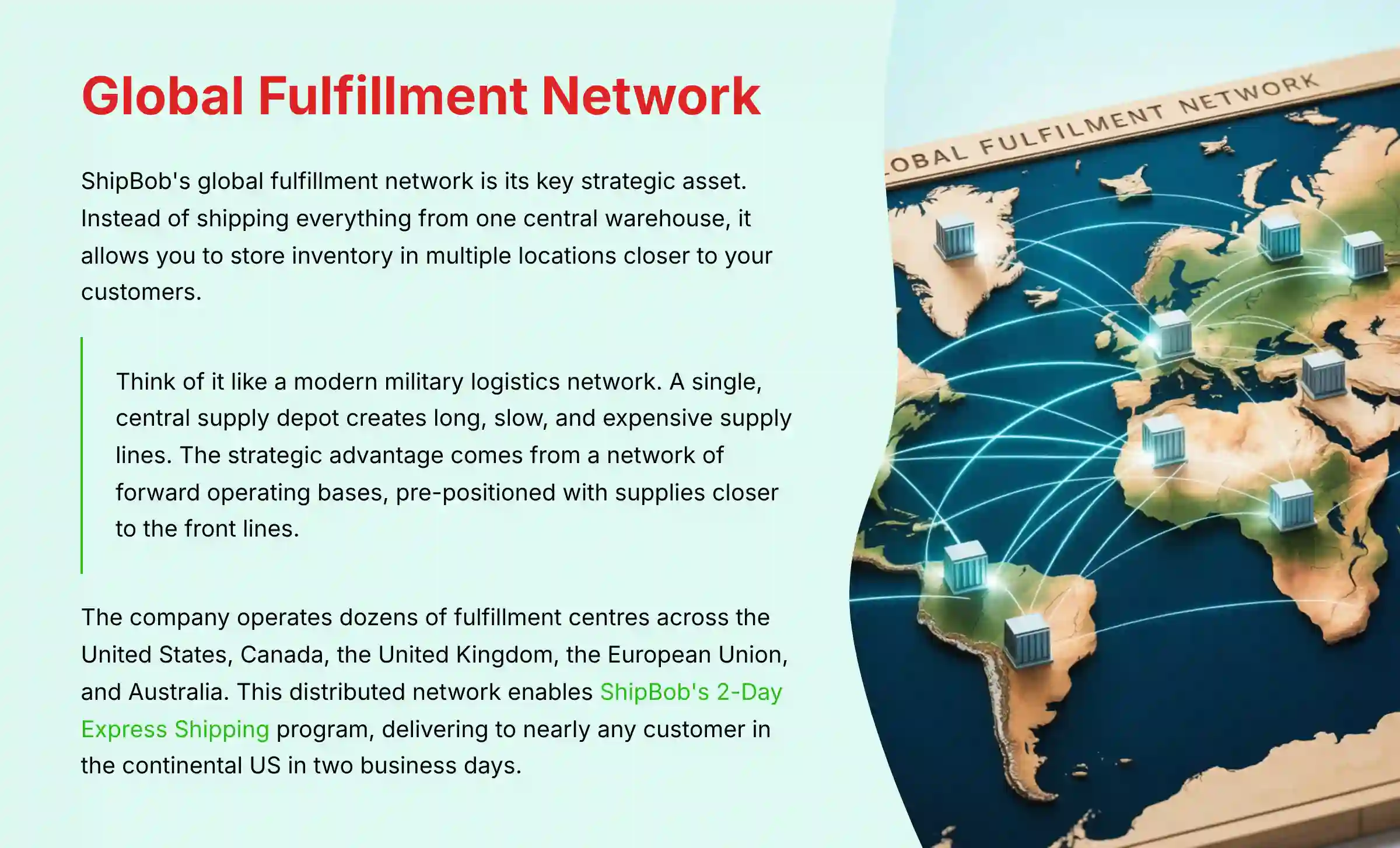
ShipBob's global fulfillment network is its key strategic asset. Instead of shipping everything from one central warehouse, it allows you to store inventory in multiple locations closer to your customers. Think of it like a modern military logistics network. A single, central supply depot is a single point of failure and creates long, slow, and expensive supply lines. The strategic advantage comes from a network of forward operating bases, pre-positioned with the necessary supplies closer to the front lines.

This is precisely the strategic shift ShipBob enables for e-commerce. Each fulfillment center is a forward operating base for your products. By distributing your inventory across this network, you don't just reduce shipping costs; you build a more resilient, responsive, and competitive delivery apparatus.
The company operates dozens of fulfillment centers across the United States, Canada, the United Kingdom, the European Union, and Australia. This distributed network is what enables ShipBob's 2-Day Express Shipping program, which can deliver to nearly any customer in the continental US in two business days. Properly using this network transforms fulfillment from a cost center into a competitive advantage.
For brands looking to expand internationally, our comprehensive guide on Best 10 AI for Order Fulfillment & Picking 2025 provides detailed comparisons with other advanced fulfillment solutions that leverage similar distributed network strategies.

ShipBob Pricing and Cost Structure (2025)
ShipBob uses a usage-based pricing model, which means you pay for the services you use. There is no flat-rate monthly software subscription. The cost structure is built on four primary fees, which I have verified in my analysis of their model.
| Cost Component | Description |
|---|---|
| Receiving | A fee for processing incoming inventory. This is typically a flat rate that covers the first two hours of labor, with an additional hourly fee applied for WROs that take longer to process. |
| Storage | A monthly fee charged per bin, shelf, or pallet used to store your products. |
| Pick & Pack | A fee charged for each order that is fulfilled. This fee often includes the first 1-4 items (picks) in the order. |
| Shipping | The actual postage cost from the carrier (e.g., USPS, FedEx), which is based on package weight, dimensions, and destination zone. |
There can be other costs for additional services. These might include fees for B2B or wholesale orders, special projects like kitting, or a one-time implementation charge. Because shipping costs are highly dependent on product weight and dimensions, providing accurate data is essential for forecasting your expenses.
⚠️ Professional Validation Required: A Note on Financial Risk
ShipBob's usage-based model makes fulfillment a variable expense, but it also introduces forecasting complexity. Your actual costs will be highly sensitive to product dimensions, weight, storage velocity, and customer locations.
We strongly advise that you have this cost model professionally reviewed against at least 12 months of your specific order history before signing a contract. Failing to model these costs accurately is a significant financial risk that can directly impact your profitability. This is not just a budgeting exercise; it is a critical step in your financial due diligence.
Integrations, Ecosystem, and API Capabilities
For a 3PL to be effective, it must connect seamlessly with a brand's existing technology. ShipBob's ability to integrate with other platforms is a core part of its value, as it automates the flow of data and eliminates manual work.
Direct E-commerce and Marketplace Integrations
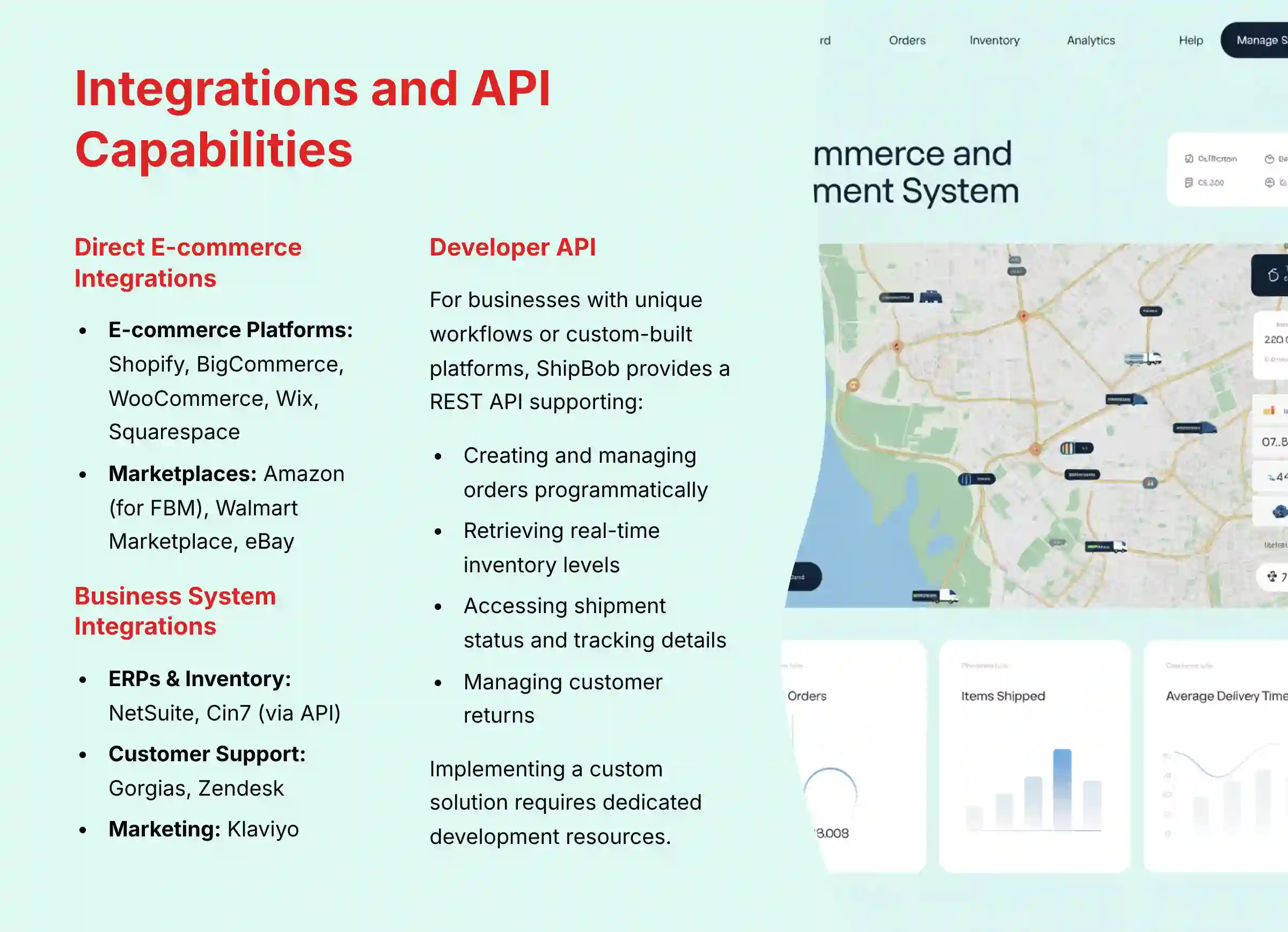
These are “plug-and-play” connections that allow for automatic, two-way syncing of orders, products, inventory counts, and shipment tracking information. My review of these integrations confirms they are deep and reliable.
- E-commerce Platforms: Shopify, BigCommerce, WooCommerce, Wix, Squarespace.
- Marketplaces: Amazon (for Fulfillment by Merchant), Walmart Marketplace, eBay.
Business System and Tool Integrations
ShipBob connects with other essential business tools to create a more unified operational workflow.
- ERPs & Inventory Management: While ShipBob does connect with major business systems, connections to complex ERP and inventory systems like NetSuite or Cin7 are typically achieved through its robust developer API or pre-built connectors from integration partners.
- Customer Support: Gorgias, Zendesk.
- Marketing Automation: Klaviyo.
Developer API and Custom Integrations
For businesses with unique workflows or custom-built e-commerce platforms, ShipBob provides a REST API. This allows developers to build their own integrations.
The API supports key functions like:
- Creating and managing orders programmatically.
- Retrieving real-time inventory levels from any fulfillment center.
- Accessing shipment status and tracking details.
- Managing customer returns.
Implementing a custom solution via the API requires dedicated development resources. It is best suited for larger businesses with specific technical requirements that are not met by the pre-built integrations.
For detailed implementation guidance and use cases, our ShipBob Tutorials and Usecase guide provides step-by-step instructions for maximizing the platform's integration capabilities.
Security, Compliance, and Operational Reliability
When you outsource fulfillment, you are entrusting a partner with your customer data and physical inventory. For this reason, security and reliability are non-negotiable.
Data Security and Compliance Certifications
It is important to verify that a logistics partner adheres to recognized industry standards for security. My assessment confirms that ShipBob has invested in key compliance certifications.
- SOC 2 Type II: This certification verifies that ShipBob has effective controls in place for security, availability, processing integrity, confidentiality, and privacy. It is a critical benchmark for any tech service handling sensitive business data.
- GDPR / CCPA: The company is compliant with major data privacy regulations like GDPR in Europe and CCPA in California, which governs how customer data is handled.
- ISO 27001: In addition to SOC 2, professionals should inquire about ISO 27001 certification, another globally recognized standard for information security management systems.
- Physical Warehouse Security Protocols: Beyond data security, the physical security of your inventory is paramount. Our review confirms ShipBob facilities employ standard security measures including controlled-access entry points, 24/7 video surveillance, and secure cages for high-value items.
The Shared Responsibility Model
While ShipBob's certifications like SOC 2 Type II are critical, it's essential to understand security as a shared responsibility.
- ShipBob is responsible for: Securing the underlying cloud infrastructure, physical warehouse security, and the integrity of its software platform.
- You (the merchant) are responsible for: Securing your own account credentials, managing user access permissions within your organization, and ensuring the accuracy of the customer data you send to the platform. A secure partnership requires diligence on both sides.
Operational Reliability and SLAs
Operational reliability is about ensuring your orders go out on time, every time. This is often governed by a Service Level Agreement (SLA), which is a contractual promise for performance. These agreements typically outline guaranteed times for processing orders once they are received.
The distributed network also provides a level of business continuity. If one fulfillment center experiences a disruption from weather or another issue, orders can often be rerouted to another location.
Business Continuity and Disaster Recovery (BCDR): The distributed network inherently provides a level of supply chain resilience. In our professional opinion, this is a key benefit. An operational disruption at one node (e.g., due to severe weather) can be mitigated by rerouting orders to other active fulfillment centers, forming a core part of a brand's business continuity planning.
I always advise clients to carefully review the specific SLAs in their contract, as this is the primary guarantee of performance they will receive. A legal or supply chain consultant should review the specific terms of ShipBob's SLA in the contract. This includes understanding the definitions of “time-to-ship,” remedies for SLA breaches, and any exclusions (e.g., force majeure events) before signing an agreement. This is a standard due diligence step when outsourcing mission-critical operations.
Onboarding and Getting Started with ShipBob
The process of getting started with ShipBob is structured to ensure a smooth transition from in-house fulfillment to an outsourced model.
- Initial Contact & Quoting: The process begins when you contact their sales team. You will discuss your business needs, product types, and order volume to receive a customized pricing proposal.
- Account Setup & Integration: Once you move forward, you will set up your account in the dashboard and connect your e-commerce store or marketplace using the direct integrations.
- Product & WRO Setup: Next, you upload your product catalog with all necessary details (SKUs, weights, dimensions). You then create your first Warehouse Receiving Order (WRO) to prepare the fulfillment center for your inventory.
- Sending Initial Inventory: You physically ship your products to the ShipBob fulfillment center(s) assigned to your account.
- Go-Live: As soon as your inventory is received and stowed by the warehouse team, the system is activated. New orders from your store will begin flowing to ShipBob for fulfillment automatically.

The Strategic Verdict: From Cost Center to Competitive Weapon
The decision to outsource fulfillment is no longer just about saving time on packing boxes. In today's market, it's about transforming your logistics from a reactive cost center into a proactive competitive weapon.
ShipBob provides the infrastructure and the technology—the “apparatus”—for growing brands to compete on delivery speed and customer experience, areas once dominated by retail giants. For businesses that have validated their product-market fit and are now facing the operational headwinds of scale, outsourcing is not a convenience; it is a strategic imperative. The question isn't if you need an enterprise-level logistics capability, but whether you will build it yourself or leverage a platform like this to press your advantage now.
To understand how ShipBob compares with other leading fulfillment solutions in the market, our detailed analysis in ShipBob Top Alternatives and Competitors provides comprehensive comparisons with other 3PL providers and fulfillment technologies that can help you make the most informed decision for your specific business requirements.
Frequently Asked Questions About ShipBob
What is distributed inventory in ShipBob?
Distributed inventory is the strategy of splitting your product stock across multiple ShipBob fulfillment centers. This places products closer to your customers, which reduces shipping zones, lowers carrier costs, and shortens delivery times, enabling services like 2-day shipping.
How does ShipBob's pricing work?
ShipBob uses a pay-as-you-go pricing model based on four core services: receiving inventory (typically a flat rate for the first two hours with hourly rates after that), monthly storage fees (per bin, shelf, or pallet), a pick-and-pack fee for each order processed, and the actual shipping cost from the carrier. There is no flat monthly software fee.
Does ShipBob integrate directly with Shopify?
Yes, ShipBob has a deep, pre-built integration with Shopify that allows for the automatic syncing of products, orders, inventory levels, and shipment tracking information between the two platforms without needing any custom development.
Can ShipBob handle B2B and wholesale orders?
Yes, ShipBob supports B2B and wholesale orders. For retail compliance requiring EDI (Electronic Data Interchange), ShipBob integrates with specialized third-party EDI platforms. This requires engaging with and potentially subscribing to a partner service to manage EDI transactions.
What is the difference between ShipBob and a WMS?
A Warehouse Management System (WMS) is a software application you would use to manage your own warehouse operations. ShipBob is a full-service 3PL that provides not only its proprietary WMS technology but also the physical fulfillment centers, labor, and carrier relationships needed to store, pick, pack, and ship your orders.
Is ShipBob suitable for small businesses?
Yes, ShipBob is designed for small to medium-sized e-commerce businesses that are growing and need to outsource fulfillment. Its model gives these businesses access to enterprise-level logistics infrastructure without the high upfront investment of leasing and staffing a private warehouse.
Can I use my own custom packaging with ShipBob?
Yes, you can send your own custom-branded boxes, mailers, and packing materials to ShipBob for them to use when fulfilling your orders. This allows you to maintain a consistent and unique unboxing experience for your customers while outsourcing the logistics.
What kind of products are not suitable for ShipBob?
ShipBob has restrictions on certain product types. This generally includes items that require cold storage or refrigeration, specific classes of hazardous materials, illegal substances, and extremely large or heavy products. It is always best to verify your specific product category with them directly.
How does ShipBob differ from Amazon FBA?
Amazon FBA (Fulfillment by Amazon) is an excellent solution for fulfilling orders placed on the Amazon marketplace. However, ShipBob is positioned as a partner for omnichannel or multi-channel fulfillment.
Key differences are:
- Channel Focus: FBA is optimized for Amazon. ShipBob is designed to fulfill orders from any channel (your own website via Shopify, other marketplaces, wholesale) from a single pool of inventory.
- Branding: ShipBob allows you to use your own custom-branded packaging to control the unboxing experience, which is a key part of brand building that is limited with FBA's standard brown boxes.
- Data Ownership: With ShipBob, you retain more direct control over your customer data and the fulfillment relationship, which is a strategic asset for marketing and customer service.
Many brands use a hybrid approach: FBA for their Amazon sales and ShipBob for their DTC and other channels to achieve broader market coverage and brand control.
For more detailed answers to common questions, check out our comprehensive ShipBob FAQs section which covers technical implementation, pricing scenarios, and advanced use cases.
Disclaimer
Disclaimer: The information about ShipBob Overview and Features presented in this article reflects our thorough analysis as of 2025. Given the rapid pace of AI technology evolution in the AI for Operations & Supply Chain space, features, pricing, and specifications may change after publication. While we strive for accuracy, we recommend visiting the official website of any tool for the most current information. Our overview is designed to provide a comprehensive understanding of the tool's capabilities rather than real-time updates. You can find more details in our complete guide on ShipBob Overview and Features.
For in-depth analysis and real-world case studies, our expert ShipBob Review provides detailed insights from actual implementations and professional evaluations of the platform's performance across different business scenarios.

Leave a Reply