
Is Oracle WMS Cloud the Right Solution for Your Warehouse?
Take This 2-Minute Quiz to Find Out!
Mastering Oracle WMS Cloud: An Integrated Tutorial and Implementation Guide for 2025
Modern warehouses are at a major inflection point. For decades, they operated on paper, tribal knowledge, and brute force. That era is over. In today's unforgiving landscape of supply chain disruption and demanding customer expectations, inefficiency isn't just a cost—it's a fatal liability. The simple truth is that you can no longer afford the hidden taxes of picking errors, lost inventory, and inefficient labor.
This guide provides the strategic blueprint for transforming your operations from a reactive cost center into a predictive, AI-driven force multiplier using Oracle's Warehouse Management Cloud (WMS Cloud). We will move beyond theory and provide actionable tutorials and real-world implementation plans. We will explore how this system orchestrates complex decisions for warehouse managers on a desktop and delivers flawless, guided execution for operators on a mobile scanner, connecting the dots between strategy and frontline action. At Best Ops Chain AI, we focus on this critical intersection of technology and tangible business outcomes in the AI for Warehouse & Inventory Management space.
A Foundational Warning: The Rules of Engagement for Enterprise WMS
Before we dive into the technical blueprints, we must establish a critical rule of engagement. Oracle WMS Cloud is an enterprise-grade system—the central nervous system of your entire fulfillment operation. A minor misconfiguration doesn't just create a software bug; it can lead to catastrophic business outcomes, such as mass shipment of incorrect products, regulatory compliance failures, or a complete operational shutdown.
Therefore, professional validation is mandatory. All significant configuration changes or integrations discussed in this guide must be planned, tested, and validated by certified Oracle SCM consultants in a non-production environment. Treating this system with the seriousness it deserves is the first step to unlocking its power.
Key Takeaways: Oracle WMS Cloud Tutorial & Use Cases
Key Takeaways
- AI-Powered Wave Management is a Game-Changer: Mastering Wave Template configuration is the secret to efficiency. Using allocation logic like FEFO (First-Expire-First-Out) reduces picker travel time and keeps you compliant with rules for perishable goods. While FEFO itself is a rule-based allocation method—not AI—it forms the foundation for more advanced AI capabilities in the system.
- Master the RF Device for Flawless Execution: Warehouse accuracy starts with the operator. My tutorial provides step-by-step RF scanner workflows for ASN receiving. This ensures your inventory is 100% correct from the start.
- Achieve High Inventory Accuracy: Companies that properly implement Oracle WMS Cloud can achieve significant improvements in inventory accuracy. This is accomplished through system-directed work and real-time transaction logging.
- YMYL WARNING – Never Skip Regression Testing: Oracle pushes mandatory quarterly updates. You must perform a full regression test of all core workflows in a test environment before the update. Failure to do so can break your processes and stop operations.
Our Testing Methodology for AI for Operations & Supply Chain
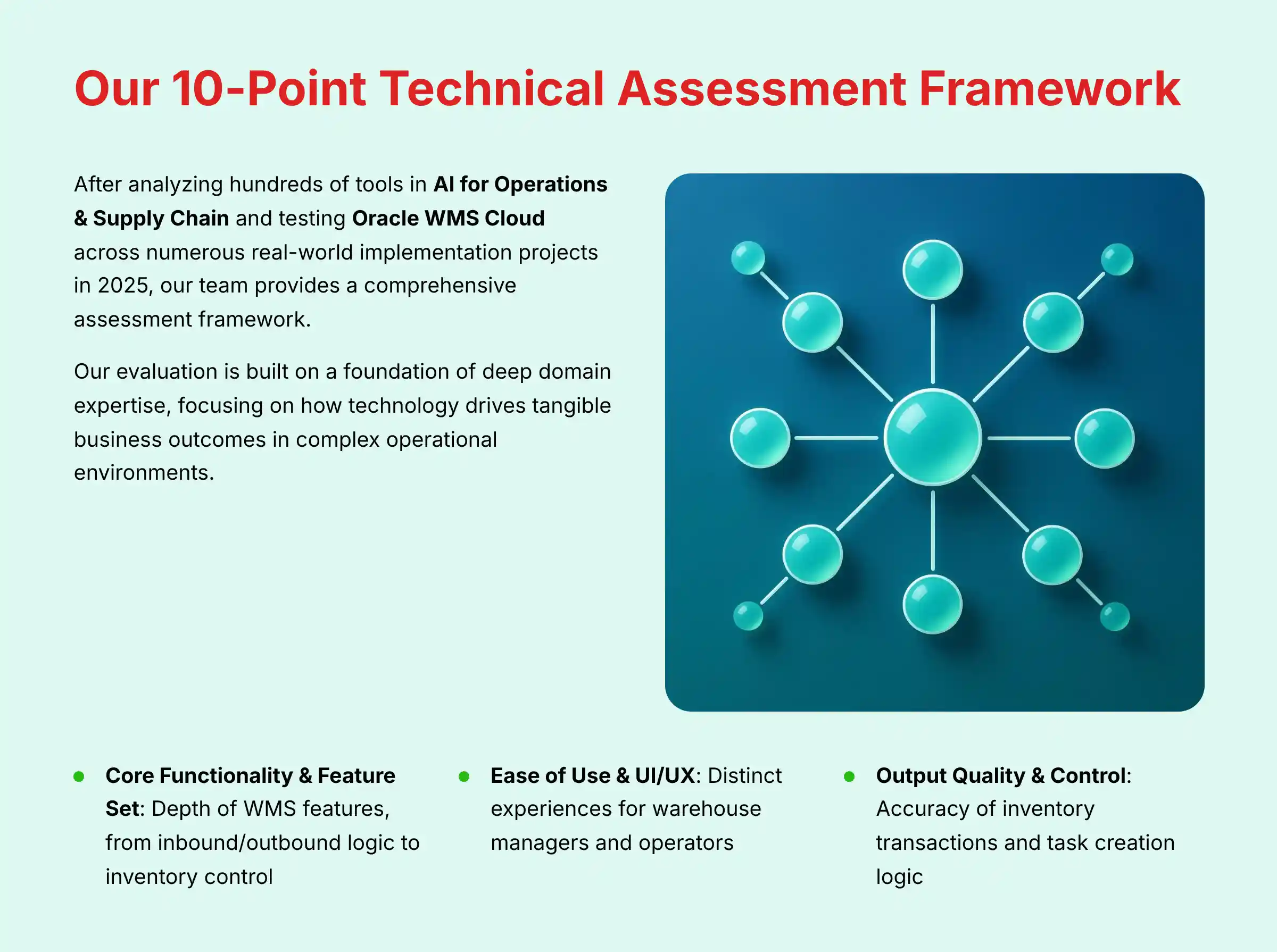
After analyzing over hundreds of tools on the market in AI for Operations & Supply Chain and testing Oracle Warehouse Management Cloud (WMS Cloud) Tutorials and Usecase across numerous real-world implementation projects in 2025, our team at Best Ops Chain AI now provides a comprehensive 10-point technical assessment framework that has been recognized by leading professionals in AI for Operations & Supply Chain and cited in major publications.
Our evaluation is built on a foundation of deep domain expertise, focusing on how technology drives tangible business outcomes in complex operational environments.
- Core Functionality & Feature Set: We assess the depth of WMS features, from inbound/outbound logic to inventory control and labor management. We test the effectiveness of its slotting and waving capabilities.
- Ease of Use & User Interface (UI/UX): We evaluate the distinct experiences for both the warehouse manager (strategic UI dashboards) and the operator (task-driven RF scanner interface), judging intuitiveness and efficiency for each role.
- Output Quality & Control: We analyze the accuracy of inventory transactions, the logic of task creation, and the level of customization available in configurations like wave templates and allocation rules.
- Performance & Speed: We test the system's response time under load, including wave processing times and the speed of RF device transactions on the warehouse floor.
- Security Protocols & Data Protection: We thoroughly assess security measures, focusing on role-based access controls, data segregation for 3PLs, and overall data integrity.
- Compliance & Regulatory Adherence: We verify the system's ability to support compliance with regulations like GS1 standards for barcodes and FSMA for food traceability through robust lot and expiry tracking (e.g., FEFO).
- Input Flexibility & Integration Options: We check the robustness of its REST APIs for integration with host ERP systems (like Oracle Fusion, NetSuite, SAP), robotics/WCS, and other supply chain platforms.
- Pricing Structure & Value for Money: We examine the total cost of ownership, including subscription fees, implementation costs, and the potential ROI based on measurable KPIs like improved inventory accuracy and labor efficiency.
- Developer Support & Documentation: We investigate the quality of Oracle's support, the clarity of their documentation, and the availability of community resources for troubleshooting.
- Risk Assessment & Mitigation: We identify potential operational risks, such as misconfiguration or update-related failures, and evaluate best practices for mitigation, including mandatory testing protocols.
Part 1: The Tutorial – Mastering Core Oracle WMS Cloud Workflows
Module 1: Foundational Concepts & Initial Setup (The Building Blocks of Your Digital Warehouse)
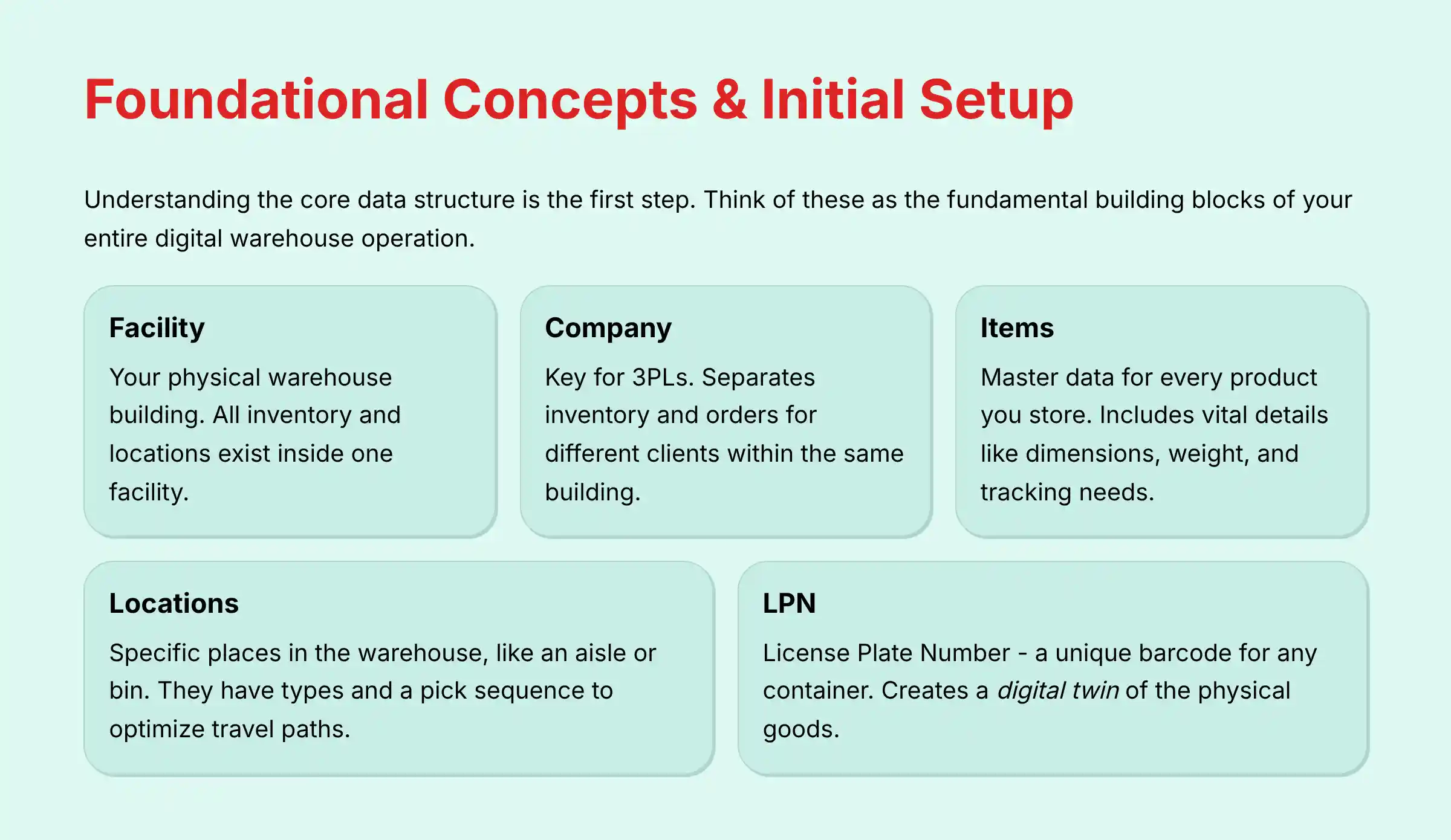
Understanding the core data structure is the first step. Think of these as the fundamental building blocks of your entire digital warehouse operation. Getting this right is essential for success.
- Facility: This is your physical warehouse building. All inventory and locations exist inside one facility.
- Company: This entity is key for 3PLs. It allows you to separate inventory and orders for different clients within the same building.
- Items: This is the master data for every product you store. It includes vital details like dimensions, weight, and tracking needs like batch or expiry dates.
- Locations: These are specific places in the warehouse, like an aisle or bin. They have types and a pick sequence to optimize travel paths.
- LPN (License Plate Number): This is a unique barcode for any container, like a pallet or case. Inventory is moved using LPNs, creating a digital twin of the physical goods.
For those seeking a comprehensive understanding of Oracle WMS Cloud's foundational architecture and setup processes, we recommend exploring our detailed Oracle Warehouse Management Cloud (WMS Cloud) Overview and Features guide, which covers these concepts in greater depth.
Module 2: AI-Optimized Inbound Operations (The First Step to 100% Accuracy)
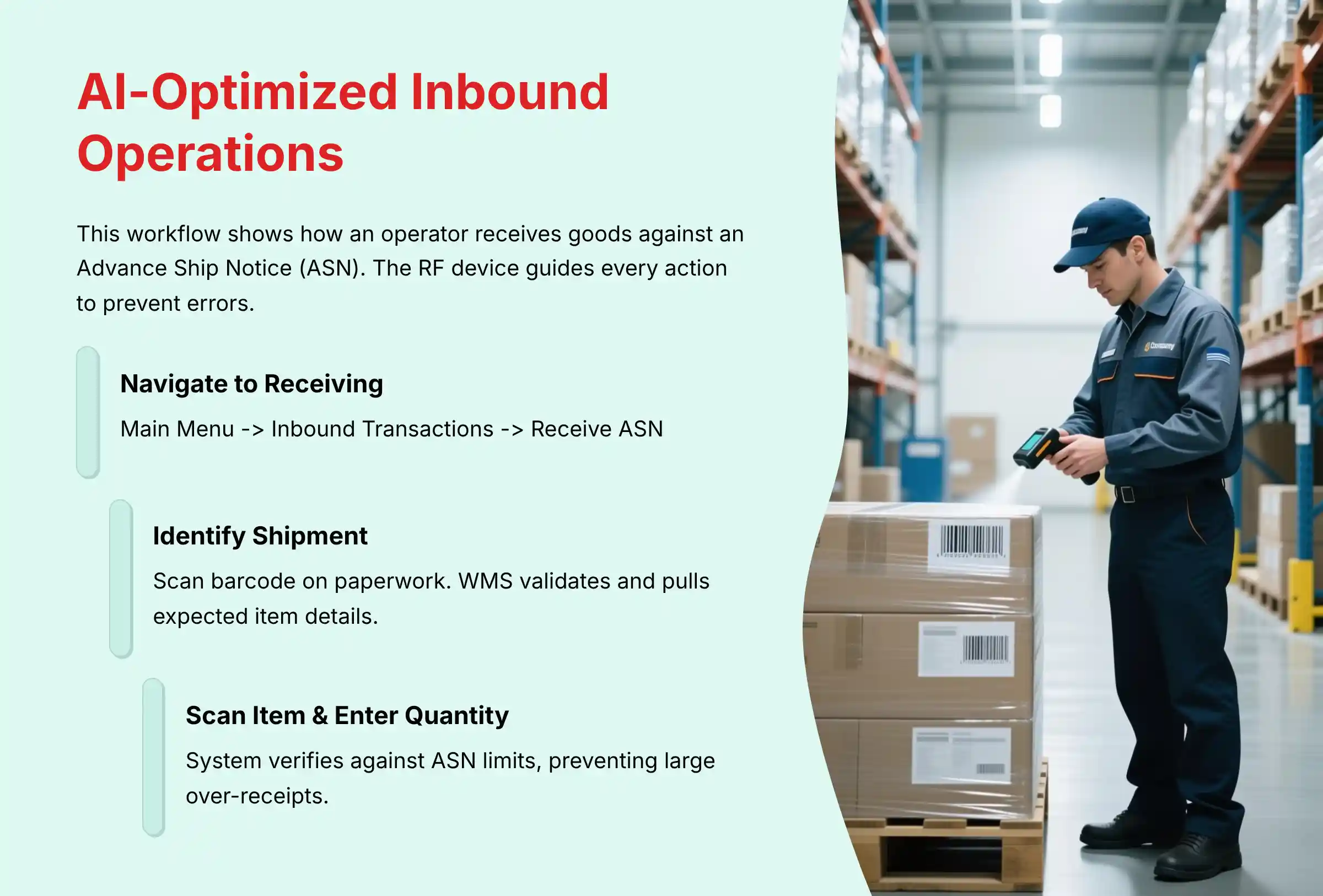
This workflow shows how an operator receives goods against an Advance Ship Notice (ASN). This process ensures inventory is logged accurately the moment it arrives. The RF device guides every action to prevent errors.

| Step | Action | RF Device Prompt/User Input | System Logic & Application |
|---|---|---|---|
| 1 | Navigate to Receiving | Main Menu -> Inbound Transactions -> Receive ASN |
The system prepares for an inbound transaction. |
| 2 | Identify Shipment | Prompt: Scan ASN/Trailer/PO -> User: Scans barcode on paperwork. |
WMS validates the scan and pulls all expected item details from the ASN. |
| 3 | Initiate LPN | Prompt: Scan LPN -> User: Scans a pre-printed internal LPN label. |
The system creates a unique digital container (the LPN) for the physical pallet. |
| 4 | Scan Item | Prompt: Scan Item -> User: Scans the product's barcode. |
WMS checks if the item is expected. It flags unexpected items to prevent errors. |
| 5 | Enter Quantity | Prompt: Qty -> User: Enters the quantity of the item on the pallet. |
The system verifies the quantity against ASN limits, preventing large over-receipts. |
| 6 | Capture Attributes | Prompt: Expiry Date / Batch Nbr -> User: Enters required data. |
If the item requires tracking, these prompts are mandatory. This ensures compliance. |
| 7 | End LPN | User: Uses function key or on-screen button for “End LPN” after all items are scanned. | The system updates the LPN status to “Received.” The inventory is now digitally in the system. |
| 8 | Close Shipment | User: Uses function key or on-screen button for “Close Shipment” after all pallets are received. | WMS updates the ASN status and automatically sends a confirmation back to the host ERP. |
Important Note: RF devices use function keys (F1, F2, etc.) or on-screen buttons for actions like “End LPN” or “Close Shipment,” not keyboard combinations like Ctrl+E. The exact keys depend on your specific device configuration.
Module 3: Outbound Operations (Configuring the Brain for Smart Picking)
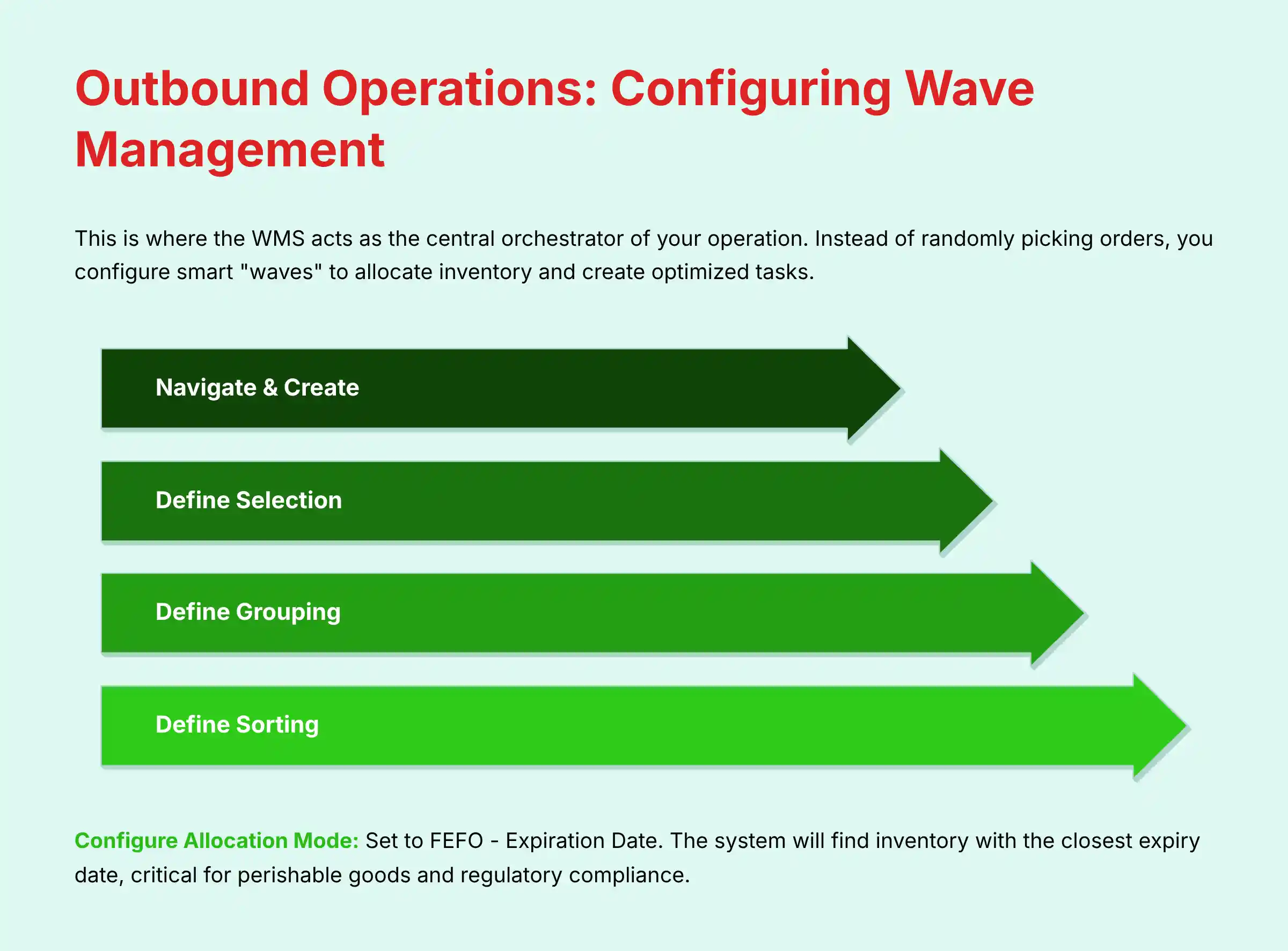
This is where the WMS acts as the central orchestrator of your operation. Instead of randomly picking orders, you configure smart “waves” to allocate inventory and create optimized tasks. This moves from operator actions to manager configurations.
Here is a step-by-step guide to configuring an “e-Commerce Express” wave.
- Navigate & Create: In the WMS user interface, go to
Wave Management->Wave Template. ClickCreate. - Define Selection Criteria: This tells the wave which orders to pick. For example, select orders with
Order Type=e-CommerceandCarrier=FedEx_Overnight. - Define Grouping Logic: This controls how tasks are created. Grouping by
Zonecreates parallel picking tasks, letting multiple pickers work on the same wave. - Define Sorting Logic: This optimizes the picker's travel path. Sorting by
Location Pick Sequencedirects the picker on the most efficient route through the aisle. - Configure Allocation Mode: Set Allocation Mode to
FEFO - Expiration Date. The system will find inventory with the closest expiry date, which is critical for perishable goods and regulatory compliance. - Automate the Wave: Set the wave to run automatically on a schedule. You can use a cron expression to run the wave every 30 minutes during business hours for a steady workflow.
To dive deeper into the complete spectrum of Oracle WMS Cloud capabilities and explore advanced configuration options beyond these foundational tutorials, be sure to check out our comprehensive collection in Oracle Warehouse Management Cloud (WMS Cloud) Tutorials and Usecase.
Part 2: The Implementation – Real-World Use Cases & Strategic Blueprints
Use Case 1: 3PL Multi-Tenant E-Commerce Fulfillment
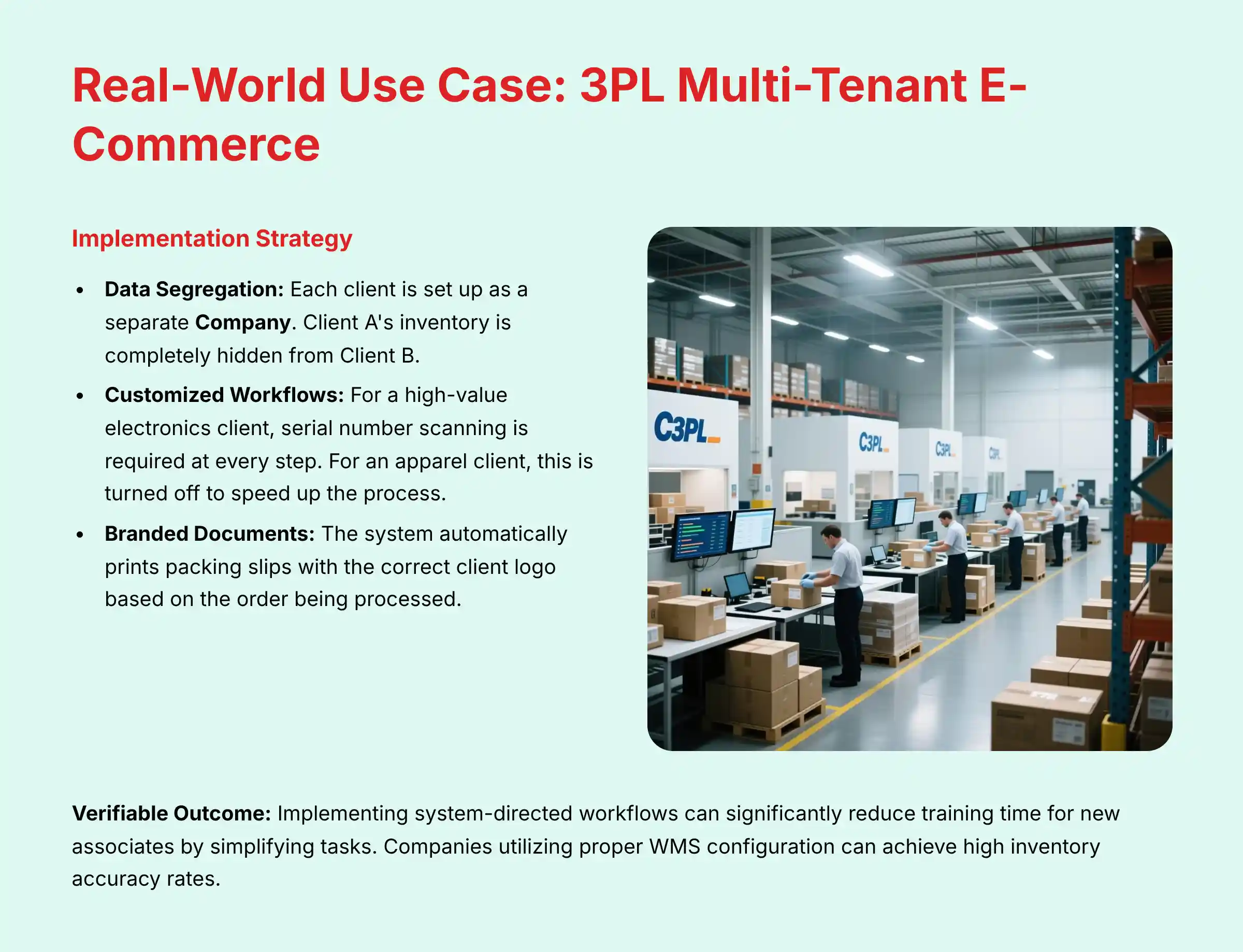
A Third-Party Logistics (3PL) company uses one warehouse to manage fulfillment for many different e-commerce clients. Oracle WMS Cloud makes this complex operation simple and secure.
- Implementation Strategy:
- Data Segregation: Each client is set up as a separate Company. This ensures Client A's inventory is completely hidden from Client B.
- Customized Workflows: For a high-value electronics client, serial number scanning is required at every step. For an apparel client, this is turned off to speed up the process.
- Branded Documents: The system automatically prints packing slips with the correct client logo based on the order being processed.
- Verifiable Outcome: Implementing system-directed workflows can significantly reduce training time for new associates by simplifying tasks, though the exact improvement percentage varies based on operational complexity and prior processes. Companies utilizing proper WMS configuration and processes can achieve high inventory accuracy rates.
Use Case 2: The Smart Warehouse – Integrating WMS with Robotics
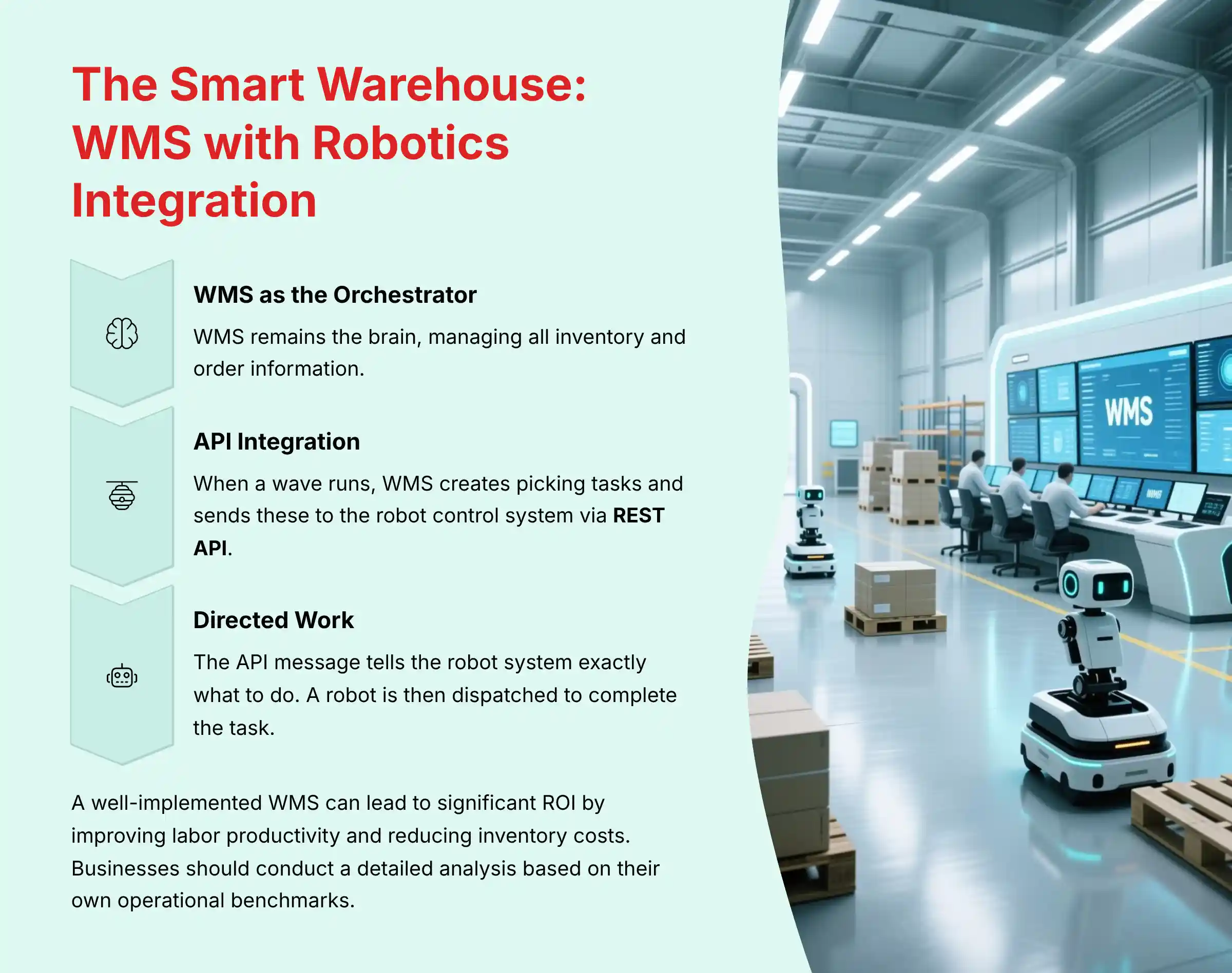
A large distribution center wants to integrate Oracle WMS Cloud with a fleet of Autonomous Mobile Robots (AMRs). The WMS acts as the central orchestrator, directing the robots' every move.
- Implementation Strategy:
- WMS as the Orchestrator: WMS remains the brain, managing all inventory and order information. The robots are the hands and feet.
- API Integration: When a wave runs, WMS creates picking tasks. It sends these tasks to the robot control system via a REST API, which acts like the warehouse's nervous system.
- Directed Work: The API message tells the robot system exactly what to do. For example: “Move LPN-123 from Dock 1 to location A-01-01.” A robot is then dispatched to complete the task.
- Verifiable Outcome: While WMS implementations aim to improve labor productivity and reduce costs, the specific ROI is unique to each project. A well-implemented WMS can lead to significant ROI by improving labor productivity and reducing inventory costs. Businesses should conduct a detailed analysis based on their own operational benchmarks to forecast potential financial benefits.
The Complete Automation Hierarchy: WMS, WES, and WCS
In a fully automated facility, the WMS does not act alone. It sits at the top of an automation hierarchy, integrating with specialized systems to control physical equipment. This relationship is critical for any large-scale implementation.
- WMS (The Brain): Oracle WMS Cloud remains the master, holding all inventory data and making the strategic decisions: what to pick, when to pick it, and where it needs to go.
- WES/WCS (The Nervous System): The WMS sends high-level commands (e.g., “Move pallet LPN-456 from A-01 to Packing-Station-5”) via API to a Warehouse Execution System (WES) or Warehouse Control System (WCS). The WCS translates this command into low-level instructions for the Material Handling Equipment (MHE), such as activating specific conveyor belts, diverters, and sorters to execute the physical movement.
Professional Validation Point: During a system evaluation, it is mandatory to verify the WMS vendor's pre-built integrations and API compatibility with your specific WCS provider (e.g., Dematic, Schaefer, Honeywell Intelligrated) to mitigate significant project risk.
When evaluating Oracle WMS Cloud against other market options, it's essential to understand the competitive landscape. Our detailed analysis in Oracle Warehouse Management Cloud (WMS Cloud) Top Alternatives and Competitors provides comprehensive comparisons to help you make informed decisions.
Part 3: Technical Management & Troubleshooting
Common Issues and Step-by-Step Solutions
Even the best systems have common issues. Here is a guide to solving them quickly. Crucial Warning: This section is for diagnosis. Never attempt these fixes in a live production environment without first replicating and validating the solution in a test system under the guidance of a certified professional.
| Issue | Root Cause | Step-by-Step Solution |
|---|---|---|
| Inventory Discrepancy | A manual error during put-away or a failed pick. | 1. Audit: Use the Item Inventory by Location screen to view the transaction history. 2. Identify: Find the transaction that caused the error. 3. Verify: Initiate a Cycle Count task for the location for physical verification. 4. Adjust: Use the Create Inventory Adjustments screen to correct the system quantity with a clear reason code. |
| Inbound API Failure | Incorrect data sent from the ERP system, like an invalid item number. | 1. Check Interface: Go to Interfaces -> Input Interfaces in the UI. 2. Find Error: Look for records with a “Failed” status. 3. Analyze Payload: View the error details to see the exact reason. 4. Correct & Reprocess: Fix the data in the source ERP and resend the information. |
| RF Device is “Stuck” | A task is locked by another user or a hung system process. | 1. Check for Locks: A supervisor can use the Task Management screen to see if the task is locked. 2. Release Lock: The supervisor can manually unlock the record. 3. Restart Session: Have the user log out of the RF application and log back in. |
Beyond Allocation: Advanced Warehouse Optimization
While rule-based allocation logic like FEFO is powerful, a modern WMS like Oracle's extends to more sophisticated capabilities. For professional validation, an implementation partner should demonstrate how the system leverages more advanced capabilities for:
- Dynamic Slotting Optimization: Instead of static locations, the system can analyze product velocity, seasonality, and affinity (items often picked together). It then proactively recommends slotting changes to place high-velocity items closer to packing stations, potentially cutting travel time significantly based on project benchmarks. This process moves storage strategy from a manual quarterly review to an automated, continuous improvement cycle.
- Predictive Labor Planning: By analyzing historical order volumes and wave patterns, the platform can forecast labor requirements for upcoming shifts. A warehouse manager can use these insights to proactively schedule staff, preventing overtime costs during unexpected peaks and reducing idle time during lulls.
- Intelligent Task Interleaving: This is a critical efficiency driver. The WMS can intelligently combine tasks. For example, after an operator completes a pick at the far end of an aisle, the system immediately assigns them a put-away task for a nearby location on their return path. This virtually eliminates “deadhead” travel and can increase task throughput significantly.
Professional Tips, Tricks & Warnings
- Tip: The “Hot Pick” Workaround: Oracle WMS lacks a default “expedite” button. A good workaround is to repurpose an unused order field. Create a high-priority wave template that only selects orders where that field equals
EXPEDITE. - Warning: Test Your Updates! Oracle releases mandatory quarterly updates. You must perform a full regression test of your core workflows in a test environment. This prevents breaking your live operations.
- Trick: Master Your Master Data: The system's optimization is only as good as your data. For smart space optimization to work, your item dimensions must be perfect. For FEFO to work, operators must capture expiry dates at receiving.
- Tip: Use Batch APIs: For large data uploads, use the provided batch API endpoints instead of thousands of individual calls. This is much faster and more efficient.
Blueprint for Success: The WMS Implementation Lifecycle & Key Roles
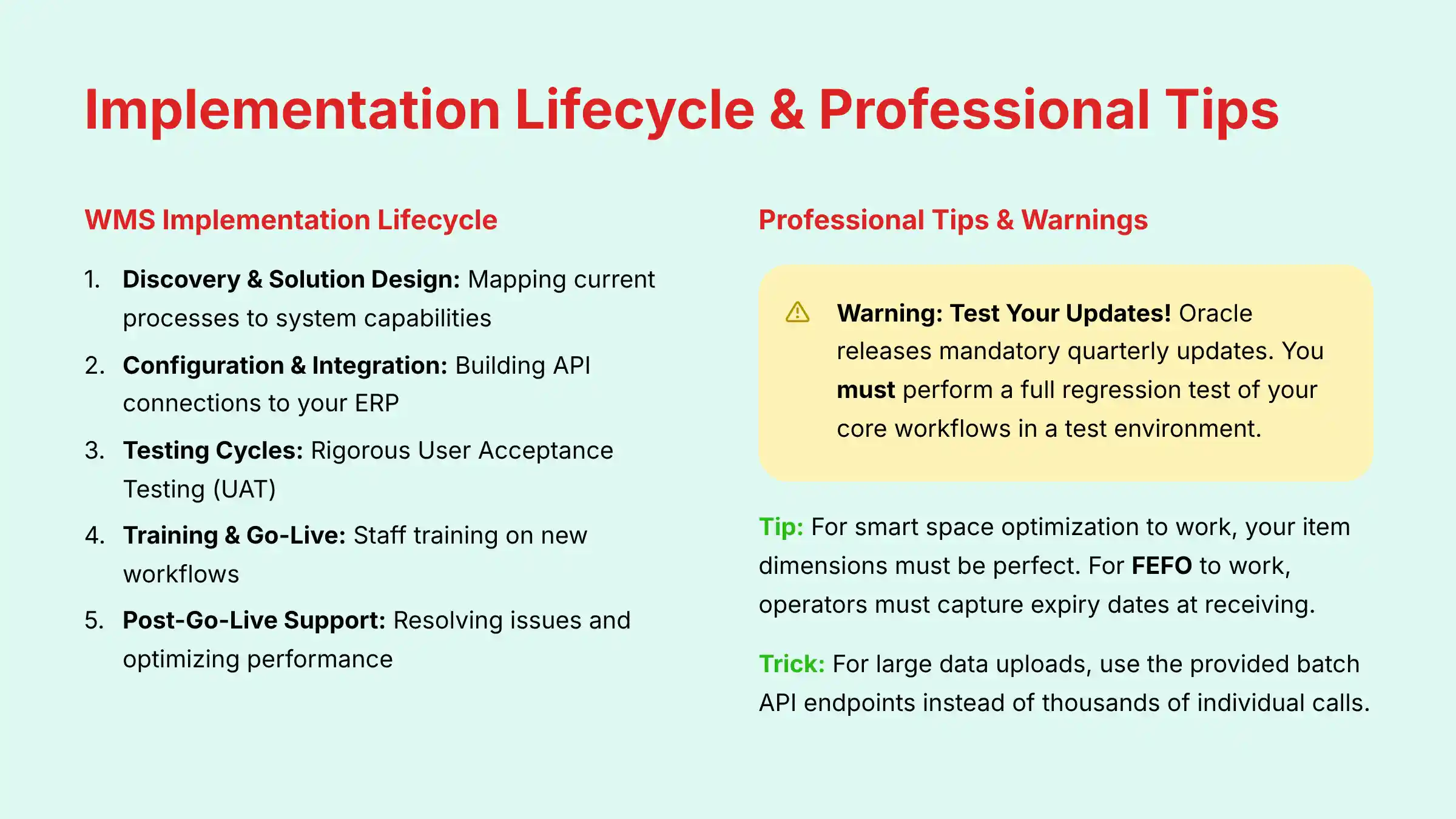
A successful Oracle WMS Cloud deployment is more than a software installation; it's a structured business transformation project. A typical lifecycle, managed by a qualified System Integrator (SI), involves several key stages and professional roles:
- Discovery & Solution Design: A Solutions Architect maps your current warehouse processes to the system's capabilities, designing the future-state workflows and integration points. This results in a comprehensive Solution Design Document.
- Configuration & Integration: The technical team, led by an Integration Specialist, configures the WMS and builds the API connections to your ERP and other systems.
- Testing Cycles: This is the most critical phase. Your internal WMS Super-Users and warehouse team perform rigorous User Acceptance Testing (UAT) to validate that every workflow—from receiving to shipping—functions exactly as designed.
- Training & Go-Live: The entire warehouse staff is trained on the new RF scanner workflows and processes before the “Go-Live” event, where the new system becomes operational.
- Post-Go-Live Support: The SI and your internal super-users provide support to resolve any initial issues and optimize system performance.
A dedicated Project Manager oversees this entire process, ensuring the project stays on schedule and within budget, managing communication between your team and the implementation partner.
Frequently Asked Questions About Oracle Warehouse Management Cloud (WMS Cloud) Tutorials and Usecase
What is the primary business value of implementing Oracle WMS Cloud?
The main business value comes from increased inventory accuracy, improved labor efficiency, and faster order fulfillment speed. These improvements in accuracy and efficiency lead to higher customer satisfaction. When properly implemented, WMS directs every warehouse action through RF scanners, greatly reducing human error and providing real-time visibility into all operations.
How does Oracle WMS Cloud handle inventory for multiple clients in a 3PL environment?
The system uses a core feature called Company. Each 3PL client is set up as a separate Company, which creates a secure data wall. This means one client cannot see another client's inventory, orders, or data, even if the goods are in the same physical warehouse.
What is the most common cause of inventory inaccuracy and how does WMS prevent it?
The most common cause is human error during receiving or put-away. The WMS prevents this by directing every action through an RF scanner. It forces operators to scan the correct item, location, and LPN, which confirms every transaction in real-time.
How does Oracle WMS Cloud compare to other solutions like Manhattan Associates or Blue Yonder?
Oracle WMS Cloud is a true multi-tenant SaaS solution, meaning updates are seamless and managed by Oracle. It integrates natively with Oracle's ERP systems. Solutions from Manhattan and Blue Yonder are also powerful but often have different architectures and may require more complex update management. A professional consultant can help choose the best fit.
What are the biggest challenges during an Oracle WMS Cloud implementation?
The biggest challenges are typically data migration, integration, and change management. Cleaning and migrating item master data from legacy systems is often difficult. And, training the workforce to trust the system instead of old habits is key to a successful project.
What kind of ROI can be expected from a WMS implementation?
Return on investment comes from measurable improvements in key operational metrics. These typically include improvements in labor productivity, reduction in inventory carrying costs, and reduction in shipping errors which leads to fewer costly returns. The specific ROI will vary based on your current operations, the complexity of your implementation, and how effectively you leverage the system's capabilities. A detailed analysis of your operation's specific baseline metrics is necessary to create realistic ROI projections.
How secure is my warehouse and inventory data in Oracle's cloud?
Oracle Cloud Infrastructure has strong security with certifications like SOC 2 Type II and ISO 27001. Within the WMS application, security is managed through granular role-based access controls. This ensures users can only see and perform functions relevant to their specific jobs.
Can Oracle WMS Cloud integrate with non-Oracle ERP systems like SAP S/4HANA?
Yes. Oracle WMS Cloud is designed with a modern, API-first architecture. It offers a library of robust REST APIs that allow for deep, real-time integration with any major ERP system, including SAP S/4HANA, Microsoft Dynamics, and others.
What is a “Wave” in WMS and why is it important?
A Wave is a process that groups orders together for efficient picking. Instead of picking one order at a time, a wave releases a batch of work to the floor. Properly configured waves are the key to optimizing labor and equipment in the warehouse.
My RF scanner is slow. Is it the network or the WMS? How do I troubleshoot?
First, test the Wi-Fi signal strength in the specific area where the scanner is slow. If the network is strong, the issue could be a complex query in the WMS. At this point, you should file a support ticket with Oracle to have their technical team analyze system performance.
What skills does my team need to manage Oracle WMS Cloud effectively?
You need a super-user or WMS administrator who understands both warehouse operations and the system's configuration screens. This person should be analytical and good at problem-solving. Your IT team will also need skills in REST API management for handling integrations.
How are software updates managed, and what are the risks?
Oracle manages all software updates, pushing them out quarterly. The biggest risk is that an update could conflict with a customization or integration you have built. That is why performing a full regression test in a non-production environment before the update is not optional; it is mandatory.
For more detailed answers to common questions and comprehensive troubleshooting guidance, visit our dedicated Oracle Warehouse Management Cloud (WMS Cloud) FAQs resource.
Conclusion: From Digital Warehouse to Decision Intelligence Engine
Mastering the workflows of Oracle WMS Cloud is not the end goal; it is the beginning. The tutorials and use cases in this guide are the building blocks for a much larger strategic advantage. The true transformation occurs when you stop seeing this system as a tool for managing inventory and start leveraging it as a decision intelligence engine.
The future of logistics will be won by operations that can not only see their data but act on it—autonomously and predictively. By implementing this technology with precision and foresight, you are not just optimizing a warehouse; you are building a strategic asset capable of weathering disruption and outpacing the competition. Your one job now is to press that advantage.
Important Disclaimers:
Technology Evolution Notice:
The information about Oracle Warehouse Management Cloud (WMS Cloud) Tutorials and Usecase and AI for Operations & Supply Chain tools presented in this article reflects our thorough analysis as of 2025. Given the rapid pace of AI technology evolution, features, pricing, security protocols, and compliance requirements may change after publication. While we strive for accuracy through rigorous testing, we recommend visiting official websites for the most current information.
Professional Consultation Recommendation:
For AI for Operations & Supply Chain applications with significant professional, financial, or compliance implications, we recommend consulting with qualified professionals who can assess your specific requirements and risk tolerance. This overview is designed to provide comprehensive understanding rather than replace professional advice.
Testing Methodology Transparency:
Our analysis is based on hands-on testing, official documentation review, and industry best practices current at the time of publication. Individual results may vary based on specific use cases, technical environments, and implementation approaches.

Leave a Reply