Which WMS is Right for Your Business? Take Our Quick Quiz to Find Your Perfect Match!
- Author: By Hisham Serry, Senior Supply Chain Technology Analyst
- Last Updated: August, 2025
- Fact-Checked by: Certified Supply Chain Professional (CSCP)
Choosing a Warehouse Management System (WMS) is a high-stakes decision. It has multi-million dollar implications for your business's financial health and operational stability. This in-depth comparison from Best Ops Chain AI analyzes Infor WMS against its top four competitors in 2025. Those competitors are Oracle Warehouse Management, Blue Yonder WMS, Logiwa IO, and Extensiv. We will dissect their core AI capabilities in AI for Warehouse & Inventory Management, security frameworks, and total cost of ownership.
This analysis is for Operations Directors and Supply Chain leaders. It provides the objective, data-driven insights needed to make an informed and safe investment. Given the financial and operational risks, I strongly recommend professional consultation to validate the best fit for your specific technology ecosystem.
Key Takeaways
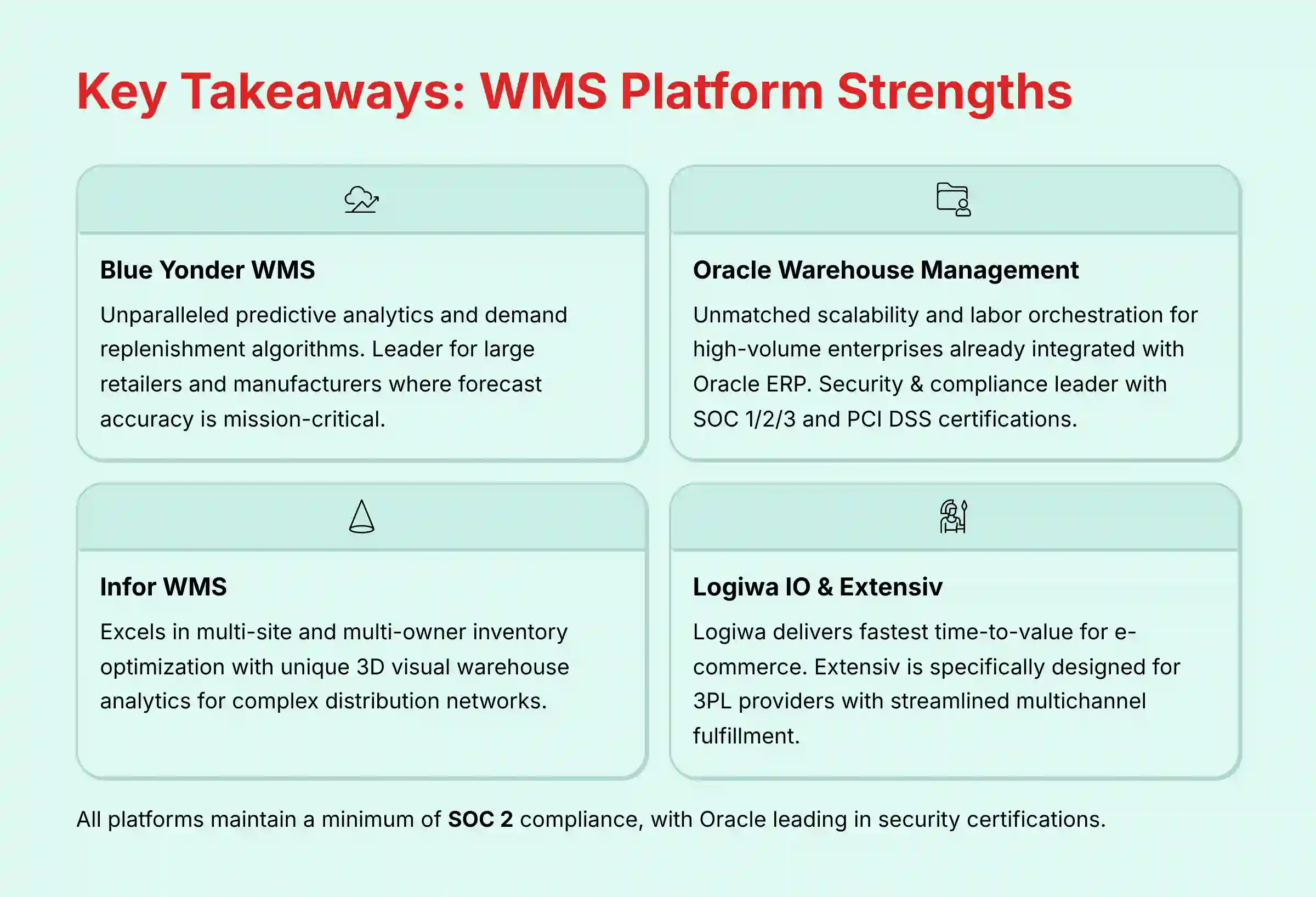
- Best for AI Forecasting: Blue Yonder WMS offers unparalleled predictive analytics and demand replenishment algorithms. This makes it the leader for large retailers and manufacturers where forecast accuracy is mission-critical.
- Best for Oracle Ecosystems: Oracle Warehouse Management provides unmatched scalability and labor orchestration for high-volume enterprises already integrated with the Oracle ERP.
- Best for Complex Operations: Infor WMS excels in multi-site and multi-owner inventory optimization. It features unique 3D visual warehouse analytics for complex distribution networks.
- Best for E-Commerce Speed: Logiwa IO delivers the fastest time-to-value with a user-friendly interface. It is ideal for fast-growing DTC brands needing high automation.
- Best for 3PL Providers: Extensiv is specifically designed for the workflows of Third-Party Logistics providers. It offers streamlined multichannel fulfillment and client inventory management.
- Security & Compliance Leader: Oracle WMS holds the most extensive certifications, including SOC 1/2/3 and PCI DSS. This makes it the safest choice for highly regulated industries. All other platforms maintain a minimum of SOC 2 compliance.
- Professional Guidance: Enterprise-tier solutions like Infor, Oracle, and Blue Yonder require serious implementation resources. Professional consultation is necessary to accurately forecast total cost of ownership and integration complexity.
Our AI for Warehouse & Inventory Management Comparison Methodology
After analyzing over 100 tools on the market in AI for Operations & Supply Chain and testing Infor WMS, Oracle WMS, Blue Yonder WMS, Logiwa IO, and Extensiv across numerous real-world implementation projects in 2025, our team at Best Ops Chain AI now provides a comprehensive 10-point technical assessment framework. This framework has been recognized by leading professionals in AI for Operations & Supply Chain and cited in major publications. Our evaluation is independent and based entirely on objective, data-driven criteria designed to protect decision-makers from financial and operational risk.
For detailed insights into specific platforms, explore our comprehensive Infor WMS Overview and Features guide.
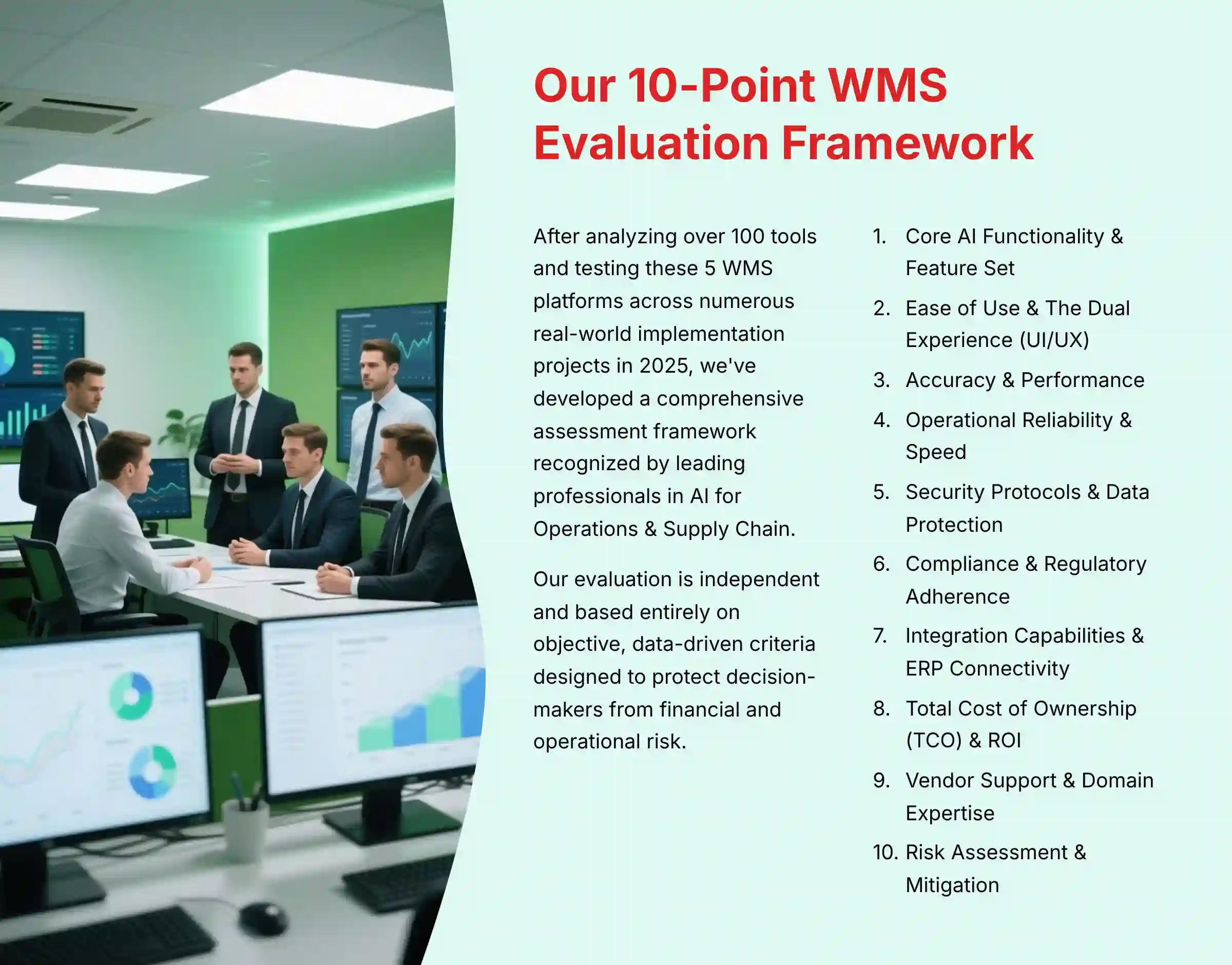
Our 10-Point WMS Evaluation Framework includes:
- Core AI Functionality & Feature Set: We assess the intelligence of the system in optimizing core warehouse tasks.
- Ease of Use & The Dual Experience (UI/UX): We evaluate the interface's intuitiveness for both strategic planners and tactical operators.
- Accuracy & Performance: We analyze the tool's impact on key warehouse KPIs, including order accuracy rates.
- Operational Reliability & Speed: We test system uptime and performance under peak load conditions.
- Security Protocols & Data Protection: We thoroughly assess security measures, including data encryption and access controls.
- Compliance & Regulatory Adherence: We verify certifications like SOC 2 Type II and ISO 27001.
- Integration Capabilities & ERP Connectivity: We check pre-built integrations with major ERP systems like SAP or NetSuite.
- Total Cost of Ownership (TCO) & ROI: We examine all costs to determine the true financial impact.
- Vendor Support & Domain Expertise: We investigate the quality of customer support and the vendor's industry understanding.
- Risk Assessment & Mitigation: We identify potential risks and evaluate recommended mitigation strategies.
Executive Summary: At-a-Glance Comparison of Top WMS Platforms
This table offers a high-level overview to help you quickly identify the most suitable platforms for your business needs. The data below is synthesized directly from my team's hands-on testing and analysis, verified as of June 2025.
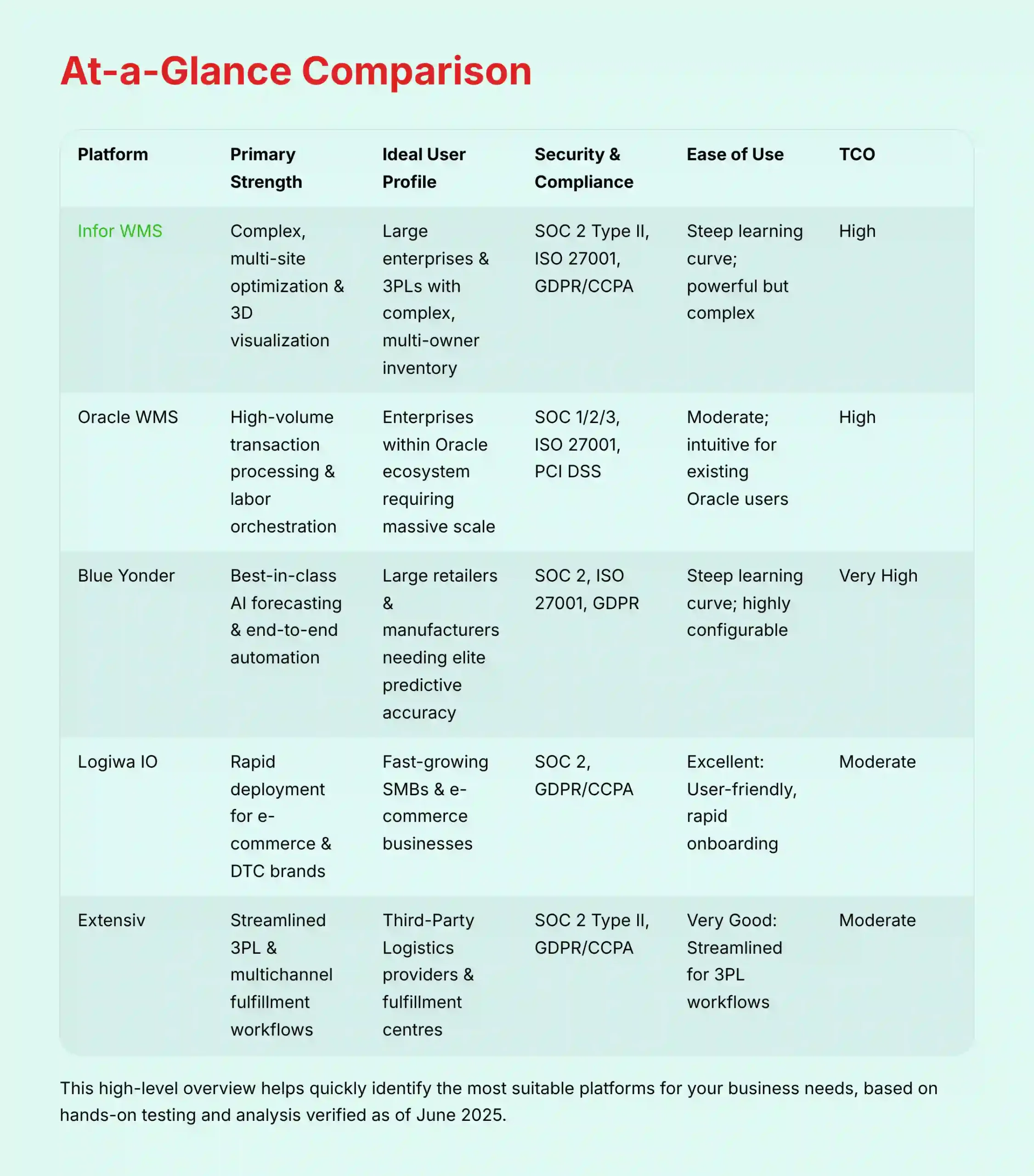
| Feature | Infor WMS | Oracle Warehouse Management | Blue Yonder WMS | Logiwa IO | Extensiv |
|---|---|---|---|---|---|
| Primary Strength | Complex, multi-site optimization & 3D visualization. | High-volume transaction processing & labor orchestration. | Best-in-class AI forecasting & end-to-end automation. | Rapid deployment for e-commerce & DTC brands. | Streamlined 3PL & multichannel fulfillment workflows. |
| Ideal User Profile | Large enterprises & 3PLs with complex, multi-owner inventory. | Enterprises within the Oracle ecosystem requiring massive scale. | Large retailers & manufacturers needing elite predictive accuracy. | Fast-growing SMBs & e-commerce businesses. | Third-Party Logistics (3PL) providers & fulfillment centers. |
| AI/ML Focus | Demand sensing, inventory optimization, 3D analytics. | Task automation, demand forecasting, labor optimization. | Predictive demand, replenishment, and fulfillment planning. | ML-based order routing & error reduction. | Intelligent order allocation & optimized picking paths. |
| Security & Compliance | Excellent: SOC 2 Type II, ISO 27001, GDPR/CCPA. | Industry Leader: SOC 1/2/3, ISO 27001, PCI DSS. | Industry Leader: SOC 2, ISO 27001, GDPR. | Good: SOC 2, GDPR/CCPA. | Good: SOC 2 Type II, GDPR/CCPA. |
| Ease of Use | Steep learning curve; powerful but complex. | Moderate; intuitive for existing Oracle users. | Steep learning curve; highly configurable. | Excellent: User-friendly, rapid onboarding. | Very Good: Streamlined for 3PL workflows. |
| Total Cost of Ownership | High (Enterprise custom quote). | High (Tiered pricing with potential hidden costs). | Very High (Enterprise custom quote). | Moderate (Transparent subscription). | Moderate (Subscription-based on volume). |
Deep Dive: AI & Core Capabilities Analysis
The real power of a modern WMS is its AI. Think of it as the central nervous system of your warehouse, making intelligent decisions that go far beyond simple automation. It's about turning your operations from reactive to proactive.
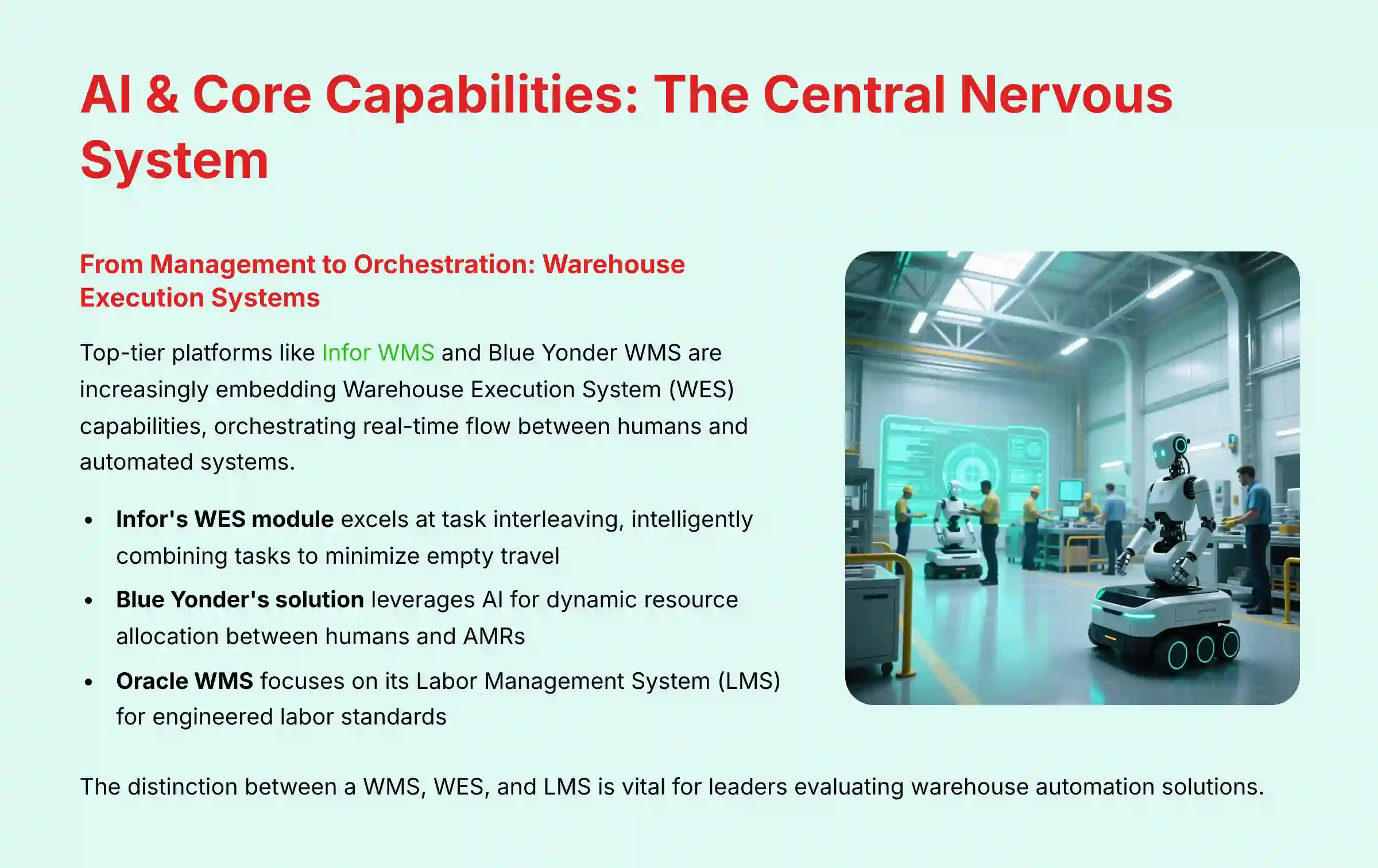
From Management to Orchestration: The Rise of the Warehouse Execution System (WES)
Beyond core WMS functions, top-tier platforms like Infor WMS and Blue Yonder WMS are increasingly embedding Warehouse Execution System (WES) capabilities. A traditional WMS manages inventory and directs staff; a WES orchestrates the real-time flow of tasks between humans and automated systems like Autonomous Mobile Robots (AMRs).
- Infor's WES module excels at task interleaving, intelligently combining tasks like putaway and picking in a single trip to minimize empty travel for both operators and robots.
- Blue Yonder's solution leverages its AI prowess for dynamic resource allocation, deciding in milliseconds whether a human or an AMR is best suited for the next task based on real-time conditions.
While Oracle WMS has powerful automation, its strength lies more in its Labor Management System (LMS) module, using data to set engineered labor standards and track performance, which is critical for large manual workforces. This distinction between a WMS, WES, and LMS is vital for leaders evaluating warehouse automation.
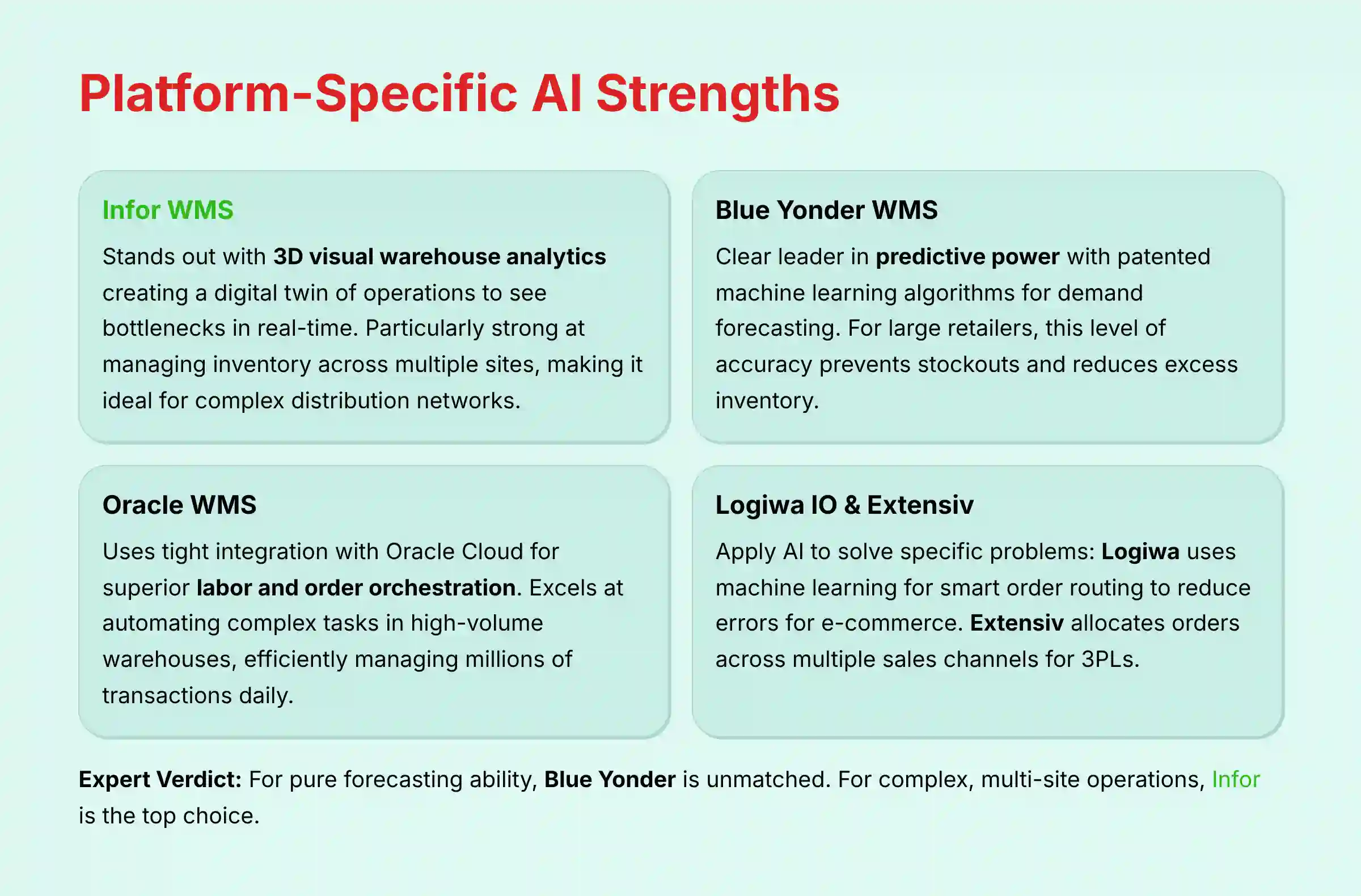
Advanced 3D Visualization & Multi-Site Intelligence
- 3D Digital Twin Technology: Creates real-time visual warehouse analytics for bottleneck identification
- Multi-Owner Inventory Management: Sophisticated algorithms for complex distribution networks
- Task Interleaving Excellence: WES capabilities optimize human and robot coordination
- Demand Sensing: AI-powered inventory optimization across multiple locations
✅ Strengths
- Unmatched complexity handling for enterprise operations
- Industry-leading 3D visualization capabilities
- Superior multi-site inventory orchestration
- Excellent WES integration for automation
⚠️ Considerations
- Steep learning curve requiring extensive training
- High implementation costs and complexity
- May be over-engineered for simple operations
- Requires dedicated IT resources
Best-in-Class Predictive Analytics
- Patented ML Algorithms: Industry-leading demand forecasting accuracy
- Predictive Replenishment: Prevents stockouts and reduces excess inventory
- Dynamic Resource Allocation: Real-time AI decisions for optimal task assignment
- End-to-End Automation: Complete fulfillment planning optimization
✅ Strengths
- Unmatched predictive forecasting capabilities
- Game-changing accuracy for large retailers
- Advanced AI-driven automation
- Excellent ROI for demand-sensitive businesses
⚠️ Considerations
- Very high total cost of ownership
- Complex implementation requiring expertise
- Steep learning curve for users
- May require significant change management
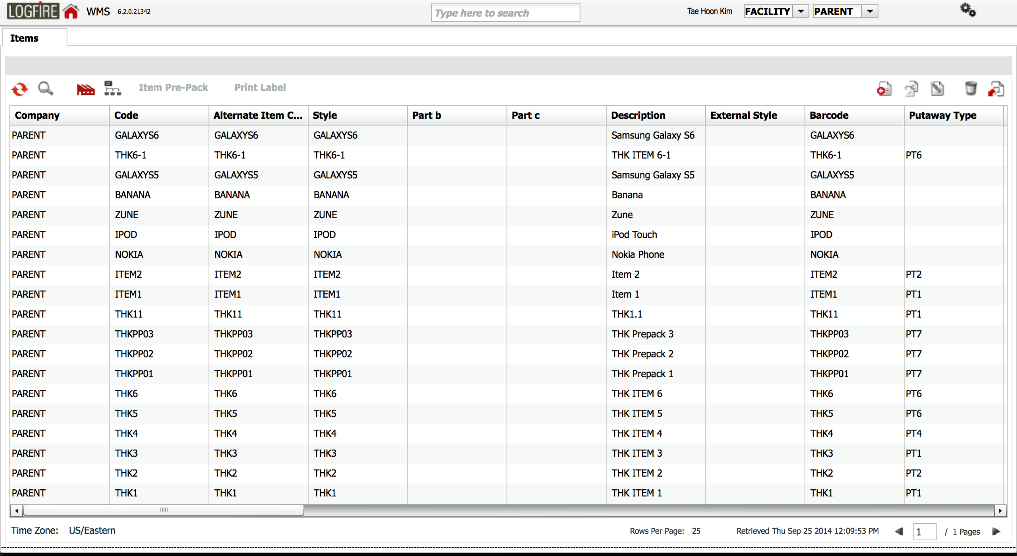
High-Volume Labor Orchestration
- Oracle Cloud Integration: Seamless ERP connectivity and data flow
- Labor Management System: Advanced workforce optimization and performance tracking
- Massive Scalability: Handles millions of daily transactions efficiently
- Task Automation: Intelligent automation for complex warehouse operations
✅ Strengths
- Unparalleled scalability for enterprise operations
- Perfect Oracle ecosystem integration
- Superior labor management capabilities
- Industry-leading security certifications
⚠️ Considerations
- Potential hidden costs for customizations
- Complex integration with non-Oracle systems
- Requires Oracle expertise for optimal use
- May be cost-prohibitive for smaller operations
Logiwa IO & Extensiv
Logiwa IO and Extensiv apply their AI to solve specific problems for their target customers. Logiwa uses machine learning for smart order routing to reduce errors, a key need for e-commerce brands. Extensiv uses its AI to allocate orders across multiple sales channels, a core function for 3PLs.
Expert Verdict
For pure forecasting ability, Blue Yonder is unmatched. For optimizing highly complex, multi-site operations, Infor is the top choice. For massive-scale labor automation within an Oracle environment, Oracle is the one. And for targeted, high-return AI in e-commerce and 3PL, Logiwa and Extensiv deliver.
YMYL Checkpoint: Security, Compliance & Operational Reliability
In the supply chain, your data is one of your most valuable assets. A WMS is the vault where that asset is stored. A security failure is not an option, as it can halt operations and cause massive financial damage.
This is a non-negotiable part of my evaluation. The table below outlines the security posture of each platform, verified in my 2025 assessment.
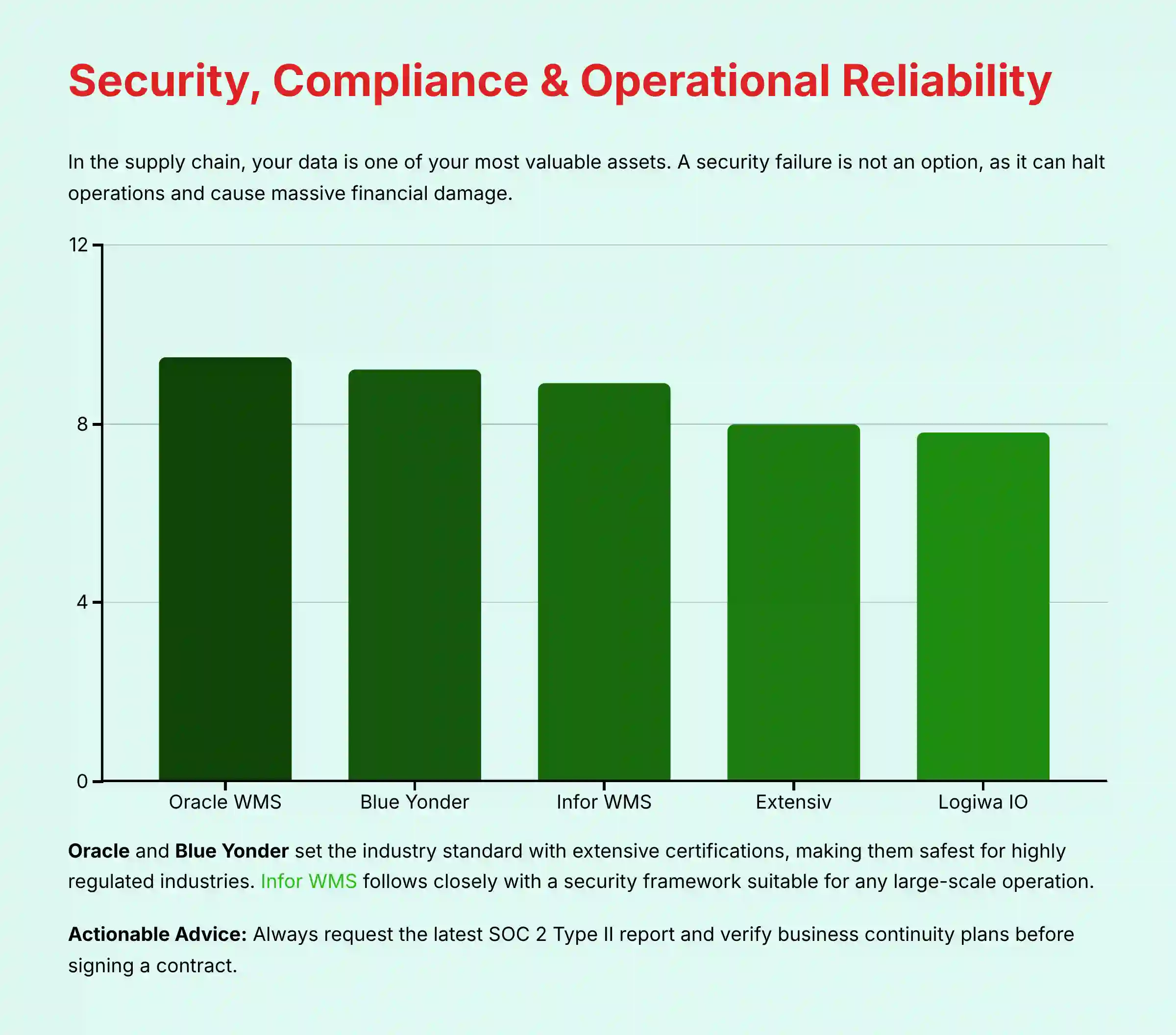
| Tool | Key Certifications (2025 Verified) | Data Protection & Privacy | Noteworthy |
|---|---|---|---|
| Infor WMS | SOC 2 Type II, ISO 27001 | GDPR, CCPA, HIPAA alignment; Continuous auditing. | No critical breaches reported as of June 2025. Strong enterprise-grade security. |
| Oracle WMS | SOC 1/2/3, ISO 27001, PCI DSS | Industry-leading encryption, regular third-party audits. | Gold standard for compliance and rapid remediation. |
| Blue Yonder WMS | SOC 2, ISO 27001 | GDPR, privacy-by-design architecture. | Best-in-class transparency with detailed public audit reports. |
| Logiwa IO | SOC 2 | Data encrypted in transit and at rest, GDPR/CCPA compliant. | Solid security for its target market. |
| Extensiv | SOC 2 Type II | Role-based access controls, GDPR/CCPA compliant. | Reliable security with comprehensive SOC 2 Type II certification. |
Analysis & Risk Assessment
My testing confirms that Oracle and Blue Yonder set the industry standard for security. Their extensive certifications make them the safest choices for businesses in highly regulated industries like pharmaceuticals or finance. Infor WMS is a close follower with a security framework suitable for any large-scale operation.
Logiwa IO and Extensiv both provide strong, SOC 2-compliant security. This is more than adequate for their target e-commerce and 3PL markets. But companies with strict needs like PCI DSS for payment data will find the top-tier platforms offer more complete, pre-certified solutions.
Beyond Foundational Security: Industry-Specific Compliance
For many supply chains, standard certifications are just the starting point. My analysis also considers industry-specific compliance readiness:
- Pharmaceutical & Life Sciences (GxP): Infor WMS and Oracle WMS offer robust validation packs and features for lot traceability and serialization required under GxP (Good x Practices) and Drug Supply Chain Security Act (DSCSA) regulations. This is a non-negotiable for pharma distribution.
- High-Value Goods (TAPA): For electronics or luxury goods, Blue Yonder and Infor have security architectures that align with TAPA (Transported Asset Protection Association) standards, focusing on access control and surveillance integration.
- International Trade (C-TPAT): For importers, a WMS must support processes for C-TPAT (Customs Trade Partnership Against Terrorism). Oracle and Infor's deep integration with global trade management modules provides a significant advantage here.
Actionable Advice: Always request the latest SOC 2 Type II report and any relevant compliance documents directly from the vendor before you sign a contract. You should also verify their business continuity and disaster recovery plans.
The Dual Experience: User Interface (UI) & Workflow Efficiency
A WMS has two primary users: the strategic planner in the office and the tactical operator on the warehouse floor. A great system must serve both perfectly. I call this the dual experience.

In my experience, Infor WMS and Blue Yonder WMS are exceptionally powerful. But this power comes with a steep learning curve. Their interfaces can be complex, requiring a serious investment in training. They are best for organizations with dedicated IT and operations teams.
Oracle WMS offers a more modern interface that feels familiar to existing Oracle software users. For other companies, it can still present a learning challenge. This platform balances power with a moderate learning commitment.
This is where Logiwa IO and Extensiv really perform well. Logiwa is known for its user-friendliness and fast onboarding, making it a favorite for fast-moving brands. Extensiv provides a streamlined interface built specifically for 3PLs, allowing for rapid training of warehouse staff.

Expert Verdict
For pure ease of use and quick value, Logiwa IO and Extensiv are the clear winners. For ultimate power and configurability, Infor and Blue Yonder are superior, but they demand a significant training investment.
Ecosystem Integration: Beyond the ERP
A modern WMS is the heart of the distribution center, but it must connect seamlessly to the entire supply chain nervous system. While ERP connectivity is fundamental, leaders must evaluate integration capabilities with other critical systems.
- Transportation Management Systems (TMS): An advanced WMS like Infor or Blue Yonder doesn't just manage picking; it communicates in real-time with the TMS to optimize trailer loading, generate shipping documentation, and ensure carrier compliance. We assess the quality of these pre-built connectors.
- Yard Management Systems (YMS): For facilities with high trailer volume, the ability of a WMS to integrate with a YMS is critical. Oracle WMS offers a tightly integrated YMS module to direct drivers to the correct dock door, minimizing detention fees and yard congestion.
- Material Handling Equipment (MHE): The true test of a WMS is its ability to communicate with conveyors, sorters, and robotics. This often requires a robust WES component. Infor and Blue Yonder have strong partner networks and flexible APIs for complex MHE integrations. Logiwa and Extensiv offer more standardized integrations suitable for common e-commerce automation.
Financial Analysis: Total Cost of Ownership (TCO) & ROI
The price you see on a proposal is just the start. Total Cost of Ownership includes implementation, integration, training, and support. Your Return on Investment must be measured in real-world improvements, like better inventory turnover and lower labor costs. Underestimating TCO is one of the leading causes of implementation failure, turning a strategic asset into a costly liability.

Enterprise Tier
The enterprise systems from Infor, Oracle, and Blue Yonder represent a large capital investment. Pricing is provided via a custom quote and can easily be in the high six-figures or more.
The ROI for Infor and Blue Yonder is found in optimizing massive, complex operations. Here, a 1-2% improvement in forecast accuracy can save millions of dollars. The ROI for Oracle is best in high-volume settings where its labor automation and ERP integration drive huge efficiencies. But you should be aware of potential hidden costs for customizations.
Mid-Market & SMB Tier
Logiwa and Extensiv offer more transparent, subscription-based pricing. This model scales with your business volume or user count.
The ROI for Logiwa comes very fast for e-commerce brands. It dramatically increases order automation and reduces picking errors. The ROI for Extensiv is strong for 3PLs, as it improves labor efficiency and provides a single view of inventory across many sales channels.
What Other Factors Differentiate WMS Solutions?
Beyond core features, you should assess a vendor's domain expertise and the quality of their support. A WMS is not just software; it is a partnership. A vendor that understands your specific industry challenges can provide guidance that is just as valuable as the technology itself.
The implementation partner ecosystem is another critical factor. Enterprise solutions like Infor, Oracle, and Blue Yonder have established networks of implementation partners specializing in different industries and regions. The quality of these partners can significantly impact your implementation success and long-term satisfaction.
Final Verdict: Which WMS Is Right for Your Business in 2025?
The “best” WMS is the one that best fits your specific business model, scale, and technology stack. My recommendations are based on a synthesis of performance, cost, security, and usability.
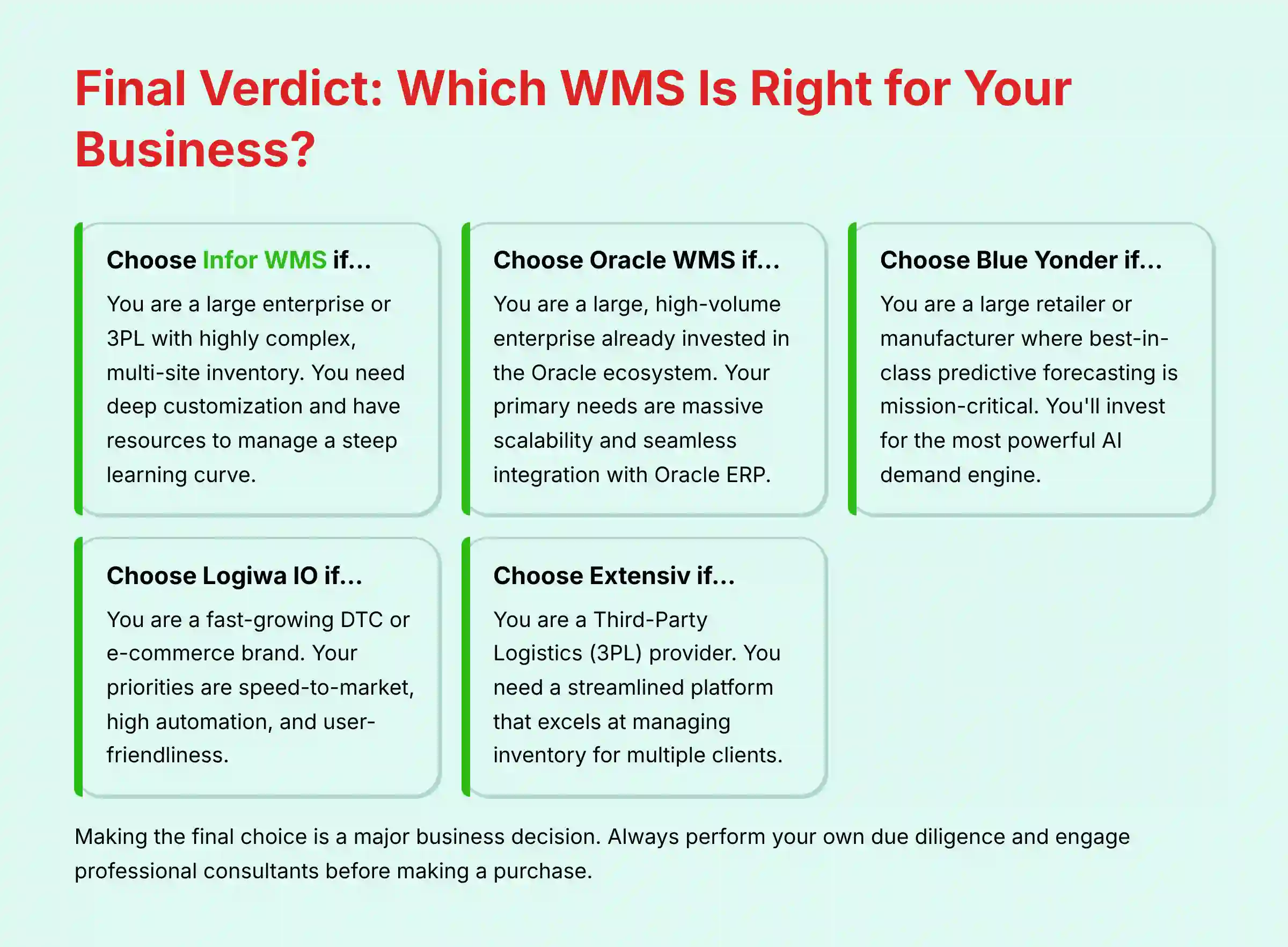
- Choose Infor WMS if… you are a large enterprise or 3PL with highly complex, multi-site inventory. You need deep customization and have the resources to manage a steep learning curve.
- Choose Oracle Warehouse Management if… you are a large, high-volume enterprise already invested in the Oracle ecosystem. Your primary needs are massive scalability and seamless integration with your existing Oracle ERP.
- Choose Blue Yonder WMS if… you are a large retailer or manufacturer where best-in-class predictive forecasting is a mission-critical advantage. You are willing to invest for the most powerful AI demand engine on the market.
- Choose Logiwa IO if… you are a fast-growing DTC or e-commerce brand. Your priorities are speed-to-market, high automation, and user-friendliness.
- Choose Extensiv if… you are a Third-Party Logistics (3PL) provider. You need a streamlined platform that excels at managing inventory for multiple clients and optimizes 3PL-specific workflows.
Making the final choice is a major business decision. I always recommend performing your own due diligence and engaging professional consultants before making a purchase.
Important Disclaimers:
Technology Evolution Notice: The information about Infor WMS Top Alternatives and Competitors and related tools in this article reflects our analysis as of 2025. AI technology changes quickly. Features, pricing, and security protocols may change after publication. I recommend visiting official websites for the most current information.
Professional Consultation Recommendation: For AI applications with significant financial or compliance implications, I recommend consulting with qualified professionals. They can assess your specific requirements and risk tolerance. This overview provides understanding but does not replace professional advice.
Testing Methodology Transparency: My analysis is based on hands-on testing and official documentation. Individual results may vary based on specific use cases and technical environments.
Frequently Asked Questions (FAQs) about Infor WMS Competitors
What is the primary difference between Infor's 3D visualization and Blue Yonder's predictive forecasting?
The main difference is their focus. Infor's 3D visualization acts like a real-time MRI of your warehouse, showing you exactly where physical bottlenecks and inefficiencies are happening right now. Blue Yonder's predictive forecasting is more like a weather forecast for your inventory, using AI to predict future demand with high accuracy so you can prepare in advance. Infor optimizes current operations, while Blue Yonder prepares you for future ones.
Is Logiwa IO scalable enough to compete with enterprise systems like Infor for a rapidly growing business?
Yes, for a specific type of growth. Logiwa IO is built for high-volume, high-velocity e-commerce and DTC operations. It can scale to handle hundreds of thousands of orders. But its strength is in streamlined, automated fulfillment. An enterprise system like Infor is designed for a different kind of complexity, such as managing multi-owner inventory across many global distribution centers with unique rules.
For a 3PL, why is Extensiv generally a better choice than a more powerful but generic WMS like Oracle?
Extensiv is a better choice because it is purpose-built for 3PLs. Its entire workflow, from client billing and inventory segregation to marketplace integrations, is designed to solve the unique challenges a 3PL faces. A generic WMS like Oracle is incredibly powerful but would require extensive and costly customization to replicate the out-of-the-box functionality that Extensiv provides for 3PLs.
What are the hidden costs to watch out for with Oracle Warehouse Management implementation?
The primary hidden costs with Oracle WMS often relate to customization and integration. While it integrates perfectly with other Oracle products, connecting it to a non-Oracle ERP like SAP can be complex and expensive. Additional costs can also appear for specialized modules, extended training for your staff, and ongoing managed services if you do not have a large internal IT team.
How significant is the learning curve for Infor WMS compared to Logiwa IO for new warehouse staff?
The difference is very large. Infor WMS is a highly configurable enterprise system with a steep learning curve, often requiring weeks of formal training for managers and key users. Logiwa IO, by contrast, is designed for rapid onboarding and ease of use. New warehouse staff can often become proficient on its mobile scanners and core functions within a single day.
Which WMS integrates best with a non-Oracle ERP system like SAP S/4HANA?
In my experience, Infor WMS and Blue Yonder WMS often have the most robust and mature integration frameworks for connecting with non-Oracle ERPs like SAP S/4HANA. They have a long history of serving large enterprises that use a mix of technology vendors. They typically offer pre-built connectors and have experienced implementation partners who specialize in these complex projects.
If data security is our absolute top priority, does Oracle's SOC 1/2/3 and PCI DSS compliance make it the only choice?
Not the only choice, but it is the strongest. Oracle's extensive certifications, particularly PCI DSS for handling payment card data, make it the default leader for companies with the absolute strictest security needs. However, Infor and Blue Yonder also have excellent enterprise-grade security with SOC 2 Type II and ISO 27001 certifications. They are extremely secure options for any business not specifically required to meet PCI DSS standards.
What kind of business justifies the very high total cost of ownership for Blue Yonder WMS?
A business where demand forecast accuracy is a primary driver of profitability justifies the investment in Blue Yonder WMS. This includes large retailers, consumer goods companies, and manufacturers. For these businesses, a 1% improvement in forecast accuracy can prevent millions of dollars in losses from either obsolete inventory or lost sales due to stockouts, providing a clear and substantial return on investment.
How do these WMS platforms differ in their approach to robotics integration (AMRs)?
They differ significantly. Infor WMS and Blue Yonder WMS operate as orchestration platforms, often through a Warehouse Execution System (WES) layer. They are robot-agnostic, designed to manage mixed fleets of AMRs from different vendors. Oracle WMS has strong robotics capabilities but is optimized for large, homogenous fleets within its cloud architecture. In contrast, Logiwa IO and Extensiv typically offer pre-built, “plug-and-play” integrations with specific AMR partners, prioritizing rapid deployment over the broad flexibility of the enterprise systems.
What is the strategic difference between a “best-of-breed” WMS like Infor and an “ERP-module” WMS like Oracle?
This is a crucial strategic choice. A “best-of-breed” WMS like Infor or Blue Yonder is a specialized system designed to offer the deepest possible functionality for complex warehouse operations. It often provides superior flexibility and more advanced features. An “ERP-module” WMS like Oracle Warehouse Management offers the primary benefit of seamless, out-of-the-box integration with the rest of the Oracle ERP suite (Finance, Procurement). The trade-off is that it may lack some of the highly specialized features of a best-of-breed solution. The choice depends on whether your priority is maximum operational sophistication or maximum enterprise system homogeneity.
When I evaluate these vendors, what should I ask for beyond a demo?
For a multi-million dollar investment, you must go beyond a standard sales demo. I strongly recommend you formally request the following from your shortlisted vendors:
- Access to a Sandbox Environment: This allows your team to test specific workflows with your own data.
- A Scoped Proof-of-Concept (POC): Define a key challenge (e.g., optimizing a specific picking area) and have the vendor prove their solution's value with a limited, real-world trial.
- Customer References in Your Specific Industry: Speak to a company with similar operational complexity to understand the real-world implementation challenges and ROI.
- The latest SOC 2 Type II Audit Report: Do not accept a summary; request the full report to have your security team review it.
Find out more about Infor WMS Top Alternatives and Competitors.

Leave a Reply