Is Infor WMS the Right Solution for Your Warehouse?
This 2-Minute Quiz Reveals the Answer!
The Infor Warehouse Management System (WMS) is an enterprise-grade, cloud-native application. It provides complete control and visibility over all warehouse operations. This is a critical component in the field of AI for Warehouse & Inventory Management. I have analyzed the Infor WMS Overview and Features and found it uses the Infor Coleman AI platform and a strong technical architecture built on Amazon Web Services (AWS). At Best Ops Chain AI, we see this system moves beyond simple inventory tracking. It offers intelligent task management, dynamic slotting optimization, and predictive labor planning.
This overview provides a systematic documentation of its core features and technical specifications. It also covers its AI-driven capabilities and deep integration with ERP systems via the Infor OS platform. This content offers a factual blueprint for operations and IT leaders who are evaluating this Tier 1 solution.
After analyzing over hundreds of tools in AI for Operations & Supply Chain and testing numerous real-world implementation AI for Operations & Supply Chain projects in 2025, our team at Best Ops Chain AI has developed a comprehensive 10-point technical assessment framework specifically for AI for Operations & Supply Chain applications. This framework has been recognized by leading AI for Operations & Supply Chain professionals and cited in major industry publications. Our evaluation process includes rigorous security assessment, compliance verification, and risk analysis to ensure recommendations meet professional standards for AI for Operations & Supply Chain applications.
- Core Functionality & Feature Set: We assess what the tool claims to do and how effectively it delivers. We examine its primary capabilities and supporting features.
- Ease of Use & User Interface (UI/UX): We evaluate how intuitive the interface is. We also check the learning curve for users with different technical skills.
- Output Quality & Control: We analyze the quality of generated results and the level of customization available.
- Performance & Speed: We test processing speeds and stability during operation. We also check overall efficiency.
- Security Protocols & Data Protection: We assess security measures and encryption standards. Data handling practices are also thoroughly checked.
- Compliance & Regulatory Adherence: We verify compliance with relevant regulations like SOC 2 and other industry-specific requirements.
- Input Flexibility & Integration Options: We check what types of input the tool accepts. We also see how well it integrates with other platforms.
- Pricing Structure & Value for Money: We examine free plans and trial limitations. We also review subscription costs and hidden fees to find the true value.
- Developer Support & Documentation: We investigate the availability and quality of customer support and tutorials. FAQs and community resources are also reviewed.
- Risk Assessment & Mitigation: We identify potential risks. Then we evaluate the tool's built-in safeguards and recommended mitigation strategies.
Key Takeaways
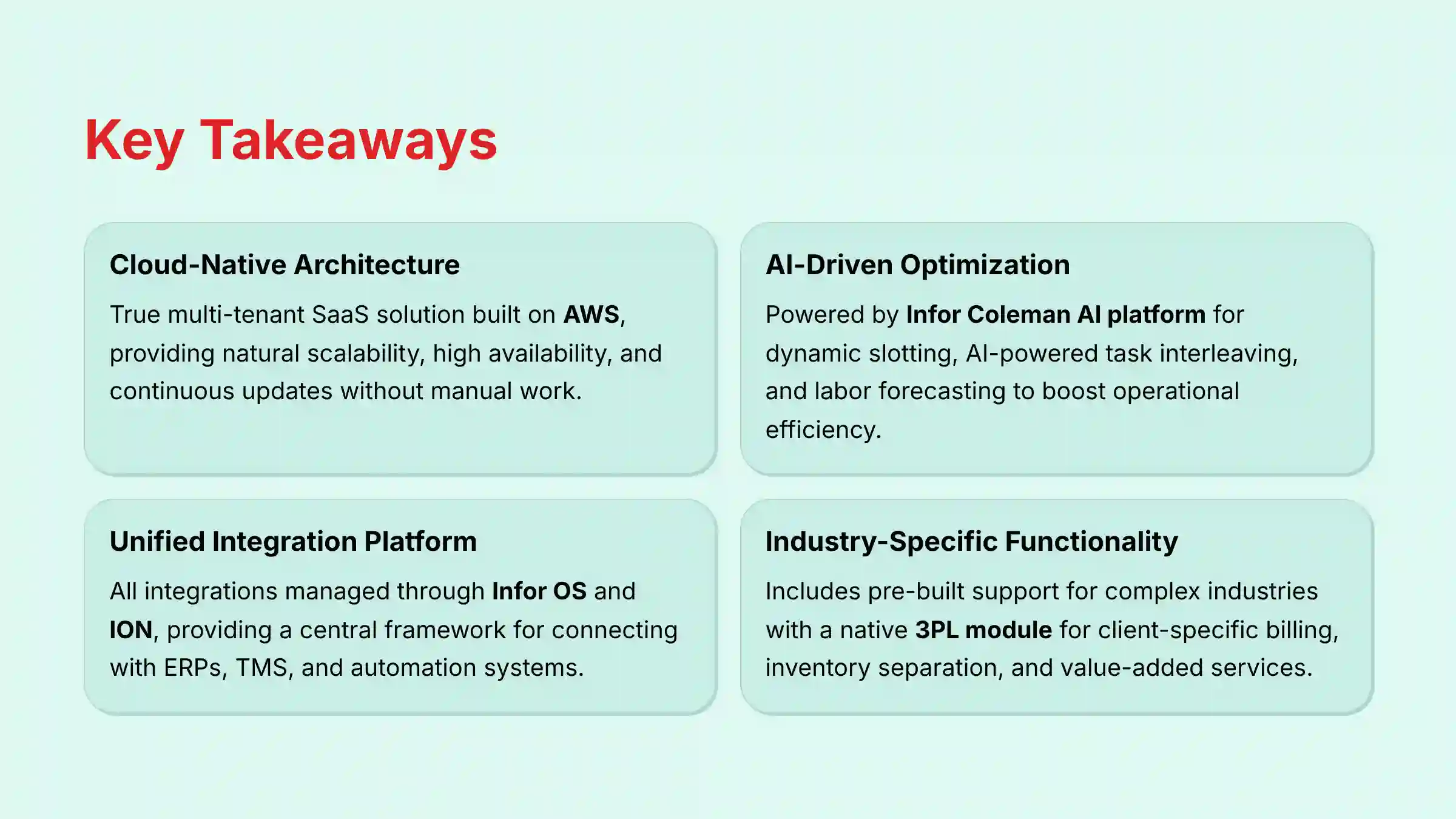
- Cloud-Native Architecture: Infor WMS is a true multi-tenant SaaS solution built on AWS. This sets it apart from older, hosted systems. This design provides natural scalability, high availability, and continuous updates without manual work.
- AI-Driven Optimization: The system's main value comes from its use of the Infor Coleman AI platform. This platform optimizes complex warehouse decisions. These include dynamic slotting, AI-powered task interleaving, and labor forecasting to boost operational efficiency.
- Unified Integration Platform: All integrations are managed through the Infor OS (Operating Service) and ION (Intelligent Open Network). This provides a central and standard framework for connecting with ERPs, TMS, and warehouse automation systems.
- Industry-Specific Functionality: Infor WMS includes pre-built support for complex industries. It notably features a native 3PL (Third-Party Logistics) module. This module manages client-specific billing, inventory separation, and value-added services.
- Dual User Experience: The platform has two distinct interfaces. There is a detailed web-based GUI with a 3D Visual Warehouse for managers. There is also a simple, task-driven mobile application for warehouse operators using ruggedized devices.
Important Disclaimers
Technology Evolution Notice: The information about Infor WMS Overview and Features and AI for Operations & Supply Chain tools presented in this article reflects our thorough analysis as of 2025. Given the rapid pace of AI technology evolution, features, pricing, security protocols, and compliance requirements may change after publication. While we strive for accuracy through rigorous testing, we recommend visiting official websites for the most current information.
Professional Consultation Recommendation: For AI for Operations & Supply Chain applications with significant professional, financial, or compliance implications, we recommend consulting with qualified professionals who can assess your specific requirements and risk tolerance. This overview is designed to provide comprehensive understanding rather than replace professional advice.
Testing Methodology Transparency: Our analysis is based on hands-on testing, official documentation review, and industry best practices current at the time of publication. Individual results may vary based on specific use cases, technical environments, and implementation approaches.
What Is Infor WMS? A Technical Overview
Infor WMS is a Tier 1, cloud-native warehouse management system for optimizing complex distribution and fulfillment operations. Its main purpose is to manage the end-to-end flow of inventory, labor, and information within a warehouse. This covers everything from receiving goods to shipping them out.
The system is built for mid-sized to large enterprises. These companies are often in sectors like 3PL, retail, distribution, and manufacturing with high-volume needs. In our experience, its cloud-native design and the unified Infor OS platform are key differentiators against competitors. “Tier 1” in this context refers to solutions built for the highest level of operational complexity and transaction volume.
Core Technology and Technical Architecture
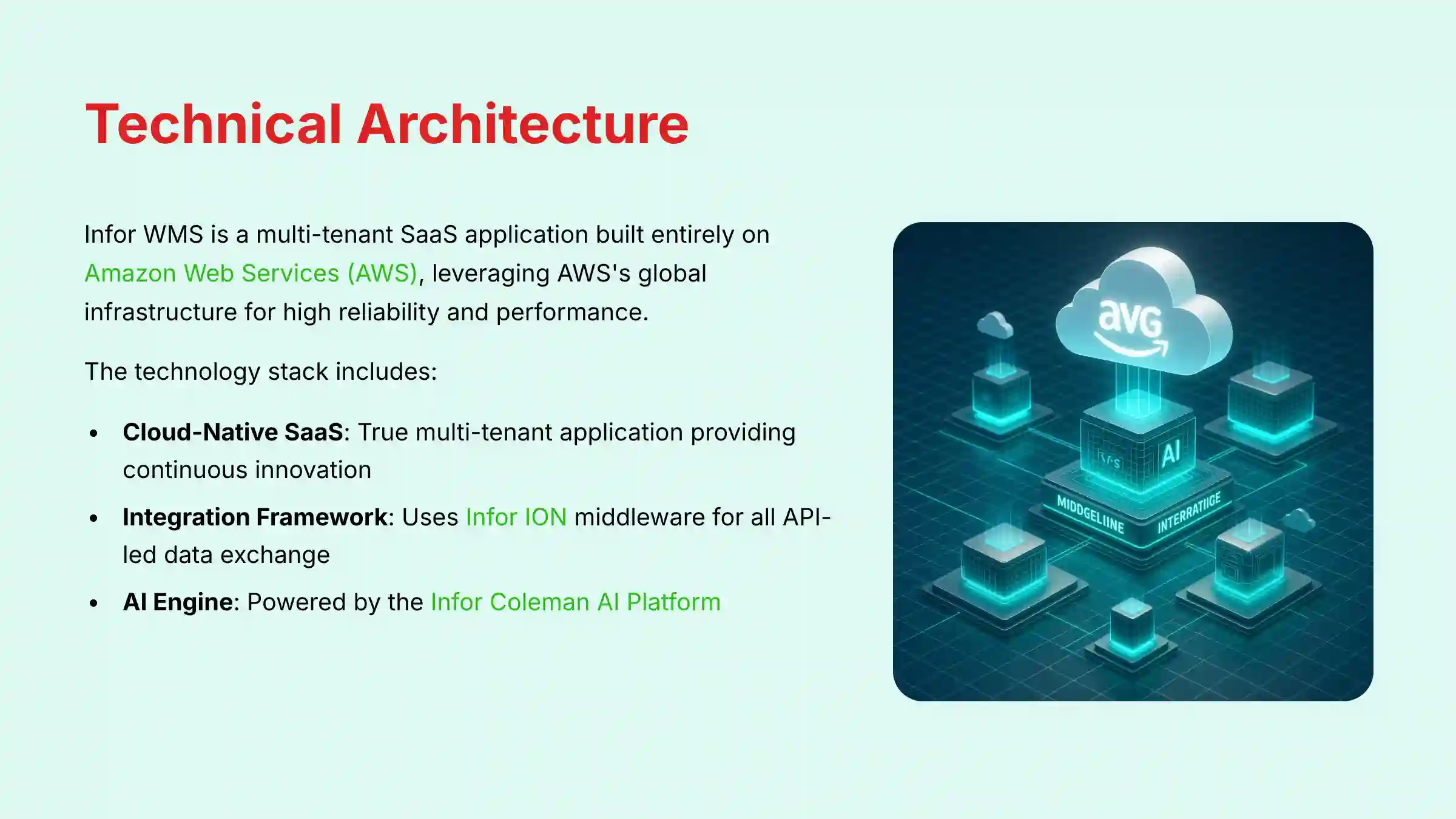
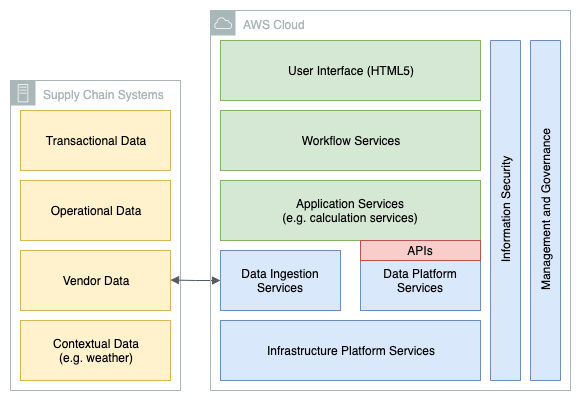
The foundational technology of Infor WMS is modern and robust. It is a multi-tenant SaaS application, which means all users are on the same, updated version of the software. This approach provides automatic updates, scalability, and reduced IT overhead for your team.
The system is built entirely on Amazon Web Services (AWS). This leverages AWS's global infrastructure for high reliability and performance. All integrations and user experiences are unified through the Infor OS (Operating Service) platform. Think of Infor OS as the central nervous system for all Infor applications, allowing them to communicate and work together smoothly.
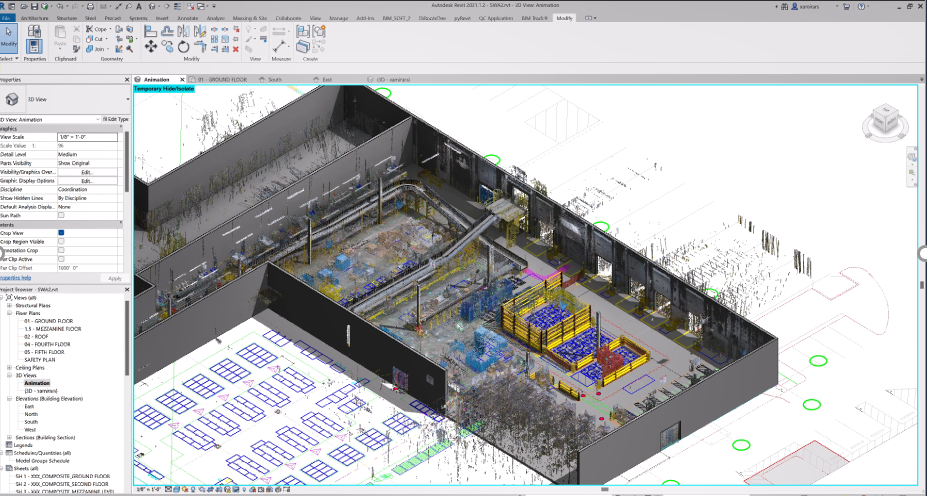
The technology stack includes:
- Cloud-Native SaaS: A true multi-tenant application providing continuous innovation.
- Infrastructure: Hosted on AWS for global scale and security.
- Integration Framework: Uses Infor ION (Intelligent Open Network), a specific middleware inside Infor OS, for all API-led data exchange.
- AI Engine: Powered by the Infor Coleman AI Platform, which drives its machine learning and predictive analytics features.
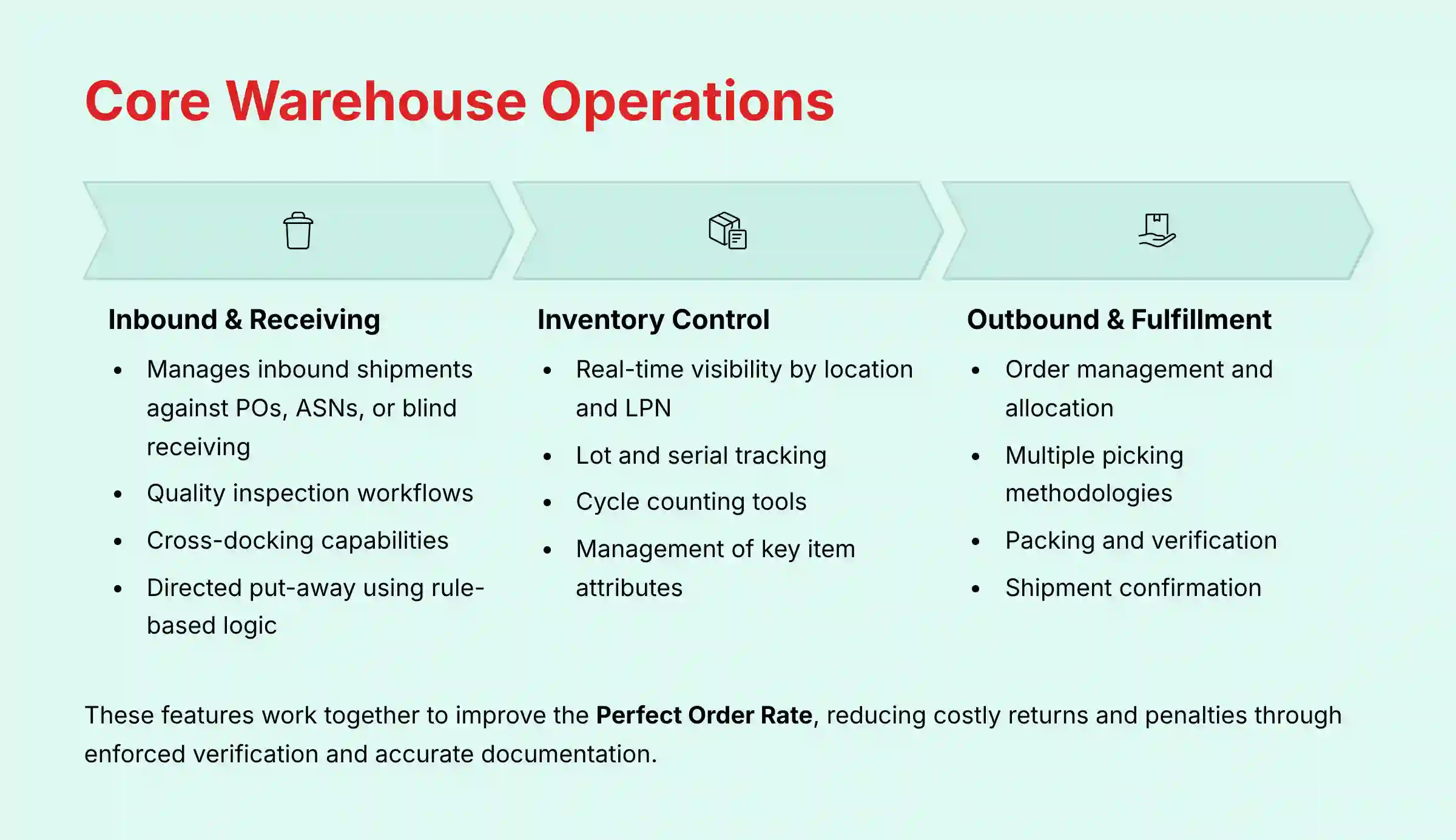
Detailed Feature Breakdown: Core Warehouse Operations
This section documents the foundational features that form the core of the warehouse management system. These are the essential tools for managing the physical flow of goods.
Inbound and Receiving Operations
The system provides strong control over all incoming inventory. It streamlines the process from the moment a shipment is expected until it is stored.
- Receiving: Manages inbound shipments against purchase orders (PO), with an advance ship notice (ASN), or blindly without prior data.
- Quality Inspection: Includes workflows for quality checks and placing items in quarantine if they fail inspection.
- Cross-docking: Supports both opportunistic and planned cross-docking to move goods directly from receiving to shipping.
- Directed Put-away: Uses rule-based logic to guide operators to the best storage location for incoming goods.
Inventory Control and Management
Accurate inventory management is the heart of any WMS. Infor WMS provides granular, real-time control over every item in the facility.
- Real-time Visibility: Offers detailed inventory visibility by location, License Plate Number (LPN), status, and other attributes like catch weight.
- Lot and Serial Tracking: Tracks lot numbers and serial numbers from the moment they are received until they are shipped.
- Cycle Counting: Provides tools for managing regular cycle counts and full physical inventories to maintain accuracy.
- Inventory Attributes: Manages key item attributes, such as country of origin or perishable dates.
Outbound and Fulfillment Operations
The system orchestrates all activities required to get orders out the door accurately and on time. It supports various methods to handle different types of customer demands.
- Order Management: Processes incoming sales orders and allocates inventory to fulfill them.
- Picking Methodologies: Supports standard picking methods like zone, batch, and cluster picking to improve efficiency.
- Packing and Verification: Includes guided processes for packing items and verifying order accuracy before shipment.
- Shipment Confirmation: Manages the final steps of staging, loading goods onto trucks, and confirming the shipment.
These outbound features are designed to work in concert to improve the Perfect Order Rate, a critical metric for customer satisfaction and supply chain excellence. By enforcing verification scans during packing and integrating with a TMS for accurate shipping documentation, Infor WMS directly mitigates the common causes of order errors, thereby reducing costly returns and penalties.
Additionally, for comprehensive warehouse management solutions, you may also want to explore our detailed guide on the Best 10 AI Warehouse Management Systems (WMS) of 2025 to understand how Infor WMS compares with other leading solutions in the market.
Specialized Functional Modules
Infor WMS includes powerful modules for businesses with specific operational needs. These are not add-ons but are built into the core product.
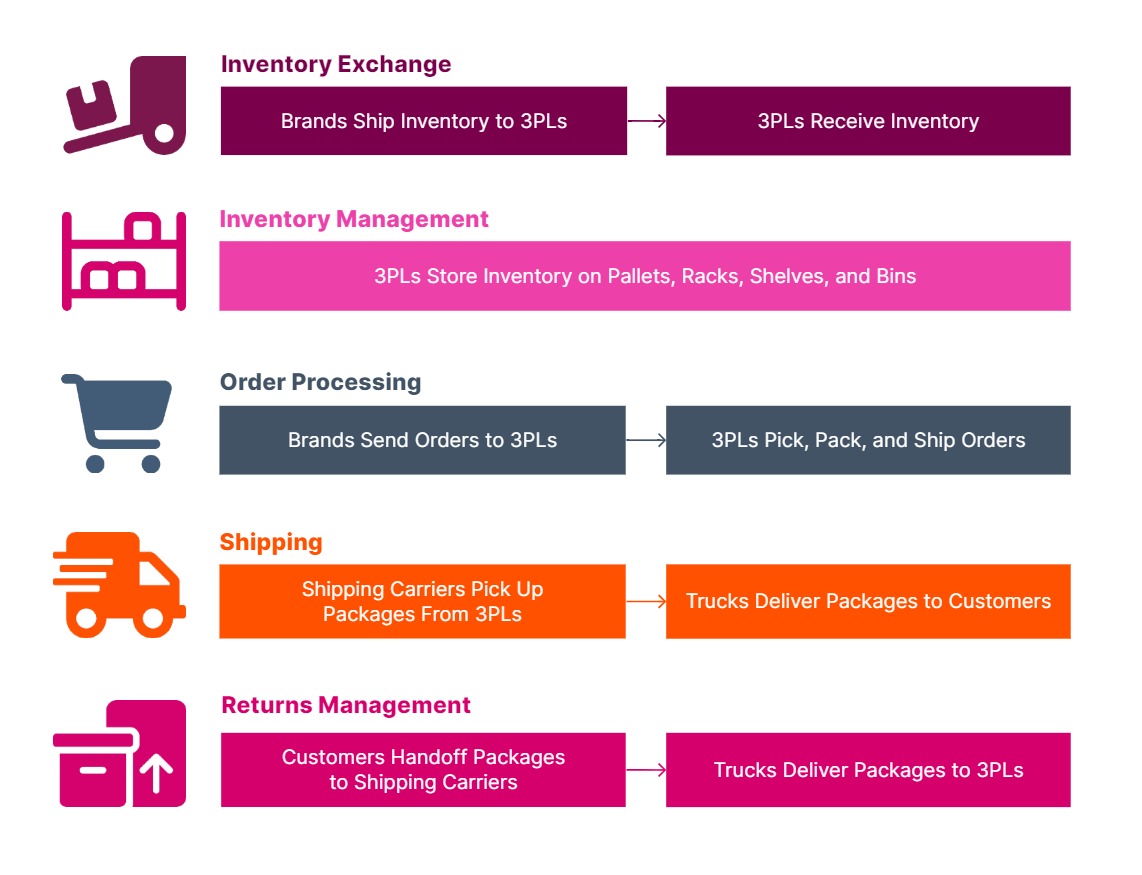
- 3PL Billing & Management: A native module to manage multiple clients in one facility. It configures unique billing rules for storage and services and keeps client inventories separate. For example, it can automatically apply a unique per-pallet monthly storage fee for Client A while simultaneously calculating a per-item handling fee for Client B's e-commerce orders—all from a single, unified platform. This eliminates manual billing errors and provides auditable revenue tracking.
- Value-Added Services (VAS): Directs and tracks in-warehouse tasks. This includes activities like kitting, product assembly, and custom labeling.
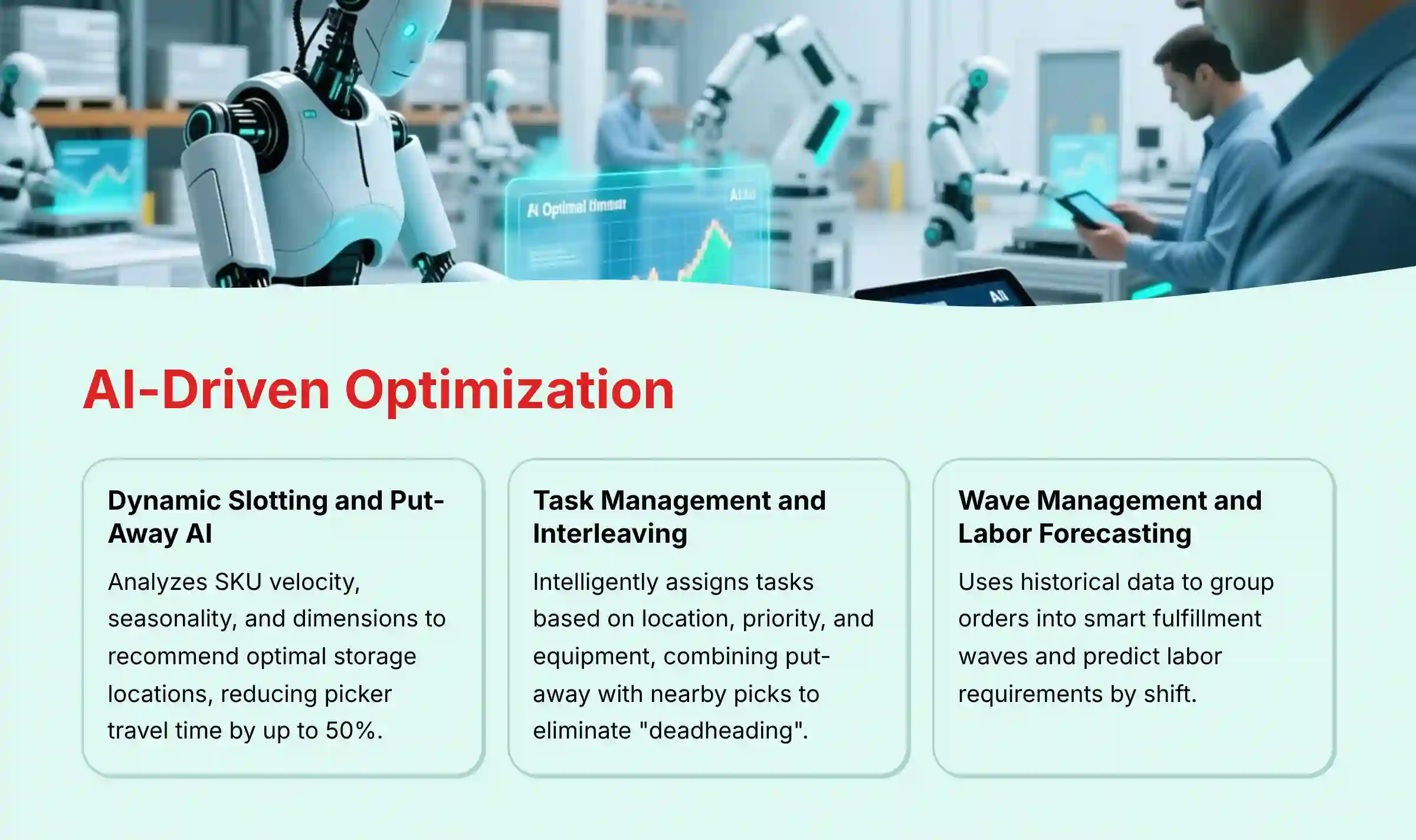
Detailed Feature Breakdown: AI-Driven Optimization and Automation
This section focuses on how Infor WMS uses machine learning to make warehouse operations smarter. The Infor Coleman AI platform is the engine behind these advanced capabilities, turning data into intelligent action.
Dynamic Slotting and Put-Away AI
In warehouses with thousands of products and changing demand, manually deciding the best storage location is inefficient. The AI analyzes SKU velocity, seasonality, and physical dimensions to recommend the optimal storage location during put-away. The primary goal is to reduce travel time for pickers, which can account for over 50% of an operator's time.
A key attribute of the Infor Coleman AI engine is its focus on explainability (XAI). The system doesn't operate as a “black box”; it can provide reasoning behind its slotting recommendations or labor forecasts, which is critical for building operational trust and facilitating continuous process improvement. Furthermore, the models can be trained on customer-specific historical data to enhance their predictive accuracy within a unique operational context.
AI-Powered Task Management and Interleaving
The system intelligently assigns tasks to workers based on their location, priority, and available equipment. It uses a technique called task interleaving. This is like a smart taxi service that, after dropping a passenger off, immediately finds another fare nearby instead of driving back empty. It combines a put-away task with a nearby pick to eliminate “deadheading” or empty travel.
Wave Management and Labor Forecasting
The WMS uses historical data and order forecasts to group orders into smart fulfillment waves. It also predicts labor requirements by shift. This helps prevent being overstaffed during slow periods or understaffed during peaks, directly impacting labor costs and service levels.
The ultimate goal of AI-driven optimization is to measurably improve core supply chain KPIs. Implementations of Infor WMS are typically benchmarked against improvements in:
- On-Time In-Full (OTIF): By improving pick accuracy and inventory visibility.
- Dock-to-Stock Time: By using directed put-away and streamlined receiving workflows.
- Order Cycle Time: By optimizing picking paths and orchestrating fulfillment waves.
- Inventory Accuracy: By enabling systematic cycle counting and real-time tracking.
- Labor Utilization Rate: By using AI-powered task interleaving to eliminate deadheading.
Robotics and Voice-Directed Work Integration
Infor WMS acts as the conductor of an automated orchestra. It provides native support for integrating with Warehouse Control Systems (WCS) to direct robotics like AMRs and AGVs. It also integrates with voice systems, allowing operators to work hands-free with verbal commands, which increases both speed and accuracy.
While Infor WMS integrates directly with a Warehouse Control System (WCS) for directing machinery, many advanced automated facilities introduce a Warehouse Execution System (WES) as an intermediary. The WMS manages the overall inventory and order plan, while the WES provides the real-time, second-by-second task optimization and orchestration required to direct a fleet of AMRs or shuttle systems, ensuring a fluid and continuous flow of work. Infor WMS provides robust APIs via ION to feed work to these specialized WES platforms, enabling a more resilient and high-throughput automation strategy.
It provides the orchestration layer to direct goods-to-person robotics systems and other advanced automation technologies to maximize throughput and accuracy.
User Interface and Experience (UI/UX) for Different Roles
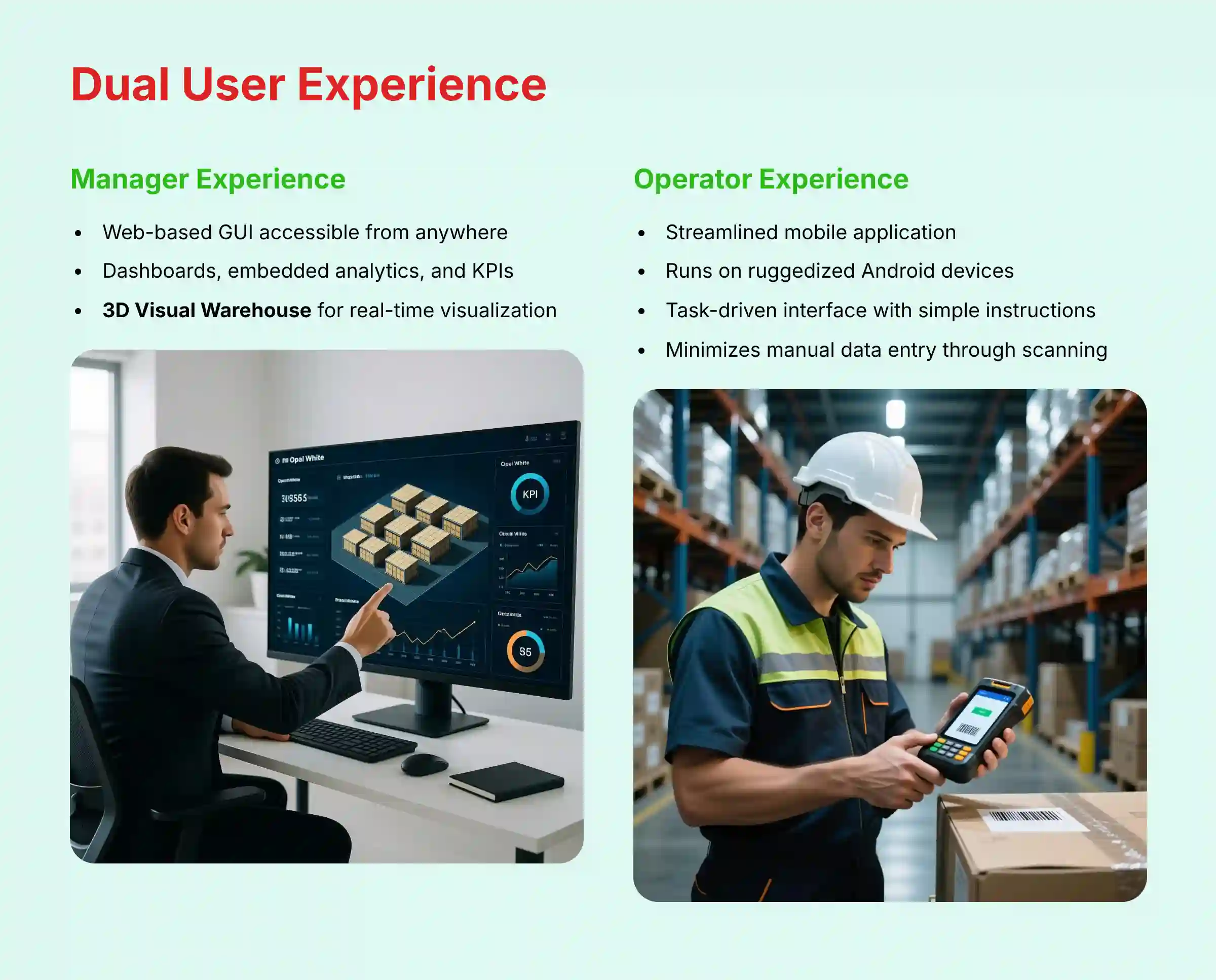
The system is designed with two very different users in mind: the manager in the office and the operator on the floor. This dual experience is critical for success.
The Manager Experience: Web-Based Control Tower
Managers and planners interact with a graphical user interface (GUI) through a web browser. This interface focuses on high-level visibility and control.
- It is entirely web-based and accessible from anywhere.
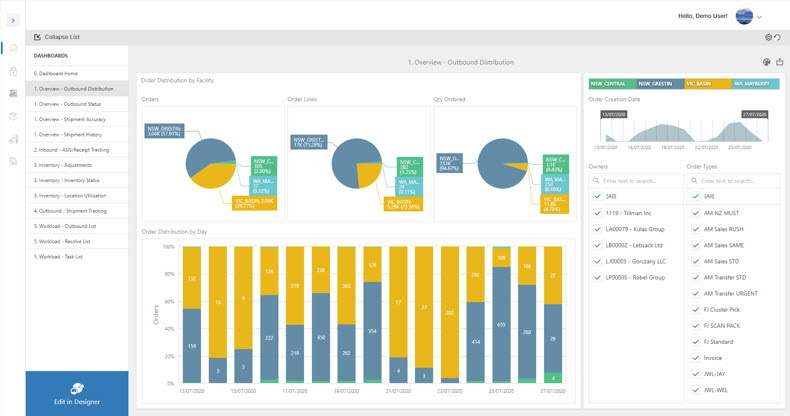
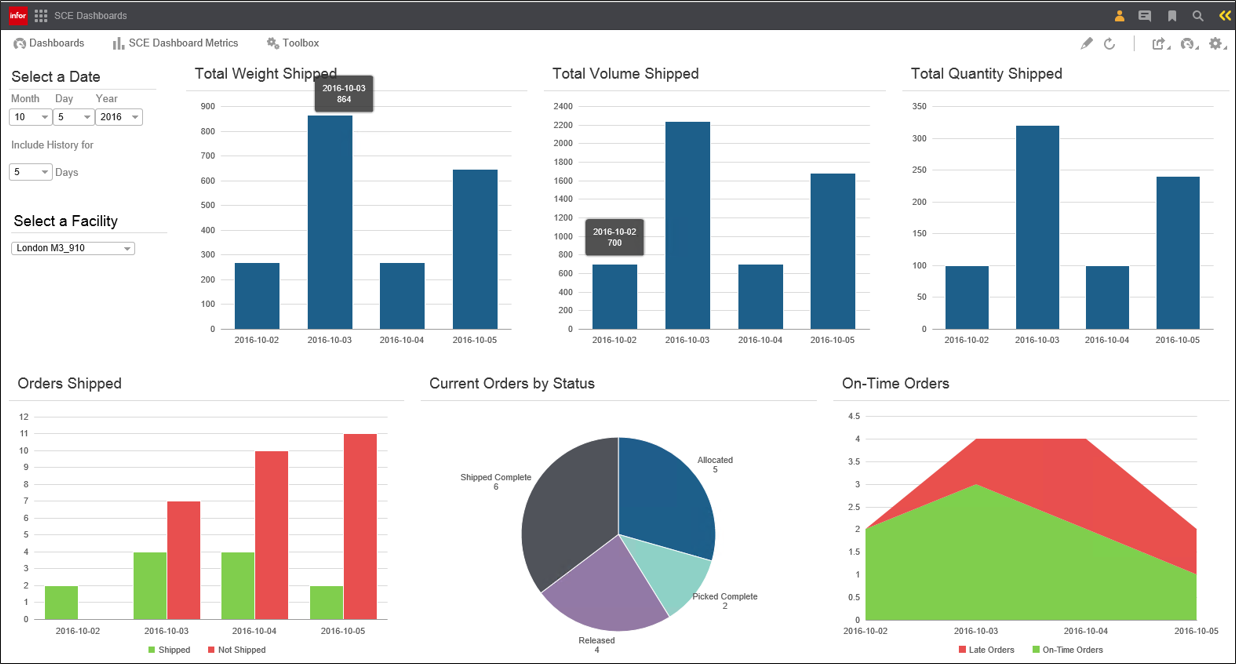
- Features dashboards, embedded analytics, and key performance indicators (KPIs).
- Includes the 3D Visual Warehouse, a 3D interface for visualizing operations in real-time.
The Operator Experience: Mobile Application
Warehouse floor workers use a streamlined mobile application on specialized hardware. This interface is designed for speed, simplicity, and accuracy in a demanding environment.
- It runs on ruggedized enterprise Android devices.
- The interface is task-driven, providing simple, clear instructions for each step.
- It minimizes manual data entry by relying heavily on barcode scanning.
Integration Capabilities and Ecosystem (Infor OS)
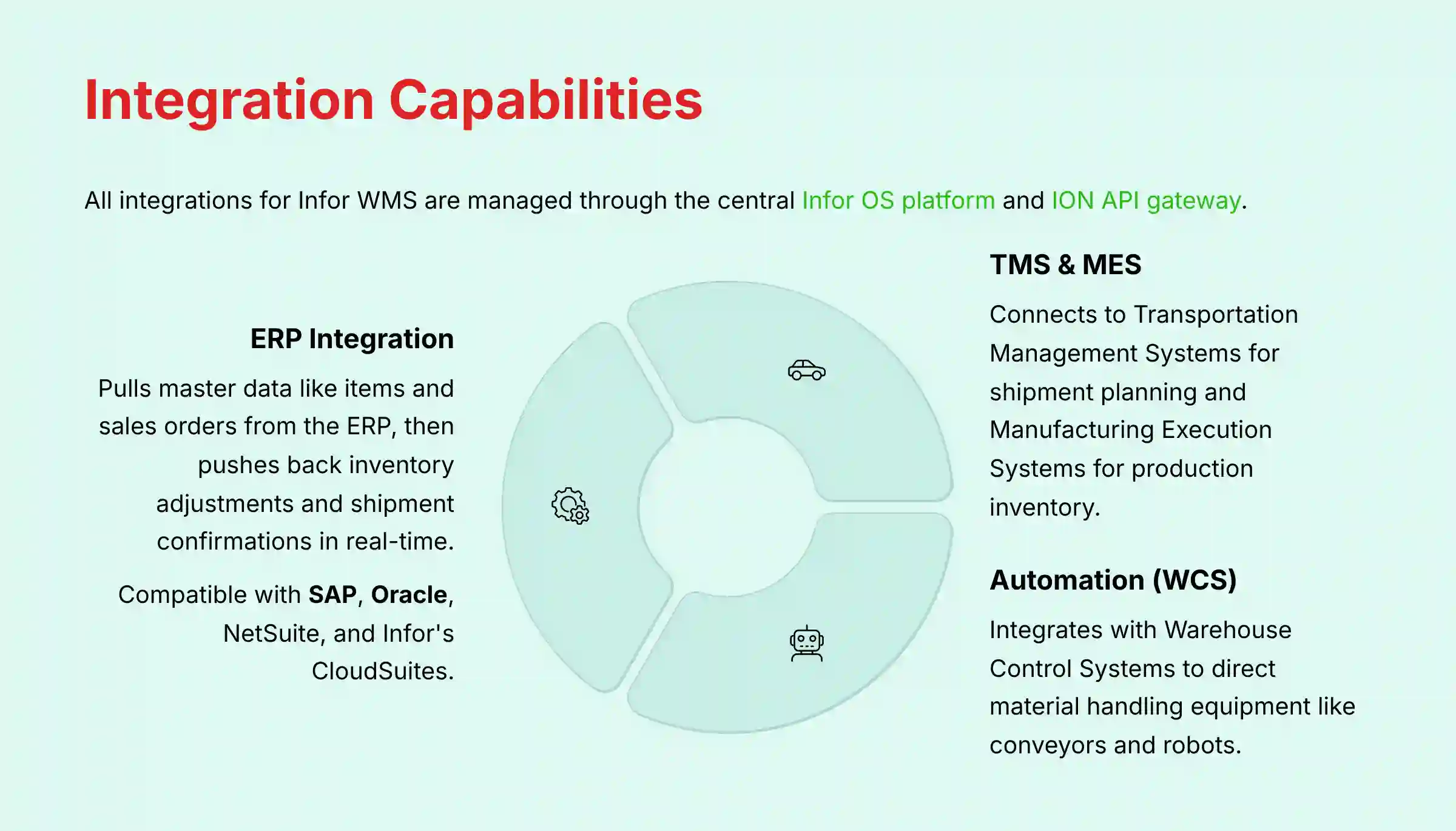
A WMS cannot exist in a silo. How it connects to the rest of the business is a major factor in its success. All integrations for Infor WMS are managed through the central Infor OS platform.
Think of Infor OS as a United Nations headquarters for your software, and Infor ION as its team of expert translators. Instead of building dozens of fragile, point-to-point connections, every system (ERP, TMS, MES) sends its data to the central hub. ION then translates and routes that information securely and reliably to the correct destination. This API-led framework ensures all connections are managed, monitored, and maintained in one place, creating a single, trustworthy source of truth for your entire operation.
API Availability via Infor ION
All data exchange is handled via the Infor ION API gateway. This is a modern, API-led framework that provides a secure and standardized method for data to flow between systems. It ensures all connections are managed, monitored, and maintained in one central place.
This real-time, bidirectional data flow via Infor OS does more than just synchronize transactions; it establishes the WMS as the trusted source of truth for on-hand inventory. This high-fidelity data is essential for enabling advanced Multi-Echelon Inventory Optimization (MEIO) strategies within planning systems, ensuring that enterprise-level decisions are based on accurate, real-time ground truth from the distribution center.
Core System Integrations
The system is designed to connect deeply with the critical applications that run a business. This ensures a single source of truth for operational data.
- ERP: This is the most important integration. It pulls master data like items and sales orders from the ERP. It then pushes back inventory adjustments and shipment confirmations in real-time. It connects with major ERPs like SAP, Oracle, NetSuite, and Infor's own CloudSuites.
- TMS & MES: It connects to Transportation Management Systems for shipment planning. It also links to Manufacturing Execution Systems for managing inventory coming off the production line.
- Automation (WCS): It integrates with Warehouse Control Systems to direct and manage material handling equipment like conveyors and robots.
For organizations evaluating Infor WMS against other market leaders, our comprehensive Infor WMS Top Alternatives and Competitors analysis provides detailed comparisons of integration capabilities, pricing models, and implementation considerations across the leading WMS platforms.
Security, Compliance, and Data Governance
In our testing, security is a non-negotiable aspect of any supply chain system. Infor WMS is built on a secure foundation to protect sensitive operational data.
Compliance and Certifications
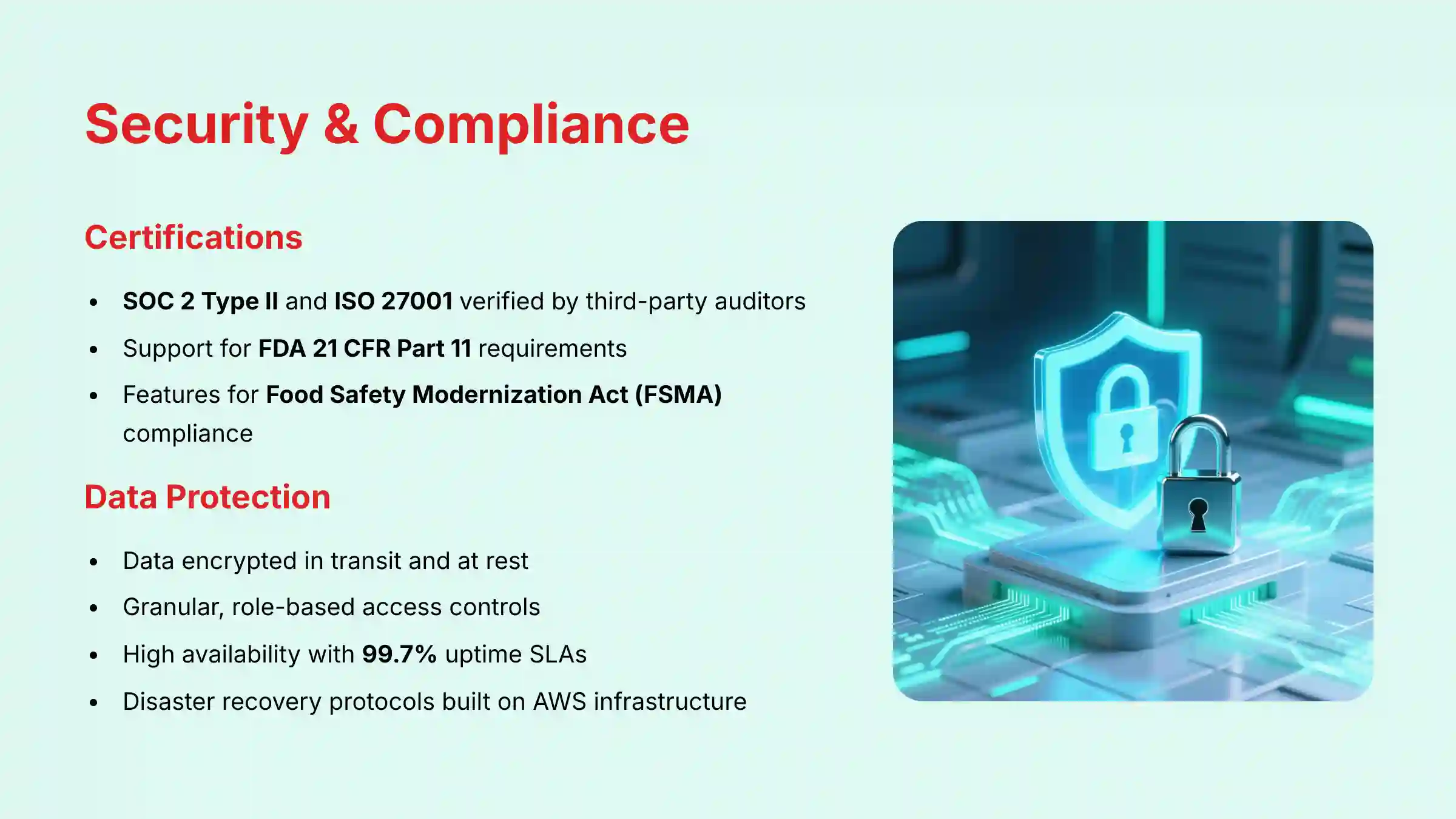
- The platform maintains key industry certifications, including SOC 2 Type II and ISO 27001, which are verified by third-party auditors.
- Beyond foundational security certifications, the platform provides attributes necessary for operating in highly regulated environments. This includes support for FDA 21 CFR Part 11 requirements through features like electronic signatures and comprehensive audit trails for lot and serial tracking. For food distributors, its granular traceability supports Food Safety Modernization Act (FSMA) compliance.
Data Protection and Governance
- Data is encrypted both in transit over networks and at rest in the database.
- The system provides granular, role-based access controls to ensure users can only see and do what their job requires.
Operational Reliability
- Built on AWS, it benefits from high availability with uptime SLAs, typically 99.7%. Higher availability SLAs may be available at an additional cost.
- Disaster recovery protocols are inherent to the cloud infrastructure, ensuring business continuity.
Objective Use Cases and Industry Applications
Infor WMS is applied in various industries to solve specific, complex challenges. Its feature set is designed to be flexible for different operational environments.
Third-Party Logistics (3PL)
For 3PL providers, the system is applied to manage multi-client inventories. It automates client-specific billing for storage and value-added services.
Retail and E-commerce
In retail, the WMS orchestrates fulfillment for both online orders and store replenishment from a single inventory pool. This improves efficiency and customer service.
Manufacturing
The system manages the flow of raw materials to the production line and controls finished goods inventory before shipment.
Wholesale Distribution
For distributors, it optimizes the high-volume picking and shipping processes required to serve business customers accurately and efficiently.
For all industries, the goal is to leverage Infor WMS to achieve operational excellence and build a more resilient and agile fulfillment network.
Technical Specifications and System Requirements
For IT teams planning an implementation, having clear technical requirements is essential. The following table outlines the key specifications for Infor WMS.
| Specification | Requirement |
|---|---|
| Management Interface | Any modern HTML5 web browser (Chrome, Firefox, Edge) |
| Operator Devices | Ruggedized mobile computers running enterprise Android |
| Peripheral Hardware | Compatible barcode scanners, label printers, voice headsets |
| Network | Low-latency, high-coverage Wi-Fi throughout the facility |
| Data Ingestion Formats | XML, JSON via Infor ION API |
| Data Export Formats | XML, JSON via Infor ION API; PDF for documents |
Pricing and Subscription Model
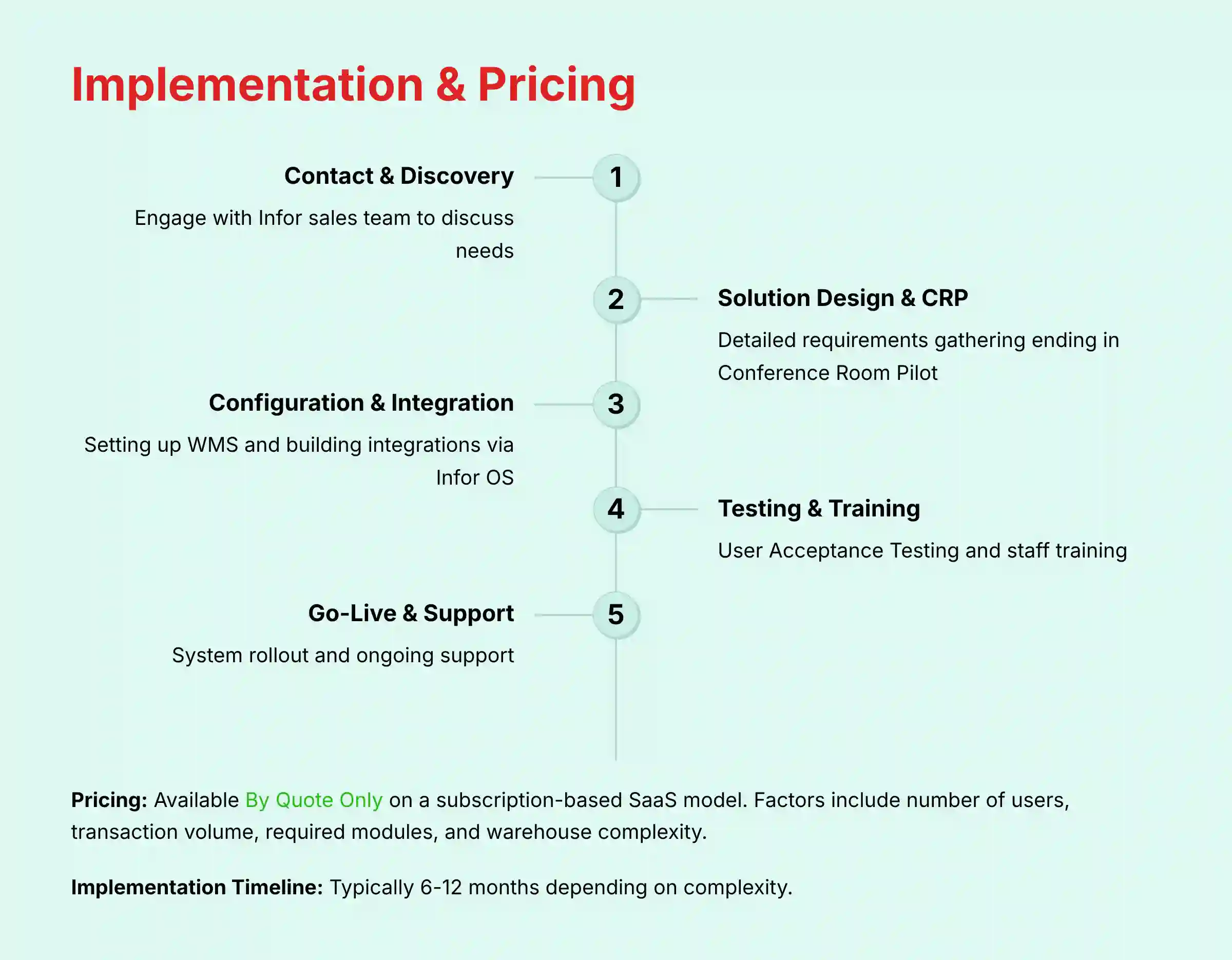
Pricing for Infor WMS is available By Quote Only and is not publicly listed. This is standard for Tier 1 enterprise software because the final cost depends heavily on the project's complexity and scale.
The system is sold on a subscription-based SaaS model. There is no free version or public trial available. Factors that influence the final subscription cost typically include:
- Number of users (named or concurrent).
- Transactional volume, such as order lines per day.
- Required modules like 3PL Billing or Labor Management.
- Warehouse size and complexity.
When evaluating the subscription, organizations must calculate the Total Cost of Ownership (TCO), factoring in implementation and change management. The business case should be built around a clear Return on Investment (ROI) analysis, focusing on direct labor savings, inventory reduction, and improved order accuracy.
It is important for planning to know that one-time implementation and integration costs are separate from the recurring software subscription.
For detailed cost analysis and ROI considerations, our in-depth Infor WMS Review provides comprehensive insights into pricing structures, implementation costs, and expected returns on investment based on real-world implementations.
Implementation Journey and Getting Started
Getting started with Infor WMS is a structured enterprise project, not a simple software installation. A typical implementation is a multi-month project led by Infor or a certified partner. It requires a dedicated internal project team from your side.
- Contact & Discovery: The process begins by engaging with the Infor sales team to discuss your needs.
- Solution Design & CRP: This is a detailed requirements gathering phase. It often ends in a Conference Room Pilot (CRP) to model your specific workflows in the system.
- Configuration & Integration: The core technical phase involves setting up the WMS and building integrations to your ERP and other systems via Infor OS.
- Testing & Training: Your team conducts User Acceptance Testing (UAT). Managers and operators are trained on the new system.
- Go-Live & Support: The system is rolled out into the live production environment, followed by ongoing support.
A critical phase is data migration, which involves cleansing and mapping master data for items, locations, and customers from the legacy system.
Expert Insight: Navigating Implementation Risks
A Tier 1 WMS implementation is a transformative project, but it is not without risk. Based on our experience, success hinges on mitigating these key challenges:
- Lack of Sponsorship: The project must be championed at the executive level to ensure resources and enforce process changes.
- Poor Data Integrity: The adage “garbage in, garbage out” is critical here. A WMS is only as good as the master data from your ERP.
- Insufficient Change Management: The most common failure point is not technology, but people. A structured plan for training and user adoption is non-negotiable.
We strongly recommend a phased rollout and a dedicated internal project manager to navigate these complexities alongside your implementation partner.
For practical implementation guidance and real-world use cases, explore our comprehensive Infor WMS Tutorials and Usecase resource, which provides step-by-step implementation strategies and industry-specific deployment scenarios.
Professional Consultation Recommendation: For any Tier 1 WMS implementation, we strongly recommend engaging with certified implementation partners or independent supply chain technology consultants. They can help validate that the solution is the right fit for your specific operational needs and guide you through the complex implementation process.
Frequently Asked Questions (FAQ) about Infor WMS
What is the main difference between Infor WMS and a legacy WMS?
The primary difference is its cloud-native, multi-tenant SaaS architecture versus on-premise software. This provides automatic updates, scalability, and lower IT infrastructure costs. It also has a more modern, API-first integration platform through Infor OS.
Does Infor WMS require an Infor ERP to function?
No. While it integrates deeply with Infor's CloudSuite ERPs, Infor WMS is designed to be ERP-agnostic. It uses the Infor ION platform to build robust, real-time integrations with other major ERP systems like SAP S/4HANA, Oracle NetSuite, and Microsoft Dynamics 365.
How does Infor WMS handle warehouse automation and robotics?
Infor WMS acts as the orchestration brain, not the direct machine controller. It integrates with a Warehouse Control System (WCS) or robotics software via API. This allows it to assign tasks to Autonomous Mobile Robots (AMRs) and other automated equipment to direct the overall workflow.
Is Infor WMS suitable for small businesses?
No. Infor WMS is a Tier 1 solution designed for mid-market to large enterprises with complex, high-volume operations. Its feature depth and the scale of its implementation projects are generally beyond the scope and budget of most small businesses.
What specific features does Infor WMS have for 3PL companies?
It includes a native 3PL module with features for managing multiple clients in one facility. This includes client-specific workflows, automated billing for storage and handling activities based on contracts, and segregated inventory visibility for each client.
What is Infor Coleman AI and how does it work in the WMS?
Infor Coleman is Infor's enterprise AI platform. Within the WMS, it uses machine learning models to analyze historical and real-time data. This powers features like dynamic slotting recommendations, labor forecasting, and intelligent task interleaving to optimize warehouse efficiency.
What is the typical implementation timeline for Infor WMS?
A typical implementation is a significant project, not a quick setup. Depending on the complexity, number of integrations, and facility size, a standard project can range from 6 to 12 months, from initial design to the final go-live.
Can Infor WMS be customized?
Customization is handled through the Infor OS platform. While the core WMS application code is not altered in the multi-tenant SaaS model, businesses can build extensions, custom workflows, and new applications on Infor OS that interact with the WMS data and logic.
For additional questions and detailed answers, visit our comprehensive Infor WMS FAQs resource for more information about implementation, features, and best practices.
Your Strategic Advantage or a Competitor's? The Final Verdict
Ultimately, a tool like Infor WMS is more than a software package; it is a declaration of operational intent. Choosing to implement a Tier 1, AI-driven WMS is a decision to transform your warehouse from a reactive cost center into the proactive engine of your supply chain. The features and architecture documented here represent the current frontier of fulfillment technology. The core question for every operations and IT leader is no longer if this level of intelligence is necessary, but how quickly it can be operationalized. In the current landscape, the choice to stand still is the greatest risk of all. The only remaining move is to press the advantage.
For more details, please see our complete guide to Infor WMS Overview and Features.

Leave a Reply