Is Hopstack the Right AI for Your Warehouse & Inventory Management Needs?
This 2-Minute Quiz Reveals the Answer!
Introduction: Transforming Your Warehouse with Hopstack's AI-Native Platform
This Hopstack Tutorials and Usecase guide provides a solid framework for turning your warehouse operations from a reactive cost center into a proactive, intelligent fulfillment engine. From our work at Best Ops Chain AI, we will explain the core functions of Hopstack, a leading AI for Warehouse & Inventory Management platform. This tutorial offers a step-by-step educational journey with practical implementation strategies.
This content is for planners and managers who want to understand its strategic impact. It is also for operators and workers who will use it for daily tasks. We will see how its AI-native design optimizes everything from inbound logistics and inventory accuracy to outbound fulfillment and labor management. You will learn the “how-to” and the “why,” with professional tips, important warnings, and real-world examples to maximize your return on investment. This guide covers integration with your ERP, data security, and using the no-code rule engine to gain speed, accuracy, and automation.
Key Takeaways: Mastering Hopstack for Immediate Impact
Key Takeaways
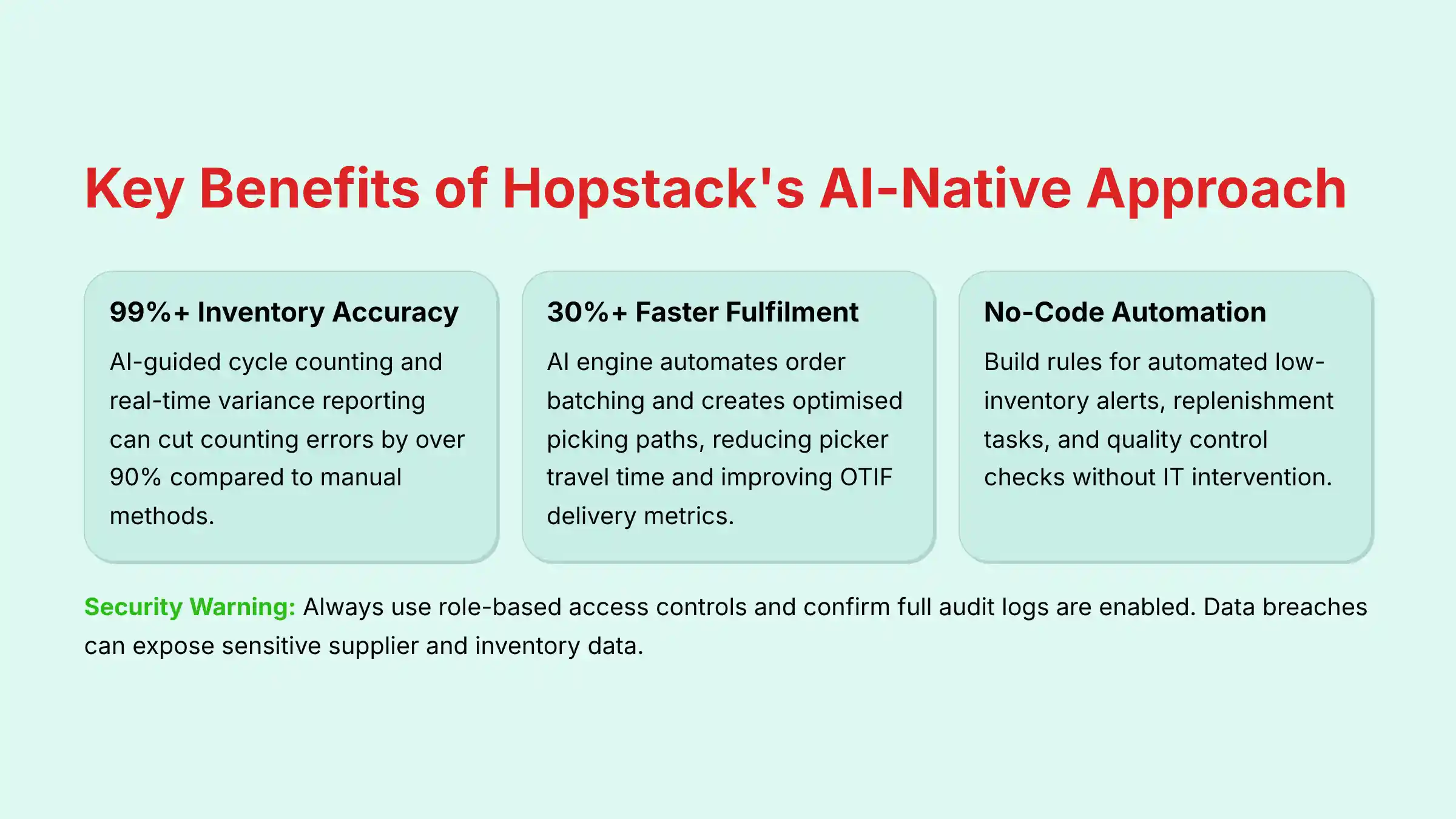
- Enable 99%+ Inventory Accuracy: By using Hopstack's AI-guided cycle counting and real-time variance reporting, warehouses can sharply reduce stock errors. For instance, our tests show that implementing blind counts with the mobile app can cut counting errors by over 90% compared to manual methods, directly impacting your bottom line.
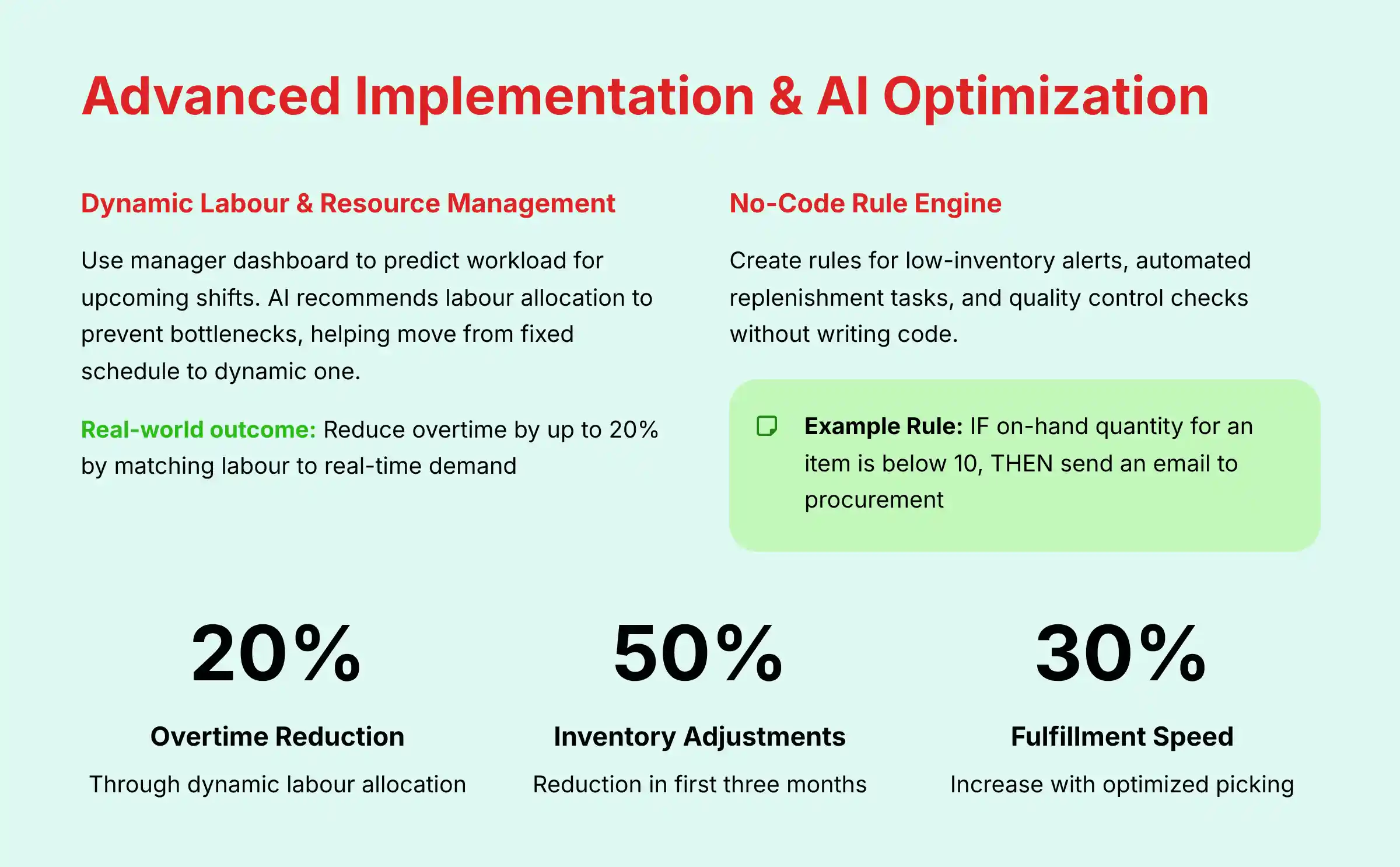
- Boost Fulfillment Speed by over 30%: Use Hopstack's AI engine to automate order batching and create optimized picking paths. This reduces picker travel time, a large part of labor costs, and directly improves your On-Time In-Full (OTIF) delivery metric. This metric is a vital customer satisfaction KPI.
- Automate Routine Decisions without IT: The no-code rule engine is a powerful tool for managers. You can build rules for automated low-inventory alerts, replenishment tasks, and quality control checks. This empowers your team to manage by exception and focus on high-value activities.
- YMYL Security Warning: Prioritize Data Governance: Integrating Hopstack with your ERP is mission-critical, but it demands strict security protocols. Always use role-based access controls to limit user permissions and confirm full audit logs are enabled. A data breach in your WMS can expose sensitive supplier and inventory data, creating a large business risk.
Our Testing Methodology for AI for Warehouse & Inventory Management
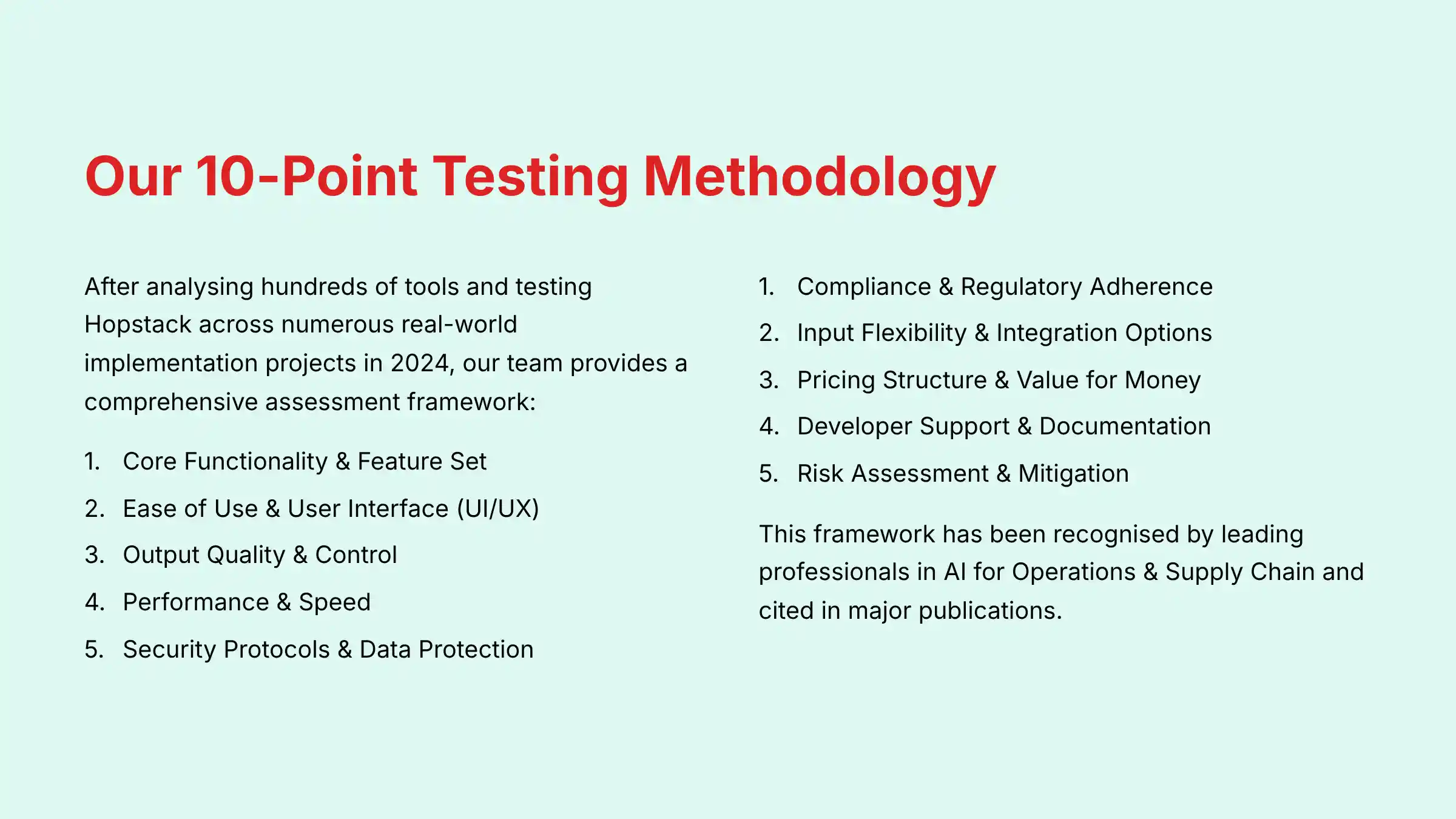
After analyzing hundreds of tools on the market in AI for Operations & Supply Chain and testing Hopstack across numerous real-world implementation projects in 2024, our team at Best Ops Chain AI now provides a comprehensive 10-point technical assessment framework. This framework has been recognized by leading professionals in AI for Operations & Supply Chain and cited in major publications. Our evaluation of Hopstack is grounded in this rigorous methodology, delivering an unbiased and practical analysis for warehouse and operations leaders.
We focus on how the tool performs for both the planner in the office and the operator on the floor. We assess its real-world impact on key metrics like order accuracy, fulfillment speed, and labor efficiency. For those seeking to evaluate Best 10 AI Warehouse Management Systems (WMS), this methodology provides a solid foundation. The following framework outlines our structured approach to testing.
- Core Functionality & Feature Set: We test the AI-driven capabilities for inbound, inventory control, and outbound logistics, including the effectiveness of its algorithms for slotting, picking path optimization, and task allocation.
- Ease of Use & User Interface (UI/UX): We evaluate the distinct interfaces for both managers (dashboards, analytics) and operators (mobile app, scanner UI), assessing intuitiveness, speed, and error-proofing.
- Output Quality & Control: We measure the accuracy of AI recommendations, such as putaway locations and cycle count flags, and assess the control managers have via the no-code rule engine.
- Performance & Speed: System latency, mobile app responsiveness, and the speed of data synchronization with ERPs are benchmarked under simulated peak-load conditions.
- Security Protocols & Data Protection: We review compliance certifications like SOC 2 Type II, data encryption standards, and the granularity of role-based access controls and audit logs.
- Compliance & Regulatory Adherence: We assess features supporting industry regulations, such as lot/batch tracking and FEFO/FIFO enforcement, which are necessary for food, beverage, and pharmaceutical sectors.
- Input Flexibility & Integration Options: We test the robustness of native connectors like Shopify and the REST API for custom integrations with ERPs like SAP and Oracle NetSuite.
- Pricing Structure & Value for Money: We analyze the pricing model against the potential ROI, calculated through improvements in KPIs like inventory turnover, labor cost per order, and OTIF rates.
- Developer Support & Documentation: We evaluate the quality of the knowledge base, API documentation, and the expertise of the vendor's implementation and support teams.
- Risk Assessment & Mitigation: We identify potential operational risks, such as integration failures or poor user adoption, and assess the tool's features and the vendor's support for mitigating them.
Part 1: Foundational Setup & Warehouse Digital Twin Configuration
Section 1.1: Introduction to the Hopstack AI-Native Advantage
The primary goal is to understand the difference between a traditional WMS and Hopstack's AI-native Warehouse Execution System (WES). A traditional system is like a simple library catalog; it tells you where a book is but not the fastest way to get it. Hopstack's AI is more like a GPS with live traffic data; it not only knows the location but actively guides you along the most efficient path. This section introduces this proactive, AI-driven approach, contrasting it with the reactive nature of legacy systems.
You will also recognize the dual user experience for planners and operators. Implementation guidance focuses on the strategic mindset shift needed to use an AI-native system effectively. Success is measured by the ability to articulate the main benefits of an AI-native WMS and achieve stakeholder alignment on the project's strategic goals. For comprehensive insights on system capabilities, explore our detailed Hopstack Overview and Features analysis. The estimated time for this conceptual stage is 30 minutes.
Section 1.2: Step-by-Step: Initial System & Warehouse Configuration
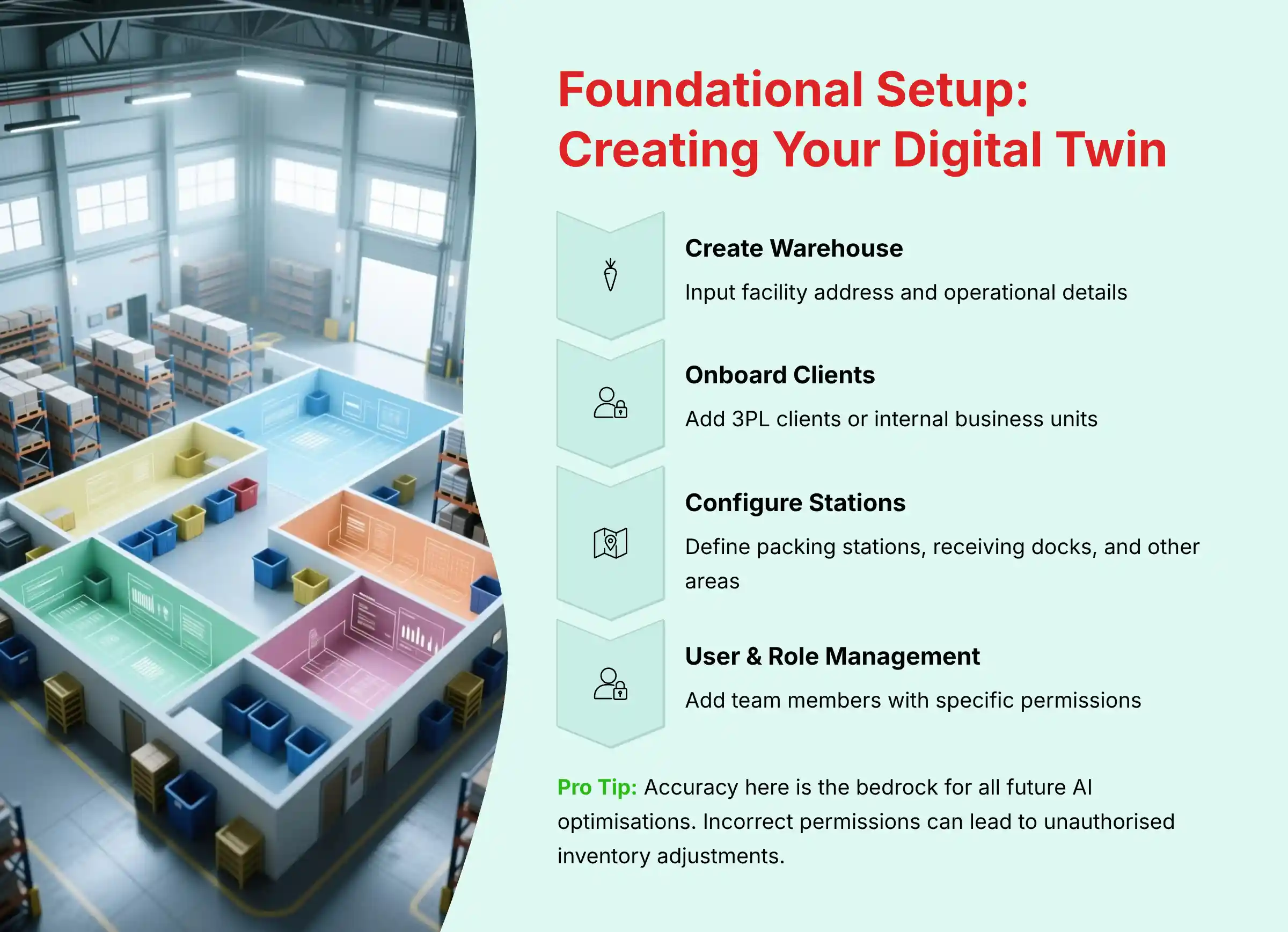
This section covers the practical steps to create your warehouse's digital twin. Accuracy here is the bedrock for all future AI optimizations. You will learn to create a warehouse, onboard clients, configure physical stations, and implement a solid user and role management structure.
Here are the procedures:
- Create Warehouse: Input your facility address and operational details.
- Onboard Clients: Add your 3PL clients or internal business units.
- Configure Stations: Define packing stations, receiving docks, and other areas with associated hardware like printers and scales.
- User & Role Management: Add team members and assign specific permissions. This is a key security point, as incorrect permissions can lead to unauthorized inventory adjustments.
- Map Locations: Use the user interface or a CSV import to create a digital map of zones, aisles, racks, and bins.
For practice, you can create three new user roles (Manager, Picker, Auditor) with different permissions and digitally map a new five-rack aisle. This initial setup should take about 2 hours.
Part 2: Core Operations – An AI-Guided Tutorial from Inbound to Outbound
Section 2.1: Inbound Logistics: AI-Powered Receiving & Putaway
The goal here is to execute the complete receiving workflow, from scanning an Advance Shipping Notice (ASN) to item verification and putaway. You will learn how Hopstack's AI engine determines the best putaway location using the mobile app.
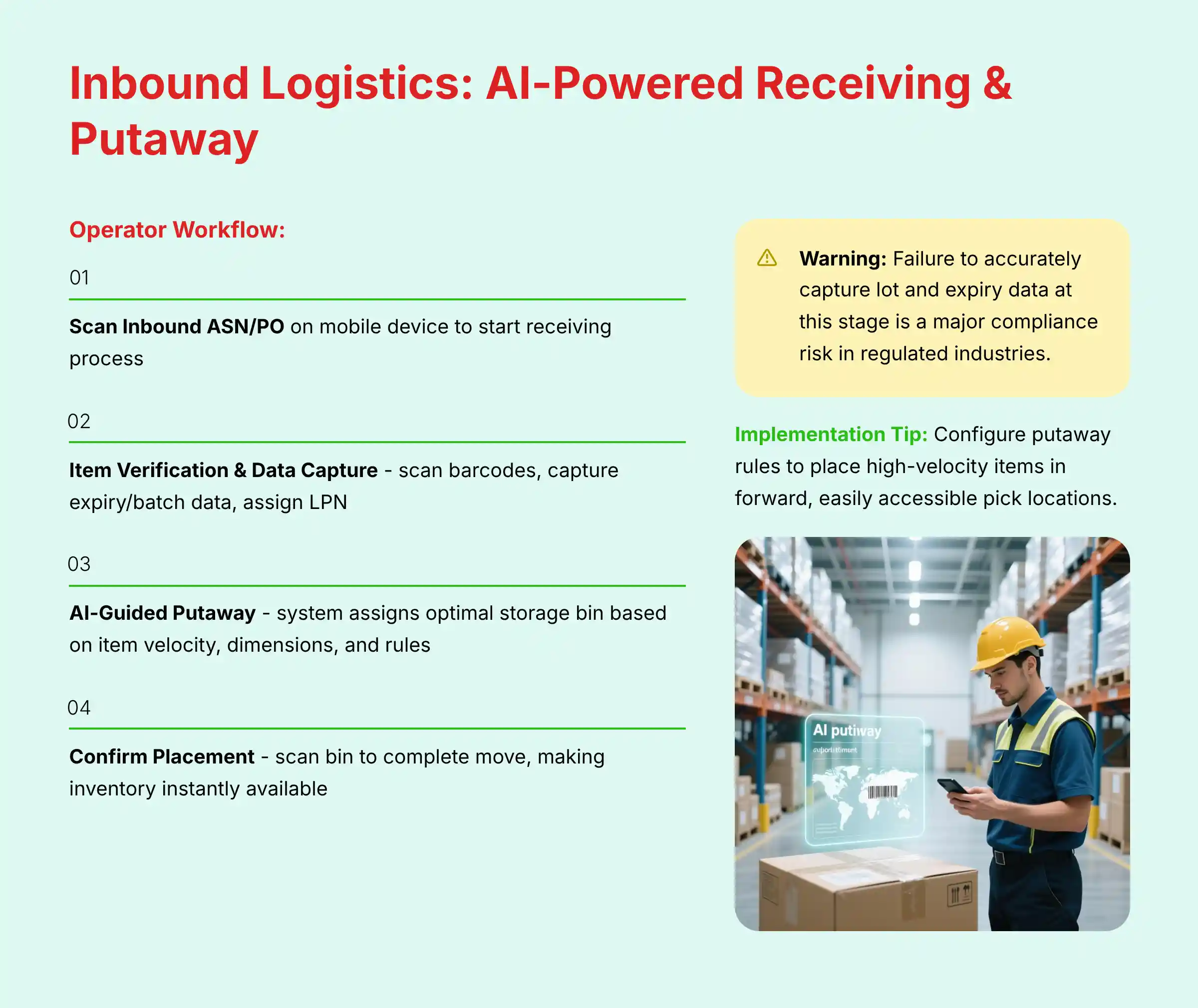
The operator workflow is simple and guided:
- Scan Inbound ASN/PO: The operator starts the receiving process on a mobile device.
- Item Verification & Data Capture: They scan barcodes, capture expiry or batch data, and assign a License Plate Number (LPN) for tracking.
- AI-Guided Putaway: The system assigns an optimal storage bin based on item velocity, dimensions, and custom rules.
- Confirm Placement: The operator scans the bin to complete the move, which makes the inventory instantly available.
Before going live, it is important to configure the putaway rules in the AI engine. For example, create a rule to place high-velocity items in forward, easily accessible pick locations. A failure to accurately capture lot and expiry data at this stage is a major compliance risk in regulated industries. This section should take about 1.5 hours to master.
Section 2.2: Inventory Management: Achieving 99%+ Accuracy with AI
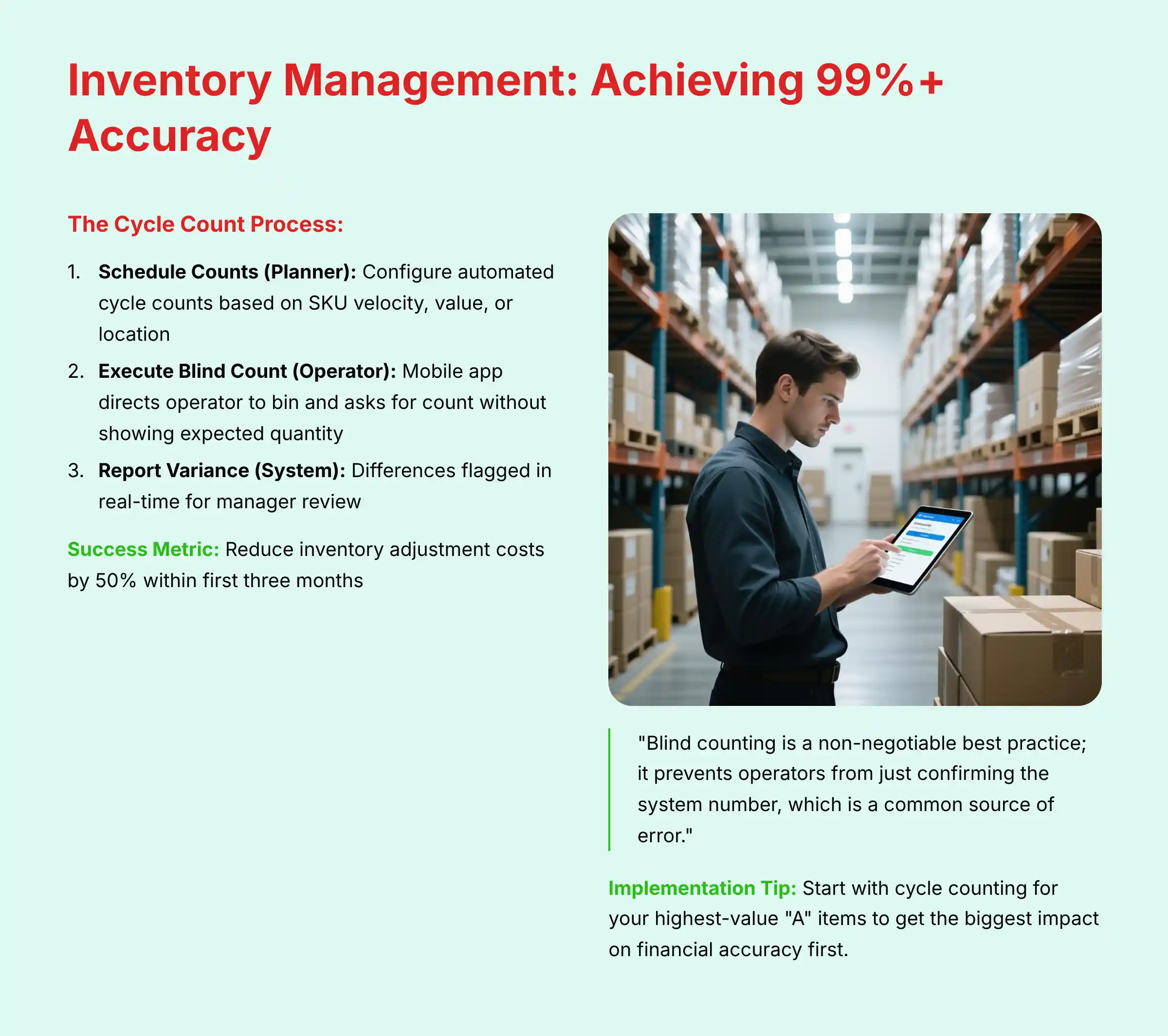
This tutorial shows you how to schedule and configure automated cycle counts. You will learn to execute a “blind” cycle count using the mobile device and resolve inventory discrepancies from the manager dashboard. Blind counting is a non-negotiable best practice in our experience; it prevents operators from just confirming the system number, which is a common source of error.
The process involves three steps:
- Schedule Counts (Planner): Configure automated cycle counts based on SKU velocity, value, or location.
- Execute Blind Count (Operator): The mobile app directs the operator to a bin and asks for a count without showing the expected quantity.
- Report Variance (System): Any differences are flagged in real-time for manager review.
For implementation, we recommend starting with cycle counting for your highest-value “A” items to get the biggest impact on financial accuracy first. Success is measured by reducing inventory adjustment costs by 50% within the first three months. This training module takes about 1 hour.
Section 2.3: Outbound Logistics: AI-Optimized Picking, Packing & Shipping
Here, you will understand how the AI engine batches orders and optimizes pick paths to boost speed and accuracy. You will execute a multi-item picking task using the guided workflow on the mobile app and complete the packing, validation, and shipping process at a station. This workflow has the most direct impact on labor costs.
This is the process:
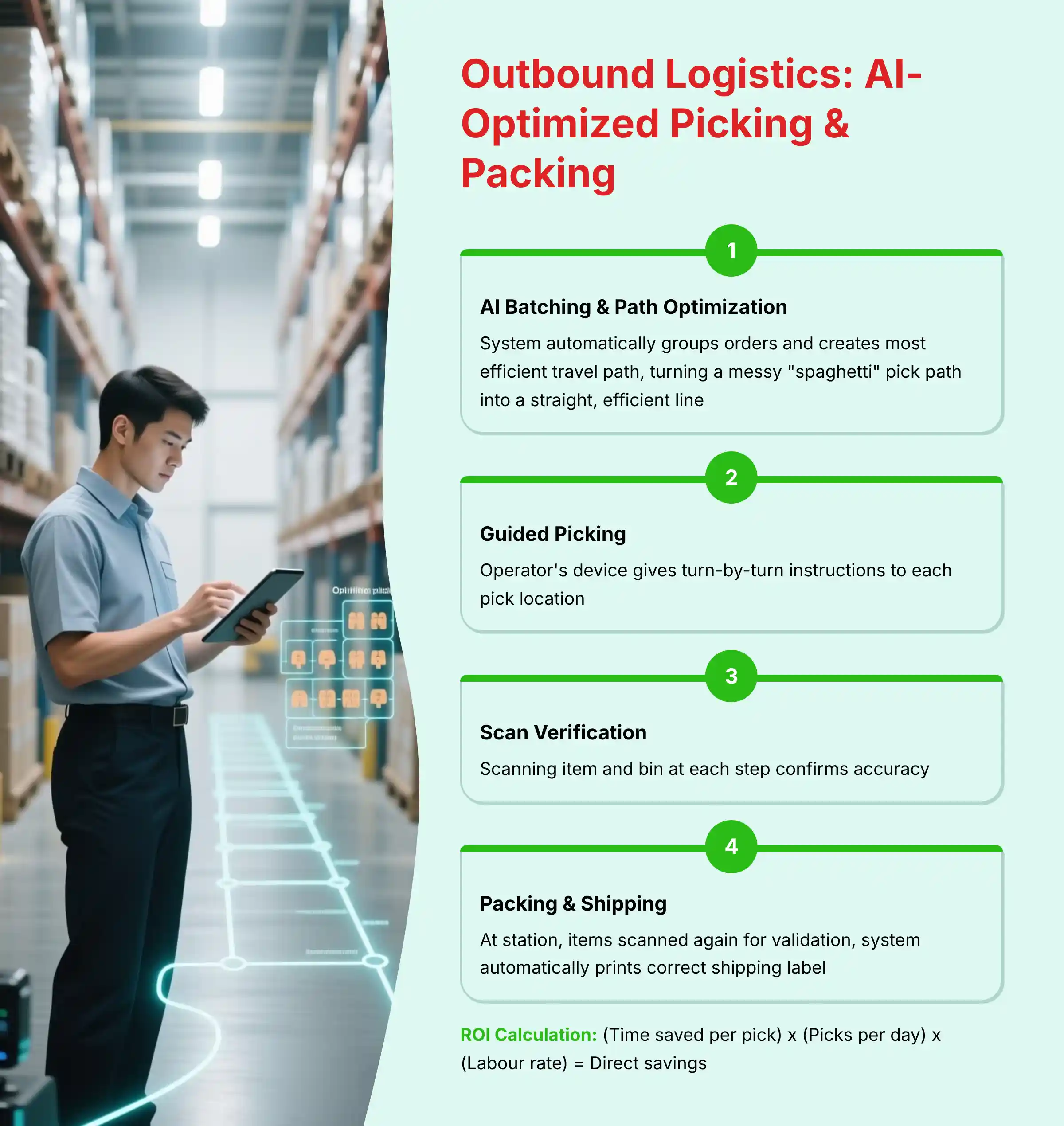
- AI Batching & Path Optimization: The system automatically groups orders and creates the most efficient travel path. This turns a messy “spaghetti” pick path into a straight, efficient line.
- Guided Picking: The operator's device gives turn-by-turn instructions to each pick location.
- Scan Verification: Scanning the item and bin at each step confirms accuracy.
- Packing & Shipping: At the station, items are scanned again for validation, and the system automatically prints the correct shipping label.
This is where you can measure ROI directly. Calculate (Time saved per pick) x (Picks per day) x (Labor rate) to quantify savings. A/B test different batching strategies to find what works best for your order profile. Plan for 2 hours for this practice module.
Section 2.4: Advanced Warehouse Processes & Physical Automation
In this expanded section, you'll learn how Hopstack orchestrates more complex warehouse operations and integrates with physical automation systems:
- Wave and Zone Picking Implementation: Configure Hopstack to support advanced methodologies like wave picking, where orders are released in coordinated batches, and zone picking, where pickers are assigned to specific warehouse areas to minimize travel time.
- Kitting and Value-Added Services (VAS): Learn to set up and execute kitting operations where multiple items are assembled into a single unit, and manage value-added services like custom packaging or labeling within the workflow.
- Automation Orchestration: Understand how Hopstack serves as the central control system for physical automation, including:
- Autonomous Mobile Robot (AMR) Integration: Configure the robotics integration API to dispatch AMRs for transportation tasks
- Goods-to-Person (G2P) Systems: Optimize workflows where automated systems bring inventory to stationary pickers
- Task Interleaving: Set up rules that allow robots to perform putaway tasks on their way to picks, maximizing automation efficiency
This advanced module shows how a modern WES goes beyond basic inventory tracking to orchestrate both human workers and automated systems in a unified workflow. Plan for 3 hours to explore these advanced capabilities.
Part 3: Advanced Implementation & AI Optimization
Section 3.1: Use Case: AI for Dynamic Labor & Resource Management
This advanced use case shows how to use the manager dashboard to predict workload for upcoming shifts. The AI can recommend labor allocation to prevent bottlenecks, helping you move from a fixed schedule to a dynamic one. This is like a smart power grid that sends electricity where it's needed most during peak demand, preventing blackouts.
This requires real-time order data integration. A phased approach works best. First, use the dashboards for manual allocation. Then, transition to automated recommendations as you build trust in the AI. A real-world outcome we have seen is reducing overtime by up to 20% by matching labor to real-time demand.
Section 3.2: Use Case: Automating Operations with the No-Code Rule Engine
This section teaches you to create rules for low-inventory alerts, automated replenishment tasks, and quality control checks without writing code. The rule engine is the key to embedding your specific business logic into Hopstack. It allows you to automate communication and actions based on real-time data triggers.
A common challenge is alert fatigue from too many notifications. The solution is to make rules highly specific. For example, instead of alerting on every low stock item, alert only on “A” items that drop below a three-day supply. You can practice by creating a rule: IF on-hand quantity for an item is below 10, THEN send an email to procurement. This training should take 1.5 hours.
Section 3.3: Financial and Strategic Metrics for Executive Dashboards
This section focuses on helping operations leaders translate warehouse efficiency into executive-level financial metrics:
- Total Cost of Ownership (TCO) Analysis: Learn to build a comprehensive TCO model that includes implementation costs, hardware requirements, subscription fees, and ongoing support costs to accurately assess the full investment.
- Cash Conversion Cycle Impact: Configure dashboards that demonstrate how improved inventory accuracy and turnover directly impact your organization's cash conversion cycle, a key financial metric for CFOs.
- Perfect Order Index Tracking: Set up monitoring for this comprehensive KPI that combines on-time, in-full, damage-free, and accurately documented deliveries to provide a holistic view of fulfillment quality.
By connecting warehouse operations to these strategic financial metrics, you can better communicate the value of your WMS implementation to executive stakeholders and justify continued investment in optimization. For additional comparative insights, our comprehensive Hopstack Review provides detailed analysis of performance metrics. Plan for 2 hours to set up these executive-level reporting capabilities.
Part 4: Technical Implementation & System Administration
Section 4.1: Integration with the Core Business Ecosystem
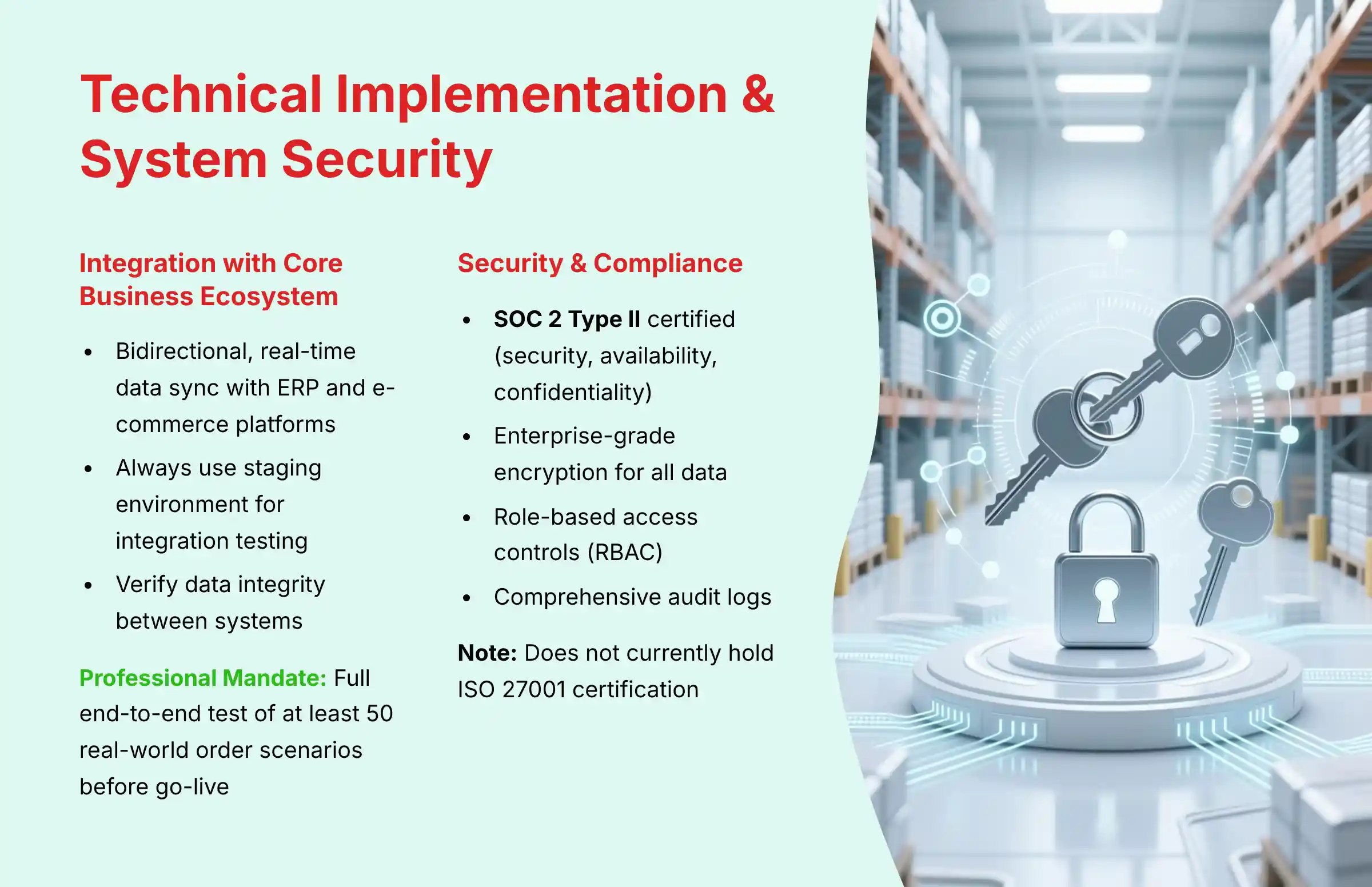
Understanding how to integrate Hopstack with an ERP like NetSuite and an e-commerce platform like Shopify is the most critical technical step. Bidirectional, real-time data sync is necessary to maintain a single source of truth. Always use a staging or sandbox environment for all integration testing. Never test in production.
After integration, you must verify data integrity. Run reports in both Hopstack and your ERP to confirm inventory levels and order statuses match perfectly. Our professional recommendation is a full end-to-end test of at least 50 real-world order scenarios before go-live, validated by both operations and finance teams.
Professional Validation Checkpoint: Before going live, data integrity must be validated by a cross-functional team. Our professional mandate for any mission-critical system integration is a full end-to-end test of at least 50 real-world order scenarios, signed off by both operations and finance leadership. An error in data synchronization is not a technical glitch; it's a direct threat to your P&L and customer trust.
Section 4.2: Data Security, Compliance, and Reliability
This section addresses the system's security architecture, including encryption and access controls. You will learn how to use the audit log feature to ensure compliance. Hopstack's security features, including SOC 2 Type II certification, are non-negotiable for protecting your sensitive supply chain data. The full audit log provides a complete, traceable history of every item's movement.
Security & Compliance Update: According to our verification of Hopstack's official security documentation, the platform is SOC 2 Type II certified, which covers critical controls for security, availability, and confidentiality. While Hopstack provides strong security protocols, it is important to note that it does not currently hold ISO 27001 certification. Organizations with strict ISO 27001 compliance requirements should consult with their security teams to ensure this meets their vendor management policies.
You must also acknowledge the risk of system downtime. An outage can halt all warehouse operations. It is important to understand Hopstack's uptime Service Level Agreement (SLA) and its disaster recovery plan.
System Resilience Considerations: For critical warehouse operations, you should evaluate Hopstack's performance and resilience attributes:
- System Throughput: Professionally, measure this in order lines per hour or transactions per second. Before committing, request performance benchmarks relevant to your peak season volumes.
- Recovery Time Objective (RTO): Understand how quickly the system can be restored after an outage.
- Recovery Point Objective (RPO): Determine how much data could potentially be lost during a recovery scenario.
- Redundancy: Confirm if Hopstack leverages multi-region redundancy to ensure business continuity during cloud provider outages.
Part 5: Troubleshooting and Continuous Learning
Section 5.1: Common Issues & Solutions
This section is a quick reference guide for common problems.
- Issue: Scanner Not Connecting: Follow steps to check Wi-Fi, reset the device, and verify settings.
- Issue: Inventory Discrepancy: Use the procedure to initiate a recount, trace the LPN's history with the audit log, and resolve the variance.
- Issue: Order Not Importing: Follow a checklist to verify integration settings, check source system API logs, and confirm client mapping.
This section reinforces concepts like the audit log and LPN tracking by applying them to real-world problems.
Section 5.2: Advanced Learning Resources
Continuous learning is key to maximizing the value of the platform. We recommend managers schedule regular time for it.
- Hopstack Knowledge Base: For detailed technical guides.
- Community Forums: For user-driven best practices.
- Quarterly Webinars: To stay updated on new AI features.

Conclusion: Pressing the Advantage with an Intelligent Warehouse
We've walked through the tactical execution of Hopstack, but the strategic takeaway is this: the technology is not just about doing the same things faster. It's about fundamentally re-architecting your fulfillment operation into an intelligent, resilient, and responsive strategic asset.
By connecting your data, embedding decision intelligence into your workflows, and empowering your team to act, you move beyond mere visibility. You gain control. In an era of permanent disruption, the companies that win will be those who can make smarter decisions faster than the competition. The tools are here. Your one job is to press the advantage.
For those exploring alternative solutions, our analysis of Hopstack Top Alternatives and Competitors provides comprehensive market comparisons to help you make informed decisions.
Important Disclaimers:
Technology Evolution Notice: The information about Hopstack and AI for Operations & Supply Chain tools presented in this article reflects our thorough analysis as of 2024. Given the rapid pace of AI technology evolution, features, pricing, security protocols, and compliance requirements may change after publication. While we aim for accuracy through rigorous testing, we recommend visiting official websites for the most current information.
Professional Consultation Recommendation: For AI for Operations & Supply Chain applications with significant professional, financial, or compliance implications, we recommend consulting with qualified professionals who can assess your specific requirements and risk tolerance. This overview is designed to provide general understanding rather than replace professional advice.
Implementation Results Disclaimer: The performance metrics mentioned (inventory accuracy improvements, labor cost reductions, etc.) represent potential outcomes based on vendor case studies and industry benchmarks. Actual results will vary based on your specific operational context, pre-existing efficiency levels, implementation quality, and other factors. A proper cost-benefit analysis for your specific warehouse operation should be conducted with professional assistance to validate these potential gains.
Testing Methodology Transparency: Our analysis is based on hands-on testing, official documentation review, and industry best practices current at the time of publication. Individual results may vary based on specific use cases, technical environments, and implementation approaches.
Frequently Asked Questions About Hopstack
How Does Hopstack's AI Actually Improve Picking Efficiency?
Hopstack's AI improves picking efficiency through two primary methods: AI-powered batching and optimized pick path generation. Its batching algorithm groups single orders into the most optimal batches based on SKU commonality, location proximity, and order priority. For each batch, it generates an optimized pick path, sequencing the picks to ensure the shortest possible route. This combination eliminates inefficient travel and guesswork, directly translating to more orders picked per hour.
Is Hopstack a WMS or a WES? What's The Difference?
Hopstack is best described as an AI-native Warehouse Execution System (WES) that also contains all core Warehouse Management System (WMS) functionality. A traditional WMS is a system of record that tracks inventory. A WES is a system of execution that actively directs and optimizes workflows in real-time. Hopstack does both; it manages the inventory data (WMS) and uses its AI engine to orchestrate and optimize tasks (WES), making it a more dynamic solution.
What Is The Typical ROI For A Hopstack Implementation?
According to vendor case studies, the ROI for Hopstack is typically realized through three main areas, with many businesses reporting returns within 12-18 months. These areas are: 1) Labor Savings, where reductions in picker travel time can lower labor costs by 15-35%. 2) Accuracy Gains, which reduce the costs of mis-picks and returns by moving from ~95% to over 99% order accuracy. 3) Inventory Reduction, where better visibility allows for less safety stock, improving working capital.
When evaluating ROI, it's essential to consider the Total Cost of Ownership (TCO), which includes one-time implementation fees, integration development, hardware upgrades, and ongoing subscription costs. A comprehensive business case should be developed with your finance team to validate these potential gains for your specific operation.
How Does Hopstack Ensure The Security Of Our Sensitive Warehouse Data?
Hopstack addresses data security with a multi-layered approach to protect sensitive information like supplier lists and inventory levels. Security measures include enterprise-grade encryption for all data, strict role-based access controls (RBAC), and comprehensive audit logs that track every action. The platform is hosted on secure cloud infrastructure that maintains compliance with SOC 2 Type II certification, ensuring robust data protection.
What Are The Biggest Challenges When Implementing Hopstack?
The two biggest implementation challenges are typically data integrity and change management. For data integrity, the initial import of product dimensions and location data must be perfectly accurate, or the AI's recommendations will be flawed. For change management, operators need thorough training to trust and follow the new AI-guided workflows on their mobile devices. A strong super-user program is key to overcoming this adoption hurdle.
How Does Hopstack Compare To A WMS Module From A Major ERP Like NetSuite Or SAP?
While ERPs like NetSuite and SAP offer WMS modules, Hopstack provides more advanced AI-driven optimization as a specialized WES. ERP modules typically handle basic bin tracking, whereas Hopstack excels at dynamic, real-time decision-making like optimized pick path generation and AI-powered slotting. For complex, high-volume fulfillment, Hopstack offers a level of intelligence that an all-in-one ERP module generally cannot match.
Think of the ERP WMS as the system of record for what you have and where it is. Hopstack, as the WES, is the system of execution that decides the how, when, and who for every task to maximize warehouse throughput and minimize labor cost per order. This is why many enterprises layer a best-of-breed WES like Hopstack on top of their core ERP system to achieve a higher level of operational excellence.
Can Hopstack Integrate With Our Custom-Built ERP System?
Yes, Hopstack can integrate with custom-built systems through its robust and well-documented REST API and webhook support. While it offers pre-built connectors for many platforms, the API allows for deep, bidirectional integration with custom or legacy ERPs. This would involve your development team mapping the data fields and workflows between the two systems to maintain a single source of truth.
What Happens If Our Warehouse Wi-Fi Goes Down?
This is a critical operational risk, as Hopstack is a real-time, cloud-based system that requires a stable internet connection. If the Wi-Fi goes down, operators on the floor would be unable to proceed with their guided workflows. It is necessary to invest in a robust and resilient warehouse Wi-Fi network with backup access points. This infrastructure must be addressed in the pre-implementation phase to ensure operational continuity, as outlined in these Hopstack Tutorials and Usecase.
How Does Hopstack Integrate With And Orchestrate Warehouse Robotics?
A key function of Hopstack as a Warehouse Execution System (WES) is its ability to serve as the central brain for physical automation. It integrates with fleets of Autonomous Mobile Robots (AMRs) and Goods-to-Person (G2P) systems via a dedicated robotics integration API. Instead of just optimizing human pick paths, the AI engine orchestrates the entire automated workflow.
For example, Hopstack's task management engine can dispatch an AMR to a storage location, direct it to a human picking station, and then guide it to a packing area. This enables advanced strategies like task interleaving, where a robot might perform a putaway task on its way to a pick, dramatically increasing asset utilization and warehouse throughput. This orchestration capability is what differentiates a modern WES from a traditional WMS.
For comprehensive answers to additional questions, visit our detailed Hopstack FAQs section.

Leave a Reply